Court No. VI, Case No. VI.
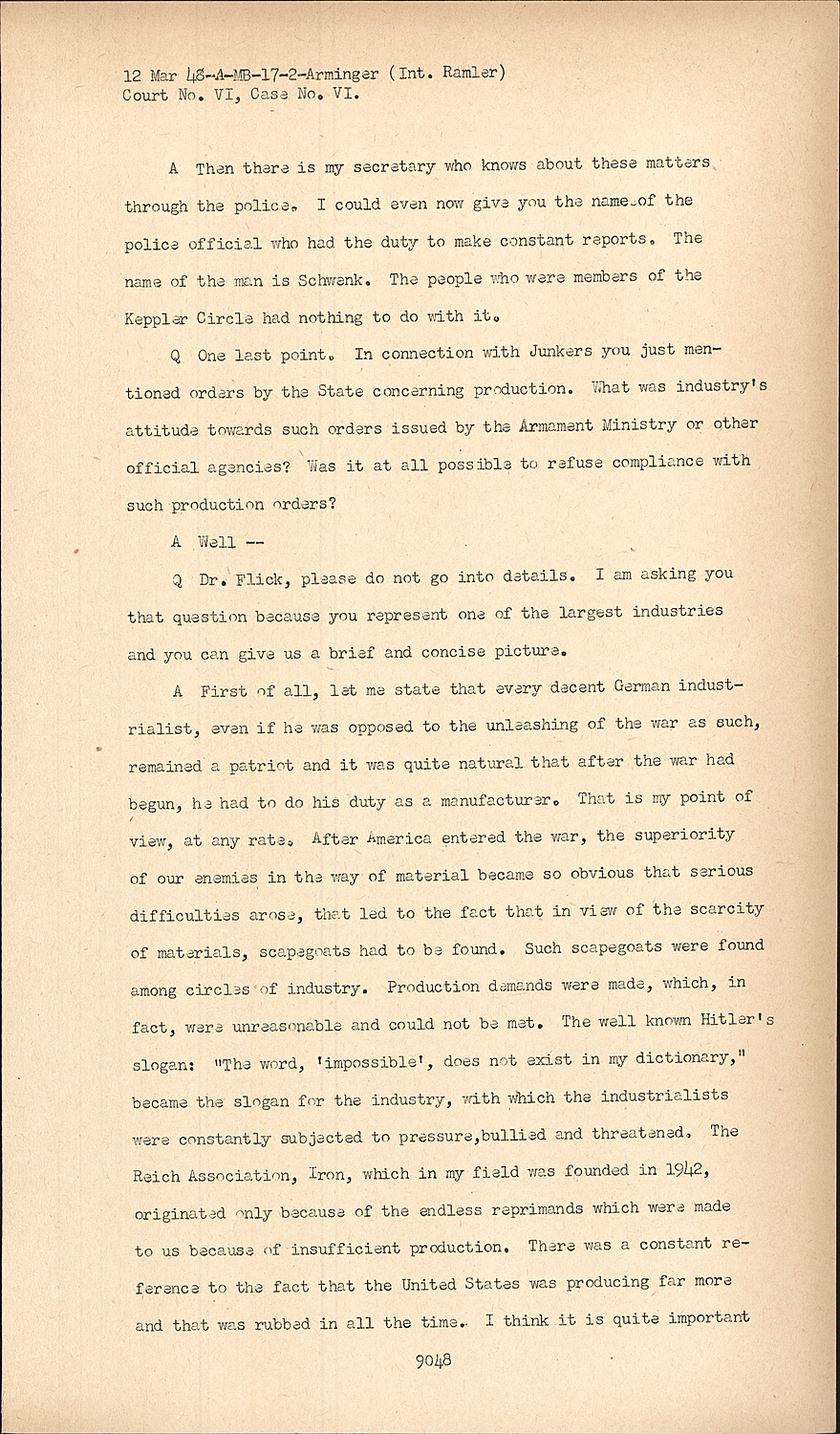
AThen there is my secretary who knows about these matters through the police. I could even now give you the name of the police official who had the duty to make constant reports. The name of the man is Schwenk. The people who were members of the Keppler Circle had nothing to do with it.
QOne last point. In connection with Junkers you just mentioned orders by the State concerning production. What was industry's attitude towards such orders issued by the Armament Ministry or other official agencies? Was it at all possible to refuse compliance with such production orders?
AWell -
QDr. Flick, please do not go into details. I am asking you that question because you represent one of the largest industries and you can give us a brief and concise picture.
AFirst of all, let me state that every decent German industrialist, even if he was opposed to the unleashing of the war as such, remained a patriot and it was quite natural that after the war had begun, he had to do his duty as a manufacturer. That is my point of view, at any rate. After America entered the war, the superiority of our enemies in the way of material became so obvious that serious difficulties arose, that led to the fact that in view of the scarcity of materials, scapegoats had to be found. Such scapegoats were found among circles of industry. Production demands were made, which, in fact, were unreasonable and could not be met. The well known Hitler's slogan: "The word, 'impossible', does not exist in my dictionary," became the slogan for the industry, with which the industrialists were constantly subjected to pressure, bullied and threatened. The Reich Association, Iron, which in my field was founded in 1942, originated only because of the endless reprimands which were made to us because of insufficient production. There was a constant reference to the fact that the United States was producing far more and that was rubbed in all the time. I think it is quite important Court No. VI, Case No. VI.
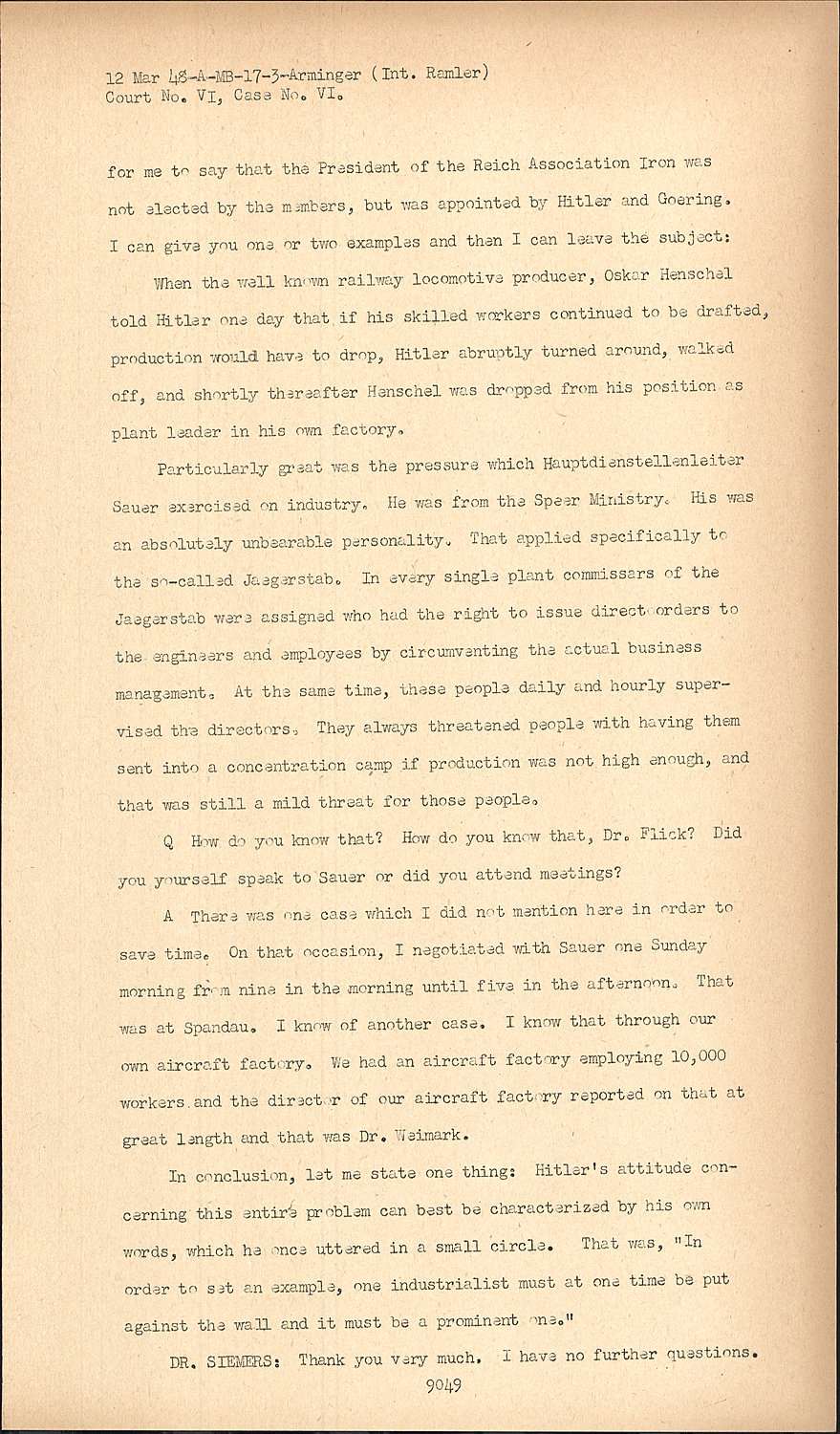
for me to say that the President of the Reich Association Iron was not elected by the members, but was appointed by Hitler and Goering. I can give you one or two examples and then I can leave the subject:
When the wall known railway locomotive producer, Oskar Henschel told Hitler one day that if his skilled workers continued to be drafted, production would have to drop, Hitler abruptly turned around, walked off, and shortly thereafter Henschel was dropped from his position as plant leader in his own factory.
Particularly great was the pressure which Hauptdienstellenleiter Sauer exercised on industry. He was from the Speer Ministry. His was an absolutely unbearable personality. That applied specifically to the so-called Jaegerstab. In every single plant commissars of the Jaegerstab were assigned who had the right to issue direct orders to the engineers and employees by circumventing the actual business management. At the same time, these people daily and hourly supervised the directors. They always threatened people with having them sent into a concentration camp if production was not high enough, and that was still a mild threat for those people.
QHow do you know that? How do you know that, Dr. Flick? Did you yourself speak to Sauer or did you attend meetings?
AThere was one case which I did not mention here in order to save time. On that occasion, I negotiated with Sauer one Sunday morning from nine in the morning until five in the afternoon. That was at Spandau. I know of another case. I know that through our own aircraft factory. We had an aircraft factory employing 10,000 workers and the director of our aircraft factory reported on that at great length and that was Dr. Weimark.
In conclusion, let me state one thing: Hitler's attitude concerning this entire problem can best be characterized by his own words, which he once uttered in a small circle. That was, "In order to set an example, one industrialist must at one time be put against the wall and it must be a prominent one."
DR. SIEMERS:Thank you very much. I have no further questions.
Court No. VI, Case No. VI.
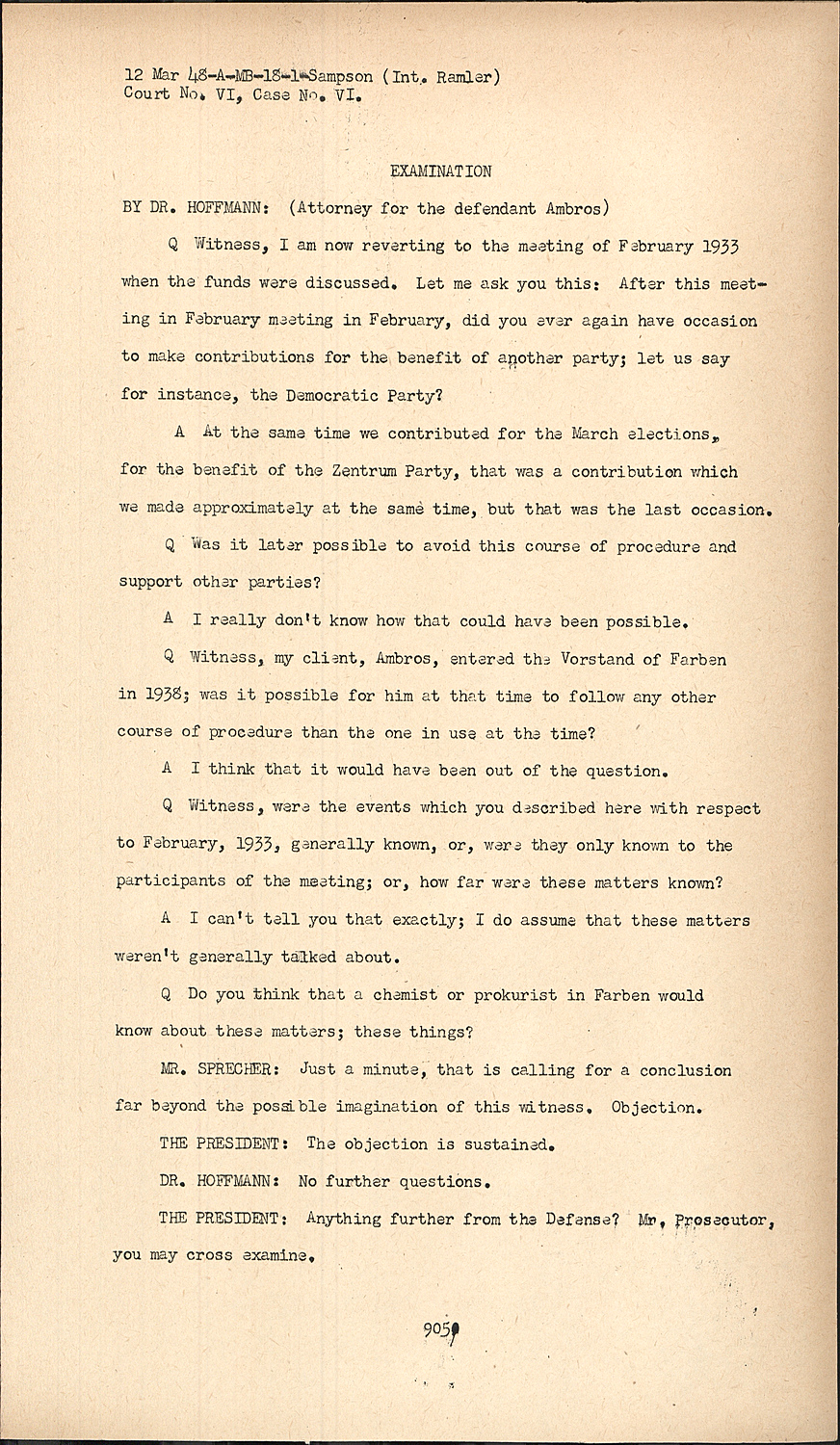
EXAMINATION BY DR. HOFFMANN: (Attorney for the defendant Ambros)
QWitness, I am now reverting to the meeting of February 1933 when the funds were discussed. Let me ask you this: After this meeting in February meeting in February, did you ever again have occasion to make contributions for the benefit of another party; let us say for instance, the Democratic Party?
AAt the same time we contributed for the March elections, for the benefit of the Zentrum Party, that was a contribution which we made approximately at the same time, but that was the last occasion.
QWas it later possible to avoid this course of procedure and support other parties?
AI really don't know how that could have been possible.
QWitness, my client, Ambros, entered the Vorstand of Farben in 1938; was it possible for him at that time to follow any other course of procedure than the one in use at the time?
AI think that it would have been out of the question.
QWitness, were the events which you described here with respect to February, 1933, generally known, or, were they only known to the participants of the meeting; or, how far were these matters known?
AI can't tell you that exactly; I do assume that these matters weren't generally talked about.
QDo you think that a chemist or prokurist in Farben would know about these matters; these things?
MR. SPRECHER:Just a minute, that is calling for a conclusion far beyond the possible imagination of this witness. Objection.
THE PRESIDENT:The objection is sustained.
DR. HOFFMANN:No further questions.
THE PRESIDENT:Anything further from the Defense? Mr. Prosecutor, you may cross examine.
Court No. VI, Case No. VI.
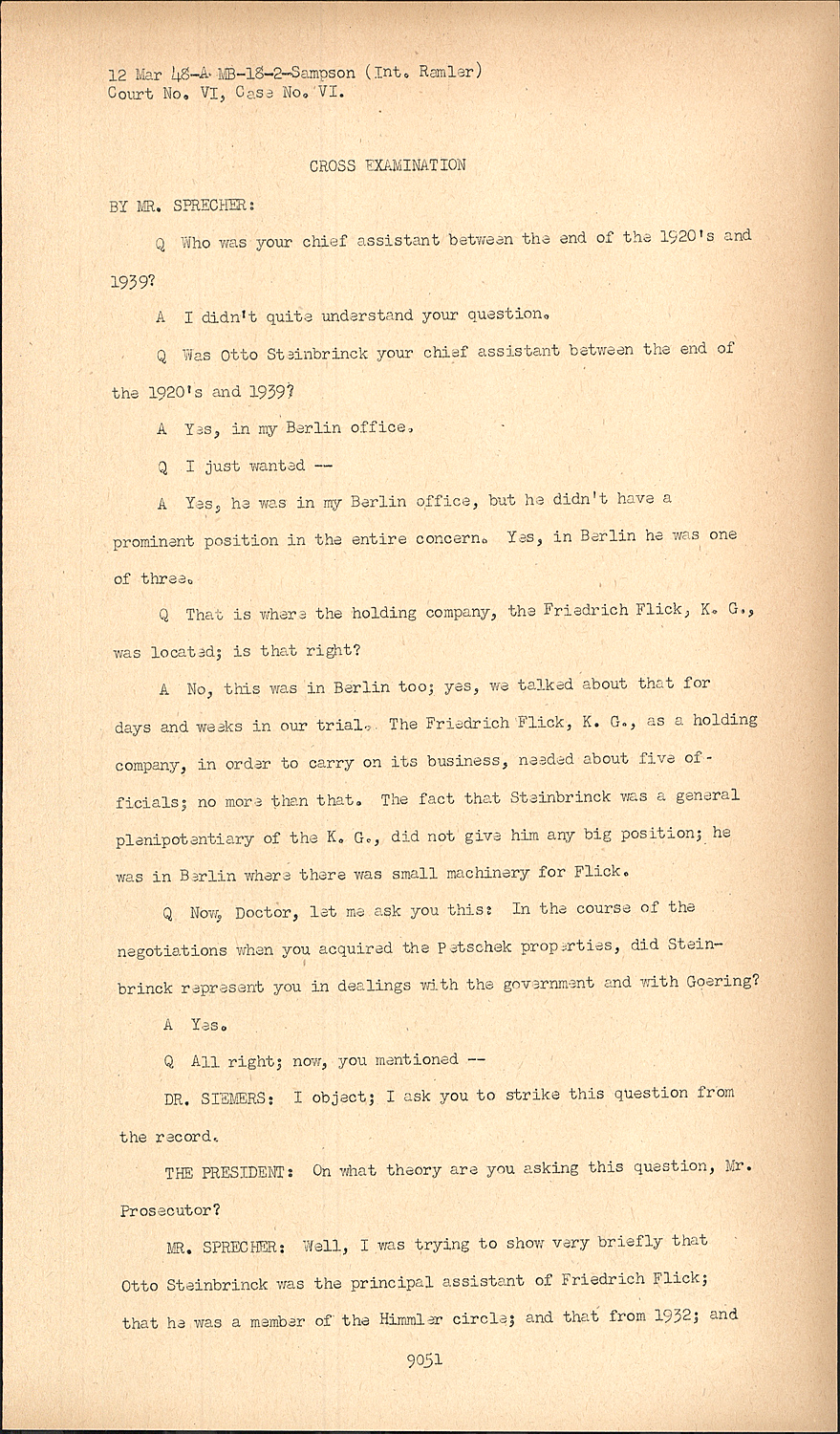
CROSS EXAMINATION BY MR. SPRECHER:
QWho was your chief assistant between the end of the 1920's and 1939?
AI didn't quite understand your question.
QWas Otto Steinbrinck your chief assistant between the end of the 1920's and 1939?
AYes, in my Berlin office.
QI just wanted -
AYes, he was in my Berlin office, but he didn't have a prominent position in the entire concern. Yes, in Berlin he was one of three.
QThat is where the holding company, the Friedrich Flick, K. G., was located; is that right?
ANo, this was in Berlin too; yes, we talked about that for days and weeks in our trial. The Friedrich Flick, K. G., as a holding company, in order to carry on its business, needed about five officials; no more than that. The fact that Steinbrinck was a general plenipotentiary of the K. G., did not give him any big position; he was in Berlin where there was small machinery for Flick.
QNow, Doctor, let me ask you this: In the course of the negotiations when you acquired the Petschek properties, did Steinbrinck represent you in dealings with the government and with Goering?
AYes.
QAll right; now, you mentioned -
DR. SIEMERS:I object; I ask you to strike this question from the record.
THE PRESIDENT:On what theory are you asking this question, Mr. Prosecutor?
MR. SPRECHER:Well, I was trying to show very briefly that Otto Steinbrinck was the principal assistant of Friedrich Flick; that he was a member of the Himmler circle; and that from 1932; and Court No. VI, Case No. VI.
that Friedrich Flick had around him as his next man a man very close to the party.
THE PRESIDENT:He so testified; there is no issued about that.
MR. SPRECHER:Well, the only question was the importance of Steinbrinck in relation to the witness.
THE PRESIDENT:What materiality would that have? We are neither trying Dr. Flick or Mr. Steinbrinck, and he has pretty fully told his relationship with the government and the party and also covered Mr. Steinbrinck's relationship to himself and to the party and government.
MR. SPRECHER:Mr. President, if I chose, say, as my second man, that is to say in that close connection with the party leadership and then at the same time testify that I have had great difficulties because of the oppression of the party, it seems to me that there is something in the nature of an inconsistency.
THE PRESIDENT:The Tribunal does not feel that that would be worth the time to ask the question and have it answered.
The objection is sustained. BY MR. SPRECHER:
QIsn't it true that when Wilhelm Keppler came to see you in 1932, at a time when Wilhelm Keppler was the economic advisor to Hitler, that he was sent to see Steinbrinck; is that true or not true?
AI didn't send him to see Steinbrinck.
QWere you present when he was sent to Steinbrinck by Voegler?
ANo.
QDid you talk to any of the other industrialists who came to the 20th February, 1933, meeting as to whether or not they received a telegram from Goering which was similar to the one you received?
ANo, I don't remember that.
QI show you Document No. D-201, which will become Prosecution Exhibit 1995. I ask you if this is -- has the same text as the telegram you received from Goering in connection with that meeting?
Court No. VI, Case No. VI.
AI can't say; I don't remember that in the telegram which I received a speech of Hitler's was mentioned; I just don't remember.
QNow, on 24th March, 1933, the Enabling Act of the so-called Law for the Alleviation of German People was passed in the Reichstag. Did the three parties which contributed, or, which were to receive contributions from the collections taken, after the 20th February 1933 meeting, did they vote for that Enabling Act?
THE PRESIDENT:Just a moment.
DR. SIEMERS:One minute, Dr. Flick. I object, Your Honor; these are fields which were not touched upon during my examination. I don't really have anything against the Prosecution talking about the general policy, but in view of the time which would be burdened against me, I want to object to this question.
THE PRESIDENT:That is too remote to be of any value in this case. The objection is sustained. BY MR. SPRECHER:
QHad you or your firm, to your knowledge, made contributions to the NSDAP before the meeting of the 20th of February, 1933?
AI testified on that during my trial. There were smaller contributions to the SA, SS and Stahlhelm and similar organizations. We did that in order to live in peace, but that didn't actually mean a support of the National Socialist policy.
QThank you, that will do; that will do. This is just a small question that goes to the credibility; Doctor, can you -- I want to ask you about this: Dr. Schnitzler has indicated in an exhibit before this Tribunal, Prosecution Exhibit 36, that it was Stein who made the suggestion that some payments also go to this little Volkspartei. Do you have any distinct recollection as to whether or not it was Schnitzler or Stein who made such a suggestion?
AAs far as I remember, both gentlemen said that, but I am quite sure that Schnitzler said it; perhaps both, but I am quite Court No. VI, Case No. VI.
sure about Schnitzler; I remember that he made that suggestion. I said that I stood next to Schnitzler at the time.
Q.Now, Goering was the head of the Four Year Plan; did he oppose the growth of your concern?
A.I can't say that; I didn't speak about the expansion of concerns as such, but in connection with Funk I spoke of the stoppage of any expansion during the war.
Q.Now, just a minute; just a minute. Now, I wasn't asking about Funk; I was asking about Goering.
A.The growth of the concern was not opposed by Goering, but at that time, at the time about which we are speaking now, the concern no longer grew. The growth really came about through buying of shares, fusions, affiliations, etc.
Q.Is it fair to say that the fear of economic loss, to speak of yourself, led to your making concessions to Nazi wishes which you otherwise would not have made?
A.I didn't quite understand what you meant about loss........
Q.Speaking of your own case, for I am sure you have good knowledge of it, did the fears of economic loss on your own part lead to your making concessions to the Third Reich, the leaders of the Third Reich?
A.I don't know what I have to understand by losses; what do you mean by losses?
Q.Did you fear any economic loss if you did not take a leading part in the Third Reich as an industrialist?
THE PRESIDET:Mr. Witness, I don't knew how it gets to you on the translation, but I think what the prosecutor is trying to convey to you is this: Did you cooperate with the government and the party because you were afraid that your property would be taken away from you if yo did not cooperate? Is that a fair statement of what you are driving at there, Mr. Prosecutor?
MR. SPRECHER:Yes.
A.It is impossible to express it so generally, moreover I contest the fact. There was no mention of any cooperation. That I cooperated with National Socialism in the first years, I was observed and suspected.
It is being stated here that if as if it was a matter of course, but I object to that sort of statement. Naturally every industrialist is afraid of losses -- not only in Germany but throughout the world. BY MR. SPRECHER:
Q.Now, in this case of Professor Junkers, did you yourself hear from General Milch that Professor Junkers was very well paid for the plant when he stepped out the Junkers concern?
A.Very well paid?
Q.Yes.
A.I can't tell you what he got, but you can rely upon at that he didn't sell voluntarily. I knew something about the Junkers question at the time. If was in contact with that question because I was to act as some sort of economic export. Let me repeat here that according to information I received the negotiations were carried out in the way I described them.
Q.Just a minute -
A.In the very same room, not at the same table, but a prosecutor was sitting there -
Q.Just a second -
A.I think that that is very important when you come to judging that question.
Q.I will ask the question, and I will ask that if the answers are not responsive, I will ask the Tribunal to interfere. I asked you whether you heard from General Milch, when you were present and General Milch was talking, that Professor Junkers was well paid. Now, if you didn't hear it, just say you didn't hear it.
THE PRESIDENT:Mr. Prosecutor, as we understand the witness, he was testifying to the point that the property was taken away because of the coercive conduct of the government. If that was true, and if it was forcibly taken, the question whether it was paid for afterwards wouldn't be very important. The man who steals jay property is not going to make the act lawful by coming around afterwards and paying for the property he has stolen.
That is hardly an answer to the question. BY MR. SPRECHER:
Q.You mentioned a Vostand member who was executed for some reason or other. Who was that person?
A.Mining Director Riecken.
Q.Do you know what he was executed for?
A.Because of an allegedly defeatist remark he had made; that was made in the circle of the staff of his close associates.
Q.You mentioned one of your mining formen was sentenced for many years; what was he sentenced for?
A.As I said, he was sentenced for the same reason. He was also mining director, Knautz.
Q.Did he make some remark against the regime or something? What was the nature of the remark he made?
A.Yes, I can tell you that. That was in 1943 when Mussolini resigned; there were difficulties in Italy, and he made some remark to the effect that the war wasn't going very well, and he was still lucky that he got away with a long prison term.
Q.Do you know the name -- when was the other Vorstand member executed that you mentioned; when was that?
A.I only mentioned one as far as execution is concerned, didn't I?
Q.Yes.
A.I only mentioned one.
Q.When was he executed?
A.Well, I wasn't present; I think it was in 1943 or 1944. At any rate, it was before the end of 1944.
Q.Now, didn't you get a little gift from Himmler in 1944 along with other members of the Himmler circle?
A.What did I get from Himmler?
Q. AGift.
A.A gift? Really I can't say. From the Porcelain factory in Allach I received some sort of a figurine; I think you can buy that for twenty-five marks in any shop; I remember that.
Q.Well, assume it was only ten pfennigs, you accepted, it knowing it was from Himmler, didn't you?
A.Yes, the package arrived and I assume with certainty that Himmler's address was on the left-hand top corner of the package; I assume that. I can't tell you -
Q.Now, your gifts to Himmler were somewhat larger.
A.Yes, much larger, one hundred thousand marks a year.
Q.Now, did you get any -
A.But it wasn't a gift.
Q.Did you get any reprimand in the circle of friends at any time, from Mr. Himmler, after this alleged occasion when Himmler's physician told you that Himmler was going to have you sent to a concentration camp as an international capitalist; did Kranefuse or Himmler mention that to you in the meetings of the Himmler Circle of 1940?
A.After I know of that; do you mean?
Q.Yes.
A.After I know.
Q.Yes.
A.Well, if Himmler had known that his personal physician had to me about that, something serious would have happened, but I can explain the circumstances to you under which this personal physician told me about that.
Q.Just a second -
A.It is very important.
Q.I was asking you -
A.I think they are of great significance.
THE PRESIDEIT: Mr. Witness, the Prosecutor is a judge of when he has elicited sufficient information, but I may say to you that Counsel who is responsible for having you here will be privileged to go into re-direct examination to bring out any details that he thinks you have not had an opportunity to tell, and which he thinks are competent and important; so, he contented with answering the Prosecutor's questions and leave it to Dr. Siemers.
MR. SPRECHER:I will rephrase the question just to be sure it is clear, and then you can object. I will rephrase the question. I shall rephrase the question and then you can object.
Q.Did Kimmler, Keppler or Kranofuss after 1940 ever tell you about what Himmler allegedly said to Himmler's doctor?
A.I didn't get the question.
Q.You testified that Himmler's doctor made this statement to you, about the fact that Kimmler had ordered that you were to go to a concentration camp us an international capitalist, is that right?
A.Yes, his personal physician told me that.
Q.Now, after the personal physician of Himmler told you that, was that or something to that effect repeated to you at any time in the Himmler circle thereafter by either Himmle, Keppler or Kranefuss?
A.No, neither before nor afterwards.
Q.Thank you.
A.They didn't tell me that.
Q.Thank you, that is answered.
A.They usually didn't give you notice beforehand if they wanted to put you into jail.
Q.And you never did got to jail under the Nazis, did you?
A.No.
Q.Thank you.
A.Not up to 1945. I was never imprisoned in my life.
MR. SPRECHER:No further questions.
THE PRESIDENT:Any further examination on behalf of the defense? Dr. Scimers, I feel obligated to remind you that the field of your inquiry now is Very, very narros and doesn't lead very far.
REDIRECT EXAMINATION BY DR. SIEMERS:
Q.Dr. Flick, in order to clarify this case of the man Riecken, you said that he made some defeatist remarks. Do you still remember that.
Riecken said? Did he doubt Germany's victory, or what?
A.The concept "defeatist remark" went very far. I was told that his remark was that it was very difficult to cope with the Communists, but "let's hope that we will be able to cope with the national Socialists." That is what I was told.
Q.You were asked by Mr. Sprecher whether you gave Himmler a gift. He meant whether you gave him a larger gift than the one you received from him. You said, "Yes, but it wasn't a gift." Would you please elucidate on this point?
A.These were the payments to the Peppier Circle, which was later called Himmler's Circle of Friends. These weren't any contributions to Himmler or to the SS. We were asked to make them and the express reason was given that we had to do that in order to satisfy Himmler's hobbies in the field of research work of the old Germanic culture. He wanted to make excavations in places of ancient civilization in order to maintain the antiquities of the German nation. This was the only reason given. Perhaps some social-welfare considerations were mentioned later, but at any rate, these were the reasons by which the contributions were asked for, were given, and theuse of these contributions was currently demonstrated to us by showing us films, by asking us to inspect those sites, the Quedlinburg Cathedral, the Lueneburger Heide, Wewelsburg, did all these numerous sites where such excavations and works and cultural research were taking place.
Q.I think that will suffice. It further becomes apparent from the judgment of the Military Tribunal on your trial. One last question. You were asked about a telegram by Mr. Sprecher. You said you didn't discuss it with others. Didn't you speak to Dr. Tengelmann, who was present, who came from the mining association?
A.No. At the time, Tengelmann wasn't general director of Essener Steinkohle, but director of Gelsenkirchen. At the time, I had no professional contact with him at all, that was only later in 1936.
Q.Then it was merely an assumption on your part when you stated during directexamination that you thought that the others also received telegrams?
A.Yes.
DR. SIEMERS:Just to clarify one more point, in relation to the contributions, Dr. Dix will be kind enough to ask some questions of Flick, because he knows far more about that matter than I.
DR. DIX:Your Honors, the questions put by Mr. Sprecher concerning that point were only aimed at the credibility or lack of credibility of the witness, and that is why I am putting my questions now. BY DR. DIX:
Q.Mr. Flick, you said when asked by Mr. Sprecher that you already contributed small amounts even before 1933 for the benefit of certain affiliations of parties, SA, etc. I am asking you now, can you tell us approximately the entire sum of these small corntributions in their proportion to such contributions which were made at the time for anti Fascist purposes, that is, to support the Hindenburg election and to support the Central parties?
A.The amounts paid to these small organizations can be estimated as amounting to 50 to 70,000 marks, that is, for the years 1931 and 1932, as compared to 1.3 to 1.5 million experienced for the Anti-Fascist parties in the year of 1932 alone. Let me state in that regard that these contributions amounting to 50 to 70,000 marks were not initiated or by myself, by saying that I wanted to make some contributions be the party , but they were merely the sum total of very insignificant amounts which were paid by one or the other mining or plant director, of only a local significance. They were paid in Berlin. These were individual amounts of 5,000 marks, 3,000 marks, et cetera, trifles. We don't have any statitistical material on that question, only an estimate on my part, and Mr. Steinbrinck told about this matter in much greater detail, but that is the proportion, approximately.
Q.One last question. In your Berlin office and in the offices which were subject to your influence, was it customary to quite generally give everybody something who came along and entered your door and had some small request, irrespective from what camp he came, who he was, or were you in the habit of investigating carefully every contribution you made?
A.Yes, that was quite customary, if only to save time.
DR. DIX:Your Honor, the same question was discussed during the Flick trial. Let me say that. I regret that at the time I personally didn't go to Flick's door and ask for something, because then I would have gotten something, too.
THE PRESIDENT:Does this conclude the interrogation of this witness? Since it so appears, Mr. Witness, you are excused from further attendance. Now, Dr. Von Metzler, in the course of a minute or so, can you tell us what you have in mind about your own program now before the recess, and then we will start?
DR. VON MITZLER:Well, I think if you will allow me to start my case after the recess --
THE PRESIDENT:Do you wish a witness, or will you want the defendant?
DR. VON METZLER:The defendant only.
THE PRESIDENT:I am sorry, did Dr. Siemers have something else? The Tribunal will now rise for recess.
(A recess was taken.)
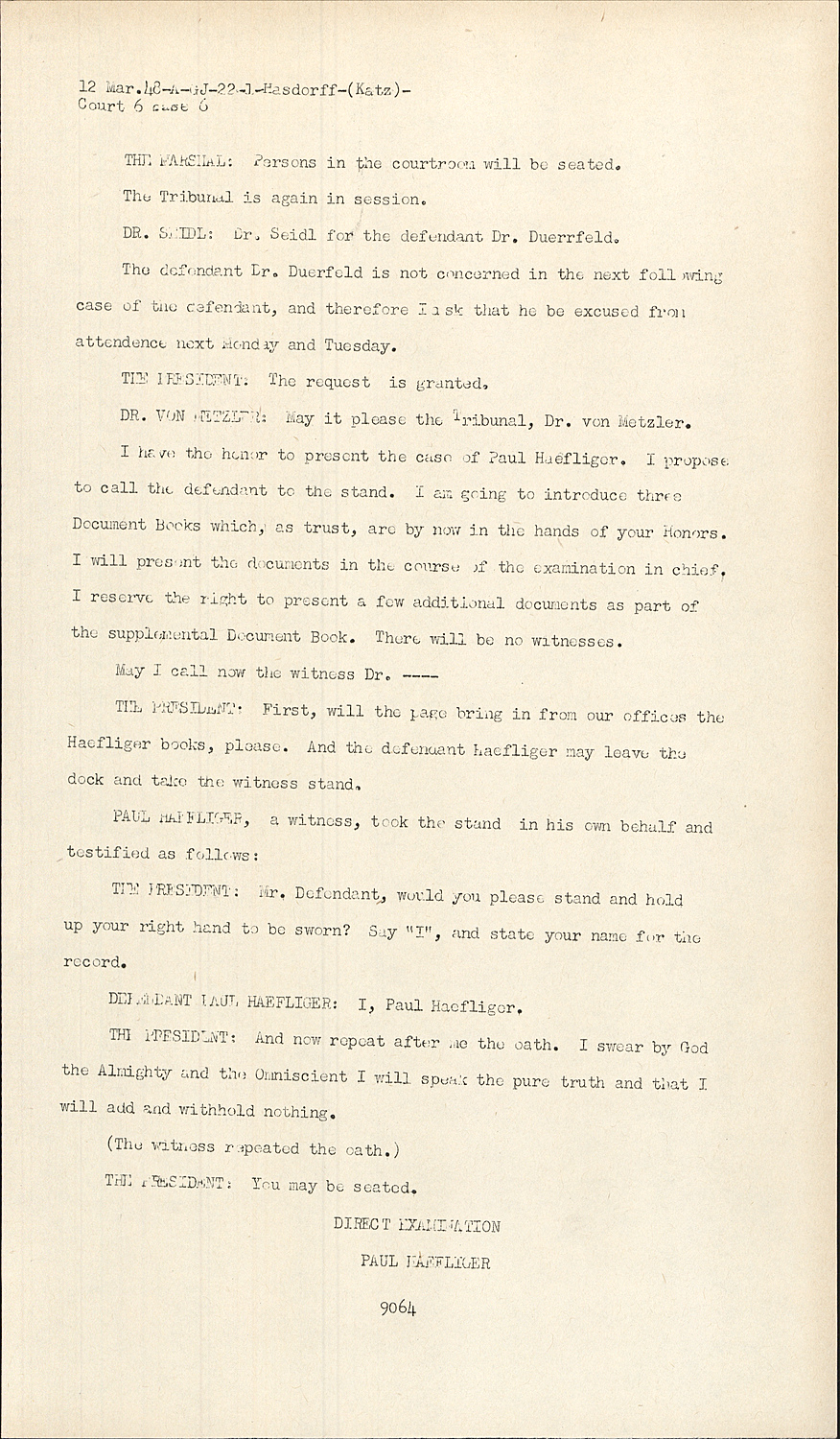
THE MARSHAL:Parsons in the courtroon will be seated.
The Tribunal is again in session.
DR. SEIDL:Dr. Seidl for the defendant Dr. Duerrfeld.
The defendant Dr. Duerfeld is not concerned in the next following case of the defendant, and therefore I ask that he be excused from attendence next Monday and Tuesday.
THE PRESIDENT:The request is granted.
DR. VON METZLER:Day it please the Tribunal, Dr. von Metzler.
I have the honor to present the case of Paul Haefliger. I propose to call the defendant to the stand. I am going to introduce three Document Books which, as trust, are by now in the hands of your Honors. I will present the documents in the course of the examination in chief. I reserve the right to present a few additional documents as part of the supplemental Document Book. There will be no witnesses.
May I call now the witness Dr. ---
THE PRESIDENT:First, will the page bring in from our offices the Haefliger books, please. And the defendant Haefliger may leave the dock and take the witness stand.
PAULHAEFLIGER, a witness, took the stand in his own behalf and testified as follows:
THE PRESIDENT:Mr. Defendant, world you please stand and hold up your right hand to be sworn? Say "I", and state your name for the record.
DEFENDANT PAUL HAEFLIGER:I, Paul Haefliger.
THE PRESIDENT:And now repeat after me the oath. I swear by God the Almighty and the Omniscient I will speak the pure truth and that I will add and withhold nothing.
(The witness repeated the oath.)
THE PRESIDENT:You may be seated.
DIRECT EXAMINATION PAUL HAEFLIGER BY DR. VON METZLER:
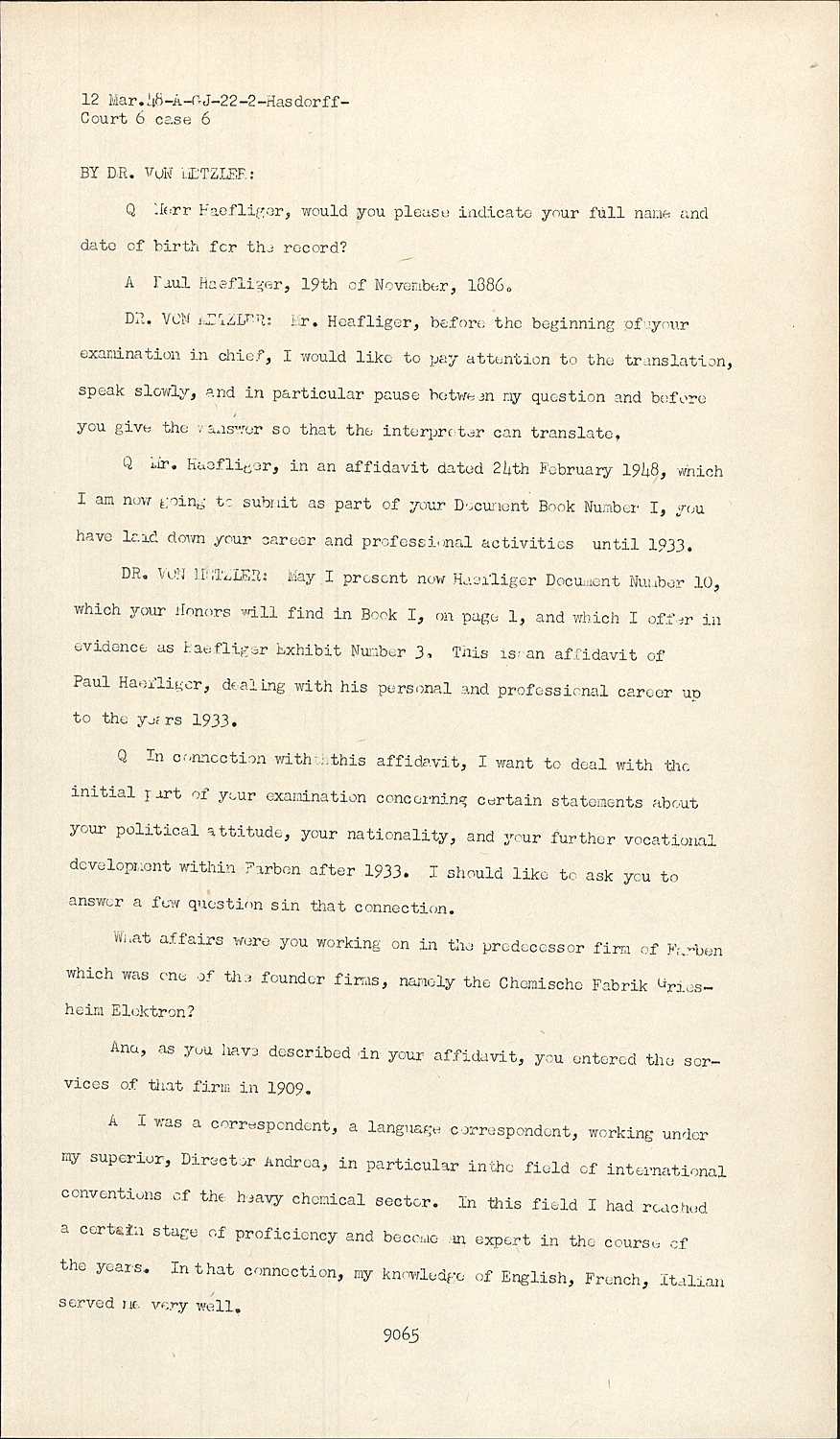
QMerr Haefliger, would you please indicate your full name and date of birth for the record?
APaul Haefliger, 19th of November, 1886.
DR. VON METZLER:Mr. Heafliger, before the beginning of your examination in chief, I would like to pay attention to the translation, speak slowly, and in particular pause between my question and before you give the answer so that the interpreter can translate.
QMr. Haefliger, in an affidavit dated 24th February 1948, which I am now going to submit as part of your Document Book Number I, you have laid dorm your career and professional activities until 1933.
DR. VON METZLER:May I present now Haefliger Document Number 10, which your Honors will find in Book I, on page 1, and which I offer in evidence as Haefliger Exhibit Number 3. This is an affidavit of Paul Haeiliger, dealing with his personal and professional career up to the years 1933.
QIn connection with this affidavit, I want to deal with the initial part of your examination concerning certain statements about your political attitude, your nationality, and your further vocational development within Farben after 1933. I should like to ask you to answer a few question sin that connection.
What affairs were you working on in the predecessor firm of Farben which was one of the founder firms, namely the Chemische Fabrik Griesheim Elektron?
And, as you have described in your affidavit, you entered the services of that firm in 1909.
AI was a correspondent, a language correspondent, working under my superior, Director Andrea, in particular in the field of international conventions of the heavy chemical sector. In this field I had reached a certain stage of proficiency and become an expert in the course of the years. In that connection, my knowledge of English, French, Italian served me very well.
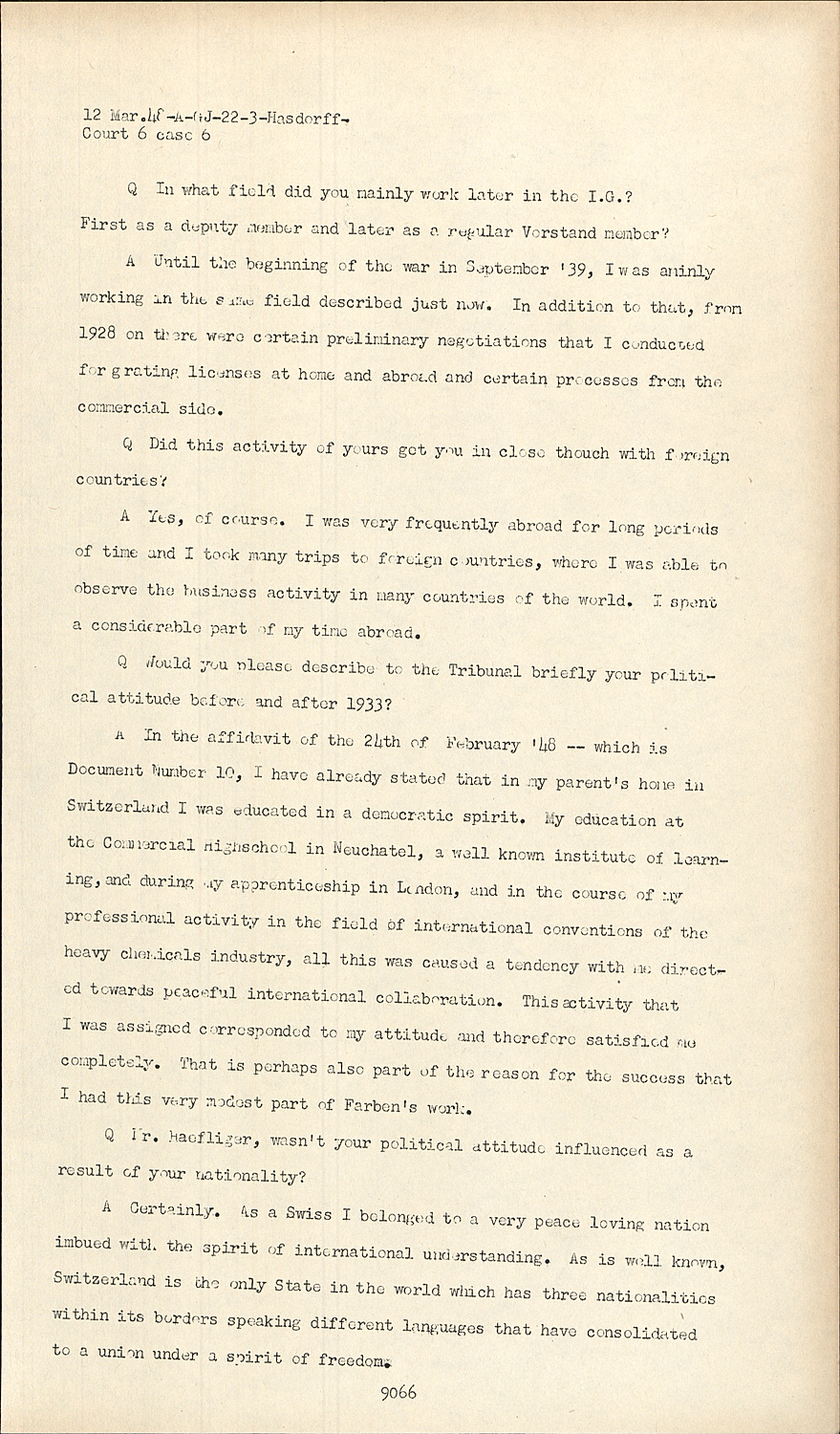
QIn what field did you mainly work later in the I.G.? First as a deputy member and later as a regular Vorstand member?
AUntil the beginning of the war in September '39, I was aminly working in the same field described just now. In addition to that, from 1928 on there were certain preliminary negotiations that I conducted for grating licenses at home and abroad and certain processes from the commercial side.
QDid this activity of yours get you in close thouch with foreign countries?
AYes, of course. I was very frequently abroad for long periods of time and I took many trips to foreign countries, where I was able to observe the business activity in many countries of the world. I spent a considerable part of my time abroad.
QWould you please describe to the Tribunal briefly your political attitude before and after 1933?
AIn the affidavit of the 24th of February '48 -- which is Document Number 10, I have already stated that in my parent's home in Switzerland I was educated in a democratic spirit. My education at the Commercial Highschool in Neuchatel, a well known institute of learning,and during my apprenticeship in London, and in the course of my professional activity in the field of international conventions of the heavy chemicals industry, all this was caused a tendency with me directed towards peaceful international collaboration. This activity that I was assigned corresponded to my attitude and therefore satisfied me completely. That is perhaps also part of the reason for the success that I had this very modest part of Farben's work.
QMr. Haefliger, wasn't your political attitude influenced as a result of your nationality?
ACertainly. As a Swiss I belonged to a very peace loving nation imbued with the spirit of international understanding. As is well known, Switzerland is the only State in the world which has three nationalities within its borders speaking different languages that have consolidated to a union under a spirit of freedom.
Court No. VI, Case No. VI.
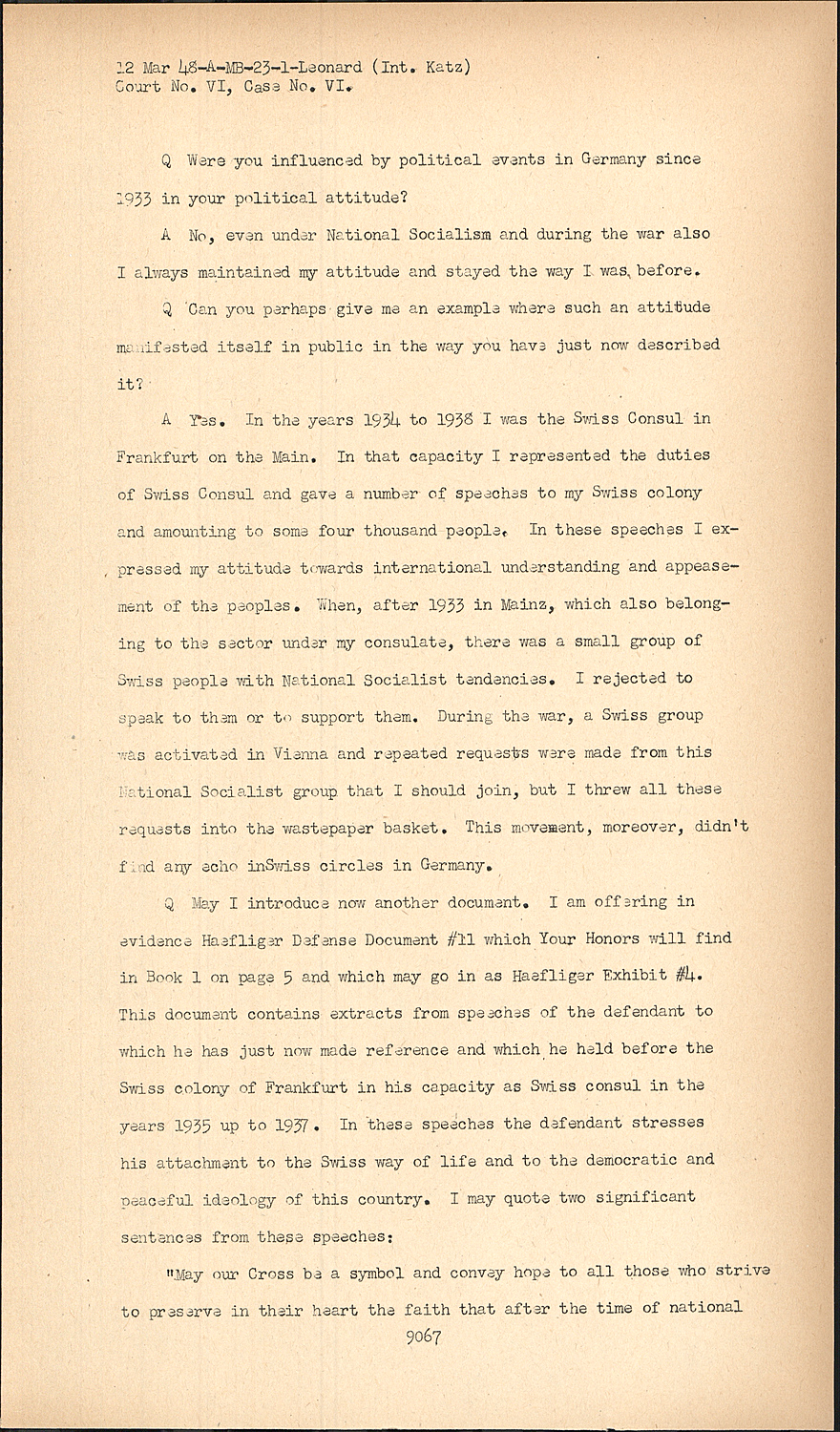
QWere you influenced by political events in Germany since 1933 in your political attitude?
ANo, even under National Socialism and during the war also I always maintained my attitude and stayed the way I was before.
QCan you perhaps give me an example where such an attitude manifested itself in public in the way you have just now described it?
AYes. In the years 1934 to 1938 I was the Swiss Consul in Frankfurt on the Main. In that capacity I represented the duties of Swiss Consul and gave a number of speeches to my Swiss colony and amounting to some four thousand people. In these speeches I expressed my attitude towards international understanding and appeasement of the peoples. When, after 1933 in Mainz, which also belonging to the sector under my consulate, there was a small group of Swiss people with National Socialist tendencies. I rejected to speak to them or to support them. During the war, a Swiss group was activated in Vienna and repeated requests were made from this national Socialist group that I should join, but I threw all these requests into the wastepaper basket. This movement, moreover, didn't find any echo inSwiss circles in Germany.
QMay I introduce now another document. I am offering in evidence Haefliger Defense Document #11 which Your Honors will find in Book 1 on page 5 and which may go in as Haefliger Exhibit #4. This document contains extracts from speeches of the defendant to which he has just now made reference and which he held before the Swiss colony of Frankfurt in his capacity as Swiss consul in the years 1935 up to 1937. In these speeches the defendant stresses his attachment to the Swiss way of life and to the democratic and peaceful ideology of this country. I may quote two significant sentences from these speeches:
"May our Cross be a symbol and convey hope to all those who strive to preserve in their heart the faith that after the time of national Court No. VI, Case No. VI.