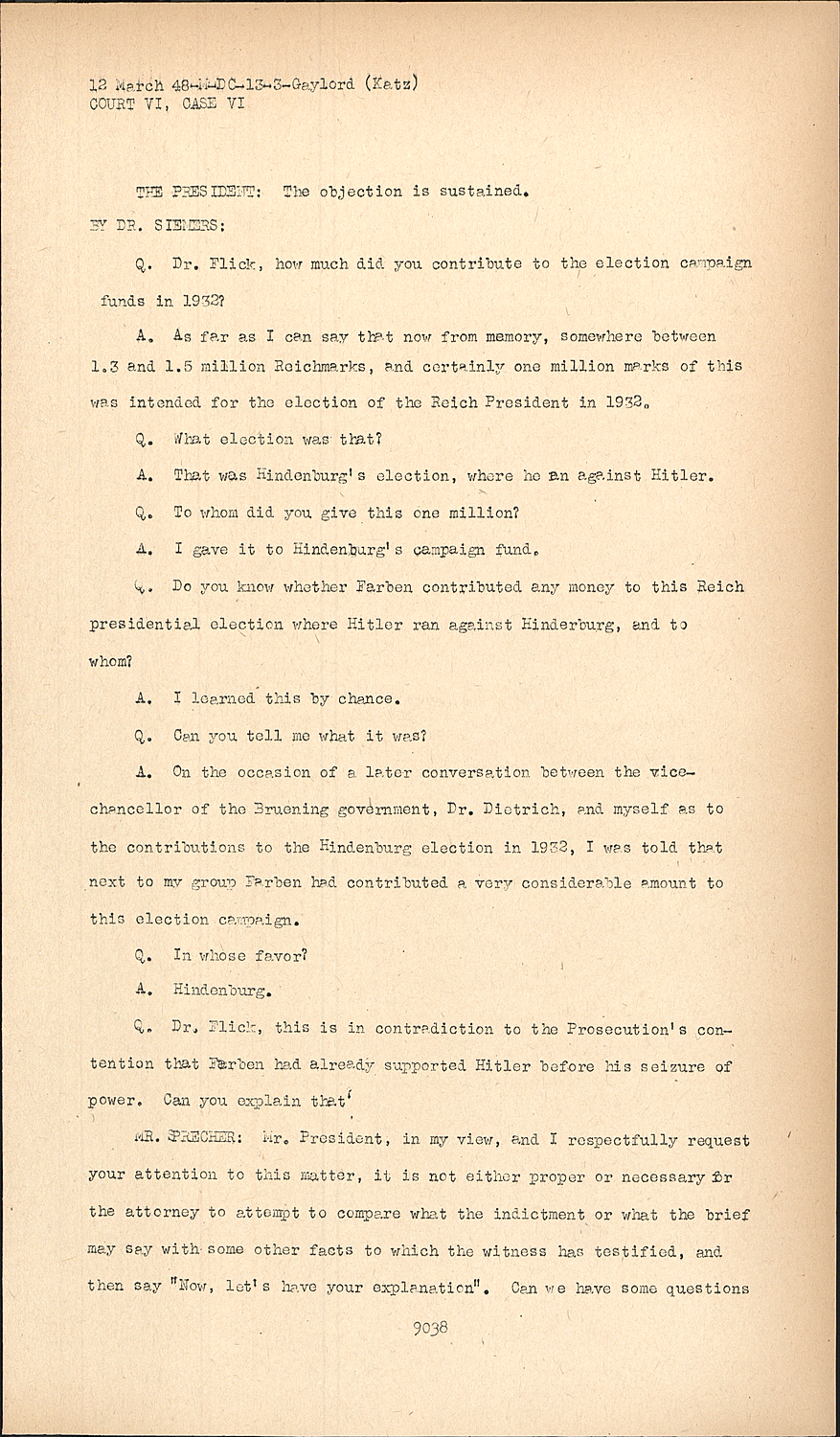
THE PRESIDENT:The objection is sustained. BY DR. SIEMSRS:
Q.Dr. Flick, how much did you contribute to the election campaign funds in 1932?
A.As far as I can say that now from memory, somewhere between 1.3 and 1.5 million Reichmarks, and certainly one million marks of this was intended for the election of the Reich President in 1932.
Q.What election was that?
A.That was Hindenburg's election, whore he an against Hitler.
Q.To whom did you give this one million?
A.I gave it to Hindenburg's campaign fund.
Q.Do you know whether Farben contributed any money to this Reich presidential election where Hitler ran against Hinderburg, and to whom?
A.I learned this by chance.
Q.Can you tell me what it was?
A.On the occasion of a later conversation between the vicechancellor of the Bruening government, Dr. Dietrich, and myself as to the contributions to the Hindenburg election in 1933, I was told that next to my group Harden had contributed a very considerable amount to this election campaign.
Q.In whose favor?
A.Hindenburg.
Q.Dr. Flick, this is in contradiction to the Prosecution's contention that Parben had already supported Hitler before has seizure of power. Can you explain that'
MR. SPERSCHSR:Mr. President, in my view, and I respectfully request your attention to this matter, it is not either proper or necessary for the attorney to attempt to compare what the indictment or what the brief may say with- some other facts to which the witness has testified, and then say "How, lot's have your explanation". Can we have some questions which call for facts in connection with what the witness knows about a relevant topic and without the preliminary instructions?
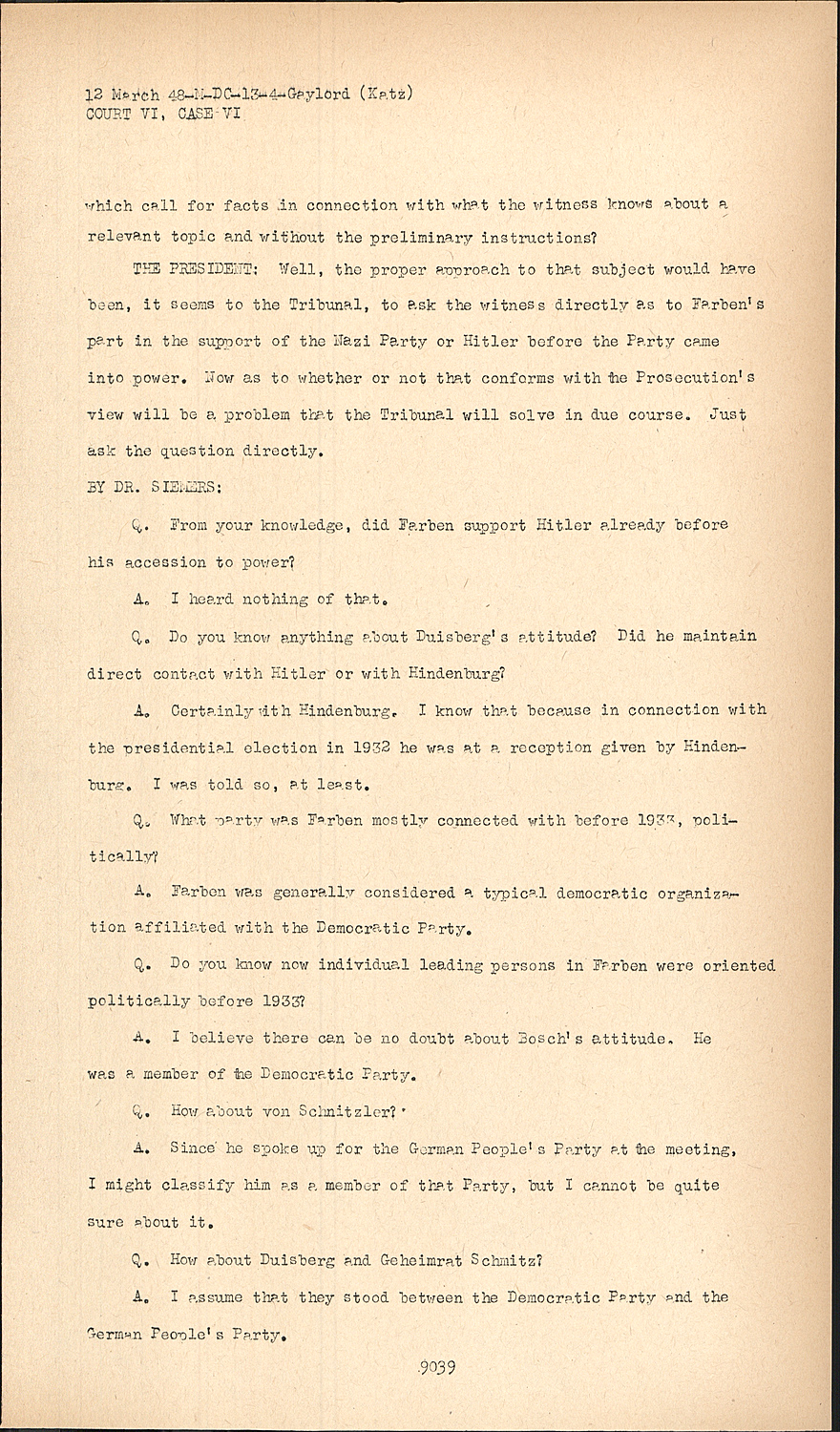
THE PRESIDENT:Well, the proper approach to that subject would have been, it seems to the Tribunal, to ask the witness directly as to Parben's part in the support of the Nazi Party or Hitler before the Party came into power. Now as to whether or not that conforms with tie Prosecution's view will be a problem that the Tribunal will solve in due course. Just ask the question directly. BY DR. SIEMERS:
Q.From your knowledge, did Farben support Hitler already before his accession to power?
A.I heard nothing of that.
Q.Do you know anything about Duisberg's attitude? Did he maintain direct contact with Hitler or with Hindenburg?
A.Certainly with Hindenburg. I know that because in connection with the presidential election in 1932 he was at a reception given by Hindenburg. I was told so, at least.
Q.What party was Farben mostly connected with before 1933, politically?
A.Faarben was generally considered a typical democratic organization affiliated with the Democratic Party.
Q.Do you know new individual leading persons in Farben were oriented politically before 1933?
A.I believe there can be no doubt about Bosch's attitude. He was a member of tie Democratic Party.
Q.How about von Schnitzler?
A.Since he spoke up for the German People's Party at tie meeting. I might classify him as a member of that Party, but I cannot be quite sure about it.
Q.How about Duisberg and Geheimrat Schmitz?
A.I assume that they stood between the Democratic Party and the German People's Party,
Q.Mr. President, may I suggest that this might be a good time for the recess?
THE PRESIDENT:The Tribunal will rise until one-thirty.
(The Tribunal adjourned until 1330 hours.)
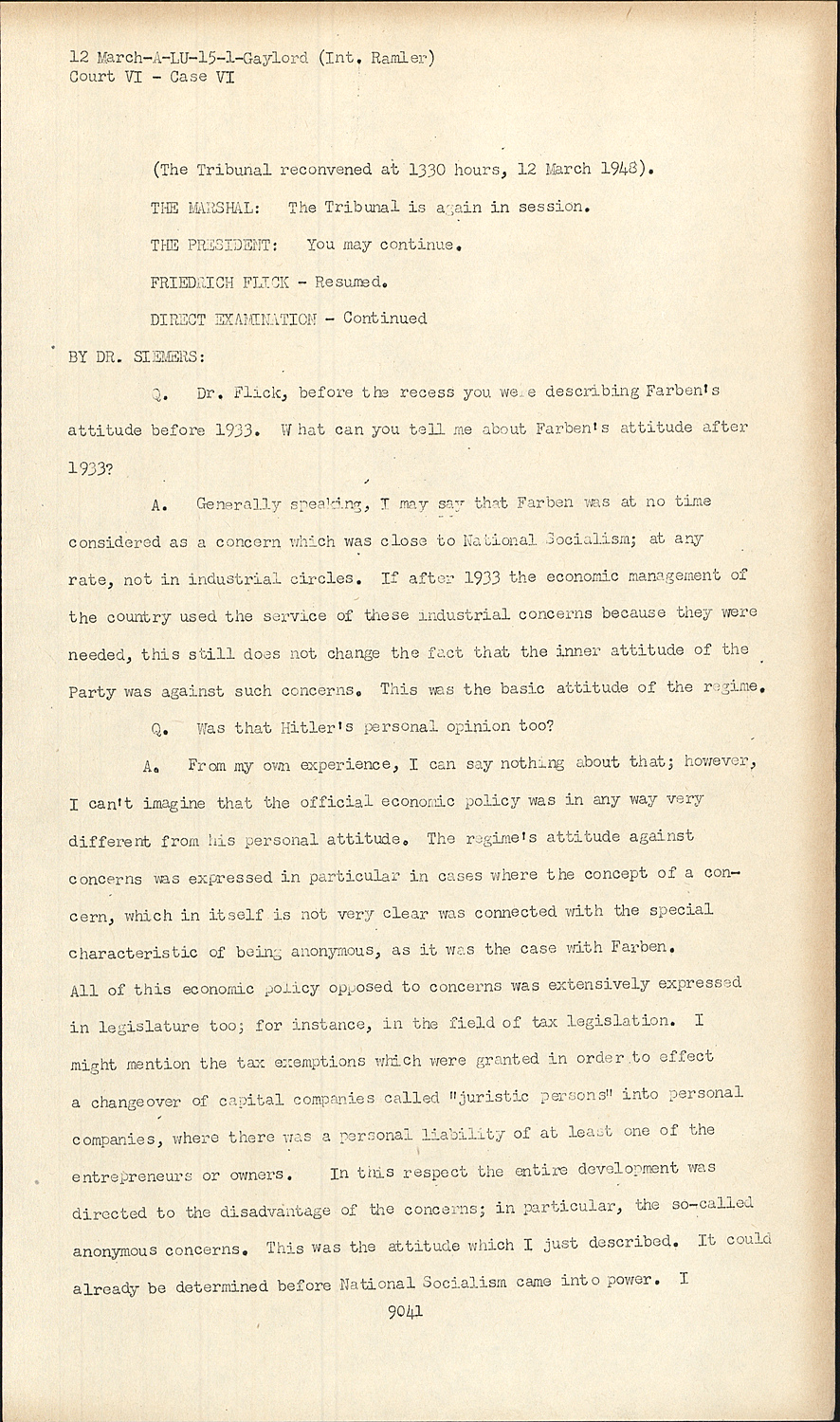
(The Tribunal reconvened at 1330 hours, 12 March 1943).
THE MARSHAL:The Tribunal is again in session.
THE PRESIDENT:You may continue.
FRIEDRICHFLICK - Resulted.
DIRECTEXAMINATION - Continued BY DR. SISMERS:
Q.Dr. Flick, before the recess you we e describing Farben's attitude before 1933. What can you tell me about Farben's attitude after 1933?
A.Generally speaking, I may say that Farben was at no time considered as a concern which was close to National Socialism; at any rate, not in industrial circles. If after 1933 the economic management of the country used the service of these industrial concerns because they were needed, this still does not change the fact that the inner attitude of the Party was against such concerns. This was the basic attitude of the regime.
Q.Was that Hitler's personal opinion too?
A.From my own experience, I can say nothing about that; however, I can't imagine that the official economic policy was in any way very different from his personal attitude. The regime's attitude against concerns was expressed in particular in cases where the concept of a concern, which in itself is not very clear was connected with the special characteristic of being anonymous, as it was the case with Farben. All of this economic policy opposed to concerns was extensively expressed in legislature too; for instance, in the field of tax legislation. I might mention the tax exemptions which were granted in order to effect a changeover of capital companies called "juristic persons" into personal companies, where there was a personal liability of at least one of the entrepreneurs or owners. In tiiis respect the entire development was directed to the disadvantage of the concerns; in particular, the so-called anonymous concerns. This was the attitude which I just described. It could already be determined before National Socialism came into power. I remember that my associate, Steinbrinck, who in 1932 became a member of the so-called Keppler Circle, immeidately received a request to work out some sort of a memorandum which was to serve the prevention of the formation of concerns.
I may add that Kranefuss, who was close to Himmler, stated to me in 1940 that concerns would have to be dissolved as soon as the time was ripe. In summarry, I might say in relation to that subject, that as a consequence of this attitude expressed by the National Socialist regime against anonymous Large scale concerns, Farben had to consider itself threatened, and arising purely from the interest of their entierprise, in fact and inwardly had to be opposed to the regime.
QThank you very much, Dr. Flick. One more question: You were saying that you couldn't definitely tell us about Hitler's attitude towards this problem of concerns. Didn't you get any further idea because of the conversations between Keppler and Kranefuss, about which you spoke? What was Keppler's position?
AKeppler was Hitler's economic advisor before 1933 and a number of years after 1933 too. It is hardly imaginable that Keppler would be of a different opinion concerning that important question from his own immediate superior Hitler. Kranefuss was a good friend of Keppler and played a particular role in the so-called Keppler Circle, which was latter called "Himmler"s Circle of Friends", and it is from him that these utterances originate dating to 1940. He said that the program of the SS at least, was the dissolution of the concerns and I may add that Goering himself had formed a concern - the Reichswerke Hermann Goering, - and that was "the temporary obstacle," as Kranefuss expressed it.
QThank you very much. That will suffice. Do you know something about the attitude of the ministeries and Party agencies towards Farben?
AI think that Ministeries and Party agencies cannot be thought of in the same sense in that respect. Regarding the Ministeries, I must say that Reich Minister of Economics Funk, who, contrary to most other prominent people in the Party, on the basis of his former activity as Economic Correspondent, had actual insight into the German economic structure on a broad basis. On the whole, he was a reasonable man, holding liberal views. However, he was not a strong man and he cound not assert himself against the stronger forces of the Party and SS. The Party and the SS agencies, however, remained adamant in their attitude opposing concerns. Funk, during the war, also adopted the policy of opposition against any expansion of concerns. He did that through decrees, directives, and regulations which partly had only an internal character and were not expressed towards the outside by way of publicized legislation. For instance, a Ministerialrat at the Ministery of Economics told me at one time that there was an internal directive that smaller enterprises were to be given preference, as compared to Farben.
In this connection, I could perhaps briefly describe an experience I had with the Reichsstatthalter Mutschmann was one of the oldest Gauleiters and had a very good reputation with Hitler. One day, he told me, on the occasion of a lengthy conversation about economic political questions and I quote? "I am in favor of the maintenance of private enterprise, however, with one exception: Farben must be nationalized."
QDr. Flick, I am coming back to the question of the Election Fund of 1933. Could one of these prominent industrialists refuse to attend this meeting which was called by Goering?
AHe could do that, if he did not consider the consequences, but, naturally, he would have regretted it. As I said, I and I think that also held true for other industrialists, or, at least, for many was frequently called to attend conferences and meetings held by the preceding government. If now, the smae industrialist, had not followed a call of a prominent member of the new government, of the Prime Minister, that would certainly have been considered as an open affront.
I could give you an example: When the well known bio industrialist Fritz Thyssen at a later date did not obey another telegraphic invitation by Goering to attend a Reichstag - meeting, and when, as a result of the danger which he brought upon himself by that action, he had to visit Switzerland and stay there for a while, all of his property was confiscated, When they later succeeded in getting hold of him in 1940 in some foreign country, he was sent into a concentration camp where he was only liberated by the Americans.
QCould the present industrialist in any way refuse to participate in the Election Fund? In other words, could they withhold contributions?
AI think that the same applies to this question what I explained before. In this connection, however, one more fact is of considerable importance. These enterprises which, during the preceding years, that is to say, 1932, were politically active in an Anti-Fascist sense by supporting those Parties who were opposed to the seizure of power by the Nazis, they, after the seizure of power, had become an accomplished fact, certainly had to consider themselves as being incriminated and compromised and Farben belonged, to one of those enterprises, because, as I already stated, they supported Hindenburg's election when he ran against Hitler.
If the dictatorship at that time, at the beginning of 1933 a was not as drastic as it developed later, we still had enough proof at the time already that dictatorship was actually in existence and there were sufficient indications which pointed to its further development.
In summary, let me state that Farben was considered with a great amount of suspicion and it was already incriminated because of the payments it made in 1932. Therefore, such a concern could not have afforded, after the seizure of power had become an accomplished fact, to oppose National Socialism and to refuse making any payments in the instance under discussion now.
QThank you very much. You said that the dictatorship became more drastic at a later stage. Can you give examples, according to which at this later period prominent industrialists opposed the Party or National Socialistic ideas and thereby became subject to danger?
JUDGE HERBERT:Dr. Siemers, I hesitate to interrupt your examination but I do want to make one simple observation of fact. You have consumed approximately one quarter of the trial day which the Tribunal alloted to you for the presentation of outstanding matters and I think that only you can be the judge of whether or not pursuing this line of testimony, in view of what is already in the record is of sufficient importance to warrant using up your time in that fashion.
DR. SIEMERS:May it please the Tribunal, I shall certainly consider this matter. I think that if you look at the clock, you will find that a defense counsel has a great deal of difficulty to fix exactly the time he is going to consume with his examination. Since I am forced to abide by such a period, as a result of a ruling of the Tribunal, but since I do not want to tear one complex of questions apart, I feel that I would rather forege other methods of presenting evidence than now disrupt this present examination.
Moreover, let me state that I tried to calculate the time I am going to consume, but please keep in mind that today I was repeatedly interrupted by objections of the prosecution. Because of those objections, a great deal of time has been consumed with which I cannot be burdened. Furthermore, would you also keep in mind that I cannot include time which is consumed by the prosecution through their objections. I shall briefly continue dealing with that subjects, but I shall endeavor to be as brief as possible.
" (By Dr. Siemers) Dr. Flick, would you be good enough to answer my questions how leading industrialists fared who at a later date, in 1936 or 1937 opposed the Party or National Socialistic ideas?
AAn example as to how such leading industrialists fared can easily be given by me, but I shall limit myself to one: Professor Junkers, the owner of the well known Junkers Aviation firm, had his property confiscated when he did not comply with the request of the Government to reorganize his firm.
QI beg your pardon. How was he supposed to convert his firm?
Court No. VI, Case No. VI.
AHe was to expand his firm and to take up the production of other types of airplanes. They claimed that he did not produce enough from a quantitative point of view. The matter was handled informally and voluntarily by way of a mutual agreement, but it is interesting to note that, as far as I know, a prosecutor was always present during such negotiations. He was not at the table where the negotiations were carried on, but he was always sitting in the corner of the room and I believe Professor Junkers could not fail to notice him. Furthermore, I could say that a Vorstand member of an electricity plant at Essen, which was one of the largest plants of its kind in Europe, because of a defeatist remark he made was sentenced by the People's Court to death and was actually executed.
Furthermore, I could say that one of my raining directors, for similar reasons, was sentenced to a prison term of many years.
Finally I might mention my own person. Himmler, in 1940, demanded that I be sent into a concentration camp, giving the reason that I was an international capitalist. That order was not executed merely because of an intervention on my behalf by Himmler's personal physician, but actually I did not completely escape the danger to which I was subject.
They had certain microphones built into my room in order to find out what I was sayings. That was done upon order of Himmler. Reports had to be made to Himmler about what was going on in my office and this has been proven by affidavits presented in my own trial.
QMr. Flick, it is sufficient if you merely tell us from whom you know the details.
AAre you referring to my case?
QYes.
AI heard the details from Himmler's physician, a Finnish citizen Sanitaetsarzt Kersten. At the moment he is at Stockholm. He made a very detailed affidavit as to that point.
QThank you. That will suffice.
Court No. VI, Case No. VI.
AThen there is my secretary who knows about these matters through the police. I could even now give you the name of the police official who had the duty to make constant reports. The name of the man is Schwenk. The people who were members of the Keppler Circle had nothing to do with it.
QOne last point. In connection with Junkers you just mentioned orders by the State concerning production. What was industry's attitude towards such orders issued by the Armament Ministry or other official agencies? Was it at all possible to refuse compliance with such production orders?
AWell -
QDr. Flick, please do not go into details. I am asking you that question because you represent one of the largest industries and you can give us a brief and concise picture.
AFirst of all, let me state that every decent German industrialist, even if he was opposed to the unleashing of the war as such, remained a patriot and it was quite natural that after the war had begun, he had to do his duty as a manufacturer. That is my point of view, at any rate. After America entered the war, the superiority of our enemies in the way of material became so obvious that serious difficulties arose, that led to the fact that in view of the scarcity of materials, scapegoats had to be found. Such scapegoats were found among circles of industry. Production demands were made, which, in fact, were unreasonable and could not be met. The well known Hitler's slogan: "The word, 'impossible', does not exist in my dictionary," became the slogan for the industry, with which the industrialists were constantly subjected to pressure, bullied and threatened. The Reich Association, Iron, which in my field was founded in 1942, originated only because of the endless reprimands which were made to us because of insufficient production. There was a constant reference to the fact that the United States was producing far more and that was rubbed in all the time. I think it is quite important Court No. VI, Case No. VI.
for me to say that the President of the Reich Association Iron was not elected by the members, but was appointed by Hitler and Goering. I can give you one or two examples and then I can leave the subject:
When the wall known railway locomotive producer, Oskar Henschel told Hitler one day that if his skilled workers continued to be drafted, production would have to drop, Hitler abruptly turned around, walked off, and shortly thereafter Henschel was dropped from his position as plant leader in his own factory.
Particularly great was the pressure which Hauptdienstellenleiter Sauer exercised on industry. He was from the Speer Ministry. His was an absolutely unbearable personality. That applied specifically to the so-called Jaegerstab. In every single plant commissars of the Jaegerstab were assigned who had the right to issue direct orders to the engineers and employees by circumventing the actual business management. At the same time, these people daily and hourly supervised the directors. They always threatened people with having them sent into a concentration camp if production was not high enough, and that was still a mild threat for those people.
QHow do you know that? How do you know that, Dr. Flick? Did you yourself speak to Sauer or did you attend meetings?
AThere was one case which I did not mention here in order to save time. On that occasion, I negotiated with Sauer one Sunday morning from nine in the morning until five in the afternoon. That was at Spandau. I know of another case. I know that through our own aircraft factory. We had an aircraft factory employing 10,000 workers and the director of our aircraft factory reported on that at great length and that was Dr. Weimark.
In conclusion, let me state one thing: Hitler's attitude concerning this entire problem can best be characterized by his own words, which he once uttered in a small circle. That was, "In order to set an example, one industrialist must at one time be put against the wall and it must be a prominent one."
DR. SIEMERS:Thank you very much. I have no further questions.
Court No. VI, Case No. VI.
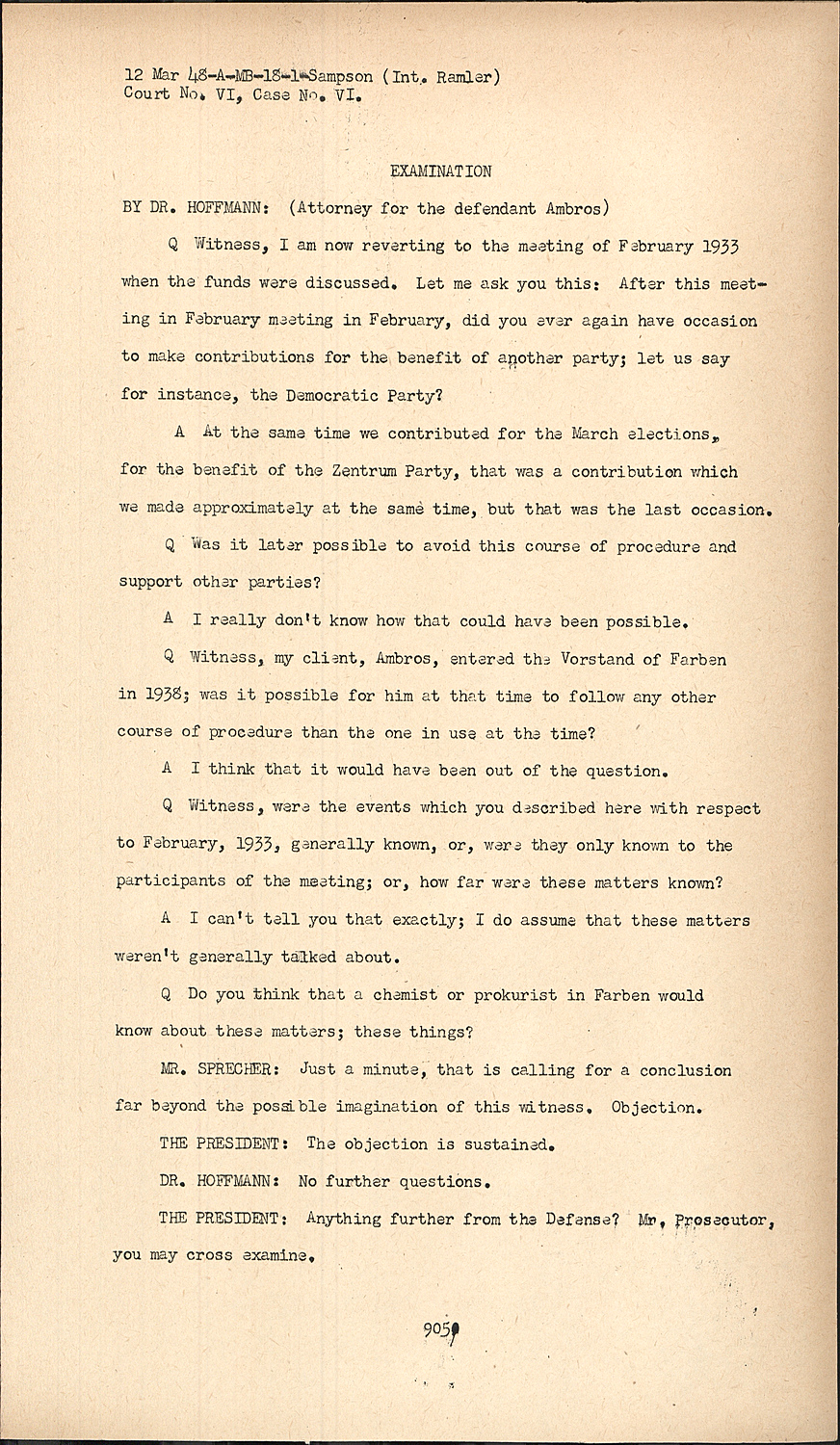
EXAMINATION BY DR. HOFFMANN: (Attorney for the defendant Ambros)
QWitness, I am now reverting to the meeting of February 1933 when the funds were discussed. Let me ask you this: After this meeting in February meeting in February, did you ever again have occasion to make contributions for the benefit of another party; let us say for instance, the Democratic Party?
AAt the same time we contributed for the March elections, for the benefit of the Zentrum Party, that was a contribution which we made approximately at the same time, but that was the last occasion.
QWas it later possible to avoid this course of procedure and support other parties?
AI really don't know how that could have been possible.
QWitness, my client, Ambros, entered the Vorstand of Farben in 1938; was it possible for him at that time to follow any other course of procedure than the one in use at the time?
AI think that it would have been out of the question.
QWitness, were the events which you described here with respect to February, 1933, generally known, or, were they only known to the participants of the meeting; or, how far were these matters known?
AI can't tell you that exactly; I do assume that these matters weren't generally talked about.
QDo you think that a chemist or prokurist in Farben would know about these matters; these things?
MR. SPRECHER:Just a minute, that is calling for a conclusion far beyond the possible imagination of this witness. Objection.
THE PRESIDENT:The objection is sustained.
DR. HOFFMANN:No further questions.
THE PRESIDENT:Anything further from the Defense? Mr. Prosecutor, you may cross examine.
Court No. VI, Case No. VI.
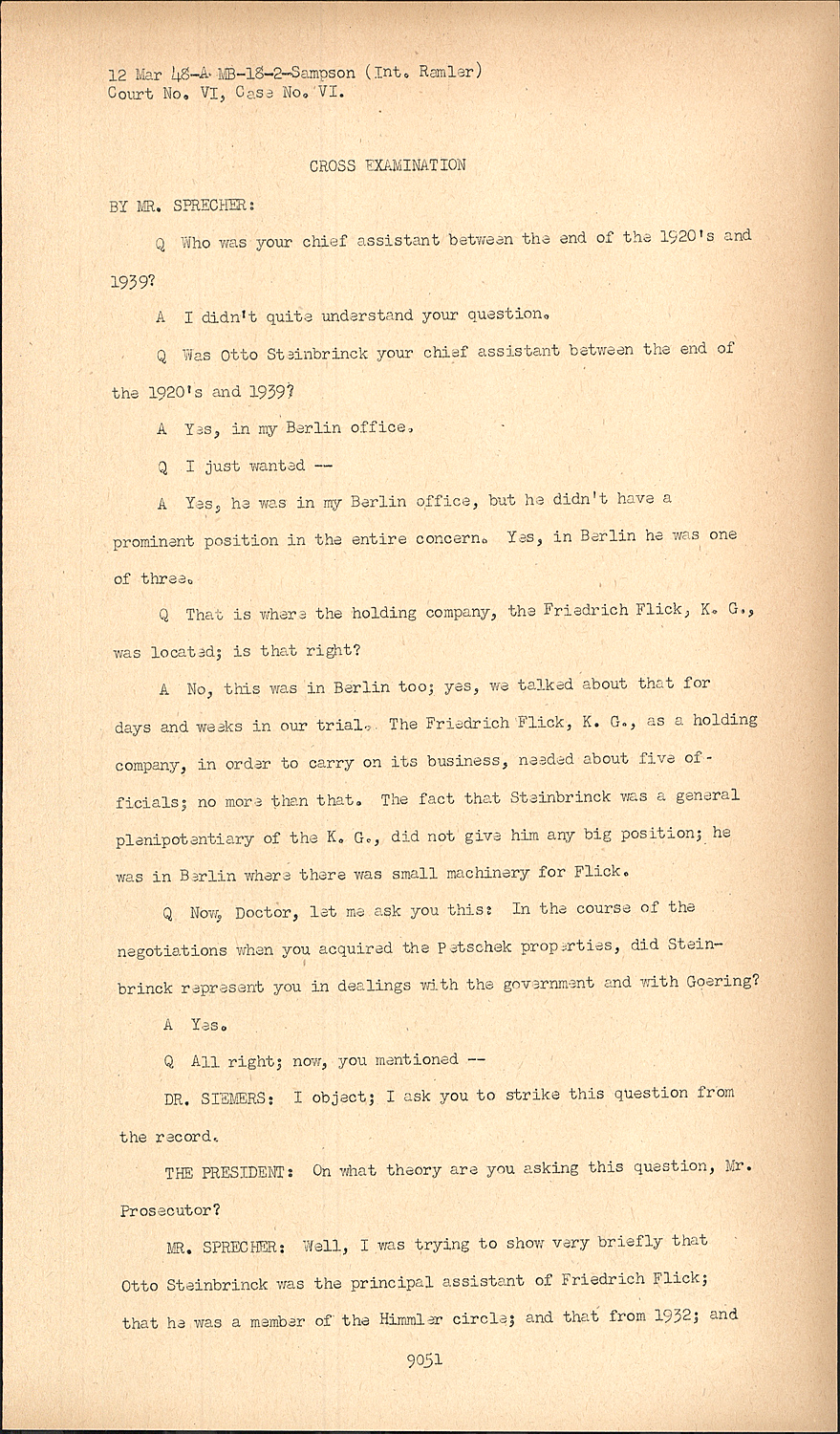
CROSS EXAMINATION BY MR. SPRECHER:
QWho was your chief assistant between the end of the 1920's and 1939?
AI didn't quite understand your question.
QWas Otto Steinbrinck your chief assistant between the end of the 1920's and 1939?
AYes, in my Berlin office.
QI just wanted -
AYes, he was in my Berlin office, but he didn't have a prominent position in the entire concern. Yes, in Berlin he was one of three.
QThat is where the holding company, the Friedrich Flick, K. G., was located; is that right?
ANo, this was in Berlin too; yes, we talked about that for days and weeks in our trial. The Friedrich Flick, K. G., as a holding company, in order to carry on its business, needed about five officials; no more than that. The fact that Steinbrinck was a general plenipotentiary of the K. G., did not give him any big position; he was in Berlin where there was small machinery for Flick.
QNow, Doctor, let me ask you this: In the course of the negotiations when you acquired the Petschek properties, did Steinbrinck represent you in dealings with the government and with Goering?
AYes.
QAll right; now, you mentioned -
DR. SIEMERS:I object; I ask you to strike this question from the record.
THE PRESIDENT:On what theory are you asking this question, Mr. Prosecutor?
MR. SPRECHER:Well, I was trying to show very briefly that Otto Steinbrinck was the principal assistant of Friedrich Flick; that he was a member of the Himmler circle; and that from 1932; and Court No. VI, Case No. VI.
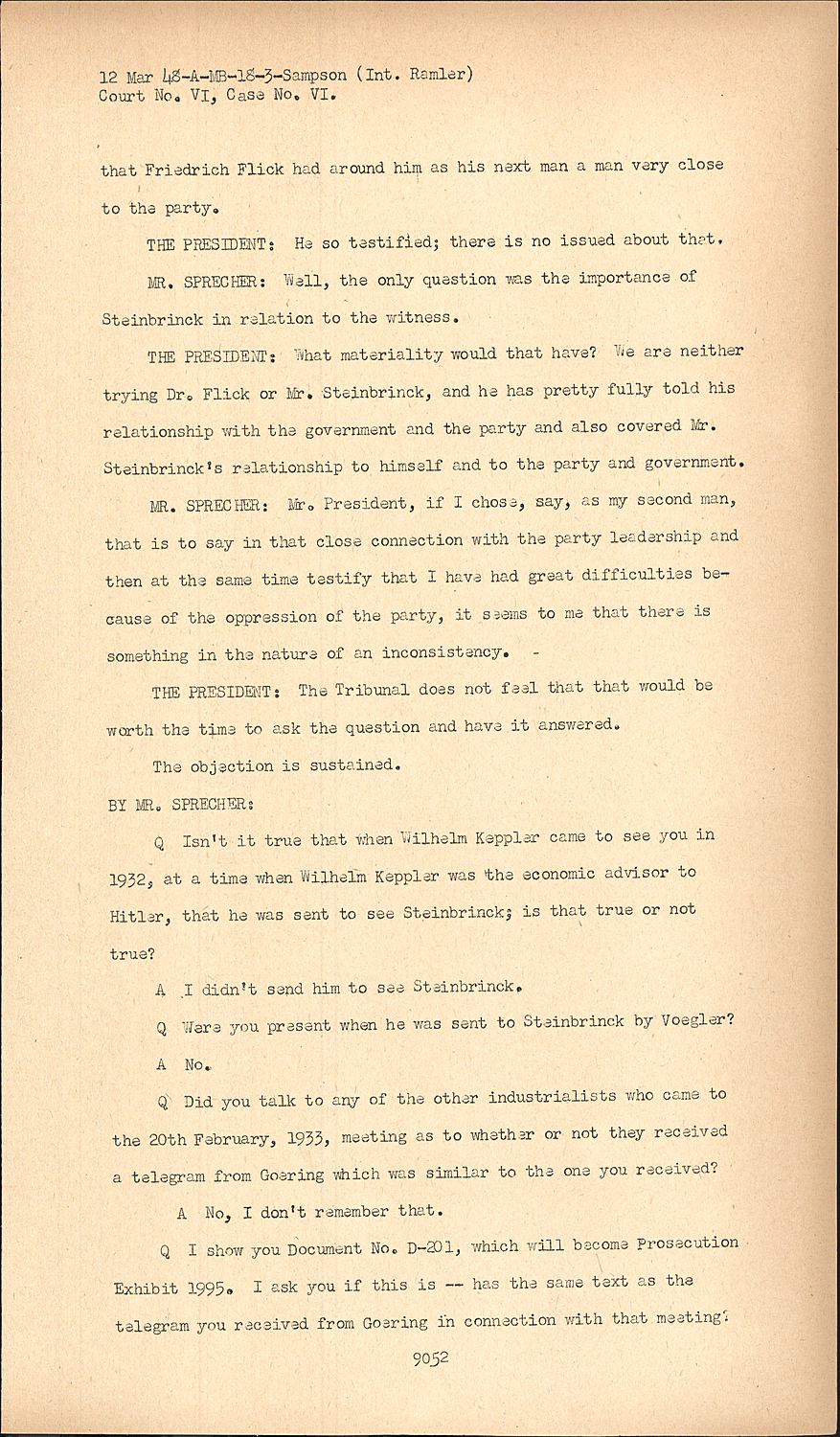
that Friedrich Flick had around him as his next man a man very close to the party.
THE PRESIDENT:He so testified; there is no issued about that.
MR. SPRECHER:Well, the only question was the importance of Steinbrinck in relation to the witness.
THE PRESIDENT:What materiality would that have? We are neither trying Dr. Flick or Mr. Steinbrinck, and he has pretty fully told his relationship with the government and the party and also covered Mr. Steinbrinck's relationship to himself and to the party and government.
MR. SPRECHER:Mr. President, if I chose, say, as my second man, that is to say in that close connection with the party leadership and then at the same time testify that I have had great difficulties because of the oppression of the party, it seems to me that there is something in the nature of an inconsistency.
THE PRESIDENT:The Tribunal does not feel that that would be worth the time to ask the question and have it answered.
The objection is sustained. BY MR. SPRECHER:
QIsn't it true that when Wilhelm Keppler came to see you in 1932, at a time when Wilhelm Keppler was the economic advisor to Hitler, that he was sent to see Steinbrinck; is that true or not true?
AI didn't send him to see Steinbrinck.
QWere you present when he was sent to Steinbrinck by Voegler?
ANo.
QDid you talk to any of the other industrialists who came to the 20th February, 1933, meeting as to whether or not they received a telegram from Goering which was similar to the one you received?
ANo, I don't remember that.
QI show you Document No. D-201, which will become Prosecution Exhibit 1995. I ask you if this is -- has the same text as the telegram you received from Goering in connection with that meeting?
Court No. VI, Case No. VI.
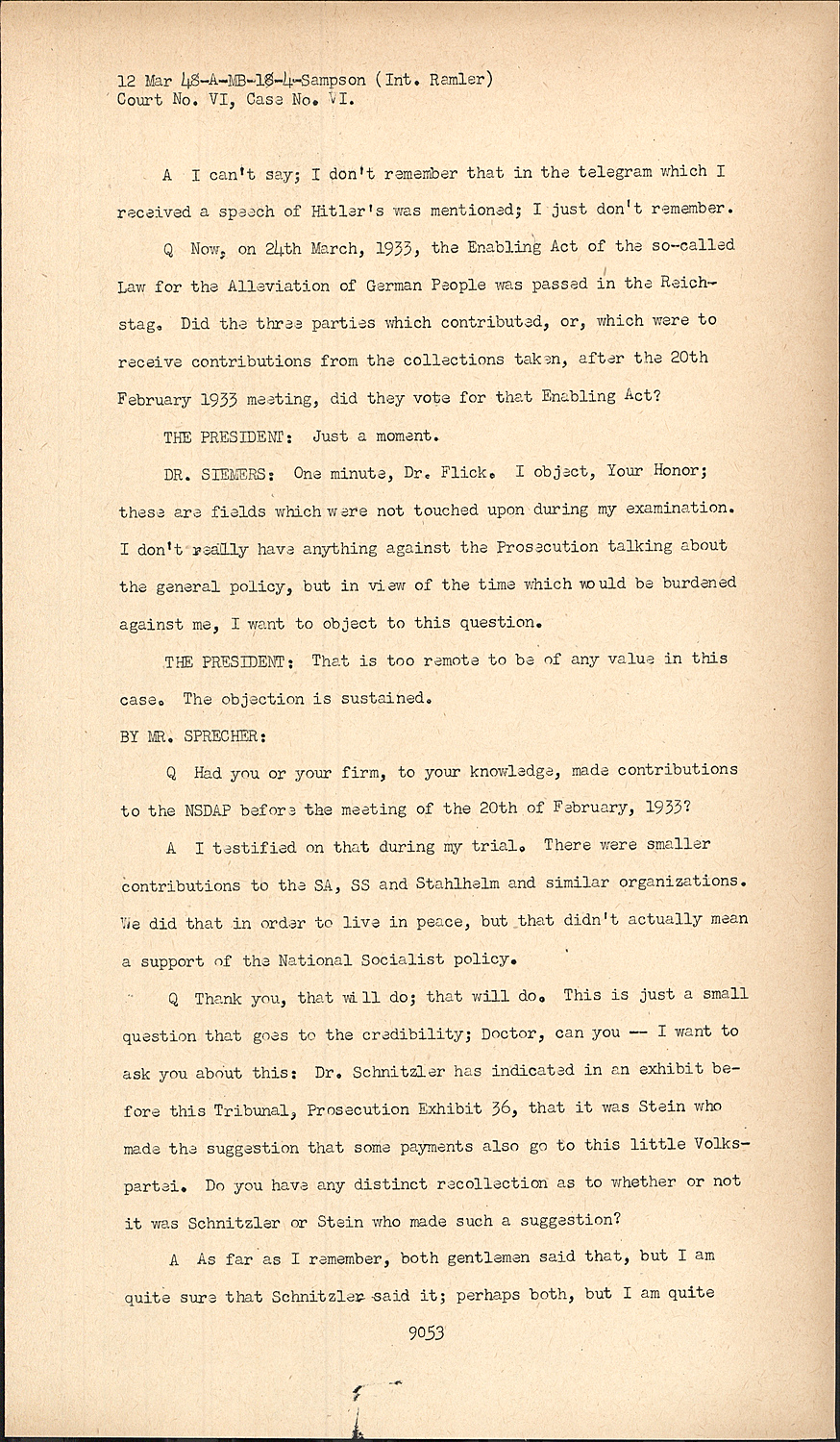
AI can't say; I don't remember that in the telegram which I received a speech of Hitler's was mentioned; I just don't remember.
QNow, on 24th March, 1933, the Enabling Act of the so-called Law for the Alleviation of German People was passed in the Reichstag. Did the three parties which contributed, or, which were to receive contributions from the collections taken, after the 20th February 1933 meeting, did they vote for that Enabling Act?
THE PRESIDENT:Just a moment.
DR. SIEMERS:One minute, Dr. Flick. I object, Your Honor; these are fields which were not touched upon during my examination. I don't really have anything against the Prosecution talking about the general policy, but in view of the time which would be burdened against me, I want to object to this question.
THE PRESIDENT:That is too remote to be of any value in this case. The objection is sustained. BY MR. SPRECHER:
QHad you or your firm, to your knowledge, made contributions to the NSDAP before the meeting of the 20th of February, 1933?
AI testified on that during my trial. There were smaller contributions to the SA, SS and Stahlhelm and similar organizations. We did that in order to live in peace, but that didn't actually mean a support of the National Socialist policy.
QThank you, that will do; that will do. This is just a small question that goes to the credibility; Doctor, can you -- I want to ask you about this: Dr. Schnitzler has indicated in an exhibit before this Tribunal, Prosecution Exhibit 36, that it was Stein who made the suggestion that some payments also go to this little Volkspartei. Do you have any distinct recollection as to whether or not it was Schnitzler or Stein who made such a suggestion?
AAs far as I remember, both gentlemen said that, but I am quite sure that Schnitzler said it; perhaps both, but I am quite Court No. VI, Case No. VI.
sure about Schnitzler; I remember that he made that suggestion. I said that I stood next to Schnitzler at the time.
Q.Now, Goering was the head of the Four Year Plan; did he oppose the growth of your concern?
A.I can't say that; I didn't speak about the expansion of concerns as such, but in connection with Funk I spoke of the stoppage of any expansion during the war.
Q.Now, just a minute; just a minute. Now, I wasn't asking about Funk; I was asking about Goering.
A.The growth of the concern was not opposed by Goering, but at that time, at the time about which we are speaking now, the concern no longer grew. The growth really came about through buying of shares, fusions, affiliations, etc.
Q.Is it fair to say that the fear of economic loss, to speak of yourself, led to your making concessions to Nazi wishes which you otherwise would not have made?
A.I didn't quite understand what you meant about loss........
Q.Speaking of your own case, for I am sure you have good knowledge of it, did the fears of economic loss on your own part lead to your making concessions to the Third Reich, the leaders of the Third Reich?
A.I don't know what I have to understand by losses; what do you mean by losses?
Q.Did you fear any economic loss if you did not take a leading part in the Third Reich as an industrialist?
THE PRESIDET:Mr. Witness, I don't knew how it gets to you on the translation, but I think what the prosecutor is trying to convey to you is this: Did you cooperate with the government and the party because you were afraid that your property would be taken away from you if yo did not cooperate? Is that a fair statement of what you are driving at there, Mr. Prosecutor?
MR. SPRECHER:Yes.
A.It is impossible to express it so generally, moreover I contest the fact. There was no mention of any cooperation. That I cooperated with National Socialism in the first years, I was observed and suspected.
It is being stated here that if as if it was a matter of course, but I object to that sort of statement. Naturally every industrialist is afraid of losses -- not only in Germany but throughout the world. BY MR. SPRECHER:
Q.Now, in this case of Professor Junkers, did you yourself hear from General Milch that Professor Junkers was very well paid for the plant when he stepped out the Junkers concern?
A.Very well paid?
Q.Yes.
A.I can't tell you what he got, but you can rely upon at that he didn't sell voluntarily. I knew something about the Junkers question at the time. If was in contact with that question because I was to act as some sort of economic export. Let me repeat here that according to information I received the negotiations were carried out in the way I described them.
Q.Just a minute -
A.In the very same room, not at the same table, but a prosecutor was sitting there -
Q.Just a second -
A.I think that that is very important when you come to judging that question.
Q.I will ask the question, and I will ask that if the answers are not responsive, I will ask the Tribunal to interfere. I asked you whether you heard from General Milch, when you were present and General Milch was talking, that Professor Junkers was well paid. Now, if you didn't hear it, just say you didn't hear it.
THE PRESIDENT:Mr. Prosecutor, as we understand the witness, he was testifying to the point that the property was taken away because of the coercive conduct of the government. If that was true, and if it was forcibly taken, the question whether it was paid for afterwards wouldn't be very important. The man who steals jay property is not going to make the act lawful by coming around afterwards and paying for the property he has stolen.
That is hardly an answer to the question. BY MR. SPRECHER:
Q.You mentioned a Vostand member who was executed for some reason or other. Who was that person?
A.Mining Director Riecken.
Q.Do you know what he was executed for?
A.Because of an allegedly defeatist remark he had made; that was made in the circle of the staff of his close associates.
Q.You mentioned one of your mining formen was sentenced for many years; what was he sentenced for?
A.As I said, he was sentenced for the same reason. He was also mining director, Knautz.
Q.Did he make some remark against the regime or something? What was the nature of the remark he made?
A.Yes, I can tell you that. That was in 1943 when Mussolini resigned; there were difficulties in Italy, and he made some remark to the effect that the war wasn't going very well, and he was still lucky that he got away with a long prison term.
Q.Do you know the name -- when was the other Vorstand member executed that you mentioned; when was that?
A.I only mentioned one as far as execution is concerned, didn't I?
Q.Yes.
A.I only mentioned one.
Q.When was he executed?
A.Well, I wasn't present; I think it was in 1943 or 1944. At any rate, it was before the end of 1944.
Q.Now, didn't you get a little gift from Himmler in 1944 along with other members of the Himmler circle?
A.What did I get from Himmler?