A I explained the other day that even at the moment when the Fuehrer left by plane the next morning, the Fuehrer himself still had some reservations in his mind, doubt as to whether a permanent union could be carried out, and I also said that I personally did not consider the solution far-reaching enough and I was for an absolute, direct, and total Anschluss, annexation.
I did not know Seyss-Inquart's attitude at that time for sure.
At any rate, I knew that I had to consider that his attitude would be rather in the direction of still a separate form, not so far toward an absolute and total annexation, and therefore, I was very much satisfied when that finally crystallized.
QI respectfully submit that the answers are not responsive, and I repeat the question.
Did Seyss-Inquart become Chancellor of Austria with an under standing that he would call in the German troops and surrender Austria to Germany, or did you lead him to believe that he could continue an independent Austria?
AExcuse me, but that is a number of questions which I cannot simply answer with yes or no.
First, if you ask me, "Did Seyss-Inquart become Chancellor and was that demanded from Hitler?"
--yes.
And if you ask me then, "Did he become Chancellor under the assumption that he should send the telegram for troops to march in?"
-
I say no, because at that time nobody spoke about the fact that he should send the telegram.
If you ask me thirdly, "Did he become Chancellor under the assumption that he would be able to maintain an independent Austria?"
-
then I have to say again that the final turn of events on that evening \ was not clear even in the Fuehrer's mind.
That is what I tried to explain.
QIsn't it true that you expected that he might want to remain as independent as possible, and that that was one of the reasons why the troops were marched in?
A No. Excuse me, there are two questions. I absolutely suspected that Seyss-Inquart wanted to be as independent as possible.
The sending of troops had nothing at all to do with that suspicion, and it would not have been necessary.
I gave my reasons for the sending of the troops.
QIt was never intimated to Seyss-Inquart that Austria would not remain independent until after--as you put it--the Fuehrer and you were in control of Austria's fate?
Is that a fact?
AThat was certainly not told to him before the Fuehrer. As far as I was concerned, it was known generally that I desired it, and I assume that he know of my attitude.
QNow, you have stated that you then, in conversation with Ribbentrop in London, stressed that no ultimatum had been put to Seyss-Inquart, and you have said that legally that was the fact.
AI did not say "legally," I said "diplomatically."
THE PRESIDENT:Is that a convenient time to break off?
MR. JUSTICE JACKSON:Yes, your Honor.
(The Tribunal adjourned until 1000 hours, 19 March 1946.)
Official transcript of the International Military Tribunal in the matter of the I United States of America, the French Re public, the United Kingdom, of Great Britain and Northern Ireland, and the Union of Soviet Socialist Republics, against Hermann Wilhelm Goering et al, Defendants, sitting at Nurnberg, Germany, on 19 March 1946, 1000-1300, Lord Justice Lawrence presiding.
DR.STAHMER (Counsel for Defendant Goering): With the approval of the Tribunal, I call as witness Mr. Dahlerus, from Stockholm.
BIRGERDAHLERUS, a witness, took the stand and testified as follows: BY THE PRESIDENT:
QWill you tell me your name?
ABirger Dahlerus.
QWill you repeat this oath after me:
I swear that the evidence I shall give shall be the truth, the whole truth, and nothing but the truth,so help me God.
(The witness repeated the oath).
You may sit down if you wish.
DIRECT EXAMINATION BY DR. STAHMER:
QMr. Dahlerus, would you please tell the Court how it happened that you, as a private individual and a Swede, made efforts for reaching an understanding between England and Germany?
AI did know England very well, since I had lived there for twelve years, and I also knew Germany very well. I had seen the First World War from both sides, having lived in Germany and England during the first war.
On a visit to England by the end of June, 1939, I traveled around a number of cities, Birmingham, Coventry, Manchester and London, and I found all around a very determined position that the British public wouldn't stand for any aggression any longer from the German side.
On the 2nd of July I met with some friends in the Constitutional Club, and we discussed the position and they summed up the general opinion in England in a rather clear way. As this summary of the general opinion in England was a basis for my discussions afterwards with Goering, I think I shall quote it.
THE PRESIDENT:The Russian translation is not coming through. I am told it is coming through with interruptions.
DR. STAHMER:Should the witness repeat his testimony?
THE PRESIDENT:Would you just repeat the last sentence that you stated You said that on the 2nd of July you met friends in the Constitutional Club and discussed the general situation.
AAnd they summed up the position in a rather clear way. This formed the basis for my discussions afterwards with Goering. I therefore think I shall quote exactly the summary they made up of the opinion in Great Britain:
Formation of our opinion obtained by observation of conditions in England and from discussion with ordinary people.
A.Agreement that Berchtesgaden and Czechoslovakia have shaken confidence. Immediately after Berchtesgaden and before Czechoslovakia possibly could have obtained by cooperation many things decided by Germany.
B.British public opinion now exasperated. Decided that we go so far and no further.
C.Britain now had commitments which did not exist at the time of the Berchtesgaden meeting.
Poland and Danzig. Invasion of Danzig means war with Poland and Britain.
THE PRESIDENT:I am afraid the French translation isn't coming through properly now. The French and Russian are coming together. BY THE PRESIDENT:
QNow, Witness, would you go on with the document. You have given us a, b, and c, I think.
AWell, the end of c is as follows:
"Britain automatically involved by virtue of new commitments. Therefore, automatically war with Britain.
"d. Britain does not advertise her strength: not even fully appreciated by general British public."
Then follows Statement No.2, about Lord Halifax's sp "Own personal observation indicates that Britain solid behind his statement."
THE PRESIDENT:One moment. I am afraid the Russian is coming through on the French again.
I am afraid the Tribunal must adjourn then.
(A recess was taken.)
THE PRESIDENT: Before the witness goes on with his evidence, the Tribunal ants me to say that the system by which the earphones are connected with the interpreters was checked over after the Court rose last night, was checked over gain at 9:30 this morning, and again at 9:35 this morning.
But everyone who comes into this Court must realize that it has not been possible to bury these cables so as to make them altogether safe. It is, therefore, of the very greatest importance that everybody who comes into this Court should take real care to avoid, if possible, treading upon these cables, which may become injured by being kicked and broken, and in that way the faults in the system occur.
Everything is being done to maintain the system as efficiently as possible. It, therefore, rests with those who use this Court to see that they do their best o assist in keep ing the system efficient. DIRECT EXAMINATION CONTINUED):
QWould you please continue, witness?
APoint Number Two: Lord Halifax's speech. Own personal observation indicates that Britain solidly behind his statement. Lord Halifax understates is case, as is British custom; that is to say, understates the strength of Great Britain's force. Is perhaps not fully understood by Germany.
Number Three: Britain desires peace, but not peace at any price. erman people very acceptable to British, and does not appear to be any good reason for armed conflict. As in past, Germany will certainly be defeated and rill obtain far less by means of war than by peaceful methods of negotiation. Britain and her friends will also suffer very heavily. May be end of civilization.
THE PRESIDENT:Yes.
AHaving observed that there was rather a disinclination in the Third *eich to forward unfavorable reports, I felt it was both my duty and it might be of great value if this exact opinion in Great Britain was brought to the highest quarters in Germany.
QMr. Dahlerus, one question. Were these friends of yours members of the English Parliament?
ANo, it was people from the business world, and if the Court so desires, can hand over a list of the names.
THE PRESIDENT:Go on, Dr. Stahmer.
QWhat were their names?
A May I save time and hand in the list of names to the Court?
THE PRESIDENT:Their names are not of any great importance, are they, if they were people inthe business world?
AAfter having agreed with my friends in reference to the advisability of visit to Germany, I left for Germany and got an appointment with Goering on 6 July, four o'clock in the afternoon, at Karinhall.
I told him about my observations in Great Britain and strongly emphasized the necessity to take such actions that no risk of war might occur. Goering doubted if these observations may not refer to an attempt on the British side to bluff and also emphasized that he was of the opinion that Great Britain wanted to control developments on the Continent.
A I told him that I did not want him to accept my statements as a neutral citizen, but suggested that a meeting should be arranged where he and some other members of the German Government would have an opportunity of meeting British citizens who knew conditions well.
I suggested that such an informal meeting might usefully take place in Sweden, possibly on the invitation of His Majesty the King of Sweden, or the Swedish Government.
On the 8th of July I received from Goering the reply that Hitler agreed to this plan, and I left for Sweden to ascertain if it was possible to make arrangements in Sweden.
The Swedish Government, for certain reasons, considered it inadvisable that His Majesty the King or the Government issue such an invitation, but they had nothing against if private people made such arrangements.
Count Trola Wachmeester willingly placed his castle, Trola Beelja at our disposal for such a meeting.
I left on the 19th of July for London to make the arrangements.
THE PRESIDENT:Dr. Stahmer, can't you take the witness on, in order to save time, to the actual negotiations?
All these preliminaries do not seem to the Tribunal to be very important.
Can't you take him on to the actual negotiations?
DR. STAHMER:I can, yes. He is about to speak of the conference that took place in Soenke Nissen Koog.
BY DR. STAHMER:
QIf the witness could please describe that meeting. You were about to say that on the 19th of July you flew to London.
Did you there meet Lore Halifax on the 20th?
AYes.
QI consider this report essential. Could you please tell us about that?
What took place during this conference with Lord Halifax?
AI met Lord Halifax on the 20th, and be then emphasized that he did not want any members of the British Government or Parliament to participate, but His Majesty's Government would, with interest, follow the results of the meeting.
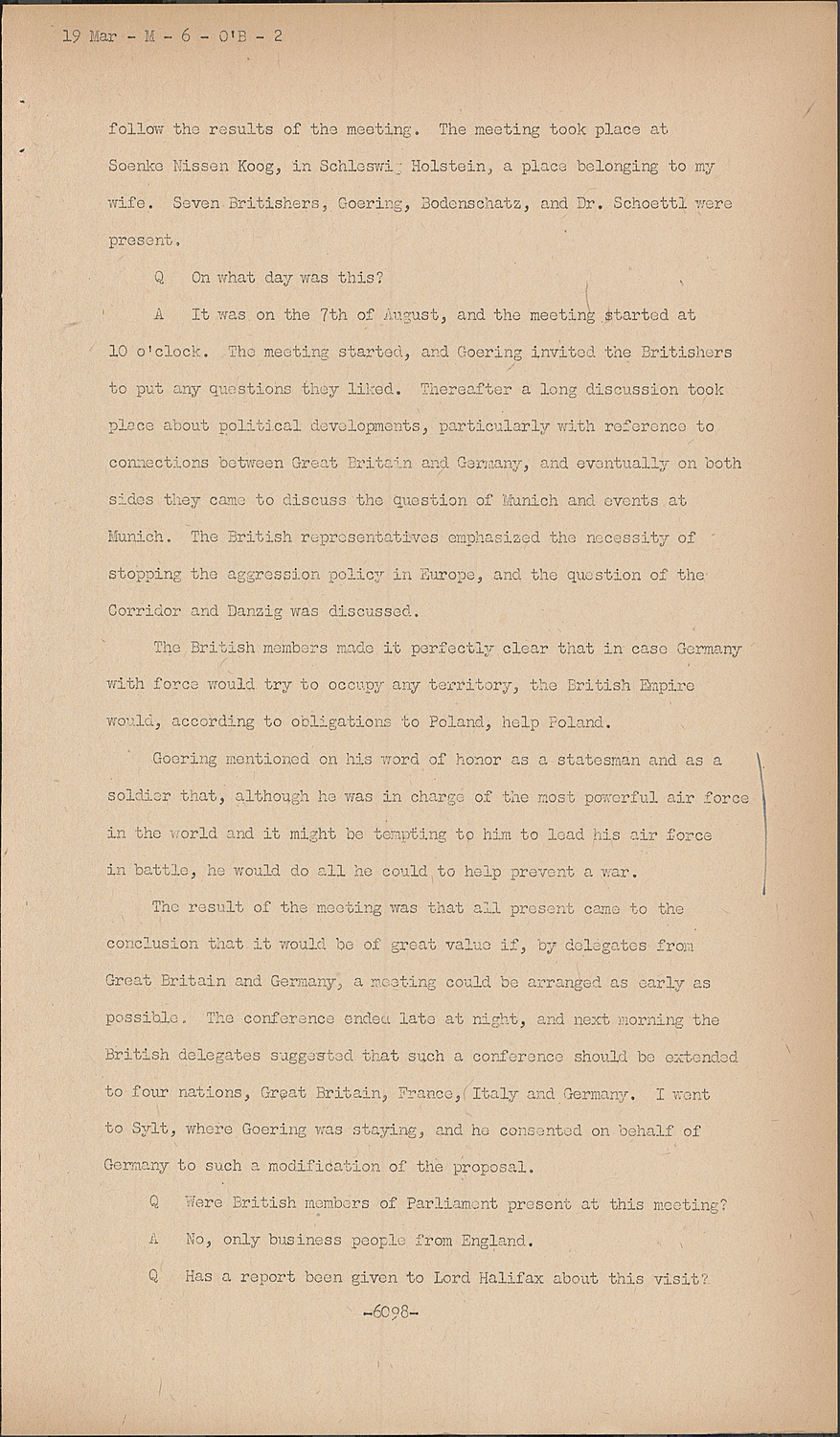
The meeting took place at Soenke Nissen Koog, in Schleswig Holstein, a place belonging to my wife.
Seven Britishers, Goering, Bodenschatz, and Dr. Schoettl were present.
QOn what day was this?
AIt was on the 7th of August, and the meeting started at 10 o'clock.
The meeting started, and Goering invited the Britishers to put any questions they liked.
Thereafter a long discussion took place about political developments, particularly with reference to connections between Great Britain and Germany, and eventually on both sides they came to discuss the question of Munich and events at Munich.
The British representatives emphasized the necessity of stopping the aggression policy in Europe, and the question of the Corridor and Danzig was discussed.
The British members made it perfectly clear that in case Germany with force would try to occupy any territory, the British Empire would, according to obligations to Poland, help Poland.
Goering mentioned on his word of honor as a statesman and as a soldier that, although he was in charge of the most powerful air force in the world and it might be tempting to him to lead his air force in battle, he would do all he could to help prevent a war.
The result of the meeting was that all present came to the conclusion that it would be of great value if, by delegates from Great Britain and Germany, a meeting could be arranged as early as possible.
The conference ended late at night, and next morning the British delegates suggested that such a conference should be extended to four nations, Great Britain, France, Italy and Germany.
I went to Sylt, where Goering was staying, and he consented on behalf of Germany to such a modification of the proposal.
QWere British members of Parliament present at this meeting?
ANo, only business people from England.
QHas a report been given to Lord Halifax about this visit?
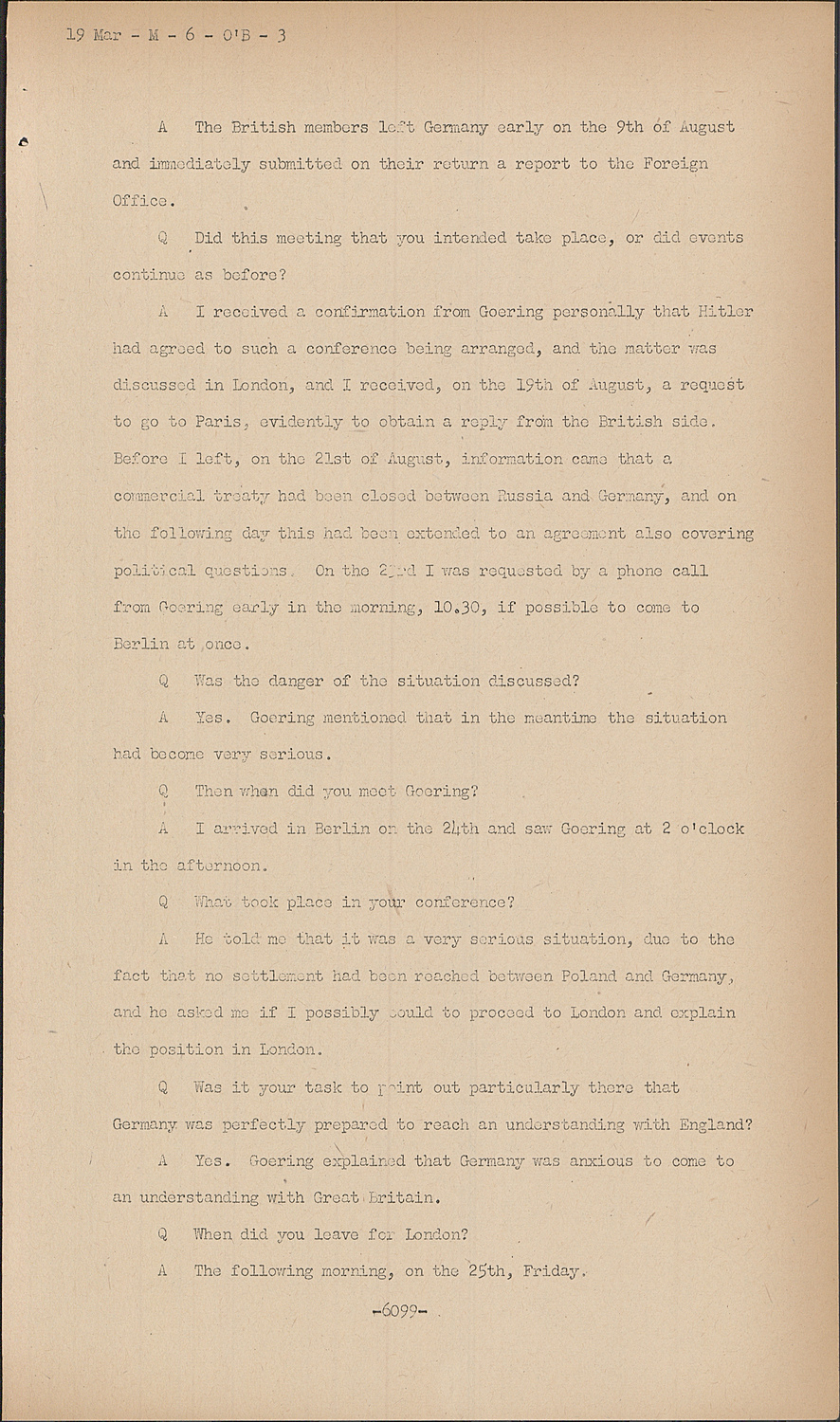
A The British members left Germany early on the 9th of August and immediately submitted on their return a report to the Foreign Office.
QDid this meeting that you intended take place, or did events continue as before?
AI received a confirmation from Goering personally that Hitler had agreed to such a conference being arranged, and the matter was discussed in London, and I received, on the 19th of August, a request to go to Paris, evidently to obtain a reply from the British side.
Before I left, on the 21st of August, information came that a commercial treaty had been closed between Russia and Germany, and on the following day this had been extended to an agreement also covering political questions.
On the 23rd I was requested by a phone call from Goering early in the morning, 10.
30, if possible to come to Berlin at once.
QWas the danger of the situation discussed?
AYes. Goering mentioned that in the meantime the situation had become very serious.
QThen when did you meet Goering?
AI arrived in Berlin on the 24th and saw Goering at 2 o'clock in the afternoon.
QWhat took place in your conference?
AHe told me that it was a very serious situation, due to the fact that no settlement had been reached between Poland and Germany, and he asked me if I possibly could to proceed to London and explain the position in London.
QWas it your task to print out particularly there that Germany was perfectly prepared to reach an understanding with England?
AYes. Goering explained that Germany was anxious to come to an understanding with Great Britain.
QWhen did you leave for London?
AThe following morning, on the 25th, Friday.
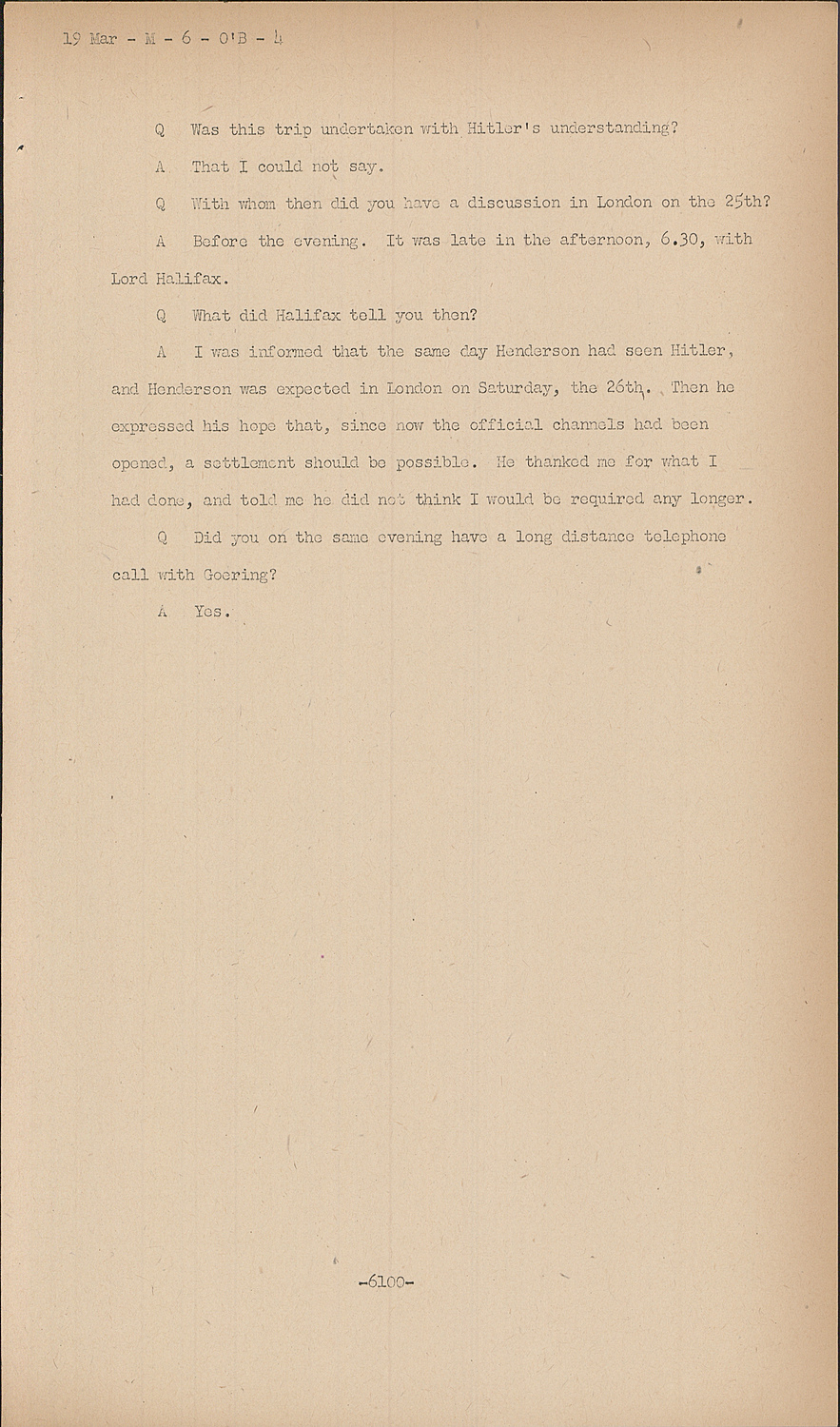
Q Was this trip undertaken with Hitler's understanding?
AThat I could not say.
QWith whom then did you have a discussion in London on the 25th?
ABefore the evening. It was late in the afternoon, 6.30, with Lord Halifax.
QWhat did Halifax tell you then?
AI was informed that the same day Henderson had seen Hitler, and Henderson was expected in London on Saturday, the 26th.
Then he expressed his hope that, since now the official channels had been opened, a settlement should be possible.
He thanked me for what I had done, and told me he did not think I would be required any longer.
QDid you on the same evening have a long distance telephone call with Goering?
AYes.
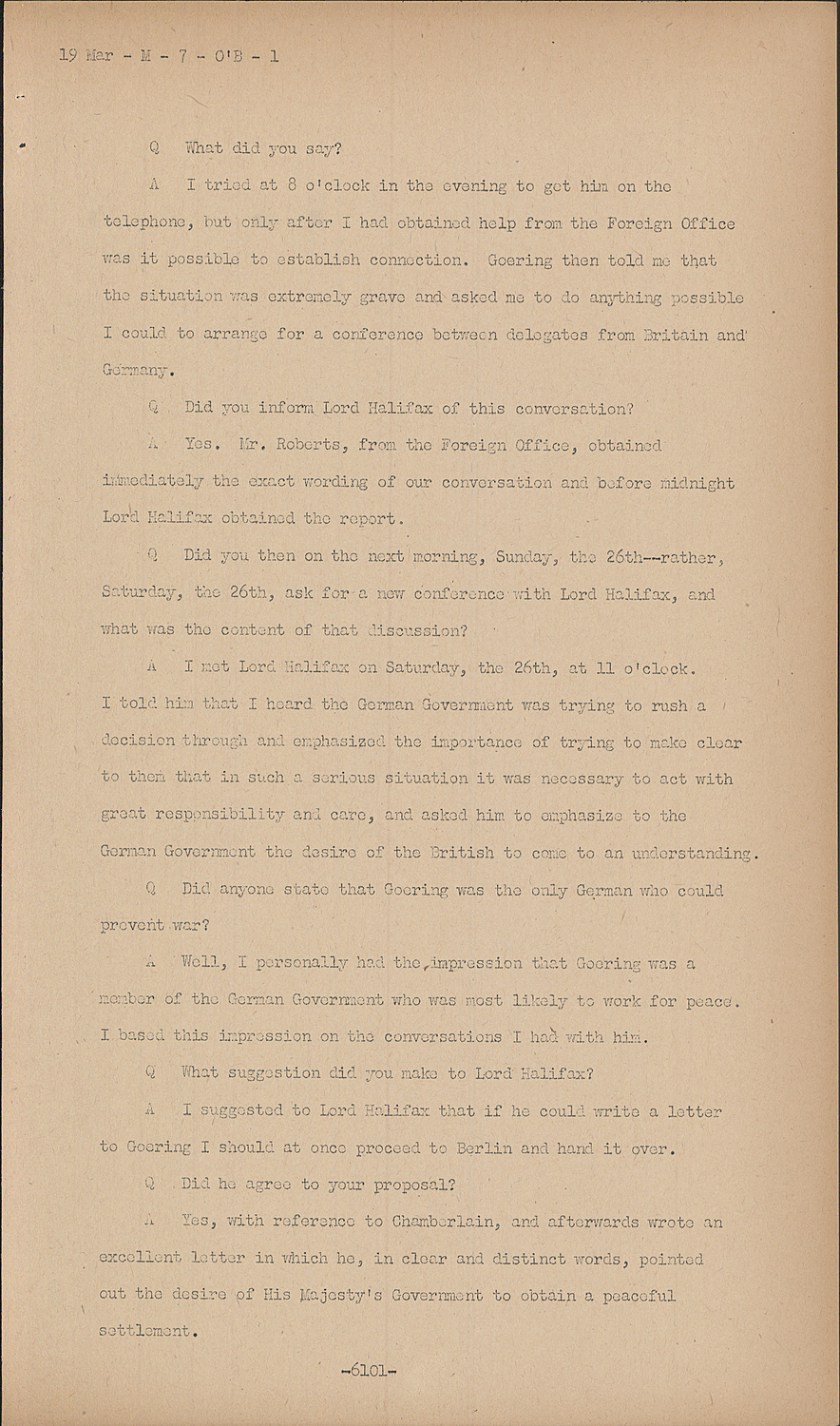
Q What did you say?
AI tried at 8 o'clock in the evening to get him on the telephone, but only after I had obtained help from the Foreign Office was it possible to establish connection.
Goering then told me that the situation was extremely grave and asked me to do anything possible I could to arrange for a conference between delegates from Britain and Germany.
QDid you inform Lord Halifax of this conversation?
AYes. Mr. Roberts, from the Foreign Office, obtained immediately the exact wording of our conversation and before midnight Lord Halifax obtained the report.
QDid you then on the next morning, Sunday, the 26th--rather, Saturday, the 26th, ask for a new conference with Lord Halifax, and what was the content of that discussion?
AI met Lord Halifax on Saturday, the 26th, at 11 o'clock.
I told him that I heard the German Government was trying to rush a decision through and emphasized the importance of trying to make clear to then that in such a serious situation it was necessary to act with great responsibility and care, and asked him to emphasize to the German Government the desire of the British to come to an understanding.
QDid anyone state that Goering was the only German who could prevent war?
AWell, I personally had the impression that Goering was a member of the German Government who was most likely to work for peace.
I based this impression on the conversations I had with him.
QWhat suggestion did you make to Lord Halifax?
AI suggested to Lord Halifax that if he could write a letter to Goering I should at once proceed to Berlin and hand it over.
QDid he agree to your proposal?
AYes, with reference to Chamberlain, and afterwards wrote an excellent letter in which he, in clear and distinct words, pointed out the desire of His Majesty's Government to obtain a peaceful settlement.
Q Did you then fly back to Berlin with this letter?
AYes. I reached Berlin in the evening and met Goering about 10 o'clock in the evening.
QDescribe to the Tribunal what happened during this conference with Goering regarding your conference with Halifax?
AI met Goering in his train which was just on the way to headquarters.
I told him about conditions in London and emphasized that there was no doubt that, if the German Government took a step against Danzig, they would be involved with Great Britain, but that I was satisfied the German Government would do what it possibly could to avoid a crisis.
After having explained to him, I handed him the letter.
He tore it open, and after having read through it, he put it before me and asked me to carefully translate it, because it was of great Importance that the contents were clearly understood.
Immediately he told the adjutant to order the train to stop at the next station and declared that he felt it was necessary immediately to inform Hitler of the letter.
I followed him in the car to Berlin, and exactly at 12 o'clock midnight he stopped outside the Reichkanzlei, where Goering started out to see Hitler and I proceeded to my hotel.
QThat was on the 27th of August, in the evening or early morning of the 27th of August?
Did you have a conference with Hitler?
AI was called on by two officers about a quarter past 12 midnight, who asked me to come to Hitler, and upon immediately arriving I was received by him, and with him was only Goering.
QPlease describe this discussion more exactly.
AWell, Hitler started in his usual way with a long explanation of German policy.
It lasted about twenty minutes, and I thought that no useful purpose would be served by my visit.
At a suitable opportunity, when he was running down the British Nation and Great Britain, I interrupted and told him I have been working as a working man, an engineer, and in charge of industries in Great Britain, and I knew the people well, and I had to disagree with his statements.
We came into a long discussion when he asked lots of questions about England and the British people.
Afterwards, he started to explain to me how well the armed forces of Germany had been equipped.
He then looked rather excited, walked up and down, and in the end he got in a very excitable stage and told me that, if it same to war, "I will build U boats, U boats, U boats--U boats I will build," and he seemed to be speaking as if he didn't realize somebody was present.
After a while he shouted that he would, build airplanes, airplanes--airplanes he would build and he would win the war.
After a while he calmed down and began to speak about England and said, Mr. Dahlerus, tell me why I never succeed to come to an arrangement with the British Government.
You seem to know England so well, you might be able to explain?
I hesitated, but told him that with my intimate knowledge of the British people I was satisfied that the lack of confidence in him and his Government was the reason.
QContinue.
AThe conversation went on. He gave me a long resume about his discussion on Friday with Henderson, and at the end he asked me to go ever to London at once and explain his viewpoints.
I naturally refuse, telling him that I could not go as an emissary for the German Government, but if the British Government expressed the desire that I should came over I was prepared to go.
The condition was, however, that I had full knowledge of the exact conditions and proposals that he wanted to make.
We spent an hour and a half, during which he fully explained the various points much more in detail than he had the time to explain to Henderson.
Q What specific proposals did you make?
AIn condensed form, they are as follows:
(1) German to sign a pact or alliance with Great Britain.
(2) England was to help Germany to obtain Danzig and to obtain Corridor, (3) Germany pledged herself to care for Poland's populace.
(4) An agreement should be reached about Germany's colonies.
(5) Adequate provisions should be made for the treatment of the German minority in Poland.
(6) Germany pledged herself to defend the British Empire with the German Wiermacht whenever the former might be attacked.
QRegarding point (2), was not Poland assured that it would have a free harbor in Danzig?
AYes. That is true. This is only a condensed form of the proposals, of course.
QIs it true that Poland did have a free harbor?
AThat is what Hitler said, Yes.
QWhat was the further course of this conversation?
AI left on a special plane in the morning, after having been in contact with London, and met Mr. Chamberlain, Lord Halifax, Sir Horace Wilson, and Sir Alexander Cadogan.
QThis is or the 27th of August, is that not so?
AThe 27th of August, at Downing Street No. 10.
QWhat took place during this conference with Lord Halifax and Mr. Chamberlain?
AWe discussed the proposals made in great detail. On certain points, as will be seen from the blue books, these proposals differed from these made to Henderson. I therefore suggested to the British Government, if they had full confidence in me as an intermediary, they should tell me how far they could accept he proposals or not, and I should go back to Berlin the same day and discuss the British viewpoints with Hitler and Goering. They should retain Henderson in London until Monday so that their reply could be given after they knew how Hitler viewed the British standpoint.
QDuring these days, did you also have a conference with Sir Alexander adegan?
A After the meeting with members of the Government I mentioned above, I had a long conversation with Cadogan.
QDid you receive specific proposals from him?
AYes.
QWhat were they?
AThe British Government took a lot of trouble to deal in a fair and respectable way with the various points. Naturally, point (6), the offer of defending the British Empire, was turned down. Similarly, they refused to discuss colonies before Germany had demobilized, and in reference to the boundaries of Poland, they wanted these boundaries to be carried by five great powers: Russia, Germany, England, Prance and Italy.
In reference to the Corridor, they recommended immediate negotiations with Poland.
In reference to point (8), rather to point (1), England was in principle willing to come to some agreement with Germany.
QDid you then return to Germany with these proposals?
AYes, after having telephoned to Berlin, because the British Government promised to send Henderson back the same day, and obtaining confirmation from Berlin that they agreed with Henderson's delay in returning on Monday, I left that evening and arrived shortly before midnight at Berlin.
QDid you then immediately have a conversation with Goering?
AI met Goering about 11:10 on Sunday evening and told him about the results.
QCan you describe that conversation a little more exactly?
AHe replied that it was fatal, but I explained to him that considering events during recent years, he could hardly expect Great Britain to be satisfied with the Corridor of Poland. And in reference to the colonial question, I explained to him that any British Government trying to force this point in Parliament as long as Germany's forces were mobilized would be bound to fall at once.
In reference to the 6th point, I would like to make it clear that Great Britain, or the British Empire, wouldprefer to look after their own interests.
In the end, he said that it would be better if he saw Hitler alone. He left for Reichskenzlei and I went back to my hotel.
About 1:00 on Monday morning, the 28th, I received a telephone call that Hitler accepted the British viewpoints subject to the reply Henderson gave the next day would in general be the same as I had given.
QDid you not then, on the same evening, talk to the English Ambassador?
AYes. I went straight to the British Ambassador and reported to Sir George Ogilive Forbes the results of my conversation with Goering and he cabled to London.
QDid you inform Goering of what happened during that conversation?
AWell, naturally I was acting quite openly, so I told Goering what I intended to do so it was with full knowledge of the German Government that I discussed it with Forbes.
Q When did you then meet Goering next?
AI met Goering on Monday morning, the 28th, at his headquarters.
QWasn't this Tuesday?
ANo, Monday morning. It was Monday morning, the 28th.
QWhat took place during this conversation with Goering?
AIn general, about the position, and he seemed satisfied with the fact that Forbes had cabled to London.
QDid you then visit Forbes again?
AYes, I met Forbes afterward but that was not of great importance.
QThen on Tuesday you met Goering again, Tuesday morning?
AWell, the most important that happened was that Tuesday morning or just after midnight, 1:15, on the 29th, I received a telephone call from the Reichskanzlei on the request of Goering, from Oberstleutnant Konrad, that Henderson had given his written reply and this was most satisfactory and there was every hope that there would be no risk of war.
I met Goering afterwards on Tuesday morning and he expressed to me his great pleasure that things had developed so well.
QDidn't he make a statement as follows: We want peace and peace is assured?
AYes, that is a fact.
QThen in the course of the 29th of August you were called up once again by Goering. Why?
AI was at my hotel late in the evening, about 10:30. I was called up by Forbes, who told me he had to see me at once. He came to my hotel and explained that a meeting between Hitler and Henderson on Tuesday evening had been most unsatisfactory and they departed after a great quarrel. And he asked me what I could suggest under the circumstances.
During our conversation I was called to the phone by Goering, who asked me to come to his house in Berlin. He told me the same thing, and seemed very upset at developments. He showed me the German reply to the British note and went through it carefully and tried to explain the reasons for the formulation of the note. In the end he asked me at once to proceed to London again and try to explain this unfortunate incident to the British Government, and if it is not, by explaining that Hitler was busy on a proposal to Poland that probably would be ready the next day.
After consultation through Sir Kingsley Wood, the Air Minister, about a new visit to England, I left on Wednesday morning, 5 o'clock. Immediately after my arrival in London I met the same members of His Majesty's Government.
Q Whom did you meet there?
AI met some of the members, Mr. Chamberlain, Mr. Halifax, Mr. Horace Wilson, and Cadogan.
QWhat took place during the conversation?
AIt was obvious that by that time the British Government was most suspicious, and rather inclined to feel that whatever efforts were made from their side nothing would prevent Hitler from declaring war on Poland. The British Government did everything they could. They sent their ambassador to Warsaw to request the Polish Government to do everything they possibly could to avoid incidents along the border, but they explained to me that it was hardly fair to expect the Polish Government to send delegates to Berlin to negotiate after the experience the other countries had had during recent years when they had been on similar missions to Berlin.
I telephoned to Berlin for a contact with Goering with the object of trying to persuade him to arrange for a meeting outside of Germany for the delegates, but he only said that this was impossible; that Hitler was in Berlin and the meeting had to take place in Berlin. They indicated proposals to Poland, but members of the British Government viewed these proposals with great suspicion. The Polish government was going to have a meeting in the afternoon, and cable results to Berlin. In the meantime I returned to Berlin.
QWhen did you meet Goering there?
AI met Goering-
THE PRESIDENT:Could you make this a little bit shorter, Dr. Stahmer.
DR. STAHMER:Since these are very essential matter, I believe it is being shortened as much as possible, Your Honor.
THE PRESIDENT:Mr. Dahlers, the Tribunal wishes you to get to the crucial matters as soon as possible.
THE WITNESS:Well, I met Goering just after a midnight on a Wednesday. He first informed me about the proposal made to Poland, and he showed me the note. I telephoned Forbes to obtain results. He then told me that Ribbentrop had refused to give him the note after he had read the proposal. I immediately told Goering that it would be impossible to treat an Ambassador of an empire like that, and suggested he should allow me to telephone Forbes, and to give Forbes the contents of the note on the telephone. I did this about one o'clock on Thursday morning.