
The farmers were working and every sign of peaceful life existed.
QAre you aware of any crimes committed - sex crimes -- committed by German soldiers in the East? Are you aware of any cases of violations of international law and did you in such cases always use every means at your disposal to deal with them?
AAt least I tried to. I did that since I was interested in preserving the reputation of the German Army, and I did it because I wanted to preserve the relations between us and the Italians. For those reasons I proceededagainst German soldiers who violated any of these paragraphs with which we are here concerned. However, since I was aware that war is a nasty business and that as the years go by men become raw, I always considered it necessary to order preventative measures.
These preventative measures which I am sure the Allied Armies noticed on the spot when they marched through Italy -- I am referring to my various decrees for punishing violators which were generally and publicly knownthese preventative measures prove the wards which I have just spoken.
Preventative measures which I took included an order that towns -or if that was difficult, at least the interior of towns -- were to be cleared of administrative officers, and that towns and centres should be fenced off.
Furthermore, as far as anti-aircraft interests permitted, soldiers were to be accommodated in barracks or drawn together in a small order.
Furthermore, that isolated cases which always caused such orders were summed upand any return leave journeys used to proceed in groups. Thus the supervising authority were given strict instructions, field police and military police were attached; they had summary courts martial attached to them.
The selling-out in Italy which played an important part was to be stopped -- it was to be stopped by a liaison with the Italian Government, and two large stores were to be established on the return route, where soldiers should be able to purchase certain goods. Certain punitive measures were introduced. Cases which were reported to me by the Italians or Germans were always taken care of. Perpetrators were prosecuted. When operations prevented my personal interference on the spot, I made it known that all cases would later on be prosecuted by me. And in other cases, when solution became difficult, I fixed the death penalty and set up special courts-martial. Few of these death penalties served to solve the problem, However, against any superiors who would protect their soldiers, I proceeded -- if they were too lenient in carrying out their tasks.
I believe that files referring to these things are all available and that the reports from the front reached police and law courts and so forth.
QWitness, are you aware of any violations of international law on the part of your opponents?
ADuring my many visits to the front I did, of course, come across a large number -
GENERAL RUDENKO:I protest against putting the question in this way. From my viewpoint, the witness is not competent to conclude whether Germany's enemies have broken international law. I believe that this question should be put aside.
DR. LATERNSER:May I defend my attitude on that question? I am interested in having that question answered since subsequently I want to put the further question to the witness, whether after he heard of violations of international law from the other side he then failed to proceed against violators of international law on his own side. That is the reason I am anxious to have that question answered.
THE PRESIDENT:The Tribunal would like to know exactly what your question is and why you say it is competent.
DR. LATERNSER: The exact wording of the question is as follows:
I request of the witness, Are you aware of violations of international law committed by the opposing side?
Depending on the answer he would give to that, I would then ask him the following question:
Whether after having discovered violations of international law by the opponents he took the attitude that violations of international law committed by his own men should for this reason either not be punished at all or less severely.
From the answers to these questions I want to draw conclusions on the attitude and views of a member of the group, and for that reason I consider the answers to these questions of extreme importance.
THE PRESIDENT:The Tribunal would like to hear what Counsel for the United States says about it.
MR. JUSTICE JACKSON:If your Honor please, I believe it is a wellestablished principle of international law that a violation on one side does not excuse or warrant violations on the other side. There is, of course, a doctrine of reprisal, but it is clearly not applicable here, on any basis that has been shown.
In the second place, even if the treatment of the subject-matter were competent, here is a broad question, "Did you hear of violations of international law?" It would at least, even if the subject were proper, require that some particularity of a case be given. A broad conclusion of a charge -- a violation of internationallaw -- would hardly be sufficient to inform this Tribunal as to the basis on which this witness may have acted.
If there were some specific instance, with credible information called to his attention, there might be some basis; but merely the question as asked by Counsel does not afford a basis here.
It seems to me we are getting far afield from the charges here and that this is far afield from anything that is involved in the case. I do not know what particular atrocities or violations of international law are to be excused by this method. There must have been atrocities committed, on the basis of which thereis sought to be excused atrocities committed by somebody else. Who else committed them, where they were committed -- is a subject we might have have to try if we went into this subject.

It seems to me that the inquiry is quite beside the point and if it were, if there is anyway that it is within the point, it is improper when put in this manner.
DR. STAHMER: This question which is of principal importance has some-
time ago already once been put before this Tribunal. It was when I applied to present "white books" in which reports about atrocities were contained. I think it was at the session of February 25.
At that time Professor Exner defined his attitude, expressed his views on that question and the Tribunal then permitted me to submit these "white books", subject to information on the subject of what out of these books was to be presented.
At that time the Tribunal's attention was drawn to the fact that the question whether atrocities were committed on the other side as well was important since this would primarily contribute information as to the German attitude and it would explain the German attitude, since the motive for the perpetration is also of decisive importance and important also for the findings. It will be necessary to realize that the perpetration on the German side will have to be judged differently, if in fact a perfectly correct procedure was adopted by the other side.
It is furthermore of importance whether in a case like this we are not concerned with reprisals.
Because of these considerations the question as was put here should at all events be of importance and be permitted to be put.
THE PRESIDENT:The Tribunal will adjourn for ten minutes.
(A recess was taken.)
THE PRESIDENT: The Tribunal have considered the questions which Dr. Laternser proposed to put to the witness and have also considered the objections made by General Rudenko and Mr. Justice Jackson, and they hold the questions are inadmissible.
DR. LATERNSER:Mr. President, I assume that I may be entitled to put the following question. BY DR. LATERNSER:
QWitness, have you not refrained fromprosecuting the violations of international law of your own men when violations of that law by your opponents were reported to you?
THE PRESIDENT:That seems to me to be putting in one question what before you put in two.
DR. LATERNSER:Mr. President, that question is meant to cause the witness to name violations of international law committed by the opponents.
In having that question answered, I merely want to get at the typical views of the witness, namely, that as supreme commander he was anxious to prosecute all known violations of international law, although he had had reports about violations committed by the opponents.
I withdraw the question.
THE PRESIDENT:The Tribunal would see no objection in your asking the witness whether he was anxious to avoid violations of international law; if you wish to put that ques ion to him there willbe no objection to that question. The question which you have suggested putting is really identical with the questions you put before. BY DR. LATERNSER:
QWitness, during this trial severe accusations have been made because of atrocities committed by German soldiers. Is not every soldier sufficiently well informed about international regulations, and has he not been instructed on that subject?
AI must asnwer that question in the affirmative. During the many addresses which I have delivered to my subordinate commanders, such pointers and instructions have continuously been issued.
Q Did you, as commander of an army group, try to protect towns containing art treasures and churches?
AI regarded it as a matter of course and as a duty to respect cultural objects and art treasures of churches. I gave orders accordingly, and during my tactical actions my measures were designed in that respect, What do you know about the treatment of prisoners of war who fell into German hands?
APrisoners of war were treated according to international law, after certain controls which I had ordered to be carried out. If there were violations, the commandant in question was warned and these matters were terminated.
QI have only three more questions.
Were you previously informed, as Field Marshal, that Italy would enter the war?
ANo, I had not been informed about that. As far as I know, the entry of Italy into the war occurred so spontaneously that even the political leaders were surprised.
QAnd were you previoulsy informed that a declaration of war should be placed against America?
ANo. I can't say anything about these questions.
QAnd now the last question. What was the situation regarding the retirement of military leaders during the war?
AA resignation from the armed foeces on one's own initative, or an application to resign from the armed forces, was not permissible. During the later years --that is to say, 1944--an order existed which threatened severest penalties and prohibited the exercising of those rights or any changes in theleading positions. The Supreme Commander of the Armed Forces reserved for himself that right, alone, and exclusively.
QBid an order exist about that fact?
AYes; I should so assume, yes.
DR. LATERNSER:I have no further questions. BY PROFESSOR DR. JAHRREISS (Counsel for defendant Jodl):
QWitness, you said, a little earlier, that the military commanders in the military field had the right and the possibility to put demands to the Supreme Commander of the Armed Forces, Hitler, and express their views.

Did I understand that correctly?
AYes.
QDid you personally discuss matters--did you have differences of opinion with Hitler about matters referring to orders?
AIn questions relating to operations, very considerable difficulties.
QWere they actual conflicts?
A "Conflict" is probably saying too much; certain changes of opinion.
QShall we say quarrels, and frequently, if I understand you correctly?
AYes.
QAfter everything we have heard, Adolf Hitler must have been a fairly difficult customer.
AThat must be admitted. On the other hand, I--I don't know why--was lucky enough to find him understanding as to the questions which I put up to him.
QDidn't these quarrels with Hitler solve themselves?
AIn critical cases I was asked for by General Jodl.
QYou mean when you couldn't get through?
ANo, when he couldn't put his point over.
QThen you were asked for, yes, I see.
Was Jodl also of a different opinion than Hitler?
AOn various occasions when I reported, I found very definite differences of opinion between the two gentlemen, and I found that Jodl--who was our administrative superior in the OKW--acted with remarkable energy and presented his views. He adhered to his views right to the end.
Q What do you mean, he was your representative at the OKW?
AThe theaters of war, when I was a gneral in the armed forces, were so-called OKW theaters of war. Contrary to other army theaters of war, the East was an army theater of war, whereas the others were known as OKW theaters of war.
QDid the OKW have no influence on theaters of war in the East, and did the Army have no influence in the OKW theaters of war? I don't believe that everybody will understand the difference.
AIt is asking a bit much, since I myself didn't have enough understanding for that situation.
QYou, in other words, were in an OKW theater of war. What does OKW stand for?
ASupreme Commander of the Armed Forces. Immediate subordination of the supreme commander under Adolf Hitler, and then the command department under Jodl's staff of leaders.
QIn an original interrogation I talked about n order from the OKW. Who is OKW? Who gave these orders?
AOrders of a principle nature only originated from one person, and that was Adolf Hitler. The other personalities were executive officers, which did not exclude, however, the executive organs having their own conception or the conception of the army groups under their command. They could include the views of army groups, when they represented these army groups with Adolf Hitler.
QThat surprises me somewhat, what you are saying now. The opinion has been voiced that Jodl, whom you defined as a sort of administrative man, was a cheap tool of Adolf Hitler?
AI believe one doesn't exclude the other. I cannot imagine a marriage lasting six years without both sides making attempts to misunderstand. On the other hand, I can imagine that in every good marriage there must be frightful disputes.
QBut in a normal marriage the husband doesn't necessarily have to be a cheap tool, a willing tool.
AHere the situation is rather different. That comparison, that example, seems to limp, as all examples do, and, of course, it limps once more.
In the military theory, we have the absolute subordination principle.
QYes, but what you just explained to me about the position of Jodl as administrator for the supreme commanders sounds to me as if Jodl would have to be the intermediary.
AJodl in an incredible manner has always represented our interests, thus acting as an intermediary for everybody.
QDid he also express his opinions, if they were opposed to Adolf Hitler's opinions, if Hitler published one of his orders?
AI can only say one thing, that during the few visits I paid to the HQ, when I saw Jodl get red in the face, that he expressed his views in such a way that I considered it just about bordering the possibilities a military person had.
THE PRESIDENT:The Tribunal will adjour.
(The Tribunal adjourned until 13 March 1946, at 1000 hours.)
Official Transcript of the International Military Tribunal in the matter of the United States of America, the French Republic, the United Kingdom of Great Britain and Northern Ireland, and the Union of Soviet Socialist Republics, against Hermann Wilhelm Goering et al, Defendants, sitting at Nurnberg, Germany, on 13 March 1916, 1000-1300, Lord Justice Lawrence presiding.
THE PRESIDENT:The Tribunal has made an order with respect to further proceedings on the charge against Organizations and the applications of members thereof. I don't propose to read that order, but the order will be posted on the Defense Counsel's information board and will be communicated to them and to the Prosecution.
Dr. Jahrreiss, had you finished your examination?
DR. JAHRREISS:Yes.
THE PRESIDENT:Very well. Does any other of the Defense Counsel wish to examine the witness?
ALBERTKESSELRING-resumed.
DIRECTEXAMINATION--continued. BY DR. KAUFFMANN:
QWitness, have you any recollection when the Defendant Kaltenbrunner first became publicly known?
AI have no knowledge of Kaltenbrunner becoming prominent. The first time I had known Kaltenbrunner was when he appeared as the successor to Canaris.
QHave you any recollection to the effect that he, Kaltenbrunner, in January, 1943, was made the Chief of the RSHA?
AI may have heard about that, but I have no certain recollection of it.
QKaltenbrunner states that in April, 1945, he was anxious to exclude the country of Austria from the war. Have you any recollection of that?
AI merely heard that Kaltenbrunner was one of these personalities who were working for an independent Austria, but any definite certain knowledge of that situation I have not.
Q Furthermore, Kaltenbrunner states that he, on the basis of an arrangement with the Red Cross at Geneva, which said that civilian internees should be led through the front and back to their homeland, that he had communicated that arrangement to your office--not to you personally--and that he had expressed the wish that a gap should be created in the fighting line to let these people through.
AIt is quite possible that such an application was actually made, but I did not gain any personal knowledge of it. I was away from my office a great deal.
QHave you, witness, any recollection when concentration camps were first instituted in Germany?
AYes. It was in 1933. I remember three concentration camps, the installing of which I cannot exactly remember when. I passed them quite frequently; I flew over them, and I am thinking of Dachau which was talked about a great deal, and Weimar which was a concentration camp over which I flew quite frequently, and I have no recollection of any other concentration camp, but perhaps I may add that, as to the rumors which were very frequent during these days of crisis I had no time to devote myself to such rumors since I was extremely busy.
QRegarding the internees in these camps, did you have any clear-cut picture regarding who would be brought to these concentration camps?
AI did have. I heard views on that-I cannot remember who from-which seem plausible to me. I was told that the National Socialist Revolution should be achieved without loss of blood and that political opponents should be put into a safe place until the construction of the new State was given a firm basis and then they should be returned to public life. That is my view, my knowledge of the situation, but from that I rather concluded--to answer your question--that these people were mostly persons who were opposed to the National Socialist views.
Q Have you ever thought about the problem of how, in your conception, people were treated in these camps; what was your idea about the treatment of these internees in the camps?
There may be a difference whether you are thinking of the first and earlier or later years?
AAbout the method of treatment in the camps I have no knowledge at all. During the earlier years, when I was still active in Germany, one heard rumors to the effect that treatment was normal. In the later years I was abroad, that is to say, in the war, and I was so far away that I gained no knowledge of these things and wasn't interested in it.
QIs it right therefore to assume, as far as the atrocities were concerned, which did actually occur, you had no positive knowledge?
ANo, did not have any positive knowledge, not even in March 1945, when I became Supreme Commander in the best; even then things, stories from concentration camps were completely strange to me. This I attributed to two facts. One, the personal attitude which I have expressed earlier, that I principally concerned myself with my own business, which was very considerable, and secondly, that within the State a Police State had developed which, in a hermetic way, closed itself off from the rest of the world.
Q Have you any clues from contact with your officers corps that there was more knowledge about these things then what just came to yourself?
AThe contact which was with my office was extremely a good one. I do not believe that any large number of officers could have existed who knew more about these things, but of course I can not answer that question for the individuals.
QDid you know that Hitler had decided to eliminate the Jewish people physically?
AThat is certainly not so.
QDid you not have frequent opportunities to talk to Hitler about whether this was a competent question?
AWhenever I was at headquarters then during the official part of the conversation and any military questions were talked about and asked about, no question was put to Hitler. When I was invited to a meal, then historical matters of general interest would be talked about, but very few political problems of the work on political questions never came up for question. I personally can not remember any instance where Hitler influence any of the other gentlemen with regard to making an act personal.
QDid you believe in Hitler's personality in a sense that Hitler was determined to leave the German nation for a better Germany, but with consideration of personal freedom and respect to human dignity. What was your conception about that?
THIS PRESIDENT:What relevancy is that of a witness belief upon a subject of that sort. What relevancy has it got to do with any part of the case of defendant Kaltenbrunner. The Tribunal considers these sort of questions are a waste of the Tribunal's time. BY DR. KAUFFMANN:
QIs it correct that in the leadership state, which existed in Germany, of course, any contradiction by a human being of an order was impossible?
AIn that form I would not deny that. One could certainly represent one's own views, but if one's own views were enacted by some decision than the absolute obedience became necessary, and that absolute obedience was demanded under certain circumstances with the application of the penal laws. In other words, the resistance to that order, or an order, was under my impression, or to my knowledge, a personality and attitude of Adolf Hitler which was quite adequate to the question that he was not to be mislead about anything.
QWould a person listing a final issued order, and who tried to resist such an order, would he not have to expect to lose his life?
ADuring the later years that was an absolute certainty.
QDid you at any time, and if so, when did you think the war could not be won?
ABeginning with the year of 1943, one had to consider the possibility that a gainful peace could not be achieved. I emphasize that one had to expect that possibility, considering certain measures of the organization as correct that state could have been changed.
QDid you ever discuss these questions on a" higher level, in other words, your objection to continuing the war?
AAt various times when I talked within my military sector I had referred to a number of constructions which night influence the end of the whole war, but as representative of a certain military fear I though I would not be entitled in my position to judge the whole military situation, since after all I did not know the situation regarding the production, regarding the organization, and regarding the manpower; that I could not judge these matters from ay small opinion of view. As I said before, I refused as an amateur to make a statement about a situation, which under certain circumstances might be regarded as an official statement, since this would have been like a statement of that man Field Marshall Kesselring.
THE PRESIDENT:Will you kindly explain to the Tribunal what relevancy the last two or three questions have to the case of Kaltenbrunner?
DR. KAUFFMANN:I want to show that Kaltenbrunner, that he could not resist an order, that is what he said. It would have meant loss of his life.
THE PRESIDENT:You asked the witness whether at any time during the war he thought how long the war would last. What has that got to do with Kaltenbrunner?
DR. KAUFFMANN:The prosecution accuses several defendants that they held the knowledge of the possibility of victory had Germany continued to fight, to extend the war in that manner, and that is the problem that I want to clarify in my questions.
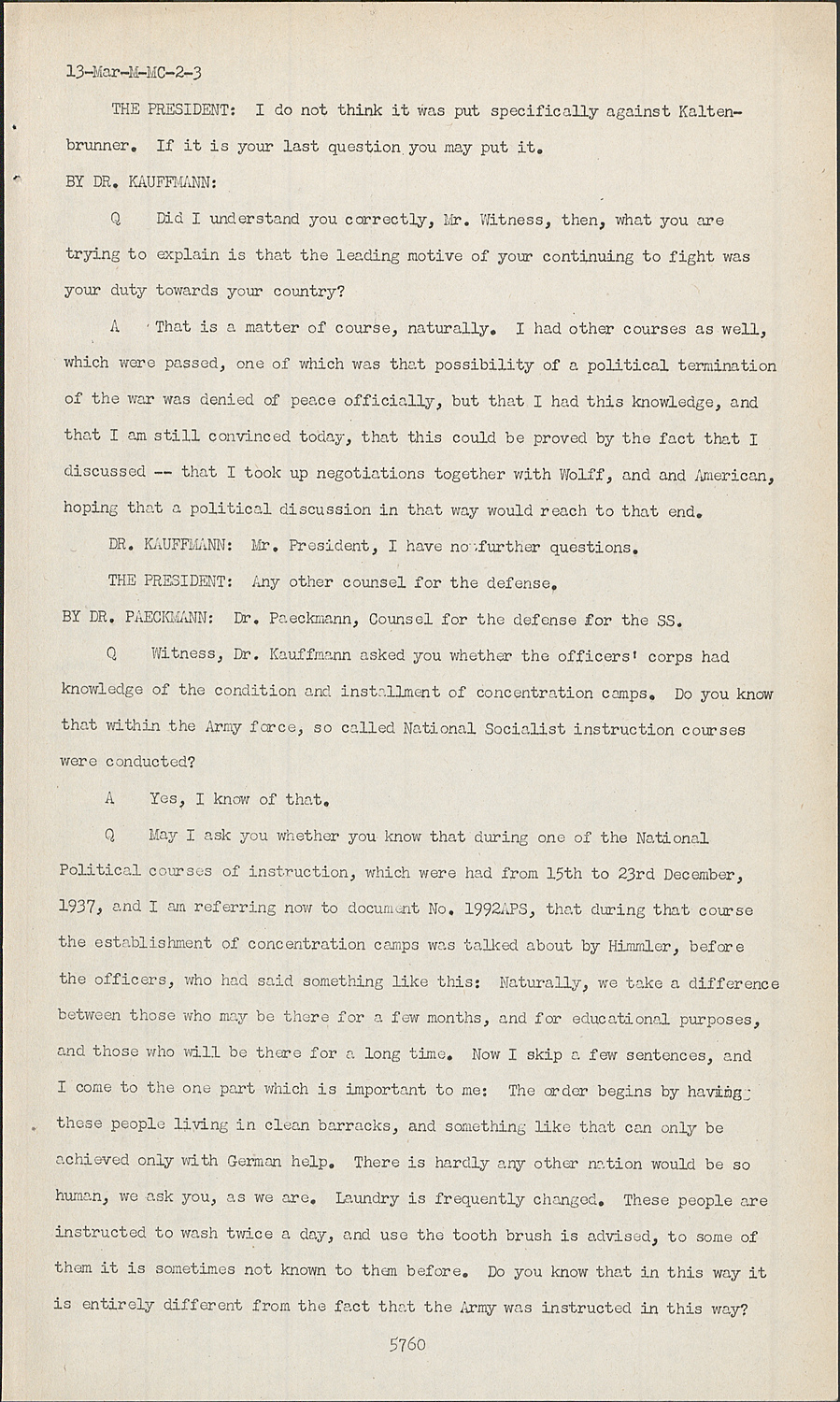
THE PRESIDENT: I do not think it was put specifically against Kalten-
brunner. If it is your last question you may put it. BY DR. KAUFFMANN:
QDid I understand you correctly, Mr. Witness, then, what you are trying to explain is that the leading motive of your continuing to fight was your duty towards your country?
AThat is a matter of course, naturally. I had other courses as well, which were passed, one of which was that possibility of a political termination of the war was denied of peace officially, but that I had this knowledge, and that I am still convinced today, that this could be proved by the fact that I discussed -- that I took up negotiations together with Wolff, and and American, hoping that a political discussion in that way would reach to that end.
DR. KAUFFMANN:Mr. President, I have no further questions.
THE PRESIDENT:Any other counsel for the defense. BY DR. PAECKMANN: Dr. Paeckmann, Counsel for the defense for the SS.
QWitness, Dr. Kauffmann asked you whether the officers' corps had knowledge of the condition and installment of concentration camps. Do you know that within the Army force, so called National Socialist instruction courses were conducted?
AYes, I know of that.
QMay I ask you whether you know that during one of the National Political courses of instruction, which were had from 15th to 23rd December, 1937, and I am referring now to document No. 1992APS, that during that course the establishment of concentration camps was talked about by Himmler, before the officers, who had said something like this: Naturally, we take a difference between those who may be there for a few months, and for educational purposes, and those who will be there for a long time. Now I skip a few sentences, and I come to the one part which is important to me: The order begins by having these people living in clean barracks, and something like that can only be achieved only with German help. There is hardly any other nation would be so human, we ask you, as we are. Laundry is frequently changed. These people are instructed to wash twice a day, and use the tooth brush is advised, to some of them it is sometimes not known to them before. Do you know that in this way it is entirely different from the fact that the Army was instructed in this way?
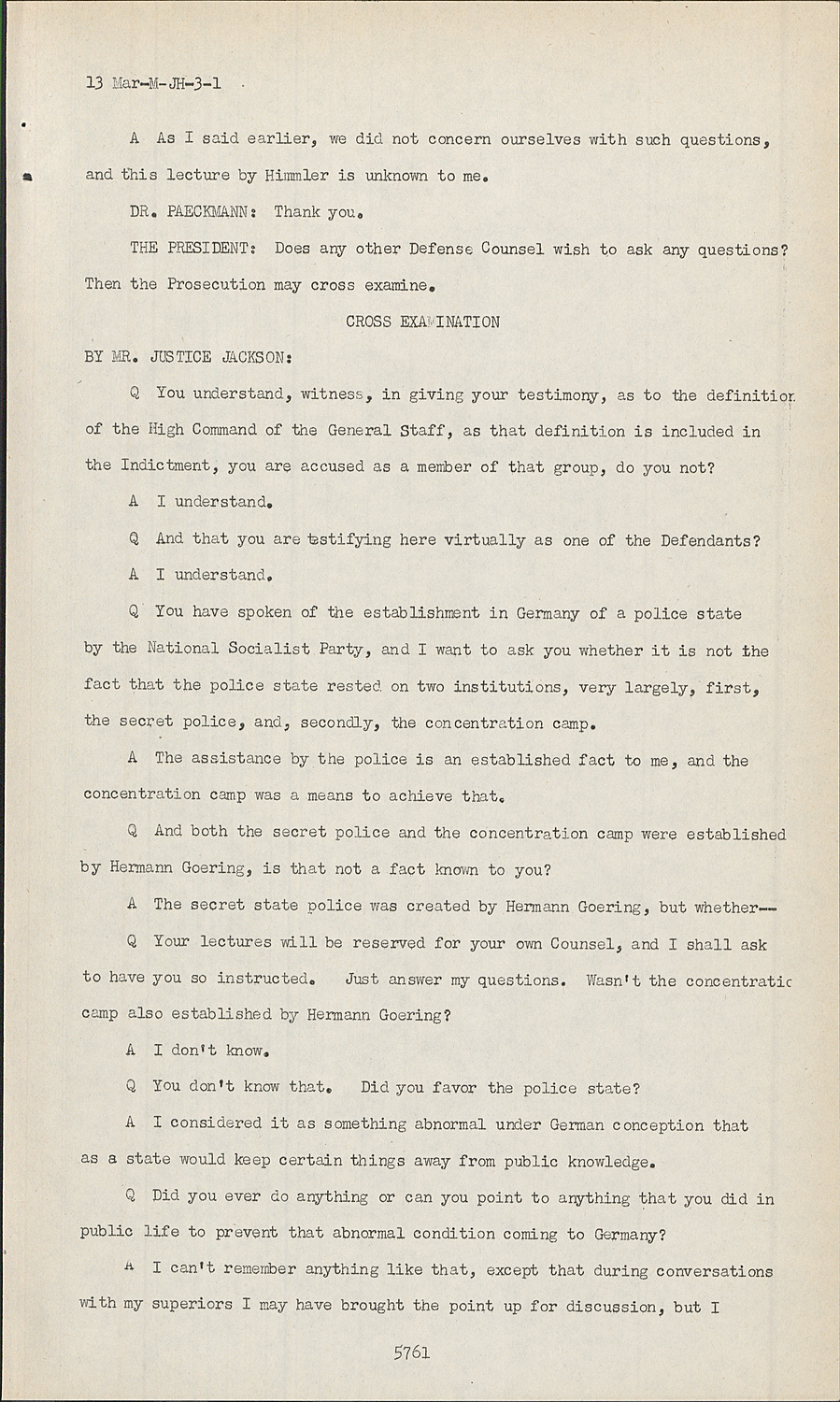
A As I said earlier, we did not concern ourselves with such questions, and this lecture by Himmler is unknown to me.
DR. PAECKMANN:Thank you.
THE PRESIDENT:Does any other Defense Counsel wish to ask any questions? Then the Prosecution may cross examine.
CROSS EXAMINATION BY MR. JUSTICE JACKSON:
QYou understand, witness, in giving your testimony, as to the definition of the High Command of the General Staff, as that definition is included in the Indictment, you are accused as a member of that group, do you not?
AI understand.
QAnd that you are testifying here virtually as one of the Defendants?
AI understand.
QYou have spoken of the establishment in Germany of a police state by the National Socialist Party, and I want to ask you whether it is not the fact that the police state rested on two institutions, very largely, first, the secret police, and, secondly, the concentration camp.
AThe assistance by the police is an established fact to me, and the concentration camp was a means to achieve that.
QAnd both the secret police and the concentration camp were established by Hermann Goering, is that not a fact known to you?
AThe secret state police was created by Hermann Goering, but whether-
QYour lectures will be reserved for your own Counsel, and I shall ask to have you so instructed. Just answer my questions. Wasn't the concentration camp also established by Hermann Goering?
AI don't know.
QYou don't know that. Did you favor the police state?
AI considered it as something abnormal under German conception that as a state would keep certain things away from public knowledge.
QDid you ever do anything or can you point to anything that you did in public life to prevent that abnormal condition coming to Germany?
AI can't remember anything like that, except that during conversations with my superiors I may have brought the point up for discussion, but I emphasize particularly that I confined myself to my tasks in my spheres.
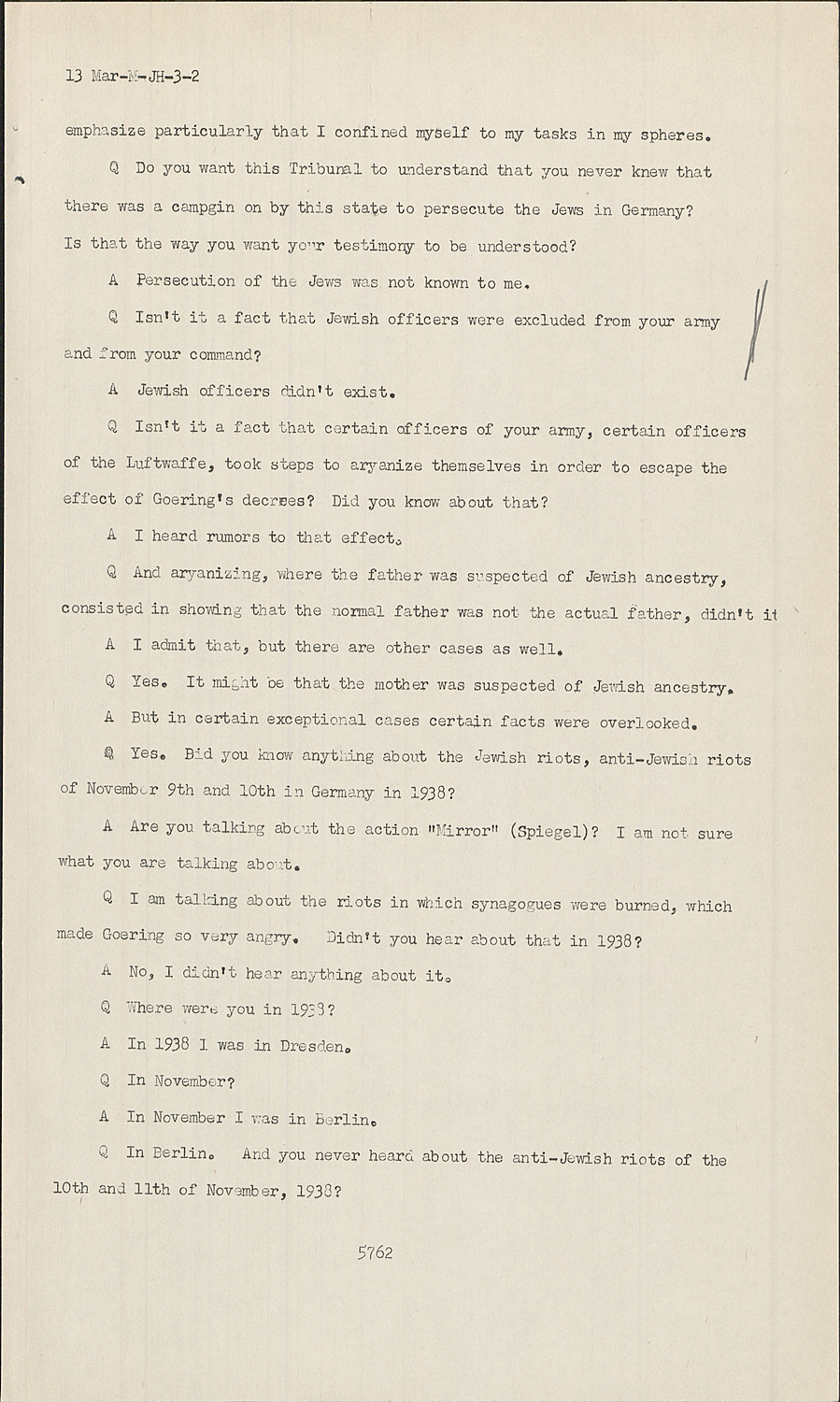
QDo you want this Tribunal to understand that you never knew that there was a campgin on by this state to persecute the Jews in Germany? Is that the way you want your testimony to be understood?
APersecution of the Jews was not known to me.
QIsn't it a fact that Jewish officers were excluded from your army and from your command?
AJewish officers didn't exist.
QIsn't it a fact that certain officers of your army, certain officers of the Luftwaffe, took steps to aryanize themselves in order to escape the effect of Goering's decrees? Did you know about that?
AI heard rumors to that effect.
QAnd aryanizing, where the father was suspected of Jewish ancestry, consisted in showing that the normal father was not the actual father, didn't it
AI admit that, but there are other cases as well.
QYes, It might be that the mother was suspected of Jewish ancestry.
ABut in certain exceptional cases certain facts were overlooked.
QYes. Bid you know anything about the Jewish riots, anti-Jewish riots of November 9th and 10th in Germany in 1938?
AAre you talking about the action "Mirror" (Spiegel)? I am not sure what you are talking about.
QI am talking about the riots in which synagogues were burned, which made Goering so very angry. Didn't you hear about that in 1938?
ANo, I didn't hear anything about it.
QWhere were you in 1938?
AIn 1938 I was in Dresden.
QIn November?
AIn November I was in Berlin.
QIn Berlin. And you never heard about the anti-Jewish riots of the 10th and 11th of November, 1938?
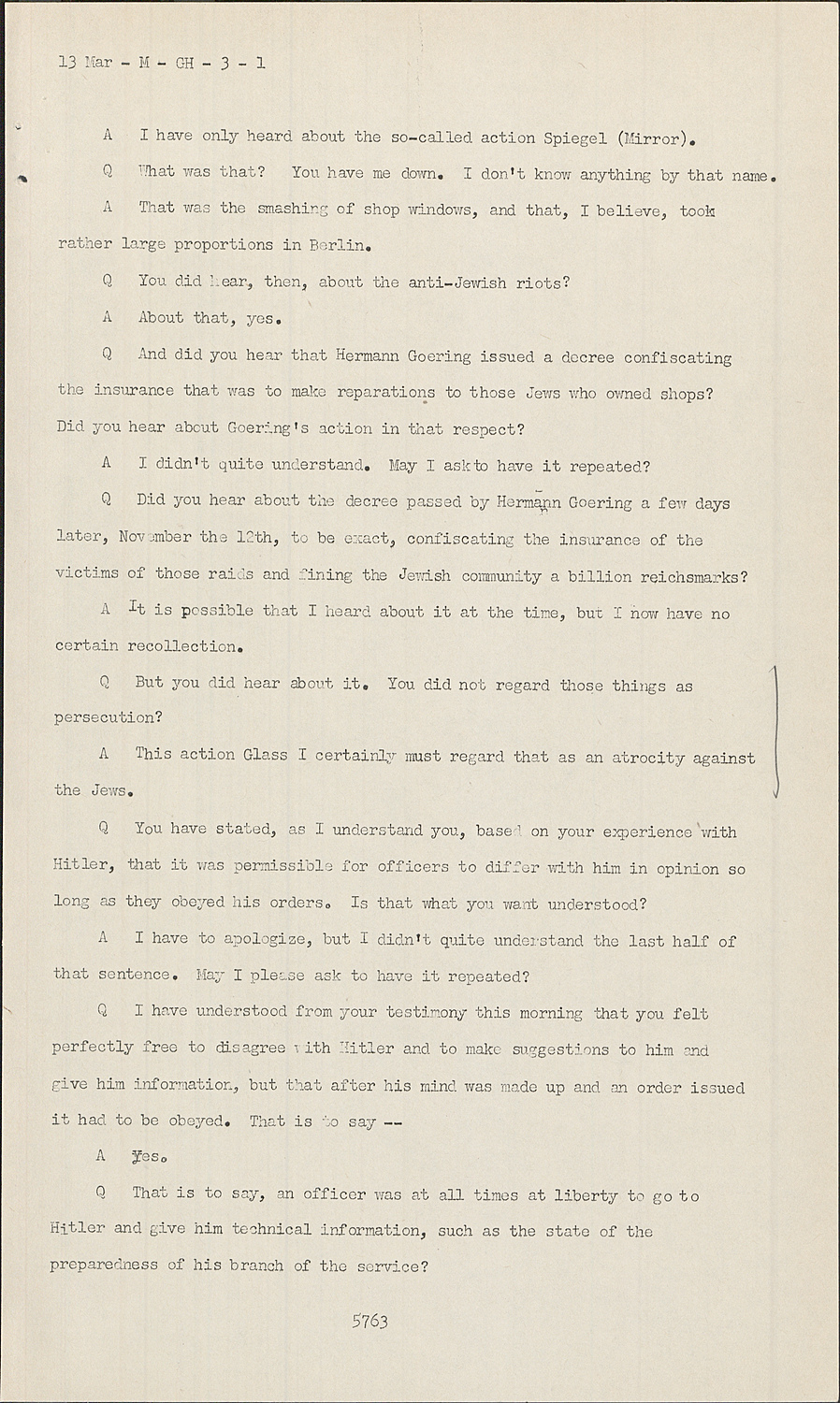
A I have only heard about the so-called action Spiegel (Mirror).
QWhat was that? You have me down. I don't know anything by that name.
AThat was the smashing of shop windows, and that, I believe, took rather large proportions in Berlin.
QYou did hear, then, about the anti-Jewish riots?
AAbout that, yes.
QAnd did you hear that Hermann Goering issued a decree confiscating the insurance that was to make reparations to those Jews who owned shops? Did you hear about Goering's action in that respect?
AI didn't quite understand. May I ask to have it repeated?
QDid you hear about the decree passed by Hermann Goering a few days later, November the 12th, to be exact, confiscating the insurance of the victims of those raids and fining the Jewish community a billion reichsmarks?
AIt is possible that I heard about it at the time, but I now have no certain recollection.
QBut you did hear about it. You did not regard those things as persecution?
AThis action Glass I certainly must regard that as an atrocity against the Jews.
QYou have stated, as I understand you, based on your experience with Hitler, that it was permissible for officers to differ with him in opinion so long as they obeyed his orders. Is that what you want understood?
AI have to apologize, but I didn't quite understand the last half of that sentence. May I please ask to have it repeated?
QI have understood from your testimony this morning that you felt perfectly free to disagree with Hitler and to make suggestions to him and give him information, but that after his mind was made up and an order issued it had to be obeyed. That is to say -
AYes.
QThat is to say, an officer was at all times at liberty to go to Hitler and give him technical information, such as the state of the preparedness of his branch of the service?
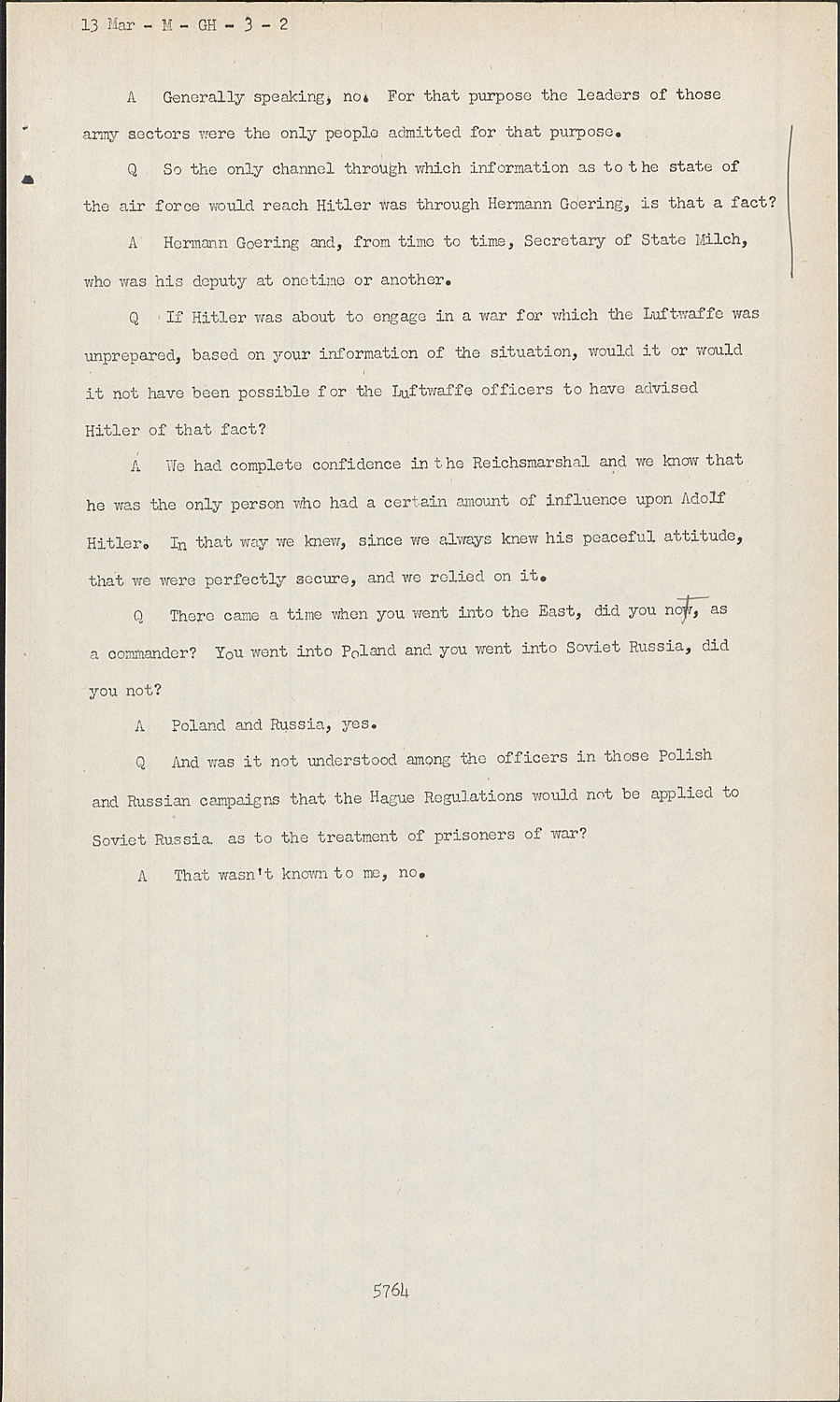
A Generally speaking, no. For that purpose the leaders of those army sectors were the only people admitted for that purpose.
QSo the only channel through which information as to the state of the air force would reach Hitler was through Hermann Goering, is that a fact?
AHermann Goering and, from time to time, Secretary of State Milch, who was his deputy at onetime or another.
QIf Hitler was about to engage in a war for which the Luftwaffe was unprepared, based on your information of the situation, would it or would it not have been possible for the Luftwaffe officers to have advised Hitler of that fact?
AWe had complete confidence in the Reichsmarshal and we know that he was the only person who had a certain amount of influence upon Adolf Hitler. In that way we knew, since we always knew his peaceful attitude, that we were perfectly secure, and we relied on it.
QThere came a time when you went into the East, did you now, as a commander? You went into Poland and you went into Soviet Russia, did you not?
APoland and Russia, yes.
QAnd was it not understood among the officers in those Polish and Russian campaigns that the Hague Regulations would not be applied to Soviet Russia as to the treatment of prisoners of war?
AThat wasn't known to me, no.