In the fifth place I can tell you of experiments of a medical, legal nature.
So we have five different types of experiments.
QThe humans who served as subjects in these experiments, were they volunteers or not?
AThe humans who served for these experiments were recruited, not only in the camp of Buchenwald, but outside of the camp.
They were not volunteers.
They were ignorant, most of them, of the type of camp it was.
Until they came to Block 46 they did not know that they were to serve as subjects for experiments.
This recruitment was carried out among criminals, of which they wished to eliminate a number in this way.
But the recruitment was also carried out among political prisoners, and I should also add that this recruit ing for Block 46 was also among war prisoners, Russian war prisoners.
I must say that among the political prisoners who were used for experimental purposes at Block 46 the Russians were always in the majority.
There were a greater number of Russians, for the following reasons, because the Russians, of all the prisoners who came from any concentration camps, were those who had the greatest physical resistance; their physical resistance was clearly superior to that of the French or the people of Western Europe.
They had a resistance to hunger, a resistance to ill-treatment, a physical resistance of every kind.
Consequently, and particularly because of their powers of resistance, these political Russian prisoners were recruited more for the experiments than other prisoners.
Nevertheless, there were people of other nationalities among these prisoners, notably French.
I would now like to come back to the details concerning these experiments.
Q Don't give us too detailed answers, because we are not technicians.
We merely want to know that these experiments were carried out without any interest in humanity.
Will you please tell us, in simple language, how these experiments were carried out?

A The experiments which were conducted in Block 46 were experiments which had a medical purpose, but most of them served no useful end.
Consequently we can hardly call them experiments.
The men served particularly as controls, or as verification for the medicine, for the poison, for the strains, and so on.
For example, on the question of the vaccine against typhus, for the manufacture of this vaccine they had to have different strains.
That was not indispensable. In normal researches, in the Pasteur Institute and in different institutes in the world, there are always typhus patients which we can use for our research.
However, here the case was quite different.
In Block 46 we were able to find out from the information in the record, according to the chart which we had under observation, twelve different strains of typhus bacteria, which were marked by the letters "BU."
There was a number 1-BU, number 2-BU, and so on, up to BU-12.
These twelve strains of typhus were propagated and kept as a permanent strain in Block 46 by being handed from one patient who was dying to a healthy patient.
In this artificial way, through intravenous injections from zero-five to one cubic centimeter of virulent blood, which was taken from a man who was dying and given to a healthy man, we know quite well that this form of innoculation of typhus--artificial, through intravenous injections--is invariably fatal.
Consequently, every person who serves to keep up these strains-
during the whole period when those strains were utilized, from October 1942 until the liberation of the camp, all men who were subjugated to these injections died, and we were able to verify and note that there were more than 600.
QThey literally murdered them., didn't they, to keep up the strain?
AThey literally murdered these individuals just to keep these strains of typhus up.

Also there were experiments on the curative or therapeutic value.
(A document was submitted to the Tribunal.)
Q What is this document?
AThe document which you have is the document which gives you the record of the typhus strain.
QThis document was brought by you from the camp?
AYes, I brought this document from the camp, and I got it from the data in Block 46 from the records of Block 46 I got these data.
QThis document is the one you handed to me?
AThis document I handed to you, but today we have a document which is still more complete, which is in the hands of the American Psychological Service. They have all the data. This is only one page of the data.
M. DUBOST:I ask the Tribunal to re cognize that the French Prosecution submits this document under the number 364.
A (continuing) In August 1944, they made an experiment on the therapeutic value of the vaccine. One hundred and fifty men lost their lives in that experiment.
The vaccine which was used by the German Army was not only manufactured in Block 46. We had vaccines which came from Italy, some from Denmark, vaccines from Poland, and the Germans wanted to find the respective value of these different vaccines. Consequently they made experiments on the 150 men in the month of August, 1944, who were in Block 46.
I should like to say how Block 46 functioned. Block 46 was a block which was entirely closed and surrounded by barbed wire. Those in Block 46 had to present themselves at no roll call; they never went out of the block. All the windows were closed, and all the windows were covered with some type of paint.
AGerman prisoner was in charge of the block. This German political prisoner was Kapo Dietsch, the leader of the block. Kapo was a social outcast who had been imprisons and in camps for 20 years. He carried out the material work of the SS. He injected or inoculated, and he was the one who killed, on order, the prisoners.
There was an extraordinary thing in this block. There were automatic pistols, and hand grenades, so they could handle any revolt which might come from outside, or which might come from within the block.
I can also tell you that in an order concerning Block 46, which was sent to Block 50, in the month of January, 1945, we found that there were three episodes of force used to master those who did not want to be injected.
Now I come back to the experiments on typhus, on the vaccine, and how these experiments were carried out. The 150 prisoners were split into two groups; 75 were controls and the others were to be experimented on. Only those who were subject to experiments received the vaccine. That is, only 75 received this vaccine; the controls received no vaccine whatsoever, they were not vaccinated.
After vaccination of the 75 who were the subjects of the experiment, they inoculated, in an intravenous fashion, all the men who were connected with this experiment, subjects and controls. Fifteen days after this inoculation the controls died, at the approximate time for one inoculated with typhus to see his final hour arrive. As for the others, who received different kinds of vaccines, they died at varying lengths of time, proportionate to the value of the vaccine which they had received. Some kinds of vaccines gave an excellent result and there was a very slight mortality, particularly the Polish vaccine. Other vaccines resulted in a much higher mortality.
When the experiment was considered concluded, according to the habit and tradition in Block 46, the survivors of the experiments did not survive. Those survivors of the experiments were liquidated, they were murdered in Block 46, by the customary method which my comrades have told you of, by intracardiac injections of phenol, pure phenol of assafetic. That was the customary method of extermination in Buchenwald.
THE PRESIDENT:The Russian translation is not coming through. Can you repeat that about the survivors being killed by intracardiac injections?
AI will repeat it.
Thus, the person who survived the experiments within Block 46, according to the tradition and the habit which reigned in that Block 46, did not survive. Once the experiment could be considered concluded, the survivors of the experiment were murdered. They were liquidated by the customary methods which were used in Buchenwald. I think certain of my comrades have already spoken of this.
BY M. DUBOST:
QWill you go more slowly , please? I think the interpreters are having difficulty.
AIn Buchenwald I think the liquidation was carried out by intracardiac injections of pure phenol of assafetic, a proportion of five or ten cubic centimeters.
THE PRESIDENT:We are not really concerned here with the proportion of the particular injections.
THE WITNESS:Will you repeat that please?
THE PRESIDENT:As I have said, I am not concerned with the proportions in which these injections were given, and will you kindly not deal with these details?
M.Dubost, you might try and confine the witness.
A (continuing) Then I will speak of other details which I think may interest you.
There were other experiments on typhus, experiments of a therapeutic type, chemical products which were to cure typhus, under the same conditions in Block 46.
The German industries collaborated with these experiments. Notably, among those which collaborated with these experiments was I.G. Farben. I.G. Farben furnished a certain number of medicines which might be used for experiments in Block 46, Among to professors of I.G. Farben -- which furnished the medical materials for Block 46 for experimental purposes -- we find Professor Lauschleger.
From the question of typhus we now go to the question of phosphorus experiments, where prisoners of Russian origin were particularly utilized for phosphorus burns. These bums from phosphorus in Block 46 were practiced upon the Russian prisoners for the following reason: bombs which were thrown in Germany through the Allied aviators produced phosphorus burns upon the civilian population, and those were burns which were hard to heal. Consequently, the Germans sought some sort of medical treatment which might ameliorate and improve the conditions of the wounds which were caused by these burns. Thus, experiments were carried out in Block 46 on Russian prisoners.

who were artificially burned by products of a phosphorus base, and they were then treated with different medicants furnished by the German industry.
Also there were experiments on sexual hormones. BY M. DUBOST:
QWhat were the results of these experiments?
AEach experiment was like a murder.
QWho was responsible, the SS?
AYes, of course, because the SS was in charge of these burns and these experiments.
The SS was responsible, since all orders for experiments came from Section 5 of the SS at Leipzig and, consequently, from the Supreme Command of the Waffen SS.
QWhat were the results of the experiments made on sexual hormones?
AThey were less serious. These were ridiculous experiments from a scientific point of view.
We had, at Buchenwald, a number of homosexuals, that is to say, men who had been condemned by German tribunals for their crimes. These homosexuals were sent to the concentration camps, notably Buchenwald, and put with the other prisoners.
QWhat kind of prisoners? With political prisoners, who were patriots?
AWith all kinds of prisoners,
QYes?
AThey were with all kinds of prisoners. They were distinguished by a triangle of pink color.
QAs to the color of this triangle, was that a well-established custom, or was there a great confusion in the classification?
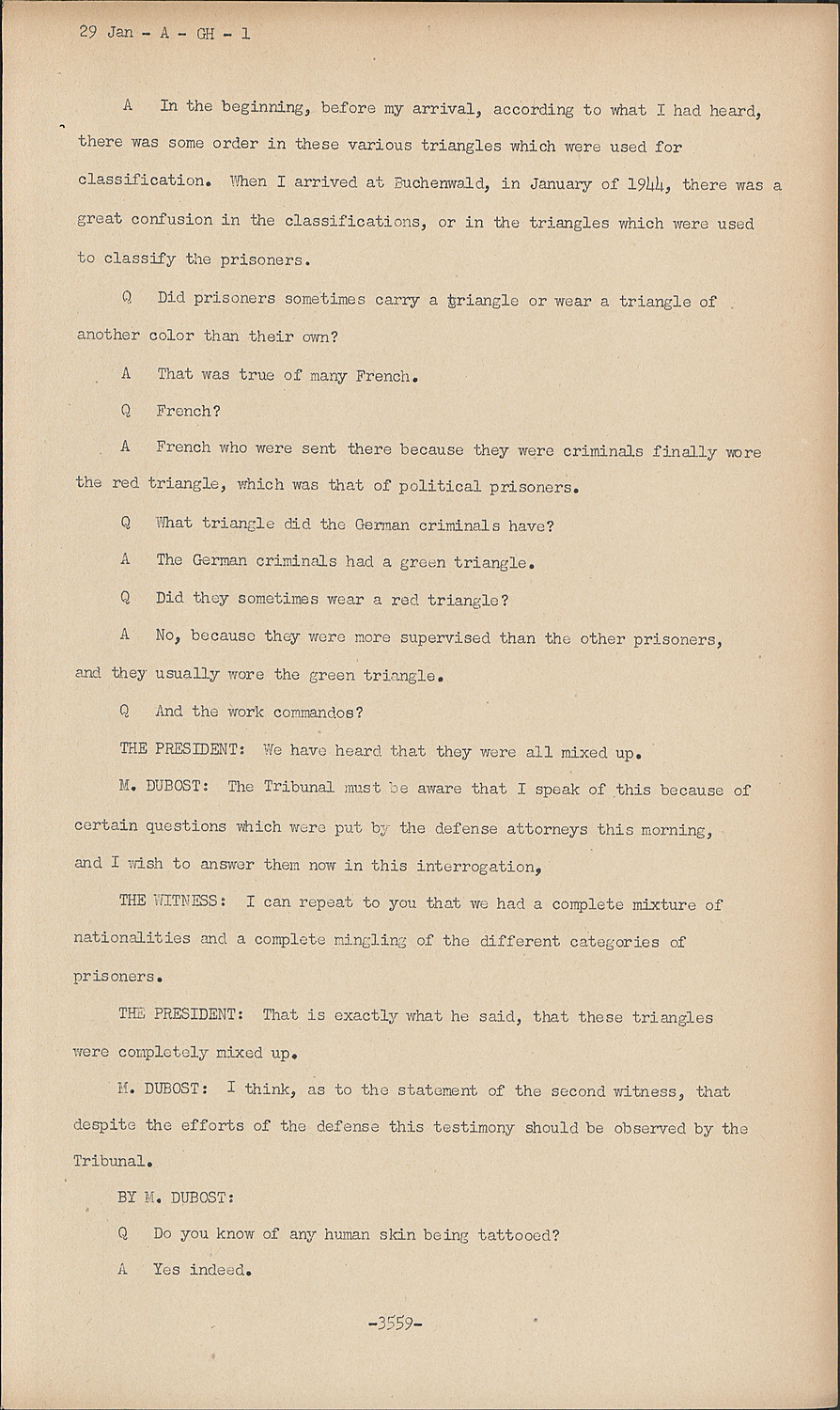
A In the beginning, before my arrival, according to what I had heard, there was some order in these various triangles which were used for classification.
When I arrived at Buchenwald, in January of 1944, there was a great confusion in the classifications, or in the triangles which were used to classify the prisoners.
QDid prisoners sometimes carry a triangle or wear a triangle of another color than their own?
AThat was true of many French.
QFrench?
AFrench who were sent there because they were criminals finally Tore the red triangle, which was that of political prisoners.
QWhat triangle did the German criminals have?
AThe German criminals had a green triangle.
QDid they sometimes wear a red triangle?
ANo, because they were more supervised than the other prisoners, and they usually wore the green triangle.
QAnd the work commandos?
THE PRESIDENT:We have heard that they were all mixed up,
M. DUBOST:The Tribunal must be aware that I speak of this because of certain questions "which were put by the defense attorneys this morning, and I wish to answer them now in this interrogation,
THE WITNESS:I can repeat to you that we had a complete mixture of nationalities and a complete mingling of the different categories of prisoners.
THE PRESIDENT:That is exactly what he said, that these triangles were completely nixed up.
M. DUBOST:I think, as to the statement of the second witness, that despite the efforts of the defense this testimony should be observed by the Tribunal.
BY M. DUBOST:
QDo you know of any human skin being tattooed?
AYes indeed.
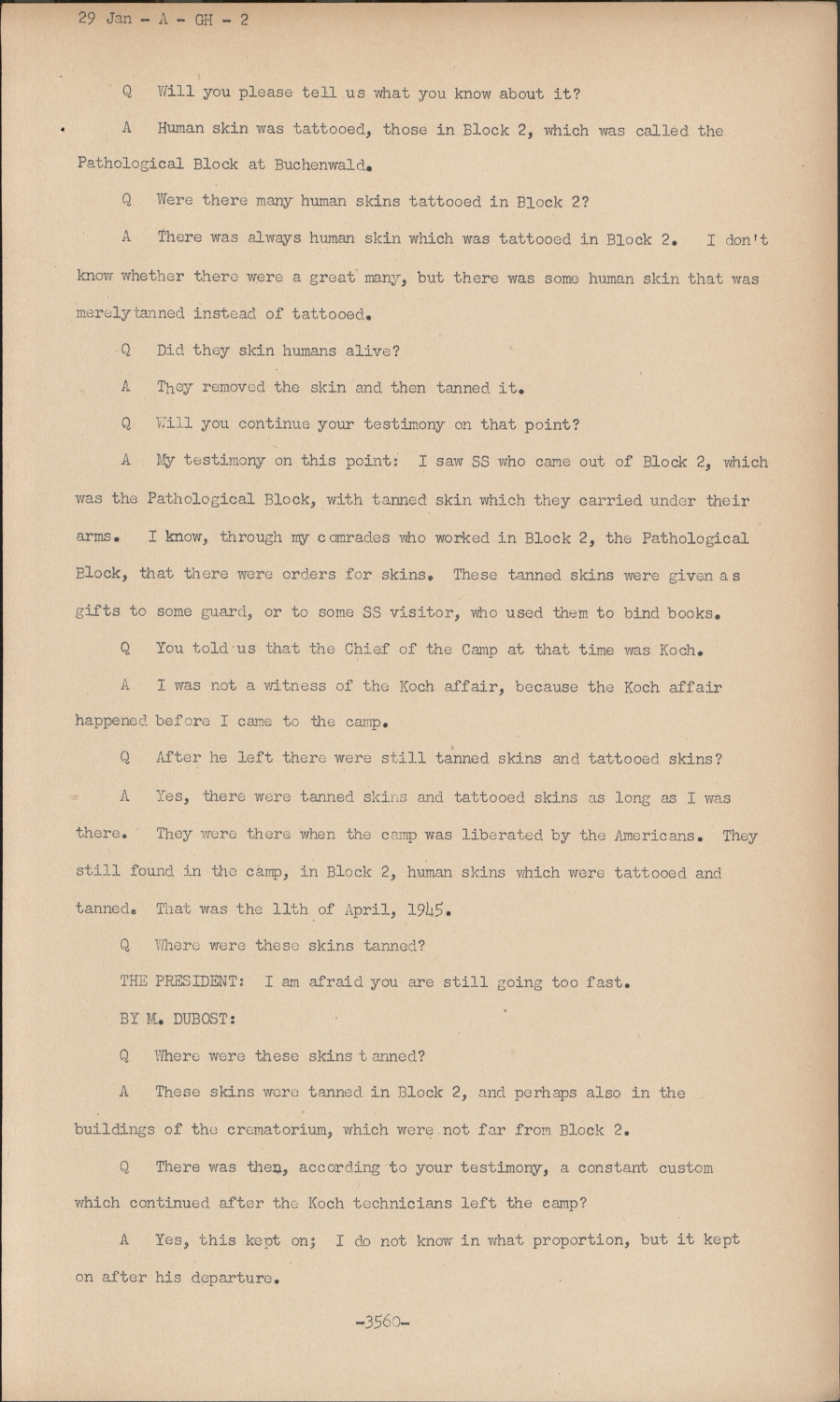
Q Will you please tell us what you know about it?
AHuman skin was tattooed, those in Block 2, which was called the Pathological Block at Buchenwald.
QWere there many human skins tattooed in Block 2?
AThere was always human skin which was tattooed in Block 2. I don't know whether there were a great many, but there was some human skin that was merely tanned instead of tattooed.
QDid they skin humans alive?
AThey removed the skin and then tanned it.
QWill you continue your testimony on that point? A My testimony on this point: I saw SS who came out of Block 2, which was the Pathological Block, with tanned skin which they carried under their arms. I know, through my comrades who worked in Block 2, the Pathological Block, that there were orders for skins. These tanned skins were given as gifts to some guard, or to some SS visitor, who used them to bind books.
QYou told us that the Chief of the Camp at that time was Koch.
AI was not a witness of the Koch affair, because the Koch affair happened before I came to the camp.
QAfter he left there were still tanned skins and tattooed skins?
AYes, there were tanned skins and tattooed skins as long as I was there. They were there when the camp was liberated by the Americans. They still found in the camp, in Block 2, human skins which were tattooed and tanned. That was the 11th of April, 1945.
QWhere were these skins tanned?
THE PRESIDENT:I am afraid you are still going too fast.
BY M. DUBOST:
QWhere were these skins tanned?
AThese skins were tanned in Block 2, and perhaps also in the buildings of the crematorium, which were not far from Block 2.
QThere was then, according to your testimony, a constant custom which continued after the Koch technicians left the camp?
AYes, this kept on; I do not know in what proportion, but it kept on after his departure.
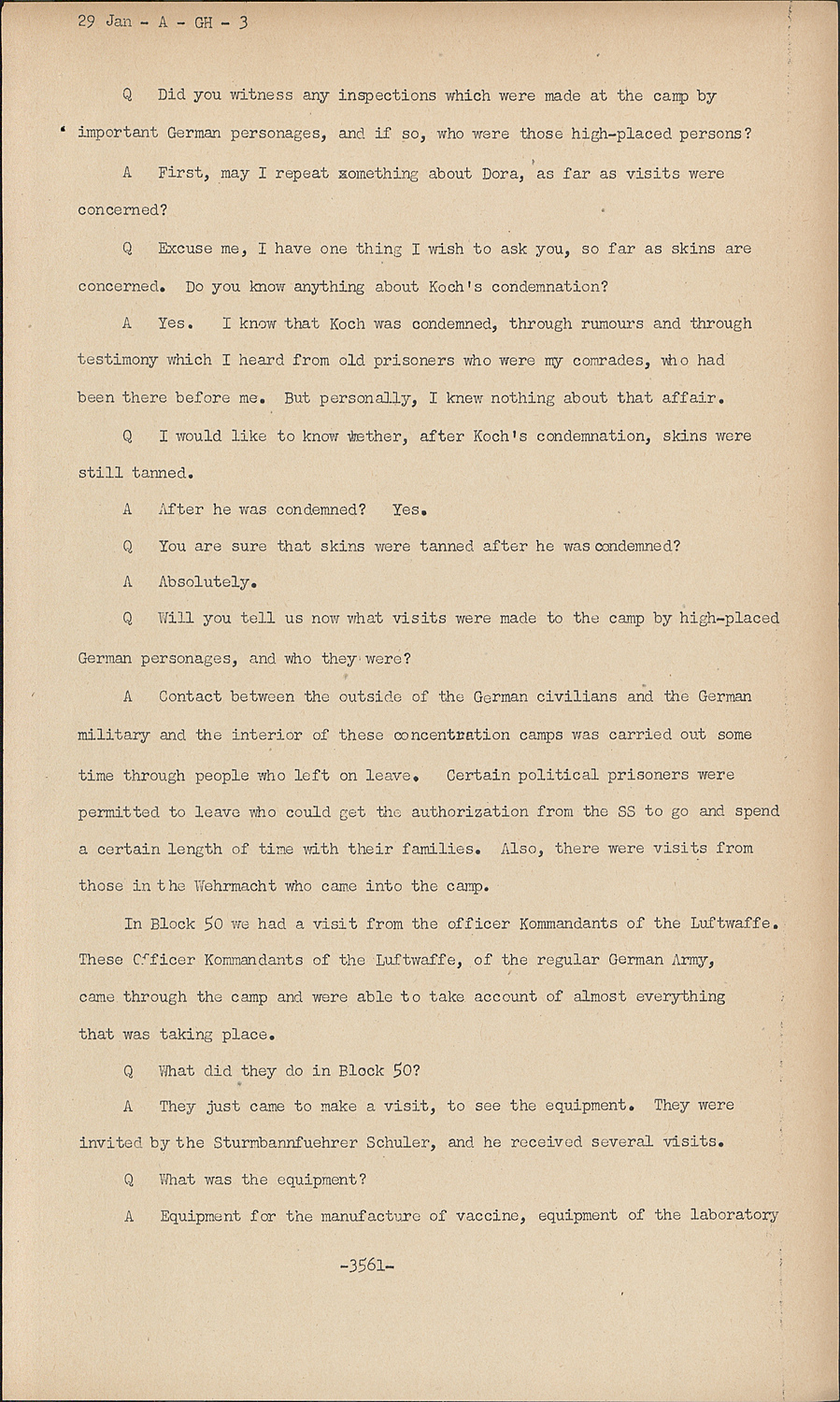
Q Did you witness any inspections which were made at the camp by important German personages, and if so, who were those high-placed persons?
AFirst, may I repeat something about Dora, as far as visits were concerned?
QExcuse me, I have one thing I wish to ask you, so far as skins are concerned. Do you know anything about Koch's condemnation?
AYes. I know that Koch was condemned, through rumours and through testimony which I heard from old prisoners who were my comrades, who had been there before me. But personally, I knew nothing about that affair.
QI would like to know tether, after Koch's condemnation, skins were still tanned.
AAfter he was condemned? Yes,
QYou are sure that skins were tanned after he was condemned?
AAbsolutely.
QWill you tell us now what visits were made to the camp by high-placed German personages, and who they were?
AContact between the outside of the German civilians and the German military and the interior of these concentration camps was carried out some time through people who left on leave. Certain political prisoners were permitted to leave who could get the authorization from the SS to go and spend a certain length of time with their families. Also, there were visits from those in the Wehrmacht who came into the carp.
In Block 50 we had a visit from the officer Kommandants of the Luftwaffe. These Officer Kommandants of the Luftwaffe, of the regular German Army, came through the camp and were able to take account of almost everything that was taking place.
QWhat did they do in Block 50?
AThey just came to make a visit, to see the equipment. They were invited by the Sturmbannfuehrer Schuler, and he received several visits.
QWhat was the equipment?
AEquipment for the manufacture of vaccine, equipment of the laboratory Q Thank you.

AThere were other visits also. There were also nurses who came to this same Block 50. In the month of October 1944 hospital attendants and nurses visited this block.
QDo you know the names of any important personages A Yes, personages, if you wish.
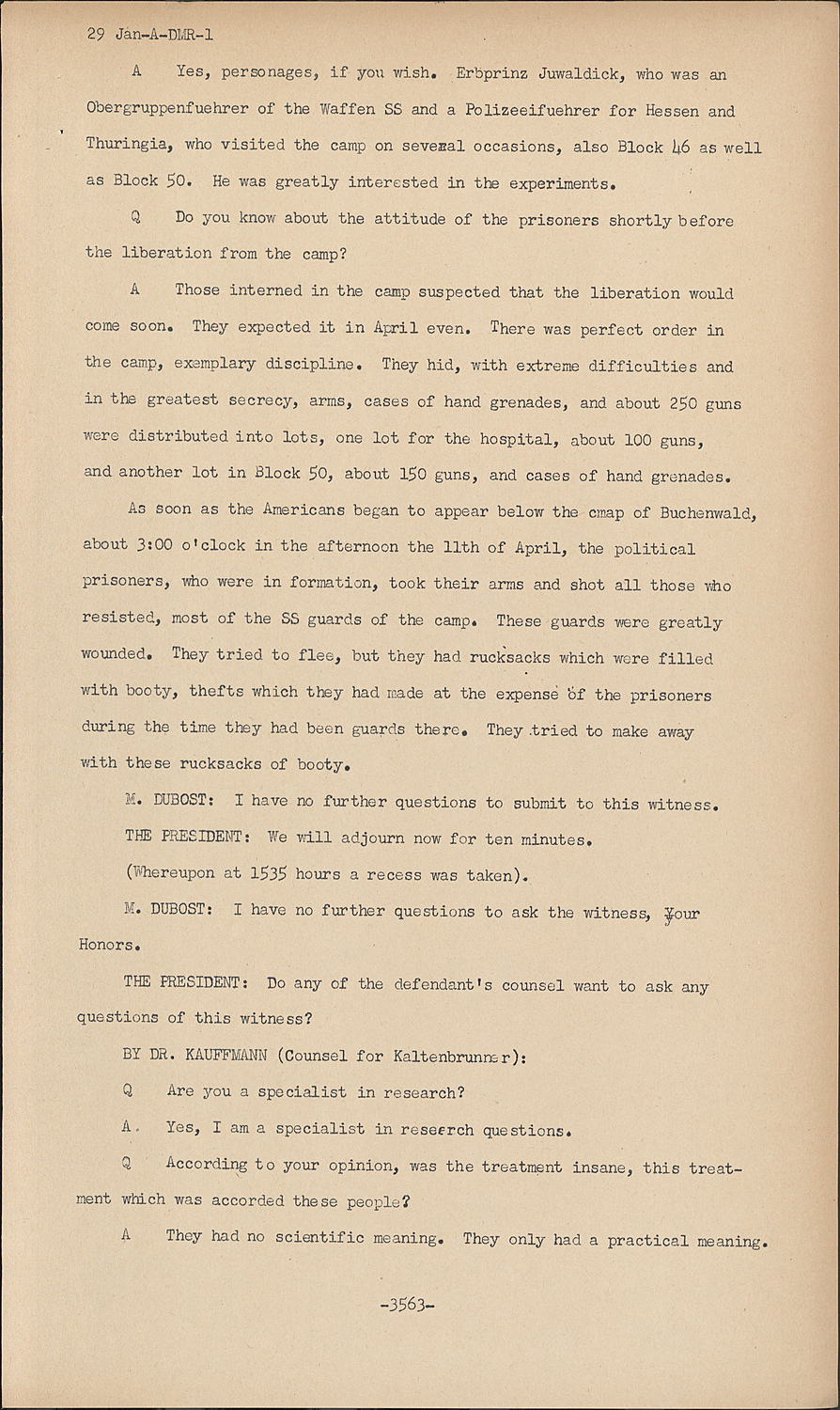
Erbprinz Juwaldick, who was an Obergruppenfuehrer of the Waffen SS and a Polizeeifuehrer for Hessen and Thuringia, who visited the camp on several occasions, also Block 46 as well as Block 50.
He was greatly interested in the experiments.
QDo you know about the attitude of the prisoners shortly before the liberation from the camp?
AThose interned in the camp suspected that the liberation would come soon. They expected it in April even. There was perfect order in the camp, exemplary discipline. They hid, with extreme difficulties and in the greatest secrecy, arms, cases of hand grenades, and about 250 guns were distributed into lots, one lot for the hospital, about 100 guns, and another lot in Block 50, about 150 guns, and cases of hand grenades.
As soon as the Americans began to appear below the cmap of Buchenwald, about 3:00 o'clock in the afternoon the 11th of April, the political prisoners, who were in formation, took their arms and shot all those who resisted, most of the SS guards of the camp. These guards were greatly wounded. They tried to flee, but they had rucksacks which were filled with booty, thefts which they had made at the expense of the prisoners during the time they had been guards there. They tried to make away with these rucksacks of booty.
M. DUBOST:I have no further questions to submit to this witness.
THE PRESIDENT:We will adjourn now for ten minutes.
(Whereupon at 1535 hours a recess was taken).
M. DUBOST:I have no further questions to ask the witness, Your Honors.
THE PRESIDENT:Do any of the defendant's counsel want to ask any questions of this witness?
BY DR.KAUFFMANN (Counsel for Kaltenbrunner):
QAre you a specialist in research?
A.Yes, I am a specialist in research questions.
QAccording to your opinion, was the treatment insane, this treatment which was accorded these people?
AThey had no scientific meaning. They only had a practical meaning.
They made it possible to verify the value of certain manufactures.
QBut do you have a judgment of your own? Did you in reality as a person see these people?
AI saw these people at very close hand, since in Block 50 I was in charge of a part of this manufacture of vaccine. Consequently, I was quite well aware of the kind of experiment that was being made in Block 46 and the reasons for these experiments.
Further, I was able to find out the almost complete inaptitude of the SS doctors and the ease with which we were able to sabotage the sabotage of the German Army.
QNow, these people must habe gone through much misery and suffering before they died.
AThese people certainly suffered terribly, especially in the case of certain experiments, notably Q (Interposing) Can you certify that through your own experience, or is that just hearsay?
AI saw in Block 50 photographs taken in Block 46 of phosphorus burns, and it is not necessary to be a specialist nor a doctor to realize what patients whose flesh was burned to the bones have suffered, what they must have suffered.
QThen, according to your conscience, you were disgusted deeply.
AAbsolutely disgusted with those things.
QNow, I'd like to ask you, what did you do with the order that went to your conscience, namely, the conscience to help the people?
AThat is quite simple When I arrived in the Buchenwald Camp as a deportee, I did not decline my qualities. I simply specified that I was a laborant. Laborant means a man who is accustomed to the technique of a laboratory, having no defined speciality. I was sent to Dora. The SS regime made me lose 30 Kilos in two months. I became anemic.
QWitness, I am just concerned with Buchenwald. I don't wish to know anything about Dora.
AWill, it was the prisoners themselves at Buchenwald in relation to the camp itself who made me come back to Buchenwald. It was M. Julian Cint, the Frenchman, Director of the French National Library, who called attention to my presence to a German political prisoner, Walter Hummelschein, who was secretary in Block 50.
And this secretary of Block 50 called attention to my existence without my knowledge and without my having had anything to do with it, that there was a French specialist in Dora. That is why the SS called me back from Dora to work in Block 50.
QPlease pardon the interruption. We do not wish to amplify too much on these matters. I believe everything that you have just said, that that is the reason why you were sent to Dora and your return My purpose is a completely different one. I would like to ask you once more: You knew that these people, humanely speaking, were martyrs. Is that really the case? Please answer yes or no.
AI knew it of course, but long after -
Q (Interposing) Please answer yes or no.
AI answer the question as I must answer it. I answer that when I arrived at Block 50 I knew nothing, either of the block or of the experiments. It was only later when I was in Block 50, with time, with the relations that I was able to make in the block, that I found out the details of the experiments.
QVery well. And after you were sure about the particulars of the experiments, the way in which they were carried out, did not your conscience dictate sympathy for these poor creatures?
AMy pity was very great, but there was not in the camp any possibility of having pity or not. One had to carry out to the letter the orders that were given or disappear.
QVery well. Then you are stating that if in any way you had not followed the orders that you had received you might have been killed? Is that right?
AThere is no doubt of this. On the ether hand, my work consisted wholly in manufacturing vaccine, and neither I nor any other prisoners in Block 46 were able to make or to witness experiments directly. We knew what was going on only through cards that passed through Block 46. These were officially registered in Block 50.
Q Very well, but I believe there is no difference in consciennce whether you see suffering before your eyes or whether you have knowledge that in the same camp people are being murdered in such a way.
Now, I come to another question,
THE PRESIDENT:Did he answer the question you were putting? Will you confine yourself to the question.
DR. KAUFFMANN:That was not a question, Mr. Witness. I will put another question new.
THE WITNESS:I should like to answer this remark then.
DR. KAUFFMANN:I am not interested in your answer.
THE WITNESS:I am anxious to give it.
THE PRESIDENT:Answer the question, please.
THE WITNESS:These sufferings in the camp were everywhere. It was not only in the experimental blocks. It was in the quarantine blocks. It was in the hospitals. It was among all the men who every day died by the hundreds. Suffering reigned everywhere in the concentration camps. BY DR. KAUFFMANN:
QWas there a decree or an announcement that there was to be no conversation about these experiments?
AIn principle the experiments were absolutely secret, and indiscretion in regard to the experiments might bring penalty of death at any moment. I should add that there were very few of us who knew the details of these experiments.
Q You mentioned the visits to this camp, and you also mentioned that German Red Cross members, or nurses, and members of the Wehrmacht visited the camp, and that vacations were granted political prisoners to leave the camp.
Were you at any one time present at the visits?
AI was present at those visits of which I am speaking within the camp.
QDid the visitors at this camp see that cardiac injections were being given, or did the visitors see that human skin was tanned? Were those visitors present while mistreatments were being given?
AI cannot answer this question in the affirmative for visitors went behind closed doors. I can only speak of the visitors who came to my block. One had to pass all the way through the camp to pass my block. I don't know where the visitors might go either before or after the exit from my block,
QDid one of your own comrades tell you perhaps whether the visitors personally saw these excesses? Yes or no.
AI don't understand the question. Would you mind repeating it?
QDid perhaps one of your comrades tell you that the visitors at the camp were present at these excesses?
AI never heard that the visitors were present at experiments of this kind or at excesses of this kind. The only thing I can say as to the condemned is what I saw with my own eyes, The SS, the non-commissioned or possibly the commissioned officers - I can't quite remember - I saw them come from the block too. These were SS men; these were not visitors to the camp.
QDid these visitors, that is, members of the Red Cross, know that those experiments were medically completely worthless, or did they just visit the laboratories and the installations and just wish to look at them and inspect them?
AI repeat again that visitors came to my laboratory section, where they saw what was being done there, that is, the filling of the vials. I cannot say what they saw after or before. I only know that these visitors of whom I am speaking, Luftwaffe people or Red Cross people, visited the whole set-up of the blocks. They certainly knew, however, what the origin of this manufacture of vaccine was and that men might he used as subjects of experi-ments, since there were tables, graphs, which indicated the progress of the manufacture there for men; but one had to use blood as a basis coming from patients suffering from typhus and not obligatorily from patients artificially innoculated with typhus.
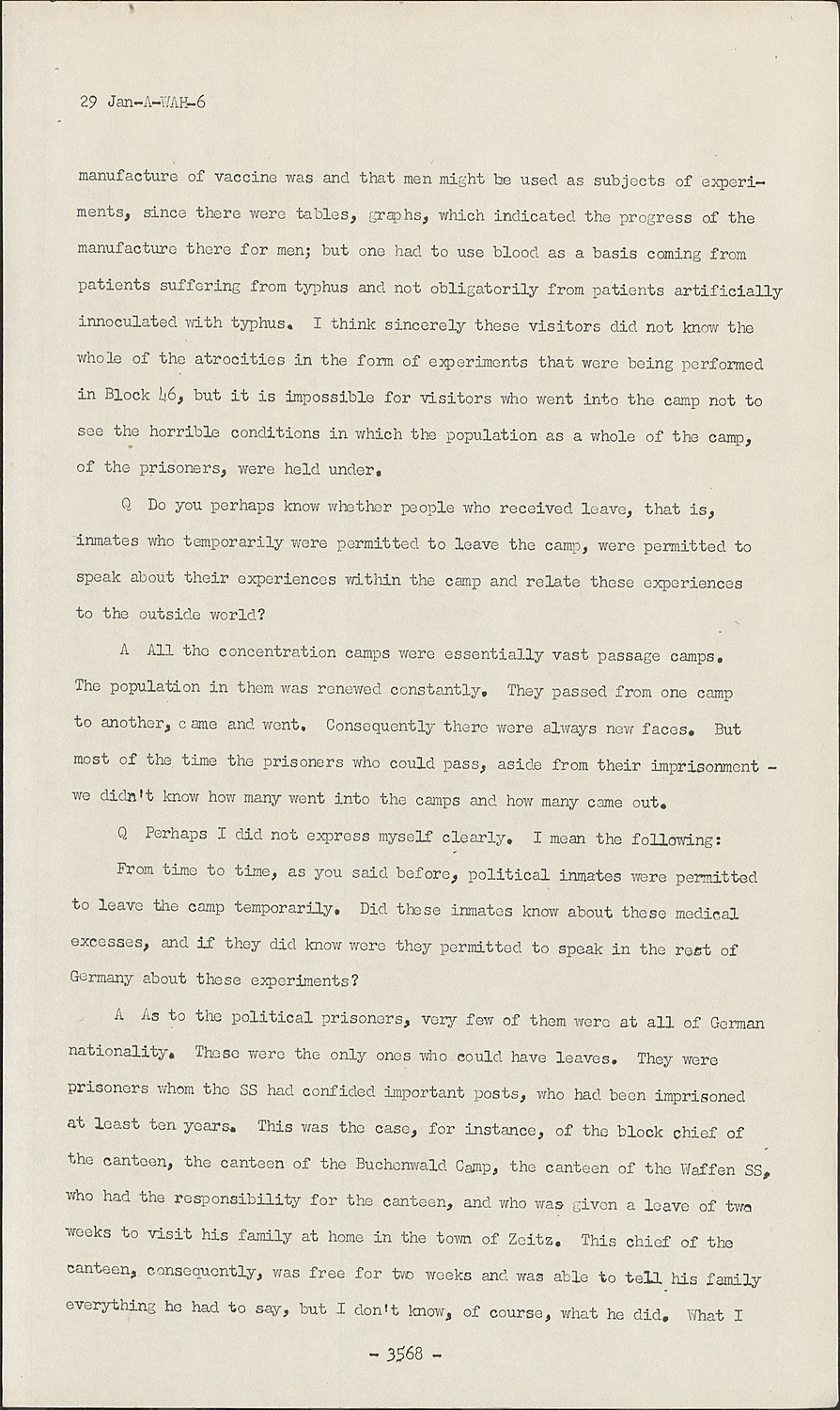
I think sincerely these visitors did not know the whole of the atrocities in the form of experiments that were being performed in Block 46, but it is impossible for visitors who went into the camp not to see the horrible conditions in which the population as a whole of the camp, of the prisoners, were held under,
QDo you perhaps know whether people who received leave, that is, inmates who temporarily were permitted to leave the camp, were permitted to speak about their experiences within the camp and relate these experiences to the outside world?
AAll the concentration camps were essentially vast passage camps. The population in them was renewed constantly. They passed from one camp to another, came and went. Consequently there were always new faces. But most of the time the prisoners who could pass, aside from their imprisonment we didn't know how many went into the camps and how many came out.
QPerhaps I did not express myself clearly, I mean the following:
From time to time, as you said before, political inmates were permitted to leave the camp temporarily. Did these inmates know about these medical excesses, and if they did know were they permitted to speak in the rest of Germany about these experiments?
AAs to the political prisoners, very few of them were at all of German nationality. These were the only ones who could have leaves. They were prisoners whom the SS had confided important posts, who had been imprisoned at least ten years. This was the case, for instance, of the block chief of the canteen, the canteen of the Buchenwald Camp, the canteen of the Waffen SS, who had the responsibility for the canteen, and who was given a leave of two weeks to visit his family at home in the town of Zeitz. This chief of the canteen, consequently, was free for two weeks and was able to tell his family everything he had to say, but I don't know, of course, what he did. What I can say is that obviously he would have to be careful.
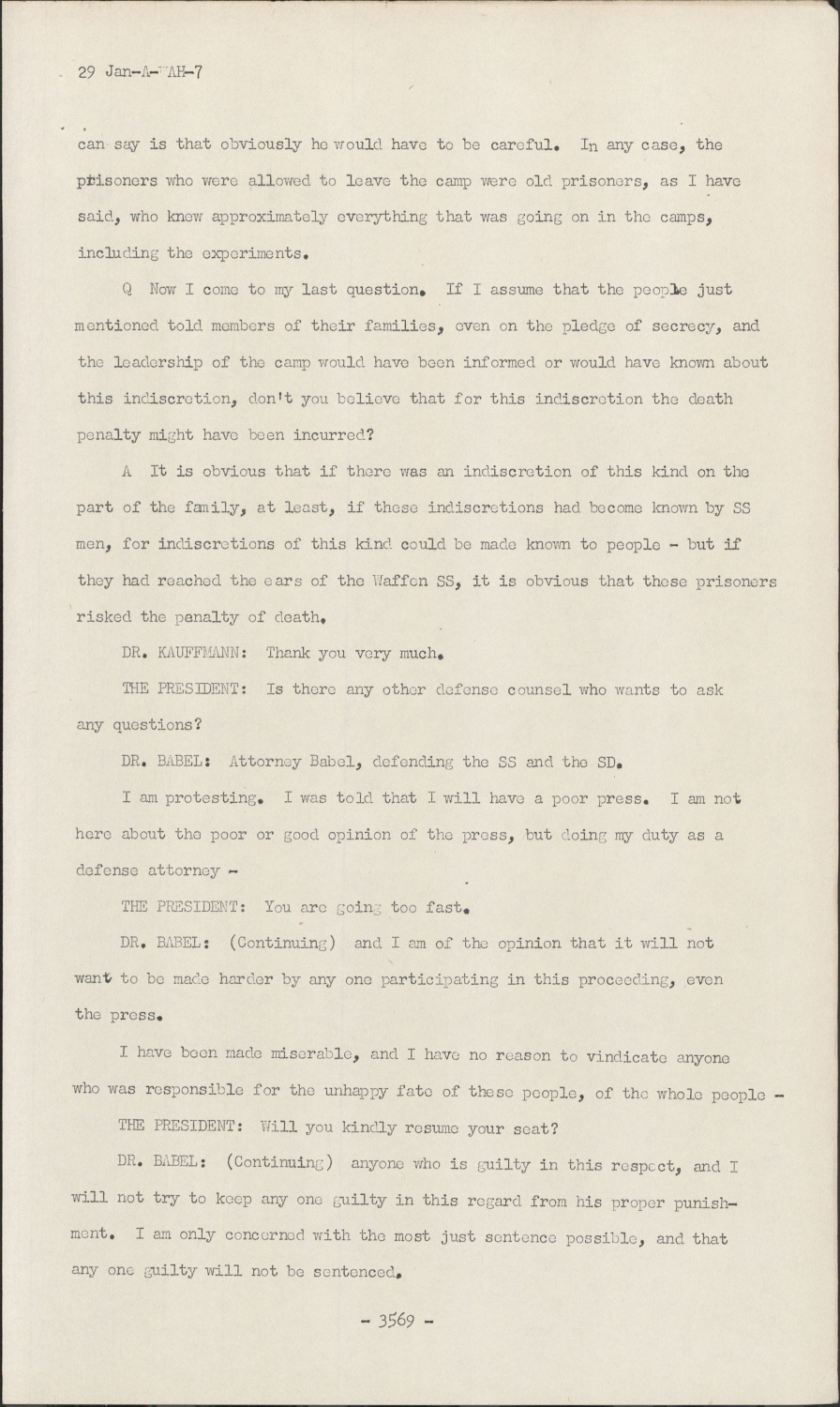
In any case, the prisoners who were allowed to leave the camp were old prisoners, as I have said, who knew approximately everything that was going on in the camps, including the experiments.
QNow I come to my last question. If I assume that the people just mentioned told members of their families, even on the pledge of secrecy, and the leadership of the camp would have been informed or would have known about this indiscretion, don't you believe that for this indiscretion the death penalty might have been incurred?
AIt is obvious that if there was an indiscretion of this kind on the part of the family, at least, if these indiscretions had become known by SS men, for indiscretions of this kind could be made known to people - but if they had reached the ears of the Waffen SS, it is obvious that these prisoners risked the penalty of death.
DR. KAUFFMANN:Thank you very much.
THE PRESIDENT:Is there any other defense counsel who wants to ask any questions?
DR. BABEL:Attorney Babel, defending the SS and the SD.
I am protesting. I was told that I will have a poor press. I am not here about the poor or good opinion of the press, but doing my duty as a defense attorney
THE PRESIDENT:You are going too fast.
DR.BABEL: (Continuing) and I am of the opinion that it will not want to be made harder by any one participating in this proceeding, even the press.
I have been made miserable, and I have no reason to vindicate anyone who was responsible for the unhappy fate of these people, of the whole people
THE PRESIDENT:Will you kindly resume your seat?
DR.BABEL: (Continuing) anyone who is guilty in this respect, and I will not try to keep any one guilty in this regard from his proper punishment. I am only concerned with the most just sentence possible, and that any one guilty will not be sentenced.

THE PRESIDENT: I said kindly resume your seat. It is not fit for you to make a speech, You have been making a speech, as I understood it, this isn't the occasion for it.
DR, BABEL: I find it necessary because I was not protected against the Prosecution.
(Dr. Babel started to resume his seat)
THE PRESIDENT:One moment; come back.
(Dr. Babel came before the microphone again) I don't know what you mean about not being protected.
I don't know what you mean by not being protected against the Prosecution. The Prosecution called this witness, and the defendants counsel had the fullest opportunity to cross-examine, and we understood you went to the Tribunal for the purpose of cross-examining the witness. I don't understand your protest.
DR, BABEL: Mr. President, I am not familiar with legal proceedings in the United States and Great Britain, but according to German criminal law and regulations, it is customary that accusations which are made without reason, and unjustly, be referred back to the President, and I expected that that might take place in this instance, but since it did not take place, I took occasion to call attention to it. If I committed any injustice or any error, I wish to be excused.
THE PRESIDENT:What unjust accusations are you referring to?
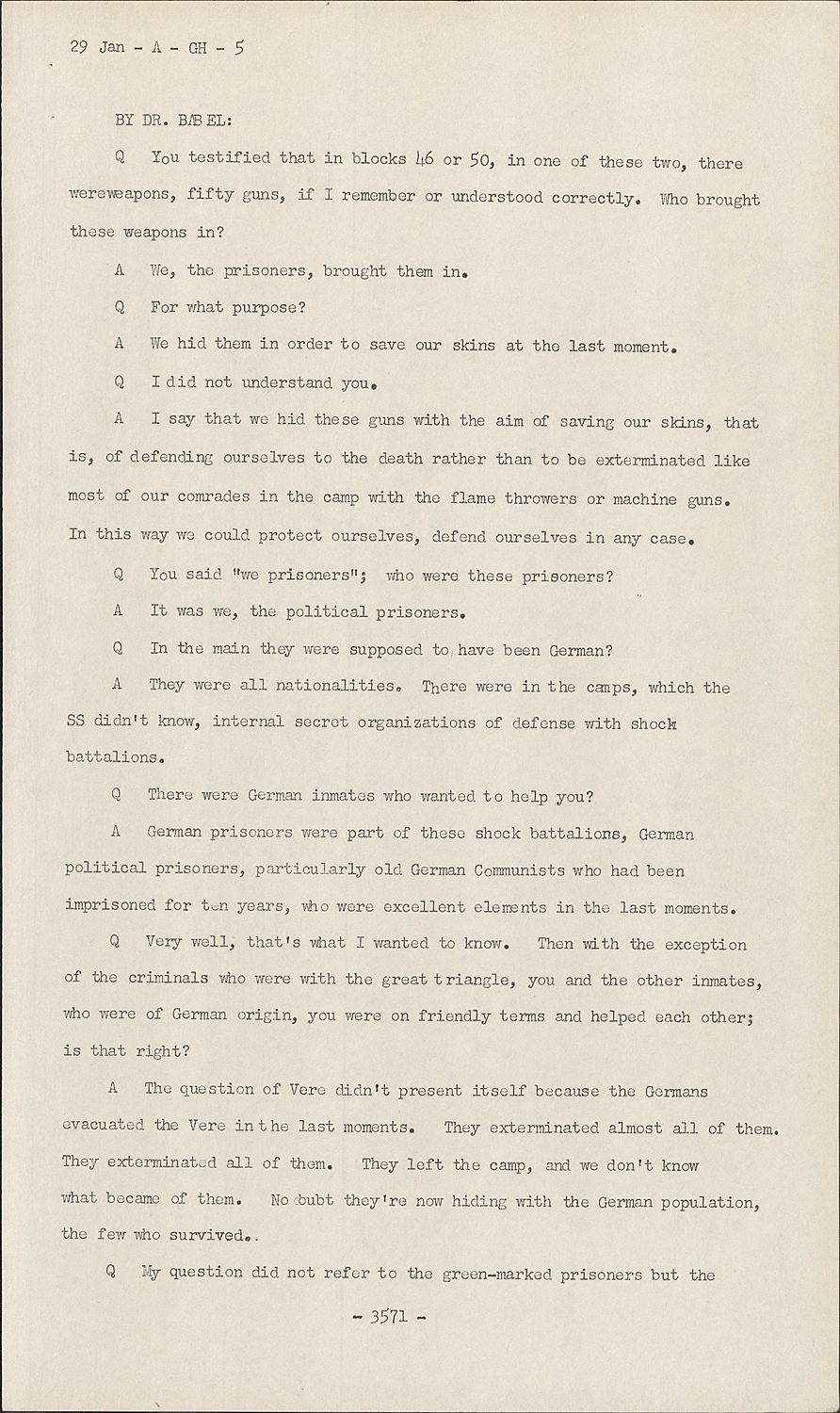
BY DR. BABEL:
QYou testified that in blocks 46 or 50, in one of these two, there were weapons, fifty guns, if I remember or understood correctly. Who brought these weapons in?
AWe, the prisoners, brought them in.
QFor what purpose?
AWe hid them in order to save our skins at the last moment.
QI did not understand you.
AI say that we hid these guns with the aim of saving our skins, that is, of defending ourselves to the death rather than to be exterminated like most of our comrades in the camp with the flame throwers or machine guns. In this way we could protect ourselves, defend ourselves in any case.
QYou said "we prisoners"; who were these prisoners?
AIt was we, the political prisoners.
QIn the main they were supposed to have been German?
AThey were all nationalities. There were in the camps, which the SS didn't know, internal secret organizations of defense with shock battalions.
QThere were German inmates who wanted to help you?
AGerman prisoners were part of these shock battalions, German political prisoners, particularly old German Communists who had been imprisoned for ten years, who were excellent elements in the last moments.
QVery well, that's what I wanted to know. Then with the exception of the criminals who were with the great triangle, you and the other inmates, who were of German origin, you were on friendly terms and helped each other; is that right?
AThe question of Vere didn't present itself because the Germans evacuated the Vere in the last moments. They exterminated almost all of them. They exterminated all of them. They left the camp, and we don't know what became of them. No doubt they're now hiding with the German population, the few who survived.
QMy question did not refer to the green-marked prisoners but the relationship you had to the German political prisoners.