Q. Please.
A.Strafkommando of Lindberg -- This commander came from 10 C Stalag. After the night which I related a little while ago, during an attempted escape which failed, we were beaten for three hours successively. The following day a certain number of us were kept at the commando. We saw then the immediate superior of the Chief of the Command, an Oberleutnant, whose name I do not know, who saw that we were wounded, covered with wounds on our heads particularly, and he found that it was very fine. That evening we went to work. We came back at 7:00 o'clock. We received a visit of a mayor, who was a very distinguished man, who also found that since we had tried to escape, that it was quite just that we be punished, so my complaint didn't go much further, sir.
Q.Did you know that the German Government, with the current Vichy Government, had an agreement regarding prisoners of war?
A.Yes, I have heard of that, but they didn't inspect that kind of commando camp.
Q.Therefore, you wish to say that the visit of the people who were authorized did not apply to labor commandos?
A.The visits took place at the work commando, but not in the reprisal commando where I was. That is the real difference.
Q.You were not always in the reprisal commando?
A.No.
Q.And when were you put into this punishment commando?
A.Quite long before Ravaruska, April 1941, for the first time. It was a commando where they sent, without any motive, only the priests and officer candidates. We received no visits there.
The strafkommando at Lindberg -- nobody visited that camp either. There was no inspection. At Ravaruska we received a visit of two Swiss physicians in September.
Q.September, '42?
A.Yes, '42.
Q.Did you complain to the Swiss physicians?
A. Not myself personally, but some people were able to talk to them.
Q.And were there any results?
A.Yes, certainly.
Q.Don't you believe that the way to complain might have been successful to complain through the commandant if you had wished to do so?
A.We had no very friendly relations with the general commander at Ravaruska?
Q.I don't quite understand you.
A.I said that we had no friendly relationship with the German commander of the camp at Ravaruska.
Q.We are not concerned with the question of cordial relations, but an official, formal visit, which could have, been conducted in such a way. Don't you believe that?
A.To present a complaint would seem to have some relationship with somebody, if we could present a complaint.
Q.When did you leave Ravaruska?
A.The end of October, 1942,
Q.If I remember correctly, you gave the number of victims that were counted or observed by you. You gave that number, is that correct?
A.Yes.
Q.How many victims were there?
A.There was a figure that was given to me by Dr. Levin, who was a French physician at Ravaruska. About 60 I said in the camp itself, to which I must add about 100 who disappeared.
Q.The German Defense can't hear. Would you be kind enough to repeat the last few statements about the number of victims?
A.Yes, I said that there were about 60 dead for the camp of Ravaruska, at the time when I was there.
Q.Are you talking about French victims, or in general?
A.At Ravaruska there were hardly any nationalities except French -- a few Poles and a few Belgians.
Q.I am putting the question for this reason: An official French report, which I have with me, from 15 July 1945, gave the number of victims until the end of July as 14.
That is 14 Frenchmen according to the official French report, and for the period of time, August to September.
The number that you gave seems to be quite high.
Thank you.
THE PRESIDENT:Does any other German counsel want to put any questions to this witness?
(No response.)
THE PRESIDENT:M. Dubost?
M. DUBOST:I have finished with this witness, Mr. President.
If the Tribunal will permit me, we will now come to a last witness.
THE PRESIDENT:One moment.
M.Dubost, the witness can retire.
Could you tell the Tribunal whether the witness you are about to call is going to give us any evidence of a different nature from the evidence which has already been given? You will remember that we have in the French document, of which we shall take judicial notice -- a very large French document - I forget the number -- 321, I believe it is -- 321 -- We have a very large volume of evidence on the conditions in concentration camps. Is the witness you are going to call going to prove anything fresh?
M. DUBOST:The Witness whom we have called is going to submit direct testimony on a certain number of experiments which he saw.
He will submit certain documents.
THE PRESIDENT:Are these experiments about which the witness is going to speak all recorded in these, in the book 321?
M. DUBOST:They are quoted, but they are not given the importance that the French presentation gives concerning direct testimony.
We will not read all of these documents if it will be permitted to introduce direct testimony.
Once these witnesses have been heard, we will then be able to skip over a number of documents.
THE PRESIDENT:You may call the witness, but try and not let him be too long.
M. DUBOST:I shall do my best, Mr. President.
(Witness takes the stand)
THE PRESIDENT:What is your name?
THE WITNESS:Alfred Balachowsky,
THE PRESIDENT:Are you French?
THE WITNESS:French.
THE PRESIDENT: Will you take this oath? Do you swear to speak without hate nor fear, to say the truth, all the truth, only the truth?
Raise your right hand and swear.
THE WITNESS:I swear.
THE PRESIDENT:You may sit if you wish.
(Examination by M. Dubost)
QYour name is Balachowsky, Alfred B-a-l-a-c-h-o-w-s-k-y?
AThat is correct.
QYou are chief of the Pasteur Laboratory in Paris?
AThat is correct.
QYou reside in Viroflay; you were born 15 August 1901 at Kurutcha in Russia?
AThat is correct.
QYou are French?
AYes. Russian by birth, French through nationalization.
QWhat year were you naturalized?
A 1932
QWere you deported 16 January 1944?
AI was arrested 2 July 1943 and after six months in prison at Rheims and Compiegne.
QYou then went to the camp of Dora?
AThat is correct.
QCan you rapidly tell us what you know about the camp of Dora?
AThe camp of Dora is situated five kilometers north of Mauthausen in the Suedharzgebiet in Germany. This camp was considered by the Germans as a secret commando. That is to say, a Geheimkommando, where prisoners consequently were interned. They were not permitted to leave.
This Geheimkommando or secret commando had for a purpose to manufacture the V-1's and V-2's, Vergeltungswaffen, torpedoes, which the Germans shot at England. That is why Dora was a secret commando.
This camp was divided into two parts. One was the outer part, which included a third of the total number of persons employed in the camp, and two thirds of the persons were concentrated in the subterraneum factory.
Dora . was a subterraneum factory for the manufacture of V-1's and V-2's.I arrived in Dora 10 February 1944, coming from Buchenwald.
QLet's slow up please. You arrived, coming from Buchenwald, at Dora 10 February 1944?
AIn the period when life in the camp of Dora was particularly painful and hard, We left 10 February in a truck - 73 men in a large German truck. In the front part it had four SS guards. We could not squat, since we were too numerous. Every time that a man lifted his head, he received a blow with a butt of a gun. On many of these convoys, which lasted four hours, several persons were wounded during the convoy.
When we arrived at Dora, we spent about a whole day and night without food in the cold, in the snow, and had to undergo all the formalities of being registered in the camp, filling out forms, innumerable forms, and so on.
In comparison with Buchenwald it was quite different. There were numerous changes in Dora. For the general management, Dora was entrusted to a special category of prisoners who were criminals. These were criminals who were our block leaders, criminals who distributed the food, criminals who looked after us. These criminals were distinguished by a green triangle, and the political prisoners had a red triangle. It was a green triangle on which was written in black the letter "S", We called them the "S", that is to say, criminals who had been condemned by German tribunals before the war for crimes, but once their punishment had been completed, instead of being sent home, these criminals were sent for life to concentration camps to make up the personnel, to look after ether prisoners. This category of criminals served as personnel.
THE PRESIDENT:You are going too fast; please slow down.
A (Continuing) These criminals with the green triangles were people who had social vices; sometimes they would have 15 years in prison, and afterwards five or ten years in concentration camps. These social outcasts had no hope, they never had any hope, of leaving the concentratration camps. These criminals, thanks to the collaboration which they had with the SS management of the camp were able then, through this collaboration, to embark upon a career.
Their career consisted of stealing and pillaging from the other prisoners, and in obtaining from other prisoners the maximum labor or work output required by the SS.
They beat us from morning until night. We got up in the morning at 4 o'clock. We had to get up in five minutes. We were in subterranean dormitories. We were piled together, without ventilation, in a vicious atmosphere. In a block about as large as this room where we are at present, we found 3,000 or 3,500 prisoners. There were five stories of rotten straw mattresses, which were never freshened or renewed. In fivre minutes we had to get up, and so we went to bed completely dressed. We were hardly able to sleep. however, for at night there was a continual going and coming. Thefts of all sorts took place in the night among prisoners, and consequently it was not possible to sleep. Also, it was not possible to sleep because we were covered with lice. In all the camp of Dora the vermin swarmed. It was practically impossible to get rid of the lice.
In five minutes we had to get into the tunnel
THE PRESIDENT:Just one minute, please.
M.Dubost, you said you were going to call this witness upon experiments. He is now giving us all the details of these camp lives which we have already heard on several occasions.
M. DUBOST:No one has ever spoken of Dora, Mr. President.
THE PRESIDENT:But every camp we have heard of has got the same sort of brutalities, hasn't it, according to the witnesses who have been called?
You were going to call this witness because he was going to deal with experiments.
M. DUBOST:If the Tribunal is persuaded that all the camps had the same regime, then the witness will proceed to tell about the experiments. However, I wanted to show that in all German camps where civilians were interned the regime was the same. That is what I want to prove.
THE PRESIDENT:If you were going to prove that, you would have to call a witness from every camp, and there are hundreds of them.
M. DUBOST: This question must be proved because this is what is going-
to prove the prosecution of the defendants so far as each camp is concerned. In every camp there was one person who was responsible. We are not judging the chief of the camp, but the person who was his superior.
THE PRESIDENT:I have already pointed out to you that there has been practically no cross-examination, and I have asked you to confine this witness, so far as possible, to the question of experiments.
M. DUBOST:The witness will then restrict himself to experiments.
The French Prosecutor will consider, then, that the uniformity of treatment of prisoners in all camps is proved. BY M. DUBOST:
QWill you go now to the criminal experiments which the SS Medical Corps was concerned with in camps, criminal practices which took the form of scientific experiments?
AI was called to Buchenwald the 1st of May, 1944, and assigned to Block 50, which was, in fact, a factory for the manufacture of vaccines against typhus, the ordinary typhus. I was called from Dora to Buchenwald, and that was done because, in the meantime, the directors of the camp had learned that I was a specialist in this sort of scientific research, and consequently they wished to utilize my services within Block 50 for the manufacture of vaccines.
However, I was absolutely ignorant of this measure until the very last moment.
I became acquainted with Block 50 on the 1st of May, 1944, and I remained there until the liberation of the camp on the 11th of April, 1945.
Block 50 was the block where they manufactured vaccines, which was directed by Sturmbannfuehrer Schuler, that is to say, a Physician Sturmbannfuehrer, having the rights, consequently, of a Commander-SS, who directed this block and had the responsibility for the manufacture of vaccines. This same Sturmbannfuehrer Schuler also directed another block in the camp of Buchenwald. This other block was Block 46, the famous block for experiments, the famous block where they interned men to utilize them as guinea pigs.
The secretary of Block 46 and of Block 50 was a common secretary in the Geschaeftzimmer. Consequently, all the archives and files, all the forms and files of experiments, all the correspondence, all the decisions relating to Block 46, the block of experiments, and relating to Block 50, were put in the Geschaeftzimmer, in the General Secretary's office of Block 50.
The secretary of Block 50 was a political person, an Austrian, my friend, Eugene Kogen, for seven years imprisoned. Eugene Kogen and a few other comrades had, consequently, the opportunity of looking through all the archives of which they had charge. Therefore they could know, from day to day, exactly what went on either in Block 50 or in Block 46.
Personally I could see most of the archives and records of Block 46 and even the record books of the experiments in Room 46 were saved. We have them; they are in our hands. They were given to the Psychological Service of the American Forces.
Consequently we have, from these record books, the total number of experiments which were made in Block 46.
Block 46 was created in October 1941 by a supreme committee coming from the Higher Service of the Waffen SS, and we saw, in its Administrative Council, a certain number of names for Block 46, under Section 5 of the Hygiene Service of Leipzig, the supreme leadership of the Waffen SS, those responsible for this section.
The inspector was Oberstfuehrer Mugrowski of the Waffen SS, but the Administrative Council who created Block 46 was composed of the following personages:
Dr. Gaenschen, Obergruppenfuehrer, the highest grade in the Waffen SS, Dr. Poppendick, Gruppenfuehrer of the Waffen SS.
We also saw associated with these names Dr. Handloser of the Wehrmacht, of the Military Academy of Berlin, who was also associated with the creation of this experimental block.
Consequently in this Administrative Council there were SS and there was also the name of Dr. Handloser.
The experiments themselves were conducted by Sturmbannfuehrer Schuler, but all orders and all kinds of experiments, which I shall speak of briefly to you, were ordered by Leipzig, by the General Management, by the head of the Scientific Research Section of the Waffen SS of Leipzig.
There was no personal initiative then on the part of Schuler, and no personal initiative on the part of those in charge of the camp so far as the experiments were concerned, for all these experiments were authorized from a higher echelon, from the Supreme Command in Berlin.
Among these experiments, which we could follow step by step by the results, by the registrants, by those who came into the block and those who left the block, there were first numerous experiments on the ordinary typhus, secondly, experiments on burns, on phosphorus burns.
There were also experiments on sexual hormones.
Fourth, there were experiments on the exanthema of avitaminosis.
In the fifth place I can tell you of experiments of a medical, legal nature.
So we have five different types of experiments.
QThe humans who served as subjects in these experiments, were they volunteers or not?
AThe humans who served for these experiments were recruited, not only in the camp of Buchenwald, but outside of the camp.
They were not volunteers.
They were ignorant, most of them, of the type of camp it was.
Until they came to Block 46 they did not know that they were to serve as subjects for experiments.
This recruitment was carried out among criminals, of which they wished to eliminate a number in this way.
But the recruitment was also carried out among political prisoners, and I should also add that this recruit ing for Block 46 was also among war prisoners, Russian war prisoners.
I must say that among the political prisoners who were used for experimental purposes at Block 46 the Russians were always in the majority.
There were a greater number of Russians, for the following reasons, because the Russians, of all the prisoners who came from any concentration camps, were those who had the greatest physical resistance; their physical resistance was clearly superior to that of the French or the people of Western Europe.
They had a resistance to hunger, a resistance to ill-treatment, a physical resistance of every kind.
Consequently, and particularly because of their powers of resistance, these political Russian prisoners were recruited more for the experiments than other prisoners.
Nevertheless, there were people of other nationalities among these prisoners, notably French.
I would now like to come back to the details concerning these experiments.
Q Don't give us too detailed answers, because we are not technicians.
We merely want to know that these experiments were carried out without any interest in humanity.
Will you please tell us, in simple language, how these experiments were carried out?

A The experiments which were conducted in Block 46 were experiments which had a medical purpose, but most of them served no useful end.
Consequently we can hardly call them experiments.
The men served particularly as controls, or as verification for the medicine, for the poison, for the strains, and so on.
For example, on the question of the vaccine against typhus, for the manufacture of this vaccine they had to have different strains.
That was not indispensable. In normal researches, in the Pasteur Institute and in different institutes in the world, there are always typhus patients which we can use for our research.
However, here the case was quite different.
In Block 46 we were able to find out from the information in the record, according to the chart which we had under observation, twelve different strains of typhus bacteria, which were marked by the letters "BU."
There was a number 1-BU, number 2-BU, and so on, up to BU-12.
These twelve strains of typhus were propagated and kept as a permanent strain in Block 46 by being handed from one patient who was dying to a healthy patient.
In this artificial way, through intravenous injections from zero-five to one cubic centimeter of virulent blood, which was taken from a man who was dying and given to a healthy man, we know quite well that this form of innoculation of typhus--artificial, through intravenous injections--is invariably fatal.
Consequently, every person who serves to keep up these strains-
during the whole period when those strains were utilized, from October 1942 until the liberation of the camp, all men who were subjugated to these injections died, and we were able to verify and note that there were more than 600.
QThey literally murdered them., didn't they, to keep up the strain?
AThey literally murdered these individuals just to keep these strains of typhus up.
Also there were experiments on the curative or therapeutic value.
(A document was submitted to the Tribunal.)
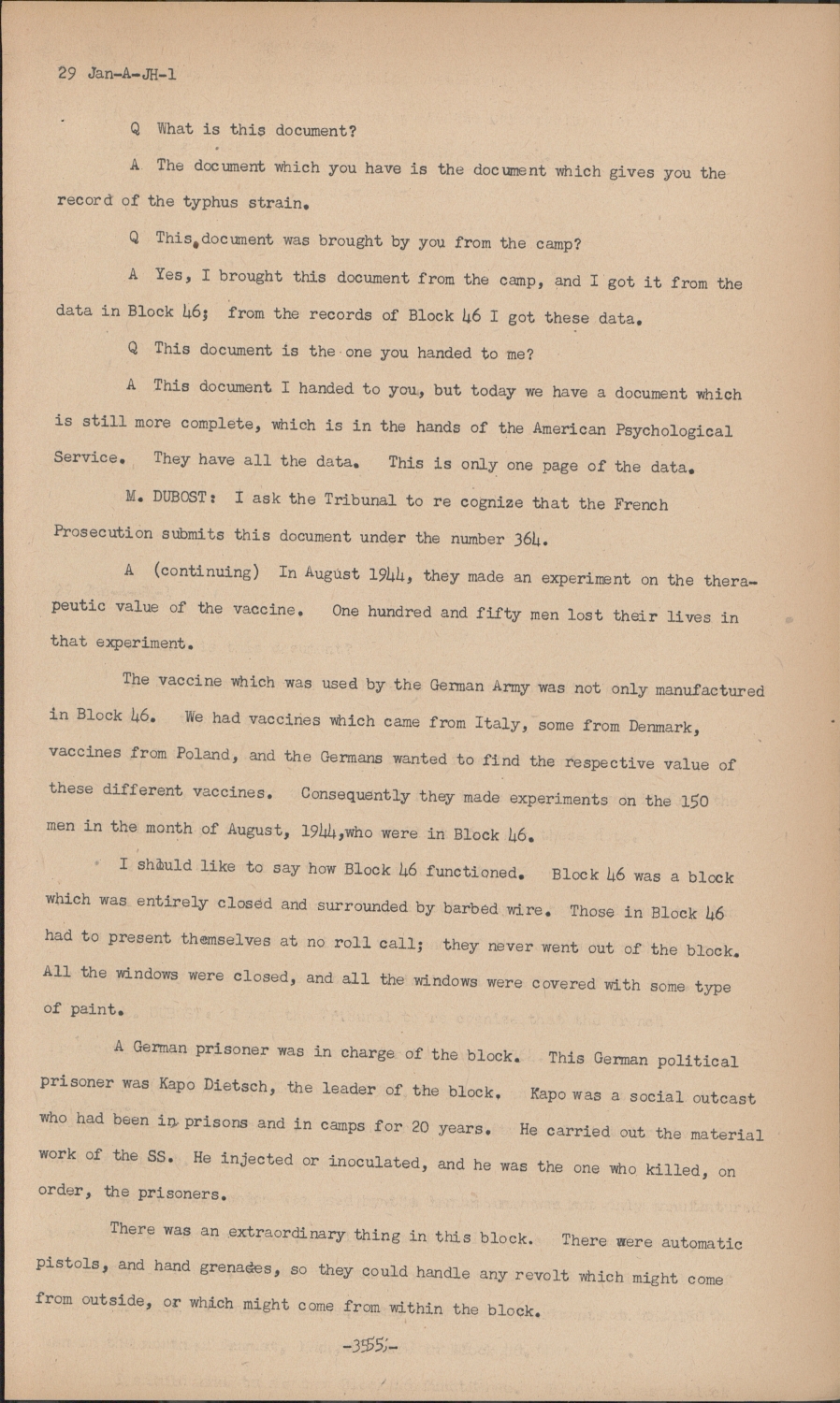
Q What is this document?
AThe document which you have is the document which gives you the record of the typhus strain.
QThis document was brought by you from the camp?
AYes, I brought this document from the camp, and I got it from the data in Block 46 from the records of Block 46 I got these data.
QThis document is the one you handed to me?
AThis document I handed to you, but today we have a document which is still more complete, which is in the hands of the American Psychological Service. They have all the data. This is only one page of the data.
M. DUBOST:I ask the Tribunal to re cognize that the French Prosecution submits this document under the number 364.
A (continuing) In August 1944, they made an experiment on the therapeutic value of the vaccine. One hundred and fifty men lost their lives in that experiment.
The vaccine which was used by the German Army was not only manufactured in Block 46. We had vaccines which came from Italy, some from Denmark, vaccines from Poland, and the Germans wanted to find the respective value of these different vaccines. Consequently they made experiments on the 150 men in the month of August, 1944, who were in Block 46.
I should like to say how Block 46 functioned. Block 46 was a block which was entirely closed and surrounded by barbed wire. Those in Block 46 had to present themselves at no roll call; they never went out of the block. All the windows were closed, and all the windows were covered with some type of paint.
AGerman prisoner was in charge of the block. This German political prisoner was Kapo Dietsch, the leader of the block. Kapo was a social outcast who had been imprisons and in camps for 20 years. He carried out the material work of the SS. He injected or inoculated, and he was the one who killed, on order, the prisoners.
There was an extraordinary thing in this block. There were automatic pistols, and hand grenades, so they could handle any revolt which might come from outside, or which might come from within the block.
I can also tell you that in an order concerning Block 46, which was sent to Block 50, in the month of January, 1945, we found that there were three episodes of force used to master those who did not want to be injected.
Now I come back to the experiments on typhus, on the vaccine, and how these experiments were carried out. The 150 prisoners were split into two groups; 75 were controls and the others were to be experimented on. Only those who were subject to experiments received the vaccine. That is, only 75 received this vaccine; the controls received no vaccine whatsoever, they were not vaccinated.
After vaccination of the 75 who were the subjects of the experiment, they inoculated, in an intravenous fashion, all the men who were connected with this experiment, subjects and controls. Fifteen days after this inoculation the controls died, at the approximate time for one inoculated with typhus to see his final hour arrive. As for the others, who received different kinds of vaccines, they died at varying lengths of time, proportionate to the value of the vaccine which they had received. Some kinds of vaccines gave an excellent result and there was a very slight mortality, particularly the Polish vaccine. Other vaccines resulted in a much higher mortality.
When the experiment was considered concluded, according to the habit and tradition in Block 46, the survivors of the experiments did not survive. Those survivors of the experiments were liquidated, they were murdered in Block 46, by the customary method which my comrades have told you of, by intracardiac injections of phenol, pure phenol of assafetic. That was the customary method of extermination in Buchenwald.
THE PRESIDENT:The Russian translation is not coming through. Can you repeat that about the survivors being killed by intracardiac injections?
AI will repeat it.
Thus, the person who survived the experiments within Block 46, according to the tradition and the habit which reigned in that Block 46, did not survive. Once the experiment could be considered concluded, the survivors of the experiment were murdered. They were liquidated by the customary methods which were used in Buchenwald. I think certain of my comrades have already spoken of this.
BY M. DUBOST:
QWill you go more slowly , please? I think the interpreters are having difficulty.
AIn Buchenwald I think the liquidation was carried out by intracardiac injections of pure phenol of assafetic, a proportion of five or ten cubic centimeters.
THE PRESIDENT:We are not really concerned here with the proportion of the particular injections.
THE WITNESS:Will you repeat that please?
THE PRESIDENT:As I have said, I am not concerned with the proportions in which these injections were given, and will you kindly not deal with these details?
M.Dubost, you might try and confine the witness.
A (continuing) Then I will speak of other details which I think may interest you.
There were other experiments on typhus, experiments of a therapeutic type, chemical products which were to cure typhus, under the same conditions in Block 46.
The German industries collaborated with these experiments. Notably, among those which collaborated with these experiments was I.G. Farben. I.G. Farben furnished a certain number of medicines which might be used for experiments in Block 46, Among to professors of I.G. Farben -- which furnished the medical materials for Block 46 for experimental purposes -- we find Professor Lauschleger.
From the question of typhus we now go to the question of phosphorus experiments, where prisoners of Russian origin were particularly utilized for phosphorus burns. These bums from phosphorus in Block 46 were practiced upon the Russian prisoners for the following reason: bombs which were thrown in Germany through the Allied aviators produced phosphorus burns upon the civilian population, and those were burns which were hard to heal. Consequently, the Germans sought some sort of medical treatment which might ameliorate and improve the conditions of the wounds which were caused by these burns. Thus, experiments were carried out in Block 46 on Russian prisoners.

who were artificially burned by products of a phosphorus base, and they were then treated with different medicants furnished by the German industry.
Also there were experiments on sexual hormones. BY M. DUBOST:
QWhat were the results of these experiments?
AEach experiment was like a murder.
QWho was responsible, the SS?
AYes, of course, because the SS was in charge of these burns and these experiments.
The SS was responsible, since all orders for experiments came from Section 5 of the SS at Leipzig and, consequently, from the Supreme Command of the Waffen SS.
QWhat were the results of the experiments made on sexual hormones?
AThey were less serious. These were ridiculous experiments from a scientific point of view.
We had, at Buchenwald, a number of homosexuals, that is to say, men who had been condemned by German tribunals for their crimes. These homosexuals were sent to the concentration camps, notably Buchenwald, and put with the other prisoners.
QWhat kind of prisoners? With political prisoners, who were patriots?
AWith all kinds of prisoners,
QYes?
AThey were with all kinds of prisoners. They were distinguished by a triangle of pink color.
QAs to the color of this triangle, was that a well-established custom, or was there a great confusion in the classification?
A In the beginning, before my arrival, according to what I had heard, there was some order in these various triangles which were used for classification.
When I arrived at Buchenwald, in January of 1944, there was a great confusion in the classifications, or in the triangles which were used to classify the prisoners.
QDid prisoners sometimes carry a triangle or wear a triangle of another color than their own?
AThat was true of many French.
QFrench?
AFrench who were sent there because they were criminals finally Tore the red triangle, which was that of political prisoners.
QWhat triangle did the German criminals have?
AThe German criminals had a green triangle.
QDid they sometimes wear a red triangle?
ANo, because they were more supervised than the other prisoners, and they usually wore the green triangle.
QAnd the work commandos?
THE PRESIDENT:We have heard that they were all mixed up,
M. DUBOST:The Tribunal must be aware that I speak of this because of certain questions "which were put by the defense attorneys this morning, and I wish to answer them now in this interrogation,
THE WITNESS:I can repeat to you that we had a complete mixture of nationalities and a complete mingling of the different categories of prisoners.
THE PRESIDENT:That is exactly what he said, that these triangles were completely nixed up.
M. DUBOST:I think, as to the statement of the second witness, that despite the efforts of the defense this testimony should be observed by the Tribunal.
BY M. DUBOST:
QDo you know of any human skin being tattooed?
AYes indeed.
Q Will you please tell us what you know about it?
AHuman skin was tattooed, those in Block 2, which was called the Pathological Block at Buchenwald.
QWere there many human skins tattooed in Block 2?
AThere was always human skin which was tattooed in Block 2. I don't know whether there were a great many, but there was some human skin that was merely tanned instead of tattooed.
QDid they skin humans alive?
AThey removed the skin and then tanned it.
QWill you continue your testimony on that point? A My testimony on this point: I saw SS who came out of Block 2, which was the Pathological Block, with tanned skin which they carried under their arms. I know, through my comrades who worked in Block 2, the Pathological Block, that there were orders for skins. These tanned skins were given as gifts to some guard, or to some SS visitor, who used them to bind books.
QYou told us that the Chief of the Camp at that time was Koch.
AI was not a witness of the Koch affair, because the Koch affair happened before I came to the camp.
QAfter he left there were still tanned skins and tattooed skins?
AYes, there were tanned skins and tattooed skins as long as I was there. They were there when the camp was liberated by the Americans. They still found in the camp, in Block 2, human skins which were tattooed and tanned. That was the 11th of April, 1945.
QWhere were these skins tanned?
THE PRESIDENT:I am afraid you are still going too fast.
BY M. DUBOST:
QWhere were these skins tanned?
AThese skins were tanned in Block 2, and perhaps also in the buildings of the crematorium, which were not far from Block 2.
QThere was then, according to your testimony, a constant custom which continued after the Koch technicians left the camp?
AYes, this kept on; I do not know in what proportion, but it kept on after his departure.
Q Did you witness any inspections which were made at the camp by important German personages, and if so, who were those high-placed persons?
AFirst, may I repeat something about Dora, as far as visits were concerned?
QExcuse me, I have one thing I wish to ask you, so far as skins are concerned. Do you know anything about Koch's condemnation?
AYes. I know that Koch was condemned, through rumours and through testimony which I heard from old prisoners who were my comrades, who had been there before me. But personally, I knew nothing about that affair.
QI would like to know tether, after Koch's condemnation, skins were still tanned.
AAfter he was condemned? Yes,
QYou are sure that skins were tanned after he was condemned?
AAbsolutely.
QWill you tell us now what visits were made to the camp by high-placed German personages, and who they were?
AContact between the outside of the German civilians and the German military and the interior of these concentration camps was carried out some time through people who left on leave. Certain political prisoners were permitted to leave who could get the authorization from the SS to go and spend a certain length of time with their families. Also, there were visits from those in the Wehrmacht who came into the carp.
In Block 50 we had a visit from the officer Kommandants of the Luftwaffe. These Officer Kommandants of the Luftwaffe, of the regular German Army, came through the camp and were able to take account of almost everything that was taking place.
QWhat did they do in Block 50?
AThey just came to make a visit, to see the equipment. They were invited by the Sturmbannfuehrer Schuler, and he received several visits.
QWhat was the equipment?
AEquipment for the manufacture of vaccine, equipment of the laboratory Q Thank you.