QWitness, did you also speak about the amnesty of Communists at the time?
AYes. Jost told me that in Riga around May some hundred Communist had been released or were to be released. He asked me how this situation was in Estonia and I told him that in February an amnesty had already taken place and another amnesty was expected for August.
QWitness, now I just have a few brief questions about the organization. Was the leadership of Einsatzgruppe A in the area of the kommando of the Security Police and SD separated organizationally?
AThey were separated organizationally insofar as the Einsatzgruppe A was commended from the staff headquarters in Krasnoguardeisk, and the agency of the Security Police Commander was commanded from Riga.
QWho were your superiors when you yourself were commander in Estonia?
AWhen I was commander in Estonia my superiors were , first in Revel the Commissioner General as Chief of Civil Administration, then the SS and Police Leader in Reval, and furthermore the commander of the Security Police in Riga.
QWitness, could you give us for the period of service that Jost spent in Riga how often you reported to your above-mentioned three superiors?
AI reported to the Commissioner General in Reval about two or three times a week; to the SS and Police Leader somewhat less; to the Commander of the Security Police about every six weeks.
QWitness, did you get any directives from the Commissioner General, Litzmann, as far as Security Police measures were concerned?
AYes.
QCould you give me some examples for this?
AThis is, first of all, a question of Communist matters. Many applications by relatives reached Litzmann, and there were cases in which women described their economic position very impressionably and for which the Commissioner General ordered a release of the men concerned.
Also the amnesties which I have mentioned took place because of a decree promulgated by the Commissioner General.
DR. SCHWARZ:Your Honor, I have no further question.
THE PRESIDENT:Very well. Any other cross-examination on the part of defense counsel?
(No response).
THE PRESIDENT:Mr. Glancy, you may take up the cross-examination on behalf of the Prosecution.
CROSS EXAMINATION BY MR. GLANCY:
QDr. Sandberger, when did you join the Party?
ANovember, 1931.
QIn 1941 when you took command of Sonderkommando L-A, you had been a National Socialist for ten years, is that correct?
AYes.
QPrior to your time of service with the SIPO and SD, that is, during your student days, you were a speaker on behalf of the National Socialist movement, weren't you?
AI don't know what you mean by the expression "speaker".
QOrator or propagandist.
AIn the student association at Tubingen, I made two or three speeches, yes, that is correct.
QWere you indoctrinated, or rather, did you learn of the tenets, the ideologies and aims of the National Socialist movement?
AYes, of course.
QThen during these times you became aware of the National Socialist attitude toward the Jews, is that right?
AThe National Socialist attitude was not all unified in all circles of the Party.
There were some circles which did not approve of the things which some other circles of the Party did in the Jewish question, or said.
QWhen did you join the SS?
AJanuary, 1936.
QThat was unified organizationally, wasn't it?
AYes.
QThere was very little lack of unity in their ideas and their ideologies and aims, is that right?
AIn the SS there were many various tendencies, just within the SD especially.
QI am speaking of the SS.
AYes. I only joined the SS by way of the SD.
QI don't want any explanation now. When did you join the SS?
AIn January 1936, within the SD.
QDid you join the SS on the 11th of May, 1935?
ANo, that is not correct. I joined the SS on the 1st of January 1936.
QWere you born on the 17th of August, 1911?
AYes.
QBoth these dates are contained in your service record. Do you have any comment on that?
AI think that is a mistake. The date of May, 1935, which is contained herein, is not the date of my membership in the SS but is the time when I first got in contact with the SD. I am quite sure of this.
QWhen did you join the Party?
ANovember, 1931.
QCouldn't that have been the first of December, 1931?
AIt could be that it was dated on that date.
QWhen did you apply to become a member of the SS?
AIn December, 1935, or in January, 1936, as far as I can remember, but my recollection is not quite exact.
QI think that your recollection fails you. A record is more permanent than a memory. On the first of December, 1931, you became a Party member; on the 11th of May, 1935, you became a member of the SS.
APardon me, Mr. Prosecutor. This is doubtlessly a mistake. I am absolutely certain that the date of May, 1935, is the date of my first contact with the SD and that on the 30th of January, 1936, I received my admission into the SS, retroactive to the 1st of January, 1936.
QWhat is your SS number?
A 272495.
QYour SS record carries your SS number, and next to it is the 11th of May, 1935. Do you expect us to believe that they got the number correctly; they got your birthday correctly; your Party record correctly, and make a mistake on the date of your joining, which is all important as far as seniority is concerned?
AMr. Prosecutor, I don't know whether it says on that record that this is SS membership for this date. I am absolutely certain about this, that I was admitted to the SS on the first of January 1936. My superior at that time, Dr. Scheel, is here in the house and will be able to confirm this at any time.
QDuring the time that you were a member of the SS, prior to your Einsatz mission in the East, were you aware of the attitude of the National Socialists towards Jews and Communists?
AThis attitude was different in the various circles of the Party.
QI am asking you if you were aware of it.
AMay I ask, Mr. Prosecutor, which concrete attitude you mean? For example, I did not know, and I never heard of this, that prior to 1941 Jews were systematically sent in concentration camps in Germany, in case that is what you mean.

QIt is exactly what I mean.
ANo, I was not aware of this. I didn't hear about this. I already said yesterday that I learned that after the 10th of November, 1938. Jews were sent to concentration camps, but that they were again released after a few weeks, as far as I heard, and I know nothing, that later, until 1941, in any case, any systematic internments into concentration camps took place for Jews.
QWhen did you join the SD?
AMy first contact with the SD was in May, 1935. That is the date which you mentioned before.
QYour record that you joined the SD on the 11th of May, 1935 that your first contact with the SD was in january of 1935.
AMr. Prosecutor, this is a mix-up. In January, 1936, is the membership into the SS and May, 1935, the contact with the SD. I am absolutely certain of this.
QWhen you joined the SS you took a certain oath of complete subervience, subordination and obedience to the Fuehrer, did you not?
APreviously already, in 1934, I already shore the oath of allgiance to Hitler as a justice official, and in 1936.
AI am asking you about your oath as an SS man. Answer that question.
AYes.
QCan you repeat it for the Tribunal?
AI cannot give the exact wording of it.
QGive us the sense of it. You must remember it. You lived with it for years.
AThe sense of the oath is as follows: That I vowed allegiance to Adolf Hitler, and to the superiors designated by him.
QDidn't it say complete faithfulness without questions, wasn' it more likely the sense of it?
AAs officials and soldiers innumerable people swore the oath.
QI am asking you if that was not the sense of the oath?
AYes, insofar not -
QWas it or was it not?
AInsofar not -
QWas it or was it not, yes or no?
APardon me, may I ask you to repeat the question?
GGladly, Wasn't it the sense of the oath that you swore, vowed complete and utter obediance to the Fuehrer and to such superiors as he would place over you, without question?
AYes, but-
QThat is all.
ABut I never thought of these things at that time as they happened later.
QDid you take the oath?
AYes.
QDo you consider an oath binding?
AYes.
QDid you consider this oath binding at that time?
AYes, but I never considered -
QWere you released from that oath?
ANo.
QWhen you took charge of Sonderkommando I-A and when you heard the two speeches, one in Berlin and one in Pretsch, were you aware of the Hitler order to exte minute Jews, Communists, gypsies and other asocial elements?
AI received the order to mean that you were slay defenseless people whenever and wherever found it they were Jews, Communists or other elements odious to the German people?
ANot wherever they may be found, but I did not understand it that way, that anywhere where I would go this happen through my kommando, but I was convinced that a delay was possible.
QI didn't ask you that. Was it your understanding that the wording of the order was such that would call for the annihilation and extermination of the Jews, gypsies, Communists?
AYes.
QIn view of your oath of complete allegiance and complete obedience to any order, or any commander, that Hitler issued or placed over you, do you not consider that it was necessary that you obey this order?
AI consider myself justified to tell my superiors, to request them, to give them my reasons whatever they were, to delay the carrying out of this order.
QLet us stop right hero. Let's remove the other people between you and the Fuehrer. The Fuehrer issued the order. He issued it through channels, that is true, but in effect he issued it directly to you. You had sworn an oath. Was this oath binding?
AYes.
QDid you receive this order?
AYes.
QWhy did you consider that you would not obey it as it was given?
AIt wasn't given to me in such a way that I had to carry it out by a certain deadline, that is, immediately or within four weeks.
QWhen an order is given, when this order was given, was there any clause or stipulation as a part of the order that it would be up to your discretion that you could not, or that you could fail to carry out this order?
ASuch an order, an Hitler order was binding, strict, and allowed not much interpretation. This order that you would kill the Jews; you would kill the Communists, you would kill the gypsies, or anything that was concerned or deemed a threat to security of the German Army.
AYes.
QDid Stahlecker repeat this order for the extermination of the Jews, Communists, etc.?
AHe repeated it, but he then granted my request for a delay.
QIn the German Army is it accepted thing that when a junior officer of the grade of Obersturmfuehrer, or major, receives an order from a Brigadefuehrer, or a General, that he will question this order?
AIt is possible that he may discuss it with the BrigadierGeneral and requests him for certain reasons not to have to execute this order for the time being.
QWhat were the orders that Stahlecker received?
AStahlecker received the order to destroy these groups of people whom you have enumerated, but no deadline was given Stahlecker either, and at the time of Stahlecker's death, that is after nine months tens of thousand of Jews lived in the area of Stahlecker.
Thus, he also did not carry out the order to its complete extent in nine months, either.
QIs it possible that the reason some of those Jews and Communists remained is because you needed manpower?
AYes.
QWasn't the final aim or the final solution that all Jews, wherever and whenever encountered, when they served no further usefulness or if they ever were considered a security threat, would be annihilated?
AMay I ask do you mean the aim of the Fuehrer Order?
QAnswer my question.
AI didn't quite understand the question.
THE PRESIDENT:Mr. Glancy, would you mind refraining the question after recess?
MR. GLANCY:Yes, sir.
THE PRESIDENT:The Tribunal will be in recess for fifteen minutes.
(A recess was taken.)
THE MARSHAL:The Tribunal is again in session.
THE PRESIDENT:You may proceed.
MR. GLANCY:Thank you. BY MR. GLANCY:
QJust before we recessed, I asked you if the final aim or the final solution of the Jewish problem in the East was a complete and total annihilation insofar as possible after they had served their purpose as workers and laborers.
AThere was no period of time, no time limit; no deadline.
QI didn't ask you that; just a moment. I didn't ask you that. Answer my question as it was phrased .. yes or no.
AIf you attach particular importance to the word immediately. I must say no.
QI didn't say immediately. I said the final aim or final Solution.
AIn that case I misunderstood; yes. May I ask the question to be repeated? I understood immediately; I am sorry.
QMy question was, and I shall repeat it, was not the final aim or the final solution of the problem, insofar as it concerned Jews, Gypsies and communists in the East, their total extermination and annihilation whenever it was possible after they had served their purpose as laborers?
AYes, without a deadline.
QYou answered yes to the question; did you not?
AWith addition by saying there was not a deadline. BY THE PRESIDENT:
QWhen did you think -- excuse me for interrupting, Mr. Glancy -when did you think that deadline might finally be decided upon?
AThat was not in the contents of the order that immediately when the territory had been reached all Jews should be eliminated. There was no time limit; no deadline.
QBut you said it was not indicated in the order when this elimina tion should take place; that is right?
AYes.
QThen you said there was no dealine.
AYes.
QWhen did you think that finally a deadline would be established; that from a certain day then the order had to go into effect?
AThe deadline itself according to our conditions was the matter of the Chief of the Einsatzgruppe or at least within Einsatzgruppe A; it might have been different with other groups.
QYes. When was the deadline reached in your case?
AStahlecker first of all ordered, or at least he gave a basic order that could not be contradicted at the end of September, referring to one part.
QVery well. So that then the Fuehrer Order was held in abeyance from the early part of June until the end of September.
ANo. Stahlecker knew that; it becomes quite evident from the reports that it was not absolutely carried out. I will also explain the reasons why.
QJust a moment, please; just a moment. You said the order did not have to go into effect immediately. Then I asked you when it did go into effect. You said about the end of September; is that right?
AStahlecker passed on, did not give us the order for all of us at the end of September.
QNow just a moment, please. Answer the question. We lose so much time because you pay no attention to the question. The order did not require you to put it into effect immediately, you tell us; is that correct?
AYes.
QAll right. Now, when did you finally get an order; when did the order finally go into effect so far as you were concerned?
AI do not remember the date.
QWell, you told us before the end of September; is that date incorrect?
AAt the end of September I am only referring to one part, but not totally, not for all of them.
QBut insofar as you were concerned, when were you ordered finally to exterminate Jews, as the Fuehrer Order indicated?
ADuring the course of autumn, 1941.
QWell, what month? The autumn has three months?
AFirst in September and once in October and once in November.
QWell, all right; the first of September was the first time that you finally were called upon to give some effect to this order; is that correct?
AYes.
QAll right; now, I am coming back to that original question, so far as that Fuehrer Order, as far as you were concerned, was held in abeyance during the months of June, July, August, so that this order was held up three months so far as you were concerned.
ANot insofar as my group chief was in agreement that it should not be carried out.
QThen it wasn't out into effect for three months.
AYes, that is correct.
THE PRESIDENT:It took me a long time to get that very simple question. Proceed, Mr. Glancy. BY MR. GLANCY:
QNow that we have ascertained that there was a culminating point as far as you are concerned with regard to the Fuehrer Order, you must have at all times been aware that at some time you would be called on to carry out this order; is that correct?
AI had to reckon with this possibility.
QIt was not a possibility, it was a certainty that a Hitler order must be obeyed; is that right?
AYes; there was no deadline though.
QWitness, let me caution you we have been taking much too much Time. I am sure that my question have been clear and concise, where there is only one interpretation.
We won't waste any time if you will be a little more responsive to my question; consider it and answer it as it is asked, please. You knew that as far as the Hitler order for the extermination of Jews, Gypsies and communists was concerned, that at some time you would be called upon to carry this out; is that correct?
AYes, I had to assume that.
QVery well. You have said that you were a commanding officer of Sonderkommando I.-A; is that right?
AYes.
QYou broke your commando up into five Amts divisions, or offices; is that correct?
AYes.
QYou had subordinates in each one of these offices; is that correct?
AYes.
QThat is Amt I, the personnel.
AYes.
Q II -
AAdministration.
QIII -- for SD work.
AYes.
QIV -- for executive or the Gestapo.
AState Police
QAnd V -- the KRIPO, or criminal police.
AYes.
QYou issued orders and expected them to be carried out?
AYes.
QIt was the original mission of the Einsatzgruppen and Sonderkommandos to exterminate Jews, Gypsies and communists; is that right?
AThat was one of the tasks yes.
QThat was their main task; that was the reason for their formation and organization -- the security of the army's rear area and the extermination of Jews, Gypsies and communists.
AThe securing of the army territory was the task of my commando.
QAnswer the question yes or no; then you may explain after you have given an answer. Was that not the reason for the formation, of the organization of the Einsatzgruppen, the extermination of Jews, Gypsies and communists because they were considered a threat to the security of the army?
ANo, in this formulation it is not correct because the Einsatzgruppen existed as organizations at the time when the Fuehrer Order had not been made known that their assignment would be that of a general securing of the rear army territory.
QAt some time you received the Fuehrer Order; is that right?
AYes.
QDid not that make it your prime, your first main task the extermination of the Jews, Gypsies and communists?
ANo.
QIn other words, Hitler in Germany issued orders and if you felt so inclined you obeyed them; otherwise you relegated them to a position of secondary importance.
ANo, that is not how it was. There were many cases in which we hesitated to carry out the orders.
QHesitancy is not what I am driving at here. You were to carry out the Hitler order as the Chief of Sonderkommando; is that right?
AYes.
QDid you not say that that order took effect in September of 1941?
AI said that, but I added that Stahlecker was agreed to a delay.
QYou said that the deadline was reached in September?
AIn September when I spoke to Stahlecker, it must have been the 2nd of September, he wasn't very well, and he gave me that order.
When hegave me that order he agreed to a delay on that date. At the end of September, in my absence, he repeated this order at my office, but he did not refer to the execution of the whole, but only of a part of it.
QThen, you followed -
AIt becomes evident from the reports.
QThis order in part?
AI wasn't there. Therefore, I couldn't obey it either in part or wholly.
QDid the members of your commando obey it?
AYes, in my absence, without my knowledge.
QDid you not foresee that this order must at some time be carried out whether you were present or not?
AI had to reckon on that possibility, yes.
Q.Did you realize this when you assumed command of Sonderkommando I-A?
A.Yes.
Q.Was it carried out in part by you or by your subordinates in Sonderkommando I-A?
A.By my subordinates, yes, without, my knowledge; in my absence.
Q.Were you in command of Sonderkommando I-A?
A.Yes.
Q.How many Jews were killed in September by members of your command?
A.The report says that there were four hundred forty; I do not know from my own knowledge.
Q.Did't you say that your subordinates reported to you as to this affair?
A.After I had returned.
Q.Did they report to you?
A.After I had returned from the Leningrad area, in the beginning of October they reported to me, yes.
Q.They reported to you?
A.Yes, after it had happened. BY THE PRESIDENT:
Q.Did you reprimand them for doing it?
A.I couldn't reprimand. At least the next day...
Q. (Interposing) I didn't ask you whether you could; I asked you whether you did.
A.No.
Q.Did you talk about it at all?
A.Yes.
Q.What did you tell them?
A.I said that I regretted that this order which he knew was going to be delayed by me, that it had to be carried out at least in part.
Q.Did you tell him not to do it again?
A.I had no choice to do that because he was transferred the next day to Berlin.
Q.Well, during the conversation that you had with him, when you expressed your regret this had happened, did you say: Now, I don't want you to do this again.
A.Your Honor, that was not topical at the time because this man was about to be transferred to Berlin anyway.
Q.Witness, answer me: How old are you?
A.Thirty-six years.
Q.Very well. Now, a man thirty-six years of age ought to be able to understand a question and to reply to it directly.
A.Yes.
Q.Now, you talked with this sub-commando leader when you returned?
A.Yes.
Q.And you expressed your regret that he had executed these Jews in your absence.
A.Yes,
Q.How long was this conversation with him?
A.I don't remember that.
Q.Well, a matter of minutes?
A.I think it must have been longer.
Q.Well, about how long? An hour or two?
A.Approximately an hour; it could have been an hour; I have no recollection at the moment.
Q.Yes, all right. Now, all I asked you was that in this conversation which you had with him, did you or did you not say to him: I don't want you to do this again.
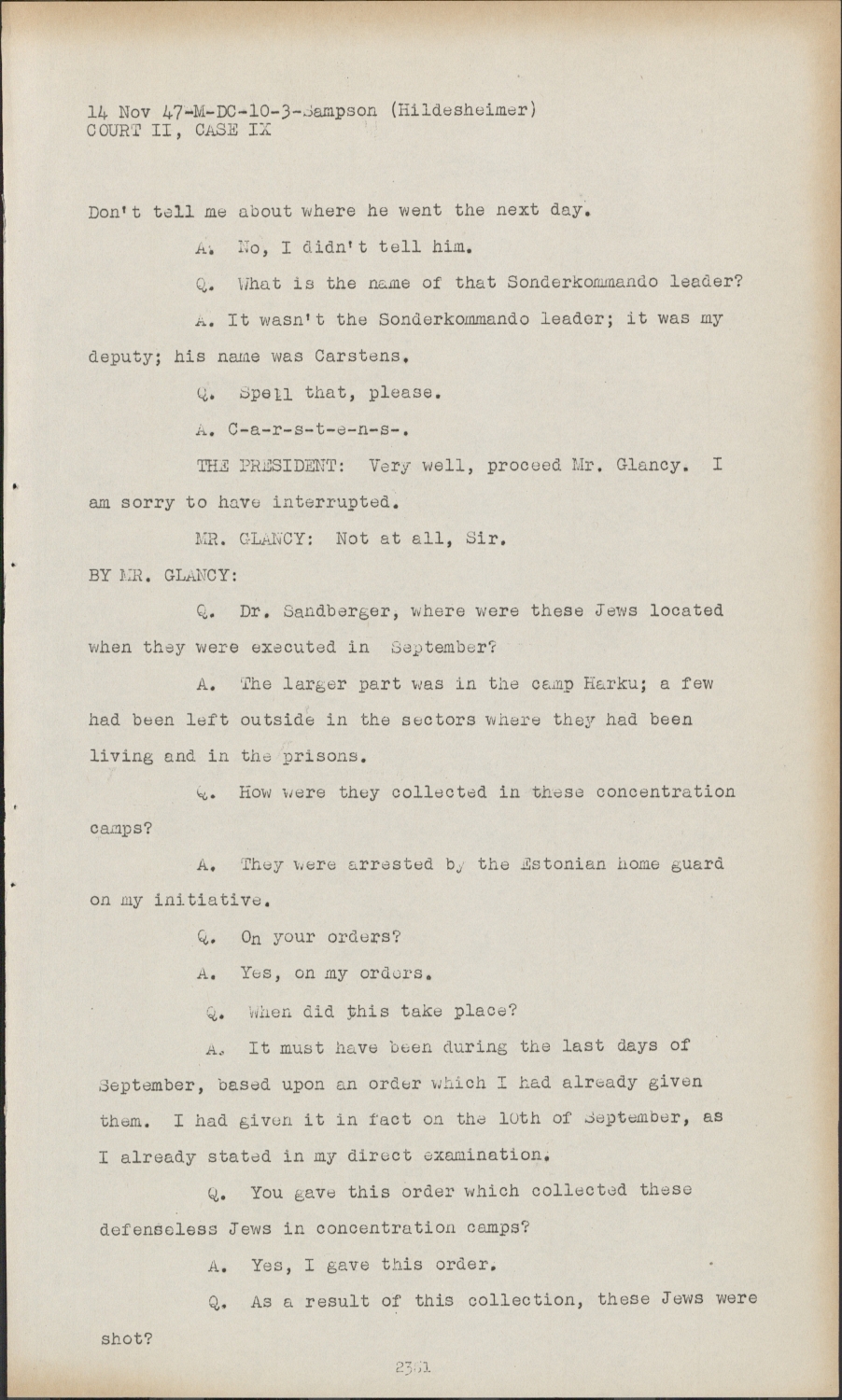
Don't tell me about where he went the next day.
A.No, I didn't tell him.
Q.What is the name of that Sonderkommando leader?
A.It wasn't the Sonderkommando leader; it was my deputy; his name was Carstens.
Q.Spell that, please.
A.C-a-r-s-t-e-n-s-.
THE PRESIDENT:Very well, proceed Mr. Glancy. I am sorry to have interrupted.
MR. GLANCY:Not at all, Sir. BY MR. GLANCY:
Q.Dr. Sandberger, where were these Jews located when they were executed in September?
A.The larger part was in the camp Harku; a few had been left outside in the sectors where they had been living and in the prisons.
Q.How were they collected in these concentration camps?
A.They were arrested by the Estonian home guard on my initiative.
Q.On your orders?
A.Yes, on my orders.
Q. When did this take place?
A. It must have been during the last days of September, based upon an order which I had already given them.
I had given it in fact on the 10th of September, as I already stated in my direct examination.
Q. You gave this order which collected these defenseless Jews in concentration camps?
A. Yes, I gave this order.
Q. As a result of this collection, these Jews were shot?
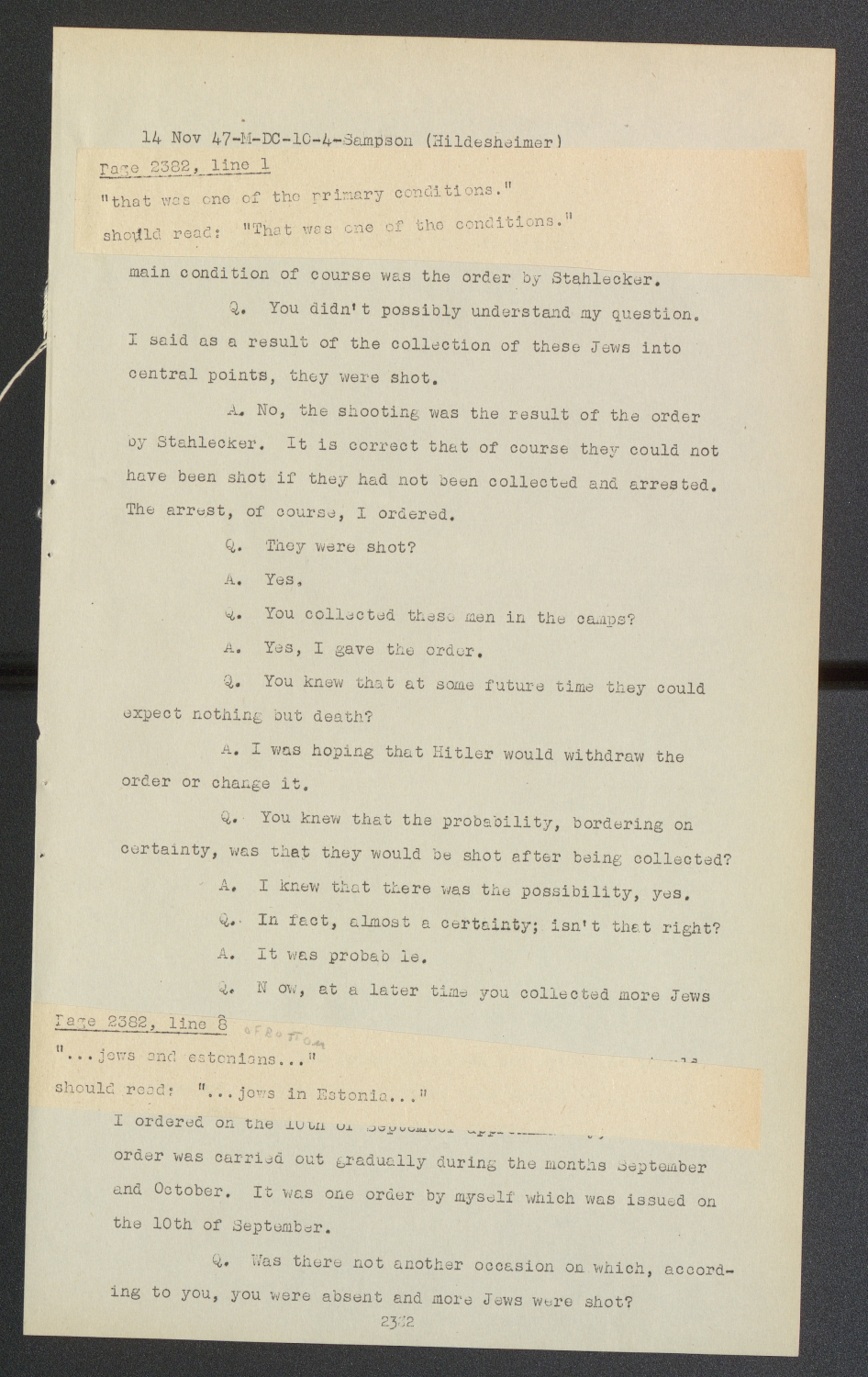
A.That was one of the primary conditions; the main condition of course was the order by Stahlecker.
Q.You didn't possibly understand my question. I said as a result of the collection of these Jews into central points, they were shot.
A.No, the shooting was the result of the order by Stahlecker. It is correct that of course they could not have been snot if they had not seen collected and arrested. The arrest, of course, I ordered.
Q.They were shot?
A.Yes.
Q.You collected these men in the camps?
A.Yes, I gave the order.
A.You knew that at some future time they could expect nothing out death?
A.I was hoping that Hitler would withdraw the order or change it.
Q.You knew that the probability, bordering on certainty, was that they would be shot after being collected?
A.I knew that there was the possibility, yes.
Q.In fact, almost a certainty; isn't that right?
A.It was probable.
A.N ow, at a later time you collected more Jews didn't you?
A.No, the order that Jews and Estonian should be arrested, that all Jews within time should be arrested, I ordered on the 10th of September approximately, and this order was carried out gradually during the months September and October. It was one order by myself which was issued on the 10th of September.
Q.Was there not another occasion on which, according to you, you were absent and more Jews were shot?
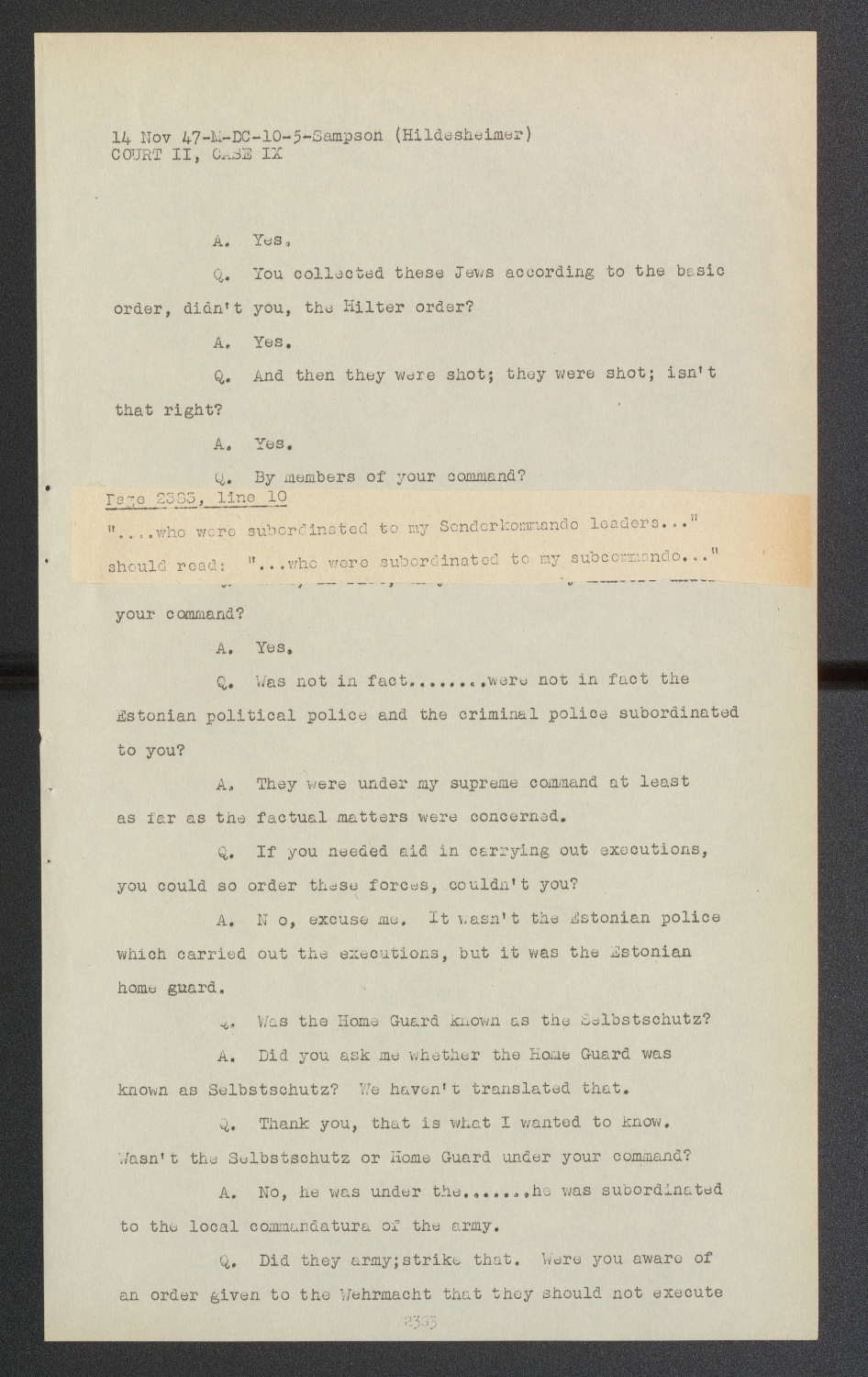
A.Yes,
Q.You collected these Jews according to the basic order, didn't you, the Hilter order?
A.Yes.
Q.And then they were shot; they were shot; isn't that right?
A.Yes.
A.By members of your command?
A.From Estonian men who were subordinated to * y Sonderkommando leaders; that is also myself then.
Q.Then, in fact, they were shot by members under your command?
A.Yes.
Q.Was not in fact........were not in fact the Estonian political police and the criminal police subordinated to you?
A.They were under my supreme command at least as far as the factual matters were concerned.
Q.If you needed aid in carrying out executions, you could so order these forces, couldn't you?
A.No, excuse me. It wasn't the Estonian police which carried out the executions, but it was the Estonian home guard.
Q.Was the Home Guard known as the Selbstschutz?
A.Did you ask me whether the Home Guard was known as Selbstschutz? We haven't translated that.
Q.Thank you, that is what I wanted to know. Wasn't the Selbstschutz or Home Guard under your command?
A.No, he was under the.......he was subordinated to the local commandatura of the army.
Q.Did they army; strike that. Were you aware of an order given to the Wehrmacht that they should not execute 14 N ov 47-M-DC-10-6-Sampson (Hildesheimer) Jews and Gypsies and communists but leave that to the forces of the SIPO and SD as that was their primary task?