It was the acute awareness of these truths, forced upon us by the first World War, which has led to the general condemnation of those who wilfully launch a war of conqoust as criminals in the deepest and most serious sense.
These proceedings at Nuernberg, in which crimes against peace are charged, are vitally important because the principles to be applied here are man's best protection against his own capacity for self-destruction. When we say that aggressive war is a crime, we mean it to exactly the extent to which we are prepared to treat it a criminal in a judicial proceedings. No principle deserves to be called such unless men are willing to stake their conscience on its enforcement.
In this proceeding, we ask the Tribunal to test the conduct of men who stood at the top of the German profession of arms. In most countries, arms is one among a number of callings. It is a respected and honorable occupation, and it will be an absolutely necessary profession as long as organized force plays an important part in the affairs of men. But it is the true and high purpose of this profession to protect, not to subject. The military art is never to be practiced for its own sake; the death and destruction which the use of arms entails is redeemed and ennobled only when the sword is the guardian and restorer, not the destroyer, of peace.
But in Germany, however, the military profession was not merely only among many. The German officer was accorded a very unique and exalted role. A century and a half ago, the Frenchman Mirabeau wrote that "Prussia is not a state that possesses an Army; it is an army that has conquered a nation." And it is because of the dominant part which military matters have played in the life and thought of Germany ever since the time those words were written, that this twelfth and last case before the Nuernberg Military Tribunals may well prove of greater importance to Germany than any other case heard in this court-roam.
In saying this, we by no means, mean to depreciate the significance of the issues at state in other cases which are being or have been held here. But the evidence here is closely related to one of the strongest currents in German thought, which may be aptly entitled "Arms and the German".
The defendants are charged not only with the unlawful use of war, but also with its abuse, The laws and customs of war, which mitigate its ravages, have never won more than lip loyalty from the German militarists. The German military manual openly scoffs at the Hague Convention as being derived from "humanitarian considerations which not infrequently degenerated into sentimentality and flabby emotion." The terrible consequences of this ruthless nihilism are not, even today, fully grasped. Millions of innocent civilians were slaughtered by troops under the command or control of the defendants and their colleagues, not in pursuit of any legitimate military objective, but in furtherance of the basest Nazi racial and social myths. The defendant von Kuehler, for example, as the documents prove, observed Christmas Day in Russia 1941 by authorizing the killing of 230 incurable invalids in an asylum at Makarjewo, on the basis of a subordinate report which stated that:
..... the inmates of the asylum no longer represent objects with lives worth living according to the German conception.
We have said that the military profession was esteemed above all others by many Germans and the German officers' corps included men of great ability and high character.
To those men we mean no dishonor in this proceeding. The issues here are far too grave to warrant any tricks of advocacy; the evidence is quite compelling enough and will provide its own eloquence. Those members of the German officers' corps who have the capacity for clear vision and the courage to face the facts will welcome this opportunity for emergence of truth.
In presenting the evidence under Count One of the indictment, the prosecution plans to deal summarily with the years prior to the advent of Hitler. But we must not overlook the fact that most of these defendants were not Nazis in the usual sense of the word, and that they are charged with the commission of crimes, not as party members, but as military leaders. The moral outlook and purposes which resulted in those crimes were not invented by Hitler, but were developed by the defendants and their prodecessors in the German officers' corps. Mr. Justice Oliver Wendell Holmes has observed that, in some circumstances, "a page of history is worth a volume of logic." And we believe that the story of the German Army since the first World War, very briefly treated, will do much to illuminate the issues in this case.
The most fundamental circumstance in Germany's military structure during the Weimar Republic was, of course, the Treaty of Versailles. Under part V of the Treaty, the Military, Naval and Air Clauses, precise limitations were prescribed for the size and nature of the German armed forces, and compliance with these provisions was to be ensured by Inter-Allied Commissions of Control. Such Commissions Military, Naval and Aeronautical O arrived in Germany in September, 1919.
The air clauses of the Treaty need not detain us long. Military and naval aviation was completely prohibited by providing that "the armed forces of Germany must not include any military or naval air forces".
The naval clauses were, of necessity, more elaborate. Like military aircraft, submarines were completely prohibited. As for surface craft, the Navy was restricted to six each of battleships and light cruisers, and twelve each of destroyers and torpedo boats. The tonnage of newly-built units was Limited: battleships 10,000 tons, light cruisers 6,000 tons; and the rate at which naval units could be replaced was also specified. The personnel of the German Navy was not to exceed 15,000 officers and men.
But most important for our purposes are the military clauses. By Article 160 it was stipulated that, after 31 March, 1920, the German Army should not exceed ten divisions -- seven infantry and three cavalry divisions, comprising not over 100,000 officers and men, and grouped under not more than two corps headquarters. The so-called "Great German General Staff" was to be dissolved and not "reconstituted in any form" The Army was not to be designed for any warlike purpose; it was expressly stated in the Treaty that The Army shall be devoted exclusively to the maintance of order within the territory and to the control of the frontiers.
Other provisions were intended to ensure that the "100,000 man Reichswehr" should not be used as a means of training a large reserve. Compulsory military service was abolished. Newly-appointed officers had to agree to serve for twenty-five years, and enlisted men for twelve years.
The armament and munitions limitations were equally important. Tanks and poison gas were Prohibited. Precise schedules fixed the maximum amounts of guns and small arms of specified calibres, and stocks of ammunition, which were permitted to be maintained. Within Germany, arms could be manufactured only at certain factories listed by the Allied Powers; all other munition plants were to be "closed down".
And, finally, special safeguards were provided by the demilitarization of the Rhineland. In Germany west of the Rhine, and east of the Rhine to a depth of fifty kilometers, no armed forces were to be maintained or assembled. Forts and field defense works were likewise forbidden within this area.
The organization of the German armed forces under the Republic reflected these arms limitation clauses. There was no German Air Force. The Army and Navy were brought together in a single cabinet ministry, which was pacifically named the Reich Defense Ministry, the Reichswehrministerium.
Sovereign authority over the Reichswehr was divided between the President of Germany and the Cabinet, acting through the Chancellor and the Reich Defense Minister. The President was the supreme commander of the armed forces. But because of the parliamentary form of governnent, the development and execution of government policies was in the hands of the Cabinet. Therefore all Presidential orders pertaining to the armed forces had to be countersigned by the Reich Chancellor or the Reich Minister of Defense.
The 100,000 man Army and the 15,000 man Navy were established on 1 January, 1921. The Army was headed by a general with the title "Chief of the Army Command" and the Navy by an Admiral entitled "Chief of the Navy Command". These commanders and their staffs were established within and as part of the Reich Defense Ministry, and in a governmental sense they were subordinate to the Reich Defense Minister; but, in the military chain of command, their supreme commander was the Reich President. The Reich Defense Minister himself had only a small staff, and most of the actual work of the armed forces was done by the staffs of the army and navy chiefs.
Because the first Reich President (Ebert) and the first two Defense Ministers (Nosske and Gessler) were all civilians, the army and navy chiefs were the military commanders-in-chief of the two services. Their staffs were organized much as were the army and navy staffs in other countries. In view of the prohibition of the Versailles Treaty there was no army general staff by that name; but, the functions of an army general staff were performed by the so-called "Troops Department" (Truppenamt) of the Army Command. Like any general staff, the Truppenamt had sections for operations, training, intelligence, and organization.
In the field, Germany was divided into seven military districts (Wehrkreise) corresponding to the seven infantry divisions allowed by the Treaty. In each Wehrkreis was an infantry divisional headquarters which also controlled all military activities within the Wehrkreis, such as recruitment, pensions, training, etc.
Again following the Treaty Limitation of the Army to two corps headquarters, the Wehrkreise of eastern Germany were grouped under a "group headquarters" (Gruppenkommando) at Berlin, and these in western Germany under a similar headquarters at Kassel. There were also three cavalry divisional headquarters without territorial jurisdiction.
Restricted by the Treaty provisions described above, the Reichswehr of the Weimar Republic bore little outward resemblance to the mighty army of the Kaiser. But the purpose, the intelligence, and the energy and determination to salvage as much as possible from the wreckage and start to rebuild Germany's military might were not lacking, either in the Army or the Navy. They found their most effective focus in the Brain of the Chief of the Army Command, General Hans von Seeckt.
There is no occasion now to debate the merits or demerits of the Treaty of Versailles. The important fact here is that, whatever they might say publicly, von Seeckt and the other military leaders of Germany unqualifiedly rejected the Treaty, and all their plans were directed to its overthrow. Their immediate purpose, therefore, was to bring about as soon as possible a state of affairs which would permit Germany to recreate her once formidable military engine.
Von Seeckt's plan of campaign to achieve these ends was flexible, but was based upon about half a dozen basic principles. The first of these principles, designed to preserve the Army's prestige in the eyes of the German people, was intensive cultivation of the legend that the German Army was not defeated in the first World War. Thus, when Fieldmarshal von Hindenburg appeared before a legislative committee of inquiry in November, 1919, he testified that "In spite of the superiority of the enemy in men and material, we could have brought the struggle to a favorable issue if determined and unanimous cooperation had existed between the Army and those at home.
... The German Army was stabbed in the back.
It is plain upon whom the blame lies. If any further proof were necessary to show it, it is to be found in the utter amazement of our enemies at their victory."
Secondly, the traditions of the old imperial army were to be preserved. There was to be no "democratizing" of the new Reichswehr. Prussian concepts of discipline and "honor" persisted, and the preorgatives of the officers' corps were safeguarded. As a practical matter, the officers' corps remained closed to Jews. Despite the fact that the Reichswehr's oath of allegiance was given to the President of the Republic, the spirit of the officers' corps continued to be autocratic; monarchism was tolerated and was not uncommon.
Seeckt's third basic principle was that the Reichswehr should hold itself aloof from and above internal party politics in Germany. The Weimar Republic was a frail ship on a stormy sea. The economic aftermath of war, and in particular the disastrous inflation of 1922 and 1923, caused great unrest. Cabinets rose and fell and Chancellors came and went amid unstable political conditions. Rather than risk the Army's prestige in this maelstrom of party politics, von Seeckt wisely held the Army apart from any party and discouraged political party activity within the officers' corps.
But this is not to say that the Army was not a political fact or that von Seeckt had no political attitude. Quite the contrary; the Army was above politics because in a sense, it dominated them. Sedulously and skillfully, von Seeckt brought about, among the leading politicians of all parties, a feeling that the government was dependent upon the Reichswehr for its protection and to insure its continued existence. When industrial unrest and workers' demonstrations were quelled by the Reichswehr, von Seeckt appeared as the guardian of the Republic against Communism. When the much more serious threat of reactionary revolution culminated in actual attempts to overthrow the Republic -- such as the Kapp Putsch of 1920 and the Hitler-Ludendorf Putsch in 1923 -- the Army again emerged in the role of saviour despite the fact that military leaders were among the participants.
Fourthly, von Seeckt brought about close relations between the Reichswehr and the Soviet Union's Red Army.
The fact that the officers' corps was reactionary was not allowed to obstruct this policy. Since the Army's principal purpose was the overthrow of the Versailles Treaty, von Seeckt sought alliance with the one major European power that had no interest in upholding it. The Treaty of Rapallo, signed by Germany and the Soviet Union in 1922, set the official seal upon the unofficial close relations which already existed between the military leaders of the two countries.
Fifthly, von Seeckt saw that the Reichswehr could best compensate for its small size by keeping in the forefront on questions of military techuique. The greatest emphasis was put on the improvement of weapons and equipment, and on experience in handling the newer weapons, such as tanks. German officers were sent to Russia to train with the Red Army in the handling of heavy artillery, tanks, and other weapons forbidden to Germany under the Treaty.
The training of German officers with the Red Army was, indeed, only one of many ways in which the arms provisions of the Treaty were evaded and violated by the Reichswehr. And von Seeckt's sixth and last principle was that the Treaty imposed no obligation on the Wehrmacht to comply with its provisions, and should be violated in every way which would further the rebuilding of Germany's armed might. Contempt for the binding character of treaties was not an invention of Adolf Hitler.
For the time being, of course, rearmament had to be clandestine. In this hidden rearmament, von Seeckt found willing allies in various high political officials and in the huge armament firm of Krupp. With the assistance of Chancellor Joseph Wirth and the Reich Finance Ministry government funds were secretly made available to Krupp for illegal gun design and development activities directed by the Reichswehr. These informal arrangements were embodied in a "gentleman's agreement" on 15 January. 1922 between army and navy representatives and the Krupp firm which, as Krupp records show, was .....the first step taken jointly by the Reich Defense Ministry and Krupp to circumvent, and thereby to break down, the regulations of the Treaty of Versailles which strangled Ger many's military freedom.
The Navy did not lag behind. In 1922, with the approval of the Chief of the Navy Command (Admiral Bohnke), Krupp and other shipyards established a German submarine construction office in The Hague, under cover of Dutch incorporation. The purpose of this company (called the I.v.S.) was, as German naval records reveal to keep together an efficient German submarine office and, by practical work for foreign navies, to keep it in con stant practice and on top of technical developments.
By the time of von Seeckt's retirement in October, 1926, Germany's military and political situation was grealy improved. Hindenburg, the nation's idol, had become President after Ebert's death in 1925. With Hindenburg's support, Custav Stresemann achieved a measure of political stability within Germany; and, abroad, he joined in the Locarno Pact under which allied evacuation of the Rhineland began in 1926, and Germany was admitted to the League of Nations.
Within Germany, the prestige of the Army had been reestablished. The election to the presidency of Hindenburg -- a retired fieldmarshal and, in public estimation, Germany's greatest military hero -strengthened the Reichswehr enormously in a political sense. More practical military advantages accrued from the Locarno Fact; in the course of the Locarno settlement, Stresemann's arguments that the Inter-Allied Control Commissions should be wound up and withdrawn prevailed. In January, 1927, the last staff members of the Commission left Germany, and thereby Allied supervision of compliance with the arms limitation clauses of the Treaty came to an end.
New faces appeared in the highest positions at about this time. As Chief of the Army Command, von Seeckt was succeeded by General Heye, who, in turn,gave way to General Kurt von Hammerstein-Equord in November, 1930. In 1928, Admiral Erich Raeder became Chief of the Navy Command, a position he was to hold for 15 years. In 1929, the growing influence of the Army was again shown when the civilian Minister of Defense, Gessler, was replaced by Groener who, though nominally a civilian, was a retired general and one of the leading military figures of the first World War.
Behind many of these personnel changes, and taking a constantly larger share in guding the destinies of the Reichswehr, was General Kurt von Schleicher. A regimental comrade of Hindenburg's son Oskar, von Schleicher had become a protege and favorite of the old Reich President as well as of Groener. In 1925, in order to provide the Minister of Defense with better staff assistance and to improve coordiation of matters of interest to both the Army and Navy, a new staff section was established directly under the Minister of Defense called the Armed Forces Section (Wehrmachts abteilung). Von Schleicher became its chief, and utilised this position and his personal contacts with Hindenburg, Groener, and Hammerstein to achieve great political and military influence. In 1929, his section was renamed Ministeramt, the Ministry Department, and von Schleicher was given the title of Deputy Minister of Defense.
Von Schleicher, as is well known, became the last chancellor of the Weimar Republic, save only Hitler himself, who destroyed it. Although Schleicher had been an early supporter of Chancellor Bruening, his attitude changed after Hindenburg's election to a second term as President, in april, 1932. Soon thereafter, he persuaded Hindenburg to sack Bruening and appoint Franz von Papen, who became Chancellor, in June 1932. Schleicher himself relinquished his military rank and became the Minister of Defense in Papen's cabinet. The elections of November, 1932, and Papen's own instability brought about the fall of his cabinet, and in December von Schleicher became Chancellor. His tenure was short; Papen who had charmed Hindenburg, struck a bargain with Hitler; on 28 January, 1933, Hindenburg dismissed Schleicher, and on 30 January Hitler became Chancellor in a coalition cabinet with Papen as Vice-Chancellor.
But if the era of von Schlcicher had been one of political vicissitudes, the Reichswehr itself had been further strengthene Although von Schleicher himself became enmeshed in party politics, the Army as a whole did not, but continued on the general lines laid down by von Seeckt. In particular, clandestine rearmament in violation of the Versailles Treaty continued with quickened pace, and whith the strong moral support of Hindenburg's secret approval.
It was, of course, well understood by all concerned that this secret rearmament was not only a violation of international law, but was also forbidden by Germany's internal law. The legal expert of the Reich Defense Ministry, in an opinion written in January, 1927, declared that ".... the Peace Treaty of Versailles is also a law of the Reich, and by reason of this, it is binding on all members of the Reich at home. This commitment ranks superior even to the provisions of the Constitution of the Reich ....." And another memorandum prepared during the sane month within the Troops Department of the Army Command, stated:
When, years ago, preparations for mobilization were started, and after the clarification of the international and constitutional aspects of the affair, and in full recognition of the fact that in no respect was any legal foundation present, other means were knowingly and purposefully used.
A few serving officers were asked whether they would be prepared, and whether their conscience would permit them, to participate in activities which were necessary from the point of view of their Fatherland, but contrary to its law.
The military offices as such were by-passed. High ranking officers did not participate openly, so that they did not have to bear the odium of a conscious breach of the law.
In important fundamental matters, they issued directives sub rosa to individual confidential agents.
It may also be noted that this accelerated secret rearmament began during the years 1926-1929, when international relations seemed comparatively harmonious. As part of the Locarno settlement, the Inter-Allied Commissions of Control were withdrawn, but to the German Government and the Reichswehr this meant merely that they could now proceed with clandestine activities without fear that the Commissions might find them out. As Krupp records reveal, the Commissions' departure was regarded as "an important step on the road towards freedom" because "after the departure of the Commission" the army and Krupp "had more of a free hand" to carry on the prohibited artillery development work which they were engaged in together. They also found,it possible to commence tank and armoured car development work, The Reich government now dared to assist more extensively; a secret document of the German Navy tells us that, beginning in 1927 "...German rearmament was put on a basis which was more and more expanded by the sharing of responsibility by the Reich Government...." It tells us further that a "secret special budget" was set up to cover unlawful military expenses, which increased from 6,800,000 Reichsmark in 1928 to 21,000,000 in 1933.
By the time the Weimar Republic was nearing its end, the Reichswehr had ample cause for satisfaction with the progress it had made in rearmament despite the Versailles Treaty. At Christmas time in 1932, Colonel Zengauer, a department chief in the Army Ordnance Office, accompanied the season's greetings to Krupp with the information that The department is convinced that, thanks to your active cooperation and valuable advice, our armament development in 1932 has made great progress, which is of great significance to our intent or rearming as a whole.
When this was written, Hitler's appointment as Chancellor was only five weeks in the future. Many terrible changes were in store for Germany, but it is a mistake to overlook that the Weimar Republic and the Third Reich had numerous common denominators, and that the Reichswehr was the most important link between the two. What the German military leaders accomplished under the Republic was a vitally important part of the process of German rearmament for aggressive war. This will become increasingly clear as we examine the development of events under Hitler and the Third Reich.
With the Court's permission, Mr. McHaney will continue with the reading of the statement.
MR. MCHANEY:May it Please the Tribunal, Your Honors:
The events leading to Hitler's appointment as Chancellor on 30 January 1933 need not here be set forth again. We do not charge that the Reichswehr bears any special responsibility for Hitler's selection. We may, indeed, criticize the military leaders for not actively opposing the appointment of a man whose criminal program had been so brazenly proclaimed; but however blameworthy this failure was, it is not charged as criminal in the indictment.
But Hitler's appointment as Chancellor was only dictatorship in embryo. The infant was actually born only with the suspension of the Constitution, the suppression of all civil liberties, and the abolition of political opposition.
Thereafter there came a stormy childhood and a violent adolescence before the terrible full maturity of the Third Reich was reached. During this time, the Wehrmacht's lenders did not stand aside. They took a leading part in the development of the Third Reich, and the Wehrmacht was a key pillar in the finished structure. And in so doing, the German military leaders, including those defendants, committed crimes against peace by preparing and launching aggressive wars.
In conclusion we will make a few observations on why this happened. For the moment we will restrict ourselves to an account of what actually happened. And we will start with a description of the changes in the structure of the Wehrmacht which followed Hitler's accession to power, in the course of which we shall see how the individual defendants fitted into the structure.
In Hitler's cabinet, the position of Minister of Defense was for the first time bestowed on a general, Werner von Blomberg, who remained on active service. The principal staff division of the Ministry - the Ministoramt, which under Schleicher had acquired such importance - was now renamed the Armed Forces Department (Wehrmachtsamt). As its chief, Blomberg appointed General von Reichenau, who had been his chief of staff in East Prussia, and who was known as proNazi.
Admiral Raeder's tenure as Chief of the Naval Command continued undisturbed. General Hammerstein, however, was personally anti-Nazi and endured the Hitler regime for only a year. It must not be thought, however, that at this stage Hitler was strong enough to dictate the selection of the Army's leader. Hammerstein's successor as Chief of the Army Command, General Werner von Fritsch, was the choice of Hindenburg and the officers' corps; he perpetuated von Seeckt's reserved attitude toward party politics.
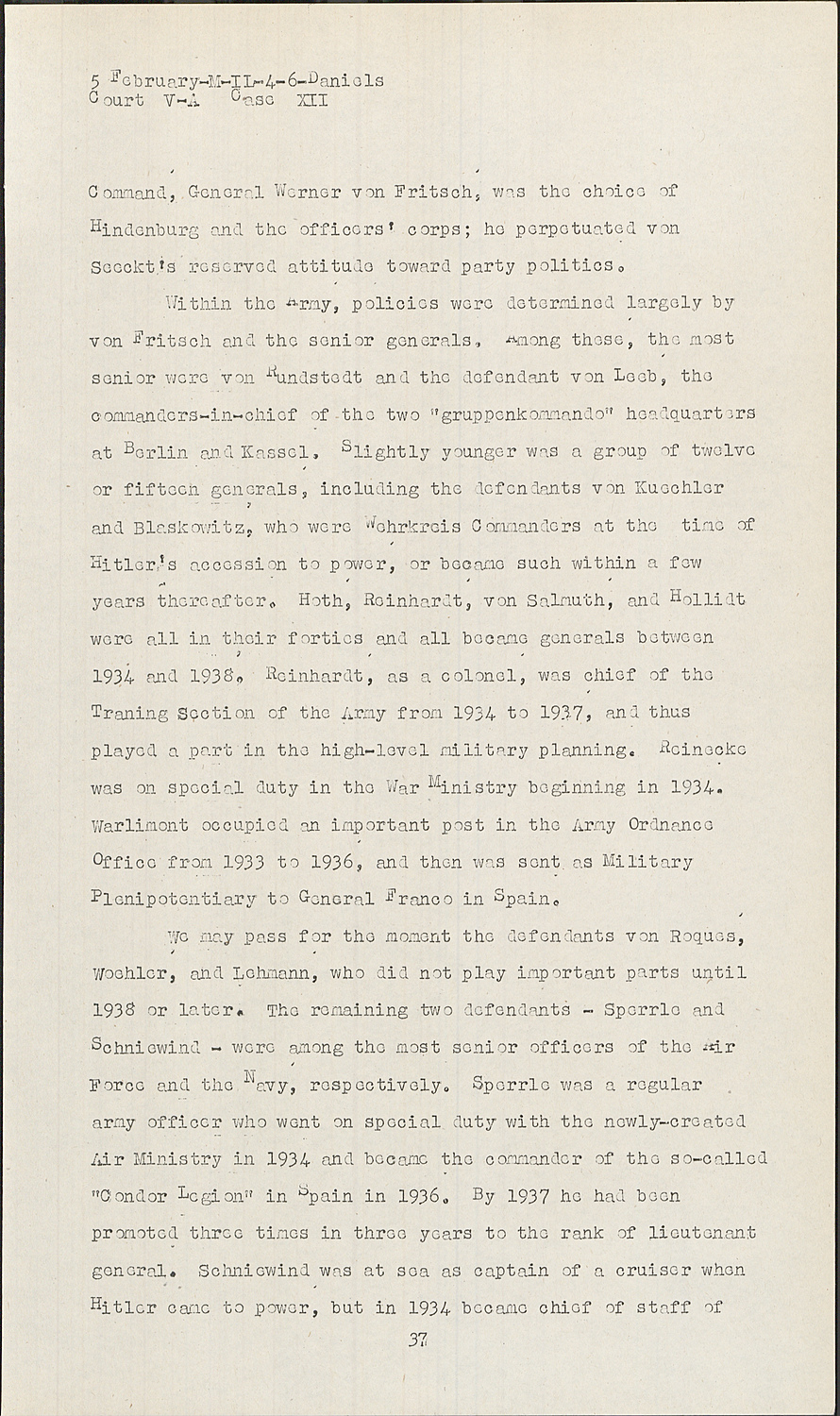
Within the Army, policies were determined largely by von Fritsch and the senior generals. Among these, the most senior were von Rundstedt and the defendant von Leeb, the commanders-in-chief of the two "gruppenkomnando" headquarters at Berlin and Kassel. Slightly younger was a group of twelve or fifteen generals, including the defendants von Kuechler and Blaskowitz, who were Wehrkreis Commanders at the time of Hitler's accession to power, or became such within a few years thereafter. Hoth, Reinhardt, von Salmuth, and Hollidt were all in their forties and all became generals between 1934 and 1935. Reinhardt, as a colonel, was chief of the Traning Section of the Army from 1934 to 1937, and thus played a part in the high-level military planning. Reinecke was on special duty in the War Ministry beginning in 1934. Warlimont occupied an important post in the Army Ordnance Office from 1933 to 1936, and then was sent as Military Plenipotentiary to General Franco in Spain.
We may pass for the moment the defendants von Roques, Woehler, and Lehmann, who did not play important parts until 1935 or later. The remaining two defendants - Sperrle and Schniewind - were among the most senior officers of the Air Force and the Navy, respectively. Sperrle was a regular army officer who went on special duty with the newly-created Air Ministry in 1934 and became the commander of the so-called "Condor Legion" in Spain in 1936. By 1937 he had been promoted three times in three years to the rank of lieutenant general. Schniewind was at sea as captain of a cruiser when Hitler came to power, but in 1934 became chief of staff of the fleet.
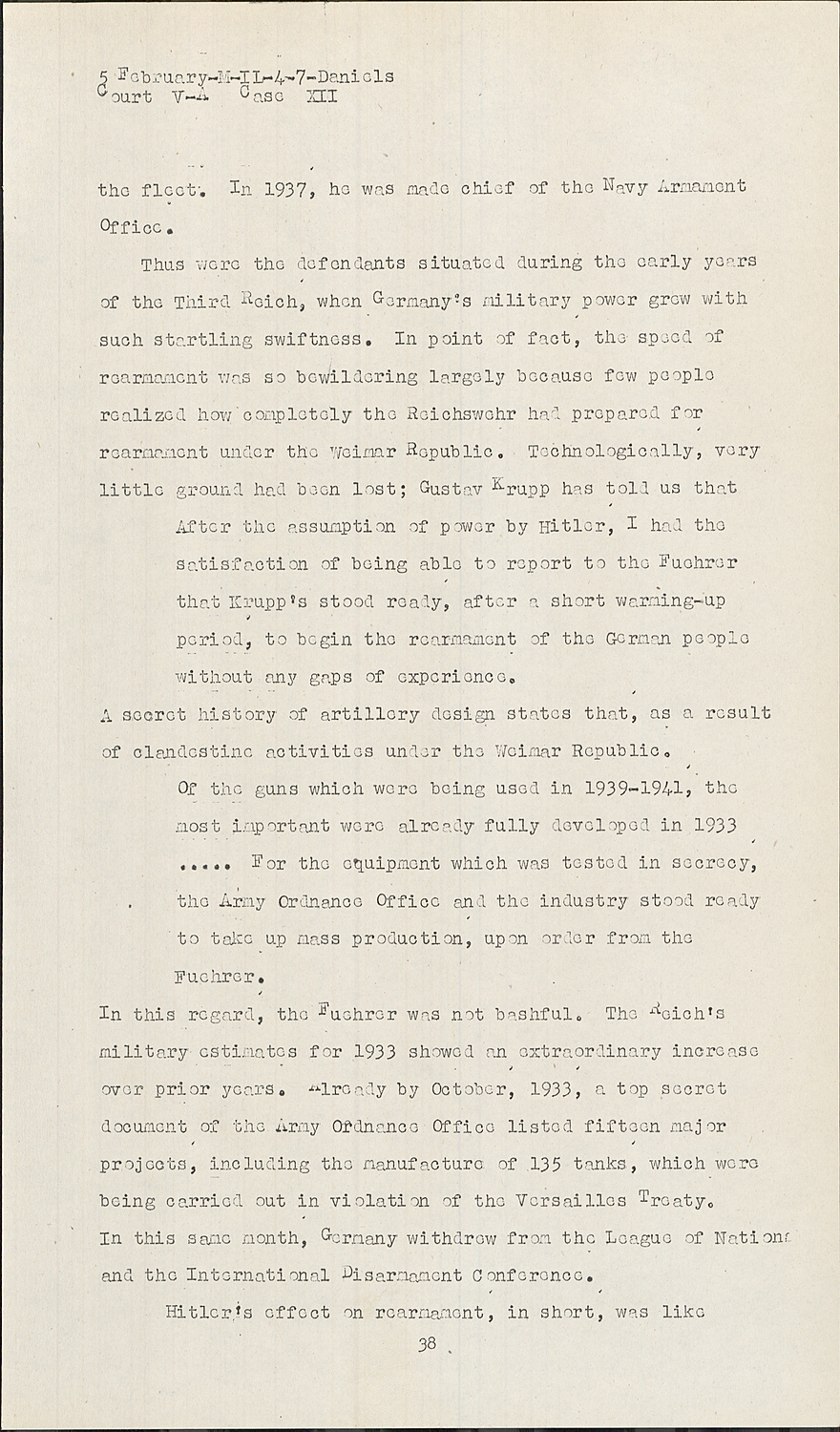
In 1937, he was made chief of the Navy Armament Office.
Thus were the defendants situated during the early years of the Third Reich, when Germany's military power grew with such startling swiftness. In point of fact, the speed of rearmament was so bewildering largely because few people realized how completely the Reichswehr had prepared for rearmament under the Weimar Republic. Technologically, very little ground had been lost; Gustav Krupp has told us that After the assumption of power by Hitler, I had the satisfaction of being able to report to the Fuehrer that Krupp's stood ready, after a short warming-up period, to begin the rearmament of the German people without any gaps of experience.
A secret history of artillery design states that, as a result of clandestine activities under the Weimar Republic.
Of the guns which were being used in 1939-1941, the most important were already fully developed in 1933 ..... For the equipment which was tested in secrecy, the Army Ordnance Office and the industry stood ready to take up mass production, upon order from the Fuehrer.
In this regard, the Fuehrer was not bashful. The Reich's military estimates for 1933 showed an extraordinary increase over prior years. Already by October, 1933, a top secret document of the Army Ordnance Office listed fifteen major projects, including the manufacture of 135 tanks, which were being carried out in violation of the Versailles Treaty. In this same month, Germany withdrew from the League of Nations and the International Disarmament Conference.
Hitler's effect on rearmament, in short, was like uncapping a gusher.
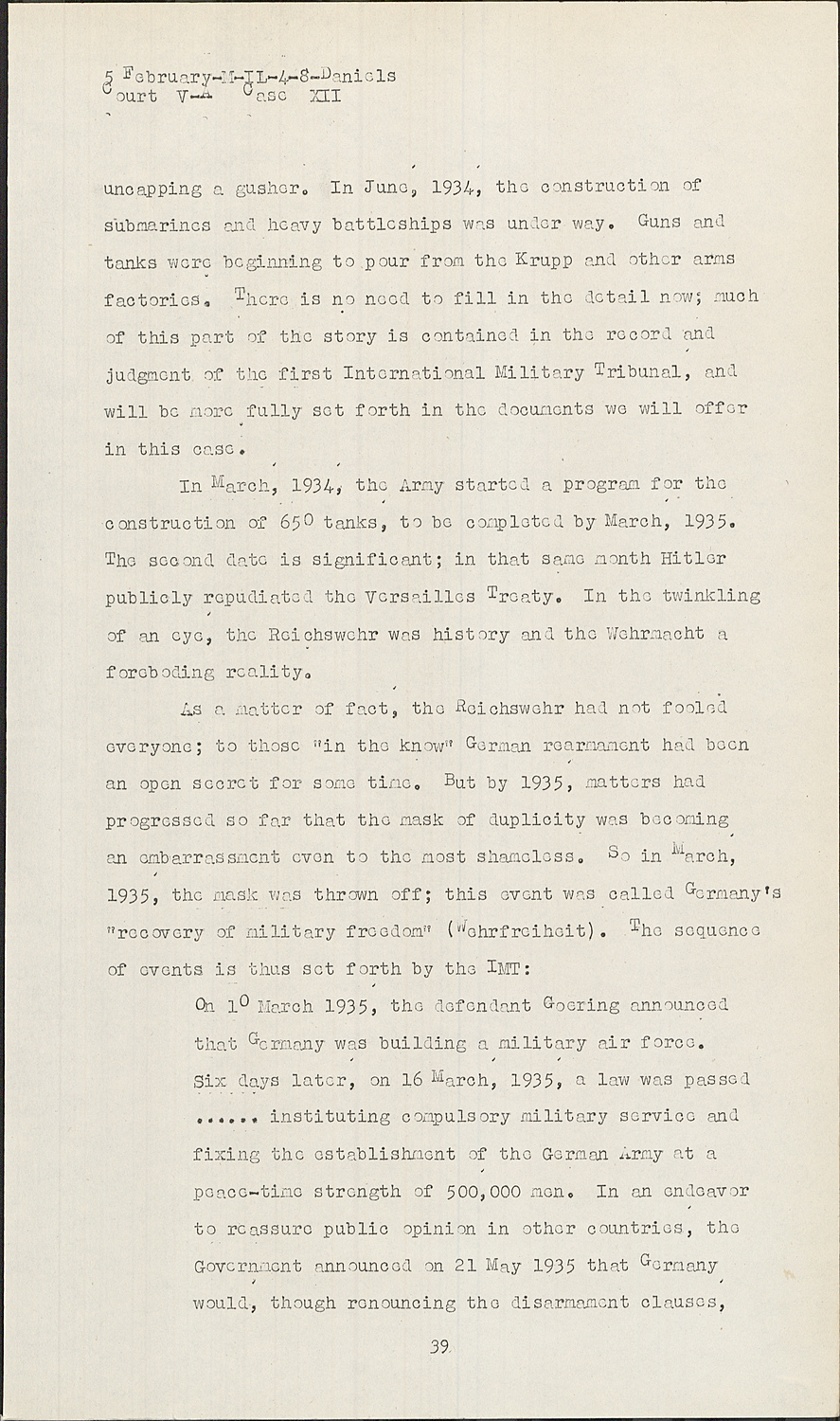
In June, 1934, the construction of submarines and heavy battleships was under way. Guns and tanks were beginning to pour from the Krupp and other arms factories. There is no need to fill in the detail now; much of this part of the story is contained in the record and judgment of the first International Military Tribunal, and will be more fully set forth in the documents we will offer in this case.
In March, 1934, the Army started a program for the construction of 650 tanks, to be completed by March, 1935. The second date is significant; in that same month Hitler publicly repudiated the Versailles Treaty . In the twinkling of an eye, the Reichswehr was history and the Wehrmacht a foreboding reality.
As a matter of fact, the Reichswehr had not fooled everyone; to those "in the know" German rearmament had been an open secret for some time. But by 1935, matters had progressed so far that the mask of duplicity was becoming an embarrassment even to the most shameless. so in March, 1935, the mask was thrown off; this event was called Germany's "recovery of military freedom" (Wehrfreiheit). The sequence of events is thus set forth by the IMT:
On 10 March 1935, the defendant Goering announced that Germany was building a military air force.
Six days later, on 16 March, 1935, a law was passed ......instituting compulsory military service and fixing the establishment of the German Army at a peace-time strength of 500,000 men.
In an endeavor to reassure public opinion in other countries, the Government announced on 21 May 1935 that Germany would, though renouncing the disarmament clauses, still respect the territorial limitations of the Versailles Treaty, and would comply with the Locarno Pact.
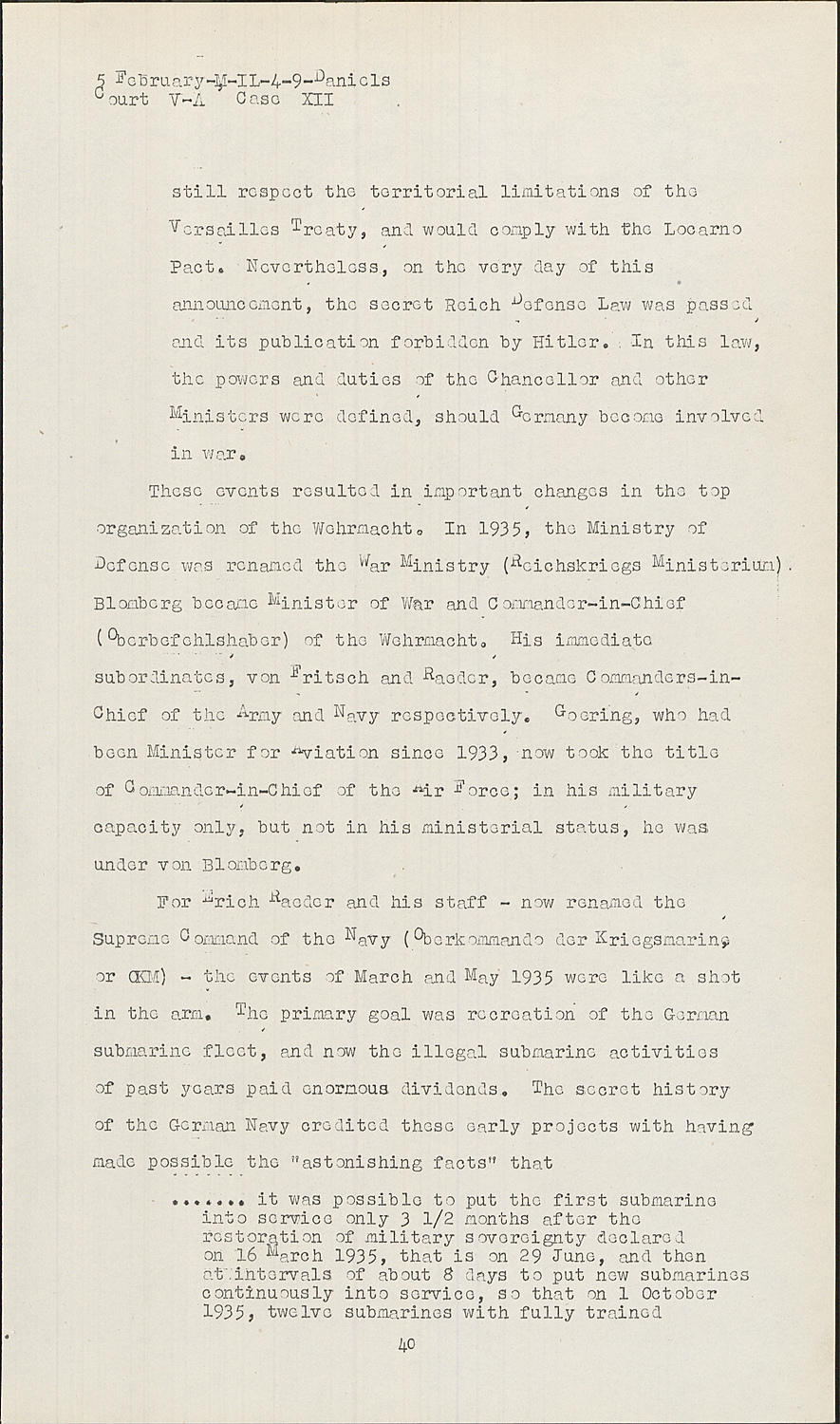
Nevertheless, on the very day of this announcement, the secret Reich Defense Law was passed and its publication forbidden by Hitler.
In this law, the powers and duties of the Chancellor and other Ministers were defined, should Germany become involved in war.
These events resulted in important changes in the top organization of the Wehrmachtl. In 1935, the Ministry of Defense was renamed the War Ministry (Reichskriegs Ministerium) Blomberg became Minister of War and Commander-in-Chief (Oberbefehlshaber) of the Wehrmacht. His immediate subordinates, von Fritsch and Raeder, became Commanders-inChief of the Army and Navy respectively. Goering, who had been Minister for Aviation since 1933, now took the title of Commander-in-Chief of the Air Force; in his military capacity only, but not in his ministerial status, he was under von Blomberg.
For Erich Raeder and his staff - now renamed the Supreme Command of the Navy (Oberkommando der Kriegsnarine or OKM) - the events of March and May 1935 were like a shot in the arm. The primary goal was recreation of the German submarine fleet, and now the illegal submarine activities of past years paid enormous dividends. The secret history of the German Navy credited these early projects with having made possible the "astonishing facts" that ....... it was possible to put the first submarine into service only 3 1/2 months after the restoration of military sovereignty declared on 16 March 1935, that is on 29 June, and then at intervals of about 8 days to put now submarines continuously into service, so that on 1 October 1935, twelve submarines with fully trained personnel were in services.