DR. HAGEMANN:The next document is Sk1-404 on Page 18, and this contains a telegram of General Gamelin to the French Military Attache in London. It is dated the 13th of November, 1939. This telegram shows that on the part of the Allies the occupation of Belgium, including the islands in the Schelde, was planned and prepared at that early date. This document I am offering as Schniewind Exhibit 91.
THE PRESIDENT:It is admitted.
DR. DOBBS:I would like to point out at this time that when Dr. Hagemann says that it is a telegram he obviously means that it is what is purported to be a copy of a telegram which appears in the White Book of the German Foreign Office.
DR. HAGEMANN:That is correct, your Honor. That can be seen from the heading in the document books.
THE PRESIDENT:It seems to show that in the heading. 91 is admitted.
DR. HAGEMANN:The next document to offer is Ski-402 on Page 20 of the document book. This contains minutes of the meeting of the French War Commission on 9 April 1940. During this conference Admiral Darlan proposed to invade Belgium. General Gamelin supports this proposal. The National Defense and War Minister passed his expert opinion which completely supported this operation. In the following letters of General Gamelin to Daladier he once again points out to the French leadership the great advantages which would be brought about by an occupation of Belgium. This document is to become Schniewind Exhibit 92.
THE PRESIDENT:It is admitted.
DR. HAGEMANN:Sk1-410 on Page 25 of the document book is an order of the Second Belgium Infantry Regiment which is dated the 13th of April, 1940. The order contains statements as to what line is to be occupied by the Allied Troops. I am offering this document as Schniewind Exhibit 93.
THE PRESIDENT:Admitted.
DR. HAGEMANN:The last document about this particular subject matter is Sk1-407 on Page 27 of the document book. This contains a plan for the railway transportation into Belgium of the Allied Troops as of the 16th of April, 1940. I am offering this document as Schniewind Exhibit 94.
THE PRESIDENT:Admitted.
DR. HAGEMANN:The next series of documents contained in Document Book IV deal with documents relating to the campaign in Greece. All these documents were enemy documents captured by the Germans after the Western Campaign, in French archives, thus they were known to the Germans before the campaign against Greece. They are to prove that on the enemy's side, much earlier than on the German side, reflections and plans were made about the extention of the theater of war to the Balkans. The first document in this series is Sk1-513 on Page 29 of the document book.
THE PRESIDENT:What about 28? Is that -- Page 28. Is that a separate document?
DR. HAGEMANN:Your Honors, on Page 28 there is a document which I don't intend to present. I am now referring to Sk1-513 on Page 29 of the document book, the first one of Group D. This is a report of the French expert for the destruction of the Rumanian Mineral Oil industry as of the 1st of October, 1939. It deals with the plan for the demolition of drilling sites, refining plants, stores, etc. It is presented to show that on the enemy side also, from the very start, there were plans against a country which so far had been neutral. I am offering this document as Schniewind Exhibit No. 95.
THE PRESIDENT:Admitted.
DR. HAGEMANN:The next document in this series is Sk1-514 on Page 31 of the document book. This again is a letter of General Gamelin addressed to Prime Minister Daladier. It is dated the 18th of October, 1939. Gamelin suggests to entrust the French Military Attache in Bucharest with all steps for the demolition of Rumanian oil sources. I am offering this document Schniewind Exhibit 96.
THE PRESIDENT:Admitted.
DR. HAGEMANN:Sk1-515 on Page 32 of the document book is a notation of General Gamelin which is dated the 22nd of February, 1940, relating to an action against the Caucasian oil fields. This notation is in the nature of a study and shows that the Western Powers had in 1940 plans against a country which war was so far neutral, the Soviet Union, and these plans were directed in the final analysis against Germany.
This is to become Schniewind Exhibit 97.
THE PRESIDENT: 97?
DR. HAGEMANN:Yes, Your Honor, 97. The next document to be offered is Sk1-516 on Page 35 of the document book. This contains minutes of the discussions in the Great High Command of the French Air Force on the 5th of April, 1940. This shows that the French British Air Force hoped within six days to destroy 30 to 35 percent of the refining plants in the caucasus. I offer this as Exhibit 98.
THE PRESIDENT:Admitted.
DR. HAGEMANN:Sk1-517 on Page 36 of the document book is a letter of General Weygand, the Supreme Commander of the French Armed Forces, addressed to General Gamelin. It is dated the 17th of April, 1940. Herein he reports that the preparations for the bombing of the oil fields have almost been concluded. I am offering this as Schniewind Exhibit 99.
THE PRESIDENT:Admitted.
DR. HAGEMANN:The next document, Sk1-519, is on Page 37 of the document book. This is a handwritten letter of General Weygand to General Gamelin. It is dated the 9th of September, 1939 and deals with secret discussions with the Greek General Staff about preparations for the occupation of Salonika. Herein it is expressed that an expeditionary force will have to be transported by sea by the British Navy. I am offering this document as Schniewind Exhibit 100.
THE PRESIDENT:Admitted.
DR. HAGEMANN:Sk1-518 on Page 40 of the document book is an analysis of the situation by the subdirector of the Europe Department of the French Foreign Ministry, which is dated the 20th of September, 1939.
It deals with the diplomatic situation in the Balkans. He designates the Greek policy as being officially observing strict neutrality but secretly the aim will be cooperation with France and Great Britain. I am offering this document as Schniewind Exhibit 101.
THE PRESIDENT:Admitted.
DR. HAGEMANN:The next document is Sk1-502 on Page 41 of the document book. This is a report of the French Naval Attache in Athens to the Supreme Commander of the French Naval forces, and it is dated the 5th of October, 1939. Herein it is expressed that the Greek Government will not oppose a landing operation in Salonika, that is a landing operation of the Allied forces, but will make Greek armed forces available for the support of such an operation. I am offering this as Schniewind Exhibit 102.
THE PRESIDENT:Admitted.
DR. HAGEMANN:The next document is Sk1-509 on Page 43 of the document book. This contains a letter of General Gamelin to the Supreme Commander of the French naval forces and it is dated the 15th of December, 1939. It contains information that Major Mariot will be dispatched to Greece, for the investigation of a possible military cooperation between Greece and the Western Powers. I am offering this as Schniewind Exhibit 103.
THE PRESIDENT:Admitted.
DR. HAGEMANN:The next document to offer is Sk1-510 on Page 44 of the document book. This document is a questionnaire of the French General Staff to the French Military Attache in Athens, and it is dated the 15th of December, 1949. He is commissioned to inquire into the possibilities of landing and billeting in Salonika, as well as air bases, and he is to report about his investigations. I am offering this document as Schniewind Exhibit 104.
THE PRESIDENT:Admitted.
DR. HAGEMANN:The next document is Sk1-511 on Page 47 of the document book. This contains notes of the Commander in Chief of the French Army, General Gamelin, about an Allied intervention in the Balkans, and it is dated the 4th of January, 1940. In this document it is explained that the Greek chief of the general staff promises to support the landing of an Allied expeditionary corps in the event that sufficient air forces and anti-aircraft forces are available. This document is being offered as Schniewind Exhibit 105.
THE PRESIDENT:It is admitted.
DR. HAGEMANN:The next document to be offered is SKl-512, on page 48 of the document book. It contains notes of Gamelin of 6 March 1940 about the French-British military policy in the Balkans. Here again it is expressed that the bulk of the French Armed forces are to be committed in the area of Salonika. I am offering this document as Schniewind Exhibit 106.
THE PRESIDENT:Admitted.
DR. HAGEMANN:The next document is SKl-520 on page 50 of the document book. This is a report of General Weygand to Gamelin dated 14 March 1940 relating to the establishing contact with the Balkan general staffs. From this document is becomes apparent that the Greek General Staff has made certain bases available to the French Air Force. This is being offered as Schniewind Exhibit 107.
THE PRESIDENT:Admitted.
DR. HAGEMANN:The next document in this series is Sk1-503 on page 52 of the document book. It contains a letter from Deladier to Gamelin dated 1 May 1940 and concerns operations in the Mediterranean. Deladier requests Gamelin to see to it that the Supreme Command in North Africa and in the Middle East should hold troops in readiness for a possible landing. I am offering this document as Schniewind Exhibit 108.
THE PRESIDENT:Admitted.
DR. HAGEMANN:The next document is SKl-504 which is on page 54 of the document book. It contains an excerpt from the speech of Amery in Newmarket on 1 December 1940. Herein it is expressed what importance was attached to the Greek front on the part of the Allies. I quote, "From this position we will be able to render the death blow to the German Dragon by means of our armies." That is the end of the quotation. This is to be offered as Schniewind Exhibit 109.
THE PRESIDENT:Admitted.
DR. HAGEMANN:I am further offering SKl-505 on page 55 of the document book. This is an excerpt from Churchill's address to the House of Commons on 19 December 1940. This speech shows that at this date a very large part of the British air force had been sent to Greece. This is being offered as Schniewind Exhibit 110.
THE PRESIDENT:Admitted.
DR. HAGEMANN:I may now point out to the court that all these documents were known to the Germans in the summer of 1940 when they were captured in France. Therefore, the subject matter discussed in these documents was known to Germany when the question of an occupation of Greece became topical. I am now offering two further documents which are to show the attitude of the Navy in the question of the Balkan warfare. The first one of these is SKl-506, on page 56 of the document book. This contains an excerpt of the war diary of the Naval War Staff with entries of 23 December 1940, This war diary shows that the SKI at this very early date knew about the strength of the British troops and the available war material on Greek soil. This is being offered as Schniewind Exhibit 111.
THE PRESIDENT:Admitted.
DR. HAGEHANN:SKl-508 is not going to be offered. Instead I am offering C-152 on page 59 of the document book. This contains an excerpt from the minutes of the report of the Supreme Commander of the Navy to Hitler on 18 March 1941 which dealt with the preparation of the Navy for "Operation Marita." This shows that the Navy at this date believed in a peaceful occupation of Greece and considered it proper to occupy the whole of the Greek mainland in such an event. This document is being offered as Schniewind Exhibit 112.
THE PRESIDENT:Admitted.
DR. HAGEMANN:The last part of Document Book 4 contains six documents which deal with the war against Russia. The first one I am offering is SKl-602 on page 62 of the document book. This is to become Schniewind Exhibit 113. It contains statements of Grand Admiral Raeder before the International Military Tribunal (IMT) dealing with the history of what led to the Russian campaing. This reveals that the Navy now as before saw the focal point of the war to be the naval war against Britain. This is being offered as Schniewind Exhibit 113.
THE PRESIDENT:Admitted.
DR. HAGEMANN:The next document to be offered is SKl-603 on page 72 of the document book. It is an ooinion of Grand Admiral Raeder expressed to Admiral Assmann in the Spring of 1944. It reports about Raeder's constant efforts to talk Hitler out of the idea of attacking Russia. In Grand Admiral Raeder's opinion England was now as before the main opponent. This is being offered as Schniewind Exhibit 114.
THE PRESIDENT:Admitted.
DR. HAGEMANN:The next document I am offering is 446-PS on page 79 of the document book. It is a directive No. 21 in the event of the Case Barbarossa. Since the Prosecution in submitting that document did not translate the part I have included in my document book I am offering this as Schniewind Exhibit. It states that the task of the Navy is merely that of protecting the coast and preventing enemy naval forces from breaking out of the Baltic Sea. This is being offered as Schniewind Exhibit 115.
THE PRESIDENT:Admitted.
DR. HAGEMANN:The next document I am offering is SKl604, on page 80 of the document book. This contains an excerpt from the war diary of the naval war staff. It contains an entry of 30 January 1941.
It deals with the intentions of the Navy for the waging of the war against England and Russia. It is again expressed in this document that the crucial point of the war now as before was seen in the warfare against England. The Baltic Sea problem is to be dealt with by small forces. This document is being offered, as Schniewind Exhibit 116.
THE PRESIDENT:Admitted.
DR. HAGEMANN:Document SKl-605 on page 84 is an excerpt of the"public papers and addresses" of Franklin D. Roosevelt. I am trying to prove that even in Roosevelt's opinion of the political leadership alone was to decide when they thought that an attack was to take place. I am offering this document as Schniewind Exhibit 117.
THE PRESIDENT:Admitted.
DR. HAGEMANN:As the last document contained in this document book I am offering Skl-601 which is an excerpt from the book "Speaking Frankly" by Janes F. Byrnes. Byrnes states here and I quote according to the German text, "The German-Russian Treaty is the classic example of an agreement which is not worth the paper on which it is written." Stalin had stated in Yalta that Russia had concluded the treaty in with Germany with the clear intention of breaking it. This document is being offered as Schniewind Exhibit 118.
THE PRESIDENT:Admitted.
MR. DOBBS:I misunderstood the translation, or it came through incorrectly. The way I understood it was that Stalin said the Treaty of Yalta was to be broken.
DR. HAGEMANN:I had said Stalin had stated Yalta that Russia concluded the pact with Germany with the clear intention of breaking the same, the pact with Germany.
This brings me to the end of document book 4 and I would now like to come to Book 5. May I ask the Tribunal whether Book 5 is available to the Court.
THE PRESIDENT:It is available.
DR. HAGEMANN:If your Honor please, in Book 5, I am offering a few documents which deal with counts 2 and 3 of the indictment. Since the Tribunal has not granted the motion to strike these counts of the indictment I am obliged to present evidence as to these points also. I am going to offer four documents in this connection. The first one of these is SKl-807, on page 1. This is an affidavit of the former Rear Admiral August Thiele, the Chief of Staff of the Command of the fleet at the time when Admiral Schniewind was fleet chief. Admiral Thiele states in this affidavit that the commando order was probably not even received by the fleet, and as to the supplementary order to the commando order - he had not submiatted that to the fleet chief. A passing on of this supplementary order to the commando order to subordinate divisions had not taken place for two reasons and had not been necessary. The first reason, because the subordinate units received this supplementary order directly, and the second reason because the fleet was not factually concerned with the contents of this order. I am now offering this document as Schniewind Exhibit 119.
THE PRESIDENT:Admitted.
DR. HAGEMANN:SKl-801, on page 3 of the document book, 3 to 18, contains a series of affidavits, referring to the decree concerning the application of military jurisdiction in the Barbarossa area and concerning special measures by the troops. All these are affidavits, one from the former Admiral Boehm, at one time commanding Admiral of Norway; another affidavit by the former Admiral Wurmbach, then Chief of Staff of the Baltic Sea Naval Station. Then there is an affidavit of the fomer Admiral Schmundt, at that time commanding Admiral of the cruisers; further a document by the former Rear Admiral Loewisch, former chief of Staff at the Navy Commander "C"; then there is an affidavit of the former Rear Admiral Englehardt then Chief of Staff at the Navy Commander "D"; and finally an affidavit of the former Squadron Judge Advocate Dr. Kickstat who was at the time Chief Judge Advocate at the Navy Military courts in the Ostland.
The affiants unanimously state that the decree in question was not passed on to subordinate units and that for the rest this decree was not applied. I am offering this document as Schniewind Exhibit 120.
THE PRESIDENT:Admitted.
DR. HAGEMANN:As a further document I am offering Doenitz 49 on pages 19 to 28 of Document Book 5. This contains an affidavit of the former Marineoberstabsrichter Fritz Jaeckl. It contains a list of verdicts of Navy courts concerning cases which according to the military jurisdiction order Barbarossa were not subject to the jurisdiction of military courts. This is to show that contrary to the jurisdiction order in the event of offenses of German soldiers which damaged indigenous populations, the navy courts took action against the perpetrators. What the Navy courts thought of the jurisdiction order can be gathered from the reportsof sentences which are enclosed. I am making reference in this connection to page 27 where it is stated that heavy sentences are necessary in order to increase the faith of the population of the occupied territory in the good name and integrity of the German soldier. I am offering this document as Schniewind Exhibit 121.
THE PRESIDENT:Admitted.
DR. HAGEMANN:The last document which I would like to offer is one contained in document book supplement 5 which is SKl-808. This is a further listing of sentences where German soldiers were sentenced by Naval courts for offenses committed against indigenous population. This list was compiled by an Oberstatsanwalt with the court in Flensburg who was in charge of the former Navy file archives. The document contains four cases where German soldiers were tried and word sentenced contrary to the military jurisdiction or the Barborossa order. This document is being offered as Schniewind Exhibit 122.
THE PRESIDENT:Admitted.
DR. HAGEMANN:All documents of Document Book 5 are to prove that Admiral Schniewind did not pass on the orders at issue and that the orders were not applied or adhered to.
This, if your Honors please, brings me to the conclusion of my presentation of evidence.
THE PRESIDENT:Dr. Gollnick, we are ready, to hear your opening statement in the case of Field Marshal Sperrle.
DR. GOLLNICK:If Your Honor please, before I am to start with the reading of my opening statement I should like to have the Marshal of the court instructed to fetch the witness Field Marshal Milch here from the court prison. I intend to hear him as the first witness after having concluded with the reading of my opening speech.
THE PRESIDENT:The Marshal will take note of that and so arrange.
DR. GOLLNICK:Mr. President, Your Honors .
At the close of its Opening Statement of 5 February 1948, the Prosecution in discussing the point of the Indictment "crime against peace" has declared that the provision of Art. II Fig. 2 of the Control Council Law No. 10 regarding the circle of those that may be found guilty of this crime, does not have the purpose to hold automatically criminally responsible all persons who occupied high military positions. Furthermore it was emphasized that the accused high military leaders were not accused because they were soldiers, and that they were not charged with such acts that customarily are to be expected of soldiers, namely the drafting of military plans and the commanding of troops.
The Prosecution did not adhere to these principles. This is particularly evident in the Indictment against Field Marshal Sperrle. Examining the evidence submitted against this defendant with an impartial and unprejudiced eye one cannot escape the impression that Field Marshal Sperrle was indicted only because of his high military position as Field Marshal and Commander in Chief of Air Fleet 3. This judgment results not only in regard to the Indictment for the crimes against peace and of conspiracy, but also in regard to war crimes and crimes against humanity.
As to Point I of the Indictment the Prosecution fails to recognize a particularly important point of view, which at this point I wish to emphasize.
This concerns the position of the Army in relation to the State leadership, the relationship between politics and Armed Forces, an essential problem, which also in the verdict will play a decisive part.
No less authority but the Commander-in-Chief of the British Armed Forces, Field Marshal Montgomery, has precisely recognized and appraised this problem, when he said in his well-known speech at Portsmouth on 26 July 1946. I quote:
"In serving the nation the Army is above politics and this must remain so. It is devoted to the State and it is not for the soldier to change his devotion because of political views. It must be made clear that an Army is not a gathering of individuals, but a fighting force, formed by discipline and under the control of its leaders." What Field Marshal Montgomery says is true of the common soldier just as much as of the high military leader. They have neither the right nor the duty to put their own views above those of the State leadership, and what Field Marshal Montgomery demands for himself and his country must not be denied to the German military leaders, even though the Stateleadership has made wrong decisions and fateful mistakes. This the State leadership in the final analysis will have to account for to its own nation. This responsibility, however, is not that of the soldier whatever his rank, who as a bearer of arms of his country has staked his life for the existence of his fatherland. He is responsible neither to his own people, much the less toward the victorious nations.
I now shall consider the individual points of the Indictment against Field Marshal Sperrle and am starting with Points I and IV.
Field Marshal Sperrle until 1934 was an officer with the troops. After a short activity at the newly created Reichs Air Ministry he was again transferred to field service, and in 1935 he took over the command Air Service Area Headquarters 5 at Munich. In his service rank and position he lacked any possibility to influence the military development in Germany.
He had no part in the seizure of power by Hitler. The ideas of National Socialism were opposed by him. This opposing attitude also led to his dismissal by Hitler in August 1944.
At the outbreak of the war Field Marshal Sperrle took over the newly formed Air Fleet 3, which he has led until his dismissal in August 1944. Throughout the war he was assigned only on the Western Front.
The first charge of the Prosecution against him is that Field Marshal Sperrle from November 1936 until November 1937 was in charge of the "Legion Condor" in Spain, Nothing less is alleged but that purpose and aim of this undertaking was the establishment of a regime in Spain that would support the Third Reich in its plans of aggression and war. Furthermore the civil war was designed to serve as a testing ground for German pianos and other weapons. Field Marshal Sperrle never learned of theso aims. Neither did he have any knowledge of war plans and aggressive wars, which according to the Prosecutor's statement Hitler is supposed to have indicated to the Commander in Chiefs of 3 Armed Forces Branches only in November 1937. The German Auxiliary Corps, the leadership of which Field Marshal Sperrle had taken over on orders of the OKW, comprised only 5 - 6000 men and already numerically was not in a position to influence decisively the course of military events in Spain. This strength could not compare with the Italian units, which mounted to 50 - 60,000 men and with the International Brigades fighting on the side of the red Spaniards, who were more than 40,000 men strong and also supported by a strong air-arm of Russian origin.
I shall prove that also in Spain General Sperrle advocated a more humane warfare and in his conduct of war reduced the terror of the civil war to the best of his ability.
Further the Prosecution accused Field Marshal Sperrle to have taken part in a conference between Hitler and the Austrian Chancellor v. Schuschnigg at the Obersalzberg on 12 February 1938, as well as in the blackmail against Schuschnigg. As evidence the Prosecution presents document 4005 PS, Exh.
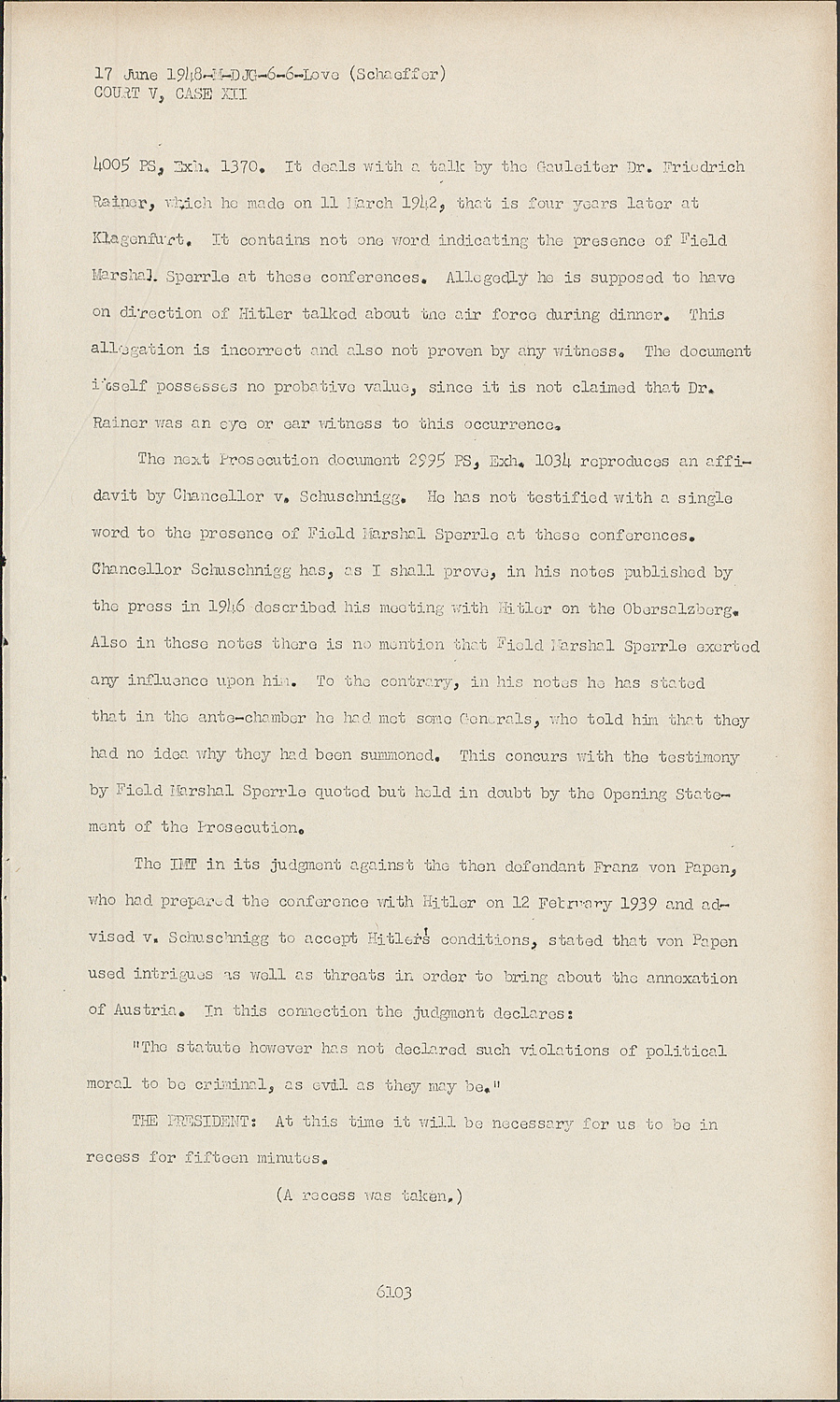
1370. It deals with a talk by the Gauleiter Dr. Friedrich Rainer, which he made on 11 March 1942, that is four years later at Klagenfurt. It contains not one word indicating the presence of Field Marshal Sperrle at these conferences. Allegedly he is supposed to have on direction of Hitler talked about the air force during dinner. This allegation is incorrect and also not proven by any witness. The document itself possesses no probative value, since it is not claimed that Dr. Rainer was an eye or oar witness to this occurrence.
The next Prosecution document PS, Exh. 1034 reproduces an affidavit by Chancellor v. Schuschnigg. He has not testified with a single word to the presence of Field Marshal Sperrle at these conferences. Chancellor Schuschnigg has, rs I shall prove, in his notes published by the press in 1946 described his meeting with Hitler on the Obersalzberg. Also in these notes there is no mention that Field Marshal Sperrle exerted any influence upon hit. To the contrary, in his notes he has stated that in the ante-chamber he had met some Generals, who told him that they had no idea why they had been summoned. This concurs with the testimony by Field Marshal Sperrle quoted but held in doubt by the Opening Statement of the Prosecution.
The IMT in its judgment against the then defendant Franz von Papen, who had prepared the conference with Hitler on 12 February 1939 and advised v. Schuschnigg to accept Hitlers conditions, stated that von Papen used intrigues as well as threats in order to bring about the annexation of Austria. In this connection the judgment declares:
"The statute however has not declared such violations of political moral to be criminal, as evil as they may be."
THE PRESIDENT:At this time it will be necessary for us to be in recess for fifteen minutes.
(A recess was taken.)
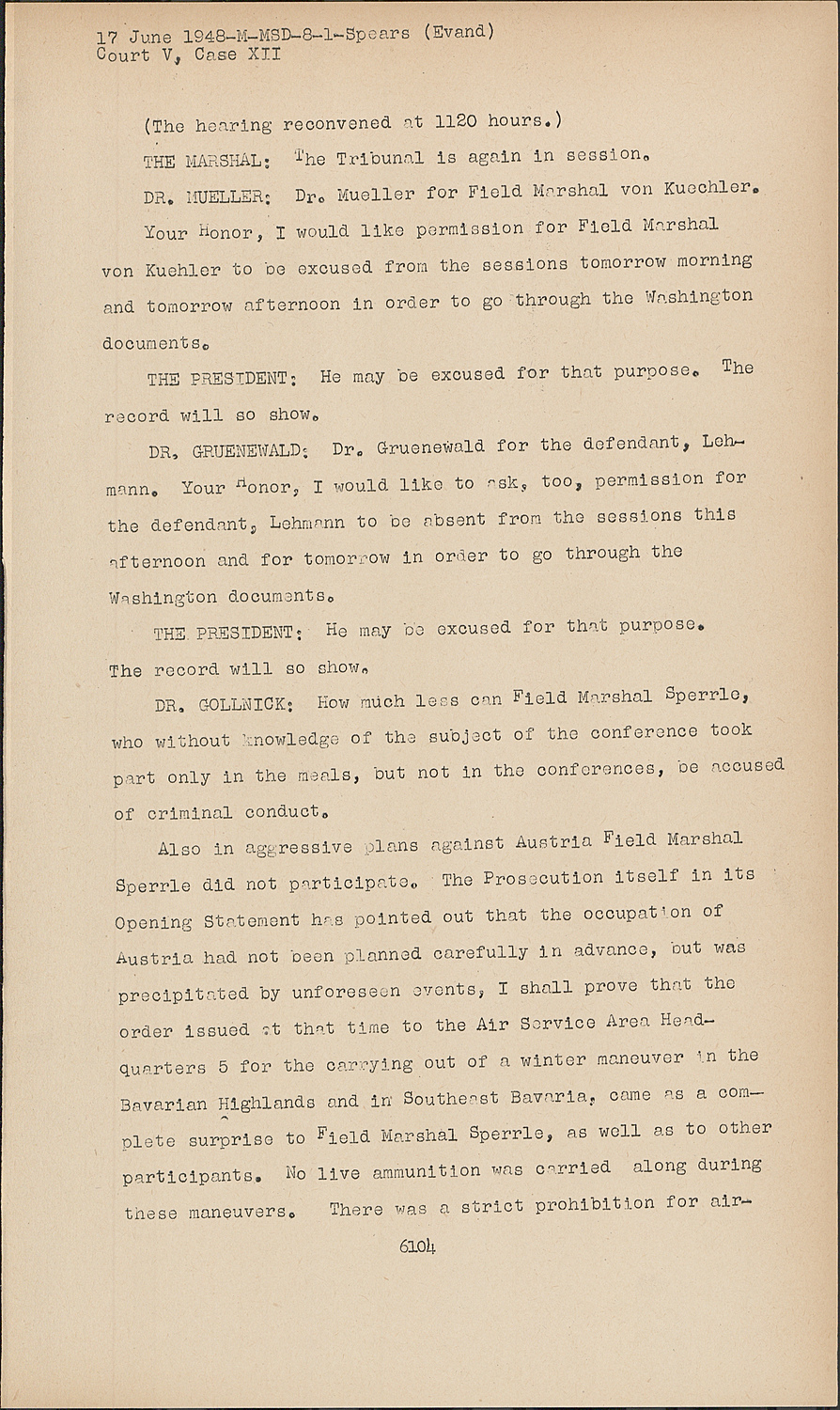
(The hearing reconvened at 1120 hours.)
THE MARSHAL:The Tribunal is again in session.
DR. MUELLER:Dr. Mueller for Field Marshal von Kuechler.
Your Honor, I would like permission for Field Marshal von Kuehler to be excused from the sessions tomorrow morning and tomorrow afternoon in order to go through the Washington documents.
THE PRESIDENT:He may be excused for that purpose. The record will so show.
DR. GRUENEWALD:Dr. Gruenewald for the defendant, Lehmann. Your Honor, I would like to ask, too, permission for the defendant, Lehmann to be absent from the sessions this afternoon and for tomorrow in order to go through the Washington documents.
THE PRESIDENT:He may be excused for that purpose. The record will so show.
DR. GOLLNICK:How much less can Field Marshal Sperrle, who without knowledge of the subject of the conference took part only in the meals, but not in the conferences, be accused of criminal conduct.
Also in aggressive plans against Austria Field Marshal Sperrle did not participate. The Prosecution itself in its Opening Statement has pointed out that the occupation of Austria had not been planned carefully in advance, but was precipitated by unforeseen events, I shall prove that the order Issued at that time to the Air Service Area Headquarters 5 for the carrying out of a winter maneuver in the Bavarian Highlands and in Southeast Bavaria, came as a complete surprise to Field Marshal Sperrle, as well as to other participants. No live ammunition was carried along during these maneuvers. There was a strict prohibition for air craft to cross the Austrian border.
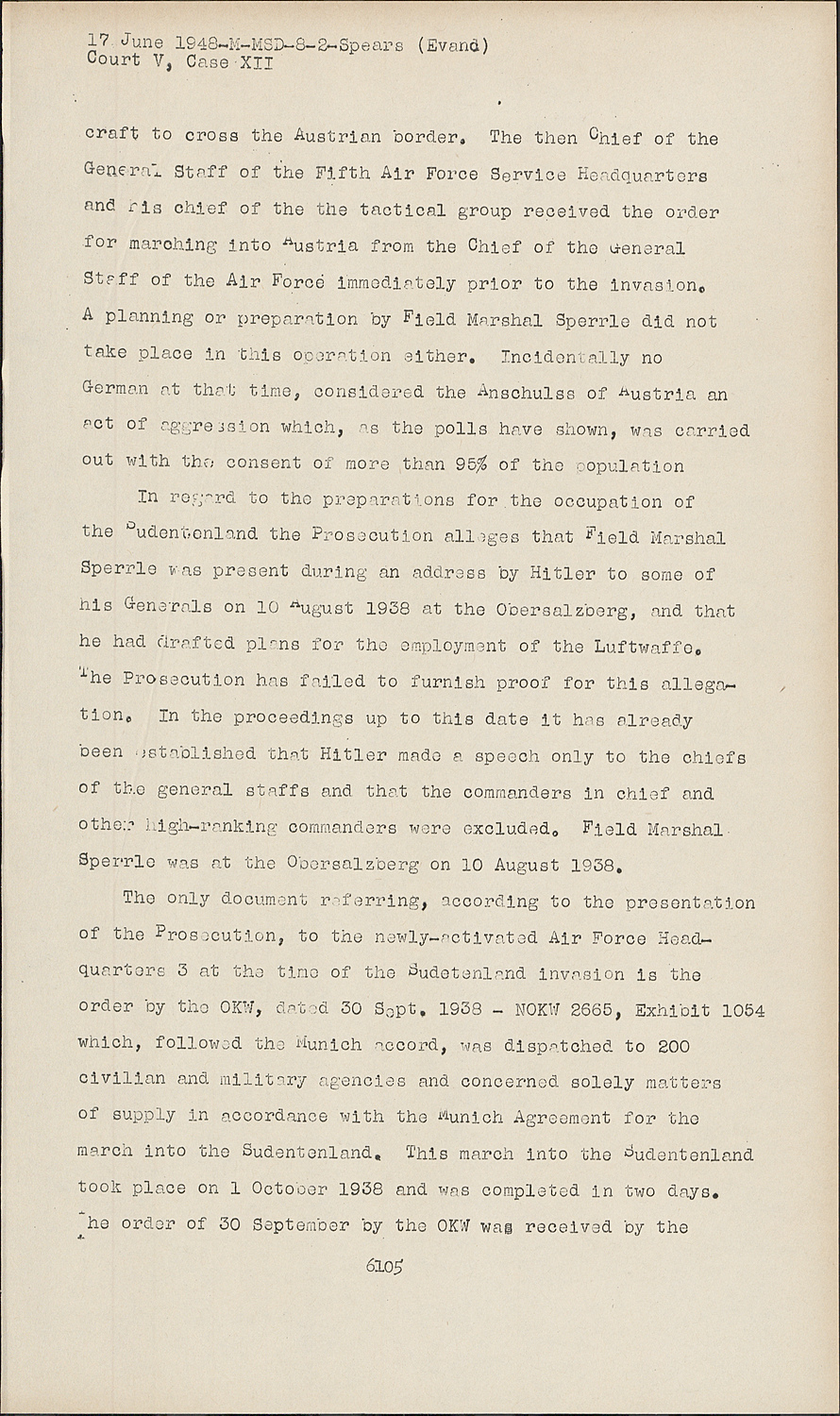
The then Chief of the General Staff of the Fifth Air Force Service Headquarters and his chief of the the tactical group received the order for marohing into Austria from the Chief of the General Staff of the Air Force immediately prior to the invasion. A planning or preparation by Field Marshal Sperrle did not take place in this operation either. Incidentally no German at that time, considered the Anschulss of Austria an act of aggression which, as the polls have shown, was carried out with the consent of more than 95% of the population In regard to the preparations for the occupation of the Sudentenland the Prosecution alleges that Field Marshal Sperrle was present during an address by Hitler to some of his Generals on 10 August 1938 at the Obersalzberg, and that he had drafted plans for the employment of the Luftwaffe.
The Prosecution has failed to furnish proof for this allegation. In the proceedings up to this date it has already been established that Hitler made a speech only to the chiefs of the general staffs and that the commanders in chief and other high-ranking commanders were excluded. Field Marshal Sperrle was at the Obersalzberg on 10 August 1938.
The only document referring, according to the presentation of the Prosecution, to the newly-activated Air Force Headquarters 3 at the time of the Sudetenland invasion is the order by the OKW, dated 30 Sept. 1938 - NOKW 2665, Exhibit 1054 which, followed the Munich accord, was dispatched to 200 civilian and military agencies and concerned solely matters of supply in accordance with the Munich Agreement for the march into the Sudentenland. This march into the Sudentenland took place on 1 October 1938 and was completed in two days. The order of 30 September by the OKW was received by the Air Force Headquarters 3 as late as 4 October 1938, as it is shown by the receipt stamp, it therefore war out of date in view of the course of events.
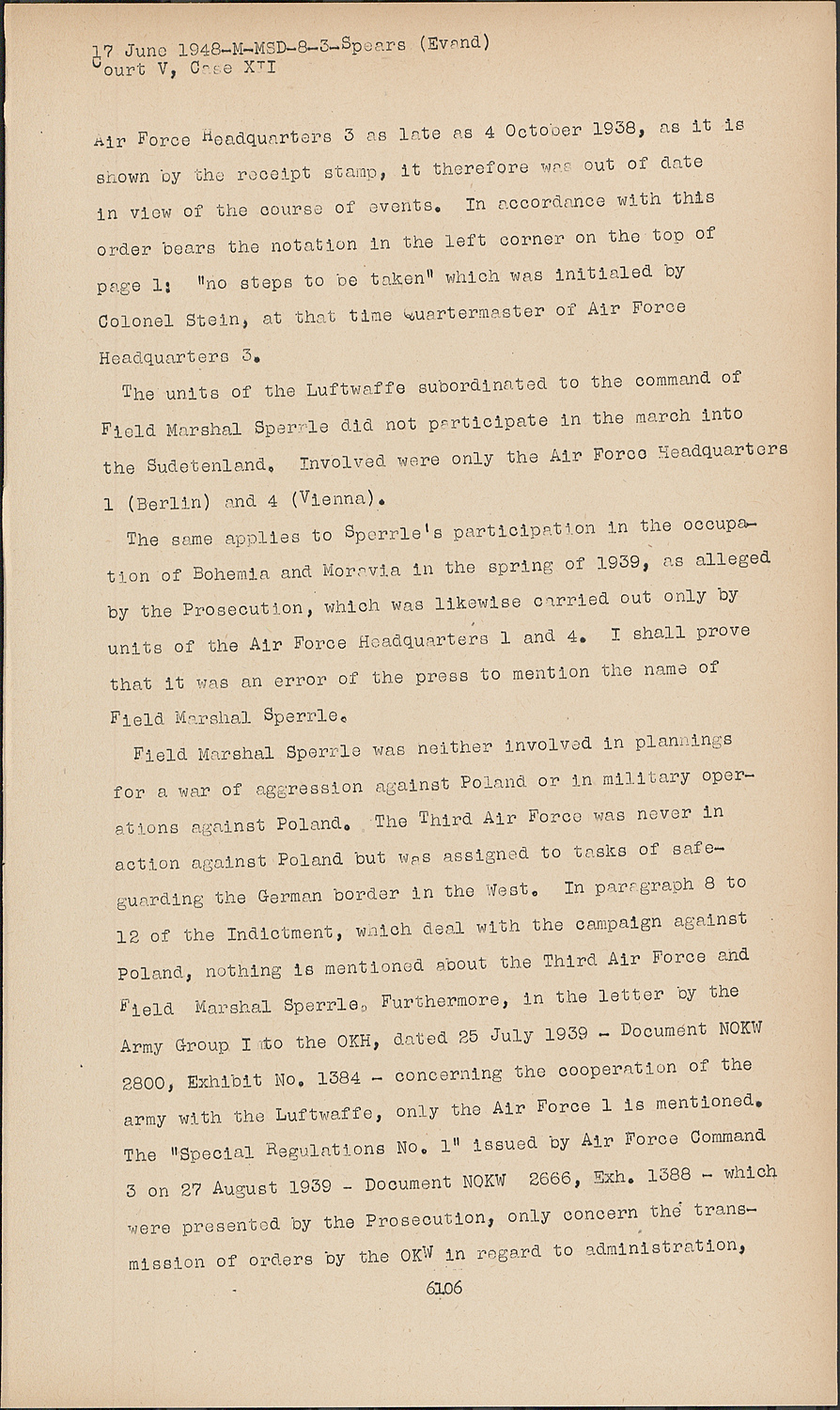
In accordance with this order bears the notation in the left corner on the top of page 1: "no steps to be taken" which was initialed by Colonel Stein, at that time quartermaster of Air Force Headquarters 3.
The units of the Luftwaffe subordinated to the command of Field Marshal Sperrle did not participate in the march into the Sudetenland. Involved were only the Air Force Headquarters 1 (Berlin) and 4 (Vienna).
The same applies to Sperrle's participation in the occupation of Bohemia and Moravia in the spring of 1939, as alleged by the Prosecution, which was likewise carried out only by units of the Air Force Headquarters 1 and 4. I shall prove that it was an error of the press to mention the name of Field Marshal Sperrle.
Field Marshal Sperrle was neither involved in plannings for a war of aggression against Poland or in military operations against Poland. The Third Air Force was never in action against Poland but was assigned to tasks of safeguarding the German border in the West. In paragraph 8 to 12 of the Indictment, which deal with the campaign against Poland, nothing is mentioned about the Third Air Force and Field Marshal Sperrle. Furthermore, in the letter by the Army Group Into the OKH, dated 25 July 1939 - Document NOKW 2800, Exhibit No. 1384 - concerning the cooperation of the army with the Luftwaffe, only the Air Force 1 is mentioned. The "Special Regulations No. 1" issued by Air Force Command 3 on 27 August 1939 - Document NOKW 2666, Exh. 1388 - which were presented by the Prosecution, only concern the transmission of orders by the OKW regard to administration, supply and food supply.