A.The Reich Ministry of Economics.
Q.How did this control and direction become apparent in economy and according to what aspects was it undertaken?
A.Just a few cues here. Orders to the export firms to give preferred treatment in deliveries to certain countries and to carry out certain business transactions with a priority. The preferred countries were chosen according to those aspects as to what countries furnished important food stuffs and raw materials and above all what countries bring in unfrozen foreign exchange.
Q.Were these countries mentioned directly by the Reich Ministry of Economics?
A.Yes, these countries were named in lists propounded by the Reich Ministry of Economics, and those countries that brought in free foreign exchange were listed at the top. They were the United States, Canada, the Argentines, and a whole number of other countries.
Q.Did it also happen that the Reich Ministry of Economics suggested individual burliness transactions that were interesting for bringing in foreign exchange or for foreign political purposes? Did they name certain firms to Farben, for instance, with the direct order or fee direct request to carry out such transactions?
A.Yes, very often. The prosecution has sited a whole number of such cases in their documents. I only name one document -- Exhibit 764, in, Book Number 41.
Q.Did these frequent requests of the government disturb Farben in the subsequent course of their business?
A.Yes, absolutely. For that reason we tried to explain to the official agencies that we were already doing everything we could and we occasionally made certain reports to the government in that direction and there, of course, we emphasized our achievements in the favorable light as required by the government. This is particularly true in the case of Prosecution's Exhibit 765 Book 41.
Q.In order to conclude this chapter I now want to ask you, Dr. Ilgner, did all this promotion of exports have anything to do with measures for the preparation of a war of aggression.
A.Doctor Nath, I can't understand at all how one can reach such a conclusion -- how one can have such an opinion. Even an analysis of the overall German exports will show that the share of raw materials important for armament such as iron and other metals constituted only a small fraction of all of German Exports. The problem was an entirely different one.
Q.You said exports. What you actually meant was imports.
A.Yes, that is right.
Q.Could you please explain that to us ?
A.The natural counterbalance against radical tendencies, to acquire raw materials of certain countries by force the natural counterbalance to acquire such things is a sound German export which will gain for Germany the necessary foreign exchange which it needs for the imports of the necessary raw materials and especially the food stuffs. Hungry stomachs are always troublesome. Satisfied people don't give any trouble. Therefore I saw the strongest necessity for the maintenance of peace in the sound export of Germany.
Q.We can now leave this chapter and I now turn to something else entitle propaganda. I want to discuss with you the so-called "F Circle" the circle of economic loaders. On page 54 of the trial brief it says -Mr. President, may I point out that the pages in the trial brief in the English and German are identical -- I quote "In 1933 immediately after Hitler's ascension to power, the defendant Ilgner, supported by the defendant Gattineau, collected a program from the industrialists to be spread abroad, a program of propaganda with the intention of carrying it out for the new Germany. A circle of economic exports was gotten together for this purpose." Is this assertion correct? What can you say about it?
A.No, this assertion is incorrect. The initiative emanated from the then State Secretary in the Ministry of Propaganda Funk, who later became the Minister of Economics. Funk was a journalist. Neither my initiative nor any support of Dr. Gattineau existed. We didn't want to make Nazi propaganda but we were worried about German exports.
Q.Do you mean a particular concern about this ? What was your cause for this concern or worry?
A.The boycott of the Jews which was organized immediately after the ascension to power which again influenced a boycott of German products all over the world and particularly in the United States. The worry of leading economists that the Nazis were not properly informed how the foreign countries actually reacted to their measures. That was a reason.
Q.On the occasion of your explanation for the promoting of export you already named to us the leading circles of economists. Were the representatives of the leading export firms called into the F Circle?
A.Yes, quite briefly I can state approximately twenty-four firms represented approximately one half of German exports and these few export firms represented particularly at that time essential worries of German export business. Besides Farben they were Siemens represented by Dr. von Winterfeld; the Alkali Syndicate represented by Dr. Diehn; the Central European Economic Diet represented by Max Hahn; and furthermore the foreign banks represented by Otto Christian Fischer, and the insurance system by Dr. Ruperti. There were a few others.
Q.Dr. Ilgner, I believe that is sufficient. I would like to ask you now to tell me what were the tasks of the circle of economic leaders.
A.I forgot to mention something just now. I wanted to say that Mr. Diehn was a well known man internationally because of his French alkali interests; perhaps one of the most international economists we had in Germany.
Mr. Max Hahn already belonged to the resistance movement since 1933 and was a close friend of Edgar Jung who was shot on 30 June 1934 by the Gestapo. Otto Christian Fischer is a well known name in Germany as an international Anglo-American banker.
He is the old president of the Banking Association. None of these people belonged to the Party at the time. These were not concrete tasks that we had. It was the fashion of the 3rd Reich to have advisors whose counsel was not followed. We, however, wanted to point out the effects of the National Socialist measures abroad.
We wanted to achieve that the mistakes were done away with at home,-that is to say to have these measures prevented as far as possible at home.
Q.Did you yourself try to bring it about that these mistakes were stopped?
A.I believe that I made that very clear. My trouble is not that I am not clear enough. For instance after my Scandinavian trip I expressed to this F Circle the impressions I gained on that trip. I told them about the protest against the change of the flags -- the old General Dehner told me about it. I told them that the many uniforms that people were wearing in Germany created a militaristic impression.
Q.Go a little more slowly, Mr. Ilgner.
A.I told them that the boycott against the Jews was not understood at all abroad. I told them of the effect that Goering's letter to Goeteborg had. Everybody knows this story who lived in Europe. And last but not least I told that if such people were sent to Scandinavia as Goering was sending up there, that then one should not be surprised that the German export was being damaged. I told them of the negative attitude of the foreign press towards the 3rd Reich quite clearly. I told them what the world was actually thinking and I didn't paint a rosy picture as it was customary in the Third Reich.
Q.What was the F Circle's attitude in regard to propaganda?
A.They rejected it absolutely. We were tried and proven foreign economists who knew well the reaction of the world to propaganda. I knew that propaganda in America means something else than it does in Germany. For that reason we objected against these methods and even against the name that the Propaganda Ministry had given itself.
Q.Were your advises complied with?
A.Almost not at all and that was erased by the fact that all the Propaganda Ministry was staffed with small people that were jealous of the big shots. They knew everything better, they thought. They contradicted any suggestion that didn't run with their ideas. Any reasonable idea they rejected. Besides that there was a tremendous confusion in all sorts of organizations at the time.
Q.What do you mean when you say the confusion of these organizations?
A.I mean in particular the so-called interstate organizations that all acted on their own initiative. The leader principle was understood that everybody was to be his own little leader. They should have taken care of the fostering of cultural relations and should nave left their hands off propaganda. That was our opinion. For that reason I had a large survey chart made in my office to show all those people who were now concerning themselves about these things and I showed that chart to Mr. Funk sometime.
Q.Would you please explain that survey chart a little more clearly. Whad you did with that?
A.I drafted that with my colleagues from industry and economy. I showed it to them and we were of the opinion that these old and decent people who were working on cultural matters should be protected against the Party and that the experiences of these old experts who knew foreign countries should be esteemed and that overstaffing and overorganization should be avoided. But in order to achieve that one had to make constructive suggestions in the Third Reich if one wanted to have success at all.
Q.Were discussions held in the Propaganda Ministry?
A.Yes, these were the so-called P Circle meetings or discussions. In the beginning Mr. Goebbels participated a few times and later Mr. Funk presided. But for us businessmen it was much more important to see that we agreed on certain things, not during these meetings but when we were among ourselves in order to represent the interests of export business uniformity.
Q.Can you please tell me how frequently these F Circle meetings took place to the Propaganda Ministry under the chairmanship of Goebbels?
A.I generally have a good memory but this is an old story that is buried and forgotten. But if I remember correctly it happened on two or three occasions with the chairmanship of Goebbels and just as often under Funk's chairmanship. Goebbels wasn't stupid. He looked through the whole stroy right away and he lost interest to us. He was vexed. He called us the clique of capitalists that only criticised.
COURT VI CASE VI He called us criticisers and he withdrew from this entire circle very quickly.
Q.Did the economists among themselves have their work divided up?
A.Yes, we did that, according to those countries that each individual knew particularly well. Mr. Diehn knew East Asia. He took over that part of the world. Mr. Ruperti treated the overseas business. He had South and Central America and the British Empire. Otto Christian Fischer took care of England and the Low Countries and Belgium and Switzerland. Dr. Gattineau took care of the Scandinavian countries and I concerned myself with the United States and France because I had travelled much in the United States until 1932.
Q.Did you ever speak to Goebbels confidentially?
A.Yes, I remember concretely one discussion that I had at the request of all leaders of the businessmen. That is the F Circle.
Q.You said one concrete example. Can you explain to me what that means?
A.I already said that yesterday. That was in connection with the Jewish question. I had one particular tangible point I wanted to discuss with him and that was the paragraph about Aryans of the German-American Association Carl Schulz. I asserted my point of view that this paragraph was not incorporated into the by-laws. I had one further point. There may have been a few more -- I don't know any more -- but the important point was that on behalf of all business people I complained to Goebbels that the little people, the so-called referents, counteracted our measures all the time. That was an unpleasant task but in my life it happened frequently that I was asked to take over an unpleasant duty.
Q.Can you remember any other problems that you raised in the F Circle?
A.Not towards Goebbels alone in the F Circle, but two more points that I was concerned about particularly. The League of Nations and the Rotary Club.
Q.What point of view did you hold?
A.I had many friends in France at the time -- I always had -- and I knew the opinion of the French. I said quite clearly that it was a great mistake to resign from the League of Nations -- that we should maintain that platform, but when we resigned, nevertheless, I was very distressed about it. I considered that absolutely wrong. In regard to the Rotary Club, I became a member of the Rotary Club after 1933, after it was no longer considered the thing to do, and I joined on the request of Rotary. Rotary, just as the Free Masons, was not well esteemed in the Third Reich. I intervened very actively not to have the Rotary Club dissolved and I tried to convince Goebbels. I participated on a trip with Austrian and German Rotarians to Norway. But just as everything else in the Third Reich, one was talking against a blank wall and in two years it was dissolved nevertheless.
QTaking the whole thing together, was the F Circle active?
AUnfortunately not. It became less and less active so that after one year, in 1934, it stopped altogether.
QWhat was the cause for this dissolution?
AOn the 30th of June 1934 many of us were strongly suspected. Max Hahn I have already mentioned because his friend, Edgar Jung had been shot by the Gestapo. He belonged to Edgar Jung's intimate circle of friends. Gattineau was nearly shot by the Gestapo. I myself heard from friends in the circle of Bruening's friends that I was on the list along with the General Schleicher who was shot by the Nazis. Ruperti and Winterfeld, too, had difficulties later and were thrown out.
QDid the F Circle ever become reactivated?
ANo, never.
QI now turn to something else. That is the subject, Ivy Lee. Trial Brief on page 55, your attitude towards the foreign countries-Trial Brief on page 84. First, who was Ivy Lee?
AHe was one of the leading publicity agents of the United States.
QWere there such institutions in Germany, too?
ANo.
QWhen did you make Mr. Ivy Lee's acquaintance?
AIn 1929 in connection with the incorporation of the American I. G. Chemical Corporation.
QCan you describe to me the circumstances under which you made his acquaintance.
AYes. At that time the former alien property custodian from the World War I, Frank Gardener, at the occasion of the foundation of the American Chemical Corporation, made a strong attack against Farben and American I.G. This article was entitled, "Cui Bonum" For whom is it good? At that time I talked to a colleague in the Board of Directors of the American I.G. as to what we were to do against it. We were very unpleasantly attacked, partcularly Farben, and I talked to General Hermann Metz. That gentlemen told me: "Talk to the city company," where I talked to Robert Byrnes and Robert Byrnes said:
"You have to go to the boss." I want to see Charlie Mitchell, the president of the National City Bank, also on the board of the American I.G., and he said to me: "Don't worry about it. Don't get excited"; but he said; "You can talk to Walter Teagel, the president of the Standard Oil, and other industrialists. He can tell you," he said, "whether this had to be taken seriously and, if so, what I should do against it.
QWas any agreement concluded?
AYes. I went to see Teagel and he said: "You are not well known. You Farben people, nobody knows what you are doing; you have got to make some publicity first." He explained to me what Standard Oil was doing and he said: "Our publicity agent is Mr. Ivy Lee. I am going to have you introduced to him." He had me introduced. I went to see him.
Mr. Lee was a perfect gentlemen and he thought about it a long time. He considered what was to be done. Then he first looked at the books, the pamphlets on Farben, and on the next day he told me: "Very well; I am ready to make a retainer agreement with American I.G."
I reported about that officially in the board meeting and the board meeting made a resolution that a retainer agreement was to be concluded with Ivy Lee.
QI want to interpose one question. Who was on the board of the American I.G.?
AI already mentioned Charlie Mitchell, the president of the City Bank. I also mentioned Walter Teagel, the president of the Standard Oil of New Jersey. I mentioned Hermann Metz of General Anilinex Edsel Ford of the Ford Motor Company, with whom we also had friendly relations in Germany, was on the board. Paul Warburg of the International Acceptance Bank was on the board whom I certainly can call a fatherly friend of mine. Dr. Weiss of Sterling Products and a few others were on the board.
QDid you belong to the board also?
AYes, I was a member of the baord of American I.G. from 1929 until 1933 and at the same time I was a member of the executive committee and a vice president; that is to say, that in 1933 I resigned from the board at all these functions at the very moment I resigned from an American enterprise where, in the Prosecution's view point, I was just beginning to make Nazi propaganda in the United States.
QI now return to Mr. Ivy Lee. What did that gentlemen do actually?
AI already told you that he informed himself according to the books and pamphlets and he did what a publicity agent does in America. He informed the press. He issued statements to the press about what I.G. was, what the American I.G. was, and he expressed his opinion on the article, "Cui Bono."
QDid Mr. Ivy Lee have any relations with Farben in Germany?
AOf course. For instance, Mr. Schmitz was also simultaneously a member of the board of directors of the American I.G. So was I. My other colleagues hardly knew Ivy Lee. At any rate, they had nothing to do with him.
QDid Farben gain any advantages from the consulations with Mr. Ivy Lee?
AYes, by necessity a tangible example, a small example; the silver pamphlet on Farben that was distributed here in English and German, a simple idea but it comes from Ivy Lee. I personally learned very much from him: above all, never to do propaganda but only to do fair publicity. That is what I learned from him.
QDo you remember how high the retainer was which the American I.G. paid to Mr. Ivy Lee?
AYes, yes exactly. It was ten thousand dollars.
QDr. Ilgner, the Prosecution introduced a document -- that is Exhibit 777 in Book XLIV on page 21 of the English and of the German; this is Mr. Ivy Lee's testimony before the United States Committee for Un-American Activities. In that testimony Mr. Ivy Lee said that he received three thousand dollars. Can you explain the discrepancy?
AYes. In 1934 when he gave his testimony, it was only three thousand dollars but when the agreement was concluded, it was ten thousand dollars.
The then first vice-president, Wilfred Greif, was a very economical person and he reduced the retainer because Ivy Lee didn't have much to do.
QDid you see Mr. Ivy Lee frequently until 1933?
AYes, on every trip that I made to the United States -- in 1929, 1931, 1932 -- and privately we became friends.
QDid Mr. Ivy Lee at that time have any other relations with Germany, apart from Farben?
AAs far as I know, no business relations at that time but many personal relations. I know, for instance, the former Reich Chancellor, Kuno, the former director general of the HAPAG, Dr. Hjalmar Schacht, then Ministerial Director, Dickoff, who was a counsellor of legation in Washington before 1929, and a few others.
QWas Mr. Ivy Lee also introduced in other European countries?
AYes. Ivy Lee particularly interested in Russia and, later, business interests in Belgium. He concluded a large agreement with the Solve enterprises, also a friendly concern of Farben. His interest in Russia was of a general and platonic nature and at a later time, at the Congressional Committee for Un-American Activities, it brought about serious misunderstandings which were, however, at a later time clarified. That can be seen from the testimony, by the way; one has to read the whole things.
QWhat caused Farben's agreement to be concluded with Mr. Ivy Lee in the spring of 1933?
AI already told a little while ago that what we export people were mostly alarmed about at the time were the effects of the boycott against the Jews in the world, particularly in the United States, the socalled boycott of industry. There was a strong campaign in the press of the United States against Germany, against German industry, against Farben, and against German exports. From this worry I probably talked it over with my friends but I personally considered it proper and correct to send three cables to the United States: one to Ivy Lee, another one to Senator Royal S. Copeland who was a friend of mine, and a third cable to General Hermann A Metz.
The text of these cables was approximately: What is going on? What shall we do?"
Q.Why did you cable to Senator Copeland and General Metz in that connection?
A.As is frequently the case in life, that was not an accident. That was meant to be so. In the previous autumn I had been in the United States and I believe I spent a weekend with Senator Copeland and General Metz. We talked at that time by accident about the atrocity propaganda that was made in the first world war in certain American newspapers and Senator Copeland said then in his very calm and definite manner: "That will never happen a ain"; but now it had happened again and that is why I cabled him.
Q.How did these gentlemen react?
A.Senator Copeland sent regards by his son. He was very careful and I understood his caution. General Metz sent a cable: "Come myself and see you alone?" Ivy Lee cabled: "I shall be ready to come." He wanted to make a trip to Italy anyway and he actually did come.
Q.In the Prosecution document, Exhibit 776, in Book XLIV, on page 18 of the English and German , which is an affidavit of Dr. Jacobi, Dr. Jacobi makes statements about General Metz's visit, opposed to that of Mr. Lee's visit. Is there not a contradiction in your testimony: Can you explain that to me?
A.It is correct. Jacobi considered Mr. Metz's visit as laudible and Mr. Ivy Lee's visit not laudible, but Mr. Jacobi didn't know -- and he didn't know when he made the affidavit -- that I had invited, so to speak, both of them to come here; that wasthe same thing, but Jacobi is quite correct. We did take this boycott very seriously.
Q.What was Jacobi's position at that time?
A.Until the middle of 1935, Jacobi was the business manager of the nitrogen syndicate. He emigrated because he was a Jew with the assistance of the firm and particularly with the assistance of his friends, Oster, Buetefisch, my colleagues Krueger, von Frank-Fahle, and I also helped him similarly. I myself in 1935, in the presence of Dr. Frank-Fahle, introduced Jacobi to our English banking associates in London, Anglo Banks, the Schroeder Company, the Anglo Foreign Securities. I introduces him as a man enjoying my confidence and as my friend.
I wanted to improve at that time his financial position and give him a backing of his morale for the building up of a new existance which he, Thank God, was die to do.
Q.Dr. Ilgner, let's come back to General Metz's trip. Did he actually arrive and what happened?
A.He came and he said essentially the same thing that Mr. Ivy Lee had said. They arrived almost simultaneously. He said: "Stop that nonsense. Stop the boycott." That was easier said than done, because we didn't have any power.
Q.A little while ago we spoke about the F Circle. When you sent these three cables, were you already a member of the F Circle and did this F Circle have anything to do directly or indirectly with this cable?
A.Not the least.
Q.Did you know Goebbels already at that time?
A.No, I made his acquaintance several months thereafter.
Q.Did you, after the agreement with Mr. Ivy Leee had been concluded, inform Goebbels about anything later?
A.No, not at all.
Q.Let's return to Mr. Lee's trip in the spring of 1933 undertaken to Germany. Please explain to me the general outline of the events very shortly.
A.I will give you the clues. In the spring of 1933 Ivy Lee first travels to Rome, makes a visit to Mussolini. He goes to France, go Belgium where he concluded his new contract with the Solve enterprise. He came to Berlin and visited many business people there, he also desired to see Hitler -- what he looked like. Dr. Traeger, the vice-president of the Carl Schurz Association, arranged that. On his visit to Hitler, Ivy Lee was accompanied by his son, Jimmy; and, if I remember correctly, My assistant Guenther Schiller, at the time. I myself did not go there.
Q.Did you learn anything of Mr. Lee's conversation with Hitler?
A.I believe it was Guenther Schiller who told me about it afterwards because immediately after this visit Lee flew away by Plane.
Hitler swore at the Jews terribly and Lee couldn't say anything at all. He had no possibility to open his mouth even. That was at the end of his visit in Germany at that time.
Q.Dr. Ilgner, was there any agreement concluded with Mr. Lee when in 1933 be was in Berlin and, if so, how was this agreement concluded? What brought it about?
A.Yes. It came about after a certain time of orientation for Mr. Lee. I believe Geheimrat Schmitz who had been in the United States for all t is time arrived on the same steamship with Ivy Lee in Europe. He was already informed about the German policy. When Lee had sufficiently informed himself he made a very clear suggestion. He said: "Try to prevent any propaganda in the United States, but see to it that the American public is better and more completely informed from Germany by way of fair publicity." That was the suggestion he made.
Q.Did you accept his suggestions?
A.Of course; they were fair and sound. I reported to Geheimrat Schmitz and Geheimrat Schmitz talked to Geheimrat Bosch. Geheimrat Bosch agreed. He liked to do these things himself. He didn't want to ask many firms first. He might have consulted Siemens and A.E.G., too, but he decided he was going to do that himself, for Farben's interests in a decent publicity in the United States were more than justified because of our large exports.
Q.How high was Mr. Lee's retainer?
A.Now, I know it again; twenty-five thousand dollars. It is what he says in the testimony. I didn't have anything to do with the payment itself and for that reason it had escaped my memory.
Q.What was the practical execution of Mr. Lee's suggestions? How were they carried out?
A.On his own initiative Mr. Lee had taken along his son Jimmy. In the meantime, at the suggestion of President Schacht, I had become the chairman of the Carl Schurz Association. For that reason I took upon myself the practical application of Mr. Lee's suggestions and I applied them and gave them to my personal associate in the Carl Schurz Association whom I had brought along from Farben.
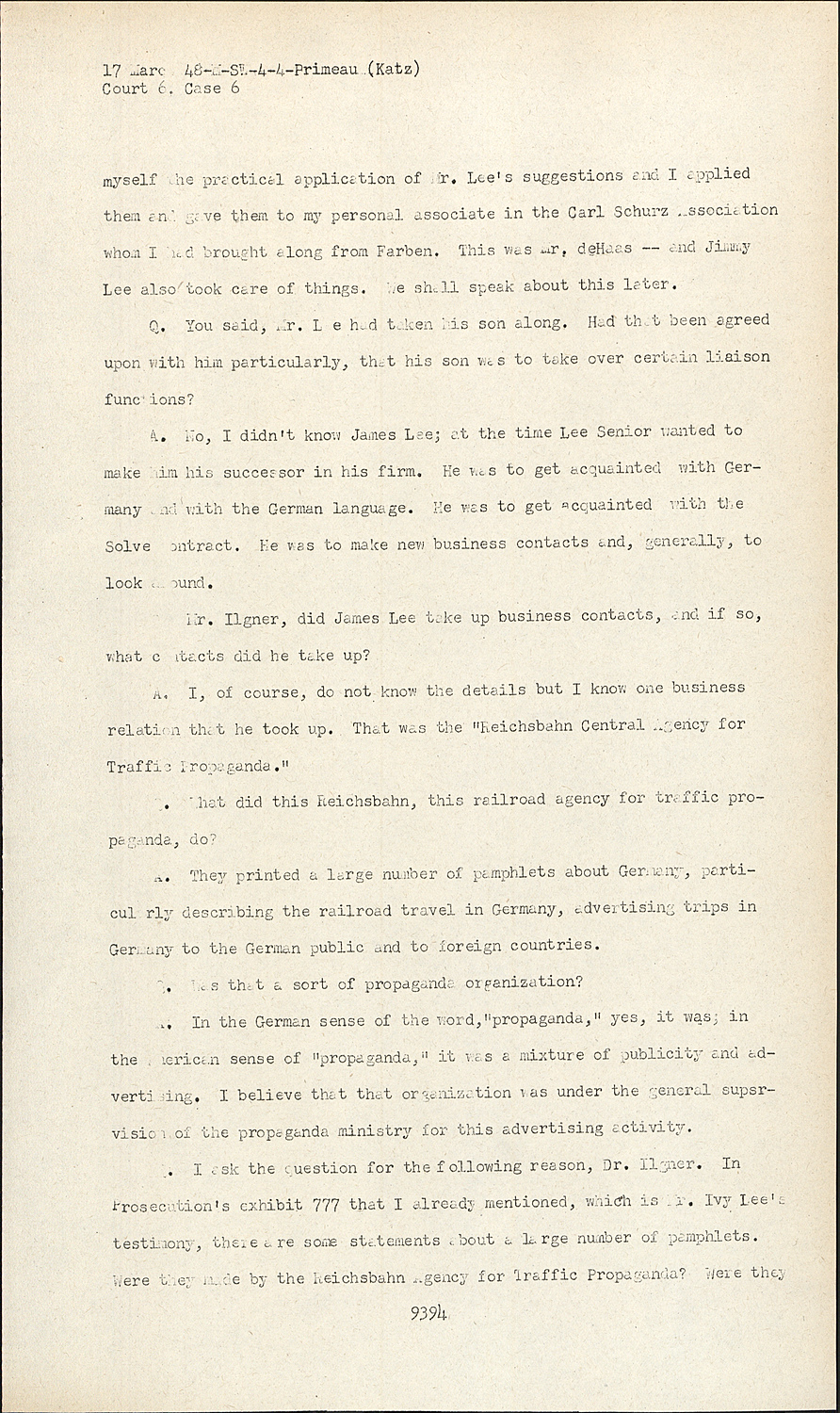
This was Mr. deHaas -- and Jimmy Lee also took care of things. We shall speak about this later.
Q.You said Mr. Lee had taken his son along. Had that been agreed upon with him particularly, that his son was to take over certain liaison functions?
A.No, I didn't know James Lee; at the time Lee Senior wanted to make him his successor in his firm. He was to get acquainted with Germany and with the German language. He was to get acquainted with the Solve contract. He was to make new business contacts and, generally, to look around.
Q.Mr. Ilgner, did James Lee take up business contacts, and if so, what contacts did he take up?
A.I, of course, do not know the details but I know one business relation that he took up. That was the "Reichsbahn Central Agency for Traffic Propaganda."
Q.What did this Reichsbahn, this railroad agency for traffic propaganda, do?
A.They printed a large number of pamphlets about Germany, particularly describing the railroad travel in Germany, advertising trips in Germany to the German public and to foreign countries.
Q.Was that a sort of propaganda organization?
A.In the German sense of the word,"propaganda," yes, it was; in the American sense of "propaganda," it was a mixture of publicity and advertising. I believe that that organization was under the general supsrvision of the propaganda ministry for this advertising activity.
Q.I ask the question for the following reason, Dr. Ilgner. In Prosecution's exhibit 777 that I already mentioned, which is Mr. Ivy Lee's testimony, there are some statements about a large number of pamphlets. Were they made by the Reichsbahn Agency for Traffic Propaganda? Were they brought to America by James Lee?
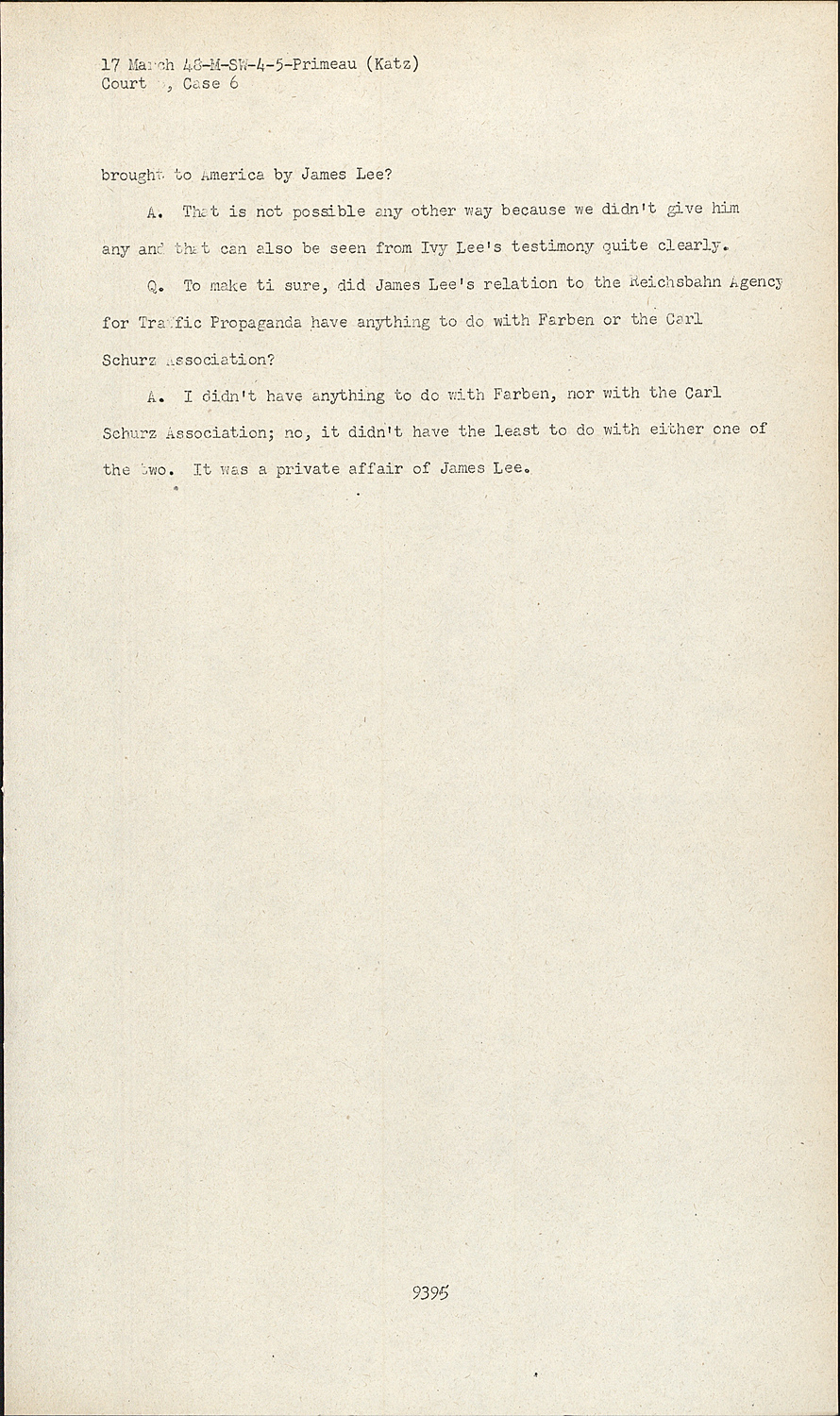
A.That is not possible any other way because we didn't give him any and that can also be seen from Ivy Lee's testimony quite clearly.
Q.To make ti sure, did James Lee's relation to the Reichsbahn Agency for Traffic Propaganda have anything to do with Farben or the Carl Schurz Association?
A.I didn't have anything to do with Farben, nor with the Carl Schurz Association; no, it didn't have the least to do with either one of the two. It was a private affair of James Lee.
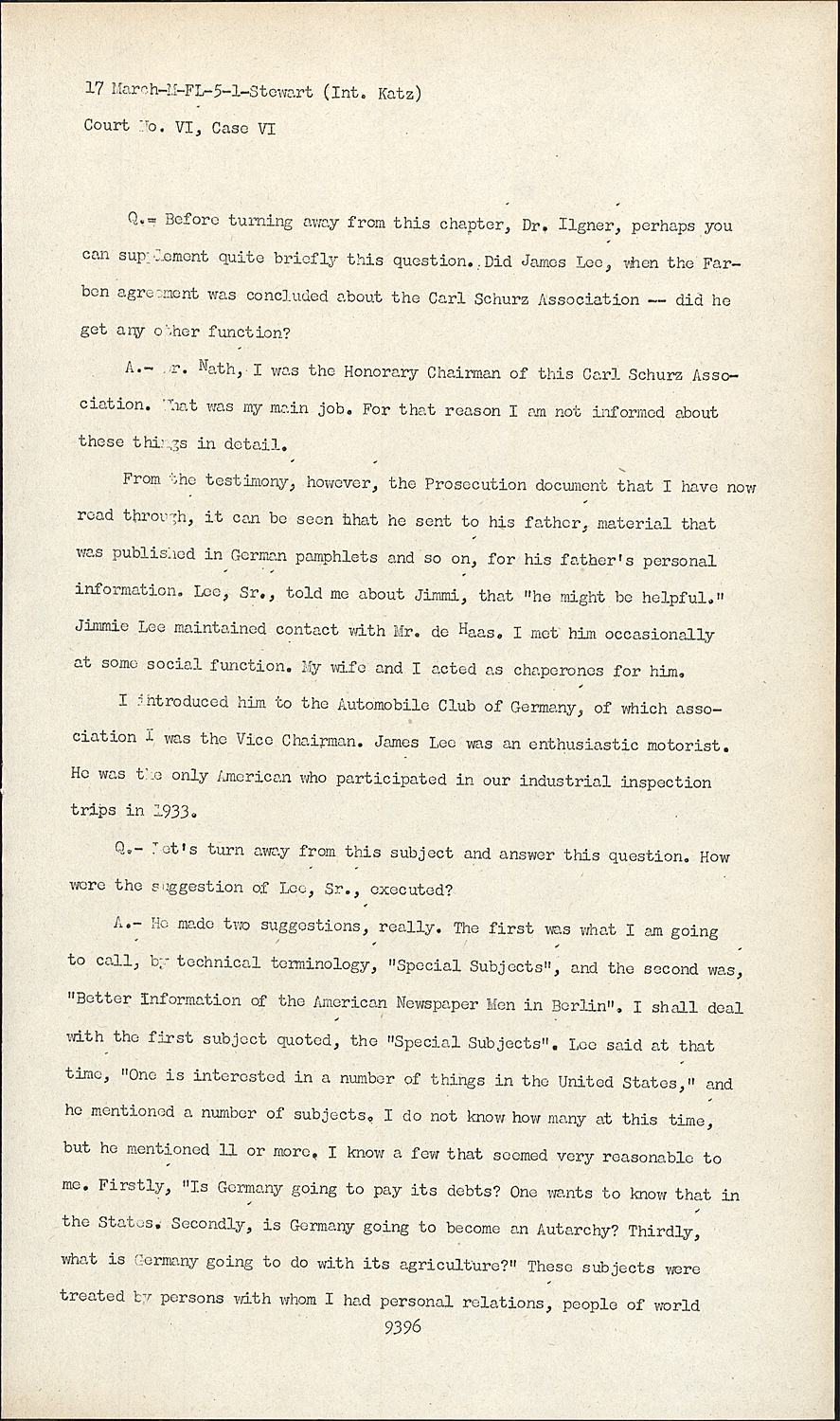
Q.Before turning away from this chapter, Dr. Ilgner, perhaps you can supplement quite briefly this question. Did James Lee, when the Farben agreement was concluded about the Carl Schurz Association -- did he get any other function?
A.- Dr. Nath, I was the Honorary Chairman of this Carl Schurz Association. What was my main job. For that reason I am not informed about these things in detail.
From the testimony, however, the Prosecution document that I have now read through, it can be seen that he sent to his father, material that was published in German pamphlets and so on, for his father's personal information. Lee, Sr., told me about Jimmi, that "he might be helpful." Jimmie Lee maintained contact with Mr. de Haas. I met him occasionally at some social function. My wife and I acted as chaperones for him.
I Introduced him to the Automobile Club of Germany, of which association I was the Vice Chairman. James Lee was an enthusiastic motorist. He was the only American who participated in our industrial inspection trips in 1933.
Q.- Let's turn away from this subject and answer this question. How were the suggestion of Leo, Sr., executed?
A.- He made two suggestions, really. The first was what I am going to call, by technical terminology, "Special Subjects", and the second was, "Bettor Information of the American Newspaper Men in Berlin". I shall deal with the first subject quoted, the "Special Subjects". Lee said at that time, "One is interested in a number of things in the United States," and he mentioned a number of subjects. I do not know how many at this time, but he mentioned 11 or more. I know a few that seemed very reasonable to me. Firstly, "Is Germany going to pay its debts? One wants to know that in the States. Secondly, is Germany going to become an Autarchy? Thirdly, what is Germany going to do with its agriculture?" These subjects were treated by persons with whom I had personal relations, people of world renown, that were generally recognized, such as Schacht, Wagemann, Bruening's Minister of Economics, Professor Warmbold, Professor Warmbold was a former colleague of the Vorstand of Farben.
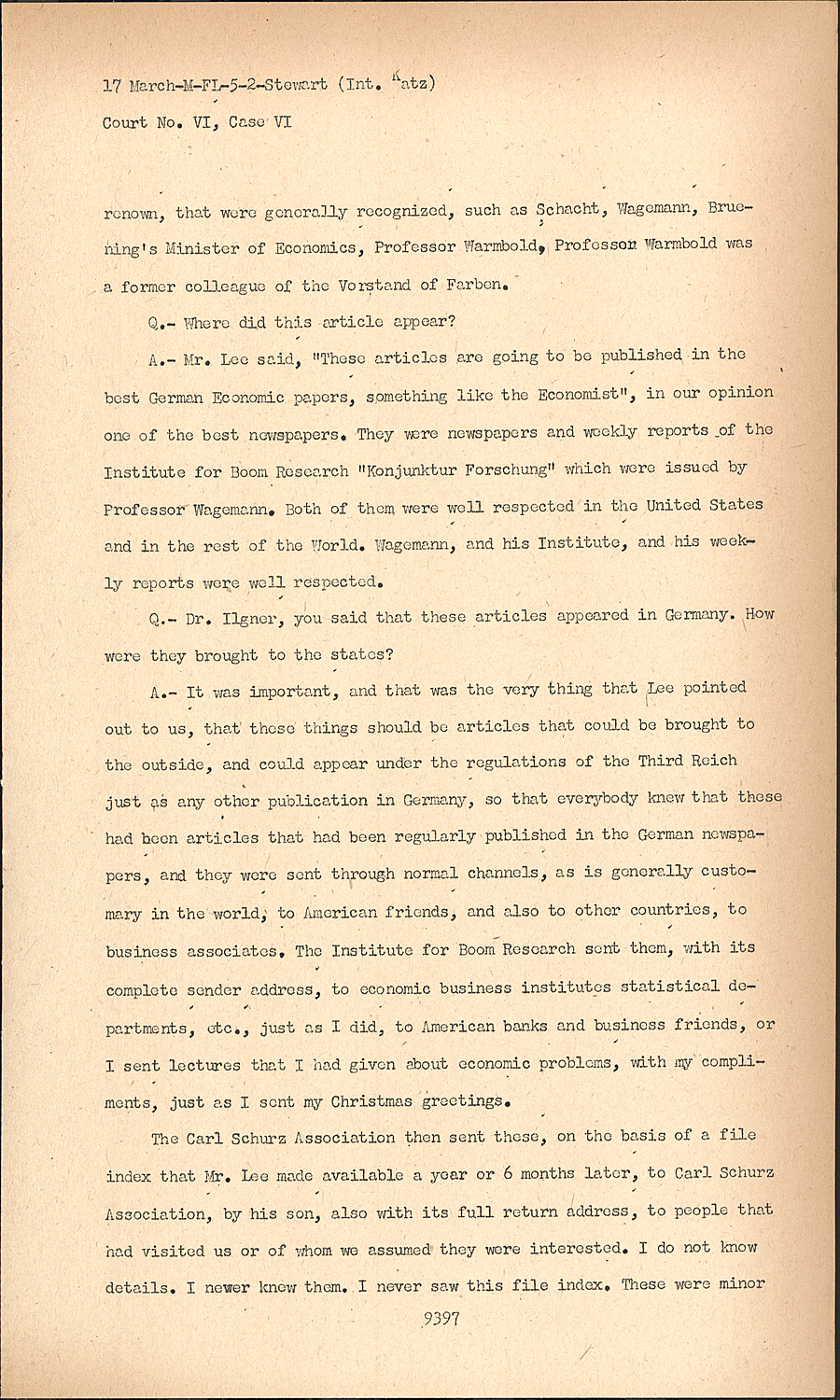
Q.- Where did this article appear?
A.- Mr. Lee said, "These articles are going to be published in the best German Economic papers, something like the Economist", in our opinion one of the best newspapers. They were newspapers and weekly reports of the Institute for Boom Research "Konjunktur Forschung" which were issued by Professor Wagemann. Both of them were well respected in the United States and in the rest of the World. Wagemann, and his Institute, and his weekly reports were well respected.
Q.- Dr. Ilgner, you said that these articles appeared in Germany. How were they brought to the states?
A.- It was important, and that was the very thing that Lee pointed out to us, that these things should be articles that could be brought to the outside, and could appear under the regulations of the Third Reich just as any other publication in Germany, so that everybody knew that these had been articles that had been regularly published in the German newspapers, and they were sent through normal channels, as is generally customary in the world, to American friends, and also to other countries, to business associates. The Institute for Boom Research sent them, with its complete sender address, to economic business institutes statistical departments, etc., just as I did, to American banks and business friends, or I sent lectures that I had given about economic problems, with my compliments, just as I sent my Christmas greetings.
The Carl Schurz Association then sent these, on the basis of a file index that Mr. Lee made available a year or 6 months later, to Carl Schurz Association, by his son, also with its full return address, to people that had visited us or of whom we assumed they were interested. I do not know details. I never knew them. I never saw this file index. These were minor executive affairs.