Dr. Koppenberg, also spoke on this occasion and found words which gave all of us a rather, piesant surprise."
Mr. Haefliger, what was the attitude of Norsk Hydro to this new suggestion for participation in Nordisk Lettmetall?
A.Norsk Hydro realized that in view of the situation this suggestion was the best that Farben was able to achieve in their interest too and agreed without further ado. They knew end were confident that Farben had made the best possible arrangement for them too.
Q.When Nordisk Lettmetall was founded, were Norwegian laws observed?
A.Yes, very carefully. Both when the contracts were worked out and when the members of the Vorstand and Aufsichtsrat were appointed.
Q.Who worked out the contracts, Mr. Haefliger?
A.Cur lawyers, Meyer-Wegelin and Kersten. They also worked with the Norwegian lawyers of Norsk Hydro.
Q.Was the majority in the Vorstand Norwegians?
A.Yes, according to Norwegian law.
Q.And who was the chairman of the Aufsichtsrat?
A.The General Director of Norsk Hydro, Mr. Aubert.
Q.Did not Dr. Koppenberg claim this position?
A.Yes, that was a big difficulty, but Farben succeeded in dissuading him. Finally, a way out had to be found. A special committee had to be created and he was made the chairman of this committee. It was provided, however, that the authority of the Aufsichtsrat would hardly be affected thereby. I must add that the authority of an Auf sichtsrat in Norway is even less than in Germany. The Stuere or Vorstand has the absolute authority there.
Q.Did Dr. Koppenberg, as chairman of this committee, have anything to do?
A.No, it was more a question of prestige. One had to agree for formal reasons.
I believe there was only one short meeting of this committee. It lasted perhaps a quarter of an hour. Nothing was decided. One year later, or it might have been eighteen months, approximately, Koppenberg was recalled. Then this committee disappeared.
Q.Who was in charge of the aluminum program in Norway which Koppenberg had originally set up?
A.Koppenberg had already formed a special company for that purpose by the name of Nordag. Later, it was changed to Hansa Leichtsmetall A.G. It was owned 100% by the Reich. This company carried out Koppenberg's plan.
Q.What quantities of production were proposed in this plan?
A.As far as I can recall, this is what I heard, 2000,000 to 250, 000 tons per year were finally planned. I believe everyone agreed that it was impossible such a plan because about 800,000 kilowatts of power had to be built. I believe that is about three times the capacity of --- that I was speaking about yesterday. That took years to build.
Q.How big was the aluminum factory imposed on the Nordisk Lettmetall by Koppenberg?
A. 12,000 tons per year. Later, 12,000 more were demanded, but this was dropped again.
Q.Mr. Haefliger, in connection with the foundation of Nordisk Lettmetall, was the capital of Norsk Hydro increased?
A.Yes, this necessity later became apparent in Norsk Hydro.
Q.In this connection the prosecution claims that the French shareholders of Norsk Hydro suffered. What do you have to say about that?
A.I had nothing to do with financing Norsk Hydro. I wasnot competent for this and did not belong to the Aufsichtsrat. Therefore, I never participated in with negotiations with French banks. Besides, Dr. Ilgner will be able to go into this point in detail.
Court No. VI, Case No. VI.
QYour collaboration in this Norway project was then limited to the negotiations preceding the founding of Nordisk Lettmetall?
AYes, essentially. While the contract was running there were repeated discussions which required my assistance in commercial matters. For example, the cryolite plan.
QMr. Haefliger, did you have anything else to discuss in this question in connection with the production of heavy water? I refer to 102 of the prosecution. In the electro-mechanical plant of Norsk-Hydro in Femo did you have anything to do with that?
AI had nothing to do with such questions and I knew nothing about them. I heard later, it is true, that there was a laboratory or similar plant which had been destroyed by an air raid, but what this was, I was not told.
QI now put to you a few exhibits of the prosecution. First of all 1191, Document Book 65, English page 1, German page 1. This is the draft of Farben's suggestions for peace planning in Norway. Have you anything to say about that?
AThis is obviously part of the so-called European New Order. I have already said that I never read this academic work thoroughly. I can not remember this Norway work either. At least I never read it. I have not even read it now. I am sure it contains useful material to which one could have referred if necessary.
But I was always more of a practical worker because in practice theoretical conditions on which economic considerations are based usually look different and there is always time to adapt oneself to concrete circumstances.
QI now put to you another prosecution exhibit, Number 1192, Document Book 65, English page 34, German page 63. This is a meeting of the Metal subcommission of 16 April 1940 containing a report by Mayer-Kuester. What do you have to say about this exhibit?
Court No. VI, Case No. VI.
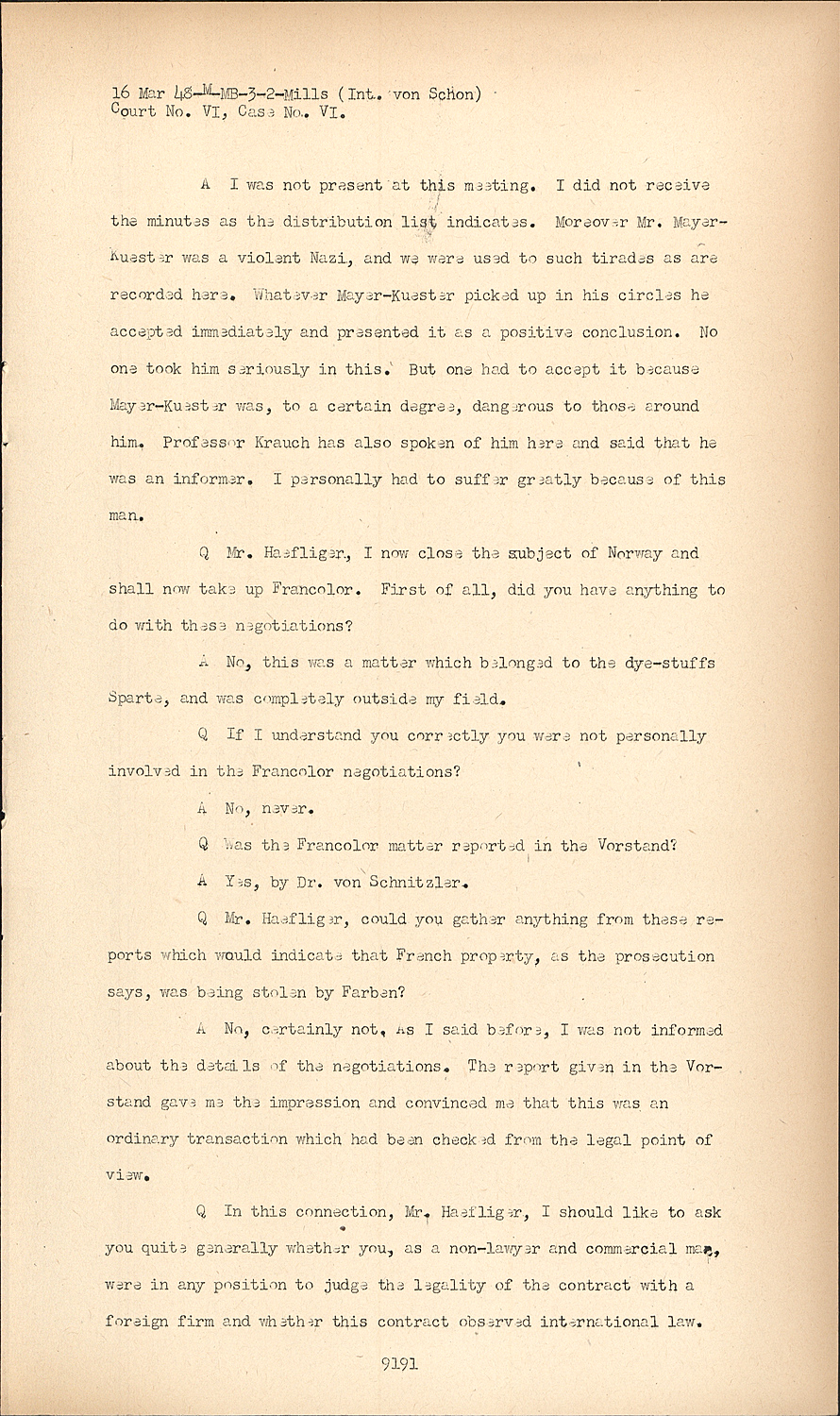
AI was not present at this meeting. I did not receive the minutes as the distribution list indicates. Moreover Mr. MayerKuester was a violent Nazi, and we were used to such tirades as are recorded here. Whatever Mayer-Kuester picked up in his circles he accepted immediately and presented it as a positive conclusion. No one took him seriously in this. But one had to accept it because Mayer-Kuester was, to a certain degree, dangerous to those around him. Professor Krauch has also spoken of him here and said that he was an informer. I personally had to suffer greatly because of this man.
QMr. Haefliger, I now close the subject of Norway and shall now take up Francolor. First of all, did you have anything to do with these negotiations?
ANo, this was a matter which belonged to the dye-stuffs Sparte, and was completely outside my field.
QIf I understand you correctly you were not personally involved in the Francolor negotiations?
ANo, never.
QWas the Francolor matter reported in the Vorstand?
AYes, by Dr. von Schnitzler.
QMr. Haefliger, could you gather anything from these reports which would indicate that French property, as the prosecution says, was being stolen by Farben?
ANo, certainly not, As I said before, I was not informed about the details of the negotiations. The report given in the Vorstand gave me the impression and convinced me that this was an ordinary transaction which had bean checked from the legal point of view.
QIn this connection, Mr. Haefliger, I should like to ask you quite generally whether you, as a non-lawyer and commercial mas, were in any position to judge the legality of the contract with a foreign firm and whether this contract observed international law.
Court No. VI, Case No.VI.
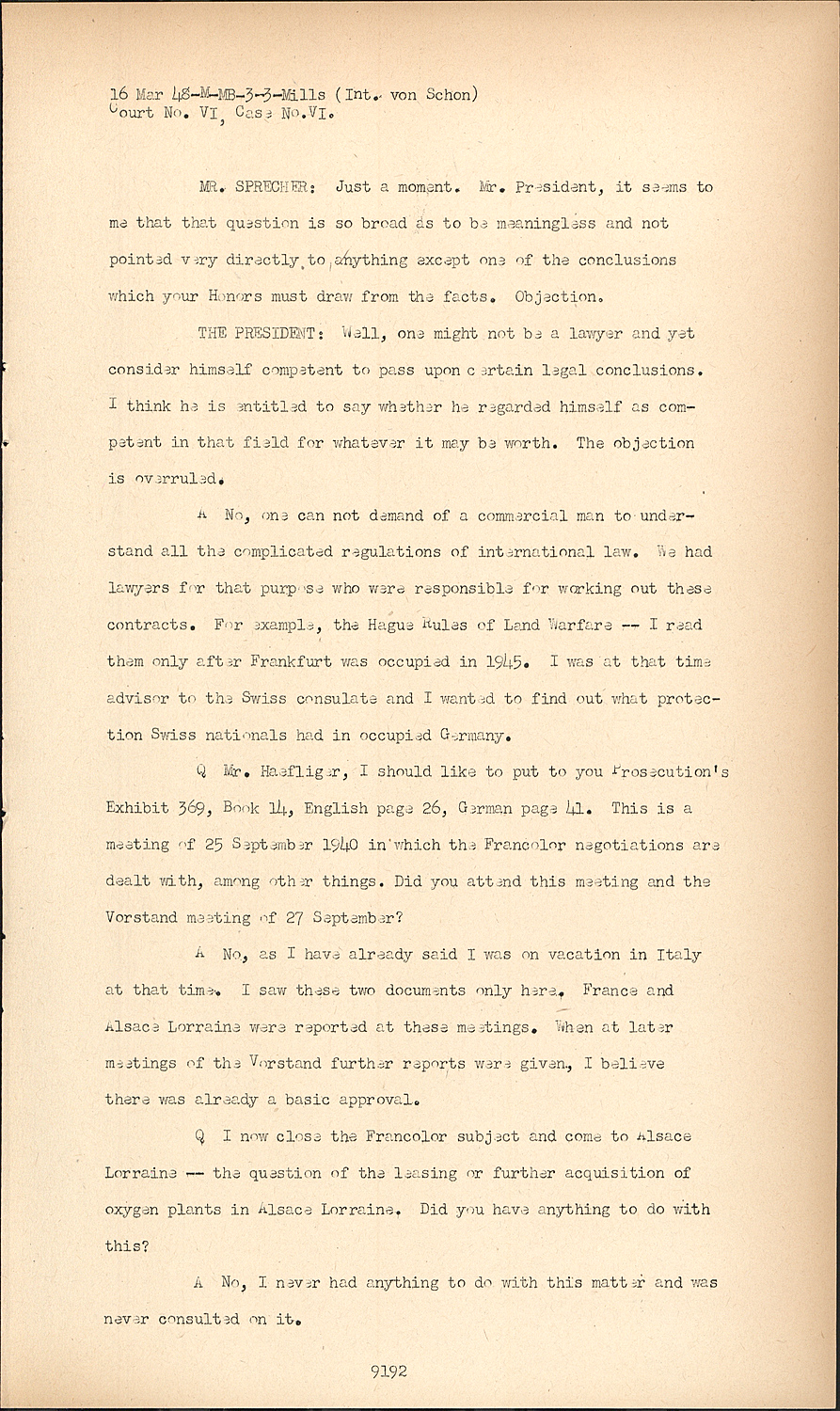
MR. SPRECHER:Just a moment. Mr. President, it seems to me that that question is so broad as to be meaningless and not pointed very directly to anything except one of the conclusions which your Honors must draw from the facts. Objection.
THE PRESIDENT:Well, one might not be a lawyer and yet consider himself competent to pass upon certain legal conclusions. I think he is entitled to say whether he regarded himself as competent in that field for whatever it may be worth. The objection is overruled.
ANo, one can not demand of a commercial man to understand all the complicated regulations of international law. We had lawyers for that purpose who were responsible for working out these contracts. For example, the Hague Rules of Land Warfare -- I read them only after Frankfurt was occupied in 1945. I was at that time advisor to the Swiss consulate and I wanted to find out what protection Swiss nationals had in occupied Germany.
QMr. Haefliger, I should like to put to you Prosecution's Exhibit 369, Book 14, English page 26, German page 41. This is a meeting of 25 September 1940 in which the Francolor negotiations are dealt with, among other things. Did you attend this meeting and the Vorstand meeting of 27 September?
ANo, as I have already said I was on vacation in Italy at that time. I saw these two documents only here. France and Alsace Lorraine were reported at these meetings. When at later meetings of the Vorstand further reports were given, I believe there was already a basic approval.
QI now close the Francolor subject and come to Alsace Lorraine -- the question of the leasing or further acquisition of oxygen plants in Alsace Lorraine. Did you have anything to do with this?
ANo, I never had anything to do with this matter and was never consulted on it.
Court No. VI, Case No. VI.
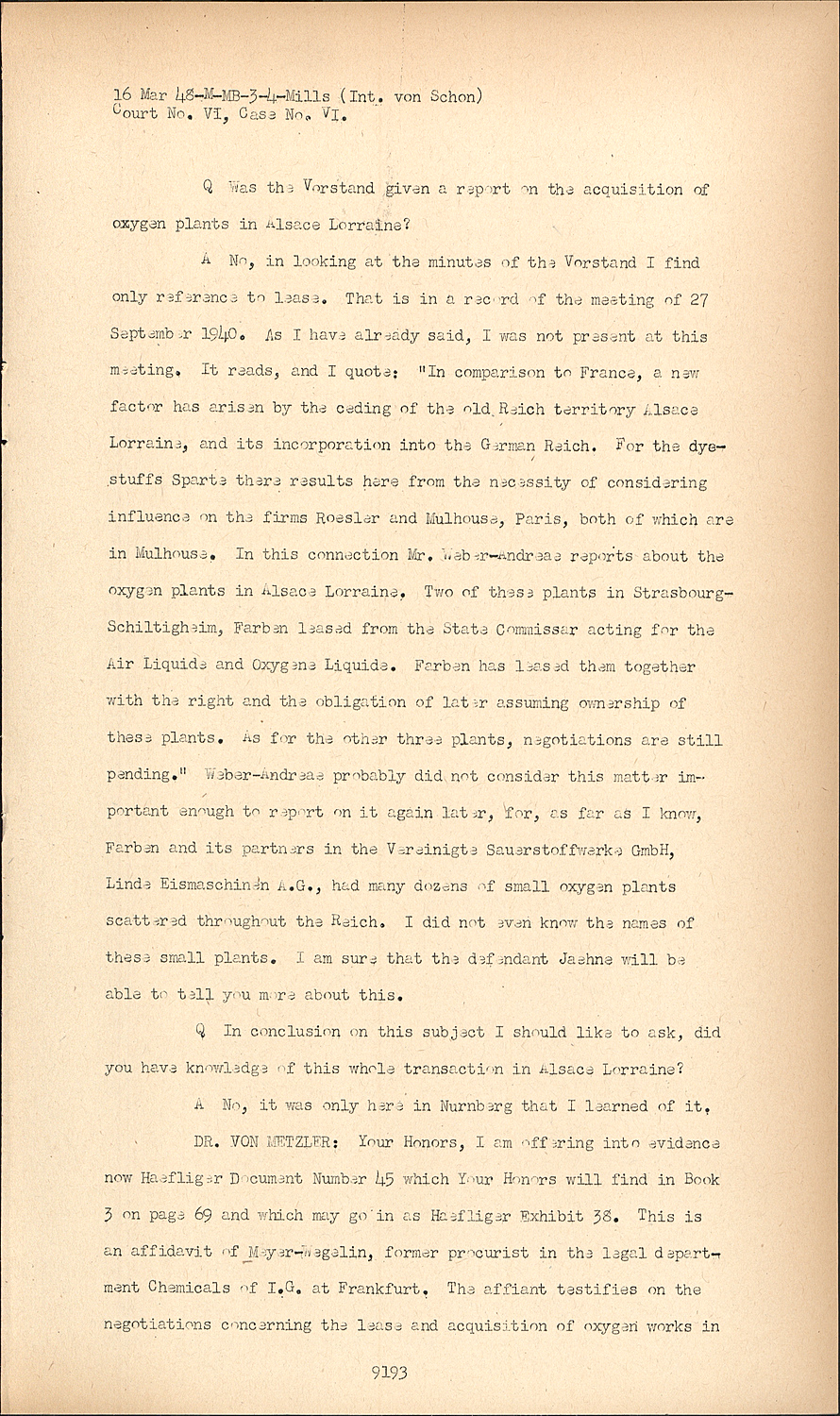
QWas the Vorstand given a report on the acquisition of oxygen plants in Alsace Lorraine?
ANo, in looking at the minutes of the Vorstand I find only reference to lease. That is in a record of the meeting of 27 September 19140. As I have already said, I was not present at this meeting. It reads, and I quote: "In comparison to France, a new factor has arisen by the ceding of the old Reich territory Alsace Lorraine, and its incorporation into the German Reich. For the dyestuffs Sparte there results here from the necessity of considering influence on the firms Roesler and Mulhouse, Paris, both of which are in Mulhouse. In this connection Mr. Weber-Andreae reports about the oxygen plants in Alsace Lorraine. Two of these plants in StrasbourgSchiltigheim, Farben leased from the State Commissar acting for the Air Liquide and Oxygene Liquide. Farben has leased them together with the right and the obligation of later assuming ownership of these plants. As for the other three plants, negotiations are still pending." Weber-Andreae probably did not consider this matter important enough to report on it again later, for, as far as I know, Farben and its partners in the Vereinigte Sauerstoffwerks GmbH, Linde Eismaschinen A.G., had many dozens of small oxygen plants scattered throughout the Reich. I did not even know the names of these small plants. I am sure that the defendant Jaehne will be able to tell you more about this.
QIn conclusion on this subject I should like to ask, did you have knowledge of this whole transaction in Alsace Lorraine?
ANo, it was only here in Nurnberg that I learned of it.
DR. VON METZLFR:Your Honors, I am offering into evidence now Haefliger Document Number 45 which Your Honors will find in Book 3 on page 69 and which may go in as Haefliger Exhibit 38. This is an affidavit of Meyer-Wegelin, former procurist in the legal department Chemicals of I.G. at Frankfurt. The affiant testifies on the negotiations concerning the lease and acquisition of oxygen works in Court No. VI, Case No. VI.
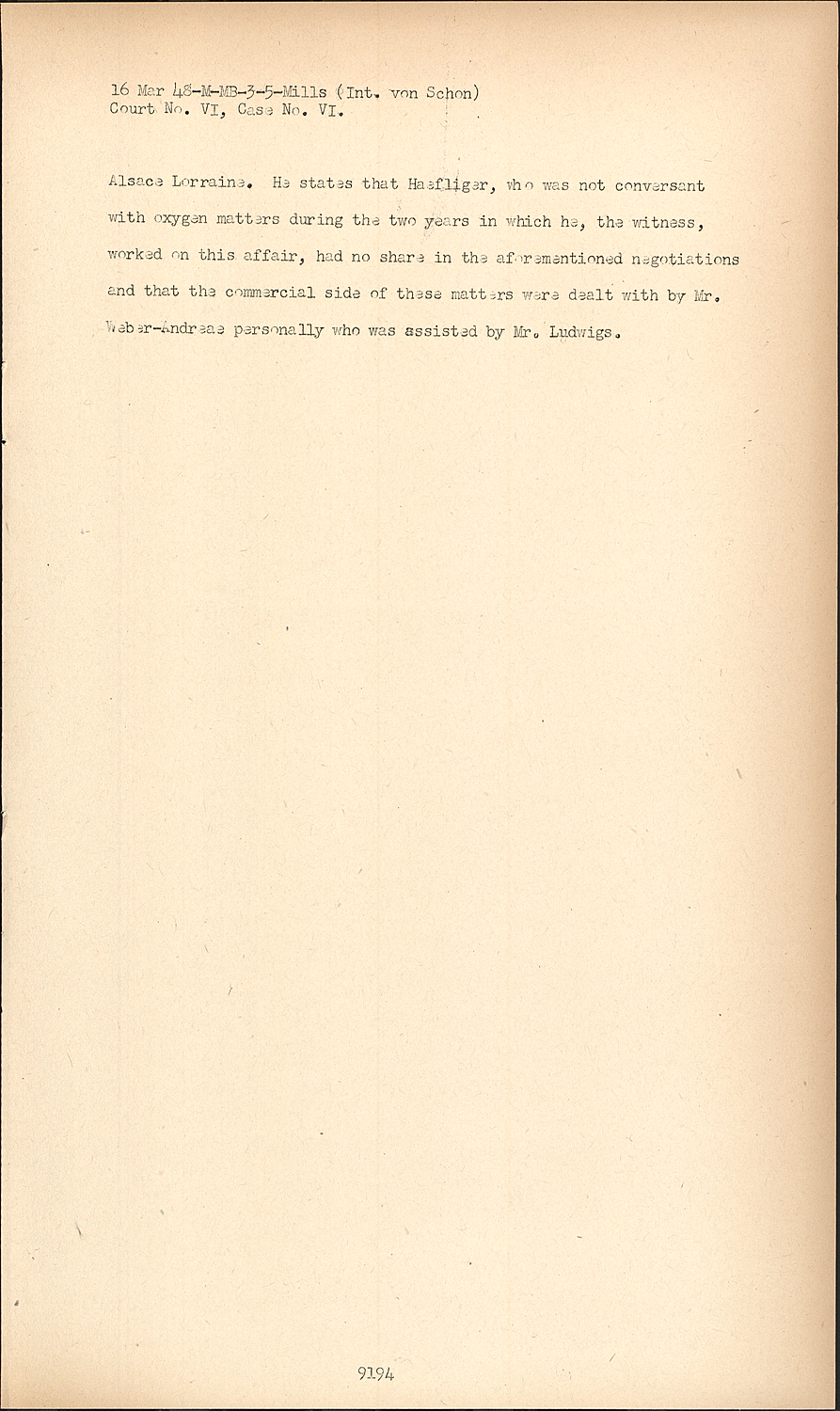
Alsace Lorraine. He states that Haefliger, who was not conversant with oxygen matters during the two years in which he, the witness, worked on this affair, had no share in the aforementioned negotiations and that the commercial side of these matters were dealt with by Mr. Weber-Andreae personally who was assisted by Mr. Ludwigs.
BY DR. VON HETZLER:
QMr. Haefliger, I now come to the subject of Russia where I have a very few questions to ask you. Did you, in any form, as mentioned by the Prosecution have anything to do with the Kontinentale Oel, Ostchemie GmbH, or Soda and Aetzalkali Ost G.m.b.H? Were you in the Vorstand or the Aufsichtsrat of any of these companies?
ANo. I had nothing to do with any of these Eastern companies and contrary to the contention of the prosecution I was not a member of the East Committee of Farben. I do not even know whether this committee ever met.
QDo you know anything about the realization of the alleged plundering plans of Farben in the East?
ANo, I know nothing about this. As far as I know Farben never took over any chemical factories in the east. I know nothing of Farben's connections in this direction aside from the foundantion of a common sales office in Riga. I know, however, that one of our men was in this trustee company, Soda and Aetzalkali Ost G.m.b.H., but that was purely a trustee and has nothing to do with the business.
QMr. Haefliger, in conclusion of your examination on Count II, I want to ask you the following question. You know that the prosecution charges Farben with having systematically exploited the foreign chemical industries during the war. Now, can you tell the Tribunal, from your own field of work, an example showing that this attitude with which the prosecution accusses the leading men of Farben, is not correct?
AYes, I should like to cite as an example the case of the nickle mine at Petsamo which is mentioned in the prosecution document.
QWill you please tell us about this case.
AI do not know whether I should go into this matter in detail. It would perhaps overburden the record. I believe after examing my document book one could have a very good idea of this incident. Therefore I need only give a general outline. First of all, there was an intention of getting a concession in a nickle mine at Petsamo owned by Mond Nickle and Company.
I objected to the Finish Foreign Office and I said that this should not be done. In the first negotiations on a private basis with the Finnish subsidiary of the nickle trust, from the very beginning I said that we expected nothing from the Finns, which would look like a plundering of the mine, spoliation, and that the mine would be operated according to customary mining methods, and that we would demand nothing else from the Finns. Also in setting a price, which is very difficult, and calculation of the price was quite impossible under the circumstances, we agreed on a price that we should start with the cost price plus the full amortization and later I managed to arrange that the Finnish company should be paid an extra price to cover increased cost, for the finishing of the plant in the far North. It was a sum of eighteen million marks which the firm received in addition in this way. I had the feeling that the Finns welcomed our attitude and were very much relieved because I recall that they were having negotiations with another power at that time, because in the beginning we were to receive only sixty percent of production and forty percent was reserved for another power. I recall that during these negotiations very strong pressure was exerted to take the concession away and turn if over to this other power and to form a mixed company of which the other power would be in charge. These conditions are recorded in the official Finnish White Book or Blue Book that was published after the so-called Winter War.
QMr. Haefliger, what I am interested in primarily is the fact that originally the German authorities demanded that the concession of the Petsamo Mine which belonged to the Canadian or British Company Internation Nickle or Mond Nickle, should also go into German hands.
AI can not say that that was the demand made to us, but that was the intention to demand that, and I opposed this because I considered it an American firm and I didn't want to negotiate with a friendly firm under such conditions. I said that is not necessary to proceed in this way and I object to that for reasons of private industry.
DR. VON METZLER:Your Honors, I am offering now in evidencetwo documents dealing with the Petsamo Nickeli affair. The first document is Number 46 which your Honors will find in Book 3 on page 72 and which may go in as Haefliger Exhibit 39. This is an affidavit of Mr. Hilger van Scherpenberg, now Oberregeirungsrat in the Bavarian Ministry of Economy. Up to 1 February 1944 the affiant was referent for the Scandinavian countries in the Department for Trade Policy of the German Foreign Office. In this capacity the affiant was concerned with the Petsamo Nikkeli affair and came in touch with the defendant Haefliger. He testifies that due to the intervention of the defendant who took the side of the British, respectively Canadian ownersof thePetsamo Nickle concession, this concession remained untouched despite an intention to the contrary on the part of the German authorities. I am offering next in evidence Haefliger Document No. 47 which your Honors will find in Book 3 on page 75 and which may go in as Haefliger Exhibit No. 40. This is an affidavit of Freiherr Gustaff Woldemar Wrede of Helsinki, Finland, who between 1 September 1940 and 19 September 1944 was managing director of the Petsamo Nikkeli Company, the Finnish subsidiary of the International Nickle Company of Canada, Toronto, the company who owned this concession, in this capacity the affiant participated in the negotiations with I. G. respectively, the defendant Haefliger, concerning the expansion and operation of the Petsamo Nickle Mines. He collaborates the statement of the affiant von Scherpenberg. He furthermore testifies on the friendly, fair, and loyal attitude which Haefliger adopted on this occasion. During the negotiations the terms under which the mines were to be exploited. He ends by saying that he considers Haefliger to be a just and fair minded business man.
Q.Dr. Haefliger, in the exhibit which I have just offered--that is, the affidavit of Gustaf Woldemar Wrede, Exhibit 40, it is mentioned that you informed Mr. Wrede of certain plans of the Reichkommissar in Norway, Terboven, with the purpose of expanding his influence byond Norway. Can you very briefly explain this?
A.Yes. I consider it important to avoid any misunderstanding here. I had reason to assume that Terboven had certain ambitions to extend his influence in the north and to take in the nickel interests in the far north of Norway and, in addition to that, he may have had ideas that later Cola would be included in a new Arctic state, that a European Alaska might arise. I never identified these ambitions with the official German policy. In contact with the foreign office about the Petsamo matter, I was always of the opinion that the official attitude was always honest. It was a private idea of the Reichskommissar and, therefore, I was able with a clear conscience to inform my Finnish friend about these ideas and tell him to watch out.
Q.Thank you, Mr. Haefliger. I now close your examination on Count II and shall go into Count III briefly -- slave labor and mass murder. First of all, Mr. Haefliger, I want to ask you generally whether you had anything to do with labor commitment and social care of workers in Farben at any time.
A.No. As a commercial man in the Central Office of Farben in the Frankfort office, these matters were entirely outside my sphere of work and my competency. I never had anything to do with these questions.
Q.Mr. Haefliger, did you know anything about the employment of foreign workers by Farben?
A.Yes. I knew quite generally that foreign workers were employed.
Q.Did you have any influence on the employment of foreign workers as a commercial man?
A.No. As I said, it was not the commercial man who had to decide that. The employment of foreign workers was under the plant management.
Q.Mr. Haefliger, did you know that from a certain time on foreign workers were conscripted for labor in Germany?
A.Since this whole subject was so outside my sphere, I have only a very vague recollection. In the case of France, I can recall that from a certain time on there was some sort of labor conscription according to the German pattern which was promulgated by the Vichy government. I recall that at one time -- I believe it was in 1943--two young French pharmacology students from Lyon called on me at my home in Frankfurt and brought me a letter of recommendation from one of my French friends in which it was asked that I should help them to get a good job. I was able to place them in a leading pharmacy in Frankfurt and I later saw them a few times. They were quite satisfied with the work to which they were assigned. In 1944 they did not come back from leave and the owner of the pharmacy told me they didn't want to expose themselves to the dangers of the air raids any more and I could hardly blame them. These young people did not tell me that they came to Germany on a compulsory basis.
There were some Dutch construction workers, too, whom the firm sent to me to repair some bomb damage on my house in 1944. They did not tell me either that they were in Germany ona compulsory basis. They used to sing at their work.
Those were my little personal impressions that I had of foreign workers and I never thought of compulsion.
Q.Mr. Haefliger, was the Vorstand, the Commercial Committee or the Chemicals Committee ever given a report about obtaining or employing labor within Farben?
A.As I recall, these matters were never discussed in the bodies which you mentioned. I recall only that Mr. Mann once, at the end of a Vorstand meeting, was asked by Geheimrat Schmitz to speak about the socalled speech of Sauckel on the employment of foreign labor quite generally, not referring to Farben specifically; I might have happened to hear this speech. I do not remember whether labor conscription was mentioned on this occasion. I was not listening very carefully, I believe this was during the terrible time when one never knew whether such meetings might not end in the air raid shelter.
I should like to say a few more words which might help to clarify this special atmosphere which existed from 1943 on to an increasing extent in such meetings and altogether in daily work. From the objective records and minutes one might believe that everything was in order, systematic. Actually, however, this was more and more just a sham and everyone felt an inner tension, an unrest, and concealed fear at the dissolution that was coming because of the murderous air raids. If one reads the minutes of the Vorstand TEA and KA now carefully, one can see the collapse which begins in 1943. A great deal was still written; we knew that at least a great deal of it would remain on paper. One must have experienced all this to be able to understand that, for example, there must be gaps of memory and I wouldn't ask my worst enemy to meet in inadequate air raid shelters, that his wife and children go through airraids where 2000 and more bombs are dropped dating from 1930.
Please forgive this diversion. I have seen the Chema minutes here. I have read them all through and I have been able to observe that the obtaining of labor was never discussed, not a single time. There are over a hundred meetings recorded. That was simply up to the management of the various plants.
Q.Thank you. Mr. Haefliger, when you visited the Bitterfeld I.G. plant, did you not talk about labor questions?
A.No. I visited Bitterfeld about every two months approximately, but such questions were never discussed.
Q.Did you never hear that Poles and Eastern workers were brought to Germany by force?
A.No. I cannot recall. As I said, I had only a very vague idea of how labor was obtained abroad. I assumed, of course, that workers came from the East who were in very difficult circumstances, very difficult living conditions, because of the war and, therefore, preferred to come to Germany where conditions were better. How these people were actually brought to Germany, I did not know.
I might give an example from my private life here, too. Every evening a little Russian turned up. He seemed quite free and when Frankfurt was occupied he said goodbye. He was in tears because he had been so well off. He had been working in the garden and we gave him cigarettes. He was very happy. He never said that he was here because of compulsion. He seemed quite happy. I came in touch with such cases and that is where I got my impressions.
Q.Thank you, Mr. Haefliger. Did you know that concentration camp inmates were employed in the Farben plants?
A.No. I learned of that only during this trial.
Q.But you were a guest at the TEA meetings a few times.
A.Yes, I was present a few times as a guest. In order to listen to a scientific lecture which was always given at the beginning of these meetings, perhaps two or three times it happened that at the end of the meeting I came back to the meeting in Frankfurt, having been busy with other things in my office in the meantime, so that I could be present at lunch, because I had been invited.
On such occasions I once heard a report by Dr. Struss on labor. He gave some statistics and in this way I obtained a certain overall view of the question. I cannot recall, however, that Struss mentioned the employment of concentration camp inmates. As usual, there were quite a lot of charts in the room. Some of them were on top of others because there was not enough space. As far as I could see from my seat, there was no writing on them, possible for reasons of secrecy. As I say, no details were given.
Q.Mr. Haefliger, did you not learn that concentration camp inmates were employed at the concentration camp at Auschwitz?
A.No. I learned of that only here.
Q.Did you not know the name "Monowitz"?
A.Here in Nurnberg by conversation with the gentlemen--what did you say? Didn't you ask me another question?
Q.Yes. I said "Monowitz." In the Vorstand meetings when credit applications were reported on, wasn't something said about this, about the use of concentration camp inmates at (Auschwitz) Monowitz?
A.Monowitz was a name that I heard only here. In the Vorstand meetings, no -- nothing was said about that -- no.
Q.Did you at any time attend any plant leader meetings?
A.No. I was not a plant leader.
Q.Did you know anything about the employment of prisoners of war by Farben?
A.I always assumed that prisoners of war were employed by Farben but I know nothing about the details.
Q.Did you ever in Vorstand meetings, Chema meetings or Tea meetings, or in conversation with your colleagues, learn anything about mistreatment of foreign workers, concentration camp inmates or prisoners of war?
A.No, never. I was always absolutely convinced, by virtue of a social attitude of my colleagues that everything possible would be done for the foreign workers. I never doubted that. It never occurred to me that it could be any different.
Q.Mr. Haefliger, in this connection I should like to ask you very briefly whether, you know anything about the human experiments with medical preparations which are alleged by the prosecution. These preparations are supposed to have been supplied by Farben.
A.I am outraged that men of science, whom I consider benefactors of humanity and whom I have always admired, should be accused of being connected with such atrocities. That is quite impossible. I never heard anything about such human experiments in concentration camps. It was only through the Nurnberg trials that I learned of them.
Q.Mr. Haefliger, did you ever hear anything of the gassing of concentration camp inmates?
A.No. I learned of this, too, only after the capitulation. I may remark, in 1944 I was in Switzerland and I cannot recall seeing anything in the newspapers about any gassings. I can add that.
Q.Mr. Haefliger, I now conclude your examination on Count III. I want to ask you a question about Count V, common plan or conspiracy. All the defendants are accused of having participated in a conspiracy to commit crimes against peace with reference to Count II and III.
What do you have to say to this accusation?
A.I must very decisively object to such an accusation. I have already explained that I was not aware of any intentions of the Nazi government to wage a war of aggression. Of course, there never was any such conspiracy. My membership in the Vorstand as a Swiss citizen and the fact that before 1938 I was occasionally a guest at meetings of the working committee, although I was at the time Swiss consul, I consider further proof that nothing was over said in the Vorstand about any proposed war of aggression. I consider this contention of the Prosecution so misleading that I believe I need not say anything more about it.
Q.Mr. Haefliger, to conclude your examination, I should like to ask a very few questions about your arrest. When were you arrested?
A.On the 11th of May 1945.
Q.Have you always been in custody since that time?
A.No, thank goodness; in October 1945, because of my state of health, I was released from the prison in Frankfurt, Brendosheim, and was dismissed to my home. On the 27th of December 1945 I was definitely released; at least, I thought this was final at the time.
Q.When were you arrested again?
A.On the 8th of April 1947 I came to Nurnberg, presumably as a voluntary witness. On the 3rd of May 1947. one day before the indictment was served, I was arrested.
DR. VON METZLER:This, Mr. President, concludes my examination in chief.
THE PRESIDENT:The defendant Haefliger is available to counsel for defense for further examination. BY DR. DIX: (Counsel for defendant von Schnitzler):
Q.Mr. Haefliger, you have told about the negotiations with the Aussiger Verein. When and where did these negotiations take place?
A.With the Aussiger Verein, there were two meetings. Ono was in November and the other in December 1938 in Berlin -- both of them in Berlin.
Q.Where in Berlin?
A.The first negotiations were in the Drosdnor Bank. The chemical factory, von Heyden, had invited us there because Mr. Zinsser was an Aufsichtsrat of the Dresdner Bank and in this capacity I believe and already contacted Prague.
Q.Did my client, Geheimrat Schmitz, attend these negotiations?
A.No. I can only recall that in the morning when the gentlemen of the Prager Verein arrived, including Mr. Preiss -
Q.Who is Mr. Preiss?
A.Mr. Preiss was the president of the Tiflostencza Bank -- I believe an important person -- and Geheimrat Schmitz appeared in the Hotel Adlon to greet him and there was a short conversation and then he went away again.
Q.Mr. Haefliger, are you not mistaken? In the record of these negotiations, the written minutes, Geheimrat Schmitz is mentioned as having been present at the negotiations.
A.I cannot recall any official minutes being prepared. I believe this is a file note to refresh the memory and one is usually not very formal here. I assume that Mr. Schmitz came in for ten minutes and, in order to emphasize how important the matter was, they thought they should regard that Mr. Schmitz was there but I can recall that he was not present.
DR. DIX:Your Honors, this is merely a contribution to prove the reliability of the documentary evidence. BY DR. HOFFMAN (Counsel for defendant Ambros):
Q.Mr. Haefliger, your examination on Count III gives me occasion to ask you a few brief questions. The first one is: did you, Mr. Haefliger, know that there were concentration camps in Germany?
A.Yes, I know, but one is ashamed to repeat here that one actually knew of only Oranienburg and Dachau.
That has become a joke but it is true. I didn't know any others.
Q.Mr. Haefliger, may I ask you then; you knew only those two?
A.Yes, perhaps here and there I knew that there was a camp -in Haeger, because an acquaintance of mine was there; she didn't tell me anything about it but I knew she was there; I thought that it was a little camp; I wasn't interested.
Q.Mr. Haefliger: another question: if you had happened to be at a Vorstand meeting and had there become acquainted with the order to employ concentration camp inmates, what would you have done?
MR. SPRECHER:Just a minute; objection.
THE PRESIDENT:Permit Dr. Hoffman to complete his question - or had you completed it?
DR. HOFFMAN:Yes.
THE PRESIDENT:The objection is sustained. That is in the field of speculation as to what he would have done under these circumstances.
DR. HOFFMAN:No further questions. BY DR. KRAFT (Counsel for defendant Oster).
Q.Mr. Haefliger, yesterday, when examined by your counsel you spoke about Prosecution Document NI-14274, Exhibit 1906, cross examination of Dr. Schneider. This is a record of a discussion at Frankfurt about the Falkenau factory. You attended this discussion and I should like to ask you the following about it: were you acquainted with conditions of the German nitrogen aluminum industry?
A.No. I was not; that is why we asked Mr. Bachmann to tell us about it, because we had no information about it.
Q.Dr. Bachmann was the director of the G. for the nitrogen of lime and perhaps, as you said, had helped the nitrogen of lime industry. Did you not make a mistake here inasmuch as Dr. Bachmann was the head of the German carbide association?
A.Yes, that is quite possible -- the carbide -- that is right.