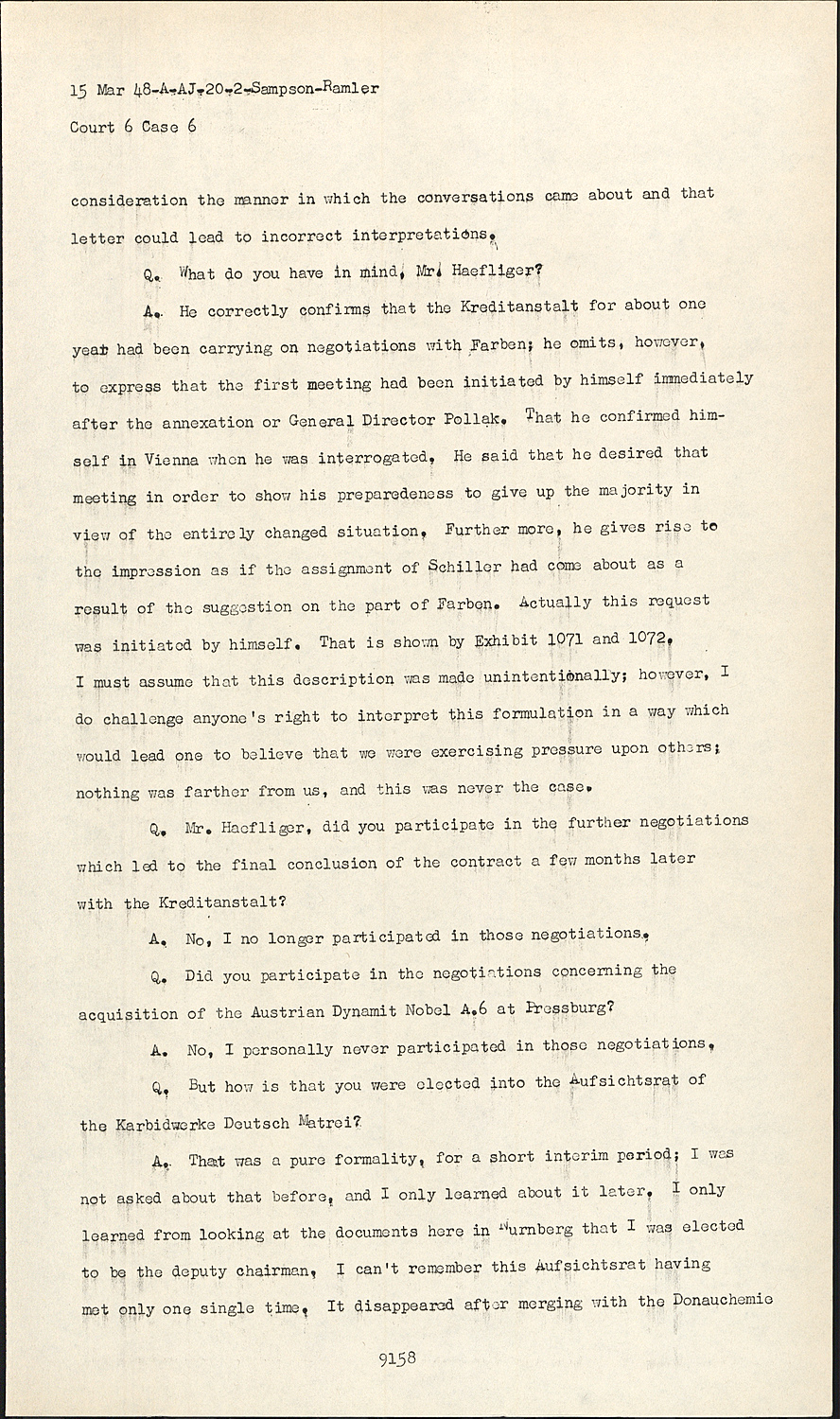
Q.What do you have in mind, Mr. Haefliger?
A.He correctly confirms that the Kreditanstalt for about one year had been carrying on negotiations with Farben; he omits, however, to express that the first meeting had been initiated by himself immediately after the annexation or General Director Pollak. That he confirmed himself in Vienna when he was interrogated. He said that he desired that meeting in order to show his preparedeness to give up the majority in view of the entirely changed situation. Further more, he gives rise to the impression as if the assignment of Schiller had come about as a result of the suggestion on the part of Farben. Actually this request was initiated by himself. That is shown by Exhibit 1071 and 1072. I must assume that this description was made unintentionally; however, I do challenge anyone's right to interpret this formulation in a way which would lead one to believe that we were exercising pressure upon others; nothing was farther from us, and this was never the case.
Q.Mr. Haefliger, did you participate in the further negotiations which led to the final conclusion of the contract a few months later with the Kreditanstalt?
A.No, I no longer participated in those negotiations.
Q.Did you participate in the negotiations concerning the acquisition of the Austrian Dynamit Nobel A.6 at Pressburg?
A.No, I personally never participated in those negotiations.
Q.But how is that you were elected into the Aufsichtsrat of the Karbidwerke Deutsch Matrei?
A.That was a pure formality, for a short interim period; I was not asked about that before, and I only learned about it later. I only learned from looking at the documents here in Nurnberg that I was elected to be the deputy chairman. I can't remember this Aufsichtsrat having met only one single tine. It disappeared after merging with the Donauchemie a. 6 soon after its appearance; the whole thing was a pure formality.
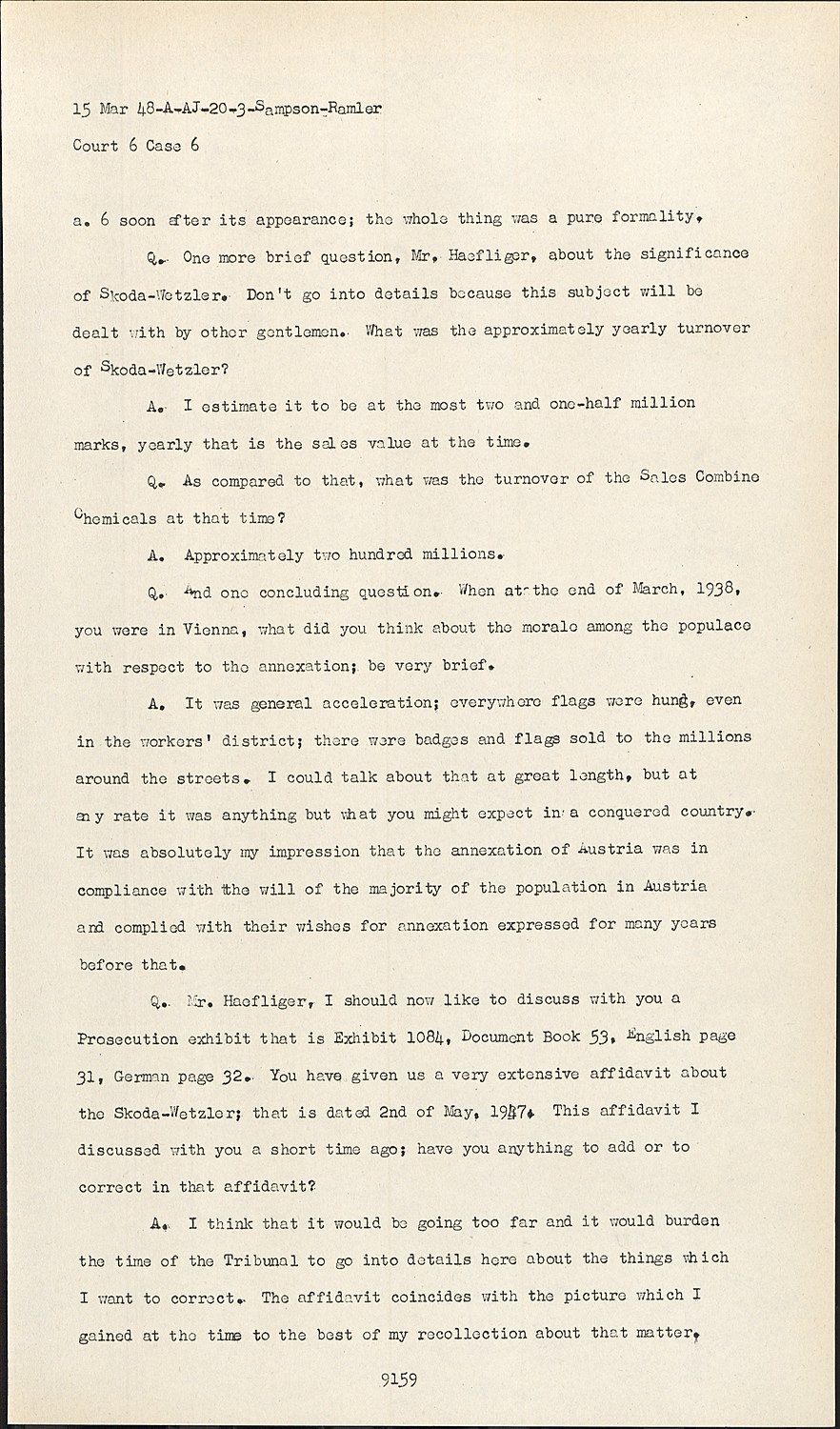
Q.One more brief question, Mr. Haefliger, about the significance of Skoda-Wetzler. Don't go into details because this subject will be dealt with by other gentlemen. What was the approximately yearly turnover of Skoda-Wetzler?
A.I estimate it to be at the most two and one-half million marks, yearly that is the sales value at the time.
Q.As compared to that, what was the turnover of the Sales Combine Chemicals at that time?
A.Approximately two hundred millions.
Q.And one concluding question. When at the end of March, 1938, you were in Vienna, what did you think about the morale among the populace with respect to the annexation; be very brief.
A.It was general acceleration; everywhere flags were hung, even in the workers' district; there were badges and flags sold to the millions around the streets. I could talk about that at great length, but at any rate it was anything but what you might expect in a conquered country. It was absolutely my impression that the annexation of Austria was in compliance with the will of the majority of the population in Austria and complied with their wishes for annexation expressed for many years before that.
Q.Mr. Haefliger, I should now like to discuss with you a Prosecution exhibit that is Exhibit 1084, Document Book 53, English page 31, German page 32. You have given us a very extensive affidavit about the Skoda-Wetzler; that is dated 2nd of May, 1947. This affidavit I discussed with you a short time ago; have you anything to add or to correct in that affidavit?
A.I think that it would be going too far and it would burden the time of the Tribunal to go into details here about the things which I want to correct. The affidavit coincides with the picture which I gained at the time to the best of my recollection about that matter.
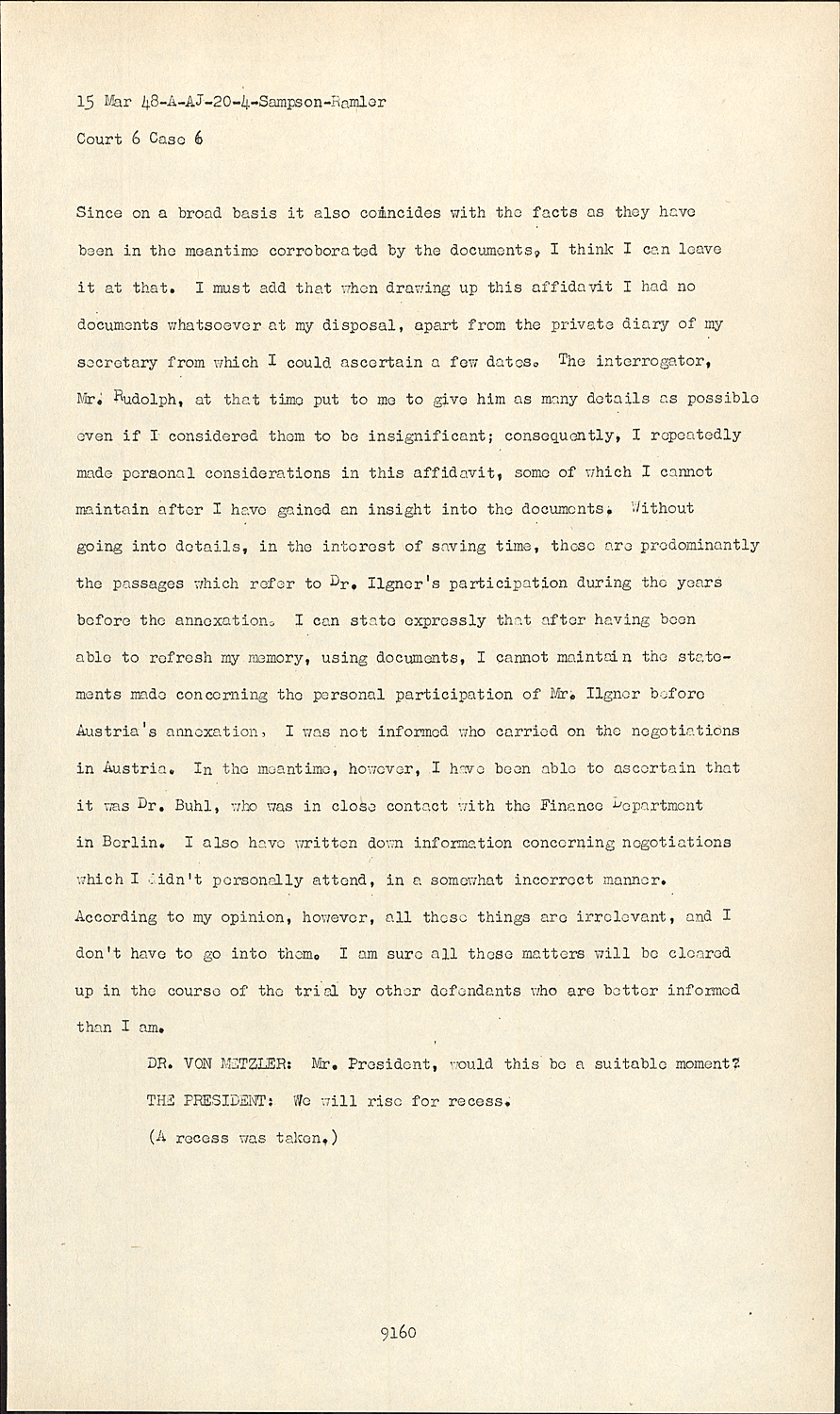
Since on a broad basis it also coincides with the facts as they have been in the meantime corroborated by the documents, I think I can leave it at that. I must add that when drawing up this affidavit I had no documents whatsoever at my disposal, apart from the private diary of my secretary from which I could ascertain a few dates. The interrogator, Mr. Rudolph, at that time put to me to give him as many details as possible even if I considered them to be insignificant; consequently, I repeatedly made personal considerations in this affidavit, some of which I cannot maintain after I have gained an insight into the documents. Without going into details, in the interest of saving time, these are predominantly the passages which refer to Dr. Ilgner's participation during the years before the annexation., I can state expressly that after having been able to refresh my memory, using documents, I cannot maintain the statements made concerning the personal participation of Mr. Ilgner before Austria's annexation, I was not informed who carried on the negotiations in Austria. In the meantime, however, I have been able to ascertain that it was Dr. Buhl, who was in close contact with the Finance Department in Berlin. I also have written down information concerning negotiations which I didn't personally attend, in a somewhat incorrect manner. According to my opinion, however, all these things are irrelevant, and I don't have to go into them. I am sure all these matters will be cleared up in the course of the trial by other defendants who are better informed than I am.
DR. VON METZLER:Mr. President, would this be a suitable moment?
THE PRESIDENT:We will rise for recess.
(A recess was taken.)
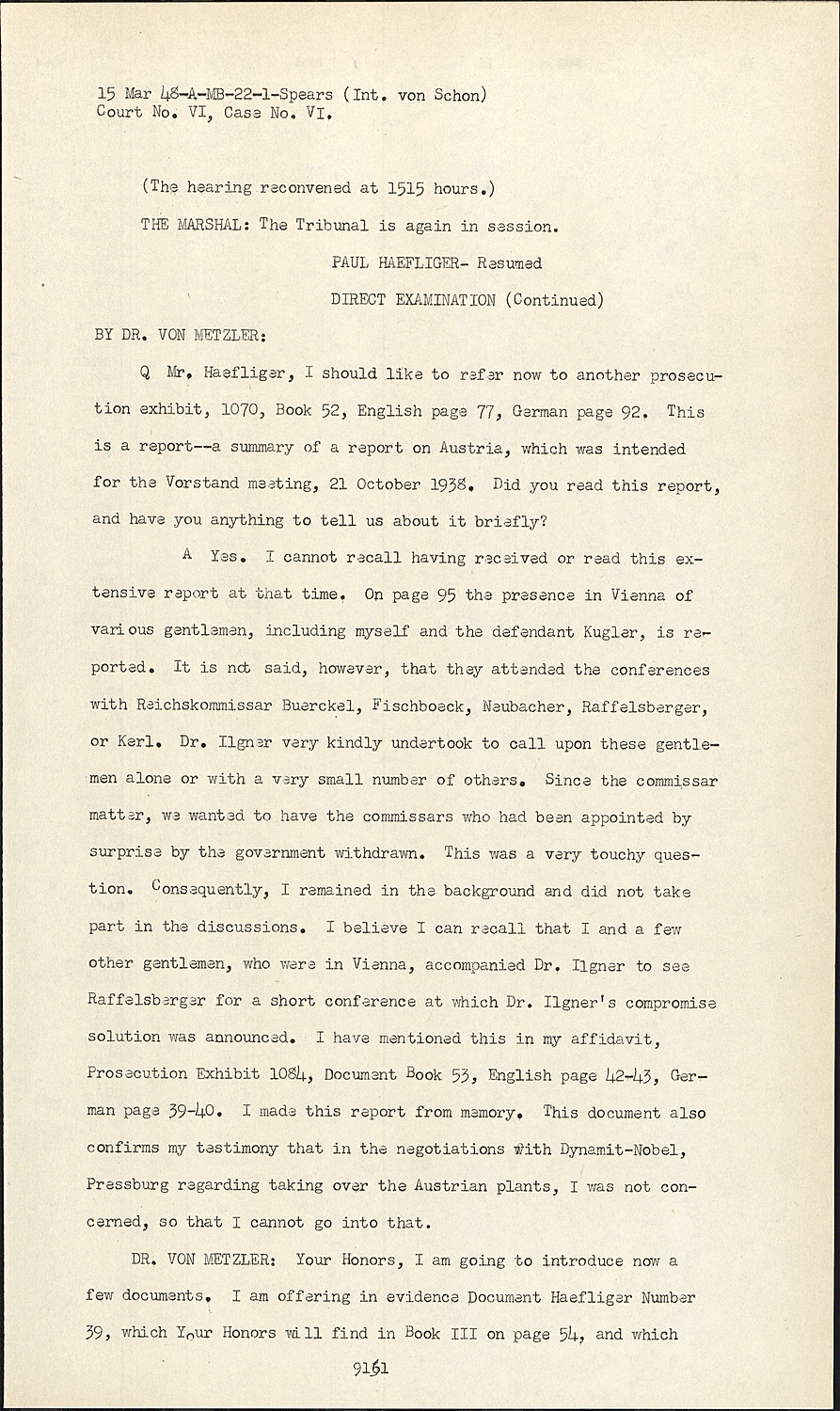
Court No. VI, Case No. VI.
(The hearing reconvened at 1515 hours.)
THE MARSHAL:The Tribunal is again in session.
PAUL HAEFLIGER- Resumed DIRECT EXAMINATION (Continued) BY DR. VON METZLER:
QMr. Haefliger, I should like to refer now to another prosecution exhibit, 1070, Book 52, English page 77, German page 92. This is a report--a summary of a report on Austria, which was intended for the Vorstand meeting, 21 October 1938. Did you read this report, and have you anything to tell us about it briefly?
AYes. I cannot recall having received or read this extensive report at that time. On page 95 the presence in Vienna of various gentlemen, including myself and the defendant Kugler, is reported. It is not said, however, that they attended the conferences with Reichskommissar Buerckel, Fischboeck, Neubacher, Raffelsberger, or Kerl. Dr. Ilgner very kindly undertook to call upon these gentlemen alone or with a very small number of others. Since the commissar matter, we wanted to have the commissars who had been appointed by surprise by the government withdrawn. This was a very touchy question. Consequently, j remained in the background and did not take part in the discussions. I believe I can recall that I and a few other gentlemen, who were in Vienna, accompanied Dr. Ilgner to see Raffelsberger for a short conference at which Dr. Ilgner's compromise solution was announced. I have mentioned this in my affidavit, Prosecution Exhibit 1084, Document Book 53, English page 42-43, German page 39-40. I made this report from memory. This document also confirms my testimony that in the negotiations with Dynamit-Nobel, Pressburg regarding taking over the Austrian plants, I was not concerned, so that I cannot go into that.
DR. VON METZLER:Your Honors, I am going to introduce now a few documents. I am offering in evidence Document Haefliger Number 39, which Your Honors will find in Book III on page 54, and which Court No. VI, Case No. VI.
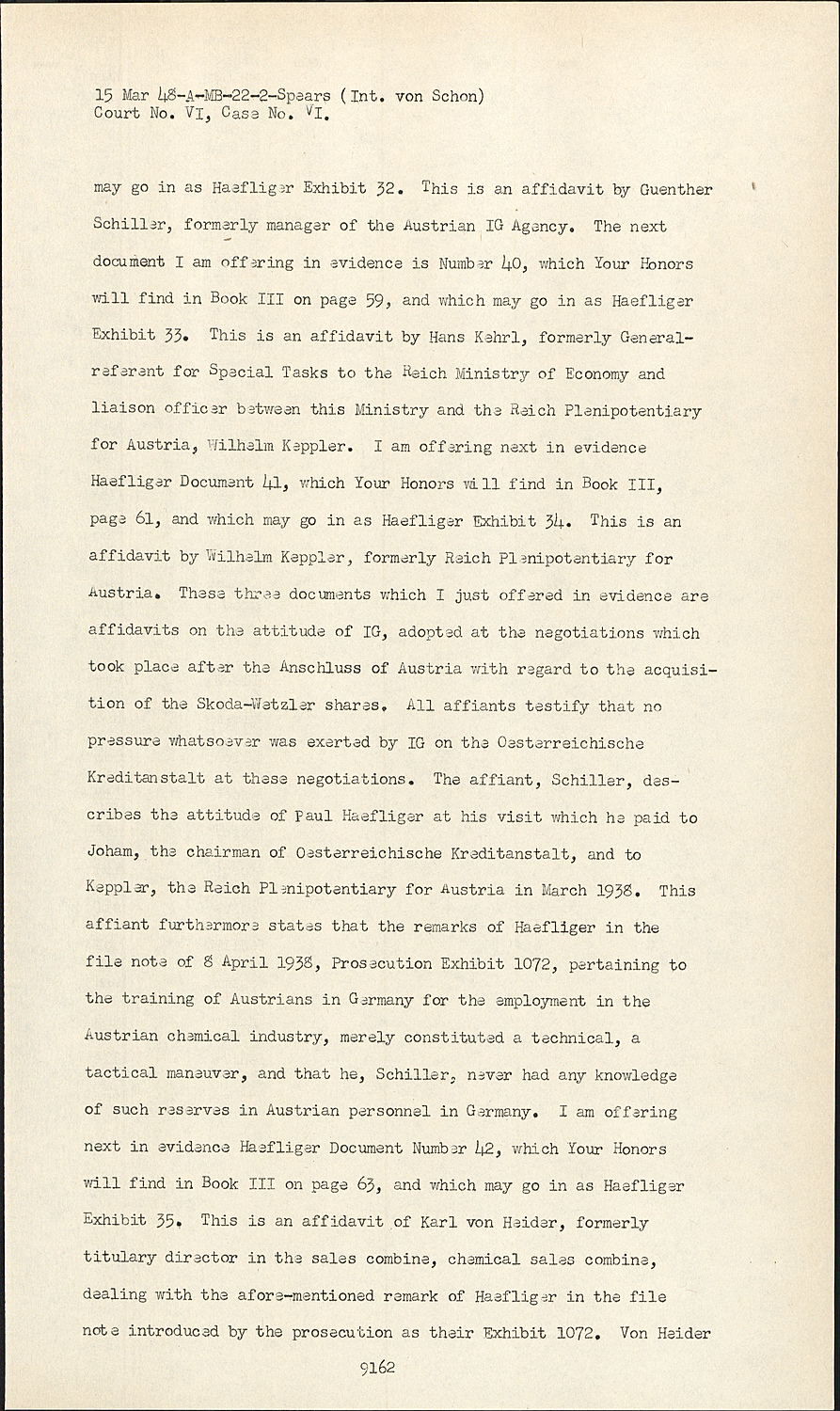
may go in as Haefliger Exhibit 32. This is an affidavit by Guenther Schiller, formerly manager of the Austrian IG Agency. The next document I am offering in evidence is Number 40, which Your Honors will find in Book III on page 59, and which may go in as Haefliger Exhibit 33. This is an affidavit by Hans Kehrl, formerly Generalreferent for Spacial Tasks to the Reich Ministry of Economy and liaison officer between this Ministry and the Reich Plenipotentiary for Austria, Wilhelm Keppler. I am offering next in evidence Haefliger Document 41, which Your Honors vill find in Book III, page 61, and which may go in as Haefliger Exhibit 34. This is an affidavit by Wilhelm Keppler, formerly Reich Plenipotentiary for Austria. These three documents which I just offered in evidence are affidavits on the attitude of IG, adopted at the negotiations which took place after the Anschluss of Austria with regard to the acquisition of the Skoda-Wetzler shares. All affiants testify that no pressure whatsoever was exerted by IG on the Oesterreichische Kreditanstalt at these negotiations. The affiant, Schiller, describes the attitude of Paul Haefliger at his visit which he paid to Joham, the chairman of Oesterreichische Kreditanstalt, and to Keppler, the Reich Plenipotentiary for Austria in March 1938. This affiant furthermore states that the remarks of Haefliger in the file note of 8 April 1938, Prosecution Exhibit 1072, pertaining to the training of Austrians in Germany for the employment in the Austrian chemical industry, merely constituted a technical, a tactical maneuver, and that he, Schiller, never had any knowledge of such reserves in Austrian personnel in Germany. I am offering next in evidence Haefliger Document Number 42, which Your Honors will find in Book III on page 63, and which may go in as Haefliger Exhibit 35. This is an affidavit of Karl von Heider, formerly titulary director in the sales combine, chemical sales combine, dealing with the afore-mentioned remark of Haefliger in the file note introduced by the prosecution as their Exhibit 1072. Von Heider Court No. VI, Case No. VI.
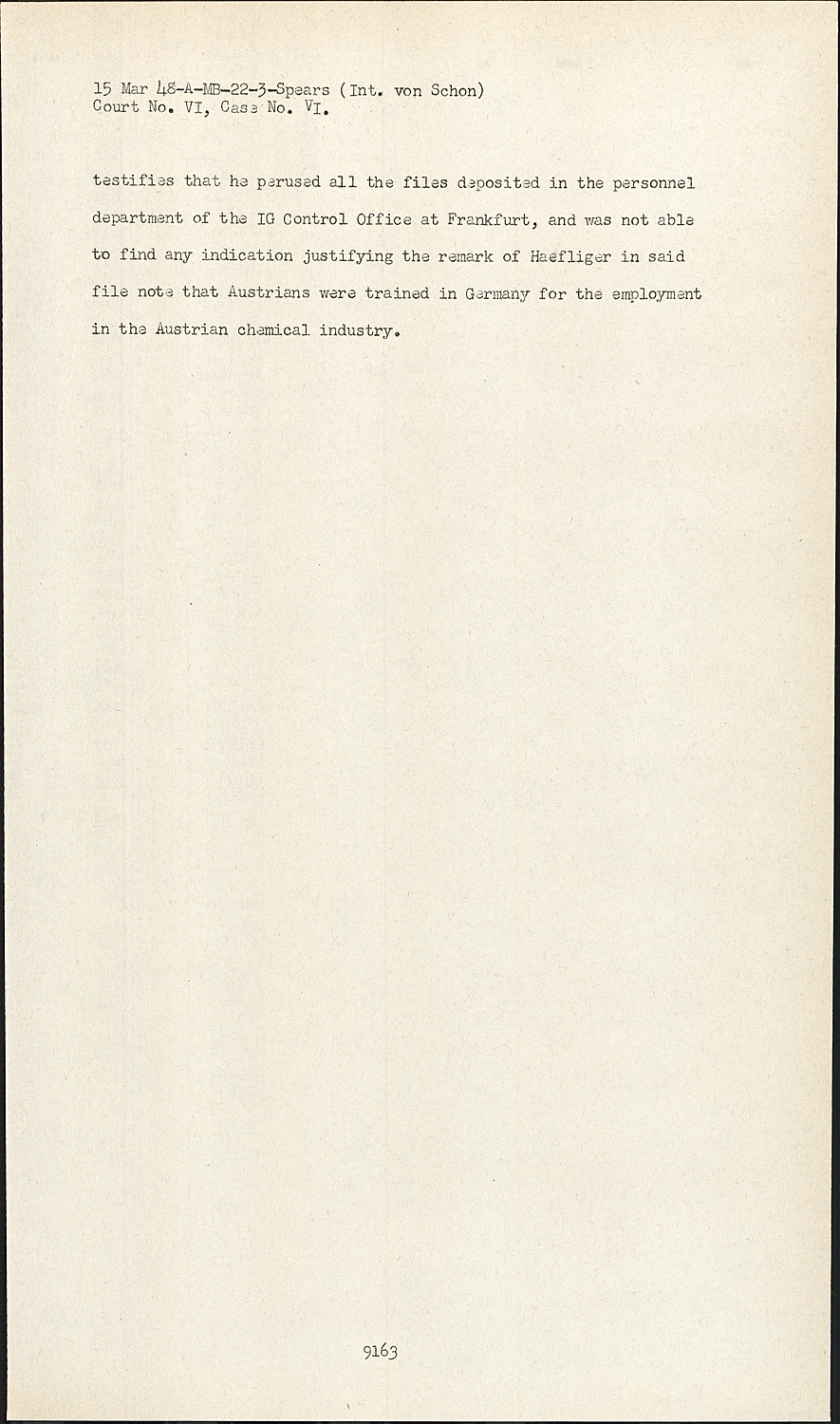
testifies that he perused all the files deposited in the personnel department of the IG Control Office at Frankfurt, and was not able to find any indication justifying the remark of Haefliger in said file note that Austrians were trained in Germany for the employment in the Austrian chemical industry.
Court No. VI, Case No. VI.
BY DR. VON METZLER:
QMr. Haefliger, this is the end of your examination in connection with Skoda-Wetzler. I now proceed with Aussig-Falkenau. First of all, I should like to put to you Prosecution Exhibit 1072, which has just been discussed, Document Book 52, English page 1, German page 2. I said this is a file note of 6 April 1938 prepared by you; on English page 2 we find a record of your conversation with Keppler in which he mentions Aussig. What about this remark?
AI know that the prosecution deduces knowledge of coming events. That is not the case, however. As I have already said regarding Skoda-Wetzler, I knew, and it was recorded in the note that General Director Barsch of the Prager Verein had approached DynamitNobel, Pressburg with the suggestion that some shares of Aussig should be given to us through Dynamit-Nobel, Pressubrg.
I considered this a good opportunity, therefore, to sound out Keppler and find out what the attitude of the German authorities would be because if the situation had arisen, we would have to obtain approval for the question of foreign exchange, if nothing else. If I wrote in the file note that I was aiming at Aussig, I meant, as I have already said, the Prager Verein, and not the Aussig Plant. There can also be seen from the fact that in my note I speak of some shares of Aussig. If Keppler said that this interest could not cost much, it was only because he was considering Prager Verein's future chances of export to the Southeastern countries unfavorable, and apparently he thought that the value of such enterprises would drop. There was nothing concrete here, and, as I have said, I merely happened to be sounding out Keppler, wanted to be informed about the Prager Verein, and I passed this request on to Berlin via Mr. Schiller, and I never heard anything more about it.
QMr. Haefliger, did you have any knowledge of alleged plans of Farben before the occupation of the Sudetenland particularly regarding the acquisition of Aussig-Falkenau, which belonged to the Court No. VI, Case No. VI.
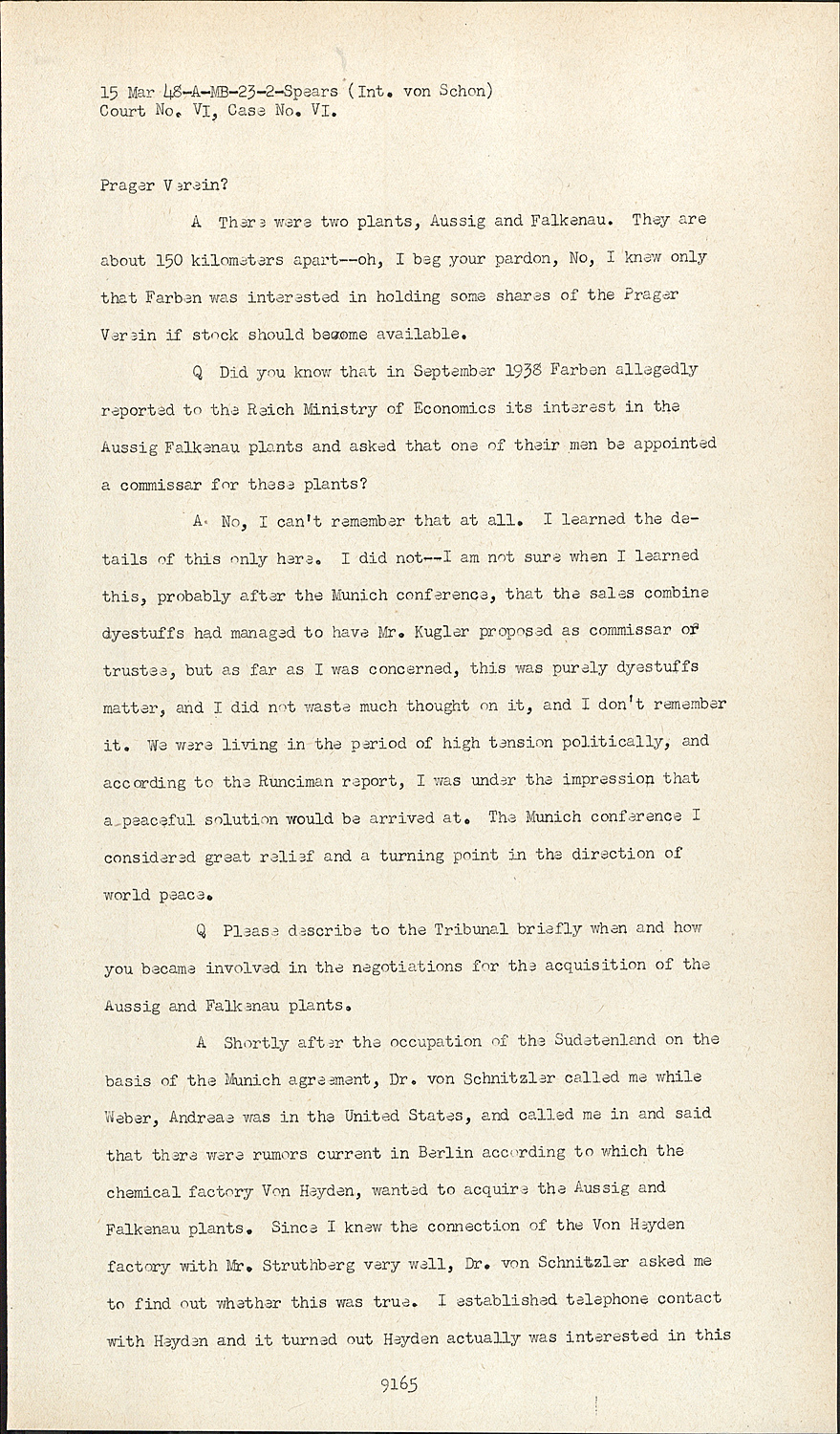
Prager Verein?
AThere were two plants, Aussig and Falkenau. They are that Farben was interested in holding some shares of the Prager Verein if stock should become available.
QDid you know that in September 1938 Farben allegedly reported to the Reich Ministry of Economics its interest in the Aussig Falkenau plants and asked that one of their men be appointed a commissar for these plants?
A.No, I can't remember that at all. I learned the details of this only here. I did not--I am not sure when I learned this, probably after the Munich conference, that the sales combine dyestuffs had managed to have Mr. Kugler proposed as commissar of trustee, but as far as I was concerned, this was purely dyestuffs matter, and I did not waste much thought on it, and I don't remember it. We were living in the period of high tension politically, and according to the Runciman report, I was under the impression that a peaceful solution would be arrived at. The Munich conference I considered great relief and a turning point in the direction of world peace.
QPlease describe to the Tribunal briefly when and how you became involved in the negotiations for the acquisition of the Aussig and Falkenau plants.
AShortly after the occupation of the Sudetenland on the basis of the Munich agreement, Dr. von Schnitzler called me while Weber, Andreae was in the United States, and called me in and said that there were rumors current in Berlin according to which the chemical factory Von Heyden, wanted to acquire the Aussig and Falkenau plants. Since I knew the connection of the Von Heyden factory with Mr. Struthberg very well, Dr. von Schnitzler asked me to find out whether this was true. I established telephone contact with Heyden and it turned out Heyden actually was interested in this Court No. VI, Case No. VI.
project because Heyden had vital interests at stake, thereupon, on the suggestion of Heyden on the 13th of October 1938, there was a conference in the Hotel Adlon between the representatives of Farben and Heyden.
QExcuse me, if I interrupt you, just for the Tribunal, where is the Hotel Adlon?
AIn Berlin.
QThank you.
ADuring the discussion agreement was reached to the effect that acquisition of Aussig-Falkenau plants, Farben and Heyden would deal over these plants on a 50-50 basis and the dye sector would be left to Farben.
QNow, before these negotiations you have just described between Heyden and Farben, had there been any contact before that with Prager Verein regarding turning over the Aussig-Falkenau plants?
ANo, not as far as I know by Farben. I was always under the very definite impression at the time that Heyden had already established contact with Prager-Verein or that Prager-Verein had already indicated that it was willing to give up its plants in the Sudetenland. That was my impression.
QTell me, Mr. Haefliger, in your opinion did the PragerVerein have any reasons or any necessities to sell the Aussig Falkenau plants?
AThe cession of the Sudetenland, of course, brought a very changed situation for the Prager Verein. Two of its plants were in German Reich territory now. The consequence was that these plants would have to be incorporated into the existing German economic system, also these plants would be included in the German tariff area, with entirely different market situations, and because of the local sales prices in comparison with the protected Czech market, the profit would be less. Also one must not overlook the fact that the employees were predominantly German. The owners of Court No. VI, Case No. VI.
Prager Verein, of course, knew all this, and the issue for them was that they should get rid of these plants in the most advantageous way possible.
QNow, the prosecution has repeatedly referred to the alleged haste with which the whole negotiations were carried out. What about that?
AAfter all, it is obvious that at such a moment one has to act quickly, it is as plain as pikestaff that there are other people interested, too, prospective purchasers, and everyone does what he thinks proper at the moment. And that is correct in the case of Heyden who had apparently taken steps in the matter much earlier. Haste was necessary because we and von Heyden knew that there would be quite a number of other parties trying to acquire the factories at Prager-Verein, therefore, we had to act quickly. From this, too, I concluded that the Prager-Verein was quite at liberty to negotiate with whoever it thought most suitable, that it wanted to sell its plants on principle was beyond any doubt as far as I was concerned for the reasons given.
Q when did the first negotiations with Prager-Verein take place which you attended, Mr. Haefliger?
AOn the 7th of November 1938. At this meeting we agreed on the sales price and the basic directives. The negotiations took place, I recall that very well, in the meeting room of the Dresdner Bank in Berlin.
QWere there any further negotiations?
AYes. There followed the final negotiations from the 5th to 7th December. Also in Berlin. In our building in the Unter Den Linden. In the meantime the very numerous contracts had been worked out by the lawyers on both sides. On the 7th of December the contracts were signed, and letters of friendship were exchanged. The representative of the Prager-Verein, General Director Dvortaczek has confirmed on the witness stand that it was very important, and rightly so.
Q.- Will you please briefly describe to the Tribunal how the negotiations were regarding the purchase price?
A.- I can only speak very briefly on that. I believe the Prager Verein started at a sum of, I believe, about 400,000,000 Czech crowns. I believe that was an experimental balloon. They went down to 380,000,000 crowns very quickly. The Germans suggested 250,000,000 crowns.
Q.- Do you remember, Mr. Haefliger, what considerations this German counter suggestion of 250,000,000 crowns was based on?
A.- Yes, Dr. von Schnitzler in the private preliminary discussion with Heiden mentioned as a suitable purchase price, according to experience, the annual turnover. This annual turnover in the Aussig and Falkenau plants as we estimated from our knowledge of production, conventions, etc. and Struthberg's information since he had been director at Aussig and Falkenau for many years before he worked for Heiden, we estimated this turnover at about 250,000,000 crowns. I recall dr. Von Schnitzler's formula because of its simplicity.
Q.- Mr. Haefliger, to repeat, you have just used a rather long sentence, the German counter suggestion was equal to the annual turnover of the plants?
A.- Yes.
Q.- And that was, in your opinion, a customary formula for culculating the purchase price?
A.- No, it was not the customary formula, It was a simple formula which Dr. von Schnitzler mentioned from experience with such negotiations. It was just a counter suggestion, and I will tell you later on that on closer investigation, it was discovered that this estimate was quite correct.
Q.- I just mean to ask you whether that was an arbitrary figure or whether that was a figure based on experience and certain considerations?
A.- Subsequently, it was carefully investigated, and so that it was not just mentioning a figure arbitrarily. There was, of course, a foundation for it.
Q.- What was the figure which the various parties finally agreed on?
A.- 280,000,000 Czech crowns.
Q.- In your opinion, as far as you could judge, was this sum an adequate compensation, an adequate price for the plants?
A.- Yes, the sum seemed to be quite adequate, especially considering that the plants, as I have already said, would now come into a market with a much lower purchase price, a much lower sales price, then in Czechoslovakia, which had protective tariffs.
Q.- Did the Germans make any further concessions in favor of the Czechs?
A.- Yes, they did. The German partners turned over various facilities belonging to the Aussig and Falkenau plants to the Prager Verein, that is the machinery. Also, there was an agreement on payment which was to be paid to the Prager Verein under the Titanium White convention, Also, there was an important concession that in spite of the instability of the Czech crown, the amount of 280,000,000 crowns had to yield at least 24,000,000 marks. The risk of the rate of exchange was on the Germans. It was also agreed that a fairly large share of the purchase price, I believe about 100,000,000 Czech crowns, would be paid in kind, commodities, at cost price to the Prager Verein to put the enterprise in a position to keep its Czech customers until new plants could be built.
Q.- Were any restrictions imposed on the Prager Verein by the sales contract regarding further development in Czechoslovakia?
A.- No.
Q.- Mr. Haefliger, excuse me for interruption you. Would you please make a pause? You don't have to speak so fast, we have plenty of time.
Q.- No, on the contrary, from the very beginning, it was considered important that the Prager Verein should keep complete freedom to be able to expand at will. Dr. von Schnitzler said expressly that this should be true of the manufacture of primary products, too, that is, the Prager Verein was at liberty to open new dyestuff plants in Czechoslovakia.
In addition, it was even proposed that the expansion of the Prager Verein should, as far as possible, be facilitated by technical assistance if required, and that was the purpose of the friendship pact, which was an integral part of the contract which was exchanged when the contract was signed in Berlin.
Q.- Was any other reason given in the negotiations for lowering the Czech demand from 380,000,000 crowns by the German side?
A.- I believe I recall that the lawyers said that the Aussig and Falkenau plants had certain liabilities which had to be taken over, and that there were various legal disputes pending which might lead to further financial liabilities on the parts which also had to be taken over when the plants were purchased.
Q.- Then, if I understand you correctly, Mr. Haefliger, you mean to say that the concessions made by the Germans to the Czechs were justification for lowering the purchase price from 380,000,000 to 280,000,000 Czech crowns?
A.- Yes, the purchase price of 380,000,000, that was the suggestion of the Prager Verein. In commercial negotiations, there is always trading, that is so in the whole world. That doesn't mean by any means that these 380,000,000's would have been the proper price. I consider that this fixing of 280,000,000 with all the complete details and the concessions, was a quite fair solution of the problem.
Q.- Did the representatives of the Prager Verein in the negotiations ever indicate that they had previously been in touch with Ruetgers about the sale of Aussig and Falkenau plants?
A.- No, not a word. They didn't even hint it. They didn't even hint such previous negotiations with other firms.
Q.- Now, outwardly were all these negotiations in a fair spirit, or were there violent disputes, scences, which might be interpreted as exertion of pressure on the Czech partners?
A.- No, the negotiations differed in no way from the form of negotiations customary throughout the world in private business and such matters. Only at the meeting on the 6th of December, 1938, on the day before the contract was signed, when the main points had long been agreed upon and there were a few minor points to be settled, at the end of the 14 hour meeting, there was a dispute between General Director Basch and Dr. von Schnitzler, about a minor point, but I don't remember what that was, and thereupon the meeting was closed, I believe it was already after midnight. Aside from this incident, which was due to exhaustion, the negotiations were carried out in quite correct and objective tone, and on the next morning, when we were able to go to work refreshed, not a word was said about this midnight quarrel.
Q.- Mr. Haefliger, I want to come back to the purchase price of 280,000,000 Czech crowns. Do you perhaps recall whether this sum which you finally agreed on was suggested by the Prager Verein at the end or was this suggestion made by Farben?
A.- I cannot remember that. There were some intermediate stages. We went to 310, and then the titanium white plant was discussed and all kinds of questions were considered. I don't know how we came to agree on 280.
Q.- Now, Mr. Haefliger, did you have. the impression during all these negotiations that Farben exerted any pressure on the Czechs?
A.- No, I did not have this impression.
Q.- Do you perhaps know whether the German authorities in any form, acting on or without Farben's suggestion, exerted any pressure on the Prager Verein in order to have the Aussig and Falkenau plants turned over to Farben?
A.- No. I did not know anything of that and I cannot remember the representatives of the Prager Verein during the negotiations having made any such remark or hint even. I don't believe that the German authorities intervened in any way. I have no knowledge of such a thing.
Q.- But, Mr. Haefliger, you did say that the Prager Verein, after the Sudetenland was ceded, realized the necessity of selling realized a certain necessity, let us say, of selling the Aussig and Falkenau plants. Was that not a certain compulsion under which the Prager Verein was negotiating in this case?
A.- One has to state most emphatically that in international business it is a well known fact that if an enterprise is obliged to give up a working plant it is generally because of political circumstances or because of the ecomic situation and this usually constitutes some pressure.
Q.- Can you not give an example of this grom your own activity with Farben -- for such compulsion in which you were, of course, again in international business dealings?
A.- Certainly. Not long before that I personally was in such a position. It was a question of the Farben's option participation in the American Magnesium Corporation in the United States, in the fall of 1937. It might have been the middle of the year. At that time, Farben was obliged to give up this very promising holding, since, on one hand, the anti-German attitude which prevailed in the United States at this period was affecting the enterprise adversely. For example, by all the withholding of Government orders and also because of lack of foreign exchange, it was impossible to carry out capital measures which in the future might become necessary for the welfare of the enterprise, and in the minutes of the Chemical Come mittee of the 25th of May 1937 there is the following remark:
"Magnesium U.S.A. If we were to exercise this option, the company would have great difficulties in securing Government orders which are of vital interest to the business." I should like to remark that this option of 50 percent participation in the Magnesium Corporation had -- could have been obtained at a very small price; only a few thousand dollars; but, as I say, this we could -- we could more or less consider this option as participation. I mean to say that in the sale of enterprises, especially large international transactions, there is a certain compulsion on one side for which the other side cannot be held responsible. Thus I see and saw the position in the Aussig-Falkenau case.
Q.- You mean to say, Mr. Haefliger, that there is a certain compulsion under which the Prager firm was suffering because of the Munich agreement of 30 September 1938, but that Farben cannot be held responsible for it?
A.- Yes, that is what I mean to say.
Q.- Now tell me what the connections were between Farben and the Prager Verein after the scale of the Aussig-Falkenau plants. Were relations impaired because of the purchase of these plants?
A.- No, not at all. As far as I could judge, we had a friendship agreement, too, which the Prager side and we too considered very important.
And we observed it.
Q.- Tell me, because of this transaction -- that is, the giving up of the Aussig and Falkenau plants -- was the Prager Verein financially weakened?
A.- I am convinced that it was not. By the payment of the purchase price by Farben the Prager Verein had become to a great degree liquid, and I emphasize once again that a large portion of the purchase prise was paid in the form of goods. The best proof of this is the fact that at some time later, as far as I recall, it participated to 40 percent in the company for building a rayon factory together with the Dynamit Nobel Pressburg, and, according to the Friendship Pact, Farben had invited this participation.
This rayon factory at Pressburg proved to be an excellent investment for Farben, for Dynamit-Nobel and for the Prager Verein. That was quite a profitable enterprise.
Q.- You mean to conclude from the Prager Verein's participation in this rayon project that, after selling the Aussig and Falkenau plants, the Prager firm was enjoying prosperity?
A.- Yes, and I believe the stock was never so high as after this transaction. The Prager Verein stock, I mean.
Q.- Mr. Haefliger, to conclude the Aussig and Falkenau chapter, I should like to put to you Prosecution Exhibit 1906, which was offered in evidence in the session of 20 February by the Prosecution. I believe it was offered only for identification. This is the record of a discussion with the Chemical Factory Heyden at which representatives of Farben were present, and you are mentioned too, and also a representative of the company for nitrogen fertilizer.
In this record it is said that the Czech authorities, upon inquiry of the Nitrogen Syndicate, are supposed to have said that Czechoslovakia was endeavoring to make itself independent in calcium, nitrogen production and it is also said in this document that it was the endeavor of the German nitrogen authorities to prevent this endeavor and that instructions were issued to Dr. Bachmann to take the necessary steps with the Economic Group.
I should like to put this Exhibit to you and ask you to comment briefly on it.
A.- I am afraid that will be very confusing. After the meeting of the 30th of October 1938 -- that is the meeting between Farben and the von Heyden Chemical Firm, at which equal collaboration between these two firms was agreed upon -- there were a number of internal discussions between the two partners. In order to get a picture of the value of the Aussig and Falkenau plants under the changed circumstances, in order to be prepared for the coming negotiations with the Prager Verein, the elegant formula of Dr. von Schnitzler could not just be accepted; it had to be investigated.
We had to see whether it was really applied in this case. We have to be thorough. And more, too, it was necessary to consult numerous experts who were informed about the prospects of those two plants for their products. This included Mr. Schneider -- not this Schneider, but the Prokurist and the head of the Chemical Sub-Department. Mr. Struthberg, an commercial director of the von Heyden factory, also attended these meetings. First of all, as I said, he had for many years been a director in the Prager Verein at Aussig, and secondly because he rightly wanted to find out if he was to participate on a 50-50 basis with Farben, what opinions were held about future operations or what obligations there might exist on Farben's part, which would not be in his interest. One had to be quite frank with one's partner, of course. Dr. von Schnitzlor, who had called these meetings, asked Dr. Bachmann of the I.G. for the nitrogen Fertilizer to come to Frankfurt to report to us and Mr. Struthberg what the situation was for a nitrogen of lime at Falkenau, in his opinion. We knew nothing about this field in Frankfurt. Bachmann who was in charge of the calcium syndicate, which, I believe, is a sub-division of the Nitrogen Syndicate. He alone could tell us this, and he was to inform us and to inform us about the policy of the Nitrogen Syndicate regarding the branch of which he was in charge.
From this document I see that Bachmann gave the necessary information. I don't remember when I was present. There were five of six prokurists and directors who spoke on the various products, and I can't remember the details. This document shows that Mr. Bachmann explained and told us that the nitrogen lime industry wanted to prevent production in Czechoslovakia. That was the nitrogen policy which probably arose in this case because there was too great a capacity in nitrogen of lime. I don't know. Since the von Heyden Chemical factory was in charge of chemicals and had the decisive word regarding the sale of nitrogen of lime produced at Falkenau, it was agreed that the new company was to sell Falkenau production through the syndicate. This would best serve all interests.
The Prager Verein was not placed under any contactual restrictions in producing the nitrogen of lime in its own field, but it could not expect to be supported by the nitrogen syndicate. This decision was with the syndicate, it was not a matter for Heyden to decide.
QI have now finished your examination on the question of the acquisition of the Aussig Falkenau plants. I should merely like to ask in conclusion, Mr. Haefliger, whether in this entire transaction at any time you were aware that Czech property was being stolen?
AI must deny that emphatically. I was convinced that the Prager Verein because of political developments could no longer hold the Aussig Falkenau plants, but that in the sale of these plants it received a purchase price and other important concessions which were very proper renumeration and suffered no financial loss.
QI now go over to Count II, the subject, of Poland. In the trial brief of the Prosecution on Count II, on page 19, it is sayd in connection with Poland, and I quote: "we have shown that the Defendants von Schmitzler and Haefliger and other I.G. Farben men as early as 7 and 14th of September approached the Reich ministry of Economics."
Mr. Haefliger, I ask you whether you had anything to do with negotiations affecting the Poland dyestuffs factories in Boruta, Wola and Winnica?
ANo, there was no question of any participation there. These were purely dyestuffs factories. They were completely outside of my field of work. The message of Dr. von Schnitzler to Dr. Kuehner on 7 September 1939, Prosecution Exhibit 1138, Document Book 55, English page 54, German page 85, and the letter to the Reich Ministry of Economics of 14 September 1939, Prosecution Exhibit 1139, Document Book 55, English page 56, German page 87, I was not familiar with. The letter was not as the Prosecution contends signed by me, but by Dr. von Schnitzler and Dr. Kuehner. It is true that on the occasion of a visit which I made together with my associate, Dr. Prentzel to Regierungsrat Hoffmann in the RWM, I had business with Mr. Hoffmann rather frequently in connection with the import of sulphur for the rayon industry. On this occasion we discussed the question of the Polish dye-stuffs fac tories.
It was brought up by Hoffmann. In this matter I acted only as as letter carrier, if I may say so, to prevent a discussion with Dr. von Schnitzler and the RWM, and Dr. von Schnitzler gave the information which Mr. Hoffmann desired.
After the discussion with Regierungsrat Hoffmann, I informed Dr. von Schnitlzer that there should be an interview with him as soon as possible in the RWM.
QIf I understood you correctly, Mr. Haefliger, on the occasion of a visit to Regierungsrat Hoffmann in the Reich Ministry of Economics, the questions of the Polish dye-stuffs factories, the appointment of trustees was brought up, and you undertook to arrange an interview with Mr. von Schnitzler on this question?
AYes, Mr. Hoffmann said because of the situation it was necessary to appoint a trustee, and he should like to talk to the men responsible for such things in Farben, and I undertook to deliver the message.