Apart from this, upon the decision of the acting Tribunal the letter of defense, dated 25 July, and the reply dated 30 July of Prosecution, deals with the statements of the Prosecution and has not been put before this Tribunal presumably for technical reasons. Consequently the decision of the acting Tribunal was handed down without the statements of the defense, which was made in reply to the statement of the Prosecution, being made known to the Tribunal. Defense does not wish to leave this Tribunal in doubt that postponement of the beginning of the trial alone would not alleviate the difficulties at hand. since gain in time would have to be connected with the granting of further applications made on behalf of the defense, which deal with the creation of proper external prerequisites for these proceedings. No doubt, in the meantime, the high Tribunal will have received applications in question. They deal with the question of obtaining legal evidence and material from abroad. They deal with the admission of further German and Foreign defense counsels and auxiliary forces. They deal with the creation of a considerably larger financial basis, and for payment of defense, and deal with granting of at least the most simple assistance of a technical nature, such as for instance, the availability of sufficient work rooms in the building, typewriters, the possibilities to put through telephone calls and similar points.
It is utterly insufficient, for the work to be done on such a voluminous complicated trial material, if a defendant has only two lawyers. That is to say one chief defense counsel and one assistant at his disposal who are helped by one single secretary. Further, intolerable conditions arise from the fact that defense counsel of various defendants are forced to work together in one room, as is the case at this time, whereas individual defence counsel have no office of their own at all. A further impediment which can not probably be understood by anyone who has not experienced it himself, are the Case I, case 6 difficulties which we meet in connection with frequent journies which are necessary to locate witnesses and documents.
The defense have no motor cars and have not sufficient gasoling. Journies made by train, due to to catastrophic traffic conditions, are an unusual waste of time and are unusually exhausting. Let me draw your attention to the particular difficulties which now arise, and which in this form did not arise in any other of the trials which have been in progress in Nurnberg up to now. The extent of the International business activities of the I. G. Farbenindustrie, which to a considerable extent has been made the subject of this indictment, necessitates extensive contacts of the defense with sources abroad, if the subject is to be properly cleared up. It is impossible to use correspondence or even to use defense counsels who are not familiar with the material to alleviate these points in the foreign countries councerned. In fact, they can only be handled by the defense counsel themselves with a reasonable chance of success, particularly since the secrecy of the defense cannot be observed properly due to conditions of censorship if correspondence were solely chosen. The difficulties which would entail if journies abroad were made due to the condition Germany now finds herself are known to the denfens. The defense fells it necessary to draw your attention to that fact that without a satisfactory solution to these questions a fair defense will not be possible.
Independently and apart from the principle request for an adjuornment which are connected with this motion are those which we handed in on S July, 30 July and 7 August 1947. All further motions which were made in connection with these are repeated and an early decision of the Tribunal is requested. They can be summarized as follows:
A request for adjournment of the beginning of the trial for 6 months, for the purpose of more efficient presentation on the part of defense.
Request that the Office of the Secretary General and the Prosecution be instructed that a sufficient and properly conducted defense be arranged.
It may appear to be somewhat mean that those technical matters are contained in an application of the defense playing such a big part, but it is necessary to understand how difficult and unpleasant and hopeless a task and bettle with difficulties is presented by dialy life. It is necessary to see them from a close distance in order to feel our depression which we register concerning the magnitude of our task which we have to perform subject to insufficient mans which we need for its completion.
The defense, therefore, begs this Tribunal in relizing when deal-in with their applications to be aware of the fact that for the first time in history the heads of an International industrial large enterprise are under Indictment, the scientific accomplishments of which, and the economic solidarity of which, and the international attitude of which, has been recognised the world over, and that the accusations are raised which in every respect are appalling. The defendants themselves are keenly interested to prove before the public of the world that these charges are unjustifiable. They request no more than fairness with regard to the preparation and development of these proceedings the granting of which the countries who uphold Anglo-Saxon legal traditions are so particularly proud of. There can be no doubt whatever that this trial is destined to write history and to clear up the question how in the future leading industrialists of a country should conduct themselves in the event of an international conflagration. This judgment can only, however, make history if it can live up to the scrutiny of the historians. That is the basis, and nothing else, for this motion of the defense. The defense cannot see that these two principal motions made with regard to this trial, namely, with reference to the incompleteness of the Indictment and insufficent possibility of preparation on the part Case I, case 6 of the defense, cannot exhaust the objections on principle which have been raised to this trial in its entirety.
When the time comes the defense will point out that in this instance proceedings are carried on before an American Tribunal which must be carried out within the frame work of the American Constitution. The American Constitution contains an explicit prohibition that actions should be subject of criminal proceedings for which at the point when they were committed no penal cede had been in existance. Defense feels that they may not assume that the American democracy would depart from the ideal principles which it has represented the world over and for which it is attempting to gain the support of that same German people (just with regard to members of this nations Germany.)
The defense trust that the American Tribunals, right to the very head will see to it that this practice which has its basis in the American Prosecution should be applied forthwith.
May I make one remark of a technical nature. A written translation of this motion of mine will be submitted to this Tribunal in the near future and the Prosecution as well. It is already on its way to the Tribunal.
THE PRESIDENT:This Tribunal, which was only recently constituted, has been laboring under the impression that a motion for the continuance of this cause had been ruled upon by the presiding Judges of the Tribunal before this body was organized. If there has been filed any additional motion for continuance this Tribunal has no knowledge of it and would like to inquire of counsel for defense who has just spoken if any such motion as been filed and called to the attention of the Prosecution.
DR. BOETTCHER:That isn't an application, Mr. President. It is a statement of objections on the part of the defense against the beginning of the trial based upon the incompleteness of the Indictment and the insufficient time for defense to prepare their work.
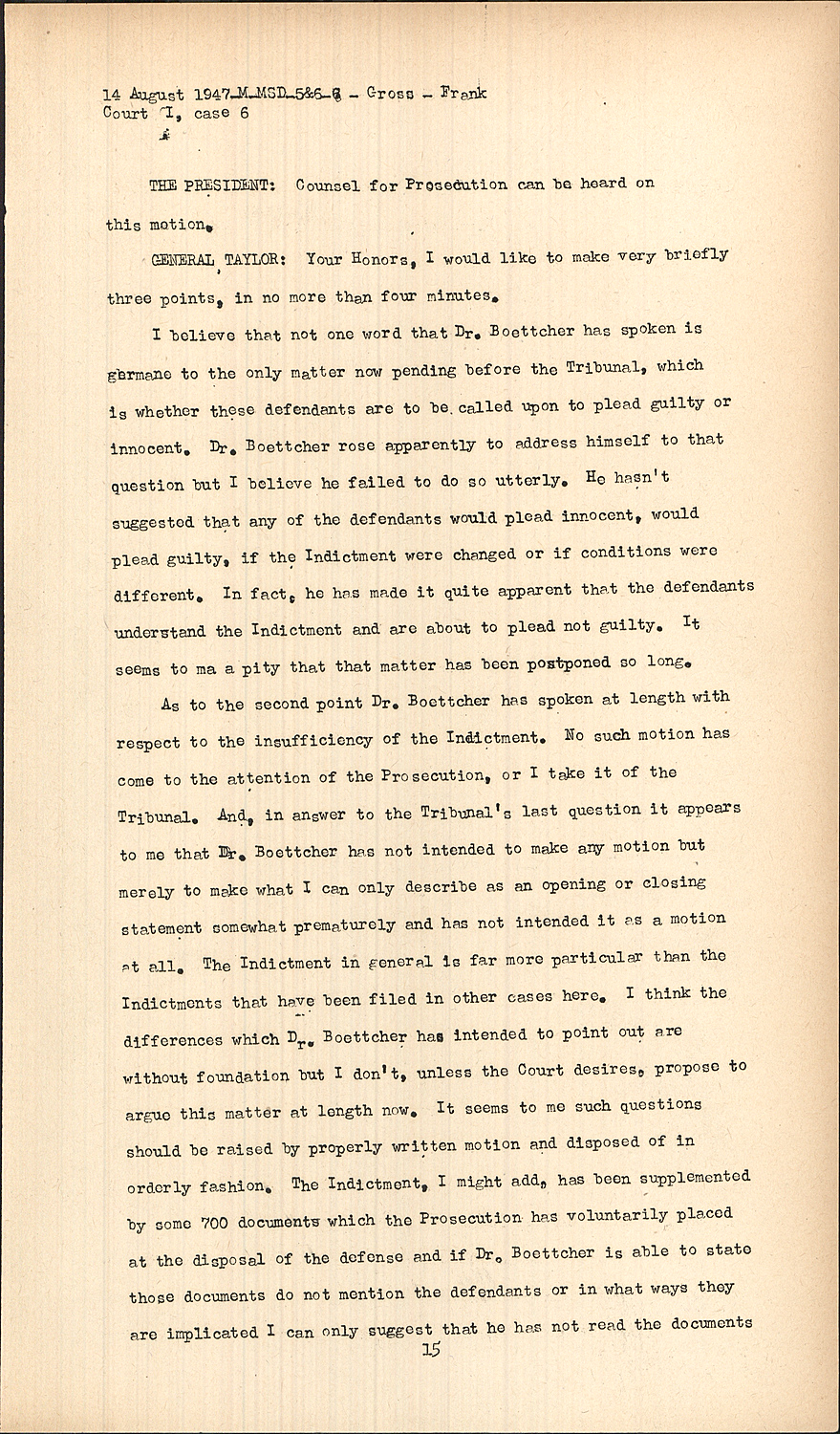
THE PRESIDENT:Counsel for Prosecution can be heard on this motion.
GENERAL TAYLOR:Your Honors, I would like to make very briefly three points, in no more than four minutes.
I believe that not one word that Dr. Boettcher has spoken is germane to the only matter now pending before the Tribunal, which is whether these defendants are to be called upon to plead guilty or innocent. Dr. Boettcher rose apparently to address himself to that question but I believe he failed to do so utterly. He hasn't suggested that any of the defendants would plead innocent, would plead guilty, if the Indictment were changed or if conditions were different. In fact, he has made it quite apparent that the defendants understand the Indictment and are about to plead not guilty. It seems to ma a pity that that matter has been postponed so long.
As to the second point Dr. Boettcher has spoken at length with respect to the insufficiency of the Indictment. He such motion has come to the attention of the Prosecution, or I take it of the Tribunal. And, in answer to the Tribunal's last question it appears to me that Dr. Boettcher has not intended to make any motion but merely to make what I can only describe as an opening or closing statement somewhat prematurely and has not intended it as a motion at all. The Indictment in general Is far more particular than the Indictments that have been filed in other cases here. I think the differences which Dr. Boettcher has intended to point out are without foundation but I don't, unless the Court desires, propose to argue this matter at length now. It seems to me such questions should be raised by properly written motion and disposed of in orderly fashion. The Indictment, I might add, has been supplemented by some 700 documents which the Prosecution has voluntarily placed at the disposal of the defense and if Dr. Boettcher is able to state those documents do not mention the defendants or in what ways they are implicated I can only suggest that he has not read the documents made available to him.
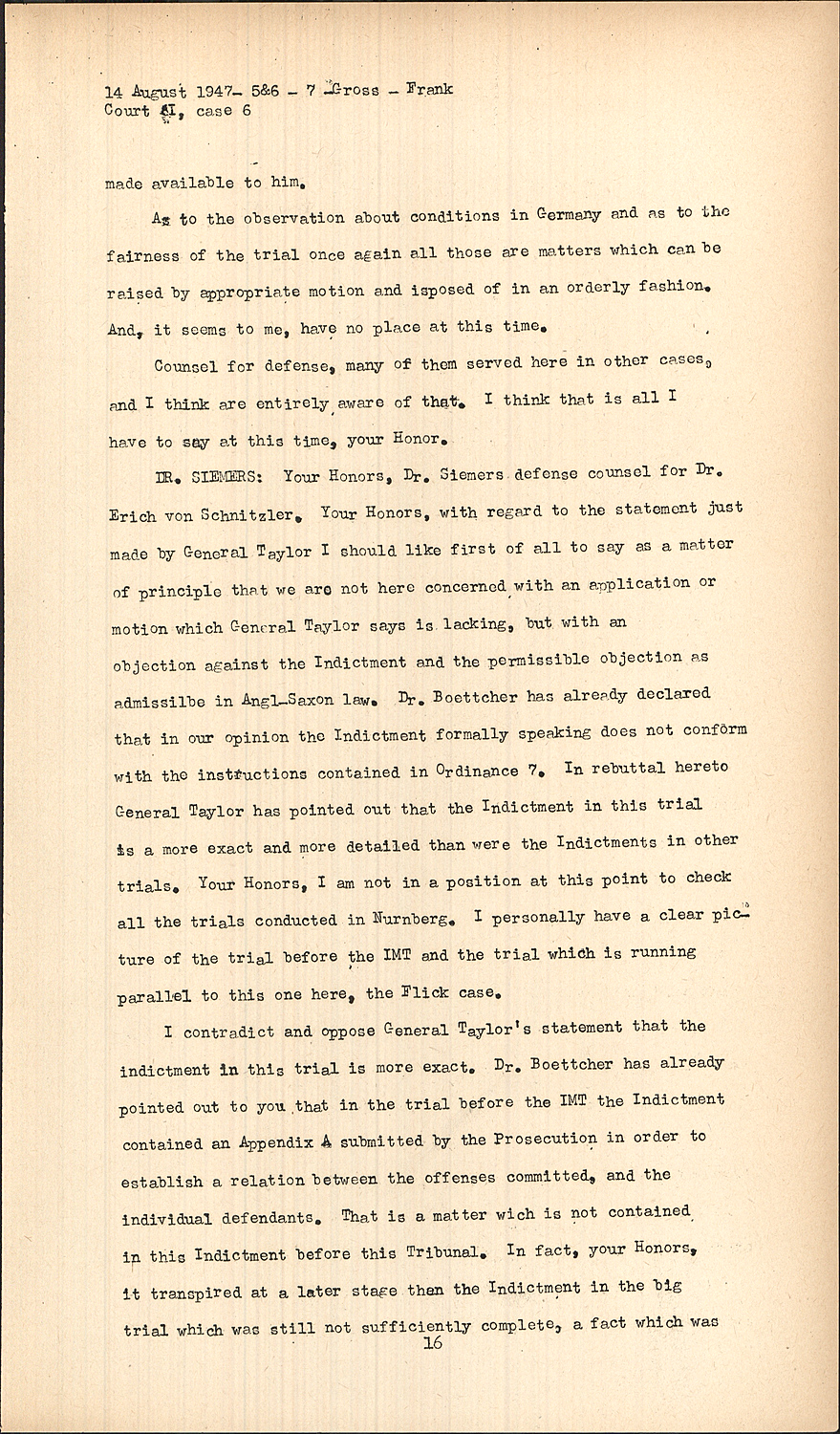
As to the observation about conditions in Germany and as to the fairness of the trial once again all those are matters which can be raised by appropriate motion and isposed of in an orderly fashion. And, it seems to me, have no place at this time.
Counsel for defense, many them served here in other cases, and I think are entirely aware of that, I think that is all I have to say at this time, your Honor.
DR. SIEMERS:Your Honors, Dr. Siemers defense counsel for Dr. Erich von Schnitzler. Your Honors, with regard to the statement just made by General Taylor I should like first of all to say as a matter of principle that we are not here concerned with an application or motion which General Taylor says is lacking, but with an objection against the Indictment and the permissible objection as admissilbe in Angl_Saxon law. Dr. Boettcher has already declared that in our opinion the Indictment formally speaking does not conform with the instructions contained in Ordinance 7. In rebuttal hereto General Taylor has pointed out that the Indictment in this trial is a more exact and more detailed than were the Indictments in other trials. Your Honors, I am not in a position at this point to check all the trials conducted in Nurnberg. I personally have a clear picture of the trial before the IMT and the trial which is running parallel to this one here, the Flick case.
I contradict and oppose General Taylor's statement that the indictment in this trial is more exact. Dr. Boettcher has already pointed out to you that in the trial before the IMT the Indictment contained an Appendix A submitted by the Prosecution in order to establish a relation between the offenses committed, and the individual defendants. That is a matter wich is not contained in this Indictment before this Tribunal, In fact, your Honors, it transpired at a later stage than the Indictment in the big trial which was still not sufficiently complete, a fact which was generally recognized and it was for that reason that the Prosecution later submitted special trial briefs with regard to each individual defendant.
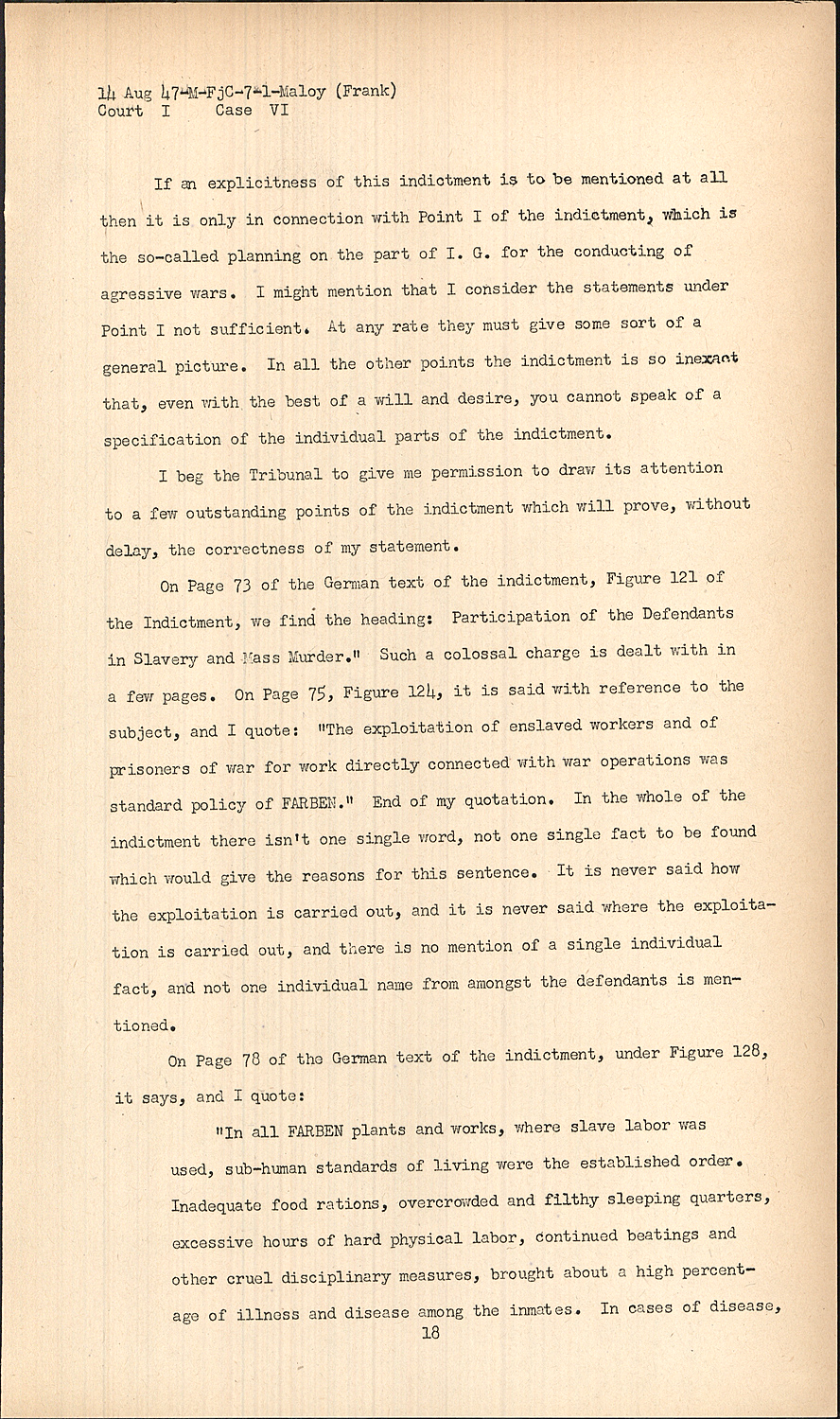
If an explicitness of this indictment is to be mentioned at all then it is only in connection with Point I of the indictment, which is the so-called planning on the part of I. G. for the conducting of agressive wars. I might mention that I consider the statements under Point I not sufficient. At any rate they must give some sort of a general picture. In all the other points the indictment is so inexact that, even with the best of a will and desire, you cannot speak of a specification of the individual parts of the indictment.
I beg the Tribunal to give me permission to draw its attention to a few outstanding points of the indictment which will prove, without delay, the correctness of my statement.
On Page 73 of the German text of the indictment, Figure 121 of the Indictment, we find the heading: Participation of the Defendants in Slavery and Mass Murder." Such a colossal charge is dealt with in a few pages. On Page 74, Figure 124, it is said with reference to the subject, and I quote: "The exploitation of enslaved workers and of prisoners of war for work directly connected with war operations was standard policy of FARBEN." End of my quotation. In the whole of the indictment there isn't one single word, not one single fact to be found which would give the reasons for this sentence. It is never said how the exploitation is carried out, and it is never said where the exploitation is carried out, and there is no mention of a single individual fact, and not one individual name from amongst the defendants is mentioned.
On Page 78 of the German text of the indictment, under Figure 128, it says, and I quote:
"In all FARBEN plants and works, where slave labor was used, sub-human standards of living were the established order.
Inadequate food rations, overcrowded and filthy sleeping quarters, excessive hours of hard physical labor, continued beatings and other cruel disciplinary measures, brought about a high percent age of illness and disease among the inmates.
In cases of disease, little or no medical care was furnished, as a result of which many slave laborers died."
Your Honor, as Ordinance No. VII stated expressly that it is desirable and essential that details should be given, so that the defendant can inform himself of the details regarding the perpetrations with which he is charged, then I would like to ask the Prosecution, just how can the defendant, or defense counsel, inform himself and make the facts clear to himself in this connection? Once again the I. G. Farben is only generally mentioned, which supposedly isn't under indictment in its entirety as a body. Generally all works and factories are talked about, although we know that there are hundreds of them, and although we know that there were hundreds of camps. In spite of all that, not one single name of any camp is mentioned. If that is supposed to be a specification, then I, both legally and economically, have never yet up to now understood the meaning of the word "specification."
May I now turn to Figure 131 of the indictment, that is Page 80 of the German text, and I quotes:
"Use of poison gas and medical experimentation on enslaved persons.
Poison gases and various deadly pharmaceuticals manu factured by FARBEN and supplied by FARBEN to officials of the SS were used in experimentation upon and the extermination of en slaved persons in concentration camps throughout Europe.
Experi ments on human beings (including concentration camp inmates,) without their consent, were conducted by FARBEN to determine the effect of deadly gases, vaccines, and related products."
Your Honors, one of the most horrible charges, the most farreaching charges, namely that of planned murder of every sort, that is an accusation which the Prosecution dares to render in nine lines of the text of the indictment, and without mentioning any further details and, they dare to assort that its duty of specification under Article IV of Ordinance No. 7, complied with. There is no mention as to which one of the defendants is supposed to have participated.
It has never said where these supplies went, to which officers of the SS.
Quite generally "enslavement" and "extermination" is used. It is the typical purely propaganda material, by means of which the defendants are linked with sad and regrettable criminal acts, which the German Regime under Hitler was guilty of. I deny the right on the part of the Prosecution to make statements of this nature in such general terms. We, since they are of material importance legally, shall deal with these points at a later stage.
We are here only concerned with the question of procedure, and then it will have to be granted that this individual charge is not specifically treated.
May I, in this connection, supplement my statement by saying that the ruling contained in Article IV, specifically started with the words, and I quote: "For the purpose of the preservation of the privileges of the defendants, this and that type of procedure is to be adopted." We are concerned with the ruling on procedure which is to preserve the privileges of the defendants. Consequently, the Prosecution must take upon themselves the trouble of complying with the details demanded in this Article.
The Ordinance No. VII arose from the Charter of the International Military Tribunal. It might be interesting, therefore, to re-establish this link, and I might draw your attention to the fact that in Article 16 of this Charter of the International Military Tribunal, you will find the following sentence: "The indictment is to contain all details from which the facts of guilt can be ascertained."
Your Honor, the very same picture, which was the basis of the big trial, applies to this no doubt equally big I. G. trial.
Finally, may I draw your attention to Figure 146 of the indictment, which is Count V of the Indictment. In Count V, as before, the conspiracy is charged as an independent crime. It appears doubtful to me whether this is possible. We might leave this question open for the moment.
The most doubtful fact, however, is whether in consideration of the Control Council Law the conspiracy can be brought up at all in connection with Points 2 and 3, but even if it were legally justified, the Prosecution must, at least at this point, relate individual facts through which the charge of conspiracy arose. It is quite unthinkable that a more general way of expression can be chosen, less justified than in this case. Let me draw your attention to the first sentence:
"All the defendants, acting through the instrumentality of FARBEN and other wise, with divers other persons, during a period of years preceding 8 May 1945, participated as leaders, organizers, instigators, and accomplices in the formulation and execution of a common plan or conspiracy to commit, or which involved the commission of Crimes against Peace (including the acts constituting War Crimes and Crimes against Humanity, which were committed as an integral part of such Crimes against Peace) as defined by Control Council Law No. 10, and are individually responsible for their own acts and for all acts committed by any persons in the execution of such common plan or conspiracy."
The defendants are personally responsible for their own acts and for any other acts which any other persons committed in the execution of this common plan for conspiracy. Your Honors, the Prosecution doesn't even bother to give us any details. They say, "together with several other persons," but they aren't mentioning them. They say generally that the I. G. and other means were used, but they don't quote the other means of this conspiracy. They never quote anything at all in detail.
I think that I have been able to show you, by means of four or five examples, that this indictment is, in fact, not in compliance with Article IV. I might supplement my statement by saying this, it is beyond a doubt not the duty on the part of the Prosecution to hand over all documents of the evidence, but in Article IV it is prescribed that all such documents are to be submitted in the German language before the end of 30 days, which are put forward in connection with the indictment.
The importance of the English version of this Article may be argued about. It is the interpretation of the Prosecution on this Article that they only have to submit such documents, together with the indictment, as are already linked with the indictment as an appendix. Quite possibly that may be true if you interpret the regulation word by word, but it certainly does not comply with the intention of the meaning. If I am to describe the details of the indictment, and as I have already said this is only done in connection with Case I, then at least documents which are clearly and thoroughly mentioned must be submitted at the same time. If, for instance it is stated in Count II, as a matter of fundamental importance in connection with "Plunder and Spoliation", and the Goering Decree dated October 19, 1939 is quoted, and if three sentences from that document are re-printed, then in my opinion this is a document which is in connection with the indictment, and therefore according to the Regulation must be submitted at the same time.
I don't want to delay the High Tribunal by multiplying my examples. They are integral parts of this indictment, and they are a part of this specification which we request because only then will sufficient clarify be achieved.
GENERAL TAYLOR:May it please the Court, I am convinced that everything Dr. Siemers has said is quite as irrelevant, as was everything Dr. Boettcher said.
I clearly understood the Court to ask, at the conclusion of Dr. Boettcher's argument, whether any motion had been filed requestion a dismissal of the Bill of Particulars, and there is a clear answer, no such motion has been filed.
In order to prevent a repetition of Dr. Stemer's insurgent remarks, the Prosecution now formally requests that the pleas of the defendants be taken, and if there are any objections to the form and substance of the indictment, the defendants file a motion in accordance with the rules of the Court with which all of them are fully familiar.
THE PRESIDENT:As the Tribunal understands the arguments of counsel for the defense, three propositions have been urged; one that the indictment does not charge an offense within the language or the meaning of the laws of the Charter and the Ordinances under which this Tribunal operates. That matter would go to the jurisdiction of this Tribunal as applied to these defendants, and any objection may be as well raised on the offering of the evidence or in the final argument as now, and it cannot be seen how the arraignment of the defendants would injure their rights in that regard.
The second proposition urged appears to be that the indictment does not charge the offenses with sufficient certainty. Manifestly this Tribunal would be in no position to pass decision upon such amatter without a definite and specific motion before it, setting out certainly the parts of the indictment which ought to be made more definite and certain, in order to permit the defendants to make their proper showing.
Now, the third proposition appears to be a motion for a continuance of the cause, and it is the view of the Tribunal that on the present state of the record that matter was passed upon by the presiding Judges. This Tribunal is not disposed at this time to distrub the ruling of the presiding Judges in that regard, and unless and until some further facts are presented to the Tribunal we shall be obliged to consider that matter as closed.
The Tribunal will now rase for about 10 minutes, after which the arraignment of the defendants will proceed without further interruption.
(Thereupon a 10-minute recess was taken.)
THE MARSHAL:The Tribunal is again in session.
THE PRESIDENT:The Secretary-General will proceed with the calling of the defendants for arraignment.
THESECRETARY-GENERAL: Carl Krauch.
THE PRESIDENT:Defendant Carl Krauch, have you counsel?
DEFENDANT KRAUCH:Yes, sir.
THE PRESIDENT:Was the indictment in the German language served upon you at least 30 days ago?
DEFENDANT KRAUCH:Yes, sir.
THE PRESIDENT:Have you had an opportunity to read the indictment?
DEFENDANT KRAUCH:Yes.
THE PRESIDENT:Have you read the indictment?
DEFENDANT KRAUCH:Yes.
THE PRESIDENT:Defendant Carl Krauch, how do you plead to this indictment, guilty or not guilty?
DEFENDANT KRAUCH:Not guilty.
THE PRESIDENT:You may be seated.
THE SECRETARY-GENERAL: HERMANN SCHMITZ.
THE PRESIDENT:Defendant Hermann Schmitz, have you counsel?
DEFENDANT SCHMITZ:Yes.
THE PRESIDENT:Was the indictment in the German language served upon you at least 30 days ago?
DEFENDANT SCHMITZ:Yes.
THE PRESIDENT:Have you had an opportunity to read the indictment?
DEFENDANT SCHMITZ:Yes.
THE PRESIDENT:Have you read the indictment?
DEFENDANT SCHMITZ:Yes.
THE PRESIDENT:Defendant Hermann Schmitz, how do you plead to this indictment, guilty or not guilty?
DEFENDANT SCHMITZ:Not under any circumstances guilty.
THE SECRETARY GENERAL:Georg Von Schnitzler.
THE PRESIDENT:Georg Von Schnitzler, have you counsel?
DEFENDANT VON SCHNITZLER:Yes.
THE PRESIDENT:Has the indictment in the German language been served upon you at least 30 days ago?
DEFENDANT VON SCHNITZLER:Yes.
THE PRESIDENT:Have you had an opportunity to read the indictment?
DEFENDANT VON SCHNITZLER:Yes.
THE PRESIDENT:Have you read the indictment?
DEFENDANT VON SCHNITZLER:Yes.
THE PRESIDENT:Defendant Georg Von Schnitzler, how do you plead to this indictment, guilty or not guilty?
DEFENDANT VON SCHNITZLER:Not guilty.
THE SECRETARY GENERAL:Fritz Gajewski.
THE PRESIDENT:Defendant Fritz Gajewski, have you, counsel?
DEFENDANT GAJEWSKI:Yes.
THE PRESIDENT:Was the indictment in the German language served upon you at least 30 days ago?
DEFENDANT GAJEWSKI:Yes.
THE PRESIDENT:Have you had an opportunity to read the indictment?
DEFENDANT GAJEWSKI:Yes.
THE PRESIDENT:Have you read the indictment?
DEFENDANT GAJEWSKI:Yes.
THE PRESIDENT:Defendant Fritz Gajewski, how do you plead to this indictment, guilty or not guilty?
DEFENDANT GAJEWSKI:Not under any circumstances guilty.
THE SECRETARY GENERAL:Heinrich Hoerlein.
THE PRESIDENT:Defendant Hoerlein, have you counsel?
DEFENDANT HOERLEIN:Yes.
THE PRESIDENT:Was the indictment in the German language served upon you at least 30 days ago?
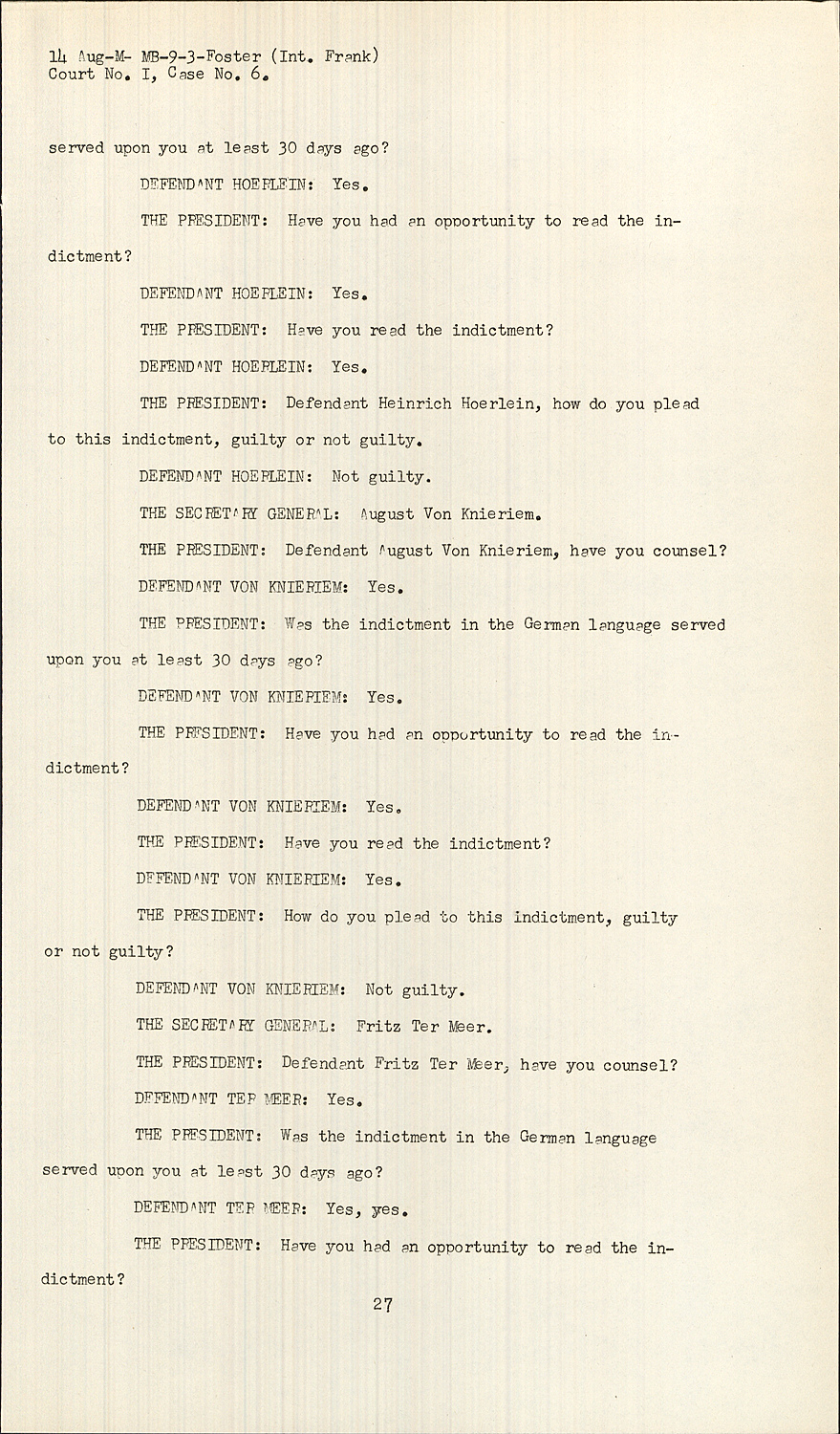
DEFENDANT HOERLEIN:Ye s.
THE PRESIDENT:Have you had an opportunity to read the indictment?
DEFENDANT HOERLEIN:Yes.
THE PRESIDENT:Have you read the indictment?
DEFENDANT HOERLEIN:Yes.
THE PRESIDENT:Defendant Heinrich Hoerlein, how do you plead to this indictment, guilty or not guilty.
DEFENDANT HOERLEIN:Not guilty.
THE SECRETARY GENERAL:August von Knieriem.
THE PRESIDENT:Defendant August von Knieriem, have you counsel?
DEFENDANT VON KNIERIEM:Yes.
THE PRESIDENT:Was the indictment in the German language served upon you at least 30 days ago?
DEFENDANT VON KNIERIEM:Yes.
THE PRESIDENT:Have you had an opportunity to read the indictment?
DEFENDANT VON KNIERIEM:Yes.
THE PRESIDENT:Have you read the indictment?
DEFENDANT VON KNIERIEM:Yes.
THE PRESIDENT:How do you plead to this indictment, guilty or not guilty?
DEFENDANT VON KNIERIEM:Not guilty.
THE SECRETARY GENERAL:Fritz Ter Meer.
THE PRESIDENT:Defendant Fritz Ter Meer, have you counsel?
DEFENDANT TER MEER:Yes.
THE PRESIDENT:Was the indictment in the German language served upon you at least 30 days ago?
DEFENDANT TER MEER:Yes, yes.
THE PRESIDENT:Have you had an opportunity to read the indictment?
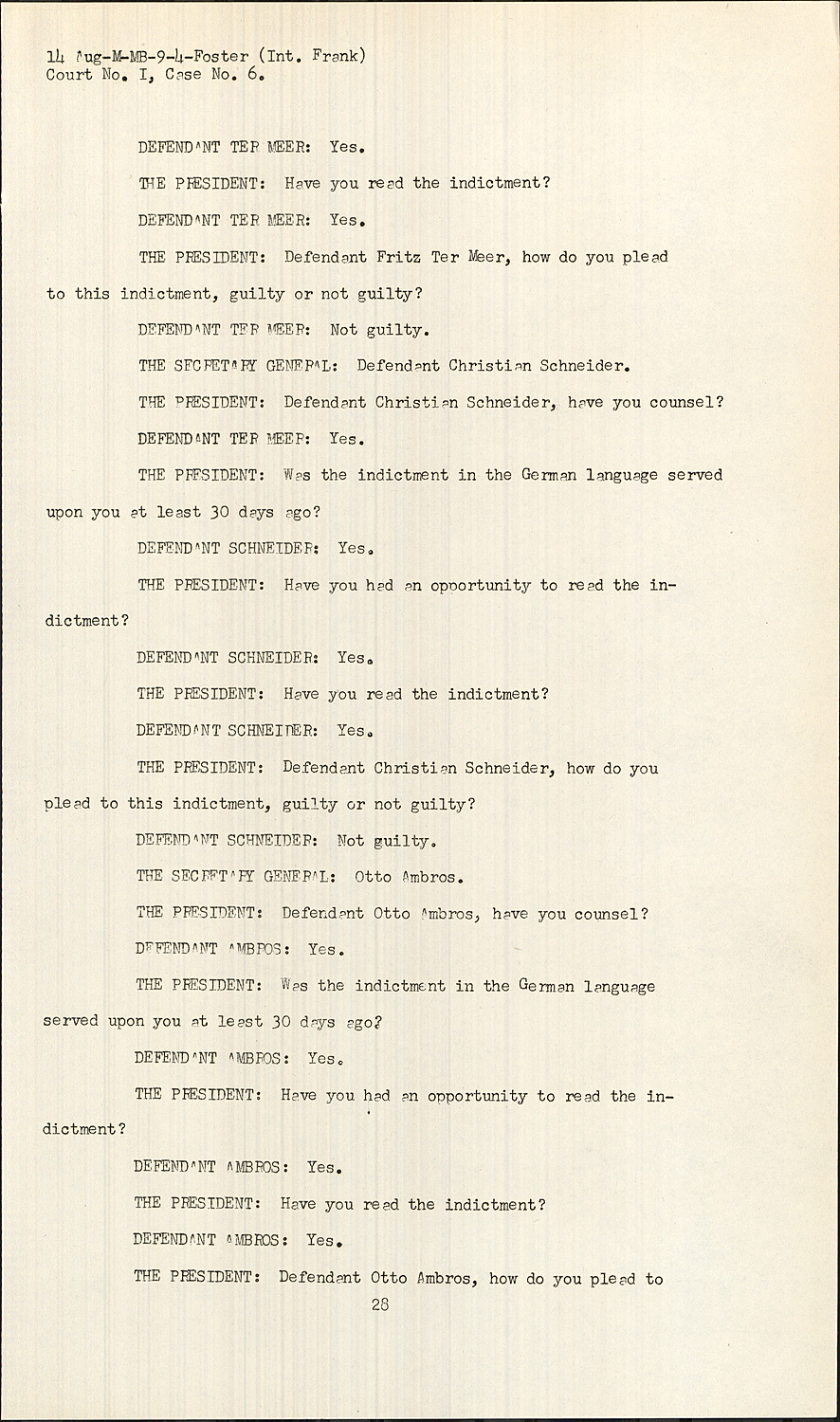
DEFENDANT TER MEER:Yes.
THE PRESIDENT:Have you read the indictment?
DEFENDANT TER MEER:Yes.
THE PRESIDENT:Defendant Fritz Ter Meer, how do you plead to this indictment, guilty or not guilty?
DEFENDANT TER MEER:Not guilty.
THE SECRETARY GENERAL:Defendant Christian Schneider.
THE PRESIDENT:Defendant Christian Schneider, have you counsel?
DEFENDANT TER MEER:Yes.
THE PRESIDENT:Was the indictment in the German language served upon you at least 30 days ago?
DEFENDANT SCHNEIDER:Yes.
THE PRESIDENT:Have you had an opportunity to read the indictment?
DEFENDANT SCHNEIDER:Yes.
THE PRESIDENT:Have you read the indictment?
DEFENDANT SCHNEIDER:Yes.
THE PRESIDENT:Defendant Christian Schneider, how do you plead to this indictment, guilty or not guilty?
DEFENDANT SCHNEIDER:Not guilty.
THE SECRETARY GENERAL:Otto Ambros.
THE PRESIDENT:Defendant Otto Ambros, have you counsel?
DEFENDANT AMBROS:Yes.
THE PRESIDENT:Was the indictment in the German language served upon you at least 30 days ago?
DEFENDANT AMBROS:Yes.
THE PRESIDENT:Have you had an opportunity to read the indictment ?
DEFENDANT AMBROS:Yes.
THE PRESIDENT:Have you read the indictment?
DEFENDANT AMBROS:Yes.
THE PRESIDENT:Defendant Otto Ambros, how do you plead to the indictment, guilty or not guilty?
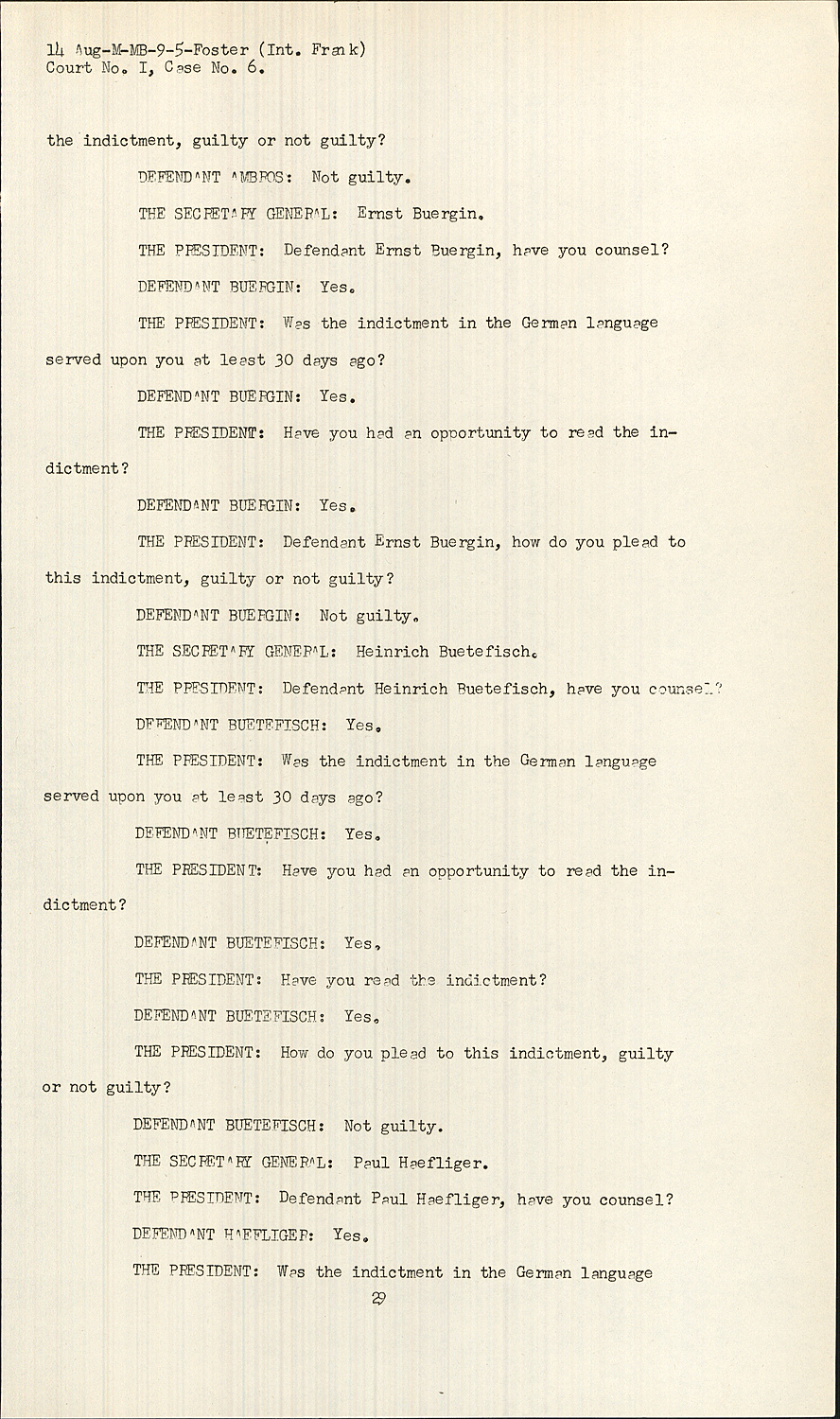
DEFENDANT AMBROS:Not guilty.
THE SECRETARY GENERAL:Ernst Buergin.
THE PRESIDENT:Defendant Ernst Buergin, have you counsel?
DEFENDANT BUERGIN:Yes.
THE PRESIDENT:Was the indictment in the German language served upon you at least 30 days ago?
DEFENDANT BUERGIN:Yes.
THE PRESIDENT:Have you had an opportunity to read the indictment?
DEFENDANT BUERGIN:Ye s.
THE PRESIDENT:Defendant Ernst Buergin, how do you plead to this indictment, guilty or not guilty?
DEFENDANT BUERGIN:Not guilty.
THE SECRETARY GENEFAL:Heinrich Buetefisch.
THE PRESIDENT:Defendant Heinrich Buetefisch, have you counsel?
DEFENDANT BUETEFISCH:Yes.
THE PRESIDENT:Was the indictment in the German language served upon you at least 30 days ago?
DEFENDANT BUETEFISCH:Yes.
THE PRESIDENT:Have you had an opportunity to read the indictment?
DEFENDANT BUETEFISCH:Yes.
THE PRESIDENT:Have you read the indictment?
DEFENDANT BUETEFISCH:Yes.
THE PRESIDENT:How do you plead to this indictment, guilty or not guilty?
DEFENDANT BUETEFISCH:Not guilty.
THE SECRETARY GENERAL:Paul Haefliger.
THE PRESIDENT:Defendant Paul Haefliger, have you counsel?
DEFENDANT HAFFLIGER:Yes.
THE PRESIDENT:Was the indictment in the German language served upon you at least 30 days ago?
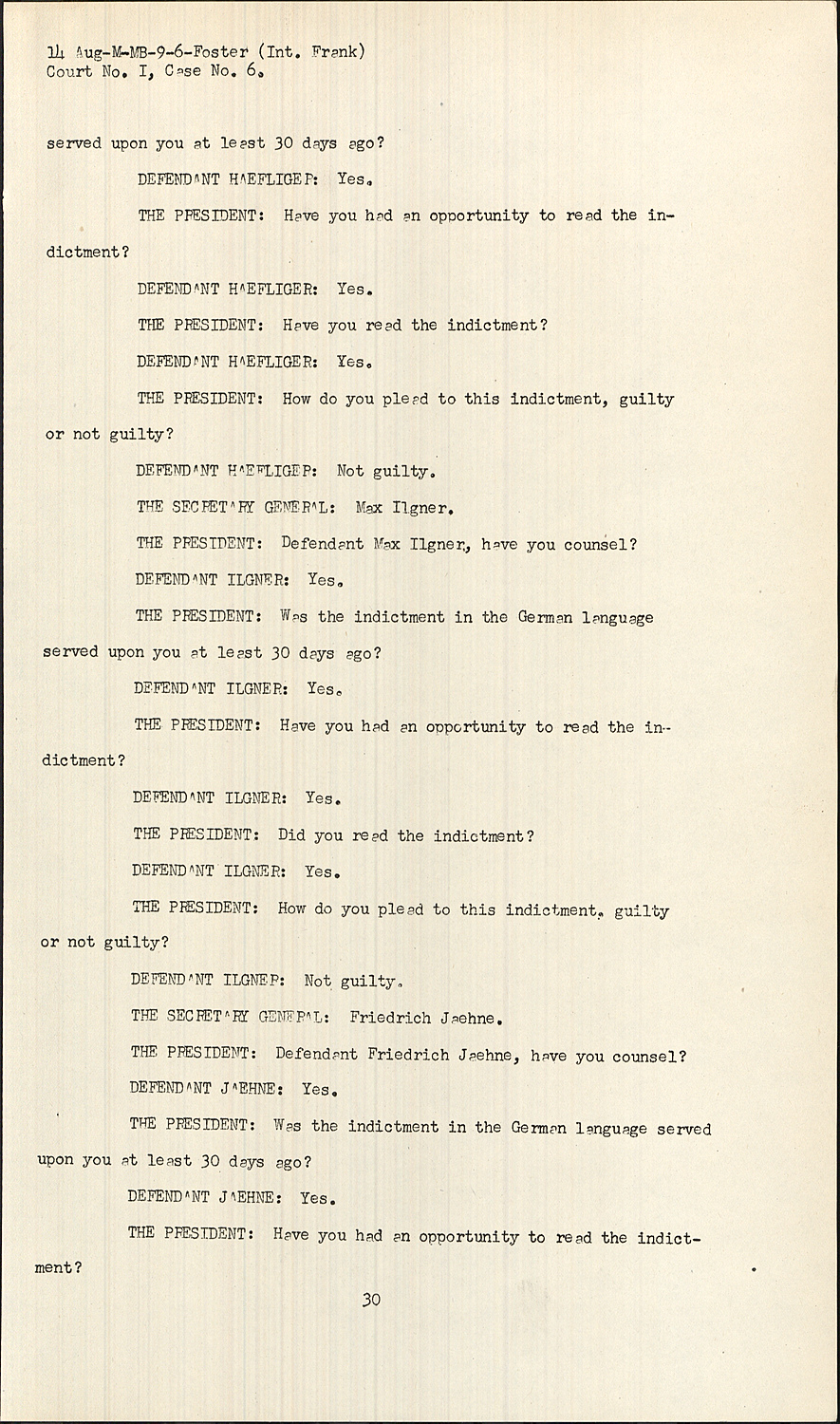
DEFENDANT HAEFLIGER:Yes.
THE PRESIDENT:Have you had an opportunity to read the indictment?
DEFENDANT HAEFLIGER:Yes.
THE PRESIDENT:Have you read the indictment?
DEFENDANT HAEFLIGER:Yes.
THE PRESIDENT:How do you plead to this indictment, guilty or not guilty?
DEFENDANT HAEFLIGER:Not guilty.
THE SECRETARY GENERAL:Max Ilgner.
THE PRESIDENT:Defendant Fax Ilgner, have you counsel?
DEFENDANT ILGNER:Yes.
THE PRESIDENT:Was the indictment in the German language served upon you at least 30 days ago?
DEFENDANT ILGNER:Yes.
THE PRESIDENT:Have you had an opportunity to read the indictment?
DEFENDANT ILGNER:Yes.
THE PRESIDENT:Did you read the indictment?
DEFENDANT ILGNER:Yes.
THE PRESIDENT:How do you plead to this indictment, guilty or not guilty?
DEFENDANT ILGNER:Not guilty.
THE SECRETARY GENERAL:Friedrich Jaehne.
THE PRESIDENT:Defendant Friedrich Jaehne, have you counsel?
DEFENDANT JAEHNE:Yes.
THE PRESIDENT:Was the indictment in the German language served upon you at least 30 days ago?
DEFENDANT JAEHNE:Yes.
THE PRESIDENT:Have you had an opportunity to read the indictment?