Official Transcript of the American Military Tribunal No. 6 in the matter of the United States of America against CARL KRAUCH et al, defendants, sitting at Nurnberg, Germany on 14 August 1947, 1000, Justice SHAKE presiding.
THE MARSHAL:The Honorable, the Judges of Military Tribunal VI.
Military Tribunal No. 6 is now in session. God save the United States of America and this Honorable Tribunal.
There will be order in the courtroom.
THE PRESIDENT:Military Tribunal No. 6 will come to order.
The Tribunal will now proceed with the arraignment of the defendants in case number 6 pending before this Tribunal, The SecretaryGeneral will call the roll of the defendants.
THESECRETARY-GENERAL: Each defendant will stand and answer present when his name is called.
(The Secretary-General then called the roll of the defendants:
CARL KRAUCH, HERMANN SCHMITZ, GEORG VON SCHMTZLER, FRITZ GAJEMSKI,
HEINRICH HOERLEIN, AUGUST VON KNIERIEIEM, FRITZ TER MEER, CHRISTIAN
SCHNEIDER, OTTO AMBROS, MAX BRUEGEMANN -
BRIGADIER GENERAL TELFORD TAYLOR:May it please your Honor, the Defendant Brueggemann is at present in a hospital near Duesseldorf in the British Zone of Occupation. Brueggemann was served with the indictment on 18 June 1947. Two days prior, on 16 June, Brueggemann's counsel, Dr. Klefisch, filed a letter in the nature of a motion with the Secretary-General asking that the proceedings against Brueggemann be temporarily quashed or separated from the trial of the other defendants and that Brueggemann be released from custody in the interest of his health. The prosecution answered this motion on 24 June and there appears to be no substantial conflict between the prosecution and the defense on this matter. Both the motion and the answer agree on the basis of the medical reports, that the defendant Brueggemann is not at present able to stand trial without serious danger to his life. The prosecution in its answer has suggested, in accordance with a procedure which the International Military Tribunal adopted in the case of Gustav Von Bohlen, that an order be made here postponing for an indefinite time the proceedings against Brueggeman but directing that the charges in the indictment be retained upon the docket of the Military Tribunals for trial thereafter, if the physical and mental condition of the defendant should permit.
The tribunal may of course, wish to have a further medical examination of Brueggenann before deciding this matter. So far as the prosecution is concerned we would have no objection to the entrance of an order severing the proceedings against Brueggemann at this time. In accordance with Dr. Kleflsch request, and on the basis of the medical reports, Brueggemann was released from the Nurnberg Jail on 7th July and, as I have said, he is presently hospitalized near Duesseldorf in the British zone, where he is under surveillance.
THE PRESIDENT:The Tribunal will pass upon that matter at the conclusion of the call of the defendants. You nay proceed, Mr. Secretary.
THESECRETARY-GENERAL: (Continuing):
ERNST BUERGIN, HEINRICH BUETEFISCH, PAUL HAEFLIGER,
MAX ILGENR, FRIEDRICH JAEHNE, HANS KUEHNE, CARL
LAUTENSCHLAEGER -
THE PRESIDENT:Is Counsel for the defendant present? Do you desire to make some observation to the court with reference to this defendant?
DR. PRIBILLA:No.
THE PRESIDENT:I may say to counsel that it has come to the attention of the Tribunal that the only son of this defendant passed away last night. I don't know whether the defendant himself yet knows of this fact, but under the circumstances we have excused him from attendance here this morning and we will dispose of his matter at the end of the roll-call also. You may proceed.
THESECRETARY-GENERAL: (Continuing):
WILHELM HANN, HEINRICH OSTER, KARL WURSTER -
BRIGADIER GENERAL TELFORD TAYLOR:May it please the court, the defendant Wurster is at present in a hospital at Ludwigshafen in the French Zone of Occupation.
After the indictment of this case was filed, the prosecution learned, that the defendant Wurster had sustained an injury to his shoulder and that an operation had been performed and that Wurster was hospitalized in consequence thereof. According to the advice of the French doctors who treated Burster, it appeared that he could not be moved to Nurnberg at least for several weeks. Accordingly, arrangements were made to serve the indictment on the defendant Wurster at Ludwigshafen in the French Zone, and that was done by the Marshal of the Court on 20th of June 1947. Thereafter the defendant Burster was further affected by heart condition which further delayed his transfer to Nurnerg. Defense Counsel for Wurster, Dr. Wagner, has filed a motion requesting in the alternative that the defendant be discharged, or that the proceedings against him be severed from the proceedings against the other defendants. The prosecution filed an answer to this petition. On 24th of July 1947 to which Dr. Wagner filed a further reply on the 4th of August. The Defendant's motion and the answer are pending before the Tribunal for disposition and can be dealt with now or later in the discretion of the Tribunal. The prosecution has just received information that the Defendant Wurster was examined on 12 August 1947 by an American Military doctor and is advised that Burster could now be transported under proper physical safeguards to Numbers. The prosecution will, when the court hears this matter, oppose Dr. Wagner's request that the proceedings be severed although we, of course, have no objection to such further medical examinations as the court may direct.
THESECRETARY-GENERAL: (Continuing):
BALTER DUERRFELD, HEINRICH GATTINEAU, ERICH VON DER HEYDE
AND HANS KUGLER.)
May the Honorable Tribunal please, all defendants except Max Brueggemann, Carl Burster and Carl Lautenschlaeger are present and in the dock.
THE PRESIDENT:On the basis of the showings made, the arraignment of the Defendant Carl Lautenschlaeger will be postponed until the next session of the Tribunal.
The arraignment and trial of the defendants Brueggemann and Wurster will be postponed until such time as they are present or, in the alternative, until the further order of the Tribunal. In the meanwhile, the charges against the defendants Brueggemann and Wurster will be continued and the indictments against them will not be dismissed, but their names may be omitted from the list of the defendants now before the Tribunal for trial.
The Secretary-General will now call the defendants in the dock, one by one, for arraignment.
THESECRETARY-GENERAL: Carl Krauch -
DR. CONRAD BOETTCHER:Mr. President, before this question is put to the defendants, I should like to have your permission, on behalf of all defense counsel and all defendants, to make a brief declaration with regard to this question.
THE PRESIDENT:Yes.
DR. CONRAD BOETTCHER:Your Honor, my name is Boettcher, Dr. Conrad Boettcher, attorney-at-law and defense counsel for the defendant Professor Dr. Krauch. At this time I am also speaking on behalf of all defense counsel present in this court room. At this point we must deal with two principal objections against these proceedings. The two points which I wish to deal with are these: I am first of all, objecting to this indictment as such since it does not correspond with the form prescribed in Ordinance Number 7. According to this Ordinance No. 7, paragraph 4, the indictment must make it plain to a sufficiently clear extent what charges are being preferred against individual defendants. This, however, is not the case, particularly since the legal concept of conspiracy -- at least as far as Counts 2 and 3 of the indictment are concerned, that is, War Crimes and Crimes against Humanity has been declared not applicable. For that reason the prerequisites for this trial are not sufficiently in existence, namely, the question cannot at this point be put to the defendants whether they are guilty or not guilty.
Secondly, according to Ordinance No. 7, as well as according to the American constitution, the defendants have a claim for a fair trial. That is Article 5 of the American Constitution, and it is a claim which, according to the present defendants and considering the volume of the material, presents particularly great difficulties for the preparation for the defense, and which has, therefore, not been sufficiently realized.
My argument with regard to these two points is as follows:
With regard to one, as already stated at this point, proceedings cannot be continued because provisions contained in Article 4, of Ordinance No. 7, dealing with the prerequisites for such a trial at the beginning of the proceedings have not yet been fulfilled. Article 4 states in its first paragraph, sub-paragraph a, as follows:
"The indictment must specify clearly and simply the points of the indictment and must produce sufficient details in order to enable the defendants to be aware of the accusations and charges raised against him."
This is not met sufficiently in the indictment, neither as far as the evidence of conspiracy is concerned nor, as far was the formal participation is concerned, contained in Control Council Law No. 10 with regard to the first three points of the indictment. They are based upon the principal of individual participation, of course, although in the proceedings before the IMT the conspiracy was described as a particular form of participation under Anglo-Saxon law and, formed thus the basis of the indictment. The prosecution, at that time properly considered it essential to state in Appendix A of the indictment, with regard to every individual defendant, which points were applicable to his particular case and through which particular actions the individual perpetrations had been realized in his particular case.
As far as this present indictment here is concerned, the conspiracy, apart from Count 1 of the indictment has been dealt with by decisions of the Military Tribunals at Nurnberg on the basis of the en banc session of 9 July 1947, that is to say, after this present indictment was filed and the decision of that Tribunal was binding for every later Tribunal and, it was declared an independent charge, and in that manner was also declared as non-applicable as a point of indictment.
For that reason too the prosecution will have to go into infinitely greater detail than was necessary earlier, even as early as the filing of the written, indictment which concrete facts every individual of the 24 defendants are being charged with.
So long as this objection of mine, which I am discussing now, has not been dealt with, sufficient details are not available, which would have to be available according to Ordinance 7, in order to inform the individual defendants regarding the charges raised against them. And consequently the preconceived conditions for the entering into these proceedings, and which are essential for the defendants to allow them to answer the question of guilty or not guilty, are not met with.
I do not wish to be cause for a misunderstanding. All defendants do feel that they are not guilty. However, that would not effect our objection which is, that on the basis of the indictment in the form in which we have it here before us, the question of guilty or not guilty can not be put to them in the proper way at all. If the indictment with regard to individual counts produces very occasionally individual names, then it is not recognizable whether the charges are applicable to those defendants named in that connection and are to be restricted to them. In most cases any indication is lacking to the effect which one of the 24 defendants is to be charged with the individual count of the indictment.
Let me mention only two out of many examples, in order to eludicate the shortcomings which I am dealing with. I will quote from page 5 of the original indictment.
"All defendants through the IGFarben and otherwise, with diverse other persons, during a period of years proceeding the 8th of May 1945, participated in the planning, preparation, initiation and waging of wars of aggression and invasions of other countries" end of quotation.
I shall continue to quote from page 38 of the original of the indictment. "All defendants together with various other persons availed themselves during the time of the 12th of March 1938 up to the 8th of May 1945 of the facilities of the IG in order to commit War Crimes and Crimes against Humanity by participating in the looting of public and private property, its exploitation, spoliation, in other countries which came under the belligerent occupation of Germany in the course of its invasions and aggressive wars."
It is for this reason what the defense would request this Tribunal to declare the indictment as insufficient and non-admissable, at least, however , to request the prosecution to supply the necessary supplement for this indictment before the beginning of its case in chief, and after the submission of the completed indictment to allow a sufficient period to elapse in order to make a statement and prepare for this new indictment.
The documents handed over to the defense by the prosecution up to this point do not alleviate the mistakes in the indictment which I have just objected to, the violation of the rules contained in Article 4 of the Ordinance No. 7 can not be done away with by submission of such documents. Since the indictment as such is meant to contain those details, the submission of documents is a gesture on the part of the prosecution which lacks a proper meaning. The documents do not say anything about the participation of individual defendants, and have no relations to the major part of the defendants and, in connection with the indictment which we have up to now and which we consider incomplete, their meaning can not be grasped or understood.
I shall now turn to my argument with regard to point 2. It is the considered duty of the defense to point out again and again that the unfavorable circumstances prevailing in Germany at this time, which effect the defense much more than the prosecution, make it an impossibility in practice to work in a trial of such international significance as this and to balance the overpowering force of the prosecution.
The defense is aware of the fact that the Tribunal and the prosecution are not in a position either to correct the effects of these unusual circumstances, no more do we expect that the beginning of the trial could be postponed until these conditions have shown a, general improvement. The defense considers these unusual difficulties, however, to be additional handicaps which it is willing to bear in every instance considering the implicating circumstances. What, however, does not appear reasonable to the defense is that beyond this, the defense is burdened with restrictions which can be removed or through the refusal of favors which could be granted them. The most important factor is that of time, whereas the prosecution has had two years to collect and screen prosecution material and, had at its disposal a large organization over a period of years, the defense has only had very few, in fact, in some Cases only three to four weeks to exploit the possibilities of preparing the trial material after they were admitted before this Tribunal and, in particular contrary to the position of the prosecution, the defense has had utterly insufficient forces at their disposal.
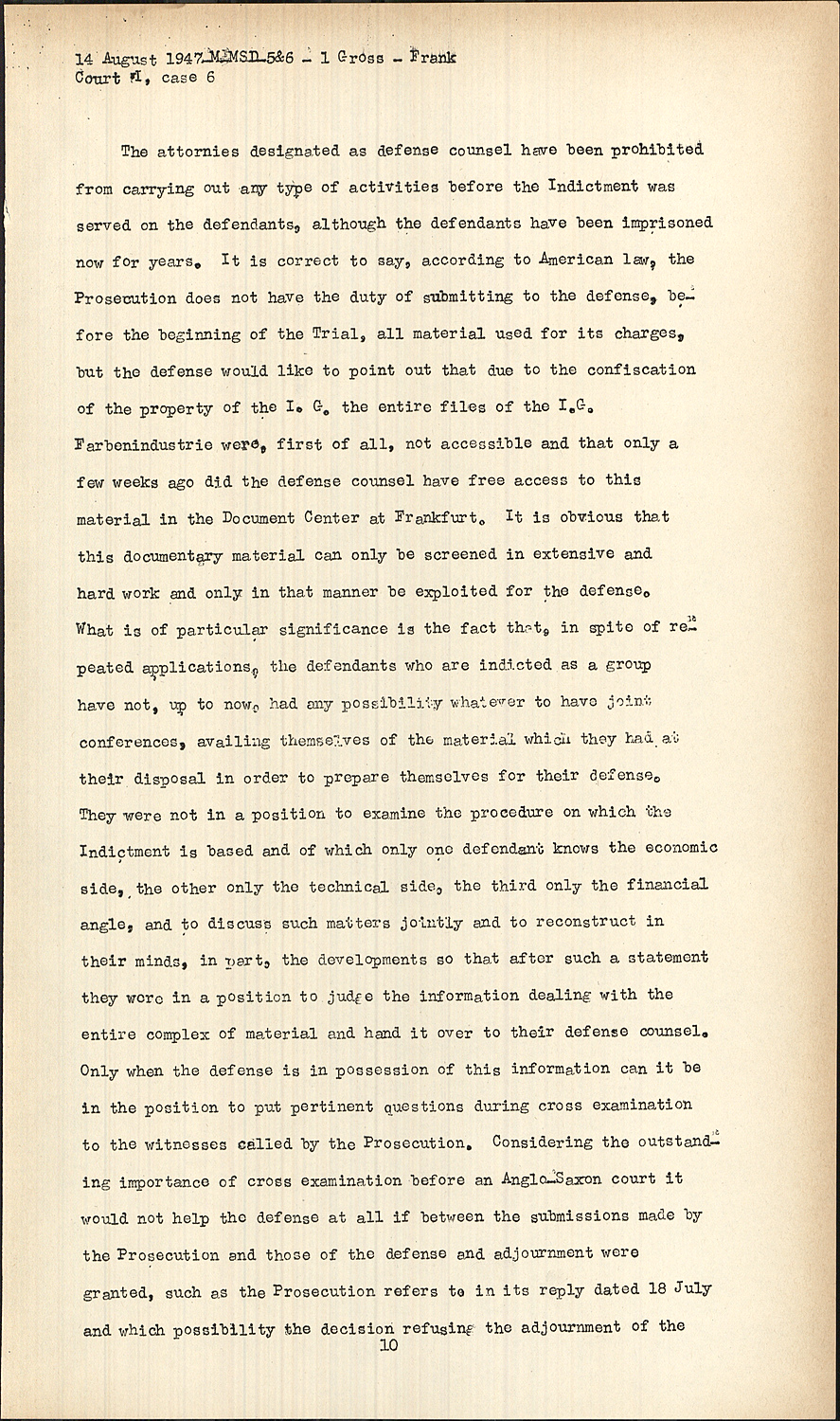
The attornies designated as defense counsel have been prohibited from carrying out any type of activities before the Indictment was served on the defendants, although the defendants have been imprisoned now for years. It is correct to say, according to American law, the Prosecution does not have the duty of submitting to the defense, before the beginning of the Trial, all material used for its charges, but the defense would like to point out that due to the confiscation of the property of the I. G. the entire files of the I.G. Farbenindustrie were, first of all, not accessible and that only a few weeks ago did the defense counsel have free access to this material in the Document Center at Frankfurt. It is obvious that this documentary material can only be screened in extensive and hard work and only in that manner be exploited for the defense. What is of particular significance is the fact that, in spite of repeated applications, the defendants who are indicted as a group have not, up to now, had any possibility whatever to have joint conferences, availing themselves of the material which they had at their disposal in order to prepare themselves for their defense. They were not in a position to examine the procedure on which the Indictment is based and of which only one defendant knows the economic side, the other only the technical side, the third only the financial angle, and to discuss such matters jointly and to reconstruct in their minds, in part, the developments so that after such a statement they were in a position to judge the information dealing with the entire complex of material and hand it over to their defense counsel. Only when the defense is in possession of this information can it be in the position to put pertinent questions during cross examination to the witnesses called by the Prosecution. Considering the outstanding importance of cross examination before an Anglo-Saxon court it would not help the defense at all if between the submissions made by the Prosecution and those of the defense and adjournment were granted, such as the Prosecution refers to in its reply dated 18 July and which possibility the decision refusing the adjournment of the Tribunal, dated 30 July is referring to.