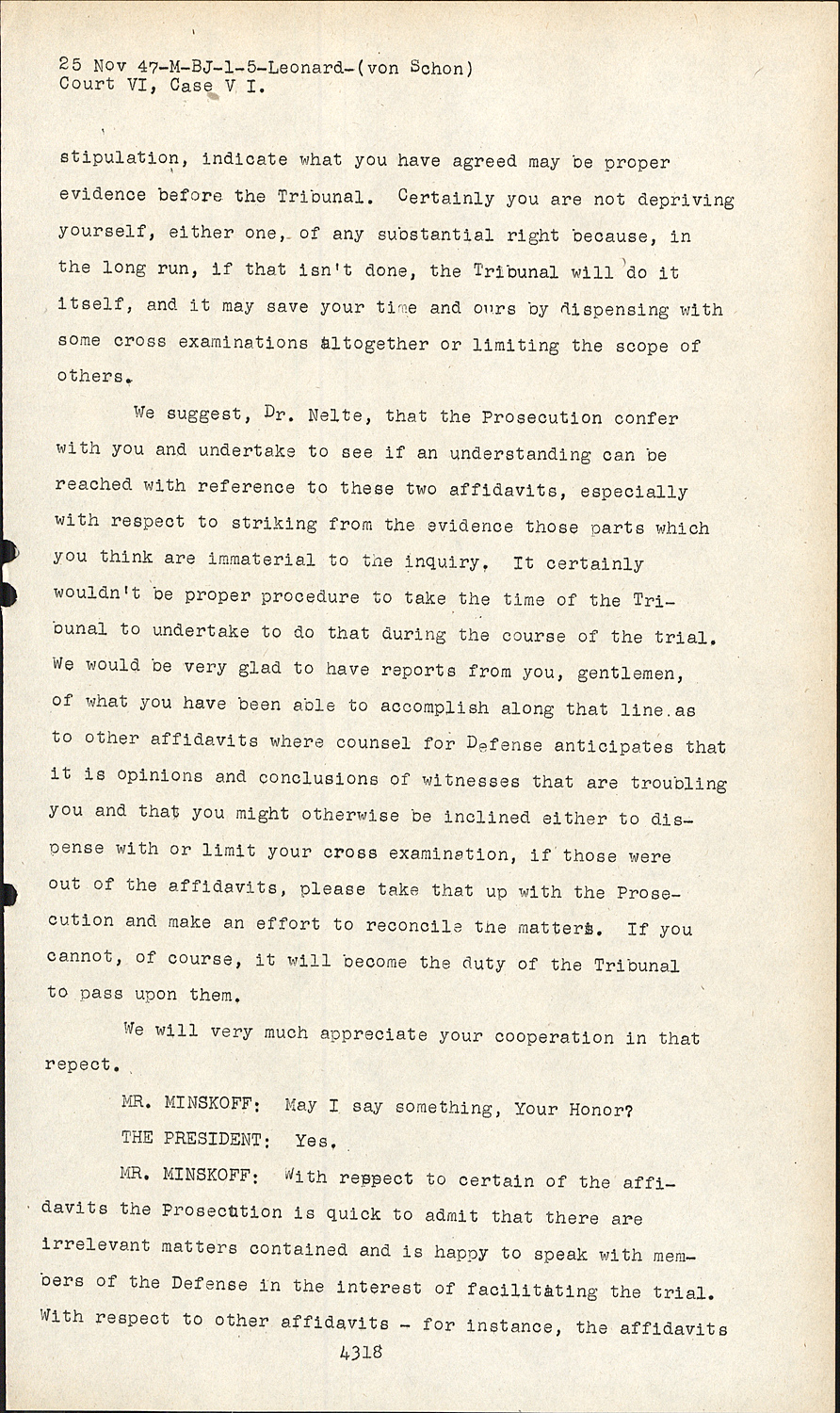
Certainly you are not depriving yourself, either one, of any substantial right because, in the long run, if that isn't done, the Tribunal will do it itself, and it may save your time and ours by dispensing with some cross examinations Altogether or limiting the scope of others.
We suggest, Dr. Nelte, that the Prosecution confer with you and undertake to see if an understanding can be reached with reference to these two affidavits, especially with respect to striking from the evidence those parts which you think are immaterial to the inquiry. It certainly wouldn't be proper procedure to take the time of the Tribunal to undertake to do that during the course of the trial. We would be very glad to have reports from you, gentlemen, of what you have been able to accomplish along that line as to other affidavits where counsel for Defense anticipates that it is opinions and conclusions of witnesses that are troubling you and that you might otherwise be inclined either to dispense with or limit your cross examination, if those were out of the affidavits, please take that up with the Prosecution and make an effort to reconcile the matters. If you cannot, of course, it will become the duty of the Tribunal to pass upon them.
We will very much appreciate your cooperation in that repect.
MR. MINSKOFF:May I say something, Your Honor?
THE PRESIDENT:Yes.
MR. MINSKOFF:With respect to certain of the affidavits the Prosecution is quick to admit that there are irrelevant matters contained and is happy to speak with members of the Defense in the interest of facilitating the trial. With respect to other affidavits - for instance, the affidavits of Hoven and Dietzsch and Kogon - there is much material contained which the defense characterizes as hearsay even though such material obviously deals with experiences these persons had and with conversations in the course of their business, which is completely different from the ordinary hearsay rules.
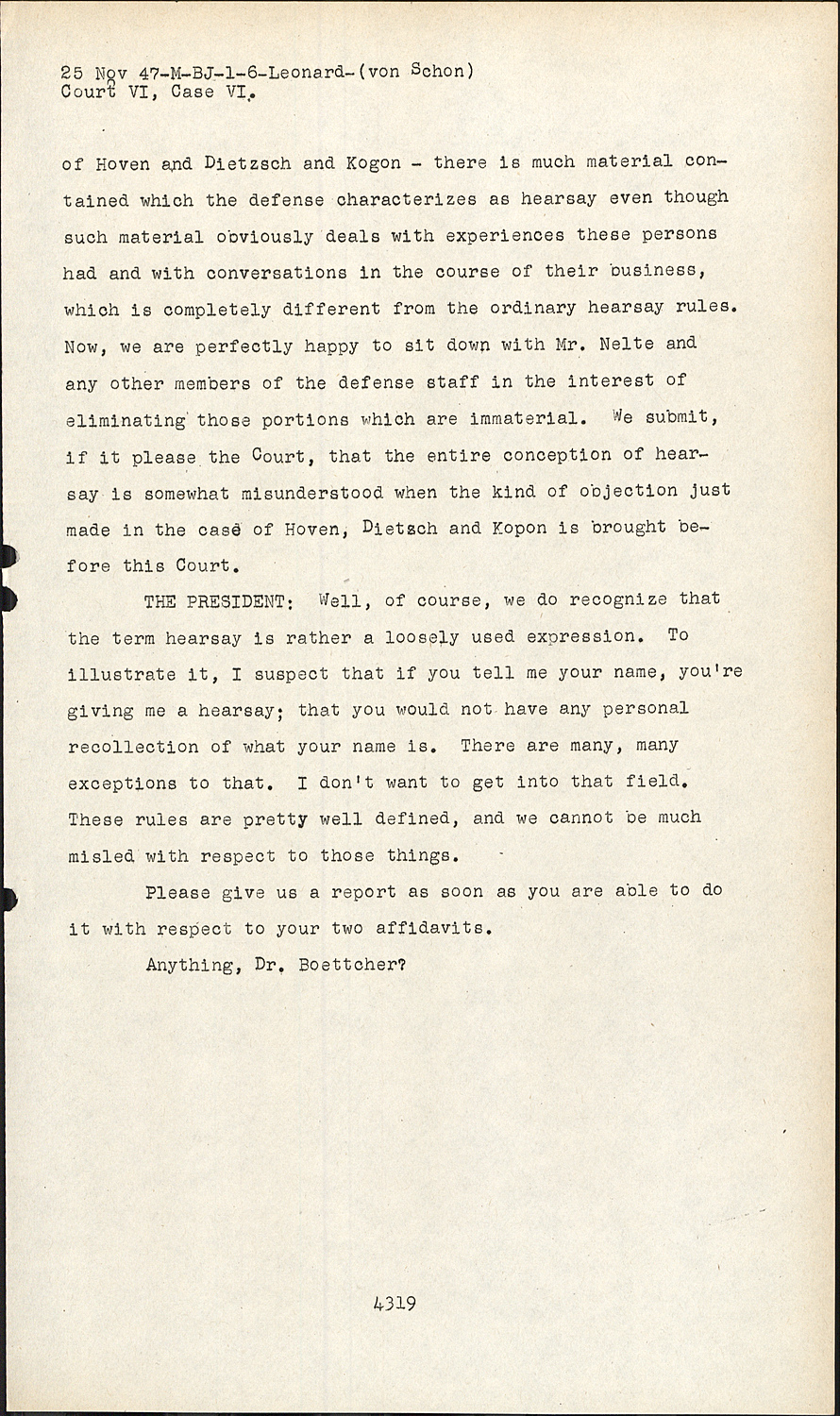
Now, we are perfectly happy to sit down with Mr. Nelte and any other members of the defense staff in the interest of eliminating those portions which are immaterial. We submit, if it please the Court, that the entire conception of hearsay is somewhat misunderstood when the kind of objection just made in the case of Hoven, Dietach and Kopon is brought before this Court.
THE PRESIDENT:Well, of course, we do recognize that the term hearsay is rather a loosely used expression. To illustrate it, I suspect that if you tell me your name, you're giving me a hearsay; that you would not have any personal recollection of what your name is. There are many, many exceptions to that. I don't want to get into that field. These rules are pretty well defined, and we cannot be much misled with respect to those things.
Please give us a report as soon as you are able to do it with respect to your two affidavits.
Anything, Dr. Boettcher?
Court No. VI, Case No. VI.
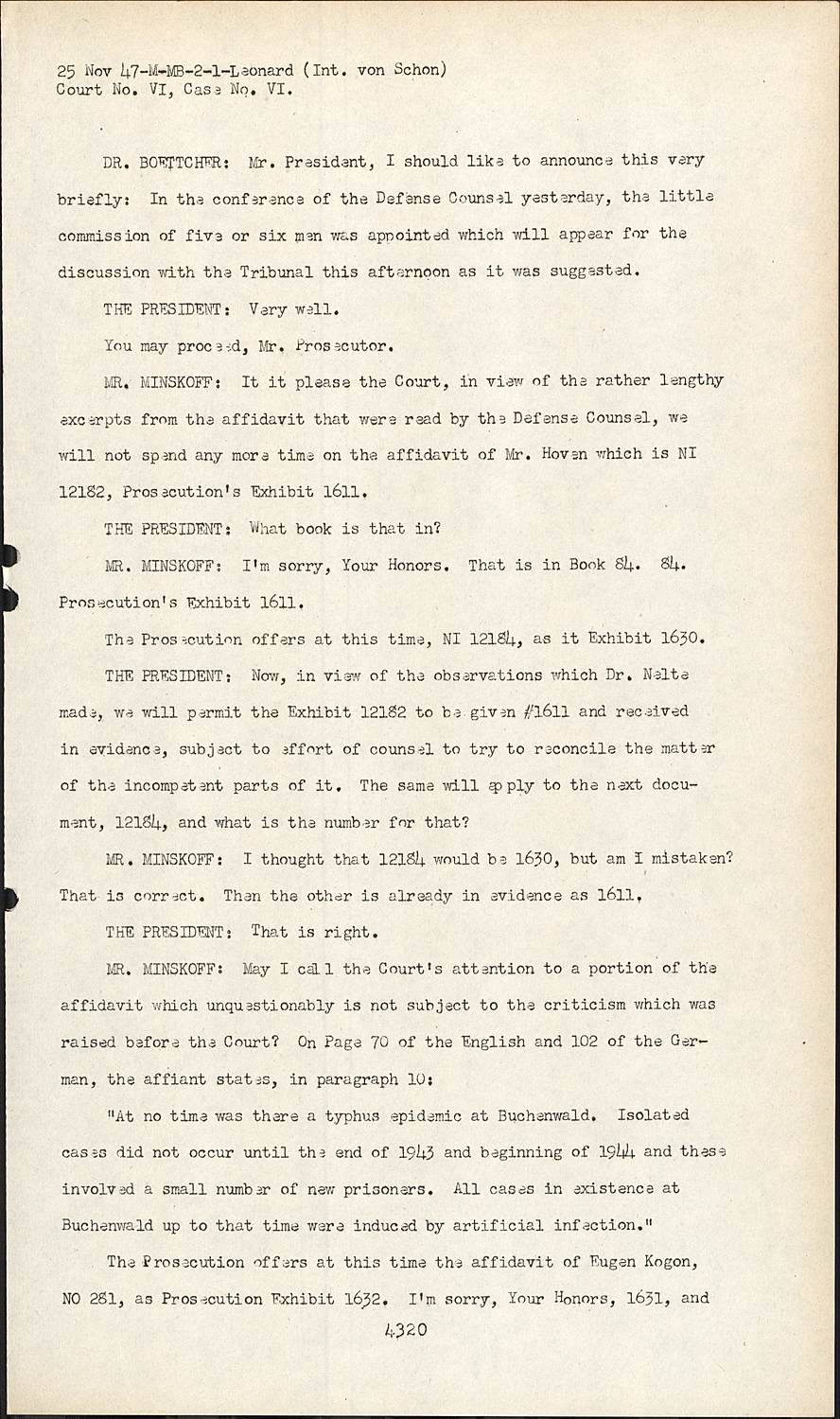
DR. BOETTCHER:Mr. President, I should like to announce this very briefly: In the conference of the Defense Counsel yesterday, the little commission of five or six men was appointed which will appear for the discussion with the Tribunal this afternoon as it was suggested.
THE PRESIDENT:Very well.
You may proceed, Mr. Prosecutor.
MR. MINSKOFF:It it please the Court, in view of the rather lengthy excerpts from the affidavit that were read by the Defense Counsel, we will not spend any more time on the affidavit of Mr. Hoven which is NI 12182, Prosecution's Exhibit 1611.
THE PRESIDENT:What book is that in?
MR. MINSKOFF:I'm sorry, Your Honors. That is in Book 84. 84. Prosecution's Exhibit 1611.
The Prosecution offers at this time, NI 12184, as it Exhibit 1630.
THE PRESIDENT:Now, in view of the observations which Dr. Nelte made, we will permit the Exhibit 12182 to be given #1611 and received in evidence, subject to effort of counsel to try to reconcile the matter of the incompetent parts of it. The same will apply to the next document, 12184, and what is the number for that?
MR. MINSKOFF:I thought that 12184 would be 1630, but am I mistaken? That is correct. Then the other is already in evidence as 1611.
THE PRESIDENT:That is right.
MR. MINSKOFF:May I call the Court's attention to a portion of the affidavit which unquestionably is not subject to the criticism which was raised before the Court? On Page 70 of the English and 102 of the German, the affiant states, in paragraph 10:
"At no time was there a typhus epidemic at Buchenwald. Isolated cases did not occur until the end of 1943 and beginning of 1944 and these involved a small number of new prisoners. All cases in existence at Buchenwald up to that time were induced by artificial infection."
The Prosecution offers at this time the affidavit of Eugen Kogon, NO 281, as Prosecution Exhibit 1632. I'm sorry, Your Honors, 1631, and Court No. VI, Case No. VI.
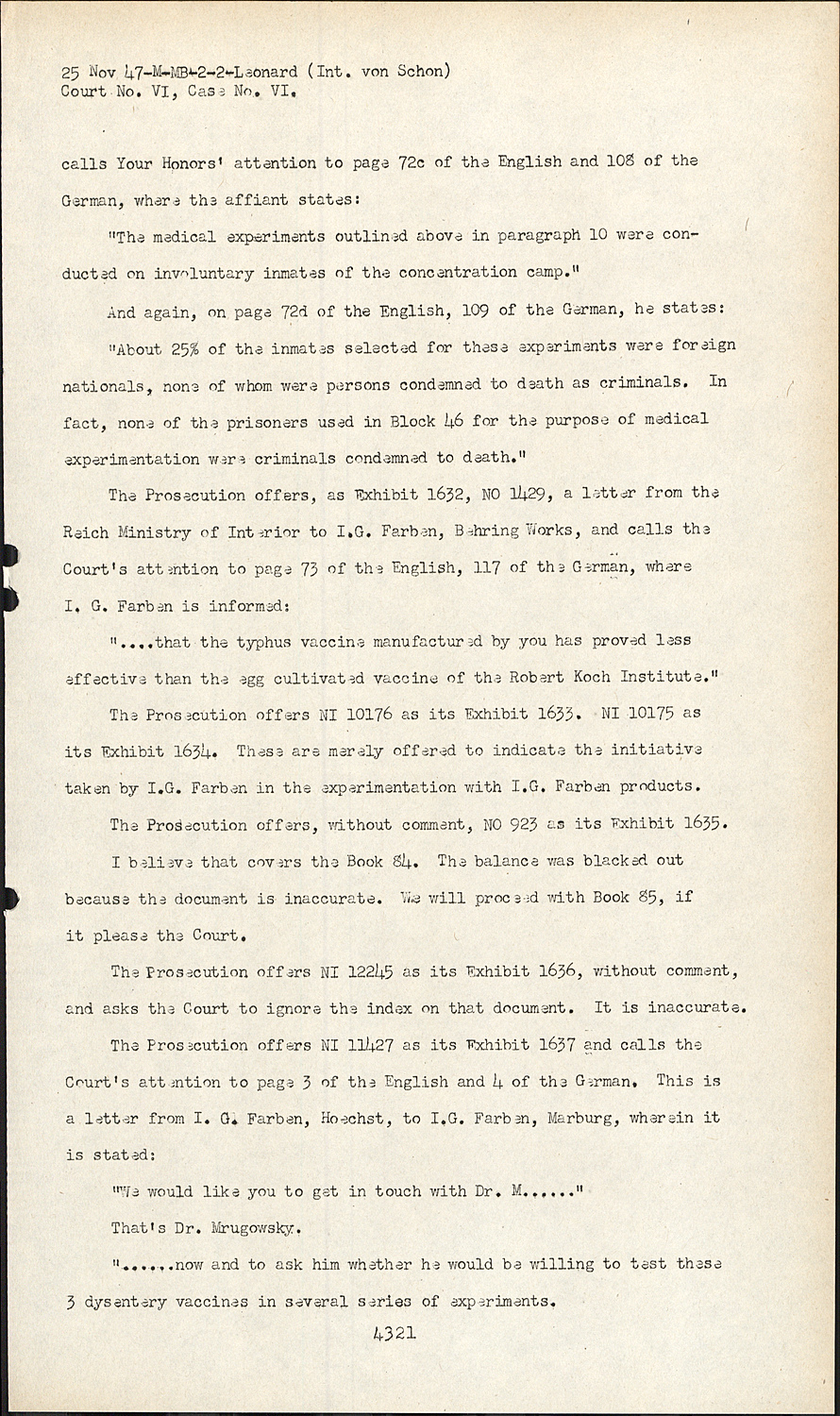
calls Your Honors' attention to page 72c of the English and 108 of the German, where the affiant states:
"The medical experiments outlined above in paragraph 10 were conducted on involuntary inmates of the concentration camp."
And again, on page 72d of the English, 109 of the German, he states:
"About 25% of the inmates selected for these experiments were foreign nationals, none of whom were persons condemned to death as criminals. In fact, none of the prisoners used in Block 46 for the purpose of medical experimentation were criminals condemned to death."
The Prosecution offers, as Exhibit 1632, NO 1429, a letter from the Reich Ministry of Interior to I.G. Farben, Behring Works, and calls the Court's attention to page 73 of the English, 117 of the German, where I. G. Farben is informed:
"....that the typhus vaccine manufactured by you has proved less effective than the egg cultivated vaccine of the Robert Koch Institute."
The Prosecution offers NI 10176 as its Exhibit 1633. NI 10175 as its Exhibit 1634. These are merely offered to indicate the initiative taken by I.G. Farben in the experimentation with I.G. Farben products.
The Prosecution offers, without comment, NO 923 as its Exhibit 1635.
I believe that covers the Book 84. The balance was blacked out because the document is inaccurate. We will proceed with Book 85, if it please the Court.
The Prosecution offers NI 12245 as its Exhibit 1636, without comment, and asks the Court to ignore the index on that document. It is inaccurate.
The Prosecution offers NI 11427 as its Exhibit 1637 and calls the Court's attention to page 3 of the English and 4 of the German. This is a letter from I. G. Farben, Hoechst, to I.G. Farben, Marburg, wherein it is stated:
"We would like you to get in touch with Dr. M......"
That's Dr. Mrugowsky.
"......now and to ask him whether he would be willing to test these 3 dysentery vaccines in several series of experiments.
Court No. VI, Case No. VI.
"Thirdly, we ask you to inform Dr. M. of the fact that with regard to the chemical treatment of typhus we had made promising progress and we would attach great value to having our preparation 3582 tested clinically in the next typhus season. We are attaching a description of this preparation."
DR. NELTE:Mr. President, in connection with Document NI 11427, I should like to ask the Prosecution to tell us what is the meaning of the loosely bound sheets where it says: "excerpts from Book 238." These pages appear repeatedly and I cannot determine what these books are from which these documents are taken, and I believe it would be important for the Tribunal to know where the documents come from.
MR. MINSKOFF:If it please the Court, there are a number of books of documents taken from I. G. Farben, Hoechst and Marburg and Leverkusen, and, in some cases, as a matter of facilitating the work of processing, we refer just to portions of the book which were extracted rather than to take the whole book as a document which has very many letters and other type of material in it. Each page is numbered so there won't be any confusion when the book is referred to.
THE PRESIDENT:Are the books from which this exhibit is taken available for examination by counsel for Defense?
MR. MINSKOFF:Yes, Your Honor.
THE PRESIDENT:Very well. You understand, Dr. Nelte, that the source of the document is available to you?
Court No. VI, Case No. VI.
DR. NELTE:Yes, I will take advantage of that opportunity. Well, then, I should like to say something else. Mr. Minskoff, whenever he gives the contents of any documents, always says "the I.G.", as for example, when speaking of Kogon and Dietzsch, he uses that expression. I should like to ask him in view of the fact that we have individual defendants here, and since I. G. Farben consisted of an enormous number of plants, to indicate which individuals or which persons he considers responsible, because I. G. Farben as such cannot be responsible.
MR. MINSKOFF:May I answer that?
THE PRESIDENT:Yes, surely.
MR. MINSKOFF:At the very outset the Prosecution quoted from the affidavits of defendant Hoerlein and defendant Lautenschlaeger and very clearly outlined their respective responsibility as they admitted it. The persons were in complete control and complete charge of I. G. Farben, Hoechst, I. G. Farben in Leverkusen, I. G. Farben, Marburg, I. G. Farben Behring Works. When we state a plant, they know which of the two is responsible for the particular plant and which had an overall responsibility.
THE PRESIDENT:There is no occasion to consume time with this kind of matter. We have indicated repeatedly and we now say again that we do not regard the statements of Counsel, be it Counsel for the Prosecution or Defense, that are made in connection with the presentation of evidence. There will be ample time to argue this case and have Counsel to draw conclusions as to whether a particular document binds a particular defendant or not. If we went into the refinements of language in every instance in which a document was offered, we would consume a very great bit of time. Insofar as Counsel can, we think it would be a proper procedure to indicate to whom the document does apply, but if you misstate it or reach conclusions that are not justified by the evidence, we will disregard the statements of Counsel as to the contents of the document and look to the document to see to whom it does apply, if anyone. You may proceed, gentlemen.
Court No. VI, Case No. VI.
MR. MINSKOFF:The Prosecution now offers NI-9701 as Prosecution's Exhibit 1638. It calls the Court's attention to page 6 of the English and page 7 of the German where there are the minutes of a discussion with Mrugowsky in the presence of Dr. Kohlhaas of the Behring Works. It is stated under paragraph 4: "Testing of Typhus Preparation 3582.
"Dr. Mrugowsky being handed a report about the preparation and he declares himself prepared to carry out in appropriate cases experiments with 3582 and the necessary material for this purpose will be put at his disposal. Dr. Mrugowsky declares emphatically that he is very much interested in these experiments and he promises to further them with all means in his power. In our presence he called in the Deputy Chief Medical Officer to whom he gave the appropriate instructions about the testing of the preparations."
The Prosecution offers as its Exhibit 1639 Document NI-11433 and as its Exhibit 1640 NI-11432. Both are offered merely to indicate the sending of materials and preparations for the conducting of experiments.
The Prosecution offers NI-9581 as its Exhibit 1641. This letter from I. G. Farben Bayer to I. G. Farben Hoechst, copies to Leverkusen, indicates that all three places in I. G. Farben were aware of experiments on the Eastern Front as well as the others.
DR. PRIBILLA:Dr. Pribilla.
Mr. President, in the case of Document NI-9701, the following Document NI-11433 and the last-mentioned Document NI-9581, I should like to ask you to put a question mark in the index since the Defense is of the opinion that the documents do not refer to experiments but only to tests.
THE PRESIDENT:That will be done.
MR. MINSKOFF:We don't know whether there is any distinction in the English language between testing these materials and experimenting with these materials.
THE PRESIDENT:Let us get along, gentlemen. We are not making very much progress this morning. Let's get on the job here, please.
MR. MINSKOFF:The Prosecution next offers as its Exhibit 1642 Docu Court No. VI, Case No. VI.
ment NI-11502 and NI-9580 as Prosecution's Exhibit 1643. Both are offered without comment.
The next document, NO-265, is already in evidence as Prosecution's Exhibit 1608. The Court's attention is drawn to page 23 of the English and 26 of the German where it is stated under 10 January 1943: "Therapeutic experiments Akridin and Methylene Blue.
"On suggestion of the I. G. Farbenindustrie A. G. as spotted fever therapeuticum were tested:
"a) Preparation 3582 "Akridin" of the chemical pharmaceutical and serobacteriological department in Frankfurt-on-Main-Hoechst, Professor Lautenschlaeger and Dr. Weber. (Therapeutic experiment A).
"b) Methylene blue, tested in an experiment on mice by Professor Kiekuth, Elberfeld. (Therapeutic experiment M)."
The Prosecution now offers Document NI-11415 as Prosecution's Exhibit 1644 and asks the Court's attention to be drawn to page 46 of the English, 44 of the German, wherein a letter from Hoechst to Leverkusen -
DR. PRIBILLA:Mr. President, I should like to call your attention to a misunderstanding arising from the various names given to diseases in English and German. In the index of the document we see that the letter indicates Dr. Mrugowsky as the main tester for typhus but the letter says "Typhoral". This is a typhoid drug.
THE PRESIDENT:To which exhibit are you referring, Counsel?
DR. PRIBILLA:The last one, Mr. President, 1644.
THE PRESIDENT:The number?
DR. PRIBILLA:NI-11415 page 46 in the English book. The disease which is mentioned here is called typhoid in German.
THE PRESIDENT:If Counsel pleases, there is nothing in our index about typhus or typhoid. The terms are not used in our index.
DR. PRIBILLA:Typhoid.
THE PRESIDENT:Not in our index.
DR. PRIBILLA:In my index, Mr. President, it says, "Dr. Mrugowsky is our main tester of the preparation 3582."
Court No. VI, Case No. VI.
THE PRESIDENT:Yes, but there is nothing about typhus or typhoid in ours.
DR. PRIBILIA:That is typhus, and in the document it says, "He is our main tester for 'Dysperos' and 'Typhoral'."
THE PRESIDENT:Very well.
DR. PRIBILLA:That is typhoid.
THE PRESIDENT:We will indicate that the index is questioned by the Defense.
MR. MINSKOFF:Attention might be called, if it please the Court, to the heading of the document, "Nitroakridine preparation 3582." It is then followed by the comment, by the text:
"Standartenfuehrer Dr. Mrugowsky has for a long time been closely connected with us as the chief tester for 'Dysperos' and 'Typhoral'. He has had small amounts of our typhus preparation for some time, having gotten them through Professor Bieling. He received the first larger delivery in September, 42, after a discussion with the right-hand signatory; he has received 30 lots containing 10 tablets at 0.25 each. We have asked to be informed of the results by 8 January."
The Prosecution offers NI-12242 as Prosecution's Exhibit 1645 and draws the Court's attention to page 47 of the English and 46 of the German where it is stated:
"It would be desirable if Dr. Weber's previously-announced visit to Leverkusen/or Koeln would soon take place so that we can coordinate all the tests of the typhus preparation and accordingly prepare a new version of the exposition, exploiting the interest of the Army Medical Inspection Board in the remedy", in which incidentally, if Your Honors please, the word "exploit" as it appears in the text is correct. The word "stimulate" in the index should be "exploit".
The next document is a reference again to Document 265 which is Prosecution Exhibit 1608, and the Court's attention is called to page 23 of the English, 26 of the German, where it is stated under the heading 26 January 1943:
Court No. VI, Case No. VI.
"Artificial infection with Eidotter-Virus Op No 223 and 226:
"20 persons for therapeutic experiment A: Akridin "20 persons for therapeutic experiment M: Methylene blue "7 persons for control."
Court No. VI, Case No. VI.
THE PRESIDENT:Now, Counsel, I am concerned that you do not construe this suggestion as criticism of you at all. We have no objection to the way you are presenting these documents whatever, but we may say to you that when the part of the document that you rely on is set out in the index and you are simply calling attention to that which is quoted or summarized, in almost every instance the Tribunal is about one jump ahead of you and has read it before you get to it because of the mechanics you have to go through of getting the numbers assigned to the document and making the statement for the record. If there is something beyond the matter quoted or cited in the index that you wish to call our attention to, it would certainly be proper, but as a practical matter when the index fairly discloses the part of the document you are relying on, it would be just as effective and save one-half of the time if you would just simply say, "We call attention to the index", because, after all, we are usually ahead of you and have read it before you do, and then we listen to you read it again. Now there are many instances I know, in which you do want to elaborate beyond your index, and that is certainly permissible.
MR. MINSKOFF:Well, one of the reasons, if Your Honor please, that the technique used has been adopted is that you will have noticed that in many instances indexes are ignored or just passed without comment, and we try to restrict the record to the portions we think Your Honors will want to have before you, and it is those portions which we are trying to read into the record this way.
THE PRESIDENT:Yes. Well, it makes very little difference whether they are in the record because we take the record and the document books together in the consideration of a document. We just offer that purely in the interest of time to save you work. You are doing all right.
MR. MINSKOFF:The Prosecution offers as its Exhibit 1646 NI-12244and it refers the Court to the following document which is NI-11417 which is already in evidence as 1520, Prosecution's Exhibit. Both of these documents are offered without comment.
Court No. VI, Case No. VI.
The Prosecution offers as its next exhibit NI-11418 as Prosecution's hibit 1650. With respect to Exhibit 1647 the portions in the index, if it please the Court, are the portions that your attention is drawn to, and there is no comment as to 1648. I am informed, if Your Honors please, that I have mistated the facts on the exhibit numbers and that NI-11417 was not in evidence and should, therefore, be introduced as Prosecution's Exhibit 1647. Make that 1651.
THE PRESIDENT: NI-11417?
MR. MINSKOFF:Is 1651.
THE PRESIDENT:Is 1651. Thank you.
MR. MINSKOFF:The other numbers remain as they were given.
THE PRESIDENT:Very well.
MR. MINSKOFF:With respect to the Prosecution's Exhibit 1649 the Court's attention is particularly drawn to the last part, to the portion which appears at the last part of the index where it is stated:
"We hope that it will be possible for you to use 10% granulate on typhus patients at once without our having to waste time on previous tests."
Finally, Prosecution's Exhibit 1650 is merely offered to show that I.G. Farben Hoechst knows that where it says Dr. Hoven is in fact intended Dr. Ding.
The Prosecution offers NI-9713 as Prosecution's Exhibit 1652 again showing the connection between Hoven and Ding and the quantities of materials sent for testing.
With respect to Prosecution's Exhibit 1608 which appears as the next document, No. NO-265, the portion of the index reflects the portion of the document your attention will be called to.
The Prosecution offers NI-9715 as Prosecution's Exhibit 1653 where again the letter indicates that the agreement between Farben and Ding required that the materials go to Dr. Hoven for the testing of typhus Court No. VI, Case No. VI.
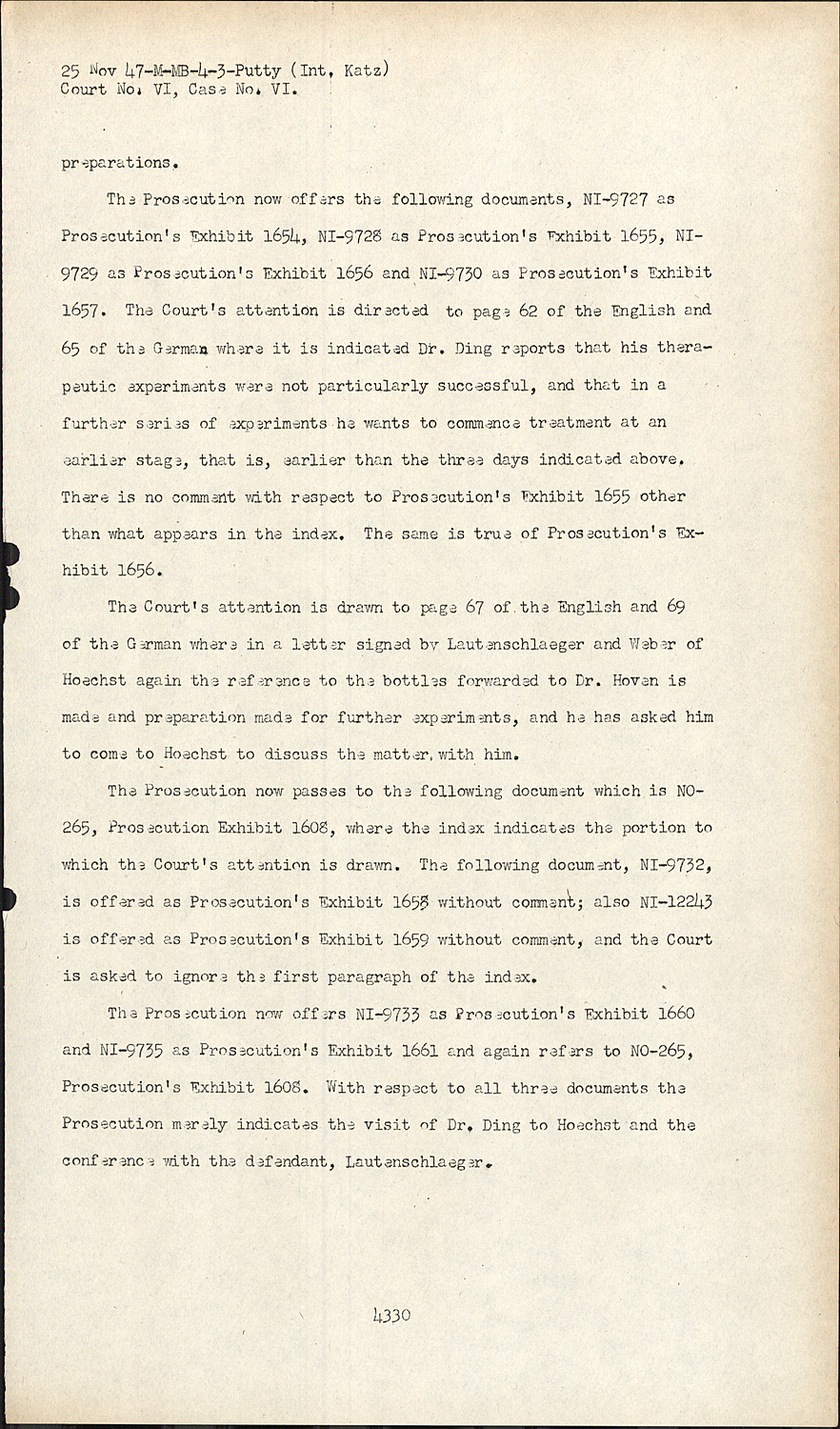
preparations.
The Prosecution now offers the following documents, NI-9727 as Prosecution's Exhibit 1654, NI-9728 as Prosecution's Exhibit 1655, NI9729 Prosecution's Exhibit 1656 and NI-9730 as Prosecution's Exhibit 1657. The Court's attention is directed to page 62 of the English and 65 of the German where it is indicated Dr. Ding reports that his therapeutic experiments were not particularly successful, and that in a further series of experiments he wants to commence treatment at an earlier stage, that is, earlier than the three days indicated above. There is no comment with respect to Prosecution's Exhibit 1655 other than what appears in the index. The same is true of Prosecution's Exhibit 1656.
The Court's attention is drawn to page 67 of the English and 69 of the German where in a letter signed by Lautenschlaeger and Weber of Hoechst again the reference to the bottles forwarded to Dr. Hoven is made and preparation made for further experiments, and he has asked him to come to Hoechst to discuss the matter with him.
The Prosecution now passes to the following document which is NO265, Prosecution Exhibit 1608, where the index indicates the portion to which the Court's attention is drawn. The following document, NI-9732, is offered as Prosecution's Exhibit 1658 without comment; also NI-12243is offered as Prosecution's Exhibit 1659 without comment, and the Court is asked to ignore the first paragraph of the index.
The Prosecution now offers NI-9733 as Prosecution's Exhibit 1660 and NI-9735 as Prosecution's Exhibit 1661 and again refers to NO-265, Prosecution's Exhibit 1608. With respect to all three documents the Prosecution merely indicates the visit of Dr. Ding to Hoechst and the conference with the defendant, Lautenschlaeger.
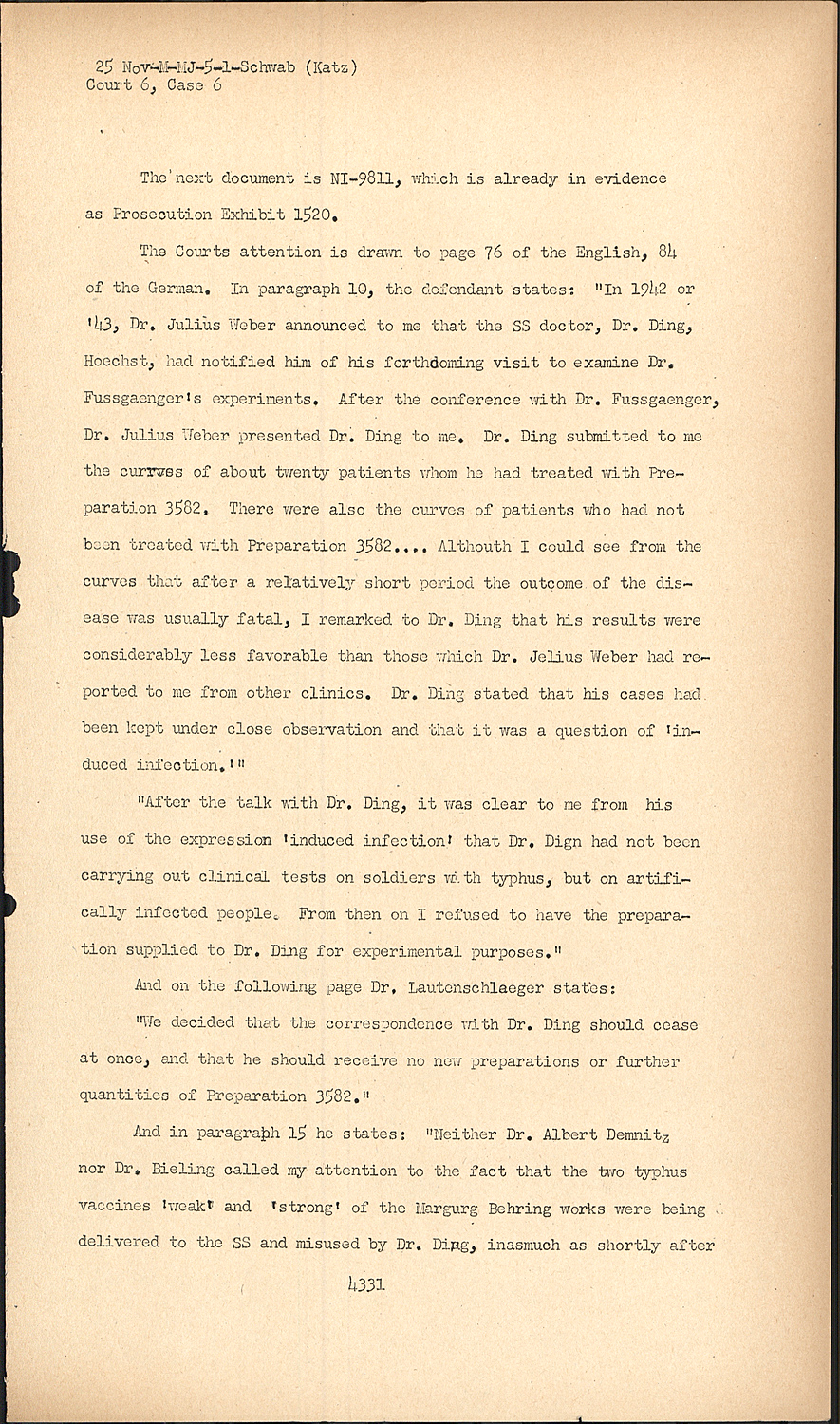
The next document is NI-9811, which is already in evidence as Prosecution Exhibit 1520.
The Courts attention is drawn to page 76 of the English, 84 of the German. In paragraph 10, the defendant states: "In 1942 or '43, Dr. Julius Weber announced to me that the SS doctor, Dr. Ding, Hoechst, had notified him of his forthcoming visit to examine Dr. Fussgaenger's experiments. After the conference with Dr. Fussgaenger, Dr. Julius Weber presented Dr. Ding to me. Dr. Ding submitted to me the cur*ves of about twenty patients whom he had treated with Preparation 3582. There were also the curves of patients who had not been treated with Preparation 3582.... Althouth I could see from the curves that after a relatively short period the outcome of the disease was usually fatal, I remarked to Dr. Ding that his results were considerably less favorable than those which Dr. Jelius Weber had reported to me from other clinics. Dr. Ding stated that his cases had been kept under close observation and that it was a question of 'induced infection.'" "After the talk with Dr. Ding, it was clear to me from his use of the expression 'induced infection' that Dr. Dign had not been carrying out clinical tests on soldiers with typhus, but on artifically infected people.
From then on I refused to have the preparation supplied to Dr. Ding for experimental purposes."
And on the following page Dr. Lautenschlaeger states:
"We decided that the correspondence with Dr. Ding should cease at once, and that he should receive no new preparations or further quantities of Preparation 3582."
And in paragraph 15 he states: "Neither Dr. Albert Demnitz nor Dr. Bieling called my attention to the fact that the two typhus vaccines 'weak' and 'strong' of the Margurg Behring works were being delivered to the SS and misused by Dr. Ding, inasmuch as shortly after the protective innoculation people were artificially infected with typhus."
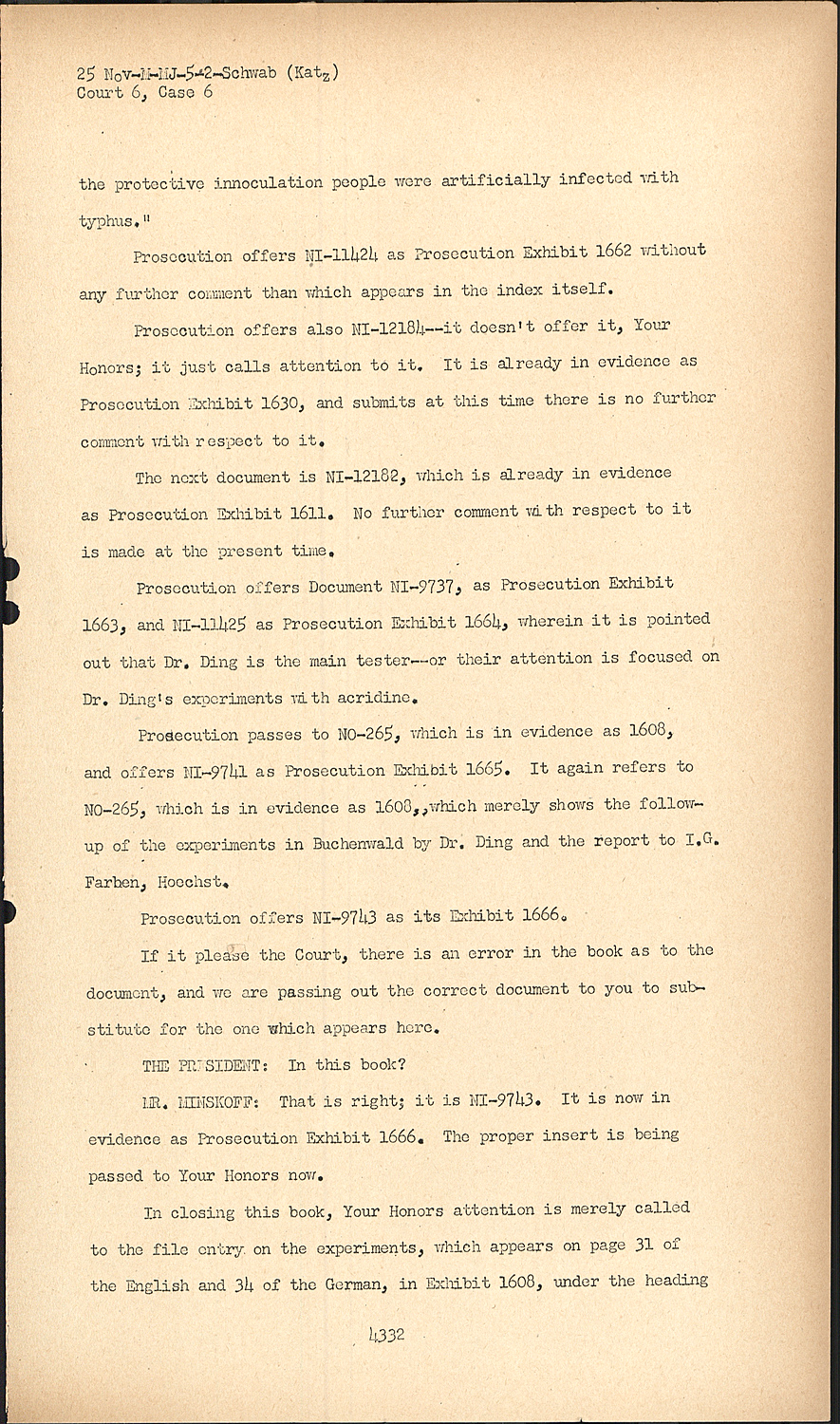
Prosecution offers NI-11424 as Prosecution Exhibit 1662 without any further comment than which appears in the index itself.
Prosecution offers also NI-12184--it doesn't offer it, Your Honors; it just calls attention to it. It is already in evidence as Prosecution Exhibit 1630, and submits at this time there is no further comment with respect to it.
The next document is NI-12182, which is already in evidence as Prosecution Exhibit 1611. No further comment with respect to it is made at the present time.
Prosecution offers Document NI-9737, as Prosecution Exhibit 1663, and NI-11425 as Prosecution Exhibit 1664, wherein it is pointed out that Dr. Ding is the main tester--or their attention is focused on Dr. Ding's experiments with acridine.
Prosecution passes to NO-265, which is in evidence as 1608, and offers NI-9741 as Prosecution Exhibit 1665. It again refers to NO-265, which is in evidence as 1608,,which merely shows the followup of the experiments in Buchenwald by Dr. Ding and the report to I.G. Farben, Hoechst.
Prosecution offers NI-9743 as its Exhibit 1666.
If it please the Court, there is an error in the book as to the document, and we are passing out the correct document to you to substitute for the one which appears here.
THE PRESIDENT:In this book?
MR. MINSKOFF:That is right; it is NI-9743. It is now in evidence as Prosecution Exhibit 1666. The proper insert is being passed to Your Honors now.
In closing this book, Your Honors attention is merely called to the file entry, on the experiments, which appears on page 31 of the English and 34 of the German, in Exhibit 1608, under the heading 1 June '43, "Charts of case history completed.
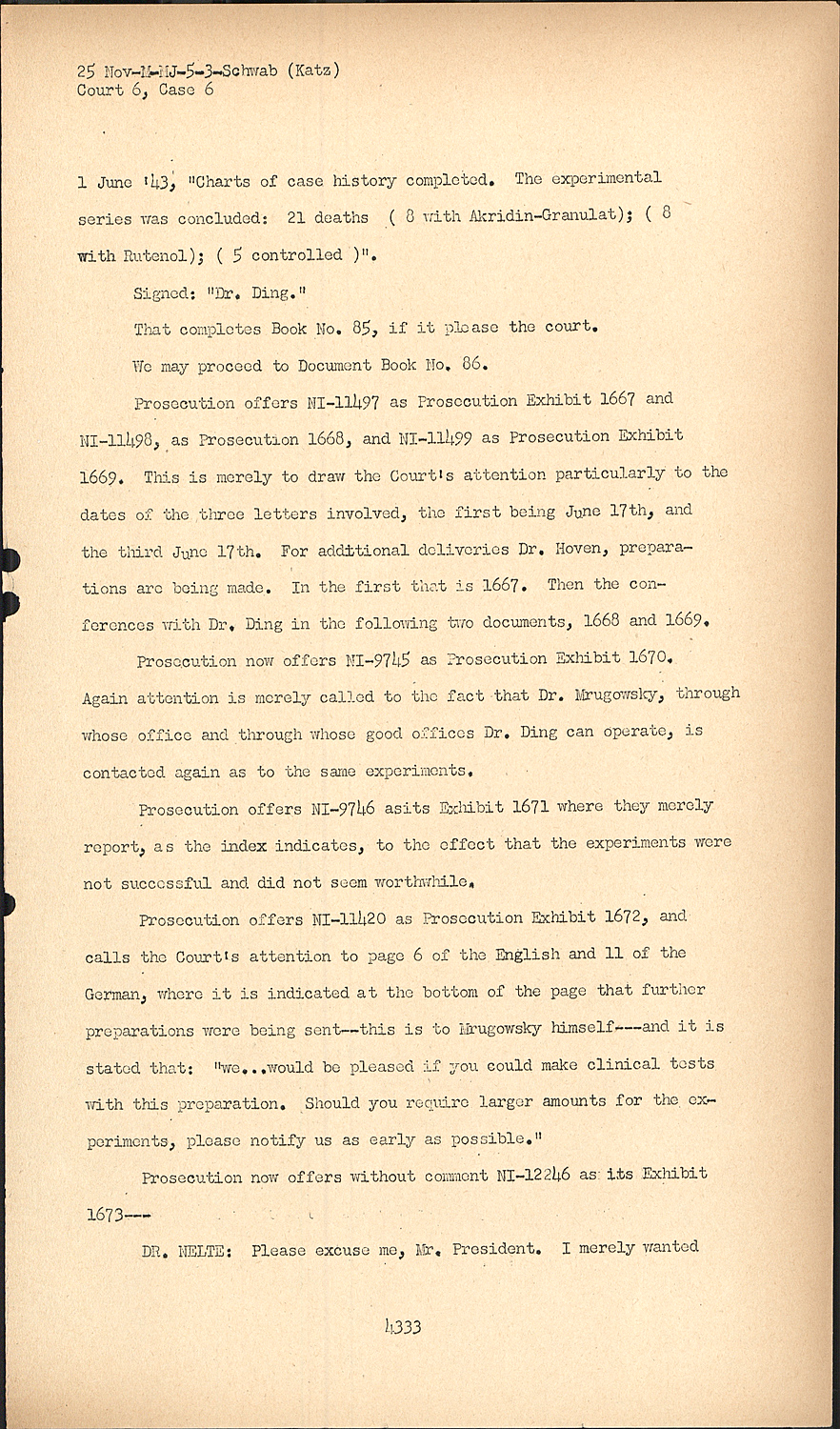
The experimental series was concluded: 21 deaths ( 8 with Akridin-Granulat); ( 8 with Rutenol); ( 5 controlled )".
Signed: "Dr. Ding."
That completes Book No. 85, if it please the court.
We may proceed to Document Book No. 86.
Prosecution offers NI-11497 as Prosecution Exhibit 1667 and NI-11498, as Prosecution 1668, and NI-11499 as Prosecution Exhibit 1669. This is merely to draw the Court's attention particularly to the dates of the three letters involved, the first being June 17th, and the third June 17th. For additional deliveries Dr. Hoven, preparations are being made. In the first that is 1667. Then the conferences with Dr. Ding in the following two documents, 1668 and 1669.
Prosecution now offers NI-9745 as Prosecution Exhibit 1670. Again attention is merely called to the fact that Dr. Mrugowsky, through whose office and through whose good offices Dr. Ding can operate, is contacted again as to the same experiments.
Prosecution offers NI-9746 asits Exhibit 1671 where they merely report, as the index indicates, to the effect that the experiments were not successful and did not seem worthwhile.
Prosecution offers NI-11420 as Prosecution Exhibit 1672, and calls the Court's attention to page 6 of the English and 11 of the German, where it is indicated at the bottom of the page that further preparations were being sent--this is to Mrugowsky himself---and it is stated that: "we...would be pleased if you could make clinical tests with this preparation. Should you require larger amounts for the experiments, please notify us as early as possible."
Prosecution now offers without comment NI-12246 as its Exhibit 1673--
DR. NELTE:Please excuse me, Mr. President. I merely wanted to ask the Prosecution to tell me where this document originates from.
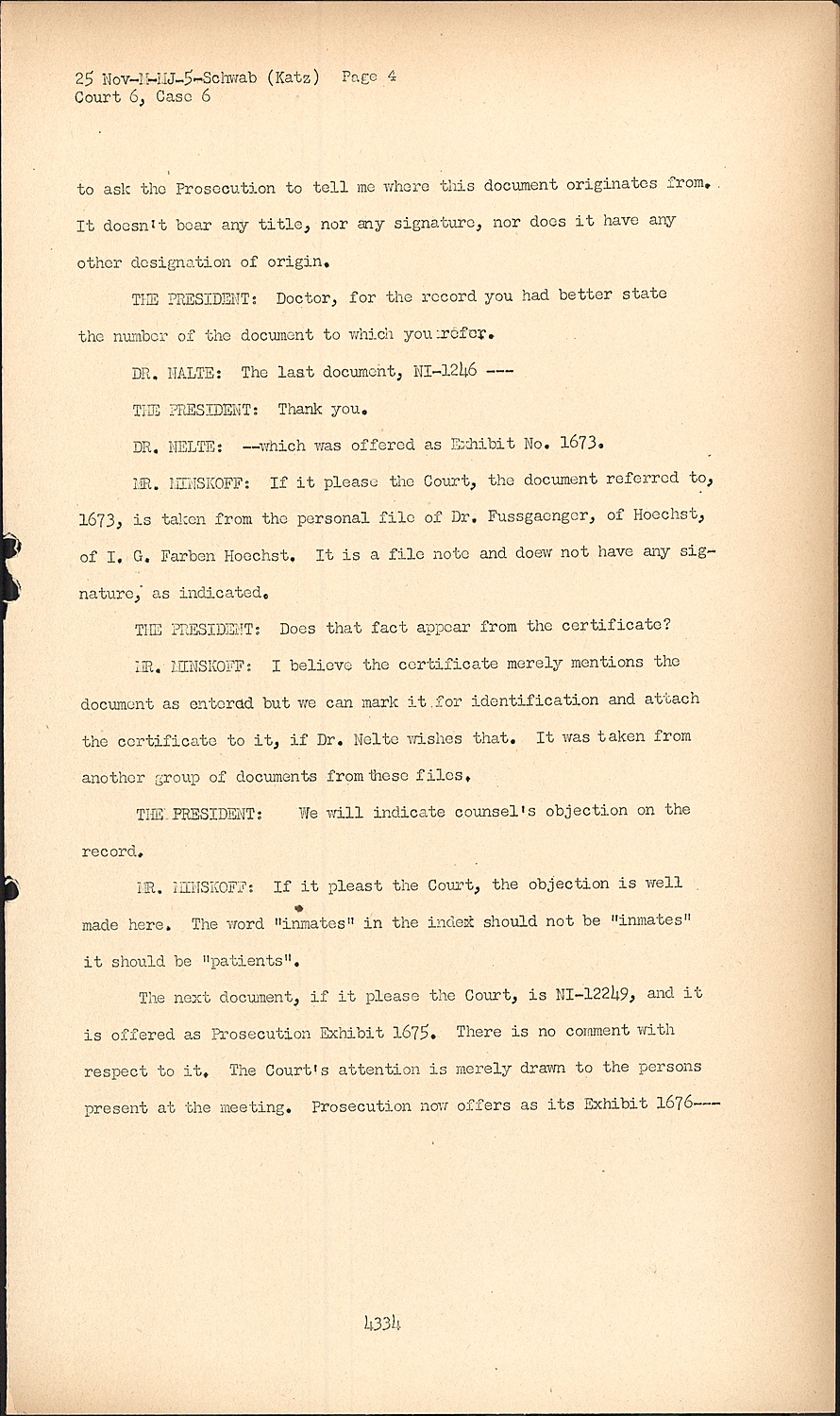
It doesn't bear any title, nor any signature, nor does it have any other designation of origin.
THE PRESIDENT:Doctor, for the record you had better state the number of the document to which you refer.
DR. NALTE:The last document, NI-1246 --
THE PRESIDENT:Thank you.
DR.NELTE: --which was offered as Exhibit No. 1673.
MR. MINSKOFF:If it please the Court, the document referred to, 1673, is taken from the personal file of Dr. Fussgaenger, of Hoechst, of I. G. Farben Hoechst. It is a file note and doew not have any signature, as indicated.
THE PRESIDENT:Does that fact appear from the certificate?
MR. MINSKOFF:I believe the certificate merely mentions the document as entered but we can mark it for identification and attach the certificate to it, if Dr. Nelte wishes that. It was taken from another group of documents from these files.
THE PRESIDENT:We will indicate counsel's objection on the record.
MR. MINSKOFF:If it pleast the Court, the objection is well made here. The word "inmates" in the index should not be "inmates" it should be "patients".
The next document, if it please the Court, is NI-12249, and it is offered as Prosecution Exhibit 1675. There is no comment with respect to it. The Court's attention is merely drawn to the persons present at the meeting. Prosecution now offers as its Exhibit 1676--
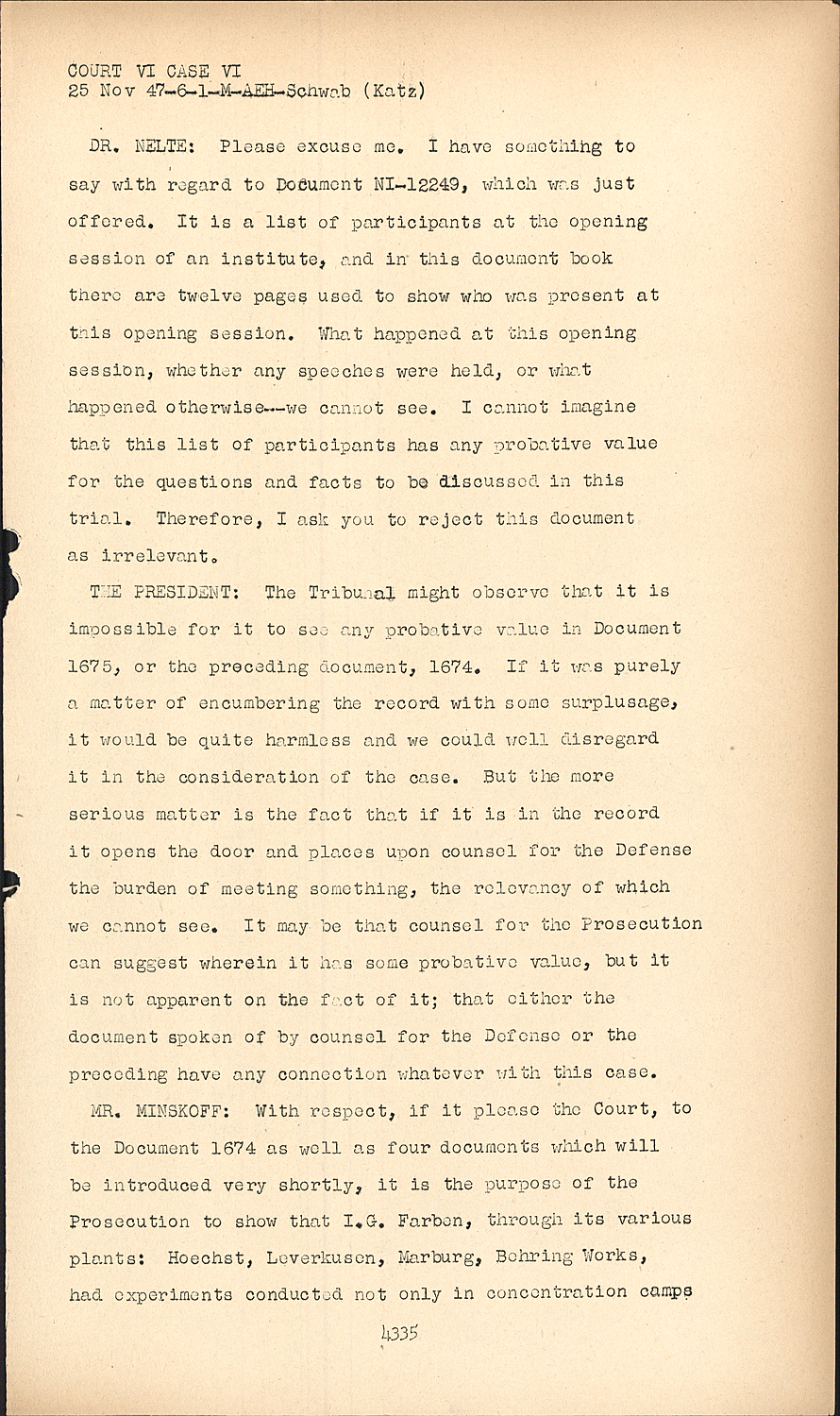
DR. NELTE:Please excuse me. I have something to say with regard to Document NI-12249, which was just offered. It is a list of participants at the opening session of an institute, and in this document book there are twelve pages used to show who was present at this opening session. What happened at this opening session, whether any speeches were held, or what happened otherwise--we cannot see. I cannot imagine that this list of participants has any probative value for the questions and facts to be discussed in this trial. Therefore, I ask you to reject this document as irrelevant.
THE PRESIDENT:The Tribunal might observe that it is impossible for it to see any probative value in Document 1675, or the preceding document, 1674. If it was purely a matter of encumbering the record with some surplusage, it would be quite harmless and we could well disregard it in the consideration of the case. But the more serious matter is the fact that if it is in the record it opens the door and places upon counsel for the Defense the burden of meeting something, the relevancy of which we cannot see. It may be that counsel for the Prosecution can suggest wherein it has some probative value, but it is not apparent on the fact of it; that either the document spoken of by counsel for the Defense or the preceding have any connection whatever with this case.
MR. MINSKOFF:With respect, if it please the Court, to the Document 1674 as well as four documents which will be introduced very shortly, it is the purpose of the Prosecution to show that I.G. Farben, through its various plants: Hoechst, Leverkusen, Marburg, Behring Works, had experiments conducted not only in concentration camps COURT VI CASE VI upon inmates, but also upon other groups of persons where their ability to consent would be lacking.
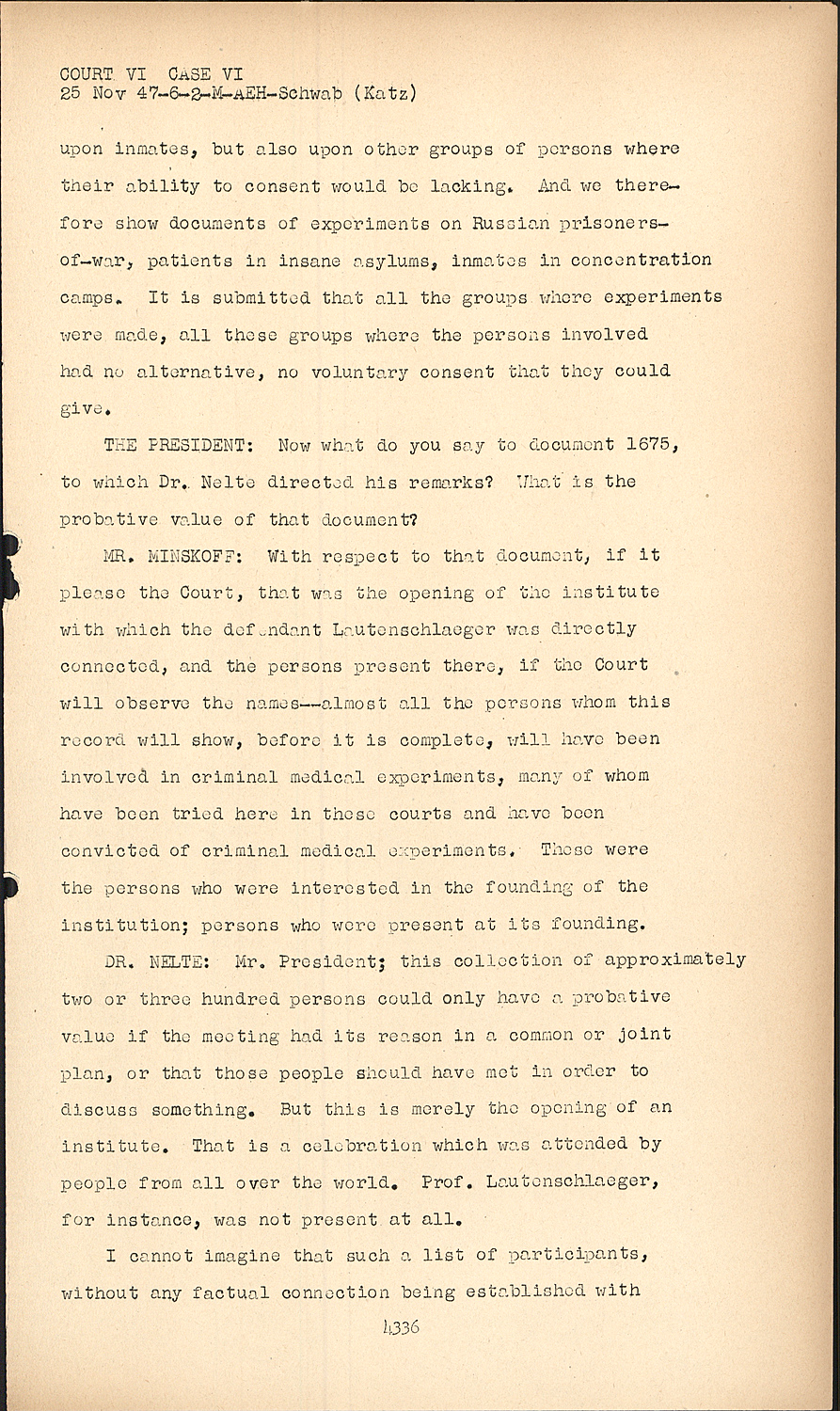
And we therefore show documents of experiments on Russian prisonersof-war, patients in insane asylums, inmates in concentration camps. It is submitted that all the groups where experiments were made, all these groups where the persons involved had no alternative, no voluntary consent that they could give.
THE PRESIDENT:Now what do you say to document 1675, to which Dr. Nelte directed his remarks? What is the probative value of that document?
MR. MINSKOFF:With respect to that document, if it please the Court, that was the opening of the institute with which the defendant Lautenschlaeger was directly connected, and the persons present there, if the Court will observe the names--almost all the persons whom this record will show, before it is complete, will have been involved in criminal medical experiments, many of whom have been tried here in these courts and have been convicted of criminal medical experiments. These were the persons who were interested in the founding of the institution; persons who were present at its founding.
DR. NELTE:Mr. President; this collection of approximately two or three hundred persons could only have a probative value if the meeting had its reason in a common or joint plan, or that those people should have met in order to discuss something. But this is merely the opening of an institute. That is a celebration which was attended by people from all over the world. Prof. Lautenschlaeger, for instance, was not present at all.
I cannot imagine that such a list of participants, without any factual connection being established with COURT VI CASE VI the facts in this case, should have any probative value.
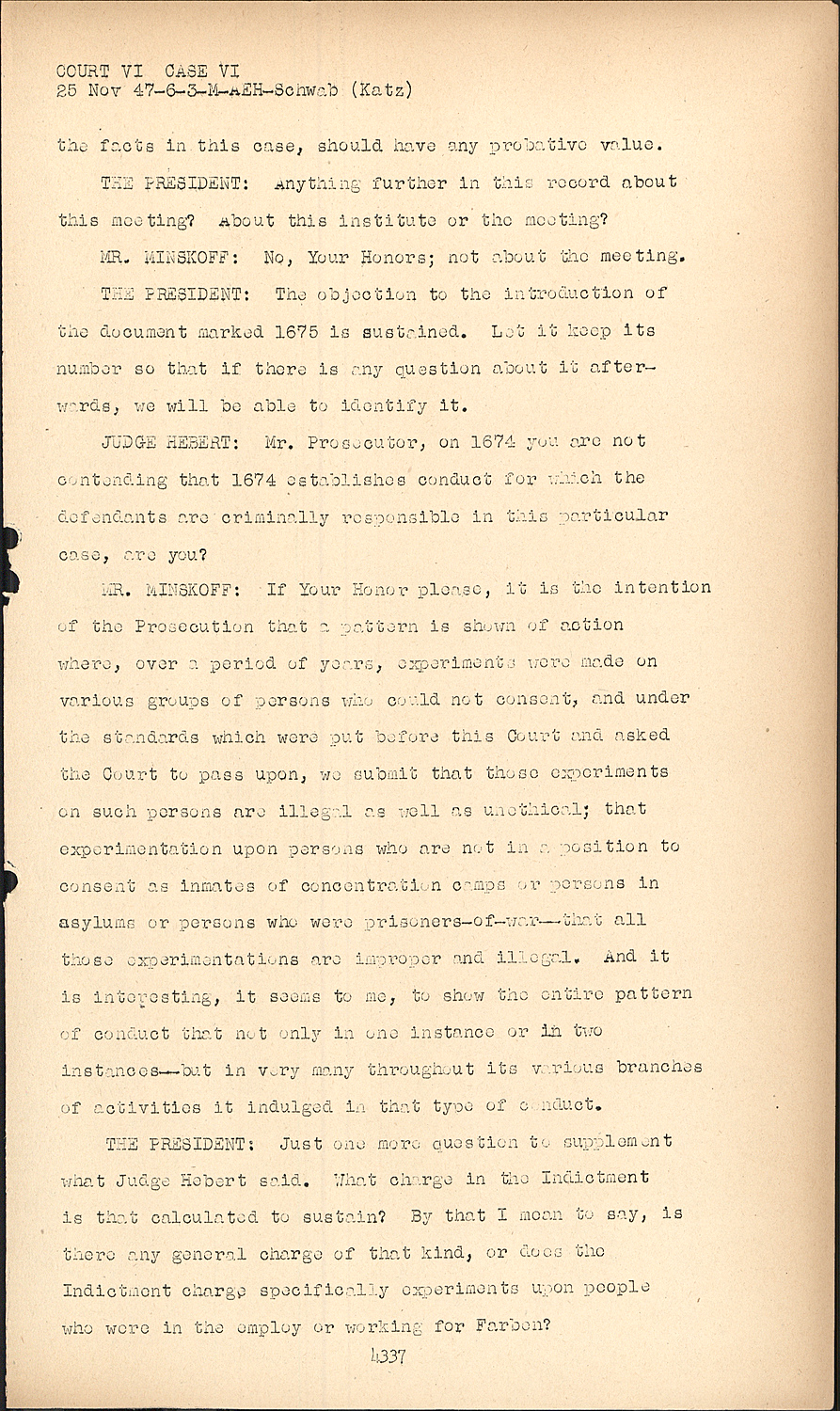
THE PRESIDENT:Anything further in this record about this meeting? About this institute or the meeting?
MR. MINSKOFF:No, Your Honors; not about the meeting.
THE PRESIDENT:The objection to the introduction of the document marked 1675 is sustained. Let it keep its number so that if there is any question about it afterwards, we will be able to identify it.
JUDGE HEBERT:Mr. Prosecutor, on 1674 you are not contending that 1674 establishes conduct for which the defendants are criminally responsible in this particular case, are you?
MR. MINSKOFF:If Your Honor please, it is the intention of the Prosecution that a pattern is shown of action where, over a period of years, experiments were made on various groups of persons who could not consent, and under the standards which were put before this Court and asked the Court to pass upon, we submit that those experiments on such persons are illegal as well as unethical; that experimentation upon persons who are not in a position to consent as Inmates of concentration camps or persons in asylums or persons who were prisoners-of-war--that all those experimentations are improper and illegal. And it is interesting, it seems to me, to show the entire pattern of conduct that not only in one instance or in two instances--but in very many throughout its various branches of activities it indulged in that type of conduct.
THE PRESIDENT:Just one more question to supplement what Judge Hebert said. What charge in the Indictment is that calculated to sustain? By that I mean to say, is there any general charge of that kind, or does the Indictment charge specifically experiments upon people who were in the employ or working for Farben?