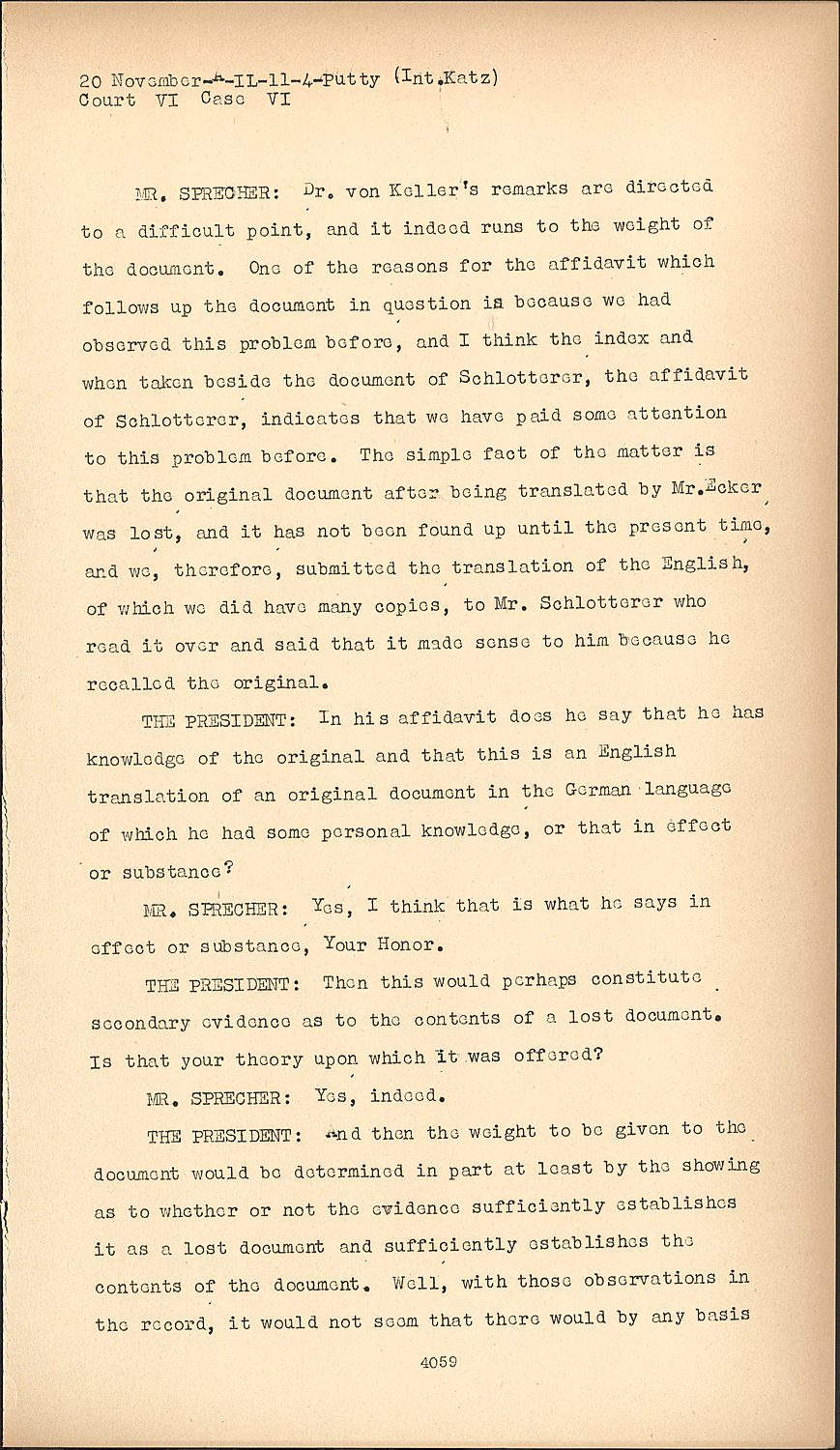
MR. SPRECHER:Dr. von Keller's remarks are directed to a difficult point, and it indeed runs to the weight of the document. One of the reasons for the affidavit which follows up the document in question is because we had observed this problem before, and I think the index and when taken beside the document of Schlotterer, the affidavit of Schlotterer, indicates that we have paid some attention to this problem before. The simple fact of the matter is that the original document after being translated by Mr.Ecker was lost, and it has not been found up until the present time, and we, therefore, submitted the translation of the English, of which we did have many copies, to Mr. Schlotterer who read it over and said that it made sense to him because he recalled the original.
THE PRESIDENT:In his affidavit does he say that he has knowledge of the original and that this is an English translation of an original document in the German language of which he had some personal knowledge, or that in effect or substance?
MR. SPRECHER:Yes, I think that is what he says in effect or substance, Your Honor.
THE PRESIDENT:Then this would perhaps constitute secondary evidence as to the contents of a lost document. Is that your theory upon which it was offered?
MR. SPRECHER:Yes, indeed.
THE PRESIDENT:And then the weight to be given to the document would be determined in part at least by the showing as to whether or not the evidence sufficiently establishes it as a lost document and sufficiently establishes the contents of the document. Well, with those observations in the record, it would not seem that there would by any basis upon which the Tribunal should reject the document, but, of course, in the determination of the authenticity of the document as well as the question of whether or not it is a faithful translation of a lost document, the objections of Counsel for the Defense should be kept in mind and considered by the Tribunal.
Anything further, Dr. von Keller, that you have to say on that subject?
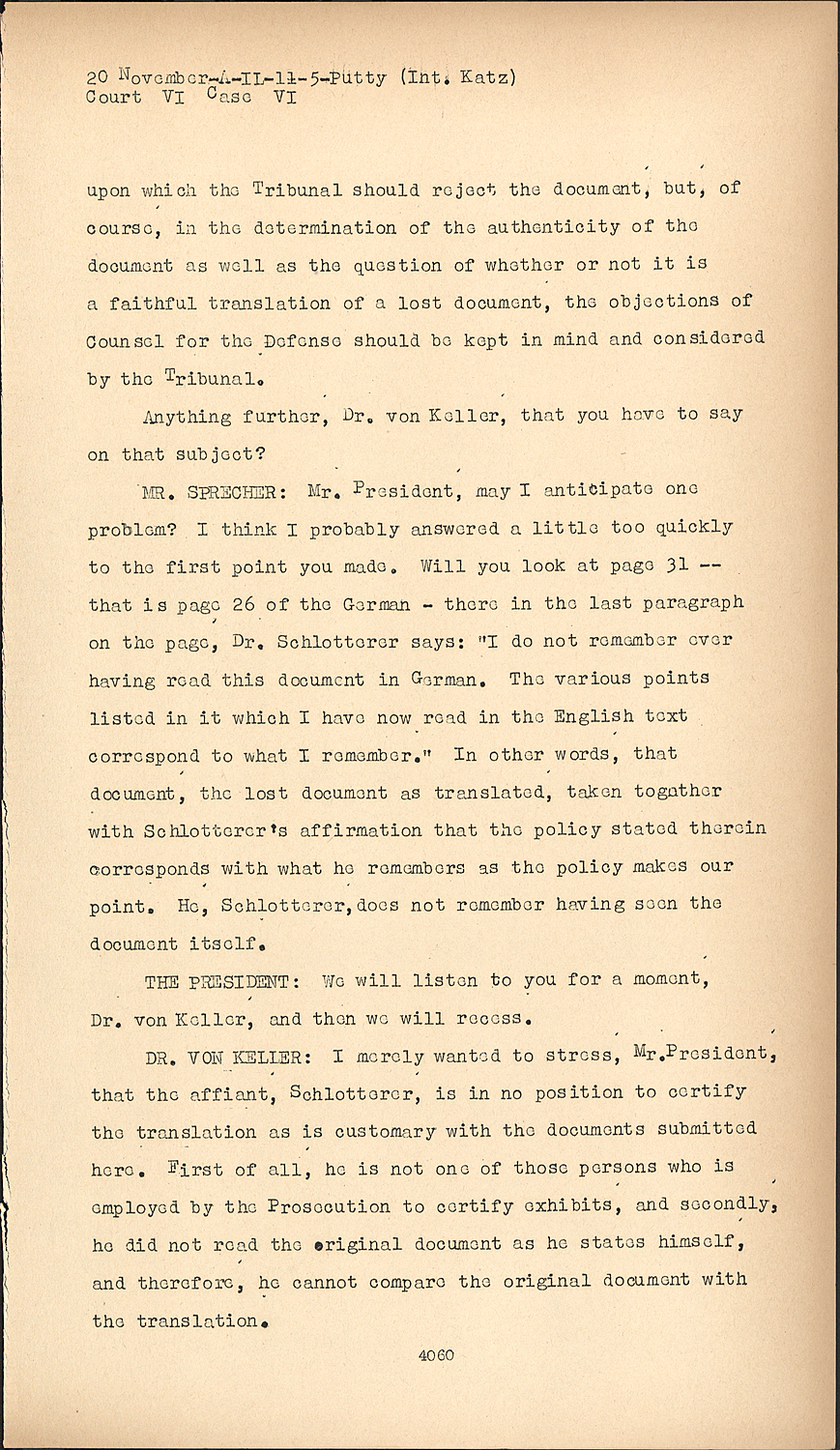
MR. SPRECHER:Mr. President, may I anticipate one problem? I think I probably answered a little too quickly to the first point you made. Will you look at page 31 -that is page 26 of the German - there in the last paragraph on the page, Dr. Schlotterer says: "I do not remember over having read this document in German. The various points listed in it which I have now read in the English text correspond to what I remember." In other words, that document, the lost document as translated, taken together with Schlotterer's affirmation that the policy stated therein corresponds with what he remembers as the policy makes our point. He, Schlotterer,does not remember having seen the document itself.
THE PRESIDENT:We will listen to you for a moment, Dr. von Keller, and then we will recess.
DR. VON KELIER:I merely wanted to stress, Mr.President, that the affiant, Schlotterer, is in no position to certify the translation as is customary with the documents submitted here. First of all, he is not one of those persons who is employed by the Prosecution to certify exhibits, and secondly, he did not read the original document as he states himself, and therefore, he cannot compare the original document with the translation.
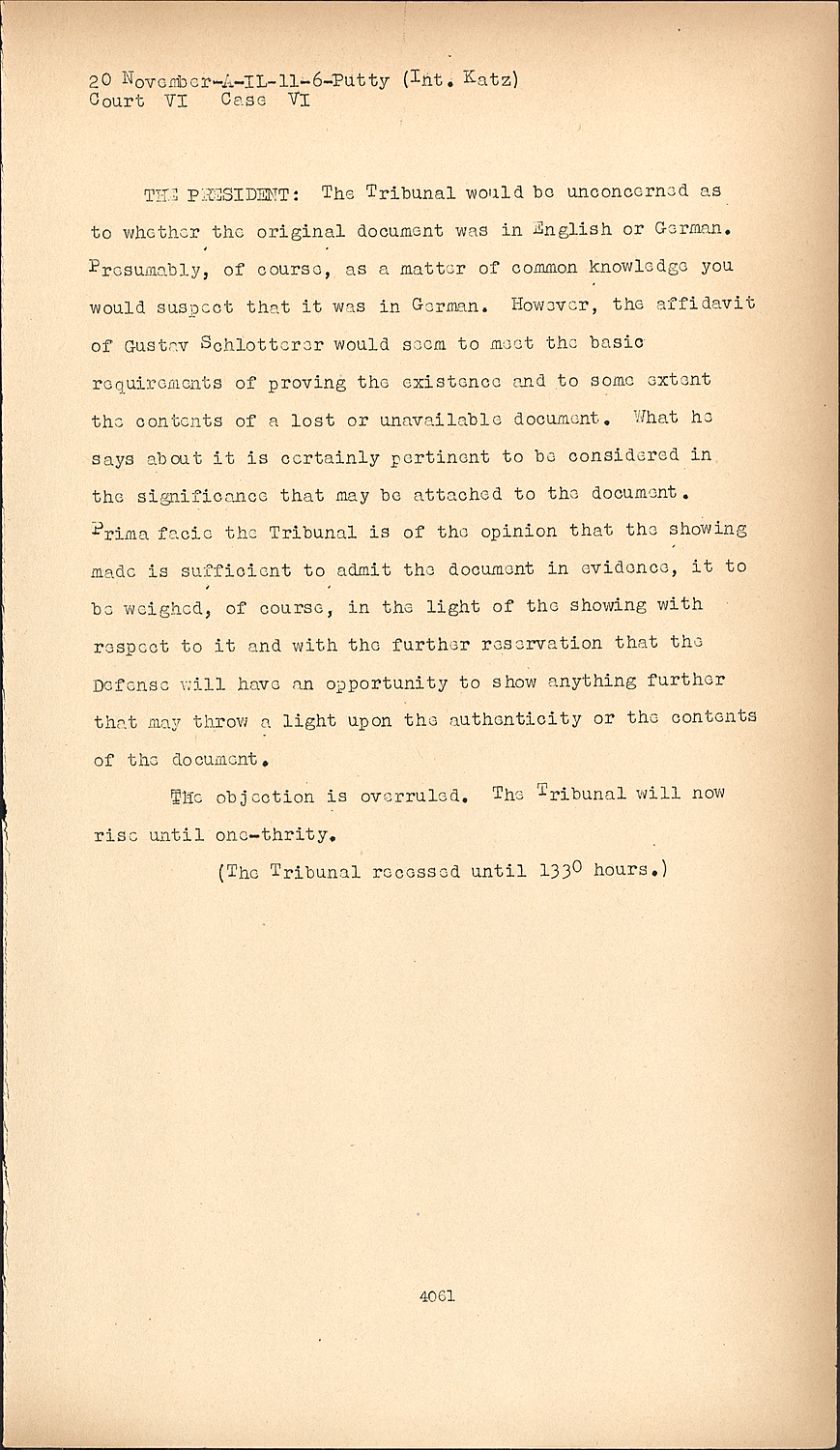
THE PRESIDENT:The Tribunal would be unconcerned as to whether the original document was in English or German. Presumably, of course, as a matter of common knowledge you would suspect that it was in German. However, the affidavit of Gustav Schlotterer would seem to meet the basic requirements of proving the existence and to some extent the contents of a lost or unavailable document. What he says about it is certainly pertinent to be considered in the significance that may be attached to the document. Prima facie the Tribunal is of the opinion that the showing made is sufficient to admit the document in evidence, it to be weighed, of course, in the light of the showing with respect to it and with the further reservation that the Defense will have an opportunity to show anything further that may throw a light upon the authenticity or the contents of the document.
The objection is overruled. The Tribunal will now rise until one-thrity.
(The Tribunal recessed until 1330 hours.)
AFTEERNOON SESSION
THE MARSHAL:The Tribunal is again in session.
MR. SPRECHER:Mr. President -
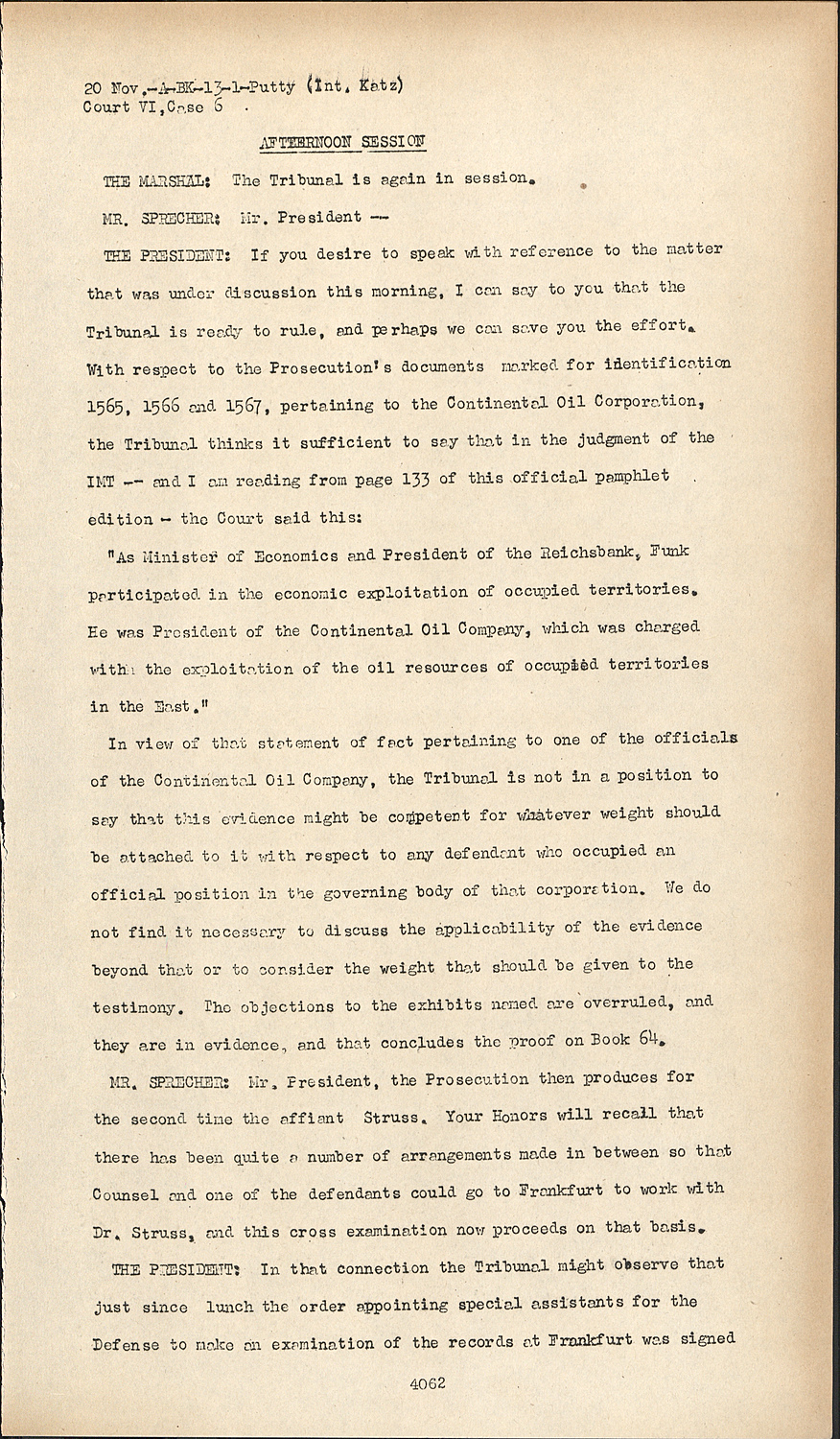
THE PRESIDENT:If you desire to speak with, reference to the matter that was under discussion this morning, I can say to you that the Tribunal is ready to rule, and perhaps we can save you the effort. With respect to the Prosecution's documents marked for identification 1565, 1566 and 1567, pertaining to the Continental Oil Corporation, the Tribunal thinks it sufficient to say that in the judgment of the IMT -- and I an reading from page 133 this official pamphlet edition - the Court said this:
"As Minister of Economics and President of the Reichsbank, Funk participated in the economic exploitation of occupied territories. He was President of the Continental Oil Company, which was charged with the exploitation of the oil resources of occupied territories in the East."
In view of that statement of fact pertaining to one of the officials of the Continental Oil Company, the Tribunal is not in a position to say that this evidence might be competent for whatever weight should be attached to it with respect to any defendant who occupied an official position in the governing body of that corporation. We do not find it necessary to discuss the applicability of the evidence beyond that or to consider the weight that should be given to the testimony. The objections to the exhibits named are overruled, and they are in evidence, and that concludes the proof on Book 64.
MR. SPRECHER:Mr. President, the Prosecution then produces for the second time the affiant Struss. Your Honors will recall that there has been quite a number of arrangements made in between so that Counsel and one of the defendants could go to Frankfurt to work with Dr. Struss, and this cross examination now proceeds on that basis.
THE PRESIDENT:In that connection the Tribunal might observe that just since lunch the order appointing special assistants for the Defense to make an examination of the records at Frankfurt was signed and deposited in the office of the Secretory General.
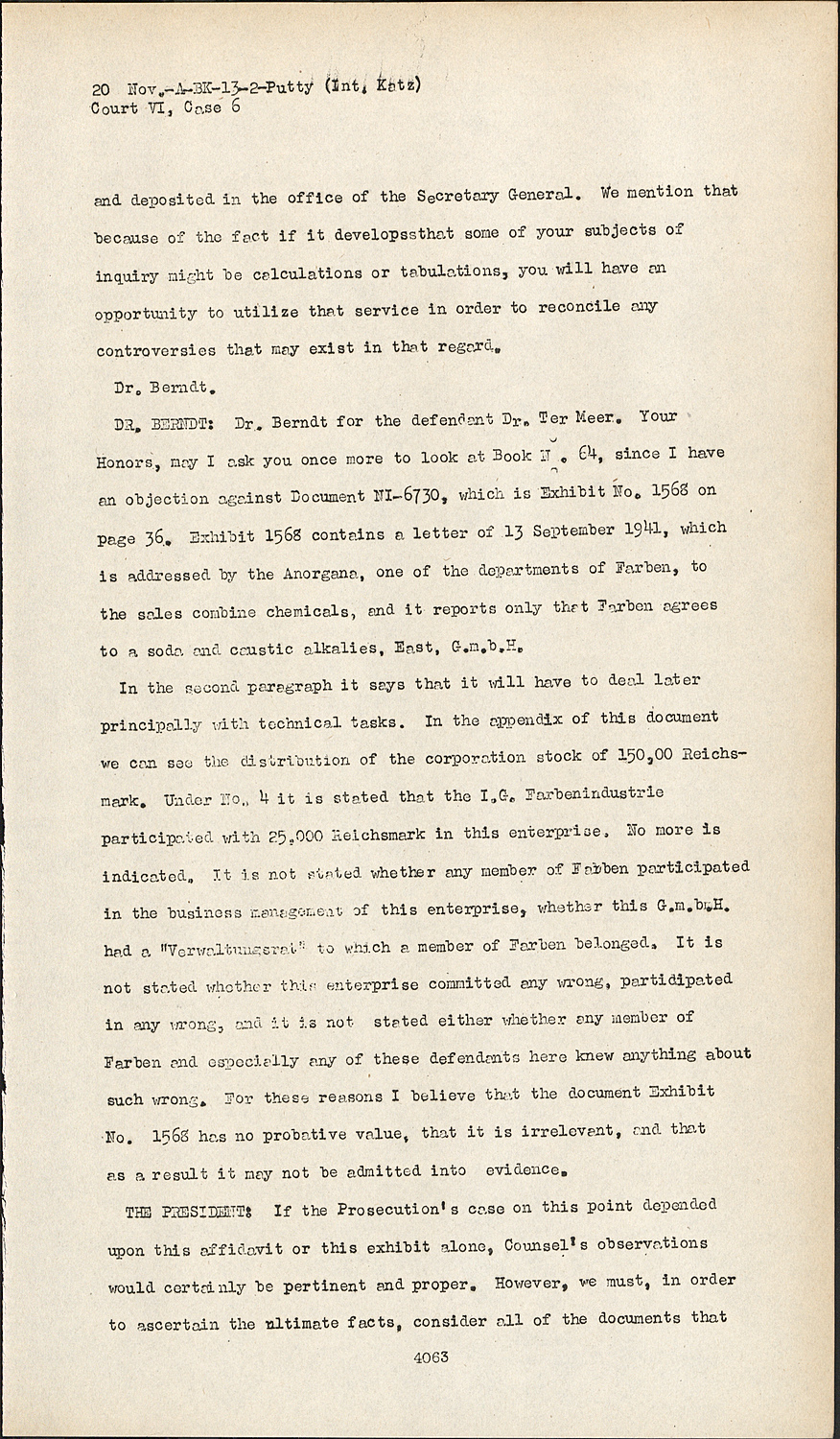
We mention that because of the fact if it developssthat some of your subjects of inquiry might be calculations or tabulations, you will have an opportunity to utilize that service in order to reconcile any controversies that may exist in that regard.
Dr. Berndt.
DR. BERNDT:Dr. Berndt for the defendant Dr. Ter Meer. Your Honors, may I ask you once more to look at Book No. 64, since I have an objection against Document NI-6730, which is Exhibit No. 1568 on Page 36. Exhibit 1568 contains a letter of 13 September 1941, which is addressed by the Anorgana, one of the departments of Farben, to the sales combine chemicals, and it reports only that Farben agrees to a soda and caustic alkalies, East, G.m.b.H.
In the second paragraph it says that it will have to deal later principally with technical tasks. In the appendix of this document we can see the distribution of the corporation stock of 150,00 Reichsmark. Under No. 4 it is stated that the I.G. Farbenindustrie participated with 25,000 Reichsmark in this enterprise. No more is indicated. It is not stated whether any member of Fabben participated in the business management of this enterprise, whether this G.m.b.H. had a "Verwaltungsrat" to which a member of Farben belonged. It is not stated whether this enterprise committed any wrong, participated in any wrong, and it is not stated either whether any member of Farben and especially any of these defendants here knew anything about such wrong. For these reasons I believe that the document Exhibit No. 1568 has no probative value, that it is irrelevant, and that as a result it may not be admitted into evidence.
THE PRESIDENT:If the Prosecution's case on this point depended upon this affidavit or this exhibit alone, Counsel's observations would certainly be pertinent and proper. However, we must, in order to ascertain the ultimate facts, consider all of the documents that bear on the subject.
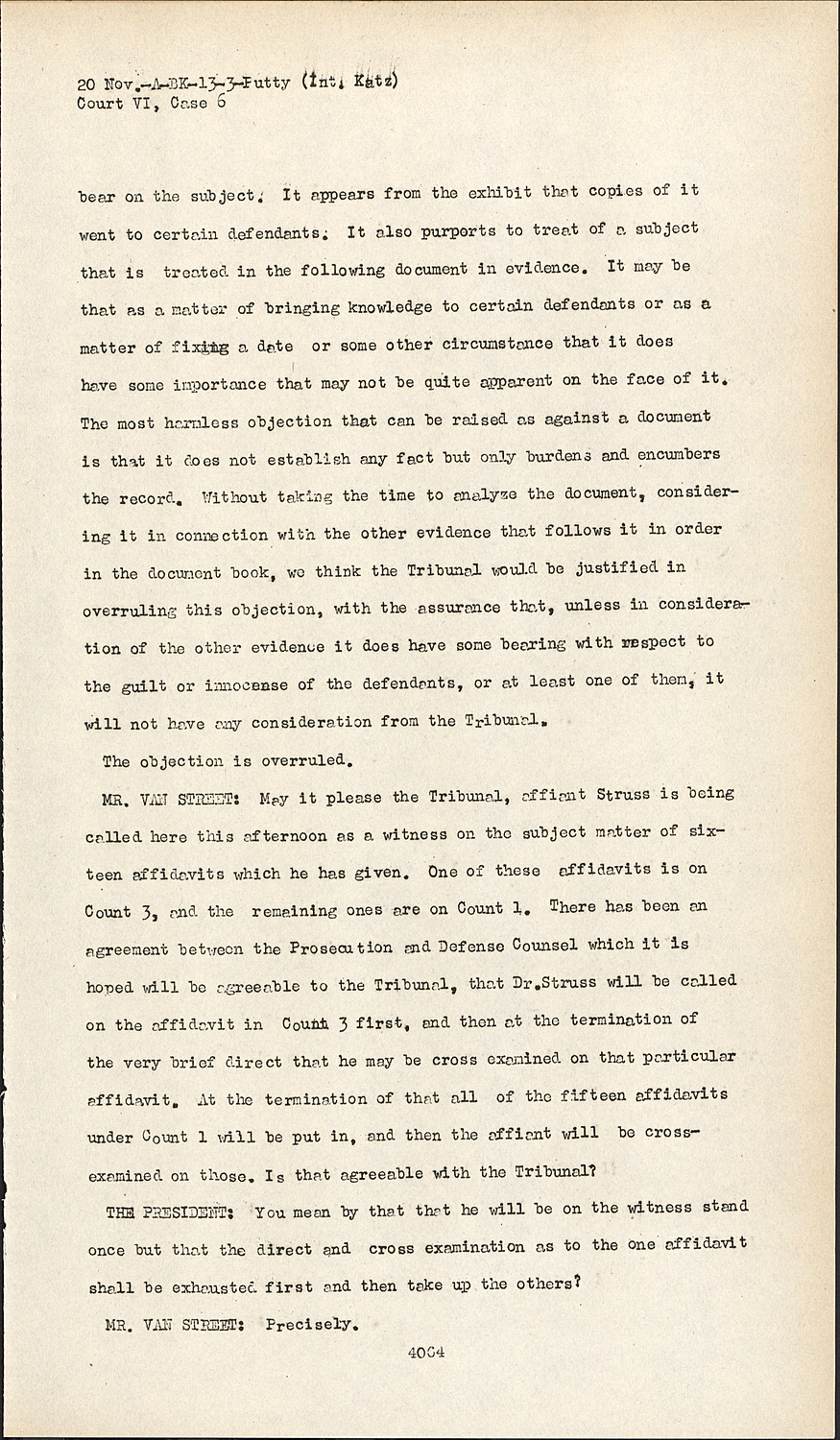
It appears from the exhibit that copies of it went to certain defendants. It also purports to treat of a subject that is treated in the following document in evidence. It may be that as a matter of bringing knowledge to certain defendants or as a matter of fixing a date or some other circumstance that it does have some importance that may not be quite apparent on the face of it. The most harmless objection that can be raised as against a document is that it does not establish any fact but only burdens and encumbers the record. Without talcing the time to analyse the document, considering it in connection with the other evidence that follows it in order in the document book, we think the Tribunal viould be justified in overruling this objection, with the assurance tha.t, unless in consideration of the other evidence it does have some bearing with respect to the guilt or innocense of the defendants, or at least one of them, it will not have any consideration from the Tribunal.
The objection is overruled.
MR. VAN STREET:May it please the Tribunal, affiant Struss is being called here this afternoon as a witness on the subject matter of sixteen affidavits which he has given. One of these affidavits is on Count 3, and the remaining ones are on Count 1. There has been an agreement between the Prosecution and Defense Counsel which it is hoped will be agreeable to the Tribunal, that Dr.Struss will be called on the affidavit in Count 3 first, and then at the termination of the very brief direct that he may be cross examined on that particular affidavit. At the termination of that all of the fifteen affidavits under Count 1 will be put in, and then the affiant will be crossexamined on those. Is that agreeable with the Tribunal?
THE PRESIDENT:You mean by that thrt he will be on the witness stand once but that the direct and cross examination as to the one affidavit shall be exhausted first and then take up the others?
MR. VAN STREET:Precisely.
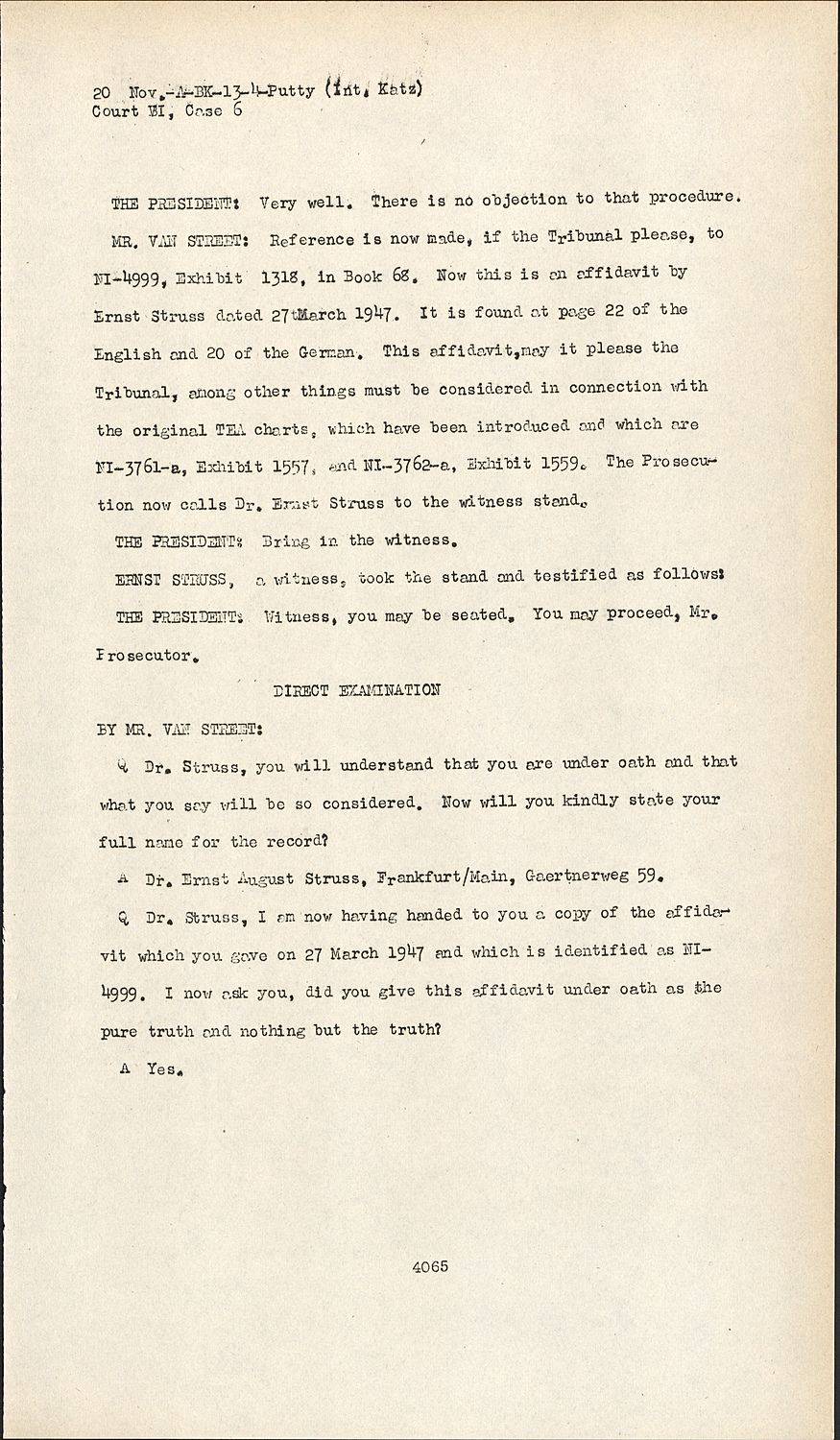
THE PRESIDENT:Very well. There is no objection to that procedure.
MR. VAN STREET:Reference is now made, if the Tribunal please, to NI-4999, Exhibit 1318, in Book 68. Now this is an affidavit by Ernst Struss dated 27tmarch 1947. It is found at page 22 of the English and 20 of the German. This affidavit,may it please the Tribunal, among other things must be considered in connection with the original TEA charts, which have been introduced and which are NI-3761-a, Exhibit 1557, and NI-3762-a, Exliibit 1559. The Prosecution now calls Dr. Ernst Struss to the witness stand.
THE PRESIDENT:Bring in the witness.
ERNSTSTRUSS, a witness, took the stand and testified as follows:
THE PRESIDENT:Witness, you may be seated. You nay proceed, Mr. Prosecutor.
DIRECT EXAMINATION BY MR. VAN STREET:
QDr. Struss, you will understand that you are under oath and that what you say will be so considered. How will you kindly state your full name for the record?
ADr. Ernst August Struss, Frankfurt/Main, Gaertnerweg 59.
QDr. Struss, I rn now having handed to you a copy of the affidavit which you gave on 27 March 1947 which is identified as NI4999. I now ask you, did you give this affidavit under oath as the pure truth and nothing but the truth?
AYes.
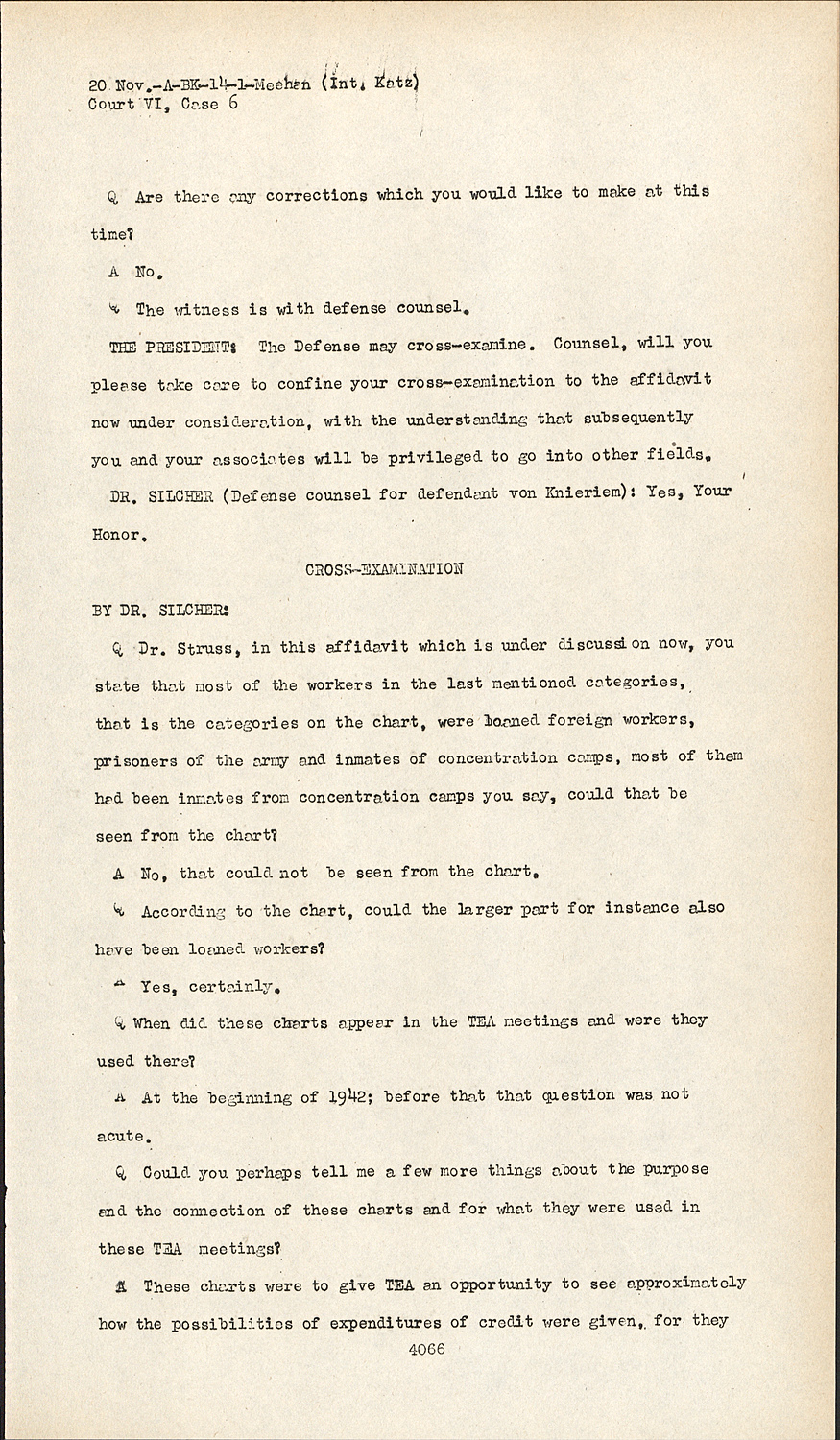
QAre there any corrections which you would like to make at this time?
ANo.
QThe witness is with defense counsel.
THE PRESIDENT:The Defense may cross-exaxiine. Counsel, will you please take care to confine your cross-examination to the affidavit now under consideration, with the understanding that subsequently you and your associates will be privileged to go into other fields. DR. SILCHER (Defense counsel for defendant von Knieriem): Yes, Your Honor.
CROSS-EXAMINATION BY DR. SILCHER:
QDr. Struss, in this affidavit which is under discussion now, you state that most of the workers in the last mentioned categories, that is the categories on the chart, were loaned foreign workers, prisoners of the army and inmates of concentration camps, most of them had been inmates from concentration camps you say, could that be seen from the chart?
ANo, that could not be seen from the chart.
QAccording to the chart, could the larger part for instance also have been loaned workers?
AYes, certainly.
QWhen did these charts appear in the TEA meetings and were they used there?
AAt the beginning of 1942; before that that question was not acute.
QCould you perhaps tell me a few more things about the purpose and the connection of these charts and for what they were used in these TEA meetings?
AThese charts were to give TEA an opportunity to see approximately how the possibilities of expenditures of credit were given, for they depended of course upon the type and numoer of workers available.
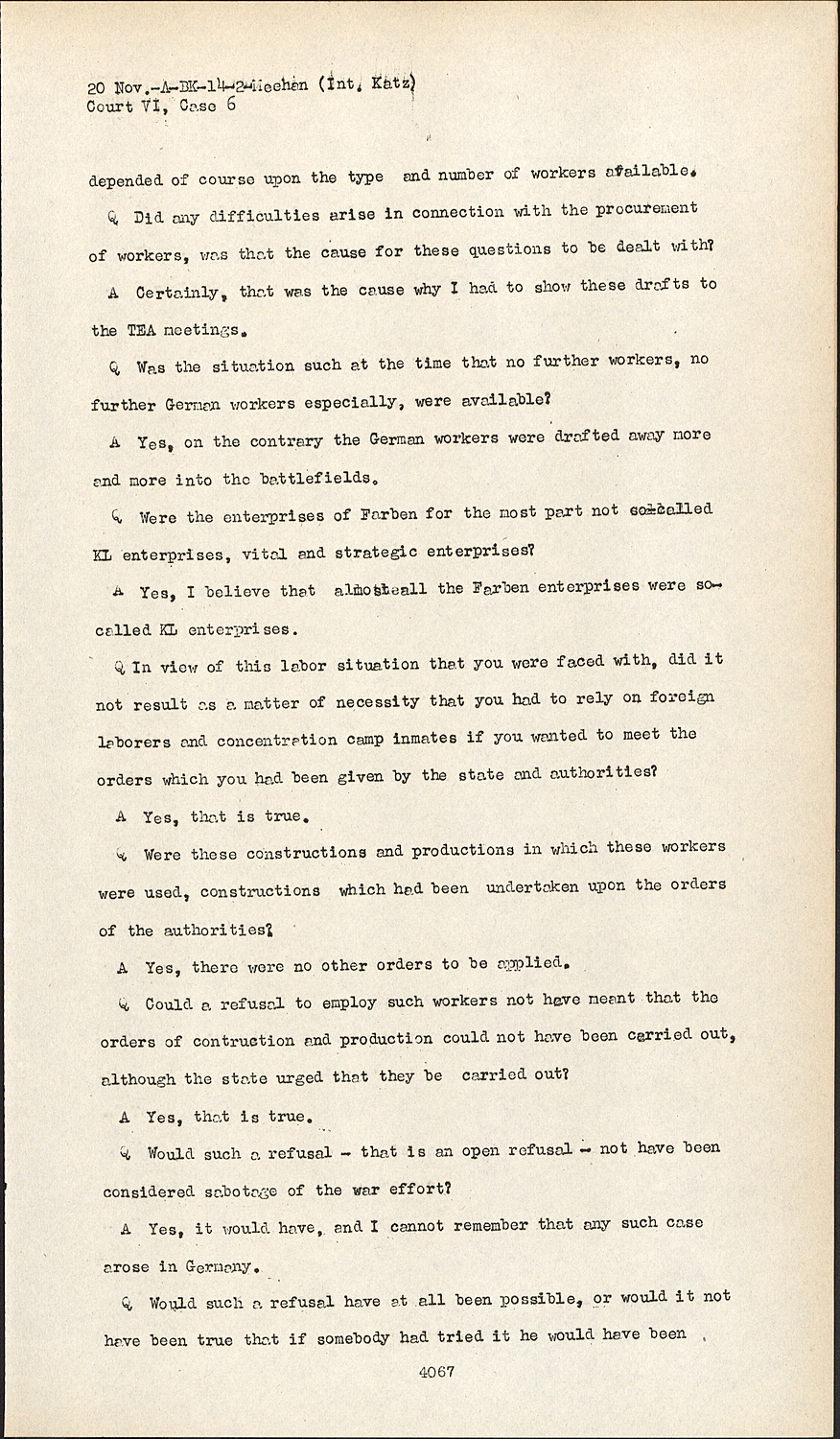
QDid any difficulties arise in connection with the procurement of workers, was that the cause for these questions to be dealt with?
ACertainly, that was the cause why I had to show these drafts to the TEA meetings.
QWas the situation such at the time that no further workers, no further German workers especially, were available?
AYes, on the contrary the German workers were drafted away more and more into the battlefields.
QWere the enterprises of Farben for the most part not so-called KL enterprises, vital and strategic enterprises?
AYes, I believe that almost*all the Farben enterprises were socalled KL enterprises.
QIn view of this labor situation that you were faced with, did it not result as a matter of necessity that you had to rely on foreign laborers and concentration camp inmates if you wanted to meet the orders which you had been given by the state and authorities?
AYes, that is true.
QWere these constructions and productions in which these workers were used, constructions which had been undertaken upon the orders of the authorities?
AYes, there were no other orders to be applied.
QCould a refusal, to employ such workers not have meant that the orders of contruction and production could not have been carried out, although the state urged that they be carried out?
AYes, that is true.
QWould such a refusal - that is an open refusal - not have been considered sabotage of the war effort?
AYes, it would have, and I cannot remember that any such case arose in Germany.
QWould such a refusal have at all been possible, or would it not have been true that if somebody had tried it he would have been punished severely by the authorities and would have been forced to comply?
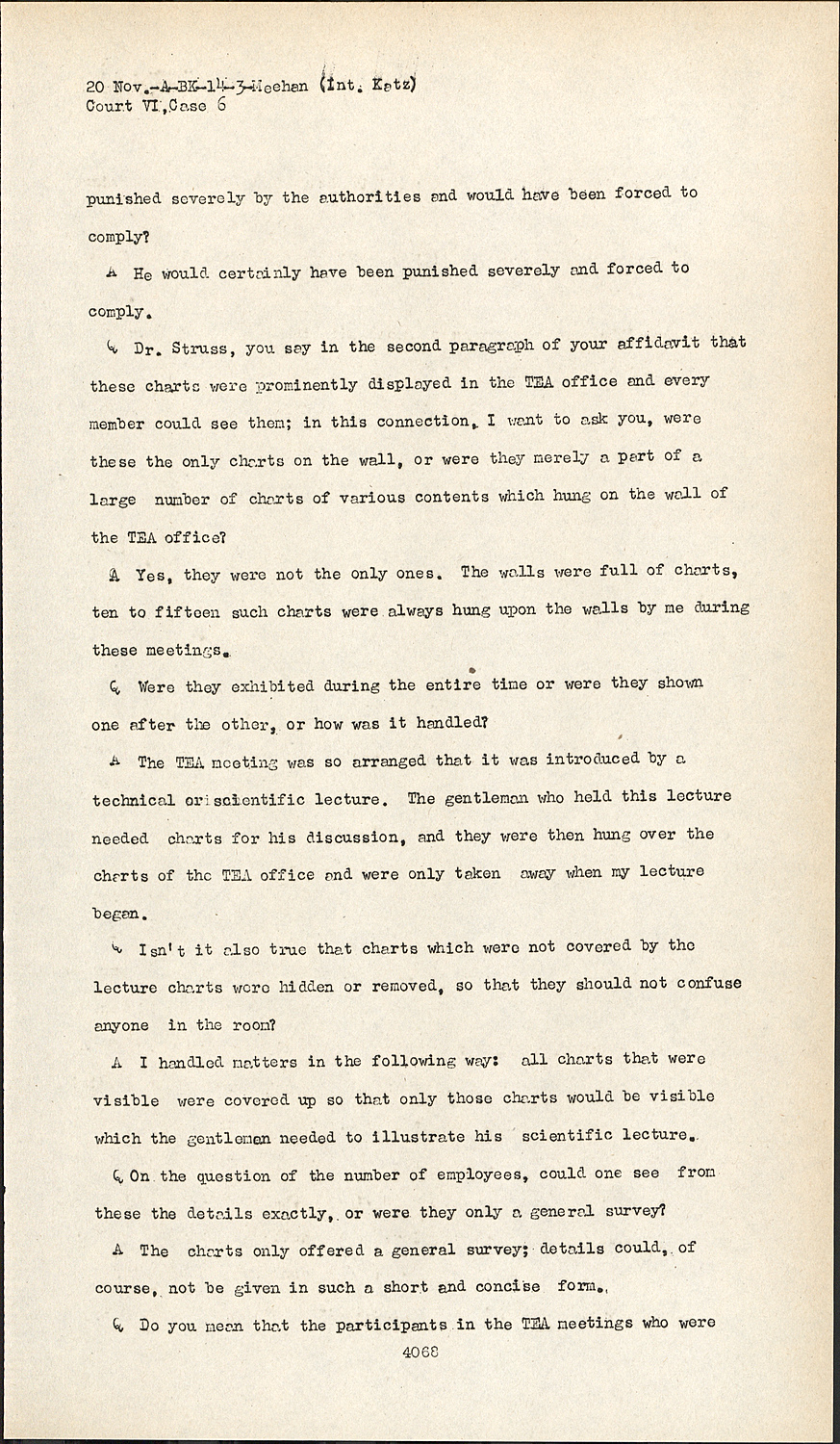
AHe would certainly have been punished severely and forced to comply.
QDr. Struss, you say in the second paragraph of your affidavit that these charts were prominently displayed in the TEA office and every member could see then; in this connection. I want to ask you, were these the only charts on the wall, or were they merely a part of a large number of charts of various contents which hung on the wall of the TEA office?
AYes, they were not the only ones. The walls were full of charts, ten to fifteen such charts were always hung upon the walls by me during these meetings.
QWere they exhibited during the entire time or were they shown one after the other, or how was it handled?
AThe TEA meeting was so arranged that it was introduced by a technical oriscientific lecture. The gentleman who held this lecture needed charts for his discussion, and they were then hung over the charts of the TEA office and were only taken away when my lecture began.
QIsn't it also true that charts which were not covered by the lecture charts were hidden or removed, so that they should not confuse anyone in the room?
AI handled natters in the following way: all charts that were visible were covered up so that only those charts would be visible which the gentleman needed to illustrate his scientific lecture.
QOn the question of the number of employees, could one see from these the details exactly, or were they only a general survey?
AThe charts only offered a general survey; details could, of course, not be given in such a short and concise form.
QDo you mean that the participants in the TEA meetings who were not imirediately interested, in these affairs, whose departments were not immediately concerned, for instance, commercial men, not technical directors; would those persons have gained a detailed insight into the workers conditions?
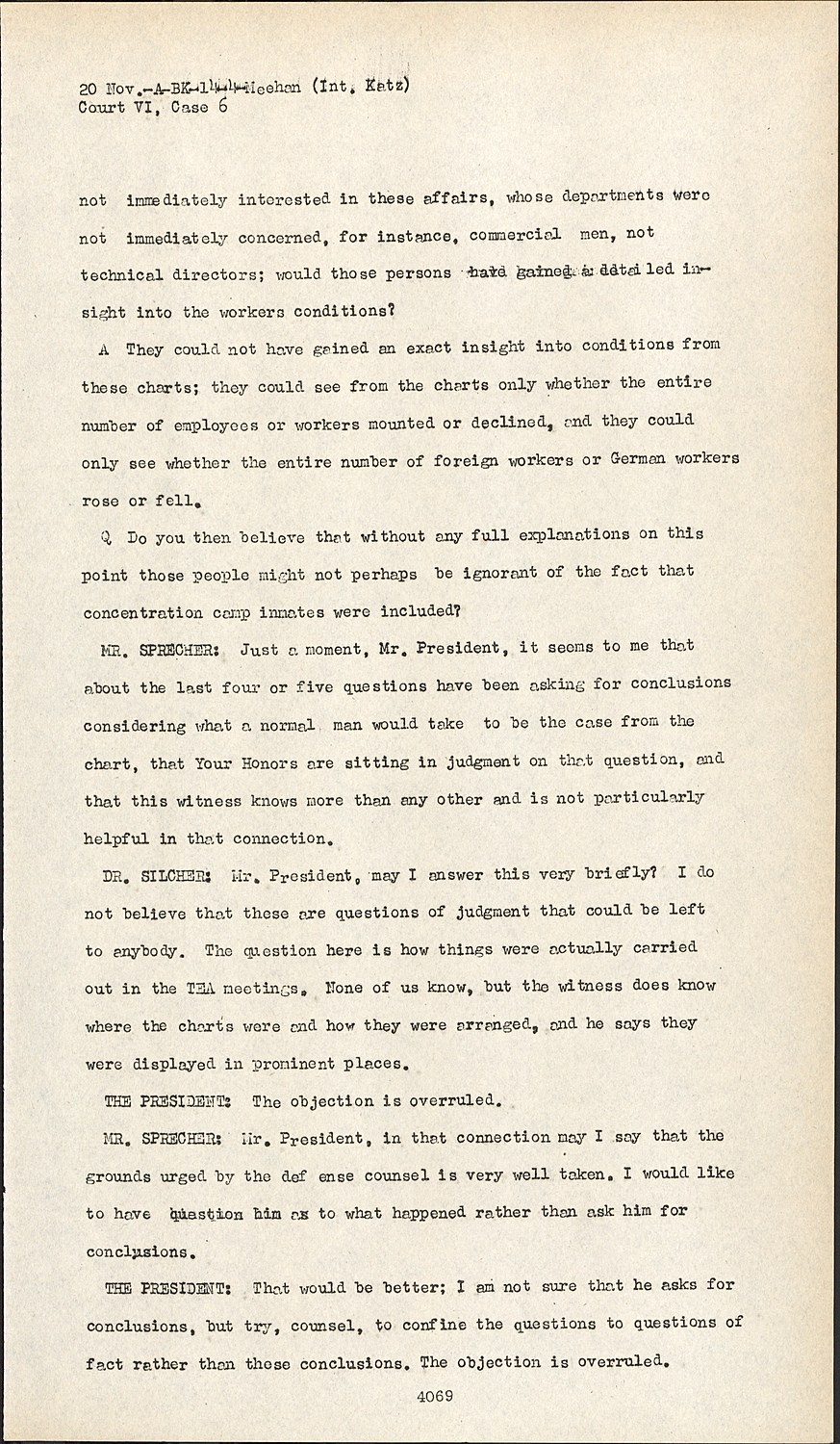
AThey could not have gained an exact insight into conditions from these charts; they could see from the charts only whether the entire number of employees or workers mounted or declined, and they could only see whether the entire number of foreign workers or German workers rose or fell.
QDo you then believe that without any full explanations on this point those people might not perhaps be ignorant of the fact that concentration camp inmates were included?
MR. SPEECHER:Just a moment, Mr. President, it seems to me that about the last four or five questions have been asking for conclusions considering what a normal man would take to be the case from the chart, that Your Honors are sitting in judgment on that question, and that this witness knows more than any other and is not particularly helpful in that connection.
DR. SILCHER:Mr. President, may I answer this very briefly? I do not believe that these are questions of judgment that could be left to anybody. The question here is how things were actually carried out in the TEA meetings. None of us know, but the witness does know where the charts were and how they were arranged, and he says they were displayed in prominent places.
THE PRESIDENT:The objection is overruled.
MR. SPEECHER:Mr. President, in that connection nay I say that the grounds urged by the def ense counsel is very well taken. I would like to have question him as to what happened rather than ask him for conclusions.
THE PRESIDENT:That would be better; I am not sure that he asks for conclusions, but try, counsel, to confine the questions to questions of fact rather than these conclusions. The objection is overruled.
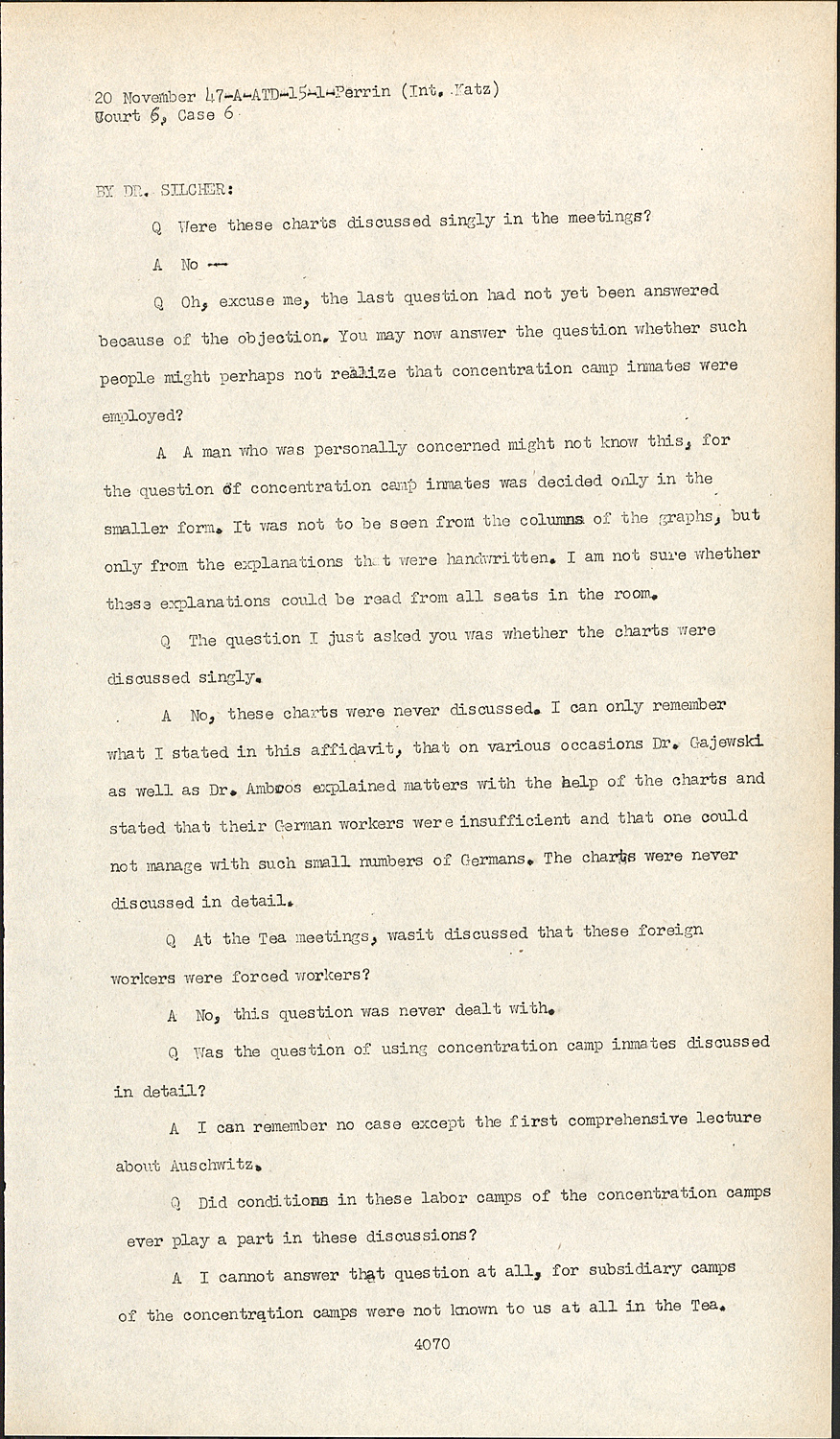
BY DR. SILCHER:
QWhere these charts discussed singly in the meetings?
ANo -
QOh, excuse me, the last question had not yet been answered because of the objection. You may now answer the question whether such people might perhaps not realize that concentration camp inmates were employed?
AA man who was personally concerned might not know this, for the question of concentration camp inmates was decided only in the smaller form. It was not to be seen from the columns of the graphs, but only from the explanations that were handwritten. I am not sure whether these explanations could be read from all seats in the room.
QThe question I just asked you was whether the charts were discussed singly.
ANo, these charts were never discussed. I can only rememeber what I stated in this affidavit, that on various occasions Dr. Gajewski as well as Dr. Amboos explained matters with the help of the charts and stated that their German workers were insufficient and that one could not manage with such small numbers of Germans. The charts were never discussed in detail.
QAt the Tea meetings, wasit discussed that these foreign workers were forced workers?
ANo, this question was never dealt with.
QWas the question of using concentration camp inmates discussed in detail?
AI can remember no case except the first comprehensive lecture about Auschwitz.
QDid conditions in these labor camps of the concentration camps ever play a part in these discussions?
AI cannot answer that question at all, for subsidiary camps of the concentration camps were not known to us at all in the Tea.
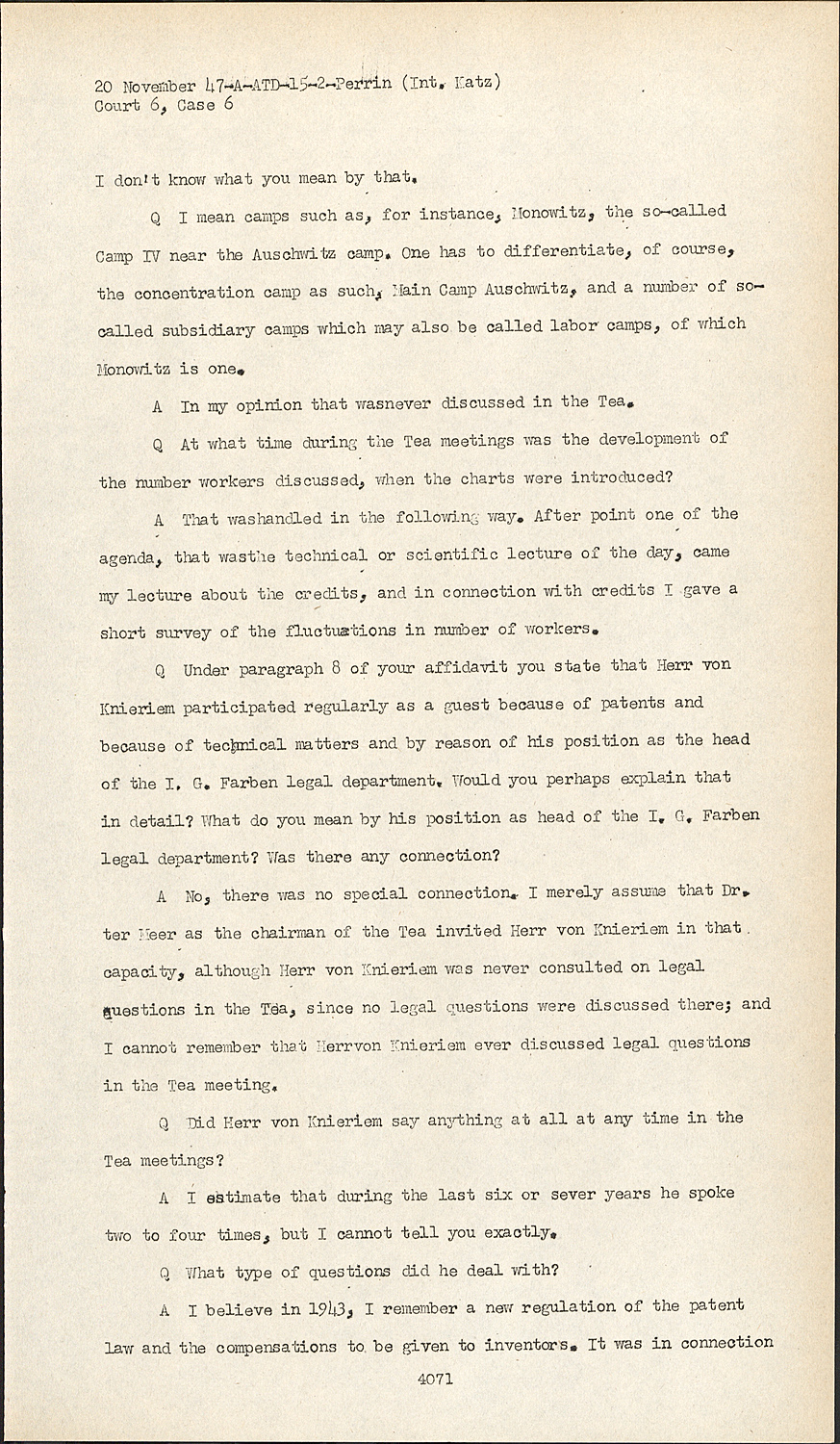
I don't know what you mean by that.
QI mean camps such as, for instance, Monowitz, the so-called Camp IV near the Auschwitz camp. One lias to differentiate, of course, the concentration camp as such, Main Camp Auschwitz, and a number of socalled subsidiary camps which may also be called labor camps, of which Monowitz is one.
AIn my opinion that wasnever discussed in the Tea.
QAt what time during the Tea meetings was the development of the number workers discussed, when the charts were introduced?
AThat washandled in the following way. After point one of the agenda, that wasthe technical or scientific lecture of the day, came my lecture about the credits, and in connection with credits I gave a short survey of the fluctuations in number of workers.
QUnder paragraph 8 of your affidavit you state that Herr von Knieriem participated regularly as a guest because of patents and because of technical matters and by reason of his position as the head of the I. G. Farben legal department. Would you perhaps explain that in detail? What do you mean by his position as head of the I. G. Farben legal department? Was there any connection?
ANo, there was no special connection. I merely assume that Dr. ter Meer as the chairman of the Tea invited Herr von Knieriem in that capacity, although Herr von Knieriem was never consulted on legal questions in the Tea, since no legal questions were discussed there; and I cannot remember that Herrvon Knieriem ever discussed legal questions in the Tea meeting.
QDid Herr von Knieriem say anything at all at any time in the Tea meetings?
AI estimate that during the last six or sever years he spoke two to four times, but I cannot tell you exactly.
QWhat type of questions did he deal with?
AI believe in 1943, I remember a new regulation of the patent law and the compensations to be given to inventors. It was in connection with patent legislation, at any rate.
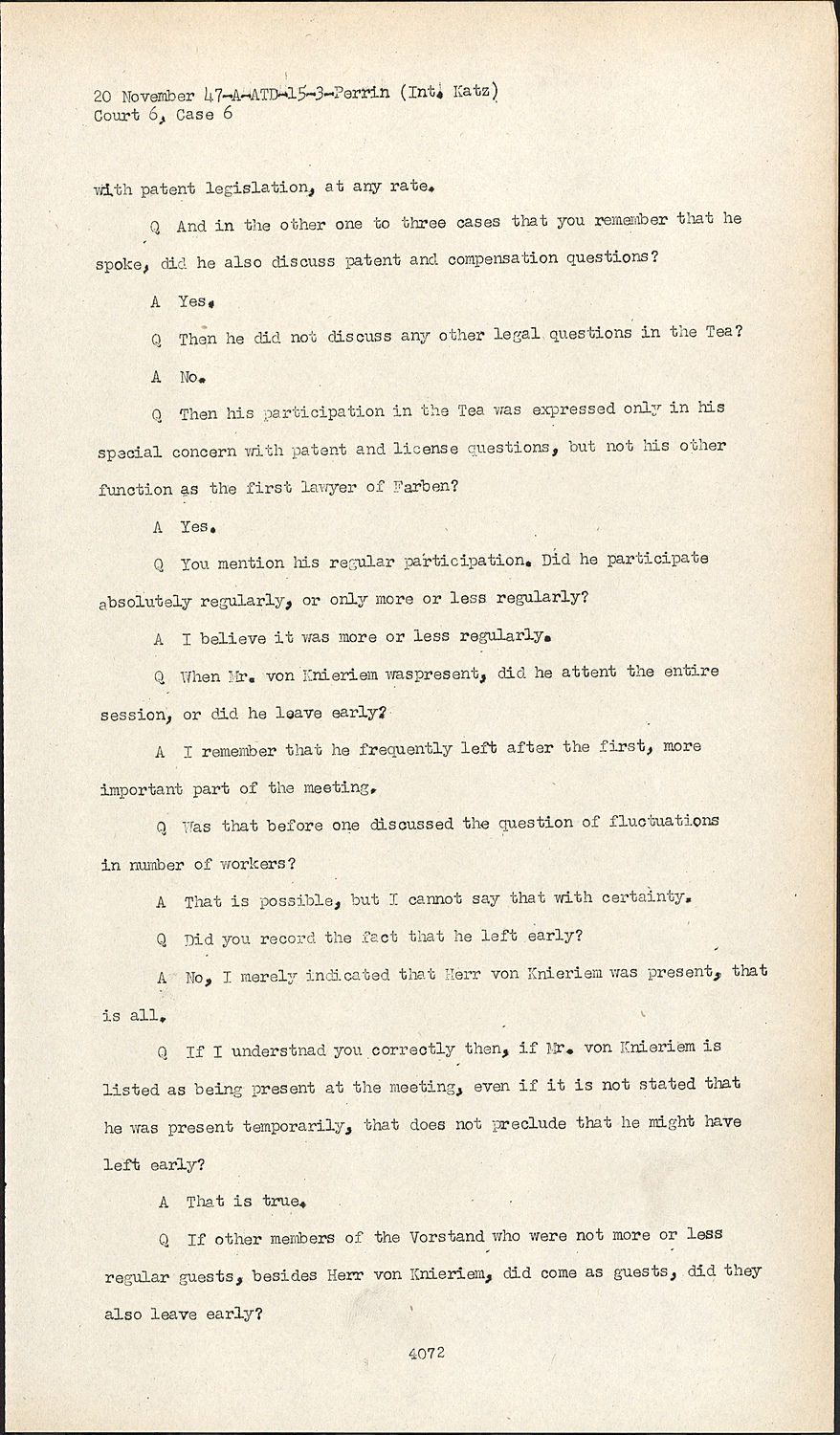
QAnd in the other one to three cases that you remember that he spoke, did he also discuss patent and compensation questions?
AYes.
QThen he did not discuss any other legal questions in the Tea?
ANo.
QThen his participation in the Tea was expressed only in his special concern with patent and license questions, but not his other function as the first lawyer of Farben?
AYes.
QYou mention his regular participation. Did he participate absolutely regularly, or only more or less regularly?
AI believe it was more or less regularly.
QWhen Mr. von Knieriem waspresent, did he attent the entire session, or did he loave early?
AI remember that he frequently left after the first, more important part of the meeting.
QWas that before one discussed the question of fluctuations in number of workers?
AThat is possible, but I cannot say that with certainty.
QDid you record the fact that he left early?
ANo, I merely indicated that Herr von Knieriem was present, that is all.
QIf I understnad you correctly then, if Mr. von Knieriem is listed as being present at the meeting, even if it is not stated that he was present temporarily, that does not preclude that he might have left early?
AThat is true.
QIf other members of the Vorstand who were not more or less regular guests, besides Herr von Knieriem, did come as guests, did they also leave early?
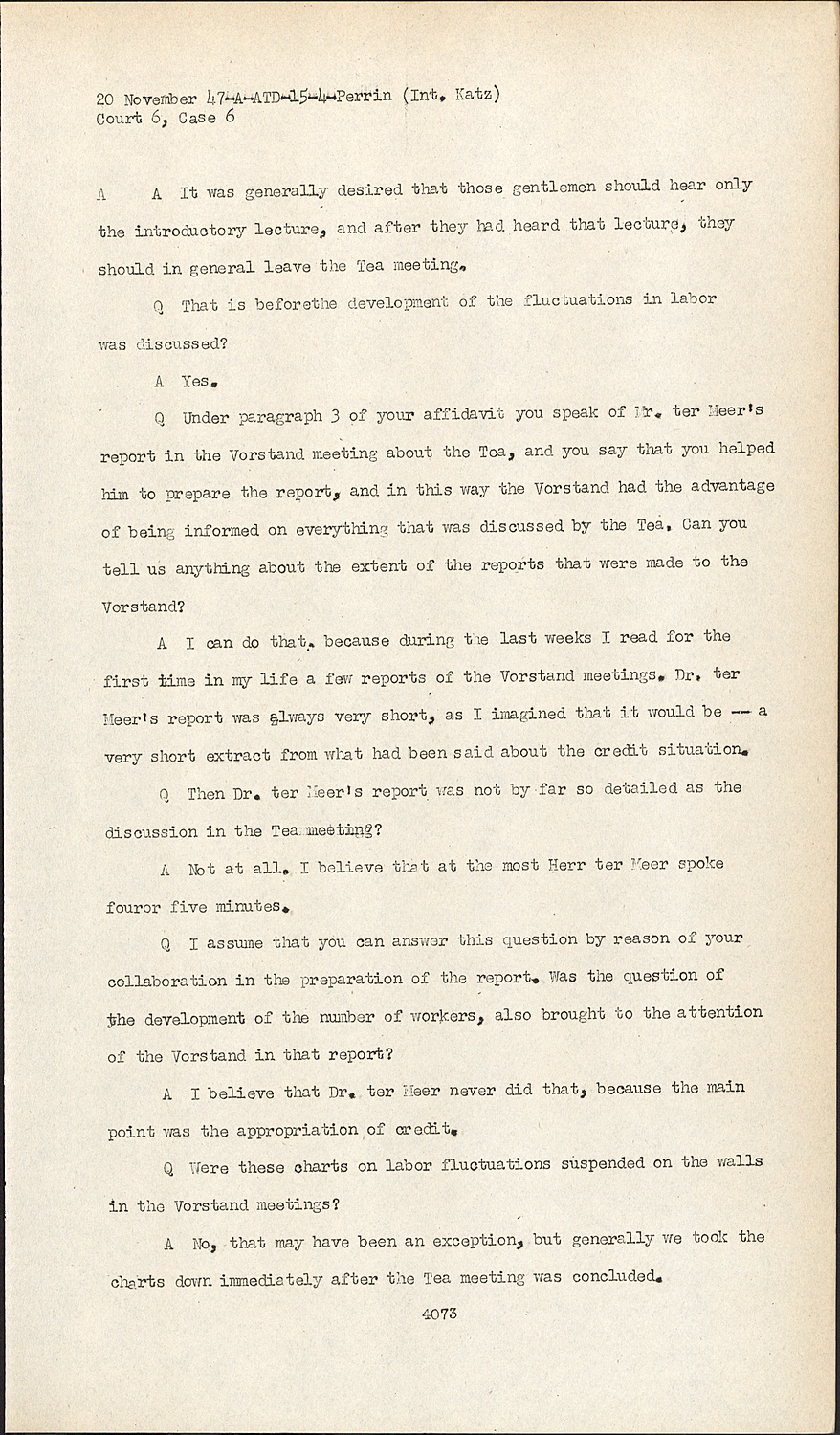
A A It was generally desired that those gentlemen should hear only the introductory lecture, and after they bad heard that lecture, they should in general leave the Tea meeting.
QThat is beforethe development of the fluctuations in labor was discussed?
AYes.
QUnder paragraph 3 of your affidavit you speak of Mr. ter Meer's report in the Vorstand meeting about the Tea, and you say that you helped him to prepare the report, and in this way the Vorstand had the advantage of being informed on everything that was discussed by the Tea. Can you tell us anything about the extent of the reports that were made to the Vorstand?
AI can do that, because during tie last weeks I read for the first time in my life a few reports of the Vorstand meetings. Dr. ter Heer's report was always very short, as I imagined that it would be -- a very short extract from what had been said about the credit situation.
QThen Dr. ter Meer's report was not by far so detailed as the discussion in the Teammeeting?
ANot at all. I believe that at the most Herr ter Meer spoke fouror five minutes.
QI assume that you can ansvrar this question by reason of your collaboration in the preparation of the report. Was the question of the development of the number of workers, also brought to the attention of the Vorstand in that report?
AI believe that Dr. ter Heer never did that, because the main point was the appropriation of credit.
QWere these charts on labor fluctuations suspended on the walls in the Vorstand meetings?
ANo, that may have been an exception, but generally we took the charts down immediately after the Tea meeting was concluded.
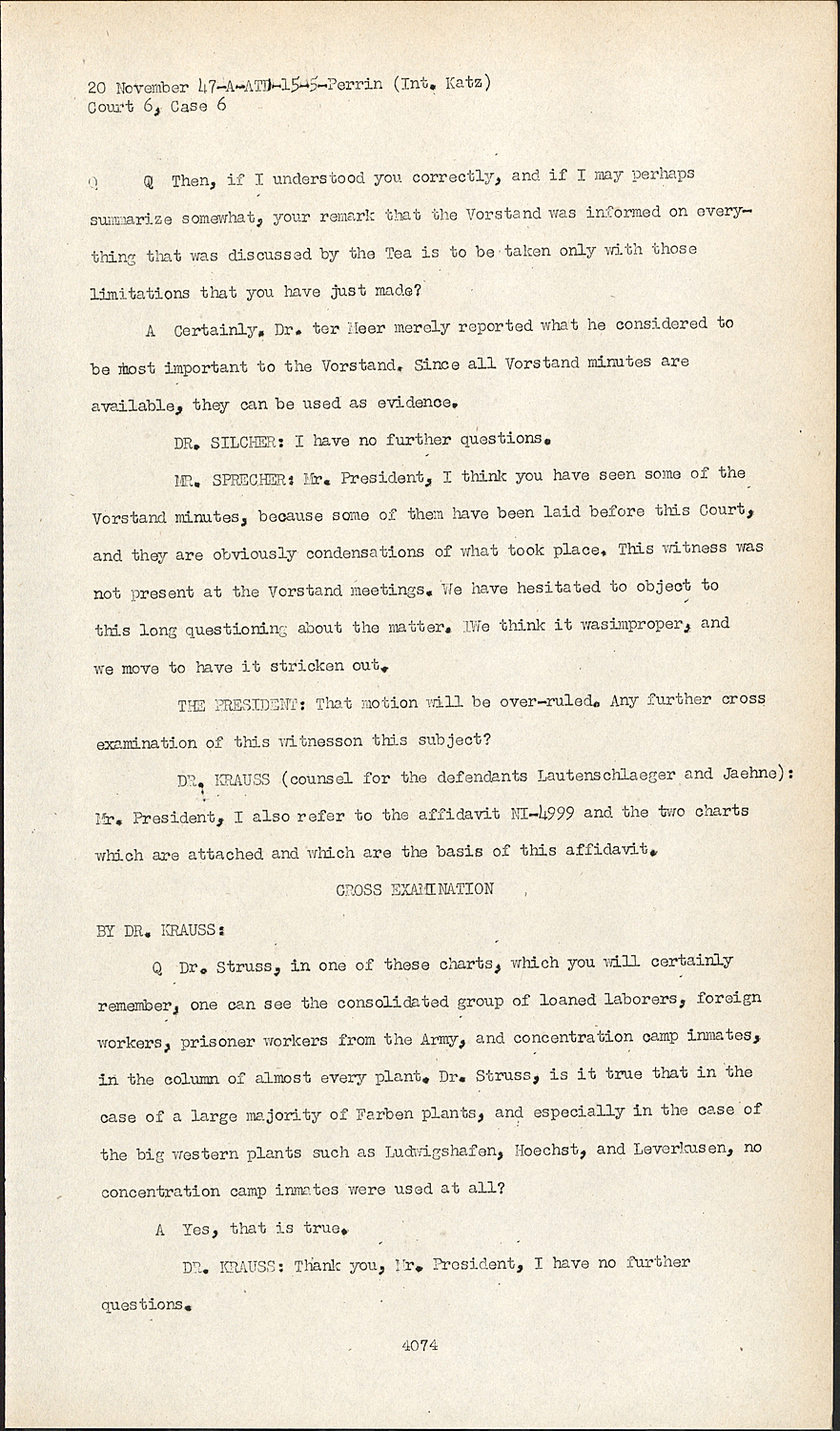
Q Q Then, if I understood you correctly, and if I may perhaps summarize somewhat, your remark that the Vorstand was informed on everything that was discussed by the Tea is to be taken only with those limitations that you have just made?
ACertainly. Dr. ter Meer merely reported what he considered to be most important to the Vorstand. Since all Vorstand minutes are available, they can be used as evidence.
DR. SILCHER:I have no further questions.
MR. SPRECHER:Mr. President, I think you have seen some of the Vorstand minutes, because some of them have been laid before this Court, and they are obviously condensations of what took place. This witness was not present at the Vorstand meetings. We have hesitated to object to this long questioning about the matter. We think it wasimproper, and we move to have it stricken out.
THE PRESIDENT:That motion will be over-ruled. Any further cross examination of this witnesson this subject?
DR.KRAUSS (counsel for the defendants Lautenschlaeger and Jaehne): Mr. President, I also refer to the affidavit NI-4999 and the two charts which are attached and which are the basis of this affidavit.
CROSS EXAMINATION BY DR. KRAUSS:
QDr. Struss, in one of these charts, which you will certainly remember, one can see the consolidated group of loaned laborers, foreign workers, prisoner workers from the Army, and concentration camp inmates, in the column of almost every plant. Dr. Struss, is it true that in the case of a large majority of Farben plants, and especially in the case of the big western plants such as Ludwigshafen, Hoechst, and Leverkusen, no concentration camp inmates were used at all?
AYes, that is true.
DR. KRAUSS:Thank you, Mr. President, I have no further questions.
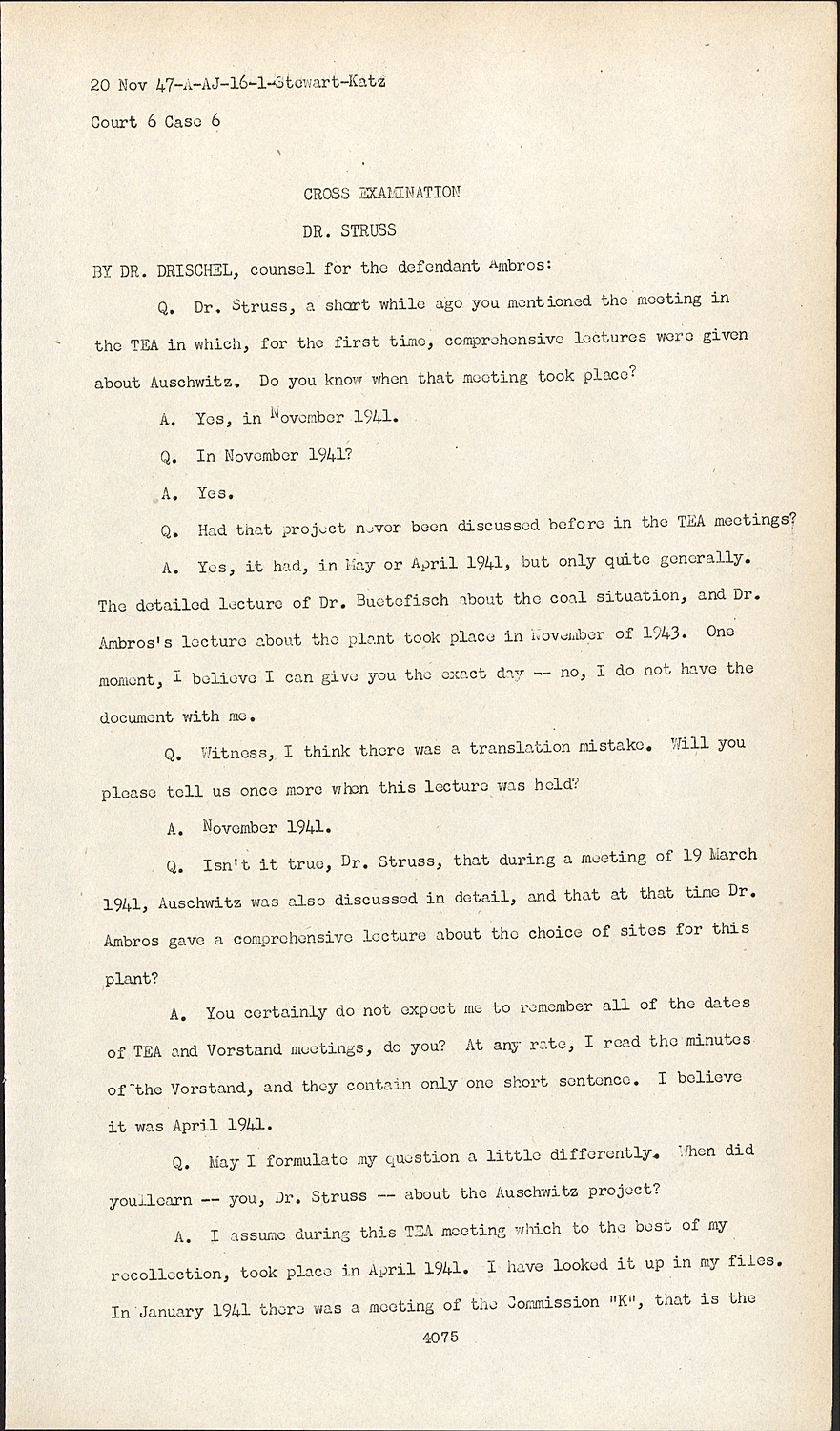
CROSS EXAMINATION DR. STRUSS BY DR. DRISCHEL, counsel for the defendant Ambros:
Q.Dr. Struss, a short while ago you mentioned the meeting in the TEA in which, for the first time, comprehensive lectures were given about Auschwitz. Do you know when that meeting took place?
A.Yes, in November 1941.
Q.In November 1941?
A.Yes.
Q.Had that project never been discussed before in the TEA meetings?
A.Yes, it had, in May or April 1941, but only quite generally. The detailed lecture of Dr. Buetefisch about the coil situation, and Dr. Ambros's lecture about the plant took place in November of 1943. One moment, i believe I can give you the exact day -- no, I do not have the document with me.
Q.Witness, I think there was a translation mistake. Will you please tell us once more when this lecture was held?
A.November 1941.
Q.Isn't it true, Dr. Struss, that during a meeting of 19 March 1941, Auschwitz was also discussed in detail, and that at that time Dr. Ambros gave a comprehensive lecture about the choice of sites for this plant?
A.You certainly do not expect me to remember all of the dates of TEA and Vorstand meetings, do you? At any rate, I read the minutes of the Vorstand, and they contain only one short sentence. I believe it was April 1941.
Q.May I formulate my question a little differently. When did youllearn -- you, Dr. Struss -- about the Auschwitz project?
A.I assume during this TEA meeting which to the best of my recollection, took place in April 1941. I have looked it up in my files. In January 1941 there was a meeting of the Commission "K", that is the Technical Experts meeting, about artificial and rubber goods.
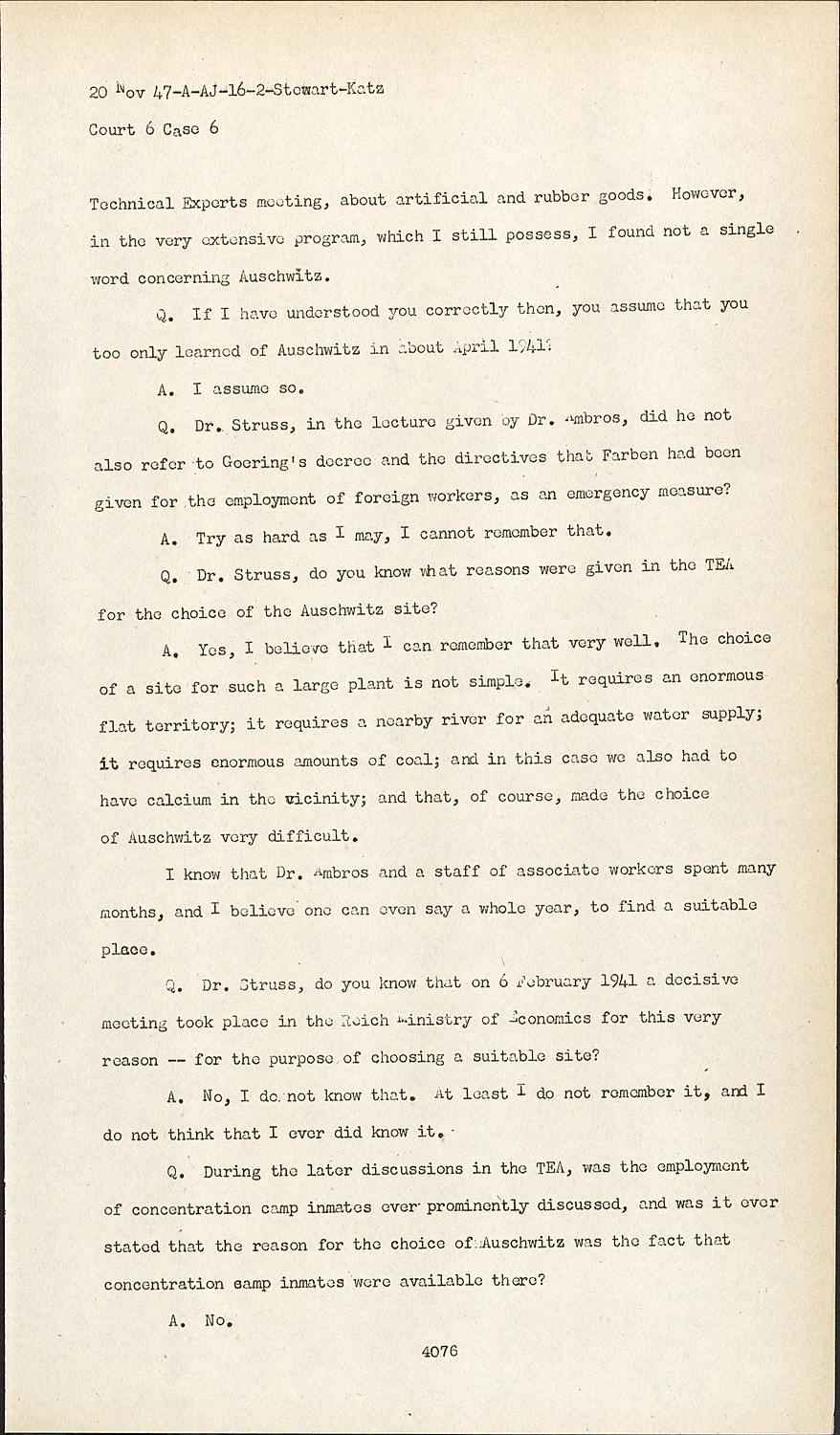
However, in the very extensive program, which I still possess, I found not a single word concerning Auschwitz.
Q.If I have understood you correctly then, you assume that you too only learned of Auschwitz in about April 1941?
A.I assume so.
Q.Dr. Struss, in the lecture given by Dr. Ambros, did he not also refer to Goering's decree and the directives that Farben had been given for the employment of foreign workers, as an emergency measure?
A.Try as hard as I may, I cannot remember that.
Q.Dr. Struss, do you know what reasons were given in the TEA for the choice of the Auschwitz site?
A.Yes, I believe that I can remember that very well. The choice of a site for such a large plant is not simple. It requires an enormous flat territory; it requires a nearby river for an adequate water supply; it requires enormous amounts of coal; and in this case we also had to have calcium in the vicinity; and that, of course, made the choice of Auschwitz very difficult.
I know that Dr. Ambros and a staff of associate workers spent many months, and I believe one can even say a whole year, to find a suitable place.
Q.Dr. Struss, do you know that on 6 February 1941 a decisive meeting took place in the Reich Ministry of Economics for this very reason -- for the purpose of choosing a suitable site?
A.No, I do not know that. At least I do not remember it, and I do not think that I ever did know it.
Q.During the later discussions in the TEA, was the employment of concentration camp inmates ever prominently discussed, and was it ever stated that the reason for the choice of Auschwitz was the fact that concentration camp inmates were available there?
A.No.
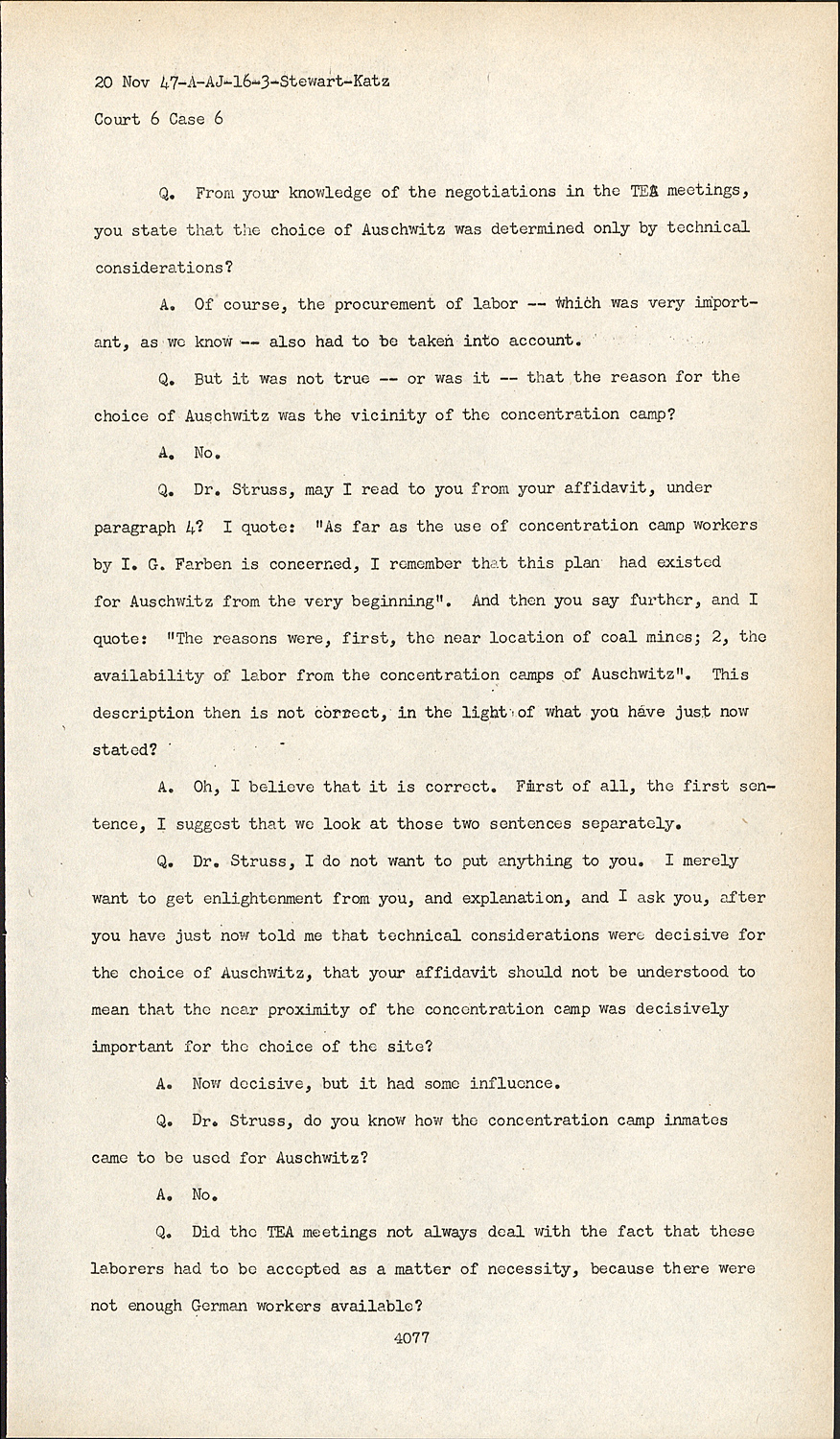
Q.From your knowledge of the negotiations in the TEA meetings, you state that the choice of Auschwitz was determined only by technical considerations?
A.Of course, the procurement of labor -- which was very important, as we know -- also had to be taken into account.
Q.But it was not true -- or was it -- that the reason for the choice of Auschwitz was the vicinity of the concentration camp?
A.No.
Q.Dr. Struss, may I read to you from your affidavit, under paragraph 4? I quote: "As far as the use of concentration camp workers by I. G. Farben is concerned, I remember that this plan had existed for Auschwitz from the very beginning". And then you say further, and I quote: "The reasons were, first, the near location of coal mines; 2, the availability of labor from the concentration camps of Auschwitz". This description then is not correct, in the light of what you have just now stated?
A.Oh, I believe that it is correct. First of all, the first sentence, I suggest that we look at those two sentences separately.
Q.Dr. Struss, I do not want to put anything to you. I merely want to get enlightenment from you, and explanation, and I ask you, after you have just now told me that technical considerations were decisive for the choice of Auschwitz, that your affidavit should not be understood to mean that the near proximity of the concentration camp was decisively important for the choice of the site?
A.Now decisive, but it had some influence.
Q.Dr. Struss, do you know how the concentration camp inmates came to be used for Auschwitz?
A.No.
Q.Did the TEA meetings not always deal with the fact that these laborers had to be accepted as a matter of necessity, because there were not enough German workers available?
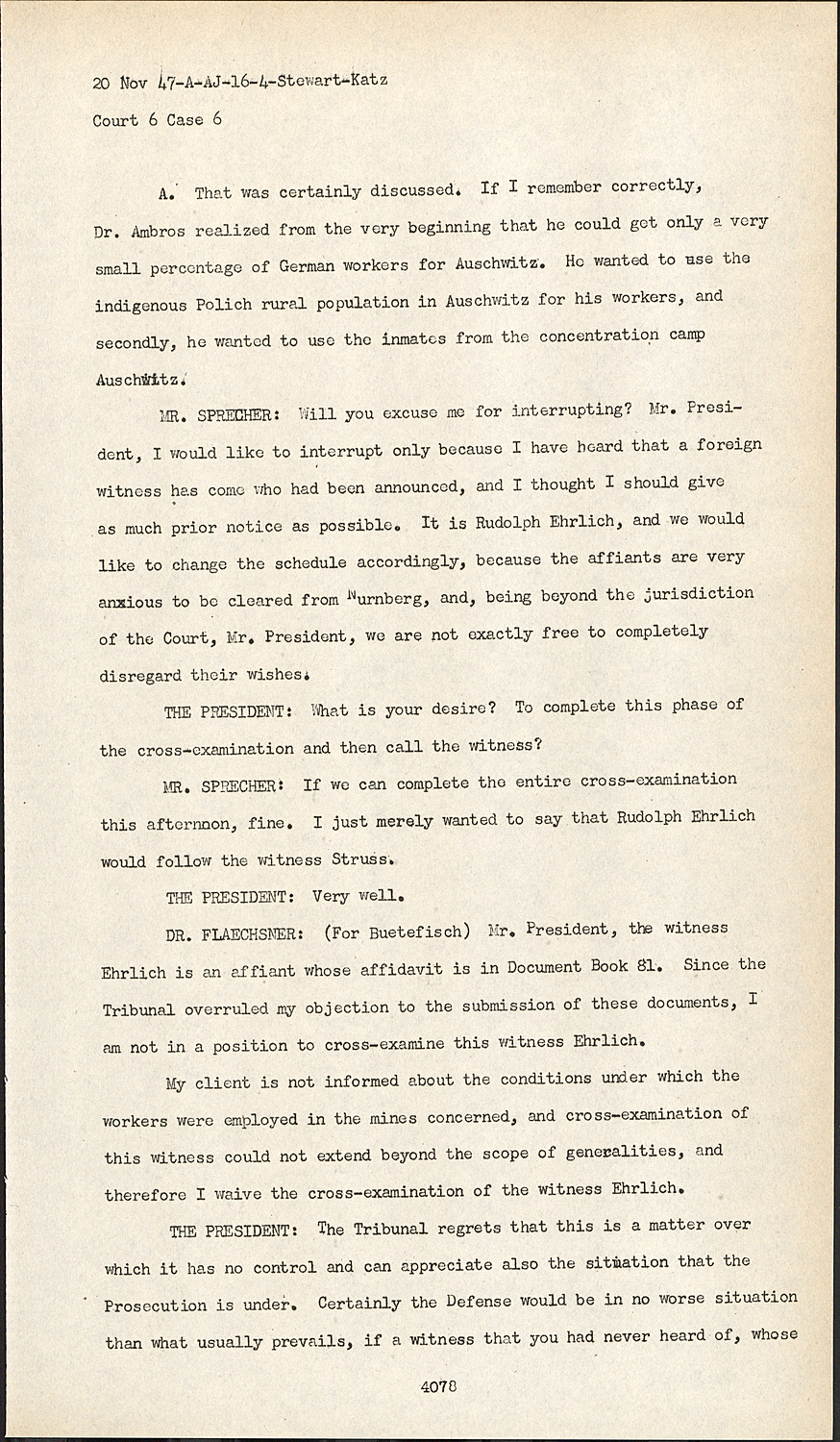
A.That was certainly discussed. If I remember correctly, Dr. Ambros realized from the very beginning that he could get only a very small percentage of German workers for Auschwitz. He wanted to use the indigenous Polich rural population in Auschwitz for his workers, and secondly, he wanted to use the inmates from the concentration camp Auschwitz.
MR. SPRECHER:Will you excuse me for interrupting? Mr. President, I would like to interrupt only because I have heard that a foreign witness has come who had been announced, and I thought I should give as much prior notice as possible. It is Rudolph Ehrlich, and we would like to change the schedule accordingly, because the affiants are very anxious to be cleared from Nurnberg, and, being beyond the jurisdiction of the Court, Mr. President, we are not exactly free to completely disregard their wishes.
THE PRESIDENT:What is your desire? To complete this phase of the cross-examination and then call the witness?
MR. SPRECHER:If we can complete the entire cross-examination this afternoon, fine. I just merely wanted to say that Rudolph Ehrlich would follow the witness Struss.
THE PRESIDENT:Very well.
DR.FLAECHSNER: (For Buetefisch) Mr. President, the witness Ehrlich is an affiant whose affidavit is in Document Book 81. Since the Tribunal overruled my objection to the submission of these documents, I am not in a position to cross-examine this witness Ehrlich.
My client is not informed about the conditions under which the workers were employed in the mines concerned, and cross-examination of this witness could not extend beyond the scope of generalities, and therefore I waive the cross-examination of the witness Ehrlich.
THE PRESIDENT:The Tribunal regrets that this is a matter over which it has no control and can appreciate also the situation that the Prosecution is under. Certainly the Defense would be in no worse situation than what usually prevails, if a witness that you had never heard of, whose name you never heard is called to the witness stand and testifies, and then the Court tells you at the conclusion of the testimony in chief to proceed to cross-examine your witness.