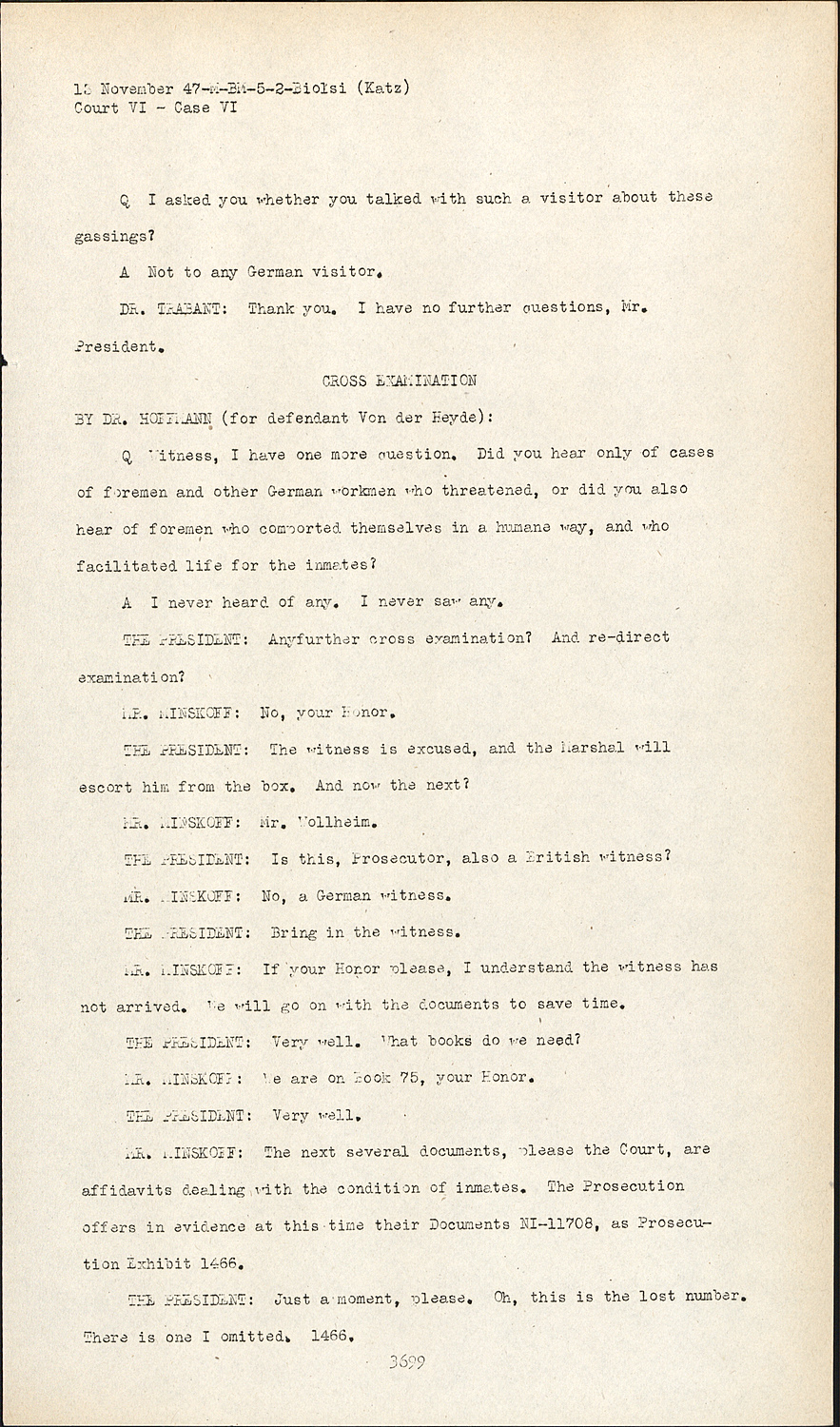
QI asked you whether you talked with such a visitor about these gassings?
ANot to any German visitor.
DR. TRAEANT:Thank you. I have no further questions, Mr. President.
CROSS EXAMINATION BY DR. HOFFMANN (for defendant Von der Heyde):
QWitness, I have one more question. Did you hear only of cases of foremen and other German workmen who threatened, or did you also hear of foremen who comported themselves in a humane way, and who facilitated life for the inmates?
AI never heard of any. I never saw any.
THE PRESIDENT:Any further cross examination? And re-direct examination?
MR. MINSKOFF:No, your Honor.
THE PRESIDENT:The witness is excused, and the Marshal will escort him from the box. And now the next?
MR. MINSKOFF:Mr. Wollheim.
THE PRESIDENT:Is this, Prosecutor, also a British witness?
MR. MINSKOFF:No, a German witness.
THE PRESIDENT:Bring in the witness.
MR. MINSKOFF:If your Honor please, I understand the witness has not arrived. We will go on with the documents to save time.
THE PRESIDENT:Very well. What books do we need?
MR. MINSKOFF:We are on Book 75, your Honor.
THE PRESIDENT:Very well.
MR. MINSKOFF:The next several documents, please the Court, are affidavits dealing with the condition of inmates. The Prosecution offers in evidence at this time their Documents NI-11708, as Prosecution Exhibit 1466.
THE PRESIDENT:Just a moment, please. Oh, this is the lost number. There is one I omitted. 1466.
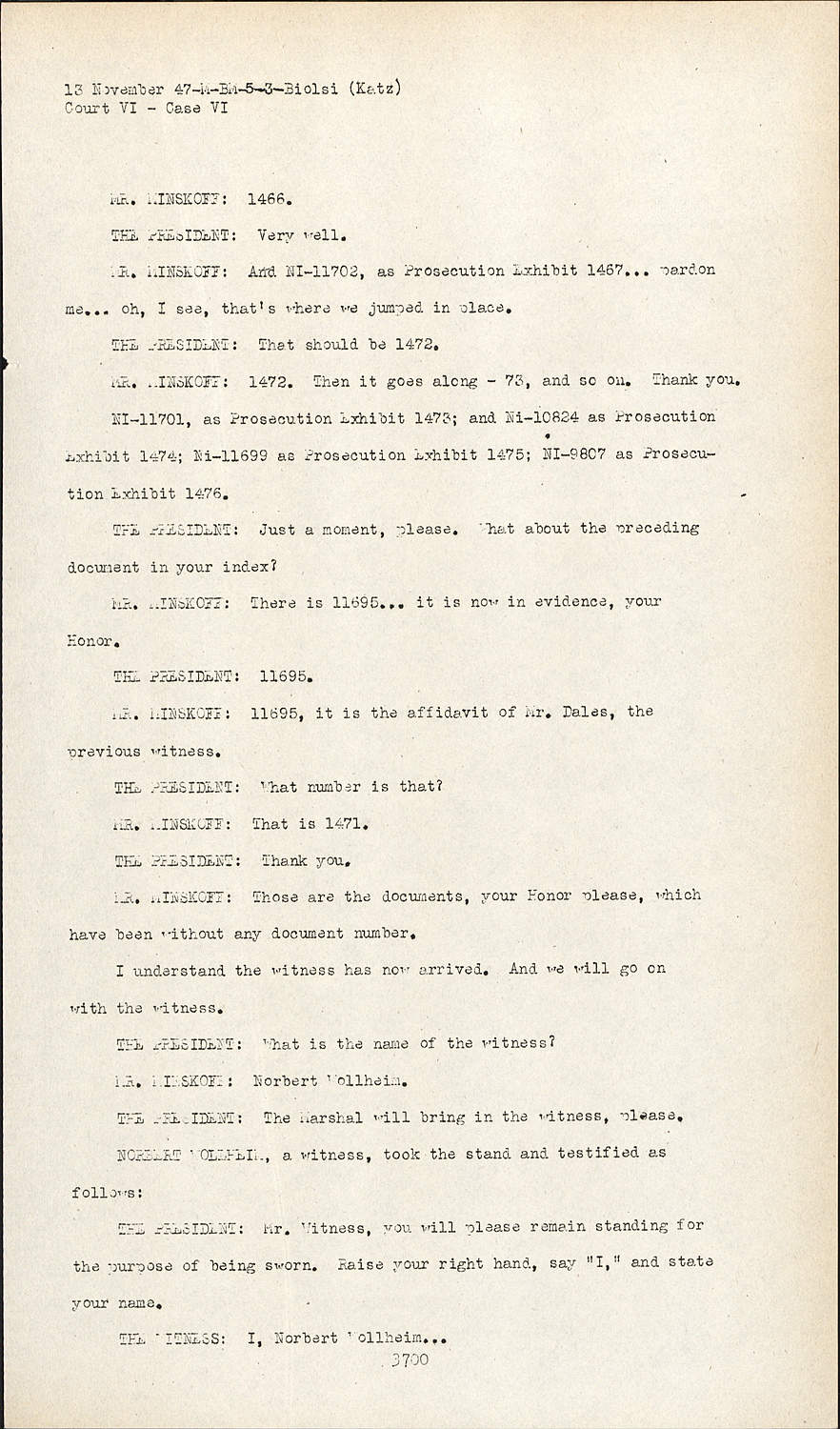
MR. MINSKOFF: 1466.
THE PRESIDENT:Very well.
MR. MINSKOFF:And NI-11702, as Prosecution Exhibit 1467... pardon me... oh, I see, that's where we jumped in place.
THE PRESIDENT:That should be 1472.
MR.MINSKOFF: 1472. Then it goes along - 73, and so on. Thank you.
NI-11701, as Prosecution Exhibit 1473; and Ni-10824 as Prosecution Exhibit 1474; Ni-11699 as Prosecution Exhibit 1475; NI-9807 as Prosecution Exhibit 1476.
THE PRESIDENT:Just a moment, please. What about the preceding document in your index?
MR. MINSKOFF:There is 11695... it is now in evidence, your Honor.
THE PRESIDENT: 11695.
MR.MINSKOFF: 11695, it is the affidavit of Mr. Dales, the previous witness.
THE PRESIDENT:What number is that?
MR. MINSKOFF:That is 1471.
THE PRESIDENT:Thank you.
MR. MINSKOFF:Those are the documents, your Honor please, which have been without any document number.
I understand the witness has now arrived. And we will go on with the witness.
THEPRESIDENT: what is the name of the witness?
MR. MINSKOFF:Norbert Wollheim.
THE PRESIDENT:The Marshal will bring in the witness, please.
NORBERTWOLLHEIM, a witness, took the stand and testified as follows:
THE PRESIDENT:Mr. Witness, you will please remain standing for the purpose of being sworn. Raise your right hand, say "I," and state your name.
THE WITNESS:I, Norbert Wollheim...
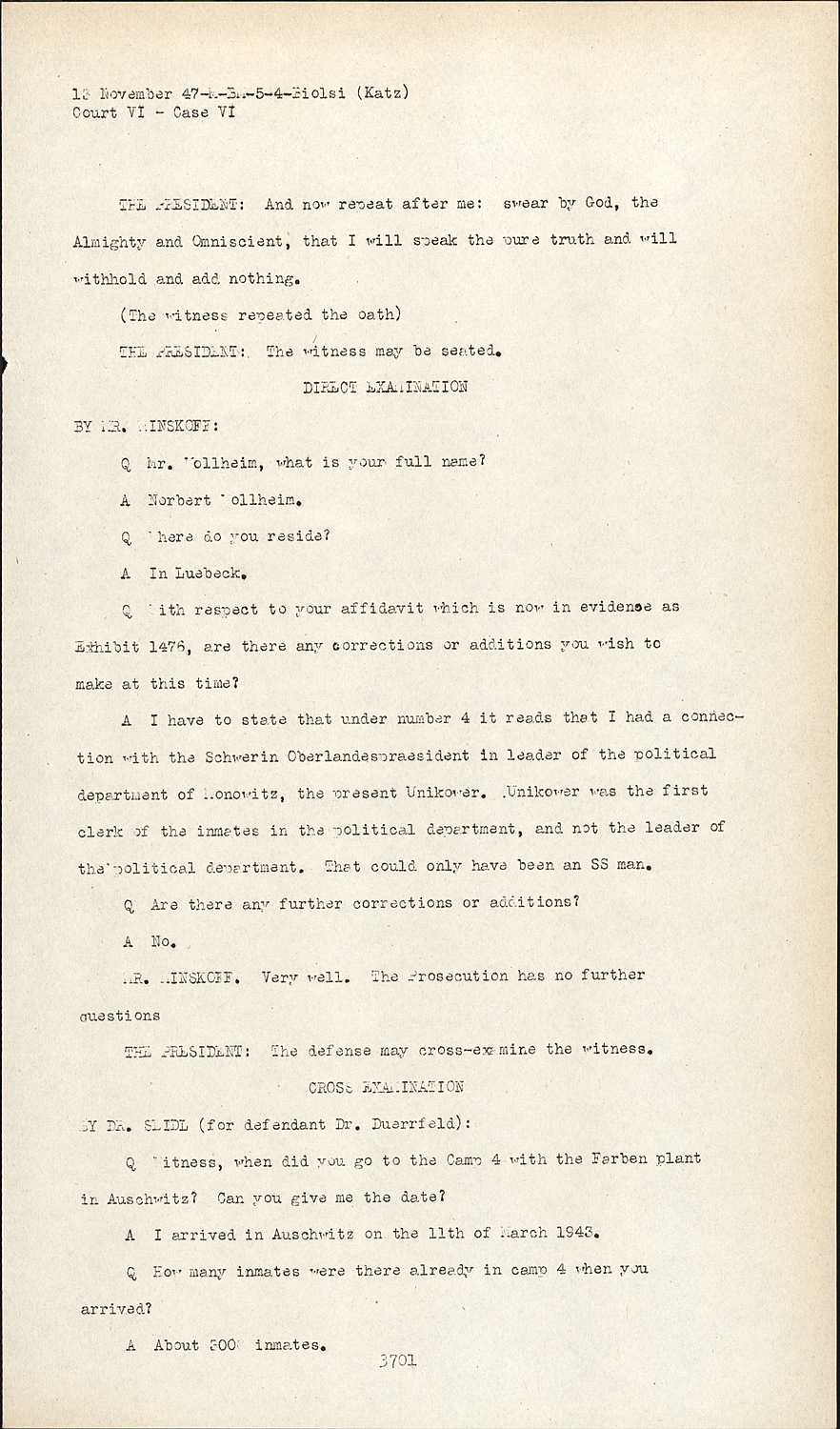
THE PRESIDENT:And now repeat after me: swear by God, the Almighty and Omniscient, that I will speak the pure truth and will withhold and add nothing.
(The witness repeated the oath)
THE PRESIDENT:The witness may be seated.
DIRECT EXAMINATION BY MR. MINSKOFF:
QMr. Wollheim, what is your full name?
ANorbert Wollheim.
QWhere do you reside?
AIn Luebeck.
QWith respect to your affidavit which is now in evidence as Exhibit 1476, are there any corrections or additions you wish to make at this time?
AI have to state that under number 4 it reads that I had a connection with the Schwerin Oberlandespraesident in leader of the political department of Monowitz, the present Unikower. Unikower was the first clerk of the inmates in the political department, and not the leader of the political department. That could only have been an SS man.
QAre there any further corrections or additions?
ANo.
MR. MINSKOFF.Very well. The Prosecution has no further questions
THE PRESIDENT:The defense may cross-examine the witness.
CROSS EXAMINATION BY DR. SEIDL (for defendant Dr. Duerrfeld):
QWitness, when did you go to the Camp 4 with the Farben plant in Auschwitz? Can you give me the date?
AI arrived in Auschwitz on the 11th of March 1943.
QHow many inmates were there already in camp 4 when you arrived?
AAbout 300 inmates.
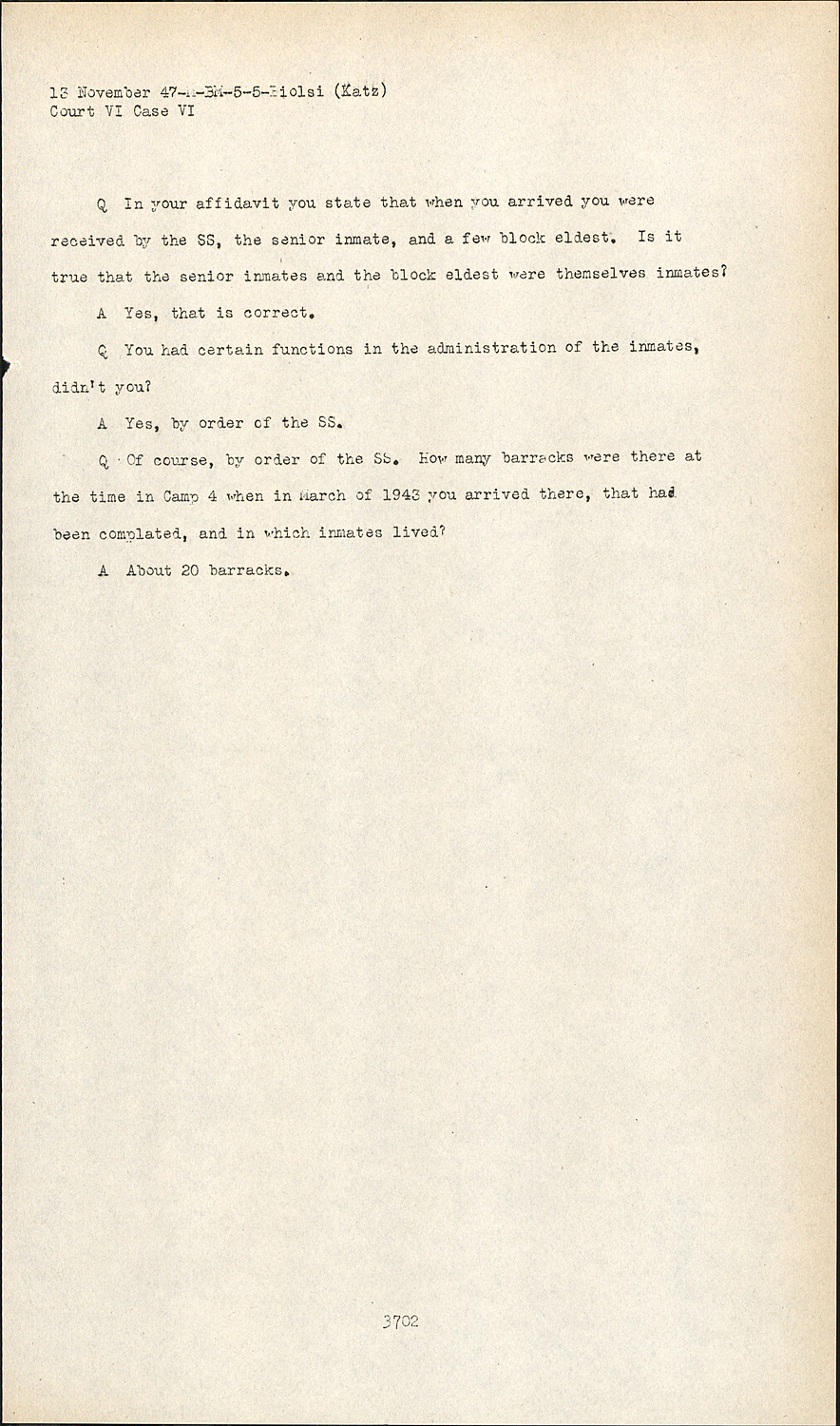
QIn your affidavit you state that when you arrived you were received by the SS, the senior inmate, and a few block eldest. Is it true that the senior inmates and the block eldest were themselves inmates?
AYes, that is correct.
QYou had certain functions in the administration of the inmates, didn't you?
AYes, by order of the SS.
QOf course, by order of the SS. How many barracks were there at the time in Camp 4 when in March of 1943 you arrived there, that had been complated, and in which inmates lived?
AAbout 20 barracks.
QYou say that the barracks were over-crowded, Witness. Can you remember how many inmates, approximately, were housed in one of these barracks?
AThe normal number was about 130 to 140. When I arrived, and later, up to 240 and 250, and sometimes more, were stuffed into these barracks.
QOther witnesses have testified that the normal capacity was 165. If I put to you now that if this figure is multiplied by 20, one arrives at the number 3,200, would not the barracks space have sufficed?
AThat is clear. The barracks also included administration, clothing and kitchen barracks.
QHow many barracks would you have to subtract for this purpose?
AAt least six to eight.
QDid you yourself work in the plant site of Farben, Witness?
AYes.
QMay I ask you for what length of time?
AWith an interruption of about three months - during my entire stay in Auschwitz.
QYou were in Auschwitz, until ...
AUntil 18 January 1945, when Auschwitz was evacuated.
QFor what firms did you work in the plant site?
AOnly with Farben.
QYou misunderstood my question, witness. I wanted to ask in what construction sites in this plant you worked. In the carpentry shop, in the bookkeeping department, cement carrying or where?
AI was, first of all, used - just as all new arrivals were used for the transporting of iron and cement, which was called the murder detail, Detail 4. Later I was used as a welder in Hall 797 - that is, the subsidiary building of the department for high-pressure synthesis.
There I worked as a welder up to the end, with a short interruption of three months, when I worked in the camp itself as a welder.
QHow long did you work in the cement detail, Witness?
AAbout three months.
QHow long approximately was the route that the inmates had to traverse when they carried the cement bags?
AThat depended on where the trains stopped and where the cement was to be taken. Generally, one can say the distance was about 300 to 500 meters, in my estimation.
QYou spoke of trains just now, Witness. Might it be correct if I tell you that on the plant site itself there were 100 kilometers of railroad tracks?
AI cannot say that, since we inmates were not permitted to wander freely about the plant site - and therefore I could never estimate the number of kilometers.
QBut you saw yourself that very large transports were done by mechanical means and not only by inmates?
ANo, I perceived that more work had to be done by hand than by mechanical means, at least at the beginning.
QYou worked as a welder, then?
AYes.
QWere there many inmates occupied as welders or in similar occupations in the Farben plant?
AIn the beginning, none at all. In the beginning everybody who was physically able was used for the most difficult and heaviest physical labor. Later they tried to pick out the skilled workers. There were not very many welders. At least, welders who were inmates.
QYou probably are not a welder by profession, either?
AI learned welding in 1938 in a special course.
QAt any rate, the welder's job was much easier and more pleasant than many other types of work, especially carrying cement?
ANo, in certain respects it was more difficult. We did not have any protection, and especially it was difficult because the German foremen gave us the most dangerous types of work, and especially without any safety devices, belts, etc.
QWitness, you just now mentioned the German Farben foremen. Don't you know that Farben as such is a chemical firm, and that the construction of the plant itself was of course not carried out by Farben, but by 200 to 250 construction firms?
ABut the partron saint of all those firms was Farben, and I myself was employed by a firm which was immediately subordinate to Farben.
QWhen you say that the person who gave this assignment was Farben then you are right. But if I put to you that there were many foremen who did not belong to Farben, but to all those other construction firms, then you will have to admit that?
AI had nothing to do with them. I was only occupied at work in Farben enterprises.
QBut you certainly must have noticed that other firms were working there?
AYes, of course.
QUnder No. 2 in your affidavit you state that you only noticed, when you arrived that you were in the Concentration Camp Auschwitz. May I assume that you meant that you were in Labor Camp IV, Monowitz, which, of course, belonged to the Concentration Camp Auschwitz? Is that correct?
AI learned that only when I was in the camp itself.
QYou say further on that German Farben foremen forced the Kapos to give the order to the inmates to take off their coats. Could the Farben foremen give orders of this nature to the Kapos, or isn't it true that such orders could only be given to the Kapos by the SS?
ANo, it occurred repeatedly that the foremen themselves gave directives to the Kapos, by reason of the strong position they had in which were construed as orders by the Kapos, and which these Kapos could not evade, since otherwise the foremen would of course have reported the Kapos to the SS.
QWhile you were working as a welder in the Farben plant, were you outdoors or indoors, or did that vary?
AI was in a semi-closed hall, summer and winter, which was made a little hospitable by us so that we could work there.
These Farben foremen didn't worry about that on the contrary, any comfort we created for ourselves was not welcomed by them.
QIn those semi-closed halls, were there only inmates, or were there German workers or free foreign laborers?
AThere were German workers, foreign laborers, and partly, also, British prisoners of war working there.
QThen practically they were all the laborers who were working in the plant of Farben mixed up there.
AYes, that was because I was doing specialized work which not every inmate could do.
QThen the conditions for the German workers, as far as working place is concerned, were the same?
AI beg your pardon the German workers did not work regularly in the same spot in which I worked. They only were there temporarily, especially to supervise us. The German foremen had their own breakfast and dining rooms. They had their own clothing rooms, and they could stay in their rooms for hours to warm themselves in the winter time, which we could not do.
QHow long were the working hours, Witness? When did you arrive at your working place, and when did you leave there?
AThe working hours varied. In the summer they were longer than in the winter. In the summer we began around seven o'clock, and we finished our work between five-thirty and six o'clock.
QAnd how about the winter time?
AIn the winter, as soon as darkness permitted us to march out from the camp, and in the evening as soon as darkness permitted us to march in.
QWere your working hours longer than those of the German and other workers, or was there any difference, or not? Isn't it true that in the winter time the prisoners left their place of work sooner and began later than the other workers?
ANo. Our working hours were partly longer - and especially the inmates were forced to work on Saturdays and Sundays, which was, of course, not the case regularly for the German and civilian workers.
QWitness, is it not true that very many inmates worked voluntarily on Sundays in the plant because they would rather stay there than in Camp IV, where they were supervised by the SS?
AThat depended. It didn't make any difference where you were beaten, and where you were hungry, whether in the plant, or in the camp.
QWhen you were working in the plant as a welder, where were the SS men who guarded you? Were they in the plant, or were they stationed around the fence of the plant?
AThe chain of guards was around the plant. The control itself was carried out in the camp by uniformed guards and also by guards who were in civilian clothes. The supervisors of Farben unquestionably reported matters to the SS in this case.
QWitness, you say "unquestionably". Is that an assumption on your part, or did you make positive observations?
AUnfortunately, my observations were very positive.
QIn what respect?
AIf a Farben supervisor was not satisfied with the tempo of the work, he reported that to the SS command and that meant severe punishment for the individual inmate or for the detail. I experienced that myself, not in my detail, but in other details.
QIf you experienced that in other details, then you must have been told about it. Isn't that right?
ANo, I saw it myself.
QWhat did you see? I cannot possibly imagine what you saw.
AI saw how a neighboring detail was checked. The result of this check was not satisfactory to the supervising Farben agent. He reported that to the SS command post. Then SS Hauptscharfuehrer Rackers had this detail called out in the evening and he punished the Kapo and foreman.

THE PRESIDENT:Just a moment. It is time for our morning recess: The Tribunal will rise at this time.
THE MARSHAL:There will be a fifteen-minute recess.
(A recess was taken)
THE MARSHAL:The Tribunal is again in session.
THE PRESIDENT:The Tribunal wishes to say that we were not establishing any practice of extending our morning recess; we had some matters in chambers of which counsel or representatives of counsel on both sides know about that took a little more time today.
MR. SPRECHER:Mr. President, after talking with Dr. Dix, for the defendant Schneider, we have made arrangements to call Walther Stothfang (S-t-o-t-h-f-a-n-g) as a witness this afternoon. The exhibit in question is Exhibit 1310. That is NI-5670, found in Document Book 67, page 150 of the English; Document Book 57, page 277 in the German.
THE PRESIDENT:Proceed with the examination of the witness, please.
CROSS EXAMINATION (Continued) NORBERT WOLLHEIM - Resumed BY DR. SEIDL (Counsel for the defendant Duerrfeld):
QWitness, before the recess you mentioned that in the I.G. plant itself controllers of the I.G. went about and made reports. We are interested in getting to know these names, and I should be grateful to you if you could name some of these controllers.
AUnfortunately I am not in a position to do that because the controllers, just as rarely as the SS, did not introduce themselves to us by name.
QYou then said that foremen of the I.G., and probably foremen belonging to other firms, had issued directives to the Kapos, etc. Can you give me the name of any of these foremen who made themselves conspicuous in that connection?
AThe foremen with whom I had dealings within my sphere of work was Obermeister Mueller, from Block 779, Synthesis High Pressure, and the man who was subordinated to him, called Dietrich.
QAnd both of them were foremen of the I.G.?
AYes, this was the synthetic high-pressure plant directly subordinated to the I.G.
QIn which way did these foremen maltreat the inmates? Did you see anything in that connection?
AI said that they repeatedly asked the Capos and the foremen to speed the work; and, furthermore, whenever in winter we lit a stove and whenever they were witnesses to such a procedure, they made reprimands to the Capo -- which meant that energetic steps were taken against us.
QBut you did not yourself see these foremen beat any inmates?
AI saw that foreman Dietrich repeatedly beat inmates and whenever my work led me into other departments I found that there German formen belonging to the I.G. were beating inmates. When I was not yet a welder I was repeatedly kicked on my buttocks by a German foreman, when unloading cement. I also saw that other inmates, comrades of mine, were treated in the same way.
QWitness, do you know or have you ever heard of the fact that from the plant management there was a strict prohibition, valid for all I.G. employees and all other employees, against beating anyone, irrespective of whether the person was an inmate or any other worker?
AI cannot remember any such directive, but if any such directive had existed it was never adhered to.
QYou furthermore said that the inmates wanted to warm themselves on the stoves. Is it true that in the plant hundreds of such stoves were erected during the winter, and that inmates could be seen frequently warming themselves at these stoves?
ANow and again little stoves were erected by the inmates themselves, but inmates could only warm themselves whenever no I.G. controller, German foreman, or SS functionary were present.
QIn another passage of your affidavit you say that the inmates were strictly prohibited from taking up any contacts with the British prisoners of war. Am I correct in saying that the inmates were not only prohibited from talking to English prisoners of war, but that they were not allowed to speak to anyone at all? They were not, for instance, allowed to speak with German workers or any other foreign workers?
ANaturally, there was such a prohibition in existence, but it was not kept, in the same way as many other directives which were issued by the I.G. management or the SS.
QWitness, do you mean to say that this prohibition was issued by the I.G. management? Would you not agree with me that we are here concerned with a prohibition which obviously emanated from the SS?
AI don't know who issued that decree, and it is really of no importance as far as its practical execution is concerned. I know that this prohibition regarding British prisoners of war was not kept by many people, as, for instance, myself, and that intentionally.
QIn your affidavit you go on mentioning the foremen of the Mannesmann Werke at Berlin, whom you saw treating inmates well. Is it not true that there were many foremen, foremen belonging to the I.G. and also of many other firms, who assisted the inmates in many ways?
ACum grano salis. It must be said that most of the foremen of the I.G. were very much opposed against the Jews and the inmates. I only mentioned the exceptional behavior of the Mannesmann Werke people because the foremen who worked there mostly came from Berlin, and since I myself was born in Berlin it was quite easy for me to establish contact with them, and I discovered that they were sympathetically inclined towards me. Probably they did not go through this investigation procedure which the I.G. Farben used for all its employees.
QIs it not true that also other firms from Berlin were active in the I.G. plant?
AI did not maintain any contact with them.
QI only mention the Siemens-Schuckert Werke, A.E.G. for example, and other big plants.
AI did not maintain any contact with them at all.
QBut you knew that such firms were there?
AI know that also other firms were working in the plant area.
QThen you corrected your remarks about Unikowa and you said that we were not concerned with the head of the political department there. You wanted to say that he was active in the office of the political department?
AYes.
QWas he the head of the office there?
AHe was the first inmate clerk in the political department. He actually had nothing to do with the office itself.
QDo you know how many clerks were active in the political department? I am referring to inmates.
AI only know of three who worked there at the time Auschwitz was evacuated.
QCan one conclude from that that inmates were active in very important positions, and that it is entirely incorrect to say that inmates were only used for hard labor?
AEven work as a clerk in the political department consisted of hard labor. It was a conspirative work, and the men working there often risked their lives whenever they tried to see to it that inmates were saved from the SS to whom these inmates had been reported. I myself am acquainted with many cases were such clerks saved the lives of my comrades, and that cannot be regarded as an easy task at all.
QDo you know that for a long time the entire wage office in the I.G. itself had clerks which were inmates of Camp IV?
APersonally, I do not know anything about that since I had no contact with the wage office.
QAt the end of your affidavit you mention that Dr. Ouerrfeld himself issued directives to German foremen to drive the inmates to the greatest possible work out-put. You referred in that connection to two directives.
Did you see these directives yourself? Or were you only told about them.
ASince I, myself, was not a German foreman, I could not see these directives. I stated in my affidavit that this report regarding the directives came to me from a reliable source, and I had confirmation regarding that matter from what German formen themselves told me and from what others told me and because of the practice which I saw myself in the year 1944.
DR. SEIDL:I have no further questions to the witness.
THE PRESIDENT:Is there to be any further cross examination of this witness? BY DR. HOFFMANN:
QWitness, in your affidavit you say that inmates were beaten by I.G. foremen and by the Kapos until they either started work again or remained lying, dead, on the floor. You said, "I, myself, saw such cases," So far, no witness has testified here as having seen an I.G. foreman beat an inmate to death.
Are you in your testimony only referring to Kapos? Or do you actually mean to say that you saw -
MR. MINSKOFF:May it please the Court, objection is made by contemplation.
THE PRESIDENT:That question is not improper. The objection is overruled. BY DR. HOFFMANN:
QI am asking you, Witness, did you see an I.G. foreman beating an inmate to death? Where did you see him do that, and will you please describe it? Or is the formulation of your sentence not quite correct; perhaps you only wanted to refer to the Kapos?
ANo, I saw personally -- it was during the first week after our arrival at Auschwitz -- that Kapos as well as I.G. foremen were beating inmates. I remember exactly that at Camp IV such a case occurred where an I.G. Farben foreman, together with a Kapo, were beating an inmate -I think it was a Jew from Holland -- until he was dead. We, ourselves, when marching to the roll call, brought this dead inmate into the camp of Monowitz.
QDo you still know which foreman that was?
AI must say again that no German foremen nor any SS-men introduced themselves to us when we came to Auschwitz.
QWell, how could you recognize that he was an I.G. foreman?
ABecause of the fact that he did not wear a uniform, as we did; furthermore, because of the fact that the building where such work was carried out was expressly designated as I.G. buildings.
QMay I put to you that according to my information hundreds of other firms were working on the plant. Therefore, it can be possible that you are speaking of a foreman belonging to another firm. Could one not say that you are right that the employer was I.G. Farben, but the foreman to whom you refer may not have been an employee of I.G.? Would you say that with certainty?
AI can say it with certainty. In this building where this case occurred there was only the I.G. responsible because I heard by conversation how the Kapo received his work slip, and he then referred to German foremen; and on that work slip I.G. Farben was mentioned, and no other firm.
QWitness, was this foreman a German?
AYes.
QHow do you explain that? You are a German and that foreman was a German. How is it possible that a normal human being, as this foreman must have been, could do an act like that? I assumed that he had the benefit of the same education as you or I ...
ACounsel, I don't have to explain to you the psychology of National Socialism. The German foreman was a German. He belonged to the Master Race; he was a National Socialist, I myself was a Jew; therefore I had no civilian status. I was only a number; and I do not want to describe to you now how we were designated there.
Q.But witness, you would agree with me that this National Socialism ideology regarding the Master race was not accepted by all Germans? You just said there were foremen of the Mannesmann-Roehrenworks, who did not act like that at all.
A.Counsel, we are now dealing with the notorious problem of the collective guilt or individual guilt.
Q.Witness, I really do not want to go into that. I only want to say that it cannot be assumed that the I. G. management gave an order to beat inmates to death; that cannot be assumed, can it?
A.Counsel, why did they then use inmates to erect their plants at Auschwitz, and why did they bring us to Auschwitz from all parts of Europe in order to give our blood there for years and years, and lose our relatives?
Q.I have put a very clear question to you. Do you believe there was a directive or a permission by the management of the I. G. permitting foremen to beat inmates to death? Yes or no?
A.Whether such a permission or whether such a directive existed or not makes no difference at all. The fact is that German foremen were beating inmates. They beat everyone, whether they were intellectual or manual laborers; whether they were people coming from Germany, Holland, Russia, Poland, or wherever they came from.
Q.Now in conclusion, do you believe that that was a consequence of the National Socialistic ideology which was inherent in these people?
A.It was not only a consequence of a National Socialistic ideology, but also a consequence of their personal attitude. These persons knew that they could give play to their brutality, that they could play their game of the Master Race there, and that they were assisted in the from all sides, including the heads of the German state.
Q.Witness, I know that you could not complain to the SS; that is why I do not want to ask you about any right of complaint; but was not the fact that you were under the supervision of the SS of decisive importance for what happened?
A.Counsel, if there had not been thousands of people who became members of the SS, there would not have been any concentration camps, and had there not been thousands of Germans who could be misused by the I. G. Farben for their plant in Auschwitz, then tragedies like that in Monowitz could not have come about.
Q.Another question, witness. Could one see at the very beginning how things were going to develop? Let us take a case of an architect who designed this plant.
A.I do not quite understand your question, Counsel.
Q.With reference to the conditions which you have described, could one understand them when one was actually there at the construction plant?
A.Every person who went through the plant with open eyes, and everyone who had any human feelings within him was in a position to observe these matters, knew to what results this treatment in the I. G. Farben plant did lead.
The defendant Duerrfeld himself could see when he attended our march into the Camp Monowitz on repeated occasions.......this march was not like a parade of wellnourished soldiers, but it was really a parade of mourning.
Q.A final question, witness. What should the plant management have done......in other words, had they wanted to........
MR. MINSKOFF:I object to that question, your Honor......as to what the I. G. should have done.
THE PRESIDENT:That objection is sustained. It is going into the field of speculation. If it becomes pertinent to determine that question, the Tribunal can only determine it from facts that are established in evidence, and will have to draw its own conclusions. It is hardly a subject for the expression of opinion of an expert, or even of a layman.
The objection is sustained.
MR. HOFFMANN:Your Honor, this brings me to the end of my cross-examination.
THE PRESIDENT:Thank you. Is there any further cross-examination of this witness? There being no request, we shall ask the Prosecution if there is any re-direct examination?
MR. MINSKOFF:No, your Honor.
THE PRESIDENT:Then, Mr. Witness, you are excused and the Marshal will escort you from the box. If you have another witness ready, we can perhaps qualify him and swear him before our recess.
MR. MINSKOFF:We haven't one now. We have Mr. Rausch. We can go to documents, if the Court please.
THE PRESIDENT:Perhaps we can get a document or two into evidence.
MR. MINSKOFF:Very well, your Honor.
THE PRESIDENT:Just for the record, we are back on Book 75?
MR. MINSKOFF:Book 75.
THE PRESIDENT:Very well.
MR. MINSKOFF:The following group of documents deal with the punishment of the inmated of Monowitz. I am speaking of the group of I. G. Farben inmates in the index.