The following four documents show that the institution of the "Verbindungsmaenner" was established to insure the successful transmission of information necessary to carry out the war aims of the Four Year Plan.
The next document appearing in Document Book XXXXVIII has been offered in evidence as Prosecution's Exhibit 762. It is marked NI-1570 and appears on page 45 of the English and page 52 of the German. This document consists of a series of correspondence in 1936 and 1937 concerning the transmittal of an East Asia report by Ilgner, which was prepared on the basis of one of the defendants Ilgner, frequent trips abroad, to the Under Secretary of State and Chief of the Reich Chancellory, and transmittal by Ilgner to the Under Secretary of State and Chief of the Reich Chancellory, and transmittal by Ilgner to the Under Secretary of State, Lammers, of a memorandum on the promotion of exports within the framework of the Four Year Plan. I should like to quote from one of these letters which was written on 15 April 1937 by Max Ilgner to Lammers. This letter appears on pages 45 and 46 of the English and 52 and 53 of the German, at the bottom of page 45 of the English: "Very esteemed Under-Secretary of State Lammers, "Because some time ago you shoved a special interest for my East Asia Report, I am taking the liberty of transmitting to you enclosed a written presentation of facts on the promotion of exports within the framework of the Four Year Plan.
I have prepared this presentation in pursuance of thorough discussions with the chairman of the Commercial Policy Committee of the National Economic Chamber, Under-Secretary of State Dr. Trendelenburg. This was prompted by his suggestion to make a presentation as to how the experiences and energies of private economy could be more effectively used for a methodical cooperation in the efforts of strengthening Germany's foreign trade position.
"As agreed upon with Under-Secretary of State Trendelenburg , I have, for the time being, made this presentation available only to you, to President Schacht, to Under-Secretary of State Possee, to Herr Brinkmann, to Ministerial Director Ritter, to Colonel Loeb, to Colonel Thomas and to President Pietzsch.
"I, of course, fully realize that the proposals I am making can in no way claim to be complete or perfect. N evertheless, I considered it in order for me to condense in writing the observations which I could personally make in recent years in almost all of the more important export markets.
"Inasmuch as I have also covered organizations of the Party (economic experts) in my presentation, and having referred to things which the regional groups and local groups"-- these are Party groups -- "in the various countries are especially interested in as I know, (German schools and German newspapers appearing abroad) I should be very much obliged to you, very esteemed Under-Secretary of State, if you would let me know whether you believe that I should transmit this presentation also to Reich Minister Rudolf Hess, that is, whether you believe he might be interested in it."
This is signed by Max Ilgner.
The memorandum on page 52 of the English and 65 of the German describes the reasons for particular intensification of export promotion, and Ilgner states at page 52 of the English and 65 of the German:
"the decisive importance which makes a particularly intensive promotion of exports a necessity arises at the present time from the fact that it has the task of providing the foreign exchange needed for carrying the Four Year Plan into effect. Export promotion, Four Year Plan, armaments and food can, however, only be considered within a total frame and -- as the Four Year Plan bears out logically-must each be brought into perfect accord with the other under a masterly control of the entire scheme. In line with the directives given, it is at the moment decisive that the proceeds of foreign exchange from exports be increased sufficiently to permit importing of all raw materials which are necessary for carrying the Four Year Plan into effect, fully and successfully, and, moreover--until the positive effects of the Four Year Plan begin to affect our own creation of raw materials favorably -- to import these raw materials which must be imported for simultaneously carrying on increased rearmament irrespective of the foreign exchange needed for food."
I should like to read the last sentence on page 52 of the English and I believe it is the last two lines of the German, page 66:
"For this very reason, however, it is necessary to augment efforts especially to win these markets and this, apart from such energy, tenacity and system calls for a comprehensive knowledge of these markets."
As the Tribunal reads this document, it will observe that the entire document is geared to meet the foreign exchange and raw material requirements of Nazi Germany's rearmament program. At page 65 of the English and page 90 of the German Ilgner sets forth a detailed program for procuring information to meet the demands of Nazi Germany for foreign exchange and raw materials. At page 66 of the English and 93 of the German Ilgner expresses his dissatisfaction with the commercial attaches of the Germany embassies abroad and makes proposals for remedying that defect.
In conclusion may I respectfully refer the Tribunal's attention to page 68 of the English and 97 of the German to show that the perspective and purpose of the program as set forth in this memorandum was the furthering of the German cause.
DR. GIERLICHS:Gierlichs for Geheimrat Schmitz.
The quotation that was just read on page 65 of the English is misleading because in the German original it says only "for the successful carrying out of armament" and in English it says "for the increased carrying out of rearmament". That is not contained in the German original. Please rectify that mistake.
MRS. KAUFMAN:At the moment I have no recollection as to the quote that I made. However, if the Defense Counsel points out that the statement is, "rearmament" and not "increased rearmament", Counsel for the Prosecution accepts that correction.
The next document to which the Prosecution makes reference appears in Document Book XXXXIV. It is Prosecution's Exhibit 776 and is marked NI-7605. It appears at page 18 of the English and page 18 of the German. This is an affidavit by Walter Jacobi, an I.G. Farben official, until the Fall-
THE PRESIDENT:Can you give me the reference again, please?
MRS. KAUFMAN:Yes. It is Document Book XXXXIV, page 18 of the English and page 18 of the German.
THE RESIDENT:Thank you.
MRS. KAUFMAN:It is marked NI-7605. I apparently do not have the correct reference to the German page number of this document, and, therefore, since I plan on reading from the document, I will read slowly enough for the record. This document is in affidavit by Walter Jacobi, and I.G. Farben official until the Fall of 1935. From this affidavit it appears that Ilgner's ideas with respect to providing the Nazi Government with information from abroad through I.G. contact men existed prior to 1937. Jacobi states at page 19 of the English, and I read paragraph 4:
"Sometime in the Summer of 1935 after Ilgner's return from his trip to the Far East, Ilgner stated that he had learned that the German official institutions abroad were not obtaining as much information about the respective countries they were located in as they should have, and proposed that I. G. supply the deficiency by setting up confidential agents known as "Vertrauensmaenner" in all of the countries abroad. Some of the members of the Commercial Committee were opposed to this proposal on the grounds that they saw no valid business reasons for such operations. The proposal was submitted to us in the typical Nazi ideological language containing the Fuehrer Principle. At that time I asked Ilgner why I. G. should undertake to supply this information stating, 'Are we I. G. or are we the German Government?'
"In questioning Ilgner as to the real purpose of such proposal which did not appear to me to have business justification, he informed me that the Foreign Office and the Auslands Organization, the Foreign Office of the Party, were interested in obtaining information from abroad to supplement their own inadequate sources."
The next document appearing in Document Book XXXXVIII marked NI-653, on page 76 of the English and page 115 of the German, has been previously introduced as Prosecution's Exhibit 361. This is a letter from the defendant Schnitzler to Bosch on the 12th of August 1937 in which we note that I. G. proceeded to act upon the program recommended by Ilgner to State Secretary Lammers. Bosch states that "at the suggestion of and in accord with Geheimrat Schmitz, we intend" -- I am quoting -"to establish a closer contact between the commercial directors of I. G. in the following manner", and he notes that, and I read from page 76 of the English and 115 of the German:
"Today the foremost of all these questions is the boosting of export which is not only acute as far as the levying of the tax or the equalization of the losses resulting from individual business transactions is concerned, but in connection with the execution of the Four Year Plan it has been positively stated that today boosting of exports has priority over everything else, to a certain degree even over defense politics."
The defendant Schnitzler proposes a cooperation of the leading commercial people and to achieve that purpose the formation of a commercial committee. Among the participants listed in the Commercial Committee are the defendants Schnitzler. Haefliger, Ilgner, Mann and Oster.
The Prosecution offers as its Exhibit 891 Document NI-2640which appears on page 79 of the English and 117 of the German. I believe a page was missing from the English document book and has been inserted between pages 79 and 80.
If it please the Tribunal, I should like to refer to this as page 79a. This exhibit contains a discussion of the organization and fields of activity of I. G. Berlin Northwest 7 prepared by the Bureau of the Commercial Committee, an office entrusted with the preparation and execution of the work of the newly created Commercial Committee. In discussing the organization and fields of activity of I. G. Berlin Northwest 7, at the bottom of page 79a of the English and page 120 of the German the report states:
"The world's markets for raw materials needed close watching in connection with the Four Year Plan", and in describing the functions of the Bureau of the Commercial Committee the report states at page 80 of the English and pages 121 and 122 of the German -- I am reading from the middle of the large paragraph appearing on page 80:
"The main duties of this office consist of an examination of problems of a general nature connected with our efforts to increase exports and of extending export business cooperation in the execution of problems abroad. It is, furthermore, entrusted with summarizing information received from the information services abroad and with transmitting this information to the individual offices of the I. G. and of the syndicate."
The Prosecution offers as its Exhibit 892 -- I withdraw that.
The next document appearing in Document Book XXXXVIII has been introduced as Prosecution's Exhibit 362.
It is marked NI-4927and appears on page 82 of the English and page 122 of the German. This document consists of minutes of the Commercial Committee meeting on 20 August 1937. Ilgner's program as set forth in the letter and memorandum to Lammers was discussed and acted on by the Commercial Committee at this meeting. Among those present were the defendants Schnitzler, Haefliger, Ilgner and Mann. The minutes note and I read from page 83 and 84 of the English, and 123 and 124 of the German:
"As the present situation with regard to raw materials" -- this is in the end of the last paragraph appearing on page 83 of the English -"and foreign exchange made it necessary for increased attention to be paid to all these activities, it became essential to insure still closer cooperation in future. In this connection all participants welcomed and accepted a proposal made by Dr. Ilgner to the effect that the Commercial Committee should in future share the responsibility for the general commercial and economic problems to be handled by the Berlin central offices."
And then on page 84 of the English and 124 of the German there is this statement:
"There was general agreement that, owing to the ever-increasing tendency towards industrialization in the world, it was imperative for the I. G. foreign organizations to have in all the larger towns abroad such persons as Verbindungsmaenner" -- or liaison men -- "who, by virtue of the positions they held and their knowledge of prevailing conditions could judge correctly the developments of their own country and give advice to the management at home accordingly. For that reason the Commercial Committee thinks it advisable that the former institution of the Zefi-confidential agents, who were already very active in this direction, be given increased consideration in their extended capacity as "I. G. Verbindungsmaenner"."
The next document appearing in Document Book 48, which is marked NI-6486, will be emitted by the Prosecution at this time in the interest of expediting the proceedings. Document NI-5744, which appears next in the document book, has been offered as Prosecution Exhibit 371. It appears on page 95 of the English and 141 of the German, and consists of a meeting of the department heads of Northwest 7 at which the Defendant Ilgner presided and which was attended by the Defendant Gattineau, in which it is noted that the appointment of Verbindungsmaenner would be made only through the Commercial Committee. This meeting also makes note of the fact that the chairman of the Vorstand was to be kept fully informed of activities by the transmittal of minutes of Northwest 7 Department Meetings by the transmittal of reports on the activities of Northwest 7 departments and by the transmittal of all data sent to the Commercial Committee.
The Prosecution next refers to a document appearing in Document Book 17. This document is marked NI-6701and has been introduced as Prosecution Exhibit 773. It appears on page 33 of the English. Page 64 of the German. This is an affidavit executed by the Defendant Ilgner and it contains a discussion of the purpose of a trip which Ilgner made to Latin America in 1936, and excerpts from a report of this trip which was prepared by the office of the Commercial Committee on the basis of Ilgner's notes and observations. The report is concerned with methods of strengthening Nazi Germany's position in South America. Ilgner makes observations concerning certain weaknesses, and proposes remedies. He discusses in some detail the institution of the system of appointing Verbindungsmaenner in each of the important countries and the functions to be performed by these COURT VI CASE VI verbindungsmaenner.
It is apparent from this report that I.G. Verbindungsmaenner were to coordinate the program of Nazi Germany abroad and to carry out the objectives of this program. The tasks assigned to Verbindungsmaenner in this document vary from an organized transmittal of information concerning the respective countries of the Verbindungsmaenner to promoting the pro-Nazi sentiment andaction in these countries through the press, German institutions abroad, and in other ways described in this report.
The Prosecution offers as its Exhibit-- No, I am sorry. I should like to refer to a document appearing in Book 45. However, I will not quote from it; I will just discuss it. It has been marked Prosecution Exhibit 363, and is noted as Document NI-4959. It appears on page 5 of the English and 7 of the German. The Tribunal will recall that at about this time--10 September 1937--it was decided at a Commercial Committee meeting that all men going abroad should be made to realize that it was their special duty to represent National Socialist Germany, and were reminded to contact the local or regional group of Germany Abroad, and to cooperate with them in their activities. And in the previous exhibit referred to by the Prosecution Ilgner's plans concerning such cooperation are set forth.
Prosecution offers as its Exhibit 892, Document marked NI-6122. It appears on page 97 of Document Book 48 and 148 of the German. This document consists of correspondence in November 1938 concerning the appointment of Verbindungsmaenner in Spain. The letter to the appointee Mr. Birk indicates the qualifications demanded of Verbindungsmaenner. The Prosecution offers as its Exhibit 893 Document NI-5621 which appears on page 100 of the English COURT VI CASE VI and 152 of the German.
This document consists of minutes of a Commercial Committee meeting presided over by the Defendant von Schnitzler and attended by the defendants Schmitz, Haefliger, Ilgner and Mann. One of the uses to which the Verbindungsmaenner were put is indicated on page 100 of the English and 152 of the German.
DR.BACHEM (Counsel for defendant Ilgner): Your Honors, from the report it can be seen that it deals with information of the leading gentlemen of Farbenindustrie. In the Index, however, only the words "prominent individuals" are stated, and this might create the impression that these are official, prominent persons. Therefore, please place a question mark next to the Index.
THE PRESIDENT:Thank you.
MRS. KAUFMAN:In connection with the problem just raised by the Defense counsel, I should like to read from page 100 of the English and 153 of the German:
"Appointment of I.G. Laiison Agents (Verbindungsmaenner) Following the discussion of some actual instances, Dr. Ilgner pointed out that members in responsible positions, when travelling abroad on other than merely routine business, must under no circumstances fail to contact I.G. Liaison Agents and to keep them informed. Such procedure appears necessary in view of the increasingly more involved and introducate relations with foreign countries, and particularly in view of the tendency, all but universally manifest, toward nationalization and industrialization."
"Under these circumstances it would make things easier for members in responsible positions travelling abroad to haves on hand, in the greatest possible number of countries, an expert (The I.G. Liaison Agent) capable of supplying information on current trends and tendencies.
COURT VI CASE VI No I.G. Liaison Agent will be able to do so unless he received adequate advance notice. Methods of selection of I.G. Liaison Agents are such as to guarantee confidential treatment of such matters."
"Dr. Schnitzler undertook to report on the matter to the Central Committee accordingly."
May I refer at this time to Document Book 45? I refer to Prosecution Exhibit 808 which is marked NI-7984and appears on page 53 of the English and 76 of the German. This document consists of excerpts from a report on Latin America made 30 September 1938 to the Commercial Committee by Overhoff, a Farben official, concerning methods of combatting anti-Nazi sentiment in South America. In discussing Verbindungsmaenner, Overhoff states, and I read from page 53 of the English and 82 of the German:
"A further point to be borne in mind in this connection is the need for precautions to prevent our representatives abroad from meeting difficulties resulting from the nature of the questions submitted. Some of them are of delicate nature affecting, as they do, the interests both from the point of view of policy and war economy, of the countries concerned. As people are getting a little sensitive in this respect--even in Latin America--no documents should be found in the offices of the Verbindungsmaenner or their assistants which could possibly hang them or ourselves. This was another point which called for our consideration on the occasion of the May rising in Brazil."
Prosecution offers as its Exhibit 894, Document, NI6077. It appears on page 102 of the English and 157 of the German. This document consists of minutes of a Commercial Committee meeting held on 7 October 1938. Overhoff's report was discussed at this meeting. The minutes state--and I read from page 103 of the English and 159 of the German, under the sub-title: "Latin-America COURT VI CASE VI (Lecture Dr. Overhoff)" "Dr. Overhoff reports in detail on the impression gained on his last journey with special reference to the situation brought about by the new political and economical offensive of the United States of America.
The questions mentioned in this connection: the Press, anti-dumping, Argentina propoganda and German re-imigration, are to be followed up accordingly."
And then on page 104 of the English and, I believe, 160 of the German, the last two paragraphs of Item 6 state: "The quick dispatch of assistants to the I.G. Verbindungsmaenner in the more important South American countries is an urgent necessity. Apart from this, it is also desirable that with regard to the projects of industrialization, suitable technicians should also be sent to South America for a longer stay."
"In view of the political situation in Latin America, reference is again made to the necessity for extreme caution in correspondence with our agencies."
Document marked NI-1137 has been previously introduced as Prosecution Exhibit 156.It appears on page 196 of the English and 162 of the German, and is a letter from the Legal Department of I-G. Berlin, dated 6 November 1937 to the Legal Department in Frankfurt, and contained an enclosed memorandum which indicates that precautions concerning the treatment of confidential correspondence with representatives abroad were taken as early as 1937.
Prosecution offers as its Exhibit 895, Document marked NI4842 which appears on page 110 of the English and 165 of the German. This is a memorandum dated 19 September 1939 by the Legal Department of I.G. Farben to members of the Dyestuffs Committee concerning methods of handling confidential correspondence overseas.
DR.BACHEM (Counsel for defendant Ilgner): In regard to the last document Exhibit 895, I should merely like to point out that in the German text there is a wrong signature under the document. The document is actually signed by Dr. Kuepper -- and not by Dr. Ilgner, as can be seen from the original.
THE PRESIDENT:That is not a very important consideration from the standpoint of the Tribunal because we do not see the German text, but perhaps counsel for the Prosecution can aid you in getting your own book straightened out.
DR. BACHEM:Excuse me, Mr. President, I don't know what the signature in the English text is -- whether it is Ilgner's or not. It is possible, but I do not know.
THE PRESIDENT:Very well. We will check that.
MRS. KAUFMAN:May the Prosecution take up this question in conference and then -
THE PRESIDENT:Yes, that is satisfactory. However, where the matter is of the importance as involving the signature of someone, please do not overlook calling it to our attention so that we get a correct document before us. Very well.
MRS. KAUFMAN:The Prosecution offers as its Exhibit 896, document marked NI-8644, appearing on page 112 of the English and 117 of the German. This is another memorandum concerned with the question of confidential correspondence and methods of treating that question.
The Prosecution offers as its Exhibit 897, Document marked NI-1130, which appears on page 118 of the Englishand 175 of the German. This is a confidential letter sent by messenger from the German envoy Moraht of Uraquay to Terhaar of WIPO , and an enclosed note with respect to the Embassy's wishes concerning I.G.'s correspondence overseas. This note contains some indication as to the contents of the confidential correspondence concerning which I.G. took the precautions indicated in the preceding exhibits.
DR. BACEHM:Please excuse me, but will you place another question mark next to the Index where one might conclude that it concerns an affair of Farben alone, but in reality the memorandum in the document book is of a general nature and does not refer to Farben only.
THE PRESIDENT:Very well.
MRS. KAUFMAN:May I read this document to the Tribunal ? I read from page 118 of the English. The page from which I read was inserted subsequent to the making up of the document books, and I do not knew if you have it. It is a document that comes after page 118 of the English and is marked "Note."
"Many firms still tend, according to the experience submitted here, to leave out of consideration the viewpoint that the enemy, or the neutral censorship in league with the enemy, also reads their correspondence. It is probable that, just now, after our newspapers have dealt in detail, and are still partly doing so, with the proceedings of the Bolivian Government against our am bassador in La Paz, the confiscation of German courier baggage in Argentina and many encroachments on the pant of North America against the Spanish American States,they will give full rein to their indignation in letters to their private or business friends and speak their minds un favorably, concerning the internal political (constitutional or admin istrative ) conditions of the state in question, will talk of corruption and USA-bondage or express the wish that they may one day be able to discipline these states in the German way.
Such remarks must at all events be discontinued now."
"The important thing is that we furnish the USA no material for the assertion that Germany is preparing an attack in South or Central America through subversive activities (Fifth column, etc.)
The German firms should therefore say nothing in their letters to South and Central America which could in any way let the conclusion be drawn that we intend to stage anything military or to step out of our reserve on the basis of our philosophy of life through meddling in the internal conditions of the individual Spanish-American states."
And the note concludes: "In so far as the purpose of the corres pondence necessitates communications which might be wrongly under stood by the censor, the firms must send their communications via the Foreign Office."
This note was sent to WIPO of I.G. Farben with a request that WIPO influence the firm of I.G. Farben on the line indicated in the note.
JUDGE MORRIS:Could you give me the date of the note, or when it was supposed to have been written?
MR. KAUFMAN:The letter to WIPO transmitting the note is dated 18 August 1941.
JUDGE MORRIS:The note is supposed to have accompanied the letter?
MRS. KAUFMAN:The note accompanied this letter.
The next document appearing in Document Book is 6646, and con sists of an affidavit which the Prosecution will omit at this time in the interests of expediting the proceedings.
The next document which the Prosecution would like to discuss appears in Book 46. T is document is marked NI-9512 and appears on page 89 of the English and page 104 of the German, and has been introduced as Prosecution Exhibit 840. This is an affidavit executed by a Farben employee Noack who was employed in WIPO of Berlin NW-7 until August 1939. He discusses in this affidavit some of the functions of WIPO with respect to its liaison with the government agencies concerning reports of I.G. Verbindungsmaenner. He states at page 90 of the English and 106 of the German:
"I.G. Verbindungsmaenner. Even before I joined I.G. there were I.G. Verbindungsmaenner; as far as I can judge one has to differentiate between two types. In the individual cities abroad, where I.G. sales departments existed, Verbindungsmaenner were appointed who continually made reports on a broad basis. These tasks were to be entrusted to especially qua$$ men who had received their training in Berlin NW 7. $$ most cases suitable men who were resident there - - - - - - - - were entrusted with such tasks, until sufficiently trained men could be provided. The reports of these Verbindungsmaenner had nothing to do with the sales reports and reports by the I.G. Foreign Agencies. The aim was the appointment of I.G. Trade Attaches, as I should like to call them, who were to report news on a wide basis, beyond the information hitherto reports (Politics, Economic Policy, Defense Policy, Currency Policy, International Conditions, and other interesting subjects.) Whether these reports came in regularly depended on the men appointed. The extent to which these reports were kept secret within the WIPO varied according to the nature of the reports. Of course there were reports and communications which were not distributed openly. Dr. Gattineau and Terhaar handled particularly important communications of various kinds personally."
The Prosecution would like to refer to the next document appearing in Document Book 46. It is marked 0558, and appears on page 94 of the English and 111 of the German.
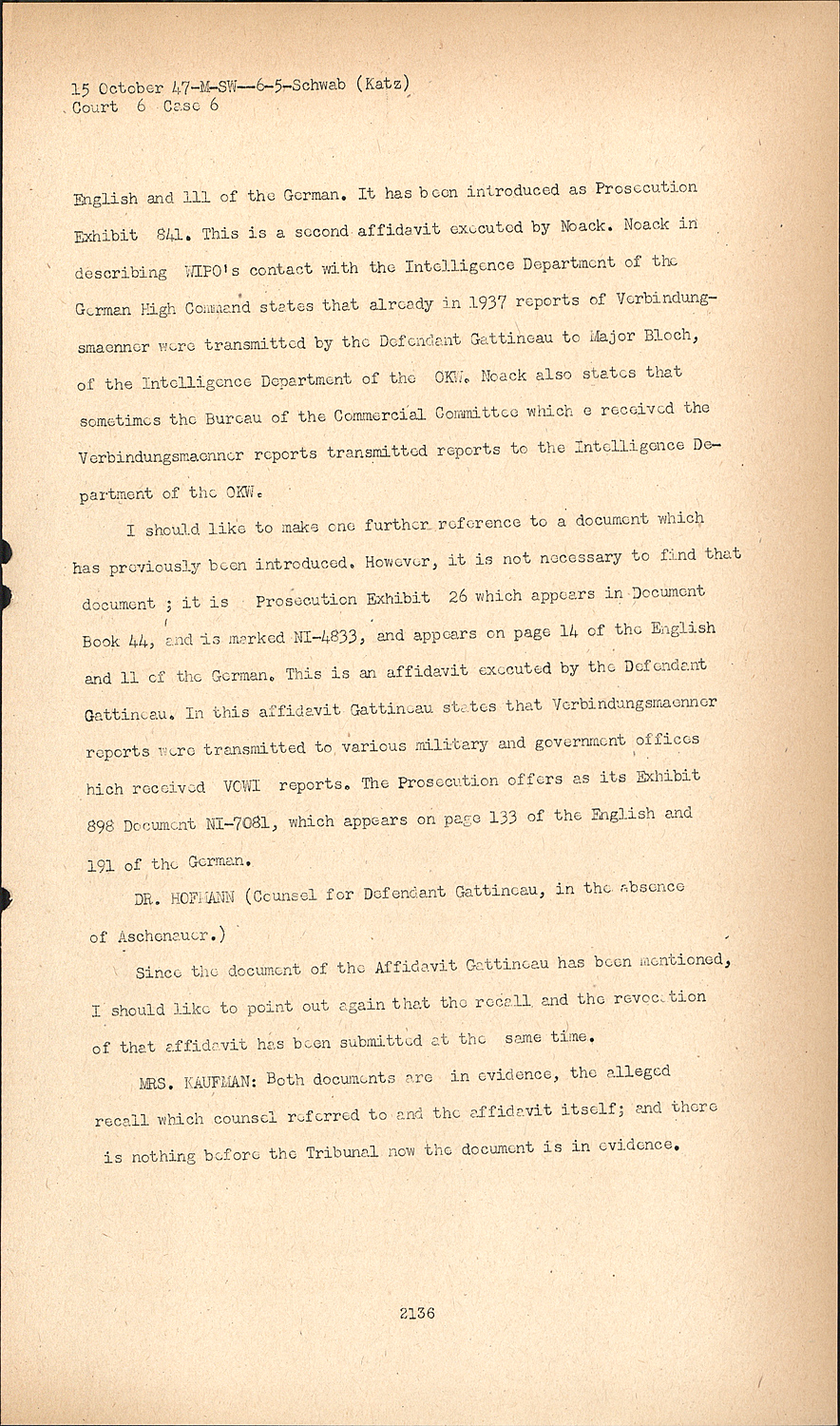
It has been introduced as Prosecution Exhibit 841.
This is a second affidavit executed by Noack. Noack in describing WIPO's contact with the Intelligence Department of the German High Command states that already in 1937 reports of Verbindung smaenner were transmitted by the Defendant Gattineau to Major Bloch, of the Intelligence Department of the OKW.
Noack also states that sometimes the Bureau of the Commercial Committee which e received the Verbindungsmaenner reports transmitted reports to the Intelligence De partment of the OKW.
I should like to make one further reference to a document which has previously been introduced. However, it is not necessary to find that document ; it is Prosecution Exhibit 26 which appears in Document Book 44, and is marked NI-4833, and appears on page 14 of the English and 11 of the German.
This is an affidavit executed by the Defendant Gattineau.
In this affidavit Gattineau states that Verbindungsmaenner reports were transmitted to various military and government offices hich received VOWI reports.
The Prosecution offers as its Exhibit 898 Document NI-7081, which appears on page 133 of the English and 191 of the German.
DR.HOFMANN (Counsel for Defendant Gattineau, in the absence of Achenauer.)
Since the document of the Affidavit Gattineau has been mentioned, I should like to point out again that the recall and the revocation of that affidavit has been submitted at the same time.
MRS. KAUFMAN:Both documents are in evidence, the alleged recall which counsel referred to and the affidavit itself; and there is nothing before the Tribunal now the document is in evidence.
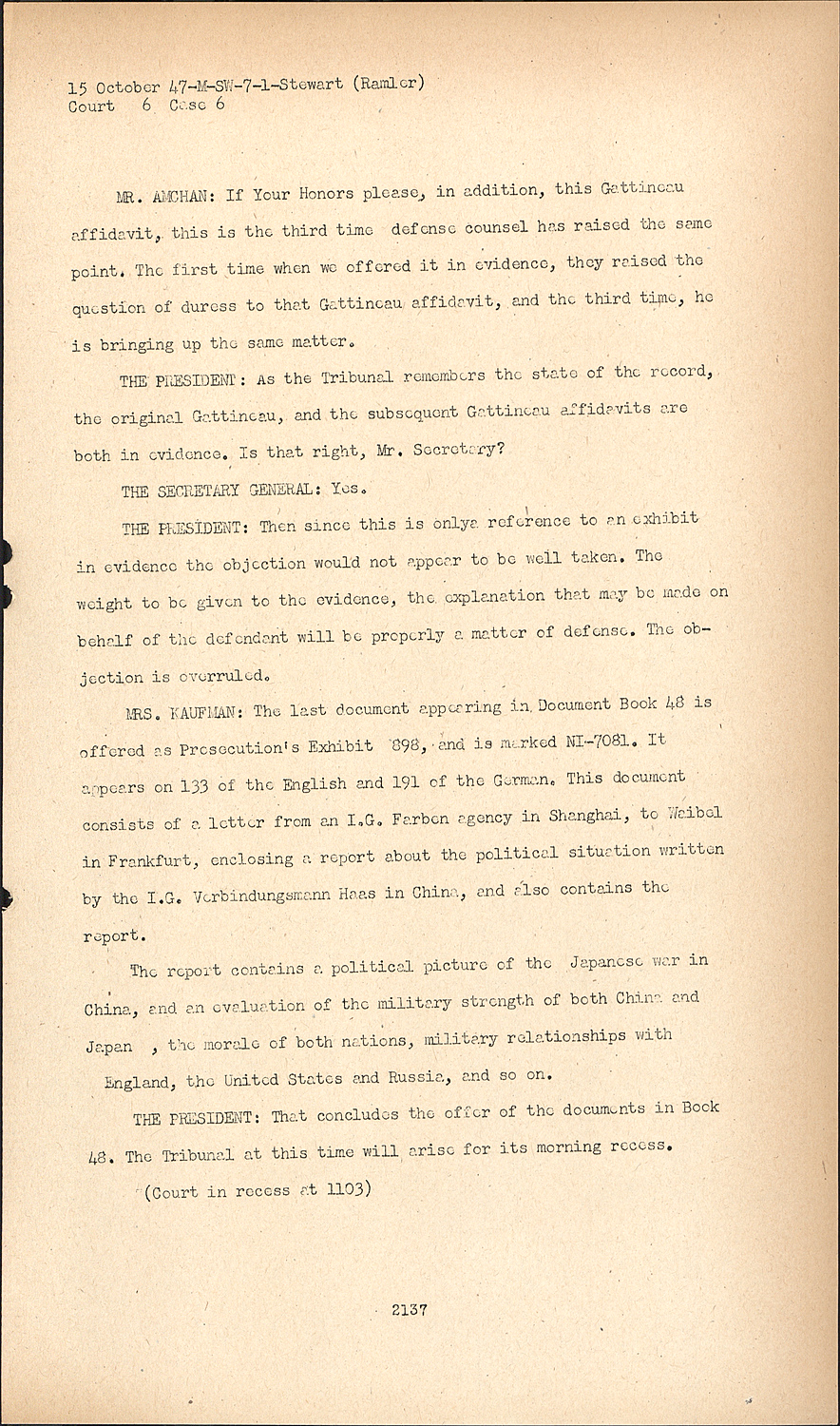
MR. AMCHAN:If Your Honors pleas, in addition, this Gattineau affidavit, this is the third time defense counsel has raised the same point. The first time when we offered it in evidence, they raised the question of duress to that Gattineau affidavit, and the third time, he is bringing up the same matter.
THE PRESIDENT:As the Tribunal remembers the state of the record, the original Gattineau, and the subsequent Gattineau affidavits are both in evidence. Is that right, Mr. Secretary?
THE SECRETARY GENERAL:Yes.
THE PRESIDENT:Then since this is onlya reference to an exhibit in evidence the objection would not appear to be well taken. The weight to be given to the evidence, the explanation that may be made on behalf of the defendant will be properly a matter of defense. The objection is overruled.
MRS. KAUFMAN:The last document appearing in Document Book 48 is offered as Prosecution's Exhibit 898, and is marked NI-7081. It appears on 133 of the English and 191 of the German. This document consists of a letter from an I.G. Farben agency in Shanghai, to Weibel in Frankfurt, enclosing a report about the political situation written by the I.G. Verbindungsmann Haas in China, and also contains the report.
The report contains a political picture of the Japanese war in China, and an evaluation of the military strength of both China and Japan , the morale of both nations, military relationships with England, the United States and Russia, and so on.
THE PRESIDENT:That concludes the offer of the documents in Book 48. The Tribunal at this time will arise for its morning recess.
(Court in recess at 1103)
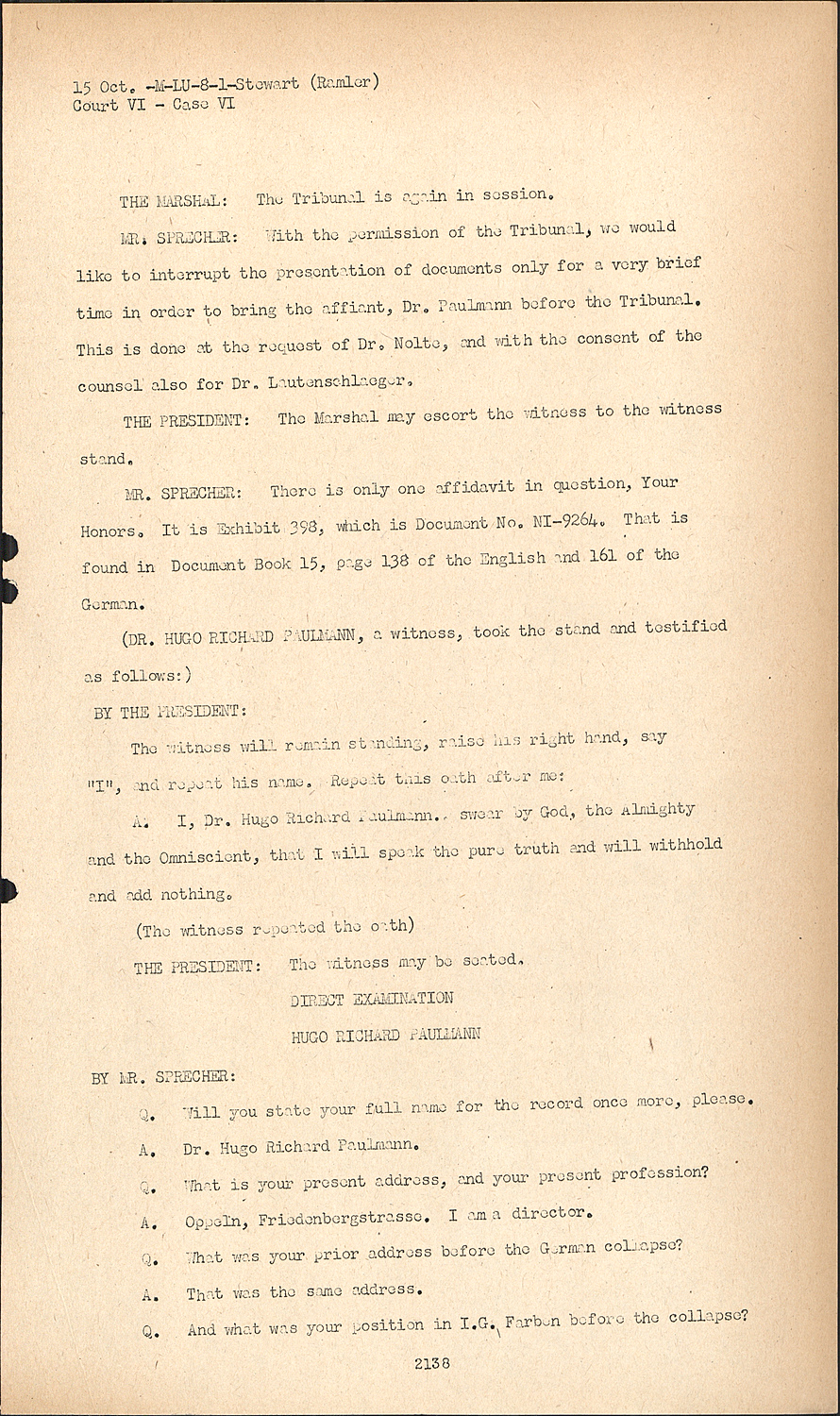
THE MARSHAL:The Tribunal is again in session.
MR. SPRECHER:With the permission of the Tribunal, we would like to interrupt the presentation of documents only for a very brief time in order to bring the affiant, Dr. Paulmann before the Tribunal. This is done at the request of Dr. Nolte, and with the consent of the counsel also for Dr. Lautenschlaeger.
THE PRESIDENT:The Marshal may escort the witness to the witness stand.
MR. SPRECHER:There is only one affidavit in question, Your Honors. It is Exhibit 393, which is Document No. NI-9264. That is found in Document Book 15, page 138 of the English and 161 of the German.
(DR. HUGO RICHARD PAULMANN, a witness, took the stand and testified as follows:)
BY THE PRESIDENT:
The witness will remain striding, raise his right hand, say "I", and repeat his name. Repeat this oath after me:
A.I, Dr. Hugo Richard Paulmann. swear by God, the Almighty and the Omniscient, that I will speak the pure truth and will withhold and add nothing.
(The witness repeated the oath)
THE PRESIDENT:The witness may be seated.
DIRECT EXAMINATION HUGO RICHARD PAULMANN BY MR. SPRECHER:
Q.Will you state your full name for the record once more, please.
A.Dr. Hugo Richard Paulmann.
Q.What is your present address, and your present profession?
A.Oppeln, Friedenbergstrasse. I am a director.
Q.What was your prior address before the German collapse?
A.That was the same address.
Q.And what was your position in I.G. Farben before the collapse?
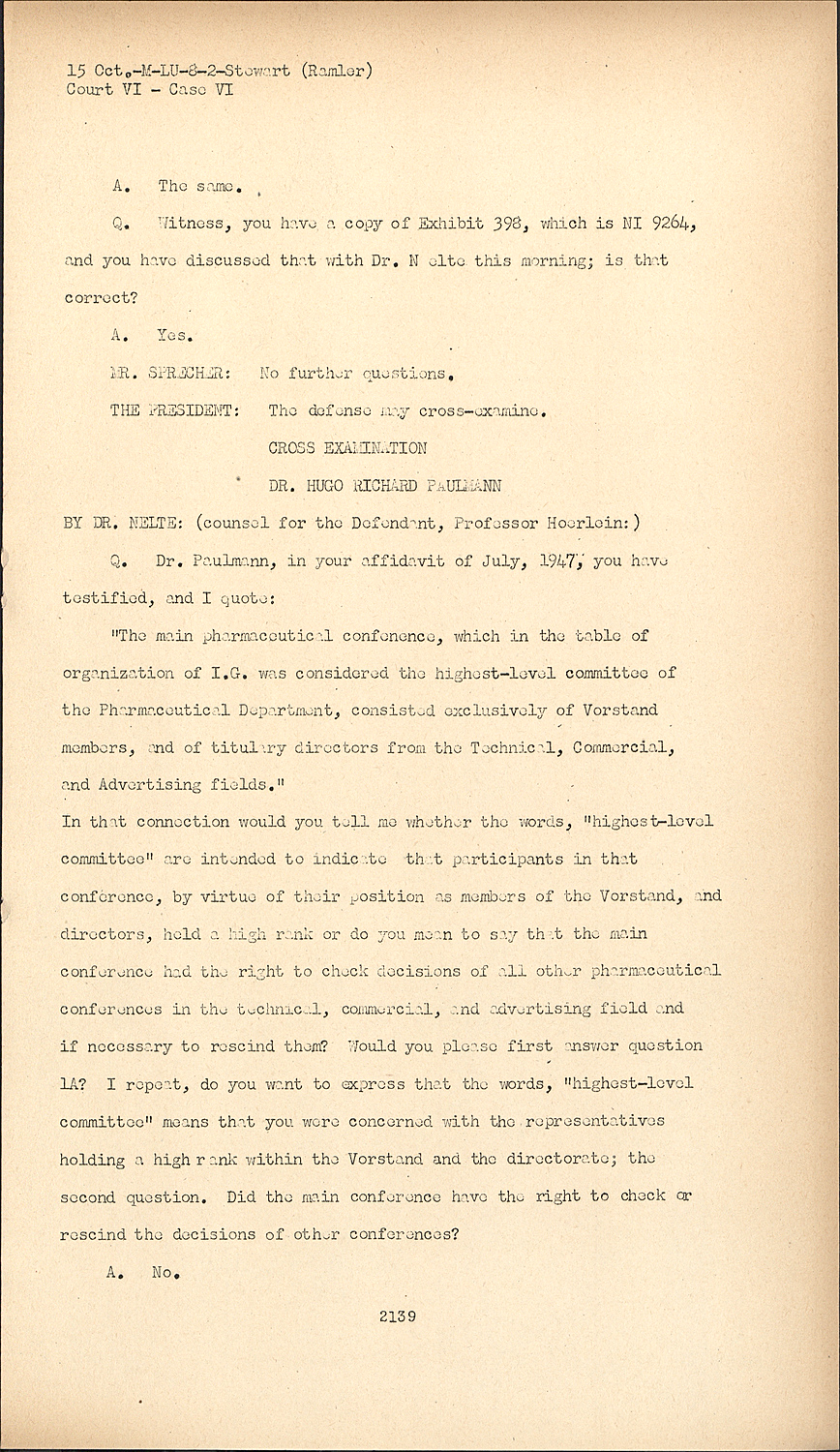
A.The same.
Q.Witness, you have a copy of Exhibit 398, which is NI 9264, and you have discussed that with Dr. N elte this morning; is that correct?
A.Yes.
MR. SPRECHER:No further questions.
THE PRESIDENT:The defense may cross-examine.
CROSS EXAMINATION DR. HUGO RICHARD PAULMANN BY DR. NELTE: (counsel for the Defendant, Professor Hoerlein:)
Q.Dr. Paulmann, in your affidavit of July, 1947, you have testified, and I quote:
"The main pharmaceutical confenence, which in the table of organization of I.G. was considered the highest-level committee of the Pharmaceutical Department, consisted exclusively of Vorstand members, and of titulary directors from the Technical, Commercial, and Advertising fields." In that connection would you tell me whether the words, "highest-level committee" are intended to indicate that participants in that conference, by virtue of their position as members of the Vorstand, and directors, held a high rank or do you mean to say that the main conference had the right to check decisions of all other pharmaceutical conferences in the technical, commercial, and advertising field and if necessary to rescind them? Would you please first answer question 1A? I repeat, do you want to express that the words, "highest-level committee" means that you were concerned with the representatives holding a high rank within the Vorstand and the directorate; the second question. Did the main conference have the right to check or rescind the decisions of other conferences?
A.No.