Q.Did Mr. Neumann remain at Aussig while you were the commissar?
A.Yes. On the evening of my arrival at Aussig, October, 1938, Mr. Neumann visited me at the hotel. He explained to me the orders which he had been given from Prague. I in turn explained to him the orders which I had been given: to act as trustee, together with Brunner, of the plants and the mines.
On the same evening I consulted Mr. Brunner, who had personally known Mr. Neumann from his former activities, and on the same evening we informed Mr. Neumann of our decision that we were agreed that he should take over the management at Aussig under the commissars. That is, he would be the chief plant director. He stayed at Aussig up to the time the Commissars left and even beyond that; and he did so against the resistance by some members of the staff and by party agencies. They thought that the assignment of Mr. Neumann to Aussig from Prague proved his unrealiability.
Mr. Neumann remained at Aussig until 1945. After the German troops left he still remained there. He, so to speak, returned the plants to the Verein, and some time later, contrary to the advice or the offers of his Czechoslovakian agencies, he left the Sudeten territory and is probably in England, after having stayed in the American zone for some time. You will introduce an affidavit by Mr. Neumann.
Q.Mr. Kugler, when did the Verein transfer its seat to Prague?
A.The Verein transferred its seat from Aussig to Prague in 1937; as was generally assumed, this was in connection with the unfavorable relations between Germany and Czechoslavakia, which were already recognizable at that time. That also becomes apparent from the affidavit of Mr. Dvoracek, Paragraph 7.
Q.Concluding my examination with respect to that subject matter, I should like to ask you the following: You turned over the two plants to the new owner on 28 February 1939, as of 1 March 1939. That meant that your trusteeship administration had ended. The contract of sale was concluded on 17 November 1938, or in December 1938. Would you please quite briefly give the reasons why you continued that activity up to the date I mentioned?
A.For one thing, it was necessary that the new owners should settle their relationship among each other. There were contracts and collateral contracts between Farben and Heyden, and so forth, This was at the beginning of 1939.
There was another reason, however, why I remained commissar for more than two months: that was that the Geran as well as the Czech s side had to approve the contract of December 1938. I may refer to Roman numeral X of the main contract, in which official approval of both governments was a requirement. The main contract is Prosecution Exhibit 1116, Book 54, English page 73.
Q.Mr. Kugler, you have just described this development. Did you feel at the time that what was done by Farben meant preparation for a war of aggression?
A.No.
Q.For a few months you were active in the management of the Aussig and Falkenau plants as a commissar. During that time did you make any changes in the production program of these plants in the sense that you assigned priority to products which could serve for the waging of a war of aggression?
A.No. For that reason, in the whole transactions, I could see no connection whatsoever with any belligerent act or any thought of aggressive war. I still can't see it today. Let me point out one thing. If the assumption of the Prosecution were corredt, that an aggressive war or further aggressive actions were contemplated and that the acouisition of those plants was connected therewith, one certainly would not have proposed a businessman for the position of a commissar - a specialist, a dyestuffs salesman. One naturally could have attached importance to placing a qualified expert in that position. When the Ministry of Economics or the Sudeten German party said, "We want Mr. Brunner there", they would not have said. "Naturally we shall withdraw our proposal for Mr. Wurster". That alone is proof. And now to the other question, with respect to production. Here again I can give you information, covering the time I was active as a commissar - from October 1938 up to March 1939 - and also the later tine, for after March 1939. I was a member of the so-called advisory council of the Aufsichtsrat of the chemical plants, and also the business manager of the subsidiary company, the tar dye factory. From 1939 to 1945, the tar-dye plant managed to just about "muddle" through. The dye-stuffs facilities were not very modern, on the whole, and during the war those dyestuffs were produced which could possibly be produced in view of the general situation.
Two new products were started in the ta-dye factories; one was a protective substance for rubber, phenyl betanaphtylamine, and the second was a synthetic substance for the cable industry; that is, "Brehm-wachs". That shows the activity or inactivity of the tar-dye factories in military production. As far as the main chemical production of Aussig and Falkenau are concerned, I made a statement to the Bernstein Committee in the summer of 1945. I have a copy of that statement before me. It is on, the whole correct, but I should like to correct just one point here. At that time I said that the production which might serve direct or indirect military purpose was the following, and I mentioned at first the expansion of chlorine electorlysis; second a hexa-chlorine-ethane plant, which is a smoke-screen substance; and third, the carbon disulphide substance.
(I mentioned that it was a preliminary product for the artificial fiber industry); and finally I mentioned the intended expansion of carbide production. One matter is correct in that statement, that is, the hexa-chlorine-ethane plant, which was war production. It was started in 1942 on the basis of a contract with the Reich of 5 February 1942, which provided that the Reich would supply the machines and installations; that the buildings would be constructed by the firm, but financed by a loan from the Reich amounting to one and one-half million marks. In speaking of the expansion of chlonine electrolysis, I erred somewhat in my earlier statement, because only a part of the expansion was devoted to hexa-chlorine-ethane. I should not have carbon disulphide at all in this connection. For it is incorrect to say that carbon disulphide is a military product. You could take any civilian product and say it could be a military product.
Finally, carbide production was never expanded because there was no iron or other material available. I think that is all.
Q.- Having concluded that subject, I should like to submit some documents in connection with these events: As Exhibit 29 I offer document 28, excerpts from a paper entitled "European Politics, 1933-1938, in the Light of the Prague Files". It is a publication of the German Institute for Foreign Policy Research. These excerpts originate from the files of the Prague Foreign Ministry.
MR. SPRECHER:Mr. President, I think we should make an objection, at least pending certain understanding as to what counsel's purpose may be.
Will you please turn in that connection to page 9 of the document book?You will notice that this is a publication which was published in 1942 by a German Publishing House subject to the controls of the Goebbels Ministry, and no doubt in this instance the Ribbentrop Ministry, since it purports to talk about certain foreign political developments.
Now, the excerpts which counsel has included are headed, as you will note if you will turn over on pages 10,11 and 12, with certain written-in headings which I suspect weren't included in the text of the original reports; and, of course, whether or not any editing took place with respect to what is allegedly a report of Czech military attache is another matter.
Now, with respect to the question of aggression, we would like to have this document in evidence. I mean I just want that to be clear, because if you take a look at page 12 under the heading, "Henderson is convinced that Berlin wants to obviate war", I don't think it takes much imagination to see why we feel that way, but the only thing I can see that these documents are offered for, or could be offered for, is to show a justification for the threat of aggression which so clearly appears on page 12 of this document, and what those threats of aggression by Hitler led to with respect to representations by the countries who were seeking time to meet the further consequences of such threats of aggression.
Now, if that becomes an issue at this point, I think that the trial would indeed be on some side issues, and I would really like to know What counsel's position is. Is it that these documents were known to these defendants at the time? That there is a justification for a threat of aggression such as is announced in these pages? Or what?
THE PRESIDENT:Mr. Prosecutor, let us first understand: Are you or are you not objecting to the introduction of the document? If you are not objecting, counsel for the defense is under no obligation to argue his case at this time by stating the purposes of the document. If you are objecting, the Tribunal would be interested in knowing for what purposes the documents are being offered, so that we can determine whether or not we think that they are competent. Are you making an objection to it?
MR. SPECHER:Mr. President, I wanted to make an objection, and I did want to state the problem I had, so that counsel could reply more specifically.
THE PRESIDENT:You did say something about that you would like to have them in evidence, and that is the reason for my remarks. I would like to know whether you do or do not object to them.
MR. SPRECHER:No, I merely meant to indicate by that that our position was being taken because we don't see that it is helpful in this particular case on what is narrowly before us.
THE PRESIDENT:The objection is overruled, and the document is in evidence.
DR. HENZE:I may state in connection with this document that it is not my intention to assert that my client knew these reports. The fact that these reports were found in the Prague Foreign Ministry shows that they were not known to my client at the time he was Commissar.
I have submitted these excerpts to the Tribunal in order to present a picture of the historic developments at the time, in order to prove that my client and other persons who participated in these events in 1938 had to see things in a different light from the way matters are now seen by the Prosecution. Public opinion at the time considered the problem in Czechoslovakia a population - political problem which had already been acute for decadeand centries.
I have introduced these documents to point to this historical background.
The second document will bee me Exhibit 30. It is document 29. This is the final report which the English envoy, Lord Runciman, sent to the British Prime Minister 21 September 1938.
The introduction of this document is to serve the same purpose.
The third document in this connection is Document 30, which will bear exhibit No. 31. This is a Verbatim copy of the so-called Munich Agreement which was signed by the British Prime Minister Chamberlain, the French Premier Daladier, Mussolini and Hitler.
The next documents which I should like to introduce, deal with my client's activities in his capacity as Commissar at Aussig and Falkenau.
The first document, Document 31, will become Exhibit 32. It is the affidavit of Walter Neumann, a leading employee of the Verein for many years. This Neumann was transferred by the General directorate of the Prager-Verein to Aussig before the Munich Agreement, to take over the management there in case of a territorial changed. In other words, he was a confidential agent of the General Directorate in Prague.
Mr. Newmann in many points confirms what my client has just tes**.
He makes some statements about the question of the dismissal of Court VI - Case VI personnel, and he says at the end:
The transfer of all persons who were sent to Prague was loyally supported and made easy by the Commissar management.
Mr. Newmann goes on to say, "Dr. Kugler behaved very correctly in his position".
I may point out that Mr. Neumann remained in Czechoslovakia until 1945. He says that the Czechs did not reproach him for that at all. On the contrary, he was advised to stay there. He received the so-called antifascist certificate and then left Czech Slovakia.
The next document is Document No. 32, which will bear Exhibit No. 33. This is the affidavit of a Farben employee, Ernst Dannenberg, who accompanied my client on his trip to Aussig.
The next document is an affidavit of the former employee of the Prager-Verein, Wenzel Sedlatschek. This is Document 33, which will become Exhibit 34.
In particular he reports on the personnel changes about which my client has spoken here. He states that there was a real migration in the Sudetenland at the time.
Document 34 will be Exhibit 35. This is a letter sent by the Verein to this man Sedlatschek on 19 October 1938, in which Sedlatschek is dismissed from the services of the Prager-Verein. This dismissal occurred because he was a Sudeten German.
I should like to parallel the Prosecution's Exhibit dealing with the converse case with this exhibit.
As Exhibit 36, I now offer Document 35. Again it is an affidavit of a former employee of the Prager Verein, she had worked for the Verein since 1914. Mr. Sedlatehel (sic) submits a list of these persons of Sudeten German origin, who were dismissed by the management of the PragerVerein, or were transferred to Prague (sic). He lists 82 persons. I offer this list as a parallel to the Prosecution's Exhibit which contains a list of persons transferred from Aussig to Prague or dismissed.
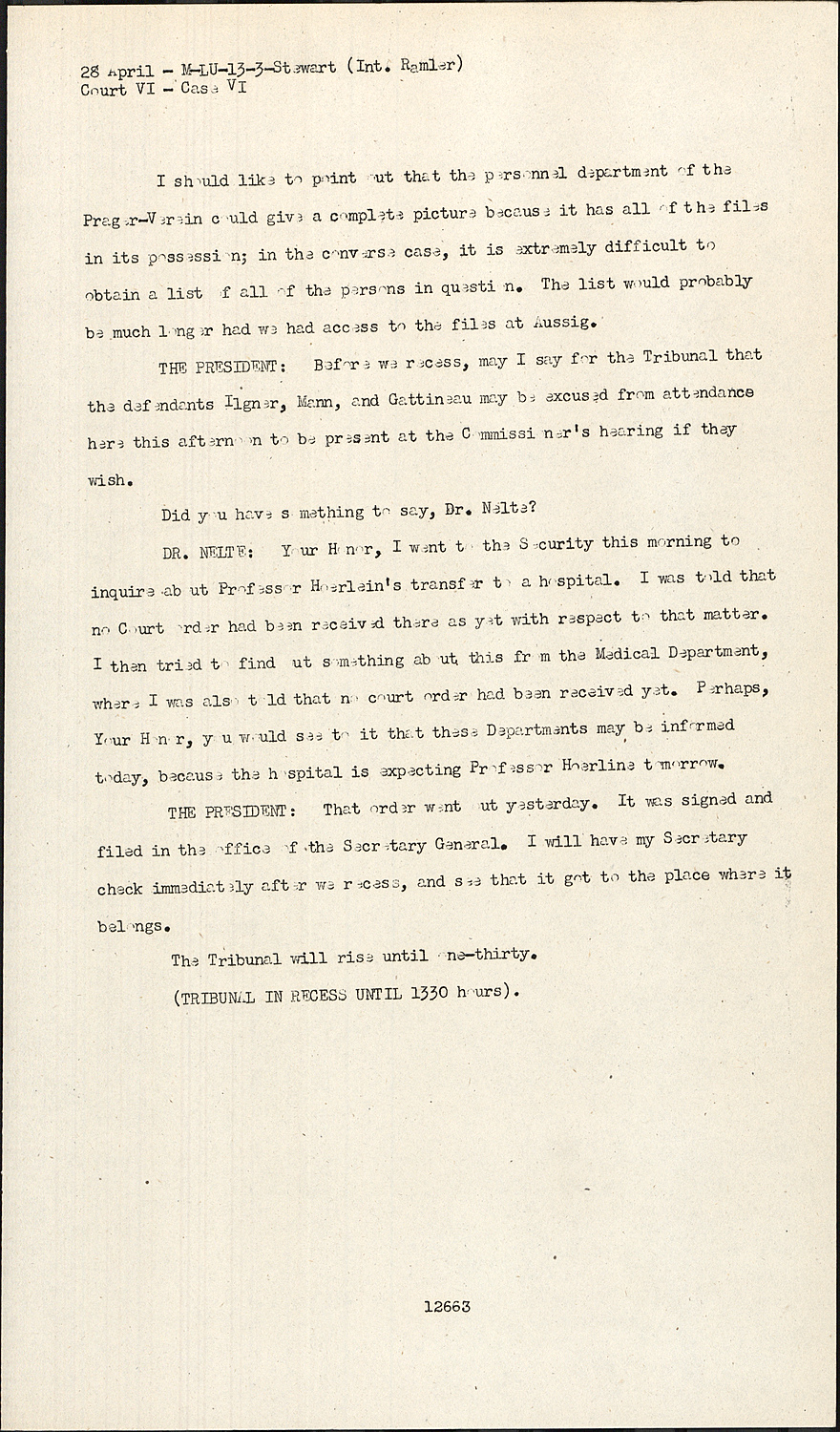
I should like to point out that the personnel department of the Prager-Verein could give a complete picture because it has all of the files in its possession; in the converse case, it is extremely difficult to obtain a list of all of the persons in question. The list would probably be much longer had we had access to the files at Aussig.
THE PRESIDENT:Before we recess, may I say for the Tribunal that the defendants Ilgner, Mann, and Gattineau may be excused from attendance here this afternoon to be present at the Commissioner's hearing if they wish.
Did you have something to say, Dr. Nelte?
DR. NELTE:Your Honor, I went to the Security this morning to inquire about Professor Hoerlein's transfer to a hospital. I was told that no Court order had been received there as yet with respect to that matter. I then tried to find out something about this from the Medical Department, where I was also told that no court order had been received yet. Perhaps, Your Honor, you would see to it that these Departments may be informed today, because the hospital is expecting Professor Hoerline tomorrow.
THE PRESIDENT:That order went out yesterday. It was signed and filed in the office of the Secretary General. I will have my Secretary check immediately after we recess, and see that it got to the place where it belongs.
The Tribunal will rise until one-thirty.
(TRIBUNAL IN RECESS UNTIL 1330 hours).
AFTERNOON SESSION
THE MARSHAL:The Tribunal is again in session.
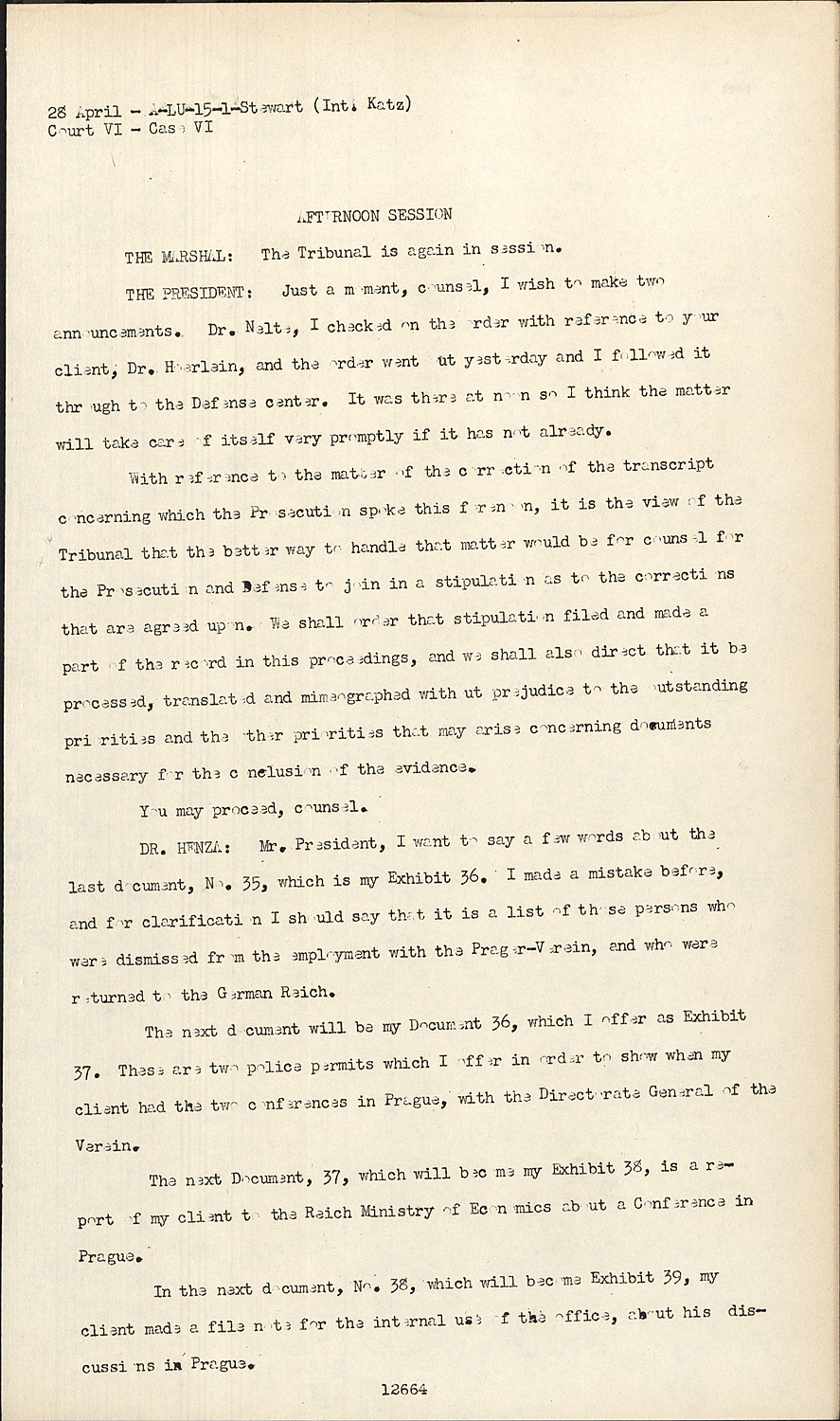
THE PRESIDENT:Just a moment, counsel, I wish to make two announcements. Dr. Nelte, I checked on the order with reference to your client, Dr. Hoerlein, and the order went out yesterday and I followed it through to the Defense center. It was there at noon so I think the matter will take care of itself very promptly if it has not already.
With reference to the matter of the correction of the transcript concerning Which the Prosecution spoke this forenoon, it is the view of the Tribunal that the better way to handle that matter would be for counsel for the Prosecution and Defense to join in a stipulation as to the corrections that are agreed upon. We shall order that stipulation filed and made a part of the record in this proceedings, and we shall also direct that it be processed, translated and mimeographed without prejudice to the outstanding priorities and the other priorities that may arise concerning documents necessary for the conclusion of the evidence.
You may proceed, counsel.
DR. HENZA:Mr. President, I want to say a few words about the last document, No. 35, which is my Exhibit 36. I made a mistake before, and for clarification I should say that it is a list of those persons who were dismissed from the employment with the Prager-Verein, and who were returned to the German Reich.
The next document will be my Document 36, which I offer as Exhibit 37. These are two police permits which I offer in order to show when my client had the two conferences in Prague, with the Directorate General of the Varein.
The next Document, 37, which will become my Exhibit 38, is a report of my client to the Reich Ministry of Economics about a Conference in Prague.
In the next document, No. 38, which will become Exhibit 39, my client made a file note for the internal use of the office about his discussions in Prague.
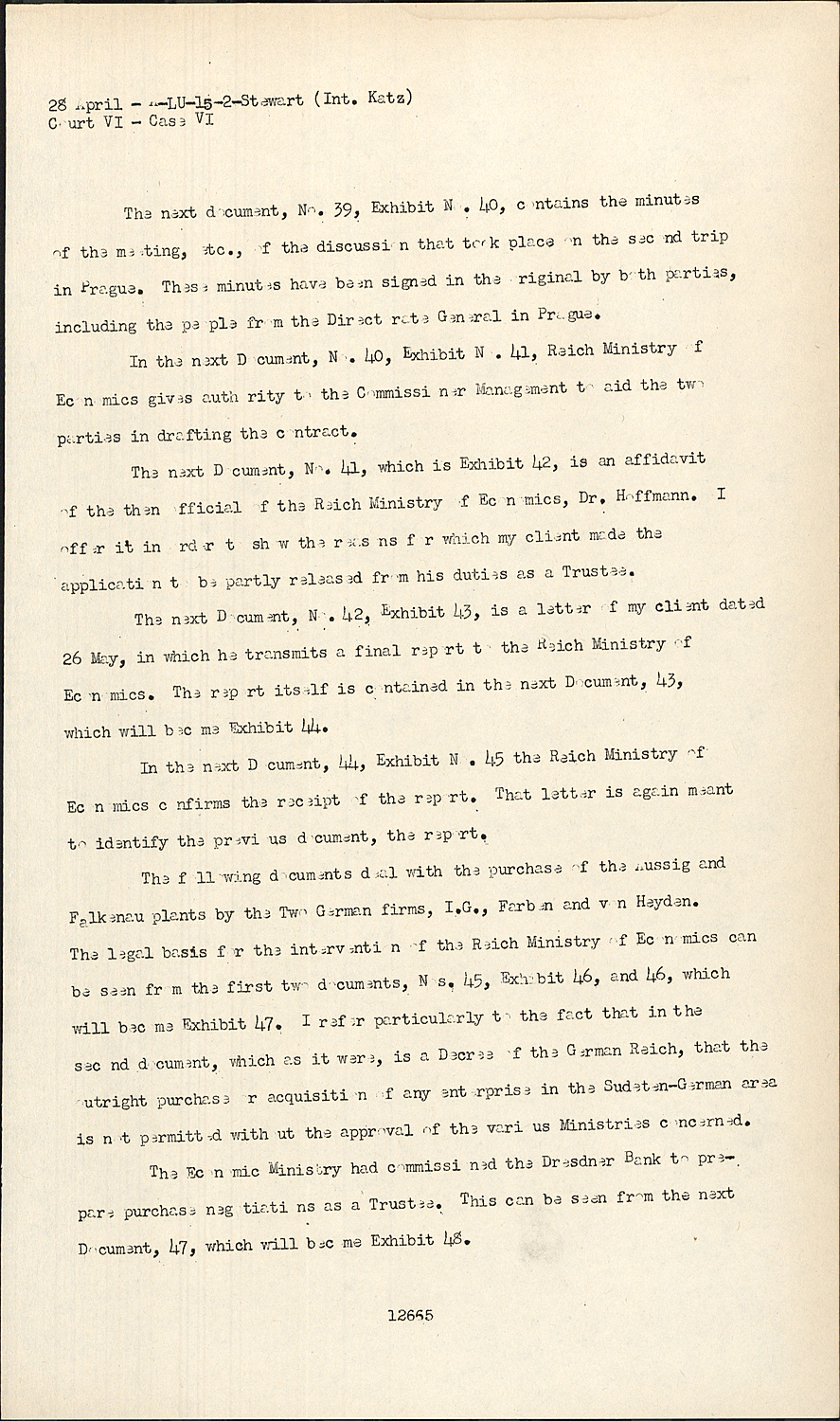
The next document, No. 39, Exhibit No. 40, contains the minutes of the meeting, etc., of the discussion that took place on the second trip in Prague. These minutes have bean signed in the original by both parties, including tha people from the Direct rate General in Prague.
In the next Document, No. 40, Exhibit No. 41, Reich Ministry of Economics gives authority to the Commissioner Management to aid the two parties in drafting the contract.
The next Document, No. 41, which is Exhibit 42, is an affidavit of the then official of the Reich Ministry of Economics, Dr. Hoffmann. I offer it in order to show the reasons for which my client made the application to be partly released from his duties as a Trustee.
The next Document, No. 42, Exhibit 43, is a letter of my client dated 26 May, in which he transmits a final report to the Reich Ministry of Economics. The report itself is contained in the next Document, 43, which will become Exhibit 44.
In the next Document, 44, Exhibit No. 45 the Reich Ministry of Economics confirms the receipt of the report. That latter is again meant to identify the previous document, the raport.
The following documents deal with the purchase of the Aussig and Falkenau plants by the Two German firms, I.G., Farben and von Heyden. The legal basis for the intervention of the Reich Ministry of Economics can be seen from the first two documents, Nos. 45, Exhibit 46, and 46, which will become Exhibit 47. I refer particularly to the fact that in the second document, which as it were, is a Decree of the German Reich, that the outright purchase or acquisition of any enterprise in the Sudeten-German area is not permitted without the approval of the various Ministries concerned.
The Economic Ministry had commissioned the Dresdner Bank to prepare purchase negotiations as a Trustee. This can be seen from the next Document, 47, which will become Exhibit 48.
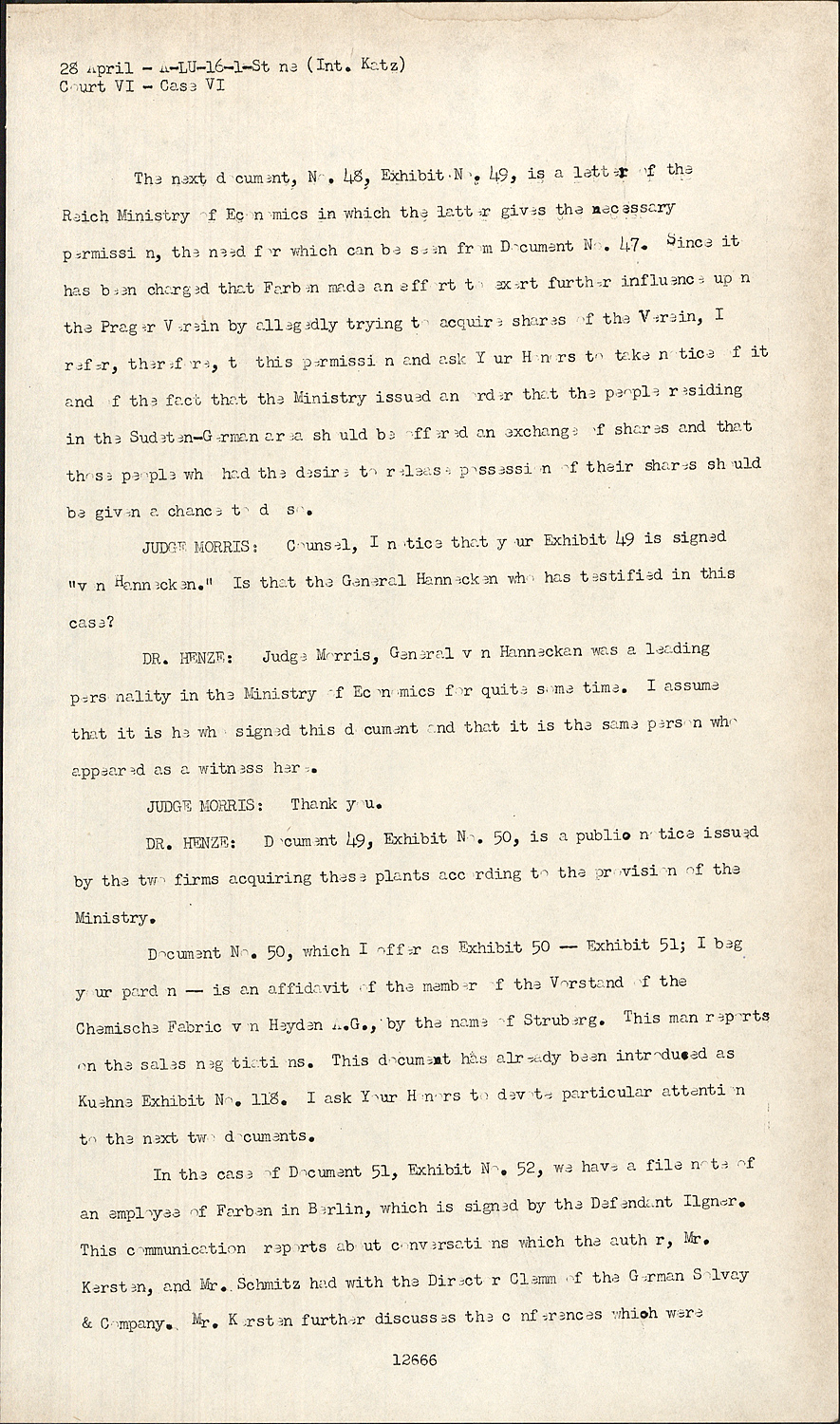
The next document, No. 48, Exhibit No. 49, is a letter of the Reich Ministry of Economics in which the letter gives the necessary permission, the need for which can be seen from Document No. 47. Since it has been charged that Farben made an effort to exert further influence upon the Prager Verein by allegedly trying to acquire shares of the Verein, I refer, therefore, to this permission and ask Your Heners to take notice of it and of the fact that the Ministry issued an order that the people residing in the Sudeten-German area should be offered an exchange of shares and that those people who had the desire to release possession of their shares should be given a chance to do so.
JUDGE MORRIS:Counsel, I notice that your Exhibit 49 is signed "von Hannecken." Is that the General Hannecken who has testified in this case?
DR. HENZE:Judge Morris, General von Hanneckan was a leading personality in the Ministry of Economics for quite some time. I assume that it is he who signed this document and that it is the same person who appeared as a witness here.
JUDGE MORRIS:Thank you.
DR. HENZE:Document 49, Exhibit No. 50, is a public notice issued by the two firms acquiring these plants according to the provision of the Ministry.
Document No. 50, which I offer as Exhibit 50 -- Exhibit 51; I beg your parden -- is an affidavit of the member of the Vorstand of the Chemische Fabric von Heyden I.G., by the name of Struberg. This man reports on the sales negotiations. This document has already been introduced as Kuehna Exhibit No. 118. I ask Your Honors to devete particular attention to the next two documents.
In the case of Document 51, Exhibit No. 52, we have a file note of an employee of Farben in Berlin, which is signed by the Defendant Ilgner. This communication reports about conversations which the author, Mr. Kersten, and Mr. Schmitz had with the Director Clemm of the German Solvay & Company. Mr. Kersten further discusses the conferences which were conducted subsequently with M. Masson, of the firm of Solvay & Company in Brussels.
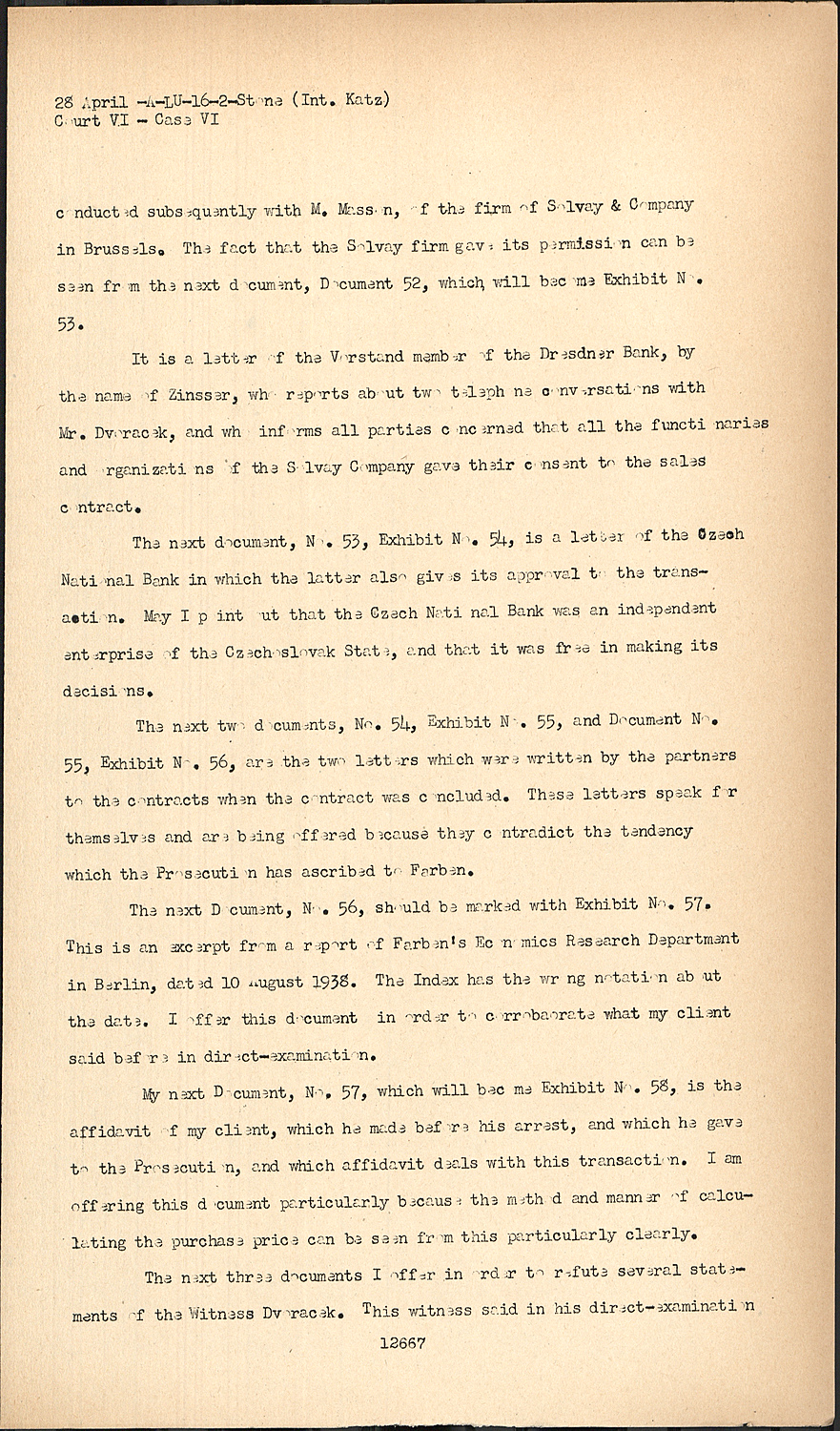
The fact that the Solvay firm gave its permission can be seen from the next document, Document 52, which will become Exhibit No. 53.
It is a letter of the Vorstand member of the Dresdner Bank, by the name of Zinsser, who reports about two telephone conversations with Mr. Dvoracek, and who informs all parties concerned that all the functionaries and organizations of the Solvay Company gave their consent to the sales contract.
The next document, No. 53, Exhibit No. 54, is a letter of the Czech National Bank in which the letter also gives its approval to the transaction. May I point out that the Czech National Bank was an independent enterprise of the Czechoslovak State, and that it was free in making its decisions.
The next two documents, No. 54, Exhibit No. 55, and Document No. 55, Exhibit No. 56, are the two letters which were written by the partners to the contracts when the contract was concluded. These letters speak for themselves and are being offered because they contradict the tendency which the Prosecution has ascribed to Farben.
The next Document, No. 56, should be marked with Exhibit No. 57. This is an excerpt from a report of Farben's Economics Research Department in Berlin, dated 10 august 1938. The Index has the wrong notation about the date. I offer this document in order to corrobaorate what my client said before in direct examination.
My next Document, No. 57, which will be me Exhibit No. 58, is the affidavit of my client, which he made before his arrest, and which he gave to the Prosecution, and which affidavit deals with this transaction. I am offering this document particularly because the method and manner of calculating the purchase price can be seen from this particularly clearly.
The next three documents I offer in order to refute several statements of the Witness Dveracek. This witness said in his direct-examination that the firms acquiring these shares insured the factories immediately after the sale was concluded; they insured them to a considerably higher value than the purchase price.
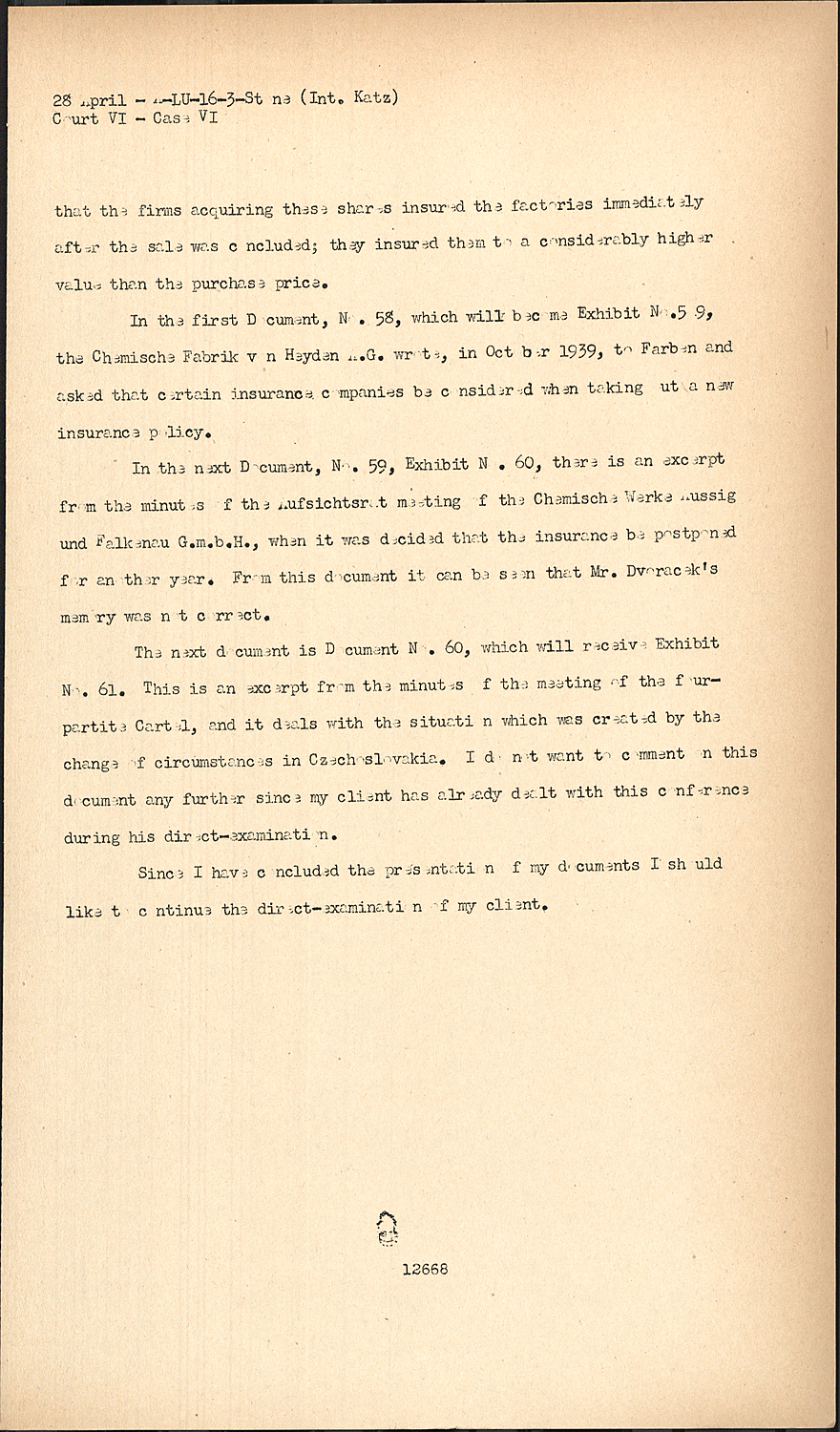
In the first Document, No. 58, which will become Exhibit No.59, the Chemische Fabrik von Heydan I.G. wrote in October 1939, to Farben and asked that certain insurance companies ba considered when taking out a new insurance a policy.
In the next Document, No. 59, Exhibit No. 60, there is an excerpt from the minutes of the Aufsichtsrat meeting of the Chemische Werka Aussig und Falkenau G.m.b.H., when it was decided that the insurance be postponed for another year. From this document it can be seen that Mr. Dvoracek's memory was not correct.
The next document is Document No.60, which will receive a Exhibit No. 61. This is an excerpt from the minutes of the meeting of the fourpartite Cartel, and it deals with the situation which was created by the change of circumstances in CzechoSlovakia. I do not want to comment on this document any further since my client has already dealt with this conference during his direct-examination.
Since I have concluded the presentation of my documents I should like to continue the direct-examination of my client.
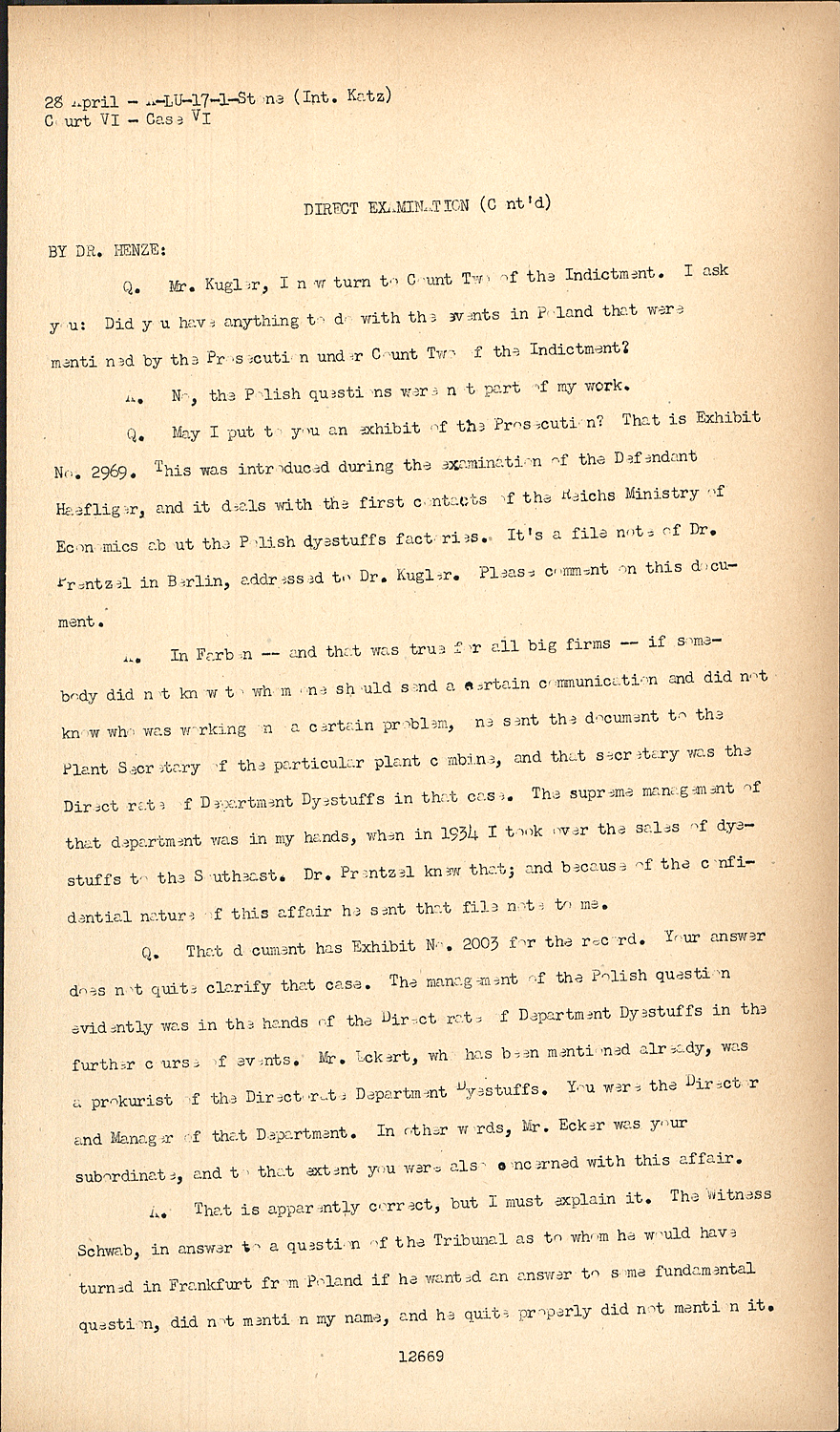
DIRECT EXAMINIATION (Cont'd) BY DR. HENZE:
Q.Mr. Kugler, I now turn to Count Two of the Indictment. I ask you: Did you have anything to do with the events in Poland that were mentioned by the Prosecution under Count Two of the Indictment?
A.No, the Polish questions were not part of my work.
Q.May I put to you an exhibit of the Prosecution? That is Exhibit No. 2969. This was introduced during the examination of the Defendant Haefliger, and it deals with the first contacts of the Reichs Ministry of Economics about the Polish dyestuffs factories. It's a file note of Dr. Prentzel in Berlin, addressed to Dr. Kugler. Please comment on this document.
A.In Farben -- and that was true for all big firms -- if somebody did not know to whom one should send a certain communication and did not know who was working on a certain problem, one sent the document to the Plant Secretary of the particular plant combine, and that secretary was the Directorate of Department Dyestuffs in that case. The supreme management of that department was in my hands, when in 1934 I took over the sales of dyestuffs to the Southeast. Dr. Prentzel knew that; and because of the confidential nature of this affair he sent that file note to me.
Q.That document has Exhibit No. 2003 for the record. Your answer does not quite clarify that case. The management of the Polish question evidently was in the hands of the Directorate of Department Dyestuffs in the further course of events. Mr. Bekert, who has been mentioned already, was a prokurist of the Directorate Department Dyestuffs. You were the Director and Manager of that Department. In other words, Mr. Ecker was your subordinate, and to that extent you were also concerned with this affair.
A.That is apparently correct, but I must explain it. The witness Schwab, in answer to a question of the Tribunal as to whom he would have turned in Frankfurt from Poland if he wanted an answer to some fundamental question, did not mention my name, and he quite, properly did not mention it.
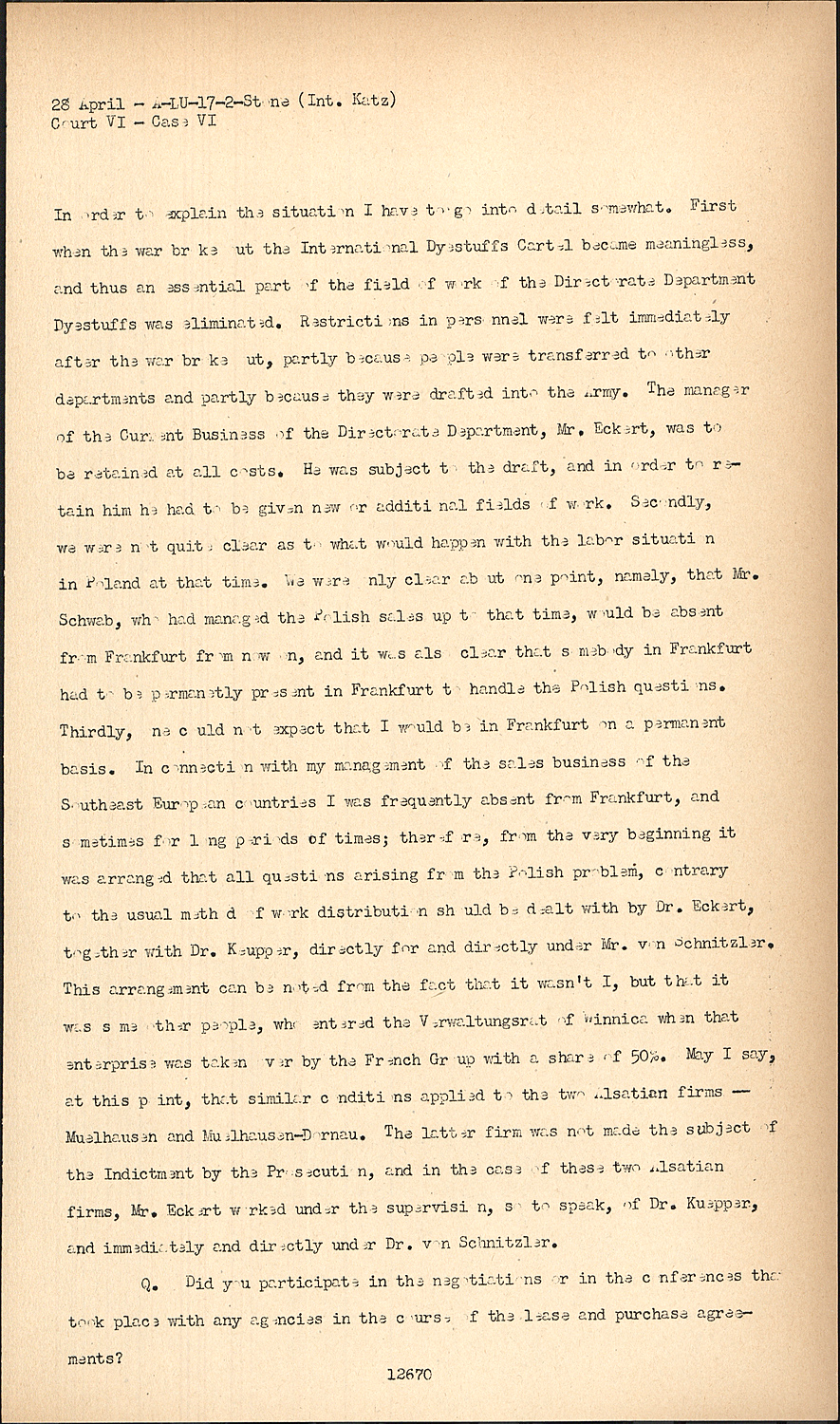
In order to explain the situation I have to go into detail somewhat. First when the war broke out the International Dyestuffs Cartel became meaningless, and thus an essential part of the field of work of the Directorate Department Dyestuffs was eliminated. Restrictions in personnel were felt immediately after the war broke out, pertly because people were transferred to other departments and partly because they were drafted into the Army. The manager of the Current Business of the Directorate Department, Mr. Eckert, was to be retained at all costs. He was subject to the draft, and in order to retain him he had to be given new or additional fields of work. Secondly, we were not quite clear as to what would happen with the labor situation in Poland at that time. We were only clear about one point, namely, that Mr. Schwab, who had managed the Polish sales up to that time, would be absent from Frankfurt from now on, and it Was also clear that somebody in Frankfurt had to be permanently present in Frankfurt to handle the Polish questions. Thirdly, one could not expect that I would be in Frankfurt on a permanent basis. In connection with my management of the sales business of the Southeast European countries I was frequently absent from Frankfurt, and sometimes for long periods of times; therefore, from the very beginning it was arranged that all questions arising from the polish problem, centrary to the usual method of work distribution should be dealt with by Dr. Eckert, together with Dr. Keupper, directly for and directly under Mr. von Schnitzler. This arrangement can be noted from the fact that it wasn't I, but that it was some other people, who entered the Verwaltungsrat of Winnica when that enterprise was taken ver by the French Group with a share of 50%. May I say, at this p int, that similar conditions applied to the two Alsatian firms -Muelhausen and Muelhausan-Dernau. The latter firm was not made the subject of the Indictment by the Prosecution, and in the case of these two Alsatian firms. Mr. Eckert worked under the supervision, so to speak, of Dr. Kuepper, and immediately and directly under Dr. ven Schnitzler.
Q.Did you participate in the negotiations or in the conferences that took place with any agencies in the course of the lease and purchase agreements?
A.No, neither in the case of Poland nor in the case of AlsaceLorraine.
Q.Did you sign or write any letters in that connection.
A.Not as far as I remember, for all parties concerned considered it important that this arrangement be observed the way I have described it just now.
Q.Then, I want to interpolate one question to clarify the functions of the Directorate Department Dyestuffs: Was the Directorate Department Dyestuffs the superior of the sales organization?
A.No.
Q.Was the Directorate Department Dyestuffs the superior of the Legal Department?
A.No.
Q.That concludes the subject-matter "Poland."
My colleague, Dr. ven Krafft, will be kind enough to continue with the examination.
DR. VON KRAFFT:Dr. ven Krafft, assistant to Dr. Henze, for the Defendant Kugler.
DIRECT-EXAMINATION (CONT'D) BY DR. KRAFFT:
Q.Mr. Kugler, when examining you about Francolor we want to take into account that according to an order of the Tribunal Dr. Ter Meer is going to be examined about Francolor subsequent to your examination. Therefore, I shall confine myself only to these questions that are not going to be gone into by Dr. Ter Meer.
I have a few preliminary questions: Did you work on the French business of Farben, or in what capacity did you participate in the French negotiations?
A.I participated in these negotiations in my capacity as Manager of Directorate Department Dyestuffs, with which, up to the war, the Central Agencies for International Dyestuffs Agreement had been connected.
Q.Were you, in the case of Francolor, also the executive organ?
A.Just as the work on the technical part of the agreement was done by the TEA office and just as the legal questions were handled by Dr. Kuepper, as the Manager of the Legal Department; then, the commercial part was worked on by the Directorate Department Dyestuffs, and to certain extent one can characterize my functions, or one can compare them to the activity of Dr. Struss in the TEA office, or with the activity of Dr. Keupper in the Legal Department Dyestuffs.
Q.Did you have a decisive influence about the fact as to whether or not the Francolor negotiations would be concluded by Farben and about the contents of the agreements?
A.One cannot say that. The decision was not in my hands, but in the final analysis it was in the hands of the Verstand members.
Q.Mr. Kugler, please tell us when you started to participate in the work and in the negotiations which brought about the Francolor Agreement.
A.As the Director of the Secretariat I participated in the preliminary work; then, I participated in the preliminary discussions that were conducted with the Armistice Commission in Wiesbaden. Whether I participated in all of these meetings I do not recall at the moment. These discussions in Wiesbaden served the purpose of taking up the initial contact with these agencies which were responsible for the reactivation of the business activity in France in connection with the Reich Ministry of Economics, and agencies that were decisive for conducting the business relations. I remember that the discussions for France in the dyestuffs business were carried out in August with the Armistice Commission and that later-- approximately around the middle of August -- Mr. Schnitzler reported in Wiesbaden about the impressions that he had gained during his first trip in France.
QMr. Kugler, what sort of trip was that and who partici pated in it?
AThis first trip was undertaken by Mr. von Schnitzler together With Dr. Ter Haar. As far as I remember it was to be a preliminary informational trip about the situation in France as it presented itself after the term nation of hostilities.
On the basis of information of German agencies in Paris, at that time, interesting peices of information was imparted to us to the effect that French textile industries would probably not start operating in the immediate future.
That was interest ing for us dye-stuffs salesmen because the textile industry in France, just as it was true for other countries, was the chief consumer of dye-stuffs.
One can say that in countries like France the share of the textile industry in the consumpt ion of dye-stuffs was approximately sixty or seventy percent.
QMr. Kugler, can you please tell me what was the immedi ate cause for this trip.
AThat wasn't one single reason alone. You have to take into consideration the situation at the time.
Before the war we had considerable business interests in France.
There was a large agency in Paris, the SOPI.
We knew by way of Switzerland, that during the war that a lawsuit for espionage activity had been brought against SOPI.
Mr. von Schnitzler wanted to find out, on the spot, what the fate of the members of that firm was and these employees were our employees or at least they were employees of our firm before the war.
There were stockpiles and storerooms of which one didn't know what had happened to them.
And the same is true for accounts receivable and other property that we had in France before the war.
Thus Mr. von Schnitzler, as the chief of the sales combine dye-stuffs, had a whole number of reason why he should undertake such a trip.
Above and beyond that, I thought that the reason was that Mr. von Schnitzler wanted to inform himself, in his capacity as chief of the Tar Dyes Group about the entire situation.
QIs it correct, Dr. Kugler, that next to the Armistice Delegation, the Reich Ministry of Economics was also a decisive agency?
AYes, that is absolutely correct.
QDid you negotiate with the Reich Ministry of Economics in the Francolor question?
ANot as far as I remember.
QWho discussed these questions with the Reich Ministry of Economics?
AI remember that Mr. von Schnitzler talked to the Reich Ministry of Economics and occasionally people from the Berin office may have talked to the Reich Ministry of Economics about the French affairs during the first time.
QBefore the beginning of the negotiations with the the French group -- that is before the Wiesbaden meeting on 21 and 22 November 1940, -- had you been in France?
AYes. At the end of August or the beginning of September 1940.
QCan it be that period of 29 August until 5 September 1940?
AYes.
QIs that the trip, Mr. Kugler, to which Prosecution Exhibit 1241 refers, NI Document 6893? Mr. President, this is the Prosecution document contained in Book 57 of the Prosecution Document Books on page 30.
AYes, that is right.
QI shal deal later with that exhibit, but now I should merely like to find out from you what brought about this trip at the end of August and the beginning of September 1940.