Dr. Dieckmann and I.
QThat's right; I didn't mean to indicate anything else, I am sorry.
AAnd Dr. Dieckmann and I were asked to make the report wanted by counter-intelligence at the meeting on the 2nd of May, '41.
QNow did you make any recommendations at that meeting as to how these Abwehr directives, - that is from Abwehr I, as constrasted with Abwehr III, - that is with repsect to getting intelligence from abroad, - did you make any recommendations as to how that was to be worked out inside of I.G. Farben - at that meeting?
AI have already said that what I told the local Abwehr agents of Farben at this meeting was based on directives of OKW to the Intelligence Major Bloch, I Wi, Major Bloch. The basic instructions that were given me, I passed on in essential to the local Farben men in terms that they could understand, that is, in I.G. Farben.
QWell, in terms that they could understand; did you make suggestions to them as to how this would work out in Farben in view of Farben's large number of foreign representatives?
ANo, I did not make any suggestions to strengthen the collaboration. On the contrary, the instructions which the OKW Counter Intelligence gave us, I always, so far as I can remember, changed or minimized their effect according to the prevailing feeling in Farben, as I knew it. I knew that all of the heads of the Sales Combines, and my superior, Dr. Ilgner, were very unwilling to cooperate with Abwehr I, because this could only interfere with normal Farben business, and I considered this when dealing with the instructions of Counter-intelligence.
QDid you recommend at that meeting that all Farben employees who went abroad should report directly to bureau A in Berlin?
AWho went abroad; I do not understand; after they had been abroad?
QThat's right.
ANo. Originally the Counter Intelligence had requested that after every trip abroad a report should be made to Counter-Intel igence. I believe that this question was once discussed in the KA, and we wanted to handle this question centrally in Farben as far as possible, so that there would be one office which would be able to survey the whole thing and handle it, but in practice, as I recall, all of these things were later decentralized and were handled by the local Administration in the individual plants and offices.
QDidn't the OKW agree that that would have to be the practice because questions of secrecy were involved?
ANo, that was no consideration, whether the questions were secret or not; that was of no significance in dealing with Farben because every Abwehrbeauftracte was obligated to secrecy. I do not see any connection there.
QNow did the question of dealings with the AO--that is the foreign organization of the Nazi Party -- come up in this meeting of Abwehr representatives in 1941?
AI just heard AO. Is that what you said?
QYes.
ANo, I can't remember that anything was said about the AO at this meeting.
Q - Now I show you NI-14312 which will become Prosecution Exhibit 2141. Now this is a file memo which you will note was written by one Riess,- R-I-E-S-S, who attended this conference from the Wofen factory, and there's the initial "G," and the defendant Gajewski's office stands at the top of your first page. Now in this report by Riess, you will note that you are referred to in the first paragraph, that you, coming from Office A of Farben in Berlin, should receive tnese reports. Did Mr. Reiss make a mistake in that connection, or had you lost your connection with Office A at that time?
AMr. Sprecher, may I ask for another copy? I can't read this one.
QCertainly. We will give you the best copy we can find here.
AMr. Sprecher, first of all I must point out that this is a file note of the Abwehrbeauftragten of Wolfen -- at least I believe he was Abwehrbeauftragten -- a Mr. Riess, on the 4th of May 1941 about the conference of the 2nd of May 1941. This is the first time that I have over seen this memorandum. He must have made a basic mistake. You are asking about the AO, but here it says "Den AO"; that means the Abwehr Offizier -- the counter-intelligence officer, and not the "Die AO" -- the foreign organization officer.
Q.That satisfies me. I wanted to make that point. I agree with you. Go ahead.
ABesides, this file note says exactly what I said before. It says here, and I quote, "Von der Heyde suggests that Department A also be notified so that Department A could participate if necessary. Major Bloch and the counterintelligence officers present were against this centralization." Then further down: "The question of centralization as von der Heyde also proposed with regard to his further points was on principle not considered desirable either by the military authorities or by the counter-intelligence officer of the I.G." That is exactly what I said basically, and Dr. Schneider wanted this too and most of his colleagues in the Vorstand. These were questions of whether trips of Farben people abroad should be handled by a central agency so that there would be one office in charbe of these things, that is to minimize the difficulties. The counter-intelligence officers and the local counter-intelligence officials of Farben were against this centralization and so it remained. The matter continued to be handled in a decentralized way.
QIf the members of the Tribunal would look at the document where it does say foreign organisation with a capital "A" and a capital "O", that is a mistake in the translation. The translator took the usual translation of AO--Auslandsorganisation -- but instead in this letter by Mr. Rless we are certainly willing to agree that AO was used as Abwehr Offizier -- or Abwehr Officer -- and thank you for your help in correcting that.
Now, did you wear the SS uniform at any time after the first of September 1939?
AI believe that I can say "no" with a clear consicience. I cannot remember any single instance.
QNow that documents which were Introduced, I don't happen to have them here because I hadn't expected to examine you now, but I think we can get along without them.
The documents which we introduced with respect to the SS Central Office records considering your membership in the SS made no mention of Reiter-SS. Is it your position that after 1936, when you came to Berlin, that you did not become an honorary member of the SS in addition to being a member of the ReiterSS?
AAs I heard the translation, you asked whether I was an honorary member of the SS? No. Mr. Sprecher, the situation was like this. I was a member of the Cavalry Detachment in Mannheim, and was on leave in Berlin. In Berlin I rode repeatedly as a guest in the Cavalry Detachments in Berlin, Zehlendorf, Wanneee, etc., and I always introduced myself with these groups as a comrade -- a member of the cavalry unit in Mannheim. The activity that I mentioned this morning for the SD Main Office was something independent of that. It involved merely giving information at irregular intervals to the office in the Wilhelmsstrasse.
QYou didn't receive a rank in the SS, an officer's rank, until you were in Berlin, is that right?
ANo, I was in Reltersturm 7 in Mannheim where I was Hauptscharfuehrer. It was not -
QWhat is the equivalent rank of Hauptscharfuehrer?
AHauptscharfuehrer would be in the Wehrmacht a sergeant, a non-commissioned officer.
QA sargeant. Did you visit Ohlendorf, or did you talk with Otto Ohlendorf after 1 September 1939?
AAs I remember, after the first of September 1939, Ohlendorf was not in the SD Main Office. In 1939, he went with Heiler to the Reich Group Trade, and was not in Wilhelrasstrasse in the SD Main Office.
That is how I remember it. As far as I know today, I never saw him after the first of September 1939 -- Oh yes, once in 1944. Ohlendorf was in Frankfurt on the Oder and made a speech to the officers of the Wi Rue Amt about economic questions. That was the last time that I saw him.
QWhat kind of economic questions did he discuss?
AAs I remember, he spoke about the general German economic policy, foreign trade, export, obtaining foreign currency, and so forth. As far as I know, he was Ministeriadlirektor in the Ministry of Economics at that time.
THE PRESIDENT:How much time will you need, Mr. Sprecher?
MR. SPRECHER:I think we might go over until tomorrow so that I may have the chance to run though this.
THE PRESIDENT:According to my calculations, you should get through in 15 minutes.
MR. SPRECHER:I am sure I will do that.
THE PRESIDENT:Very well. The Tribunal will rise until nine o'clock tomorrow morning.
(The Tribunal adjourned until 27 April 1948, 0900 hours.)
Court VI Case VI Commission Official Transcript of Hearing before a Commissioner for Military Tribunal VI, case VI, in the matter of the United States of America against Karl Krauch et al defendants, sitting at Nuernberg, Germany, on 26 April 1948, Commissioner Johnson T. Crawford presiding.
THE MARSHAL:The Commission for Tribunal VI is now in session.
DR. MUELLER:Mr. Commissioner, I may say that the defense was informed on time about the cross examination today. This is also true for the cross examination which took place last week and the defense was also notified in time about the cross examination of the witness Sauer, which will take place this afternoon.
DR. NELTE:Nelte for Hoerlein, Your Honor, in the Case for Professor Hoerlein, I make available the witness Professor Kikuth. Professor Kikuth has made out several affidavits. The Prosecution has expressed the desire to cross examine the witness on the statements he has made in these affidavits. Please swear the witness in, so that I may interrogate him.
WALTERKIKUTH, a witness, took the stand and testified as follows:
THE COMMISSIONER:The witness will raise his right hand and take the oath. "I swear by God, the Almighty and Omniscient, that I will speak the pure truth, and will omit and add nothing.
(The witness repeated the oath.)
THE COMMISSIONER:The Witness will be seated.
DR. NELTE:Witness, I call to your attention the fact that it is proper if you always pause before you answer my question because it is necessary to get correct translation for the record. If in the course of examination you use difficult expressions of a chemical or proper names, please spell those words.
COURT VI CASE VI COMMISSION DIRECT EXAMINATION BY DR. NELTE:
Q.For the record, please give me your full name.
A.Walter Kikuth.
Q.When were you born?
A. 21 December 1896.
Q.Where were you born?
A.In Riga.
Q.You are not waiting sufficiently long. Where is your residence now?
A.In Wuppertal-Vohwinkel.
Q.What positions do you hold at the moment?
A.Director of the Chemical Therapeutic Institute of the Dyes Factory Bayer and simultaneously temporary director of the Hygienic Institute of the Medical Academy in Duesseldorf.
Q.Are you a professor of medicine?
A.Yes.
Q.Are you also a member of important foreign medical associations?
A.Yes.
Q.Which ones, please?
A.I am a member of the Royal Society of Medicine, of the Royal Society of Tropical Medicine, of the Royal Tropical Medicine Society of Belgium, and of the Royal Association of Doctors in Barcelona.
Q.Have you received important distinctions in the medical field?
A.I received the Golden Ehrlich Modal in 1934.
Q.Have you been politically examined?
A.Yes.
Q.With what results?
A.In the main trial in Duosseldorf, I was exonerated.
Q.And thereupon you continued in your position in the Medical Academy in Duesseldorf, is that right?
A.Yes.
COURT VI CASE VI COMMISSION
Q.Now, Professor, you have made out a number of affidavits, alone and in connection with the testimony of Professor Wiese and Domagk, Before you took the witness stand, did you look at these affidavits once again?
A.Yes.
Q.Do you have anything to add to what you have said or do you have to correct anything?
A.No.
DR. NELTE:Then for the time being I have no further questions to the witness.
THE COMMISSIONER:The prosecution will proceed with the examination.
CROSS EXAMINATION BY LIE. MNSKOFF:
Q.Mr. Witness, was there a particular day sot aside during which you reported to the defendant Hoerlein on your progress with different preparations?
A.I didn't understand the question.
Q.In your work at Elborfeld, was there one particular day during the week that was set aside for the purpose of reporting to the defendant Hoerlein?
A.In earlier days.
Q.Was that regularly done each week during the war?
A.What do you mean took place?
MR. MINSKOFF:Something is wrong with the sound system.
(Interpreter tests system)
MR. MINSKOFF:Right. Thank you very much. Just so we got this clear for the record this time -BY MR. MNSKOFF:
Q.Mr. Witness, on Saturdays were there meetings hold in which you reported on your results of the progress of various preparations, to the defendant Hoerlein?
A.Well, such conferences took place on Saturday.
COURT VI CASE VI COMMISSION
Q.Now, your own sphere of work, Mr. Witness, was that of the discovery and development of new cures?
A.Yes.
Q.Will you tell the court how, in practice, you carried out that responsibility?
A.If a new medicine was discovered which was to serve doctors in their treatment, then the socalled animal experiments were first conducted in my laboratory. That is to say, the animals were artificially injected with infectious bacilli and after that were treated with the now chemicals which were made available to us by the chemists. If an effect against a certain disease was discovered by us, contact was made with the pharmacologists and it was their job to tost the medicine which I or someone else found to be an effective medicine and to see whether it was compatible.
Q.Mr. Witness, the pharmacologist sorely tested whether a particular preparation was compatible or not; that is true, is it not?
A.I don't understand.
Q. "Vertraoglichkeit" in German, "Vertraeglichkeit." The pharmacologist's job was to tost the compatibility of a particular product, its digestibility; is that right?
A.Yes, he was supposed to examine the compatibility Of the substance.
Q.Now, it was your job, was it not, to text the efficacy of the preparation? Isn't that right?
A.It was my job to find out the efficacy of the product in the animal experiment.
Q.Yes. Now, Mr. Witness, will you tell the court the next stop after you have found that the preparation does work on animals?
A.After the preparation was found to be effective by me, and after it had been thoroughly investigated as far as its compatibility is concerned, a so-called expose was made together with the pharmacologists, and this expose was discussed in a larger circle of chemists and physicians.
COURT VI CASE VI COMMISSION That practically completed our job in Elberfeld. This expose was passed on to Leverkusen.
Q.Now, before an expose on an Elberfeld preparation was sent to Leberkusen, who at Elberfeld had to approve that expose?
Court VI Case VI Commission
A.The expose was discussed in the so-called "Saturday conferences," so that everyone of those present could give his opinion about it. As far as the content of the expose is concerned I, on the one hand, and the pharmacologists on the other hand, were responsible; and as far as the chemical representation is concerned the chemist who created the preparation was responsible for that.
Q.Mr. Witness, at these Saturday conferences who was chairman?
A.Professor Hoerlein was the chairman at these Saturday conferences.
Q.Mr. witness, will you tell the Court whether the expose could be sent on to Leverkusen from Elberfeld without the approval of the defendant Hoerlein.
A.If no objections were raised against the expose the author of the expose usually sent it to Leverkusen with an accompanying note.
Q.I'm afraid you didn't fully understand the question. The question was simply this: Could an expose in the practice as you know it at Elberfeld go out from El berfeld to Leverkusen without the approval of the defendant Hoerlein?
A.No.
Q.Thank you. Now, after the expose went to Leverkusen it went to Dr. Martens did it not?
A.It went to Dr. Martens at Leverkusen, yes.
Q.And was it then Dr. Martens' function to pass it on to various places where it could be tested for its efficacy?
A.It was the job of Dr. Martens to find those physicians who were responsible for the therapeutic treatment with these new preparations.
Q.Now, Mr. witness, is it or is it now true that one of Dr. Martens' duties was to see to it that the reports which he received on the results of the tests were forwarded to the scientists for their critical evaluation?
A.The results which Dr. Martens received had to be sent on to us by him of course.
Q.And who at Elberfeld received these reports and evaluated them?
Court VI case VI Commission
A.If it was a report which had a preparation as its subject-matter which I had recognized as being effective, then that, of course, came to me automatically.
Q.Now, Mr. witness, B-1034 is an Elberfeldtproduct is it not?
A.Yes.
Q.Do you recall, Mr. witness, whether you received the first report on the clinical tests of B-1034 in connection with typhus?
A.B-1034 was found by me. This is a preparation from the Sulfonamide series which is distinguished from the other sulfonamides by the fact that its compatibility was especially good, and that beyond that, in the so-called "virus tests," -- that is to say, in infections of a special nature; in contrast to the other sulfonamides -- was found to be especially effective. On the other hand it was known at that time that sulfonamides had a certain effect in trachoma, the Egyptian eye disease; but since this was a chronic disease, the sulfonamides had to be administered for a long period of time, which now and then led to its incompatibility.
Q.Mr. witness, may I repeat the original question before we get too far off?
The original question merely was: In connection with typhus, do you recall whether you received the first reports on the clinical tests of B-1034?
A.Yes, I'm almost at the end of my statement. On the basis of this very fine efficacy - that is, of the sulfonamides in the case of trachoma other physicians also used it in the case of typhus, and as for the first reports about this preparation in the case of typhus, I heard personally from Professor Seiffert in Deipzig, and together with Dr. Koenig, I went to Leipzig in order to convince myself of the results right there.
DR. NELTE:Your Honor, I would merely like to ask for a clarification so that there won't be any further confusion. The witness spoke of "Typhus", and I ask the Prosecutor whether "Typhus" is meant here in the English to be typhoid or whether he means typhus (Fleckficher).
Court VI Case VI Commission By "Typhus" in German we also mean "typhoid" and I don't know whether the witness wants to say that B-1034 was used in the treatment of stomach typhoid or of typhus.
MR. MINSKOFFLTo clarify the record, when we speak of "typhus" we intend the German "Fleckfieber," not "Typhus". The translation of "typhus" is "Fleckfieber." BY MR. MINSKOFF:
Q.Now, Mr. witness, have you understood the question?
A.I meant it that way. I interpreted the English "typhus" as German "Fleckfieber."
Q.Now, the question, if I may repeat it, Mr. witness, was: Do you recall receiving the first reports on the clinical tests of B-1034 in cases of typhus or Flickfieher?
A.Well, I already said that I went to Leipzig in order to convince myself of the results right there in Leverkusen.
Q.Approximately when was that, Mr. witness?
A.That was in the first winter of the war against Russia.
Q.That's the winter of 1941-42?
A.Yes.
Q.Now, do you recall in July 1942 receiving the report on three case histories from the Russian doctor Kosetzky?
A.I cannot remember that.
Q.Do you recall, Mr. witness, any conversations or discussions held with Luecker and Kownig of Leverkusen concerning the fact that the preparation of B-1034 was so poor as a means for fighting typhus that it was not intended to be put on the open market?
A.The judgments about the compatibility of B-1034 were varied. There were physicians who thought that it was difficult to use it in case of typhus because those patients had a very dry mouth when they had fever and that they could swallow the preparation with only great difficulty; and it happened now and then that the patients concerned vomited it.
Court VI Case VI Commission
Q.Now, Mr. witness, I was not speaking of the digestibility or the compatibility of the preparation in typhus cases. I was speaking of the finding in July 1942 that its therapeutic effect was so weak that it was out of the question to use It for typhus.
Court VI Case VI Commission
A.That's true.
Q.Then, just so I have the record clear, you knew in July 1942 that the therapeutic effect of typhus was too weak to justify -- Pardon me. ....of B-1034 as a means of curing typhus was too weak to justify its use on the market?
A.Yes, "because the results at least were too contradictory. There were some results which were good like those of Professor Seiffert, but there were other physicians who again found that it was not effective enough.
Q.Yes, but the conclusion which was drawn by the report of your own Leverkusen people was, was it not, that it was too weak a cure to be useful? Now, is that true or isn't it?
A.Well, in order to pass a final judgment about it such experiences must be collected over a number of years. It can happen that a preparation is not effective in this particular form, but if it is used in some different form it may after all be effective.
Q.Now, Mr. witness, at this same time, in July 1942, do you recall that Dr. Vetter was also experimenting with B-1034 at Auschwitz?
A.What do you mean by "experimenting"?
Q.He was testing the efficacy of B-1034 as a cure for typhus.
A.Certainly I was informed that Dr. Vetter made such experiments, with the preparation B-1034.
Q.How would you be informed of that?
DR. NELTE:One moment please.
Your Honor, for the record I merely would like to say that the Interpreter has translated "Versuche" as "experiments." I ask the Interpreter to interpret in the manner in which we consider it correct -- either as "tests" or as "trial under medical care."
MR. MINSKOFF:If your Honor please, the Prosecution strongly objects to telling the Interpreters how to interpret from English into German. As a matter of fact the Prosecution has shown Dr. Nelte an exhibit which it puts in its rebuttal book, where the I.G. Farben dictionary has Court VI Case VI Commission "Versuche" translated by the word "experiment". Now, we don't lay any great emphasis on the meaning of the word "experiment", but the question that we asked the witness was perfectly clear, and his answer was perfectly clear.
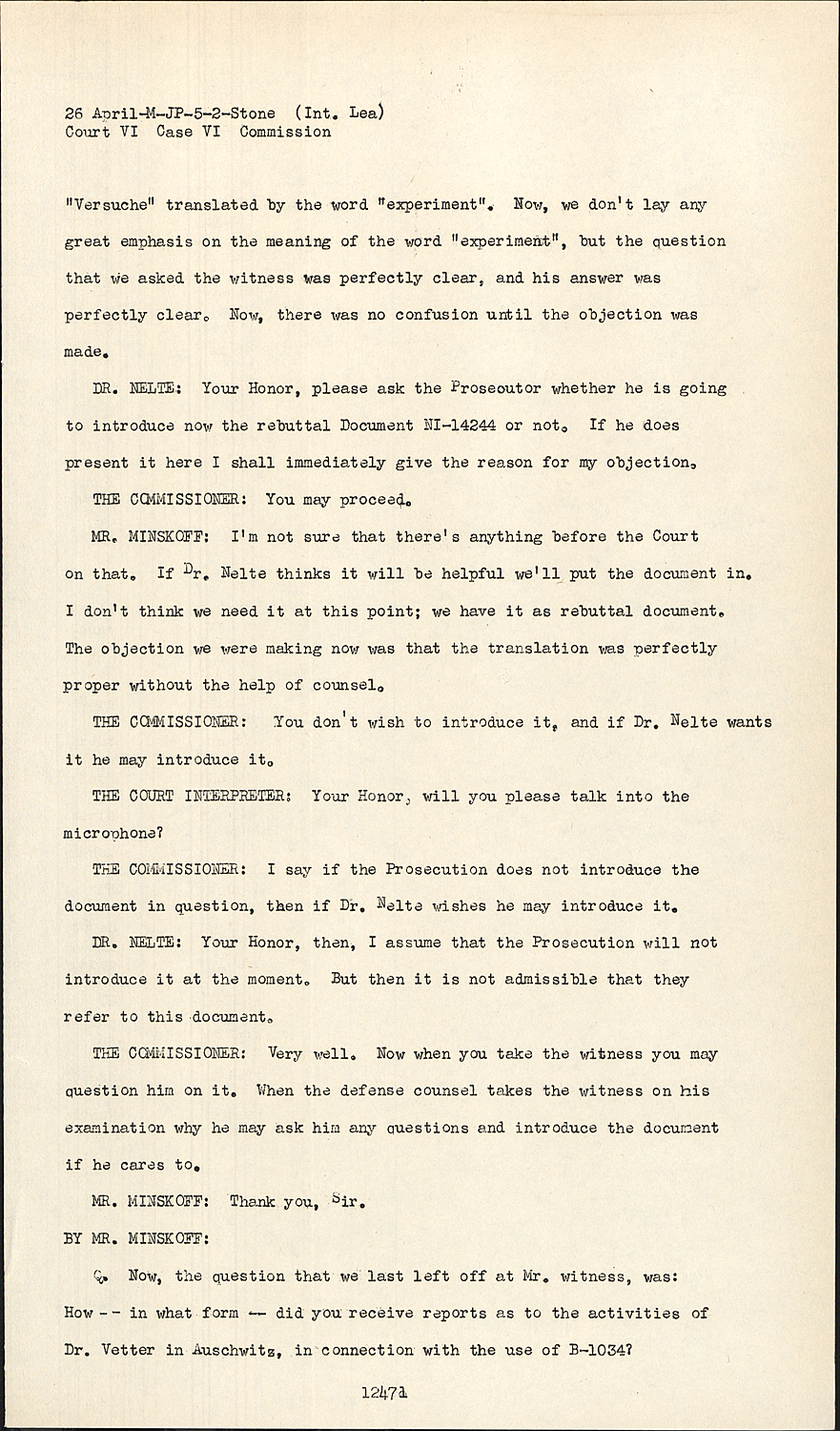
Now, there was no confusion until the objection was made.
DR. NELTE:Your Honor, please ask the Prosecutor whether he is going to introduce now the rebuttal Document NI-14244 or not. If he does present it here I shall immediately give the reason for my objection.
THE COMMISSIONER:You may proceed.
MR. MINSKOFF:I'm not sure that there's anything before the Court on that. If Dr. Nelte thinks it will be helpful we'll put the document in. I don't think we need it at this point; we have it as rebuttal document. The objection we were making now was that the translation was perfectly proper without the help of counsel.
THE COMMISSIONER:You don't wish to introduce it, and if Dr. Nelte wants it he may introduce it.
THE COURT INTERPRETER:Your Honor, will you please talk into the microphone?
THE COMMISSIONER:I say if the Prosecution does not introduce the document in question, then if Dr. Nelte wishes he may introduce it.
DR. NELTE:Your Honor, then, I assume that the Prosecution will not introduce it at the moment. But then it is not admissible that they refer to this document.
THE COMMISSIONER:Very well. Now when you take the witness you may question him on it. When the defense counsel takes the witness on his examination why he may ask him any questions and introduce the document if he cares to.
MR. MINSKOFF:Thank you, Sir. BY MR. MINSKOFF:
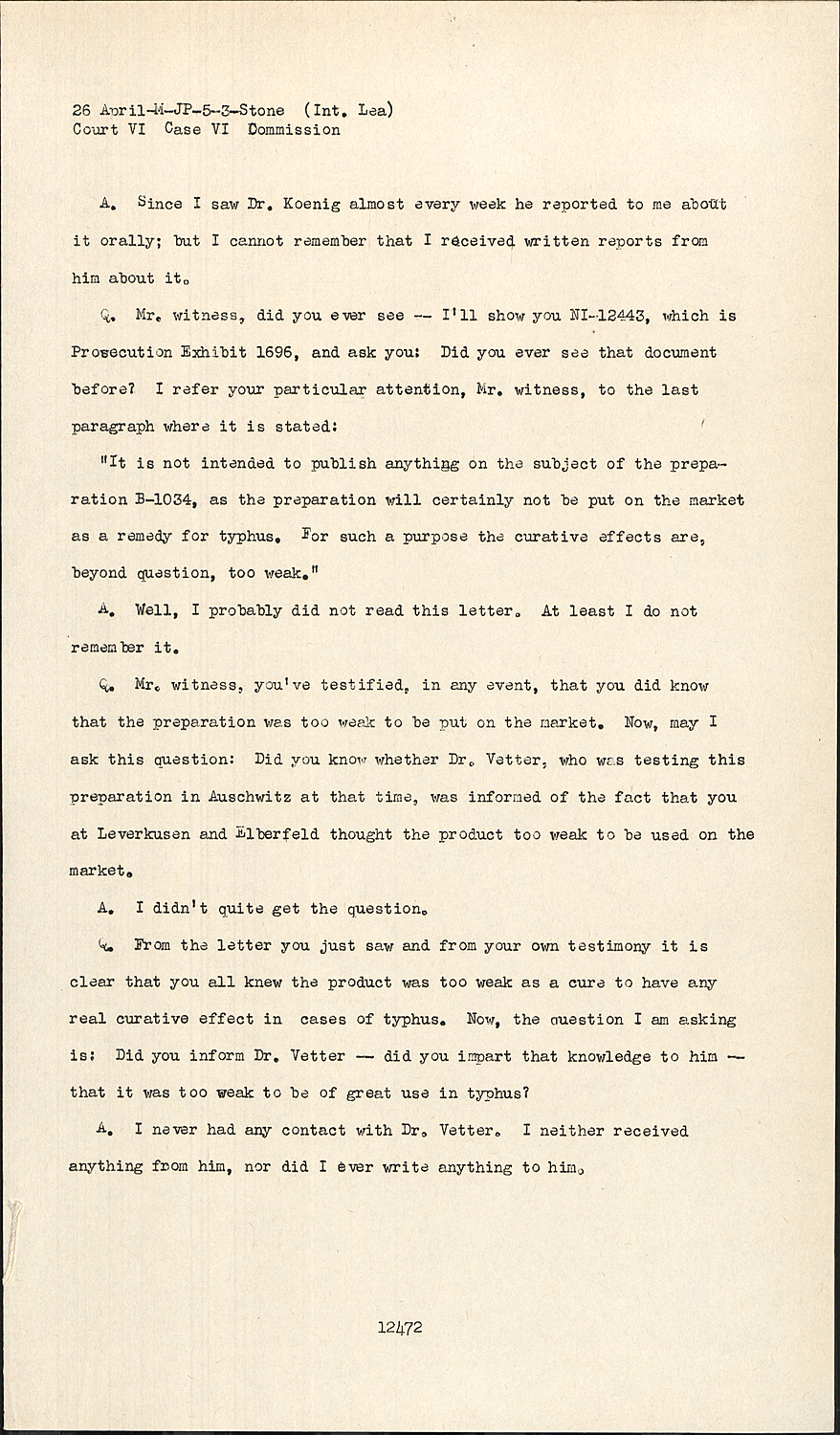
Q.Now, the question that we last left off at Mr. witness, was: How- - in what form -- did you receive reports as to the activities of Dr. Vetter in Auschwitz, in connection with the use of B-1034?
Court VI Case VI Commission
A.Since I saw Dr. Koenig almost every week he reported to me about it orally; but I cannot remember that I received written reports from him about it.
Q.Mr. witness, did you ever see -- I'll show you NI-12443, which is Prosecution Exhibit 1696, and ask you: Did you ever see that document before? I refer your particular attention, Mr. witness, to the last paragraph where it is stated:
"It is not intended to publish anything on the subject of the preparation B-1034, as the preparation will certainly not be put on the market as a remedy for typhus. For such a purpose the curative effects are, beyond question, too weak."
A.Well, I probably did not read this letter. At least I do not remember it.
Q.Mr. witness, you've testified, in any event, that you did know that the preparation was too weak to be put on the market. Now, may I ask this question: Did you know whether Dr. Vetter. who was testing this preparation in Auschwitz at that time, was informed of the fact that you at Leverkusen and Elberfeld thought the product too weak to be used on the market.
A.I didn't quite get the question.
Q.From the letter you just saw and from your own testimony it is clear that you all knew the product was too weak as a cure to have any real curative effect in cases of typhus. Now, the question I am asking is: Did you inform Dr. Vetter -- did you impart that knowledge to him -that it was too weak to be of great use in typhus?
A.I never had any contact with Dr. Vetter. I neither received anything from him, nor did I ever write anything to him.
Court VI Case VI Commission
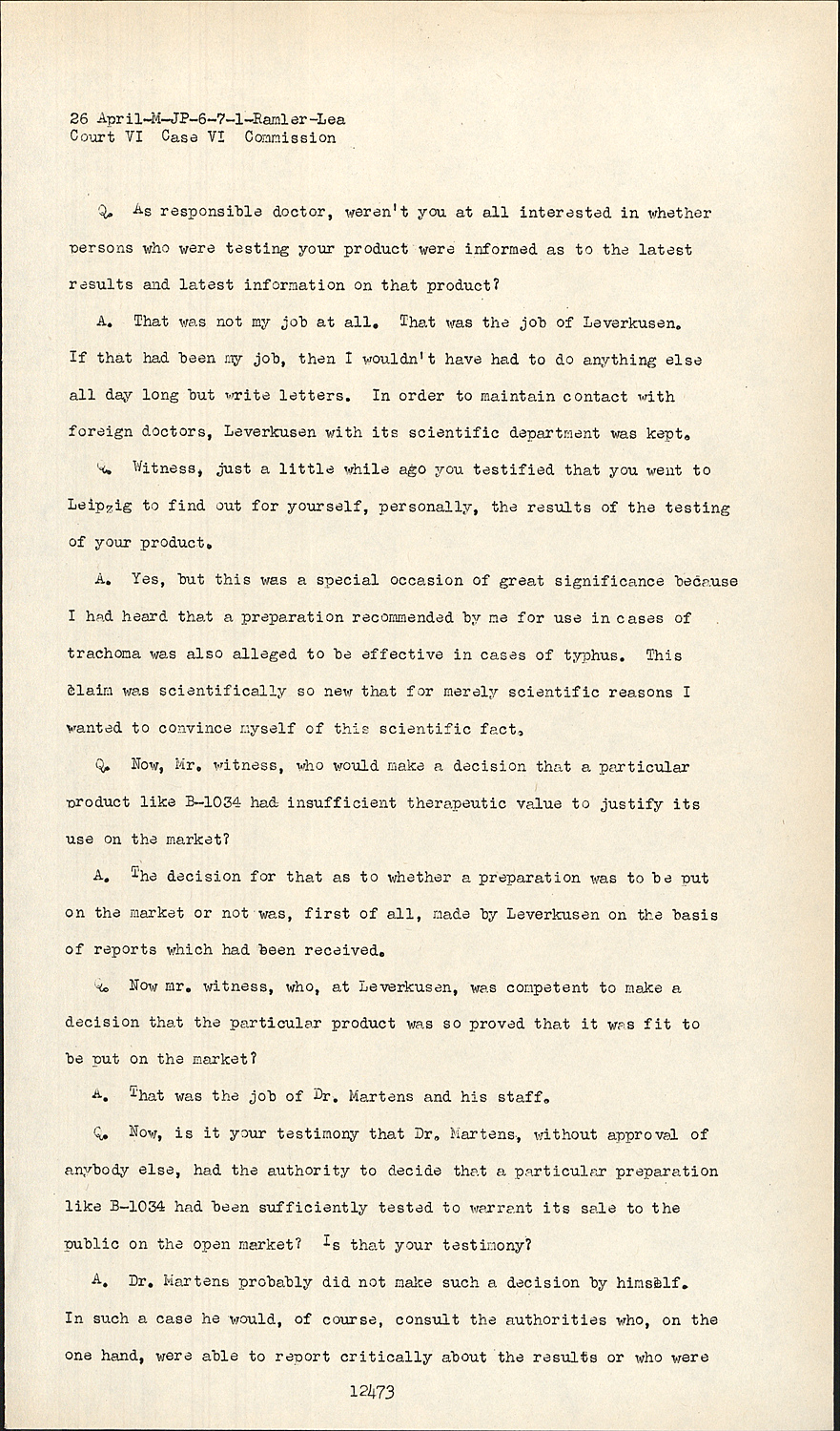
Q.As responsible doctor, weren't you at all interested in whether persons who were testing your product were informed as to the latest results and latest information on that product?
A.That was not my job at all. That was the job of Leverkusen. If that had been my job, then I wouldn't have had to do anything else all day long but write letters. In order to maintain contact with foreign doctors, Leverkusen with its scientific department was kept.
Q.Witness, just a little while ago you testified that you went to Leipzig to find out for yourself, personally, the results of the testing of your product.
A.Yes, but this was a special occasion of great significance because I had heard that a preparation recommended by me for use in cases of trachoma was also alleged to be effective in cases of typhus. This claim was scientifically so new that for merely scientific reasons I wanted to convince myself of this scientific fact.
Q.Now, Mr. witness, who would make a decision that a particular product like B-1034 had insufficient therapeutic value to justify its use on the market?
A.The decision for that as to whether a preparation was to be put on the market or not was, first of all, made by Leverkusen on the basis of reports which had been received.
Q.Now mr. witness, who, at Leverkusen, was competent to make a decision that the particular product was so proved that it was fit to be put on the market?
A.That was the job of Dr. Martens and his staff.
Q.Now, is it your testimony that Dr. Martens, without approval of anybody else, had the authority to decide that a particular preparation like B-1034 had been sufficiently tested to warrant its sale to the public on the open market? Is that your testimony?
A.Dr. Martens probably did not make such a decision by himself. In such a case he would, of course, consult the authorities who, on the one hand, were able to report critically about the results or who were Court VI Case VI Commission interested in the preparation for one reason or another.
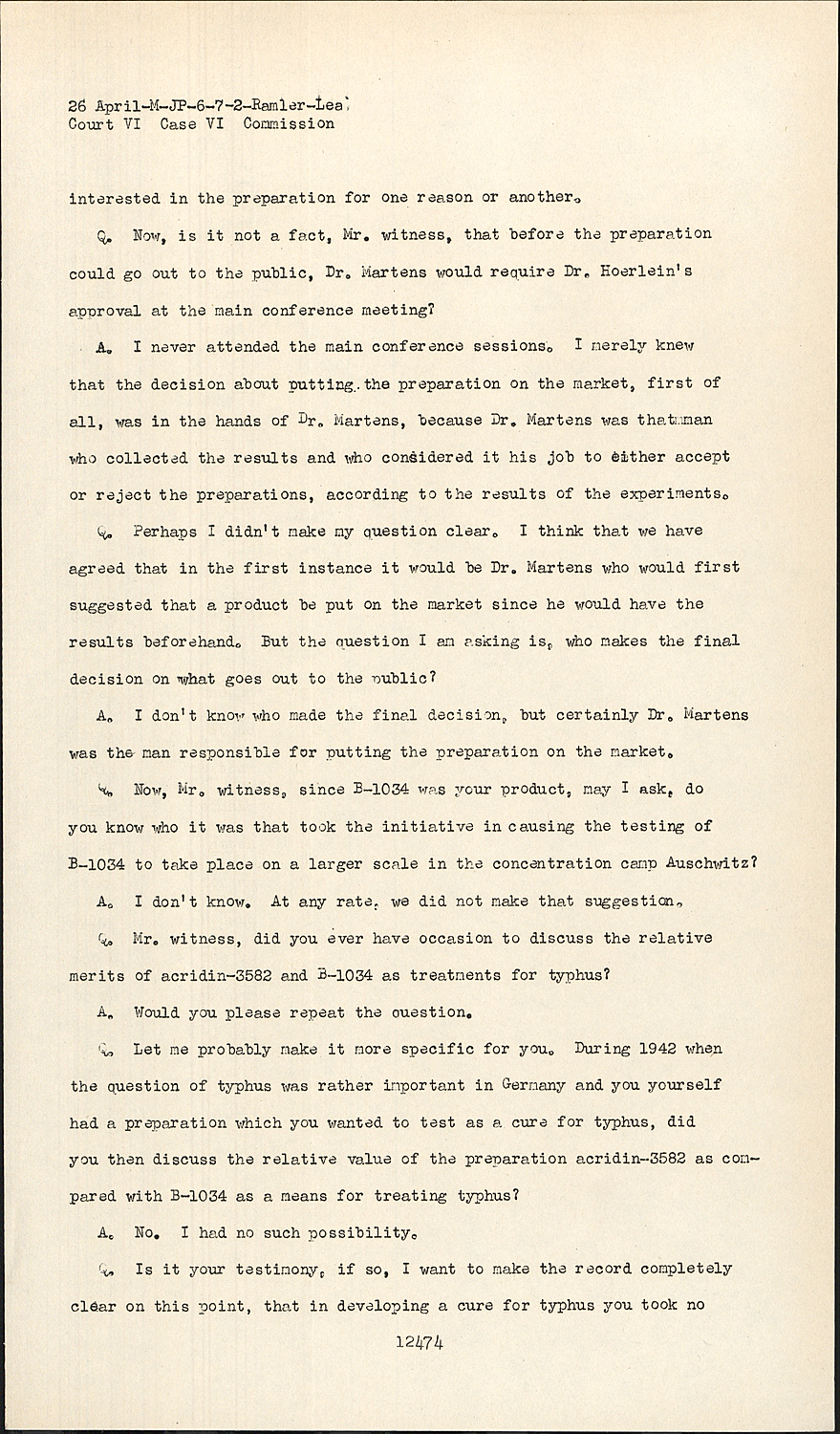
Q.Now, is it not a fact, Mr. witness, that before the preparation could go out to the public, Dr. Martens would require Dr. Hoerlein's approval at the main conference meeting?
A.I never attended the main conference sessions. I merely knew that the decision about putting the preparation on the market, first of all, was in the hands of Dr. Martens, because Dr. Martens was thatman who collected the results and who considered it his job to either accept or reject the preparations, according to the results of the experiments.
Q.Perhaps I didn't make my question clear. I think that we have agreed that in the first instance it would be Dr. Martens who would first suggested that a product be put on the market since he would have the results beforehand. But the question I am asking is, who makes the final decision on what goes out to the public?
A.I don't know who made the final decision, but certainly Dr. Martens was the man responsible for putting the preparation on the market.
Q.Now, Mr. witness, since B-1034 was your product, may I ask, do you know who it was that took the initiative in causing the testing of B-1034 to take place on a larger scale in the concentration camp Auschwitz?
A.I don't know. At any rate, we did not make that suggestion.
Q.Mr. witness, did you ever have occasion to discuss the relative merits of acridin-3582 and 3-1034 as treatments for typhus?
A.Would you please repeat the question.
Q.Let me probably make it more specific for you. During 1942 when the question of typhus was rather important in Germany and you yourself had a preparation which you wanted to test as a cure for typhus, did you then discuss the relative value of the preparation acridin-3582 as compared with B-1034 as a means for treating typhus?
A.No. I had no such possibility.
Q.Is it your testimony. if so, I want to make the record completely clear on this point, that in developing a cure for typhus you took no Court VI Case VI Commission interest in the other cures developed in Farben for typhus?