Q.Was Duisberg thinking of political expansion in that connection?
A.No. That was not his idea. He supported the efforts of the Weimar Republic and particularly the Bruening government to restore Germany's equality but he was an advocate of the policy of Stresemann who wanted to obtain equality by peaceful means, by negotiation, and who had had certain initial success.
Q.That brings us to the political attitude of Duisberg. Was it attempted to recruit Duisberg for National Socialism?
A.Yes, Geheimrat kirdorf wrote to him to this effect. Thyssen repeatedly tried to win him over to National Socialism and about 1930 the chief editor of the Boersenzeitung Funk wanted to visit Dulsberg to get him interested in Hitler.
Q.Did these efforts succeed?
A.No. Duisberg refused in writing to Kirdorf. From repeated remarks made by Duisberg, I know that he refused Thyssen's efforts, too, and on this account the relations became strained between them. He did not receive Funk at all. In 1932 there was a presidential election. He abandoned his political reserve and became unhesitatincly a supporter of Hindenburg in the election since, he says here, it was the only way to prevent a seizure of power by Hitler.
Q.Did you share Geheimrat Duisberg's attitude?
A.Of course; otherwise, I couldn't have done my duties with a clear conscience.
DR. ASCKEHAUER:In order to substantiate Dr. Gatteneau's testimony, I shall offer document, Gattineau No. 7. This is an affidavit of Professor Dr. Heinrich Konen, the Rector of the Bonn University. This will become Gattineau Exhibit No. 2. The witness, after 1 again became the rector of the Bonn University and Minister for Culture at North-Rhine -- that is Westphalia. He confirms the rejecting attitude of Geheimrat Duisberg towards National Socialism. With respect to Dr. Gattineau's personality he states that he -- and 1 quotes: "Advocated the views and policy of his chief warmly and from his innermost conviction."
In order to substantiate the political economical attitude of Geheimrat Duisberg, I shall now submit Gattineau Document No. 8 which is an excerpt from the book, "Dissertations, Lectures and Speeches from the Years 1922 to 1933 by Carl Duisberg." This document will become Gattineau Exhibit No. 3.
The next document will be Gattineau Document No. 9. This is an excerpt from the book, "Carl Duisberg, German Industrialist," published by Dr. Herle and Dr. Gattineau. This will become Gattineau Exhibit No. 4. This excerpt shows Geheimrat Dulsberg's opinion on the relationship between politics and economics.
Gattineau Document No. 10 is an affidavit of Erwin Kritzer. This will become Gattineau Exhibit No. 5. The witness who from 1920 up to his death was the office manager of the Economic Secretariat for Geheimrat Dulsberg confirms the anti-National Socialistic attitude of Geheimrat Duisberg and substantiates his attitude with a few facts. He illuminates the part which Duisberg played during the international industrial negotiations.
The last document pertaining to the same sphere is an article by Professor Henry E. Armstrong from the Times, dated 27 March 1935. This article was published on the occasion of the death of Geheimrat Duisberg.
MR. SPRECHER:This document is not only incompetent but it has been previously ruled incompetent by this Tribunal, if I am not mistaken.
DR. ASCHEHAUER:Your Honor, I should like to be permitted to finish my submission of evidence before the prosecution makes their objection.
THE PRESIDENT:You are entitled to.
DR. ASCHEHAUER:It is incorrect that the document has already been ruled upon. Morever, I may give my reasons for the submission of that document. It would have been advisable for Mr. Sprecher to give reasons for his objection but I assume that is is Mr. Sprecher's point of view that the defense is not permitted to submit contemporaneous excerpts from the press or from books.
Before me I have a list extending to about two pages and I have actually tried to select all the excerpts from the press and from the book COURT VI CASS VI which the prosecution has already submitted.
If it is the point of view of the prosecution that contemporary excerpts from books and from the press cannot be submitted, then the prosecution itself should have adhered to that rule.
The prosecution has submitted excerpts from periodicals, from "Mein Kampf." excerpts from economic articles, excerpts from the Manual of the German Shareholding Corporation, excerpts from the "Voelkischer Bedbachter," excerpts from the book of Carl Guth about the Reichsgroup Industry.
This is a chapter which is in connection with the personality of Duisberg. The prosecution in their indictment repeatedly quoted Mr. Duisberg. The indictment asserts that Mr. Duisberg and Mr. Bosch were the significant personalities for the policy of Farben. The indictment has furthermore submitted a number of documents referring to the same subject as I. For that reason I think that this objection on the part of the prosecution has no justification whatsoever. It leads to the assumption of a one-sided course of action.
MR. SPRECHER:Mr. President, my best argument is really what the learned doctor has just said himself. The documents, as he cited, were contemporaneous German documents which had to do with knowledge which had to do with knowledge which had to do with the applicable regulations of the time in Germany. They were not books of opinion written as an obituary by someone outside which is the nature of this little obituary written by someone for the London Times, a person not even identified, and they were of an entirely different character than the documents about which my learned friend is just speaking.
THE PRESIDENT:The Tribunal will rule on the objection at nine o'clock tomorrow morning. The Tribunal is now in recess.
(The Tribunal adjourned until 0900 hours 22 April 1948).
COURT VI CASE VI COMMISSION Official Transcript of Hearing before a Commissioner for Military Tribunal VI, Case VI, in the matter of The United States of America against Karl Krauch, et al, defendants, sitting at Nuernberg, Germany, on 21 April 1948, Commissioner Johnson T. Crawford presiding.
THE MARSHAL:The Commission of Tribunal VI is now in session.
DR. HERNDT:Mr. Commissioner, the witness de Haas is in the witnessstand; he has given an affidavit for the Defendants Mann and Ilgner.
THECOMMISSIONER: (TO THE COURT MARSHAL:) Will you see about the witness.
(EMIL de HAAS, a WITNESS, took the stand and testified as follows):
The witness will hold up his right hand and repeat after me:
"I swear by God, the Almighty and Omniscient, that I will speak the pure truth and will omit and add nothing.
Witness, you may be seated.
All right, defense counsel, you may proceed.
DIRECT EXAMINATION BY DR. BERNDT:
Q.Witness, may I ask you to state your personal data?
What is your full name?
A.Emil do Haas.
Q.Where do you live?
A.In Minden, Westphalia.
Q.And when were you born?
A.On 23rd May 1891.
Q.May I ask you how long you were with the Bayer Sales Combine, or rather how long you worked for the Bayer Sales Combine?
A.I did not work particularly for the Bayer Sales Combine. I was not active for them, but I worked in Berlin-NW/7, Unter den Linden.
Q.And how long did you work for Farben?
A.From October 1933 until 1945.
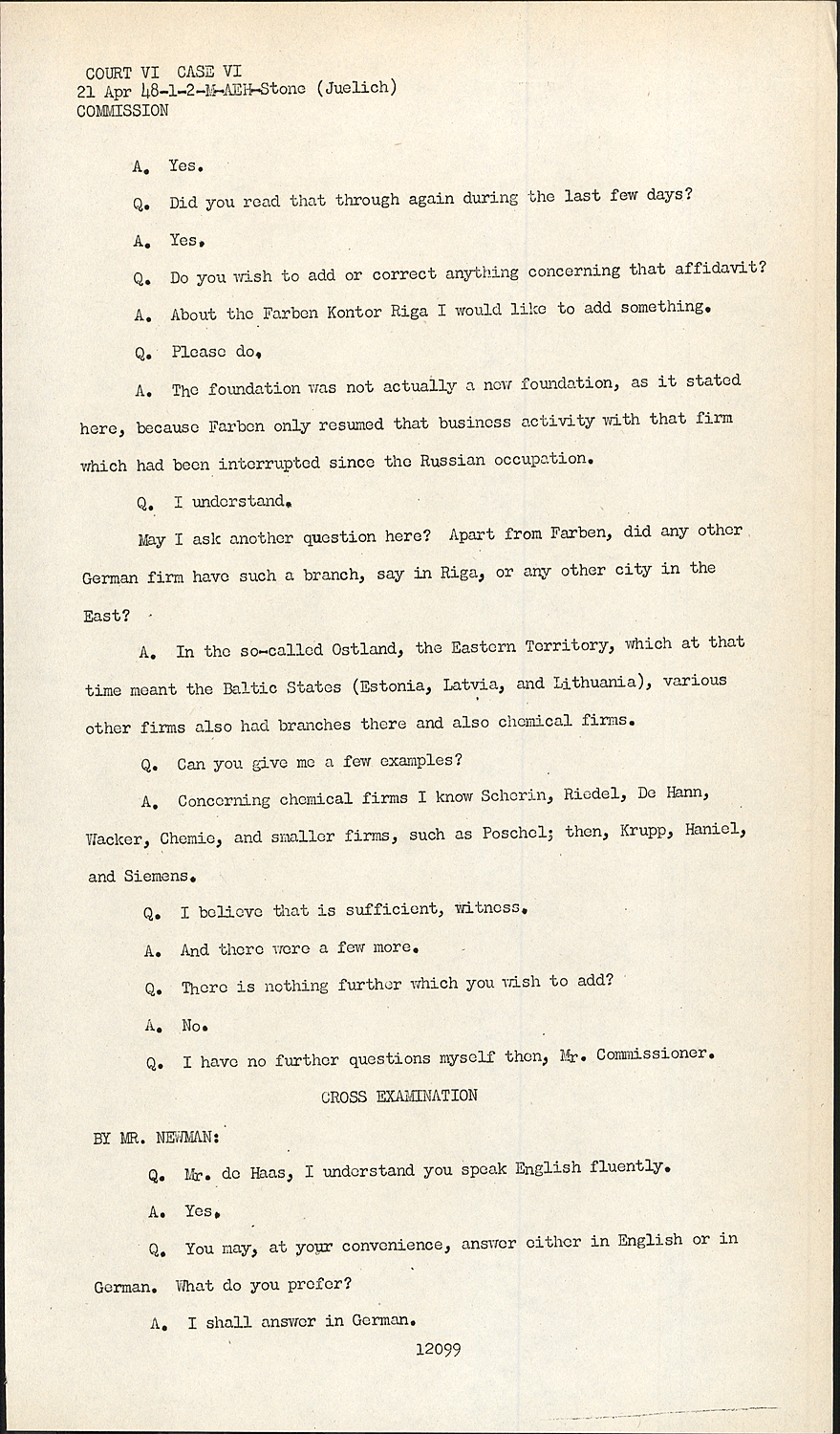
Q.You made an affidavit which we have introduced as Mann Document No. 138, Exhibit No. 169. Do you have that before you?
COURT VI CASE VI COMMISSION
A.Yes.
Q.Did you read that through again during the last few days?
A.Yes.
Q.Do you wish to add or correct anything concerning that affidavit?
A.About the Farben Kontor Riga I would like to add something.
Q.Please do.
A.The foundation was not actually a new foundation, as it stated here, because Farben only resumed that business activity with that firm which had been interrupted since the Russian occupation.
Q.I understand.
May I ask another question here? Apart from Farben, did any other German firm have such a branch, say in Riga, or any other city in the East?
A.In the so-called Ostland, the Eastern Territory, which at that time meant the Baltic States (Estonia, Latvia, and Lithuania), various other firms also had branches there and also chemical firms.
Q.Can you give me a few examples?
A.Concerning chemical firms I know Seherin, Riedel, De Hann, Wacker, Chemie, and smaller firms, such as Poschel; then, Krupp, Haniel, and Siemens.
Q.I believe that is sufficient, witness.
A.And there were a few more.
Q.There is nothing further which you wish to add?
A.No.
Q.I have no further questions myself then, Mr. Commissioner.
CROSS EXAMINATION BY MR. NEWMAN:
Q.Mr. do Haas, I understand you speak English fluently.
A.Yes.
Q.You may, at your convenience, answer either in English or in German. What do you prefer?
A.I shall answer in German.
COURT VI CASE VI COMMISSION
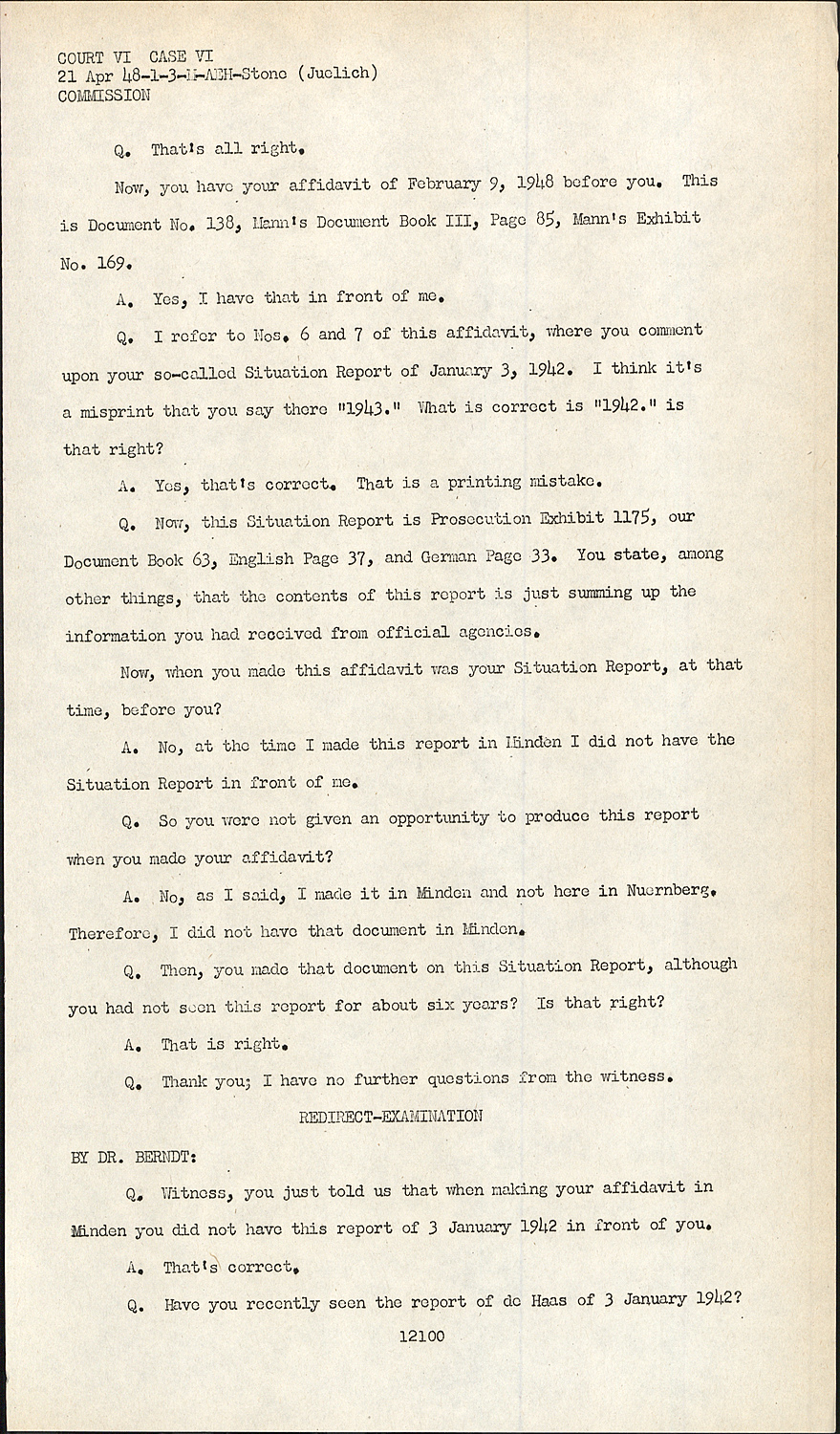
Q.That's all right.
Now, you have your affidavit of February 9, 1948 before you. This is Document No. 138, Mann's Document Book III, Page 85, Mann's Exhibit No. 169.
A.Yes, I have that in front of me.
QI refer to Nos. 6 and 7 of this affidavit, where you comment upon your so-called Situation Report of January 3, 1942. I think it's a misprint that you say there "1943." What is correct is "1942." is that right?
A.Yes, that's correct. That is a printing mistake.
Q.Now, this Situation Report is Prosecution Exhibit 1175, our Document Book 63, English Page 37, and German Page 33. You state, among other things, that the contents of this report is just summing up the information you had received from official ageacies.
Now, when you made this affidavit was your Situation Report, at that time, before you?
A.No, at the time I made this report in Minden I did not have the Situation Report in front of me.
Q.So you were not given an opportunity to produce this report when you made your affidavit?
A.No, as I said, I made it in Minden and not here in Nuernberg. Therefore, I did not have that document in Minden.
Q.Then, you made that document on this Situation Report, although you had not seen this report for about six years? Is that right?
A.That is right.
Q.Thank you; I have no further questions from the witness.
REDIRECT-EXAMINATION BY DR. BERNDT:
Q.Witness, you just told us that when making your affidavit in Minden you did not have this report of 3 January 1942 in front of you.
A.That's correct.
Q.Have you recently seen the report of do Haas of 3 January 1942?
COURT VI CASE VI COMMISSION
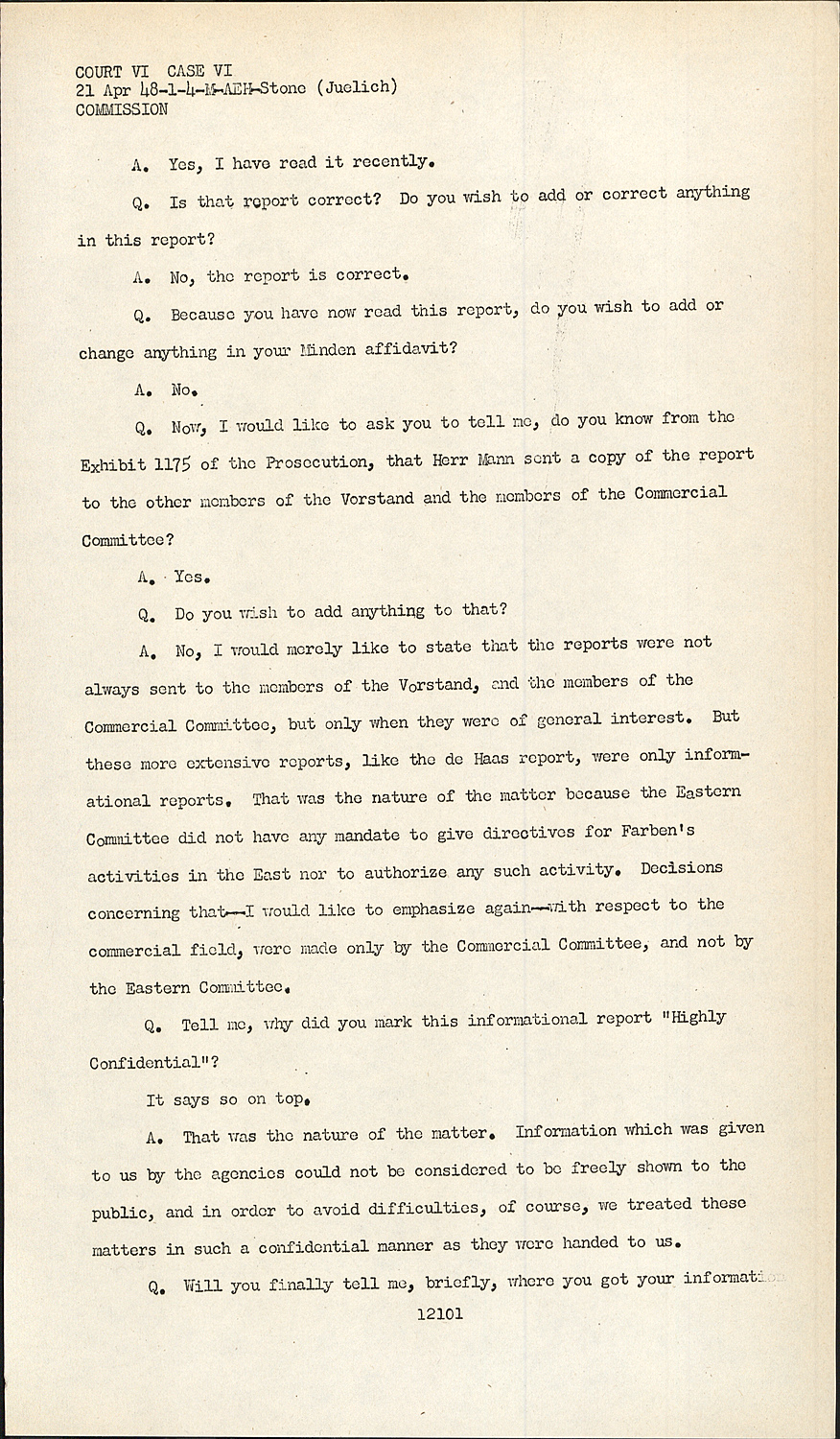
A.Yes, I have road it recently.
Q.Is that report correct? Do you wish to add or correct anything in this report?
A.No, the report is correct.
Q.Because you have now read this report, do you wish to add or change anything in your Minden affidavit?
A.No.
Q.Now, I would like to ask you to tell me, do you know from the Exhibit 1175 of the Prosecution, that Herr Mann sent a copy of the report to the other members of the Vorstand and the members of the Commercial Committee?
A.Yes.
Q.Do you wish to add anything to that?
A.No, I would merely like to state that the reports were not always sent to the members of the Vorstand, and the members of the Commercial Committee, but only when they were of general interest. But these more extensive reports, like the do Haas report, were only informational reports. That was the nature of the matter because the Eastern Committee did not have any mandate to give directives for Farben's activities in the East nor to authorize any such activity. Decisions concerning that--I would like to emphasize again--with respect to the commercial field, were made only by the Commercial Committee, and not by the Eastern Committee.
Q.Tell me, why did you mark this informational report "Highly Confidential"?
It says so on top.
A.That was the nature of the matter. Information which was given to us by the agencies could not be considered to be freely shown to the public, and in order to avoid difficulties, of course, we treated those matters in such a confidential manner as they were handed to us.
Q.Will you finally tell me, briefly, where you got your information COURT VI CASE VI COMMISSION for this report and for other reports?
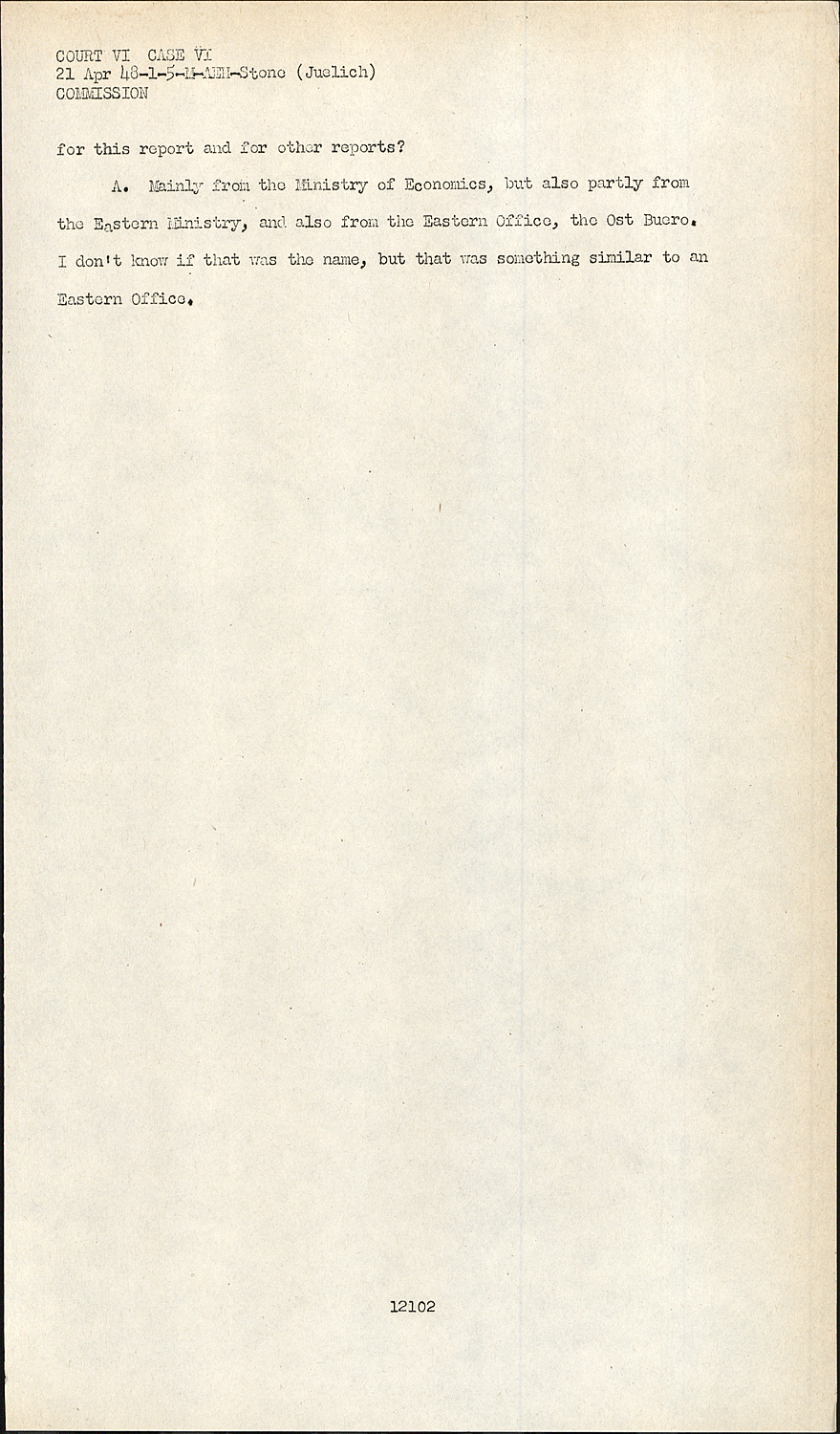
A.Mainly from the Ministry of Economics, but also partly from the Eastern Ministry, and also from the Eastern Office, the Ost Buero. I don't know if that was the name, but that was something similar to an Eastern Office.
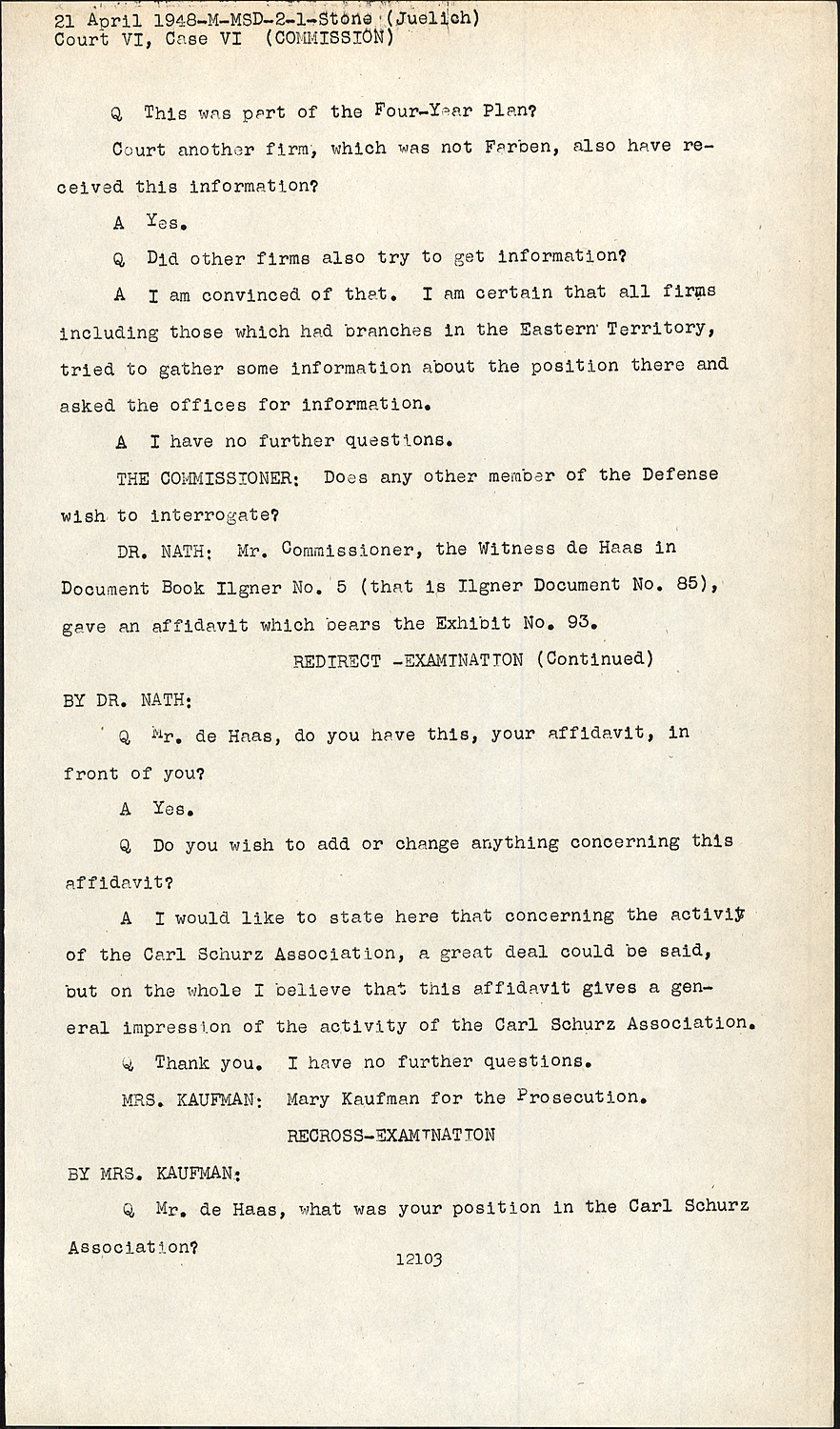
Court VI, Case VI (COMMISSION)
QThis was part of the Four-Year Plan?
Court another firm, which was not Farben, also have received this information?
AYes.
QDid other firms also try to get information?
AI am convinced of that. I am certain that all firms including those which had branches in the Eastern Territory, tried to gather some information about the position there and asked the offices for information.
AI have no further questions.
THE COMMISSIONER:Does any other member of the Defense wish to interrogate?
DR. NATH:Mr. Commissioner, the Witness do Haas in Document Book Ilgner No. 5 (that is Ilgner Document No. 85), gave an affidavit which bears the Exhibit No. 93.
REDIRECT -EXAMINATION (Continued) BY DR. NATH:
QMr. do Haas, do you have this, your affidavit, in front of you?
AYes.
QDo you wish to add or change anything concerning this affidavit?
AI would like to state here that concerning the activiy of the Carl Schurz Association, a great deal could be said, but on the whole I believe that this affidavit gives a general impression of the activity of the Carl Schurz Association.
QThank you. I have no further questions.
MRS. KAUFMAN:Mary Kaufman for the Prosecution.
RECROSS-EXAMTNATTON BY MRS. KAUFMAN:
QMr. de Haas, what was your position in the Carl Schurz Association?
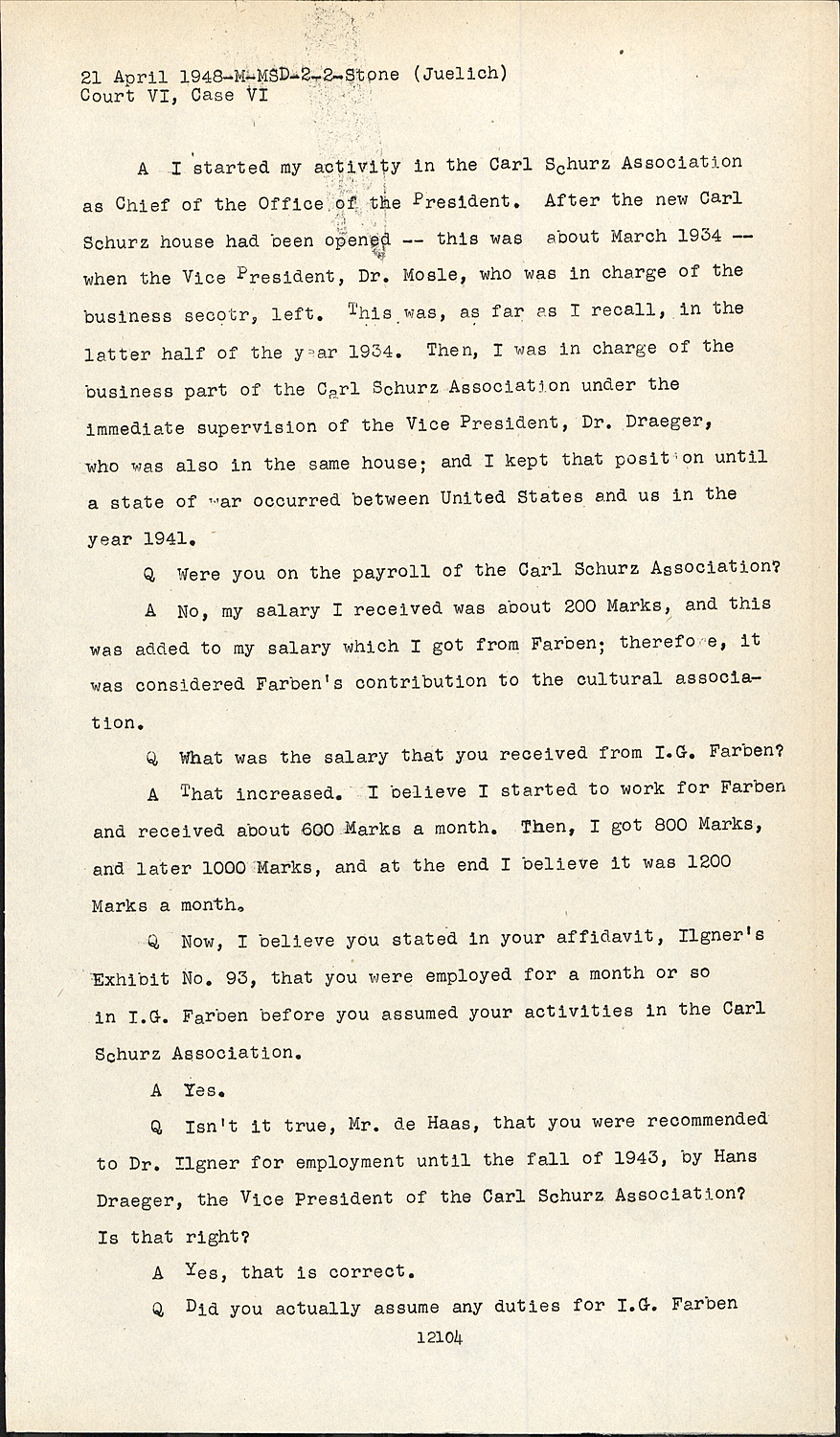
AI started my activity in the Carl Schurz Association as Chief of the Office of the President. After the new Carl Schurz house had been opened -- this was about March 1934 -when the Vice President, Dr. Mosle, who was in charge of the business secotr, left. This was, as far as I recall, in the latter half of the year 1934. Then, I was in charge of the business part of the Carl Schurz Association under the immediate supervision of the Vice President, Dr. Draeger, who was also in the same house; and I kept that position until a state of war occurred between United States and us in the year 1941.
QWere you on the payroll of the Carl Schurz Association?
ANo, my salary I received was about 200 Marks, and this was added to my salary which I got from Farben; therefore, it was considered Farben's contribution to the cultural association.
QWhat was the salary that you received from I.G. Farben?
AThat increased. I believe I started to work for Farben and received about 600 Marks a month. Then, I got 800 Marks, and later 1000 Marks, and at the end I believe it was 1200 Marks a month.
QNow, I believe you stated in your affidavit, Ilgner's Exhibit No. 93, that you were employed for a month or so in I.G. Farben before you assumed your activities in the Carl Schurz Association.
AYes.
QIsn't it true, Mr. de Haas, that you were recommended to Dr. Ilgner for employment until the fall of 1943, by Hans Draeger, the Vice President of the Carl Schurz Association? Is that right?
AYes, that is correct.
QDid you actually assume any duties for I.G. Farben Court VI, Case VI (COMMISSTON) at the time you were employed, until the time you undertook activity for the Carl Schurz Association?
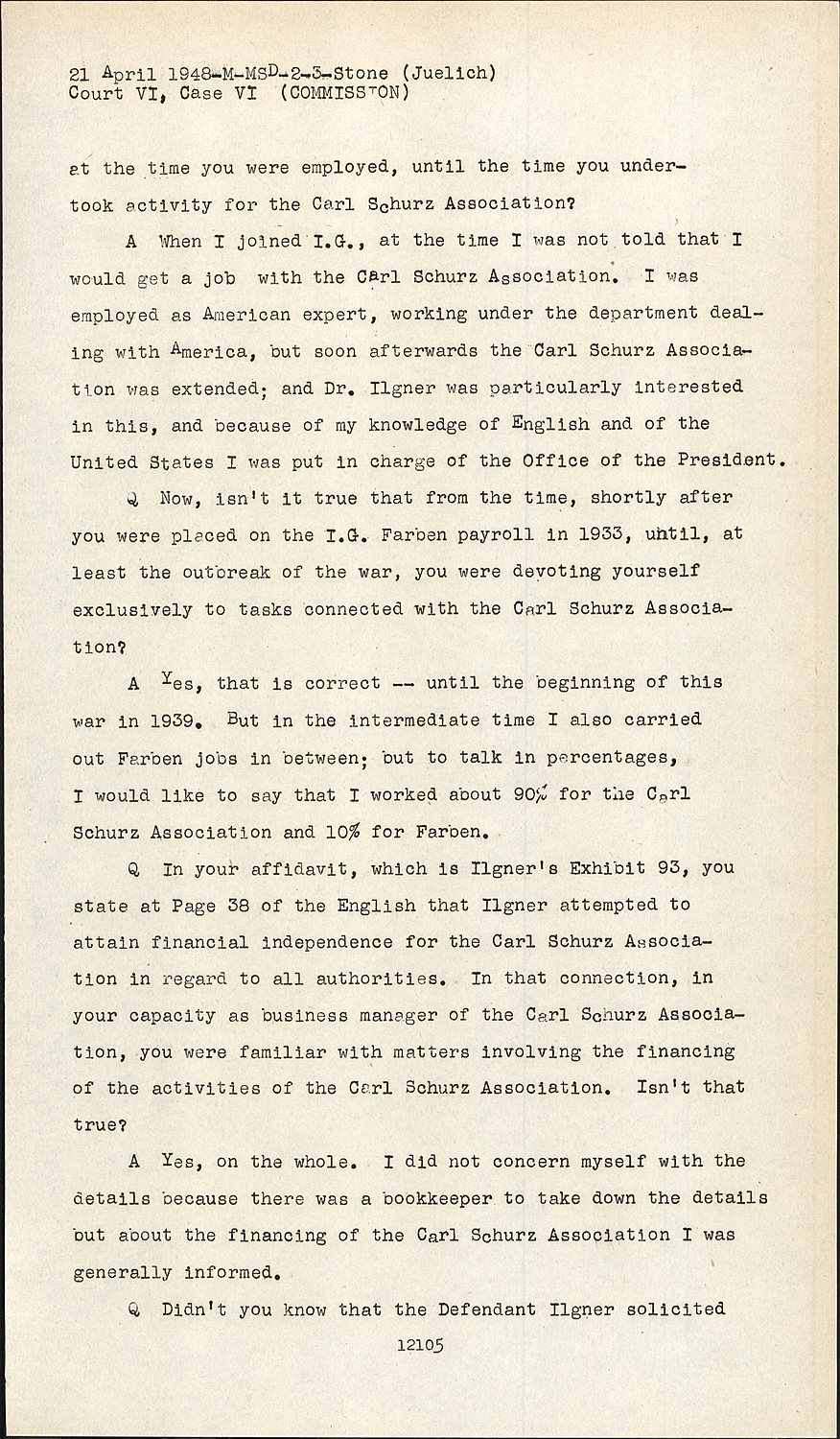
AWhen I joined I.G., at the time I was not told that I would get a job with the Carl Schurz Association. I was employed as American expert, working under the department dealing with America, but soon afterwards the Carl Schurz Association was extended; and Dr. Ilgner was particularly interested in this, and because of my knowledge of English and of the United States I was put in charge of the Office of the President.
QNow, isn't it true that from the time, shortly after you were placed on the I.G. Farben payroll in 1933, until, at least the outbreak of the war, you were devoting yourself exclusively to tasks connected with the Carl Schurz Association?
AYes, that is correct -- until the beginning of this war in 1939. But in the intermediate time I also carried out Farben jobs in between; but to talk in percentages, I would like to say that I worked about 90% for the Carl Schurz Association and 10% for Farben.
QIn your affidavit, which is Ilgner's Exhibit 93, you state at Page 38 of the English that Ilgner attempted to attain financial independence for the Carl Schurz Association in regard to all authorities. In that connection, in your capacity as business manager of the Carl Scnurz Association, you were familiar with matters involving the financing of the activities of the Carl Schurz Association. Isn't that true?
AYes, on the whole. I did not concern myself with the details because there was a bookkeeper to take down the details but about the financing of the Carl Schurz Association I was generally informed.
QDidn't you know that the Defendant Ilgner solicited Court VI, Case VI (COMMISSION) and received annual subsidies from the Foreign Office for the Carl Schurz Association?
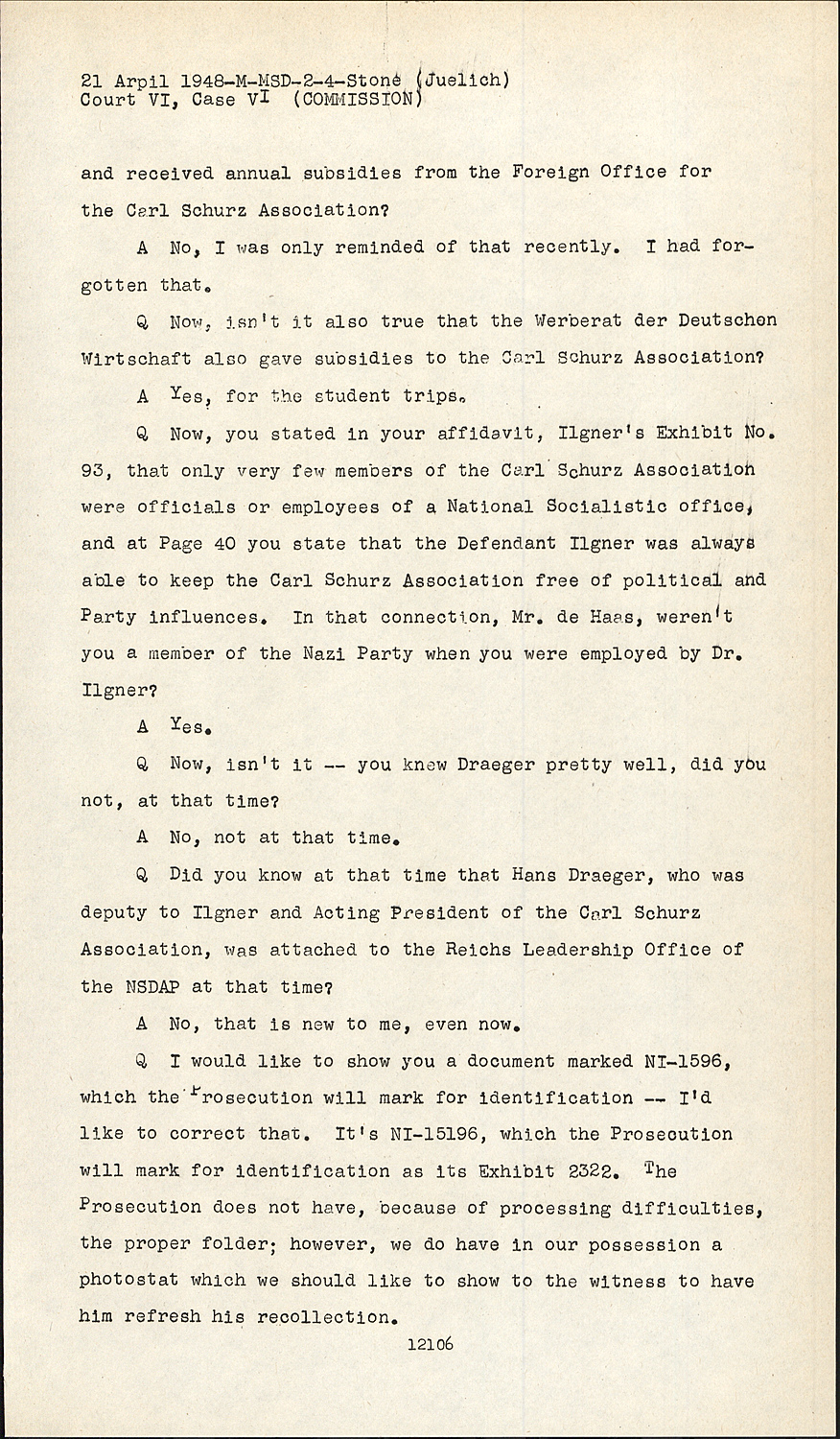
ANo, I was only reminded of that recently. I had forgotten that.
QNow, isn't it also true that the Werberat der Deutschen Wirtschaft also gave subsidies to the Carl Schurz Association?
AYes, for the student trips.
QNow, you stated in your affidavit, Ilgner's Exhibit No. 93, that only very few members of the Carl Schurz Association were officials or employees of a National Socialistic office, and at Page 40 you state that the Defendant Ilgner was always able to keep the Carl Schurz Association free of political and Party influences. In that connection, Mr. de Haas, weren't you a member of the Nazi Party when you were employed by Dr. Ilgner?
AYes.
QNow, isn't it -- you knew Draeger pretty well, did you not, at that time?
ANo, not at that time.
QDid you know at that time that Hans Draeger, who was deputy to Ilgner and Acting President of the Carl Schurz Association, was attached to the Reichs Leadership Office of the NSDAP at that time?
ANo, that is new to me, even now.
QI would like to show you a document marked NI-1596, which the Prosecution will mark for identification -- I'd like to correct that. It's NI-15196, which the Prosecution will mark for identification as its Exhibit 2322. The Prosecution does not have, because of processing difficulties, the proper folder; however, we do have in our possession a photostat which we should like to show to the witness to have him refresh his recollection.
Court VI, Case VI (COMMISSION)
THE COMMISSIONER:Go ahead.
QI show you this photostat marked NI-15196, which is the Nazi Party membership card of Hans Draeger, and ask you to look at the third page of that photostat, next to the last line, in which you will note that Hans Draeger was attached to the Gaureichsleitung, which is the Office of the Reichs Leadership.
Does that refresh your recollection?
ANo. But may I explain this in the following manner: This description is only a description of a location and does not mean the Draeger was a member of the Reichsleitung, the Reichs Leadership Office.
MRS. KAUFMAN:I should like to have that answer stricken from the record, in that it's not a response to the question that was put to the witness.
THE COMMISSIONER:Very well. It will be wtricken from the record. BY MRS. KAUFMAN:
QNow, isn't it also true that in 1933 Hans Draeger was Department Head of the Military Political Committee of the NSDAP?
AIn what year, please?
QIn 1933.
AI do not know that at all.
QDid you know that he was Department Head a Military Political Committee of the NSDAP at any time?
ANo.
QIn that connection I would like to show you a document marked NI-15199, to be marked for Identification as Prosecution's Exhibit 2324; and I ask you if that does not refresh your recollection that Hans Draeger was a member of the Military Political Committee of the NSDAP in 1933.
Court VI - Case VI Commissioner
A.No, I did not know that Draeger was with the Wehrpolitische Abteilung der Partei; the Party Political Department.
Q.Did you know what offices in the NSDAP Hans Draeger did in fact occupy?
A.No, I only know that he was a party member, and as is stated in the first exhibit which you showed to me he belonged to the local group, Brown House. The only active office in that sense which I remember is that later on, but I believe that was already during the war, he was chief of the Foreign Department and the Propaganda Ministry, but Party political work of a different nature, I know nothing about.
Q.Did you know he was proposed for the Reichstag by Hitler in 1938?
A.No, no.
Q.Now, isn't it a fact that Hanfstengel at the time he was a Vorstand member of the Carl Schurz Association in the early 1930's, after Hitler's rise to power was Hitler's Foreign Press chief?
A.Yes, whether he was chief of the foreign press I do not remember, but at any rate he was somehow connected with the press. I know that.
Q.And isn't it also true that a member of Ribbantrop's staff was on the Vorstand of the Carl Schurz Association?
A.I can not say that any more.
Q.Did you know von Raumer?
A.Dr. von Raumer, yes.
Q.Did you know that he was on the Vorstand?
A.Yes.
Q.Was he not a member of Ribbentrop's staff.
A.That I do not remember any more. At any rate, I do not remember in what capacity he was employed with Ribbentrop's.
Q.Did you know he was associated with Ribbentrop's staff?
A.I could not say that for certain any more, no.
Court VI - Case VI Commissioner
Q.Did you know von Kelmer?
A.I have heard the name. It is possible that I saw or met him soma time, but I only remember or know the name.
Q.Didn't von Kelmer serve on the Vorstand of Carl Schurz?
A.I do not know that either. It was mentioned on one occasion that Dr. von Kelmer was to leave and he was to be replaced by Stahmer. Whether this was actually carried out, I can not say any more.
Q.Did you know at that time that both were connected with the Ribbentrop staff?
A.I knew about Stahmer, but concerning Raumer I can not say any more but as far as I can remember he changed his positions repeat edly. Whether he was in Ribbentrop's staff just at that time I can not say now. I thought Dr. von Raumer was with the Werb rat of the German industry for some time.
Q.Isn't it true that Kiese, von Lewinski, Viktor Nauman and Rainrich Schwenck, all Vorstand members of the Carl Schurz Association, were members of the Nazi Party since 1944?
A.I do not know.
Q.Isn't it true that Hans Just, another Vorstand member, was official of the SS and notorious in Germany for the comment, "As soon as I hear the word "Kultur" I draw my gun"?
A.I do not know that expression of Hans Just. I believe at the time Hans Just became a member of the Vorstand in his capacity as member of the Reich Chamber of Culture, but this is only an assumption on my part now. I do not remember it.
Q.Did you know that Eugens Kuanaman, another Vorstand member of the Carl Schurz Association, was an ardent Nazi and also very active in Nazi propaganda.
A.No, as far as I know, Professor Kuenaman lived in Breslau and we personally had nothing to do with the members of the Vorstand, except with the cashier. Or rather, we had very little to do with them.
Court VI - Case VI Commissioner
Q.You stated in your affidavit, Ilgner's Exhibit 92, that in the last years before the war, Draeger held meetings at regular intervals, meetings of the Carl Schurz Association which were attended by officials of the Foreign organization, of the Propaganda Ministry. Now these meetings you spoke about were Executive Board meetings of the Carl Schurz Association, isn't that so?
A.Yes, that is right.
Q.Now, isn't it a fact that prior to the time these officials regularly attended your executive board me tings, the Foreign Organization and the Propaganda Ministry ware kept informed of the general activities of the Carl Schurz Association, by either yourself of Draeger or the defendant Ilgner, through personal conferences that took place at least every four weeks?
A.No, that is not correct. Before the founding of the working committee, which I believe was only started In 1936 and 1937, the information given to the Propaganda Ministry and the Foreign Office consisted only of occasional visits which we made there usually for other reasons, and based on these quite casual, irregular meetings we kept the departments concerned informed, that is, the propaganda ministry, Herr Feldmann, Herr Freitag, and Herr Leitner about the things the cultural association did. However, if we intended to undertake any major actions, such as important receptions on trips, than we informed the Propaganda Ministry and the Foreign Office at all times. Also at the same time as I have written here, we informed the American Embassy about it as well. Our information given to the Foreign Office and the Propaganda Ministry, before the formation of the Working Committee in 1937, did not differ from the information we gave to the American Embassy.
Q.Mr. de Haas, I show you an affidavit which you swore to on the 18th day of February, 1948, marked NI 1600. Oh, I beg pardon, it is 16,000, which will be marked for identification as Prosecution Exhibit 2325, and I ask you whether or not your statement appearing on the 2nd Court VI - Case VI Commissioner page of the affidavit under Item 3, which states, "Prior to that time the representatives of the Foreign Office and the Propaganda Ministry were kept informed of the general activities of the Carl Schurz Association by me, Dr. Draeger or Ilgner through personal conferences that took place from time to time, approximately every four weeks", and I ask you whether or not that refreshes your recollection that the Foreign Office and the Propaganda Ministry were kept informed at regular intervals.
DR. NATH:Dr. Nath for Ilgner. I big your pardon, may I interrupt here. Mr. Commissioner, the documents which are submitted here were not given to me in copy. I just received a copy in the English langauge; it is submitted in English. It is usual that the defense receives a German copy when the Prosecution assembles its documents. Owing to that I can not follow the examination of each witness if they do not comply with this.
MRS. KAUFMAN:The Prosecution must apologize for the poor state of the processing, in which its documents are today. The document now referred to -- the original of that document is in English, and unfortunately we have not had an opportunity to translate it into the German language. However, this will be done at the earliest opportunity, since the Prosacution intends offering it into evidence at a later date, when the processing is completed.
THE COMMISSIONER:Very wall of documents those, of course, defense counsel should be given a copy in their language, and you should do that as quickly as possible.
MRS. KAUFMAN:I will see to that. Thank you.
Q.Now, at page 50 of your affidavit which is Ilgner's Exhibit 93, you state that officials of the Foreign Organization and the Propaganda Ministry who participated in the Executive Board meetings of the Carl Schurz Association sh wed great understanding for the necessity to maintain an association as an institution completely neutral in regard to politics. Isn't it more correct to say that the Foreign Office and the Propaganda. Ministry were concerned with avoiding the impression that the Court VI - Case VI Commissioner Carl Schurz Association was a propaganda organization for Nazi Germany, so that under its cover it could more effectively carry out its task of winning friends for Nazi Germany?
A.No, that is not correct.
Q.What was the interest of the Propaganda Ministry and the Foreign Office in the activities of the Carl Schurz Association?
COURT VI, CASE VI COMMISSIONER
A.I would like to state concerning this that this Working Committee to which the Propaganda Ministry and the Foreign Office sent representatives was only founded in the year 1936, and certainly not before 1937. The brining in of representatives of the Propaganda Ministry and the Foreign Office occurred as far as I remember at the request of the Carl Schurz Association, and particularly, I believe, at the request of Dr. Draeger, when the political situation became more stringent. Every effort was made by the Carl Schurz organization to maintain its neutral position, and in order to avoid the Carl Schurz Association getting into any trouble, this was supposed to be some protection in order to avoid reproaches which could have been made to the Carl Schurz Association for its attitude of neutrality. May I explain the following, too. The personalities of the representatives of the propaganda ministry and the Foreign Office at the time, and also of the associations of interested associations gave an absolute guarantee that these gentlemen would maintain and support the neutrality of the Carl Schurz Association.
Q.Mr. de Haas, isn't it true that in December of 1938 the Carl Schurz Association installed a secret telephone at the request of the Propaganda Ministry so that in case of mobilization the Propaganda Ministry could reach the association at any time?
A.No, no word of that is true.
Q.In that connection I show you document marked NI 13416 which is marked for identification as Prosecution Exhibit 2326. This is a confidential file memorandum prepared by yourself.
DR. NATH:Mr. Commissioner, it is impossible for us to carry out examinations when the defense does not get any documents neither the original nor the copy which the witness has. It is impossible for me to conduct a redirect examination if I am not given copies of the documents submitted by Prosecution. After all, if the Prosecution asks us to do that, they have to do the same.
MRS. KAUFMAN:Mr. Commissioner, I am informed that the defense COURT VI, CASE VI COMMISSIONER counsel have received copies of this document on which I am now examining the witness.
THE COMMISSIONER:They have a copy of this document now?
MRS. KAUFMAN:They have a copy of this document in thier possession and I also have a photostat which I would be happy to let them have. Now, Mr. De Haas, this is a file memorandum prepared by yourself, in which you state, "Today I was asked to the Ministry of propaganda and was authorized by Herr Baron, in the name of the Ministry, to apply to our local telephone exchange for delivery of a telephone with a secret number for my office as soon as possible. The expenses of this installation will be born by the Ministry. Herr Baron explained that the installation of this telephone, in the case of emergency, was that the installation of this telephone was meant for mobilization in order to inrsure that in case of emergency I could be reached by the Propaganda Ministry at any time, as I was to consider myself as claimed by the latter" and I ask you does that refresh your recollection concerning this secret telephone?
A.Yes, I must withdraw my previous statement. I remember that a telephone was installed at the time, but these purposes of the installation I had forgotten completely.
Q.Now, you state in your affidavit, Ilgner Exhibit 93, that Ilgner's extensive business occupation and his free and extensive travel and long illness prevented him from accepting a great amount of the work on behalf of the association, so that the management was transferred more and more to the vice president, Draeger, and you also pointed out that Draeger was careful to maintain directives formulated by Ilgner. In that connection isn't it true that whenever any problem of importance arose regarding the policy and management of the Carl Schurz Association, Ilgner was consulted for his decision?
A.Yes, provided that Dr. Ilgner was present; that is, that he was in Berlin. That is right.
Q.Now, isn't it also true that whenever Ilgner returned from his COURT VI, CASE VI COMMISSIONER trips or illness he was informed of all of the important decisions that had been made by the association during his absence.