MR. MINSKOFF:We shall just mark them for identification at this time.
DR. HOFFMANN:Your Honors, I understood the decision of the Tribunal to mean that the documents should be submitted for identification, but this does not obviate the necessity that I should later have to object to all of these documents, just as I objected to the entire document book. I should like to be enlightened by the Tribunal.
THE PRESIDENT:This is purely a matter of making the record reflect the action of the Tribunal and counsel. If counsel for the Prosecution will assign a numberto the documents contained in Book 89 -which it may now do -- the Tribunal then will sustain an objection to the introduction of each and every one of the documents contained in the book, and the record will be closed as to this book.
DR. HOFFMANN:Do I have to object to each document singly, or is it enough -
THE PRESIDENT:You have made your objection and your objection hasbeen sustained as to the competency and materiality of each and every document contained in the book. We are simply straightening out the record now.
MR. SPRECHER:Mr. President, your last remark troubled us a little bit. We had understood that your ruling was not on the competency and materiality necessarily, but rather on the question of whether or not the documents may have been cumulative or whether or not they were documents of which you would normally take judicial notice, and, therefore, they should not really have been presentedto you in this manner.
THE PRESIDENT:Perhaps that wasan unfortunate use of terms. What we do mean to say -- and I think, gentlemen, this will be clear enough -- is: we shall now permit the Prosecution to mark the documents contained in the book.
There has been an objection made with respect to the admission in evidence of each of those documents. That objection is now sustained by the Tribunal upon the ground that the documents are either matters of which the Tribunal would take judicial notice or are cumulative in character. Is that clear now? Make your record.
MR.Minskoff; The first document in Document Book 89 is NI 12268which will be Prosecution's Exhibit 1744, I believe, for identification. Document NI 12421 is Prosecution's Exhibit, for identification, 1745.
NI 12347 as 1746, for identification.
1723PS as Exhibit 1747, for identification.
NI 12270 as Prosecution Exhibit 1748, for identification.
1615PS as 1749, for identification.
501PS as 1750, for identification.
NI 12350 as Exhibit 1751, for identification.
NI 12346 as 1752, for identification.
NI 12348 as Prosecution's Exhibit 1753, for identification.
1965PS as 1754, for identification.
NI 12333 as 1755, for identification.
NI 12321 as 1756, for identification.
NI 12269 as Prosecution's Exhibit 1757, for identification.
NI 12545 as 1758, for identification.
L22 as 1759, for identification.
That covers the Document Book 89.
THE PRESIDENT:Now the record may show the documents numbered from 1744 to 1759, inclusive, marked for identification by the prosecution and offered in evidence. The record may further show that the objection to the introduction of these documents is sustained by the Tribunal for reasons heretofore stated.
MR. MINSKOFF:The next book, Your Honors, will be Book 82. With respect to the first document in Document Book 82, NI 12207, the prosecution asks the Tribunal to take judicial notice of this document and marks it as Prosecution's Exhibit 1760, in evidence.
DR. BERNDT:I object;to the presentation of this document, NI 12207. First of all, this document is an uncertified excerpt. Merely the translation of the document is certified to, as can be seen from the last page of the document. The excerpt itself is not certified. At least the book should be submitted here.
Besides that, this is inadmissible evidence if, in this trial against Farben, the same fact should he partly relevant as was relevant in the trial against Tesch. If, in this trial against Farben, the same facts should be of relevancy as were relevant in the trial against Tesch before a British Military Tribunal in Hamburg, then the prosecution should prove, by witnesses, and by documents, that that is so, but they cannot be permitted to have an easy time of it and merely refer to the findings of another Tribunal. That is especially not possible if it is the Tribunal of another state whose findings are according to other principles of law. Apart from that, these defendants here were not represented in that trial and therefore they couldn't make any statements in the British trial and not cross examine the witness there. Furthermore I point out that, according to the first sheet of this document, we are here concerned not with a complete reproduction of the Hamburg trial, but merely with a selection and a compilation of a commission of the United Nations War Crimes Commission. According to the principle that the best evidence should be submitted, this document, NI 12207, is therefore not admissible as evidence to any facts.
In closing, I want to mention that in this document there is no mention made of any one of the defendants, or Farben, or of Degesch. They are not mentioned with a single word.
THE PRESIDENT:What does the prosecution have to say with reference to the theory upon which this document is offered? I'm sorry, are you offering it in evidence or are just asking us to take judicial notice of it?
MR. MINSKOFF:With respect to the first document, we're only asking the Court to take judicial notice of it.
THE PRESIDENT:Then it will be marked only for identification and not introduced in evidence.
MR. MINSKOFF:I had said "in evidence", but the record can be changed to say "identification".
THE PRESIDENT:Very well.
MR. MINSKOFF:The next document NI 034 in the book is not offered in evidence and is withdrawn from the book. It is the affidavit of a deceased affiant.
The same is true of the following, NO 2368, the affidavit of Entress.
DR.HEINTZELER (Defense Counsel for defendant Wurster): Your Honors, may I be permitted to ask something in regard to the first document in this book, Exhibit 1760? It seems to be of importance to me to clarify what the Tribunal should take judicial notice of, conforming to the request of the Prosecution. Should the Tribunal take judicial notice of the fact that in Hamburg a trial was instituted against Tesch and that it ended with a certain finding? If that is so, then the defense has no objection. However if it is the Prosecution's contention that the Tribunal should take judicial notice of the individual findings of the Hamburg Tribunal, then the defense would have to raise an objection against that.
I ask the Tribunal to request the prosecution to make their statement as to that.
THE PRESIDENT:There is no occasion for the Tribunal to discuss what subject it will or will not notice as a matter of judicial notice. That raises purely a question of law, and not one of fact. If the consideration of this document is urged upon us in the determination of this case, it will be proper time then to discuss whether or not it is a subject of which we will take judicial notice. The prosecution is not offering the document in evidence. The question of judicial notice is not presently before the Tribunal. Documents of some character are so generally known to be the subject of judicial notice that we speak of them freely. In the case of a document of another character, there might be some question raised about it. We should not want to take the time of the Tribunal now to go into a discussion of the field of material of which we might take judicial notice. If the prosecution subsequently takes the position that this is a document of which we should take judicial notice, counsel for the defense will have a full opportunity of stating their views as to whether or not that position is well taken.
MR. MINSKOFF:One moment, your Honor, please.
If it please the Court, less there be any subsequent confusion as to the purpose for which the document was offered, the prosecution calls attention to Article IX of Ordinance 7 where it is stated.
"The Tribunals shall not require proof of facts of common knowledge, but shall take judicial notice thereof. They shall also take judicial notice of official governmental documents and reports of any of the united Nations, including the acts and documents of the committees set up in the various Allied countries for the investigation of war crimes, and the records and findings of military or other tribunals of any of the United Nations."
With respect to the document marked for identification, the prosecution asks the Court to take judicial notice of the findings of that case.
THE PRESIDENT:Very well. Take up your next matter.
DR. HEINTZELER:Your Honors, I merely want to emphasize once more what I mentioned previously. This is not the record of the proceedings against Tesch in Hamburg, but only the excerpt of such record. I believe, if the prosecution wants the Tribunal to take judicial notice of these proceedings and these findings, then it would be necessary to furnish the Tribunal a complete record of the proceedings there. The defense is not in a position to decide, on the basis of an excerpt, whether the matters stated in it are correct.
THE PRESIDENT:There is nothing whatever before the Tribunal. The question of whether, in the final consideration of this case, we take judicial notice of a document is a question of law, not of fact. If it is a document of which we should take judicial notice, we shall consider the document. In case of doubt, or in case of the document not being a complete document, it raises purely a question of law, to be considered at that time. There is nothing now before the Tribunal. The prosecution has indicated that this Judgment or proceeding is one of which it will expect the Tribunal to take judicial notice. It is not offering, as it cannot offer, this document in evidence.
It is not a part of the evidence. When we come to the argument, gentlemen, if there is any controversy between you as to what we shall take judicial notice of you will have full opportunity to present your views and we will then determine what to take judicial notice of.
Perhaps it may save a bit of time if we give the prosecution a moment now to get its proof a little better organized.
We'll rise for our recess at this time.
(A recess was taken.)
DR. BERNDT:Your Honor, during the first part of the session various documents were rejected and the reason was given they were not relevant. The Tribunal, however, stated that it would take judicial knowledge of such documents. Personally I am no clear about the difference and during the recess I tried to clarify this matter by conferring with my colleagues. None of us, however, is clear about the difference and we should be very grateful to Your Honor, if you would be kind enough to explain to what the difference is between a document being admitted as having probative value and a document declared not to have probative value but admitted for judicial notice.
THE PRESIDENT:It's the view of the Tribunal that no proof, as such, is necessary to those matters of which the Tribunal takes judicial knowledge and that it is burdening the record to impose matters of that kind on the record of the Tribunal. Now, as to what matters this Tribunal is authorized to notice judicially it is only necessary for us to call your attention to Art. 9 of Ordinance 7 with which you gentlemen are familiar. It simply provides: "The Tribunals shall not require proof of facts of common knowledge but shall take judicial notice thereof. They shall also take judicial notice of official governmental documents and reports of any of the United Nations, including the acts and documents of the Committees set up in the various Allied countries for the investigation of War Crimes and the records and findings of Military or other Tribunals of any of the United nations." That, gentlemen, seems to be a sufficient answer to the question propounded by counsel and, as the Tribunal has indicated, it is our view that when documents of which the Tribunal would take judicial knowledge or should take judicial knowledge, by virtue of these provisions of Ordinance 7, it is improper and an unnecessary encumbrance of the record to introduce such material into evidence; evidence being the method by which counsel produces a showing of fact which may be the subject of controversy. Does that answer your question, doctor?
DR. BERNDT:Yes.
THE PRESIDENT:You may proceed.
MR. MINSKOFF:The next document, if it please the Court, is NO-11957 and that's offered as Prosecution Exhibit 1761 in evidence. The English had "NO". It should be "NI". The German is correct.
DR. BERNDT:Dr. Berndt. I must object to the submission of this document. The statement of Dr. Diels does not contain a sinble fact which is relevant in this case. They are only opinions repeated in this document -- only assumptions and personal opinions and utterances derived from hearsay. Only a very flighty survey of this document confirms this. For instance, under paragraph 5, it says and I quote: "It was a wellknown fact," but the witness himself cannot state anything from his own knowledge. Paragraph 6: "It was generally known." Then Paragraph 7: "In my opinion this is and that was done." Paragraph 8: "It was generally known." Paragraph 9: "It was generally said", etc., etc. There's no fact in this affidavit which is of any value for the purpose of this trial. I will also not fail to mention that in the statement of the Prosecution and in the judgment of the English Tribunal at Hamburg, the statement of Diels was not mentioned because these statements of Diels contain no facts. I think that arising from this circumstance I have a confirmation of my opinion that this document must be considered to be irrelevant.
MR. MINSKOFF:May we say a few words?
THE PRESIDENT:Yes, but we are particularly interested in what you have to say upon this proposition as to whether or not this affidavit contains anything other or different than what purports to be a matter of common knowledge, of which the Tribunal is bound to take judicial notice and secondly, whether or not it contains any recital of fact as distinguished from an expression of opinion and conclusion of the witness. Let me hear you.
MR. MINSKOFF:Let me ask you a question first, your Honor? There are two ways in which we could prepare these affidavits. We could prepare them by having the ultimate fact stated and all of the bases for that included in the affidavit and all of the illustrations and experiences of the witness.
That has not been the practice so far. We have tried to put in the affidavit statements of ultimate fact and partly conclusions of facts, it always being understood that such witnesses were available for cross examination, at which time the defense could test the bases for those facts -- those statements of ultimate facts.
THE PRESIDENT:Just in that connection, may I ask you, in the interest of saving time, is this affiant speaking of conditions as existed at any place that was connected with the Farben enterprise or with which any of these defendants had any connections or is he speaking of conditions that existed at other places?
MR. MINSKOFF:He is speaking of conditions as they existed in Germany where all of the defendants were. He mentioned specifically the use of Zyklon-B and the knowledge of the use of that product in the extermination of human beings.
THE PRESIDENT:Go ahead with your statement.
MR. MINSKOFF:As to the other questions propounded by the Tribunal, it is admittedly in large parts matter of common knowledge. There are several ways in which we can establish common knowledge. We can ask the Tribunal to take judicial notice that certain findings of other Tribunals or other bodies which are properly the subject of judicial notice. Other methods of arriving at the same results is to produce witnesses who can testify as to the common knowledge in Germany on a given subject before the Court.
THE PRESIDENT:Gentlemen, we have said before that in the interest of time we could not undertake to edit these affidavits and to strike out from the record the parts which appear to be clearly incompetent. We said that counsel would necessarily have to depend upon the fact that the Tribunal could distinguish between matters of opinion as such and matters that had some probative value. It occurs to the Tribunal that even if it is a matter of common knowledge, by which this Tribunal is bound, the use of gas as it is described in this affidavit in pagagraphs 5 and 6, there may be some matters that are not altogether the subject of common knowledge - and that is the use of a particular gas. The Tribunal is of the opinion that there may be some such showing of fact here as to warrant the introduction of this affidavit in evidence with respect to that narrow field. We assume that it is the intention of the prosecution to produce this witness for cross examination if the affidavit is admitted in evidence. Frankly, we think the field is very narrow as to any evidentiary fact contained in this affidavit, but we are hardly in a position to say that it's totally devoid of probative value, even if we take the view that it is largely devoted to matters of common knowledge of which we take judicial notice. It may be that the prosecution has in mind connecting the defendants or some of them with this particular gas that's named here. We cannot anticipate what the prosecution may have in mind. Therefore, the objection to the introduction of this document will be overruled, but we may say that if the document is to be made the subject of cross examination, the Tribunal would feel obligated to confine the cross examination to a very very narrow field.
MR. MINSKOFF:For the purpose of cross examination of the limited field we have indicated the witness will be available this afternoon to testify.
THE PRESIDENT:Very well. Offer your next document.
MR. MINSKOFF:The prosecution now offers NI 11954 as Prosecution's Exhibit 1762, without comment.
The prosecution offers also, without comment, NI 11710 as Prosecution's Exhibit 1763.
And NI 11862 as Prosecution's Exhibit 1764.
The next......
DR.BERNDT (Interrupting): Against the submission of the Document NI 11954 I have also to raise an objection. According to the first page of the document, it appears that it is an excerpt from a translation of the records of the British Military Tribunal against Tesch and others. In other words, it is a record about the interrogation of the witness Brod before the Military Tribunal in Hamburg. This record cannot substitute a hearing of this witness before this Tribunal. The Tribunal does not admit affidavits originating from deceased witnesses because they can no longer be heard. In my opinion, a record of a witness' testimony before another Tribunal can neither be admitted, for the same reason.
THE PRESIDENT:Just a moment, counsel, please. May we interrupt you to inquire of the Prosecutor, is this document, marked 1762, offered as an interrogation of this witness?
MR. MINSKOFF:This document, if it please Your Honor, is the transcript of the testimony that this witness gave before the - during the trial of the Tesch Case referred to previously.
THE PRESIDENT:Is it your purpose to produce this witness for cross examination?
MR. MINSKOEF:If he is asked for cross examination, he is available, Your Honor.
THE PRESIDENT:Then the objection will be overruled. The Tribunal is not concerned with what the purpose may have been when the affidavit or interrogation was obtained. It is immaterial to us as to whether or not the testimony or the affidavit of this witness that is offered here was obtained especially for this case or in the course of the trial of some other case. It would be quite immaterial as to those circumstances if the witness is produced here and counsel for the defense has proper opportunity to cross examine him, and on the representation of the prosecution that this witness will be produced for cross examination, if requested, the objection is overruled.
MR. MINSKOFF:The next document, if it please the Court, is 3868PS which again is the affidavit of a deceased affiant and is withdrawn from the book. The prosecution now passes to NI 6363 which it offers in evidence as its Exhibit 1765, and NI 12073 which the prosecution offers as its Exhibit 1766. The prosecution offers NI 12203as Prosecution's Exhibit 1767, and NI 9098 as Prosecution's Exhibit 1768. The prosecution also offers at this time NI 12217 as Prosecution's Exhibit 1769. The prosecution offers NI 11393.....
THE PRESIDENT:Just a moment, Mr. Prosecutor.
DR. BERNDT:I beg your pardon, Your Honor. I couldn't quite get the translation. I have to object against the submission of Document NI 6361 and the following documents thereafter. I object because the document is irrelevant. The same assertion refers to all the following documents in Volume 82 and to all documents which are collected in Volume 83.
THE PRESIDENT:Counsel, you are a bit premature. I do not believe we have quite reached the document of which you are speaking. Did I understand you correctly that you are directing your remarks at Document NI 6361 and those which follow?
DR. BERNDT:Yes.
MR.MINSKOFF: 6363, Your Honor. It's in evidence.
THEPRESIDENT: 6363. I misunderstood you. Go ahead.
DR. BRENDT:My number is 6363.
THE PRESIDENT:Now we understand you.
Very well. Now you may make your statement.
DR. BERNDT:All these documents which are contained in Book 82, following NI 6363, and all of the documents which are collected in Book 83, refer to one complex. They refer to the delivery of Zyklon B to the concentration camp of Auschwitz. I must request the Tribunal to look at page 5 of the index of Book 82 which coincides with the index of Book 83.
There you find the heading which you find in paragraph 31 of the Indictment, and I quote:
"Poison gasses manufactured by Farben and supplied by Farben to SS officials to be used in the extermination of enslaved persons in concentration camps throughout Europe."
With respect to all documents to which I object, not a single one refers to the assertion contained in this portion of the Indictment. The documents, as I have already stated, refer only to one product, Zyklon B. According to the content of the documents which have been submitted, this poison was not produced by I.G. Farben. Would you please look at the affidavit of Zaun....Alfred Zaun, Book 83, page 3 in the English and in the German. It says there very clearly that Zyklon was produced by the Dessauer Werke, for Sugar and Chemical Industry AG at Dessau, and also by the Kali Werke Kolin AG at Kolin. In other words, the Dessau Werke and the Kolin Werke were the producers of Zyklon B. In no document contained in these books is it being asserted that these two firms, Dessau and Kolin, belonged to the I.G. Farben concern. Neither is it asserted that the I. G. exercised any influence at all, from a personnel or investment point of view on these two plants. That refers to the production of Zyklon B. But even the delivery of Zyklon B to the concentration camp of Auschwitz, according to the content of the documents, was not handled by the I. G. According to the documents, Zyklon B was delivered by the firm Tesch and Stabenow at Hamburg, the so-called Testa. Not a single one of the documents submitted states that this firm Testa belonged to the I. G. Farben or that the I. G. had any influence on them.
I should like to point out to you Document NI 12073 in Volume 83, English page 85, German page 93. I draw your attention to paragraph 3 of this document. I further draw your attention to the Document 7958 in Book 82, English page 42, page 7 of the original.
In both of these documents no mention is made that the I.G. had any capital shares in Testa. It has neither been established that the I.G. had any influence from the point of view of personnel on Testa. The so-called Degesch frim is supposed to have influenced Testa, which is a German company for the combatting of vermin. This company, up to this point, has been mentioned in no chart, in no list, as a subsidiary company of I.G. Farben. Not even has it been designated as a company over which the I.G. had any influence whatsoever. From Document Book 82, English page 85, it appears that the I.G. had a capital investment in this firm of 42.5%. I don't have to state here that this was not an important influence. In other words, by virtue of its capital, I.G. had no decisive influence over Degesch. Degesch had an administrative council composed of seven persons. Only three of those were members of I.G. These too had no decisive influence over Degesch. Degesch cannot be designated as a company over which I.G. Farben had an influence.
All of the submitted documents show that two firms - the firm at Dessau and the firm at Kolin - produced Zyklon B. The documents furthermore show that a firm Testa at Hamburg distributed this Zyklon gas to the concentration camp of Auschwitz. The assertion of the prosecution that I.G. Farben produced and distributed Zyklon B is not being proven by the documents. Consequently, all the documents are irrelevant as to the assertion of the Indictment and, therewith, for the purpose of this Tribunal.
THE PRESIDENT:Mr. Prosecutor, the objections of counsel for the defense are sufficient to impose upon you the burden of pointing out the relevancy of this evidence.
MR. MINSKOFF:If it please the Court, this is a preliminary remark. I can point out that it isn't Farben that is on trial, but the defendants, acting through the instrumentality of Farben and otherwise, that are on trial.
With respect to the Dessauer Works, it will become clear as we go through the documents, that they had no control; they were not the producers; they were merely contractors to whom all the materials were supplied, including the Farben stabilizer from Uedingen. The patent rights, the production rights, the sales rights - none of those were with Dessauer or with the other production company in Czechoslovakia.
The documents in the Books 82 and 83, which were objected to, concern the question of responsibility for supplying a gas, known as Zyklon B, to concentration camps in Europe, including the Auschwitz Concentration Camp, which gas was used to exterminate several million human beings. The evidence in the documents contained in the two books referred to shows:
(1) That Degesch is a partnership with limited liability. The three partners were Degussa with a 42.5% interest, I.G. Farben with a 42.5% interest, and Goldschmidt with a 15% interest. In order to facilitate the exercise of the partnership rights in the management of Degesch, the partners have established an administrative committee or supervisory board called the Verwaltungsausschuss. This administrative committee or supervisory board is the joint representative of the partners in the exercise of their partnership rights and its decisions are binding upon the managers and the partners.
The portions I just stated are directly from the contract between Farben, Degussa and Goldschmidt in forming Degesch.
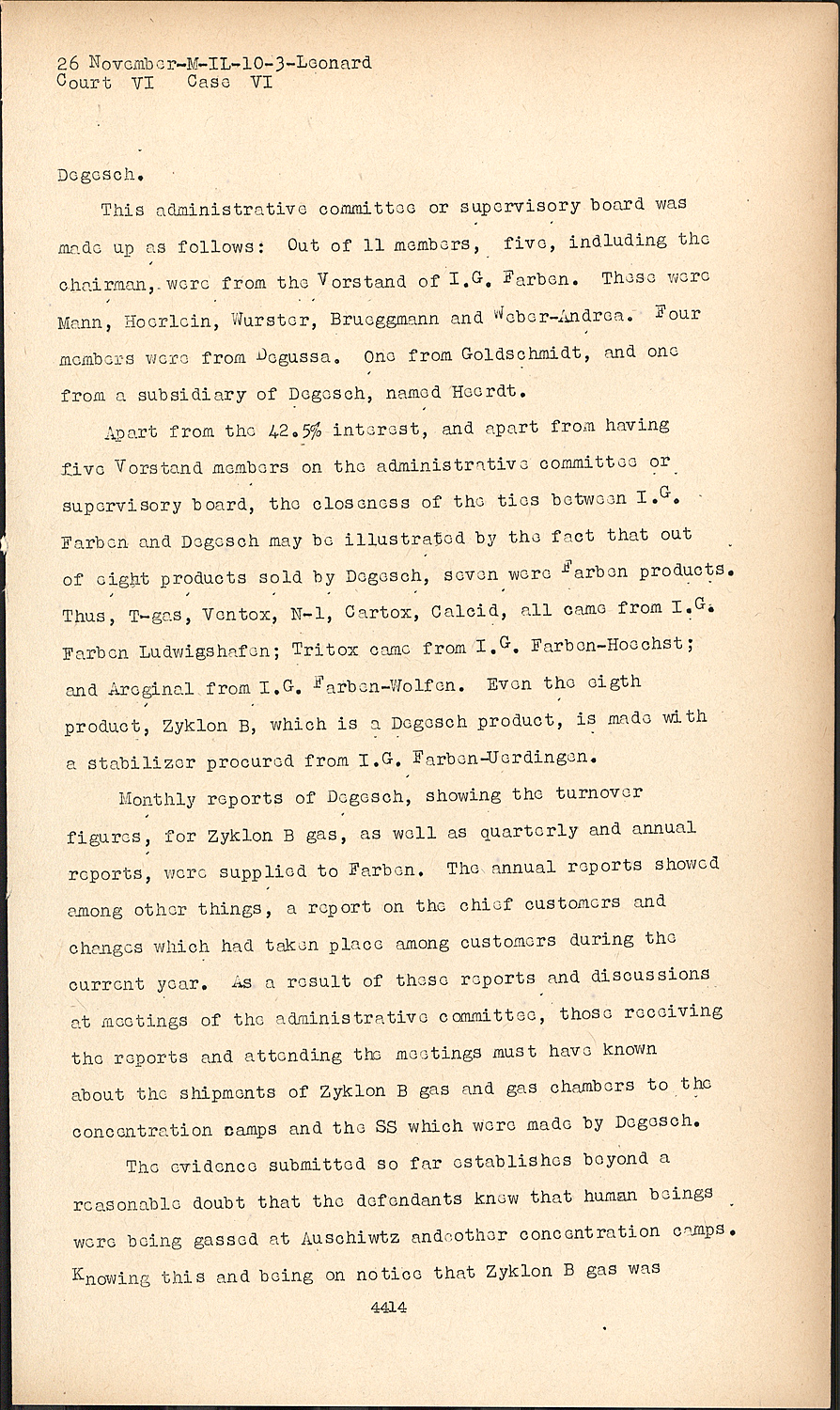
This administrative committee or supervisory board was made up as follows: Out of 11 members, five, indluding the chairman, were from the Vorstand of I.G. Farben. These were Mann, Hoerlein, Wurster, Brueggmann and Weber-Andrea. Four members were from Degussa. One from Goldschmidt, and one from a subsidiary of Degesch, named Heerdt.
Apart from the 42.5% interest, and apart from having five Vorstand members on the administrative committee or supervisory board, the closeness of the ties between I.G. Farben and Degesch may be illustrated by the fact that out of eight products sold by Degesch, seven were Farben products. Thus, T-gas, Ventox, N-1, Cartox, Calcid, all came from I.G. Farben Ludwigshafen; Tritox came from I.G. Farben-Hoechst; and Areginal from I.G. Farben-Wolfen. Even the eigth product, Zyklon B, which is a Degesch product, is made with a stabilizer procured from I.G. Farben-Uerdingen.
Monthly reports of Degesch, showing the turnover figures, for Zyklon B gas, as well as quarterly and annual reports, were supplied to Farben. The annual reports showed among other things, a report on the chief customers and changes which had taken place among customers during the current year. As a result of these reports and discussions at meetings of the administrative committee, these receiving the reports and attending the meetings must have known about the shipments of Zyklon B gas and gas chambers to the concentration camps and the SS which were made by Degesch.
The evidence submitted so far establishes beyond a reasonable doubt that the defendants knew that human beings were being gassed at Auschiwtz andcother concentration camps. knowing this and being on notice that Zyklon B gas was supplied to concentration camps and the SS by Degesch, the least that can be said is that these defendants were under a duty to investigate, and, oven though some of the defendants may claim they did not know that the gas supplied by Degesch was actually used to exterminate people, in the words of Military Tribunal I, they could have found out had they made the slightest investigation.
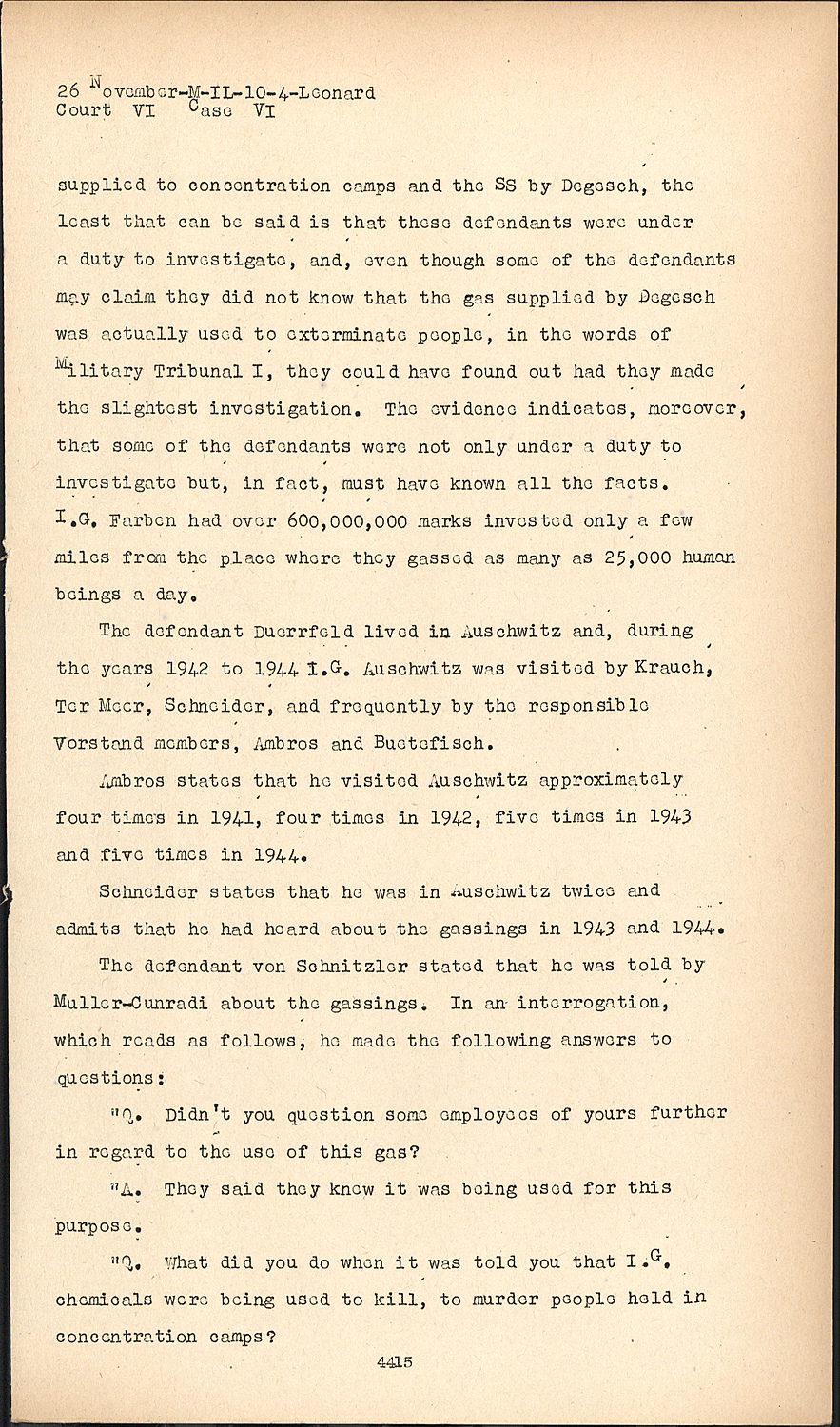
The evidence indicates, moreover, that some of the defendants were not only under a duty to investigate but, in fact, must have known all the facts. I.G. Farben had over 600,000,000 marks invested only a few miles from the place where they gassed as many as 25,000 human beings a day.
The defendant Duerrfeld lived in Auschwitz and, during the years 1942 to 1944 I.G. Auschwitz was visited by Krauch, Ter Mecr, Schneider, and frequently by the responsible Vorstand members, Ambros and Buetefisch.
Ambros states that he visited Auschwitz approximately four times in 1941, four times in 1942, five times in 1943 and five times in 1944.
Schneider states that he was in Auschwitz twice and admits that he had heard about the gassings in 1943 and 1944.
The defendant von Schnitzler stated that he was told by Muller-Cunradi about the gassings. In an interrogation, which reads as follows, he made the following answers to questions:
"Q. Didn't you question some employees of yours further in regard to the use of this gas?
"A. They said they knew it was being used for this purpose.
"Q. What did you do when it was told you that I.G. chemicals were being used to kill, to murder people held in concentration camps?
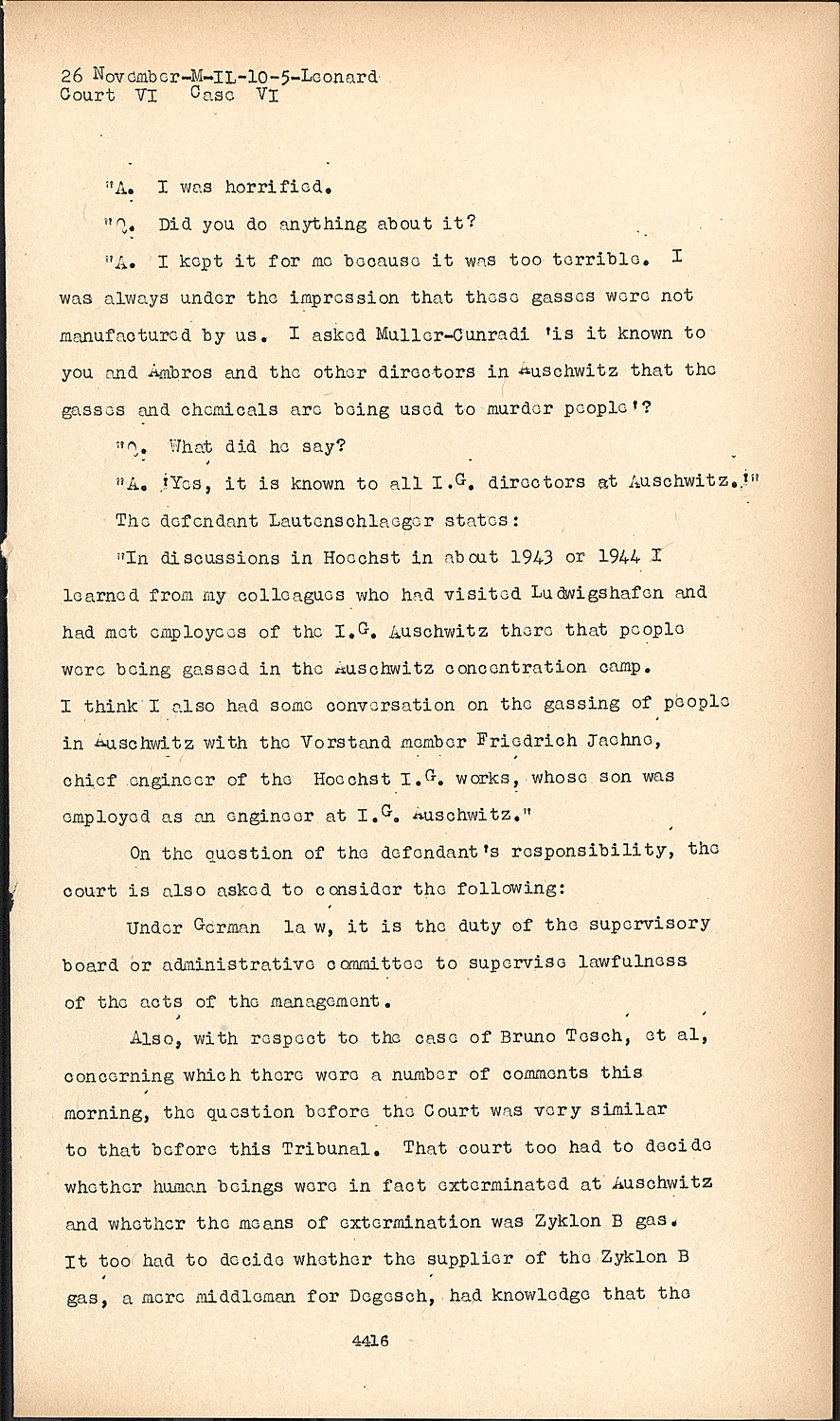
"A. I was horrified.
"Q. Did you do anything about it?
"A. I kept it for me because it was too terrible. I was always under the impression that these gasses were not manufactured by us. I asked Muller-Cunradi 'is it known to you and Ambros and the other directors in Auschwitz that the gasses and chemicals are being used to murder people'?
"Q. What did he say?
"A. Yes, it is known to all I.G. directors at Auschwitz.'" The defendant Lautenschlaeger states:
"In discussions in Hoechst in about 1943 or 1944 I learned from my colleagues who had visited Ludwigshafen and had met employees of the I.G. Auschwitz there that people were being gassed in the Auschwitz concentration camp. I think I also had some conversation on the gassing of people in Auschwitz with the Vorstand member Friedrich Ja*hn*, chief engineer of the Hoeehst I.G. works, whose son was employed as an engineer at I.G. Auschwitz."
On the question of the defendant's responsibility, the court is also asked to consider the following:
Under German la w, it is the duty of the supervisory board or administrative committee to supervise lawfulness of the acts of the management.
Also, with respect to the case of Bruno Tesch, et al, concerning which there were a number of comments this morning, the question before the Court was very similar to that before this Tribunal. That court too had to decide whether human beings were in fact exterminated at Auschwitz and whether the means of extermination was Zyklon B gas. It too had to decide whether the supplier of the Zyklon B gas, a mere middleman for Degesch, had knowledge that the gas was being used for the murder of innocent people.
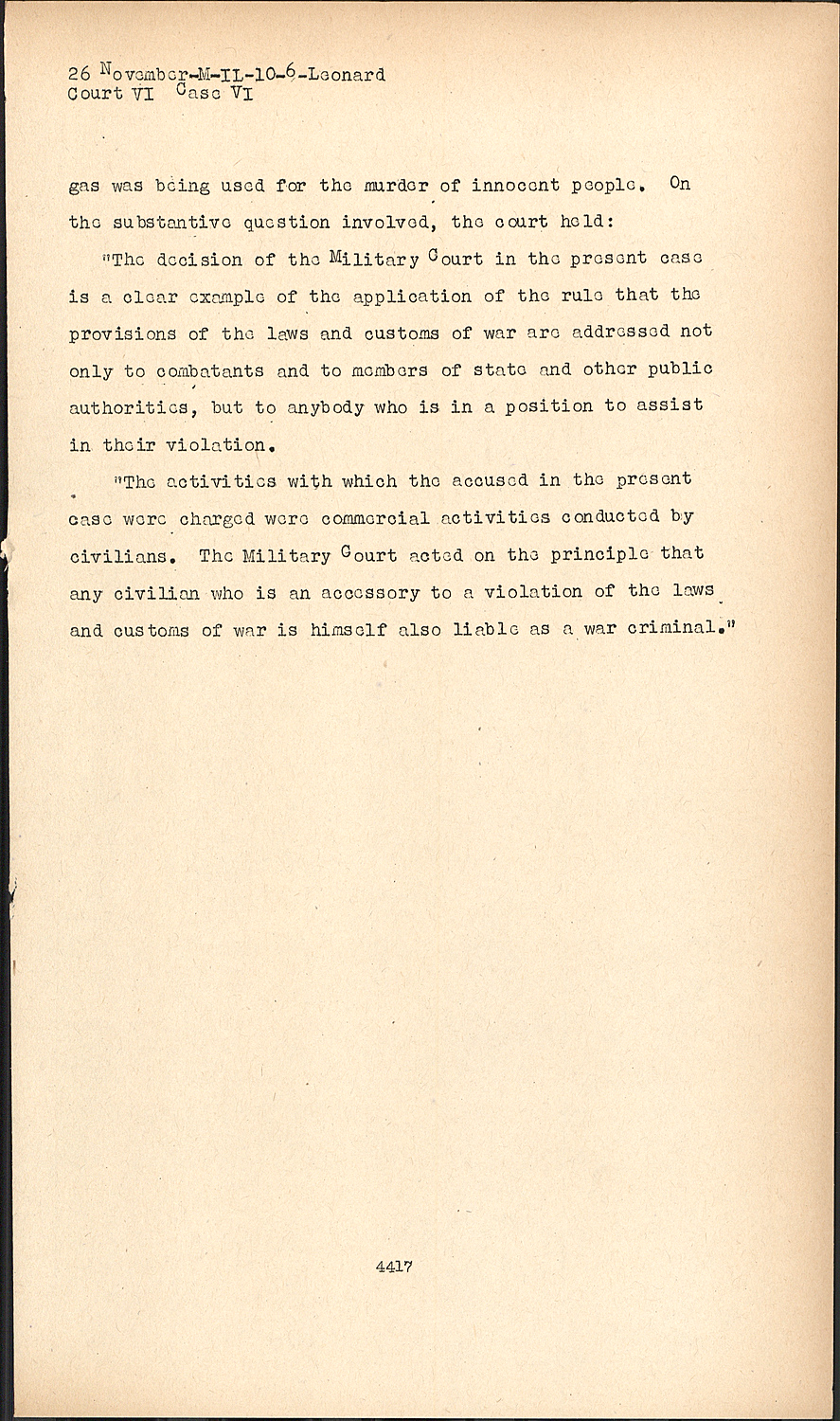
On the substantive question involved, the court held:
"The decision of the Military Court in the present case is a clear example of the application of the rule that the provisions of the laws and customs of war are addressed not only to combatants and to members of state and other public authorities, but to anybody who is in a position to assist in their violation.
"The activities with which the accused in the present case were charged were commercial activities conducted by civilians. The Military Court acted on the principle that any civilian who is an accessory to a violation of the laws and customs of war is himself also liable as a war criminal."