COURT VI CASE VI COMMISSION
A.In 1934, at the end of 1934, the plant at Aken got started. Before that there was only one plant, in Bitterfeld, a magnesium production plant.
Q.Now, could you tell me, or do you recall, how much was actually produced, how much magnesium was actually produced in Bitterfeld in the year 1932?
A.No, I do not remember the figure. I only remember that a very great depression occurred in the German industry and that for some time-it might have been a few months--we had to stop production in the magnesium plant because there was excess. But this was due to the fact that there was a general depression, as I said before, in every field, production was reduced not only in the field, but in every field of production. There was a depression at the time. But, the amount of magnesium that was produced I do not know any more now. You have to consider too that the entire magnesium--that is, the electro metal business--was only being built up. It was built up on the new process which we had started in 1928 to obtain magnesium and this process had to be started properly first. The process first made it possible for us to produce that kind of magnesium which we could sell on the market. The processes we had before could not do that so well. Owing to that, it took some time to get started and all this was necessary, and also, as I have said before, there was a depression in early 30's in Germany.
Q.I think you fixed the capacity prior to 1933 of the Bitterfeld Plant at 1,700 tons, and you stated that it was only in the middle or end of 1933 that the capacity of 3,500 tons was reached. Now, my question to you, Dr. Pistor, is, from the period 1928 to the beginning of 1933, could you tell me the highest amount in tonnage that Farben produced in the field of magnesium in any given year during these periods?
A.No, I cannot remember that any more.
Q.Can you give an approximate figure in relation to the capacity?
A.I estimate it must have been about 1,500 tons.
COURT VI CASE VI COMMISSION
Q.And that would be the highest?
A.It might have been 1,800. I do not know any more. I cannot say.
Q.And that would be the highest production for any given year of magnesium, from 1928 to the beginning of 1933; is that right?
A.Yes.
Dr. SCHUBERT: Mr. Commissioner, I must object to these questions. The witness stated he does not know any more, and the prosecution should be satisfied with that statement. It won't help at all to ask him any further about it, since he does not remember any more.
MR. AMCHAN:It is entirely permissible, as I understand the rules of evidence, to pursue the inquiry when he says he doesn't know, and ask him for his best approximation and if the witness can't give an approximation then of course he can so state. But if what defense counsel asserts here were to be the rule, then we would be foreclosed from pursuing an inquiry on every occasion where the witness says he doesn't remember.
THE COMMISSIONER:The objection and the reason will be noted in the record and if there is any further reason or any further objection, you can state them in the record. BY MR. AMCHAN:
Q.Now, you mentioned a moment ago, Dr. Pistor, that at some period prior to January 1, 1933 Farben had to stop its production of magnesium because it was overproducing. Did you so testify?
A.I said that for a few months, as far as I remember, we had to stop our production for that reason, but may I add here that before 1933 we had already introduced our new light metal, which was called electrometal successfully in all kinds of industries, everywhere where it was important to have light-weight metal, it was used in textile machine industry, in the optical industry, the telephone industry, the automobile industry, and of course also in the airplane industry, at home and abroad. We tried everything to introduce our new light metal. Introducing a new COURT VI CASE VI COMMISSION metal like this electro metal of course takes some time.
I am wiling to give the individual dates.
Q.Early in 1934, Farben constructed the Aken Plant to produce magnesium, and you state in your affidavit, and I am quoting, it is on page 5 of the English, "We knew that this plant was destined to contribute to the rebuilding of the German Wehrmacht, yet my colleagues and I did not find any fault with that." Now, my question to you, Dr. Pistor, is; who are the colleagues that you refer to in that sentence?
A.Those are mainly those colleagues who also worked in the field of magnesium with us. They were all the collaborators--Dr. Schmidt, Dr. Beck, Dr. Moschel--those were the colleagues who collaborated on the magnesium. This did not mean Dr. Buergin, who at that time did not work in the magnesium field.
Court No. VI, Case VI - COMMISSION Q.- Now, when you said, "We knew that this plant was destined to contribute to the rebuilding of the German Wehrmacht," do you include within the tern "we" the members of the Farben Vorstand?
A.- We gave information about the erection of the Aken plant to the members of the Vorstand who were concerned, in particular, Geheimrat Bosch.
Q.- And the capacity of the Aken plant was about 7,000 tons of magnesium?
A.- As far as I remember, yes.
Q.- Now, on the next page you say, and I am quoting: "As far as I remember the project for the erection of the Aken plant was submitted for approval in the usual way to the Vorstand of the I.G."
A.- Yes.
Q.- Did you submit to the I.G. the question of approval of the Aken plant?
A.- Dr. Buhl and Herr Weber together with myself negotiated with the government about the agreement , Dr. Buhl as commercial expert and Herr Weber as technical expert, and as far as I can recall they informed Geheimrat Bosch about the matter, and then in the usual manner informed the authorities of Farben; the TEO, for example; the technical commission.
Q.- When was the first time that incendiary bombs were stored from the magnesium at the Aken plant?
A.- I cannot tell you exactly when that was, but I assume that it was soon after Aken started production.
Q.- After the Aken plant Farben also constructed the Stassfurt plant for magnesium. Now do you recall the year?
A.- Yes, that must have been in 1935 and 1936. I am not quite certain any more.
Q.- And do you recall the purpose for which the Stassfurt plant was built by Farben?
Court No. VI, Case VI - COMMISSION A.- Of course, we assumed at that time that it had the same purpose as the Aken plant namely for production.
We had an agreement with the Reich to that, effect.
Q.- And was it also understood at the time that the Stassfurt plant was destined to contribute to the rebuilding of the German Wehrmacht?
A.- As far as I remember, it was the same, yes.
Q.- And do you recall whether or not you presented the matter to the Vorstand?
A.- I have no document concerning this: I assume it was done in the same manner as in the case of Aken.
Q.- Now, the plant Teutschenthal, was constructed in 1937 by Farben to produce magnesium, is that right?
A.- I believe it was 1936, but I am not quite certain, that this plant was built. I wrote here about the middle of 1935, if I remember correctly, but it might have been 1936.
Q.- All right, We will take your estimate. Is it a fair statement to say that the Teutschenthal plant was built by Farben for the same reason that it undertook the construction and operation of the Aken and Stassfurt plants. Is that a fair statement?
A.- I did not understand the first. "Is it a fair question --"?
May I ask that it be repeated, please?
Q.- Is it a fair statement to say that the purpose of Farben in undertaking the construction and operation of the Teutschenthal plant was exactly the same as in the case of the Aken and Stassfurt plants. Would that be a fair statement of the situation?
A.- In the Teutschenthal plant, the raw material was produced for the other plants.
Q.- The other two magnesium plants, is that right?
A.- Yes.
Court No. VI, Case VI - COMMISSION Q.- Now, Dr. Pistor, are you familiar with the Pyrite plants for the production of sulphuric acid?
A.- The gypsum plant? Do you mean?
Q.- The gypsum plant. Is that the plant produced by -
A.- Yes.
Q.- Now, you refer in your affidavit under Item 6, Miscellaneous, and I have page 18 of the English. You have subdivision C, reference to Gypsum sulphuric acid, you state that a plant was set up in the Farben factory in Wolfen, for the production of sulphuric acid from gypsum. Now do you recall when that plant was constructed?
A.- That must have been in 1935 or 1936, but it might have been 1937. Farben always produced a great amount of sulphuric acid, and a great amount of sulphuric acid was needed, in particular for artificial silk and vistra, and the production was increased because of the demand for sulphuric acid in the increasing manufacture of vistra. For obtaining pyrites from abroad we needed foreign currency. That is why we tried to use German pyrite. For example, pyrites which we obtained from soft coal, but since we could not get a sufficient amount of that raw material we had to start a different process which had been worked out in Leverkusen in the 1920's, and even before we erected the plant in Wolfen there were large plants which had been built in France and in England, as far as I know.
Dr. SCHUBERT: Mr. Commissioner, I just heard that the translation seems to be having considerable difficulty because the witness is talking rather fast and because the translation does not know the technical terms as well as those interpreters who were in this case all the time. May I ask you, therefore, witness, to talk more slowly so that the translation can do a better job?
WITNESS:I beg pardon. I shall try.
THE COMMISSIONER:Very well. The witness will talk slower.
Court No. VI, Case VI - COMMISSION A.- Yes.
About the gypsum, sulphuric acid, I want to say the following: Farben industry has produced a great amount of sulphuric acid for a long time. In the chemical industry sulphuric acid is the basic product for many other products, and so in Wolfen it was not produced only for dyestuffs and chemical plants, but sulphuric acid was needed also for the production of artificial silk and of the artificial silk thread, vistra, of which a great amount was made. The vistra fiber was developed through these years to a great extent, not only in Germany but all over the world, and, therefore, the demand for sulphuric acid was increased terrifically. The difficulty that existed was obtaining the raw material, that is, the sulphuric pyrites, most of which came from Spain. The Wolfen dye stuff factory therefore tried to replace the Spanish pyrites by German pyrites, and I remember very well that great efforts were made to produce pyrites from the soft coal mines which exist in Central Germany and are very numerous there. We installed large plants in Wolfen in order to clean the raw pyrites which was a by product of soft coal and to make it into a quality which dould be used for the production of sulphuric acid, but this did not alleviate the demand for raw material. The demand was too great.
COURT VI, CASE VI COMMISSIONER
Q.Mr. Witness, do you recall whether you discussed with Dr. Krauch's office the question of the construction of the gypsum plant for the production of sulphuric acid?
A.In which office, if I may ask you.
Q.Dr. Krauch's office of Raw Materials and Synthetics.
A.That may be, because Dr. Krauch was in charge of the office for the Four Year Plan.
Q.Do you recall whether you discussed with any officials of the German military agencies the need of concentrated sulphuric acid for the production of explosives?
A.Sulphuric acid, as I said before, is an important raw material for various purposes therefore it is probably that it was discussed with those authorities. I do not know any details about it unfortunately.
Q.No further questions, Your Honor, please.
REDIRECT EXAMINATION BY Dr. SCHUBERT:
Q.If it disturbs you, you can leave off the earphones, Dr. Pistor. You talked about the capacity of the Bitterfeld plant. Did I understand you correctly, Dr. Pistor, when you said that when the construction took place in the year 1928, they expected an increase of the capacity up to 3,500?
A.Yes, you understood me correctly, because right from the beginning the factory was so constructed that an increase of production up to 3,500 tons could be possible.
Q.And in the year 1933 you achieved that?
A.As far as I can remember in the year 1933 it was achieved.
Q.You further stated, Dr. Pistor, -- I am just told that the translation said the year 1934 instead of 1933. You just mentioned the year 1933, did you not?
A.Yes, 1933, I believe so, but I am not quite certain.
Q.I now wanted to ask you -- I think you mentioned that the difficulties at the beginning to produce magnesium based on the new process of COURT VI, CASE VI COMMISSIONER production which was started in 1928, that about the year 1933 and 1934 these difficulties had been overcome.
Did I understand you correctly there?
A.Well, I don't know which difficulties you are referring to at the beginning.
Q.Let us clarify this. In 1928 you started a new process?
A.Yes.
Q.This process had to be tried out?
A.Yes.
Q.And therefore you were not able to produce the full capacity right at the beginning?
A.Right.
Q.Do I understand you correctly that about the year 1933, this process proved itself and it could be used?
A.Yes, in 1933 production could start on a full capacity, but even before that it went fairly well.
Q.And you further said --.
A.May I add something to that? It is not only the process of production which has to be considered here, but also the method of manufacture, that is making the magnesium into various metals which can be used in practice. The continuing development becomes more complete, and owing to this development the production can be consistently expanded.
Q.You also said, Dr. Pistor, that before 1933 you took a particular interest in the introduction of magnesium for certain fields of production?
A.Yes, that is right.
Q.Is it correct, then, if I assume that about the year 1933, in as far as the technical part is concerned, and also in as far as consumption is concerned, now the time had come for a greater production?
A.In the year 1933 the electro-metal was known in industry and COURT VI, CASE VI COMMISSIONER it could be used for all kinds of things.
People had come to know it. Also, previously, even for many years before that, electro-metal had been used in all kinds of industry, as I mentioned briefly before; in the textile industry, in the photo industry, in the telephone industry, in the sewing machine industry, in the typewriter industry, in the automobile industry, and also in the aeroplane industry, electro-metal had become known. In spite of very great competition, even in the aeroplane industry, the electro-metal had already found its place. For example, in the year 1927 --.
Q.May I interrupt, Dr. Pistor? Let us not go into too much detail here. May I return to my question again. Is it correct that approximately about 1933 -- I do not want to fix it at 1933 -- it might have been 1932, that about that time, owing to your preliminary work in the business and in the technical field, not only thanks to you but also thanks to your collaborators, that now the preliminary work had gone so far that one could start a larger capacity production now successfully?
A.Yes, that is quite correct.
Q.We discussed storage of incendiary bombs here. In Aken or Stassfurt or Bitterfeld were any incendiary bombs stored?
A.Never.
Q.What was stored there?
A.Pipes and pipe sections were stored.
Q.Can you tell us anything about the size of the stores?
A.No, I am afraid I can not.
Q.The plants of Aken, Stassfurt and Teutschenthal were discussed and it was mentioned that the products of those plants served the re-armament of the German Army. Do you know, Dr. Pistor, that the products of these plants were not only sent to those plants who produced war materials, but also went to other plants for civilian use?
A.Yes, this was done to a large extent.
Q.The products of these three plants did not go exclusively to re COURT VI, CASE VI COMMISSIONER armament?
A.No.
Q.I would like to clarify the matter concerning Teutschenthal again. Can one compare Teutschenthal to Stassfurt and Aken, or is there a difference?
A.You mean concerning the size?
Q.No, I mean production.
A.Teutschenthal supplied raw material. Teutschenthal was wellsituated to bring in the raw material. It was close to a Kali-plant, and we used the by-products from the kali-plant.
Q.They did not supply any magnesium then?
A.No.
COURT VI, CASE VI COMMISSIONER
Q.Dr. Pistor, could you tell me very briefly whether, when planning and building these new plants, Dr. Buergin played any part or had any great influence?
A.No, Dr. Buergin did not play any part.
Q.Concerning conditions in the year 1933, I would like to discuss that again. Is it justified, Dr. Pistor, to say that at that time the magnesium production, according to the standard which had been achieved through technical and commercial work, would have increased even without rearmament because of a general boom?
A.We worked for that for many years, and we were justified in hoping that it would become like that, and we are convinced that it would have happened that way.
Q.You also increased production of gypsum sulphuric acid. Do you know whether this gypsum sulphuric acid was also used for explosives?
A.I cannot say. Sulphuric acid is used for all kinds of things in chemistry.
Q.But I mean the gypsum sulphuric acid in particular.
A.This has nothing to do with it--whether the sulphuric acid has been produced from pyrites or from gypsum. It does not make any difference from what the sulphuric acid is produced.
Q.Do you know whether petroleum was made from the gypsum sulphuric acid?
A.Oleum might have been produced from gypsum sulphuric acid, just as it might have been produced from any other sulphuric acid.
Q.I have no further questions.
Mr. AMCHAN: I think the record should contain a correction that the translation was stated "petroleum." Actually it should read "oleum," which, I understand, is concentrated or fulminated sulphuric acid. Is that correct (TO DEFENSE COUNSEL)?
The Defense informs me that they agree that oleum is highly concentrated sulphuric acid, and the reference of counsel and the witness at COURT VI, CASE VI COMMISSIONER all times applies to this oleum and not to petroleum.
I have just a few brief questions of the witness.
THE COMMISSIONER:Proceed.
RECROSS-EXAMINATION BY Mr. AMCHAN:
Q.Mr. Witness, who was the manager of the Bitterfeld magnesium plant--say from 1933 to 1936?
A.The manager of the actual plant of the Bitterfeld plant, was Dr. Schoppe as far as I remember.
Q.And what position did the Defendant Buergin have in the Bitterfeld magnesium plant? And please fix the time.
A.As far as I can remember, from 1936 onwards Dr. Buergin was in charge of the inorganic plants of the Betriebsgemeinschaft works combine, Central Germany, to which also belonged the magnesium plant; but there were many other plants there as well.
Q.All right. Now, with respect to the Aken plant, who was the manager in charge of that plant--say from 1934 onwards?
A.I can't think of the name just now.
Q.Can you tell me the-
A.The plants in Bitterfeld and in Aken were all under the charge of Dr. Moschel. The plant in Bitterfeld, as I said before, was under Dr. Schoppe; and the plant in Aken--unfortunately I can't remember the name just now.
Q.For purposes of Farben management, was the Aken plant under the jurisdiction of Bitterfeld?
A.The Aken plant belonged to the administration of the works combine, Central Germany, the same way as the plant South belonged to it, the plants Bitterfeld, North, Wolfen, and Rheinfelden belonged to it.
Q.Well, would this be a correct statement of the facts--that for the purposes of Farben's internal management, the Aken plant, the Stassfurt plant, and the Teutschenthal plant were under the jurisdiction of COURT VI, CASE VI COMMISSIONER Bitterfeld for internal administrative purposes?
Is that right?
A.All these were plants, like the plant South and the plant North, and the plant Wolfen and the plant Aken; they were under the general supervision of the management of the works combine, Central Germany. The plants producing magnesium had a special manager, but this was not Dr. Buergin; but it was Dr. Moschel.
Q.No further questions.
THE COMMISSIONER:If there are no further questions by the Defense, then the Commission will be in recess until 10 o'clock tomorrow.
(THE COMMISSION RECESSED AT 1440, TO RESUME SESSION AT 1000, 21 APRIL 1948) Official transcript of Military Tribunal VI in the matter of the United States of America against Karl Krauch, et al.
, defendants, sitting at Nurenberg, Germany, on 20 April 1948, 0900 to 1645 hours.
Justice Curtis G. Shake presiding.
THE MARSHAL:The Honorable, the Judges of Military Tribunal VI.
Military Tribunal VI is now in session. God save the United States of America and this Honorable Tribunal.
There will be order in the Court.
THE PRESIDENT:You may make your report, Mr. Marshal.
THE MARSHAL:May it please your Honors, all the defendants are present except the Defendants Lautenschlaeger, Haefliger, Gajewski, Oster and von Knieriem, absent due to illness. The defendant Ilgner, absence excused.
THE PRESIDENT:I should like to make one ruling on behalf of the Tribunal, and that is with respect to the oral motion made on the record a few days ago by Dr. Dix on behalf of Defense Counsel. The substance of the motion was that the Tribunal should revise the orders appointing Commissioners, so as to vest the Commissioners with the power in the first instance, to rule upon the admissibility of evidence subject, however, to ultimate review by the Tribunal.
The Tribunal has considered that matter, and, in the light of the circumstance that we are approaching the end of the evidence in this case, has come to the conclusion that it would not be wise to disturb the existing practice. May I point out to you the problem that would arise if the Tribunal should conclude, in a particular instance, that the Commissioner had erred in excluding some testimony that had been offered by one of the parties. Under such circumstances, the witness might not be longer available, or the situation might arise so near the end of the trial, so as to make it impractical to bring the witness back to answer the question that had been excluded by the Commissioner and that the Tribunal had concluded it was proper. In addition to that, Counsel will recall that when the matter of appointing a Commissioner was first approached, there was some question raised as to the propriety of the Tribunal delegating judicial authority to an administrative officer.
In the light of that objection, which we thing has some fundamental merit, we believe that it would be better to continue the practice of permitting Counsel to make their objections on the record, in the Commissioner's hearing, and let the evidence be put on the record and then the Tribunal will review the question upon request. In that way, if the question is deemed to have been improper, the answer will go out and be stricken. If the Question is deemed to have been proper, the answer will be in the record and it will not be necessary to face the situation of finding and bringing back the witness at some considerable inconvenience and expense for everybody concerned, and for a very snail matter, perhaps.
So, the motion made by Dr. Dix'is now over-ruled. May I say, in the same connection, that if Counsel for the Prosecution and the Defense will simply had one of us a memorandum from time to time, citing the English page of the transcript where evidence has been offered, to which there were objections, we will undertake to rule on those before we approach the end of the evidence. That need not be and should not be in the form of a formal motion. We do not care to burden the Defense center with that trouble. Just give us an informal, unsigned note or memorandum, calling our attention to the page on the English transcript where there was an objection that the interested parties would like to have the Tribunal pass upon. We shall take those, and from time to time, indicate our ruling; and dispose of those matters. Are there any other announcements from Defense Counsel before we proceed?
Dr. NELTE (For Professor Horlein): Mr. President, I ask that Professor Horlein be excused from 10:00 o'clock on this morning to participate in the examination of the witness Grobel before the Commissioner
THE PRESIDENT:That request is granted.
Dr. ROSPATT: Mr. President, I ask that the Defendant Kugler be excused from this afternoon's session in order to prepare himself for his defense.
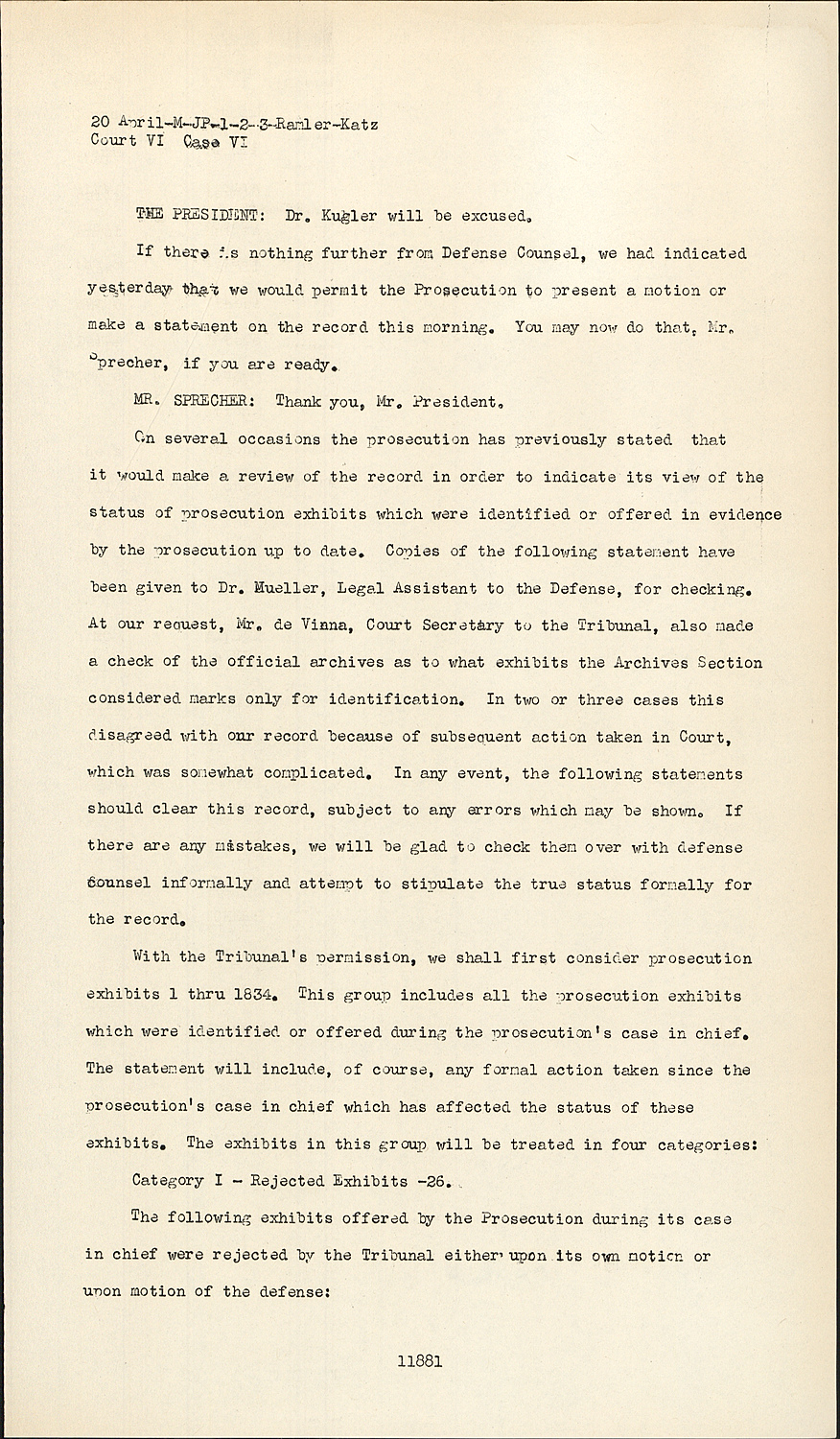
THE PRESIDENT:Dr. Kugler will be excused.
If there as nothing further from Defense Counsel, we had indicated yesterday that we would permit the Prosecution to present a motion or make a statement on the record this morning. You may now do that, Mr. Sprecher, if you are ready.
Mr. SPRECHER: Thank you, Mr. President.
On several occasions the prosecution has previously stated that it would make a review; of the record in order to indicate its view of the status of prosecution exhibits which were identified or offered in evidence by the prosecution up to date. Copies of the following statement have been given to Dr. Mueller, Legal Assistant to the Defense, for checking. At our request, Mr. de Vinna, Court Secretary to the Tribunal, also made a check of the official archives as to what exhibits the Archives Section considered marks only for identification. In two or three cases this disagreed with our record because of subsequent action taken in Court, which was somewhat complicated. In any event, the following statements should clear this record, subject to any errors which may be shown. If there are any mistakes, we will be glad to check then over with defense Counsel informally and attempt to stipulate the true status formally for the record.
With the Tribunal's permission, we shall first consider prosecution exhibits 1 thru 1834. This group includes all the prosecution exhibits which were identified or offered during the prosecution's case in chief. The statement will include, of course, any formal action taken since the prosecution's case in chief which has affected the status of these exhibits. The exhibits in this group will be treated in four categories:
Category I - Rejected Exhibits -26.
The following exhibits offered by the Prosecution during its case in chief were rejected by the Tribunal either upon its own motion or upon motion of the defense:
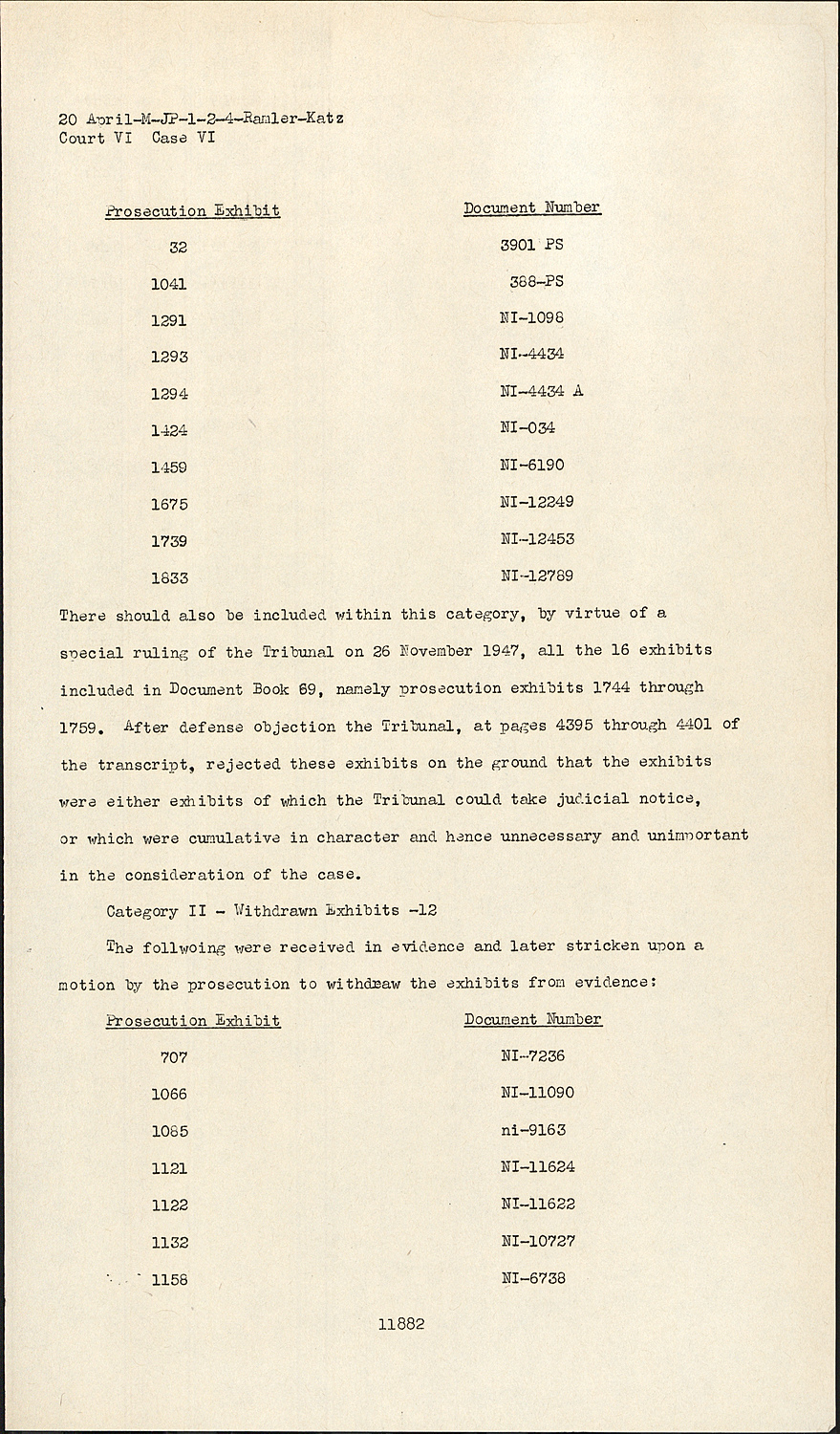
Prosecution Exhibit Document Number 32 3901 PS 1041 388-PS 1291 NI-1098 1293 NI-4434 1294 NI-4434 A 1424 NI-034 1459 NI-6190 1675 NI-12249 1739 NI-12453 1833 NI-12789There should also be included within this category, by virtue of a special ruling of the Tribunal on 26 November 1947, all the 16 exhibits included in Document Book 69, namely prosecution exhibits 1744 through 1759.
After defense objection the Tribunal, at pages 4395 through 4401 of the transcript, rejected these exhibits on the ground that the exhibits were either exhibits of which the Tribunal could take judicial notice, or which were cumulative in character and hence unnecessary and unimportant in the consideration of the case.
Category II - Withdrawn Exhibits -12 The following were received in evidence and later stricken upon a motion by the prosecution to withdraw the exhibits from evidence:
Prosecution Exhibit Document Number ------------------- --------------707 NI-7236 1066 NI-11090 1085 ni-9163 1121 NI-11624 1122 NI-11622 1132 NI-10727 1158 NI-6738 1162 NI-6739 1348 NI-9372 1349 NI-11410 1454 NI-9818 1763 NI-11710 Category III - Exhibits marked for identification only - 6.The following six exhibits were identified only.
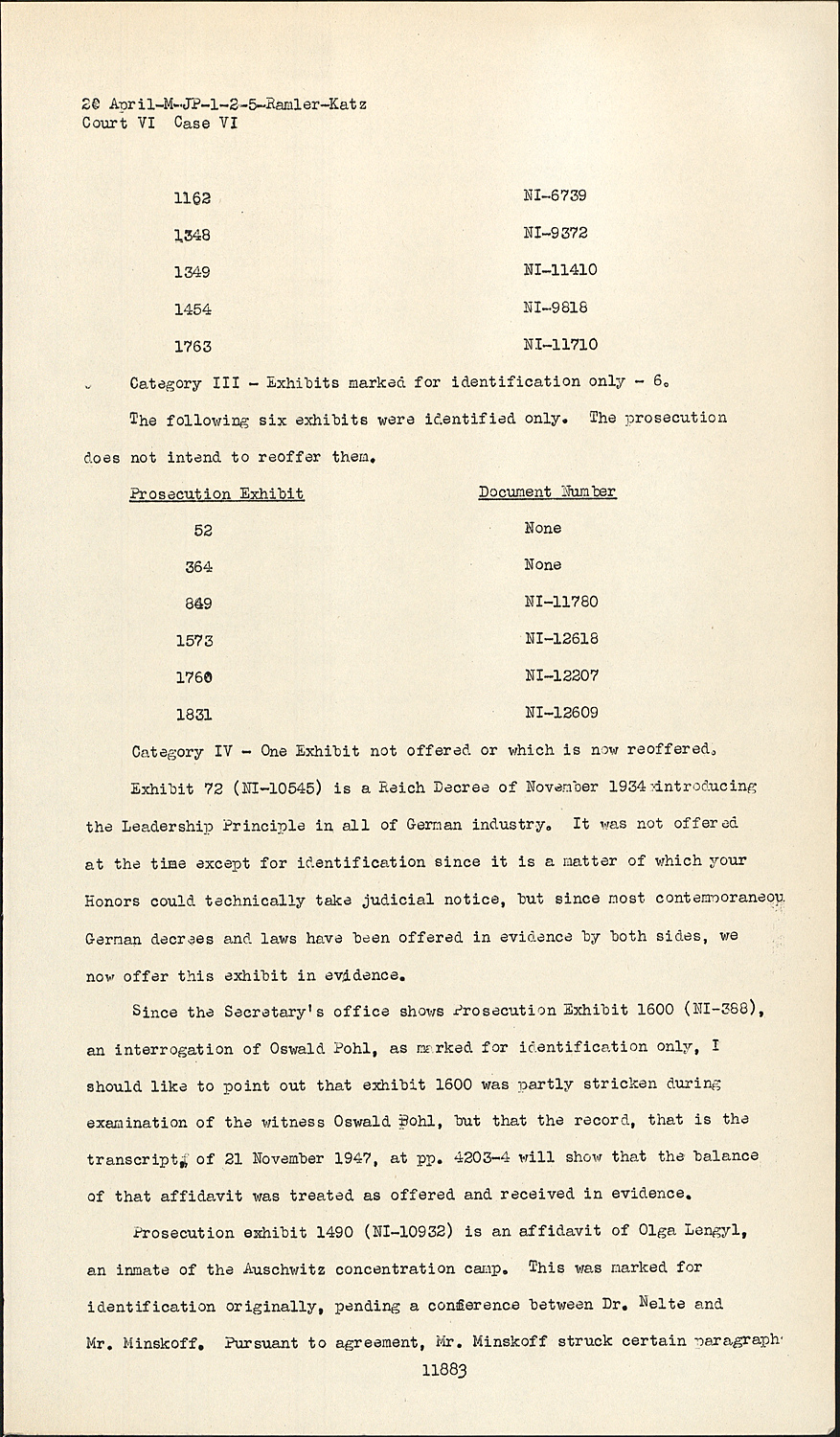
The prosecution does not intend to reoffer them.
Prosecution Exhibit Document Number 52 None 364 None 849 NI-11780 1573 NI-12618 1760 NI-12207 1831 NI-12609 Category IV - One Exhibit not offered or which is now reoffered.
Exhibit 72 (NI-10545) is a Reich Decree of November 1934 Introducing the Leadership Principle in all of German industry. It was not offered at the time except for identification since it is a matter of which your Honors could technically take judicial notice, but since most contemooraneou German decrees and laws have been offered in evidence by both sides, we now offer this exhibit in evidence.
Since the Secretary's office shows Prosecution Exhibit 1600 (NI-388), an interrogation of Oswald Pohl, as marked for identification only, I should like to point out that exhibit 1600 was partly stricken during examination of the witness Oswald Pohl, but that the record, that is the transcript, of 21 November 1947, at pp. 4203-4 will show that the balance of that affidavit was treated as offered and received in evidence.
Prosecution exhibit 1490 (NI-10933) is an affidavit of Olga Lengyl, an inmate of the Auschwitz concentration camp. This was marked for identification originally, pending a conference between Dr. Nelte and Mr. Minskoff. Pursuant to agreement, Mr. Minskoff struck certain paragraph from the affidavit, and the balance of the affidavit was to be considered in evidence.
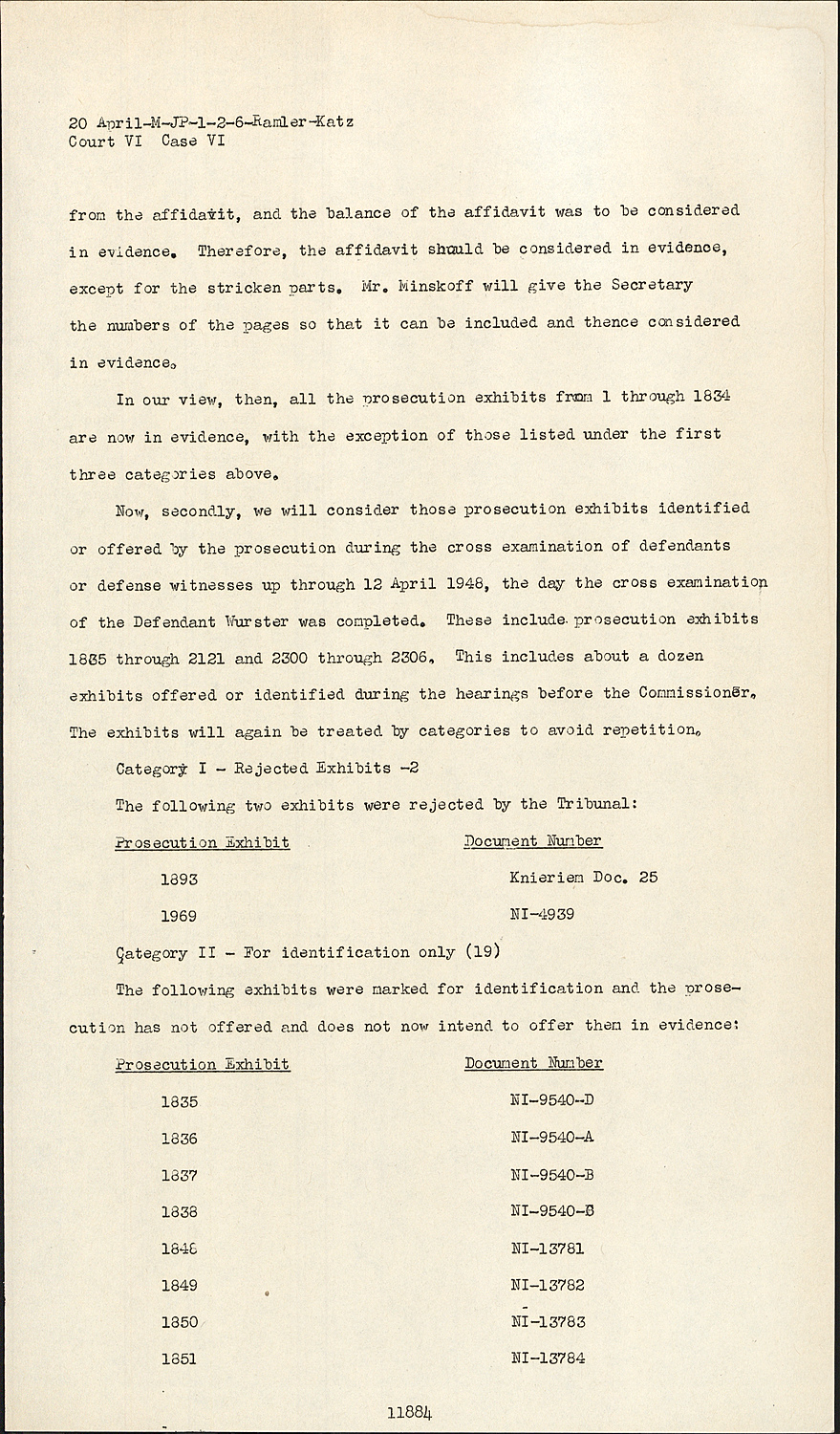
Therefore, the affidavit should be considered in evidence, except for the stricken parts. Mr. Minskoff will give the Secretary the numbers of the pages so that it can be included and thence considered in evidence.
In our view, then, all the prosecution exhibits from 1 through 1834 are now in evidence, with the exception of those listed under the first three categories above.
Now, secondly, we will consider those prosecution exhibits identified or offered by the prosecution during the cross examination of defendants or defense witnesses up through 12 April 1948, the day the cross examination of the Defendant Wurster was completed. These include prosecution exhibits 1865 through 2121 and 2300 through 2306. This includes about a dozen exhibits offered or identified during the hearings before the Commissioner. The exhibits will again be treated by categories to avoid repetition.
Category I - Rejected Exhibits -2 The following two exhibits were rejected by the Tribunal:
Prosecution Exhibit Document Number 1393 Knieriem Doc.
25 1969 NI-4939 Category II - For identification only (19) The following exhibits were marked for identification and the prosecution has not offered and does not now intend to offer then in evidence:
Prosecution Exhibit Document Number 1835 NI-9540-D 1836 NI-9540-A 1837 NI-9540-B 1838 NI-9540-C 1848 NI-13781 1849 NI-13782 1850 NI-13783 1851 NI-13784 Prosecution Exhibit Document Number ------------------- --------------1890 NI-14282 1898 NI-10168 1921 NI-14247 1924 NI-14248 1932 NI-14487 2025 NI-14677 2034 NI-14676 2040 NI-6544-A 2041 NI-6699-A 2042 NI-6702-A 2043 NI-6348-A Category III Prosecution exhibit 2118, identified during cross examination of the Defendant Warster, remains for identification only pending a possible reoffer upon our submission of a more detailed certificate of origin.