But this venture was not without its risks. There had been angry outbursts in the Reichstag and in the press over the price which the Reich had paid for the shares. In short, as the Nazi push toward the seizure of power and dictatorship neared its climax, Flick was a man who needed political support.
THE FLICK COMBINE UNDER THE THIRD REICH (1932-1945) The world-wide business depression precipitated an ever-deepening crisis in German heavy industry from 1930 through 1932 , which coincided with the rise to national prominence of Hitler and the Nazi party.
Much has been written about the early relations between Hitler and the German industrialists; much remains to be learned. But it is clear from what has been written and from documents which will be offered, that Hitler's two principal sponsors and financial supporters in heavy industry were Fritz Thyssen, the dominant figure in the Stahlverein, and Emil Kirdorf, who had been head of the largest German coal syndicate and of the Gelsenkirchencer Bergwerke.
Another early supporter of Hitler was the leading private banker of the Ruhr, Baron Kurt von Schroeder of Cologne.
A.The Flick Konzern and the Birth of the Third Reich. Many of the earliest contacts between the Flick Konzern and the Nazi leaders were handled by the second man in the dock. The defendant Steinbrinck, five years younger than Flick, was a regular officer in the German Navy from 1907 to 1919, and commanded a submarine during the first World War. ------------------------------------------------------------
1 Germany's production of crude steel sank from 16,246,000 metric tons in 1929 to 5,770,000 in 1932 After the war he was employed by the association of Iron and Steel Industrialists, he, not Flick, and in 1923 Flick gave him a position with Linke-Hofmann-Lauchhammer.
In 1925 he entered Flick's private secretariat, and by 1930 he was Flick's principal associate in the management of the Flick Konzern. He joined the Nazi party on 1 May, 1933, and four weeks later he became a Standartenfuehrer (the equivalent of a Colonel) in the SS.
By reason of their extensive interests in the Ruhr and the Stahlverein, both Flick and Steinbrinck were well acquainted with Thyssen and Schroeder. In addition, Steinbrinck became acquainted, in 1930 or shortly thereafter, with leading Nazis such as Walter Funk, Robert Ley, and Wilhelm Koppler, who at that time was Hitler's closest advisor on economic matters.
Toward the end of 1931, Thyssen, Kirdorf and others arranged a series of meetings between Hitler and the leading Ruhr industrialists, in order to give Hitler an opportunity to expound his views and win converts. Hitler, for his part, was just as anxious to gain for the Nazi party the political and financial support of heavy industry. For political historians, there can be nothing of more compelling interest than those early meetings between the stiff, arrogant iron lords and the demoniac Fuehrer-to-be, and we will have occasion to look at them more closely later on. Far apart as they were in social background and cultural heritage, Hitler and the Ruhr leaders found solid common ground in mutual contempt for democracy and admiration of ruthless, authoritarian, power-politics. At a meeting on January 27, 1932 in Dusseldorf, attended by Thyssen and Voegler of the Stahlverein and a large group of other Ruhr industrialists, Hitler delivered one of his shrewdest and most persuasive speeches, which, according to Thyssen:
".... made a deep impression on the assembled industrialists, and in consequence of this, a number of large contributions flowed from the resources of heavy industry."
Whether of not Flick attended any of those early meetings, it is certain that he know, both from Steinbrinck and from his own close association with Thyssen, Voegler, and others, the general nature of Hitler's bid for industralist support. In February, 1932, Flick had a long private meeting with Hitler. A few months later, in the spring of 1932, confronted with the storm of public criticism awakened by the sale of Gelsenkirchener shares to the Reich, Flick obtained Hitler's blessing on the transaction. This brought Flick andSteinbrinck into direct contact with Hermann Goering. The defendant Flick Burkart described this episode in a letter written in 1940 from which I quote:
"With respect to the sale of the Stahlverein majority shares, Herr Flick has asked me to inform you officially as follows:
The sale of the majority of shares in the Stahl verein was personally examined and sanctioned at the time - in the year 1932 - by the present Reichs marshall" - (that being Goering) - "in conferences at the Bellevuestrasse which lasted several days.
The Reichsmarshall further personally reported the trans action relating to the majority shares of the Stanl verein to the Fuehrer, with the result that the Fuehrer also recognized this transactions necessary and explicitly approved it."
Later in 1932, a basis was laid for permanent and systematic collaboration between Flick and the Nazi leaders. Hitler had asked his personal economic advisor, Koppler, to collect a small group of economic leaders "who will be at our disposal when we come into power". Keppler and Schacht approached Flick, Voegler, and others. The result was the formation of what was then called the "Keppler 1 Fritz Thyssen, I Paid Hitler, (1941), p. 101.
circle", which began to hold meetings to discuss the program of the Nazi party in the economic field. Steinbrinck was a member of the group from the outset, together with Baron von Schroeder, Keppler, Schacht(until 1934), and an assortment of other leading industrialists and financiers. Foreshadowing later and more sinister events, Flick came into contact with Himmler at about this time, and contributions to the funds of the SS were made by Flick and others. The SS was a very samll organization before the seizure of power and for several years thereafter, and these donations constituted a very important source of support.
Toward, the end of 1932, Hitler started to lose ground. In the November election, the Nazis dropped 34 seats in the Reichstag as a result of a decline of 2,000,000 in the Nazi vote. The party was in a critical condition and badly in need of money; in December Joseph Goebbels noted in his diary that "financial troubles makecall organized work impossible" and "the danger now exists of the whole party going to pieces and all of our work having been in vain." But, as a result of the intervention of Baron von Schroeder, Hitler and Papen made a temparary alliance, and Papen succeeded in persuading Hindenburg, on 30 January, 1933, to replace the Schleicher government by a coalition cabinet with Hitler as chanceller and Papen as viceChancellor.
Hitler's now seat of power was shaky enough. He was immediately confronted with an impending Reichstag election which could make or break him, and the Nazi party lacked funds for this crucial test. On 20 February, 1933, Goering assembled a large and representative group of industrialists and bankers at his Berlin home. Flick was present, as were Gustav Krupp von Bohlen and other Ruhr magnates. Among other things, Hitler told them:
Private enterprise cannot be maintained in the age of democracy; it is conceivable only if the people have a sound idea of authority and personality.
Every thing positive, good and valuable, which has been ach ieved in the world in the field of economics and cul ture, is solely attributable to personality.
When, however, the defense of the existing order and its political administration is left to the majority, it will irretrievably go under.
..........
I recognized,......that one had to search for new ideas conducive to reconstruction.
I found them in Nationalism, in the value of personality, in the den ial of reconciliation between nations, in the strength and power of individual personality.
.....
Now we stand before the last election. Regardless of the outcome, there will be no retreat, even if the coming election does not bring about a decision.
One way or another, if the election does not decide, the decision must be brought about even by other means.
....
For economy, I have the one wish that it go parallel with the internal structure to meet a calm future.
The question of restoration of the Wehrmacht will not be decided at Geneva, but in Germany, when we have gained internal strength through internal peace.
.......
There are only two possibilities, either to crowd back the opponent constitutional grounds, and for this purpose once more this election, or a struggle will be conducted with other weapons, which may demand greater sacrifices.
When Hitler had finished, Goering made a short statement, in the course of which, according to Krupp, he "led over very-cleverly to the necessity that other circles not taking part in this political battle should at least make the financial sacrifices so necessary at this time." Goering blandly reassured the assembly that:
"The sacrifices asked for surely would be so much ca ier for industry to bear if it realised that the elec tion of March 5th will surely be the last one for the next ten years, probably even for the next hundred years."
The leaders of German industry were, in these words, promised that, if Hitler prevailed in the election, democracy would give way to dietatorship. They responded generously to this moving appeal by furnishing at least three million Reichsmarks, of which 240,000 Reichsmarks were contributed by Flick's Mitteldeutsche Stahlwerke. Seven days later, the constitutional guarantees of freedom were suspended, and in the March elections Hitler won 44% of the total votes which, together with the Hugenberg Vote, gave Hitler a majority in the Reichstag. Never has a political contribution had such far-reaching and devastating consequences.
After the Third Reich dictatorship was solidly established, Flick appears to have had little direct contact with Hitler himself. But his relations with Hermann Goering and Heinrich Himmler endured. Goering he dealt with chiefly to achieve the expansion of the Flick Konzern, and in connection with the re-organization of German industrial controls for rearmament and, later, for war. His close connections with Himmler developed out of the Keppler circle.
Keppler's influence with Hitler declined as time went on, and after 1934, Himmler replaced him as the central figure in the Circle. Indeed, the group was seen known as "the Circle of Himmler friends." At about the time of this transition, Flick himself began to participate in the meetings. The group started to make financial contributions to Himmler's private funds, aggregating about a million Reichsmarks per year. Flick's regular contribution was 100,000 Reichsmarks per year. We will return for a closer look at the Himmler Circle and its activities in our discussion of Count 4 of the indictment.
B. Further Expansion of the Flick Konzern Having cemented his credit and standing with the Hitler dictatorship, Flick turned again to the aggrandizement of his own enterprises.
His immediate objectives were a better supply of bituminous coal to feed Maxhuette, and of brown coal and pig iron for Mittelstahl.
The bituminous coal was taken care of first. In 1933, and 1934, Flick succeeded in acquiring a 40% stock interest in the Harpener Bergbau A.G., the third largest group of coal mines in the Ruhr, with a stock capital of 90,000,000 Reichsmarks. In 1935, Flick persuaded the directors of Harpener to convert 30,000,000 shares into nonvoting debentures, which reduced the voting stock capitalization to 60,000,000 Reichsmarks. Flick thereupon sold the non-voting debentures which he received in this conversion, and bought voting stock in Harpener with the proceeds, thus acquiring majority central. In 1936, Flick acquired control (through Harpener) of another large bituminous coal concern in the Ruhr, the Essener Steinkohlenbergwerke.
Afther these purchases, the Flick Konzern resources of bituminous coal aggregated some fifteen million tons per year --- far more than the needs of Maxhuette --- as compared with less than a million tons in 1932.
The Flick acquisitions of brown coal and blast furnaces to supply pig iron to Mittelstahl will be described in detail under Count Three of the indictment. Coal fields and blast furnaces alike were acquired by Flick from Jews and were obtained by taking full advantage of the so-called "aryanization" policies and laws of the Third Reich.
The blast furnaces of the Hochefenwork-Luebeck were located on the Baltic Sea at Luebeck and Stettin. Iron ore from Sweden was brought by low-cost sea transport to these ports, and the pig iron produced by the blast furnaces was shipped on the plants of Mittelstahl near Berlin and Dresden. Hochefenwork-Luebeck was "aryanized" by Flick in 1938.
The acquisition of the blast furnaces opened, wide Flick's eyes to the interesting and profitable possibilities of "arynization" Very extensive brown coal properties --- estimated by Flick at 20% of the total tonnage of all kinds of coal mined in Germany --- were owned by a large family of Jewish citizens of Czechoslovakia, known as the Petscheks. Part of these fields were controlled by a group headed by Julius Petschek; the large portion was controlled by the Ignatz Petschek group.
In January, 1938, Flick procured from Hermann Goering exclusive authority to negotiate with the Julius Petschek interests, and he commenced negotiations with certain American and English representatives of the group which resulted in a sale in May, 1938, on terms very favorable to Flick. The Ignatz group proved much more intransigent, but their bargaining position, if any, was quite hopeless after Germany occupied the Sudetenland, where the Ignatz group main tained its principal offices.
The acquisation was finally completed in December, 1939, after an intersting but intricate interchange of properties with the Hermann Goering Works which will be developed later.
Flick's last large acquisitions within Germany were made in 1939. In addition to the Ignatz Petschek brown coal fields, in that year the Konzern purchased a 50% interest(the other half being owned by the State of Saxony) in the Saechsisiche Gusstahlwerke Dochlen, a high-quality steel concern situated at Frertal, near Dresden in Saxony. This addition increased Flick's annual crude steel output to about 2,150,000 tons per year, equal to or slightly greater than the output of Krupp.
In speech at a testimonial dinner in April, 1940, Flick told his assembled associates and colleagues: 1 "Now it has gone for enough, and we shall call a halt.
The era of expansion is finished."
But with the triumphant march of the Wehrmacht and the extansion of German hegemony over most of the continent of Europe, these conservative sentiments were soon forgotten. Within a few weeks after Flick so expressed himself, the collapse of France was so imminent, and the rich iron resources of Lorraine were as much of a magnet to Flick as to his fellow steel kings. Three days after the German army entered Paris, Flick was already discussing the general schedule of allocations that were being made by the Reich, in accordance with pro-arranged agreements with the great German industrialists, in respect to the coal, iron and steel properties to be seized in France. Shortly thereafter, valuable properties of the Societe Lorraine des Acieries de Rembas were allocated to Flick, and were subsequently administered by a newly-established company, jointly owned by Maxhuette and Harpener Bergbau. A year or more -----------------------------------1 Speech by Friedrich Flick on the 25th anniversary of his appointment to the Vorstand of Charlottenhuette, 1 April, 1940 later, as the tide of war swept over Russia, Flick began to busy himself with acquiring so-called "trusteeships" of various industrial and mining enterprises in the areas occupied by the Wehrmacht.
A plant in Riga which manufactured railway cars and equipment was allocated to him after strenuous negotiations on the part of his nephew, the defendant Weiss. In the industrial bend of the Dnieper River, Flick joined with the Hermann Goering Steel Works in the "trusteeship" of large mining and smelting properties. These industrial spoliations in France and the Soviet Union will be more discussed under Count Two of the indictment.
C.Structure and Organization of the Flick Konzern (1945) Having traced its history, we may now examine the Flick Konzern in the form in which it existed at the end of the war, as shown in the chart displayed on the wall of the court room.
Flick's control of the Konzern was vested in a holding company called the Friedrich Flick Kommanditgesellschaft, shown at the top of the chart. In addition to being a holding company for the stocks of most of the companies comprising the Konzern, the Friedrich Flick Kommanditgesellschaft itself owned and operated large steel plants at Brandenburg and Hennigsdorf near Berlin, which were formerly part of the Mitteldeutsche Stahlwerke.
The steel and bituminous coal companies are shown on the left half of the chart. Directly or through intermediate holding companies, the Flick Kommanditgesellschaft owned 100% of the stock of Maxhuette iron and steel complex, and 70% of the Harpener bituminous coal mines. Through a subsidary company, Maxhuette and Harpener controlled the Rembacher mines and plants seized in Lorraine. Harpener also controlled the other large group of bituminous coal mines, the Essner company. Essener and an intermediate holding company controlled the "aryanized" Hechefenwerk*---*st furnaces at Luebeck and Stettin.
The Flick Konzern itself owned the entire stock interest in Mitteldeutsche Stahlwerke, the other major steel complex.
Mitteldeutsche held the 50% interest in the high quality steel plant in Saxony. The Flick Konzern also directly controlled the Anhaltische Kohlenwerke, comprising the Petschek brown coal mines of central Germany used by Mittelstahl.
At the right of the chart are the companies which made finished steel products. All but one of these were controlled by an intermediate holding company called "Faguna". The Allgemeine Transportanlage Maschinenbau (ATG) at Leipzig, was acquired about 1933, and originally made conveyors and other machinery used in coal mining; by 1935 it had been converted into an airplane factory. The Linke-Hofmann Werke, manufacturing tractors, trucks, and railway cars, had been delivered over to the Stahlverein by Flick in 1926 but a contrelling stock interest was re-purchased by Flick in 1934. In that same year Flick acquired from the Stahlverein and various banking syndicates, control of the Waggon-und-Machinenfabrik Busch (commonly knows as Busch-Bautzen,) located at Bautzen near Dresden, which also manufactured electic locomotives, railway cars, and railway equipment. Another small factory, the Leipziger Werkzeug and Geraetefabrik, was established by Flick about 1936. It was small tool and machine concern which was operated as an adjuct to ATG. The Fella Werke, shown in the little box by itself at the top of the chart, manufactured agricultural machinery. It is located at Feucht, a few miles from Hurnberg, and appears to have been controlled by Flick personally.
May it please the Tribunal, if a recess would be convenient to the Tribunal, we could change the chart.
THE PRESIDENT:The Tribunal will now recess for ten minutes, (A recess was taken)
THE MARSHAL:Persons in the court room will please take their seats.
The Tribunal is again in session.
THE PRESIDENT:General Taylor, you may proceed.
GENERAL TAYLOR:The organization of the Friedrich Flick Commanditgesellschaft and the division of labor between Flick and his principal associates is shown in the second chart in the brief marked "C", now displayed on the wall of the court room. The lower part of this chart shows the organization prior to 1940, and the upper portion the organization from 1940 to 1945.
During the last decade of Steinbrinck's connection with the Flick Konzern as is shown in the lower half of the chart, he was Flick's principal associate in its general management. He was a general plenipotentiary in the top holding company, the Flick Kommanditgesellschaft. He was on the Vorstand of both the principal steel compleses, Maxhuette and Mittelstahl, but he also concerned himself with the coal companies and the factories for finished steel products. He was assisted by the defendant Kaletsch, who dealt with financial matters, and the defendant Burkart, a specialist in the iron and steel enterprises.
Toward the end of 1938, Steinbrinck became dissatisfied with the situation at the Flick Konzern, and at the end of 1939 he completely separated himself from Flick. Firtz Thyssen had fled from Germany upon the outbreak of war with Poland, and Steinbrinck was appointed trustee for the confiscated Thyssen properties. In this capacity, he became deputy chairman of the Aufsichsrat of Vereinigte Stahlwerke, and from then until the end of the war his primary private interest was in the Stahlverein.
One of the principal reasons for Steinbrinck's separation from Flick may have been Flick's increasing preoccupation with founding a family dynasty. The defendant Kaletsch, who was Flick's cousin, was becoming increasingly important in the Konzern, and Flick's oldest son (Otto Ernst) had come of age and was starting to take an active part in the business. Early in 1939, Flick sought to bring into the Konzern his nephew, the defendant Bernhard Weiss, and when Steinbrinck actually left the Konzern in December, 1939, Weiss and Burkart took over the bulk of Steinbrinck's activities.
The resulting organization is shown in the top portion of the chart. Kaletsch, Burkart and Weiss were all three given the status of general plenipotentiary of the Kommanditgesellschaft, with approximately equal status. Burkart, born in 1899, started his business career in the iron industry of Upper Silesia in 1922, and established a connection with Flick in 1925, when Flick took an interest in the Upper Silesian iron and steel merger. In 1936, Flick gave him an important position with Mitteldeutsche Stahlwerke, and he was taken in as plenipotentiary general in the Kommanditgesellschaft in the spring of 1940. Kaletsch, who is the same age as Burkart, came into Flick's inner circle in 1925, as was made a general plenipotentiary of the Kommanditgesellschaft upon its foundation in 1937.
The defendant Weiss was born in 1904 in the Siegerland. His father owned a substantial company (Siegener Maschienenbau, commonly known as Siemag) which manufactured machine tools and other metal products. Weiss succeeded to the leadership of the company and, after 1941, was the sole owner. Flick, Weiss uncle, was Vice Chairman of the Aufsichsrat. At the end of 1939, Weiss joined the Flick Konzern and became a general plenipotentiary of the Kommanditgesellschaft.
The defendant Kaletsch occupied himself with the financial problems of the Flick enterprises and, in this field, his authority out across all companies in the Konzern. Burkart specialized in the supervision of the brown coal and iron and steel companies, Weiss concerned himself principally with the Ruhr bituminous coal companies and the finishing plants, such as Linke-Hofmann and ATG.
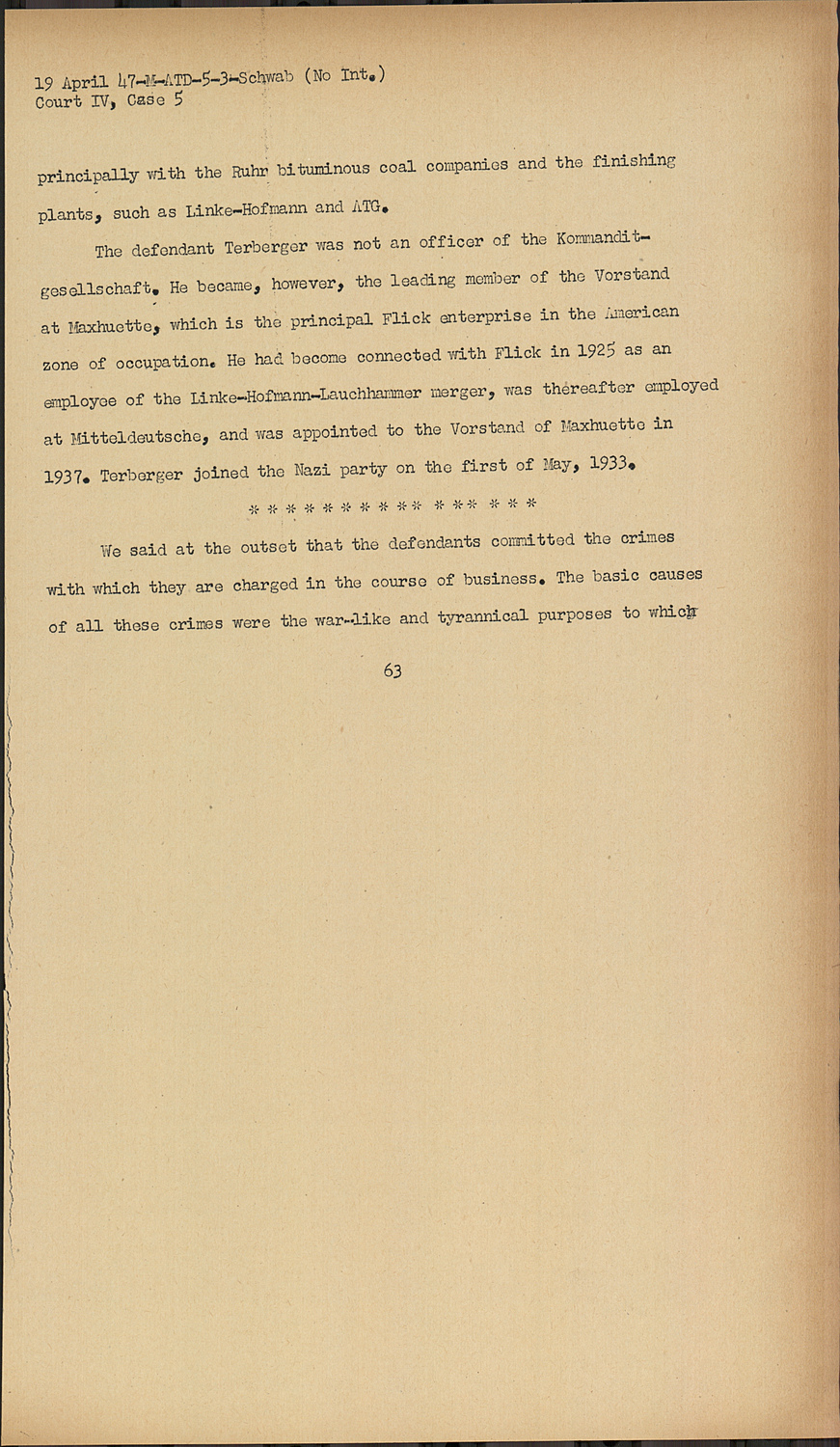
The defendant Terberger was not an officer of the Kommanditgesellschaft. He became, however, the leading member of the Vorstand at Maxhuette, which is the principal Flick enterprise in the American zone of occupation. He had become connected with Flick in 1925 as an employee of the Linke-Hofmann-Lauchhammer merger, was thereafter employed at Mitteldeutsche, and was appointed to the Vorstand of Maxhuette in 1937. Terberger joined the Nazi party on the first of May, 1933.
* * * * * * * * * * * * * * * * * * We said at the outset that the defendants committed the crimes with which they are charged in the course of business.
The basic causes of all these crimes were the war-like and tyrannical purposes to which Court IV, Case 5 the Third Reich was dedicated from its inception, the aggressive acts committed by Germany in Austria and Czechoslovakia in 1938, and the invasions and aggressive wars launched by Germany beginning in 1939.
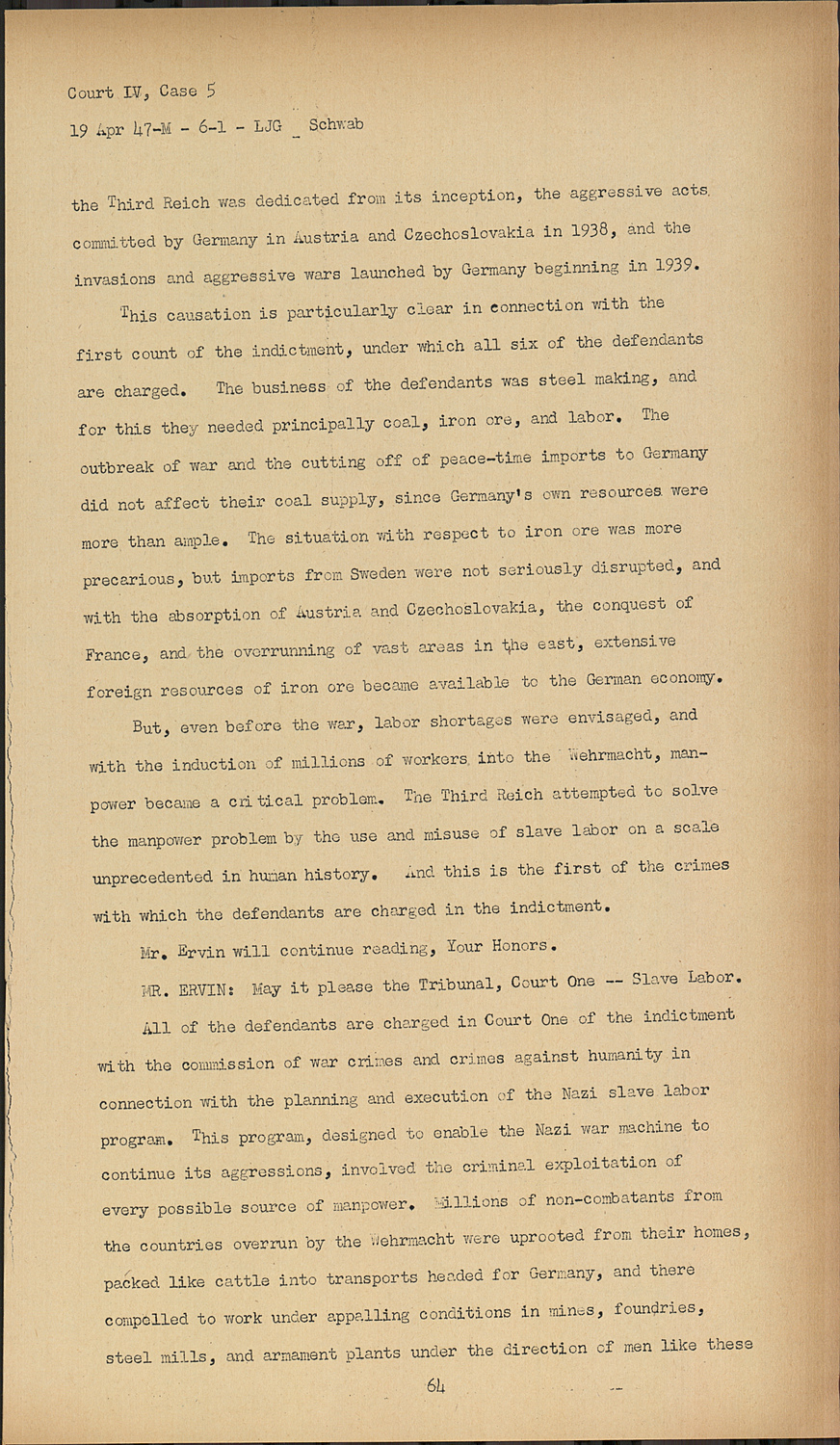
This causation is particularly clear in connection with the first count of the indictment, under which all six of the defendants are charged. The business of the defendants was steel making, and for this they needed principally coal, iron ore, and labor. The outbreak of war and the cutting off of peace-time imports to Germany did not affect their coal supply, since Germany's own resources, were more than sample. The situation with respect to iron ore was more precarious, but imports from Sweden were not seriously disrupted, and with the absorption of Austria and Czechoslovakia, the conquest of France, and the overrunning of vast areas in the east, extensive foreign resources of iron ore became available to the German economy.
But, even before the war, labor shortages were envisaged, and with the induction of millions of workers into the Wehrmacht, manpower became a critical problem. The Third Reich attempted to solve the manpower problem by the use and misuse of slave labor on a scale unprecedented in human history. And this is the first of the crimes with which the defendants are charged in the indictment.
Mr. Ervin will continue reading, Your Honors.
MR. ERVIN:May it please the Tribunal, Court One - Slave Labor.
All of the defendants are charged in Court One of the indictment with the commission of war crimes and crimes against humanity in connection with the planning and execution of the Nazi slave labor program. This program, designed to enable the Nazi war machine to continue its aggressions, involved the criminal exploitation of every possible source of manpower. Millions of non-combatants from the countries overrun by the Wehrmacht were uprooted from their homes, packed like cattle into transports headed for Germany, and there compelled to work under appalling conditions in mines, foundries, steel mills, and armament plants under the direction of men like these Court 4, Case 5 defendants.
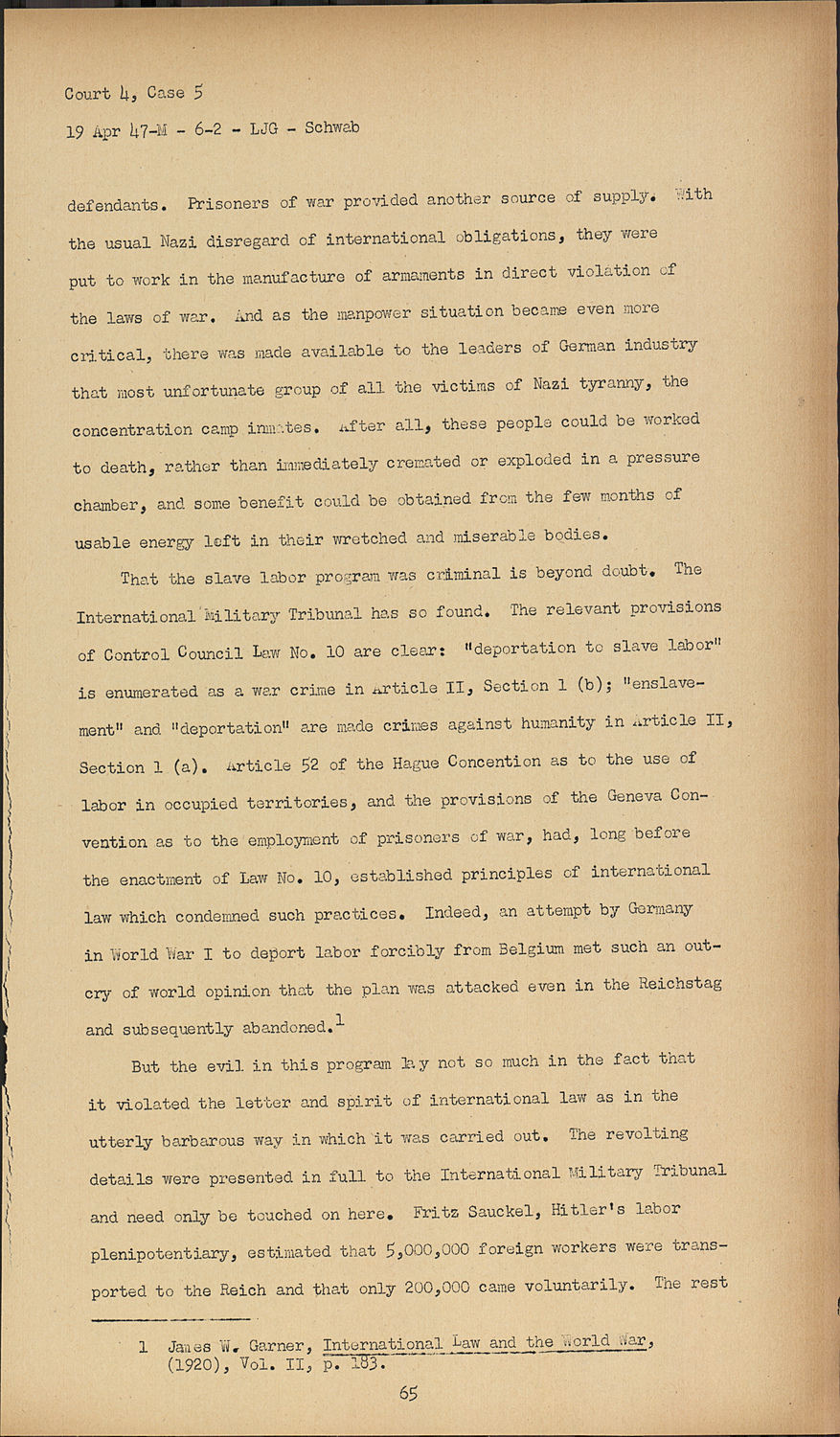
Prisoners of war provided another source of supply. With the usual Nazi disregard of international obligations, they were put to work in the manufacture of armaments in direct violation of the laws of war. And as the manpower situation became even more critical, there was made available to the leaders of German industry that most unfortunate group of all the victims of Nazi tyranny, the concentration camp inmates. After all, these people could be worked to death, rather than immediately cremated or exploded in a pressure chamber, and some benefit could be obtained from the few months of usable energy left in their wretched and miserable bodies.
That the slave labor program was criminal is beyond doubt. The International Military Tribunal has so found. The relevant provisions of Control Council Law No. 10 are clear: "deportation to slave labor" is enumerated as a war crime in article II, Section 1 (b); "enslavement" and "deportation" are made crimes against humanity in Article II, Section 1 (a). Article 52 of the Hague Concention as to the use of labor in occupied territories, and the provisions of the Geneva Convention as to the employment of prisoners of war, had, long before the enactment of Law No. 10, established principles of international law which condemned such practices. Indeed, an attempt by Germany in World war I to deport labor forcibly from Belgium met such an outcry of world opinion that the plan was attacked even in the Reichstag and subsequently abandoned.1 But the evil in this program lay not so much in the fact that it violated the letter and spirit of international law as in the utterly barbarous way in which it was carried out.
The revolting details were presented in full to the International Military Tribunal and need only be touched on here. Fritz Sauckel, Hitler's labor plenipotentiary, estimated that 5,000,000 foreign workers were transported to the Reich and that only 200,000 came voluntarily. The rest -----------------
1 James W. Garner, International Law and the World War, (1920), Vol.
II, p. 183.
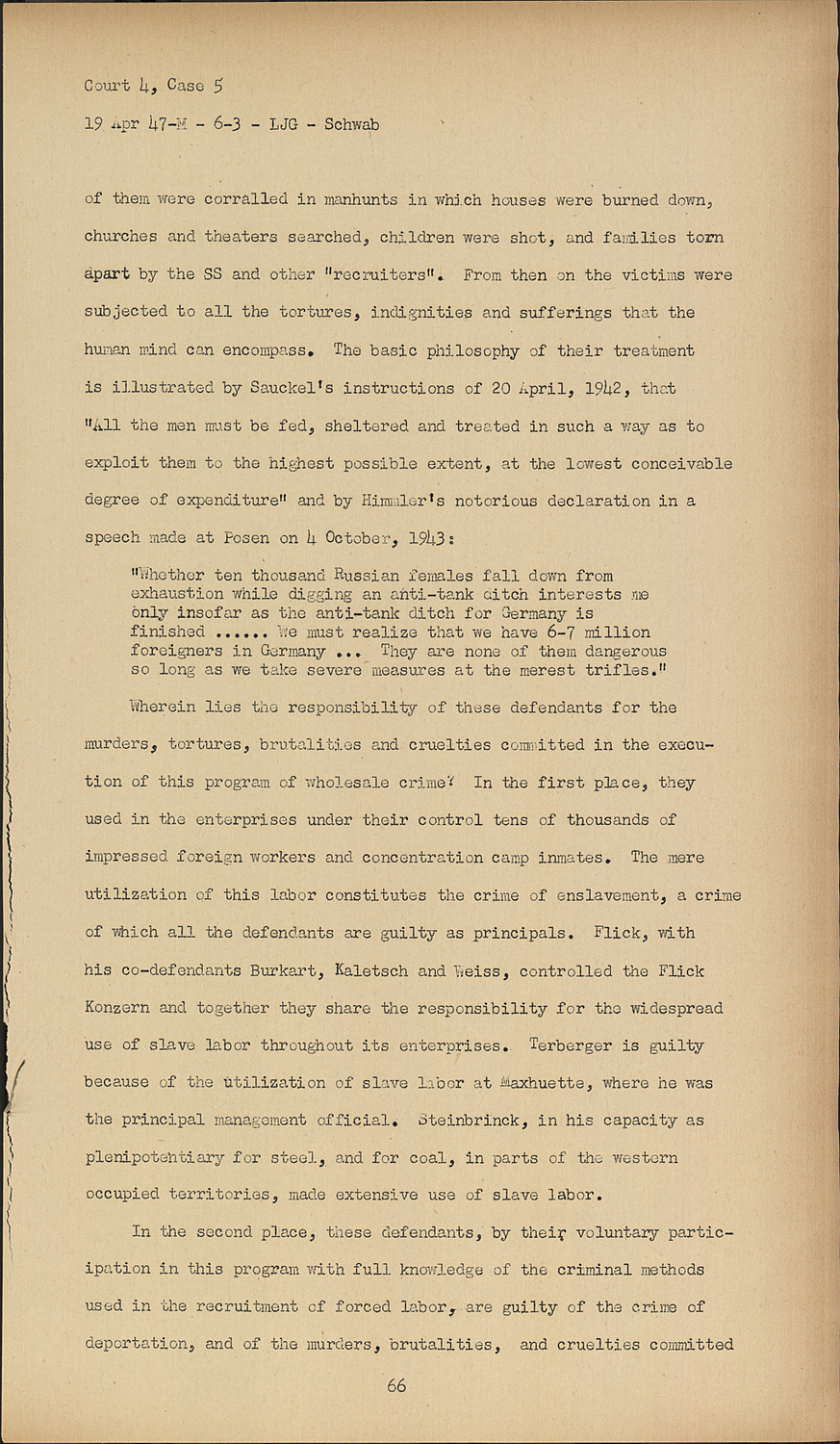
Court 4, Case 5 of them were corralled in manhunts in which houses were burned down, churches and theaters searched, children were shot, and families torn apart by the SS and other "recruiters". From then on the victims were subjected to all the tortures, indignities and sufferings that the human mind can encompass. The basic philosophy of their treatment is illustrated by Sauckel's instructions of 20 April, 1942, that "All the men must be fed, sheltered and treated in such a way as to exploit them to the highest possible extent, at the lowest conceivable degree of expenditure" and by Himmler's notorious declaration in a speech made at Posen on 4 October, 1943:
"Whether ten thousand Russian females fall down from exhaustion while digging an anti-tank ditch interests me only insofar as the anti-tank ditch for Germany is finished ...... We must realize that we have 6-7 million foreigners in Germany ... They are none of them dangerous so long as we take severe measures at the merest trifles."
Wherein lies the responsibility of these defendants for the murders, tortures, brutalities and cruelties committed in the execution of this program of wholesale crime. In the first place, they used in the enterprises under their control tens of thousands of impressed foreign workers and concentration camp inmates. The mere utilization of this labor constitutes the crime of enslavement, a crime of which all the defendants are guilty as principals. Flick, with his co-defendants Burkart, Kaletsch and Weiss, controlled the Flick Konzern and together they share the responsibility for the widespread use of slave labor throughout its enterprises. Terberger is guilty because of the utilization of slave labor at Maxhuette, where he was the principal management official, Steinbrinck, in his capacity as plenipotentiary for steel, and for coal, in parts of the western occupied territories, made extensive use of slave labor.
In the second place, these defendants, by their voluntary participation in this program with full knowledge of the criminal methods used in the recruitment of forced labor, are guilty of the crime of deportation, and of the murders, brutalities, and cruelties committed Court 4, Case 5 in connection with such recruitment and deportation.
The evidence will show that the defendants know well the manner in which this labor was being "recruited". In fact, they made every effort to participate in it directly by sending their own representatives to the occupied territories. As to the voluntary nature of their participation, it need only be pointed out that no employer in the Third Reich was assigned labor against his will. He had not only to ask for the allocation of labor, but his success in getting it de pended on the pressure he could bring to bear on the allocating authorities. The enterprises under the control of these defendants were eager, aggressive, and successful in their efforts to obtain workers from all sources involved in this criminal program. The individual firms besieged their local labor offices. The Berlin office of the Konzern was in constant touch with various officials of the Ministries connected with the administration of the program. Finally pressure was brought to bear directly on Sauckel, Speer, and others at the top of the Nazi hierarchy by means of the powerful self-administrative associations of industrialists, such as the Reichsvereinigung Eisen (RVE) for the iron industry, and the Reichsvereinigung Kohle (RWK) for the coal industry, to which these defendants belonged. He shall have more to say of these associations later.
Finally, the defendants are guilty as principals for the deaths, inhumane treatment, and suffering of the workers while employed in enterprises under their control. The entrepreneur was responsible for the well-being of the workers on the job. True, he was circumscribed by government regulations as to the amount of pay, the food, ration available, and in certain other details. But the primary responsibility for the health and wellbeing of these unfortunate workers belonged to the owners and managers of enterprises. We shall have occasion to see how these defendants discharged that responsibility.
We turn now to a discussion of the evidence to be presented on this count. According to records taken from files of the Flick Konzern, there were approximately 80,000 persons employed in its various enterprises in 1939. By the end of the war, this number had increased to upwards of 120,000, a remarkable increase in the face of a nation-wide labor shortage. We have available, and will introduce in evidence, pertinent records from many of the separate enterprises showing the composition of this labor force. On the basis of these statistics, which are not complete in every instance, a conservative estimate can be made that between 30 and 40 percent of the employees were foreign workers, prisoners of war, and concentration camp inmates.
It should be borne in mind that these statistics do not reflect the constant turnover in these classes of laborers due to deaths, escapes and disability. Thus, while approximately 40,000 forced laborers were employed at any one time by the Flick Konzern, a substantially greater number of individuals were involved in the period from 1940-1945.
The Flick Konzern used proportionately more foreign labor than other enterprises in the iron and steel industry. Statistics published on 31 July, 1944 disclose that nearly half of the labor force at Hennigsdorf, a plant under the direct control of the Kommanditgosellschaft, was composed of foreign and prisoner-ofwar labor.
This percentage was greater by nearly a third than it was in the iron and steel industry as a whole. In the coal enterprises of the Konzern there was increasing use of slave labor as the war progressed. Reports from both Harpener and Essener show that, by 1944, over half of the entire labor force came from foreign sources.
These same statistics in many instances carry separate columns indicating the number of prisoners of war employed. A comparison of those statistics with reports prepared in the Flick front office from 1942 to 1944, showing the contribution of the Flick Konzern to the war effort, proves conclusively that prisoners of war,were used in the manufacture of armaments. For example, shell casings were made at Groeditz, ammunition at Freital, and armored cars at the Linke-Hofmann Werke. During this period the employment statistics show, for example, that in January, 1944, 1145 prisoners of war were employed at Groeditz, in December, 1943, 671 were employed at Freital, and in July, 1943, 1017 were employed at Linke-Hofmann.
The Konzern, and its Berlin office, from the cutset was eagerly interested in taking advantage of all sources of the new labor supply. Scarcely a month and a half after the invasion of Poland, prisoners of war were arriving for work at Maxhuette. Whenever an additional source was made available, the Berlin office was careful to inform the various companies what steps were necessary to get their share of the new laborers. We find Kuettner, Burkart's assistant in Berlin, conferring with officials of the Labor Ministry in June, 1942 concerning the acquisition of Russian and French laborers, and then writing a circular letter to the various member firms exherting them to file their applications with the proper authorities at once. In 1944, when it appeared that Italians would be used to supplement the labor force, the defendant Burkart wrote to Maxhuette as follows:
Mr. Klaar, Groeditz, who worked in France on a similar mission for about one year, has gone to Italy in the meantime in order to recruit workers for the iron industry.
It was intended, originally, to employ Dr. Klaar exclusively in the interest of the combine.
It is not yet certain if this plan can be carried out in full.
It will, however, be possible to give due consideration to the interests of the group.
In accordance with the annexed note which Hennigsdorf gave to Mr. Klaar, we recommend that the other plants also make documents available to us, so that Mr. Klaar may be informed of all details during his recruiting.
Klaar's report to Burkart from Italy on 5 July, 1944 shows the manner in which the recruiting was accomplished. We quote the opening paragraphs:
Subject: Removal of Italian workers to Mittelstahl.
In these days, the last great drive for workers has been made in Italy.
Since voluntary recruiting and firm recruiting as roll as work contracts brought no tangible results, this drive was started in the form of military conscription of three age groups.
Unfortunately, the military conscription also brought no more results than the former drives.
Altogether, we got about 1 percent, who had to be put exclusively into the special groups.
Iron and steel, and with that Mittelstahl, again could not be taken care of.
We were only able to report to you the arrest of 500 steelworkers of the firm Siac-Genua, who were moved to Linz.
Since you were the first to be informed about this matter, we hope that you were able to take action in time when the allotment was made.
Was it news to these defendants in 1944 that force was necessary to compel workers to come to Germany? We need not speculate on this point. Consider a report of the Social Committee of the RVK, dated 1 December, 1941, a report circulated throughout the Flickoffice in Berlin and initialled by Kaletsch, Burkart and Weiss, among others. It reads:
Allocation of minors from Krivoi-Reg in the Ruhr mines.
A commission, consisting of the representatives of the interested agencies, namely, the OKW, the SS, government authorities, the Party, and the Reich association Coal, convened in Krivoi-Reg from 8 November until 10 November, 1941, in order to formulate regulations based on the decree of the Reichs Marshall of 24 October, 1941 with respect to the transfer of miners to the Ruhr mining industry.
At the present, about 6,000 out of the scheduled 10,000 to 12,000 miners are immediately concerned.