The points of view therefore, varied considerably.
"This morning we discussed those questions with the main office administration of the Anhaltische Kohlenwerke, that also thought it advisable, neither to withdraw our request for Polish workers nor to indicate subsequently a later date for the fulfillment of our demand."
The letter is from the district group of Central German Soft Coal Mining Industry within the Economic group Mining. It is signed by officials of that group, one Hirz, and one Gumbrecht. The letter shows that AKW was using foreign labor and contemplating the use of prisoners of war from, the west early in 1940. It also illustrates the workings of the various economic group ings, this time in the mining field, through its regional organizations of entrepreneurs in the soft coal industry.
I now offer as prosecution exhibit 138 Document Number NI-5240 which appears on page 23 of the English Document book.
THE PRESIDENT:The Tribunal admits in evidence the document just offered as prosecution exhibit number 138 and instructs the Secretary General to note its receipt in the records.
MR. ERVIN:Your Honor will note that the English translation in this instance, in the upper right-hand corner just below the date of the letter, says "initialled Flick, Kaletsch, Kuettner", Kuettner being another official of the Berlin office.
Those initials appear on the covering letter which is part of this document, which is translated on page 23. We have the original document here as an exhibit. The initial of the defendant Flick also appears on the second page of the document which is on page 24 of the English document book. The document is a report from AKW, a monthly report for the month of July 1942. The report itself begins on page 24 of the English document took.
THE PRESIDENT:Is the notation by Flick repeated in the English translation?
MR. ERVIN:The second notation is not, your Honor. There is an initial on the original page which is translated on page 24 of the document book just above the word "wagons" that appears in the first line. The covering letter which is addressed to Dr. Burkart reads:
"With the attached preliminary report for the month July 1942 we are able to report to you new maximum figures for output and production at our Welzow plants.
"While the coal output exceeded the 3/4 million mark by approximately 764,000 the production of briquettes reached 248,400 tons, with a 8,660 ton output per working dry. After deductions for our own consumption, deliveries to affiliated companies, etc., have been made, this amounts to approximately 108% of the contribution made by us over many years to the production of the syndicate."
There follows the signature. The report itself begins on page 24 of the document book. It has a number of subjects. I would like to call the attention of the Court to the subject headed Foreign Labor. That appears on page 25 of the English document book and in the German original at the top of page 2 of the German original. The heading is Foreign Labor, and then follows "Numbers by the end of the Month. Mine Clara, 719 French Prisoners of War; Mine Louise 30 French Prisoners of War; Mine Werminghoff 145 French Prisoners of War. Then 104 English Prisoners of War, 68 Russian Prisoners of War, making a total of 1,066 Prisoners of War." The report goes on:
"The number of prisoners of war decreased by altogether 21 men. This refers mainly to a loss of Russians at mine Werminghoff. The output per worker varies still considerably and is, especially with regard to the bulk of the French prisoners of war at mine Clara, not up to expectations. Also the possibilities to use the Russian prisoners of war at mine Werminghoff have deteriorated. Here, among the Russians, a striking increase is apparent of the percentage of sick prisoners, which has increased from approximately 7% to 18% (dropsy). As to the rest of the prisoners the state of health remains unaltered with 4%. Food, rather short until now, could be improved lately by new allocations of potatoes and vegetables.
"The Englishmen receive plenty of parcels from home as before, as to the French however, we noticed a decrease in this respect."
That was the monthly report from AKW for the month of July, 1942.
The next document is a similar report for the month of December 1942, a covering letter dated 9 January 1943. It is Document NI-5516, and I offer it as Prosecution Exhibit 139.
THE PRESIDENT:The document now offered is received by the Tribunal in evidence as Prosecution Exhibit No. 139. The SecretaryGeneral will note its receipt in the record.
MR. ERVIN:On page 27 of the English document book is a translation of the covering letter similar to the last one again addressed to Dr. Burkart. There appear on that page the initials of the defendant, Flick, the defendant, Kaletsch, the defendant, Burkart, and the defendant, Weiss. It is noted in the translation except that Burkart's none has been left out. If you will look at the upper righthand corner it says "initialed by". In addition, on the first page of the report, the translation of which appears on page 28 of the document book, the initials of Flick, Burkart and Weiss again appear. You will note at the top of that page in the translation under AKW the translation says "Initials: Flick, Weiss, etc." If you will just add the word "Burkart" there, it will make the record complete. This letter and report is similar in content to the last one.
The section on foreign workers which appears on page 29 of the English document book and will be at the bottom of page 1 of the German original report roads: "Foreign Workers at the End of the Month: Mine Clara, 673 French PW's, Mine Louise, 28 French PW'S. Mine Werminghoff, 135 French PW's, 97 English, 74 Russians," or in all 1,077 prisoners of War.
The letter goes on:
"Compared with the figures at the end of the preceding month, four PW's less were employed in the mine Clara, two less at Louise and five less in the mine Werminghoff.
"Besides the PW's the Labor office Goerlitz assigned seventy-five Eastern workers to the mine Werminghoff on 17 December 1942;
(two of them were released again immediately).
"No change is to be noted in the output of the PWs. The number of workers on the sick list again showed a further decrease in Werminghoff (4.6%) The figure for Clara is again about 5%.
"The food is at present adequate. Packages were received in such great numbers that some PWs in the mine Clara declined to come to dinner on the Christmas days. On the other hand, cooking facilities in camp were well made use of."
I now offer as Prosecution Exhibit 140 Document NI-5391 which appears at page 31 of the English document book.
THE PRESIDENT:The Tribunal receives the document now offered by the Prosecution as the Prosecution's Exhibit No. 140 and instructs the Secretary-General to note the same in his record.
MR. ERVIN:The exhibit in this case appears to be a carbon copy of a report which report as indicated at the beginning was addressed to the District Labor Allocation Engineer, Dr. Ries. The signature is a stamped signature Anhaltische Kohlenwerke with two names, Knaul and Nerger, stamped indicating the original had been signed by them. There are initials on the first page of this letter that was taken from the FKG files. One of the initials which is in ordinary pencil may be the initial of the defendant, Burkart. There is also an initial in blue pencil which we are unable to identify accurately. It may be an initial of the defendant, Flick. I will ask them to look at them.
DR. DIX:This is not the signature of the defendant, Flick. It is the sign of the Vorstand of the AKW in Hellberg.
DR. KRANZBUEHLER:In the German translation of this document it says that the document bears the initials of Terberger, Flick and Hellberg. Terberger has not signed this document. As Mr. Ervin has told me just now, it is a mistake.
MR. ERVIN:I think that also appears in the English translation. I rather suggest that that part of the English translation where it has "Initialed" the Tribunal will eliminate from its copy.
Do I understand also that it is not the defendant. Burkart's initial?
DR. DIX:No.
THE PRESIDENT:Then I understand we should strike out all three names?
MR. ERVIN:That is correct, Your Honor.
THE PRESIDENT:Terberger, Flick, Hellberg.
MR. ERVIN:Hellberg. I should think Hellberg's initial does appear.
THE PRESIDENT:Yes.
MR. ERVIN:Yes. Hellberg's initial does appear, Your Honor.
THE PRESIDENT:Then you would strike out the words "Terberger" and "Flick",
MR. ERVIN:That is correct. This document is headed: "Employment of Foreigners Group Klettwitz.
"We refer to your wish, mentioned at the meeting on 16.1.45, to be informed of difficulties occurring in the allocation of foreigners and bring therefore the following to your attention.
On 26 February '44 we received a transport of Eastern Workers, consisting of 20 men, 23 women, 13 children, 13 and 15 years old, who were considered capable to work, and 13 babies. Out of these 56 socalled workers only 31 could he employed; the rest merely filled up the camps and used up the already scarce supplies, without being of any help to us.
We contacted immediately the proper authorities concerning this transport, such as the Regional Labor Office, RVK and the Reich Labor ministry, with the request not to send us in the future such transports, since we can use only people who are capable of working in mines.
On 12 May 44 we received another transport of Easter Workers according to the Labor Office allegedly 50 workers. This is what they consisted of: 17 men, among them one 60 years old, one 71 years and one 75 years.
34 women, one 71 years old and two 75 years old. 22 children, in the age group between 1 and 14. Out of these 73 people only 12 men and 34 women were capable to work for mining, for which they had been requested only 9. We informed RVK of this at the time and asked to be spared further transports of this kind.
On 16 Dec. 44 we again received a transport of Easter workers, consisting of 15 men, 36 women and 36 children, on the whole 87 persons. Among the men there was an 80 year old blind man and several men were over 65 years old. The women were partly ill, or pregnant or mothers of infants so that they also could not be used in mining work. There are quite a number of families among them of whom no one is working at all and therefore not even make a living.
The men also, as far as they are in age groups capable to world are ill or suffering from an ailment preventing their full employment.
"We offered immediately to return some families, 15 people on the whole to the labor office, because not a single member of these families was working. Nothing happened though.
"We also offered on the 12-l-45 to return the whole transport if we would get the promised 100 PW's. Our camps are not suited for family accomodations. The available sleeping place is needed urgently for other real workers, so that we were forced already to use emergency camps for the lodging of so many people. We are burdened with the lodging and feeding of these many people, who don't work and are not capable of working. The kitchen facilities, food and clothing matters are difficult enough, are being used much too much.
"It has to be expressed clearly for once, that with these transports we do not get labor, but refugee families who do not belong into industrial labor camps, but into refugee camps. We cannot be expected to accept continuously these transports without objections and to take care and provide for them. Governmental agencies ought to provide special camps for these refugees, since this condition, does not only occur here but also in other firms. We are asking you therefore to draw the attention of the responsible agencies to those conditions and to urge help. It is indeed useless to provide the requested personnel if it is obvious from the start that only a small fraction of them are capable of performing any work."
Then follows the signature.
That brings us to the text enterprise which is the Allegemeine Transportanlagen, one of the finishing plants which is placed on the charts at the top of the column on the extreme right under the letters "ATG". It was a plant at Leipzig. This can be seen by consulting a map which was submitted here to this Tribunal.
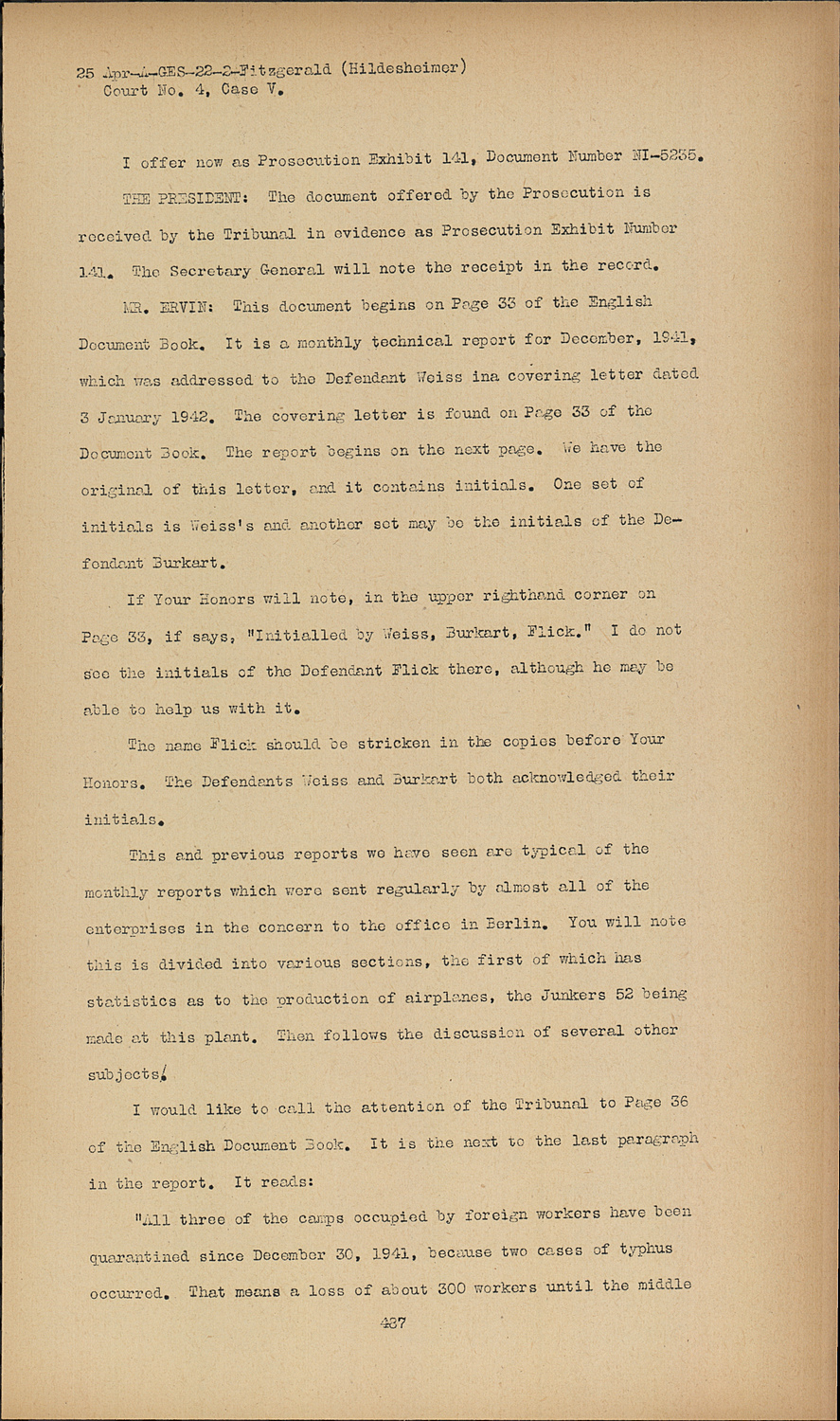
I offer now as Prosecution Exhibit 141, Document Number NI-5235.
THE PRESIDENT:The document offered by the Prosecution is received by the Tribunal in evidence as Prosecution Exhibit Number 141. The Secretary General will note the receipt in the record.
MR. ERVIN:This document begins on Page 33 of the English Document Book. It is a monthly technical report for December, 1941, which was addressed to the Defendant Weiss ina covering letter dated 3 January 1942. The covering letter is found on Page 33 of the Document Book. The report begins on the next page. We have the original of this letter, and it contains initials. One set of initials is Weiss's and another set may be the initials of the Defendant Burkart.
If Your Honors will note, in the upper righthand corner on Page 33, if says, "Initialled by Weiss, Burkart, Flick." I do not see the initials of the Defendant Flick there, although he may be able to help us with it.
The name Flick should be stricken in the copies before Your Honors. The Defendants Weiss and Burkart both acknowledged their initials.
This and previous reports we have seen are typical of the monthly reports which were sent regularly by almost all of the enterprises in the concern to the office in Berlin. You will note this is divided into various sections, the first of which has statistics as to the production of airplanes, the Junkers 52 being made at this plant. Then follows the discussion of several other subjects.
I would like to call the attention of the Tribunal to Page 36 of the English Document Book. It is the next to the last paragraph in the report. It reads:
"All three of the camps occupied by foreign workers have been quarantined since December 30, 1941, because two cases of typhus occurred. That means a loss of about 300 workers until the middle of Janauary."
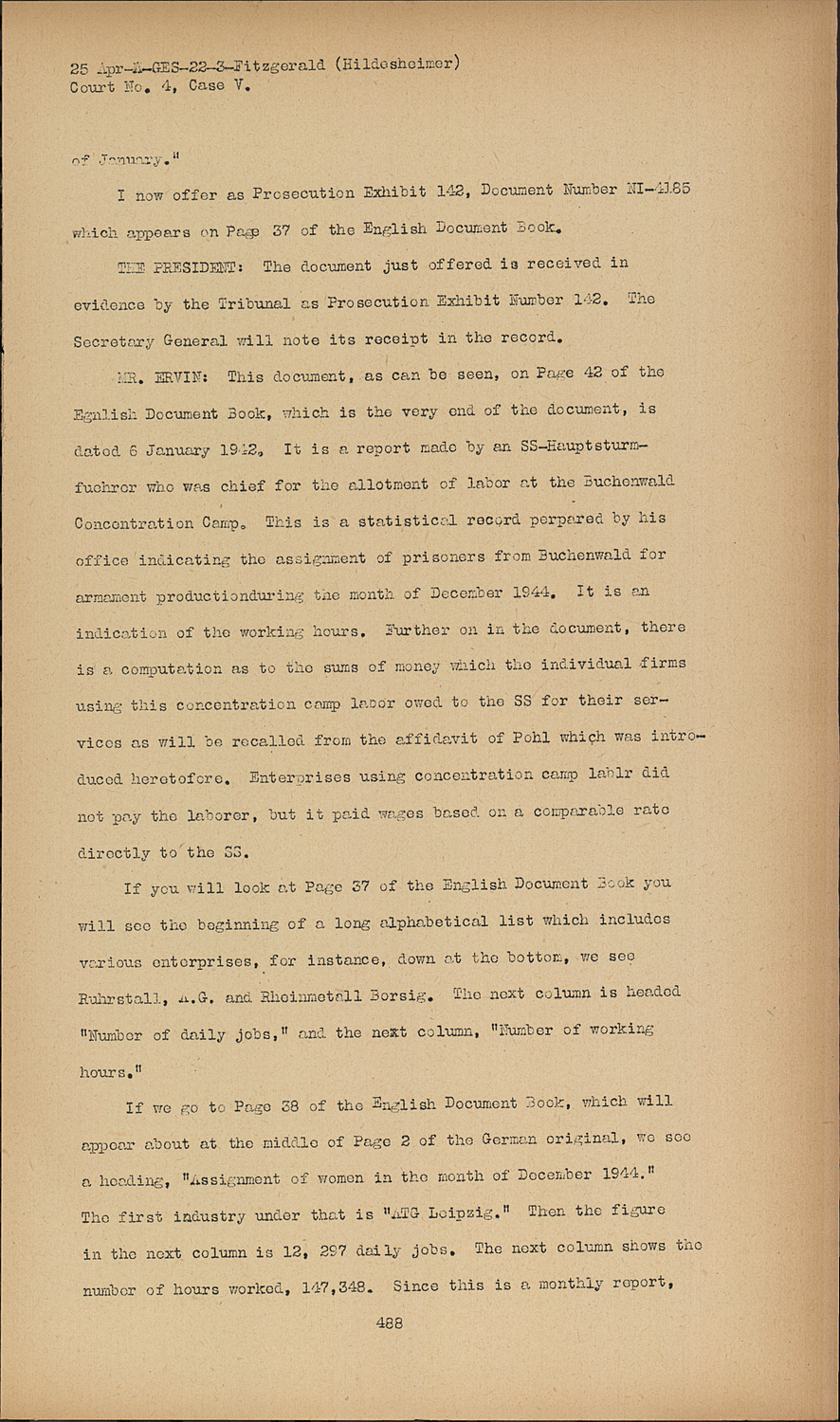
I now offer as Prosecution Exhibit 142, Document Number NI-4185which appears on Page 37 of the English Document Book.
THE PRESIDENT:The document just offered is received in evidence by the Tribunal as Prosecution Exhibit number 142. The Secretary General will note its receipt in the record.
MR. ERVIN:This document, as can be seen, on Page 42 of the English Document Book, which is the very end of the document, is dated 6 January 1942. It is a report made by an SS-Hauptsturmfuchrer who was chief for the allotment of labor at the Buchenwald Concentration Camp. This is a statistical record perpared by his office indicating the assignment of prisoners from Buchenwald for armament prodtuctionduring the month of December 1944. It is an indication of the working hours. Further on in the document, there is a computation as to the sums of money which the individual firms using this concentration camp labor owed to the SS for their services as will be recalled from the affidavit of Pohl which was introduced heretofore. Enterprises using concentration camp labor did not pay the laborer, but it paid wages based on a comparable rate directly to the SS.
If you will look at Page 37 of the English Document Book you will see the beginning of a long alphabetical list which includes various enterprises, for instance, down at the bottom, we see Ruhrstall, A.G. and Rheinmetall Borsig. The next column is headed "Number of daily jobs," and the next column, "Number of working hours."
If we go to Page 38 of the English Document Book, which will appear about at the middle of Page 2 of the German original, we see a heading. "Assignment of women in the month of December 1944." The first industry under that is "ATG Leipzig." Then the figure in the next column is 12, 297 daily jobs. The next column shows the number of hours worked, 147,348. Since this is a monthly report, I will assume that a rough average of the number of individual people concerned could probably be obtained by dividing by thirty the first figure, 12, 279 which gives approximately 400 people.
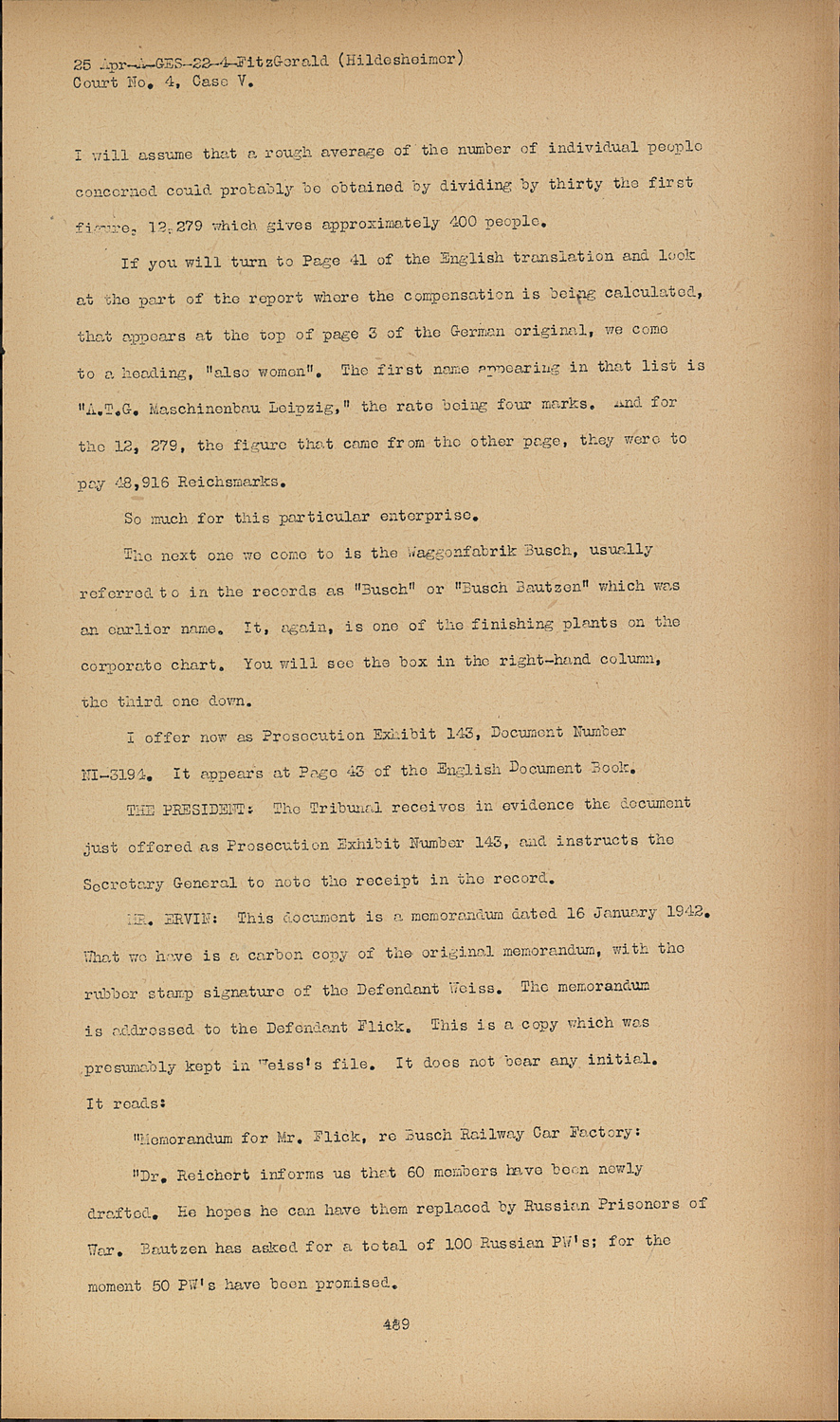
If you will turn to Page 41 of the English translation and look at the part of the report where the compensation is being calculated, that appears at the top of page 3 of the German original, we come to a heading, "also women". The first name appearing in that list is "A.T.G. Maschinenbau Leipzig," the rate being four marks. And for the 12, 279, the figure that came from the other page, they were to pay 48,916 Reichsmarks.
So much for this particular enterprise.
The next one we come to is the Waggenfabrik Busch, usually referred to in the records as "Busch" or "Busch Bautzen" which was an earlier name. It, again, is one of the finishing plants on the corporate chart. You will see the box in the right-hand column the third one down.
I offer now as Prosecution Exhibit 143, Document Number NI-3194. It appears at Page 43 of the English Document Book.
THE PRESIDENT:The Tribunal receives in evidence the document just offered as Prosecution Exhibit Number 145, and instructs the Secretary General to note the receipt in the record.
MR. ERVIN:This document is a memorandum dated 16 January 1942. What we have is a carbon copy of the original memorandum, with the rubber stamp signature of the Defendant Weiss. The memorandum is addressed to the Defendant Flick. This is a copy which was presumably kept in Weiss's file. It does not bear any initial. It reads:
"Memorandum for Mr. Flick, re Busch Railway Car Factory:
"Dr. Reichert informs us that 60 members have been newly drafted. He hopes he can have them replaced by Russian Prisoners of War. Bautzen has asked for a total of 100 Russian PW's; for the moment 50 PW's have been promised.
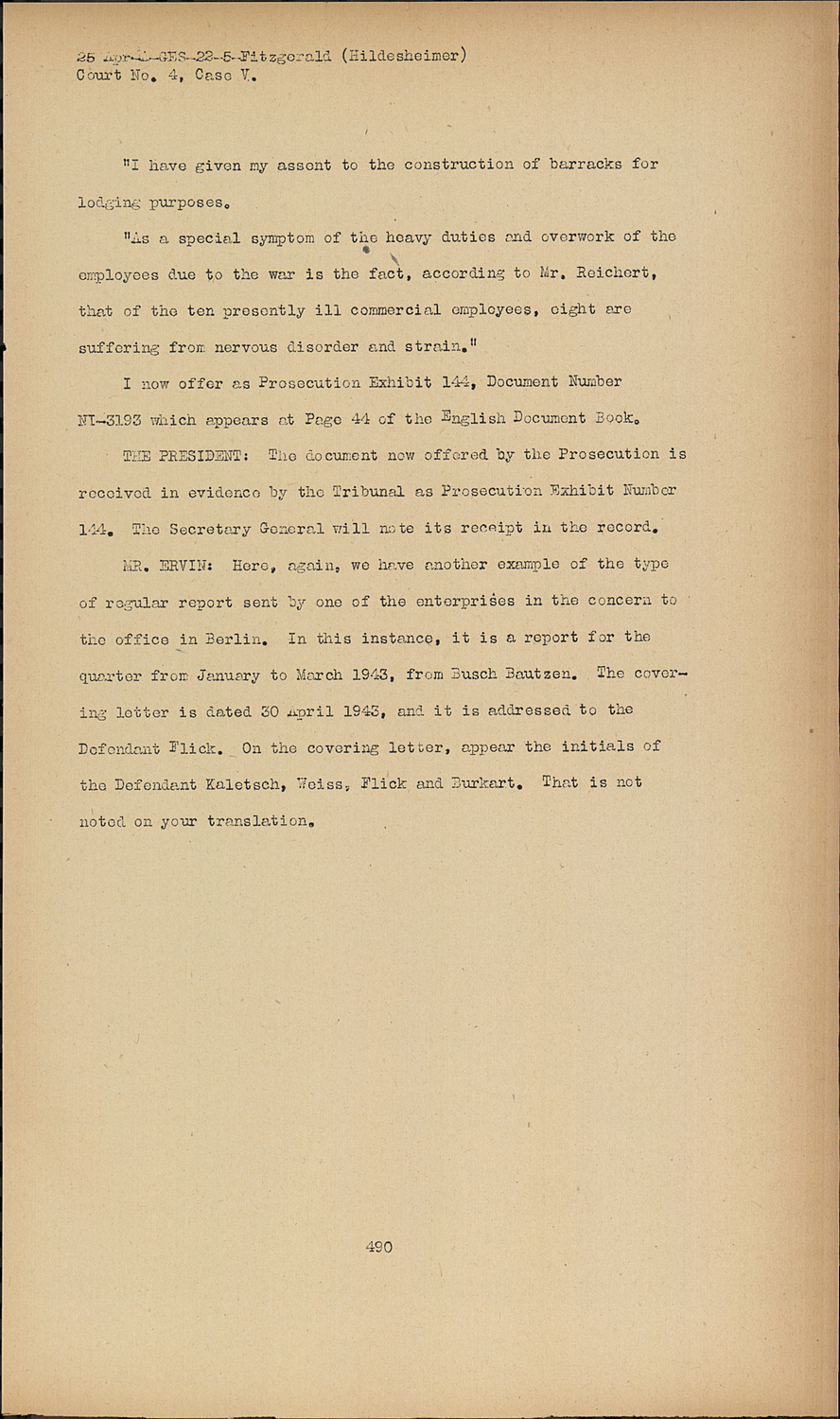
"I have given my assent to the construction of barracks for lodging purposes.
"As a special symptom of the heavy duties and overwork of the employees due to the war is the fact, according to Mr. Reichert, that of the ten presently ill commercial employees, eight are suffering from nervous disorder and strain."
I now offer as Prosecution Exhibit 144, Document Number NI-3193 which appears at Page 44 of the English Document Book.
THE PRESIDENT:The document now offered by the Prosecution is received in evidence by the Tribunal as Prosecution Exhibit Number 144. The Secretary General will note its receipt in the record.
MR. ERVIN:Here, again, we have another example of the type of regular report sent by one of the enterprises in the concern to the office in Berlin. In this instance, it is a report for the quarter from January to March 1943, from Busch Bautzen. The covering letter is dated 30 April 1943, and it is addressed to the Defendant Flick. On the covering letter, appear the initials of the Defendant Kaletsch, Weiss, Flick and Burkart. That is not noted on your translation.
THE PRESIDENT:Did I receive this?
MR. ERVIN:Yes. You did receive it. I thought perhaps you wanted to look at it, Your Honor.
THE PRESIDENT:Yes. I will look at it.
MR. ERVIN:This report begins on page 45 of the Document Book and follows the pattern of the others, the difference being due to the different types of business the enterprises were engaged in. You will note on page 46 of the English Document Book, there is a section report, II, entitled, "Allocation of Labor.'' That appears in the German original on the top of the page 2 of the report. That section reads:
" There is still a lack of manpower. The requirements stated have not yet been completely covered. Neither the promised female workers from the Eastern areas nor prisoners of war have been put at our disposal on the necessary scale.
" During the last three months, 54 men have been called up for service, in the armed forces. Substitutes have only partly been available.
" All workmen and employees worked 60 hours per week."
Then page 48 of the English Document Book is at the end of the report. There are statistics as to the number of employees under Paragraph 11 entitled " Staff." The first part of the statistics concern the German workers. At the top of Page 49, are statistics as to the number of prisoners of war and foreign civilian workmen. For example, this report indicates the number of personnel as of 1 January 1943, in that category, if they are totalled across, they amount to 340 in all, as opposed to what appears previously, 1,068 German workers.
Drop down, to a line of figures just above the double line in the translation. You have a comparable statistical breakdown the number personnel employed as of 1 March 1943. In these categories of prisoners of war and foreign civilians, by adding that total across, you can see that three months later the total of those categories new amount to 418 which compares with figure of 1,593 German workers as of that month.
I now offer as Prosecution Exhibit Number 145, Document NI-3026. That is on page 50 of the English Document Book.
THE PRESIDENT:This is 145?
MR. ERVIN:That is right.
THE PRESIDENT:The tribunal receives in evidence the document just offred as Prosecution Exhibit Number 145 and directs the Secretary general to note the receipt of the document in hos record.
MR. ERVIN:What appears in the Document Book is an excerpt which has been taken from a bound monthly report of Waggenfabrik Bautzen. The report is in a folder giving a number of systatistics on operations, extensions, production. It is typical of monthly reports on operations, extensions, production. It is typical of monthly reports which were sent in by many of the enterprises There are no initials on this particular monthly report. The excerpt is taken from Page 7, Paragraph 111. It begins: "C) Employment of labor and time of work: " At the end of August no request for workers was submitted to the labor office Bautzen, because we are to get 800 KZ inmates very soon."
"KZ" is concentration camp inmates.
" The lack of workmen was overcome by suspending all leaves and by increasing the working time for part of the workers, about 140 professional workers to 72 hours weekly. However, an agreement was reached with the Reichspost and the Transport Company, that bus schedules would be worked out to fit the working-hours of our workers coming from other places."
Then from Page 7, Paragraph 111, " G) Employment of concentration camp inmates:
" Sturmbannfuehrer Hassebrock from the headquaters of the concentration camp Gross-Pesen/Silesia visited us on 12 August. It was agreed that 800 Concentration camp inmates were to be allotted to us. We also discussed the matters necessary for erection of the barracks as well as the employment. We have ordered the barracks and the material for the fences and we are counting on starting to got things up by the end of September. The first echelon should also arrive by the end September.
" Page 8, Paragraph 111: " H) Italian Military internees:
"The Italian military internees, working for us, were taken on as civilian workers on 22 August. The Italians are at present still billeted in our plant, but they are to be transferred sometime in September to the community camp, Heiterer Blick,' Happy View."
I would now offer as prosecution Exhibit 146, Document NI-5204 which appears at page 52 of the English Document Book.
THE PRESIDENT:It is received by the Tribunal as prosecution Exhibit Number 146. The Secretary General will note the receipt in its record.
MR. ERVIN:This is aletter addressed to the defendant Weiss dated 17 October 1944. We have the original of the letter on which appear initials of Kaletsch, Weiss, Burkart and Flick. It is noted on the English translation inthe upper right-hand corner above the date. The letter reads:
" Dear Mr. Weiss:
" In reply to your letter of 9 October dealing with the 30 per cent reduction of the personnel pertaining to the administration, I inform you of the following facts relative to this paint.
" Since clearcut regulations about what belongs to the administration are not yet existing and supplements to the publications concerned have to be awaited, we have, as a matter of precaution, get in touch with the armament Command in Dresden which is competent for our plant, explaining to then the specific conditions prevailing in our plant.
The fact is that we, on the one hand, have set up our administrative machinery with a minimum of personnel, that is to say, economically, and therefore should encounter considerable difficulties in conducting our business affairs if we layed off 30 per centof our staff. On the other hand we are just in the process of building-up is we expect 800 people from the concentration camps, for which technical, supervisory and administrative personnel is required. Considering proportion of clerical workers, to the total staff as 1--"
I am sorry, my ,copy is blurred, I cannot see the number.
" --1 to 7, over 100 persons would theoretically be required for that. That is of course, not actually the case, but we shall probably have be anticipate an additional increase of the administrative staff by 40 people. Now it would not be consistent to give up training employees to production while carrying out the required 30 percent lay-off, and to engage untrained people shortly thereafter, " The Armament command takes the view that a full reduction would cause difficulties in our plant under these circumstances , and suggested that we give a report of the whole situation in a privat statement which could be produced in case of an inspection as evidence that wegave the question serious consideration.
" On this occasion 1 should like to touch once more the question already broached before, as to that extent the concern could dispense with our reports, or wether such reports we are to give to the joint supervisory beard might be somehow condensed.
" About 100 of the prisoners have arrived as yet as an advance-party, who are engaged in setting up fences, huts etc. The people are industrious and work 72 hours a week. I remain with the best regards."
There follows the signature.
That concludes the documents as to Busch-Bautzen. The next document is the only one we have in this book with reference to the Saechsische-Guss Stahlwerke, which appears in the small box directly in the center of the large chart right down at the bottom. I offer now in evidence , as Prosecution Exhibit 147, Document No. NI-5344, which appears at page 54 of the English Document Book.
THE PRESIDENT:The document now offered is received in evidence by the Tribunal as Prosecution Exhibit No. 147, and the Secretary General will note the receipt of this document in the record.
MR. ERVIN:This is a technical report on the business year 1941/1942. We have the signed original of the report here, which is taken from the KG files. There are no initials on the cover page of it. The report begins:
"During the past business year of 1941/42 incomparably greater tasks were set for, and carried out by the armaments industry than over before. The research work connected therewith demanded the hieghest performance by both engineers and skilled workers. The great quantity of comprehensive experimentation and the resultant changes in the sundry processing workshops could not fail to cause a drop in production, which, in the present situation, could not be made up again. This disadvantage, however, was greatly outweighed by the results achieved which were extraordinarily satisfactory. The plant had to place its specialists temporarily at the disposal of other firms, in order to insure a smooth start in the production of the qualitatively and technically newly developed armor-piercing, shells, or, alternatively, their experts came to Doehlen to be trained. What does the small decrease in our own output matter if it can be stated today that the problem of anti-tank defense, which was designated the deciding factor in warfare even last spring, can now be regarded as solved.
However, it must be emphasized that, due to the constantly increasing demands made on armorpiercing shells, development is being continued. We also lead in that field."
I might point out at this time that the original report has several pages missing, which is noted in the English translation here, and it continues talking about the armament production at Doehlen until we come to a heading on the next page , that is 55, of the English Document Book - "Concluding remarks." This appears at the bottom of page 10 of the German original. It says:
"The general state of health of the personnel has deteriorated in the year covered by the report. The increase demands on then had an adverse effect on their resistance, so that an increased number of the personnel proved susceptible to all kinds of diseases. The average rate of sickness per fiscal year was:
1939/40 to 4.4 % 1940/41 to 4.7 % 1941/42 to 5.6 % 6.1 % - July to October 1942.
These figures include all personnel, that is to say, foreigners are included.
"The sick-rate of the Russian civilian workers based on an average of numbers employed is:
From July to October 1942 - 7.2 % "In the sphere of medical care of sick-bay for the foreign workers was established at camp Poisental.
"Since June 1942 Russian prisoners of war as well as male and female Eastern workers have been employed at the plant. On the basis of past experience it is to be expected that the Russian prisoners of war and the women will develop into useful workers after the expiration of an extended period of adaptation.
The most willing workers who are capable of being schooled are being retrained in the training workshop.
"With the civilian Eastern workers considerable selection and elimination of the entirely useless elements is likely to prove necessary."
The report concludes with employment statistics as of 1 November 1942, which shows under workers at Plant Doehlen 2,880 Germans and 1,153 foreigners; at Plant Pirna , 200 Germans and 62 Foreigners; at Gainsdorf there were no foreigners employed.
We can thus see that at Doehlen, which, by its own admission, was leading in the production of armor-piercing shells, prisoners of war were being employed and also that the high sickness rate was undoubtedly due to the high rate among the Russian workers employed there.
If Your Honor please, the next enterprise we come to is the Essener Steinkohle, on which there is a substantial number of documents and I would suggest that it would perhaps be an appropriate time to close the day's session.
THE PRESIDENT:The Tribunal will now recess until Monday morning at 9:30.
(The Tribunal adjourned until 28 April 1947 at 0930 hours.)
Official Transcript of the American Military Tribunal IV in the Matter of the United States of America against Freidrich Flick, et al, Defendants, sitting at Nurnberg , Germany, on 23 April 1947, 0930 hours, Justice Sears presiding.
THE MARSHAL:Persons in the courtroom will please find their seats.
The Honorable, the Judges of Military Tribunal IV.
Military Tribunal IV is now in session, God save the United States of America and this Honorable Tribunal.
There will be order in the courtroom.
THE PRESIDENT:Mr. Marshal, are the Defendants present?
THE MARSHAL:If it please your Honor, all the Defendants are present in the courtroom.
THE PRESIDENT:We are ready to hear the prosecution continue.
MR. ERVIN:May it please the Tribunal, the prosecution will withdraw the exhibit which was submitted as prosecution exhibit 136 at the last session. I would suggest that it would probably be most convenient to just cancel the number and not assign that number to another exhibit.
THE PRESIDENT:Will it be reintroduced?
MR. ERVIN:No, it will not.
THE PRESIDENT:Shall we strike it out, both of the index and the note on the face of the exhibit? Is that right, Mr. Ervin?
MR. ERVIN:Yes, and I will retrieve from the Secretary General the folder which includes the original.
THE PRESIDENT:It was page 20.
MR. ERVIN:Page 20 of the English document book. We come now to documents pertaining to the Essener Steinkohlenbergwerle A.G., the hard coal mining enterprise located in the Ruhr. If your Honors will look at the chart of the corporate organizations you will see that the chain of control runs from the Kommanditgesellschaft off to the left, a line saying 100% to a holding company which in turn owned 70% of Harpener Bergbau.