My submission of evidence as to this question must restricted to pointing out to the Court the facts which exclude the establishment of a criminal guilt. By examining my client I shall print to the consequences to shich he would have exposed himself, he had opposed government regulations; consequences which the Prosecution expressed so conclusively and eloquently when it said: "The Third Reich ruthlessly exterminated any man or woman in Germany who tried to express political ideas outside the bestial Nazi ideology. (Compare opening statement, German text, page 57.
The same holds true for the essential matters for the second point, and I shall show for the third point, which raises the accusation of the responsibility for inhumane treatment and suffering of the laborers within the Flick Konzern, whether the assertion of the Prosecution is true, namely that such a knowledge did exist in the case of my client. In this respect the Prosecution believes that it can state the enterprises of the Flick Konzern were also under the supervision of Konrad Kaletsch, so as to find a legal basis for his alleged guilt, This assertion of the Prosecution will be proved to be incorrect which must be seen from my submission of evidence concerning the position and tasks of my client in the Flicj Konzern. Here I shall also substantiate this point of view by submitting affidavits.
I shall then continue in the same way as the Prosecution and discuss the next count, Count III of the Indictment--namely the alledged crimes against humanity, of which Konrad Kaletsch is said to have been guilty.
It is a question here of proceedings which are designated as so-called "Aryanization" which led to the acquisition of the shares,i) of the Rawack and Gruenfeld, 2) of the Hechefenwerk Luebeck AG, as also 3) of the acquisition of the shares of the Anhaltischen Kohlenwerke AG and of the Werschen-Weissenfels AG, which were sold by the United Continental Corporation and which belonged to the group Julius Petschek, Lastly I shall comment upon 4) the exchange of hard-coal for brown coal wich took peace between the Harpener Borgbau AG, and the Hermann-Goering-Werke, The cases of Aryanization were already settled before the outbreak of war.
In the case of Ignaz Petschek - exchange of hard-coal for brown coal, the circumstances that can at all be brought into consideration for a criminal valuation also occured before 1 September 1939. These acquisitions have been indicted before 1 September 1939. These acquisitions have been indicted by the Prosecutor by reason of the Control Council Law No, 10 Article II number C. The Prosecution is aware that it is here touching upon new territory and is demanding for the first time the punishment of crimes against humanity by an American court of justice in Nuernberg, crimes which are said to have been committed by Germans inside Germany before the outbreak of the second World War, that is therefore before 1 September 1939, Genral Taylor has therefore considered it necessary to set forth in long detailed arguments the Prosecution's interpretation of this legal basis.
The Defense is of the opinion that the Prosecution places itself in clear contradiction to the decision of the International Military Tribunal in its interpretation of Article II of the Control Council Law No. 10. The International Military Tribunal has declared crimes against humanity punishable only if the deed was committed before the outbreak of war in the process of an offensive war.
(compare Judgment of the International Military Tribunal - official edition German text I P. 285) The connection of the Control Council Law No. 10 with the Moscow Declaration of 30 October 1943 and the London Agreement of 8 August 1945 was the basis for the decision of the International Military Tribunal is seen even in the preamble to the Control Council Law No. 10.
Accordingly we must tart from the fact that the Control Council Law No. 10 contains the codification of these legal stipulations which were also the basis for the decision of the International Military Tribunal. A decision deviating from that of the International Military Tribunal appears therefore impossible and would, in the interpretation of the Defense, be in contradiction also to Article 10 of the Ordinance, No. 7.
I do not wish at this point to discuss in detail, the manifold arguments which could easily refute the legal arguments of the Prosecution. I shall take the liberty of exposing in my concluding speech for the defense, the legal interpretation of the Defense which is opposed to the Prosecution, and which rests on the judgement of the International Military Tribunal.
In this, I start out from the point of view that this Tribunal, which has permitted the hearing of witnesses by the Prosecution on count 3 of the indictment, also wishes for the hearing of witnesses on count 3 of the indictment on the part of the Defense, without having formed a decision as yet concerning this question of law.
But let so much be said at this time, that the application of the Prosecution's proposed interpretation of Article II of the Control Council Law No. 10 leads to untenable results.
A man like Julius Streicher, who is designated by the International Military Tribunal, "as Jew-baiter No. 1, by reason of his twenty five years of speaking, writing and preaching of hatred of the Jews" and who was undoubtedly guilty of numberless crimes against humanity in the years before the outbreak of the war, was only punished for those crimes gainst humanity which were committed by him "in the execution of an offensive war", that, is, therefore, after 1 September 1939.
There were, moreover, in addition to Streicher, men like Goering and Kaltenbrunner, who were net sentenced for crimes against humanity which they committed before the outbreak of war.
These examples alone show to what a disproportionate and thus unjust result the interpretation of the prosecution would lead, if one were willing to follow it. I am therefore of the opinion that purely from a legal considerations a condemnation of my client also on this count cannot take place. The submission of evidence on the part of the Defense will, however, also prove from the point of view of actual fact that in all the for cases of aryanization there existed no punishable circumstance and the defense submits that if such should have existed, Herr Konrad Kaletsch took no part in it.
The Prosecution has based its criminal judgement for this count of the indictment on the assertion that the "nature of the crime in this case was the pressure, which was exercised against the owner of the Jewish property, in order to force him to sell ...."
These statements are made in the opening speech of the Prose cution in the case of Julius Petschek P. 81 of the German text in which it is pointed out "that it is immaterial whether the seller receives an adequate price or not."
Also in another passage, namely concerning the acquisition of the Hechefenwerk Luebeck this point of view is set forth as decisive for criminal judgment, when it says of the Luebeck-Transaction:
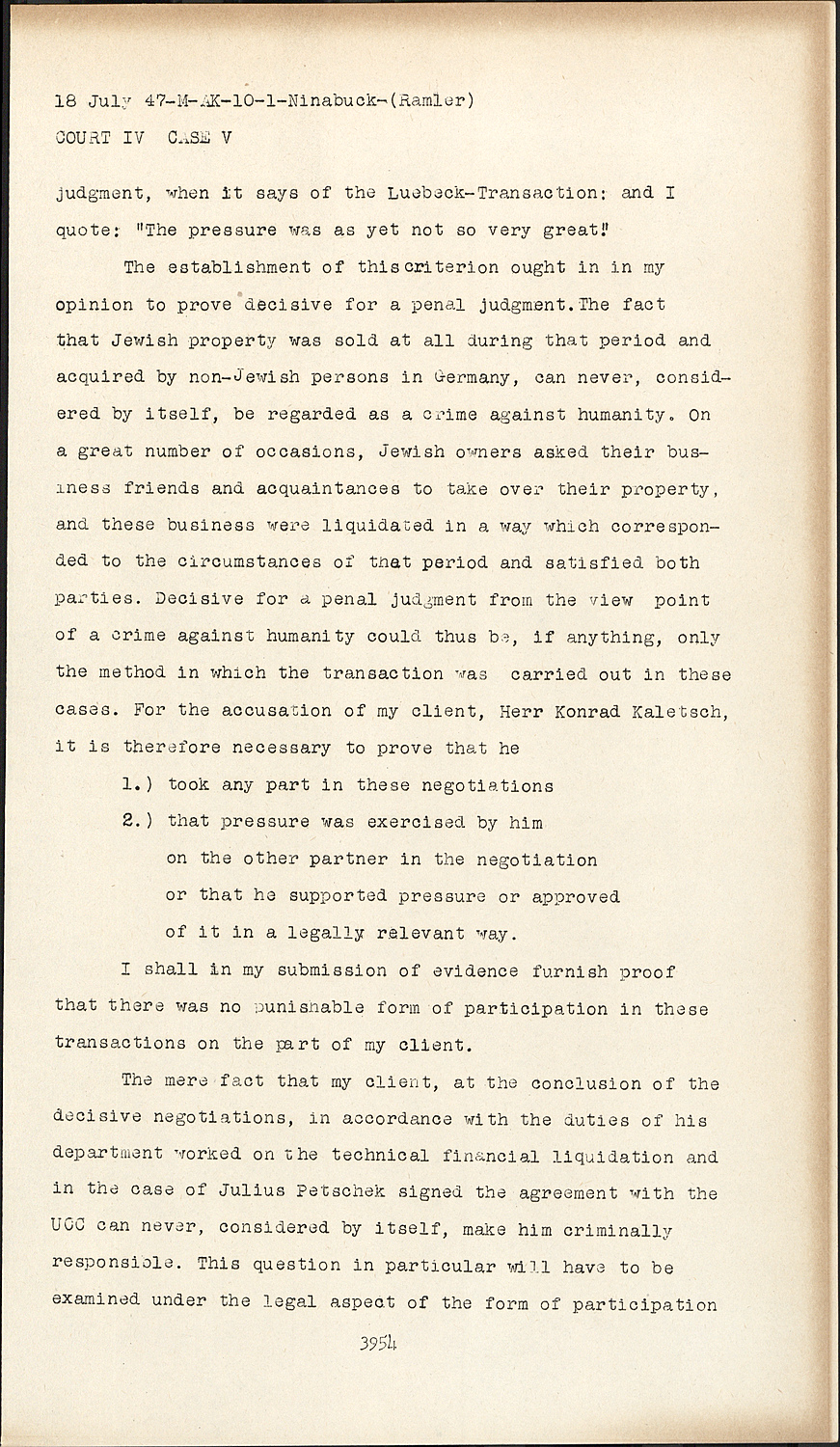
and I quote: "The pressure was as yet not so very great."
The establishment of this criterion ought in in my opinion to prove decisive for a penal judgment. The fact that Jewish property was sold at all during that period and acquired by non-Jewish persons in Germany, can never, considered by itself, be regarded as a crime against humanity. On a great number of occasions, Jewish owners asked their business friends and acquaintances to take over their property, and these business were liquidated in a way which corresponded to the circumstances of that period and satisfied both parties. Decisive for a penal judgment from the view point of a crime against humanity could thus be, if anything, only the method in which the transaction was carried out in these cases. For the accusation of my client, Herr Konrad Kaletsch, it is therefore necessary to prove that he
1.) took any part in these negotiations
2.) that pressure was exercised by him on the other partner in the negotiation or that he supported pressure or approved of it in a legally relevant way.
I shall in my submission of evidence furnish proof that there was no punishable form of participation in these transactions on the part of my client.
The mere fact that my client, at the conclusion of the decisive negotiations, in accordance with the duties of his department worked on the technical financial liquidation and in the case of Julius Petschek signed the agreement with the UCC can never, considered by itself, make him criminally responsible. This question in particular will have to be examined under the legal aspect of the form of participation as defined in the Control Council Law Article II, paragraph 2. Quite certainly it is a matter here of the precise wordings of law which, in their general setting and lack of contours call for our attention as jurists.
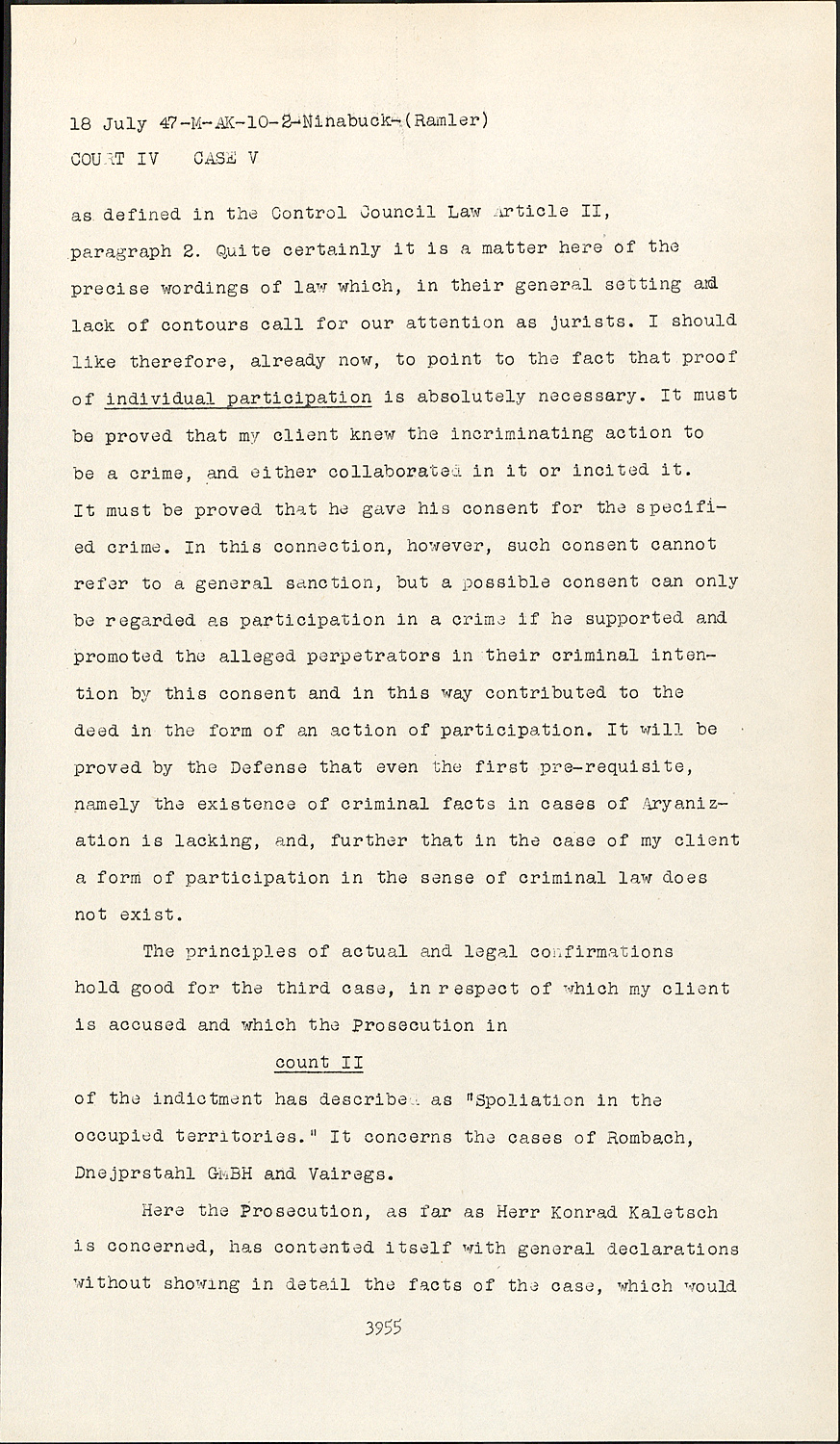
I should like therefore, already now, to point to the fact that proof of individual participation is absolutely necessary. It must be proved that my client knew the incriminating action to be a crime, and either collaborated in it or incited it. It must be proved that he gave his consent for the specified crime. In this connection, however, such consent cannot refer to a general sanction, but a possible consent can only be regarded as participation in a crime if he supported and promoted the alleged perpetrators in their criminal intention by this consent and in this way contributed to the deed in the form of an action of participation. It will be proved by the Defense that even the first pre-requisite, namely the existence of criminal facts in cases of Aryanization is lacking, and, further that in the case of my client a form of participation in the sense of criminal law does not exist.
The principles of actual and legal confirmations hold good for the third case, in respect of which my client is accused and which the Prosecution in count II of the indictment has describe as "Spoliation in the occupied territories."
It concerns the cases of Rombach, Dnejprstahl GMBH and Vairegs.
Here the Prosecution, as far as Herr Konrad Kaletsch is concerned, has contented itself with general declarations without showing in detail the facts of the case, which would render possible the establishment of his personal and criminal guilt.
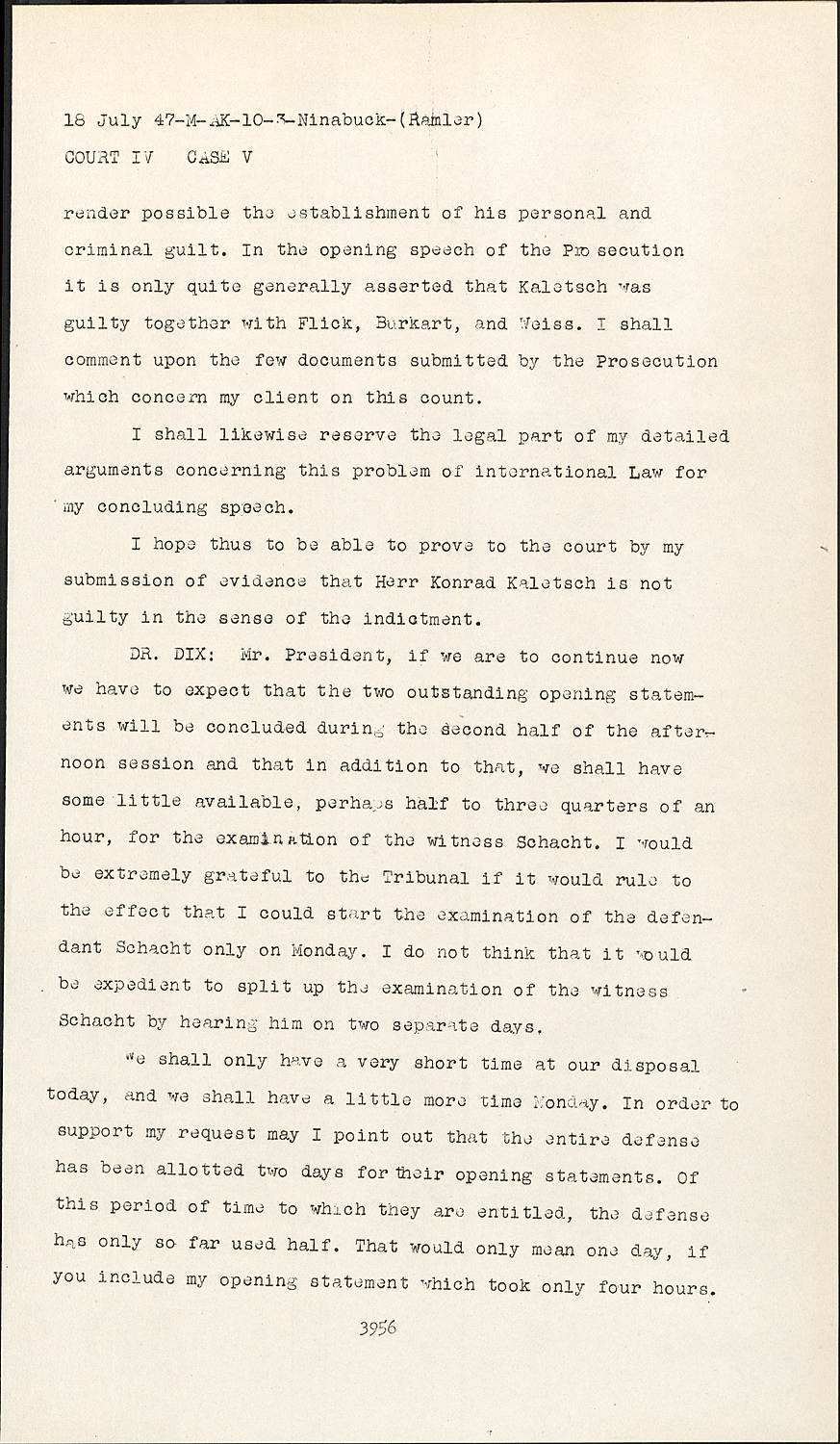
In the opening speech of the Prosecution it is only quite generally asserted that Kaletsch was guilty together with Flick, Burkart, and Weiss. I shall comment upon the few documents submitted by the Prosecution which concern my client on this count.
I shall likewise reserve the legal part of my detailed arguments concerning this problem of international Law for my concluding speech.
I hope thus to be able to prove to the court by my submission of evidence that Herr Konrad Kaletsch is not guilty in the sense of the indictment.
DR. DIX:Mr. President, if we are to continue now we have to expect that the two outstanding opening statements will be concluded during the second half of the afternoon session and that in addition to that, we shall have some little available, perhaps half to three quarters of an hour, for the examination of the witness Schacht. I would be extremely grateful to the Tribunal if it would rule to the effect that I could start the examination of the defendant Schacht only on Monday. I do not think that it would be expedient to split up the examination of the witness Schacht by hearing him on two separate days.
We shall only have a very short time at our disposal today, and we shall have a little more time Monday. In order to support my request may I point out that the entire defense has been allotted two days for their opening statements. Of this period of time to which they are entitled, the defense has only so far used half. That would only mean one day, if you include my opening statement which took only four hours.
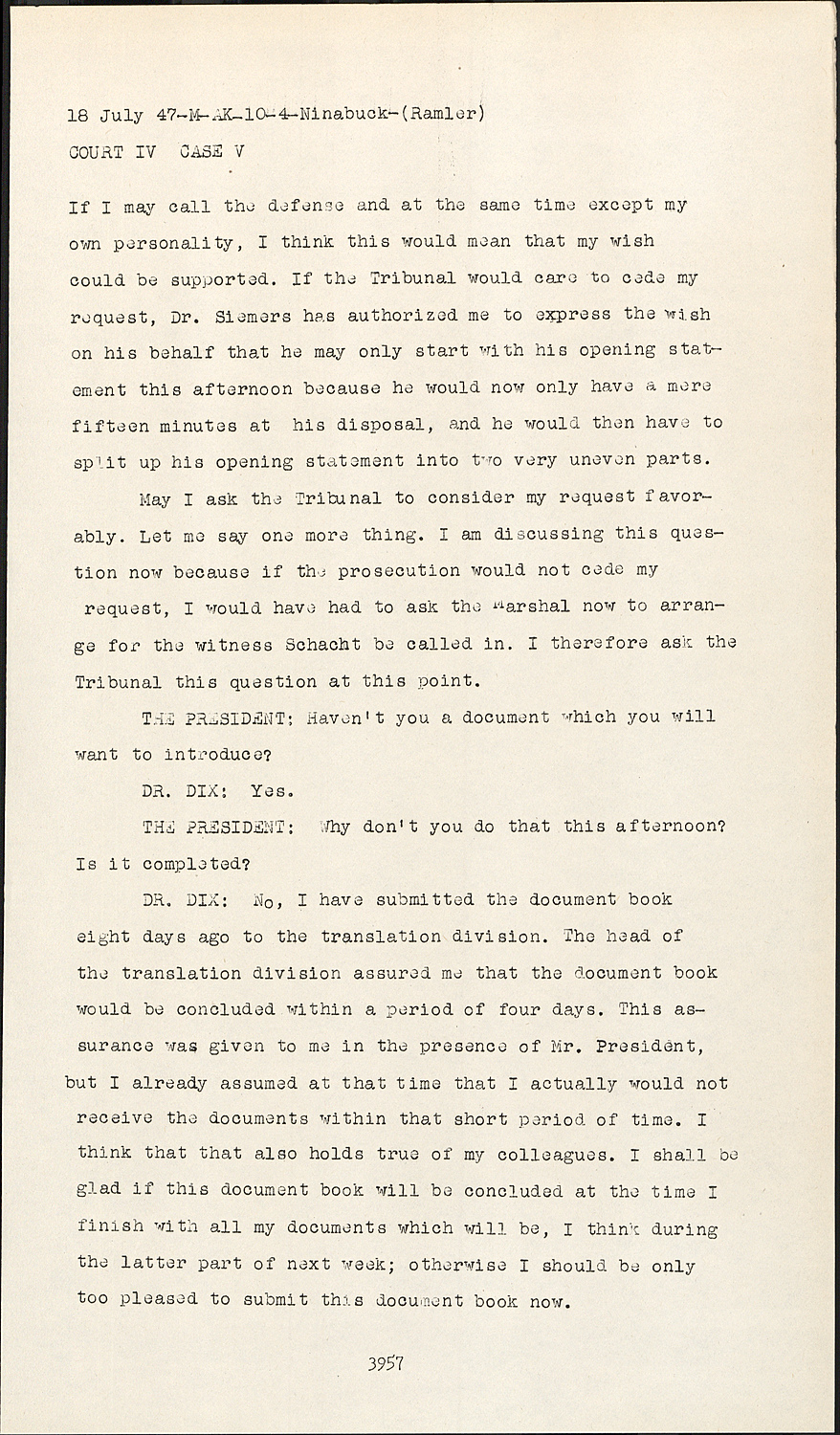
If I may call the defense and at the same time except my own personality, I think this would mean that my wish could be supported.
If the Tribunal would care to cede my request, Dr. Siemers has authorized me to express the wish on his behalf that he may only start with his opening stat ement this afternoon because he would now only have a mere fifteen minutes at his disposal, and he would then have to split up his opening statement into two very uneven parts.
May I ask the Tribunal to consider my request favor ably.
Let me say one more thing. I am discussing this ques tion now because if the prosecution would not cede my request, I would have had to ask the Marshal now to arran ge for the witness Schacht be called in.
I therefore ask the Tribunal this question at this point.
THE PRESIDENT:Haven't you a document which you will want to introduce?
DR. DIX:Yes.
THE PRESIDENT:Why don't you do that this afternoon?
Is it completed?
DR. DIX:No, I have submitted the document book eight days ago to the translation division.
The head of the translation division assured me that the document book would be concluded within a period of four days.
This as surance was given to me in the presence of Mr. President, but I already assumed at that time that I actually would not receive the documents within that short period of time.
I think that that also holds true of my colleagues.
I shall be glad if this document book will be concluded at the time I finish with all my documents which will be, I think during the latter part of next week; otherwise I should be only too pleased to submit this document book now.
A number of my witnesses, especially the witness Hannecken, I intended to show a number of documents from my document book, and I would have to do that without the Tribunal having the benefit of the English text. However, I am with no guilt in this respect. I worked as quickly as possible and under difficult circumstances of which the Tribunal is aware.
THE PRESIDENT:What does the prosecution say about the suggestion?
MR. ERVIN:You mean the original suggestion as to not calling the witness Schacht until Monday?
THE PRESIDENT:Yes.
MR. ERVIN:The prosecution has no objection to it unless the end of the opening statements is going to be very early in the afternoon session. As I understand from Dr. Dix probably they will run until the recess in any event. There are two more. Either that -
THE PRESIDENT:Well, we have fiteen minutes now.
MR. ERVIN:Fifteen minutes now.
THE PRESIDENT:Probably wouldn't get through even a shorter one of these remaining statements.
MR. ERVIN:No, and then Dr. Pelckmann has a statement.
THE PRESIDENT:Yes, then there is the longer one of Dr. Siemers. It probably will take until 3:00 o'clock.
MR. ERVIN:Yes, your Honor, so as I told Dr. Dix in recess we would have no real objection to calling the next witness on Monday morning; that is, the defense had the entire day and a half allotted to them for opening statements. They have not availed themselves of it and I think that in that respect there is really no overall delay in the proceedings of the case.
THE PRESIDENT:Of course, you understand, Dr. Dix, that the Tribunal is here ready to proceed with this case, It is quite true that the defense counsel have not occupied the time that was allotted to them and will not occupy the time, even taking in view the coming statements, will not fully occupy the time which was allowed to them for presenting their opening arguments, and in view of that attitude of the prosecution, which I understand is one of conceding the general appreciation and agreement with your position, the Court will accede to the suggestion of the defense counsel, will hear the concluding opening statements this afternoon, and adjourn until Monday morning at the usual time at which time we will expect a witness to be called; whether it be Schacht or Hannecken or someone else is a matter wholly for the defense. We won't influence the order of proof in any way in that respect. We will recess now until the usual time and try to come back promptly and hear the concluding opening statements, and then recess untill Monday morning. We will recess now until 25 minutes to 2:00.
(A recess was taken until 1335 hours.)
AFTERNOON SESSION
THE MARSHAL:The Tribunal is (again in session.
THE PRESIDENT:I observe that the defendants, are all present in the court room. Dr. Siemers.
DR. SIEMERS:Mr. President, may I point out that last night I received the English translation of my opening statement. Thanks to the friendly assistance of Dr. Wecker, I was in a position to submit corrected copies to the Judges, to Mr. Ervin, to the Secretary-General, to the interpreters and to the court reporters. May it please the Tribunal.
On the occasion of the anniversary of the Bavarian Expert Exhibition, Mr. Kenneth E. Dayton, the Deputy Director of the Military Government for Bavaria, stated that the greatest insufficiency of the Germans in the past months lay in the fact that thty had not worked out any plans for industrial development. Planning for German economy must not he loft entirely to the Government, since it lacked experts with sufficient experience and the knack to unravel the complicated and extensive plans.
I offer no opinion as to whether this criticism of Mr. Dayton concerning German industry is justified. But in any case I have the impression that Mr. Dayton is not in close contract to the American Prosecuting Authorities. For otherwise he would know that the Prosecuting Authorities started an anti-capitalist campaign German economy two years ago, and in connection with that arrested the majority of the leading German industrialists, who, to a great extent, are still in custody. It is after all no wonder if these measures, which were greeted joyfully by the Communists and the anti-capitalist Eastern states, worked out most unfavorably for the development of German economy. The criticism mentioned indeed of the American Military Government shows how problematic and how dangerous is the procedure of the Prosecuting Authorities It must be clearly recognized and explicitly stated that the industrial trials planned by Justice Jackson and conducted by or in the process of being prepared by General Taylor, represent no criminal proceedings against a few economists but are basically on attack against the whole German economy.
This results from the extraordinarily comprehensive forms of participation specified in Section II, Control Council Law No. 10.
According to the argument of the indictment a hundred thousand German economists, employees and workers are war criminals, because they have been involved in some way or other in so-called slave labor and in employment of prisoners of war. It corresponds absolutely to general humane feeling if these people are called to account who have themselves committed crimes against humanity. But it is incomprehensible when the charge is net made against real criminals but, purely for reasons of international law, against industrialists whose guilt lies in that they were industrialists and not powerful enough to oppose the measures of a dictatorial government.
1.) For the first time in the history of law, here in this trial industrialists, that is, private persons, stand before the court because they are alleged to have violated international law. I consider this legally inadmissible. All previous international treaties, as e.g. the Hague Convention concerning land warfare of 1907, and the Geneva Convention on the treatment of Prisoners of war of 1929, were directed at the State and not at private individuals. It was a general principle that the responsibility for observing rules of international law was the State's. The International Military Tribunal has deviated from this principle in the great Nuernberg judgement and it holds responsible not only the impersonal State but also those persons who have acted for this State. This argument may at least be justified in the interest of the development of international law because it seems to be logical that he who acts in the name of the State is just as responsible as the State itself. But it is not understandable if now the prosecution goes beyond that and wants to make even the individual citizens, that is, private persons, responsible, although these private persons have not themselves acted for the State in the course of its measures, but on the contrary were the victims of the measures taken by the State, that is to say, they were obliged as citizens of the State to suffer the measures taken by this State.
It is in agreement with this when the French Chief Prosecutor de Menthon in the great Nuernberg trials said the following in his indictment of 17 January 1946:
"It is clear that in a modern organized State, responsibility is limited to those who act directly for the State, since only they are in the position to judge the legitimacy of the orders given.
They alone can and shall be prosecuted".
The present Prosecuting Authorities are opposing this train of thought when they prosecute the industrialists, that is, private persons, who in contrast to the defendants at that time, such as Goering, Sauckel, Rosenberg, etc., did not act for the State.
This fundamentally new attitude taken up by the Prosecuting Authorities has consequently evoked considerable opposition in the whole world.
Justice Jackson, the American Chief Prosecutor in the first trial had not been able to carry through before the Tribunal his idea of the collective guilt of the German people; beyond that he championed the trial of the industrialists and in the meantime, influenced by the IMT judgment, withdrew from further trials, while another member of the Prosecution, elected by President Roosevelt, General Donnovan, did the same thing many months earlier. In December 1946, that is 2 months before the present indictment was made, the Prosecutor Pommerantz returned to America and to the journalists stated expressly that he could no longer represent the prosecution out of legal conviction. In the meantime, as is generally known, the Republican Party in the United States declared itself against the Industrial Trials and, - just as significantly - evidently also the Government of the British Empire, since it refused participation in these trials. How much the American trial against the German industrialists was wondered at not only by the Republicans in the United States but also in London in spite of the Socialist Government, was shown for instance by the inquiry made by the Labor M.P. Rhys Davies on 23 May 1947 in the British House of Commons, whether works managers, foremen of mines, engineers, and manual laborers, who helped the National Socialists to wage war, would likewise be arraigned after the American authorities had now arraigned the leading German industrialists for the same reason.
All this shows that the Prosecuting Authorities have gone too far in their fundamental attitude; the evidence produced by the defense will show that the attitude of the Prosecution is based to a large extent on legal errors and that the actual conditions under which the accused industrialists lived cannot be made to agree with the legal conception of the indictment.
2.) The Prosecution quote in their indictment all the Articles of the Hague Convention concerning land warfare and of the Geneva Convention against which the defendants have allegedly offended. In quoting these Articles the Prosecution forgets to mention that the Soviet Union did not ratify the Geneva Convention. Still more important is the fact that the Prosecution in its argument ignores the fact that internationally legal customs, as well as the codified International Law, are decidedly unstable legal regulations. International Law is always dependent on historical development and has changed many times in the course of time, becoming both broader and narrower, a fact which has been shown particularly in the development of modern warfare in the First World War. Therefore the International Military Tribunal says the following on International Law in its Nuernberg judgment:
"This law is not rigid, but follows, by constant assimilation, the necessities of a changing world.
It is a fact that in many cases treaties do nothing other than give form to already existing legal principles, and define them for the purpose of their application at a given time".Therefore, when applying the provisions of International Law, the historic development of the methods of warfare must be taken into consideration.
The methods of warfare known in the year 1907 were so very different from the methods of modern warfare, that is, the methods of the Second World War, that it seems hazardous to apply the internationally legal principles codified in the year 1907 without modification.
It would be fare more correct to adapt these codified legal principles, as in the quotation already read, to the "necessities of a changing world". Undoubtedly the meaning of the regulations in International Law must be adhered to, and the human ideas of these provisions must be taken into account. On the other hand however they must be adapted to the development of warfare. It seems to be in direct opposition to the basic ideas of humanity if all inhumane acts in aerial warfare are allowed and are not taken as offences against International Law, or as crimes, for the simple reason that aerial warfare was not conclusively codified cither in the year 1907 or at any other time; whereas on the other hand every small formal offence in the treatment of occupied territories is represented as an offence against International Law or as a crime for the simple reason that is was codified in 1907. It seems to me to be opposed to the most basic legal conception if one of the accused industrialists is punished as a war criminal for employing a Belgian concvripted for labor; whereas it is considered unimportant from the point of view of International Law or even as permissible, if the homes of the civilian population are turned into piles of rubble and ashes, as can be seen in almost all German towns, and which we see daily to our sorrow here in the old walled city of Nuernberg; or when, during the war in the country an airman murdered men, women and children with machine-guns without there being the slightest connection with a military purpose. It is likewise contrary to a sense of justice that submarine warfare is considered restricted by rules of International Law whereas in aerial warfare the civilian population is an open prey to military attacks.
These may also have been the ideas which caused the International Military Tribunal, in contrast to the Prosecution, to represent certain actions in submarine warfare as offences against International Law but not as war crimes. In this very sphere it was shown at the first trial in Nuernberg that International Law is dependent on change in methods of war.
The court had to ascertain that as a result of the technical development of warfare neither the United States of America nor Great Britain nor Germany had kept to the earlier provisions.
The same ideas that applied to aerial and submarine warfare must also apply to economic warfare. In the course of the terrible and pernicious total war, also economic warfare, too and therefy war in the occupied territories, was compelled to take on other forms than were formerly known.
I should believe that it is appropriated in this context that Winston Churchill stated in the British House of Commons on 27 February 1940 that he was "tired of thinking about the rights of the neutrals", and on 30 March of the same year broadcasted on the radio:
"It would not be right if the Western Powers in the life and death battle hold fast to legal provisions."
A few days later on 6 April 1940 the English Labor Minister, Ernest Brown, said that neither Germany nor the neutral countries could count on the "Western Powers keeping to the letter of International Law."
Likewise in the past 2 years there are innumerable facts which seem to confirm the mentioned principle that International Law adapts itself to methods of warfare and that a victorious nation no longer respects the provisions of the Hague Convention concerning land warfare and the Geneva Convention, to the sorrow of all, as the prosecution would say, well-meaning persons. To make myself understood I need only point out a few facts:
Pursuant to the orders of the British and American Military Government industrial plants were dismantled, thus pillaged in the sense of the indictment, although such measures are in contradiction to the Hague Convention concerning land warfare. The Soviet Union has dismantled or again as the indictment would phrase it - pillaged factories to on even much larger extent. In addition to this, the Soviet Union, despite oppo sition on the part of the Governments of the U.S.A. and Great Britain, has deported people, or - as the indictment would phrase it - carried them off for compulsory labor for the purpose of exploiting then as slaves.
3.) Even if la contradiction to all legal principles valid until now, every private person, every citizen were to be hold responsible for the observance of the regulations of international law, and even if, when indicting the defendants, are were to abide strictly by the Letter of codified international law de*---* the changed circumstances, despite too total economic warfare which altered the base of the entire warfare, particularly so in occupied territories, despite the allied acts which in part were in gross contradiction with the Hague Convention concorning land warfare and the Geneva Convention, there still remains a third basic objection against the argumentation, of the Prosecution;
In section 7 of the indictment, the Prosecution, in connection with prisoners of war and the occupied territories, has enumerated numerous articles of Hague Convention concerning land warfare (viz. 11 articles) and to a still larger extent, vie. 38 articles, of the Geneva Convention of 1929 concerning prisoners of war, assorting tint these have been illegally, intentionally and knowingly infringed.
In every infringement of everyone of these innumerable articles the Prosecution sees not only a punishable act, but even a war crime. I will refrain from debating details before the farts of the case have been clarified by the case-in-chief of the defense and in particular not in regard to subjective questions, as for instance the question of intention which can be clarified only in the course of the case-in-chief*---*. I would like to point out right now however, that the-case of the Prosecution in this general form is legally not justified, not tenable. In is in the nature of who charge that serious facts only can be considered war crimes. Not every violation of the regulations of the Geneva Convention can constitute a punishable act or even a war crime ipso jure. It is exactly the same in international law as in the civil law of every civi lized state, both codes are governed by the principle of legally to agreements.
Breach of contract is no more permissible in civil law than it is in international law. But not every breach of contract constitutes a punishable act.
A punishable act can exist only then when a serious breach of an agreement is involved and if besides a specified malicious intent is added.
Examining the articles of the Geneva Convention which have been enu merated by the Prosecution, from this point of view numerous instances can be found which clearly prove that there is no violation at issue which can be considered a war crime.
In order to make myself clear I would like to mention just a few *---* the articles quoted by the Prosecution, namely the articles 6, 23, 34, 30 and 57 especially mentioned by the Pro secution.
Under article 6, personal effects as well as steel helmet and gas mask, are supposed to remain in the possession of the prisoner of war.
Money may be taken away against receipt only, insignia of rank and decorations must not be taken away from the prisoners of war.
Article 23 deals with the amount of the salary and article 34 with the wzges to be paid if the prisoner of war works.
In article 30 the working hours are regulated to the effect that they should not exceed those of civilian workers.
Pursuant to article 57 prisoners of war under disciplinary punishment may read and write as well as dispatch and receive letters.
This list may be supplemented at will. However, I believe that these brief indications will suffice as they merely are intended to show that am infringement of regulations of this kind cannot constitute a crime.
With regard to the Russian prisoners of war special mention must be made of the fact that again and again during the war it was pointed out on the part of the State that the Soviet Union did not sign the Geneva Convention and that consequently the German prisoners of war in Russia were not treated in accordance with the Geneva Convention. That this fact had its consdquences and in many cases influenced the attitude towards the Russian prisoners of war is natural and perhaps comprehensible if one considers that again and again during the war it became known that the Soviet Union, contrary to the Hague Convention concerning land warfare and contrary to the Geneva Convention employed prisoners of war directly in the zone of operations without the least scruples, for instance in the factories of Leningrad at a period when Leningrad was besieged by the Germans.