AWith our position in connection with the Rombacher Huettenwerke, no change was made. We conducted the works in 1942 like we did in 1941, in 1943 like in 1942 and in 1944 like in 1943, etc. Nothing changed and more specifically no change took place in our policy of investments.
AThe reputation of the entrepreneurs was involved, and I didn't want anybody to say that I had used a trusteeship over a foreign work in order to use it for our personal advantage and to the disadvantage of the real owners and to impoverish it. If we did not make so many investments, then the corresponding part of the money rested with us, but there are conceptions too concerning prestige and concerning the reputation of the entrepreneur. And these considerations took a considerable part in my thoughts in this connection. I repeat that our policy of investments in Romach did not change at all, even in a period of time, when no reasonable man in the world and even in Germany could think that Lorraine would be restored to German sovereignty and that, therefore, we could count on taking over the Rombach plant.
DR. KRANZBUEHLER:Thank you, Your Honor, I have no further questions. BY DR. NATH:
Q.Herr Dr. Flick I want to ask you a few questions too. First of all I would like to clarify the structure of Mittel-Deutsche Stahlwerke, AG, and I want to discuss it with you. It is quite noticeable that the Mittel-Deutsche Stahl Werke had several groups of Vorstands. One group was at Riesa, another one at Brandenburg, and a third one in Berlin. Is that correct, Herr Flick?
AYes, that is correct.
QNow, how can you explain this structure of groups within the Vorstand?
AWell, if I want to explain that I have to give you a short description of what belonged to the Mittelstahl Works. Mittelstahl owned a certain number of plants in the Saxonian region, Riesa, Groeditz, and Lauchhammer. Another part of the plants were situated near Berlin at Brandenburg and Henningsdorf. The Saxonian group included the three already-mentioned plants, and the management of these three works was presided over by a Vorstand of three members. This Vorstand had its seat at Riesa on the Elbe. There was one technician who had the total technical management of the three works--that is, the steel works, rolling works, iron and engine works, pressing works, the smith works, and apart from that there were two business men.
One of them was in charge of purchasing and sales, and that was connected with questions of corporation at the same time. And the third was the administrative director who handled all internal affairs. And his functions were similar to these of Krugmann at the Maxhuette, which I have already described this morning, and I don't have to repeat that here I think. The groups Brandenburg and Nenningsdorf were managed by two brothers-Hennecke. One of them was a technician, and the other one was a business man. And facutally speaking, matter were similar to what they were with the Saxonian works.
QNow, Herr Flick, Mittelstahl had at Berlin, where there were no works, the so-called administrative office, and in that administrative office you could find the third group of Vorstand, and that is the two members of the Vorstand--Burkanrt and Kaletsch. Now, what were their tasks?
AMittelstahl owned not only its own plants, but Mittelstahl also owned considerable interests and securities. The chart which has been posted against the wall here hows the situation as it was in May, 1945. Two years before that date the picture would have been quite different. At that time Mittelstahl was under the Freidrich Flick, Kommandit Gesellschaft, and the Mittelstahl Works in turn were followed by a many-fold ramification and interlocking of all companies which now are more or less immediately connected with the Kommandit Gesellschaft and more specifically that was done in the course of transactions which started in the summer of 1943, but which were only concluded at the end of 1944. I had to mention that briefly because of the question put by Dr. Nath. This was the picture as it was in 1945, but in 1943 it was quite different. In the middle of 1943 the Mittelstahl had dual functions. Mittelstahl owned the five works I have mentioned, but at the same time it was a holding company in which partly in a three or four-fold interlocking all these participations eventually channeled and this holding part in Mittelstahl of course had to be administered, too.
And to administer that holding was the task for these gentlemen Kaletsch, Burkart, and Weiss, and basically it was also my task. I was not one of the directors of Mittelstahl. The management of Mittelstahl was at Reisa and at Brandenburg, and in Berlin, the task of these three gentlemen and my own task was mainly to administer these industrial participations and to exercise the functions which resulted from this profit and its administration and its proper and reasonable and good administration, and we had to hand out corresponding commissions to the Aufsichtsrat and to the president of the Aufsichtsrat, and also, as far as possible, to exercise a corresponding influence--that is an influence that corresponded to our share in the holdings. Now, I want to turn back to the question by Dr. Nath. I repeat again the gentlemen were there to administer the -- holding part, and, furthermore, the administrative office of Mittelstrahl at Berlin was a liaison office to Berlin agencies--Government agencies, to the banks, to the Reich bank, and in this sense this was just a longer arm of the administration in the works themselves, as every large concern had it. The Vereinigte Steelworks at Dusseldorf with all their establishments in the Ruhr with their central agencies at Dusseldorg, however, had a branch office at Berlin, a snail branch office of which the purpose was to maintain the relations with the Berlin agencies, and I think that is also how it happens in the other countries, if the firm DeWendel has its scat in Heigingen for instance, it will also have an office in Paris but the main office and management of DeWendel will be in Heigingen in Lorraine. In Paris they will have a liaison office, and N. Laurent -- excuse me, Mr. DeWendel, will have an office there. That is only an example for the guidance of the Court,
QNow, in the course of my case in chief I will show the Tribunal by chargs the development of the Flick Group, and by that I will show clearly the holding part of the Flick Group which was administered by Court, Case 5 my client and the others.
Now, I want to ask the following. Within the administration of the holding part what tasks did Herr Kaletsch have?
AKaletsch had to deal with financial matters--statements of affairs, finance, and so forth. Those were mainly his tasks.
QDid the members of the Vorstand of Mittelstahl have written contracts?
AYes.
QWere the fields of activities defined in these contracts--as you have already mentioned?
AI think that that was the case. Whether they are defined very much in detail I couldn't tell you. I don't suppose they were, but, of course, the general outlines were established, and the tasks defined for which the person involved had to be employed.
QCan you remember whether you have given such a written contract to Herr Kaletsch?
AThere was no written contract between Kaletsch and me. From 1925 Kaletsch had been employed with me; he was much a part of our structure and had grown into his position; furthermore, there were personal bonds between us of a nature which made a written contract appear superfluous.
QIs it correct if I say that this historic development of the position of Herr Kaletsch during this period of his employment with you remained constantly the same - namely dealing with matters of finance, with statements of affair, tax problems, and so on?
AIn a general outline that is correct. Nothing changed. Well, of course, you cannot imagine it 100 percent clearly defined. I mean our collaboration was not exactly that everybody would have a quite clearly defined field. That is impossible, you cannot do that. There are matters of which you cannot say here the activity of John Doe stops and there it starts with Tommy Atkins. You cannot say that in an A.G.
QHerr Flick, I am only interested in having the general principles confirmed and I think you did that with your answer. Now I only want to put the following question to you. You know that in 1943 the Mitteldeutsche Stahlwerke was transformed from the legal form of an A.G. into the legal form of a G.m.b.H. By that transformation did any change occur in the field of activities of these 3 groups of the Vorstand which you have just mentioned at the Mittelstahl?
ANo.
QNow I would like to turn to the Friedrich Flick Kommandit Gesellschaft. In 1937 the Siegener Eisenindustrie was converted into a personal company, namely the Friedrich Flick Kommanditgesellschaft. The Siegener Eisenindustrie up to that date had only been a holding Company. Now, when the Friedrich Flick Kommanditgesellschaft was founded, not only the large shares were brought into that company but also steel works and rolling mills, namely Hennigsdorf and Brandenburg were attached to the newly founded Friedrich Flick Kommanditgesellschaft Exactly like with Mittelstahl, the Friedrich Flick Kommanditgesellschaft had considerable participations, that was the so-called holding part and on the other hand their own plants.
At that time you gave general power of attorney to several gentlemen of the Friedrich Flick Kommanditgesellschaft. Did these powers of attorney refer only to the field of activities of the FKG or did they exceed it and have some other important apart from that?
AThey only covered the field of Friedrich Flick Kommanditgesellschaft. They had no further importance apart from that.
QDid these exclusive powers of attorney give the right to a sole representation of the Friedrich Flick Kommanditgesellschaft, or were they limited?
AThey were limited to collective signature. There was notright to be sole representative of the Friedrich Flick Kommanditgesellschaft.
QWhat were the fields of tasks of the individual plenipotentiaries within the FKG? The written exclusive authorities show that every plenipotentiary had the right to act for the whole field of activity of the FKG and therefore I have to assume that this goes also for the management of the works. Now it is well known that an internal power of attorney can be limited to a well defined field of tasks to which the plenipotentiary had to confine himself. Now, how was the situation with the Friedrich Flick Kommanditgesellschaft? I want to clarify my question. Did all these plenipotentiaries have competency for the total field of businessof the FKG and for the management of the works?
AThese gentlemen, Hennecke and Goebel, were competent for the management and conduct of the works. Thereby the gentlemen Kaletsch, Burkart, and later on also Weiss, were not connected immediately with these tasks. The Henneckes, even after the Kommanditgesellschaft had been founded, were actually and factually in the same position they had before, as members of the Vorstand of Mittelstahl; namely, they had the management of the works in their hands.
The gentlemen from Berlin were competent for dealing with the holding part, and the powers were corresponding to that. The powers for the gentlemen Hennecke and Goebel were for the management of the works and the powers of the gentlemen in Berlin were for holding matters - and they had been defined in that sense.
QIs it correct, if I may summarize, that the definition of powers had been caused by a very clear and unambiguous discussion and agreement between the other gentlemen and you?
AYou mean to say between me and the other gentlemen?
QYes, between you and the other gentlemen?
AWell, I can repeat that there was a quite clear separation of powers between theworks on the one hand and Berlin on the other hand; within the powers in Berlin there was also a basic separation that Kaletsch had the power for finances, Burkart for another, and Weiss for a third. But I have already said that it could not be such an absolutely clear out legal line drawn between these fields of authority in practice. There is a certain overlapping that cannot be avoided. I have told you already and I cannot say anything else now. I said that Kaletsch had finance and administration and whatever is connected with it; Burkart had to do with the smelting works and the soft coal; Weiss again had something to do with the hard coal and the processing of the goods; and then there were matters also with which Herr Kaletsch as well as Herr Burkart were concerned and you cannot always draw a line and Say Kaletsch has these matters and there Burkart's sphere start. After all, practical life is not such a clear-cut book. Perhaps a lawyer can see it that way. But that is not how it really is.
Herr Flick, even the lawyer has some connection with practical life; at least, as for myself, I want to say that. But the point I want to make is - you told us about the division of powers. I only wanted you to clarify that, basically speaking, Herr Kaletsch, for instance, was responsible for the holding part and for finance and that he could not turn up in the works management with the Hennecke gentlemen and give then orders which after all were only of the competency of the Henneckes - is that correct?
AWell, this I can confirm clearly and expressly.
QThat is what I wanted. That is the main point. That these fields have a certain overlapping and that Herr Kaletsch might have discussed financial matters with the brothers Hennecke, that is certain - I mean that is granted. I think I can only ask you the following question concerning the Friedrich Flick Kommanditgesellschaft. Judge Richman has already asked whether your collaborators, that is, Steinbrinck, Burkart, Kaletsch and Weiss, had a financial share in the companies and whether, therefore, they had a personal financial interest in their activities insofar as the interest could cover the individual companies, and you said No. You answered that the gentlemen just mentioned had no actual participation but were employees of the company - of the Friedrich Flick Company.
JUDGE RICHMAN:He added to that that they had a share in the profits.
QWell, I was just going to come to that point. I wanted to ask HerrFlick about that. what I wanted to ask,you, Herr Flick, was to tell me whether the income these gentlemen received as plenipotentiaries, in the cases of Kaletsch and Burkart, at the same time as members of the Vorstand of the Mitteldeutsche Stahlwerke - whether all these incomes together would exceed the income of other members of Vorstands of Important companies of the concern? In other words, whether they could be compared with the income of the other members?
AI do not think that they exceeded the income of the other members of the Vorstand and in the general line they can be compared with those incomes.
QHerrFlick, do you know whether there were members of the Vorstand in the companies which received higher incomes than the gentlemen I have just mentioned?
AYes, there were members who received higher incomes. For instance, I know that the leading members of the Vorstand of the hard coal companies, Tengelmann and Buskuehl, - considerably higher incomes were paid to these than to the gentlemen who were working in Berlin, that is, the gentlemen Burkart, Kaletsch and Weiss.
QNow at this point I want to ask you another brief question, Herr Flick. Is it correct if I say that these gentlemen, Kaletsch, Burkart and Weiss, and before them also Herr Steinbrinck, had the same kind of authority? I mean that not one of them would have been the other's superior but rather that they had the same rank of position? Is that correct?
AYes, that is correct.
QI would like to leave this field now and I would like to ask a few questions concerning the counts of the indictment insofar as they refer to my client. Maybe I can do that after the recess.
THE PRESIDENT:The Tribunal will be in recess for 15 minutes.
(A recess was taken.)
THE MARSHAL:The Tribunal is again in session.
THE PRESIDENT:Dr. Nath.
BY DR. NATH:
Q.Dr. Flick, I have a few more questions concerning the counts in the indictment which refer to my client. Herr Kaletsch has been charged with having employed forcing workers and concentration earn inmates, with having treated then inhumanely, with having employed prisoners f War in the armament industry and with being responsible for those matters. Dr. Flick, you have told us that Herr Kaletsch since he had cooperated with you, that is to say, sin since 1925 until the end, had never been in charge of the factor, not even as a member of the Vorstand of Mittelstahl nor as a Plenipotentiary General of the FHG. Is it possible then that he could have employed foreign workers, inmates of concentration camps and prisoners of war within the meaning of the indictment?
A.No. That was not possible. As I have already said here, all these were matters with which the Vorstand are concerned or the factories concerned dealt with, that is to say, outside of Berlin, and Kaletsch dealt with the sphere of duties which I have already described in detail. He had nothing to do with employment questions, labor questions.
Q.Is it correct, then if I say that Herr Kaletsch did not have the right in any plant to employ workers or employees or to dismiss them?
A.He was not entitled to do so. All these matters were dealt with by the plants themselves. They were matters to be dealt with by the Vorstand in the plant and who responsibly managed the plant.
Q.I would now like to go over the so-called cases of Aryanization. In 1937 or at the beginning of 1938 did you put in charge Kaletsch of negotiations concerning the acquisition of shares of the Ravag and Gruenfeld A.G. and shares of the Luebeck-Hochofenwerke and of holding those negotiations with the former owners?
A.No, I know nothing of that.
Q.As far as you yourself know, did Herr Kaletsch participate in such negotiations?
A.Not in my recollection.
Q.We now get to the group of questions concerning Julius Potschek. On 21 May 1938 an agreement was concluded with United Continental Corporation concerning shares of the Anhatische Kohlenwerke and the Werschen-Weissenfels. Did Herr Kaletsch take part in those negotiations which led to the concluding of that agreement?
A.Concerning the negotiations with Murnane, Stratallen and Weissmann until the agreement about the deal, that is to say, until the price was fixed, Herr Kaletsch did not participate in those negotiations.
Q.Cid Herr Kaletsch exercise any influence on the fixing of the prices?
ANo; he could exercise no influence on the purchase price because, as I told you before, when he went into action, the purchase price had already been agreed upon.
Q.At the time when the agreement was concluded, that is to say,on 1st of May 1938 was there any clear arrangement, first, as to whether the necessary consent for making the deal had been given, secondly, as to who would be the final purchaser of the shares? That is to say, what company? Three, as to whether and through what channel the necessary foreign exchange would be acquired and four, as to what expenditure would be necessary for the acquisition of foreign currency?
A.At the time when the agreement was concluded that question still remained open.
Q.As for carring out the transaction without the participation of the Vorstand of the Anhaltische Kohlenwerke and WerschenWeissenfels, that is to say, the Petschek companies--was that possible at all or was it intended at all?
A.It wasn't possible without the production company itself. Without them it would have been impossible to carry out the deal. The Wintershall and Salzdetfurth companies would receive a substance of coal, the transfer of coal despsits to these companies being an essential condition, and in order to do that the co-operation of the Vorstaende of the Anhaltische Kohlenwerke and WerschenWeissenfels was naturally necessary. The question of foreign currency, of course, does play a part as far as all of the problems are concerned and on that point discussion and negotiations with the Vorstand were necessary.
Q.I wand to differentiate. Did Herr Kaletsch take part in the negotiations with the Vorstand of Anhaltische Kohlenwerke and Werschen-Weissenfels and Group Wintershall, Salzdetfurth and I. G. on the other hand for the matter concerning substance?
A.He did not take part in the negotiations about the distribution of substance. That was first of all a question pending between the Vorstaende concerned, the companies themselves and the exports.
As soon as the financial aspect came up the sphere of work of Kaletsch came into play. Again I have to say that it is difficult to differentiate the distribution of coal and the transfer of coal; with those natters Kaletsch did not deal. As far as it was not a financial question or as far as the financial question did not come up as a result.
Q.That's obvious, Dr. Flick. Did Herr Kaletsch participate in the negotiations which finally led to the well-known exchange between hard coal for lignite between the Reichsworke Hermann G Goergin and the Harpener-Gergbau-Gesellschaft on 9 December 1939?
A.No.
Q.Did Herr Kaletsch exercise any influence on those negotiations and on the transfer and the exchange of coal for lignite as far as you know?
A.No, that's not so.
Q.Did Herr Kaletsch exercise any influence on the trustee arrangement for the Rombacher-Huettenwerke and the sponsorship agreement on Dnjoprstahl and the Trusteeship of the Vairogs factory?
A.As far as the arrangement of those trusteeship is concerned Herr Kaletsch had no influence.
Q.Thank you. I have no further questions, Your Honor.
THE PRESIDENT:Dr. Siemers.
BY DR. SIEMERS:
Q.Dr. Flick, my client, your nephew Bernhard Weiss was your youngest collaborator in the management at Berlin. That is to say, he was the last person to join you as a collaborator and that was in the Spring of 1940. Tell us what were the reasons for you in 1939 to negotiate with Herr Weiss and ask him to join the management of the concern at Berlin?
A.Naturally as my nephew I have always followed with interest his personal development after the death of my brother-inlaw. It happened quite automatically that Herr Weiss, who at that time was only 28 years old, and who was in charge of his father's firm, it followed, as I say, that he discussed with me many matters as I was his older relative and frequently he asked me for my advice. That was all the more natural because I, myself, or my own firm had interests in the Weill firm and in the Siemag. That is to say, we held an interest in that firm up to 20$. From my observation and the many discussions and negotiations with Herr Weiss I gained the impression that Herr Weiss possessed the ability to cope with a greater task as, furthermore, from the personal angle, too, I had every confidence in him and it happened almost every night, of course, that I asked him in 1940 after Herr Steinbrinck had left us, to join the service of the Mittelstahl Gruppe, that is my service. That was how Herr Weiss took up residence in Berlin and assumed the functions with which you are familiar.
Q.Dr. Flick, did Herr Weiss accept your suggestion immediately or how actually did those negotiations develop? Did they go on for some time?
A.These matters of course, didn't develop from one day to another but the agreement came about. Herr Weiss had the understandable wish, in fact, he made that a condition that in his new function with me in Berlin he should be allowed sufficient time to enable him in broad outlines to take care also of the management of his own enterprise, that is, the Siemag. I conceded to his wish.
Q.In principle Weiss took over Steinbrinck's sphere of duty but with a different distribution or rather with a certain amount of restrictions. Lignite was a field which formerly belonged into Steinbrinck's sphere of activity and Herr Weiss did not take that over. Burkart took that over. On the other hand, Herr Weiss with the same independence such as Herr Steinbrinck exercised dealt with the so-called processing plants.
Those are the enterprises whidh I should like to describe as having been combined in what I might call the intermediate holding company Faguma, that is the LinkeHofmann Works, the Railroad Car and Machine Factory Busch and the ATG in Leipsig. We call those the refining groups. At first he dealt with the direction of the hard coal group, Harpen and Essener Steinkohle. His sphere of activity comprised -- all those matters which were dealt with in Berlin and to make that clear I have to emphasixe again and again that these enterprises were not being managed from Berlin but their interests and participations were taken care of as well as all measures connected with them were handed but the management itself was in Dortmund, and in Essen and in Breslau, in the hands of the Vorstand. Weiss took care of the Railroad Car factories and the ATG in which he was chairmen of the Aufsichtsrat and within the hard coal group he was a member of the Aufsichtsrat. He played more or less the role of a liaison man between he hard coal group and myself.
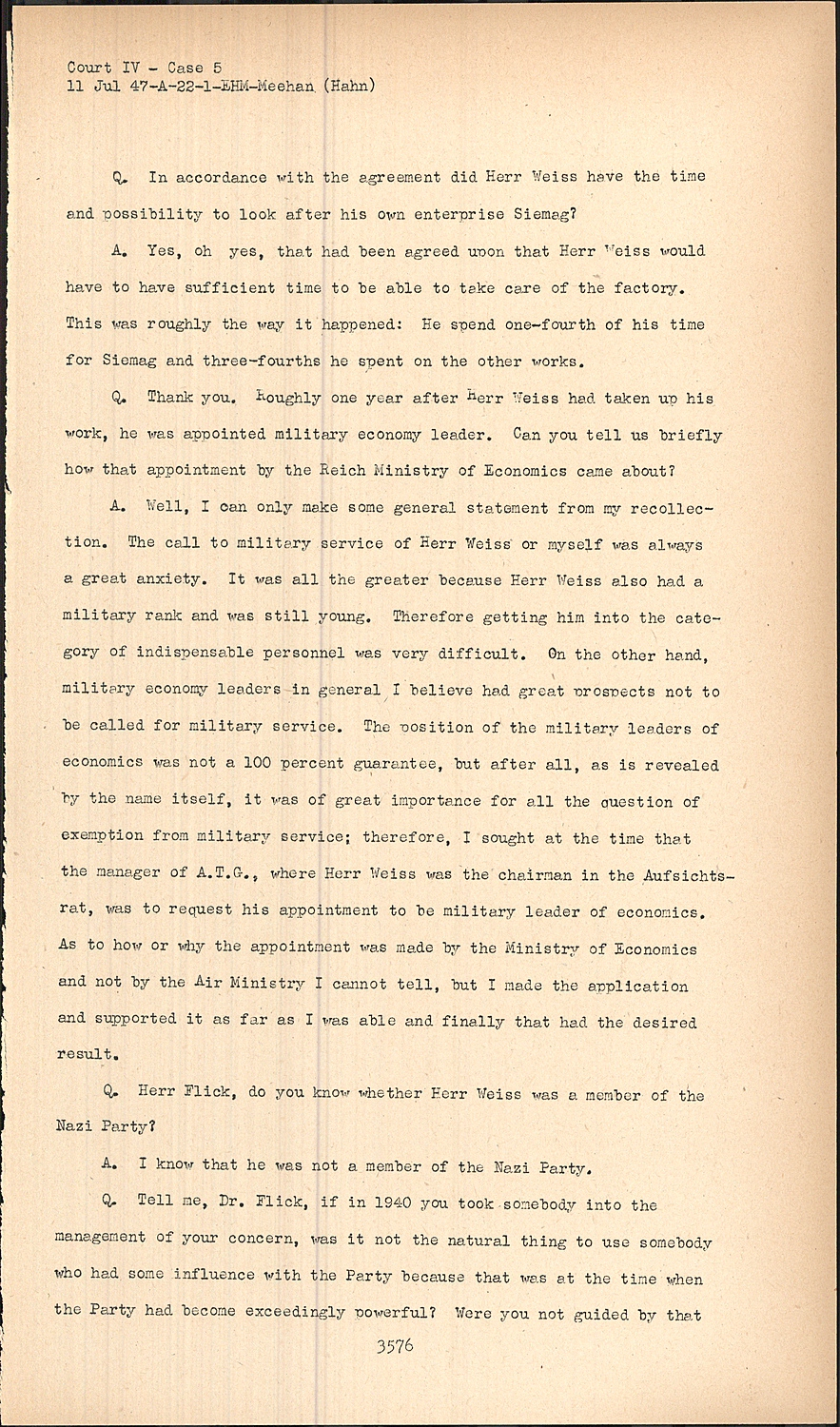
Q.In accordance with the agreement did Herr Weiss have the time and possibility to look after his own enterprise Siemag?
A.Yes, oh yes, that had been agreed upon that Herr Weiss would have to have sufficient time to be able to take care of the factory. This was roughly the way it happened: He spend one-fourth of his time for Siemag and three-fourths he spent on the other works.
Q.Thank you. Roughly one year after Herr Weiss had taken up his work, he was appointed military economy leader. Can you tell us briefly how that appointment by the Reich Ministry of Economics came about?
A.Well, I can only make some general statement from my recollection. The call to military service of Herr Weiss or myself was always a great anxiety. It was all the greater because Herr Weiss also had a military rank and was still young. Therefore getting him into the category of indispensable personnel was very difficult. On the other hand, military economy leaders in general I believe had great prospects not to be called for military service. The position of the military leaders of economics was not a 100 percent guarantee, but after all, as is revealed by the name itself, it was of great importance for all the question of exemption from military service; therefore, I sought at the time that the manager of A.T.G., where Herr Weiss was the chairman in the Aufsichtsrat, was to request his appointment to be military leader of economics. As to how or why the appointment was made by the Ministry of Economics and not by the Air Ministry I cannot tell, but I made the application and supported it as far as I was able and finally that had the desired result.
Q.Herr Flick, do you know whether Herr Weiss was a member of the Nazi Party?
A.I know that he was not a member of the Nazi Party.
Q.Tell me, Dr. Flick, if in 1940 you took somebody into the management of your concern, was it not the natural thing to use somebody who had some influence with the Party because that was at the time when the Party had become exceedingly powerful? Were you not guided by that Court IV - Case 5 idea or did you have no misgivings about taking Herr Weiss, who had no relations with the Party?
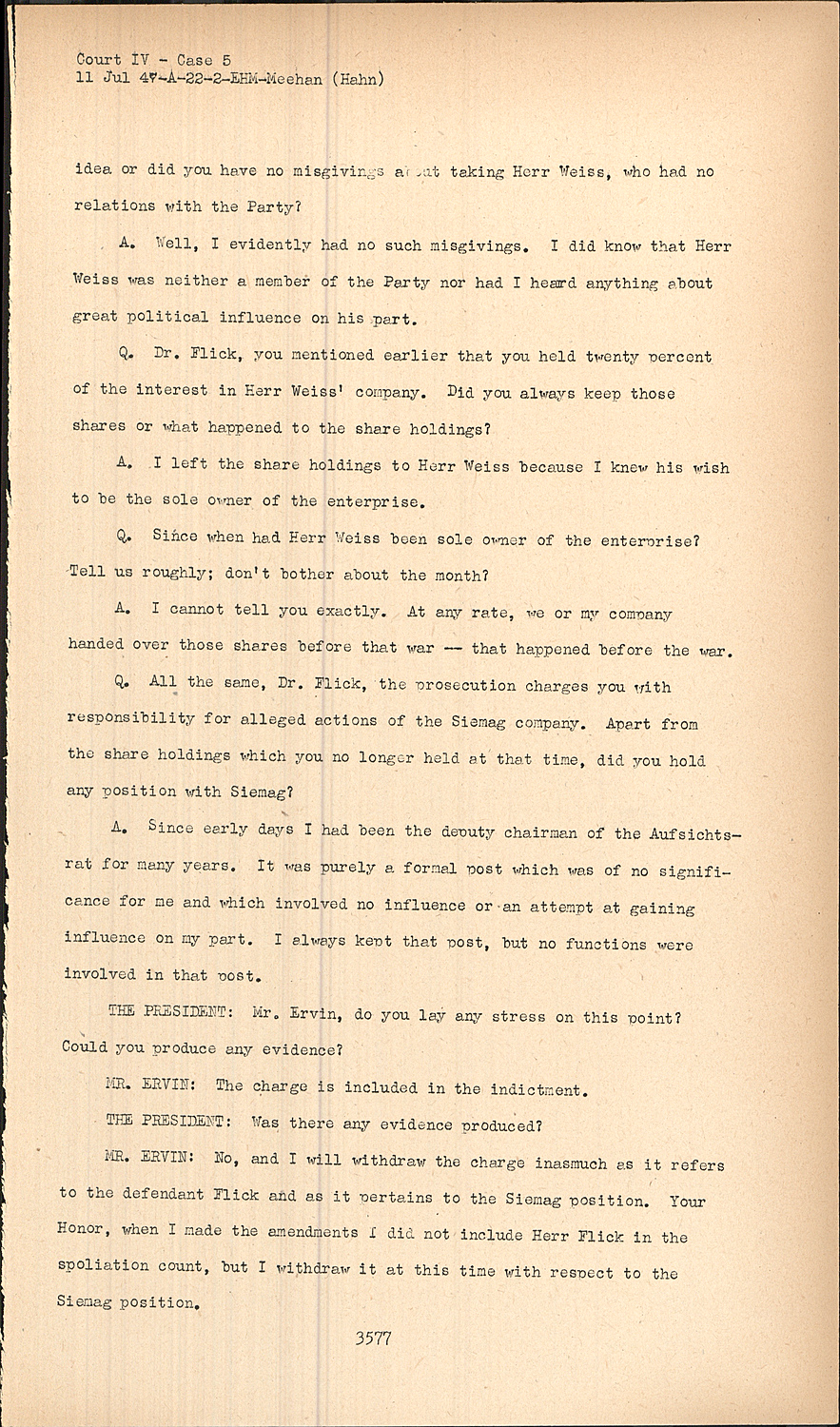
A.Well, I evidently had no such misgivings. I did know that Herr Weiss was neither a member of the Party nor had I heard anything about great political influence on his part.
Q.Dr. Flick, you mentioned earlier that you held twenty percent of the interest in Herr Weiss' company. Did you always keep those shares or what happened to the share holdings?
A.I left the share holdings to Herr Weiss because I knew his wish to be the sole owner of the enterprise.
Q.Since when had Herr Weiss been sole owner of the enterprise? Tell us roughly; don't bother about the month?
A.I cannot tell you exactly. At any rate, we or my company handed over those shares before that war -- that happened before the war.
Q.All the same, Dr. Flick, the prosecution charges you with responsibility for alleged actions of the Siemag company. Apart from the share holdings which you no longer held at that time, did you hold any position with Siemag?
A.Since early days I had been the deputy chairman of the Aufsichtsrat for many years. It was purely a formal post which was of no significance for me and which involved no influence or an attempt at gaining influence on my part. I always kept that post, but no functions were involved in that post.
THE PRESIDENT:Mr. Ervin, do you lay any stress on this point? Could you produce any evidence?
MR. ERVIN:The charge is included in the indictment.
THE PRESIDENT:Was there any evidence produced?
ME.ERVIN; No, and I will withdraw the charge inasmuch as it refers to the defendant Flick and as it pertains to the Siemag position. Your Honor, when I made the amendments I did not include Herr Flick in the spoliation count, but I withdraw it at this time with respect to the Siemag position.
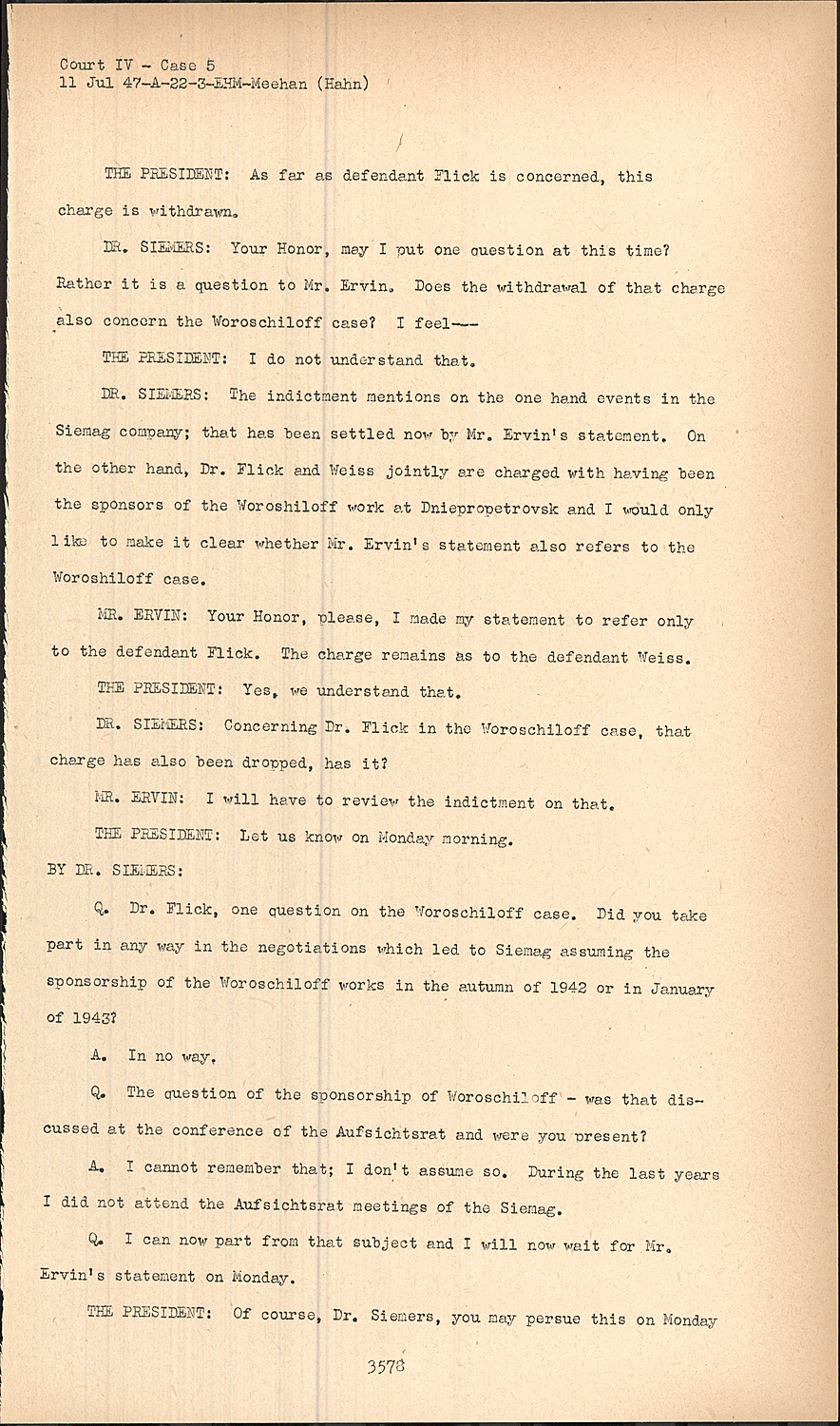
THE PRESIDENT:As far as defendant Flick is concerned, this charge is withdrawn.
DR. SIEMERS:Your Honor, may I put one question at this time? Rather it is a question to Mr. Ervin. Does the withdrawal of that charge also concern the Woroschiloff case? I feel-
THE PRESIDENT:I do not understand that.
DR. SIEMERS:The indictment mentions on the one hand events in the Siemag company; that has been settled now by Mr. Ervin's statement. On the other hand, Dr. Flick and Weiss jointly are charged with having been the sponsors of the Woroshiloff work at Dniepropetrovsk and I would only like to make it clear whether Mr. Ervin's statement also refers to the Woroshiloff case.
MR. ERVIN:Your Honor, please, I made my statement to refer only to the defendant Flick. The charge remains as to the defendant Weiss.
THE PRESIDENT:Yes, we understand that.
DR. SIEMERS:Concerning Dr. Flick in the Woroschiloff case, that charge has also been dropped, has it?
MR. ERVIN:I will have to review the indictment on that.
THE PRESIDENT:Let us know on Monday morning. BY DR. SIEMERS:
Q.Dr. Flick, one question on the Woroschiloff case. Did you take part in any way in the negotiations which led to Siemag assuming the sponsorship of the Woroschiloff works in the autumn of 1942 or in January of 1943?
A.In no way.
Q.The question of the sponsorship of Woroschiloff - was that discussed at the conference of the Aufsichtsrat and were you present?
A.I cannot remember that; I don't assume so. During the last years I did not attend the Aufsichtsrat meetings of the Siemag.
Q.I can now part from that subject and I will now wait for Mr. Ervin's statement on Monday.
THE PRESIDENT:Of course, Dr. Siemers, you may persue this on Monday Court IV - Case 5 if the statement of Mr. Ervin is not according to the line you suggest.
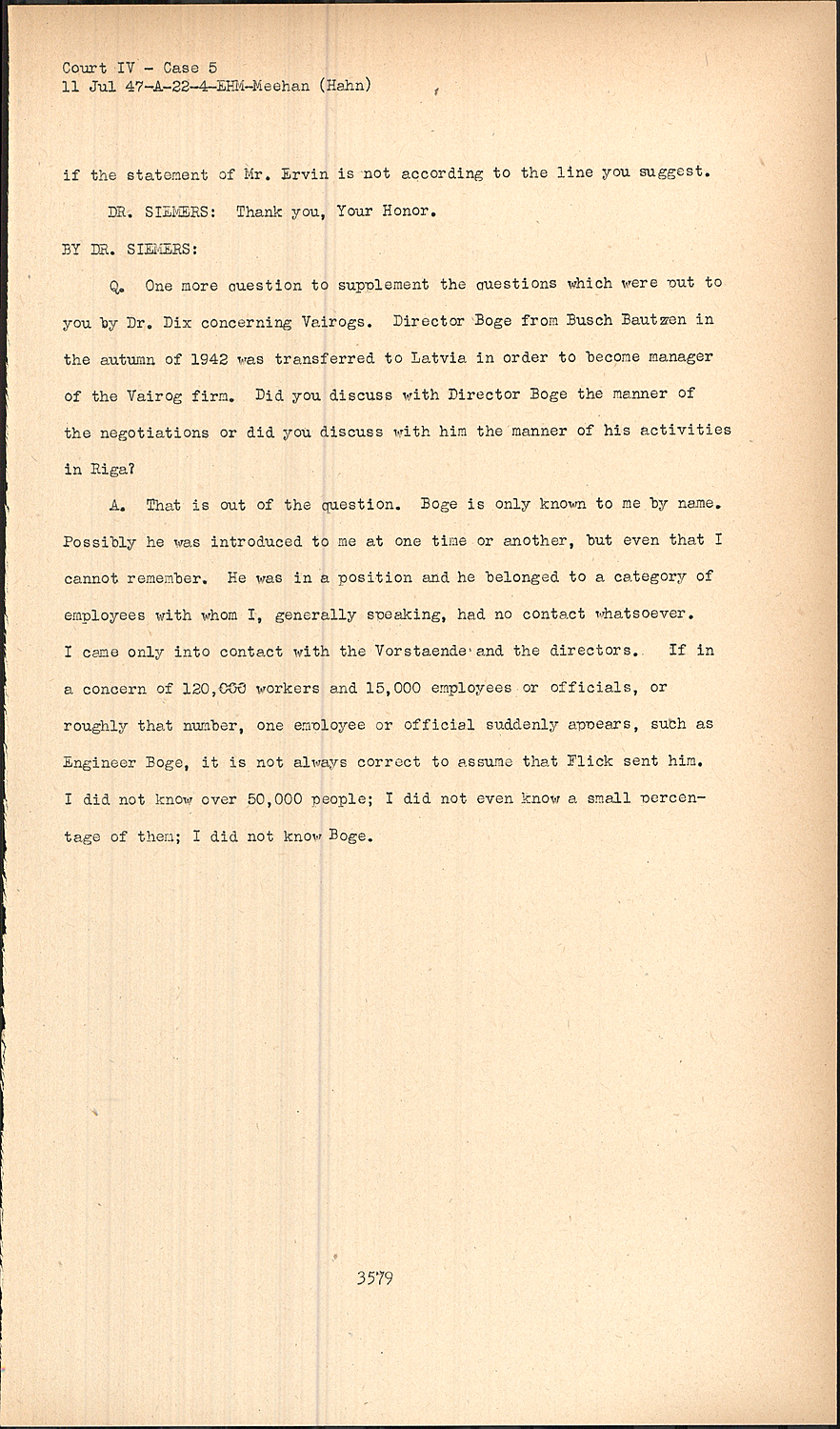
DR. SIEMERS:Thank you, Your Honor. BY DR. SIEMERS:
Q.One more question to supplement the questions which were put to you by Dr. Dix concerning Vairogs. Director Boge from Busch Bautzen in the autumn of 1942 was transferred to Latvia in order to become manager of the Vairog firm. Did you discuss with Director Boge the manner of the negotiations or did you discuss with him the manner of his activities in Riga?
A.That is out of the question. Boge is only known to me by name. Possibly he was introduced to me at one time or another, but even that I cannot remember. He was in a position and he belonged to a category of employees with whom I, generally speaking, had no contact whatsoever. I came only into contact with the Vorstaende and the directors. If in a concern of 120,000 workers and 15,000 employees or officials, or roughly that number, one employee or official suddenly appears, such as Engineer Boge, it is not always correct to assume that Flick sent him. I did not know over 50,000 people; I did not even know a small percentage of them; I did not know Boge.