That sum was, in 1936 for Goering, such an enormous sum, and he thought it was an adequate thing to do, to mention this achievement to assembly of 80 persons and thought it was good thing to tell them, "Look how much I have managed to do and how little you are capable of doing." And if this event happened in 1936, then, of course, at the beginning of 1938 it was even worse with the German Foreign exchange Economy and currency stocks. If Wintershall says: Well, we would have given ten million dollars. So would we, any day, even eleven, even twelve, if we had received the permit for 10 million dollars by the Reichsbank, at that official rate; that wouldn't have been difficult at all. Why did Wintershall not obtain this permit? Jansen says: already in the 1937 or even earlier we were awaiting contact with "the Anhaltische Kohlenworke and with the Group Julius Petschek. We considered how we could, get at the soft coal. First we considered an amalgamation." Well, anybody can consider matters. But he did not carry out the amalgamation, and not because I hindered him. Then he thought about foreign currency. I did not prevent him from obtaining the foreign currency. And when Steinbrinck in late 1937 after Rosterg refused to do a common transaction with, explained to Rosterg, "Now we shall deal with the matter by ourselves. Then it would have been the time for Rosterg to get the foreign currency at that point, because he had to reckon with one thing: There is a new competitor now and that is Mr. Flick, and you have to reckon with him as a competitor. If now you are in agreement with -- for he claimed to be -- then go quickly to Berlin, try and get the foreign currency permit and then Flick who had not started to negotiate yet is left behind."
That I will say I would have done if I had been he. But I never knew anything about it. He could have done so. Why didn't he do it? I can mention another example here. After the conclusion of the first transaction with the Julius Group -- that means the preliminary contract which was not binding for us yet -- I gave the I. G. Farben the opportunity to participate in these transactions.
I told the I. G. Farben: I have bought I am prepared although nothing is certain yet as to the attitude of the State and the Administration, if the State who gave the order agrees to the distribution of the shares you can participate and you can get shares and with the mining manager of the I.G., Reinhold Scharf, I came very quickly to an agreement as to how many tons I.G.should receive and what price they should have to pay in marks. And I told the I.G. Director, Scharf, that we have to pay in foreign currency. If you want to share in this transaction you have to procure foreign currency somehow." His answer was, "I can conclude everything with you, if it is a hundred or two hundred million tons or 300 I can deal with the situation; whether the price is 15 pfennigs per ton or ten pfennigs or twenty pfennigs does not matter to me. But if it is a matter of foreign currency, I cannot do a thing. That is a chapter by itself. Only the general manager, Schmitz, can deal with that part." I asked him, "Where is Schmitz? Let's talk to him together"."Schmitz is in Switzerland." I said, "All right, let's go to Switzerland." It didn't work out. I had a meeting with Schmitz, with the General Manager of the I.G. -- I should like to emphasize this -was the largest export firm in Germany and one of the managers of the I.G. said to me once in this connection that if I.G. has no foreign currency then I really do not know who has foreign currency, and I was all the more surprised when Geheimrat Schmitz, first gave no answer at all to my invitation to participate in this transation; that he tried to defer matters. I couldn't understand why. He said, "Let's talk about it in a couple of weeks". I said that we couldn't wait so long. Now, why did he do that? Because he did not believe me at all, that I actually had received the permit for the purchase of foreign and Jewish property of shares in German mining industry. In fact he didn't believe that I had received any permit of that kind. He just didn't believe it and therefore I.G. in this first stage did not have any dealings with us.
And I don't think it would be difficult to have information from the I.G. in this connection. I only want to explain the situation of the foreign currency permits and I shall eventually be able to tell you how the sellers -- themselves thought about this and how they themselves valued the achievement that I managed to deal with this at all. I should like to repeat and I should like to say now that from these documents about these negotiations with Murnane it becomes evident that I told Murnane the following: According to your own wish I spoke to Rosterg and Rosterg asked me to tell you that he also is not in the position to procure more or other foreign currencies than Flick. And Rosterg would be prepared at any time to confirm this to Murnane, and Murnane when he was present in Berlin at that time could get this confirmation from Rosterg verbally or by telephone. That was the real position with the Wintershall foreign currency. I must say -- now, of course, everyone can say I would have given more. He could have done so. He had been in business before us. And allegedly he had already come to conclusions before I ever appeared. Why didn't he do it? Anybody can criticise afterwards.
QWell, it wasn't only that Geheimrat Schmitz was the unbelieving Thomas or acted the unbelieving Thomas, but we know, and I believe that you probably know that the I.G. tried twice at that time to procure foreign currency. He was referring to AKW, and I think it would be a good thing if you told the Tribunal now the exact procedure as far as you remember it.
AHerr Schweissenburger -
The efforts of the I.G. for foreign currency refer to this case.
QNow it is you who are speaking, who are being examined by myself, and I would like you to state either that you don't know and I shall not put this question and I leave it to the other gentlemen to produce this affidavit which I do not know or you know the main content, and then I think it would be useful for you now if you would inform the Tribunal about it.
AWell, the matter was the following: I have a certain understanding for Geheimrat Schmitz not believing me about this preliminary contract, about 6.3 million dollars, and he did not believe it mainly for the reason that the I.G. a short time before that had itself applied in the same matter with a smaller amount of foreign currency -that was to acquire a German mining enterprise, and they asked for it and it was not permitted. They were refused by the German Government, and the German Government gave the reason that foreign currencies or property of Jews could not be used for the acquisition of German mining enterprises. It isn't even worth talking about it.
QNow, we have to go back to the Prosecution documents, which deal with this particular stage, and I would ask you to look at Document 404, which is on page 18 of the German text and it contains a note of the Defendant Steinbrinck about a telephone conversation by Herbert Goering. Herbert Goering plays a certain part in these questions on various occasions, and it is therefore necessary that the Tribunal should know, briefly, who Herbert Goering is and in what relation you, Defendant, were to him.
AHerbert Goering was the foreign expert in the Ministry of Economy. He was a cousin of Hermann Goering but at about this time he left Government service. In any case he gave it up very soon after Schacht resigned from the Ministry of Economics; the content of this document has been dealt* with already.
QYes. It is what you have already informed us about, that Goering stopped the action Sauckel and put a committee in its place. Then the staffing of the committee as you informed us and referring to this document I would like to ask you: Did this committee which should have convened on 25 January 1938, actually convene?
ANo.
QAre you of the opinion, or in order not to ask a leading questions, prevented this committee from actually meeting?
AThat became unimportant through my negotiations with Goering on 21 January and the order which he gave me on that particular day.
QAre you of the personal opinion that the Julius Petschek group would have suffered much more, very much more, in fact, if this action had actually taken place? Is it, therefore, your merit that this committee through your entervention, never met?
AYes. I have to assume so because all other decrees which had been issued on the part of the Government, as for instances, the expropriation law, or no foreign currencies, were only achieved through my negotiations with Goering and hissubsequent orders and they were led into different channels and if you ask me now what should have happened to Julius Petschek and about the whole affair in this committee, I can say, and I am absolutely convinced of it, that it was certainly not a matter of foreign currency; whether there would have been favorable result at all I cannot judge myself. I would not like to give my idea on this.
QNow, we move to the next document No. 405 and I would like to draw your attention to pages 26 & 27 of the German Document Book. There again on page 26 below there is an anti-Semitic, insinuation. It talks about brown coal, and about Jewish business dealings.
It is,natural when Jewish property is borken up" etc. - wait a moment. I shall only come to the next page afterwards. Would you just shortly give your opinion about this anti-Semitic remark and tell us what this rather long note means. I don't think it has even a date -- January, but no exact date. Now, what does this mean? What purpose does it serve?
AThat's a memorandum. It was meant for the meeting of this committee, the committee meeting which, of course, never took place. And even though there's an anti-Simitic remark refering to the Jewish coal base --it doesn't refer to Petschek but it refers to a man called Friedlander who was a share-holder of our neighboring mining enterprises. Friedlander really had brought up the hard coal before the very nose of my predecessor. A few meters before the house of the manager of Mittelstahl. Friedlander had started mining and the house itself became a sort of Peninsula. It was surrounded by mines. When I first came to Lauchhammer andasked: Now it is possible that you, as the oldest company of the Lausitz Industry District have so little soft coal. Of course, it was put down to Friedlander and it was said that this was all Friedlander's doing and if I wanted to mention something to that effect in the committee I can still see no crime in doing so. It was as I said; one had to talk the language of the Nazi Party to some small extent, and had to howl with the wolves, as they say, if one wanted to play a part at all and if one wanted to try to deal with matters as one thought right.
QOne had to talk the language of the committee in order to be understood by it?
AThe document itself -- that was the idea of a conclusive plan for the committe for breaking up the Petschek property and acondition was for me that it should be made possible privately, in sort of friendly agreement.
QThat is, without expropriation.?
ACertainly.
QNow, I would like to draw your attention to page 27. Here it says -- it's written by yourself that expropriation should be prevented and if it is used at all then only as an emergency measure, a last emergency measure if nothing else will do but if this can be expected from one particular group with certainty it is necessary to draw up a draft which can be used as a means of pressure.
Would you explain to the Tribunal the factual or tactical motives of this note? Especially the drawing up of a draft as a means of pressure because here already the expert opinion, the Dietrich report, comes up which we have to deal with later.
AThe consideration as to this question are on the same basis as I have already alluded to on various occasions. One has to start from the consideration of how this committee was actually constituted and secondly, one must remember that Goering had already asked for this expropriation law. I could not have said in one of these meetings that this was quite unheard of, the happenings here, or that I will not play, under no circumstances. I would have been dismissed immediately and what would have happened to the Petscheks is only too clear. Therefore, even here for technical and diplomatic reasons I had to try and influence these people to adopt the way which I, myself wanted. If I had been of the opinion that under no circumstances expropriation law should come into force, only as a last emergency measure, in order to use pressure and if I would have influenced the committee not to put this law into force, then it would have been a considerable success. On the whole it is by no means clear whether this draft of law which I talked about was an expropriation law or whether it would have been such. Later on, a number of measures, legal measures, were refused which had nothing to do with expropriation as, for instance, the expert report about naturalization laws; to introduce in Germany, something which had already been in force in a number of other countries or a special proceedure in the election of an Aufsichtsrat--it says here that this was a draft of the law for expropriation. I can only say here, you can think of me what you like. I had put two thirds of my fortune into mining and the idea that I should have ever had the wish to dis-own a person, whoever this other person may be is absurd, you must not think me so short-sighted or so stupid.
I think I prevented any measure which was meant against the Petscheks and that this memorandum does not actually deal with the buying of the soft coal. There are, after all, four or five other companies who might have been candidates, as for instance, Deutsche Reiches gesellschap, the I. G., the Viag and the interesting thing is that at this point we did not even think about purchasing the Petschek property. I would like to clarify this new once and for all, we were of the opinion that either we participated in the sharing of the Julius property or the Ignatz property. We could not participate in the sharing of both and if Ijuer had sold voluntarily we would surly have bought something of the size of the Julius Petschek property. Something in the value of 30,000,000 Marks.
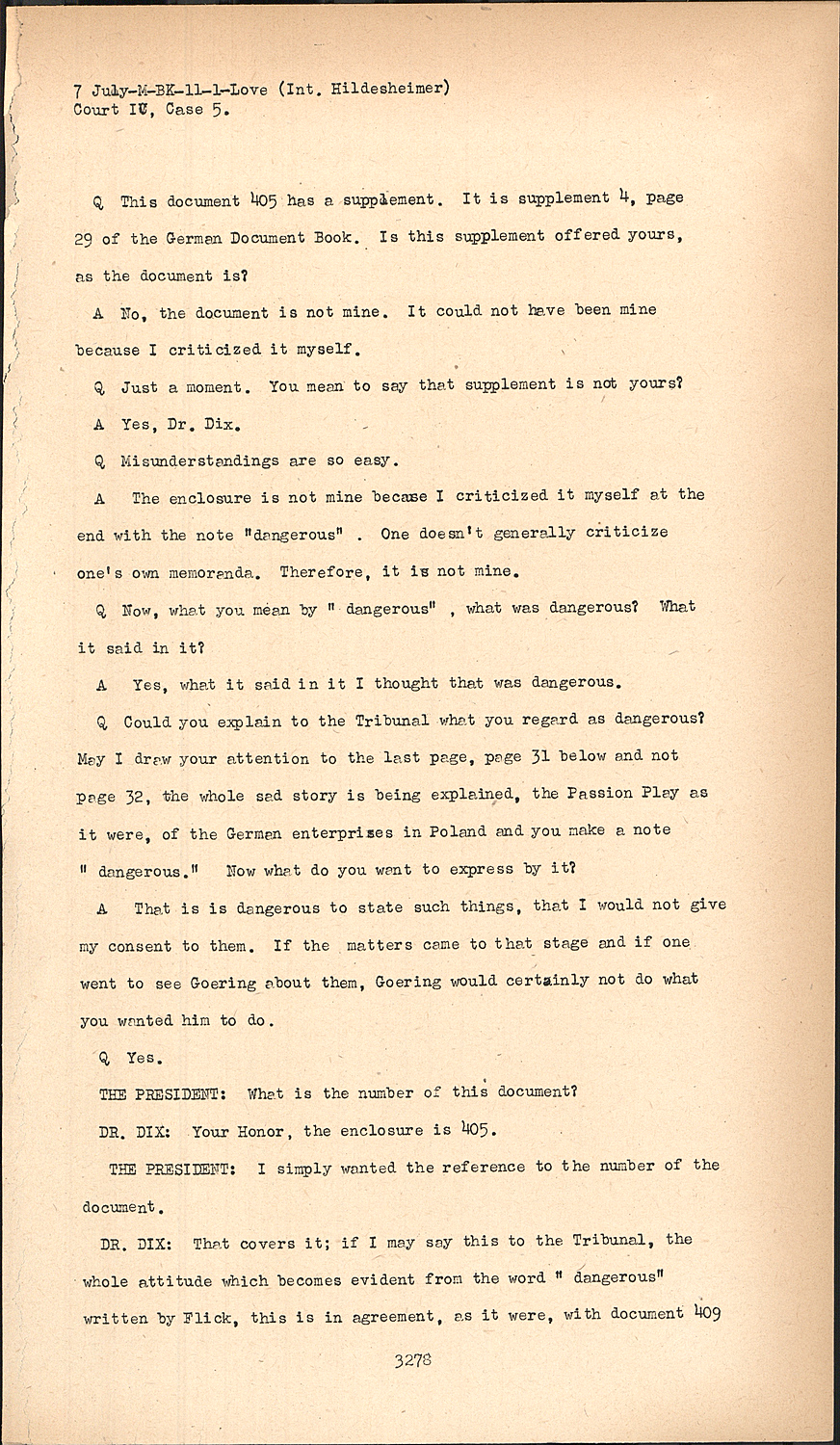
QThis document 405 has a supplement. It is supplement 4, page 29 of the German Document Book. Is this supplement offered yours, as the document is?
ANo, the document is not mine. It could not have been mine because I criticized it myself.
QJust a moment. You mean to say that supplement is not yours?
AYes, Dr. Dix.
QMisunderstandings are so easy.
AThe enclosure is not mine because I criticized it myself at the end with the note "dangerous" . One doesn't generally criticize one's own memoranda. Therefore, it is not mine.
QNow, what you mean by "dangerous", what was dangerous? What it said in it?
AYes, what it said in it I thought that was dangerous.
QCould you explain to the Tribunal what you regard as dangerous? May I draw your attention to the last page, page 31 below and not page 32, the whole sad story is being explained, the Passion Play as it were, of the German enterprises in Poland and you make a note " dangerous." Now what do you want to express by it?
AThat is is dangerous to state such things, that I would not give my consent to them. If the matters came to that stage and if one went to see Goering about them, Goering would certainly not do what you wanted him to do.
QYes.
THE PRESIDENT:What is the number of this document?
DR. DIX:Your Honor, the enclosure is 405.
THE PRESIDENT:I simply wanted the reference to the number of the document.
DR. DIX:That covers it; if I may say this to the Tribunal, the whole attitude which becomes evident from the word " dangerous" written by Flick, this is in agreement, as it were, with document 409 C ourt IV, Case 5.where he says in the end, " I personally have no reason whatever to agree to a peaceful solution.
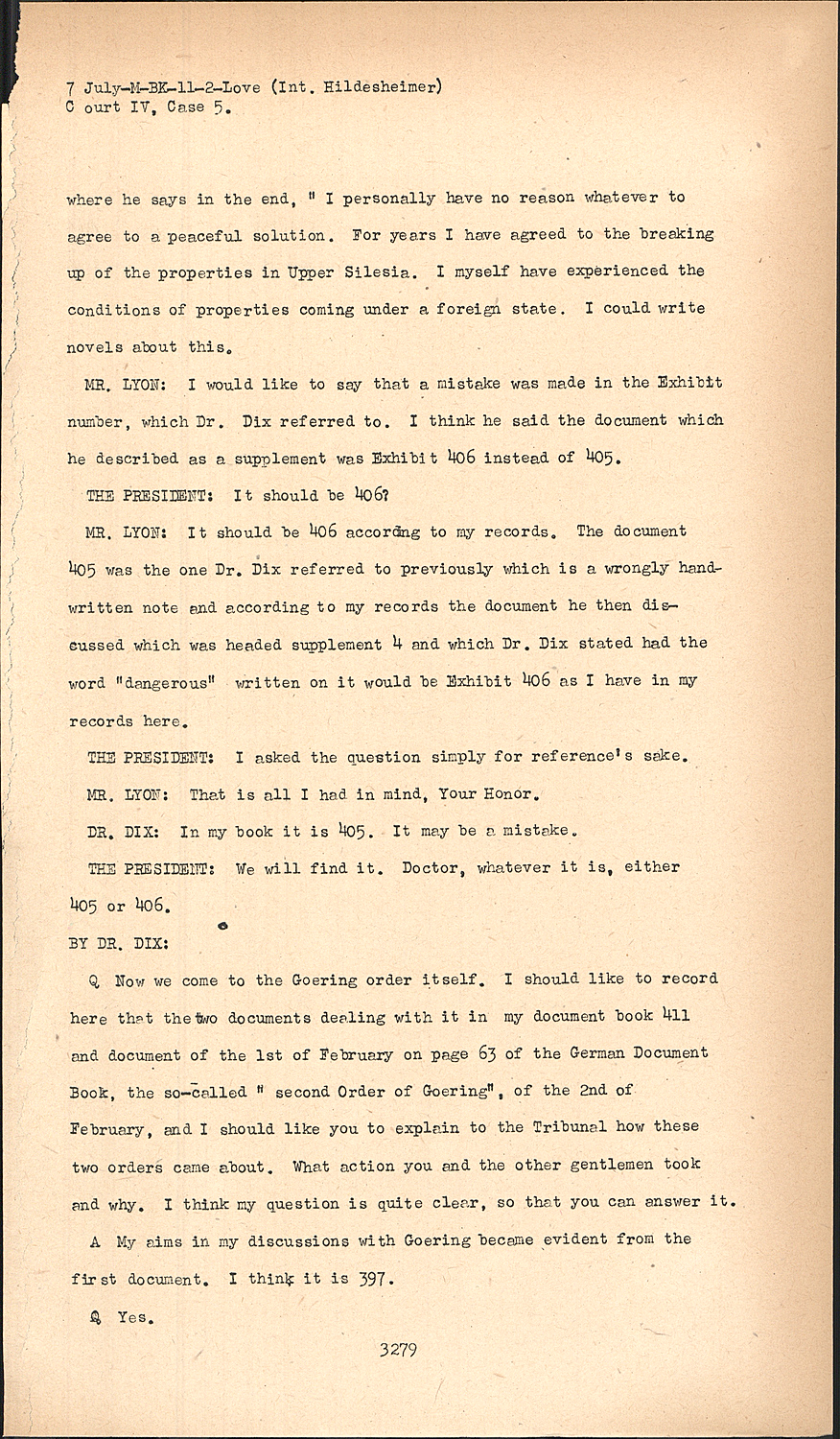
For years I have agreed to the breaking up of the properties in Upper Silesia. I myself have experienced the conditions of properties coming under a foreign state. I could write novels about this.
MR. LYON:I would like to say that a mistake was made in the Exhibit number, which Dr. Dix referred to. I think he said the document which he described as a supplement was Exhibit 406 instead of 405.
THE PRESIDENT:It should be 406?
MR. LYON:It should be 406 according to my records. The document 405 was the one Dr. Dix referred to previously which is a wrongly handwritten note and according to my records the document he then discussed which was headed supplement 4 and which Dr. Dix stated had the word "dangerous" written on it would be Exhibit 406 as I have in my records here.
THE PRESIDENT:I asked the question simply for reference's sake.
MR. LYON:That is all I had in mind, Your Honor.
DR. DIX:In my book it is 405. It may be a mistake.
THE PRESIDENT:We will find it. Doctor, whatever it is, either 405 or 406. BY DR. DIX:
QNow we come to the Goering order itself. I should like to record here that the two documents dealing with it in my document book 411 and document of the 1st of February on page 63 of the German Document Book, the so-called " second Order of Goering", of the 2nd of February, and I should like you to explain to the Tribunal how these two orders came about. What action you and the other gentlemen took and why. I think my question is quite clear, so that you can answer it.
AMy aims in my discussions with Goering became evident from the first document. I think it is 397.
QYes.
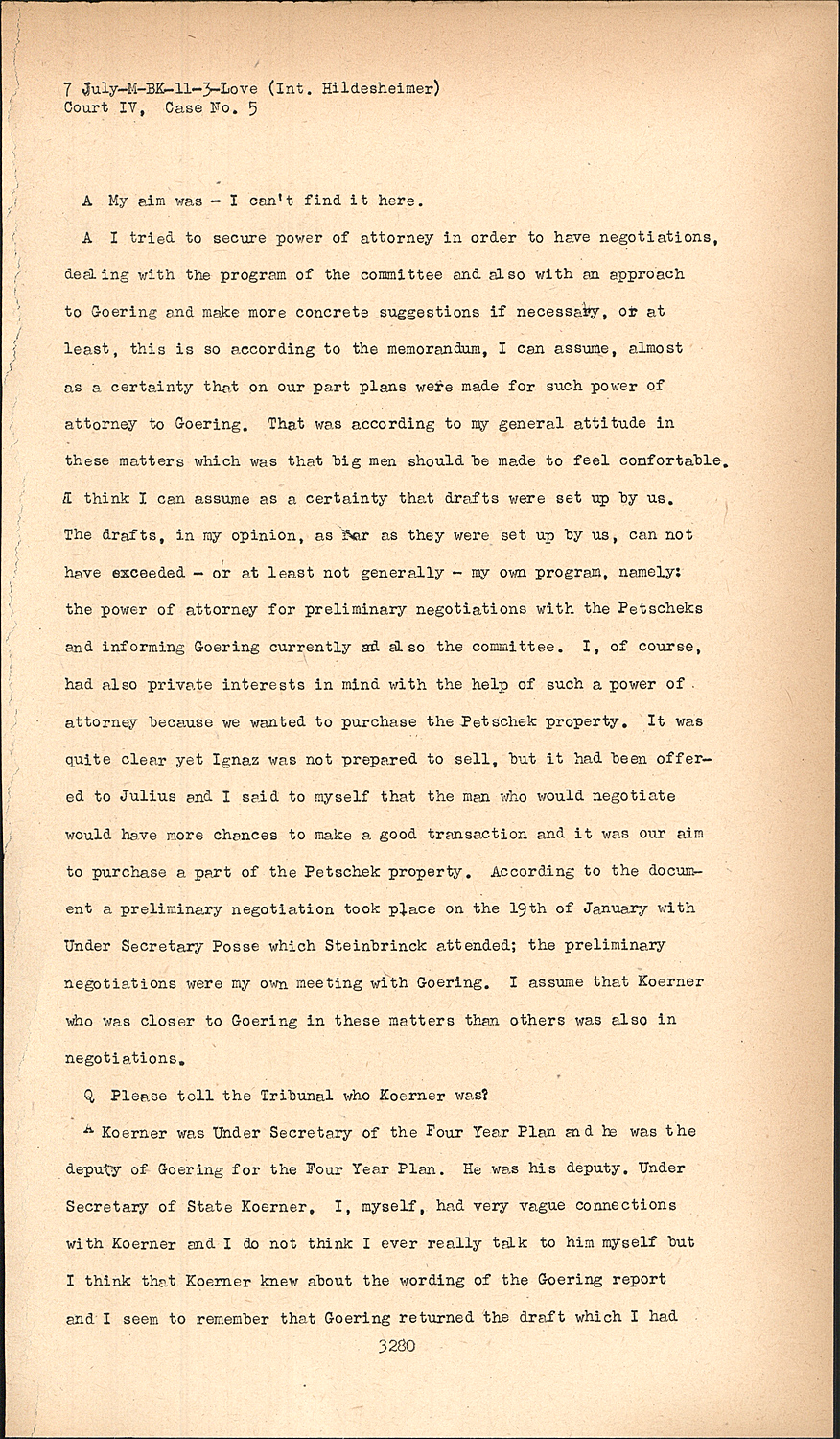
AMy aim was - I can't find it here.
AI tried to secure power of attorney in order to have negotiations, dealing with the program of the committee and also with an approach to Goering and make more concrete suggestions if necessary, or at least, this is so according to the memorandum, I can assume, almost as a certainty that on our part plans were made for such power of attorney to Goering. That was according to my general attitude in these matters which was that big men should be made to feel comfortable. I think I can assume as a certainty that drafts were set up by us. The drafts, in ray opinion, as far as they were set up by us, can not have exceeded - or at least not generally - my own program, namely: the power of attorney for preliminary negotiations with the Petscheks and informing Goering currently and also the committee. I, of course, had also private interests in mind with the help of such a power of attorney because we wanted to purchase the Petschek property. It was quite clear yet Ignaz was not prepared to sell, but it had been offered to Julius and I said to myself that the man who would negotiate would have more chances to make a good transaction and it was our aim to purchase a part of the Petschek property. According to the document a preliminary negotiation took place on the 19th of January with Under Secretary Posse which Steinbrinck attended; the preliminary negotiations were my own meeting with Goering. I assume that Koerner who was closer to Goering in these matters than others was also in negotiations.
QPlease tell the Tribunal who Koerner was?
AKoerner was Under Secretary of the Four Year Plan and he was the deputy of Goering for the Four Year Plan. He was his deputy. Under Secretary of State Koerner. I, myself, had very vague connections with Koerner and I do not think I ever really talk to him myself but I think that Koerner knew about the wording of the Goering report and I seem to remember that Goering returned the draft which I had C ourt IV, Case 5.given him about this power of attorney.
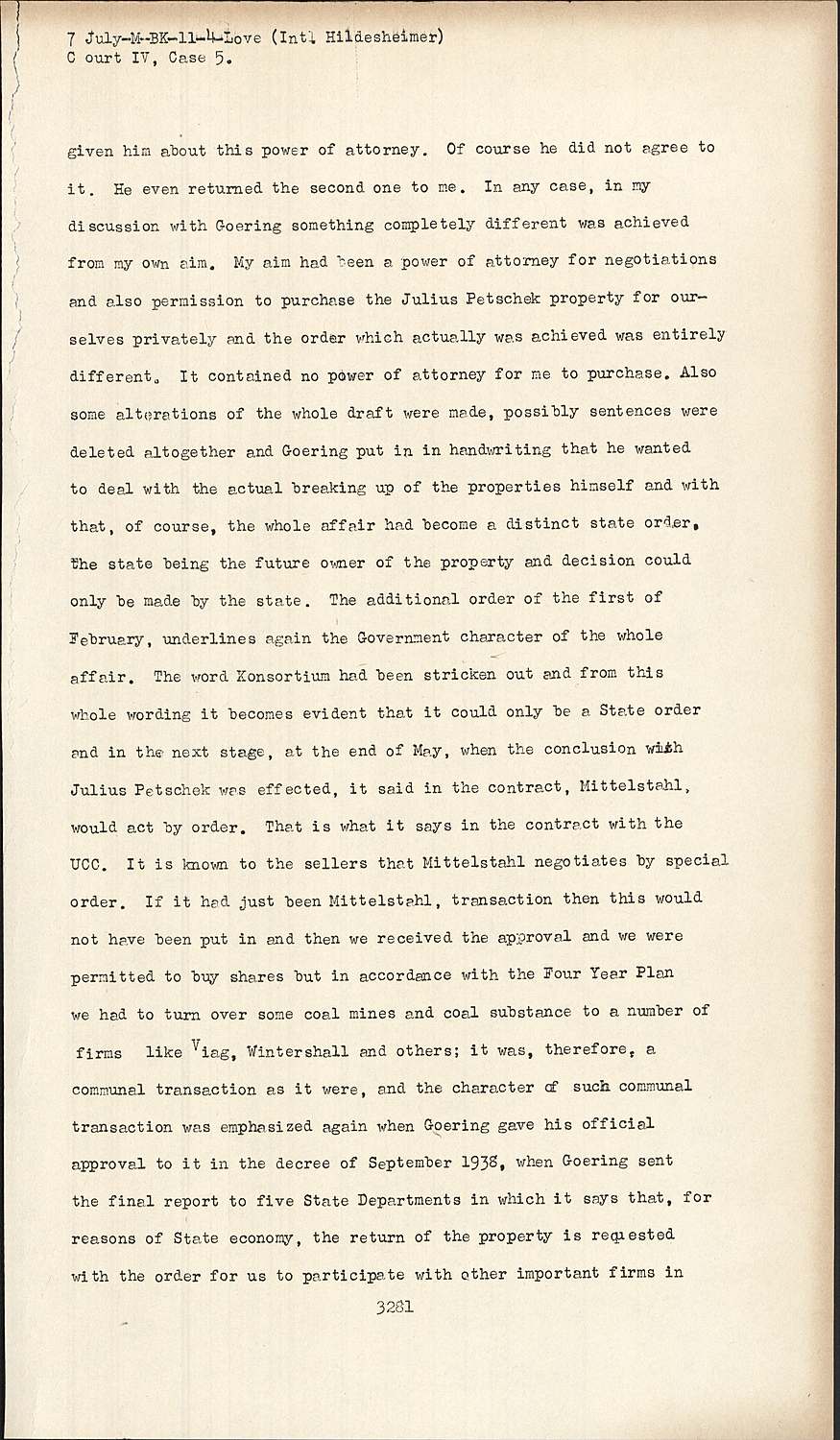
Of course he did not agree to it. He even returned the second one to me. In any case, in my discussion with Goering something completely different was achieved from my own aim. My aim had been a power of attorney for negotiations and also permission to purchase the Julius Petschek property for ourselves privately and the order which actually was achieved was entirely different. It contained no power of attorney for me to purchase. Also some alterations of the whole draft were made, possibly sentences were deleted altogether and Goering put in in handwriting that he wanted to deal with the actual breaking up of the properties himself and with that, of course, the whole affair had become a distinct state order, the state being the future owner of the property and decision could only be made by the state. The additional order of the first of February, underlines again the Government character of the whole affair. The word Konsortium had been stricken out and from this whole wording it becomes evident that it could only be a State order and in the next stage, at the end of May, when the conclusion with Julius Petschek was effected, it said in the contract, Mittelstahl, would act by order. That is what it says in the contract with the UCC. It is known to the sellers that Mittelstahl negotiates by special order. If it had just been Mittelstahl, transaction then this would not have been put in and then we received the approval and we were permitted to buy shares but in accordance with the Four Year Plan we had to turn over some coal mines and coal substance to a number of firms like Viag, Wintershall and others; it was, therefore, a communal transaction as it were, and the character of such communal transaction was emphasized again when Goering gave his official approval to it in the decree of September 1938, when Goering sent the final report to five State Departments in which it says that, for reasons of State economy, the return of the property is requested with the order for us to participate with other important firms in coal property.
And as a last remark I would like to say that Koerner also in May after the Julius Petschek affair had been concluded, emphasized in a letter which he wrote to us that in the case of Ignaz Petschek where he knew about our program we should not actually proceed before we could deal with it.
THE PRESIDENT:We have passed the hour of recess. Do you want to ask one more question?
DR. DIX:Yes, sir.
THE PRESIDENT:You may do so. BY DR. DIX:
QI did not interrupt you as we are at the beginning of the transaction and not at the end and because I understood your statements to the effect that you wanted to explain that the whole carrying through of the transaction until the final act which you just talked about was always in accordance with the Goering order, with the content and wording of the Goering order which after all is a State order. Did I understand you correctly?
AYes.
QI only wanted to clarify that.
(A recess was taken until 1330 hours.)
AFTERNOON SESSION (The hearing reconvened at 1330 hours, 7 July 1947.)
THE MARSHAL: Military Tribunal Number IV is again in session. THE PRESIDENT: I observe that the defendants are all present.
Dr. Dix.
FRIEDRICH FLICK - Resumed DIRECT EXAMINATION (Continued) BY DR. DIX:
QHerr Flick, would you please look at Document Number 412 on page 47 of the German text? This shows that Mr. Murnan , Colonel Fielding, and Lord someone or other from London, obviously Inverdate, arrived in Berlin on the 22nd. How did you get in touch with these gentlemen?
AContact was made when Dr. Schacht called me up and told me that Mr. Murnane was with him. He and Mr. Murnan had known each other for some time. Mr. Murnan had come to Germany to seel the shares of the Julius Petschek Companies. Mr. Murnan was with him at that moment and, he, Schacht, wanted, on behalf of Murnan, to ask me whether I was interested in buying them. In principle I agreed. Thereupon Schacht said, "Very well. Then Mr. Murnan will come to see you soon." I assumed that this telephone conversation between Schacht and myself was made in the presence of Mr. Murnan as far as Schacht was concerned. Murnan, as far as I remember, came to see me on the same day. It may have been the next day, but I don't think so.
QMay I interrupt you here, Herr Flick, before you continue to describe your first conversation with Murnan. The cue Schacht, makes me look back in the series of documents to Document 398 on page 9 of the German text. It is the note, a memorandum of a conversation between you and Dr. Schacht, or rather, the notes for a conversation with Dr. Schacht. The prosecutors have read this document and according to my feelings - but perhaps I am over-sensitive here - they read it with a certain undertone on account of figure 3 of this document, Schacht, Jr., position in Bautzen. Now, one might imagine Schacht introduces Murnan to you; you provide a job for Schacht, Jr., Please tell the Tribunal about this note which is not quite comprehensible in itself.
AI knew Schacht and had known him since 1920. We met on the occasion when my company gained an interest in the Upper Silesian Bismarckhuette. The Bismarckhuette, at a former stage of my examination, was mentioned here. Schacht at that time, in his capacity as director of the National Bank of Germany - a private bank, that was, not a national bank - was responsible for the banking arrangements of Bismarckhuette. That is how I met him. We were always on very good terms and Schacht soon afterwards became a member of the AAufsichtsrat of other companies in which I was interested, for instance, Charlottenhuette, another Upper Silesian company.
In 1923 Schacht entered state service and for the first time became president of the Reichsbank. I think he left in 1930 or '31 and resumed in '33. The note on this document, Schacht, Jr., in Bautzen, is concerned with the following: Schacht's son for about a year worked in Mittelstahl as part of his training and when I went to see Schacht to discuss other business matters I put down as a point to be discussed his son. I wanted to tell Schacht that it was time for his son to go to another firm; that is, to Busch-Bautzen, with which we were closely connected as with Mittelstahl. That is the context of this note, Schacht, Jr., Bautzen. The firm of Busch was in Bautzen in Saxony.
QThank you. Now, you were about to begin to describe your first meeting with Murnan. Please continue.
AThe course of this discussion in its essence is shown by these documents, 314, 315. I suppose I need not go into all the details.
AThe course of this discussion, in its essence, is shown by these Documents 314 and 315. I suppose I needn't go into all the details.
QNo, not where this is already shown by the documents and where the documents are correct. I will submit details from the documents to you in any case, but anything you may want to say in addition to these documents and beyond the documents--I don't know whether there is anything to be said there--but if you wish, please do that now.
AThe problem arose out of the complete discrepancy in the evaluation of the mark, which in Germany on the one side and abroad on the other. As Murnan said, he had expenses of about 15,000,000 marks, and I believe that because he probably made his purchase at the time when the international value of the dollar was 250. His expenses were 37.5 million at the normal dollar exchange--37.5 million marks. Now, in 1938 the following situation developed. In Germany the marks was a gold mark. In 1938 for one mark in Germany one could buy as much as in 1931 and 1932, but internationally the mark had dropped considerably to the figures. I have worked out here, the mark amounted to about 13 pfennings, and that was the cause of the problem. If Murnan sold his shares on the German exchange, with the theoretical assumption that it is possible to see 70% of a company on stock exchange--it is theoretical because this would produce immense pressure on the market, and the shares would drop in value to a considerable extent, but in any case I submit it would have been possible and, in this event, according to hos own statement as it is in this document, for 40,000,000 marks, he would have been able to exchange to about 2,000,000 dollars. If he had done this it could have been the only possibility of getting dollars without the assistance of the German Governement. For every dollar that you wanted to get over and beyond 2.2. million, he needed the agreement and the assisitance of the German Government. 2.2. million dollars he could make by selling the shares on the German stock exchange. In exchange he would have gained marks which had a fixed rate abroad, and he by selling these German marks, would have been able to get 2.2. million dollars.
His expenses, as I said and I believe, amounted to 15 million. The problem, therefore, was a discrepancy between 2.2. and 15. And because the solution of this problem of bridging this cavern did not seem possible to me, I suggested to Murnan that the largest part of the shares should not be sold, but that they should be changed into non-voting stock. The result of this would have been that he would not have lost anything of value. The term non-voting stock has already been described here before. Since the Prosecution said that these were things of no value...
QNo, no they didn't say that. I must protect the Prosecution. They said that they were of so much value.
AIn that case I didn't hear any remarks here about the various capital of shares, but since it is so much and as this line of thought-the changing of the Petschek property into a non-voting preference stock-runs though these proceedings like a red thread appearing again and again, I must unfortunately briefly explain here of what nature these non-voting preference stocks were, which were intended to be used for the Petscheks. These were preference shares with maximum value, in practice, as high in value as is theoretically possible. These shares were to have a fixed dividend in advance--a preference dividend with a guaranteed minimum dividend. And after satisfying this prefenrence dividend these shares were to be on the same footing as the other shares with the reservation that the preference shares should always have 1% higher dividend than the stock, as they were preference shares were to have a 100% value in advance. And we proved that later in the offer of these shares because after acquiring of the majority of shares of Julius Petschek the preference shareholders were made an offer to this effect by us in exchange for holdings voluntarily, and the majority of the outside shareholders made use of this offer, and the exchange rate, expressly, of this kind of preference share was not lower than that of the other voting stock. I repeat, the preference shares materially were considerably better and more valuable in every respect than the capital stock, with the difference that the conditional preference shares carried no voting-right--a voting-right only in special cases.
That's the reason why I said the Petscheks will get the best of it because the problem of the discrepancy between the valuation of the mark in Germany and abroad cannot be solved and in this way by changing an essential part of their property into preference shares and only get a small mount paid in foreign currency they would be doing the best possible for themselves from the view-point. At that time it would have been better for the Petscheks to do this and another document shows that we would have been ready in this case to pay a sum of 3,500,000 dollars in exchange for about a quarter of the Petschek property. The further prosecution of this idea became pointless because Murnan clearly stated that he wanted to part completely from the German shares and that he wanted everything in foreign currency. He refused to exchange the property for this kind of stock. I only want to repeat that the Goering Commission in case of changing part of the stock into nonvoting preference shares, according to my conviction would have been considered as fulfilled if I had gone to Goering and told him that I had solved the problem. "The Petscheks have turned their property into non-voting preference shares,t hey no longer have a vote, they no longer have any influence", and then he probably would have been satisfied but on our side we intended to pay a certain amount in dollars as well but, as I said, there was no point in going on with this plan because Murman wanted the whole amount in dollars, so the final result was a gap between 2,200,000 dollars and ten to eleven million dollars, which he had in mind as purchase value, and this could not be breached. I said already this morning that during these proceedings it has already been stated that Rosterg also said that he could not provide more dollars either. He probably decided thsi after he had made contacts in Berlin.
JUDGE RICHMAN:What would Murman have done with these preference shares if he had taken them for his interest? How could he have liquidated them at that time?
A.Then in Germany -- he would have received his substance in some form.
He would no longer have been able to exert any influence on the company. If he wanted to sell the shares and exchange them into dollars he would probably have achieved the same results as in the case of ordinary stock. The results would have been the same but my point was that politically it was impossible for the Petscheks to keep both influence and a fortune in Germany and the important point to me seemed to keep the property intact, the fortune intact, and their fortune would have been kept entirely intact if the capital stock had been exchanged into preference stock. That would have had the same value and received the same or higher interest. He would then have kept his interest in his own enterprise but would no longer have been able to exert any decisive influence and my point of view was that in view of the political emands both, that is, influence and fortune, cannot be retained and I hoped that the Petschek problem as far as the Government was concerned would have been considered settled and if the Petscheks had taken these preference shares. Materially speaking, he would not have gotten more more foreign exchange and as we could not solve this problem Murnan left and wrote me a parting letter and in this parting letter he said ........
Q.Just a minute, before we get to this letter. To supplement His Honor's question, with regard to the possibility of selling, idsposing of his property Murnan, you want to say, after changing his interest into non-voting preference shares would not have been worse off nor better off. The situation would have remained the same. May I ask His Honor whether the answer is clear?
THE PRESIDENT:Well, may I interpose? By this arrangement Murname would have kept his capital inabout the same position as he had it before but he would have to give up all influence?
A.He would no longer have any influence.
THE PRESIDENT:What inducement was that to him? He wouldn't have been any better off with his capital and he certainly would have given up his influence but, of course, you said that he was in a bad position anyway and this might have enabled him to hold hid capital in Germany without assaults upon it as he was in danger now on account of the Petscheks interest.