Therefore, the electricity plant of the Reich depended on the coal supplies sent and shipped by the Ilse on the strength of a contract which was valid until the deposits of the coal controlled by Ilse were exhausted. Therefore, if Ilse had sufficient coal for a hundred years, then the contract would be valid for a hundred years.
The Reich, represented by the Elektro-Works, had refrained from interfering itself and obtaining an influence by way of shares in the Ilse. It had been satisfied with the contract, the contract of supplies, but now in the year 1929 - I think it was 1929, at least - the Petscheks had started to buy up the shares of the Ilse on the stock exchange. As it occurs in many such instances, here also the time approached when the purchase of shares of Ilse on the stock exchange by the constant increase of the prices was generally noticed, and the German Reich, therefore, noticed that somebody was buying up these shares, and the Reich tried to secure some shares for itself. Now they themselves started purchasing shares of Ilse. The result was the Petscheks on the one side and the German Reich on the other raced for the control of Ilse. The Petscheks, however, were ahead because they had started the race. They had started, as I said, and the end came and the Petscheks had the majority and the German Reich had a parcel of shares amounting to about twenty-five percent and came out of the race as second winner. These matters caused a considerable stir in Germany. The bad feeling which had been created by this race was increased still by the fact that now the Petscheks did not even concede a seat in the Aufsichtsrat to the German Reich, who was the second largest shareholder and had twenty-five percent of the shares. I think that is a quite incomprehensible policy for them because every shareholder holding twenty-five percent of a company, after all, has the claim to be represented, at least, by one seat in the Aufsichtsrat, and if the shareholder happens to be the German Court IV - Case 5 Reich and if this shareholder has specially good reasons because the second largest electricity plant in Germany gets its coal from the company of which he has twenty-five percent of the shares, well, that then his claim to have a seat in the Aufsichtsrat still is not satisfied I cannot understand.
That was only done later on in 1934. Then the Reich ElektroWorks received two seats in the Aufsichtsrat of the Ilse. The battles for Ilse took place in 1929.
To all these matters a sensational law suit was added between the Petschek families and another Jewish family by the name of Karo. That was a sensational law suit of unique extent and importance which took perhaps half a year or three-quarters of a year. The whole attention of the public was focused on it. All these matters brought it about that these matters were largely discussed in the public, and under these auspices the Petschek question may well have entered the new times.
Q.Well, you have now entered the new times. May I now ask you in a general way: could a realistic man who had some ideas about politics imagine that this monoply power position which the Petscheks had gained after all of what has happened before, as you have described it, could still be maintained in the Third Reich?
A.Well, this question from my fullest conviction I have to answer with "no".
Q.Now, Ignatz Petschek was, after all, very clever and far-sighted. How do you explain that the Ignatz Petschek group had so little of the spirit of Ignatz Petschek?
A.Well, the only explanation I can find, and I have already hinted at that, is that Ignatz Petschek at that time had personally withdrawn more and more fromthe conducting of the business and had left it to other persons. I can only say that I knew the old man, Ignatz Petschek, as an exceptionally capable and farsighted merchant.
He had unique successes and he started out from the smallest beginning as a Prokurist and as a traveler for another coal business. That was the firm Weinmann, and certainly I have the conviction that when he died he left one of the largest fortunes in Europe and one can well imagine how far he looked ahead, if you call to mind that to my knowledge at least according to the information I received - I even was told so by my directors that he at the same time was the largest owner of unused coal deposits in the United States. He had created all that in the course of only one generation.
THE PRESIDENT:What year did Ignaz Petschek die--about what year?
A.Well, I think, as far as I recall he died soon after Hitler's rise to power, perhaps in 1934 or something like that. I still remember that I had sent him congratulations on his seventy-fifth birthday. It was a long telegram which he answered on the same day, and on this occasion I can state here that I was on the most friendly terms with old Ignaz Petschek at all times.
I made his acquaintance in 1923 when I joined the Aufsichtsrat of the Alpine Montan Company which I have repeatedly mentioned, which was the largest Austrian company. Petschek was already a member of the Aufsichtsrat, and I joined the Aufsichtsrat. We were also together in the Aufsichtsrat of the Linke-Hoffman Works and then I got into still closer contact through Schacht who had invited both of us to dinner.
First of all, I sold to him forty per cent of the Preussen Grube which was in the Upper Silesian hard coal pits and later on he purchased the rest of it and then I told him, "Herr Petschek, in general I only remain in an Aufsichtsrat when I have shares to represent there and here in the Preussen Grube which now belongs to you--well, I don't have any shares in it any more.
It doesn't belong to me and therefore, please release me from the Aufsichtsrat",and I still remember that he called me up during my holiday and said, "Herr Flick, please do me the favor and stay in the Aufsichtsrat."
I remained for a certain period of time. As I said, I was working together with him in several Aufsichtsrate and at all times I considered him an exceptionally capable man and I might even say that I admired him as such and proof of it is the way he looked ahead is also in a short experience. The Vorstand of one of the former Petschek companies--that is the Eintracht Company--has told me the following--perhaps that is typical. The Vorstand of the Eintracht had suggested to Herr Petschek to purchase large and especially good coal deposit. It was to cost ten million marks. That was in the 20's. Herr Petschek asked the question.
"When can we start using this deposit?"
The Vorstand said, "Well, forty years from now," upon which Herr Petschek answered, "All right, then we don't want to buy it because in forty years, we will have no privately owned mining companies in Germany."
Q.Herr President, it is always nice to go to lunch after receiving a pleasant impression and after this description of the fascinating old Ignatz Petschek I would like to suggest that we now recess.
THE PRESIDENT:We will recess now until Monday next at half-past nine in the morning.
(The Tribunal adjourned until 0930, 7 July 1947.)
C ourt IV, Case No. 5 Official Transcript of American Tribunal No. 4 in the Matter of the United States of America against Friedrich Flick, et al, Defendants, sitting at Nurnberg, Germany, on 7 July 1947, 0930 hours, Justice Sears presiding.
THE MARSHAL:The Honorable, the Judges of Military Tribunal No. 4.
Military Tribunal No. 4 is now in session. God save the United States of America and this Honorable Tribunal.
THE PRESIDENT:Mr. Marshal, are all the defendants present?
THE MARSHAL:May it please Your Honor, all the defendants are present in the court room.
THE PRESIDENT:Dr. Dix, you may proceed.
DIRECT EXAMINATION (Continued) BY DR. DIX:
QHerr Flick, at the end of your testimony at the last session you gave the Tribunal a picture, a characterization of old Ignaz Petschek, with the saying that in view of his far-sightedness and cleverness not everything would have turned out as unfavorable for the Ignaz Petschek Group if this important person had still been alive during the time in question. I believe it would be appropriate if you now gave us a short description of his son who was called, I think, Karl or Hans, and describe your personal relations with him.
AWith the sons of Ignaz Petschek too I lived on very good terms, although the relationship existing between the father and myself did not pass directly on to the sons. But our relationship was absolutely correct and good. On my side, they were certainly also very cordial. I can prove this by quoting an incident. In 1932 a unique, I would say sensational trial - a lawsuit - took place between the two families of Petschek and Karo. It went on for more than six months, and the German public was sensationally concerned with it. In this lawsuit I was able to assist Karl Petschek in a very complicated matter. He saw me about this matter and asked me to give evidence before the court in this lawsuit.
In itself, I wasn't very happy about this matter. It certainly was no pleasure to get involved in this lawsuit and to appear in the press as a result. In a number of discussions I talked over the problems with Karl Petschek and cleared matters up, and then appeared as his witness in the Moabit Court. That was a pure matter of helpfulness on my part. For the rest,during the time of old Ignaz, at any rate, if there was anything to be discussed, I always went to the Petscheks and the Petscheks , apart from the last matter of the testimony in the lawsuit did not come to me quite so much. But I repeat, there was a cordial atmosphere; at any rate, at least a correct and good one.
QTo be able to understand the bahavior of human beings, in particular people in such an economic position as the Petscheks were, it is perhaps useful to know what advisers they used in Germany prior and during the times of Adolf Hitler. Perhaps you are in a position to give us brief information on this point.
AThe general adviser and, over and beyond that, the confidant in the Petschek Group was State Counsellor Reinhardt, the first man in the Commerce Bank. He had -
QEx cuse me if I interrupt. That was the president of the Chamber of Commerce in Berlin in Nazi times.
AYes, he had a special position. He was among other things concerned with a number of Petschek companies, as chairman of the Aufsichtsrat, for instance in the Ilse. That was by far the biggest Petschek company. I know that he also was chairman of the Aufsichtsrat of the Eintracht too. That was the second company next to the NiederLausitz-Kohlen-Werke, and undoubtedly the bank connection with the Petscheks was the biggest industrial position the Commerce Bank held. It has also been shown by the documents here that we at various points in the negotiations always took up contact with State Counsellor Reinhardt. For example, I think it was on the 19th of January, prior to the Goering Commission and also at later stages in 1938.
We negotiated with him repeatedly, and we always told him What was intended that the Petscheks should know. He handled the things with us and he himself recognized his commission as confidential agent of the Petscheks. Of course, we had other banking connections but the connection Reinhardt-Petschek was the decisive one, and I repeat, his position was that of a confidential agent.
Q.You said that you told Reinhardt the things destined for the Petscheks to know. Did you also tell him what you considered as useful for the Petscheks?
A.Yes, of course. At a later stage, in 1938, I even tried to persuade him to use a German expression, "like a sick horse". I told him over and over again, "Herr Reinhardt, the behavior of these people is impossible." I said to him literally what my own interests in the matter were more than once. I told him clearly, "Herr Reinhardt, today the Petscheks; tomorrow Flick." Once these steps are taken, that is - arbitrary measures against the owners of mineral deposits independent of whether they are Germans or foreigners or Jews. Then these things will, in the long run, have effects in the attitude of the states and, in particular, of the Party, and that will be the same for the German owners of mineral deposits. The fact that I was correct is proved by the further development of the Petschek question and in this connection I must clarify that the German State did not only expropriate the Petscheks, it expropriated all the German shareholders, too, amounting to many hundreds. They were all expropriated and compensated in money. If the Petscheks didn't get anything, that is due to another matter. That is only the taxation question. I had those misgivings because I thought once this business starts of expropriating shareholders for the exploitation of mineral profits then one doesn't know where this movement will end, once started.
Q.As you have mentioned the expropriating of mineral profits, we know that with the Nazi government the tendency was that of, let's call it, nationalization and de-judification of profit -- was based on nationalistic and anti-semitic reasons. But in other countries, too, do you not know of events where without any expressed anti-semitism the states by way of legislation developed nationalistic tendencies with regard to their own minerals?
A.Yes, there is no doubt about that. For example, in Sweden there was a law according to which the state considerably influenced the exploitation of mineral deposits. The state had to be paid a certain Court IV - Case 5 amount of money per ton - per ton produced, and I think a 50 percent share had to be given to the state.
Over and beyond that the Swedish state has the right after the expiration of a certain time to take over the part shares at that time still in private ownership. If this had not been regulated in this manner in Sweden, then, in view of the importance of the Swedish ore deliveries to the German steel industries for many decades, a development would undoubtedly have taken place according to which the big Ruhr concerns would have purchased shares in the Swedish ore mines and obtained considerable influence on them by this fact because Swedish ore is an essential part of the raw material required by the Ruhr industry.
There are other countries, too, where things are regulated in a similar manner. I can only point out that I myself took part indirectly - Herr Weiss can give a better account of this, however - in the nationalization of the Lena Gold fields in Russia, a society with British capital. Some of the Central and Southern American states also introduced similar legislation. For instance, Brazil. In Mexico it also happened, and I think the dispute between the Mexican government and the owners of the foreign oil companies exploiting Mexican oil has not yet been settled today.
Q.How, in the Petschek case there is also their monopolistic power position as you described it. Were you yourself ever able to establish from your personal experience that the Nazi government was specifically anti-monopolistic?
A.Yes, that was the case. In 1943 or 1942 a dispute which had arisen in connection with the hard coal lignite exchange with the former Petschek company Ilse could not be settled. In order to put an end to the eternal disputes and negotiations, the idea arose then and the suggestion was made that the Ilse should be amalgamated with the Anhaltische Kohlenbergwerke. The affair had already been discussed with Minister Funk, and in principle he was in favor of it. But after he had obtained more detailed information about the affair, his decision was that the Court IV - Case 5 fusion which, in principle, had been welcomed by him - the fusion of Anhaltische Kohlenbergwerke with Ilse - could not be carried out because if it were the Mittelstahl Gruppe would gain a dominating influence in the Lausitz.
And that is why the affair failed and lost all point. That was the idea of fusion with only one of the former Petschek companies.
Q.Did you not experience the same thing with regard to an intended purchase of Harpener shares?
A.We learned that all along the line. Every suggestion during the war of, for instance, increasing ownership or interest in Harpen or to take up the offer of the purchase of a rail car factory or of incorporating a neighboring works concerned with machine con struction, all these things were from the outset impossible, the reason being that expansion was no longer permitted.
Q.That then was the economic new political situation when the Petschek case became acute.
The rigid and declining attitude of the Petschek group you have already described and to stick to chronology, let us now consider the case of Julius Petschek.
How did the Julius Petschek group behave?
When did you take up contact with it, etc.
What happened?
A.I don't know whether I have already said that at an earlier phase, perhaps in 1933 or 1934 -- at this time, we were offered the Julius Petschek property.
The offer came via the Jewish banking house Kalkahn in Berlin.
Q.During the nazi time, that was?
A.Yes. One of the owners of the Kalkahn banking house, H. Karl Gennhof, was a family relation of one of the Petschek directors in Prague and this Herr Gennhof at that time, drew our attention to the fact, several times, that the Petschek group was prepared to sell its property.
At that time, I did not follow up this matter because we were otherwise engaged and at that time it would not have fitted into our program.
We were dealing with the Harpener agency and could not deal with this.
The director general, Rosterg of Wintershall, then later told me about his connection with the Julius Petshcek group.
These were based mainly on the fact that Wintershall had built a gasoline plant and the raw coal for this gasoline plant was purchased from the Annaltische Kohlenwerke.
Rosterg also told me that the Petschek property, a s he said literally, could be had any day. The exact date of this I no longer know for certain. I believe it was September, 1937, the beginning of September, and Rosterg further told me at the time that accordingto his firm conviction, the property could be had anyday for 8 million dollars and, secondly, he told me that the responsibility for the whole affair was too much for him. He told me literally, and my impression was that Rosterg was interested but that he was undecided. I suppose he didn't quite know what he was to do about the whole thing. I should think ---
Q.Was Rosterg a business man?
A.No, Rosterg was a technician, a self-made man, a miner who had worked his way up from the bottom. He had many big successes but he was not a man entirely suited to solve an international problem because that was not the circles he came from. He had been a miner, visited the mining school, and then risen with the company as a technician. Then as I said before, probably it was in November, Director Wetzel of the Annaltische Kohlenwerke drew my attention to the fact that the Petscheks wanted to sell their property and that the question now was how to get matters into a good state.
I knew Wetzel. Wetzel used to be the director of Schering, a well known chemical company, and I myself was a member of the Aufsichtsrat of Schering. Wetzel tried to interest me in this matter.
Q.He was with Petschek at that time?
A.Yes, he was a director of a Petschek Company, the Annaltische Kohlenwerke. We explained to him that we were interested in the purchase because our own Lignite's basis in Central Germany was extremely short-lived, and there was no concern in the whole of Central Germany which had to expect such a short life for its Lignite as we. That had been neglected before my day and so I told him we were interested. Simultaneously but independently -- a state scheme got under way at this time, and this as far as I can establish from the documents was mainly staged by Sauckel who sent Goering a telegram in which he accused the Petscheks of a crude attempt of fraud.
THE PRESIDENT:Just a moment. You sued the pronoun "we" through here. Are you referring to your own concern or do you include the general coal and iron industry when you say "we?"
A.By "we" I mean "us".
THE PRESIDENT:Your mean your own concern, including the people who are associated with you? I mean an ownership?
A.Yes.
THE PRESIDENT:I didn't know but what this was the larger group -- that you were acting with a larger group outside of your own business.
A.In this Lignite matter--
THE PRESIDENT:Yes, I thought "we" might mean all the people interested in the brown coal industry.
A.I meant Mittelstahl as being my group.
JUDGE RICHMAN:Did you mean to include under that "we" your associate Steinbrinck and the other associates that were taling to him? Was that what you meant?
A.We negotiated these things together. In general, I used the word "I" and only in companies where I have a hundred per cent ownership I would use it.
THE PRESIDENT:I think that is clear. Those pronouns are sometimes confusing. We don't know their content. BY DR. DIX:
Q.Will you please continue describing this government torpedo launched by Sauckel?
A.Perhaps I should first say something else. When Wetzel made this offer to us, we -- or I - considered it correct,first of all, to get in touch with Wintershall and Rosterg. I considered this necessary because Wintershall and or Rosterg had once before discussed the Petschek problem with me and I thought it not correct to deal with this affair myself now without first having discussed it with Rosterg.
It also seemed suitable from a meterial point of view to work hand in hand with Wintershall and to do a NETA, or a common deal, and that is why I asked my colleague Steinbrinck to go to Rosterg in Berchtesgaden and to explain the situation to Rosterg and to tell him that I was prepared to discuss this purchase and to carry it out with him NETA, that is fifty-fifty.
Q.Excuse me, Herr Flick. As Berchtesgaden was mentioned, a third person easily imagines more than is meant. Would you please tell the Tribunal about this journey to Berchtesgaden, whether it had any connection with the Obersalzberg?
A.No, it had nothing to do with that. Rosterg had a summer house in Berchtesgaden which belonged to him and there is where he spent his free time.
I was very surprised that Herr Steinbrinck returned from this trip and told me about the completely negative result of his mission. Rosterg had refused. Why, I did not understand. There was no logic in the affair at all because a few months before, I believe in September, he had told me that the responsibility for the whole was too much for him and that is why I supposed that we could be a welcome partner for him. I had made a mistake. He did not agree to this suggestion and this was probably so because he had already loose connections in other directions. Perhaps to Wintershall or with Salzdethfurt. I don't know for certain. Perhaps with Salzdeth, too, because without Herr Rosterg, as it turned out later, he could not in any case not have acted alone in foreign exchange matters because Salzdeth was the second biggest potash company and Wintershall and Salzdethfurt had common foreign holding interests. Without such Salzdeth and Wintershall in many points were unable to act alone but we did not leave Herr Rosterg in any uncertainty on the point that now we would go our own way and that we would try ourselves to purchase the property of Julius Petschek which had been offered to us. Steinbrinck, therefore, had to conclude a META deal or we would go our own way. I have already mentioned that the Government scheme at the end of 1937 was in full swing. I assume that the Petscheks knew about it and that it was one more reason for them to deal positively with the question of selling their property. The Government had this attitude; partly caused by Sauckel's telegram a commission had been appointed to deal with the Petschek problem.
QExcuse me. When did you learn this? You said just now that this Government torpedo was launched, of course, as you said, without your knowledge and information but I think it is necessary now for you to tell the Tribunal when you heard of the consequences of this torpedo, that is, Goering's intervention with the formation of the committee, etc.?
C ourt IV, Case No. 5
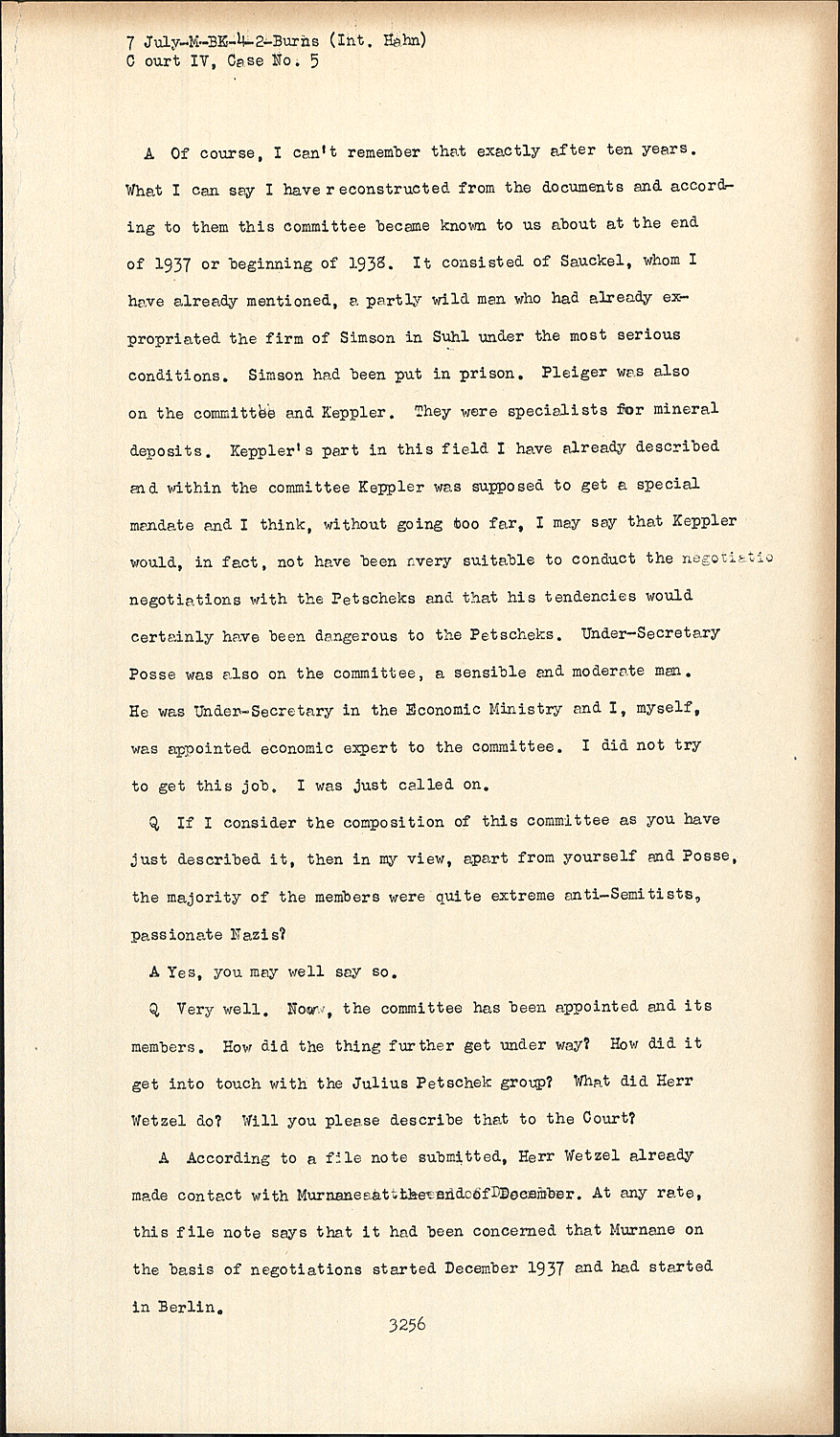
AOf course, I can't remember that exactly after ten years. What I can say I have reconstructed from the documents and according to them this committee became known to us about at the end of 1937 or beginning of 1938. It consisted of Sauckel, whom I have already mentioned, a partly wild men who had already expropriated the firm of Simson in Suhl under the most serious conditions. Simson had been put in prison. Pleiger was also on the committee and Keppler. They were specialists for mineral deposits. Keppler's part in this field I have already described and within the committee Keppler was supposed to get a special mandate and I think, without going too far, I may say that Keppler would, in fact, not have been every suitable to conduct the negotiatie negotiations with the Petscheks and that his tendencies would certainly have been dangerous to the Petscheks. Under-Secretary Posse was also on the committee, a sensible and moderate man. He was Under-Secretary in the Economic Ministry and I, myself, was appointed economic expert to the committee. I did not try to get this job. I was just called on.
QIf I consider the composition of this committee as you have just described it, then in my view, apart from yourself and Posse, the majority of the members were quite extreme anti-Semitists, passionate Nazis?
AYes, you may well say so.
QVery well. Now, the committee has been appointed and its members. How did the thing further get under way? How did it get into touch with the Julius Petschek group? What did Herr Wetzel do? Will you please describe that to the Court?
AAccording to a file note submitted, Herr Wetzel already made contact with Murnane at the end of December. At any rate, this file note says that it had been concerned that Murnane on the basis of negotiations started December 1937 had started in Berlin.
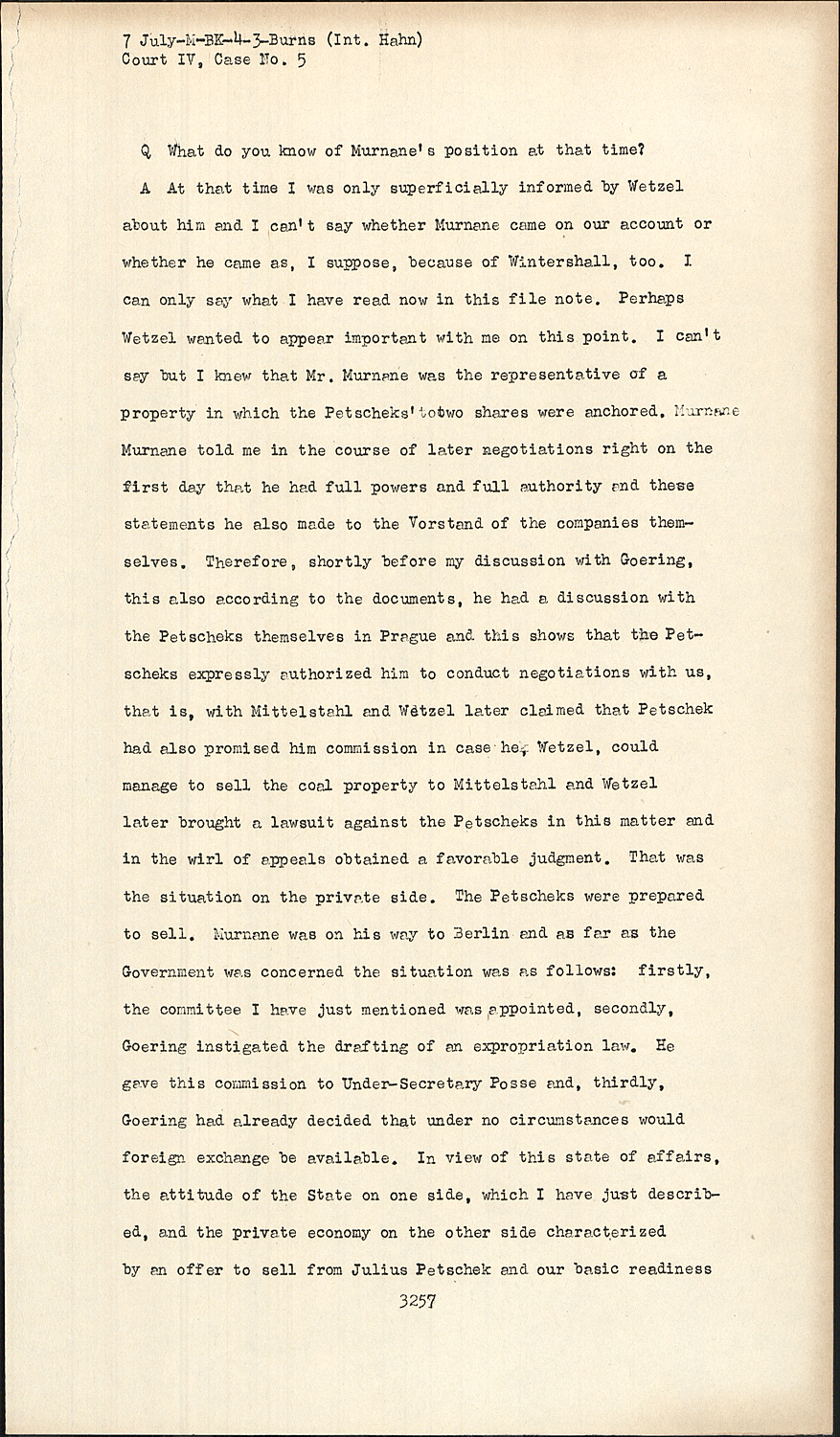
QWhat do you know of Murnane's position at that time?
AAt that time I was only superficially informed by Wetzel about him and I can't say whether Murnane came on our account or whether he came as, I suppose, because of Wintershall, too. I can only say what I have read now in this file note. Perhaps Wetzel wanted to appear important with me on this point. I can't say but I knew that Mr. Murnane was the representative of a property in which the Petscheks' two shares were anchored. Murnane Murnane told me in the course of later negotiations right on the first day that he had full powers and full authority and these statements he also made to the Vorstand of the companies themselves. Therefore, shortly before my discussion with Goering, this also according to the documents, he had a discussion with the Petscheks themselves in Prague and this shows that the Petscheks expressly authorized him to conduct negotiations with us, that is, with Mittelstahl and Wetzel later claimed that Petschek had also promised him commission in case he, Wetzel, could manage to sell the coal property to Mittelstahl and Wetzel later brought a lawsuit against the Petscheks in this matter and in the wirl of appeals obtained a favorable judgment. That was the situation on the private side. The Petscheks were prepared to sell. Murnane was on his way to Berlin and as far as the Government was concerned the situation was as follows: firstly, the committee I have just mentioned was appointed, secondly, Goering instigated the drafting of an expropriation law. He gave this commission to Under-Secretary Posse and, thirdly, Goering had already decided that under no circumstances would foreign exchange be available. In view of this state of affairs, the attitude of the State on one side, which I have just described, and the private economy on the other side characterized by an offer to sell from Julius Petschek and our basic readiness to follow up this offer - in this state of affairs I went to Goering, for us of course.
..
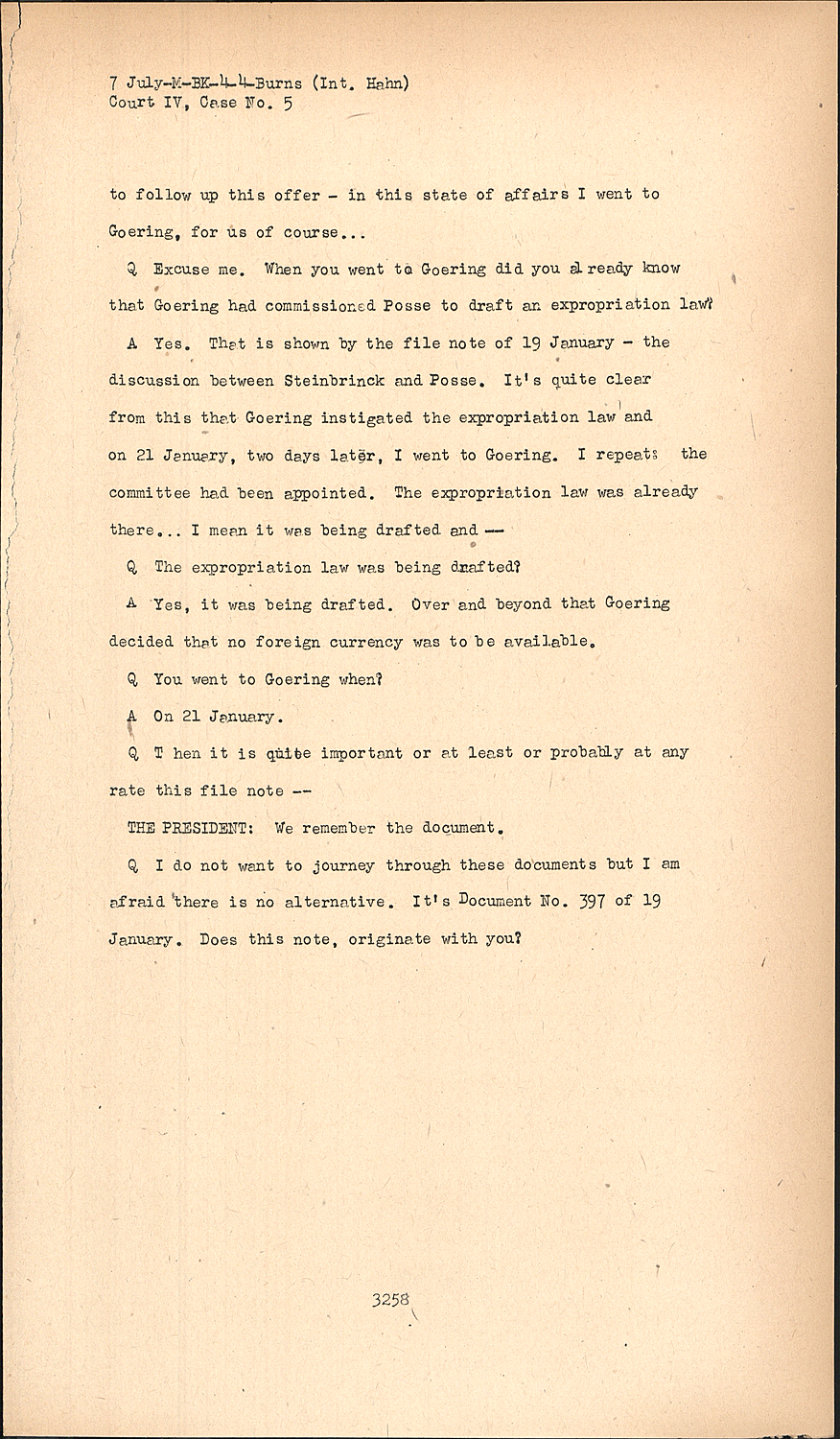
QExcuse me. When you went to Goering did you already know that Goering had commissioned Posse to draft an expropriation law?
AYes. That is shown By the file note of 19 January - the discussion between Steinbrinck and Posse. It's quite clear from this that Goering instigated the expropriation law and on 21 January, two days later, I went to Goering. I repeat: the committee had been appointed. The expropriation law was already there... I mean it was being drafted, and -
QThe expropriation law was being drafted?
AYes, it was Being drafted. Over and Beyond that Goering decided that no foreign currency was to be available.
QYou went to Goering when?
AOn 21 January.
QT hen it is quite important or at least or probably at any rate this file note -
THE PRESIDENT:We remember the document.
QI do not want to journey through these documents but I am afraid there is no alternative. It's Document No. 397 of 19 January. Does this note, originate with you?
C ourt IV, Case 5.
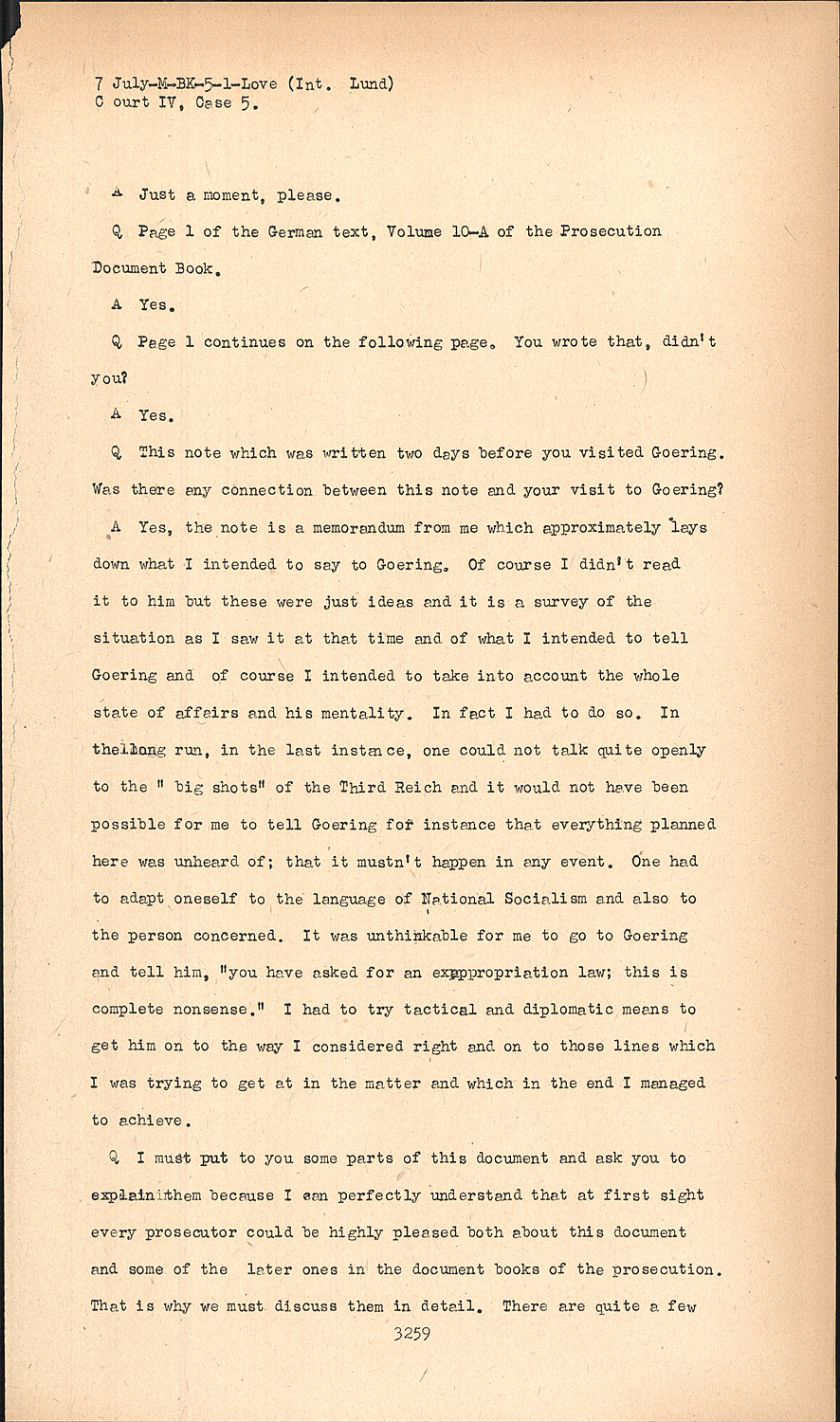
AJust a moment, please.
QPage 1 of the German text, Volume 10-A of the Prosecution Document Book.
AYes.
QPage 1 continues on the following page. You wrote that, didn't you?
AYes.
QThis note which was written two days before you visited Goering. Was there any connection between this note and your visit to Goering?
AYes, the note is a memorandum from me which approximately lays down what I intended to say to Goering. Of course I didn't read it to him but these were just ideas and it is a survey of the situation as I saw it at that time and of what I intended to tell Goering and of course I intended to take into account the whole state of affairs and his mentality. In fact I had to do so. In the long run, in the last instance, one could not talk quite openly to the "big shots" of the Third Reich and it would not have been possible for me to tell Goering for instance that everything planned here was unheard of; that it mustn't happen in any event. One had to adapt oneself to the language of National Socialism and also to the person concerned. It was unthinkable for me to go to Goering and tell him, "you have asked for an exappropriation law; this is complete nonsense." I had to try tactical and diplomatic means to get him on to the way I considered right and on to those lines which I was trying to get at in the matter and which in the end I managed to achieve.
QI must put to you some parts of this document and ask you to explain them because I can perfectly understand that at first sight every prosecutor could be highly pleased both about this document and some of the later ones in the document books of the prosecution. That is why we must discuss them in detail. There are quite a few anti-semitic remarks in them.