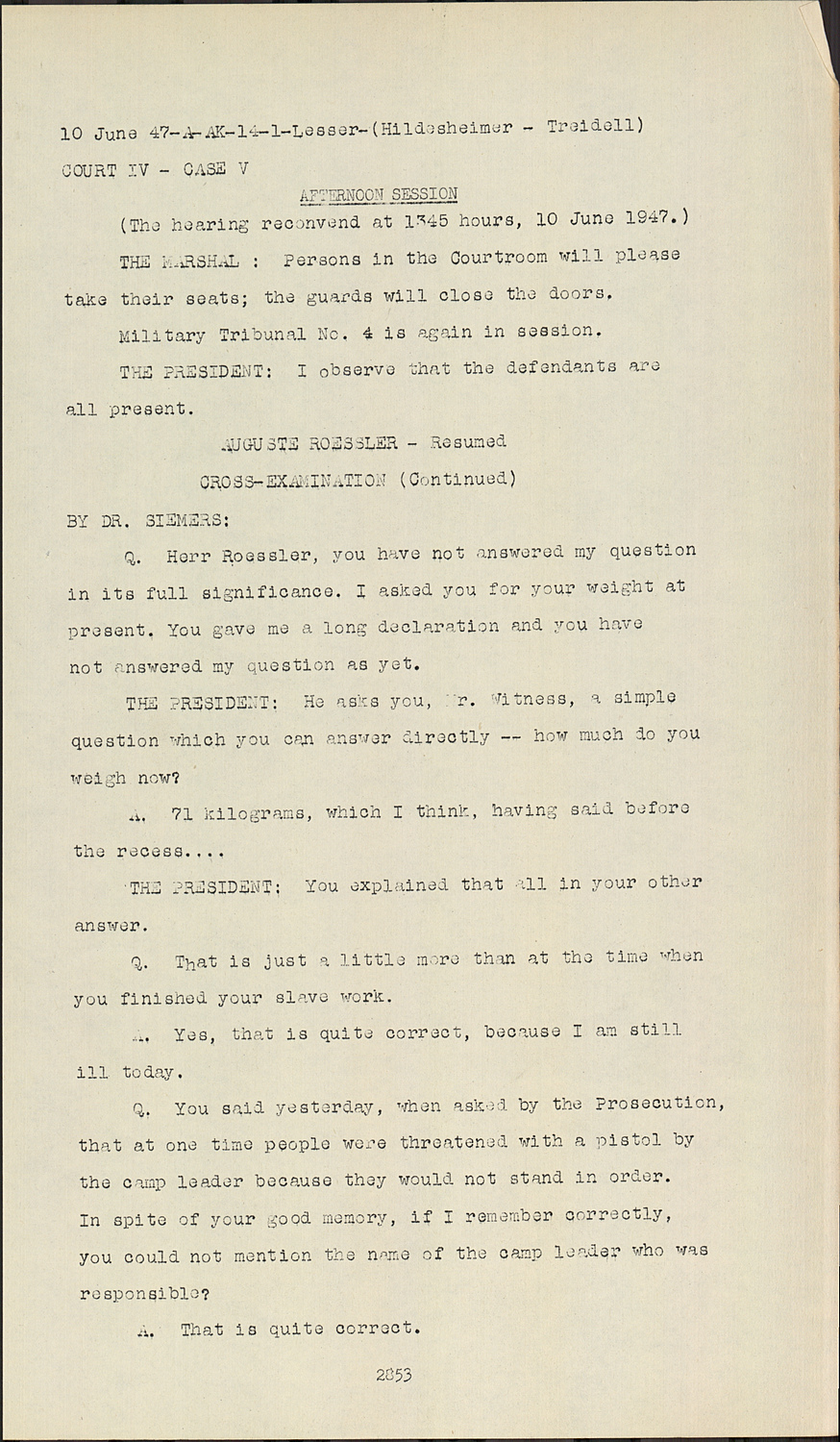
AFTERNOON SESSION (The hearing reconvend at 1345 hours, 10 June 1947.)
THE MARSHAL :Persons in the Courtroom will please take their seats; the guards will close the doors.
Military Tribunal No. 4 is again in session.
THE PRESIDENT:I observe that the defendants are all present.
AUGUSTE ROESSLER - Resumed CROSS-EXAMINATION (Continued) BY DR. SIEMERS:
Q.Herr Roessler, you have not answered my question in its full significance. I asked you for your weight at present. You gave me a long declaration and you have not answered my question as yet.
THE PRESIDENT:He asks you, Mr. Witness, a simple question which you can answer directly -- how much do you weigh now?
A. 71 kilograms, which I think, having said before the recess....
THE PRESIDENT:You explained that all in your other answer.
Q.That is just a little more than at the time when you finished your slave work.
A.Yes, that is quite correct, because I am still ill today.
Q.You said yesterday, when asked by the Prosecution, that at one time people were threatened with a pistol by the camp leader because they would not stand in order. In spite of your good memory, if I remember correctly, you could not mention the name of the camp leader who was responsible?
A.That is quite correct.
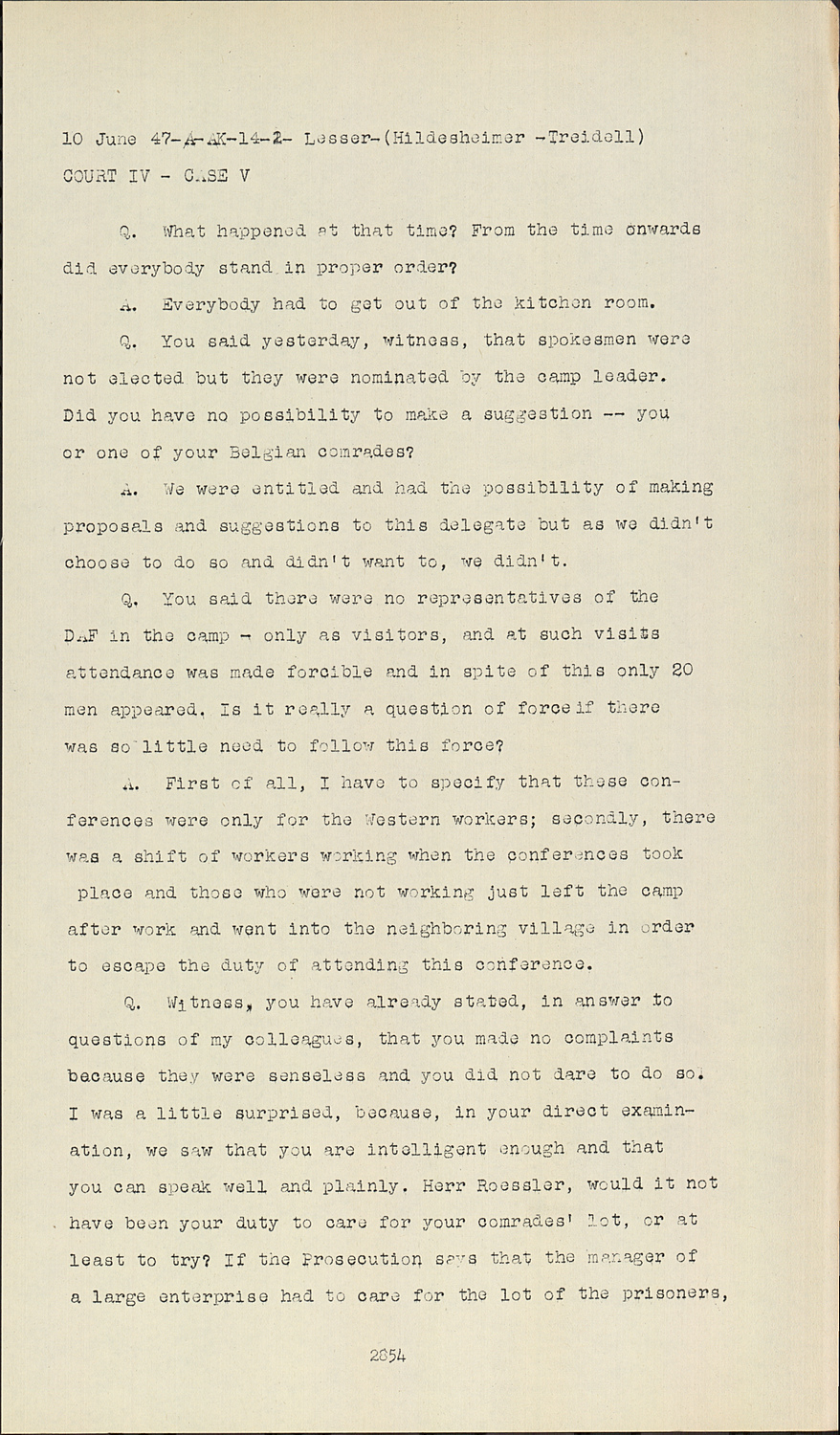
Q.What happened at that time? From the time onwards did everybody stand in proper order?
A.Everybody had to get out of the kitchen room.
Q.You said yesterday, witness, that spokesmen were not elected but they were nominated by the camp leader. Did you have no possibility to make a suggestion -- you or one of your Belgian comrades?
A.We were entitled and had the possibility of making proposals and suggestions to this delegate but as we didn't choose to do so and didn't want to, we didn't.
Q.You said there were no representatives of the DAF in the camp - only as visitors, and at such visits attendance was made forcible and in spite of this only 20 men appeared. Is it really a question of force if there was so little need to follow this force?
A.First of all, I have to specify that these conferences were only for the Western workers; secondly, there was a shift of workers working when the conferences took place and those who were not working just left the camp after work and went into the neighboring village in order to escape the duty of attending this conference.
Q.Witness, you have already stated, in answer to questions of my colleagues, that you made no complaints because they were senseless and you did not dare to do so. I was a little surprised, because, in your direct examination, we saw that you are intelligent enough and that you can speak well and plainly. Herr Roessler, would it not have been your duty to care for your comrades' lot, or at least to try? If the Prosecution says that the manager of a large enterprise had to care for the lot of the prisoners, even if it was dangerous for him, do you not think that you had the same moral duty to do so?
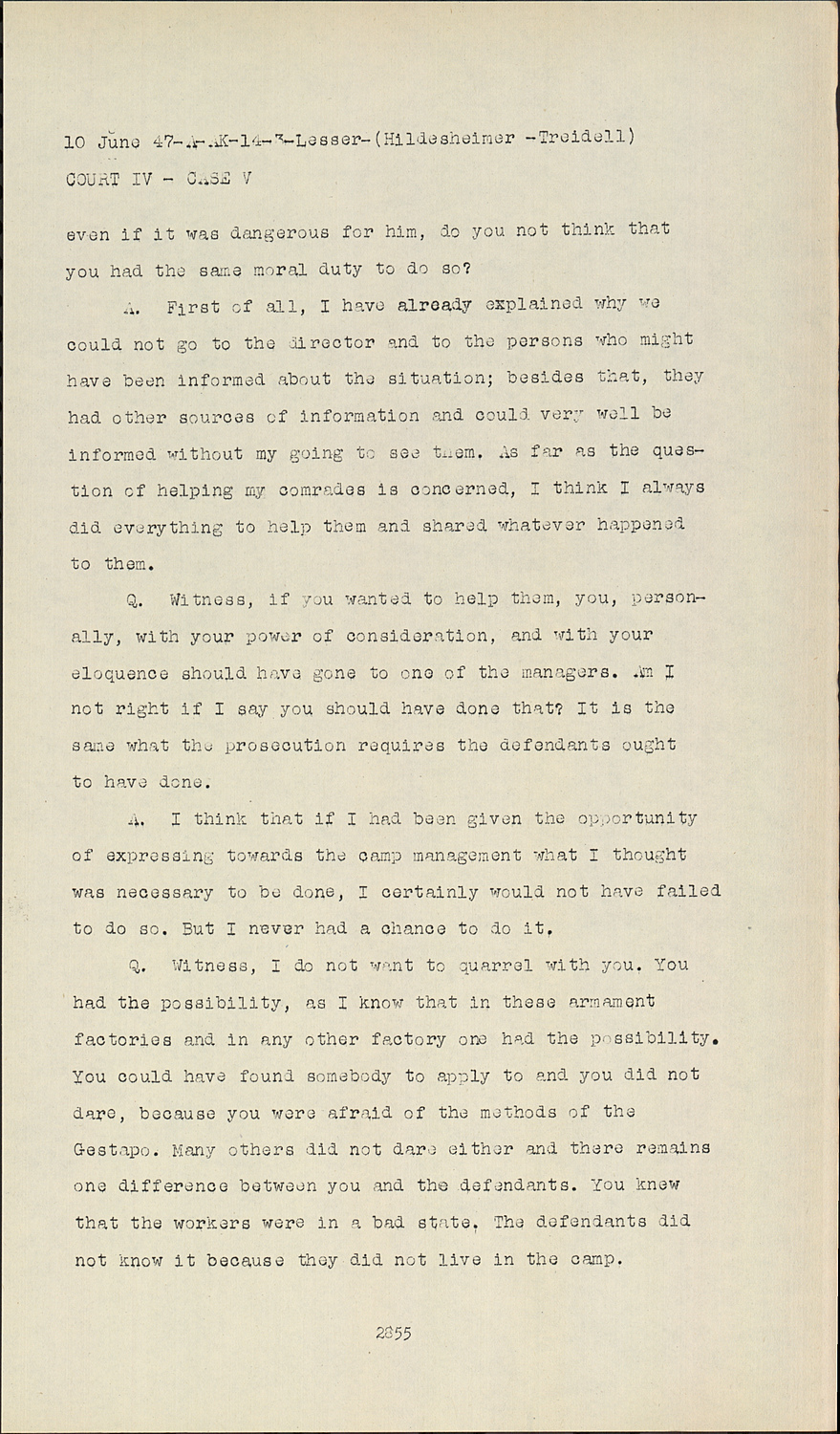
A.First of all, I have already explained why we could not go to the director and to the persons who might have been informed about the situation; besides that, they had other sources of information and could very well be informed without my going to see them. As far as the question of helping my comrades is concerned, I think I always did everything to help them and shared whatever happened to them.
Q.Witness, if you wanted to help them, you, personally, with your power of consideration, and with your eloquence should have gone to one of the managers. Am I not right if I say you should have done that? It is the same what the prosecution requires the defendants ought to have done.
A.I think that if I had been given the opportunity of expressing towards the camp management what I thought was necessary to be done, I certainly would not have failed to do so. But I never had a chance to do it.
Q.Witness, I do not want to quarrel with you. You had the possibility, as I know that in these armament factories and in any other factory one had the possibility. You could have found somebody to apply to and you did not dare, because you were afraid of the methods of the Gestapo. Many others did not dare either and there remains one difference between you and the defendants. You knew that the workers were in a bad state. The defendants did not know it because they did not live in the camp.
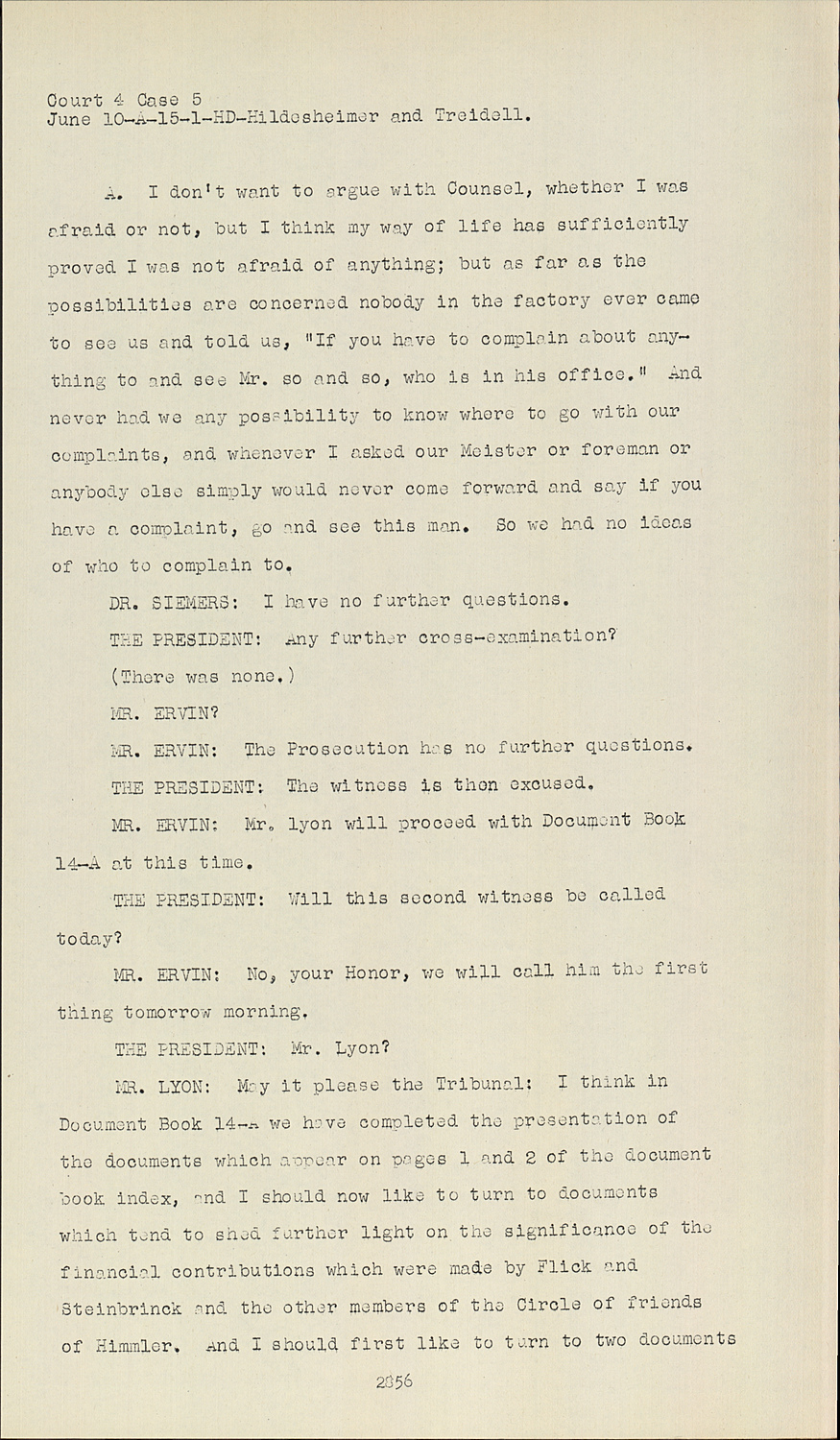
A.I don't want to argue with Counsel, whether I was afraid or not, but I think my way of life has sufficiently proved I was not afraid of anything; but as far as the possibilities are concerned nobody in the factory ever came to see us and told us, "If you have to complain about anything to and see Mr. so and so, who is in his office," And never had we any possibility to know where to go with our complaints, and whenever I asked our Meister or foreman or anybody else simply would never come forward and say if you have a complaint, go and see this man. So we had no ideas of who to complain to.
DR. SIEMERS:I have no further questions.
THE PRESIDENT:Any further cross-examination?
(There was none.)
MR. ERVIN?
MR. ERVIN:The Prosecution has no further questions.
THE PRESIDENT:The witness is then excused.
MR. ERVIN:Mr. lyon will proceed with Document Book 14-A at this time.
THE PRESIDENT:Will this second witness be called today?
MR. ERVIN:No, your Honor, we will call him the first thing tomorrow morning.
THE PRESIDENT:Mr. Lyon?
MR. LYON:May it please the Tribunal: I think in Document Book 14-A we have completed the presentation of the documents which appear on pages 1 and 2 of the document book index, and I should now like to turn to documents which tend to shed further light on the significance of the financial contributions which were made by Flick and Steinbrinck and the other members of the Circle of friends of Himmler. And I should first like to turn to two documents Court 4 Case 5 which testify to the importance of these funds for the organization.
This, I suppose, is a point which hardly needs proof, the point that money can be a very important form of subsistence. We have already seen some explicit reference to that in Exhibit 694, which appears at page 91 of the document book. The Tribunal recalls that was a letter from the defendant Steinbrinck to Mr. Raabe, the then head of the Maxhuette plant, in which he authorizes the payment of a contribution to the SA. And it is clear from the letter that he regarded the contribution as of some importance since it would permit the SA company to buy the necessary uniforms. If I may just revert to one sentence which appears at the middle of page 91, it might be of interest. Mr. Steinbrinck says, and I quote:
"I would like to do something for these men in any case, all the more so as the money in question is not going to be squandered, but is to be used to equip additional SA men."
Then toward the bottom of the page he goes on to say, and I quote again;
"As this concerns the special case of enrolling SA storm troopers from the Sudetanland I would even go higher."
We have also seen in the two documents which were introduced when we discontinued this document book, the large sums that were contributed to Hitler's campaign funds for the decisive elections of March, 1933. That appeared from Exhibit 595 and 596.
I should now like to offer in evidence, Document NI-6522, which appears at page 98 of the English Document book.
THE PRESIDENT:The document now offered is received in evidence as Prosecution's Exhibit No. 696, and the Court 4 Case 5 Secretary-General will note this in his records.
MR. LYON:This document is an excerpt from the diary of the well-known Dr. Josef Goebbels who, of course, was the Propaganda Minister under the Third Reich. This excerpt was an entry under the date of 8 December 1932, and a very brief reference to that excerpt will show the financial difficulties which the Naze Party was experiencing at that time, just a little more than a month before Hitler was appointed Chancellor. At the top of page 99 we see the first entry, which roads as follows:
"Deep depression is prevalent in the Organization. Financial worries prevent any constructive work."
The entry continues to refer to the danger of an internal split, with Strasser threatening to split off from the party. And then at the bottom of page 99 Goebbels summarizes the situation. He says, and I quote:
"We could not got into the right spirit. We are all very much discouraged, particularly in the face of the present danger that the entire party may collapse and all our work be in vain."
I should now like to skip the next document, which appears in the document book, and I should like to offer in evidence Document NI-6036, which appears at page 103.
THE PRESIDENT:What page?
MR.LYON: 103, your Honor.
THE PRESIDENT:Just a moment. The document offered is received in evidence as Prosecution's Exhibit No. 699.
MR. LYON:This document is an affidavit by a man named August Arnold Oest. He describes himself as an exObersturmfuehrer in the SS. I should like to read the beginning of paragraph 1:
"In 1935 I was an inspector of the SS" -- the German word that follows is "Oberabschnitt;" I think it would be better to refer to the German rather than the attempted translation ---- "of the SS Oberabschnitt Dresden. On 1 October 1935 I become inspector of the NSDAP in the Gau Thueringen and in 1937 I was transferred to the inspection office of the Reich treasurer." Again perhaps a correction should be made in the translation. The German word which is translated as treasurer is Reichsschatz-Meister, and what that Official was, was a Reich treasurer of the Party. But really it should be more properly translated as the "party treasurer." I may say in the explanation of the term, "Oberabschnitt," my understanding is that it was the largest subdivision of the entire SS organization, and I understand there were thirteen Oberabschnitts covering all of Germany and occupied areas which were considered incorporated, and the Oberabschnitt corresponds, I suppose, to a corps. Under the Oberabschnitts were the Abschnitts which perhaps corresponded to divisions; under the Abschnitts were the Standarte, or regiments, and under the Standarte were the Sturmbann, and the lowest of these units was a Sturm, or company, So the Oberabschnitt was a relatively large group and covered a relatively large area.
THE PRESIDENT:Are these words in your glossary?
MR. LYON:I am afraid they are not, your Honor. I think it might be a good idea if we supplied a glossary which supplies ---
THE PRESIDENT:Are they included in the decision of the IMT?
MR. LYON:I believe not. Some of these technical matters are covered --
THE PRESIDENT:Are you going to prove them?
MR. LYON:I don't think we will. As far as I can see, I don't think we will furnish special proof of these.
THE PRESIDENT:Then they can't be material.
MR. LYON:I don't think it is material. I thought the Court might be curious to know what these words meant --
THE PRESIDENT:Well, "Abschnitt" is a perfectly simple word.
MR. LYON:Yes, it is one we will run into several times. I might say that a description of the organizational set-up of the SS, the higher officers of the SS, appears in the IMT judgment.
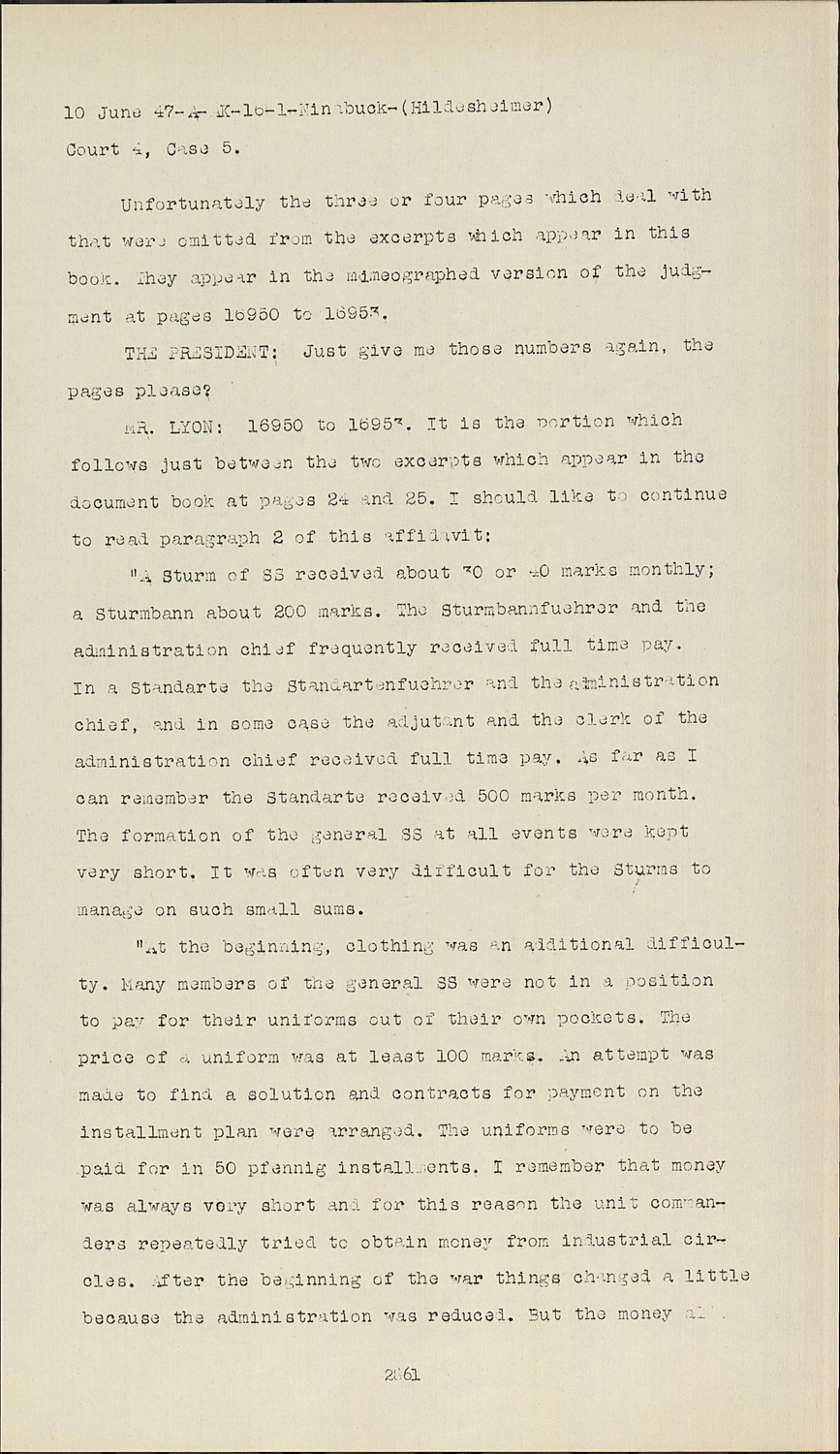
Unfortunately the three or four pages which deal with that were emitted from the excerpts which appear in this book. They appear in the mimeographed version of the judgment at pages 16950 to 16953.
THE PRESIDENT:Just give me those numbers again, the pages please?
MR.LYON: 16950 to 16953. It is the portion which follows just between the two excerpts which appear in the document book at pages 24 and 25. I should like to continue to read paragraph 2 of this affidavit:
"A Sturm of SS received about 30 or 40 marks monthly; a Sturmbann about 200 marks. The Sturmbannfuehrer and the administration chief frequently received full time pay. In a Standarte the Standartenfuehrer and the administration chief, and in some case the adjutant and the clerk of the administration chief received full time pay. As far as I can remember the Standarte received 500 marks per month. The formation of the general SS at all events were kept very short. It was often very difficult for the Sturms to manage on such small sums.
"At the beginning, clothing was an additional difficulty. Many members of the general SS were not in a position to pay for their uniforms out of their own pockets. The price of a uniform was at least 100 marks. An attempt was made to find a solution and contracts for payment on the installment plan were arranged. The uniforms were to be paid for in 50 pfennig installments. I remember that money was always very short and for this reason the unit commanders repeatedly tried to obtain money from industrial circles. After the beginning of the war things changed a little because the administration was reduced. But the money al allowance was still so small that one couldn't make ends meet.
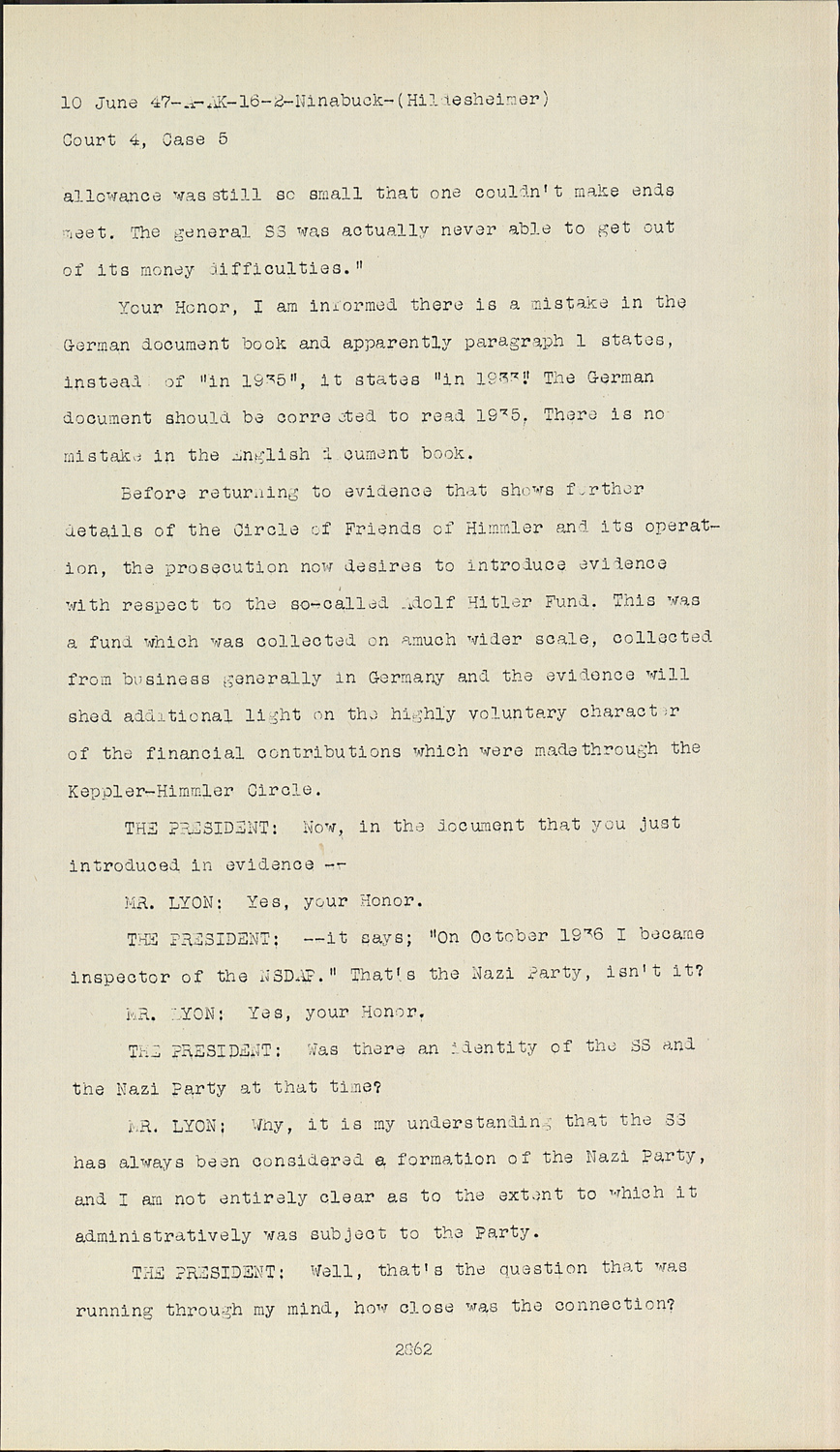
The general SS was actually never able to get out of its money difficulties."
Your Honor, I am informed there is a mistake in the German document book and apparently paragraph 1 states, instead of "in 1936", it states "in 1933" The German document should be corrected to read 1935. There is no mistake in the English document book.
Before returning to evidence that shows further details of the Circle of Friends of Himmler and its operation, the prosecution now desires to introduce evidence with respect to the so-called Adolf Hitler Fund. This was a fund which was collected on amuch wider scale, collected from business generally in Germany and the evidence will shed additional light on the highly voluntary character of the financial contributions which were made through the Keppler-Himmler Circle.
THE PRESIDENT:Now, in the document that you just introduced in evidence -
MR. LYON:Yes, your Honor.
THEPRESIDENT: --it says; "On October 1936 I became inspector of the NSDAP." That's the Nazi Party, isn't it?
MR. LYON:Yes, your Honor.
THE PRESIDENT:Was there an identity of the SS and the Nazi Party at that time?
MR. LYON:Why, it is my understanding that the SS has always been considered a formation of the Nazi Party, and I am not entirely clear as to the extent to which it administratively was subject to the party.
THE PRESIDENT:Well, that's the question that was running through my mind, how close was the connection?
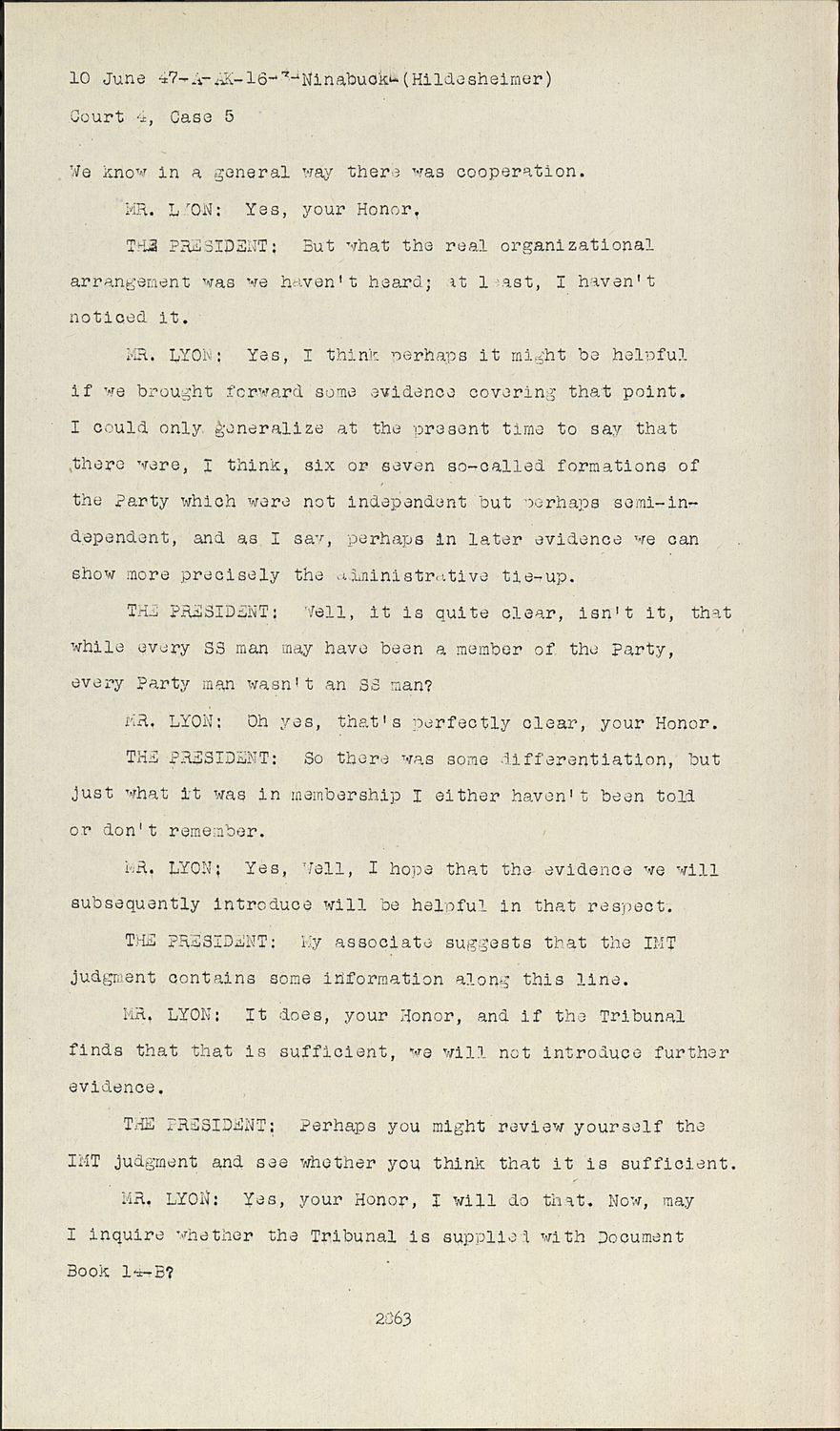
We know in a general way there was cooperation.
MR. LYON:Yes, your Honor.
THE PRESIDENT:But what the real organizational arrangement was we haven't heard; at least, I haven't noticed it.
MR. LYON:Yes, I think perhaps it might be helpful if we brought forward some evidence covering that point. I could only generalize at the present time to say that there were, I think, six or seven so-called formations of the Party which were not independent but perhaps semi-independent, and as I say, perhaps in later evidence we can show more precisely the administrative tie-up.
THE PRESIDENT:Well, it is quite clear, isn't it, that while every SS man may have been a member of the Party, every party man wasn't an SS man?
MR. LYON:Oh yes, that's perfectly clear, your Honor.
THE PRESIDENT:So there was some differentiation, but just what it was in membership I either haven't been told or don't remember.
MR. LYON:Yes, Well, I hope that the evidence we will subsequently introduce will be helpful in that respect.
THE PRESIDENT:My associate suggests that the IMT judgment contains some information along this line.
MR. LYON:It does, your Honor, and if the Tribunal finds that that is sufficient, we will not introduce further evidence.
THE PRESIDENT:Perhaps you might review yourself the IMT judgment and see whether you think that it is sufficient.
MR. LYON:Yes, your Honor, I will do that. Now, may I inquire whether the Tribunal is supplied with Document Book 14-B?
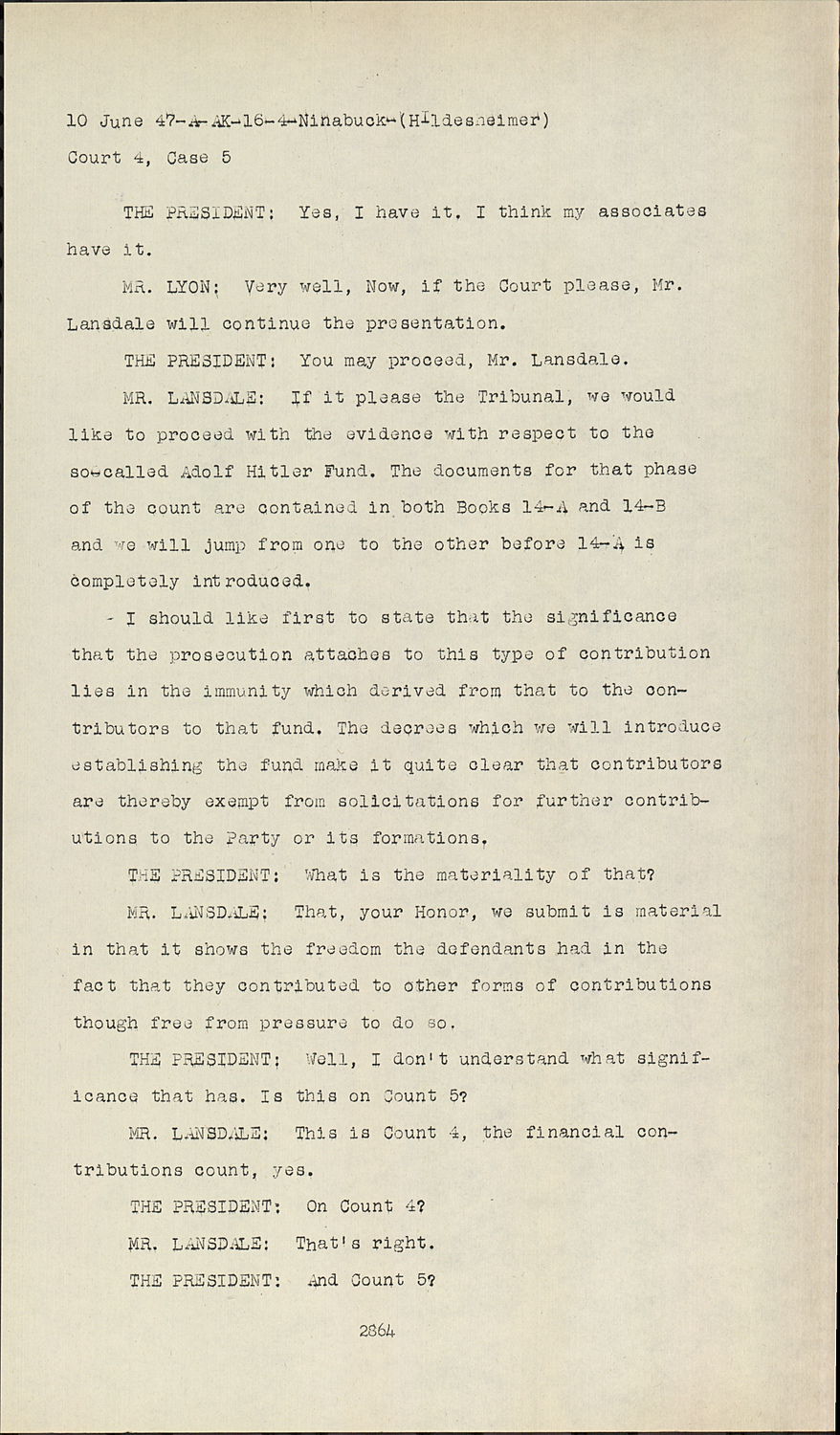
THE PRESIDENT:Yes, I have it. I think my associates have it.
MR. LYON:Very well, Now, if the Court please, Mr. Lansdale will continue the presentation.
THE PRESIDENT:You may proceed, Mr. Lansdale.
MR. LANSDALE:If it please the Tribunal, we would like to proceed with the evidence with respect to the so-called Adolf Hitler Fund. The documents for that phase of the count are contained in both Books 14-A and 14-B and we will jump from one to the other before 14-A is completely introduced.
I should like first to state that the significance that the prosecution attaches to this type of contribution lies in the immunity which derived from that to the contributors to that fund. The decrees which we will introduce establishing the fund make it quite clear that contributors are thereby exempt from solicitations for further contributions to the Party or its formations.
THE PRESIDENT:What is the materiality of that?
MR. LANSDALE:That, your Honor, we submit is material in that it shows the freedom the defendants had in the fact that they contributed to other forms of contributions though free from pressure to do so.
THE PRESIDENT:Well, I don't understand what significance that has. Is this on Count 5?
MR. LANSDALE:This is Count 4, the financial contributions count, yes.
THE PRESIDENT:On Count 4?
MR. LANSDALE:That's right.
THE PRESIDENT:And Count 5?
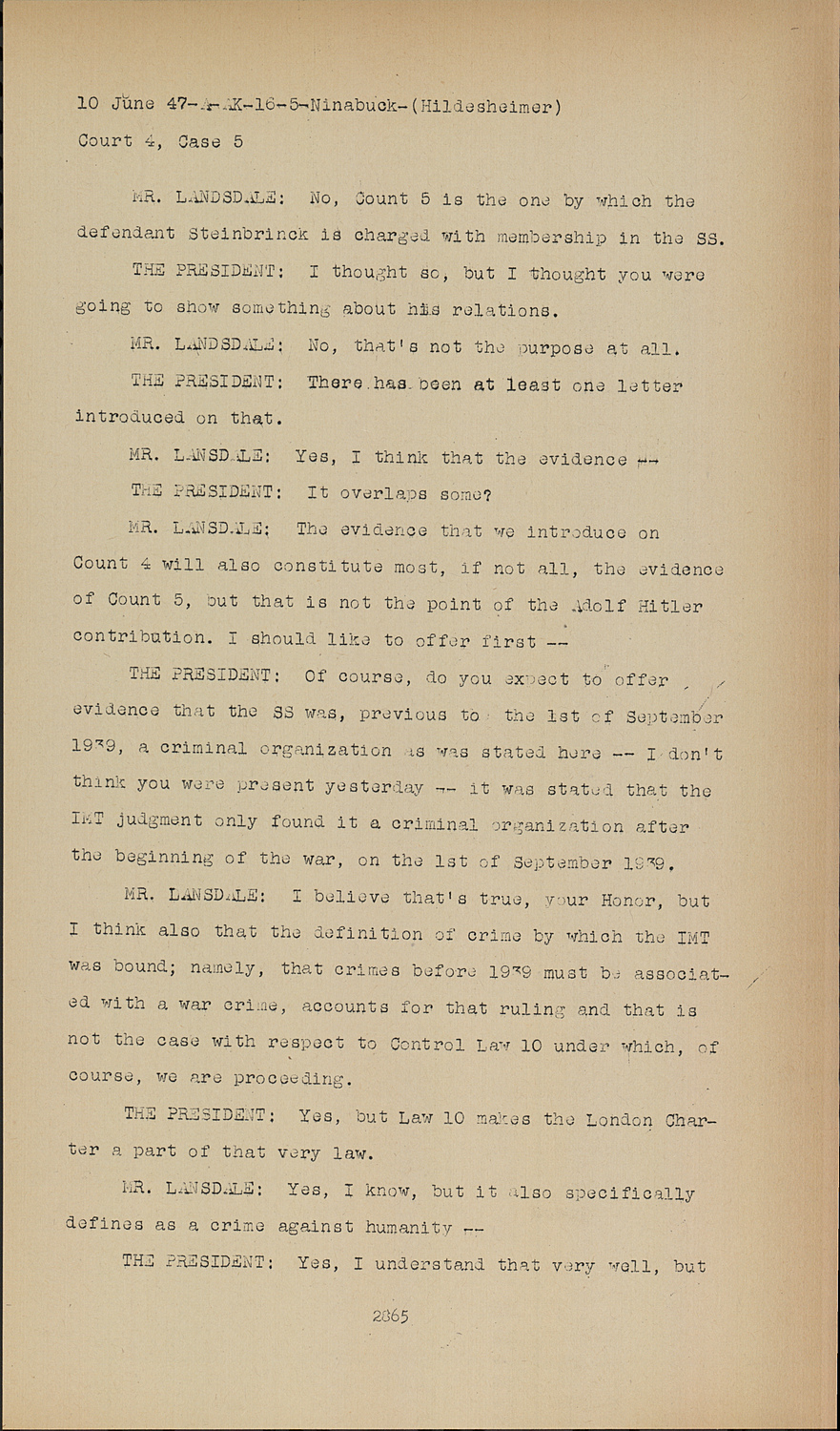
MR. LANDSDALE:No, Count 5 is the one by which the defendant Steinbrinck is charged with membership in the SS.
THE PRESIDENT:I thought so, but I thought you were going to show something about his relations.
MR. LANDSDALE:No, that's not the purpose at all.
THE PRESIDENT:There has been at least one letter introduced on that.
MR. LANSDALE:Yes, I think that the evidence -
THE PRESIDENT:It overlaps some?
MR. LANSDALE:The evidence that we introduce on Count 4 will also constitute most, if not all, the evidence of Count 5, but that is not the point of the Adolf Hitler contribution. I should like to offer first -
THE PRESIDENT:Of course, do you expect to offer evidence that the SS was, previous to the 1st of September 1939, a criminal organization is was stated here -- I don't think you were present yesterday -- it was stated that the IMT judgment only found it a criminal organization after the beginning of the war, on the 1st of September 1939.
MR. LANSDALE:I believe that's true, your Honor, but I think also that the definition of crime by which the IMT Was bound; namely, that crimes before 1939 must be associated with a war crime, accounts for that ruling and that is not the case with respect to Control Law 10 under which, of course, we are proceeding.
THE PRESIDENT:Yes, but Law 10 makes the London Charter a part of that very law.
MR. LANSDALE:Yes, I know, but it also specifically defines as a crime against humanity -
THE PRESIDENT:Yes, I understand that very well, but what I ask is not as to the terms of the law but whether you intend to offer proof that the SS organization was a criminal organization previous to the date of the beginning of the war.
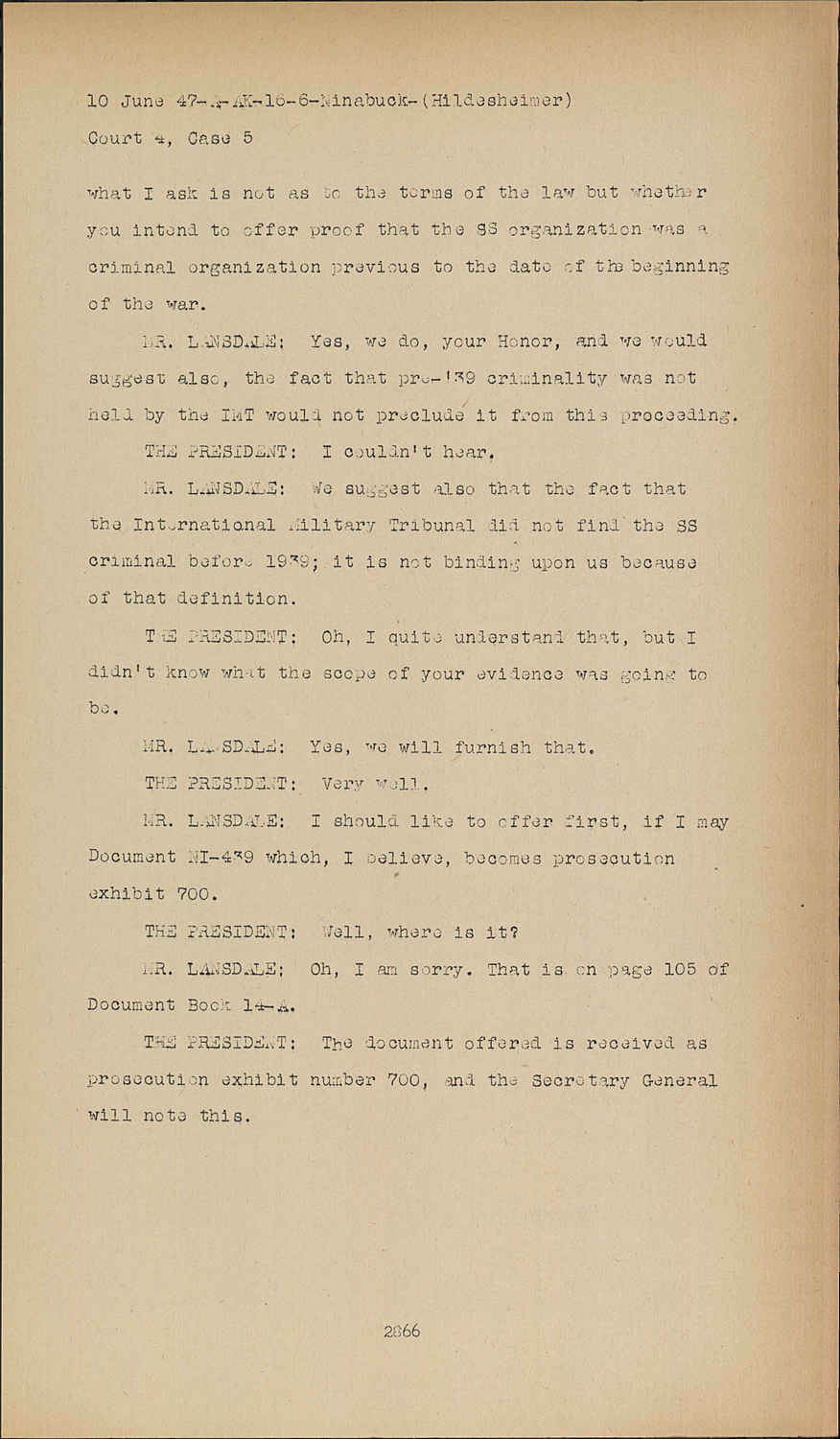
MR. LANSDALE:Yes, we do, your Honor, and we would suggest also, the fact that pre-139 criminality was not held by the IMT would not preclude it from this proceeding.
THE PRESIDENT:I couldn't hear.
MR. LANSDALE:We suggest also that the fact that the International military Tribunal did not find the SS criminal before 1939; it is not binding upon us because of that definition.
THE PRESIDENT:Oh, I quite understand that, but I didn't know what the scope of your evidence was going to be.
MR. LANSDALE:Yes, we will furnish that.
THE PRESIDENT:Very well.
MR. LANSDALE:I should like to offer first, if I may Document NI-439 which, I believe, becomes prosecution exhibit 700.
THE PRESIDENT:Well, where is it?
MR. LANSDALE:Oh, I am sorry. That is on page 105 of Document Book 14-A.
THE PRESIDENT:The document offered is received as prosecution exhibit number 700, and the Secretary General will note this.
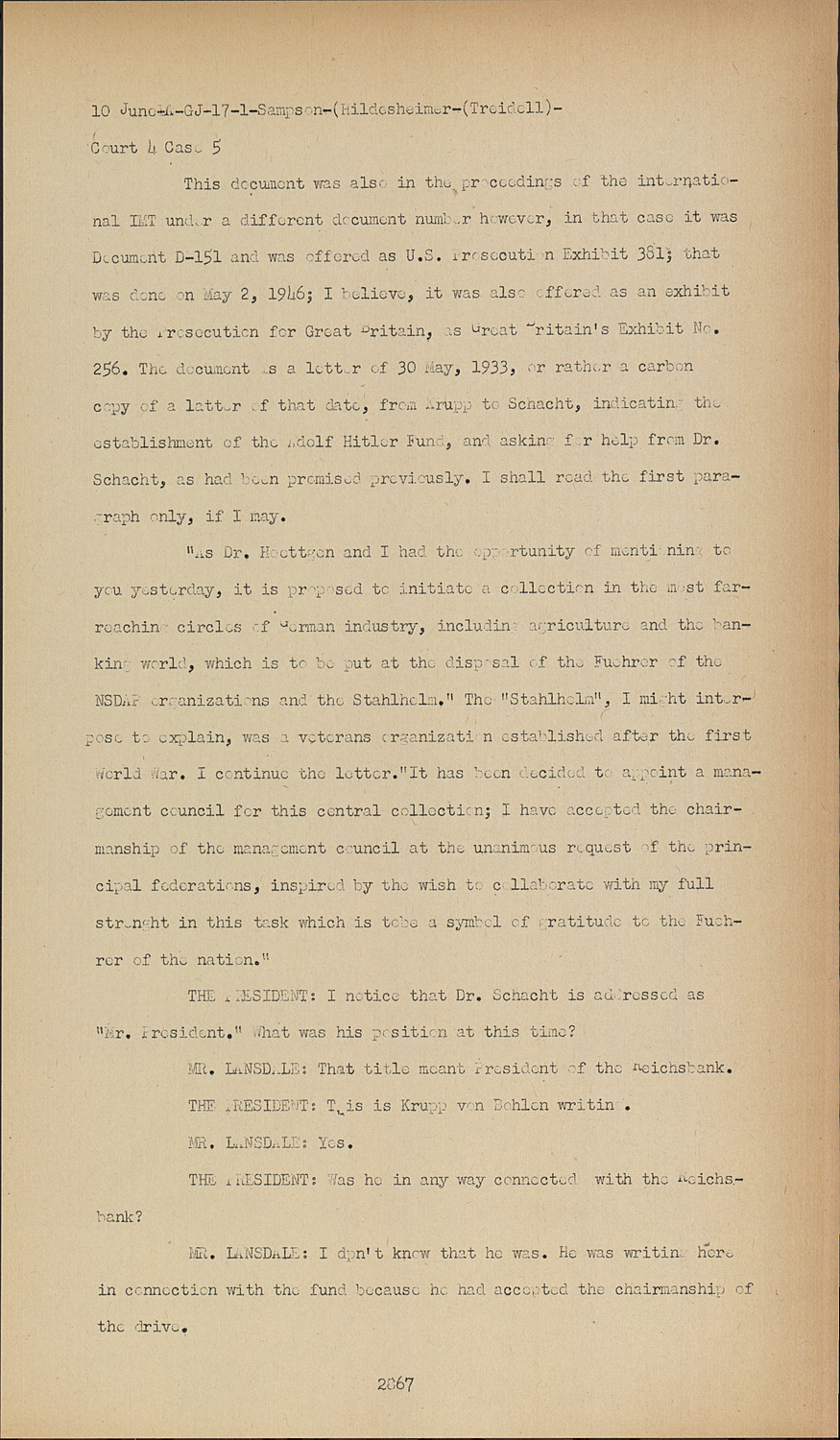
This document was also in the proceedings of the international IMT under a different document number however, in that case it was Document D-151 and was offered as U.S. prosecution Exhibit 381; that was done on May 2, 1946; I believe, it was also offered as an exhibit by the prosecution for Great Britain, as Great Britain's Exhibit No. 256. The document as a letter of 30 May, 1933, or rather a carbon copy of a latter of that date, from Krupp to Schacht, indicating the establishment of the Adolf Hitler Fund, and asking for help from Dr. Schacht, as had been premised previously. I shall read the first paragraph only, if I may.
"As Dr. Hoettgen and I had the opportunity of mentioning to you yesterday, it is proposed to initiate a collection in the most farreaching circles of German industry, including agriculture and the banking world, which is to be put at the disposal of the Fuehrer of the NSDAP organizations and the Stahlhelm." The "Stahlhelm", I might interpose to explain, was a veterans organization established after the first world war. I continue the letter."It has been decided to appoint a management council for this central collection; I have accepted the chairmanship of the management council at the unanimous request of the principal federations, inspired by the wish to collaborate with my full strenght in this task which is tobe a symbol of gratitude to the Fuehrer of the nation."
THE PRESIDENT:I notice that Dr. Schacht is addressed as "Mr. President. "What was his position at this time?
MR. LANSDALE:That title meant President of the Reichsbank.
THE PRESIDENT:This is Krupp von Bohlen writin .
HR. LANSDALE:Yes.
THE PRESIDENT:Was he in any way connected with the Reichsbank?
MR. LANSDALE:I don't know that he was. He was written here in connection with the fund because he had accepted the chairmanship of the drive.
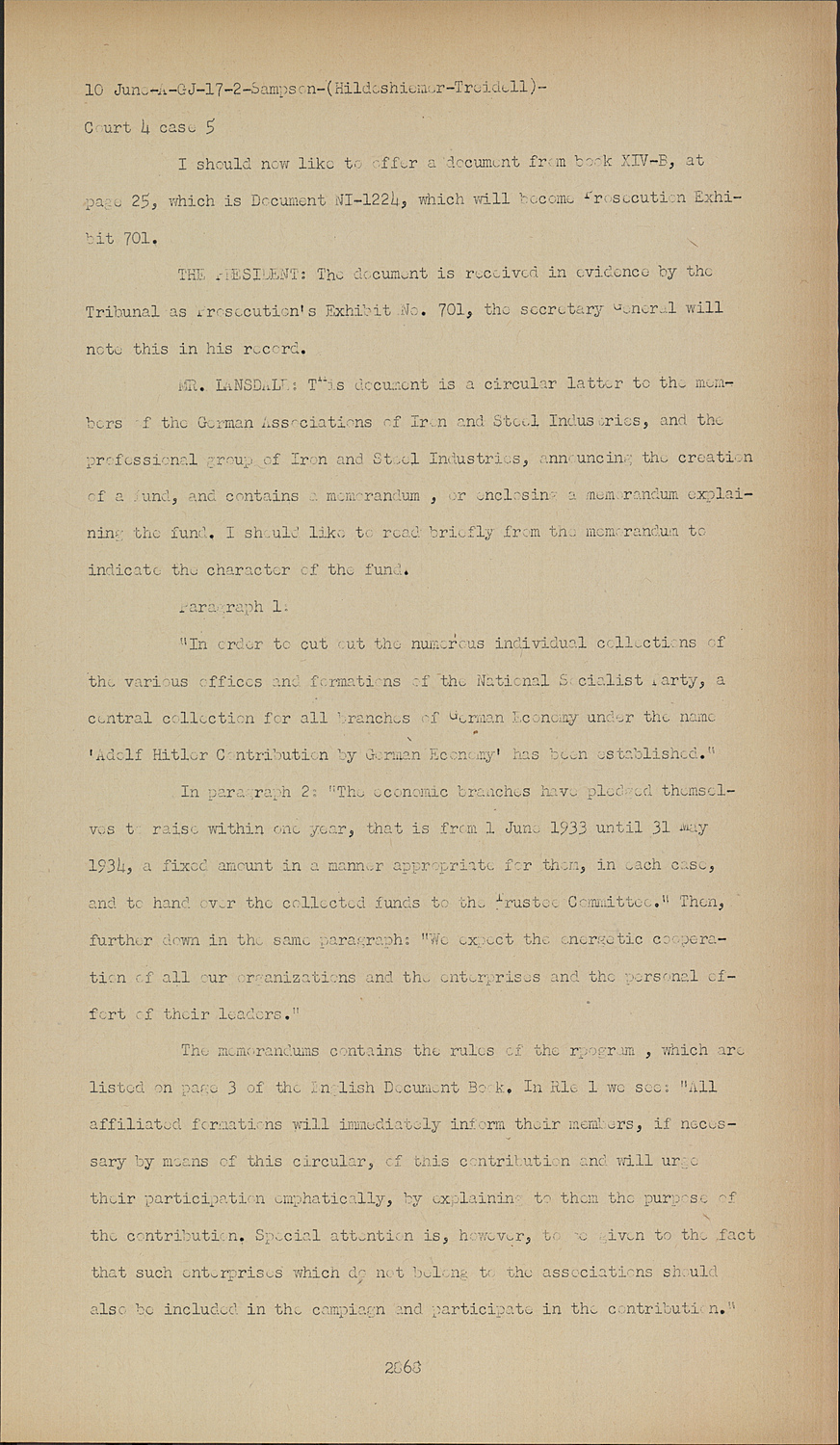
I should now like to offer a document from book XIV-B, at bit 701.
THE PRESIDENT:The document is received in evidence by the Tribunal as Prosecution's Exhibit No. 701, the secretary General will note this in his record.
MR. LANSDALE:This document is a circular latter to the members of the German Associations of Iron and Steel Industries, and the professional group of Iron and Steel Industries, announcing the creation of a Fund, and contains memorandum , or enclosing a memorandum explaining the fund. I should like to read briefly from the memorandum to indicate the character of the fund.
Paragraph 1.
"In order to cut out the numerous individual collections of the various offices and formations of the National Socialist Party, a central collection for all branches of German Economy under the name 'Adolf Hitler Contribution by German Economy' has been established."
In paragraph 2: "The economic branches have pledged themselves to raise within one year, that is from 1 June 1933 until 31 may 1934, a fixed amount in a manner appropriate for them, in each case, and to hand over the collected funds to the Trustee Committee." Then, further down in the same paragraph: "We expect the energetic cooperation of all our organizations and the enterprises and the personal effort of their leaders."
The memorandums contains the rules of the rpogram , which are listed on page 3 of the English Document Book. In Rle l we see: "All affiliated formations will immediately inform their members, if necessary by means of this circular, of this contribution and will urge their participation emphatically, by explaining to them the purpose of the contribution. Special attention is, however, to be given to the fact that such enterprises which do not belong to the associations should also be included in the campiagn and participate in the contribution."
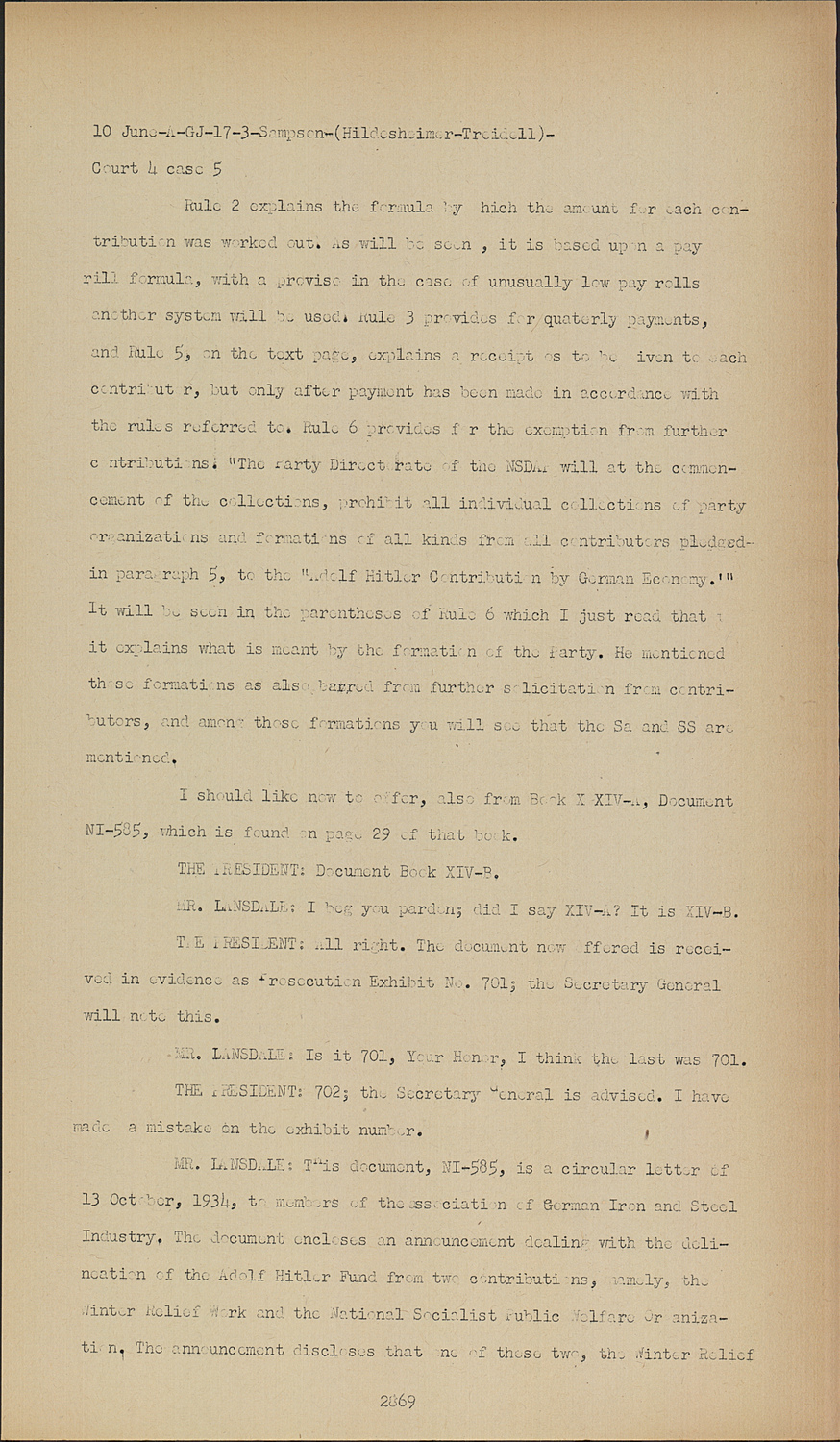
Rule 2 explains the formula by which the amount for each contribution was worked out. As will be seen , it is based upon a pay rill formula, with a provise in the case of unusually low pay rolls another system will be used. Rule 3 provides for quaterly payments, and Rule 5, on the text page, explains a receipt os to be given to each contributor, but only after payment has been made in accordance with the rules referred to. Rule 6 provides for the exemption from further contributions. "The Party Direct rate of the NSDAP will at the commencement of the collections, prohibit all individual collections of party organizations and formations of all kinds from all contributors pledgedin paragraph 5, to the "Adolf Hitler Contribution by German Economy.'" It will be seen in the parentheses of Rule 6 which I just read that it explains what is meant by the formation of the Party. He mentioned these formations as also barred from further solicitation from contributors, and among those formations you will see that the Sa and SS are mentioned.
I should like new to offer, also from Book X XIV-A, Document NI-585, which is found on page 29 of that book.
THE PRESIDENT:Document Book XIV-B.
MR. LANSDALE:I beg you pardon; did I say XIV-A? It is XIV-B.
THE PRESIDENT:All right. The document now offered is received in evidence as Prosecution Exhibit No. 701; the Secretary General will note this.
MR. LANSDALE:Is it 701, Your Honor, I think the last was 701.
THEPRESIDENT: 702; the Secretary General is advised. I have made a mistake on the exhibit number.
MR. LANSDALE:This document, NI-585, is a circular letter of 13 October, 1934, to members of the association of German Iron and Steel Industry. The document encloses an announcement dealing with the delineation of the Adolf Hitler Fund from two contributions, namely, the Winter Relief Work and the National Socialist Public Welfare Organization. The announcement discloses that one of these two, the Winter Relief Work and the National Socialist Public Welfare Organization.
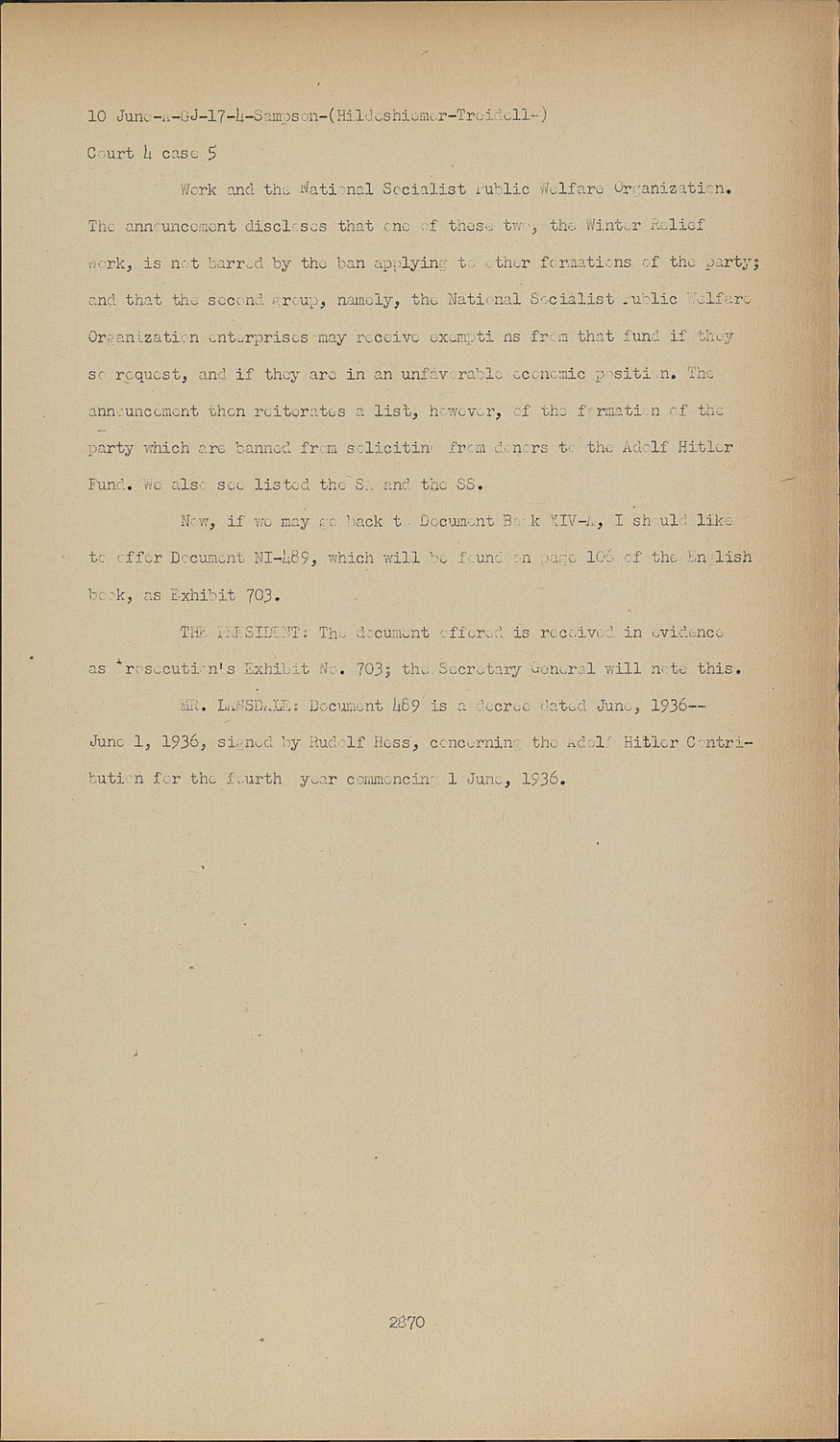
The announcement discloses that one of these two, the Winter Relief work, is not barred by the ban applying to other formations of the party; and that the second group, namely, the National Socialist Public Welfare Organization enterprises may receive exemptions from that fund if they so request, and if they are in an unfavorable economic position. The announcement then reiterates a list, however, of the formation of the party which are banned from soliciting from donors to the Adolf Hitler Fund. We also see listed the SA and the SS.
Now, if we may go back to Document Book XIV-A, I should like to offer Document NI-489, which will be found on page 106 of the English book, as Exhibit 703.
THE PRESIDENT:The document offered is received in evidence as Prosecution's Exhibit No. 703; the Secretary General will note this.
MR. LANSDALE:Document 489 is a decree dated June, 1936-June 1, 1936, signed by Rudolf Hess, concerning the Adolf Hitler Contribution for the fourth year commencing 1 June, 1936.
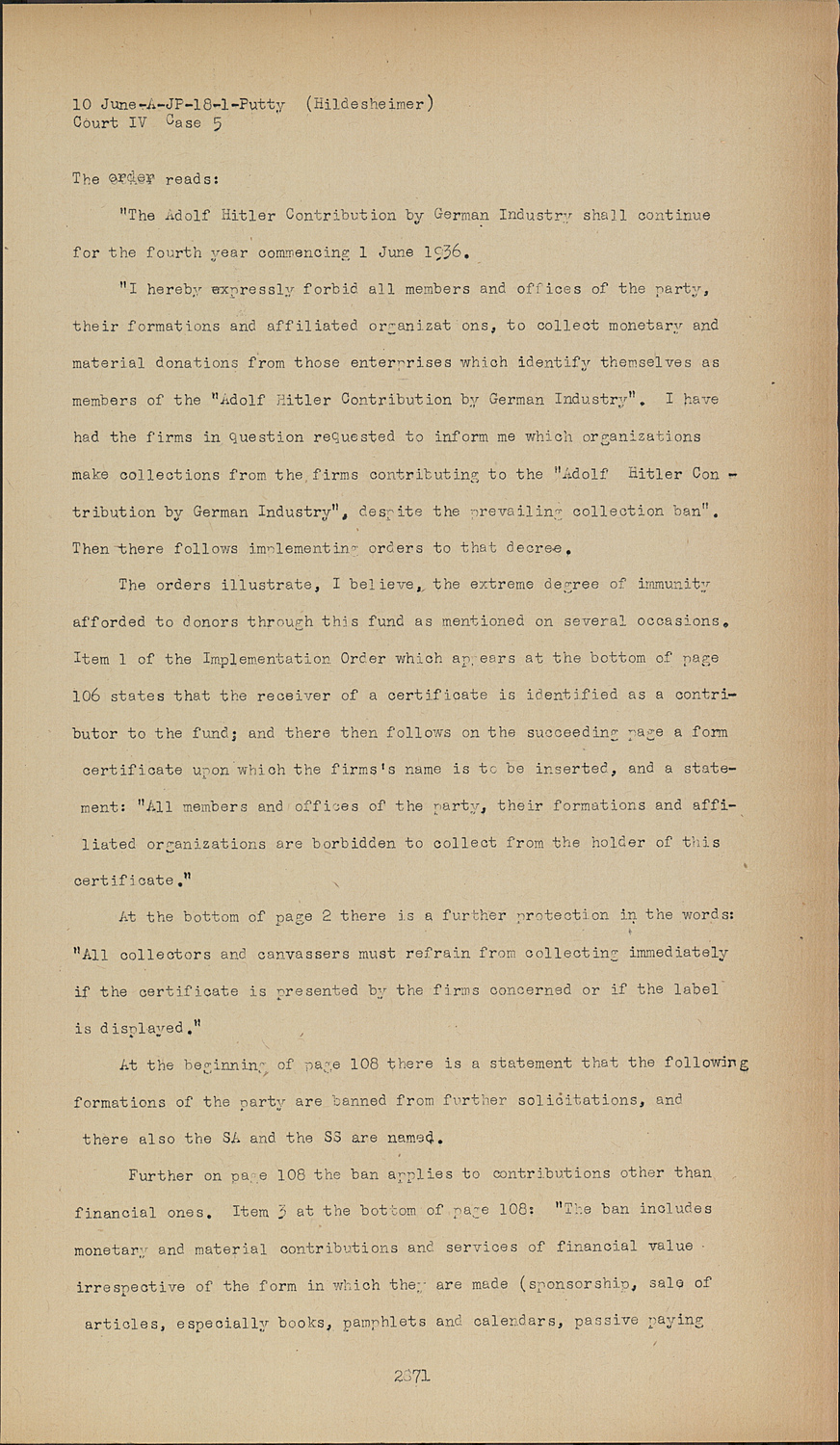
The order reads:
"The Adolf Hitler Contribution by German Industry shall continue for the fourth year commencing 1 June 1936.
"I hereby expressly forbid all members and offices of the party, their formations and affiliated organizations, to collect monetary and material donations from those enterprises which identify themselves as members of the "Adolf Hitler Contribution by German Industry". I have had the firms in Question requested to inform me which organizations make collections from the firms contributing to the "Adolf Hitler Con tribution by German Industry", despite the prevailing collection ban". Then there follows implementing orders to that decree.
The orders illustrate, I believe, the extreme degree of immunity afforded to donors through this fund as mentioned on several occasions. Item 1 of the Implementation Order which appears at the bottom of page 106 states that the receiver of a certificate is identified as a contributor to the fund; and there then follows on the succeeding page a form certificate upon which the firms's name is to be inserted, and a state ment:
"All members and offices of the party, their formations and affi liated organizations are borbidden to collect from the holder of this certificate."
At the bottom of page 2 there is a further protection in the words: "All collectors and canvassers must refrain from collecting immediately if the certificate is presented by the firms concerned or if the label is displayed."
At the beginning, of page 108 there is a statement that the following formations of the Party are banned from further solicitations, and there also the SA and the SS are named.
Further on page 108 the ban applies to contributions other than financial ones. Item 3 at the bottom of page 108: "The ban includes monetary and material contributions and services of financial value irrespective of the form in which they are made (sponsorship, sale of articles, especially books, pamphlets and calendars, passive paying members and the like)."If Your Honor please, the next four documents are, I believe, identical except that they pertain to different years.
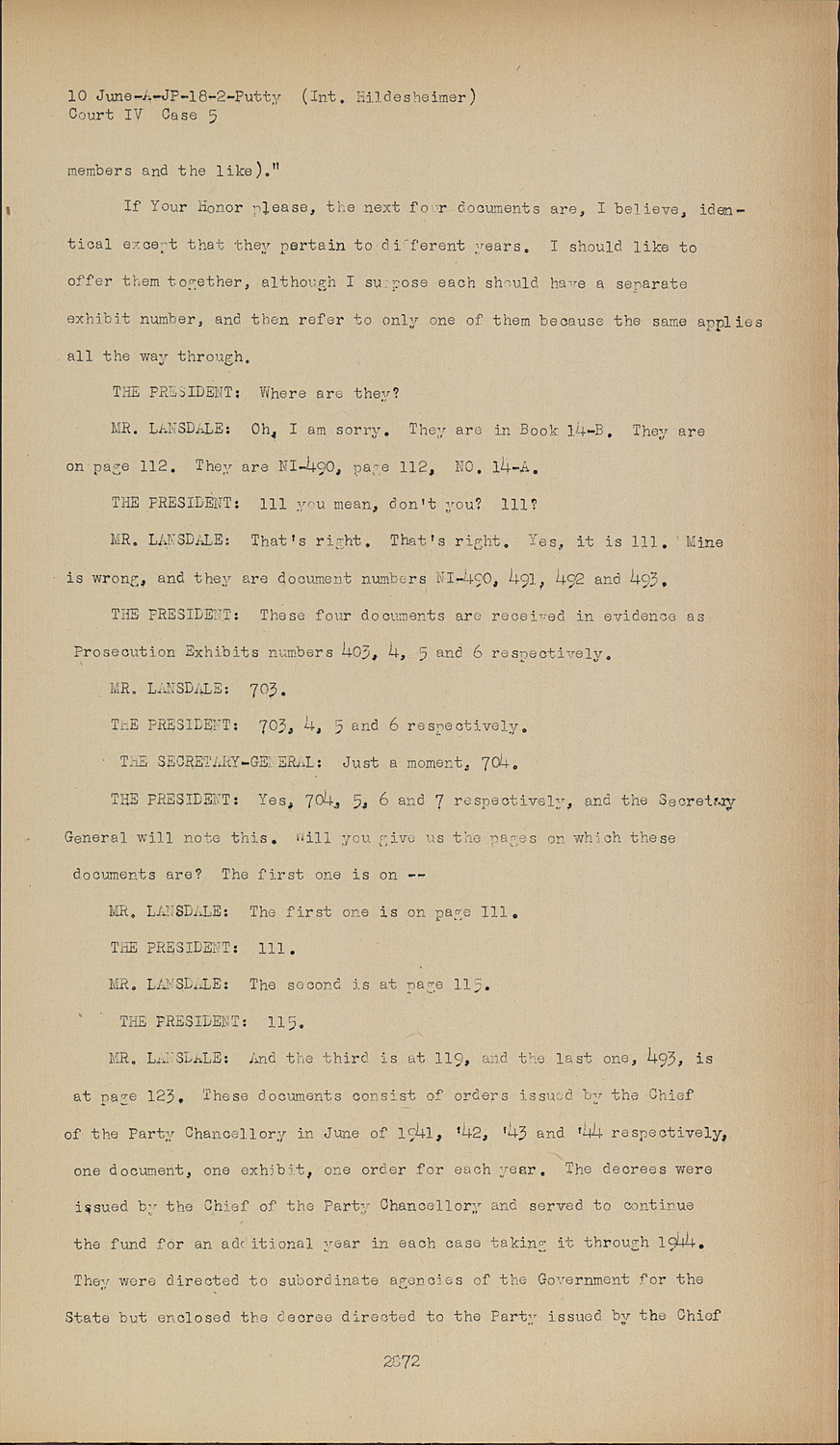
I should like to offer them together, although I suppose each should have a separate exhibit number, and then refer to only one of them because the same applies all the way through.
THE PRESIDENT:Where are they?
MR. LANSDALE:Oh, I am sorry. They are in Book 14-B. They are on page 112. They are NI-490, page 112, NO. 14-A.
THEPRESIDENT: 111 you mean, don't you? 111?
MR. LANSDALE:That's right. That's right. Yes, it is 111. Mine is wrong, and they are document numbers NI-490, 491, 492 and 493.
THE PRESIDENT:These four documents are received in evidence as Prosecution Exhibits numbers 403, 4, 5 and 6 respectively.
MR. LANSDALE: 703.
THEPRESIDENT: 703, 4, 5 and 6 respectively.
THESECRETARY-GENERAL: Just a moment, 704.
THE PRESIDENT:Yes, 704, 5, 6 and 7 respectively, and the Secretary General will note this. Will you give us the pages or which these documents are?
The first one is on -
MR. LANSDALE:The first one is on page 111.
THE PRESIDENT: 111.
MR. LANSDALE:The second is at page 115.
THE PRESIDENT: 115.
MR. LANSDALE:And the third is at 119, and the last one, 493, is at page 123.
These documents consist of orders issued by the Chief of the Party Chancellory in June of 1941, 142, 143 and 144 respectively, one document, one exhibit, one order for each year.
The decrees were issued by the Chief of the Party Chancellory and served to continue the fund for an additional year in each case taking it through They were directed to subordinate agencies of the Government for the State but enclosed the decree directed to the Party issued by the Chief of the Party Chancellery and which continued the fund and which provided for the same exhibits, the same certificates and labels and prohibitions against further solicitations as the original decree contained.