BY DR. SIEMERS:
Q.Mr. Admiral, now I am submitting to you Document UK-45.
DR. SIEMERS:Mr. President, UK-45 corresponds to USSR-130. This document deals with a report by the SKL dated the 29th of September 1941, addressed to the Group North, and it deals with the future of the city of Petersburg.
This report to the Group North says that the Fuehrer had decided to raze the city of Petersburg from the face of the earth. The Navy itself was not to be concerned with that announcement. Despite that, this report was sent to Group North. BY DR. SIEMERS:
Q.Mr. Witness, I will return to this point, but I would like to ask you first -- you have a photostatic copy of the original --to please tell me whether Raeder knew and saw this document before he resigned, or could have seen it.
AAccording to the statement which I have made, Great Admiral Raeder did not see this document. There are no notices or other comments to that effect on the document.
QAnd now the more important question on this point, relating to the report which is mentioned in Point 2 by Hitler. Why did the SKL, the Naval Warfare Command, receive this report and transmit it, even though the Navy itself was not concerned therewith?
AThe SKL had ordered that as far as Leningrad was concerned, at the occupation or attack, the shipyards and the port installations and all other naval installations were to be spared so they might be used as bases later or. That suggestion, as set down in this document, was turned down by Hitler. That may be seen from Point 3 of this document.
This fact had to be reported to Admiral Karls so that he could act accordingly, and in the case of a later occupation of Leningrad he could not count on this port as a base.
QBecause of the significance of this testimony, I would like to call attention to the point to which the witness just referred, and that is III of USSR-130. I quote:
"The original demand of the Navy to spare the docks, ports, and other installations important to the Navy, is known to the High Command of the Wehrmacht.
The fulfilling of this demand, because of the attack on Petersburg, is not possible."
That was the decisive point which the SKL told admiral Karls as Commander in Chief of Group North.
AThat was the decisive point for this document.
QDo you know whether Admiral Karls did anything with this document, that is, whether he transmitted it or disposed of it in any way, or don't you know anything about that?
AAs far as I am informed, this document was not passed on, and it was not the intention that this document be passed on, for it was meant solely and exclusively for Group North. On the basis of this document, the preparations which Admiral Karls had made as far as the Navy was concerned were stopped, and the personnel which had been earmarked for this were put at other disposal. That was the only measure which the Navy took on the basis of this document, and the only measure which could have been taken.
DR. SIEMERS:Perhaps I might tell the Tribunal that in my document book Raeder, under No. 111, I should like to submit an affidavit which contains this fact, that nothing was passed on by Group North, so the leading docks and yards and their Commanders never had any knowledge of this document.
I am referring to an affidavit by Admiral Buetow, who at that time was Commander-in-Chief in Finland, and I should like to come back to this point when I present the case on behalf of Grand Admiral Raeder.
I have no further questions of this witness.
THE PRESIDENT:Does any other member of defendants' counsel wish to ask any questions?
The Prosecution may cross examine.
CROSS EXAMINATION
COLONEL PHILLLIMORE:May it please the Tribunal, with regard to the question asked by Dr. Siemers, I was going to leave the cross examination on those points to the cross examination of the defendant Raeder, so as to avoid any duplication
BY COLONEL PHILLIMORE:
Q. ASI understand the evidence which the defendant Doenitz has given, and your evidence, you are telling the Tribunal that in respect of the treatment of neutral merchant ships, the German Navy has nothing to reproach itself with.
Is that right?
A.Yes.
Q.And the defendant has said that the German Navy was scupulous in adhering to orders about the attitude towards neutral shipping, and the neutrals were fully warned of what they should and should not do. Is that right?
A.Yes.
Q.Admiral Doenitz has also said that there was no question of deceiving neutral governments; they were given fair warning of what their ships should not do. Do you agree?
A.Yes.
Q.Now. I want just to remind you of what steps were taken as regards neutrals, as they appear from the defense documents.
First of all, on the 3rd of September, orders were issued that strict respect for all rules of neutrality and compliance with all agreements of international law which were generally recognized was to be observed.
COLONEL PHILLIMORE:My Lord, that is D-55, page 139.
THE PRESIDENT:In the British document book?
COLONEL PHILLIMORE:In the defense document book.
THE PRESIDENT:Defense.
COLONEL PHILLIMORE:Doenitz 55. BY COLONEL PHILLIMORE.
Q.And then, on the 28th of September, a warning was sent to neutrals to avoid suspicious conduct, changing course, zig-zagging, and so on. That is Doenitz 61, page 150.
On the 19th of October, that warning was repeated and neutrals were advised to refuse convoy escort. That is Doenitz 62, at page 153.
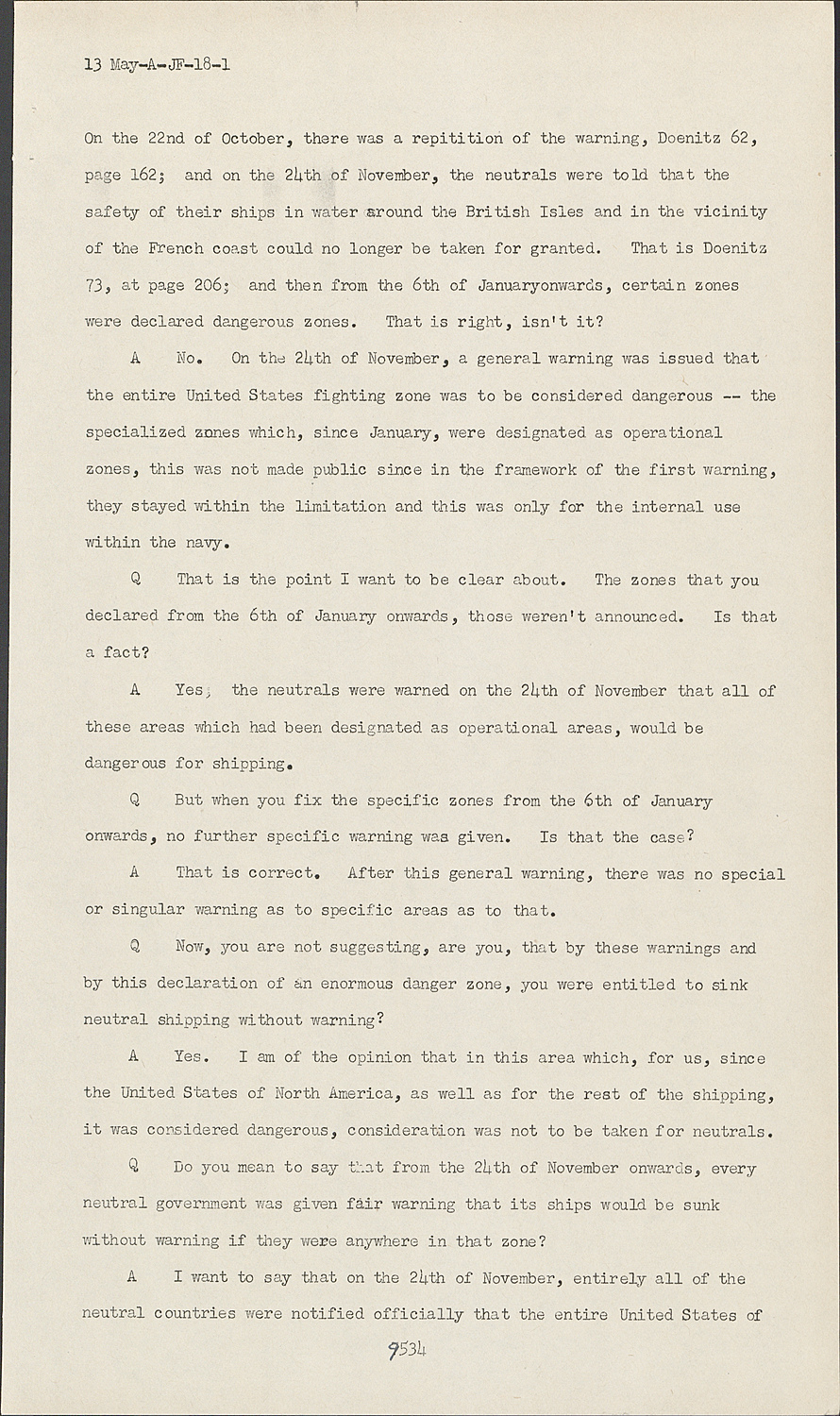
On the 22nd of October, there was a repitition of the warning, Doenitz 62, page 162; and on the 24th of November, the neutrals were told that the safety of their ships in water around the British Isles and in the vicinity of the French coast could no longer be taken for granted.
That is Doenitz 73, at page 206; and then from the 6th of Januaryonwards, certain zones were declared dangerous zones. That is right, isn't it?
ANo. On the 24th of November, a general warning was issued that the entire United States fighting zone was to be considered dangerous -- the specialized zones which, since January, were designated as operational zones, this was not made public since in the framework of the first warning, they stayed within the limitation and this was only for the internal use within the navy.
QThat is the point I want to be clear about. The zones that you declared from the 6th of January onwards, those weren't announced. Is that a fact?
AYes; the neutrals were warned on the 24th of November that all of these areas which had been designated as operational areas, would be dangerous for shipping.
QBut when you fix the specific zones from the 6th of January onwards, no further specific warning was given. Is that the case?
AThat is correct. After this general warning, there was no special or singular warning as to specific areas as to that.
QNow, you are not suggesting, are you, that by these warnings and by this declaration of an enormous danger zone, you were entitled to sink neutral shipping without warning?
AYes. I am of the opinion that in this area which, for us, since the United States of North America, as well as for the rest of the shipping, it was considered dangerous, consideration was not to be taken for neutrals.
QDo you mean to say that from the 24th of November onwards, every neutral government was given fair warning that its ships would be sunk without warning if they were anywhere in that zone?
AI want to say that on the 24th of November, entirely all of the neutral countries were notified officially that the entire United States of America fighting zone was to be considered as dangerous and that the German Reich could have no responsibility for losses in combat in this area.
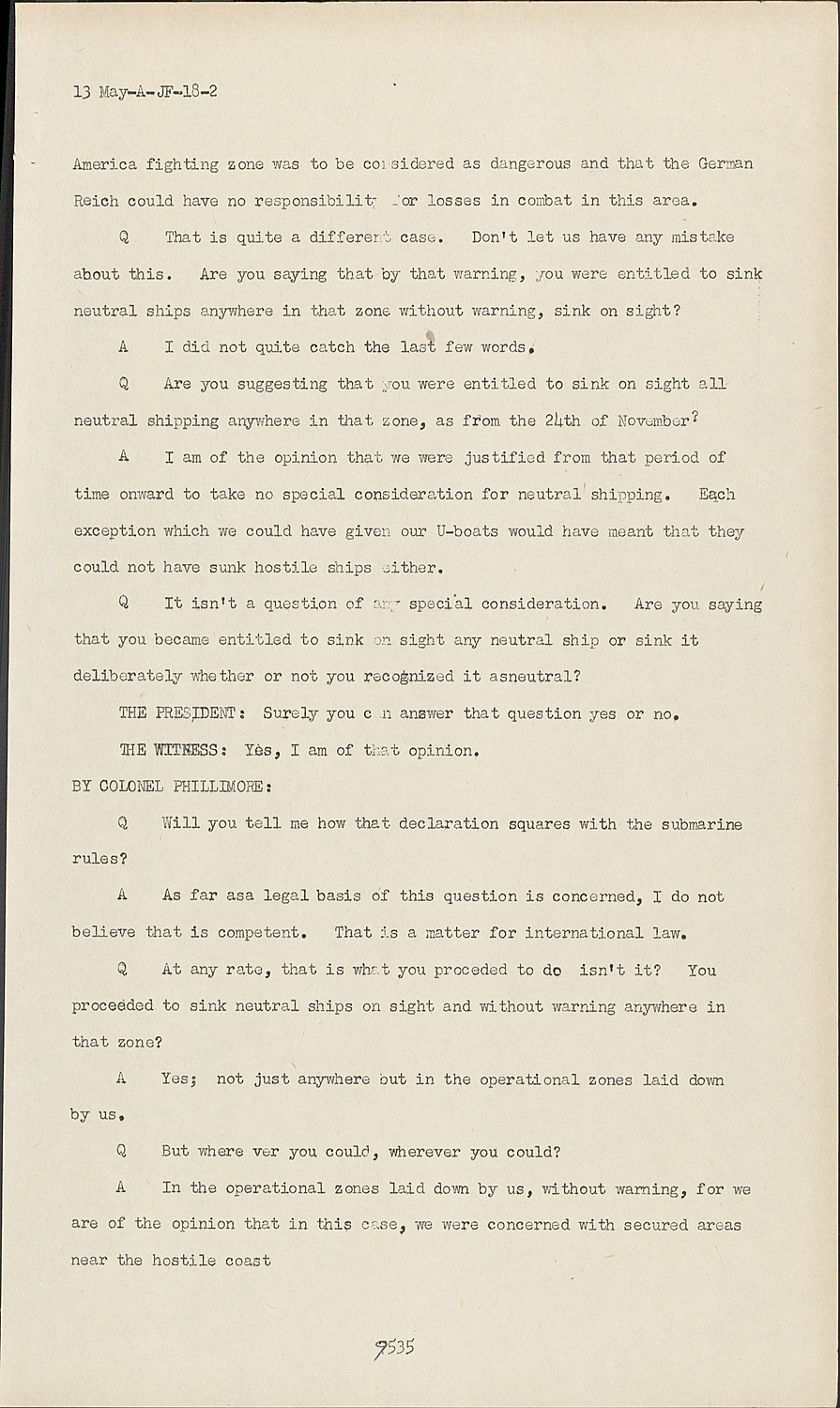
QThat is quite a different case. Don't let us have any mistake about this. Are you saying that by that warning, you were entitled to sink neutral ships anywhere in that zone without warning, sink on sight?
AI did not quite catch the last few words.
QAre you suggesting that you were entitled to sink on sight all neutral shipping anywhere in that zone, as from the 24th of November?
AI am of the opinion that we were justified from that period of time onward to take no special consideration for neutral shipping. Each exception which we could have given our U-boats would have meant that they could not have sunk hostile ships either.
QIt isn't a question of any special consideration. Are you saying that you became entitled to sink on sight any neutral ship or sink it deliberately whether or not you recognized it asneutral?
THE PRESIDENT:Surely you can answer that question yes or no.
THE WITNESS:Yes, I am of that opinion. BY COLONEL PHILLIMORE:
QWill you tell me how that declaration squares with the submarine rules?
AAs far asa legal basis of this question is concerned, I do not believe that is competent. That is a matter for international law.
QAt any rate, that is what you proceded to do isn't it? You proceeded to sink neutral ships on sight and without warning anywhere in that zone?
AYes; not just anywhere but in the operational zones laid down by us.
QBut where very you could, wherever you could?
AIn the operational zones laid down by us, without warning, for we are of the opinion that in this case, we were concerned with secured areas near the hostile coast whichcould not be considered the open sea.
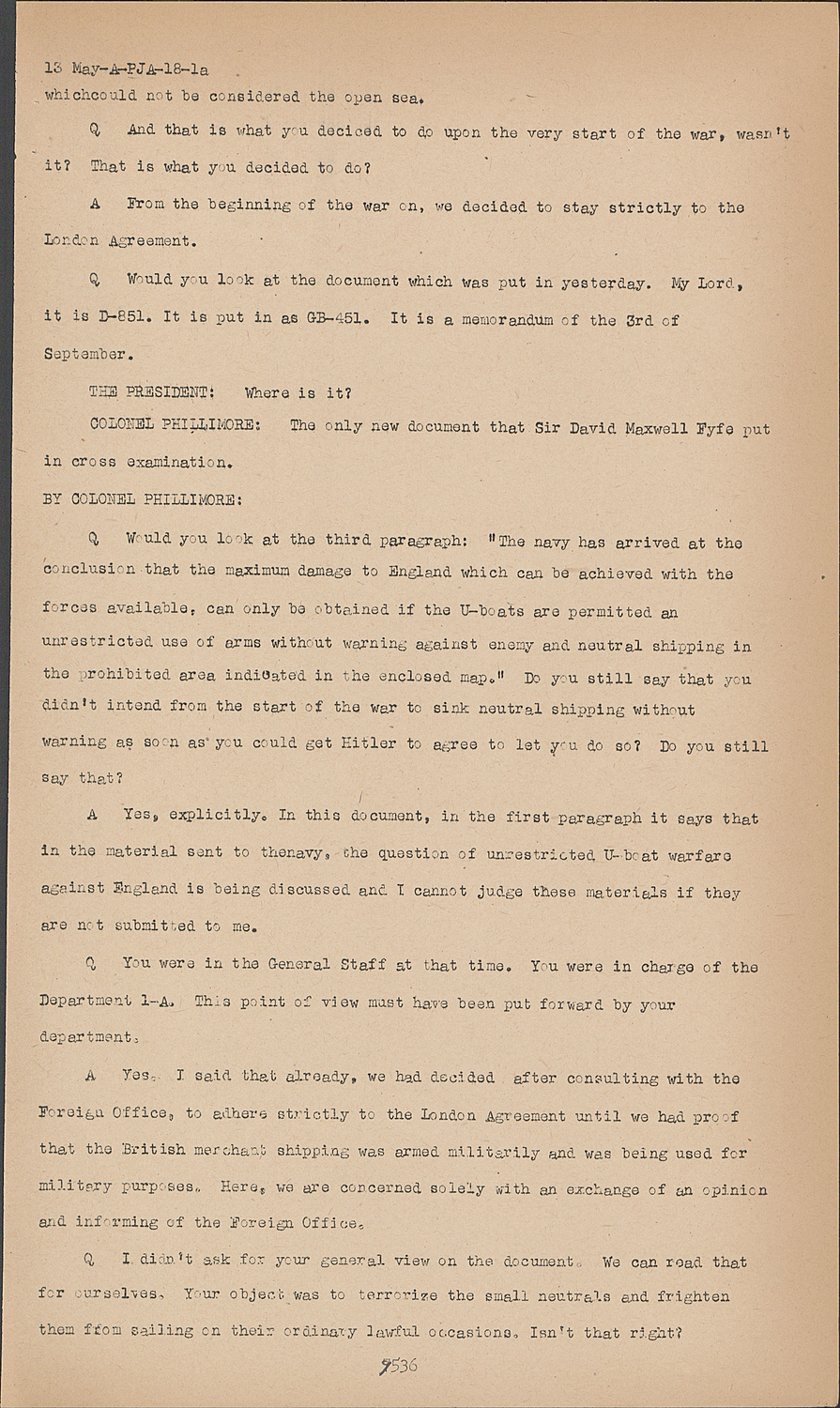
QAnd that is what you decided to do upon the very start of the war, wasn't it? That is what you decided to do?
AFrom the beginning of the war on, we decided to stay strictly to the London Agreement.
QWould you look at the document which was put in yesterday. My Lord, it is D-851. It is put in as GB-451. It is a memorandum of the 3rd of September.
THE PRESIDENT:Where is it?
COLONEL PHILLIMORE:The only new document that Sir David Maxwell Fyfe put in cross examination. BY COLONEL PHILLIMORE:
QWould you look at the third paragraph: "The navy has arrived at the conclusion that the maximum damage to England which can be achieved with the forces available, can only be obtained if the U-boats are permitted an unrestricted use of arms without warning against enemy and neutral shipping in the prohibited area indicated in the enclosed map." Do you still say that you didn't intend from the start of the war to sink neutral shipping without warning as soon as you could get Hitler to agree to let you do so? Do you still say that?
AYes, explicitly. In this document, in the first paragraph it says that in the material sent to thenavy, the question of unrestricted U-boat warfare against England is being discussed and I cannot judge these materials if they are not submitted to me.
QYou were in the General Staff at that time. You were in charge of the Department 1-A. This point of view mast have been put forward by your department.
AYes, I said that already, we had decided after consulting with the Foreign Office, to adhere strictly to the London Agreement until we had proof that the British merchant shipping was armed militarily and was being used for military purposes. Here, we are concerned solely with an exchange of an opinion and informing of the foreign Office.
QI didn't ask for your general view on the document. We can read that for ourselves. Your object was to terrorize the small neutrals and frighten then from sailing en their ordinary lawful occasions. Isn't that right?
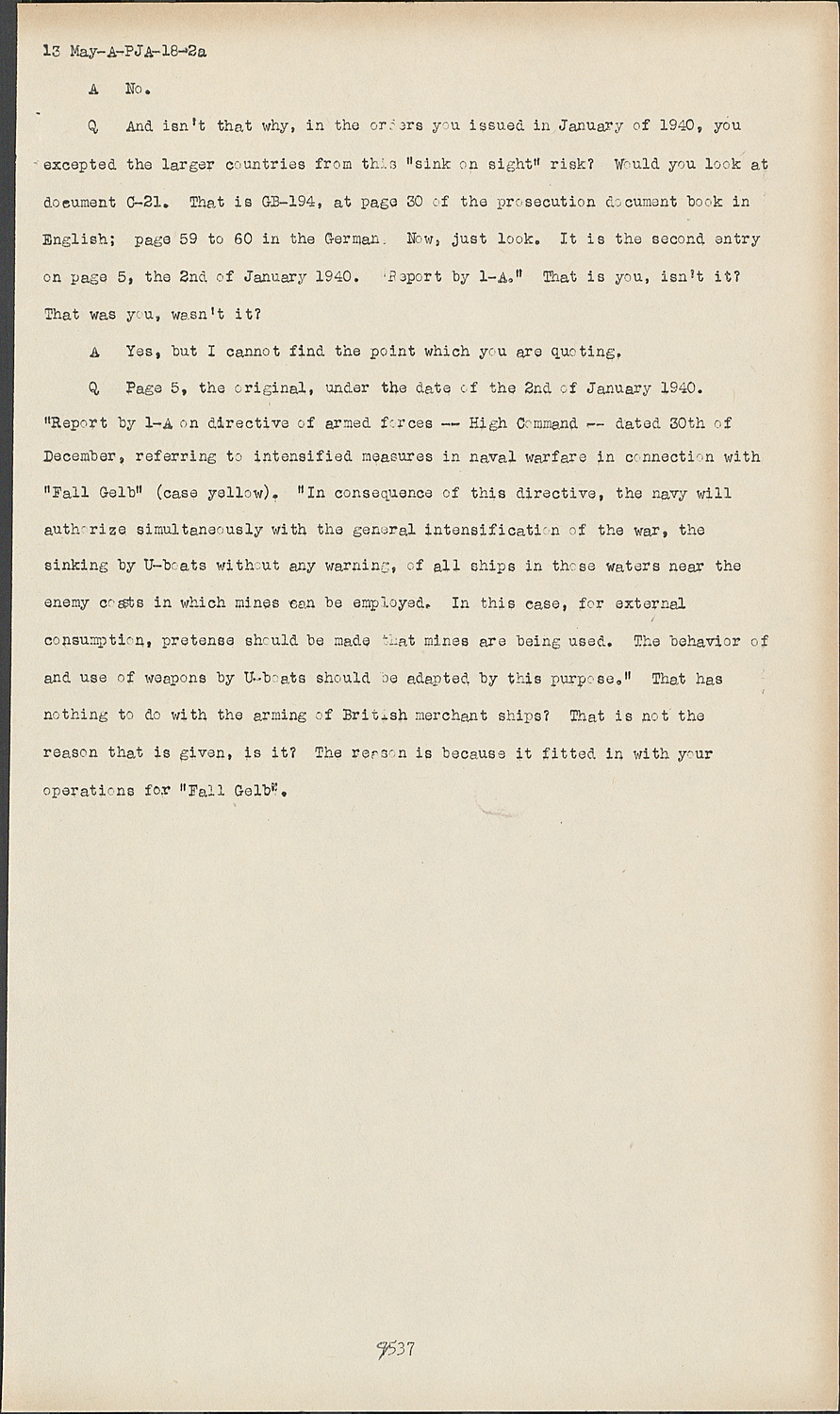
A No.
QAnd isn't that why, in the orders you issued in January of 1940, you excepted the larger countries from this "sink on sight" risk? Would you look at document C-21. That is GB-194, at page 30 of the prosecution document book in English; page 59 to 60 in the German. Now, just look. It is the second entry on page 5, the 2nd of January 1940. Report by 1-A." That is you, isn't it? That was you, wasn't it?
AYes, but I cannot find the point which you are quoting.
QPage 5, the original, under the date of the 2nd of January 1940. "Report by 1-A on directive of armed forces -- High Command -- dated 30th of December, referring to intensified measures in naval warfare in connection with "Fall Gelb" (case yellow). "In consequence of this directive, the navy will authorize simultaneously with the general intensification of the war, the sinking by U-beats without any warning, of all ships in these waters near the enemy casts in which mines can be employed. In this case, for external consumption, pretense should be made that mines are being used. The behavior of and use of weapons by U-boats should be adapted by this purpose." That has nothing to do with the arming of British merchant ships? That is not the reason that is given, is it? The reason is because it fitted in with your operations for "Fall Gelb".
A I didn't understand the last sentence.
QYou don't give as your reason that the British were arming their merchant ships. The reason you give is that it was necessary in connection with intensified measures for Fall Gelb. Why is that?
DR. KRANZBUEHLER:The German translation is so inadequate that it is almost impossible to understand the question. BY COLONEL PHILLIMORE:
QI will put the question to you again. The excuse for this directive is. to be the intensification of measures is connection with Jail Gelb. You notice, don't you, that nothing is said about the arming of British merchant ships as Justifying this step? That is correct, isn't it?
AMay I have time, please, to peruse this manuscript first?
QCertainly, This was written by yourself, you know.
ANo, that was not written by me.
Yes, the measures did concern and stay with the warning which was given to the neutrals on the 24th of November 1939.
QNothing is said about the warning of the 24th of November. If you were entitled, as you have told us, under that to sink neutral ships, there wouldn't be any need for this special directive, would there?
ANo.
QNo. Now, let's just-
A (Interposing) because of military reasons and politicalreasons we ordered that there was to be the excuse of mines, and that was the special point of this order.
QAnd justbefore we leave that document, have a look at the entry on the 18th of January, will you? You have get it? 18th of January.
AYes.
QThat is the actual order for sinking without warning. You notice the last sentence:
"Ships of the United States, Italy, Japan and Russia are exempted from these attacks." And then Spain is added in pencil.
Isn't it right that you were out to terrorize the small neutrals and to bully them, but you weren't running any risks with the big ones?
ANo, it wasn't like that. It is to be explained as follows: That, as a matter of course, military disadvantages are to be bargained for if political advantages are to be derived therefrom.
QOh, yes, it just entirely was a question of how it paid you politically. That is all it was, wasn't it?
AYes, of course, since all military actions are determined by political bases.
QAnd because the Danes and the Swedes weren't in any position to make any serious protest, it didn't matter sinking their ships at sight.
That's right, isn't it?
AThe motivation of this incident is entirely incorrect.
QWell, but what is the difference?
AThe ships of all neutrals in this area were sunk by us with the exception of those for which we had a special political interest.
QYes, you had no special political interest at this time for Norway and Sweden and Denmark, so you sank their ships at sight. That's right, isn't it?
AWe sunk then because they entered this area despite warning.
Q yes, but if a Russian ship or a Japanese ship did that, you wouldn't sink it.
ANo, not at that point, not at that period of time.
QI just want to show you what you actually did. Would you look at documents 846 and 847? COLONEL PHILLIMORE: My Lord, they are two new documents. They will be GB-452 add 453. BY COLONEL PHILLIMORE:
QWill you look at the first of these, that is 846? That is a telegram from your Ambassador at Copenhagen, dated the 26th of September 1939, That is before your first warning and before any of these zones had been declared. The second Sentence:
"Sinking of Swedish and Finnish ships by our submarines still cause great worry here, owing to Danish food transports to England."
You see, you had started sinking ships of the small neutrals right away in the first three weeks of the war, hadn't you?
AIn single causes, yes, but there was always a very special reason in these cases. I know of some cases of Danish and Swedish, ships which occurred in which these ships had turned toward the U-boat and the U-boat in turn, because of resistance, had to attack the ship.
QYou don't think it was because the blame could be put upon mines?
AAt this period of time, not at all.
QLook at the second telegram, if you would, 26th of March, 1940, again from the German minister at Copenhagen. It is the first paragraph:
"The King of Denmark summoned me to his presence in order to tell me what a deep impression the sinking of six Danish ships last week, apparently without warning, had made on him and on the whole country."
And then, passing on two sentences:
"I replied that the reason why the ships sank had not yet been elucidated. In any case, our naval units always kept strictly to the Prize Regulations, that vessels sailing in enemy convey or in the vicinity of the same took upon themselves all the risks of war, insofar as any sinkings had been carried out without warning.
It seemed that they could be traced back to the German notifications made to date.
"At the same time, I pointed out the dangers of the waters around the British coast where neutral ships inevitably involved in compromising situations on account of measures taken by the British. The King assured me emphatically that none of the Danish ships were sailing in convoy, but it would probably never be possible subsequently to clear up without possibility of doubt the incidents which had led to the sinking."
Have you any doubt that those six ships Were sunk deliberately under your sink-at-sight policy?
AWithout checking the individual cases, I cannot answer this question, but I am of the opinion that possibly these ships were sunk in that area before the English coast was in those areas or becaouse heavy defensive measures at open sea could not obtain at that point any longer.
QVery well. We will come to an incident where I think I can supply you with details. Would you look at Document D-807?
COLONEL PHILLIMORE:My Lord, that is a new document; it becomes GB-454. BY COLONEL PHILLIMORE:
QYou see, this document is dated the 31st of January 1940, and it refers to the sinking of three neutral ships, the 'Deptiord', the 'Thomas Walton', and the 'Garoufalia', The document is in three parts. It first sots out the facts as they were known to you. The second part is a note to the Foreign Office, and the third is a draft reply for your foreign office to send the neutral governments. If you look at the end of the document you will see, 1-A; the document emanates from your department.
"It is proposed in replying to Norwegian notes, to admit only the sinking by a German U-boat of the SS 'Deptford', but to deny the sinking of the two other steamers."
Would you follow it?
"According to the data attached to the notes presented by the Norwegian Government, the grounds for suspecting a torpedo to have been the cause of the sinkings do in fact appear to be equally strong in all three cases according to the Norwegian Foreign Minister's speech of the 19th January, the suspicion in Norway of torpedoing by a German U-boat appears however, to be strongest in the case of the SS 'Deptford,' wheresa in the other two cases it is at least pre-tended that the possibility of striking mines has to be taken into account; this is considered improbable in the case of the SS 'Deptford', anyhow, because other vessels had passed the same spot.
"The assumption that the SS 'Thomas Walton' struck a mine may be supported. since the torpedoing occurred towards evening and nothing was observed, and since furthermore several explosions took place in the same area owing to misses by torpedoes.
"In the case of the SS 'Garoufalia', a denial appears expedient, if only because a neutral steamer is concerned, which was attacked without warning. Since it was attacked by means of an electric torpedo, no torpedo wake could be observed."
Do you say in the face of that that you aid not deceive the neutrals? That is the advice you were given by the defendant Raeder as his staff officer, is it not?
A. This memorandum did not emanate from me; it emanated from 1 i a, which are the letters of a certain expert in the department.
Q.You would not have seen it?
A.I do not recall this memorandum.
Q.Why do you say "emanated from 1 i a? It has "1 a" at the end of it.
A.If this memorandum originated and was passed on, then I thought -
Q (Interposing) I will just read the next part of the note to remind you.
"The following" facts have thus been ascertained:" -- this is what you are writing to the foreign office -
"The steamer "Deptford' was sunk by a German U-boat on the 13th of December --"
I am sorry. I should have started earlier.
"It is suggested that Norwegian notes regarding the sinking of the Steamships 'Deptford', 'Thomas Walton' and 'Garoufaliea' be answered somewhat in the following manner:
"As a result of the communication from the Norwegian Government, the matter of the sinking of the steamships 'Deptford', 'Thomas Walton', and 'Garoufalia' has been thoroughly investigated. The following facts have thus been ascertained:
"The steamer 'Deptford' Was sunk by a German U-boat on the 13th of December as it was recognized as an armed enemy ship. According to the report of the U-boat Commander, the sinking did not take place within territorial waters. but immediately outside. The German Naval Forces have strict instructions not to undertake any military operations within neutral territorial waters. Should the U-boat Commander have miscalculated his position, as appears to be borne out by the findings of the Norwegian Authorities and should Norwegian territorial waters have been violated in consequence, the German Government regrets this most sincerely.
"As a result of this incident, the German Naval forces have once again been instructed unconditionally to respect neutral territorial waters. If a violation of Norwegian territorial waters has indeed occurred, there will be no repetition of it. As far as the sinking of the steamships 'Thomas Walton' and 'Garoufalia' is concerned, this cannot be traced to operations by German U-boats as none of them were in the naval area indicated at the time of the sinkings."
Then there is a draft reply put forward which is very much along the same line.
And you say in the face of that document that the German Navy never misled the neutrals?
A.The neutrals had been advised that in these areas, threats and dangers of war were to be encountered, and we were of the opinion that we were justified in not telling them through which war measures these areas were endangered, or which war measures would be used.
Q.Is that really your answer to this document? This is a complete lie, is it not? You admit one sinking; that you cannot get away from. And you deny the others. You deny that there was a German U-boat anywhere near, and you are telling this Tribunal that you were justified in order to conceal the weapons you were using. Is that the best answer you can give?
A.Yes, certainly, We had no interest at all in letting the enemy know what means we were operating with in this area.
Q.You are admitting that one of them was sunk by a U-boat. Why not admit the other two as well? Why not say it was the same U-boat?
A.I assume that we were concerned in an area in which the situation was different.
Q.What was the difference? Why didn't you say, "One of our U-boats has made a mistake, or disobeyed his orders, and is responsible for all those three sinkings"? Or, alternatively, why didn't you say, " We have given you fair warning we are going to sink on sight anyone in this area. And what is your complaint?"
A.It obviously was not expedient.
Q.It was considered expedient to deceive the neutrals. And you, an admiral in the German Navy, told me you did not do that, ten minutes are. As a matter of fact, these three boats were all sunk by the same U-boat, were they not?
A.At the moment I cannot tell you that.
Q. I say they were all sunk by U-38, and the dates of sinking were: the Deptford, on the 13th of December, the Garoufalia on the 11th, and the Thomas Walton on the 7th.
Do you dispute that?
A.I did not understand the last sentence.
Q.Do you dispute those details, or don't you remember?
A.I cannot recall; but I believe it is impossible.
Q.I will show you another instance of deceiving the neutrals; and this time it was your friends, the Spanish. Would you look at C-105?
COLONEL PHILLIMORE:My Lord, that is a new document; it becomes GB-455. It is an extract from the SKL War Diary for the 19th of December 1940. BY COLONEL PHILLIMORE:
Q.You kept the SKL War Diary yourself at that time, did you not?
A.No, I did not keep it.
Q.Didn't you sign it?
A.I signed it.
Q.You signed it. Did you read it before you signed it?
A.The essential parts, yes.
Q.You see, it is headed "News from the Neutrals", and begins with "Spain." It reads:
"According to a report from the Naval Attache, a Spanish fishing-vessel was sunk by a submarine of unknown nationality between Las Palmas and Cape Juey. In the rescue boats, the crew was subjected to machine gun fire. 3 men badly wounded. Landed at Las Palmas on the 18th December. Italians suspected (also possibility it might have been U-37)".
Then, on the 20th of December, the next day:
"B.d.U. will be informed of Spanish report regarding sinking of Spanish fishing-vessel by submarine of unknown nationality on 16th December between Las Palmas and Cape Juey, and will be requested to conduct an investigation.
"On the responsibility of the Naval War Staff it has been confirmed to our Naval Attache in Madrid that, regarding the sinking, there is no question of a German submarine."
When you reported that, you thought it possible, did you not, that it might have been U-37; isn't that so?
A.It seems to me that it was not by a submarine.
Q.I will read on. This is under date of 21 December.
"U-37 reports: a torpedo fired at a tanker of the "Kopbard" type had a giro failure, and probably hit an Amphitrite submarine in the tanker's convoy. The tanker is burnt out. Spanish steamer 'St. Carlos' without distinguishing mark sunk by gunfire. 9 torpedoes left.
"According to this, U-37 has torpedoed the French tanker 'Rhone' and the submarine 'Sfax', as well as sunk the Spanish fishing-vessel."
Then, if you will read the next entry.
"We shall continue to maintain to the outside world that there is no question of a German or Italian submarine being in the sea-area in question for the sinkings."
Q.Do you still say that you did net deceive the neutrals?
A.This case is doubtless a case of deception, but I do not remember this deception was carried through, or what the reasons for it were.
Q.But it is creditable, is it not? Do you regard that as creditable to the German Navy, that conduct?
A.No.
Q.Did the defendant Raeder sign the War Diary?
A.Yes.
Q.Did you tell the other defendant, Doenitz, what answer you were giving to the Spaniards and the Norwegians?
A.That I do not recall.
Q.He would get a copy, would he not?
A.I did not understand you.
Q.You would, send him a copy, would you not, of your note to the Foreign Office?
A.That is possible.
THE PRESIDENT:Colonel Phillimore, does the signature of the defendant Raeder appear at the end of this document, C-105?
COLONEL PHILLIMORE: My Lord, I regret to say I have not checked that.
But as the witness has said, the practice was that he was to sign the War Diary, and that the commander-in-chief was to sign it periodically. BY COLONEL PHILLIMORE:
Q.Is that right, witness?
A.Yes. On the next page, on the 12th, you can see my signature as well as these of Fricke, Schniewind, and Raeder.
DR.SIEMERS (Counsel for Admiral Raeder): Mr. President, I would be very grateful to the prosecution if the document which concerns the defendant Raeder would be given to me, for it is relatively difficult for me to follow the Situation otherwise. None of these documents was given to me.
COLONEL PHILLIMORE:I am extremely sorry, My Lord. That is my fault, and I will see that Dr. Siemers has a copy tonight.
THE PRESIDENT:We will adjourn at this point until tomorrow morning.
COLONEL PHILLIMORE:My Lord, I am afraid I have a little more.
(A recess was takne until 1000 hours, Tuesday, 14 May 1946.)
Official transcript of the International Military Tribunal in the matter of:
The United States of America, the French Re public, The United Kingdom of Great Britain and Northern Ireland, and the Union of Soviet Socialist Republics, against Hermann Wilhelm Goering et at, Defendants, sitting at Nurnberg, Germany on 14.
May 1946, 1400-1700. Lord Justice Lawrence presiding.
ADMIRAL WAGNER -- Resumed CROSS EXAMINATION -- Continued BY COLONEL PHILLIMORE:
Q.Do you remember the sinking of the "Monte Garbea" in September, 1942?
A.I have a certain recollection of it.
Q.That was the ship in respect of which the Defendant Doenitz sent a telegram to the U-boat Commander threatening him with court martial on his return because he had sunk the ship after recognizing it as a neutral. Now in 1942 the friendship of Spain was very important to Germany, was it not?
A.I assume so.
Q.You told us yesterday that Admiral Raeder was recommending a Mediterranean policy. Now that was the reason, wasn't it, why the U-boat Commander was threatened with court martial, that it mattered in 1942 if you sank a Spanish ship?
A.No, that was not the reason. The reason was that the Commander of the U-boat had not acted according to the directives of the Commander in Chief of the U-boats.
Q.It didn't matter in 1940 when you thought you were winning the war, but in September, 1942, I sugges to you it became politically inexpedient to sink a Spanish ship; isn't that right?
A.You will have to contact the political office of the German Reich to get that answer.
Q.If that is the answer, do you think it is unfair to describe your attitude to the sinking of neutral ships as cynical and opportunist?
A.No, I reject that completely.
Q.I want to ask you one or two questions about the witness Heisig. You spoke yesterday of a conversation in the jail here in the first week of December, 1945.