Q "Answer: Yes, it may be.
"Question: You were in favor of that?
"Answer: I don't remember what the details were of that question.
"Question: Well, it is not a matter of details. The question is a matter of discrimination.
"Answer: Yes. " You said that?
AYes, certainly.
QYou were in favor of that legislation, or were you not?
AIs that the question now?
QI am asking you now.
AYes.
QYou were in favor of it. You were not when you were interrogated.
AWell, you see how difficult it is.
QThe question then was, were you in favor of it, and you said "I wasn't in favor, but I had to sign it.
"Question: Well, you were the only one who signed it.
You were the Reich Minister of Economics."
AYes.
Q "Question: And, obviously, it was a bill which was put in by your Ministry, was it not?
"Answer: Yes."
Is that correct?
AYes, I assume so; You see, in these matters there were differences, fine differences in principle. I developed my policy before as to what extent these individual laws went. That is a question of policy or politics, you con say this or that today.
QNow, you also favored the law and signed the law prohibiting all Jews from being admitted to examinations for public economic advisors for cooperatives, for example.
AYes, possibly. I don't remember. Probably it is right.
Q And you also approved a law imposing the death penalty on German subjects who transferred German property abroad or left German property abroad.
AYes.
QAnd of course you know that that affected, chiefly and most seriously, the Jews who were moving abroad.
AI hope that the Jews weren't deceiving or cheating any more then the Christians. I hope the Jews didn't cheat any more than the Christians.
QWell, the death penalty on German subjects for transferring German property abroad was you idea of a just law?
AI don't understand. My idea?
QYes.
AIt was an idea of the Minister of Finance, and I put my signature on it.
QNow, the question was then asked you after these were recited:
"Well, now, was there a matter of conscience involved, or was there not?"
And you answered: "To some extent, yes, but not important enough to risk a break."
AYes.
QAnd the question: "Yes. In other words, you had quite another objective which was more important."
AThat's right;
Q "Well what was that objective, Dr. Schacht?" I am still reading. It saves time. A Oh, pardon me;
Q "Answer: Well, the objective was to stay in power and to help carry this through in an ordinary and reasonable way.
"Question: That is to say, the restoration of the German economy.
"Answer: Quite.
"Question: And the completion of the armament program.
"Answer: The completion of the International equality, political equality of Germany.
"Question: By means of armament, as you yourself have said.
"Answer: Also by means of armament."
AAll correct, and I stand by that today.
QYes. Soothe armament question was so important that you didn't want to risk any break about the Jews.
ANot the armament question but the equality of Germany.
QWell, now, I just asked you "by means of armament, as you yourself hove said."
AAnd I say, also by means of armament. That is one of the means.
QYes, and it is the only one that was used ultimately, wasn't it?
ANo, it wasn't. There were other ones.
QWe will get to that in time.
Now, isn't it a fact that you also approved the law dismissing all Jewish officials and notaries public?
AThat is possible.
QAnd you wrote to Blomberg on the 24th of December 1935, giving your motives, did you not, saying this:
"The economic and illegal treatment of the Jews, the anti-Church movement in certain Party Organizations, and the lawlessness which centers in the Gestapo, create an injury to our rearmament task, which could be considerably lessened through the application of more respectable methods, without abandonment of the goals in the least."
You wrote that, did you not?
AYes. I quoted it myself yesterday.
QNow, as to the rearmament program, you participated in that from three separate offices, did you not?
AYes. I don't know which ones you mean, but please go ahead. Please assume so.
QI will list them. In the first place, you were Plenipotentiary for War.
AYes.
QThat was the secret office at first.
AYes.
QYou were president of the Reichsbank. That was the financial end of it.
AYes, yes.
QAnd you were Minister of Economics, in which position you had control with the Minister for the general economic situation.
AYes. They weren't controls so general that I can confirm your statement just like that, but I was Minister of Economy.
QNow, let us take up first this position of Plenipotentiary for War. You have testified that this position was created for two purposes:
(a) Preparation for war. (b) Control of the economy in the event of want.
Is that correct?
AThat means preliminary planning in the event that a war should happen, and the direction of economy in the event of the outbreak of war having taken place, that preliminary period and the later period during war.
QAnd you were asked about your functions and gave these answers, did you not:
''As the Chief of Staff, worries in advance about mobilization from the military point of views -- so you were concerned with it from the economic point of view.
AYes.
QAnd your position as Plenipotentiary of War was of equal rank with the War Ministry, was it not?
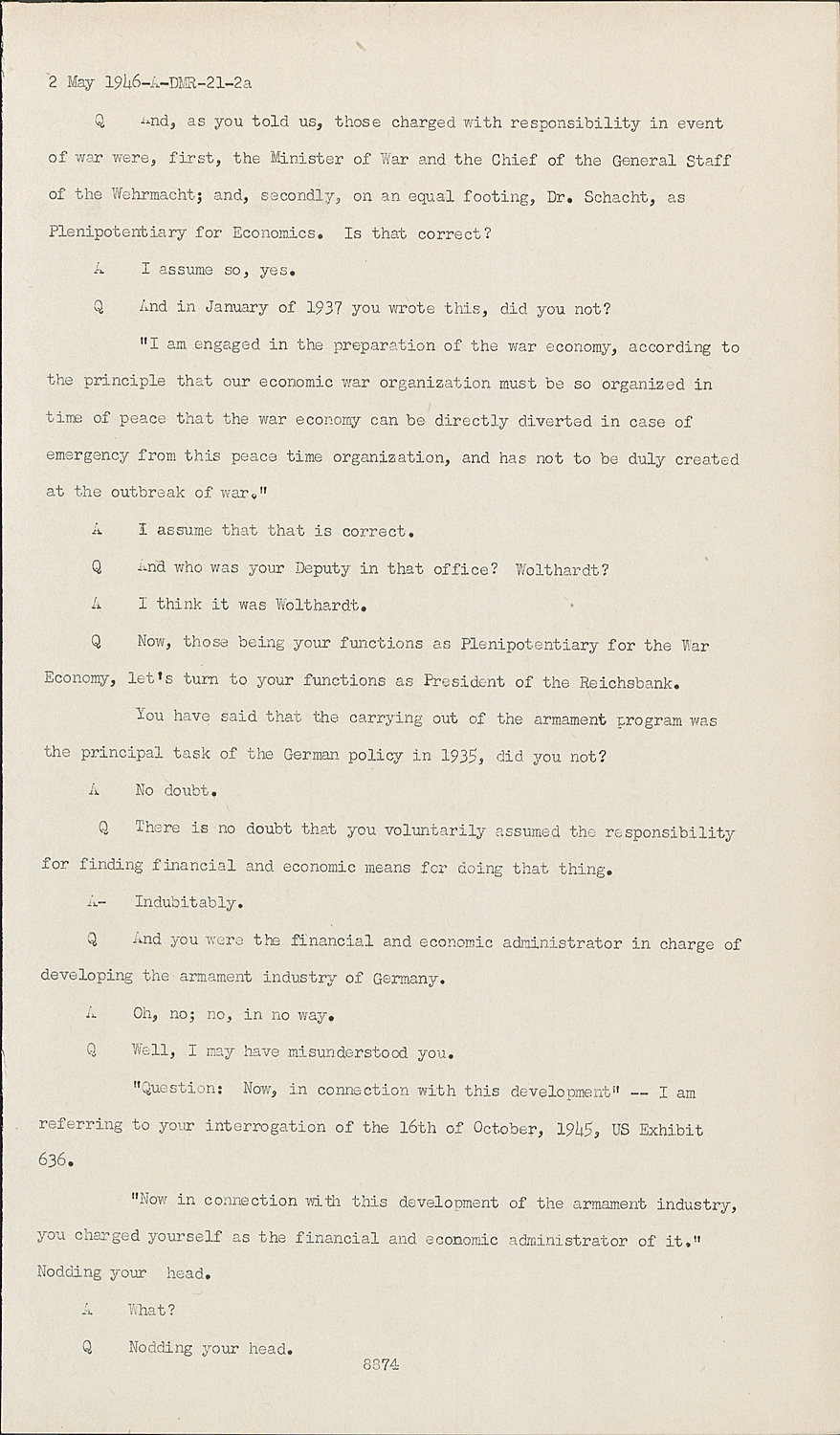
Q And, as you told us, those charged with responsibility in event of war were, first, the Minister of War and the Chief of the General Staff of the Wehrmacht; and, secondly, on an equal footing, Dr. Schacht, as Plenipotentiary for Economics.
Is that correct?
AI assume so, yes.
QAnd in January of 1937 you wrote this, did you not?
"I am engaged in the preparation of the war economy, according to the principle that our economic war organization must be so organized in time of peace that the war economy can be directly diverted in case of emergency from this peace time organization, and has not to be duly created at the outbreak of war."
AI assume that that is correct.
QAnd who was your Deputy in that office? Wolthardt?
AI think it was Wolthardt.
QNow, those being your functions as Plenipotentiary for the War Economy, let's turn to your functions as President of the Reichsbank.
You have said that the carrying out of the armament program was the principal task of the German policy in 1935, did you not?
ANo doubt.
QThere is no doubt that you voluntarily assumed the responsibility for finding financial and economic means for doing that thing.
AIndubitably.
QAnd you were the financial and economic administrator in charge of developing the armament industry of Germany.
AOh, no; no, in no way.
QWell, I may have misunderstood you.
"Question: Now, in connection with this development" -- I am referring to your interrogation of the 16th of October, 1945, US Exhibit 636.
"Now in connection with this development of the armament industry, you charged yourself as the financial and economic administrator of it." Nodding your head.
AWhat?
QNodding your head.
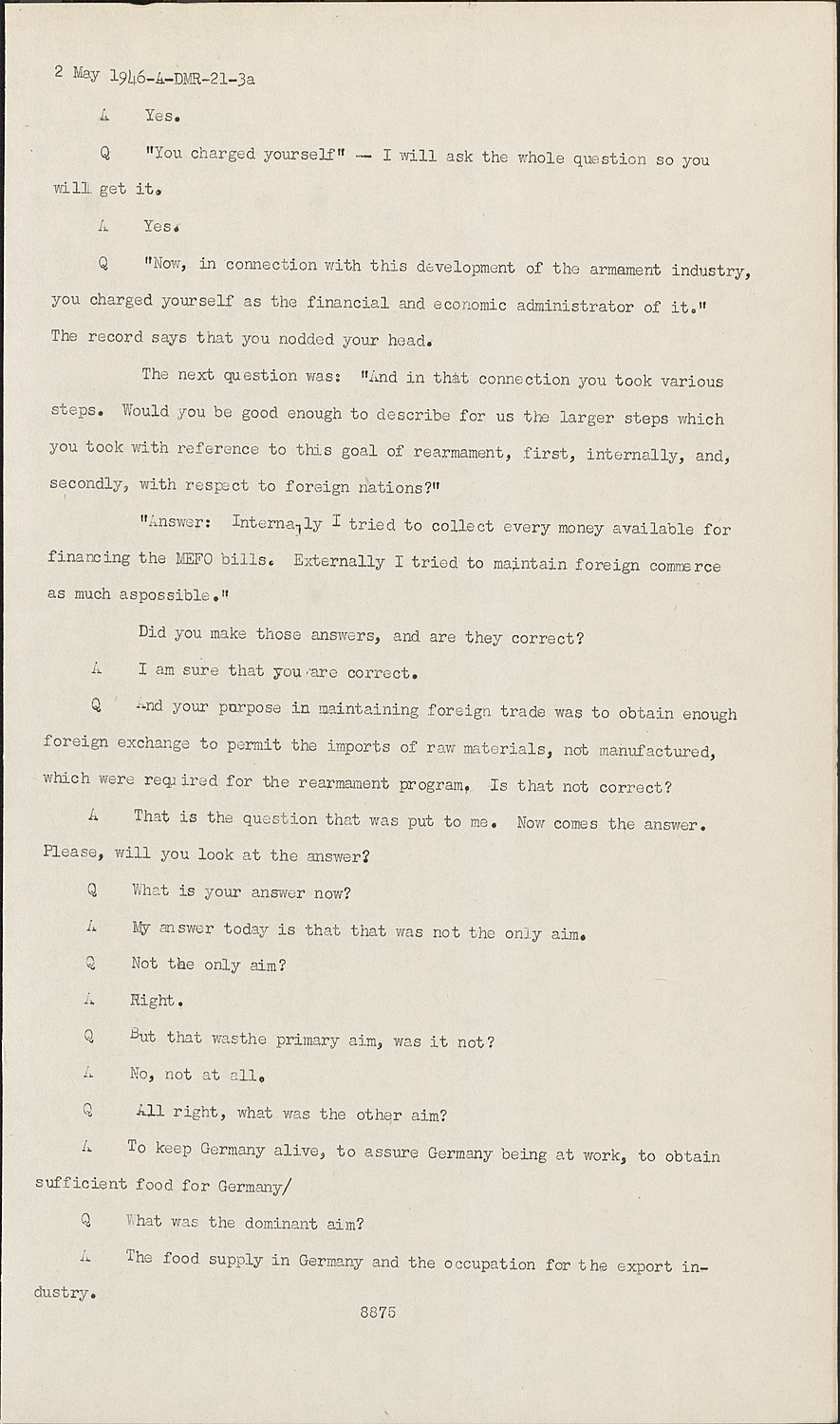
A Yes.
Q "You charged yourself" -- I will ask the whole question so you will get it.
AYes.
Q "Now, in connection with this development of the armament industry, you charged yourself as the financial and economic administrator of it." The record says that you nodded your head.
The next question was: "And in that connection you took various steps. Would you be good enough to describe for us the larger steps which you took with reference to this goal of rearmament, first, internally, and, secondly, with respect to foreign nations?"
"Answer: Internally I tried to collect every money available for financing the MEFO bills. Externally I tried to maintain foreign commerce as much aspossible."
Did you make those answers, and are they correct?
AI am sure that you are correct.
QAnd your purpose in maintaining foreign trade was to obtain enough foreign exchange to permit the imports of raw materials, not manufactured, which were required for the rearmament program. Is that not correct?
AThat is the question that was put to me. Now comes the answer. Please, will you look at the answer?
QWhat is your answer now?
AMy answer today is that that was not the only aim.
QNot the only aim?
ARight.
QBut that was the primary aim, was it not?
ANo, not at all.
QAll right, what was the other aim?
ATo keep Germany alive, to assure Germany being at work, to obtain sufficient food for Germany/
QWhat was the dominant aim?
AThe food supply in Germany and the occupation for the export industry.
Q Well, I should like to go over one or two of these documents with you as to your aim.
I refer to Document 1168-PS of May 3, 1935.
AYes.
QEntitled "Financing of Armament", Exhibit 37.
"The following comments are based on the assumption that the accomplishment of the armament program in regard to speed and extent is the task of German Policy, and that therefore everything else must be subordinated to this aim, although the reaching of this main goal must not be imperiled by neglecting other questions."
Did you write that?
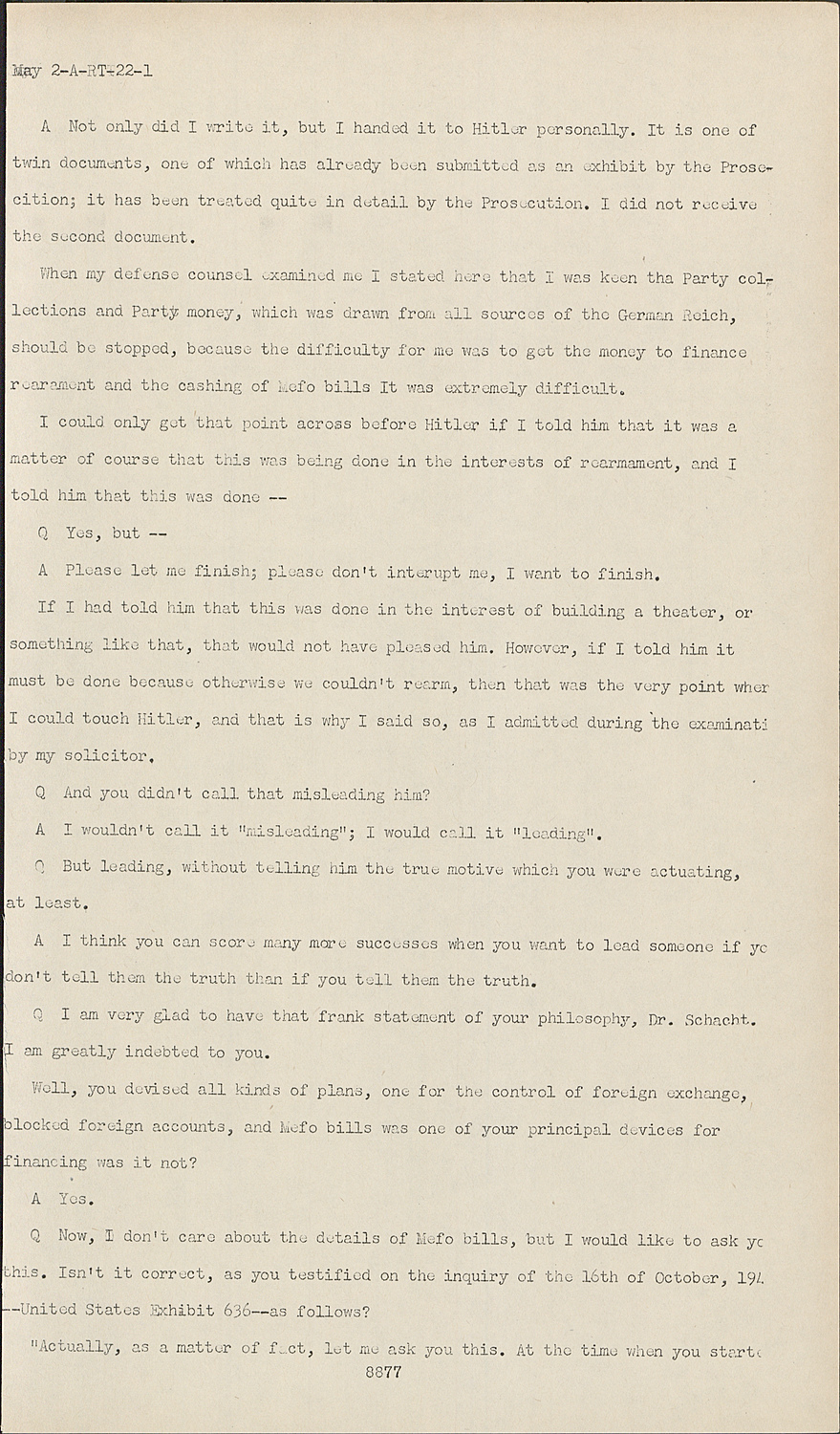
A Not only did I write it, but I handed it to Hitler personally. It is one of twin documents, one of which has already been submitted as an exhibit by the Prosecition; it has been treated quite in detail by the Prosecution.
I did not receive the second document.
When my defense counsel examined me I stated here that I was keen tha Party collections and Party money, which was dram from all sources of the German Reich, should be stopped, because the difficulty for me was to get the money to finance rearament and the cashing of kefo bills It was extremely difficult.
I could only get that point across before Hitler if I told him that it was a matter of course that this was being done in the interests of rearmament, and I told him that this was done -
QYes, but -
APlease let me finish; please don't interupt me, I want to finish.
If I had told him that this was done in the interest of building a theater, or something like that, that would not have pleased him. However, if I told him it must be done because otherwise we couldn't rearm, then that was the very point wher I could touch Hitler, and that is why I said so, as I admitted during the examination by my solicitor.
QAnd you didn't call that misleading him?
AI wouldn't call it "misleading"; I would call it "leading".
QBut leading, without telling him the true motive which you were actuating, at least.
AI think you can score many more successes when you want to lead someone if you don't tell them the truth than if you tell them the truth.
QI am very glad to have that frank statement of your philosophy, Dr. Schacht. I am greatly indebted to you.
Well, you devised all kinds of plans, one for the control of foreign exchange, blocked foreign accounts, and Mefo bills was one of your principal devices for financing was it not?
AYes.
QNow, I don't care about the details of Mefo bills, but I would like to ask you this. Isn't it correct, as you testified on the inquiry of the 16th of October, 194 --United States Exhibit 636--as follows?
"Actually, as a matter of fact, let me ask you this. At the time when you started the Mefo bills, for example, there were no ready means available for financing the the rearmament?
AQuite.
QThat is to say, through normal budget finance methods?
ANot enough.
QAlso, you were limited at that time by the statute of the Reichsbank which was required by the armament program.
AQuite.
QAnd you found a way?
AYes.
QAnd the way you found was by creating a device in effect which enabled the Reichsbank to lend, by a subterfuge, to the Government what it normally or legally could not do?
ARight.
QIs that true?
AYes, of course.
QThe following questions were then asked:
"I understand that basically what was built up in Germany in the way of an armaments industry, a domestic economy that was sound, and a Wehrmacht, the efforts that you put in from 1934 to the spring of 1939, when Mefo financing stopped, were responsible in large part for the sucess of the whole program.
AI don't know whether they were responsible for it, but I helped a great deal to achieve that"
AYes.
QAnd you were asked as follows, on the 17th of October 1945:
"In other words, in effect you are not taking the position that you are not a largely responsible for the rearming of the German Army.
AOh no, I never did.
QYou have always been proud of that fact, I take it.
AI wouldn't say proud, but satisfied"
QIs that still your position?
ATo that I should like to say this. The question of Mefo bills is quite certainly a system of financing which normally would never have happened. During my examination by my solisitor I have since made a statement on the subject. But, on the other hand, I can say that this question was dealt with by all legal experts in the Reichsbank and by that means of this subterfuge, as you put it, means were found, which was legally possible.
QNo, I didn't put it; you put it.
AAll right, I beg your pardon; what you quoted as being my answer. I beg we your pardon.
QSo the matter was legally investigated, and we told ourselves, "That is the way we can work it."
Apart from that, I am still satisfied today that I contributed to rearmament, only I wish that Hitler had used it differently.
QWell, on your 60th birthday Minister of War Blomberg said that, "Without your help, my dear Mr. Schacht, none of this armament could have taken place," did he not?
AYes, those are the sort of polite words one says on such occasions. But there is quite a bit of truth in it too; I have never denied it.
QThat is the way it looks to me.
Now, when you finally made some suggestion that the armament should stop, or slow up, as I understand it, you made that suggestion without knowing, what the armament was.
AYes.
QThe only thing you were judging by was financial conditions, was it not?
AOh no.
QWell, what was it?
AI did, of course, have a general impression of these matters because General Thomas always talked to me about these things. However, what General von Blomberg thought is something which I don't remember, and I don't remember that he has given me detailed information. But, of course, generally I was informed regarding the approximate progress made by rearmament, and that was the reason why I said "mark time". My opinions were strengthened because of the general conditions.
QWell now, let's see what reasons you gave in Exhibit EC-286. That is US-833.
"I am therefore of the opinion that we should promote our export with all resources by a temporary"--and 1 emphasize the word "temporary" -decrease of armament."
A "Decrease"?
Q "Decrease", yes, "temporary".
AYes.
QI emphasize "temporary" and you emphasize "decrease".
AOh no, no; I agree with you.
Q "And that further, with reference to the Four Year Plan, we should solve only those problems which appear most pressing. Among these I include the gasoline program, the buna program, and the program of developing internal resources insofar as this development does not of itself require large amounts of raw material which must be withheld from export.
"On the other hand, all other measures of the Four Year Plan should be postponed for the time being. I am covinced that by such a policy our export could be increased so greatly that our exhausted stockpiles would experience a certain improvement and that the resumption of a strengthened armament would again be possible in the not too distant future from the point of view of the raw material situation.
To what extent a temporary postponement of armament would have military advantages, I am unable to say. Yet, I would suppose that such a pause in armament would not only have advantages for the training of officers and men, which has yet to be done, but that this pause would afford an opportunity to survey the tehcnical results of previous armament and to perfect the technical aspect of armament."
Now that you addressed to Goering, did you not?
A.That is perfectly possible. I can't remember the letter, but it looks just like one of mine.
Q.Yes, and you were correctly giving to Goering your true views, were you not?
A.No; I believe that this was a very tactical letter. I think that I was trying to limit rearmament. If I had told him that we wanted to stop rearmament, then Goering would probably have denounced me before the Fuehrer accordingly. Therefore I told him, "Let's stop a bit, temporarily." I emphasized, too, the temporary thing. It was a tactical measure to convince Goering that for the time being it should be temporary.
Q.Then, with your fellow officers in the Government you were also using tactical statements which did not represent your true views?
A.That was necessary to the utmost degree.
Q.When did it cease to be necessary, Dr. Schacht?
A.Cease?
Q.Yes; when did it cease to be necessary?
A.I think it more important that you should ask when it commenced; when it started.
Q.Well?
A.During the first years I didn't do that sort of thing, but later on, to a considerable extent, I think you can say permamently; it never stopped.
Q.Has it stopped now?
A.I have no more colleagues, and here before this Tribunal I have to do nothing but tell the truth.
Q. Well, on the 24th of December, 1935, you wrote EC-293, which is United States Exhibit 834, and used this language, did you not?
"If a degree of armament going beyond these is now demanded, it is, of course, quite far from me to deny or change my advocacy of the greatest possible armament, expressed for years, both before and since the seizure of power; but it is my duty to point out the economic limitations of this policy."
A.That is pretty good.
Q.And that is true?
A.Yes.
Q.Now, there came the Four Year Plan in 1936?
A.Yes
Q.You did not like the appointment of Goering to that position?
A.I thought he was unsuited. Apart from that, of course, it gave an opening for a policy which was opposed to mine. I knew perfectly well that now the exaggerated rearmament was starting, whereas I was for restricted rearmament.
Q.Why do you say that Goering's appointment meant exaggeration of armament? Can you point to anything that Goering has said in favor of rearmament that is any more extreme than the things you have said?
A.Oh yes.
Q.Will you do so?
A.Yes, I think if you read the record submitted on the so-called "Small Ministerial Council", which you yourself have introduced, of the year 1936, and in particular 1938, you will then see at once that here the necessity of increased armament was emphasized. Take, for instance, October-November 1936,
Q.Well, it was also emphasized in your documents, was it not, throughout?
A.No.
Q.You say that your statements of that sort were merely tactical.
A.No, I beg your pardon. I said "rearm within the limits of the economic possibilities, and reasonably." Goering, if I may say it again, wanted to go beyond those limits.
Q.That is exactly the point I want to make. Your difference with Goering over rearmament was entirely a question of what the economy of Germany would stand, was it not?
A.No. I said: "The most important thing is that Germany live and that it have foreign trade, and within the limits of that we can rearm. But that Germany should rearm more, merely to rearm, and ruin here economy, that is out of the question."
Q.Well then, the difference between you and Goering was over what the economy would stand, was it not?
A.No, but what the degree of rearmament should be, because this is the point, Mr. Justice Jackson. The things that Goering had done were also borne by German economy. The only question is, was it reasonable or unreasonable?
If I may quite clearly state it, then I would say that I considered Goering's economic policy as unreasonable and a burden to the German nation, whereas my first and the most important argument was that rearmament should not go any further, but that the German nation should have a normal, peace-time standa.
THE PRESIDENT:The Tribunal will adjourn.
(A recess was taken until Friday, 3 May 1946, at 1000 hours.)
Official transcript of the International Military Tribunal in the Matter of the United States of America, the French Re public, the United Kingdom of Great Britain and Northern Ireland, and the Union of Soviet Socialist Republics against Hermann Wilhelm Goering, et al, Defendants, sitting at Nurnberg, Germany, on 3 May 1946, 1000-1300 hours, Lord Justice Lawrence presiding.
THE PRESIDENT:The Tribunal will sit in open session tomorrow at ten o'clock and will adjourn into closed session at twelve noon.
Mr. Justice Jackson and defendant Schacht: it is desired, on behalf of the interpreters, that you should pause, if possible, after the question has been put to you, and if you find it necessary, owing to the condition of the documents with which you are dealing, to read in English or speak in English, to give an adequate pause so that those interpreters who are interpreting from English into other languages can take over the interpretation. Is that clear?
MR. JUSTICE JACKSON:I owe an apology constantly to the interpreters. It is hard to overcome the habit of a lifetime.
THE PRESIDENT:It is very difficult. BY MR. JUSTICE JACKSON:
QDr. Schacht, -- by the way, the photograph number ten which was shown you yesterday, that was one of the occasions on which you were the Party badge which you referred to, was it not?
AThat may be.
QYou are quite sure of that, are you not?
AI can not distinguish it clearly, but it may be, and that would prove that the picture was taken after 1937, after January 1937.
QThat is what I wanted to prove. And as a matter of fact, it was taken after 1941, wasn't it?
AI beg your pardon?
QAs a matter of fact, Bormann didn't come to any important official position until after 1941, did he?
ABormann? -- that I don't know.
Q Now, if we will return to the Four-YearPlan which began in 1936, as I understand it you opposed the appointment of Goering to have charge of the Four-Year Plan on two grounds:
First, you thought that that new plan might interfere with your functions and secondly, if there were to be a Four-Year plan you did not think Goering was fit to administer it?
AI do not know what you mean by "opposed to". I was not satisfied with it, and I considered the person of Goering not the right one to have a leading position in economics.
QAs a matter of fact you described Goering as a fool in economics, have you not?
AYes, such as one would mention it in an animated conversation.
QOr an interrogation?
AAlso interrogations are sometimes animated.
QNow, very soon Goering did begin to interfere with your functions, did he not?
AHe tried it repeatedly, I believe.
QAnd he got away with it too, didn't he?
AI don't understand what you mean by that, "he got away".
QOf course, American slang is difficult, I admit. It means he succeeded.
AIn July 1937 he put me flat against the wall.
QThat started over a proposal that he made or a measure that he took with reference to mining?
AYes.
QHe also made a speech to some industrialists, didn't he?
AI assume that he made several speeches to industrialists. I do not know which one you refer to. I assume you mean a speech in December 1936.
QI am referring to the speech in which you said to us in interrogation that Goering had assembled industrialists and said a let of foolish things about the economy, which you had to refute.
AYes, yes, that was the meeting of the 17th of December 1936.
QAnd then you wrote to Goering complaining about the mining measures?
AI assume that you mean the letter of the 5th of August?
Q Right. That document is EC-497 USA-775. And in that letter of August 1937 you said this, if I quote you correctly:
"In the meantime I have repeatedly stressed the need of increased exports and have worked to bring it about. The very necessity of bringing our armament up to a certain level as rapidly as possible must place in the foreground the idea of as large returns as possible in foreign exchange and therewith the greatest possible assurance of raw material supplies." Correct?
AYes, yes.
QAnd you also said this, I believe:
"This view of the economic situation which I have explained above I have held from the first moment of my collaboration."
That was also true, was it not?
AYes, certainly.
QNow, both of those things were true, were they not?
AYes.
QAnd then you concluded addressing Goering.
"I asked you to believe me, my dear Prime Minister, that it is not my intention at all to wish to impede your policies in any way whatsoever. I offer no opinion, either, whether my views, which deviate from your economic policy, are correct or not. I have full sympathy for your activities. I do believe, however, that in a totalitarian state it is wholly impossible to conduct an economic policy divided against itself."
And that was also true, was it not?
AYes.
QAnd that was the basis on which you and Goering disagreed so far as policy was concerned?
ASo far was what was concerned?--policy?--what do you mean, the manner in which business was conducted aside from other differences which we had?
QYes. Now, these other differences were personal differences. You and Goering didn't get along well together?
A Just on the contrary. Until then we were very friendly to each other.
QOh, were you?
AOh, yes.
QSo the beginning of your differences with Goering was over the struggle as to which of you would dominate the preparations for war?
ANo.
QWell-
AI have to protest against that. The differences-
QDo you want to say anything more about it?
AThe differences which led to my resignation were about the fact that Goering wanted me to assume command over economic policies and I should have the responsibility therefore, and I was of the opinion that he who assumes responsibility should also have command; and if one has command then he also has to assume the responsibility. That is the formal reason why I asked for my dismissal.
Q Well now, I turn to your interrogation of the 16th of October, 1945, United States Exhibit 636, and ask if you did not give the following testimony:
"By Schacht:
"After Goering had taken over the Four Year Plan, and I must say after he had taken over the control of foreign exchange since April, 1936, but still more after the Four Year Plan, September 1936, he has always tried to get control of the whole economic policy. One of the objects, of course, was that as Plenipotentiary for War Economy in case of war, and he being only too anxious to get everything into his hands, he tried to get that away from me. Certainly as long as I had the position of Minister of Economics I have certainly objected to that."
You made that statement?
AI believe that is correct.
QAnd then you describe your last visit with him after Luther, for two months, had endeavored to unite Goering and yourself.
AThat is a mistake; that is Hitler, and not Luther.
QVery well.
You described it as follows:
"Then I had a last talk with Goering, and at the end of that talk Goering said, 'But I must have the right to give orders to you. ' Then I said, 'Not to me, but to my successor.' I have never taken orders from Goering, and I would never had done it because he was a fool in economics and I knew something about it, at least.
"Question: Well, I gather that was aculminating, progressive, personal business between you and Goering. That seems perfectly obvious.
"Answer: Certainly."
Is that correct?
AYes, certainly.
QAnd then the interrogator went on:
"Let's go into the duties of that job for a moment and see what he was trying to take away from you. There are only two possibilities, as it has been explained to me; if I am wrong, correct me. One would be the preparation for a mobilization, and the other would be the actual taking charge of this in the event of war. Otherwise, the post had no meaning. So the things you resisted his taking away from you, as I see it, was the right to be in charge of the preparation for mobilization, and secondly, the right to control in the event of war.
"Answer: Correct."
Did you give that testimony?
APlease, Mr. Justice, you are mixing together various things so far as time is concerned. The differences with Goering about this so-called Plenipotentiary for War Economy occurred in the winter 1936-1937 3 and the so-called last conversation with Goering which you have just mentioned took place in November 1937. I stated, I believe in January 1937, that I was quite prepared to turn over the office and the activity as Plenipotentiary for War Economy to Goering. That can be found in the notes of the Jodl Diary, which have been frequently mentioned here.
At that time the War Ministry, the Blomberg in particular, asked to keep me in the position as Plenipotentiary for War Economy, since I was the Minister of Economy, and as long as I was the Minister of Economy. You can find the correspondence about that, which I think has already been submitted by you to the Tribunal.
QWell, all right; I think the dates appear in your testimony. I am not concerned at the moment with the sequence of events, I am concerned with the functions that you were quarreling over, and which you described in your interrogations. And the questions and answers which I read to you are correct; those are the answers you made, are they not?
AYes, but I have to say the following. If you ask me about these different phases, it will give an entirely different picture if you don't separate the different periods. You cannot take evants of January and of November and put them together and then ask me if that is correct. That is not correct.
QWell, let's get what is wrong about this, if anything.
When was your last conversation with Goering in which you told him he would give orders to your successor but not to you?
ANovember 1937.
QNow, the question as to the duties of the job has nothing to do with relation to time, has it? That is, the Plenipotentiary for War, the disagreement between you and Goering.