A By Goering.
QThat means that you were the plenipotentiary of Goering for the carrying out of this plan, were you not?
AThe story of that mission is very briefly told. The activities of several plenipotentiaries of the Four-Year Plan in the Government General were such that I was greatly concerned about it. Therefore, I approached the Reichsmarshal then and asked him to make me plenipotentiary for the Four-Year Plan. That was later.
QAnd that is what happened?
A. That was later.
Q.No, it was in December 1939.
A.December 1939, yes, quite later.
Q.You mean that at the beginning of December 1939 you were his plenipotentiary, were you not?
A.Goering? Well, I was plenipotentiary for the Four Year Plan.
Q.Now, maybe you will recall, defendant, the first order regarding the organization of the Administration in occupied Poland. Do you remember that order?
A.Yes. That is here is it not?
Q.Perhaps you recall paragraph 3 of that order.
A.Yes.
Q.It says that the director of the Administration of Occupied Poland war directly subordinate to you and also the High Commander of the SS and of the Police, Does that not prove that ever since the first days of your Governorship you took over the command of the SS, and that means the responsibility for its actions?
A.No. I definitely answer that question with "no", but I would like to make an explanation.
Q.Witness-
THE PRESIDENT:Let him make his explanation.
Defendant, you may make your explanation.
THE WITNESS:I wanted to make a very short statement. There is an old legal principle which says that nobody can transfer more rights to anybody else than he had himself. What I have stated here was the ideal image which I had before me and how it should h v e been. Everybody has to admit that it is natural and logical that the police should be subordinate to the administrative person. The Fuehrer, who could decide, did not make that decree. I did not have the power and the force to put this decree, which I put in nice words, into effect. BY COLONEL SMIRNOV:
Q.If I understand you, then, this paragraph 3 was an ideal which you strove to attain but which you did not manage to attain.
Is that not so?
A.I beg your pardon, but I could not understand that question. A littl slower please, and may I have the translation into German a little slower?
Q.Should I repeat the question?
THE PRESIDENT:Yes. BY COLONEL SMIRNOV:
Q.I asked you the following. This statement can be understood in the following way. Paragraph 3 of this order war an ideal which you strove to attain, and which you declared, but which you could not attain. Is that so?
A.Which I could not achieve; and that can be seen by the fact that, of necessity, later, a special State Secretary for Security was attempted as another way out.
Q.And that is what I mean to take up now. Maybe you will recall that in April, 1942, special negotiations took place between you and Himmler. Did these negotiations take place in April of 1942?
A.Yes. Of course, I can not tell you the date offhand, but that was always my intention, I always attempted that.
Q.In order to verify this, I turn to your diary. Perhaps you will recall that as a result of these negotiations an understanding was come to.
A.Yes, an understanding was achieved.
Q.In order to refresh your recollection as to the circumstances, I will give you this volume of your diary so that you may have the text before you.
A.Yes, I am ready.
Q.I would like you to turn to paragraph 2 of this agreement, which says.
THE PRESIDENT:Where can we find this? Is it under the date 14 April 1942?
COLONEL SMIRNOV:Yes; that is quite right.
THE PRESIDENT:I think we have got it.
COLONEL SMIRNOV:It is document USSR-223. It has been translated into English and we will distribute it directly.
THE PRESIDENT::I think we have it now; we were only trying to find the place.
COLONEL SMIRNOV: It is at page 18 of the English text.
THE PRESIDENT:Yes. Go on. BY COLONEL SMIRNOV:
Q.I beg you to recall the contents of this paragraph. It says that the high chief of the SS and the Police, State Secretary for Security Affairs, is subordinated directly to the Governor General, and, if he is absent, then to his deputy. Therefore, Himmler agreed with your ideal in this respect.
A.Certainly; on that day I was satisfied, but a few days later the whole thing was chanced. I can only say that these efforts on my part were continued, but unfortunately that was never put into effect and never could be put into effect.
You will find here in paragraph 3, if you care to go on, that the Reichsfuehrer SS, according to the expected decree by the Fuehrer, could give orders to the State Secretary. So, you see, Himmler, here, had reserved the right to give orders to Krueger directly.
Q.That is true. Then, in that case, I ask you to turn to another part of the document.
A.May I say in that connection that that agreement, or that understanding, never was put into effect, as such, but, in the form of a Fuehrer decree, was published in the Reichsgesetzblatt. Unfortunately, I do not know the date of that, but you can find the decree about the regulation of security matters in the Government General, and that is the only authoritative statement.
Here, also, reference is made to the expected decree by the Fuehrer, and that was just a draft of what was to be expected to come out in the Fuehrer decree.
QYes, I was just going to pass on to that. That means that you agree that this decision was merely textually a decree of the Fuehrer?
AThat I cannot say offhand. If you will be good enough to give me the words of the Fuehrer decree I will be able to tell you about that.
QYes.
COLONEL SMIRNOV:This order is in your document book, Your Honors.
ANow I don't have the document. It seems to me that the most essential parts of that agreement have been taken and put into this decree, with a few changes. However, that book has been taken away from me and I cannot compare it.
QWe will submit the book to you now.
AThere were very important changes made, unfortunately.
QYes. I would like you to turn to paragraph 3 of Hitler's decree, dated 7 May 1942, which says that the State Secretary for Security is directly subordinated to the Governor General. Does this not confirm the fact that the police of the governorship-general were, nevertheless, directly subordinated to you? That is in paragraph 3 of the decree.
AI want to say that that is not so. The police were not subordinate to me, even by that decree, only the State Secretary for Security. It does not say her that the police are subordinate to the Governor General, only the State Secretary for Security. If you read paragraph 4, then you come to the difficulties. It was not'quoted from Hitler's decree, because I would have protested against that. However, it became impractical.
Paragraph 4 says that the Reichsfuehrer SS and Chief of the German Police is subordinate to the State Secretary for Security in the field of security and the strengthening of Germandom. If you compare the original agreement, such as it was, in the diary, you will find that in one of the most important fields the Fuehrer had changed his mind, that is, concerning the commissar for the strengthening of Germandom.
That is the title for the Jewish question and the question of colonization.
QI believe, defendant, that you have only taken into consideration one aspect of this question. May I recall to your memory paragraph 4 of this decree, which, in point 2, reads as follows:
"The State Secretary"--and this means Krueger, I suppose--"can receive the consent of the Governor to carry out this policy."
Paragraph 5 says that in case of disagreements between the Governor General and the Chief of Police, a decision must be made through channels of the Reich Ministry and Chief of the Chancellery.
Does this not prove the existence of vast rights, in view of the direction of the police in the governor-generalship and also as to your personal responsibility for the activity?
AThe wording of the decree testifies to it, but the actual development was quite to the contrary. I believe that we will come to that in detail. I say, therefore, that any attempt to gain some influence over the police and the SS has always failed.
QThen whose attempt was this? This was an attempt of Hitler's? He signed this decree, did he not? Does this mean that Krueger was more powerful than Hitler?
AThat question is not quite clear to me. You mean that Krueger did anything against the decree of the Fuehrer? Of course he did, but that has nothing to do with power. That was considered a tremendous concession made to me by Himmler.
I want to point to a memorandum of the summer of 1942, I think, shortly after that decree came up, which I had sent to the Fuehrer.
QWe will look into that memorandum later.
THE PRESIDENT:The Tribunal will adjourn now.
(A recess was taken until 1400 hours.)
Official transcript of the International Military Tribunal in the matter of the United States of America, the French Re public, the United Kingdom of Great Bri tain and Northern Ireland, and the Union of Soviet Socialist Republics against Hermann Wilhelm Goering et al, Defendants, sitting at Nurnberg, Germany, on 18 April 1946, 1400-1700, Lord Justice Lawrence presiding.
HANSFRANK * -- Resumed,
CROSSEXAMINATION -- Continued. BY COLONEL SMIRNOV:
QTell us, Defendant, who was responsible for Party policy in the Government General?
AI hear nothing at all.
QI have the following question to put to you: After the 6th of May, 1942 -
A 6th of May?
QYes, 6th of May, 1942, after the Nazi organization had been organized in the Government General, who was nominated to be its leader?
AThus, the leadership of that administration, of the absolute political life and the police, was concentrated in your hands. Therefore, you are responsible for the activity of the police and the political life there.
AIf I am to answer that question, then I must protest that you are saying that I had control of the police.
QI believe that that is the only way one could interpret the Fuehrer's orders and the other documents which I have put to you,
ANo doubt, if you disregard the facts and the truth of the life.
QWell, then, let's pass on to another group of questions. You heard of the existe nce of Maidanek only in 1944, isn't that so?
AIn 1944 the name Maidanek came to my knowledge for the first time. It was especially communicated to me by the chief of press, Maschner.
QI will now show you a document which was presented by your Defense Counsel and which was compiled by you and which is a report addressed to Hitler, dated May 1943, I will read one excerpt, and I wish to remind you that this is dated the 7th of June 1943:
"As a proof of the absence of confidence in regard to the German leadership, I enclose a characteristic excerpt from the report of the chief of the security police and of the SD in the Government General."
A.Just a moment. I haven't found the passage here on page 35 of the German text, and it is differently worded.
QHave you found this place now?
AYes. But you started with a different sentence. The sentence here starts "A considerable part of the polish intelligentsia"-
THE PRESIDENT:Which page?
COLONEL SMIRNOV:Page 35 of the German text.
Q It is certified in the German text, last paragraph.
AIt starts in this document of mine with the words "a considerable portion..."
QAll right. Then I will continue. As a proof of the absence of confidence in German leadership I include a report from the Chief of the Security Police and of the SD in the Government General, covering the period from the 31st of May 1943.
AWould you be good enough to show me the passage. I don't think it is here. Whatever you have just quoted is not contained in the document I have get here.
QNo, it is there; it is somewhat a part of the quotation.
AI think it has been omitted from this one.
QI am starting in that part which you find lower, at the bottom, it is there. "A large part of the Polish intelligentsia would not let itself, however, be influenced by the news from Katyn -- and is opposed to the similar crimes of the Germans in Auschwitz."
I skip a few parts and I continue: "Amongst the working classes in so far as they are not Communistically inclined, even if this information is not denied, it is pointed out that the attitude towards the Poles is in no way better. There are concentration camps at Auschwitz and Maidanek where the mass murders of Poles continuously took place."
How can one consider this part of your report which mentions Auschwitz and Maidanek, where mass murder took place, with your statement that you heard of Maidanek only at the end of 1944. This report is dated June 1943; you mentioned both Maidanek and Katyn.
AWith reference to Maidanek, we were talking about the extermination of Jews. The extermination of Jews in Maidanek became known to me during the summer of 1944. Up to now the word "Maidanek" has always been mentioned in connection with the extermination of Jews.
QConsequently, we can understand you in the following way, that in May 1943, you heard of the mass murder of Poles in Maidanek and in 1944 you heard of the mass shootings and killing of Jews?
AI beg your pardon. Did you say 1944 in connection with the Jewish extermination, because that is when the official documents were handed to me?
Q And you heard of the mass killings of the Poles and in 1943 --
AIt stands in my memorandum and I don't protest. These are the facts as I put them, before the Fuehrer.
QI will ask that the following document be shown to you. Do you know this document, are you acquainted with it?
AIt is a decree dated the 2nd of October 1943. I assume that the wording entirely is in the original decree.
QYes, in full agreement with the original text and we can even offer you and compare it and your defense will be able to verify it. What do you think of this law signed by you?
AYes, it is here,
QYou were President of the Reich Academy of Law. From the legal point of view, what do you think of this law signed by you?
THE PRESIDENT:What is the number of it.
COLONEL SMIRNOV:It is USSR Exhibit 335, Mr. President.
THE WITNESS:This is the general wording of an order constituting a court martial. It is stated that the proceedings should be headed by a judge, that a document is to be made out, to be certified, and that the proceedings should be recorded in writing. Apart from that, I had the authority to give pardons so that every sentence had to come before me.
QI would like you to tell us who were members of this court. Could you please pay attention to paragraph 3, point 1 of paragraph 3?
AYes; the Security Police, yes.
QYou were telling us of your histile attitude to the SD. Why, then, did you give the SD the right to exert oppression against the Polish population?
ABecause that was the only way by which I could exert influence on the sentences. If I had not published this decree, then there would have been no control and the police would have acted quite blindly.
QYou spoke of the right of amnesty, which was entrusted to you. I remind you that the verdict of this court was to be put into effect immediately, that the court could not change this verdict if it was to be put into effect immediately, if the condemned person was to be shot immediately, Could you agree with that?
AThe sentence nevertheless would have to come before me.
QJust you, but this sentence had to be carried out immediately.
AThat is the general instruction which I had given; that was the same time when I had been given powers to reprieve and that committee which dealt with pardons was continuously sitting. Files were handed in and on the strength of them they acted.
QSince you have spoken of the right to reprieve, I will put to you another question. Do you remember the B Action?
AYes.
QDo you remember that this action signified the extermination of thousands of Polish intellectuals?
ANo.
QAnd what did it signify in that case?
AIt was done within the framework of the general appeasing action and it was my plan that by means of a properly arranged procedure, willful actions of the police should be excluded; that was all contained in that.
Q I do not understand very well your formula. How did you treat per-
sons who were subjected to AB Action; what happened to them?
AFirst of all, we are here only concerned with arrests -- I mean during the meeting.
QBut what happened to then later?
AThey were arrested.
QAnd then?
AAnd they were put in a place of safeguarding and then they were subjected to the proceedings which were established --at least, that is what I intended.
QWas this left to the Police Exclusively?
AThe Police was leading in this connection, yes.
QIn other words, the police took over the extermination of these people after they had been arrested; is that so?
AYes.
QTell us, please, while they were carrying out this inhuman action, why you rejected your own right of reprieve?
ANo, I did make use of it.
QI will then put before you your statement, dated 30 May 1940. Do you remember this meeting of the police on the 30th of May 1940, when you gave final instructions to the police before carrying; out this action ? You state the following: We will directly find the excerpts. You stated that any attempt on the part of the legal institutions to intervene in the operation AB, should be considered treason towards the German interests. Do you remember this statement
AI do not remember it but in any case, you must consider the whole story, a story which went on for several weeks, before you summarize. You must consider the whole statement and not just one fact which you are drawing out. This is a thing which went on for weeks and weeks and months and the forming of this committee of reprieve comes in between, which I had had formed and there is my protest against the willful actions, and then there is the inclusion of a legal system in all these proceedings. All this went on for several weeks and you can't summarize that, in my opinion, in one sentence.
Q Now defendant, I am speaking of words which in my consideration in the eyes of a jurist cannot be misinterpreted.
"The reprieve committee which is submitted to me is not concerned with these matters. AB operation must be carried out exclusively by SS Chief Krueger and his organization. This is a purely internal repressive operation which goes beyond the limits of a normal procedure."
That is to mean you rejected your right of reprieve.
AAt that particular moment but if you follow the further developments during the following weeks then you will see that it never became effective. That was an intention, a bad intention which, thank God, stopped in time. Perhaps my defense counsel will be able to say a few words on the subject later.
QOne single question arises here. Did you reject your right of reprieve while carrying out the separation or not?
ANo.
QWell then, how can you account for your words, this one sentence? "The reprieve committee is not concerned with these matters."?
How should we interpret these words?
AThis is not a decree, it is not an edict, it is not the final ruling on the matter. It is a remark which was made .after days of negotiations. One must recognize the final picture of a development and not learn the various motives as they came up during the development.
QYes, I understand that very well, defendant. But I would like to ask you, to remind you, that this statement was made during a conference with the police, that you instructed the police in that matter.
ANot during that meeting. I assume it came up at some other meeting or occasion. Here we only discussed that one action. After all, I had to talk to Secretary of State Buehler first.
QWell, all right. While discussing with the police the AB operation you stated that the results of this action would not concern the reprieve committee, is that right?
AThat sentence is contained in the diary, yes, but it is not the final result but rather at the intermediate stage.
QPerhaps I can recall to you another sentence in order that you may judge the results of this action. Perhaps you can recall this part which I will put to you. You stated the following:
"We need not shut up these elements in German concentration camps for in that case we would have to carry out unnecessary correspondence with their families. We will liquidate them in the country and we will do it in the simplest form."
What you mean is that this would simply be a question of liquidation, is that not so?
AThat is a terrible word. Thank God that did not become a fact in this connection.
QYes, but these persons were executed. How do you mean this was not carried out?
Evidently this was carried out for the persons were executed.
AWhen they were sentenced they were killed, if the right to reprieve was not exercised.
QAnd they were condemned without the right of reprieve, that is without the right of applying the right of reprieve?
AI do not believe so.
QUnhappily, these persons are not here and therefore evidently they were executed, exterminated.
AWhich people?
QThose who were arrested because of the AB operation. I will remind you of another excerpt connected with this AB operation. If you did not agree with the police in regard to their police actions it would be difficult to explain the celebrations in connection with the departure of Brigadefuehrer Streckenbach when he left for Berlin. Does this not mean that you were at least on friendly relations with him?
AI do not think that this is in any way in keeping with the truth and I think you know that as well as the others.
QI will remind you of one part of your speech in regard to the Brigadefuehrer Streckenbach, one sentence only.
You said:
"What you, the Fuehrer, and your people have done in the Governor Generalship must not be forgotten and you need not be ashamed of all of it."
Does that not mean, does it not testify to quite a different attitude toward Streckenbach and his people?
AAnd it was not forgotten either.
COLONEL SMIRNOV:I have no further questions to put to the defendant.
THE PRESIDENT:Does that conclude the cross-examination?
MR. DODD:I have only one or two questions, if your Honor pleases. BY MR. DODD:
QIn the course of your examination I understood you to say that you had never gathered to yourself any of the art treasures of the Government General, By that I do not suppose you to mean that you did not have them collected and registered for you did them collected and registered, is not that so?
AArt treasures in the Government General were authoritatively collected and registered officially and the book has been submitted here in Court.
QYes. And before you got there you told the Tribunal that one Duerer collection had already been seized, before you took over your duties.
AMay I ask you to understand it as follows:
These were leaves of pictures made by Duerer which had been collected from the counties, the various districts before the civilian administration started to work. Muehlmann went to Lemberg and collected them from the library whereas I had not been to Lemberg at all before that time.
These leaves, these sheets were then taken directly to the Fuehrer HQ or the Reichsmarshal Goering, I am not sure.
QThey were collected for Goering, that is what I am driving at. Is that not a fact?
ASecretary of State Muehlmann, when I asked him, told me was coming by order of the Reichsmarshal and that they were collected by order of the Reichsmarshal.
QAnd were there not some other art objects that were collected by the Reichsmarshal and also by the defendant Rosenberg at the time you told the Tribunal you were too busy with war tasks to get involved in that sort of thing?
AThere is nothing like that known to me .with reference to the Government General. Rosenberg's Action Staff had no jurisdiction in the General Government and apart from the collection of the composer Elsner and a Jewish library from Lublin I had no official duties to demand the return of any art treasures from Rosenberg.
QBut there were some art treasures in your possession when you were captured by the American forces.
AYes. They were not in my possession, I was safeguarding them but not for myself. They were not under my immediate control, they had been taken away by me at once when the towns were inflamed. They could not be safeguarded or secured any other way. Aside from that these art treasures are so widely known that they are numbers one to ten on this list so that even if you wanted to you could not appropriate them. You cannot steal a Mona Lisa.
QWell, I merely wanted to clear that up.
I knew you had said on interrelation there were some in your possession. I am not trying to imply you were holding them for yourself if you were not. However, I think you have made that clear.
APerhaps, if I may, I would like to remark in this connection since I am particularly keen on clarifying these points, that these art treasures with which we are concerned, could only be made safe in that particular way. Otherwise they would have gotten lost.
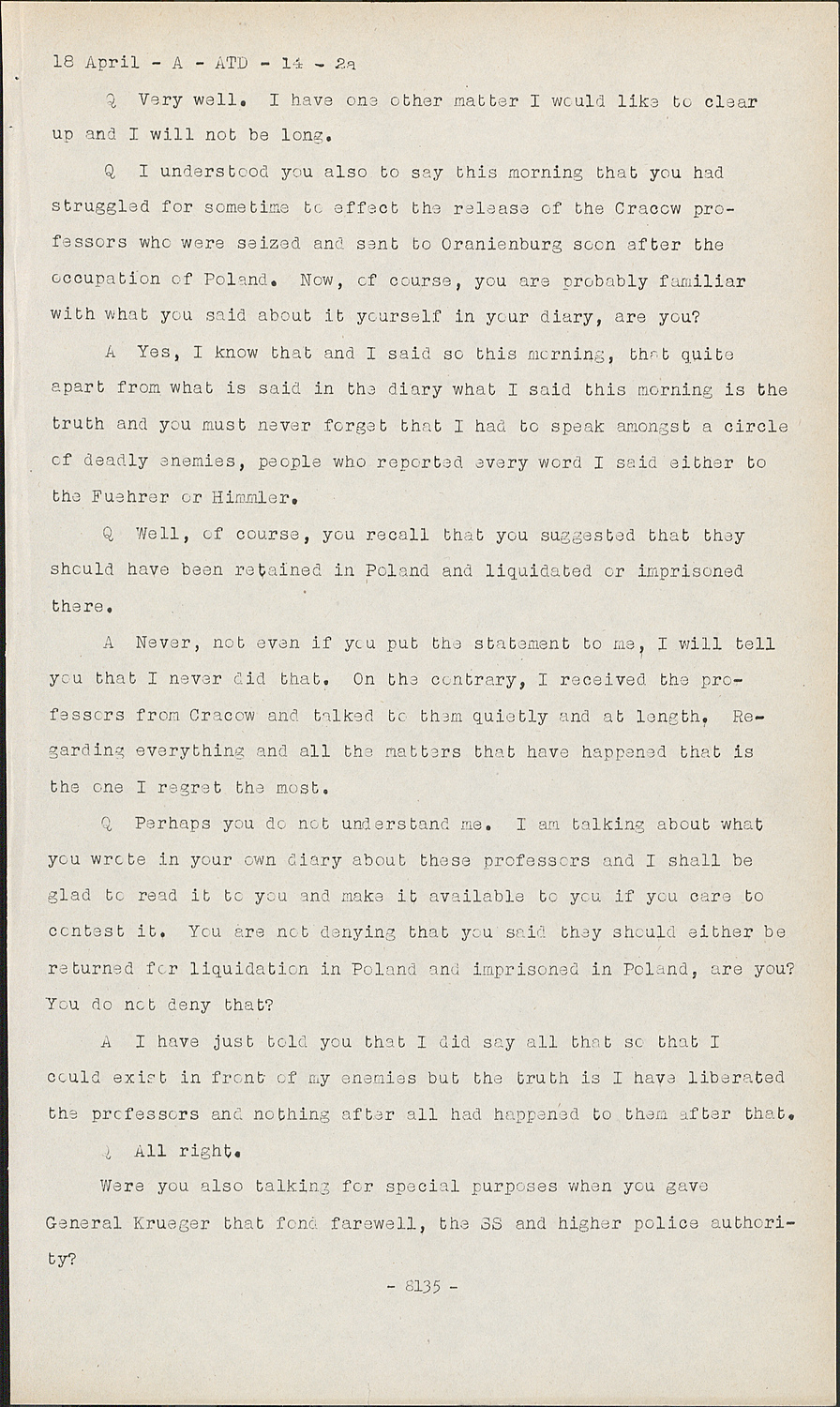
Q Very well. I have one other matter I would like to clear up and I will not be long.
QI understood you also to say this morning that you had struggled for sometime to effect the release of the Cracow professors who were seized and sent to Oranienburg soon after the occupation of Poland. Now, of course, you are probably familiar with what you said about it yourself in your diary, are you?
AYes, I know that and I said so this morning, that quite apart from what is said in the diary what I said this morning is the truth and you must never forget that I had to speak amongst a circle of deadly enemies, people who reported every word I said either to the Fuehrer or Himmler.
QWell, of course, you recall that you suggested that they should have been retained in Poland and liquidated or imprisoned there.
ANever, not even if you put the statement to me, I will tell you that I never did that. On the contrary, I received the professors from Cracow and talked to them quietly and at length. Regarding everything and all the matters that have happened that is the one I regret the most.
QPerhaps you do not understand me. I am talking about what you wrote in your own diary about these professors and I shall be glad to read it be you and make it available to you if you care to contest it. You are not denying that you said they should either be returned for liquidation in Poland and imprisoned in Poland, are you? You do not deny that?
AI have just told you that I did say all that so that I could exist in front of my enemies but the truth is I have liberated the professors and nothing after all had happened to them after that.
QAll right.
Were you also talking for special purposes when you gave General Krueger that fond farewell, the SS and higher police authority?
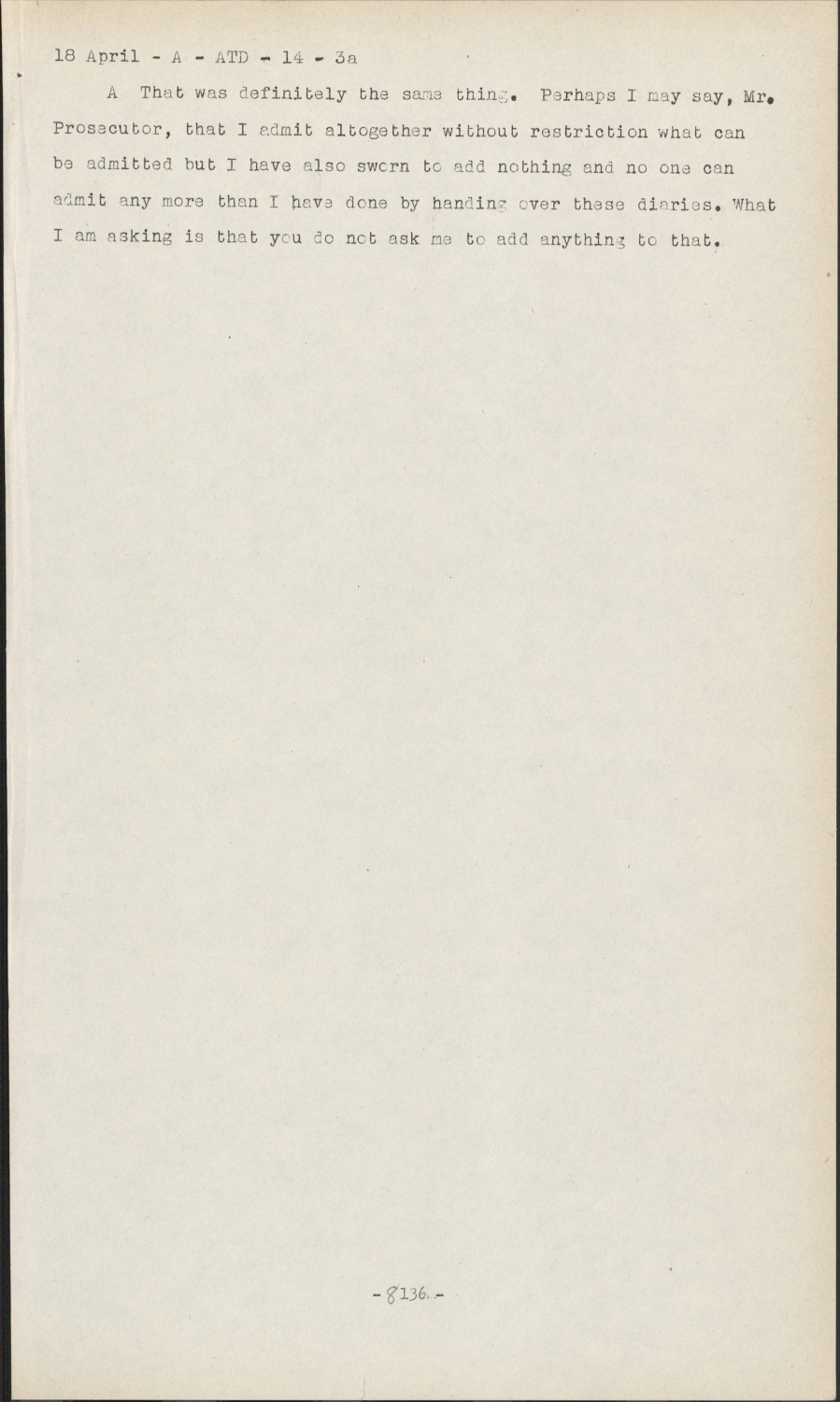
A That was definitely the same thing. Perhaps I may say, Mr. Prosecutor, that I admit altogether without restriction what can be admitted but I have also sworn to add nothing and no one can admit any more than I have done by handing over these diaries.
What I am asking is that you do not ask me to add anything to that.
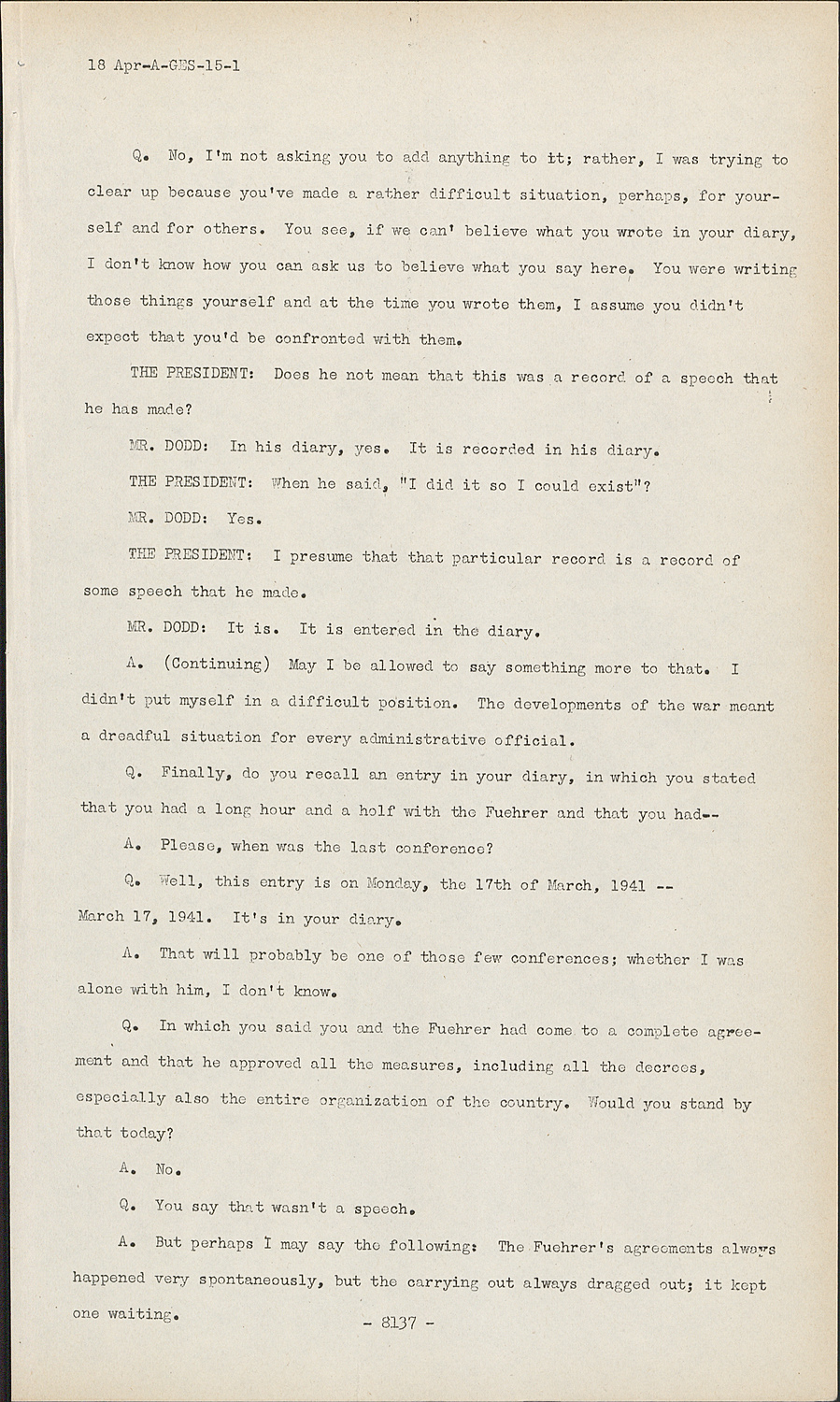
Q. No, I'm not asking you to add anything to it; rather, I was trying to clear up because you've made a rather difficult situation, perhaps, for yourself and for others.
You see, if we can' believe what you wrote in your diary, I don't know how you can ask us to believe what you say here. You were writing those things yourself and at the time you wrote them, I assume you didn't expect that you'd be confronted with them.
THE PRESIDENT:Does he not mean that this was a record of a speech that he has made?
MR. DODD:In his diary, yes. It is recorded in his diary.
THE PRESIDENT:When he said, "I did it so I could exist"?
MR. DODD:Yes.
THE PRESIDENT:I presume that that particular record is a record of some speech that he made.
MR. DODD:It is. It is entered in the diary.
A. (Continuing) May I be allowed to say something more to that. I didn't put myself in a difficult position. The developments of the war meant a dreadful situation for every administrative official.
Q.Finally, do you recall an entry in your diary, in which you stated that you had a long hour and a holf with the Fuehrer and that you had-
A.Please, when was the last conference?
Q.Well, this entry is on Monday, the 17th of March, 1941 -March 17, 1941. It's in your diary.
A.That will probably be one of those few conferences; whether I was alone with him, I don't know.
Q.In which you said you and the Fuehrer had come to a complete agreement and that he approved all the measures, including all the decrees, especially also the entire organization of the country. Would you stand by that today?
A.No.
Q.You say that wasn't a speech.
A.But perhaps 1 may say the following: The Fuehrer's agreements always happened very spontaneously, but the carrying out always dragged out; it kept one waiting.
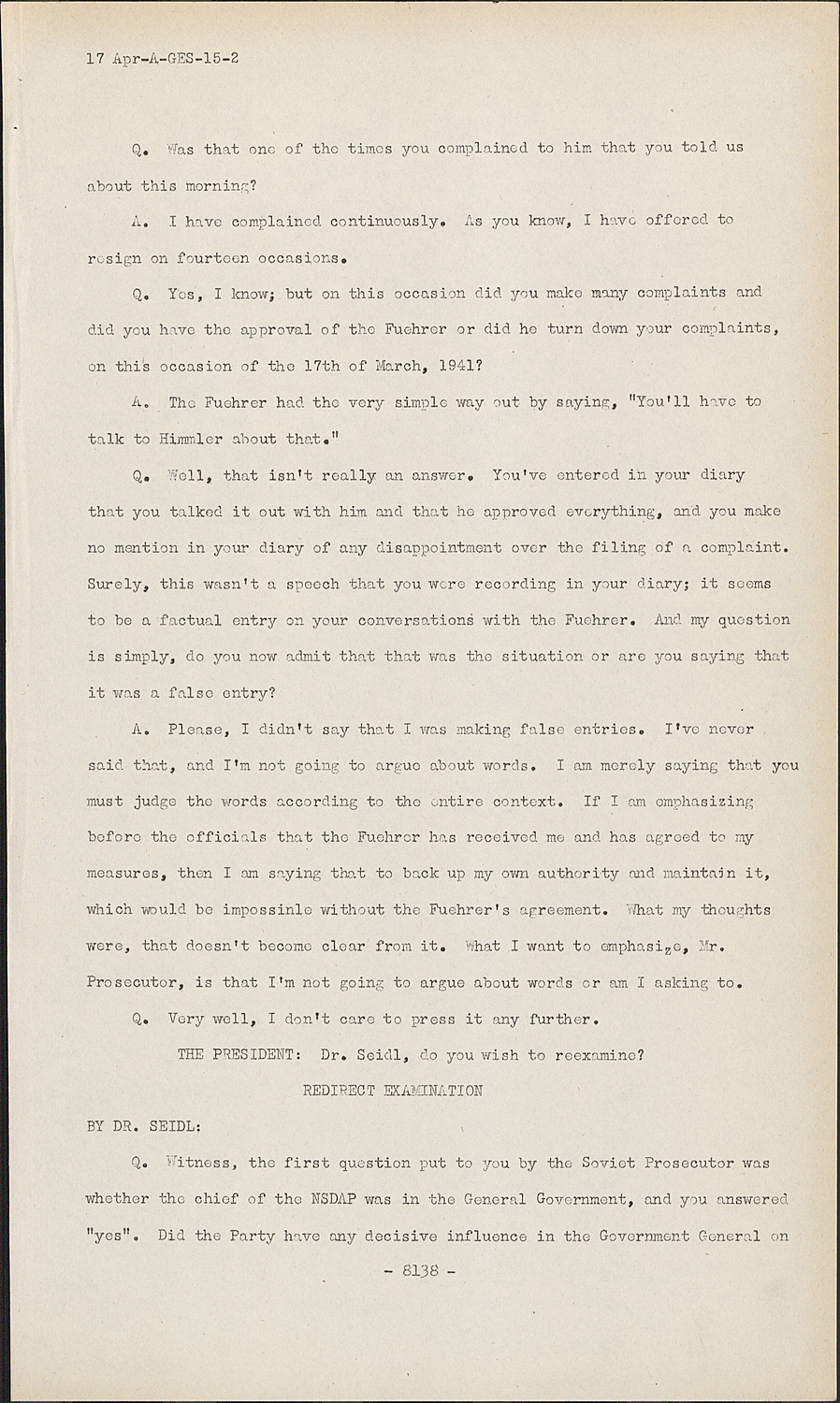
Q. Was that one of the times you complained to him that you told us about this morning?
A.I have complained continuously. As you know, I have offered to resign on fourteen occasions.
Q.Yes, I know; but on this occasion did you make many complaints and did you have the approval of the Fuehrer or did he turn down your complaints, on this occasion of the 17th of March, 1941?
A.The Fuehrer had the very simple way out by saying, "You'll have to talk to Himmler about that."
Q.Well, that isn't really an answer. You've entered in your diary that you talked it out with him and that he approved everything, and you make no mention in your diary of any disappointment over the filing; of a complaint. Surely, this wasn't a speech that you were recording in your diary; it seems to be a factual entry on your conversations with the Fuehrer. And my question is simply, do you now admit that that was the situation or are you saying that it was a false entry?
A.Please, I didn't say that I was making false entries. I've never said, that, and I'm not going to argue about words. I am merely saying that you must judge the words according to the entire context. If I am emphasizing before the officials that the Fuehrer has received me and has agreed to my measures, then I am saying that to back up my own authority and maintain it, which would be impossinle without the Fuehrer's agreement. What my thoughts were, that doesn't become clear from it. What I want to emphasize, Mr. Prosecutor, is that I'm not going to argue about words or am I asking to.
Q.Very well, I don't care to press it any further.
THE PRESIDENT: Dr. Seidl, do you wish to reexamine?
REDIRECT EXAMINATION BY DR. SEIDL:
Q.Witness, the first question put to you by the Soviet Prosecutor was whether the chief of the NSDAP was in the General Government, and you answered "yes". Did the Party have any decisive influence in the Government General on the political and administrative life?