acts of destruction, acts of sabotage, or prevention of sabotage, or in general those activities that are carried out by commandos.
It was the function of this division to coordinate these activities and to bring them into relationship with the military necessities, or the plans of the General Staff.
QWho, in general, gave you your orders as regards coordinating these activities with the military activities?
AMy orders were received usually from my Chief, Canaris.
QI was referring to the office, whether it came from the OKH or the OKW?
AIt came from the OKW usually. Usually it came from the OKW, as represented by the Chief at that time of the OKW, Keitel, or the Chief of the Fuehrung Stab; and when the General Staff, or the Air Force Fuehrung Stab were involved in any undertaking, the order, so far as I can best remember was also transmitted by the Armed Forces Fuehrung Stab. All these orders, whatever their source may have been, came through the same channels to the Abwehr Section, and were thus transmitted to me.
QAre you now describing the official channels through which you received the orders, or are you defining where the orders came from, whether they came from the OKW, the Army, the OKH, or the Fuehrung Stab; or whether they were simply transmitted by way of or via the OKW?
ASo far as I personally can make a statement on this, I was simply in touch with my chief, Admiral Canaris. I know from him of his connection with the gentlemen in the Army Fuehrung Stab, occasionally; also with the gentlemen of the General Staff of the Army. I could mention specific cases from memory, but in general, the events were such as I described them.
QIs it true that Keitel, as the Chief of the OKW, at first every year, and then from 1936 on, in shorter periods, spoke to the officials and section chiefs of the OKW; and on such occasions pointed out to them, specifically, that everyone who believed that something was being asked of him that his conscience would not allow him to carry out, he would be so kind, as to tell him, namely, Keitel?
A It is true that the Chief of the OKW at that time would speak before this circle several times -- I cannot, of course, remember his precise words -- and that he did make this statement, which could be so interpreted.
As to run the risk in those cases to which I bore witness yesterday, the risk of speaking so clearly and openly, as acquaintances of Canaris were able to speak at any time, such an occasion was not presented by Keitel.
QDo I understand you correctly to mean that you do not wish to challenge, in principle, the fact that Keitel actually said these words?
AI can neither challenge it, nor can I add anything to it, because I do not precisely recall it. I do recall that these addresses or conferences took place, and it is altogether possible that the Chief of the OKW at the time used those words, or might have used them. I can only add what I have already said.
QIs it true that on several occasions, you, in the company of Admiral Canaris, as well as alone, were in the presence of the Chief of the OKW, in order to discuss plans or undertakings with Keitel, which were in the purview of your official duties?
AOf course, I said a great deal about that yesterday; and I do not feel I have the right to talk about such things unless I personally was there
QI had the impression, as if in many respects you were being used as a mouthpiece for Admiral Canaris, among other things, through your quotations in his diary.
AThe impression is completely fallacious. I am no mouthpiece, and as to that which I said then and now, I retain my complete independence. I have never allowed myself, nor shall I ever allow myself, to become the mouthpiece of any conception, or to make any statements that run contrary to my inner convictions and my conscience.
QYou misunderstood me if you believe that I used the word "mouthpiece" as a derogative. I simply wanted to bring attention to the remarks that have their source in Canaris' diary.
AYes, I did assist Canaris in his diary, in matters which Canaris was personally concerned, and in matters, since he was dead, he could make no statement. Since I knew of it, knew a great deal, and in great detail, I took it upon myself to say what I know.
Q Did the Defendant, Keitel, ever ask the question, or communicate with Abwehr Section, as regards whether or not there were Nazis in that section?
A He answered such questions in elaborate detail in the aforementioned conferences.
I know that in such an official position as the OKW, he tolerated in officers no attitudes of mind that ran contrary to a belief in a final victory, or to a complete obedience to the Fuehrer.
QCould not these statements be interpreted as requirements of a military nature, obedience in a military set, or must they be understood politically?
AOf course, they were military, but there could be no doubt that they were also political, since any discrimination was made in this matter or recognized. It was supposed to be a unit, the National Socialistic Armed Forces. That touches the basic problem.
QDo you then believe that the basic attitude was still essentially military?
AThe basic attitude was or should have been by first order, a National Socialistic; and only in second order, a military attitude, or any sort of attitude.
QYou said "should have been."
AYes, because that actually was not the case.
QYou said that in first line it was military and not National Socialistic.
AIt should have been, according to our interpretation, but according to the attitude represented by the Chief of the OKW at that time -- whether he received that as an order or not, I am not in a position to say, as I wasn't there--but according to his opinion then, it should be a question of absolute obedience in a National Socialistic sense.
QDo you know anything about the attitude of the generals towards this problem?
AOf course, I do, because immediately after such conferences, as have been mentioned here, this theme was discussed, and a lively exchange of opinions took place, and a large number of those who were present -- I can name them; some of them are here -- took a negative attitude to the requirement that the orientation should be so National Socialistic.
QYesterday, on the occasion of the discussion of the meeting that took place in the Fuehrer's train, in September of 1939, as regards the communication of the Chief of the OKW to you, you said that the Defendant, Keitel, had expressed himself to you, or rather had expressed himself to the gentlemen present: "These measures had been determined between the Fuehrer and Goering. He, Keitel, had no influence on them. The Fuehrer and Goering telephoned frequently back and forth. Sometimes he knew something about it; sometimes I did, too."
AYou have taken it down correctly. What I said then, I have reported in my notes; and I repeated it hers in the same way that it was registered in my notes.
QMay I ask whether your remark: "Sometimes I find out about it, sometimes I don't", relates to a concrete, specific case, or was that a general rule?
AThat is to be understood as a general statement, so far as I can bear witness to it today, to the best of my remembrance.
QAt this conference in the Fuehrer's train, on the 12th of September, 1939, you spoke further of the transmission of the political goals which, according to you, had their source in Ribbentrop.
AThat is correct.
QAnd you said that the Defendant, Keitel, transmitted these political goals to those who were present; and the same way with respect to the order regarding Warsaw, namely, the bombardment of Warsaw.
AWell, so far as the air bombardment of Warsaw was concerned, according to the best of my memory, and what I have reported in the files, I can say that in this regard, as also in regards the matter of the shootings in Poland, Canaris took the initiative in these matters, in that he pointed out the terrible political international repercussions that such behavior might have.
QI should now like to ask you whether Keitel, on the occasion when the order to bombard Warsaw was made known, whether Keitel didn't specifically point out that said action was planned only to take place if Warsaw did not surrender, after it had been approached through parliamentary ways; and that first of all, Warsaw should be given an opportunity to capitulate without being bombarded?
AI cannot recall the precise words in which such took place, but so far as my knowledge of that general situation is concerned, it is quite possible, indeed probable, that the Chief of the OKW, at the time, Keitel, did make this remark.
QDo you know that the Commander in Chief of the Army at that time, von Brauchitsch, and the Chief of the OKW, Keitel, before the Polish War began, specifically objected to the use of Commandos and Gestapo, and rejected their use; and in so doing, had the agreement of Hitler?
ANo, that was not known to me, and could not have been known to me, according to my subordinate position at that time. I do not wish to over-emphasize the importance of my official position.
QThere is also here a question of knowledge of a document, which was transmitted to all departments and sections of the OKW, as you probably remember from yesterday. They were the so-called directives; and in these directives, there appears, in contrary to what happened later -
THE PRESIDENT:I think you were re going a little bit too fast.
Q (continuing) I said that in connection with such military actions, the orders and directives were mimeographed and generally made known, no doubt.
ASo far as my specific department is concerned, such orders were not definitive, and I had nothing to do with them.
Q Since later you were brought into a discussion of these questions, and since you emphasize that the orders were not
AOf course, a great deal was known to me, because I heard it.
QFor that reason, I want to ask you whether you recall that the Gestapo and SD were used, contrary to the specific intentions and wishes of the OKW, in the matter of the Polish War?
AI do not remember that anymore. I can only speak of what I remember, and what is registered in the files, and in there, there is something regarding this theme, namely, a remark of Hitler's that was transmitted by Keitel at that time, namely, that the Armed Forces objected to that behavior, the Armed Forces and the OKH; and in this memorandum, there were indications of this objection, namely, that the Gestapo and the SD were doing such things. That is all that I know, because I was present at these discussions.
QDuring this conversation, were you not told that an objection to the behavior of the SS was brought up, on the part of General Blaskowitz?
AWhether or not this question was brought up in this conference, I cannot recall. I can hardly assume that it was so, because otherwise the question would be registered in the minutes of that conference. It was particularly General Blaskowitz, whose attitude in such matters was very clear, but aside from this conversation in the Fuehrer's train, I remember in its essence something about what was just brought up, namely, Blaskowitz, on that occasion -- I cannot say what form that objection took, whether it was in writing or in words, but I do remember the general theme; and I do recall that in a conference at which I was present, such matter was mentioned.
QWhat appears to me to be important in this matter, is the fact that actually the Armed Forces, the troops, protested, or at least had a negative attitude toward the behavior of the SS.
AThat the Armed Forces did object, is, of course, clear.
QThat is what I wanted to know.
AOne moment, please. When I say "the Armed Forces," I mean the masses of common soldiers, the ordinary human beings. Of course, there were in these Armed Forces -- I do not wish to be misunderstood. The concept "Armed Forces" does not include everybody--I mean, the great masses of common soldiers and thinking human beings.
QYou use the term "Wehrmacht" to differentiate between the common soldiers and the High Command.
ASo far as methods and conditions at that time were concerned, since at that time the broad masses of the Wehrmacht first made their historical appearance all together, independently of what I can say in my little sector of it.
QWho gave the order regarding the collaboration with the Ukranian Group? You spoke yesterday of that group.
AI must reiterate something here, and say first of all, that this group was composed of citizens from various countries, Hungarians, Czechs and Poles, who, because of their oppositionist attitude, were in some sort of unit, or had gone to Germany. Who ordered this collaboration, I cannot say, because at the time when these matters came up, in point of time, it is pretty far in the past, in the year 1938, and from then on, if I remember correctly. First of all, at that time, I was not even a member of the Abwehr Section, and was not in touch with the department, which I joined only in 1939, and took over as a functioning organism. I should like to add in this context, because it was also touched on yesterday, that in the question of these Ukranians, it was a question of human beings, who were in any way connected with Germany. To be specific, a great many of these people, also those with whom the Abwehr Division had anything to do at that time, were in German concentration camps, and a part of these people were fighting for their country in Soviet-Russian partisan groups.
Those are the facts.
QDid not Admiral Canaris say to you that the chief of the OKW, when the demand was made on him for Polish uniforms and equipment, demands made by the SS, that Keitel specifically ordered that the Abwehr Division should more or less let the matter drop?
AI mentioned this matter also yesterday, and as I said then it was treated altogether in a mysterious way. Until after the actual occurrence of the event no one seemed to know what had or was going to take place. It was finally brought out to expression when one day Keitel asked for so and so many uniforms for the operation called "Himmler." This I knew about, of course, via commands from Canaris; and so far as I understood the matter--and this is registered in the diary--as the officer who had the job of keeping this diary, I wondered how Mr. Himmler had so come in contace with Polish uniforms. And I was told that these uniforms would simply be picked up on such and such a day by somebody, and that was about the end of the matter so far as I was concerned.
Of course, at that moment this matter was not only mysterious but also very suspicious, particularly because of the name "Himmler." We were acquainted with that group of people from the top way down to the man who was going to pick these things up and deliver them to a Hauptsturmfuehrer of the SS. Of course, people had their opinions on this matter; that could not be forbidden then.
QYou also made statements yesterday regarding the treatment of war prisoners. In what regard was Abwehr Section II concerned with this problem?
AAbwehr II was simply there. Of course, it was of the greatest interest to see to it that these war prisoners were treated decently, the same as any intelligence service in the world has a similar interest.
QDo I understand you to mean that the division Abwehr it as such was not admittedly concerned with problems concerning war prisoners?
ANot at all Q You spoke of this problem of the treatment of war prisoners in connection with the talk that took place the end of July 1941.
AYes, and during this conversation I was not there as a representative of my division but of the whole section, "Ausland Abwehr," namely, the section that has to concern itself with all these larger problems. And Abwehr Section III, that had to deal with espionage, was of course interested in this matter because there were officers in these camps. And from the point of view of counter-intelligence it was important to know about these things, that is to say, my division, namely II, was not so concerned; it was interested in it only in connection with the whole problem, -- such questions as whether or not people should be killed or treated decently.
QYou said yesterday that the war prisoner camps in the eastern field were under the jurisdiction of the OKW.
AYes, the war prisoner camps as I said specifically yesterday -what I said about this problem I know from my talk with Reinecke and not from my knowledge of the orders themselves in the sense that I might have seen them personally; I did not. From this conversation with Reinecke the problem of war prisoners also was in the presence of those concerned in Abwehr, and Reinecke who was concerned with these things also.
I knew of that order.
QMy question dealt with the limits of the jurisdiction. Did you not know that in the Operation Section of the Army who had responsibility for war prisoners, and that the OK took over this responsibility at the moment in which the war prisoners reached Germany?
AYes, I also said so yesterday, so far as my knowledge of what happened is concerned, namely, that the General Staff of the Army had prepared everything to bring these people back; that the order had been issued in an order to put it under them; and that the General Staff made the OKW responsible for the consequences of all this. What happened after that I can not judge; I can only say what I saw and heard.
QI thought that yesterday you expressed the conjecture -
AI did not express conjecture; I simply repeated what I had heard at that time and what I know -- I could of course be wrong -from whom in the same circle in which I led my daily life, my ordinary contacts with Canaris or the other section chiefs, and being present when addresses were held, -- conversations and that sort of thing; matters that were discussed in this circle. It was under such circumstances that I heard these things, which were frequently discussed. And as I emphasized repeatedly, I told Reinecke to his face that what he himself at that time said regarding these matters.
QThat does not -
AI understand precisely -what you mean. I wish to delimit it though as clearly as I may so that I can make clear to you what I did say yesterday in order to define the specific organizational limits.
QBut you know that as a matter of principle the OKW had charge of war prisoners only in Germany?
AThat is absolutely so.
QCould it happen that the Abwehr office that had to do with commando activities took an attitude such as you defined it yesterday insofar as you had to do with these things from the German side, but you were not officially concerned with these things?
ANot immediately, no. The Ausland Office had something to do with that to the extent that first of it it was guided by the purpose even before these things became orders; certainly at the moment that the order became a fact. And of course this order involved a serious question of international law, and of course the Abwehr Division was concerned in its Ausland, namely, its foreign division with such questions. Practically my division was immediately interested in it; was concerned with this, because other sections of the Abwehr were so concerned.
QAs regards the division for international law in the Ausland Abwehr did it take an official position toward this?
AI said even yesterday that I had drawn up a large-scale chart of the operations of my division, and that this chart was transmitted to Canaris. But what we had to deal with concretely I knew of only through what Buerckner said at that time. And whether this took place in writing or orally in his department--objections and counter-objections-these measures were taken cognizance of and transmitted. I can not say in what form this transmission took place; whether in writing and then orally or vice-versa. After the executions had actually taken place, on the basis of what had actually taken place, was of course perfectly understandable.
THE PRESIDENT:It would help the interpreter if when giving a very long answer like that that you pause between the intermediate parts of the answer.
THE WITNESS:Shall I repeat? I don't know-
THE PRESIDENT:No, no; go on. BY DOCTOR NELTE:
QYou said something yesterday about the marking of Russian prisoners with brandings. Didn't you find out that a summary of this question was presented by the chief of the OKW, who was at that time in the Fuehrer's headquarters, that this order was given telephonically; that it was a question of a terrible misunderstanding and which led to the fact that this order was issued only in a very few copies?
ANo, I do not know about this, because in general I heard only of things that took place within the Abwehr division; things that were communicated to me by Canaris. I knew of these things only if I received knowledge of them through the channels that I have described.
QYou yourself did not see the order?
AWhich order are you referring to?
QThe one concerning the marking of Russian prisoners with a brand.
ANo. That is exactly as in the question of the commando orders; I was only present at this very lively discussion of these questions, and so far as the business of branding Russian prisoners is concerned, I simply remember that someone made a medical report on how that could be most efficiently done.
QYou stated yesterday that Admiral Canaris had said that the defendant Keitel had issued the order to do away with General Weygand. The Defendant Keitel denies that. Now, he would like to ask if there is in your possession any document or any written evidence that could serve as proof of the source of such a remark regarding General Weygand?
AThis order was not transmitted in writing, but was directly only towards me. Of course, it came to me because I was to carry it out through my department. It was known in a certain circle around Canaris; a certain limited publicity; and I was insinuated into this matter through an address that Keitel held at which I was present and at which I was spoken to by Keitel on this matter. And that I have made note of in my personal journal. It was of course not an every-day affair. On December 23, 1940, this took place.
QDon't you remember the actual wording of the question that Keitel asked you?
AOf course I can not remember the precise wording. The meaning of it, of course, I remember very well. The meaning was, "What has been done in this matter? How do things stand?"
QYou said that you backed out in your answer.
AI don't Again remember the precise wording of my answer, but I certainly didn't say what I had said to Canaris, namely, that I wouldn't mostly consider carrying out such a murder order nor that I was not the chief of an organization of murderers.
What I actually said to Keitel -I probably said something about how difficult the matter was. Any evasive answer that I may have thought of.
Q Did the chief of the OKW command, or if it was said to have made such a command, namely a command to deal in this way with General Weygand?
If he had issued such an order would not the matter involve the state? You didn't tell us whether after December 23, 1940, anything transpired in this matter, that is to say, whether the chief of the OKW returned to this question.
ANo, I didn't say that yesterday, but I frequently mentioned that during the interrogations that, namely the fact that after this time nothing further happened so far as the chief of the OKW was concerned. Whatever Canaris could have told me because of my acquaintance with him, whatever it might have been, it did not lie in the direction of my jurisdiction. As to the matter of Giraud, we shall come to that presently.
QIt is obvious that if such an action involving the state, such as the murdering of General Weygand, if such an action should have been ordered, and then all of a sudden nothing more is heard of it -can you give me an explanation of that?
AI can give only this explanation, which is not only mine but also our group's interpretation of the matter. The situation at that time was in fluctuation; events were happening very fast; something was up; and we assume -- and I shall return to this, shall return to why we assumed it -- that this matter and the interest that there may have been in this action, that this interest was thrust into the background.
QDo you wish to say anything else?
AYes. I want to say that what I am saying now bears a certain relationship to the affair Giraud, in which Canaris and the others who knew about this as the matter began hoped that it would take the same course as the affair Weygand; that in other words history would take the same course that it had taken before, namely, that the order should come perhaps from Hitler to Keitel and then from Keitel to Canaris and then to me, and the it would stop there. That was our hope. Now, the matter regarding Giraud developed, you know. Whether this was right or unright I do not know.
QFor a less important matter your assumption might hold water, but in such an important matter as this matter of Weygand it doesn't seem to me to hold water. If there had been any reason from any source to do away with Weygand how do you explain the fact that Weygand, who later was taken to Germany and put in a villa without being disturbed in any way and being well treated, that nothing was done to him? It could be understood that if the order at that time was to do away with him that it might have been carried out on this occasion.
AI can only answer to this that the attitude toward personalities in public life or personalities in foreign countries was quite various. There were high personalities who were at one moment thought very highly of and at the next moment were to be found in a concentration camp.
QNow, as is the case of Giraud, you said that in the same way Admiral Canaris in your and other people's presence said that General Giraud was to be done away with on orders from above?
AYes; that is to be assumed from the remark that Pieckenbrock made, that Keitel should tell these things to Hitler once and for all,
QSo according to the communication made to you by Admiral Canaris, it was not an order of Keitel's but an order of Hitler's in the Ausland Abwehr office?
ASo far as we knew about it it was Keitel who brought the order to Canaris. I can only assume that it may have been an order from Hitler. I do not know who actually gave this order, because along this line via Canaris on up I was excluded. It was, so far as I can see it, an order from Canaris, an order which I could discuss immediately with Canaris in the same way I can discuss it here.
QYou yourself didn't personally hear this order?
ANo, I did not personally hear it.
QBut you mentioned that at a later time you were spoken to by Keitel about this matter?
AThe development was the same as in the case of Weygand.
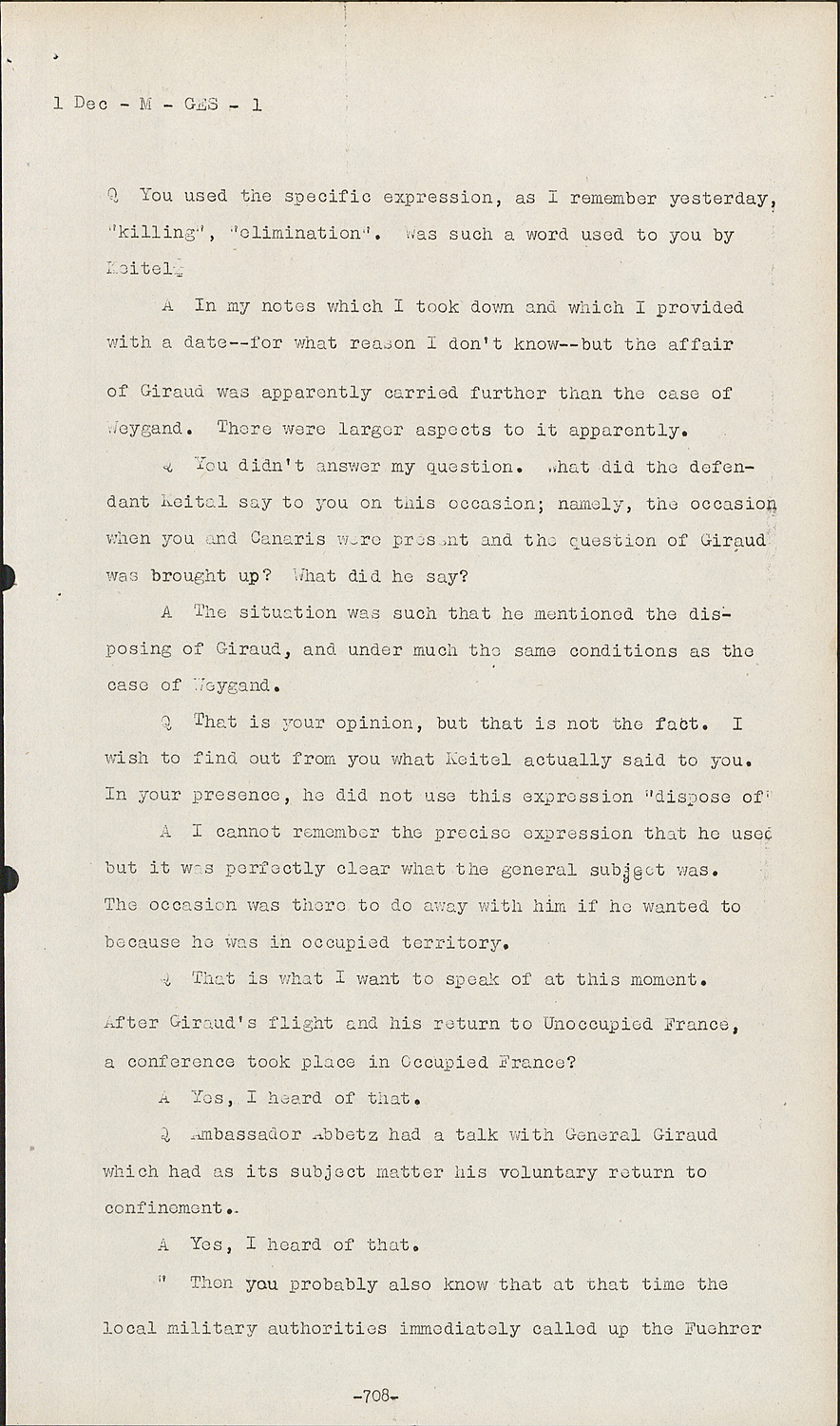
Q You used the specific expression, as I remember yesterday, "killing", "elimination", was such a word used to you by Keitel.
A In my notes which I took down and which I provided with a date--for what reason I don't know--but the affair of Giraud was apparently carried further than the case of Weygand.
There were larger aspects to it apparently.
Q You didn't answer my question. What did the defen dant Keital say to you on this occasion; namely, the occasion when you and Canaris were present and the question of Giraud was brought up?
What did he say?
A The situation was such that he mentioned the dis posing of Giraud, and under much the same conditions as the case of Weygand.
Q That is your opinion, but that is not the fact. I wish to find out from you what Keitel actually said to you.
In your presence, he did not use this expression "dispose of" A I cannot remember the precise expression that he used but it was perfectly clear what the general subject was.
The occasion was there to do away with him if he wanted to because he was in occupied territory.
Q That is what I want to speak of at this moment.
After Giraud's flight and his return to Unoccupied France, a conference took place in Occupied France?
A Yes, I heard of that.
Q Ambassador Abbetz had a talk with General Giraud which had as its subject matter his voluntary return to confinement.
A Yes, I heard of that.
Q Then you probably also know that at that time the local military authorities immediately called up the Fuehrer by way of Paris and believed that an important communication was to be made; namely, that Giraud was in Occupied France and could be taken prisoner?
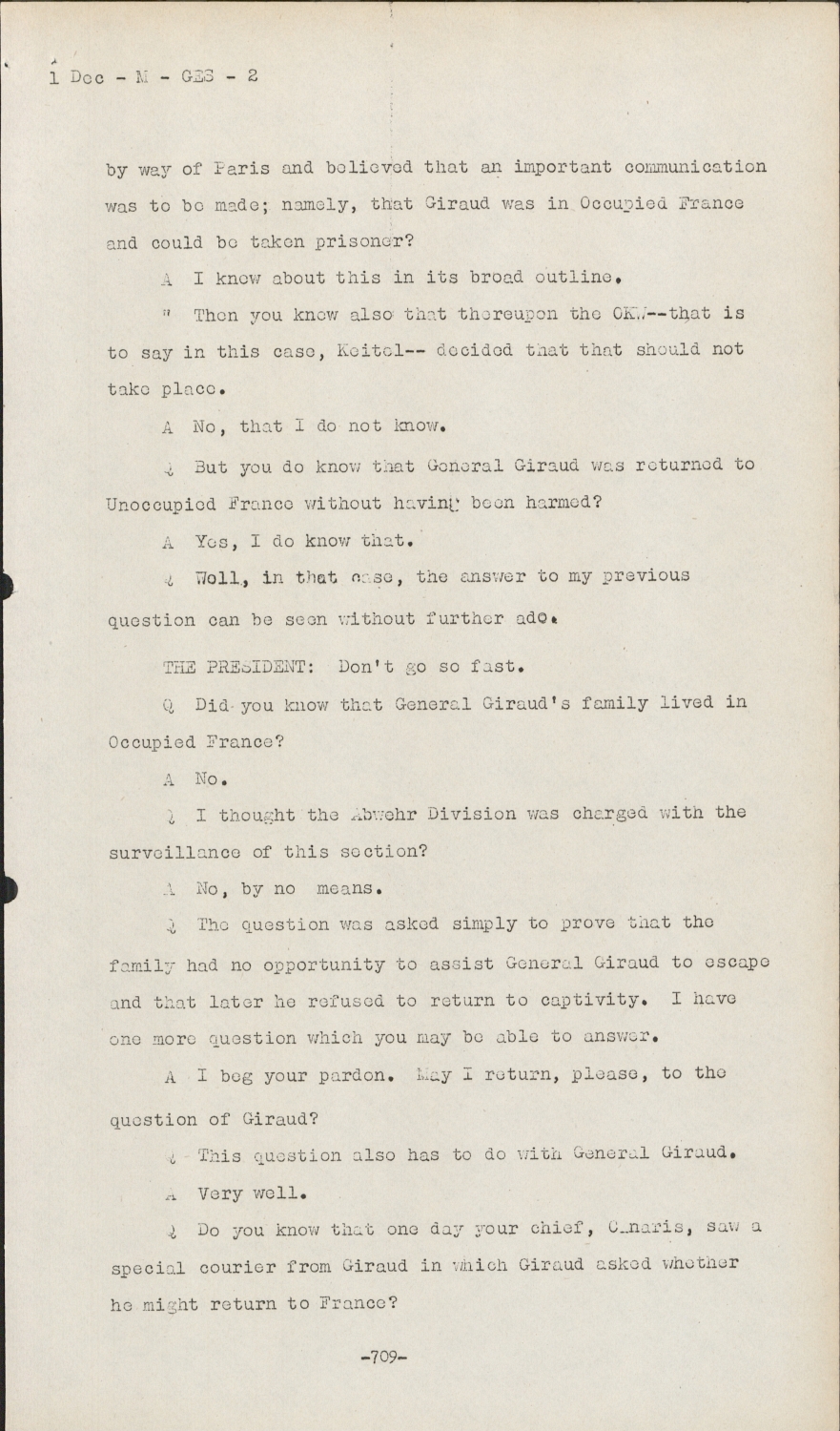
AI knew about this in its broad outline.
" Then you knew also that thereupon the OKW--that is to say in this case, Keitel-- decided that that should not take place.
ANo, that I do not know.
QBut you do know that General Giraud was returned to Unoccupied France without having been harmed?
AYes, I do know that.
QWell, in that case, the answer to my previous question can be seen without further ado.
THE PRESIDENT:Don't go so fast.
QDid you know that General Giraud's family lived in Occupied France?
ANo.
QI thought the Abwehr Division was charged with the surveillance of this section?
ANo, by no means.
QThe question was asked simply to prove that the family had no opportunity to assist General Giraud to escape and that later he refused to return to captivity.
I have one more question which you may be able to answer.
AI beg your pardon. May I return, please, to the question of Giraud?
QThis question also has to do with General Giraud.
AVery well.
QDo you know that one day your chief, Canaris, saw a special courier from Giraud in which Giraud asked whether he might return to France?
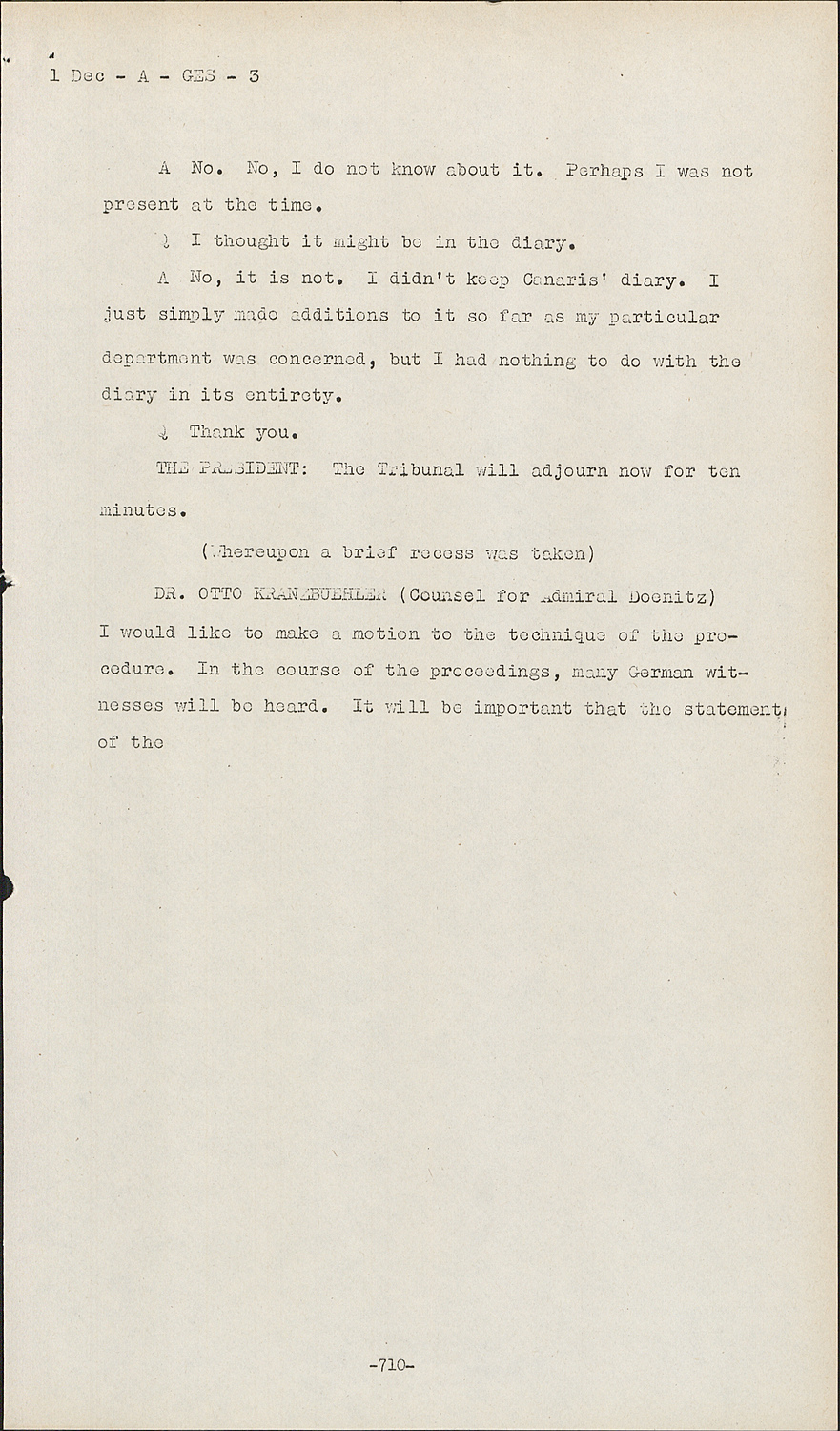
A No. No, I do not know about it. Perhaps I was not present at the time.
QI thought it might be in the diary.
ANo, it is not. I didn't keep Canaris' diary. I just simply made additions to it so far as my particular department was concerned, but I had nothing to do with the diary in its entirety.
QThank you.
THE PRESIDENT:The Tribunal will adjourn now for ten minutes.
(Whereupon a brief recess was taken)
DR. OTTOKRANZBUEHLER (Counsel for Admiral Doenitz) I would like to make a motion to the technique of the pro cedure.
In the course of the proceedings, many German wit nesses will be heard.
It will be important that oho statement.
of the witnesses be brought correctly to the attention of the Court.
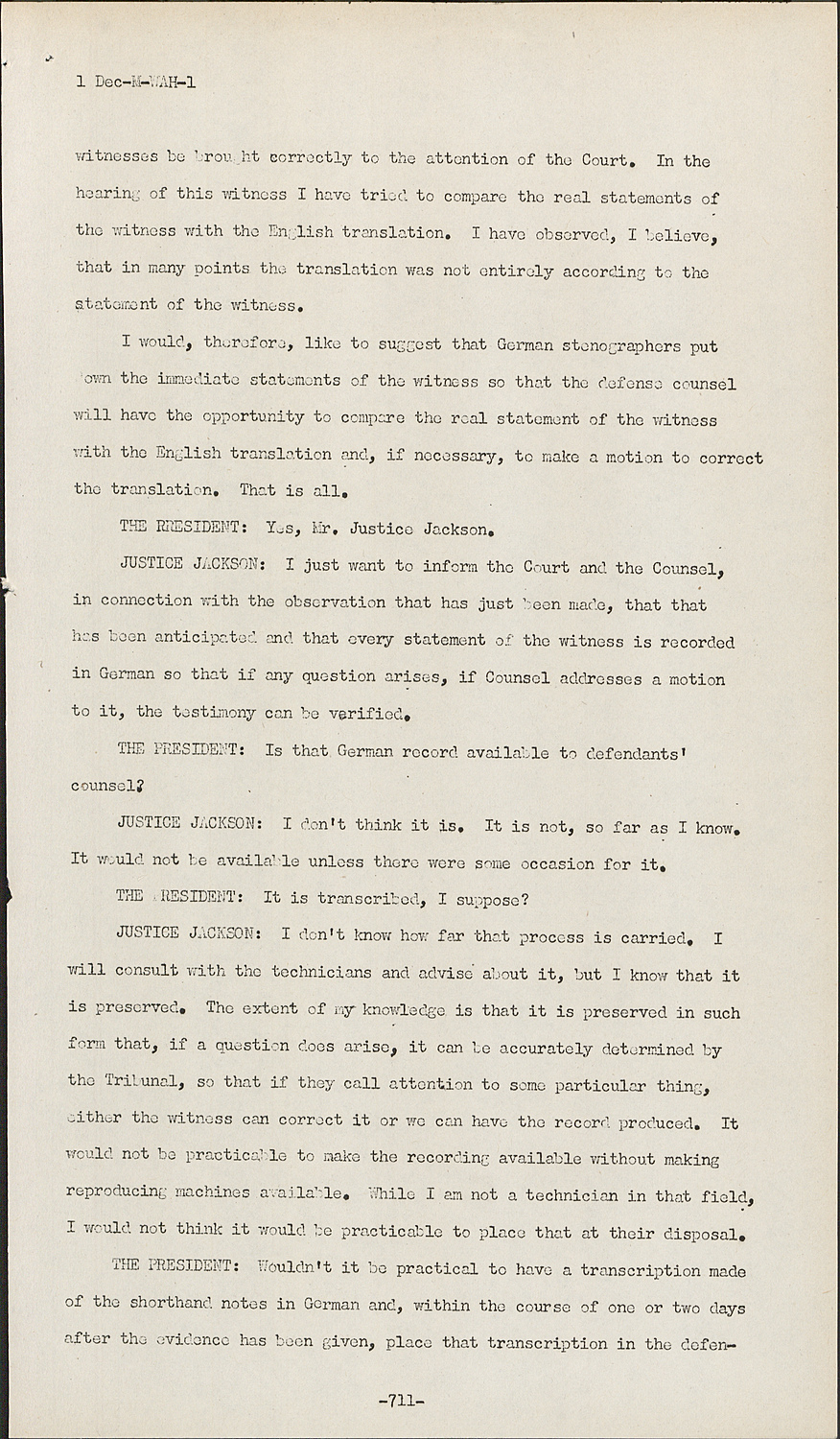
In the hearing of this witness I have tried to compare the real statements of the witness with the English translation.
I have observed, I believe, that in many points the translation was not entirely according to the statement of the witness.
I would, therefore, like to suggest that German stenographers put own the immediate statements of the witness so that the defense counsel will have the opportunity to compare the real statement of the witness with the English translation and, if necessary, to make a motion to correct the translation. That is all.
THE PRESIDENT:Yes, Mr. Justice Jackson.
JUSTICE JACKSON:I just want to inform the Court and the Counsel, in connection with the observation that has just been made, that that has been anticipated and that every statement of the witness is recorded in German so that if any question arises, if Counsel addresses a motion to it, the testimony can be verified.
THE PRESIDENT:Is that German record available to defendants' counsel?
JUSTICE JACKSON:I don't think it is. It is not, so far as I know. It would not be available unless there were some occasion for it.
THE PRESIDENT:It is transcribed, I suppose?
JUSTICE JACKSON:I don't know how far that process is carried. I will consult with the technicians and advise about it, but I know that it is preserved. The extent of my knowledge is that it is preserved in such form that, if a question does arise, it can be accurately determined by the Tribunal, so that if they call attention to some particular thing, either the witness can correct it or we can have the record produced. It would not be practicable to make the recording available without making reproducing machines available. While I am not a technician in that field, I would not think it would be practicable to place that at their disposal.
THE PRESIDENT:Wouldn't it be practical to have a transcription made of the shorthand notes in German and, within the course of one or two days after the evidence has been given, place that transcription in the defen dants' counsel room?