"According to the task-plan which had been prepared since the out break of the war, the leadership of the local organization gave orders on the 7th of April for phase one of the state of employment.
.."
It doesn't sound, does it,that plans are being made for different phases of an operation? It doesn't sound, does it, as if the work of your organization had been simply finding out about Norwegian people?
AIt might be, because this is entirely new to me. That might have been an agreement in the country itself with military and other people. I had never had any previous knowledge up until now.
QSo I understand you to say. But you were the head of this organization, were you not?
AYes.
QYou have come before this International Tribunal and given them evidence, presumably saying you are in a position to give them truthful and accurate evidence, is that so?
A yes.
QDo you understand that?
AYes, I understood that.
QWell, then, do I understand you to say now that you don't know what was happening in your organization and therefore you are not in a position to give evidence as to whether or not it was a Fifth Column business?
AIt is clear and definite that in an organization of this size the leader, who has his office at Berlin, cannot know exactly what is going on, and especially what is going on against his instructions. I didn't have the same disciplinary powers over my party members abroad as I did over the Gauleiters internally, and I need net elaborate on that, because it seems self-evident and also clear, and this I know, that some Germans abroad were called on because of their patriotism, without the knowledge of the Ausland Organization and against its direct instructions. They let themselves be used for these purposes.
QIn the interest of time we won't pursue that particular sphere of activity in Norway, just in case it may have been an exception which you didn't know about.
Let me turn to something else. Will you look at page 65 of that book?
(The witness manipulated a back.)
Is that an article by your Landesgruppenleiter in Greece?
AYes.
QIs it in the form of a day-to-day diary of the activities of the Ausland organization in Greece when German troops invaded that country?
AYes.
QWill you look at page 65?
"Sunday the 27th of April. Swastika on the Acropolis."
That is the heading. I beg your pardon. I don't know whether it comes directly under that heading.
This it the Landesgruppenleiter talking:
"I set out immediately and quickly visited the other quarters where the German colony had been interned, the Philadelphia and the Institute. I enjoined upon the inmates of the house in Academy Street that they were to renounce returning home today as well, and that they were to hold themselves in readiness. After all, we did want to help the German troops immediately with our local and linguistic knowledge. Now the moment has come. We must start in immediately."
Do you know -
AYes, I know everything about this. It was probably clear that the moment that German troops would occupy a foreign city and free the Germans who had been interned, they would put themselves at the disposal of German pools and serve then in any capacity to interpret or show the way or similar things, and that seems to be the most logical thing in the world for them to do.
QThat is in fact what they did do, and the assistance your organization appears to have given them is that it managed to organize them and get them ready to do it, isn't that so? That is what your Landesgruppenleiter seems to be doing?
AI didn't quite follow the question. Will you please repeat it?
QDo you understand that it is your Landesgruppenleiter who is organizing the members of your organization, organizing then so that they can give their assistance most beneficially to the invading armies?
ANo, that is the wrong way to express it. The Landesgruppenleiter in Greece, who had his post since 1934, couldn't know at all whether an invasion of Greece was to come or was not to come. That had nothing to do with his activity at all. At the moment where German troops were in the country it was clear that they would greet their countryman and would help them in every way, and that was a patriotic duty to be taken for granted.
QI see.
Just turn to page 66, the next page. Will you find the paragraph which commences "Meanwhile I organized the employment of all Party members to do auxiliary service for the armed forces."
Do you have that?
AI understand it, although I don't find the place.
QYou had better find the place.
AWhere shall I find that place?
QOn page 66. It is a new paragraph.
AYes, I find the place.
Q "Meanwhile I organized the employment of all Party members to do auxiliary service for the armed forces."
It really looks now as though the Landesgruppenleiter is organizing them, doesn't it?
AYes, at that moment it looks like it.
Q "Soon our boys and girls could be seen riding proud and radiant in their Hitler Youth uniforms beside the German soldiers on motor bicycles and dustcarts."
Did you yourself know of the organization and work that your Landesgruppenleiter had put in in Greece to assist your armies in semimilitary capacities, or was that another case like Norway which you didn't know about?
AThe Landesgruppenleiter at Greece did not organize anything in a military way, but he had to have organization to aid the troops who were coming in, but he did that in a civilian matter only.
QNow, have you a document there which is a telegram from somebody called Stohrer, in Madrid?
AStohrer, yes.
QDid Stohrer have something to do with the German Embassy in Madrid?
AHe was the ambassador himself, Doctor von Stohrer.
QThis is dated 23 October 1939. Just let us see what it says.
"The Landesgruppenleiter can obtain a very suitable house for accommodating the Landesgrippe, including the German Labor Front, the Hitler Youth, and the German House Madrid, also room available in case of embassy having to spread out, and especially very suitable shut-off room for possible erection of second secret radio sender, which can no longer be housed at the school because of reopening.
"Landesgruppenleiter requests me to rent the house through embassy, in which way very considerable tax expense will be avoided. Have no hesitation, in view of anticipated partial use by embassy as mentioned above. If you are not agreeable I request wire by return.
"Please submit also to Gauleiter Bohle," Were you telling the truth to this Tribunal when you told them some twenty minutes ago you had no knowledge of wireless sets being used by your organization?
A Yes, the use of the apparatus seems . . . . . If you mean that it was the apparatus used by the Embassy, I have no knowledge of that.
DR.SEIDL (Counsel for the Defendant Hess): The copy of the telegram as I have it before me, it does not indicate to whom this wire was addressed. The last sentence of the telegram leads one to assume that it was not addressed to Bohle, the witness. According to my opinion, I should think the witness should have to be asked whether he knew about this wire and to whom it was addressed.
LT. COL.GRIFFITH-JONES: Perhaps you will tell Dr. Seidl to whom,of the German Embassies, he was likely to send a telegram on such matters as this.
THE WITNESS:To the foreign office at Berlin.
QAnd you, at that time, were State Secretary at the Foreign Office of Berlin, were you not?
AThat is correct.
QBeneath his signature is set out the distribution to -- it mentions various persons in the Departments in the Foreign Office in Berlin. Is that so?
AYes.
QAnd are you saying now, that you have . . . It was not all of those departments who were asked to submit this matter to you, that they all failed to do so?
AYes.
QAnd are you saying now, that you have . . . It was not all of those departments who were asked to submit this matter to you, that they all failed to do so?
ANo. I am sure that they would have done this.
QDo you remember yourself seeing this telegram before?
ANo, I cannot recall that and I would never have noticed this for these secret centers in Spain were something which I never knew about. And in the distribution slip, it shows "State Secretary", but that does not mean me. It means the State Secretary of the Foreign Office. That is the political name.
Q I can save you all that. I am not suggesting that that "State Secretary" means you, otherwise it would not be asked to be submitted to you.
What I want to know is what you or your embassy workers, or both of you working together, wanted with two secret wireless sets in Spain in October, 1939?
Are you still saying that your organization was quite unconcerned in reporting back information of military importance?
AJust how do you mean, "reporting back?"
QAre you telling the Tribunal -- I want you to be quite clear -- are you telling the Tribunal that your organization was not being used for espionage purposes in Spain?
AYes, I am asserting that. There were certain members of the organization who worked without my knowledge. I protested against this often enough, but they were used for this purpose. I did not wish that Germans abroad, as in all other countries who had similar cases,who were members of the organization became involved or concerned in this.
QI don't want to stop you at all. I don't want to stop you. Go on if you have anything to say. But, in the interest of time, try and make it as short as possible.
AEvidently we are confusing the Ausland organization members with organizations of Germans abroad who did these things in the interest of what they considered patriotism and what they considered their patriotic duty. And that, I believe, has certain decisive points.
QI won't argue about that. You see that your organization took official interests to record accounts of what they were doing in their official books. I just want to show you one thing further -- a document. I have one further document to put to this witness.
THE PRESIDENT:You may as well go on.
LT. COL.GRIFFITH-JONES: It is a document which I have just had found. I haven't had them copied. The Tribunal will forgive me if I read extracts from them?
Is that .... It is an original document you hold in your hand and it appears to be, doesn't it, a carbon copy of a letter from . . . .
THE PRESIDENT: Has Dr. Seidl got one?
LT. COL.GRIFFITH-JONES: Yes, he has one in German.
Is that a letter from your Landesgruppenleiter Konradi?
AIt seems to be addressed to Konradi but not signed by him.
QIf you will look at the end of the letter you will see that it is actually signed "Konradi." After the usual "Heil Hitler" . . . . .
AThe copy that I have is not signed by him.
QWill you get that copy back? Perhaps these documents . . . .
(Document taken from the witness to Lt. Col. Griffith-Jones).
It is in fact signed "Konradi." Show it to him.
(Document returned to the witness).
AIt is not signed by Konradi. It is typed in.
QI am very much obliged. It is my fault. I told you that is a carbon copy. A copy of a letter which was signed by Konradi. That appears to be so, doesn't it?
AThat, I do not know, for I don't know of a letter signed by Konradi.
QYou can take it so far as you are concerned that that is a German document which has been captured and it is a place of paper, and that it bears a typewritten signature of Konradi, who was your Landesgruppenleiter in Rumania, is that correct? You remember whom you had . . . .
AYes, his name was Konradi.
QAnd is this a letter of instructions to the Zellenleiter in Constanca?
AYes.
QIt is dated the 25th of October 1939. Will you read the first paragraph?
"Between the 9 and 12 of October, a conference took place with the Senior Party's functionaries, or their deputies, of the South Eastern and Southern European groups at the Office of the Direction of the Ausland organization." Does that mean Berlin?
AYes. Berlin.
QThat means your office, doesn't it?
AIn my office, but not in my personal office.
QIn the office over which you had complete contrd?
AYes.
Q. Agreed. I imagine, before we go on that no orders would be issued from your head office at a conference of that kind which were contrary to your direction, would there?
A.Not in important things, no.
Q. "I subsequently received direct instructions from the competent Office of the Direction of the Ausland organization."
So it appears that the direction given in the conference was confirmed in writing "During the war, every National Socialist abroad must directly serve the Fatherland, either through propaganda for the German cause or by counter-acting enemy measures."
Perhaps you will turn over, or rather, you will next .... I am now reading from the next paragraph, and the next paragraph plus one, then go on to the next paragraph.
" As everywhere else it is extremely important to know where the enemy is and what he is doing...."
I want you to be quite clear about this and keep it in mind.
"It has been ascertained that the intelligence service has attempted, sometimes most successfully, to obtain admittance into the activities of the Party Group or its associates for seemingly trustworthy persons. It is therefore necessary that you thoroughly investigate not only all those persons who are not very well known to you, but more than anything else you must put any new persons appearing in your section under a magnifying glass. If possible, let him be taken in hand by a comrade who has strong Nazi convictions and is not generaly known to the man in the street."
I think we can dispense with the rest of that.
"You are to report everything that comes to your notice, even though it may at first sight appear very insignificant. Rumors suddenly appearing also come in this category, however false they may be."
Do you remember your members in Rumania being told to report everything? That is, everything they see ?
AYes, of course.
Q "An important section of both of you and your organization must be industrial concerns and business enterprises, not only because you can transplant your propaganda very well in your work, particularly in such concerns, but because you can easily pick up informayion concerning storage facility . It is more important that the men who have been organized especially are active in industrial circles that can collect information and carry out acts of sabotage.
Members with close connections in shippint and forwarding companies are particularly suitable for this work. It goes without saying that you must be meticulous and cautious when selecting your assistants."
THE PRESIDENT:Do you have some more to read from this document? If so, we will adjourn now until 2:00 o'clock.
(The Tribunal adjourned until 1400 hours.)
Official transcript of the International Military Tribunal in the matter of the United States of America, the French Re public, the United Kingdom of Great Britain and Northern Ireland, and the Union of Soviet Socialist Republics against Hermann Wilhelm Goering et al, Defendants, sitting at Nurnberg, Germany, on 25 March 1946, 1400 1700, Lord Justice Lawrence presiding.
THE MARSHAL:If it please the Tribunal, the Defendant Streicher is absent from this session.
ERNEST WILHELMBOHLE -- Resumed.
CROSSEXAMINATION -- Continued. BY LIEUTENANT COLONEL GRIFFITH JONES:
QWitness, will you look again at the document we were reading before the Court adjourned. Would you look at the paragraph which commences "as everywhere else it is extremely important to know where the enemy is and what he is doing." My Lord, I am not absolutely certain that I didn't start reading.
THE PRESIDENT:Oh, yes, you had read that and the next one and the one at the top of page 3 in the English text. At least I think you have. You read the one beginning "an important section."
QPerhaps I can start the paragraph commencing "an important section." Have you got that?
AYes.
Q "An important section of both your and your comrades work must be industrial concerns and business enterprises, not only because you can transmit your propaganda very well in this way;particularly in such concerns you can easily pick up information concerning strange visitors. It is known that the enemy espionage organizations especially are active in industrial circles, both as regards collecting information and carrying out acts of sabotage. Comrades with close connections with the shipping and forwarding companies are particularly suitable for this work. It goes without saying that you must be meticulous and cautious when selecting your assistants."
In this connection a reference to interstate organizations and exchange organisations is relevant.
I particularly want you to note these next lines:
"It has been proved that these often use harmless activities as camouflage and are in reality to be regarded as branches of the foreign intelligence service."
Witness, doesn't that exactly describe the way in which the Ausland Organization were carrying on their business? Read it again: "It has been proved that these often use harmless activities as camouflage and are in reality to be regarded as branches of the foreign intelligence service."
Doesn't that fit in with the directions that this Landesgruppenleiter of yours has been writing to his members in this document?
AOn the contrary, I find that this is a clear proof that these organizations that are mentioned are in the service of foreign espionage and not Germany. I find here, first of all, what the British Prosecutor first brought up.
Q Are you not giving instructions here, or is not your Landesgruppenleiter giving instructions to carry out counter-espionage -the work that is carried on by the intelligence service?
Isn't that what the writer is writing about so far?
AThe letter--which I personally do not know of--apparently serves the purpose of telling foreign Germans to make reports wherever they meet signs of the intelligence service functioning; and I don't think that in time of war anything can be objected to in this.
QVery well. We won't go on arguing about it. I understand that you know nothing about the instructions which are contained in that letter. This is the first you have ever seen or heard of it, is that right?
ANo. I have never seen this letter before, and I don't even know if it is an original . This one that I have is not the original.
QMay I take it then that, of the countries around Germany in which your organization worked, you have no knowledge of the activities that they were carrying out in Belgium? You have no knowledge of the activities that they were carrying out in Norway? None about what they were doing in Spain; and not very much about what they were doing in Rumania either, is that correct?
ANo, that is not correct. of course I knew of the activity of these groups; but it as not entirely clear to me what activity is being brought out by the British Prosecution as one of the purposes of the Ausland Organization.
QIf you had knowledge of any of their activities. I understand from your evidence that you had none of the activities about which your own Ausland Organization Yearbook publishes a story. Both in Norway and Greece, the activities were recounted in those two stories. You knew nothing about them at all, is that right?
AThe activity in Norway I did not know about. I have already testified to that effect. I knew vary well the activity in Greece. Moreover, it was a perfectly normal activity.
Q Very well. I want to leave that, and I just want to ask you two questions about another matter.
Am I right in saying that the information -and I am not going to argue with you how as to what typo of information it was -- but the information that your organization sent back, was that passed on to the Defendant Hess?
AIn part, yes; and in part no. That depended on the nature of the information. If it was information of an outer political nature, of course it went to some other office.
QYou were in fact acting as a pool of information, were you not? Let me explain myself: You were forwarding information that you received to the SS?
AIn part, yes; also to the foreign office, yes.
QAnd to the Abwehr, were you not?
AVery slightly, but also in part.
QYou say very slightly. Did you not have a liaison officer attached to your organization from the Abwehr?
ANo. I/had a collaborator who had an honorary connection with the Abwehr.
QPerhaps we are talking about the same gentleman. Did you not have a Captain Schnauss attached to your head officer in Berlin?
AMr. Schnauss was never a captain but was political leader and honorary officer of the SS. I believe he was sergeant. He did not come from the Abwehr, but was chief of personnel of the Ausland Organization and his function there was purely honorary.
QYou say he was not a liaison officer between your organization and the Abwehr?
ANo, he was no officer at all. He did not belong to the army.
Q I don't want to quibble with you about his rank. Was he, in effect, whatever he was, acting in a capacity of liaison between you and the Abwehr?
AYes; that is correct.
QVery well. Now, in addition to the information that Hess obtained through your system of reporting, that is, the Ausland Organization, did he also obtain information from those organizations which were dealing with the Volksdeutsche, that is to say, non-German citizens, racial Germans abroad who were not members of your organization, because you only allowed German citizens to become members of your organization. But the Volksdeutsche, I think you call them, did Hess receive information from other sources about their activities?
AI can't say, because I haven't spoken to Hess about this matter, and the matter of Volksdeutsche was entirely outside my sphere.
QDr. Karl Haushofer was for some time in 1938 and 1939 president of the V.D.A., was he not?
AI believe so.
QWhich was an organization dealing with the activities of the Volksdeutsche in foreign countries. I that correct?
AYes, I believe so. I don't know very much about this sphere.
QAnd, as you know, Hess and Karl Haushofer were great friends, were they not?
AYes.
QHaushofer had been Hess' pupil at Munich University; did you know that?
AVice versa.
QDo you not know that Hess received information from Haushofer as to the activities of these other organizations?
ANo, of that I know nothing.
QWell, now, I don't want to catch you out. Is that your answer? Are you being honest to this Tribunal?
AI should like to say that the deputy of the Fuehrer should in the course of events have a precise knowledge of the Volksdeutsche and the Ausland Organization and also pay very great close attention to Volksdeutsche questions. Also I have no knowledge of these matters.
Q Hess as Deputy Fuehrer was in fact in charge of all matters concerning Germanism abroad, was he not?
AYes, that is so, because he was born in a foreign country, but not in his capacity as Deputy Fuehrer. I don't believe there was any connection between those.
QVery well. Are you telling the Tribunal that just because he was born in a foreign country he had charge of all matters concerning Germanism abroad?
AI assume so, because it might just as well have been any other Reichsleiter of the Party who took care of these matters; but I assume that Hess took them over for that reason, mainly because he knew foreign countries,
QI want to be quite clear. Whatever the reasonwas, he in fact did have charge of them. That is your evidence?
AYes.
QNow, I just want to remind you of a passage in your interrogation in this building on the 9th of November. Do you remember that you were interrogated on the 9th-
A (Interposing) September?
QOn the 9th of November last.
ANovember, yes.
QYou were interrogated by a Lieutenant Martin, the afternoon of that day.
AI recall an interrogation by Lieutenant Martin, yes.
QLet me read a short extract from the transcript of that interrogation and ask you whether, in fact, it is correct. You were being asked about the information which came back through the Ausland Organization.
"Q He would have to rely on you for his information on matters of that kind?
"A Not only that; I think Hess had any amount of connections in Hamburg through which he got information which he told me nothing about.
"Q What were his connections in Hamburg?
"A In the shipping companies." Rather like your Landesgruppenleiter' instructions in Rumania. "In the shipping companies. I think he knew quite a lot of people there.
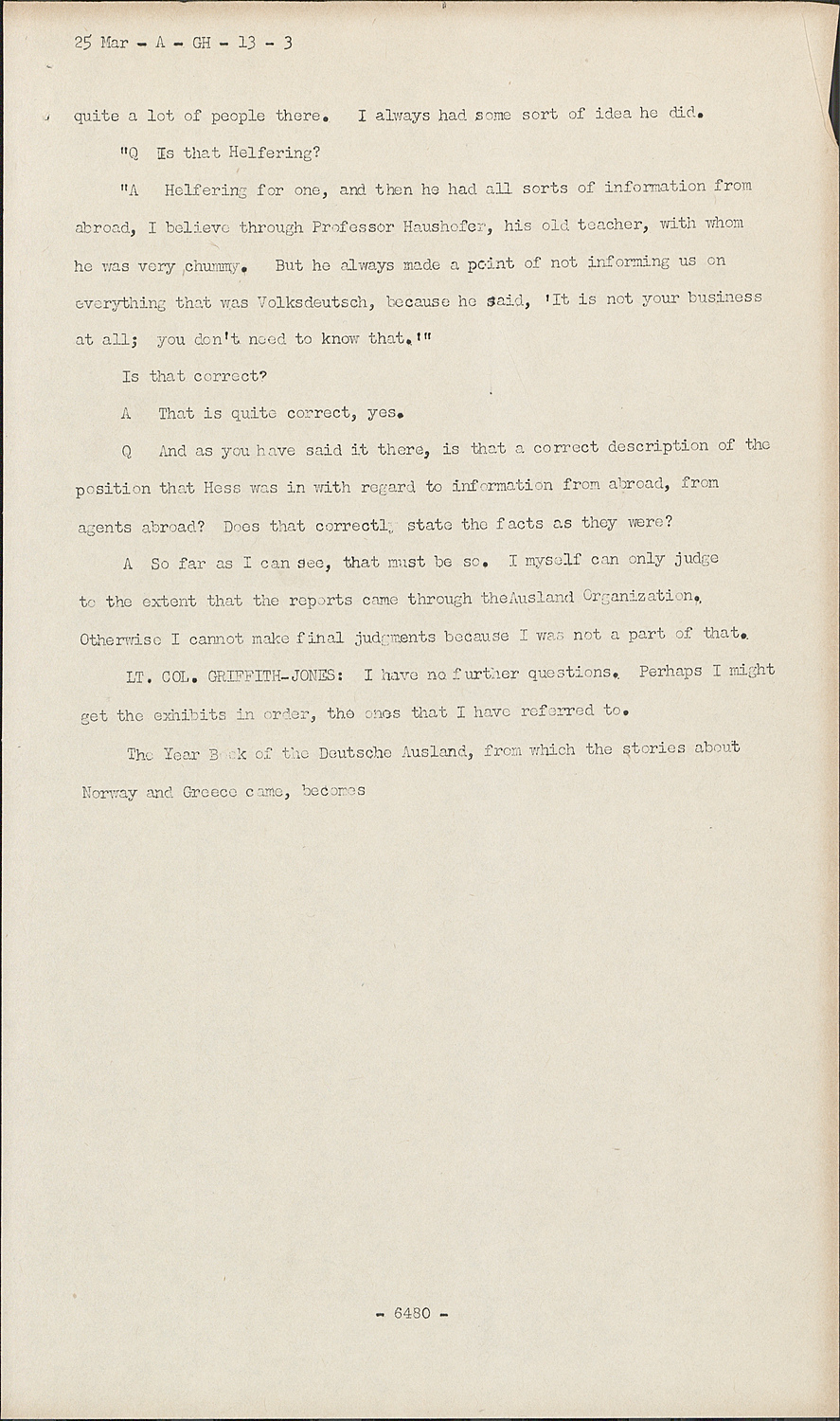
I always had some sort of idea he did.
"Q Is that Helfering?
"A Helfering for one, and then he had all sorts of information from abroad, I believe through Professor Haushofer, his old teacher, with whom he was very chummy. But he always made a point of not informing us on everything that was Volksdeutsch, because he said, 'It is not your business at all; you don't need to know that.'" Is that correct?
AThat is quite correct, yes.
QAnd as you have said it there, is that a correct description of the position that Hess was in with regard to information from abroad, from agents abroad? Does that correctly state the facts as they were?
ASo far as I can see, that must be so. I myself can only judge to the extent that the reports came through theAusland Organization. Otherwise I cannot make final judgments because I was not a part of that.
LT. COL.GRIFFITH-JONES: I have no further questions. Perhaps I might get the exhibits in order, the ones that I have referred to.
The Year Book of the Deutsche Ausland, from which the stories about Norway and Greece came, becomes GB-284.
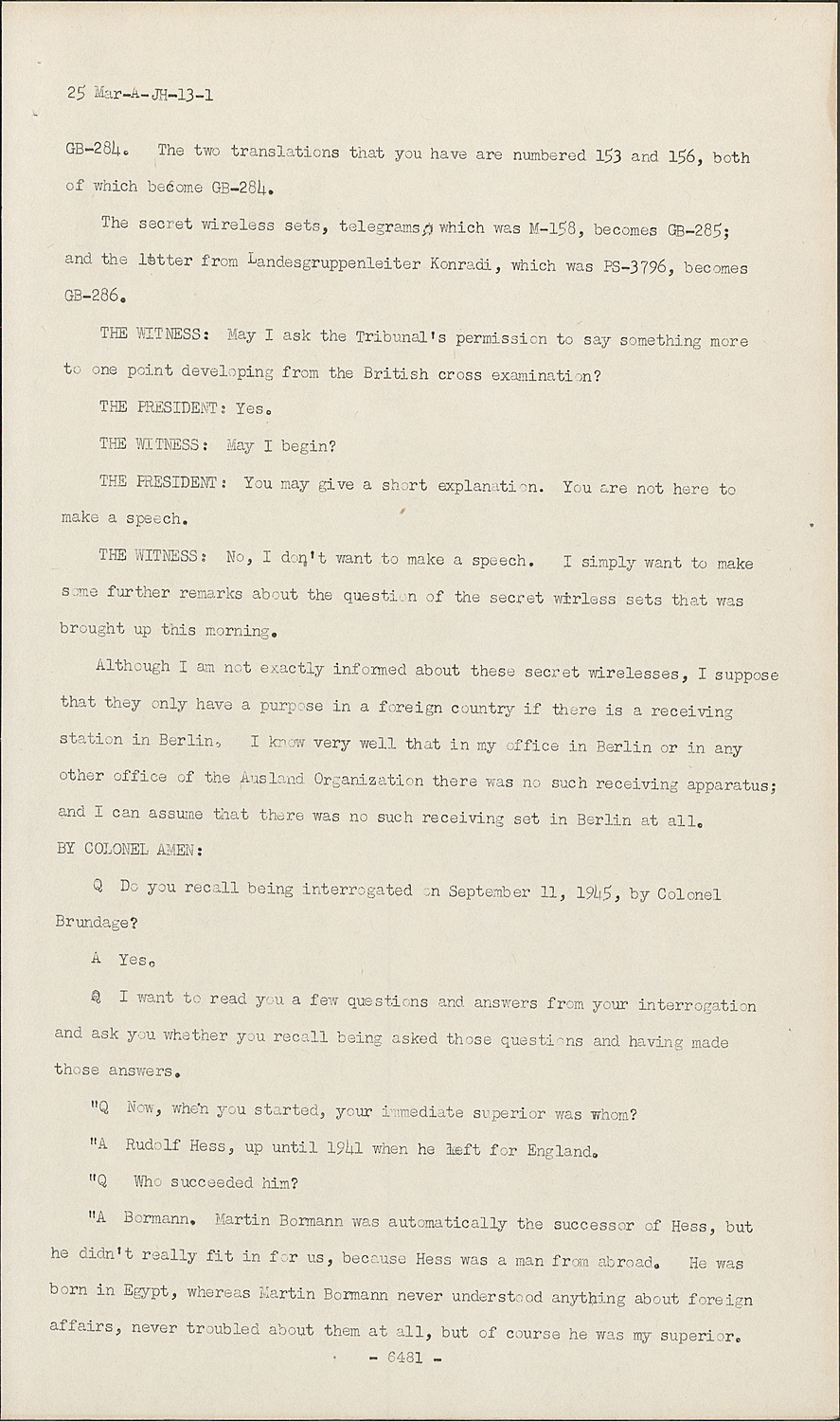
The two translations that you have are numbered 153 and 156, both of which become GB-284.
The secret wireless sets, telegrams which was M-158, becomes GB-285; and the letter from Landesgruppenleiter Konradi, which was PS-3796, becomes GB-286.
THE WITNESS:May I ask the Tribunals permission to say something more to one point developing from the British cross examination?
THE PRESIDENT:Yes.
THE WITNESS:May I begin?
THE PRESIDENT:You may give a short explanation. You are not here to make a speech.
THE WITNESS:No, I don't want to make a speech. I simply want to make some further remarks about the question of the secret wirless sets that was brought up this morning.
Although I am not exactly informed about these secret wirelesses, I suppose that they only have a purpose in a foreign country if there is a receiving station in Berlin. I know very well that in my office in Berlin or in any other office of the Ausland Organization there was no such receiving apparatus; and I can assume that there was no such receiving set in Berlin at all. BY COLONEL AMEN:
QDo you recall being interrogated on September 11, 1945, by Colonel Brundage?
AYes.
QI want to read you a few questions and answers from your interrogation and ask you whether you recall being asked those questions and having made those answers.
"Q Now, when you started, your immediate superior was whom?
"A Rudolf Hess, up until 1941 when he left for England.
"Q Who succeeded him?
"A Bormann. Martin Bormann was automatically the successor of Hess, but he didn't really fit in for us, because Hess was a man from abroad. He was born in Egypt, whereas Martin Bormann never understood anything about foreign affairs, never troubled about them at all, but of course he was my superior.
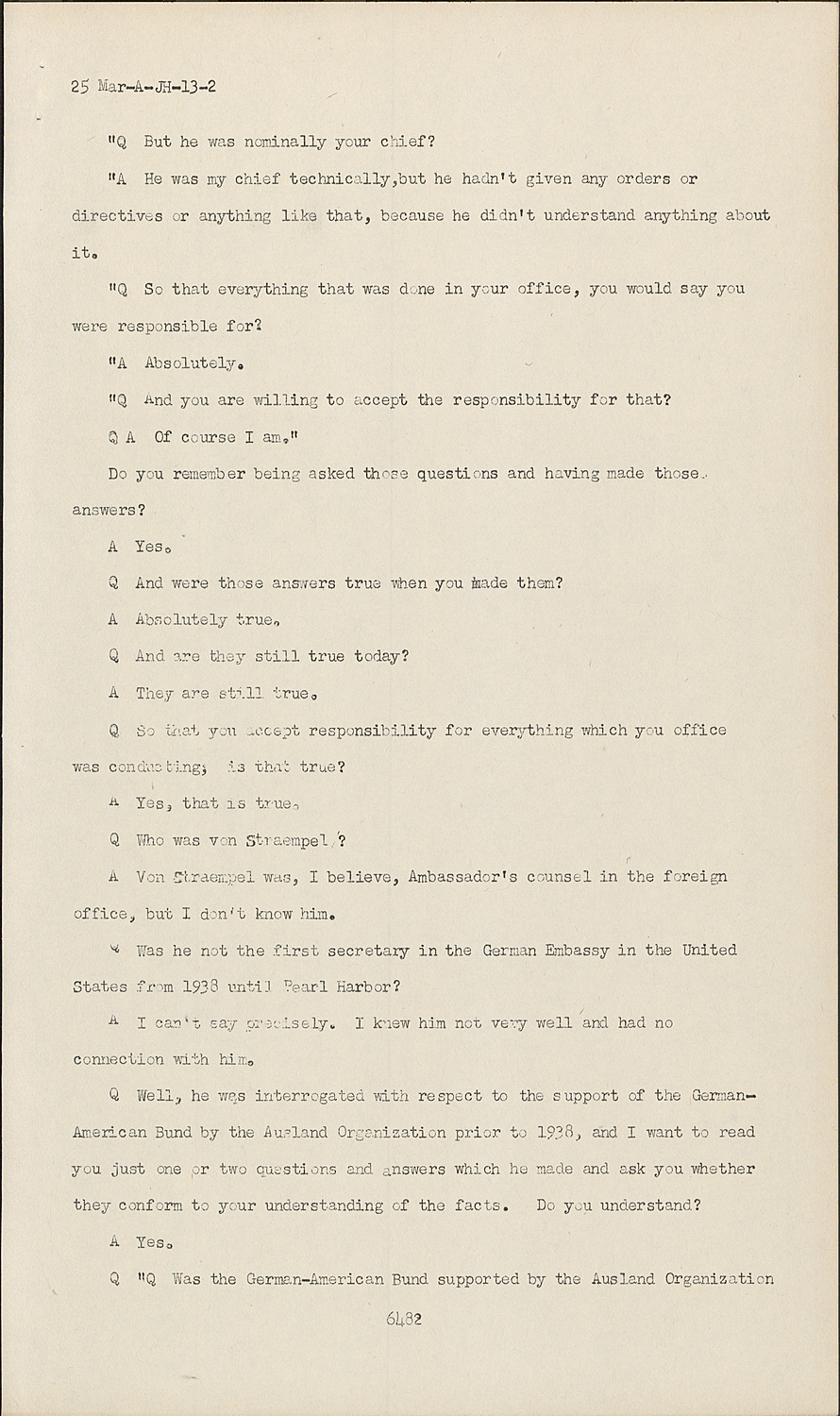
"Q But he was nominally your chief?
"A He was my chief technically,but he hadn't given any orders or directives or anything like that, because he didn't understand anything about it.
"Q So that everything that was done in your office, you would say you were responsible for"?
"A Absolutely.
"Q And you are willing to accept the responsibility for that?
Q AOf course I am."
Do you remember being asked those questions and having made those answers?
AYes.
QAnd were those answers true when you made them?
AAbsolutely true.
QAnd are they still true today?
AThey are still true.
QSo that you accept responsibility for everything which you office was conducting; is that true?
AYes, that is true.
QWho was von Straempel ?
AVon Straempel was, I believe, Ambassador's counsel in the foreign office, but I don't know him.
QWas he not the first secretary in the German Embassy in the United States from 1933 until Pearl Harbor?
AI can't say precisely. I knew him not very well and had no connection with him.
QWell, he was interrogated with respect to the support of the GermanAmerican Bund by the Ausland Organization prior to 1938, and I want to read you just one pr two questions and answers which he made and ask you whether they conform to your understanding of the facts. Do you understand?
AYes.
Q "Q Was the German-American Bund supported by the Ausland Organization "A I am positive that it had relations with the foreign section of the Party.
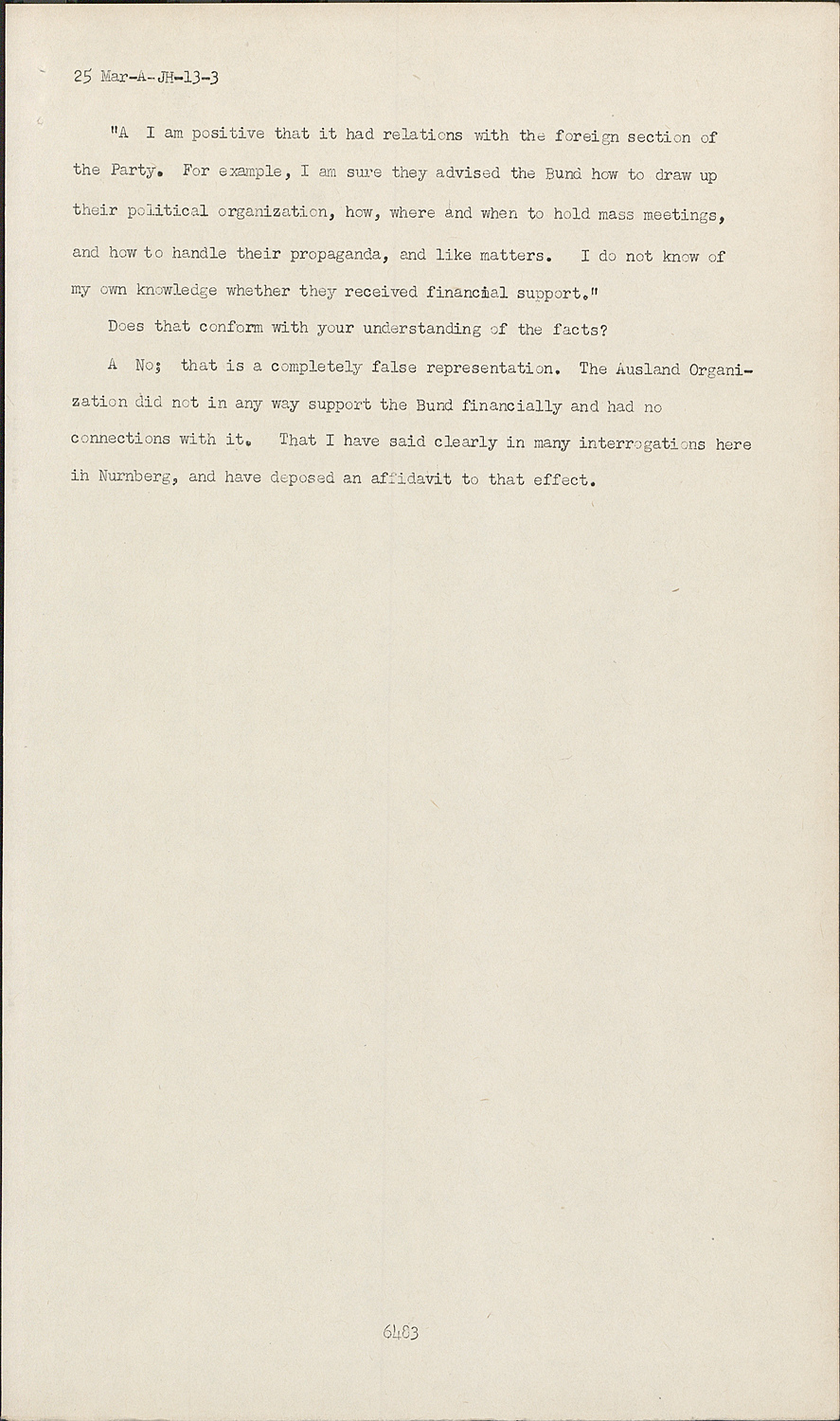
For example, I am sure they advised the Bund how to draw up their political organization, how, where and when to hold mass meetings, and how to handle their propaganda, and like matters. I do not know of my own knowledge whether they received financial support."
Does that conform with your understanding of the facts?
ANo; that is a completely false representation. The Ausland Organization did not in any way support the Bund financially and had no connections with it. That I have said clearly in many interrogations here in Nurnberg, and have deposed an affidavit to that effect.