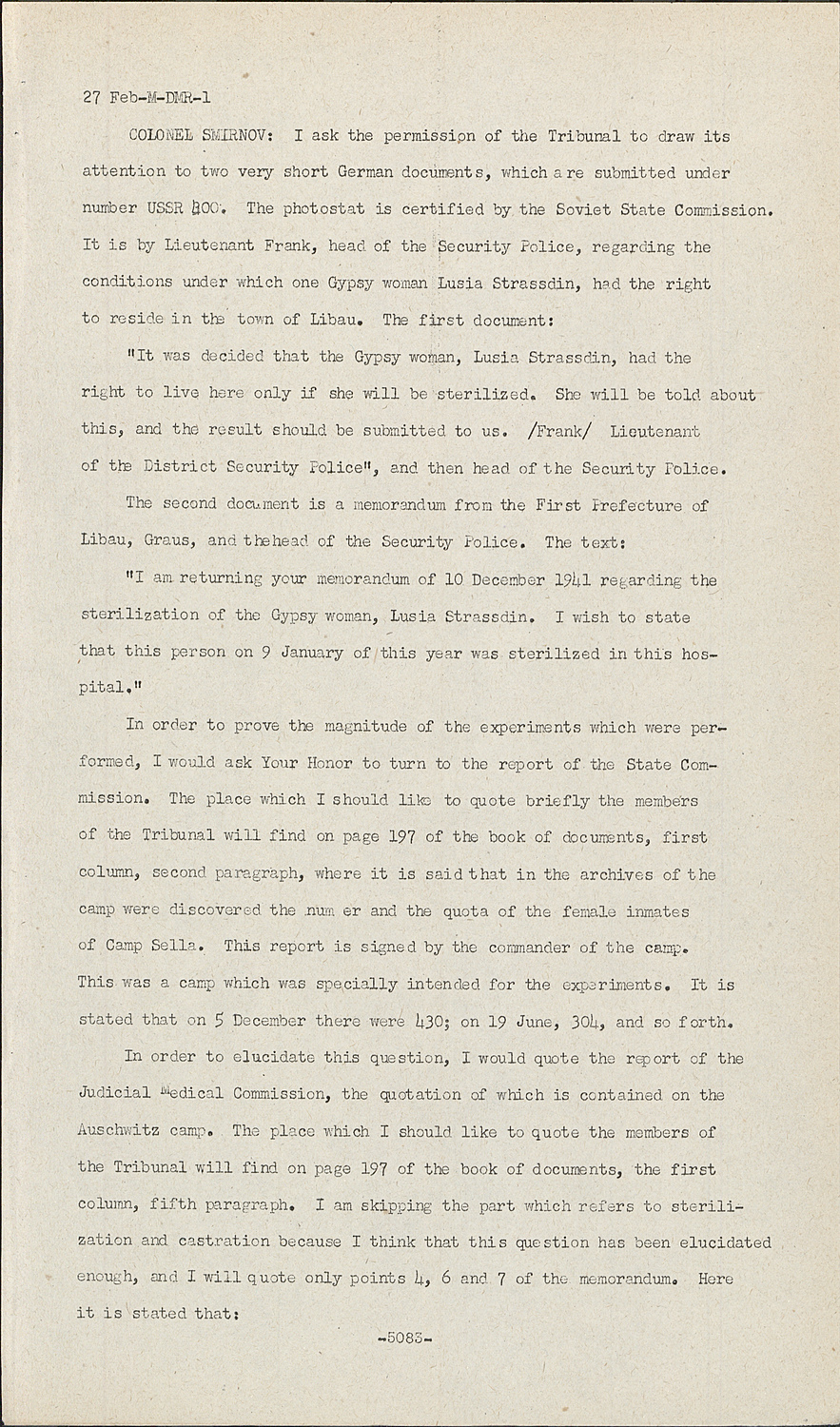
COLONEL SMIRNOV: I ask the permission of the Tribunal to draw its attention to two very short German documents, which a re submitted under number USSR 300.
The photostat is certified by the Soviet State Commission. It is by Lieutenant Frank, head of the Security Police, regarding the conditions under which one Gypsy woman Lusia Strassdin, had the right to reside in the town of Libau. The first document:
"It was decided that the Gypsy woman, Lusia Strassdin, had the right to live here only if she will be sterilized. She will be told about this, and the result should be submitted to us. /Frank/ Lieutenant of the District Security Police", and then head of the Security Police.
The second document is a memorandum from the First Prefecture of Libau, Graus, and the head of the Security Police. The text:
"I am returning your memorandum of 10 December 1941 regarding the sterilization of the Gypsy woman, Lusia Strassdin. I wish to state that this person on 9 January of this year was sterilized in this hospital."
In order to prove the magnitude of the experiments which were performed, I would ask Your Honor to turn to the report of the State Commission. The place which I should like to quote briefly the members of the Tribunal will find on page 197 of the book of documents, first column, second paragraph, where it is said that in the archives of the, camp were discovered the number and the quota of the female inmates of Camp Sella. This report is signed by the commander of the camp. This was a camp which was specially intended for the experiments. It is stated that on 5 December there were 430; on 19 June, 304, and so forth.
In order to elucidate this question, I would quote the report of the Judicial Medical Commission, the quotation of which is contained on the Auschwitz camp. The place which I should like to quote the members of the Tribunal will find on page 197 of the book of documents, the first column, fifth paragraph. I am skipping the part which refers to sterilization and castration because I think that this question has been elucidated enough, and I will quote only points 4, 6 and 7 of the memorandum. Here it is stated that:
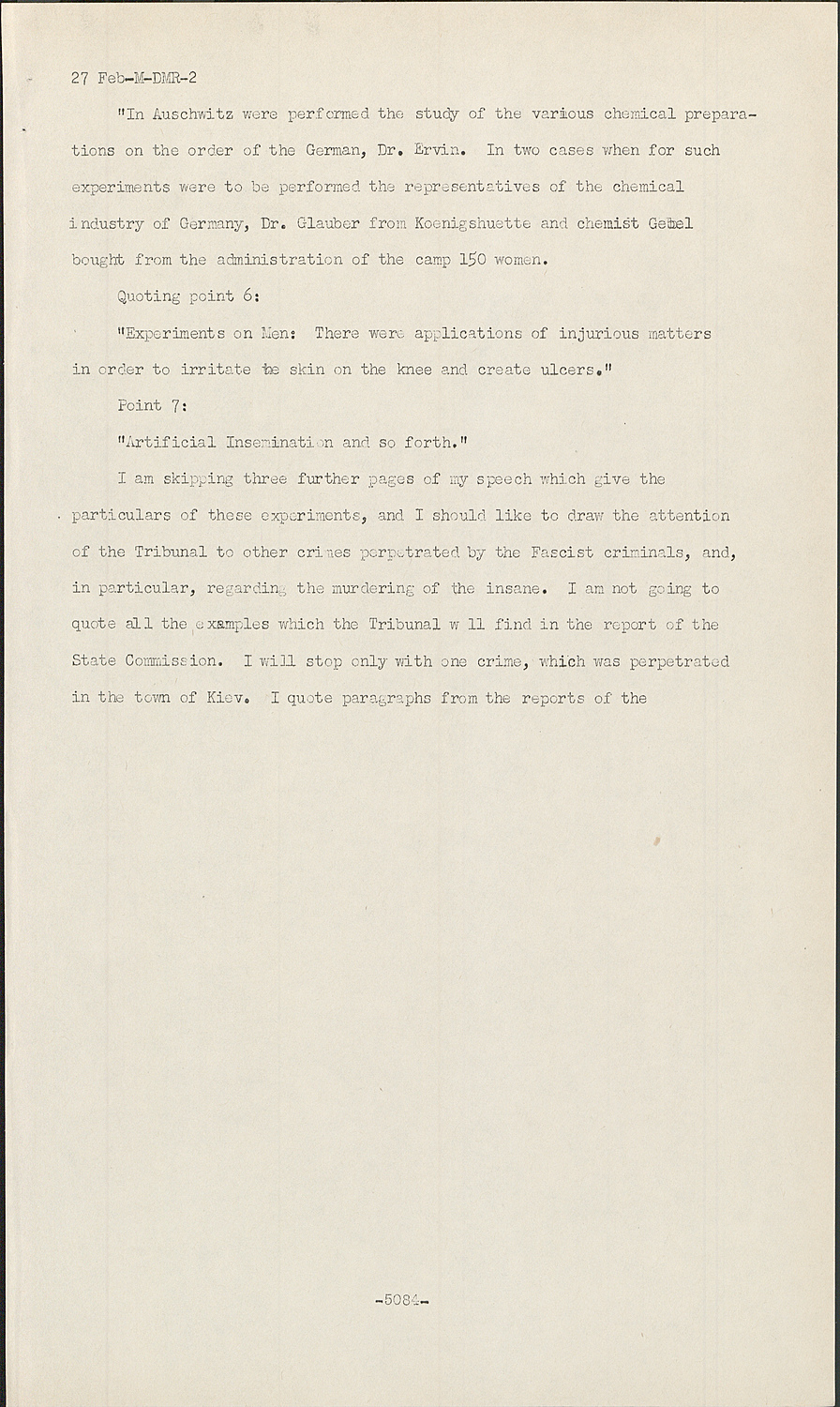
"In Auschwitz were performed the study of the various chemical prepara-
tions on the order of the German, Dr. Ervin. In two cases when for such experiments were to be performed the representatives of the chemical industry of Germany, Dr. Glauber from Koenigshuette and chemist Gebel bought from the administration of the camp 150 women.
Quoting point 6:
"Experiments on liens There were applications of injurious matters in order to irritate tie skin on the knee and create ulcers," Point 7:"Artificial Insemination and so forth."
I am skipping three further pages of my speech which give the particulars of these experiments, and I should like to draw the attention of the Tribunal to other crimes perpetrated by the Fascist criminals, and, in particular, regarding the murdering of the insane. I am not going to quote all the examples which the Tribunal will find in the report of the State Commission. I will stop only with one crime, which was perpetrated in the town of Kiev. I quote paragraphs from the reports of the Extraordinary State Commission on the town of Kiev, which the members of the Tribunal will find on page 112 of the book of documents, first column, paragraph 6:"On 14 December 1941 in the Psychiatric Hospital, there entered units of SS men.
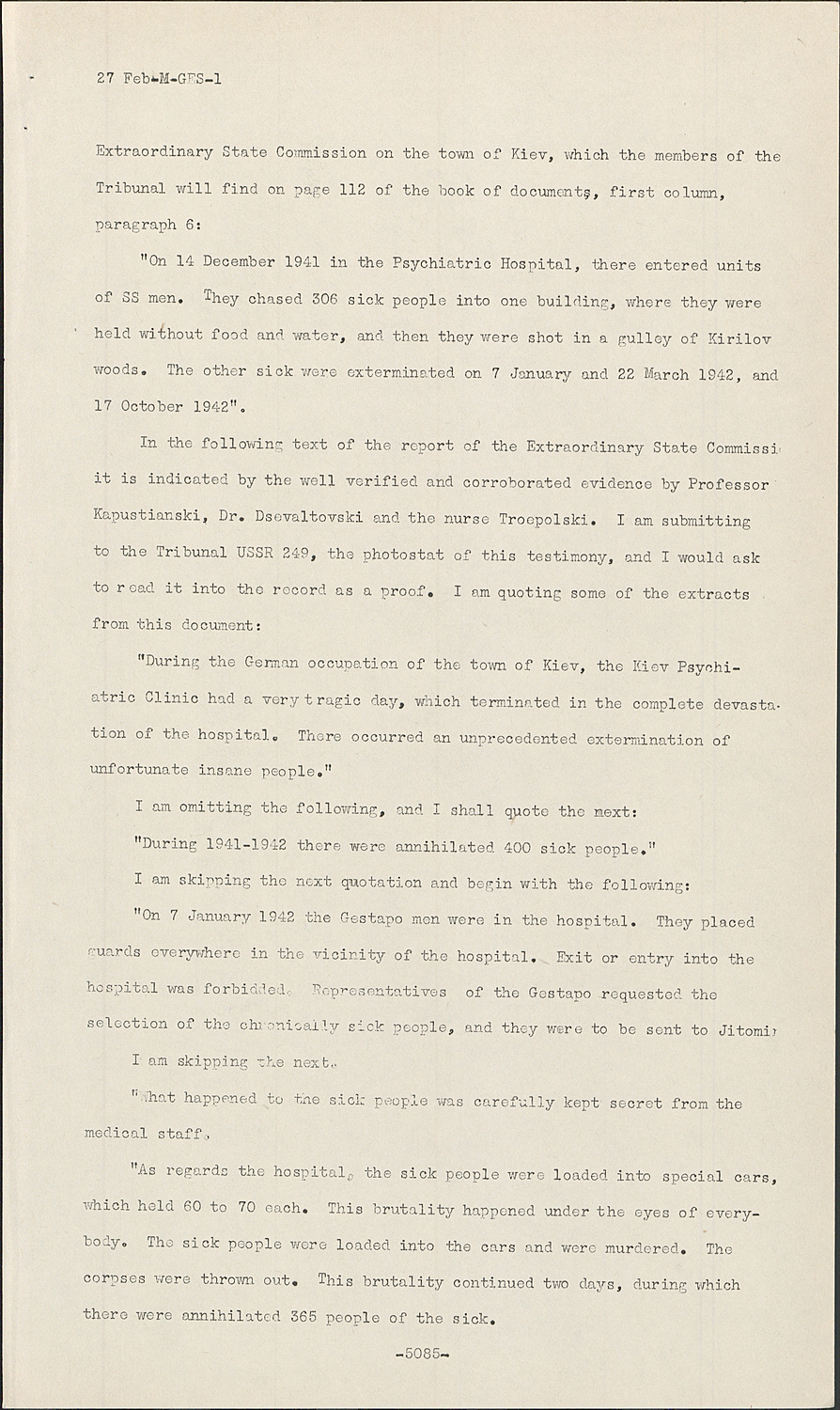
They chased 306 sick people into one building, where they were held without food and water, and then they were shot in a gulley of Kirilov woods. The other sick were exterminated on 7 January and 22 March 1942, and 17 October 1942".
In the following text of the report of the Extraordinary State Commission it is indicated by the well verified and corroborated evidence by Professor Kapustianski, Dr. Dsevaltovski and the nurse Troepolski. I am submitting to the Tribunal USSR 249, the photostat of this testimony, and I would ask to read it into the record as a proof. I am quoting some of the extracts from this document:
"During the German occupation of the town of Kiev, the Kiev Psychiatric Clinic had a very tragic day, which terminated in the complete devastation of the hospital. There occurred an unprecedented extermination of unfortunate insane people."
I am omitting the following, and I shall quote the next:
"During 1941-1942 there were annihilated 400 sick people."
I am skipping the next quotation and begin with the following:
"On 7 January 1942 the Gestapo men were in the hospital. They placed guards everywhere in the vicinity of the hospital. Exit or entry into the hospital was forbidded. Representatives of the Gestapo requested the selection of the chronically sick people, and they were to be sent to Jitomin I am skipping the next.
What happened to the sick people was carefully kept secret from the medical staff.
"As regards the hospital, the sick people were loaded into special cars, which held 60 to 70 each. This brutality happened under the eyes of everybody. The sick people were loaded into the cars and were murdered. The corpses were thrown out. This brutality continued two days, during which there were annihilated 365 people of the sick.
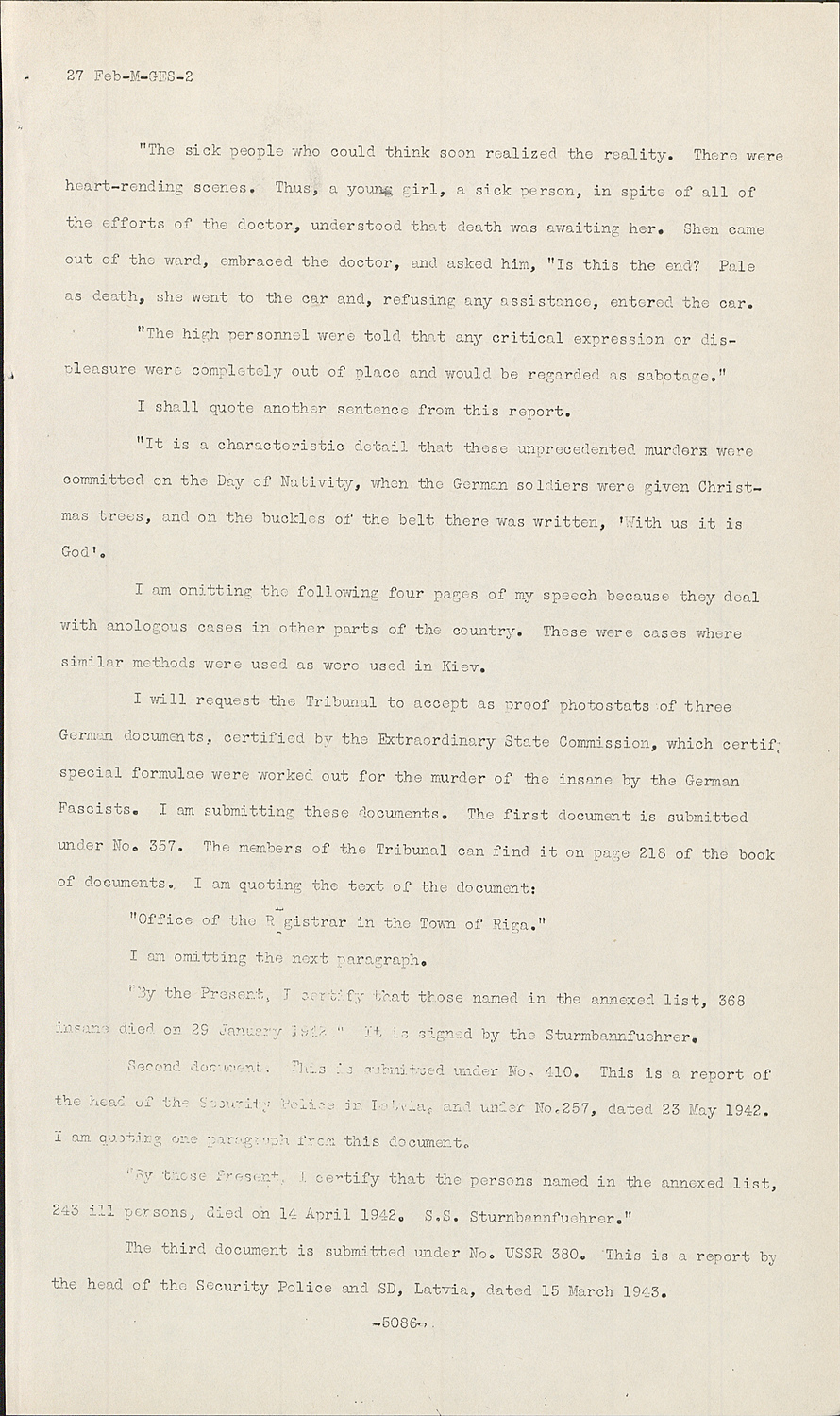
"The sick people who could think soon realized the reality. There were heart-rending scenes.
Thus, a young girl, a sick person, in spite of all of the efforts of the doctor, understood that death was awaiting her. Shen came out of the ward, embraced the doctor, and asked him, "Is this the end? Pale as death, she went to the car and, refusing any assistance, entered the car.
"The high personnel were told that any critical expression or displeasure were completely out of place and would be regarded as sabotage."
I shall quote another sentence from this report.
"It is a characteristic detail that these unprecedented murders were committed on the Day of Nativity, when the German soldiers were given Christmas trees, and on the buckles of the belt there was written, With us it is God'.
I am omitting the following four pages of my speech because they deal with anologous cases in other parts of the country. These were cases where similar methods were used as were used in Kiev.
I will request the Tribunal to accept as proof photostats of three German documents, certified by the Extraordinary State Commission, which certify special formulae were worked out for the murder of the insane by the German Fascists. I am submitting these documents. The first document is submitted under No. 357. The members of the Tribunal can find it on page 218 of the book of documents. I am quoting the text of the document:
"Office of the Registrar in the Town of Riga."
I am omitting the next Paragraph.
By the Present, I certify that those named in the annexed list, 368 insane died on 29 January 1942." It is signed by the Sturmbannfuehrer.
Second document This is submitted under No. 410. This is a report of the head of the Security Police in Latvia, and under No.257, dated 23 May 1942. I am quoting one paragraph from this document.
By these present I certify that the persons named in the annexed list, 243 ill persons, died on 14 April 1942. S.S. Sturnbannfuehrer."
The third document is submitted under No. USSR 380. This is a report by the head of the Security Police and SD, Latvia, dated 15 March 1943.

I will read into the record one paragraph of this document:
"By those Present, I certify that those named in the annexed list, 98 insane people, died on 22 December 1942. S. S. Sturnbannfuehrer."
I am also omitting the next one and a half pages of my report but I would request the Tribunal, without reading this document, in support of this proof of the extermination, to accept under USSR No. 466 the data from another camp.
These were given to us by the Polish Government Commission on the investigation of the crimes and I am now going to submit them because they are self-evident.
I would request the Tribunal's permission to interrogate a Polish woman, to have her testify regarding the attitude of the German fascists towards the children. Would you allow me, Mr. Chairman, to ask this witness to come in?
THE PRESIDENT:Yes, certainly.
(SEVERINA SHMAGLEVSKAJA took the witness stand) BY THE PRESIDENT:
QWill you first of all tell me your name?
ASeverina Shmaglevskaja.
QWill you repeat this oath after me: I hereby swear before God the Almighty, that I will speak before the Tribunal nothing but the truth, concealing nothing that is known to me, so help me God, Amen.
A (The witness repeated the oath). THE PRESIDENT: Would you like to sit down? BY COLONEL SMIRNOV:
QTell me: witness, were you an internee of Auschwitz Camp?
AYes.
QDuring what time or what period were you in the camp of Auschwitz?
AFrom the 7th of October 1942 to January 1945.
QDo you have any proof that you were internee of this camp?
AI have the number which was tattooed on my hand.
QWhat the Auschwitz inmates call the "visiting cards."
AYes.
QTell me, please, witness, were you an eye-witness of German SS men's attitude towards the children?
AYes.
QI would request you to tell the Tribunal about this?
AI could told about the children who were born in the concentration camp, regarding children who were taken to the concentration camp together with the Jewish transports and who were taken directly into the crematorium, as well as regarding children who were taken to concentration camps and interned there.
Already, in December 1942, when I went to work about ten kilometers -
QExcuse me: May I interrupt you? Then, were you in the section of the camp Birkenau?
AYes, I was in the camp Birkenau, which is a part of the camp Auschwitz, which was called "Auschwitz No.2." Can I continue? Then I noticed a pregnant woman in the last four months of pregnancy. It was obvious by the way she looked. This woman, together with the others, had to walk ten kilometers to the place of her work and there she worked the whole day with a shovel in her hands, for the excavation of trenches. She was already ill and she asked the superintendent German, a civilian, so that she would allow her to rest. She didn't allow her to rest. She laughed at her. Together with one of the SS men, she started to beat her and push her around and very strictly observed her work. Such was the situation of all the women who were pregnant. Only in the last minutes we were allowed not to go to work. The children who were born, when they were Jewish children, were immediately sent to their death.
QWhen was it ?
AThere were immediately taken from their mothers.
QWhere the infants arrived?
ANo I am speaking about the children who were born in the concentration camps. A few minutes after their delivery, the child was taken from the mother and the mother never saw her child again. After a few days, the mother had to return to work. In 1942, there was no special blocks in the camp for the children. In the beginning of 1943, when they started to tattoo the internees, the children who were born in the concentration camp were also tattooed. The number was tattooed on their leg.
QWhy on the leg?
ABecause the child is very small and the mother's number consisted of five numbers, and *---* wasn't enough room on its little hand. The children did not have special numbers but bore the same numbers as their mothers as they developed.
The numbers were in order. These children were placed in a special block and every few weeks, sometimes every few months, each echelon of children was taken away from the camp.
QWhere ?
AWe never were able to see where these children were taken to. They were taken all the time while this camp was in existence; that is to say, in 1943; 1944; the last transport of the children was taken from the camp in January 1945. These were not only Polish children, because it is known that in Birkenau there were women taken from the whole of Europe. Until today, we don't know whether these children are alive. I should like, in the name of all the women of Europe who became mothers in concentration camps, to ask today the Germans "Where are the children now?"
QTell me, witness, were you an eye-witness, for instance, when the children were sent to gas vans?
AYes, I worked very close to the road which led to the crematorium. Sometimes in the morning I came by these buildings of the German crematory from where I could see secretly how the transports were prepared.
Than I saw that, together with the Jews that were brought to the concentration camp, there came a lot of children.
Sometimes a family had several children.
COLONELSMIRNOV; The Tribunal is probably aware of the fact that in front of the crematorium was performed the selection. BY COLONEL SMIRNOV:
QSelection was made by the doctors?
ANot always by the docts; sometimes SS men.
QAlso by the doctors?
AYes, sometimes by doctors, too. During the selection, the youngest and the healthiest Jewish women in very small numbers came into the camp but those women who had children in their arms or in carriages or those who had bigger children, together with these children, were sent into the crematorium. The children were segregated from their parents in front of the crematorium and were led into the gas chambers separately.
In 1944, at a time when thegreatest number of Jews were exterminated in the gas chambers, there came out an order that the children will be thrown into the crematorium, into the orifice of the crematorium or into the ditches of the crematorium without being asphyxiated.
QHow should we understand that? Were they alive or were they killed by other means?
ASometimes the children were thrown in there alive. The cries of the children were heard all over the camp. It is difficult to say how many of these children there were.
QWhy was this committed, because the gas chambers were overworked?
AIt is very difficult to answer this question. We don't know whether they wanted to economize on the gas or because there was no room in the gas chambers. I should also add that it is impossible to determine the number of these children because the children, the Jews who were in the ditches of the crematorium, were not registered and were not tattooed. Very often when the inmates who wanted to understand and work out the number of people who perished in gas chambers, could do so for themselves only by the facts which we saw of children's death and the number of children's carriages which were taken to the shops; sometimes there were one Hundred of these carriages and they sent thousands.
QIn one day
ANot always the same. There were days when the was chambers worked from the early hours in the morning until the late hours of the night. I should also like to tell you about the children who were taken to the concentration camps and kept there until the end.
In the beginning of 1943, there arrived at the concentration camp, together with their parents, Polish children from industrialist. At the same time there arrived Russian children from territories occupied by the Germans. Then to these children were added a number of Jewish children. In smaller numbers, one could also see Italian children in the concentration camp. The condition of these children was as difficult as the adult inmates; perhaps it was even harder. These children didn't receive any rations because nobody could send them rations. Packages of the Red Cress never arrived to the inmates.
In 1944 it there arrived at the concentration camp, in a great number, Italian children and also French children. All these children were sick with diseases, phlegmatic inflammations, and suffered from malnutrition, they were very badly clad and often had no shoes on and had no possibility of washing themselves.
During the Warsaw insurrection, there arrived at the concentration camp, as inmates, children from Warsaw. The youngest of these children was a little boy six years old. The children were quartered in special barracks and when there began a systematic evacuation of these people for deportation to Germany, these children were used for heavy labor. At the same time, there arrived at the concentration camps children of Hungarian Jews and they had to work together with the children who were brought after the Warsaw insurrection. These children worked on carts or machines, those carts which they had to pull themselves and had to carry from one camp to the other coal, bricks, machinery, wood, and other heavy things. They also works at the dismantling of one of the barracks during the liquidation of the camp. These children remained in the concentration camps until the end; and in January 1945, they were evacuated and had to march to Germany on foot; and the conditions were as difficult for the children as for the adults and under the supervision of the SS men, without food, covering about thirty Q During this march the children died of exhaustion?
AI wasn't in the group in which the rewere children, and I ran away on the second day after the evacuation march. I should also state regarding the methods of demoralization of the people who were inmates of concentration camps. Everything that we had to suffer was a planned system of demoralizing and degrading human beings.
The concentration camp cars in which the internnes were taken were used previously for cattle. When the transports arrived the cars were nailed, and in each one of these cars there was a great number of people. The convoy of SS men did not take into consideration that humans have physiological necessities. It happened that some of these people had the necessary pots with them. They often had to use these pots for physical necessities.
For some time I worked at the shop store where were bought kitchen utensils of internees.
QExcuse me. Do you mean that you worked in a store where kitchen utensils of those who were murdered were bought ?
ANo, to this store was brought only kitchen utensils of the people who arrived to concentration camps.
QWere these things taken away from them?
AYes, of course. I should like to say that in some cases the kitchen utensils and pots contained remains of food, and in others there were human excrements. Each of the workers received a pot of water. Half of it they had to drink and the rest to wash a great number of these kitchen utensils. These kitchen utensils, which were sometimes not very well washed, were given to people who arrived in transports to concentration camps. From these kitchen utensils they had to eat. Sometimes during the first day they received dysentery.
THE PRESIDENT:Colonel Smirnov, I don't think the Tribunal wants quite so much of the details with respect to these domestic matters.
COLONEL SMIRNOV:I quite agree with you, Mr. Chairman. The witness was called hers only wish a view to explaining the attitude of the Germans towards the children in the camps.
THE PRESIDENT: Will you keep her to the part of her testimony which you wish to bring out?
BY COLONEL SMIRNOV:
QTell me, Witness, can you add anything else to the attitude of the Germans towards the children in the camps? You already told us about some of the facts which you knew regarding this question.
AI should like to say that the children were also subjected to the system of demoralization and degradation as were the adults, and also famine, which often led to death. Sometimes the children looked in the dirt for pieces of food--potato peels.
QTell me, Witness, do you certify in your testimony, that sometines the number of remaining carriages of children who were murdered amounted to a thousand per day?
AYes, sometimes there were such days.
COLONEL SMIRNOV:Mr. Chairman, I have no further questions from the witness.
THE PRESIDENT:Do any of the chief prosecutors wish to ask any questions?
(There was no answer).
Do any of the defendants' counsel wish to ask any questions?
(There was no answer).
Then, the witness can retire.
COLONEL SMIRNOV:I am continuing:
Mr. Chairman, I should like to take up the following section of my report, which deals with the organization of secret plans for the annihilation of peaceful citizens by German fascists. These cannot be considered as concentration camps, because the existence of human beings in these points usually was not longer than ten minutes or mostly two hours.
From the number of these terrible points organized by the German fascists I would submit to the Tribunal proof on two points, that is to say, on point Helme and Treblinka camps. In connection with this I would ask the Tribunal to request the appearance of one of the witnesses, whose testimony is interesting, because she can be considered as a person who returned, from the other world, because the road to Treblinka was called by the German executors the road to Heaven.

I am speaking of the witness Rajzman, a Polish citizen, and I would request the Tribunal to let the witness come here and be interrogated.
THE PRESIDENT:It is just a quarter to one, so we had better have this witness at two o'clock. We will adjourn new.
(A recess was taken until 1400 hours).
Official transcript of the International Military Tribunal in the matter of The United States of America, the French Re public, the United Kingdom of Great Britain and Northern Ire Ireland, and the Union of Soviet Socialist Republics against Hermann Wilhelm Goering et al, Defendants, sitting at Nurnberg, Germany, on 27 February 1946, 1400-1700, Lord Justice Lawrence presiding.
THE PRESIDENT:The Tribunal has been informed that the witness who was referred to yesterday, Wieland, is in a prisoner of war camp or in prison near London, England, and he can therefore be brought over here to be examined at short notice. The Tribunal, therefore, wishes Defendants' Counsel to make up their mind whether they wish Colonel Westhof and this man Weiland to be brought here during the Prosecution's case for them to cross examine him, or whether they prefer that they should be brought when the Defendants are presenting their case. But, as I have stated with reference to all witnesses, they can only be called once. If they are examined as part of the Prosecution's case, then all the Defendants must exercise their rights, if they wish to do so, of interrogating the witnesses at that time. If, on the other hand, Defendants' Counsel decide that they would prefer that these witnesses should be called during the Defendants' case, then, similarly, the witnesses will only be called once, and the right of examining them must then be exercised.
At the same time, the statement or the report which was presented yesterday, and which the Tribunal ruled was admissible, will be read in the course of the Prosecution's case at such time as the Prosecution decide.
DR.NELTE (Counsel for Defendant Keitel): Mr. President, I ask to be able to make a statement after speaking to my colleagues. I hope that this will be possible in the course of the afternoon.
THE PRESIDENT:I understand you want to consult the other Defendants' Counsel before you let us know. Very well; you will let us know at your convenience. Go on, Colonel Smirnov.
COLONEL SMIRNOV:Mr. President, I would like to proceed with the interrogation of a witness.
(The witness takes the stand)
THE PRESIDENT:What is your name?
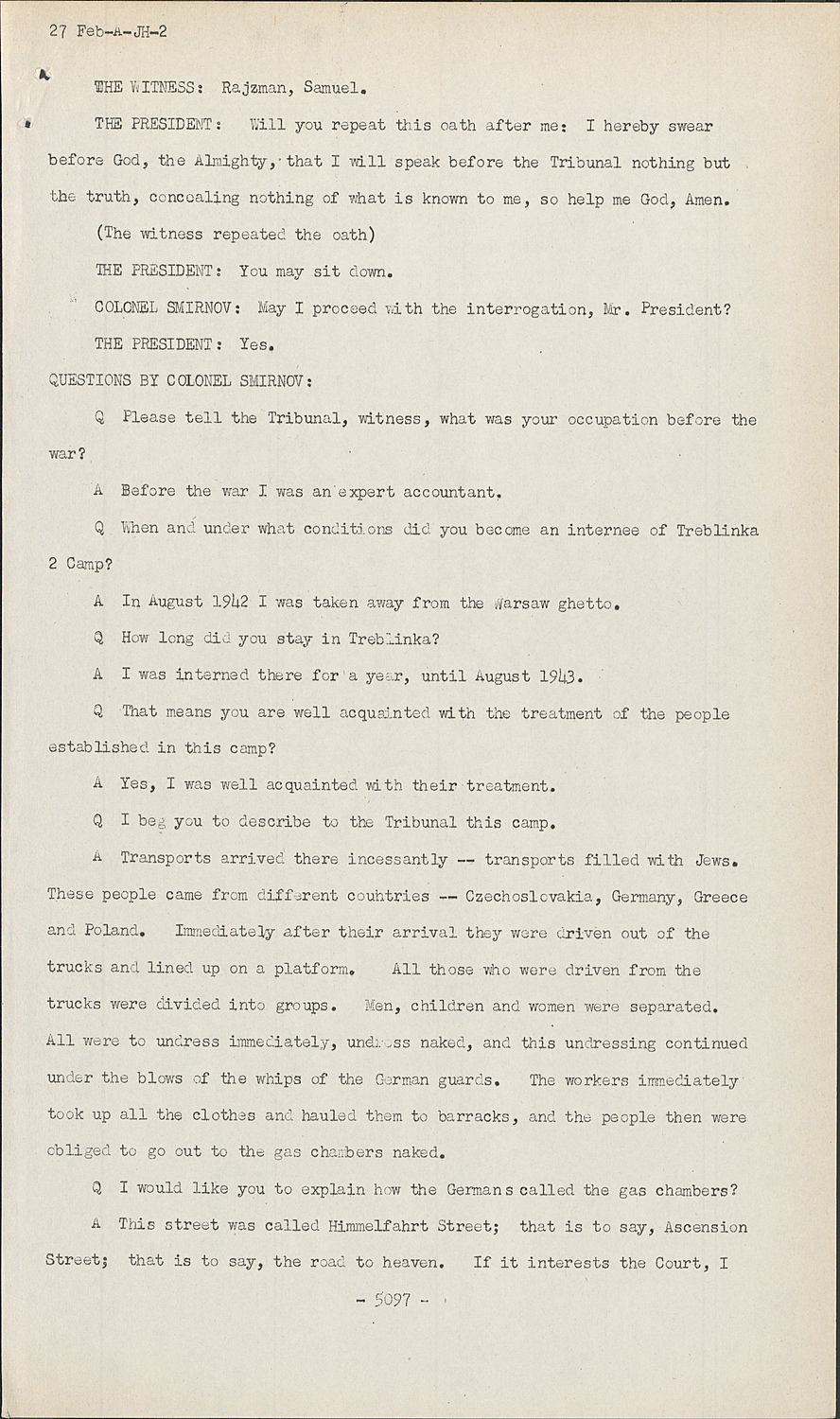
THE WITNESS: Rajzman, Samuel.
THE PRESIDENT:Will you repeat this oath after me: I hereby swear before God, the Almighty, that I will speak before the Tribunal nothing but the truth, concealing nothing of what is known to me, so help me God, Amen.
(The witness repeated the oath)
THE PRESIDENT:You may sit down.
COLONEL SMIRNOV:May I proceed with the interrogation, Mr. President?
THE PRESIDENT:Yes. QUESTIONS BY COLONEL SMIRNOV:
QPlease tell the Tribunal, witness, what was your occupation before the war?
ABefore the war I was an expert accountant.
QWhen and under what conditions did you become an internee of Treblinka 2 Camp?
AIn August 1942 I was taken away from the Warsaw ghetto.
QHow long did you stay in Treblinka?
AI was interned there for a year, until August 1943.
QThat means you are well acquainted with the treatment of the people established in this camp?
AYes, I was well acquainted with their treatment.
QI beg you to describe to the Tribunal this camp.
ATransports arrived there incessantly -- transports filled with Jews. These people came from different countries -- Czechoslovakia, Germany, Greece and Poland. Immediately after their arrival they were driven out of the trucks and lined up on a platform. All those who were driven from the trucks were divided into groups. Men, children and women were separated. All were to undress immediately, undress naked, and this undressing continued under the blows of the whips of the German guards. The workers immediately took up all the cloths and hauled them to barracks, and the people then were obliged to go out to the gas chambers naked.
QI would like you to explain how the Germans called the gas chambers?
AThis street was called Himmelfahrt Street; that is to say, Ascension Street; that is to say, the road to heaven. If it interests the Court, I drew up a plan of the camp of Treblinka, and can show the street to the Tribunal on this matter.
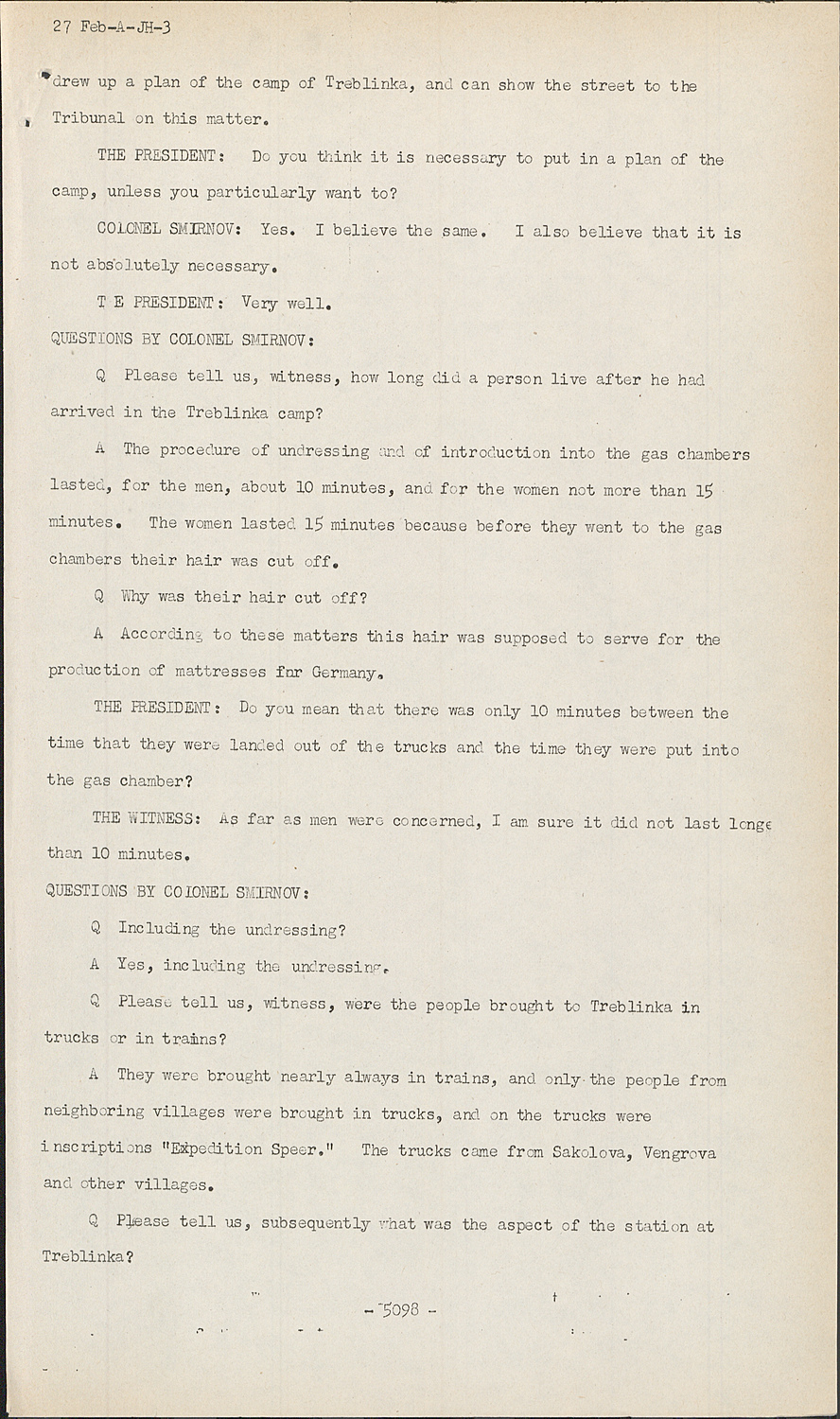
THE PRESIDENT:Do you think it is necessary to put in a plan of the camp, unless you particularly want to?
COLONEL SMIRNOV:Yes. I believe the same. I also believe that it is not absolutely necessary.
THE PRESIDENT :Very well. QUESTIONS BY COLONEL SMIRNOV:
QPlease tell us, witness, how long did a person live after he had arrived in the Treblinka camp?
AThe procedure of undressing and of introduction into the gas chambers lasted, for the men, about 10 minutes, and for the women not more than 15 minutes. The women lasted 15 minutes because before they went to the gas chambers their hair was cut off.
QWhy was their hair cut off?
AAccording to these matters this hair was supposed to serve for the production of mattresses for Germany.
THE PRESIDENT:Do you mean that there was only 10 minutes between the time that they were landed out of the trucks and the time they were put into the gas chamber?
THE WITNESS:As far as men were concerned, I am sure it did not last longer than 10 minutes. QUESTIONS BY COLONEL SMIRNOV:
QIncluding the undressing?
AYes, including the undressing
QPlease tell us, witness, were the people brought to Treblinka in trucks or in trains?
AThey were brought nearly always in trains, and only the people from neighboring villages were brought in trucks, and on the trucks were inscriptions "Expedition Speer." The trucks came from Sakolova, Vengrova and other villages.
QPlease tell us, subsequently what was the aspect of the station at Treblinka?
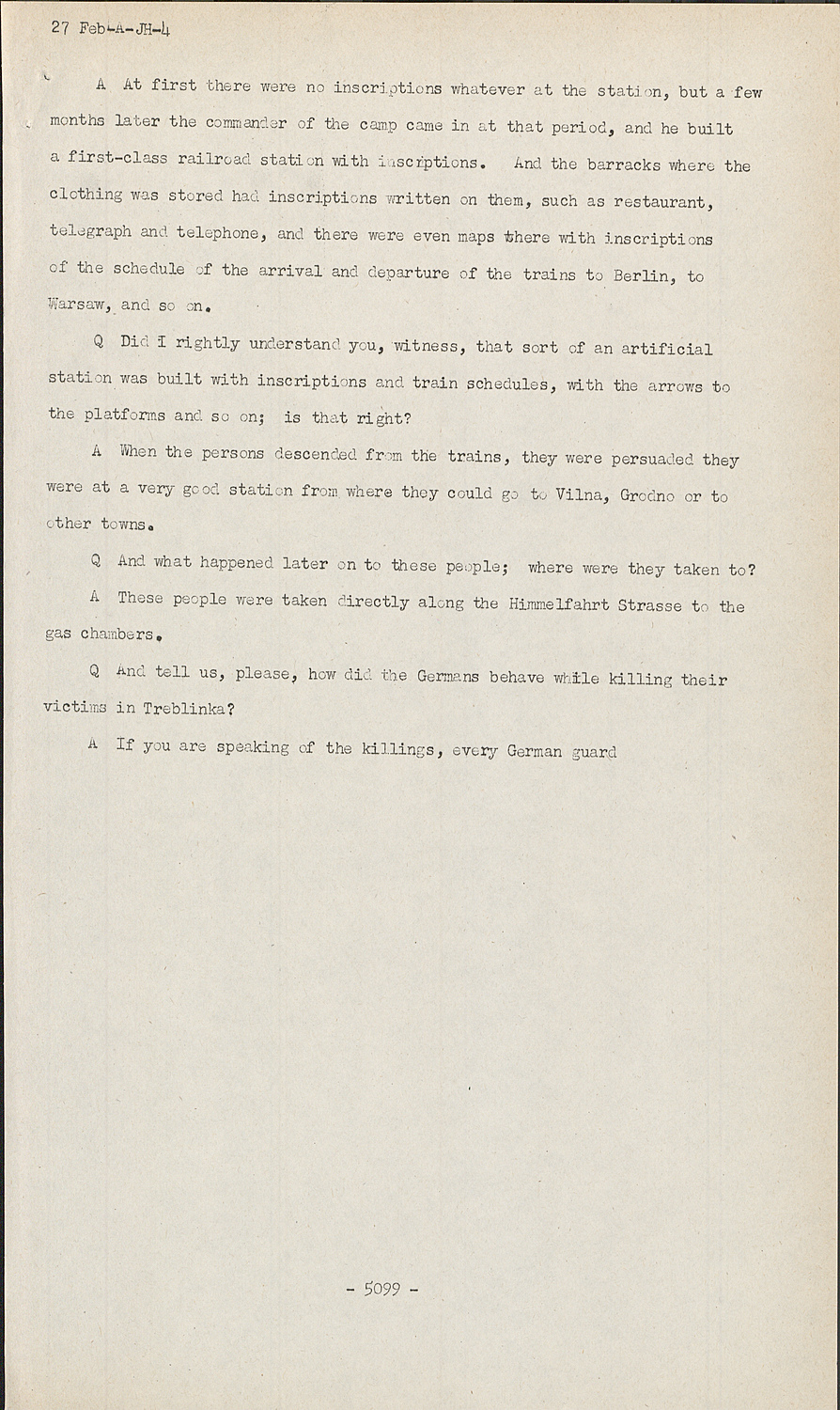
A At first there were no inscriptions whatever at the station, but a few months later the commander of the camp came in at that period, and he built a first-class railroad station with inscriptions.
And the barracks where the clothing was stored had inscriptions written on them, such as restaurant, telegraph and telephone, and there were even maps there with inscriptions of the schedule of the arrival and departure of the trains to Berlin, to Warsaw, and so on.
QDid I rightly understand you, witness, that sort of an artificial station was built with inscriptions and train schedules, with the arrows to the platforms and so on; is that right?
AWhen the persons descended from the trains, they were persuaded they were at a very good station from, where they could go to Vilna, Grodno or to other towns.
QAnd what happened later on to these people; where were they taken to?
AThese people were taken directly along the Himmelfahrt Strasse to the gas chambers.
QAnd tell us, please, how did the Germans behave while killing their victims in Treblinka?
AIf you are speaking of the killings, every German guard had his bestiality.
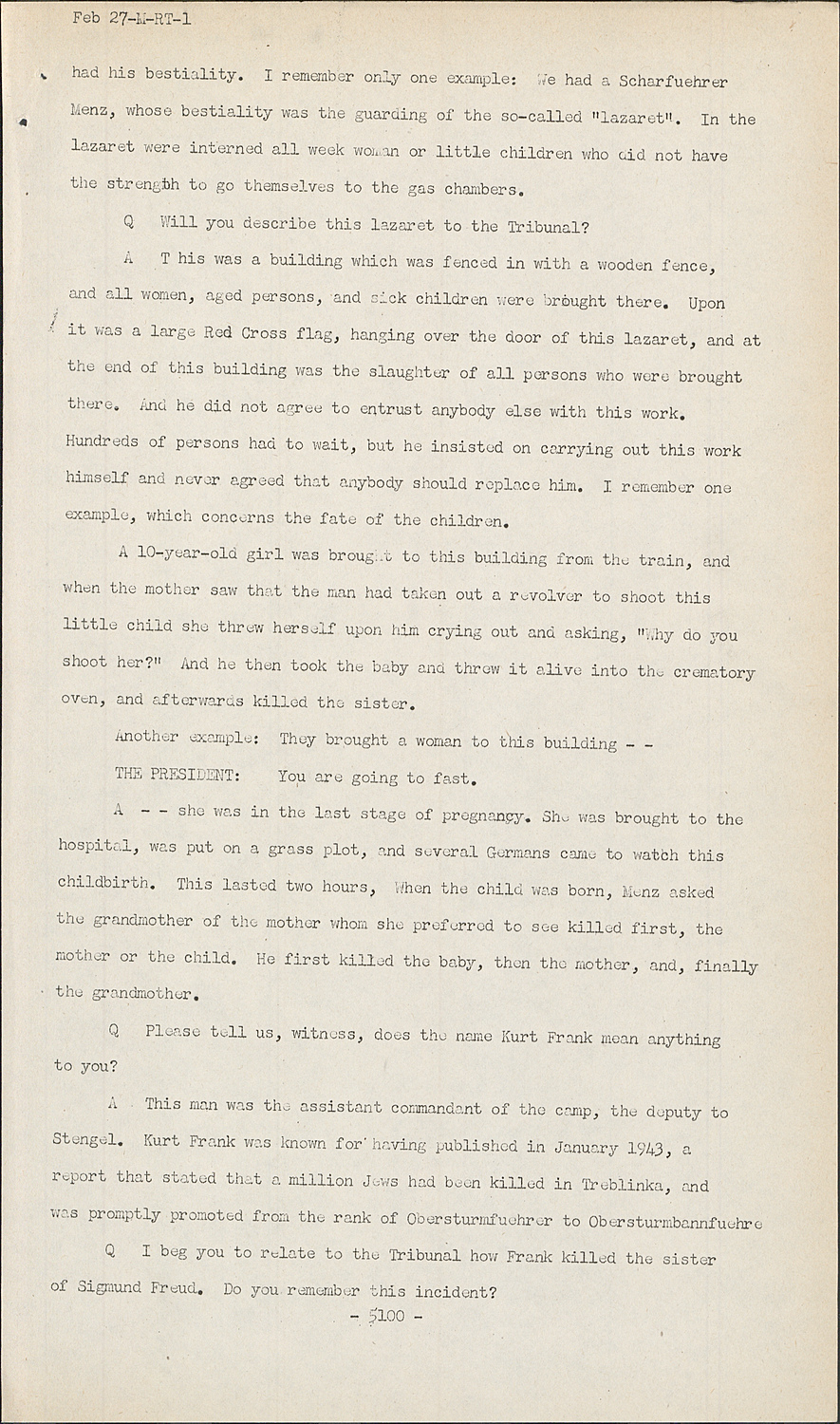
I remember only one example: We had a Scharfuehrer Menz, whose bestiality was the guarding of the so-called "lazaret". In the lazaret were interned all week woman or little children who aid not have the strength to go themselves to the gas chambers.
QWill you describe this lazaret to the Tribunal?
AThis was a building which was fenced in with a wooden fence, and all women, aged persons, and sick children were brought there. Upon it was a large Red Cross flag, hanging over the door of this lazaret, and at the end of this building was the slaughter of all persons who were brought there. And he did not agree to entrust anybody else with this work. Hundreds of persons had to wait, but he insisted on carrying out this work himself and never agreed that anybody should replace him. I remember one example, which concerns the fate of the children.
A 10-year-old girl was brought to this building from the train, and when the mother saw that the man had taken out a revolver to shoot this little child she threw herself upon him crying out and asking, "Why do you shoot her?" And he then took the baby and threw it alive into the crematory oven, and afterwards killed the sister.
Another example: They brought a woman to this building -
THE PRESIDENT:You are going to fast.
A - - she was in the last stage of pregnancy. She was brought to the hospital, was put on a grass plot, and several Germans came to watch this childbirth. This lasted two hours, When the child was born, Menz asked the grandmother of the mother whom she preferred to see killed first, the mother or the child. He first killed the baby, then the mother, and, finally the grandmother.
QPlease tell us, witness, does the name Kurt Frank mean anything to you?
AThis man was the assistant commandant of the camp, the deputy to Stengel. Kurt Frank was known for having published in January 1943, a report that stated that a million Jews had been killed in Treblinka, and was promptly promoted from the rank of Obersturmfuehrer to Obersturmbannfuehre
QI beg you to relate to the Tribunal how Frank killed the sister of Sigmund Freud. Do you remember this incident?
A It happened in the following manner: A train arrived from Vienna.
I was standing on the platform when the passengers were taken from the train when an old lady came up to Kurt Frank. She took out a document and showed that she was a relative of the sister, of Sigmund Freud, and she asked that he should give her easy work. Frank read this document very earnestly and said that this was probably a mistake. He led her up to a schedule and said that in two hours a train would leave again for Vienna. She should leave all the documents and jewels and valuables and then go to a bath, and after the bath she would then be able to be sent to Vienna. It is quite clear that she did not return from the bath.
QPlease tell us, witness, why did you stay in Treblinka?
AI was already quite undressed and had to pass through Himmelfahrt Strasse to the gas chambers. Some more Jews had come with my transport. At the last minute, before we moved towards the street, an engineer Galevski, an old friend of mine whom I had known in Warsaw, noticed me. He had an official function in the camp. He was foreman of the Jewish workers. He told me that I should turn off from the street, as they needed an interpreter for French, Jewish, Polish and German languages, and he therefore managed to receive the permission to employ me.
QYou were a member of the labor command of the camp?
AAt first I was supposed to load on the train the clothes of the killed persons. I had been two days in the camp. My mother, my sister, and two brothers were brought to the camp from a neighboring town. I watched them be led away to the gas chambers. Two days later, when I was transporting clothing to the railway cars, my comrades found a document and photograph of my wife and of my children, and that is all that remains of my family.
QTell us, witness, how many persons were brought to the Treblinka camp?
ABetween July and December, 1942, an average of three transports of 60 railway cars arrived every day, but in 1943 the transports arrived more rarely.
Q Tell, us, Witness, how many persons were exterminated in the camp on an average daily?
AOn an average I believe they killed from ten to twelve thousand persons daily.
QIn how many gas chambers did the killing take place?
AAt first there were only three gas chambers, but then they built more gas chambers. It was planned to increase this number to twenty-five.
QBut how do you know that? Why do you say, witness, that they planned to increase the number of gas chambers?
ABecause all the building material had been brought and put in the square. I asked, Why? -- there are no more Jews," and I was told that they would bring other nationalities.
QHow was Treblinka called?
ATreblinka was afterwards called Obermajdanek; as it became very popular.
QWhat do you mean by "very popular"?
AThis means that the persons who arrived in transports soon found out that it was no longer an ordinary station; but it was a death trap.
QTell us, Witness, why was this artificial station built?
AIt was done exclusively so that the people should, not be nervous; that they should quite peacefully undress; and that there shouldn't be any incidents.
QYou mean this building had a psychological function to reassure these people?
AYes, exclusively psychological function.
COLONEL SMIRNOV:I have no further questions to ask of this Witness.
THE PRESIDENT:Do any of the other chief prosecutors wish to ask any questions?
SIR DAVIDMAXWELL-FIFE: No.
MR. DODD:No.
THE PRESIDENT:Do the defendants' counsel wish to ask any questions:
(No response.)
THE PRESIDENT:Then the witness can retire.
(No cross-examination.)