The guilty ones are exclusively the Jews and the Plutocrats. If discussion on the post-war problems bring this to light so clearly, we welcome it as a contribution for later discussions and also as a contribution to the fight we are waging now, for we refuse to believe that world history will confide its future developments to those powers which have brought about this war.
This clique of Jews and Plutocrats have invested their money in armaments and they had to see to it that they would get their interests and sinking funds, hence they unleased this war."
Concerning Jews, I had one last quotation from the year 1945. It is from a broadcast of 13th of January, 1945, found on pages 2258 and 2259 of the BBC translations:
"If Jewry provided a link between divergent elements as Plutocracy and Bolshevism and if Jewry was first able to work successfully in the Democratic countries in proparing this war against Germany, it has by now placed itself unreservedly on the side of Bolshevism which, with its entirely mistaken slogans of racial freedom against racial hatred, has created the very conditions the Jewish race requires in its struggle for domination over other races."
And then skipping a few lines in that quotation:
"Not the last result of German resistance on the fronts, so unexpected to the enemy is the fruition of a development which began in the pre-war years, the process of subordinating British policy to far-reaching Jewish points of view. It began long before this when Jewish emigrants from Germany started their war mongering against us from British and American soil."
And then skipping several sentences and going to the last sentence on that page.
"This whole attempt aiming at the establishment of Jewish world domination, now increasingly recognisable, has come to a head at the very moment when the people's understanding of their racial origins has been far too much awakened to promise success to the undertaking."
Your Honors, we suggest that that is an invitation to further persecution of the Jews and indeed to their elimination. Fritzsche also incited and encouraged ruthless measures against the peoples of the U.S.S.R.
In his regular broadcasts Fritzsche's incitements against the peoples of the U.S.S.R. were often linked to, and were certainly as inflammatory as, his slanders against the Jews.
If these slanders were not so tragic in their relation to the murder of millions of people, they would be comical, indeed ludicrous. It is ironic, indeed, that the propaganda libels against the peoples of the U.S.S.R. concerning atrocities actively described some of the many atrocities committed by the German invaders, as we now well know. The following quotations are again taken from the BBC intercepted broadcasts and their translations, beginning shortly after the invasion of the U.S.S.R. in June 1941 The first one is taken again from page 16 of our Document Book and I will read only the last half of item 7, beginning with the 3rd paragraph:
"The evidence of letters reaching us from the front, of P.K. reporters"-and may I interrupt my quotation there to say that "P.K." stands for "Propaganda Kompanie," Propaganda Kompanies which were attached to the German Army wherever it went. -- "P.K. reporters and soldiers on leave demonstrates that, in this struggle in the East, not one political system is pitted against another, not one view of life is fighting another, but that culture, civilization, and human decency make a stand against the diabolical principle of a sub-human world."
And then another quote in the next paragraph:
"It was only the Fuehrer's decision to strike in time that saved our homeland from the fate of being overrun by those sub-human creatures, and our men, women, and children from the unspeakable horror of being their prey."
In the next broadcast I want to quote from, 10th of July, 1941, in the first paragraph, Fritzsche speaks of the inhuman deeds committed in various controls by the Soviet Union, and he states that one upon seeing the evidence of those deeds committed comes -- and here I quote -- "***finally to make the holy resolve to give his aid in the final destruction of those who are capable of such dastardly acts."
And then quoting again, the last paragraph: "The Bolsehvist agitators make no effort to deny that in towns, thousands, in the villages, hundreds, of corpses of men, women and children have been found, who had been either killed or tortured to death.
Yet the Bolshevik agitators allege that this was not done by Soviet Commissars but by German soldiers.
Now we Germans know our soldiers. No German woman, father or mother requires proof that their husband or their son cannot have committed such atrocious acts."
Now, evidence already in the record or shortly to be offered in this case by our Soviet colleagues will prove that representatives of these Nazi conspirators did not hesitate to exterminate Soviet soldiers and civilians by scientific mass methods. These inciting remarks by Fritzsche make him an accomplice in these crimes because his labeling of the Soviet peoples as members of a "sub-human world" seeking to "exterminate" the German people, and similar desperate talk, helped these propaganda diatribes fashion the psychological atmosphere of utter and complete unreason and the hatred which instigated and made possible these atrocities in the East.
Although we cannot say that Fritzsche directed that ten thousand or one hundred thousand persons be exterminated, it is enough to pause on this questi* Without these incitements of Fritzsche, how much harder it would have been for these conspirators to have effected the conditions which made possible the extermination of millions of people in the East.
THE PRESIDENT:Would that be a convenient time to break off?
(Whereupon, a recess was called at 1125 hours.)
Fritsche encouraged and affirmed and glorified the policy of the Nazi conspirators in ruthlessly exploiting the occupied countries.
Again I read an excerpt from his radio broadcast of the 9th of October 1941, found at page 2102 and 2103, of the BBS translation. I would like to cut it down, but it is one of those long German sentences that just can not be broken down:
"Today we can only say: Blitzkrieg or no--this German thunderstorm has cleansed the atmosphere of Europe. It is quite true that the dangers threatening us were eliminated one after the other with lightning speed; but in these lightning blows which shattered England's allies on the Continent, we saw not a proof of the weakness, but a proof of the strength and superiority of the Fuehrer's gift as a statesman and military leader; a proof of the German peoples' force; we saw the proof that no opponent can stand up to the courage, discipline, and readiness for sacrifice displayed by the German soldier; and we are particularly grateful for these lightning, unmatched victories, because --as the Fuehrer emphasized last Friday--they give us the possibility of embarking on the organization of Europe and of lifting of the treasures"-I would like to repeat that--"lifting of the treasures of this old continent, already now in the middle of war, without it being necessary for millions and millions of German soldiers to be on guard, fighting day and night along this or that threatened frontier; and the possibilities of this continent are so rich that they suffice for any need of peace or war."
Concerning the exploitation of foreign countries, Fritsche states himself, at paragraph thirty-nine of his affidavit:
"The utilization of the productive capacity of the occupied countries for the strengthening of the war potential, I have openly and gloriously praised, chiefly because the competent authorities put at my disposal much material, especially on the voluntary placement of manpower."
Now, Fritsche was an arduous propagandist indeed if he gloriously praised the exploitation policy of the German Reich, chiefly or especially because the competent authorities gave him a sales talk on the voluntary placement of manpower.
I come now to Fritsche as the high commander of the entire German radio system. Fritsche continued as the head of the German Press Division until after the conspirators had begun the last of their aggressions.
In November 1942 Goebbels created a new position, that of Plenipotentiary for the Political Organization of the Greater German Radio, a position which Fritsche was the first and the last to hold.
In paragraph thirty-five, Document No. 3469-PS, the Fritsche affidavit, Fritsche narrates how the entire German Radio and Television System was organized under his supervision. That is at page twentynine of your document book. He states:
"My office practically represented the high command of German radio."
THE PRESIDENT:And where is that?
CAPTAIN SPRECHER:That is in paragraph thirty-five-
THE PRESIDENT:I am told it is the last line of paragraph thirty-six-"My office practically represented the high command--"
CAPTAIN SPRECHER:I am very grateful to Your Honors.
As special Plenipotentiary for the Political Organization of the Greater German Radio, Fritsche issued orders to all the Reich propaganda offices by teletype. These were used in conforming the entire radio apparatus of Germany to the desires of the conspirators.
Goebbels customarily held an eleven o'clock conference with his closest collaborators within the Propaganda Ministry. When both Goebbels and his undersecretary, Dr. Naumann, were absent, Goebbels, after 1943, entrusted Fritsche with the holding of this eleven o'clock press conference.
In Document No. 3255-PS the Court will find Goebbels' praise of Fritsche's broadcasts. This praise was given in Goebbels' introduction to a book by Fritsche called, "War to the War Mongers." I would like to offer the quotation in evidence as U.S.A. Exhibit No. 724, from the Rundfunk Archiv, at page eighteen of Your Honors' document book. This is Goebbels speaking:
"Nobody knows better than I how much work is involved in those broadcasts, how many times they were dictated within the last minutes to find some minutes later a willing ear by the whole nation." So we have it from Goebbels himself that the entire German nation was prepared to lend willing ears to Fritsche, after he had made his reputation on the radio.
The rumor passed that Fritsche was "His Master's Voice" (Die Stimme Seines Herren). This is certainly borne out by Fritsche's functions. When Fritsche spoke on the radio it was indeed plain to the German people that they were listening to the high command of the conspirators in this field.
Now, Fritsche is not being presented by the prosecution as the type of conspirator who signed decrees or as the type of conspirator who sat in the inner councils planning all of the overall grand strategy of these conspirators. The function of propaganda is, for the most part, apart from the field of such planning. The function of a propaganda agency is somewhat more analogous to an advertising agency or public relations department, the job of which is to sell the product and to win the market for the enterprise in question. Here the enterprise, we submit, was the Nazi conspiracy. In a conspiracy to commit fraud, the gifted salesmen of the conspiratorial group is quite as essential and quite as culpable as the master planners, even though he may not have contributed substantially to the formulation of all the basic strategy, but rather contributed to the artful execution of this strategy.
In this case the prosecution most emphatically contends that propaganda was a weapon of tremendous importance to this conspiracy. We further content that the leading propagandists were major accomplices in this conspiracy, and further, that Fritsche was a major propagandist.
When Fritsche entered the Propaganda Ministry, the most fabulous "lie factory" of all time, and thus attached himself to this conspiracy, he did this with a more open mind than most of these conspirators who had committed themselves at an earlier date, before the seizure of power. He was in a particularly strategic position to observe the frauds committed upon the German people and upon the world by these conspirators.
The Tribunal will recall that in 1933, before Fritsche took his party oath of unconditional obedience and subservience to the Fuehrer, and thus abdicated his more or less responsibility to these conspirators, he had observed at first hand the operations of the storm troopers and the Nazi race pattern in action, When, notwithstanding this, Fritshce undertook to bring the German news agencies in their entirety within Fascist control, he learned from the inside, indeed from Goebbels' own lips, much of the cynical intrigue and many of the bold lies against opposition groups within and without Germany. He observed, for example the opposition journalists, a profession to which he had previously been attached, being forced out of existence, crushed to the ground--either absorbed or eliminated.
He continued to support the conspiracy. He learned from day to day the art of intrigue and quackery in the process of perverting the German nation, and he grew in prestige and influence as he practiced this art.
The Tribunal will also recall that Fritsche had said that his predecessor Berndt fell from the leadership of the German Press Division partly because he over-played his hand by the successful but blunt and overdone manipulation of the Sudetenland propaganda.
Fritsche stepped into the gap which had been caused by the loss of confidence of both the editors and the German people, and Fritsche did his job well.
No doubt Fritsche was not as blunt as the man he succeeded, but Fritsche's relative shrewdness and subtlety, his very ability to be more assuring and "to find," as Goebeels said, "willing ears of the whole nation," these things made him the more useful accomplice of these conspirators.
Nazi Germany and its press went into the actual phase of war operations with Fritsche at the head of the particular propaganda instrument controlling the German press and German news, whether by the press or by radio.
In 1942, when Fritsche transferred from the field of the press to the field of radio, he was not removed for bungling, but only because Goebbels needed him then most in the field of radio.
Fritsche is not in the dock as a free journalist, but as an efficient controlled Nazi propagandist, a propagandist who helped substantially to tighten the Nazi stranglehold over the German people, a propagandist who made the excesses of these conspirators more palatable to the consciences of the German people themselves, a propagandist who cynically proclaimed the barbarous racism which is at the very heart of this conspiracy, a propagandist who coldly quoted humble Germans to blind fury against people they were told by him were sub-human and guilty of all the suffering, of German suffering, which indeed these Nazis themselves had invited.
In conclusion, I wish only to say this. Without the propaganda apparatus of the Nazi State it is clear that the world, including Germany, would not have suffered the catastrophe of these years, and it is because of Fritsche's able role on behalf of the Nazi conspirators and their deceitful and barbarous practices in connection with the conspiracy that he is called to account before this International Tribunal.
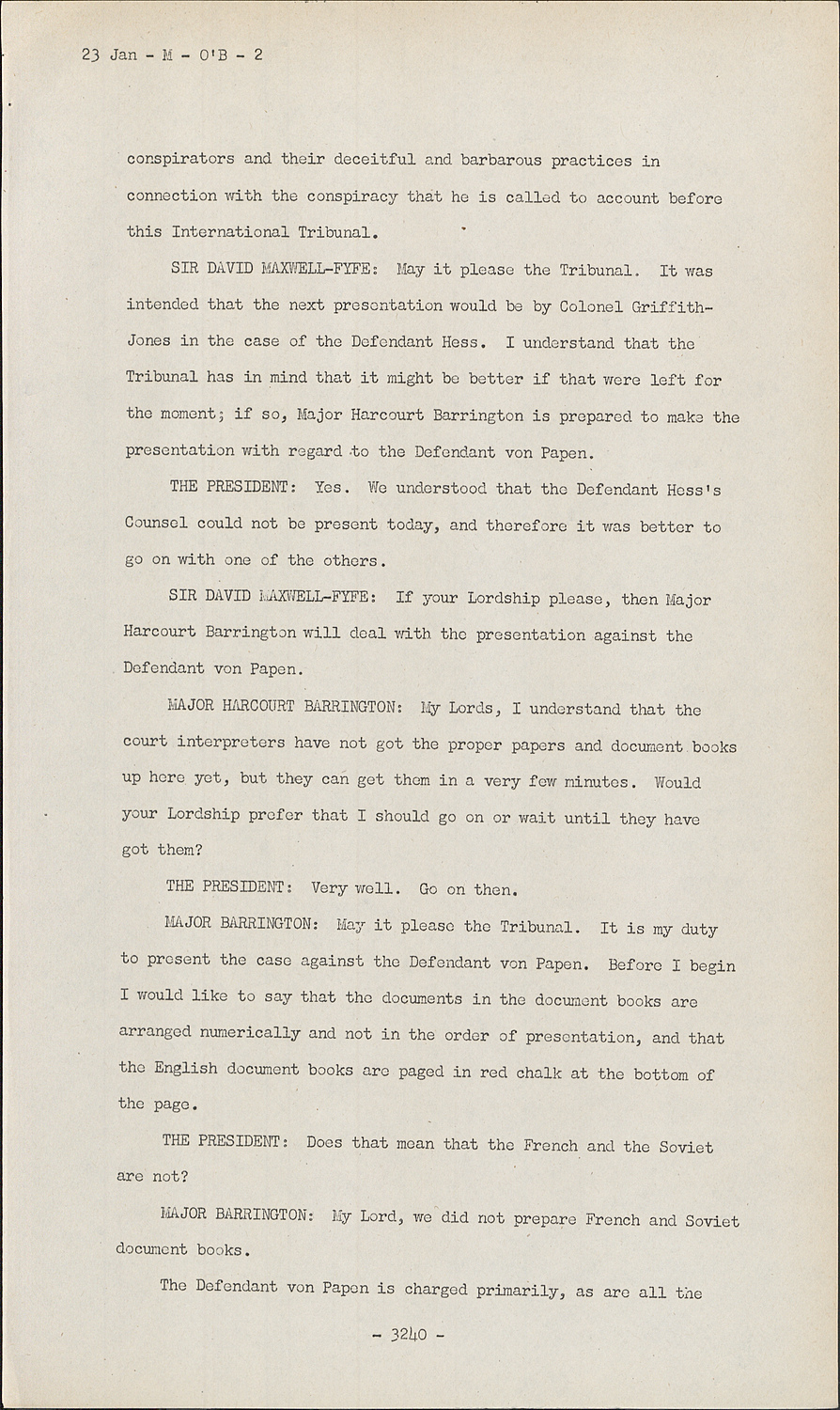
SIR DAVIDMAXWELL-FYFE: May it please the Tribunal. It was intended that the next presentation would be by Colonel Griffith Jones in the case of the Defendant Hess.
I understand that the Tribunal has in mind that it might be better if that were left for the moment ; if so, Major Harcourt Barrington is prepared to make the presentation with regard to the Defendant von Papen.
THE PRESIDENT:Yes. We understood that the Defendant Hess's Counsel could not be present today, and therefore it was better to go on with one of the others.
SIR DAVIDMAXWELL-FYFE: If your Lordship please, then Major Harcourt Barrington will deal with the presentation against the Defendant von Papen.
MAJOR HARCOURT BARRINGTON:My Lords, I understand that the court interpreters have not got the proper papers and document books up here yet, but they can get them in a very few minutes.
Would your Lordship prefer that I should go on or wait until they have got them?
THE PRESIDENT:Very well. Go on then.
MAJOR BARRINGTON:May it please the Tribunal. It is my duty to present the case against the Defendant von Papen.
Before I begin I would like to say that the documents in the document books are arranged numerically and not in the order of presentation, and that the English document books are paged in red chalk at the bottom of the page.
THE PRESIDENT:Does that mean that the French and the Soviet are not?
MAJOR BARRINGTON:My Lord, we did not prepare French and Soviet document books.
The Defendant von Papen is charged primarily, as are all the other Defendants, with the guilt of the conspiracy itself.
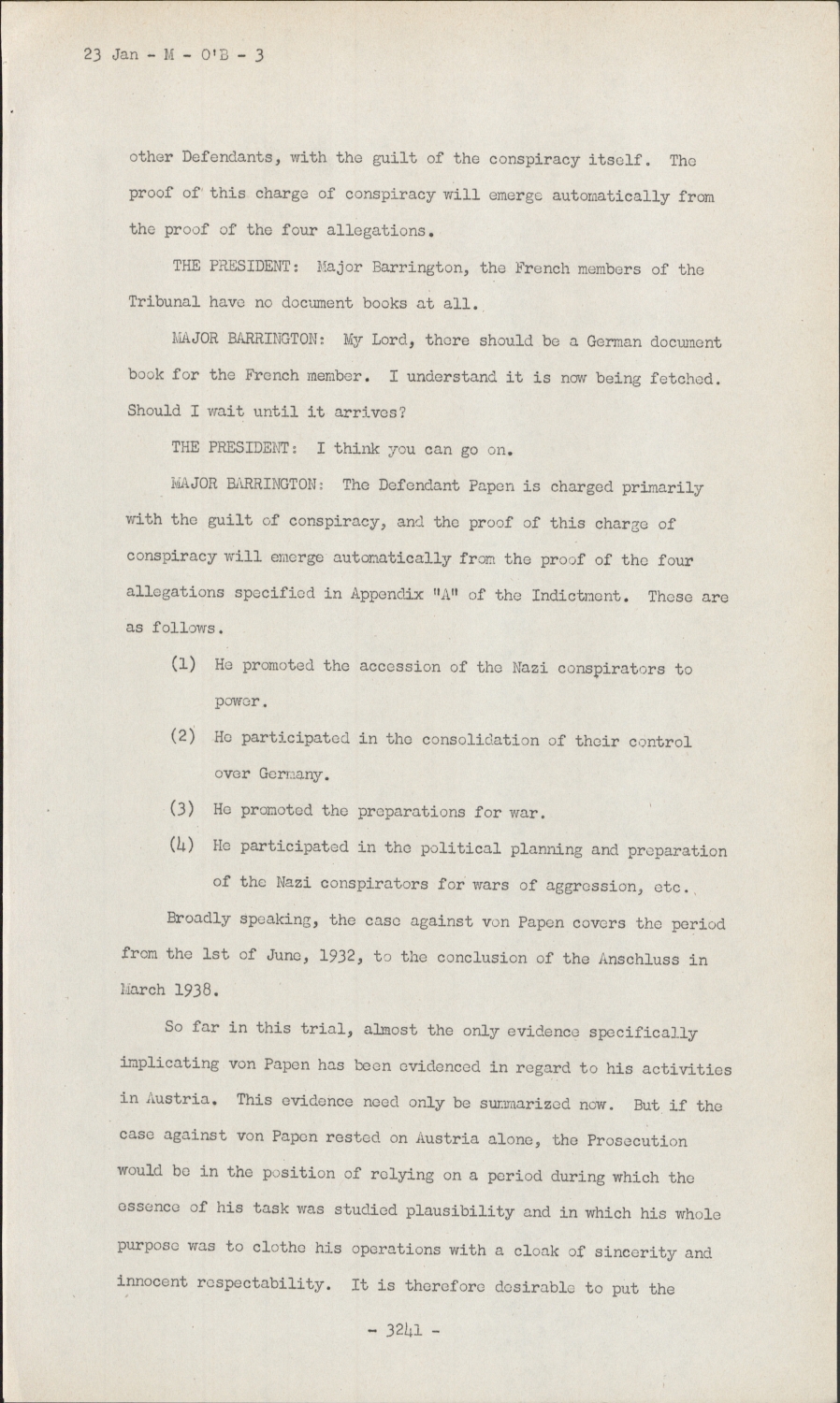
The proof of this charge of conspiracy will emerge automatically from the proof of the four allegations.
THE PRESIDENT:Major Barrington, the French members of the Tribunal have no document books at all.
MAJOR BARRINGTON:My Lord, there should be a German document book for the French member.
I understand it is now being fetched.
Should I wait until it arrives?
THE PRESIDENT:I think you can go on.
MAJORBARRINGTON; The Defendant Papen is charged primarily with the guilt of conspiracy, and the proof of this charge of conspiracy will emerge automatically from the proof of the four allegations specified in Appendix "A" of the Indictment.
These are as follows.
(1) He promoted the accession of the Nazi conspirators to power.
(2) He participated in the consolidation of their control over Germany.
(3) He promoted the preparations for war.
(4) He participated in the political planning and preparation of the Nazi conspirators for wars of aggression, etc.
Broadly speaking, the case against von Papen covers the period from the 1st of June, 1932, to the conclusion of the Anschluss in March 1938.
So far in this trial, almost the only evidence specifically implicating von Papen has been evidenced in regard to his activities in Austria.
This evidence need only be summarized now. But if the case against von Papen rested on Austria alone, the Prosecution would be in the position of relying on a period during which the essence of his task was studied plausibility and in which his whole purpose was to clothe his operations with a cloak of sincerity and innocent respectability.
It is therefore desirable to put the evidence already given in its true perspective by showing in addition the active and prominent part he played for the Nazis before he went to Austria.
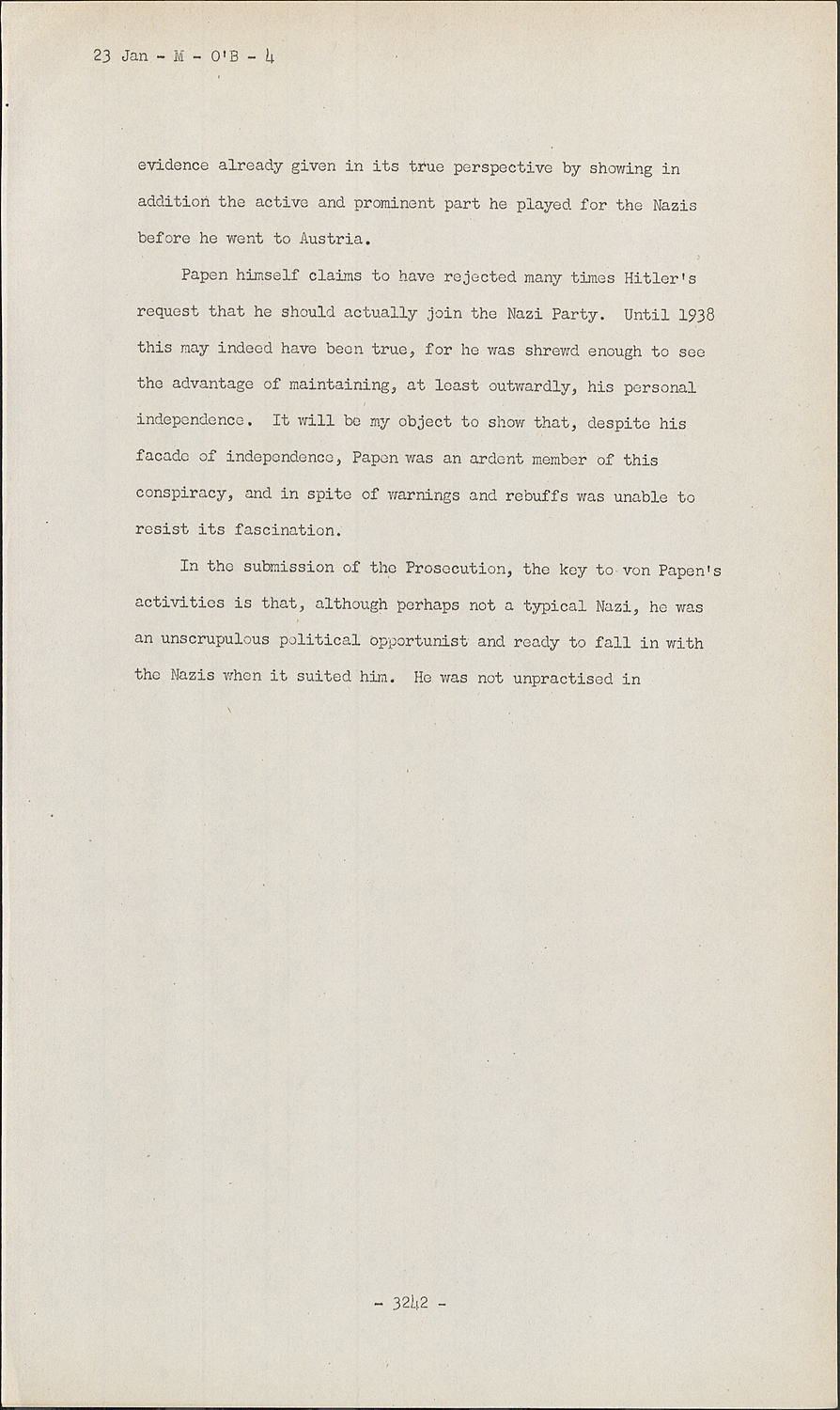
Papen himself claims to have rejected many times Hitler's request that he should actually join the Nazi Party.
Until 1938 this may indeed have been true, for he was shrewd enough to see the advantage of maintaining, at least outwardly, his personal independence.
It will be my object to show that, despite his facade of independence, Papen was an ardent member of this conspiracy, and in spite of warnings and rebuffs was unable to resist its fascination.
In the submission of the Prosecution, the key to von Papen's activities is that, although perhaps not a typical Nazi, he was an unscrupulous political opportunist and ready to fall in with the Nazis when it suited him.
He was not unpractised in duplicity, and viewed with an apparent indifference the contradictions and betrayals which his duplicity inevitably involved.
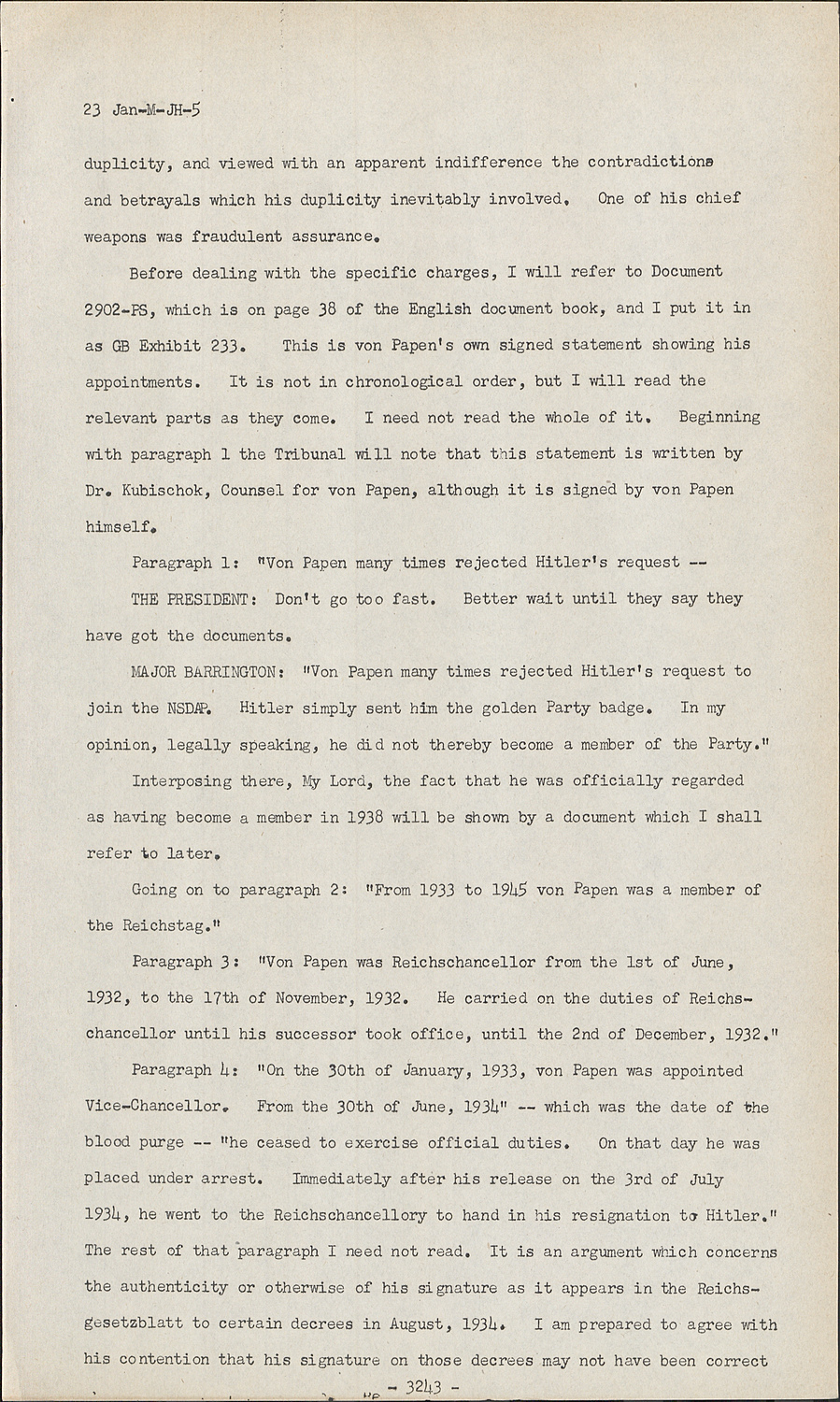
One of his chief weapons was fraudulent assurance.
Before dealing with the specific charges, I will refer to Document 2902-PS, which is on page 38 of the English document book, and I put it in as GB Exhibit 233. This is von Papen's own signed statement showing his appointments. It is not in chronological order, but I will read the relevant parts as they come, I need not read the whole of it. Beginning with paragraph 1 the Tribunal will note that this statement is written by Dr. Kubischok, Counsel for von Papen, although it is signed by von Papen himself.
Paragraph 1: "Von Papen many times rejected Hitler's request -
THE PRESIDENT:Don't go too fast. Better wait until they say they have got the documents.
MAJORBARRINGTON: "Von Papen many times rejected Hitler's request to join the NSDAP. Hitler simply sent him the golden Party badge. In my opinion, legally speaking, he did not thereby become a member of the Party."
Interposing there, My Lord, the fact that he was officially regarded as having become a member in 1938 will be shown by a document which I shall refer to later.
Going on to paragraph 2: "From 1933 to 1945 von Papen was a member of the Reichstag."
Paragraph 3: "Von Papen was Reichschancellor from the 1st of June, 1932, to the 17th of November, 1932. He carried on the duties of Reichschancellor until his successor took office, until the 2nd of December, 1932."
Paragraph 4: "On the 30th of January, 1933, von Papen was appointed Vice-Chancellor. From the 30th of June, 1934" -- which was the date of the blood purge -- "he ceased to exercise official duties. On that day he was placed under arrest. Immediately after his release on the 3rd of July 1934, he went to the Reichschancellory to hand in his resignation to Hitler." The rest of that paragraph I need not read. It is an argument which concerns the authenticity or otherwise of his signature as it appears in the Reichsgesetzblatt to certain decrees in August, 1934. I am prepared to agree with his contention that his signature on those decrees may not have been correct and may have been a mistake.
He admits holding office only to the 3rd of July, 1934.
He was, as the Tribunal will also remember, by virtue of being Reichschancellor, a member of the Reichscabinet.
Going on to paragraph 5: "On the 13th of November, 1933, von Papen became Plenipotentiary for the Saar. This office was terminated under the same circumstances described under paragraph 4."
The rest of the document I need not read. It concerns his appointments to Vienna and Ankara, which are matters of history. He was appointed Minister to Vienna on the 26th of July, 1934, and recalled on the 4th of February, 1938, and he was Ambassador in Ankara from April 1939 until August 1944.
The first allegation against the Defendant von Papen is that he used his personal influence to promote the accession of the Nazi conspirators to power. From the outset von Papen was well aware of the Nazi program and Nazi methods. There can be no question of his having encouraged the Nazis through ignorance of these facts. The official NSDAP program was open and notorious: it had been published in Mein Kampf for many years; it had been published and republished in the Yearbook of the NSDAP and elsewhere. The Nazis made no secret of their intention to make it a fundamental law of the state. This has been dealt with in full at an earlier stage of the trial.
During 1932 von Papen as Reichschancellor was in a particularly good position to understand the Nazi purposes and methods, and, in fact, he publicly acknowledged the Nazi menace. Take, for instance, his Muenster speech on the 28th of August 1932. This is Document 3314-PS, on page 49 of the English document book, and I now put it in as GB Exhibit 234, and I quote two extracts at the top of the page;
"The licentiousness emanating from the appeal of the leader of the National Socialist movement does not comply very well with his claims to governmental power. I do not concede him the right to regard the mere minority following his banner solely as the German nation and treat all our fellow countrymen as free game."
Take also his Muenster speech of the 13th of October, 1932. That is on page 50 of the English document book, Document No. 3317-PS, which I now put in as GB Exhibit 235, and I will simply read the last extract on the page:
"In the interest of the entire nation, we decline the claim to power by parties which want to own their followers body and soul and which want to put themselves as a party or a movement over and above the whole nation."
I do not rely on those random extracts to show anything more than that he had, in 1932, clearly addressed his mind to the inherent lawlessness of the Nazi philosophy. Nevertheless, in his letter to Hitler of the 13th of November, 1932, which I shall quote more fully later, he wrote of the Nazi movement as, I quote, "So great a national movement --"
THE PRESIDENT:Where is this?
MAJOR BARRINGTON:This is in a letter which I shall quote in a few minutes, My Lord, a letter to Hitler of the 13th of November, 1932. He wrote:
"So great a national movement, the merits of which for people and country I have always recognized in spite of necessary criticisms."
So variable and so seemingly contradictory are von Papen's acts and utterances regarding the Nazis that it is not possible to present the picture of Papen's part in this infamous enterprise unless one first reviews the steps by which he entered the Party. It then becomes clear that he threw himself, if not wholeheartedly, yet with cool and deliberate calculation, into the Nazi conspiracy.
I shall enumerate some of the principal steps by which Papen fell in with the Nazi conspiracy.
As a result of his first personal contact with Hitler, von Papen as Chancellor rescinded, on the 14th of June, 1932, the decree passed on the 13th of April, 1932, for the dissolution of the Nazi para-military organizations, the SA and the SS. He thereby rendered the greatest possible service to the Nazi Party, inasmuch as it relied upon its para-military organizations to beat the German people into submission. The decree rescinding the dissolution of the SA and the SS is shown in Document D-631, on page 64 of the document book, and I now put it in as GB-236. It is an extract from the Reichsgesetzblatt, which was an omnibus decree. The relevant passage is in paragraph 29:
"This order comes into operation from the day of announcement. It takes the place of the order of the Reich President for the safeguarding of the state authority."

The date there is a mistake. It should be the 13th of April, 1932.
THE PRESIDENT:Which page of the document is it?
MAJOR BARRINGTON:I am sorry, sir; it is page 64. And the date shown there should not be the 3rd of May, 1932; it should be the 13th of April, 1932. That was the decree which had previously dissolved the Nazi paramilitary organisations under the government of Chancellor Bruening. At the bottom of the page the Tribunal will see the decree -- the relevant parts of the decree of the 13th of April reproduced.
At the beginning of paragraph 1 of that decree it said:
"All organizations of a military nature of the German National Socialist Labor Party will be dissolved with immediate effect, particularly storm detachments SA and the protective detachments SS."
This rescission by von Papen was done in pursuance of a bargain made with Hitler which is mentioned in a book called "Dates from the History of the NSDAP" by Dr. Hans Voltz, a book published with the authority of the NSDAP. It is already an exhibit, US Exhibit 592. The extract I want to quote is on page 59 of the document book, and it is Document No.3463-PS. I quote an extract from page 41 of the little book:
"28th of May" -- that was in 1933, of course. "In view of the imminent fall of Bruening, at a meeting between the former deputy of the Prussian Center Party, Franz von Papen, and the Fuehrer in Berlin, first personal contact in Spring, 1932, the Fuehrer agrees that a Papen cabinet should be tolerated by the NSDAP, provided that the prohibitions imposed on the SA uniforms and demonstrations be lifted and the Reichstag dissolved."
It is difficult to imagine a less astute opening gambit for a man who was about to become Chancellor than to reinstate this sinister organization which had been suppressed by his predecessor. This action emphasizes the characteristic duplicity and insincerity of his public condemnations of the Nazis which I quoted a few minutes ago.
Eighteen months later he publicly boasted that at the time of taking over the chancellorship he had advocated paving the way to power for what he called the "young fighting liberation movement." That will be shown in Document 3375-PS, which I shall introduce in a few minutes.
Another important step was when, on the 20th of July, 1932, he accomplished his famous coup d'etat in Prussia which removed the BraunSevering Government and united the ruling power of the Reich and Prussia in his own hands as Reichskommissar for Prussia. This is now a matter of history It is mentioned in Document D-632, which I now introduce as GB 237. It is on page 65 of the document book. This document is, I think, a semi biography on a series on public men.
Papen regarded this step, his coup d'etat in Prussia, as a first step in the policy later pursued by Hitler of coordinating the states with the Reich, which will be shown in Document 3357, which I shall come to later.
The next step, if the Tribunal will look at Document D-632, on page 65 of the document book, the last four or five lines at the bottom of the page, was the Reichstag elections of the 31st of July, which were the result of von Papen's disbandment of the Reichstag on the 4th of June, which was made in pursuance of the bargain that I mentioned a few minutes ago and strengthened enormously the NSDAP, so that von Papen offered to the leader of the now stronger party his participation in the government as Vice-Chancellor Adolf Hitler rejected this offer on the 13th of August.
The new Reichstag, which assembled on the 30th of August, was disbanded by the 12th of September. The new elections brought about a considerable loss to the NSDAP, but did not strengthen the government parties, so that Papen's government retired on the 17th of November 1932 after unsuccessful negotiations with the party leaders.
My Lord, I shall wish to quote a few more extracts from that biography, but it is a mere catalog of events. Perhaps Your Lordship would allow me to return to it at an appropriate time or convenient time.
So far as those negotiations mentioned just now in the biography concern Hitler, they involved an exchange of letters in which von Papen wrote to Hitler, on the 13th of November, 1932. That letter is Document D-633, on page 68 of the English document book, and I now put it in as GB 238. I propose to read a part of this letter, because it shows the positive effort made by Papen to ally himself with the Nazis, even in face of further rebuffs from Hitler. I read the third paragraph. I should tell the Tribunal that there is some underlining in the English translation of that paragraph which does not occur in the German text:
"A new situation has arisen through the elections of November the 6th, and at the same time a new opportunity for all nationalist elements to be concentrated anew. The Reich President has instructed me to find out by conversations with the leaders of the individual parties concerned whether and how far they will be prepared to support the carrying out of the political and economic program on which the Reich Government has embarked.
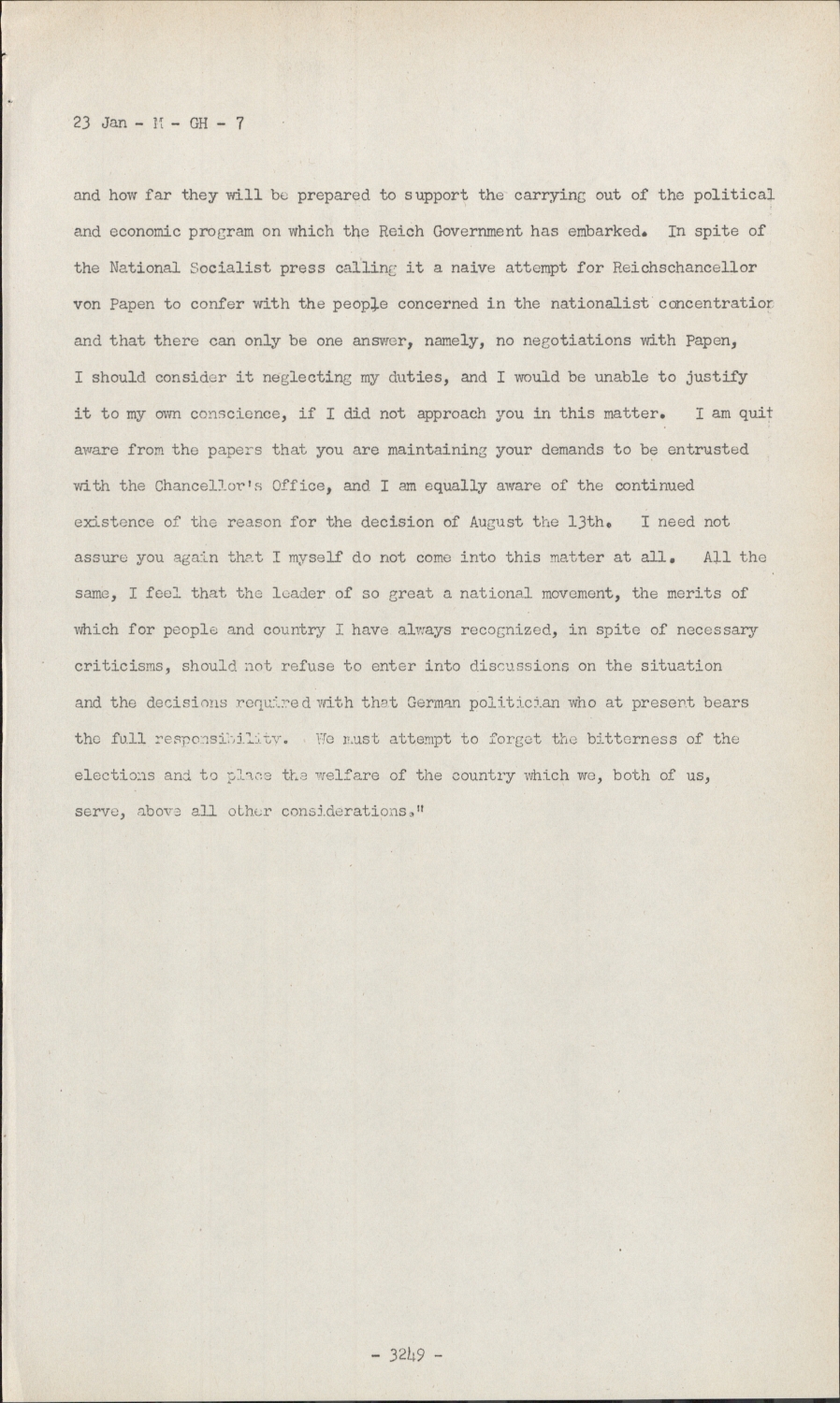
In spite of the National Socialist press calling it a naive attempt for Reichschancellor von Papen to confer with the people concerned in the nationalist concentration and that there can only be one answer, namely, no negotiations with Papen, I should consider it neglecting my duties, and I would be unable to justify it to my own conscience, if I did not approach you in this matter. I am quit aware from the papers that you are maintaining your demands to be entrusted with the Chancellor's Office, and I am equally aware of the continued existence of the reason for the decision of August the 13th. I need not assure you again that I myself do not come into this matter at all. All the same, I feel that the leader of so great a national movement, the merits of which for people and country I have, always recognized, in spite of necessary criticisms, should not refuse to enter into discussions on the situation and the decisions required with that German politician who at present bears the full responsibility. We must attempt to forget the bitterness of the elections and to place the welfare of the country which we, both of us, serve, above all other considerations."
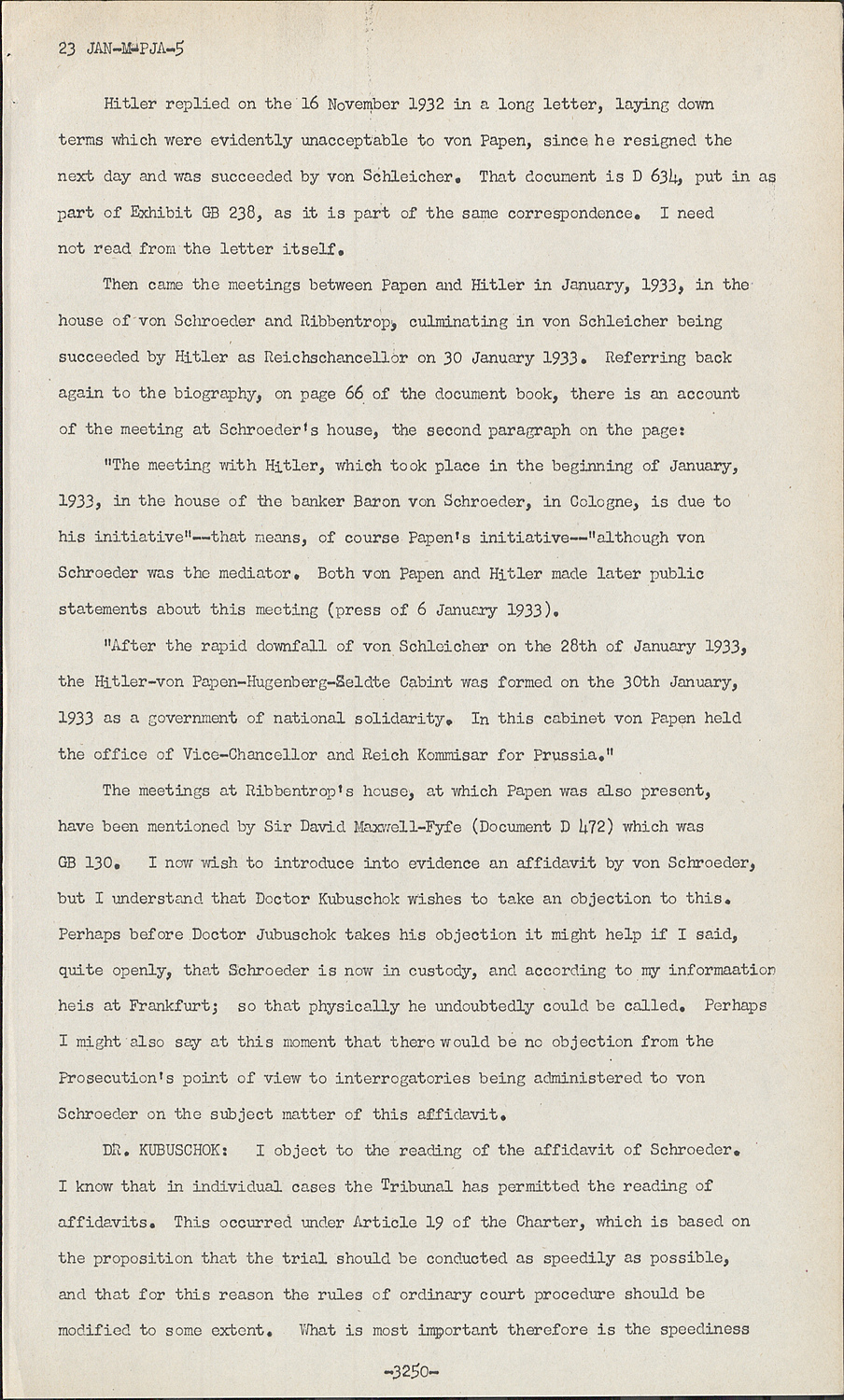
Hitler replied on the 16 November 1932 in a long letter, laying down terms which were evidently unacceptable to von Papen, since he resigned the next day and was succeeded by von Schleicher.
That document is D 634, put in as part of Exhibit GB 238, as it is part of the same correspondence. I need not read from the letter itself.
Then came the meetings between Papen and Hitler in January, 1933, in the house of von Schroeder and Ribbentrop, culminating in von Schleicher being succeeded by Hitler as Reichschancellor on 30 January 1933. Referring back again to the biography, on page 66 of the document book, there is an account of the meeting at Schroeder's house, the second paragraph on the page:
"The meeting with Hitler, which took place in the beginning of January, 1933, in the house of the banker Baron von Schroeder, in Cologne, is due to his initiative"--that means, of course Papen's initiative--"although von Schroeder was the mediator. Both von Papen and Hitler made later public statements about this meeting (press of 6 January 1933).
"After the rapid downfall of von Schleicher on the 28th of January 1933, the Hitler-von Papen-Hugenberg-Seldte Cabint was formed on the 30th January, 1933 as a government of national solidarity. In this cabinet von Papen held the office of Vice-Chancellor and Reich Kommisar for Prussia."
The meetings at Ribbentrop's house, at which Papen was also present, have been mentioned by Sir David Maxwell-Fyfe (Document D 472) which was GB 130. I now wish to introduce into evidence an affidavit by von Schroeder, but I understand that Doctor Kubuschok wishes to take an objection to this. Perhaps before Doctor Jubuschok takes his objection it might help if I said, quite openly, that Schroeder is now in custody, and according to my informaation heis at Frankfurt; so that physically he undoubtedly could be called. Perhaps I might also say at this moment that there would be no objection from the prosecution's point of view to interrogatories being administered to von Schroeder on the subject matter of this affidavit.
DR. KUBUSCHOK:I object to the reading of the affidavit of Schroeder. I know that in individual cases the Tribunal has permitted the reading of affidavits. This occurred under Article 19 of the Charter, which is based on the proposition that the trial should be conducted as speedily as possible, and that for this reason the rules of ordinary court procedure should be modified to some extent. What is most important therefore is the speediness of the trial.
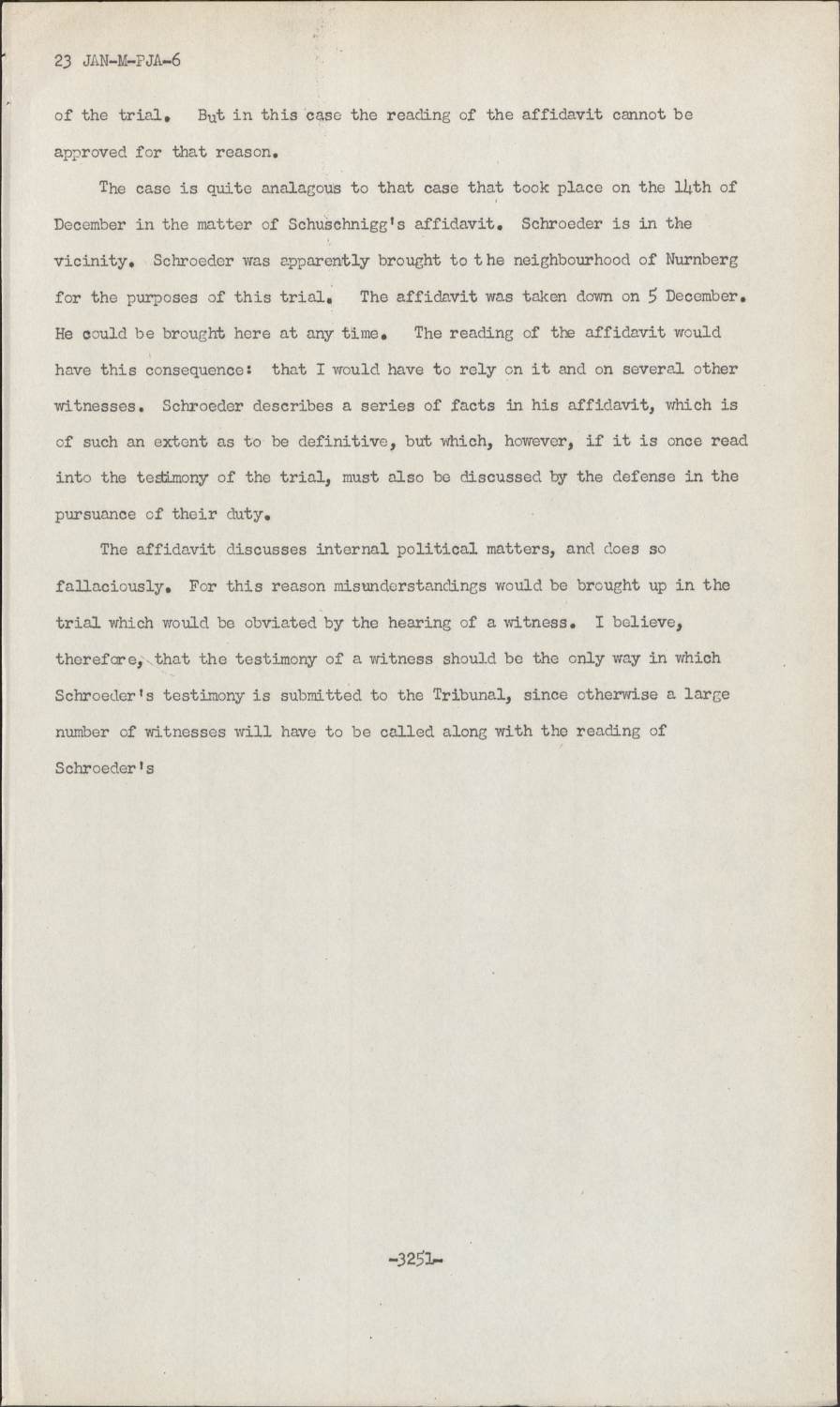
But in this case the reading of the affidavit cannot be approved for that reason.
The case is quite analagous to that case that took place on the 14th of December in the matter of Schuschnigg's affidavit. Schroeder is in the vicinity. Schroeder was apparently brought to the neighbourhood of Nurnberg for the purposes of this trial. The affidavit was taken down on 5 December. He could be brought here at any time. The reading of the affidavit would have this consequence: that I would have to rely on it and on several other witnesses. Schroeder describes a series of facts in his affidavit, which is of such an extent as to be definitive, but which, however, if it is once read into the testimony of the trial, must also be discussed by the defense in the pursuance of their duty.
The affidavit discusses internal political matters, and does so fallaciously. For this reason misunderstandings would be brought up in the trial which would be obviated by the hearing of a witness. I believe, therefore, that the testimony of a witness should be the only way in which Schroeder's testimony is submitted to the Tribunal, since otherwise a large number of witnesses will have to be called along with the reading of Schroeder's affidavit.