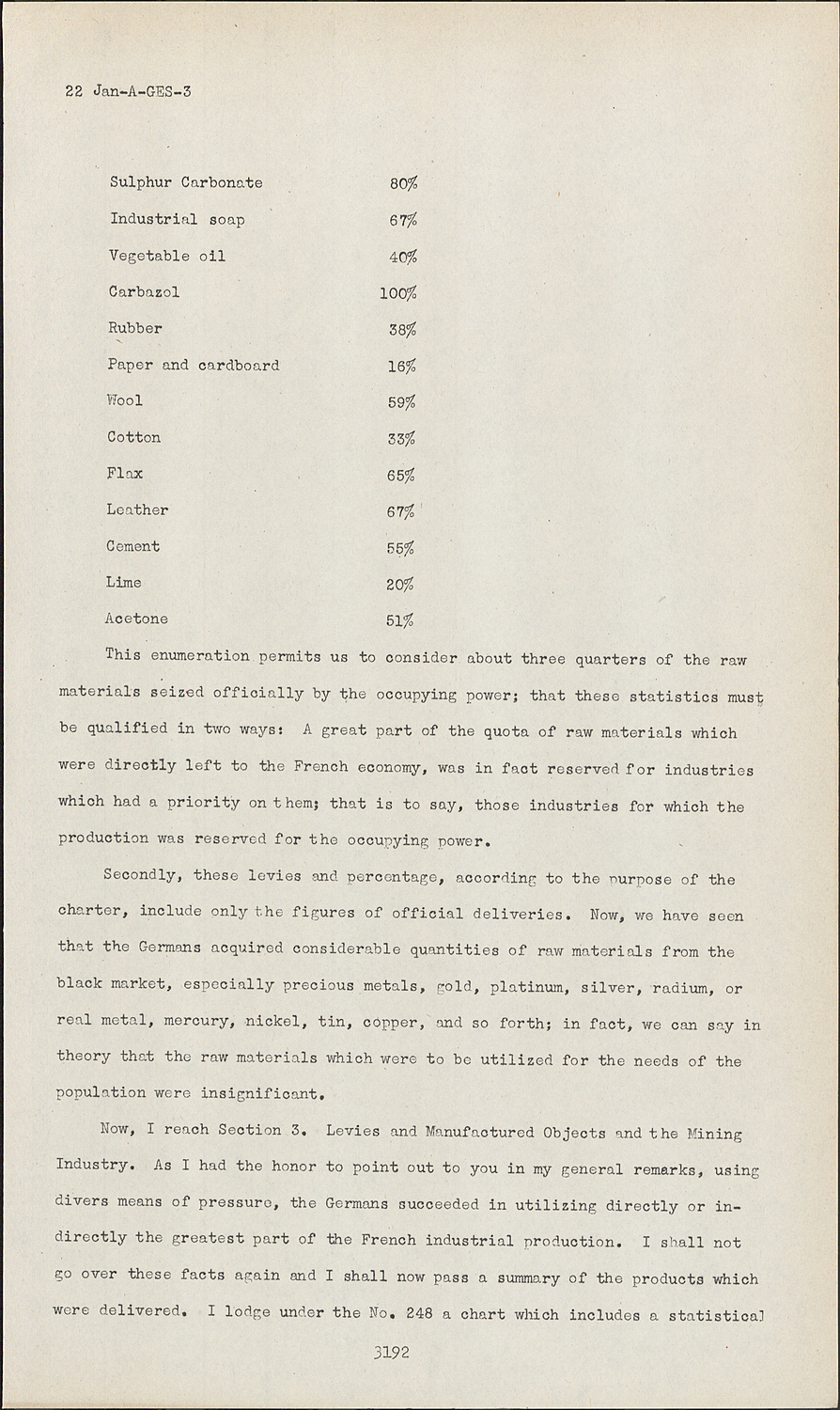
A great part of the quota of raw materials which were directly left to the French economy, was in fact reserved for industries which had a priority on them; that is to say, those industries for which the production was reserved for the occupying power.
Secondly, these levies and percentage, according to the purpose of the charter, include only the figures of official deliveries. Now, we have seen that the Germans acquired considerable quantities of raw materials from the black market, especially precious metals, gold, platinum, silver, radium, or real metal, mercury, nickel, tin, copper, and so forth; in fact, we can say in theory that the raw materials which were to be utilized for the needs of the population were insignificant.
Now, I reach Section 3. Levies and Manufactured Objects and the Mining Industry. As I had the honor to point out to you in my general remarks, using divers means of pressure, the Germans succeeded in utilizing directly or indirectly the greatest part of the French industrial production. I shall not go over these facts again and I shall now pass a summary of the products which were delivered. I lodge under the No. 248 a chart which includes a statistical information or data by categorical industries, these levies of manufactured objects during the course of the occupation, by the occupying power.
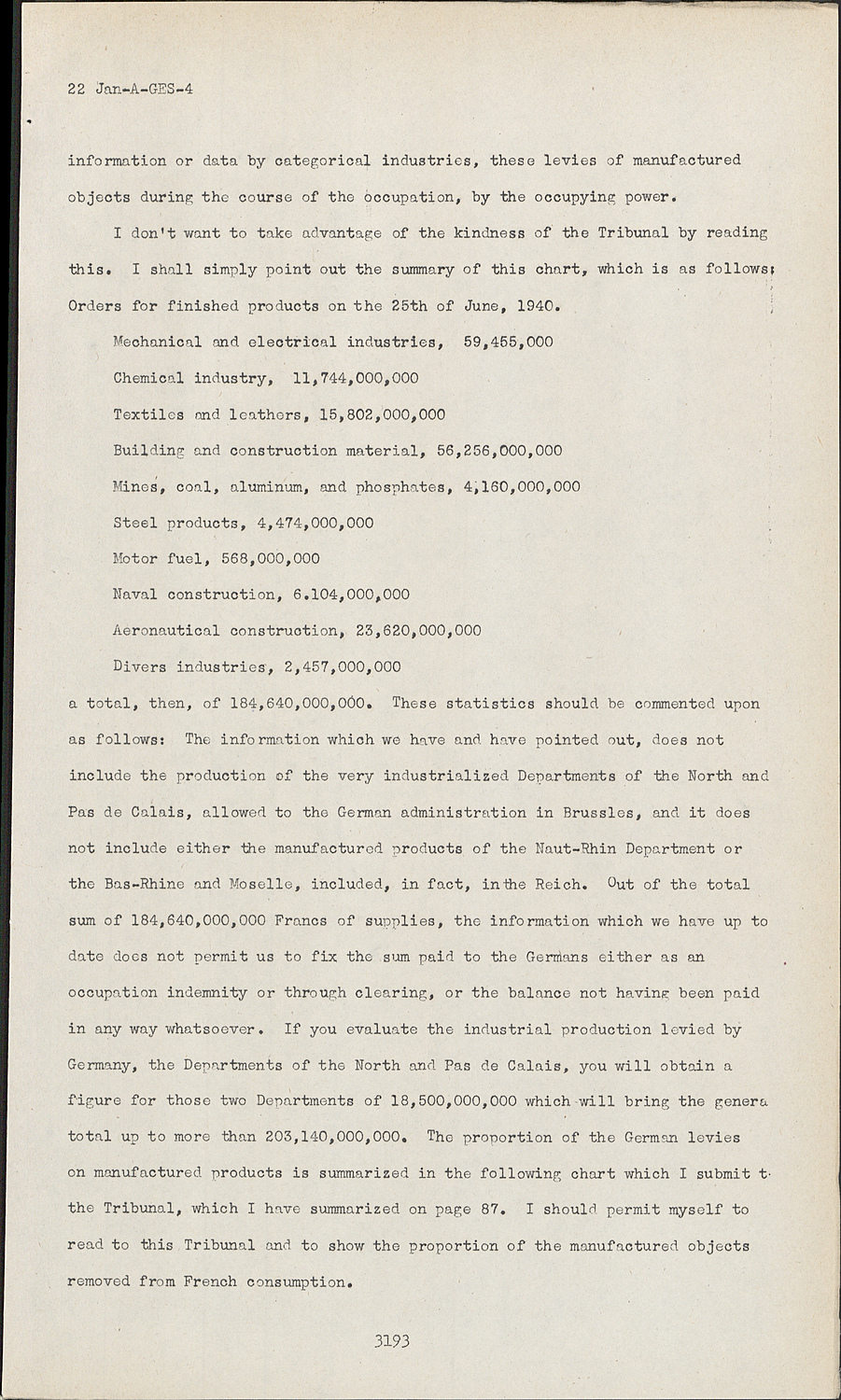
I don't want to take advantage of the kindness of the Tribunal by reading this. I shall simply point out the summary of this chart, which is as follows: Orders for finished products on the 25th of June, 1940.
Mechanical and electrical industries, 59,455,000 Chemical industry, 11,744,000,000 Textiles and leathers, 15,802,000,000 Building and construction material, 56,256,000,000 Mines, coal, aluminum, and phosphates, 4,160,000,000 Steel products, 4,474,000,000 Motor fuel, 568,000,000 Naval construction, 6.104,000,000 Aeronautical construction, 23,620,000,000 Divers industries, 2,457,000,000 a total, then, of 184,640,000,000.
These statistics should be commented upon as follows: The information which we have and have pointed out, does not include the production of the very industrialized Departments of the North and Pas de Calais, allowed to the German administration in Brussles, and it does not include either the manufactured products of the Naut-Rhin Department or the Bas-Rhine and Moselle, included, in fact, in the Reich. Out of the total sum of 184,640,000,000 Francs of supplies, the information which we have up to date does not permit us to fix the sum paid to the Germans either as an occupation indemnity or through clearing, or the balance not having been paid in any way whatsoever. If you evaluate the industrial production levied by Germany, the Departments of the North and Pas de Calais, you will obtain a figure for those two Departments of 18,500,000,000 which will bring the genera total up to more than 203,140,000,000, The proportion of the German levies on manufactured products is summarized in the following chart which I submit to the Tribunal, which I have summarized on page 87. I should permit myself to read to this Tribunal and to show the proportion of the manufactured objects removed from French consumption.
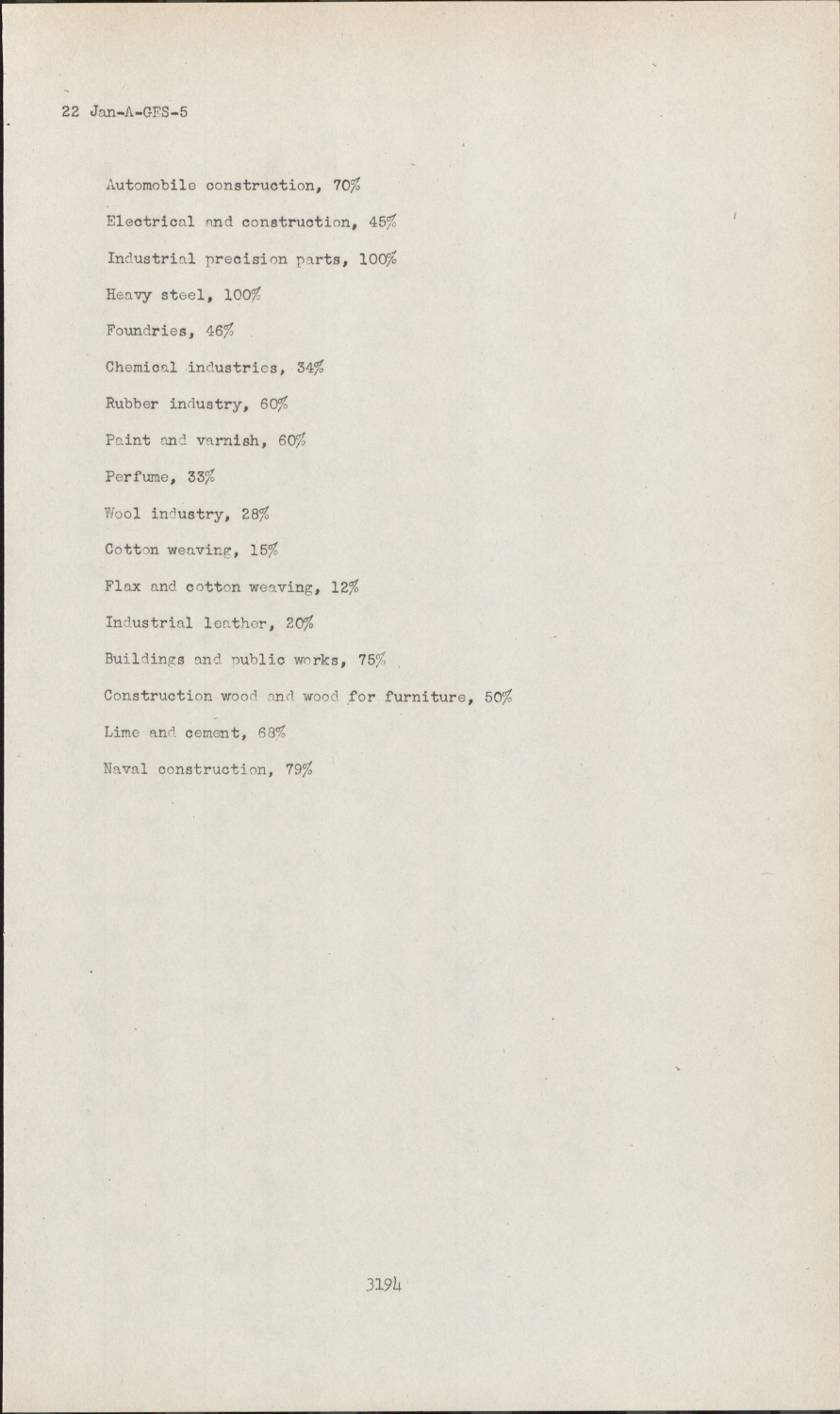
Automobile construction, 70% Electrical and construction, 45% Industrial precision parts, 100% Heavy steel, 100% Foundries, 46% Chemical industries, 34% Rubber industry, 60% Paint and varnish, 60% Perfume, 33% Wool industry, 28% Cotton weaving, 15% Flax and cotton weaving, 12% Industrial leather, 20% Buildings and public works, 75% Construction wood and wood for furniture, 50% Lime and cement, 68% Naval construction, 79% Aeronautic construction, 90% The scrutiny of this chart leads to the following remarks:
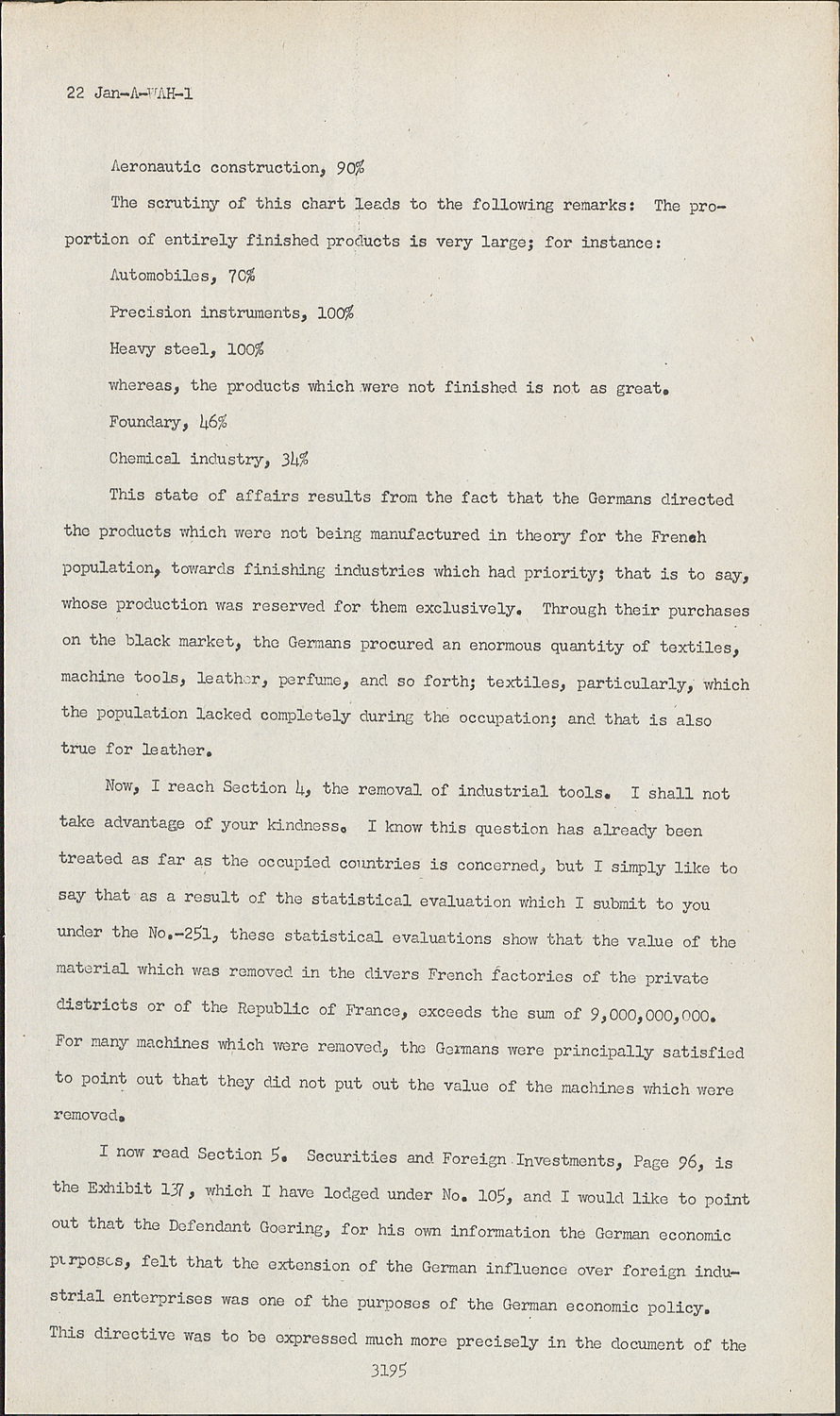
The proportion of entirely finished products is very large; for instance:
Automobiles, 70% Precision instruments, 100% Heavy steel, 100% whereas, the products which were not finished is not as great.
Foundary, 46% Chemical industry, 34% This state of affairs results from the fact that the Germans directed the products which were not being manufactured in theory for the French population, towards finishing industries which had priority; that is to say, whose production was reserved for them exclusively.
Through their purchases on the black market, the Germans procured an enormous quantity of textiles, machine tools, leather, perfume, and so forth; textiles, particularly, which the population lacked completely during the occupation; and that is also true for leather.
Now, I reach Section 4, the removal of industrial tools. I shall not take advantage of your kindness. I know this question has already been treated as far as the occupied countries is concerned, but I simply like to say that as a result of the statistical evaluation which I submit to you under the No.-251, these statistical evaluations show that the value of the material which was removed in the divers French factories of the private districts or of the Republic of France, exceeds the sum of 9,000,000,000. For many machines which were removed, the Germans were principally satisfied to point out that they did not put out the value of the machines which were removed.
I now read Section 5. Securities and Foreign Investments, Page 96, is the Exhibit 137, which I have lodged under No. 105, and I would like to point out that the Defendant Goering, for his own information the German economic purposes, felt that the extension of the German influence over foreign industrial enterprises was one of the purposes of the German economic policy. This directive was to be expressed much more precisely in the document of the 12th of August, 1940, which I depose as No. 252, from which I shall read short extracts.
"It is given that the principal economic enterprises under the form of companies have been responsible to put in securities which are in France. The execution or the seizure also was done through ordinances. Every means which was used to succeed and notably foreign issue of all concerned.
"According to Article 46 of the Hague Convention, concerning the terrestrial warfare, private property cannot be confiscated. The confiscation of securities is to be avoided in the measure - securities are not concerns belong to the State. According to Article 42, and following of the Hague Convention concerning terrestrial warfare, the authority exercising power in the occupied enemy territory, must restrict himself from utilizing measures which are necessary to re-establish or maintain order and public life; to conform to International Law; it is forbidden to deviate from these social organs or social organizations which are there and to replace them through Kommissars." Such a measure was probably not considered in the international point of viewand from the law of nations as efficacious. Consequently, we must strive to force the various social organizations to work for the German economy but not to render destitute, not to strip the persons who comprise them, of these articles.
Further on: "If these organizations will not permit themselves to be directed, we must do away with them and replace them by forces which we can utilize."
Now, we will take up property, the three categories of seizure of financial investments, which is the purpose of the German spoiliation during the occupation.
First, the seizure of financial investments in companies which were exploited in a foreign country. On the 14th of August, 1940, an ordinance V.O.B.I.F, page 67, was published forbidding any negotiation of credit for foreign securities. A simple freezing of securities did not suffice for the occupying power. They required for the form to come to the proprietor of this security in order to be able to eventually negotiate in neutral countries.
There were some agents who purchased foreign securities from private citizens who needed money, but above all, they put pressure on the Vichy Government in order to obtain the handing over the principal French investments in foreign countries, investments notably, that after long discussions in the cause of which the German pressure was very great, important concessions of investments were handed over to the Germans.
It is not possible for me to submit to the Tribunal the numerous documents which they should be in, the handing over these investments, transcripts, correspondence. It would be, without exaggeration, several cubic metres.
It will suffice me to cite a few passages concerning the Bor Mines, the copper mines which were found in Yugoslavia, the greatest part of the country which was in French hands. The Germans installed on 26 of July 1940, a Kommissar who was an administrator of the establishment of this company situated in Yugoslavia. This is found in Document 254 which I submit to the Tribunal. The Counsel General of Germany, Neuhausen, then declared, in the transcript of which I submit to the Tribunal, No. 255, the meeting of the Armistice Commission on the 22nd of November. Here is his statement:
"Germany wishes to acquire the shares of the company without concern for the juridical observations made by the French. Germany obeys in fact the imperious considerations of the economic order. It suspects that the Bor Mines are still delivering copper to England and she has decided absolutely to take possession of these mines." Faced with the refusal of the French delegates, Hemmen declared at the meeting of October 4, 1940, which I submit to the Tribunal, under No. 256, and I will read an extract from this:
Mr. Hemmen speaks:
"I should regret to have to transmit such a reply to my Government. See if French Government cannot reconsider its attitude. If not, our relations will become very difficult. My Government is anxious to complete this matter. If you refuse, the consequences will be extremely grave."
M. de Boisanger, the French Delegate, replied:
"I am going to ask you once again this question".
And Hemmen replies:
"I await your reply; I shall expect your reply tomorrow. If it does not come, I shall transmit the negative reply which you have just i Ther, in the course of the meeting on 9 January 1941, Hemman stated and I submit again an extract from the minutes, document 257.
Hemmen: "I had, from the beginning, been entrusted with this affair at Wiesbaden. Then it was discussed by the Counsellor, General Neuhausen, on behalf of a very highly placed personage, Marshal Goering, and it was discussed directly in Paris with M. Laval and M. Abetz."
As far as French investments in petroleum companies in Roumania are concerned, the pressure was not less. In the course of the meeting of October 10, 1940 of the Armistice Commission, Hemman stated - and I submit this under document 258, an extract from the minutes of the meeting:
"We shall continue ourselves, moreover, with the majority of the stocks. We will leave in your hands anything which we do not need for this purpose. Can you give us an acceptance on this point? The matter is urgent. As for the Bor Mines, there we wish everything."
On the 22nd of November, 1940, Hemmen stated again - and this extract of the minutes of the Armistice Commission meeting I submit under the number 259:
"We are still at war and we need to have an immediate influence over petroleum production in Roumania. We cannot await a peace treaty".
When the French Delegates asked that this handing over be carried out against a real compensating consideration, Hemmen stated, at the time of that meeting: "Impossible. The sums which you are to receive from us will be taken out of the occupation expenses. This kind of participation will be generalized on the German side when the collaboration policy will have been defined."
We might quote indefinitely quotations of this kind, and many even much more serious from the point of view of the violation of the provisions of the Hague Convention.
All these concessions, apparently agreed to by the French, were only agreed to after German pressure.
Scrutiny of the contracts agreed upon show serious damage towards those who had handed over their property, and enormous property for those who had acquired those properties, without the latter having furnished any real compensating consideration.
The Germans thus obtained French investments in the Roumanian petroleum companies, in the enterprises of Central Europe, Norway and the Balkans, especially those of the French Company of the Bor Mines. These concessions were paid through francs coming from occupation indemnities, and rose to the sum of 2,090,852,000 francs. The others were paid through stocks, which had been French shares issued in a foreign country, notably in Holland, and through the clearing method.
Having given you a brief summary of the seizure of investments of French affairs in the foreign countries, I should like to rapidly examine the German seizure of the capitals of French industries.
Shortly after the Armistice, in conformity with the directives of the Defendant Goering, a great number of French industries were the object of proposals on the part of German groups anxious to acquire all or part of their assets, or the assets of their companies. This operation was facilitated by the fact that the Germans, as I have had the honor of pointing out to you, had practically the control of the industry, and they had taken over the direction of production, particularly by the system of Paten Firma.
Long discussions took place between the occupying powers and the French Minister of Finance, whose department strove, without success, sometimes, to limit to 30 percent the maximum of German investments. It is not possible for me to enter into details of the seizure of these investments. I shall point out, however, that the Finance Minister handed to us a list of the principal seizures, which are reproduced in a chart appended to the French Document Book under the number 260. The result was that the seizure of investments, particularly paid through clearings, rose to the sum of 307,436,000 francs; out of the occupation expense accounts, through foreign stocks, was a sum which we cannot determine; and finally, divers or unknown ways, 28,718,700 francs.
We shall conclude the two paragraphs of this fifth section by quoting part of the Hemmen report relative to these questions. At page 63 of the original and 152 of the German text, here is what Hemmen states, in Strasbourg, in January 1944, concerning this subject:
"The fifth report upon the activity of the delegation is devoted to the difficulty of future seizures of investments in France. Given the strongly accusing attitude of the French Government concerning the concession of domestic and foreign property having value, this opposition has been strengthened during the time of the report to such an extent that the French Government was no longer disposed to give the slightest approval to the transfer of investments against the putting at the disposal of France economic compensating considerations."
Further on, in the second paragraph:
"During the four years of the occupation of France the Armistice Delegation transferred, in all of the French property to German property, shares representing, in toto, 121 million Reichsmarks, of which the investment enterprise is of first importance for the war in the third country, in France and in Germany. Details in this respect are found in the reports of prior activities of the delegation. In about half of these transfers compensating considerations were given on the German side for the delivery of French foreign shares acquired in Holland and in Belgium. For the remainder, the sums were paid through clearing or from out of the occupation expenses. From the fact of giving payment in French shares in foreign countries, the differences, as far as the shares were concerned, between the German purchasing price and the French rates which resulted from this, were these: The Germans/achieved gains of a sum of about seven million Reichsmarks, which were delivered to the Reich."
There is reason to emphasize that the profit derived by Germany merely from the financial point of view is not 7 million Reichsmarks, or 140 million francs, according to Hemmen, but much greater. In fact, Germany paid principally for their acquisition through occupation indemnities, through the clearing operation, and French loans issued in Holland or in Belgium; and the expropriation by Germany was the true cause of the spoliation of these countries.
It could not constitute a compensating consideration for France. These concessions or investments, carried out under the cloak of legality, moved the United Nations, who, in their statements made at London, January 5 1943, said in theory that such concessions should be declared null and void, even when carried out with the apparent consent of those made the concessions.
I submit, under No.261, the solemn statement signed in London, 5th of January, 1943, and which was published in the French Official Journal the 15th of August, 1944, at the time of the liberation. I submit that all these concessions are of interest to the French Justice for prosecution under the cloak of betrayal, particularly for French who collaborated with the Germans despite indisputable pressure which was exerted upon them.
I shall conclude this chapter with one last remark -- the German seizure of buildings in France. It is difficult to give at this time the exact situation of this subject, for these operations were made most often through the intermediary of an assumed name. An example is that of a certain Skolnikoff, who during the occupation spent nearly 2 billion francs in the purchase of large buildings. This individual, of indeterminate nationality, lived in poverty before the war, was enriched in a splendorous fashion, thanks to his connection with the Gestapo and his operations on the black market in cooperation with the occupying power. But, whatever may be the profits that he derived from his dishonest activities, he could not acquire personally almost 2 billions worth of buildings in France. I submit, under the number 262, a copy of a police report concerning him. It is not possible for me to read this completely to the Tribunal, but this report contains a list of the buildings and real estate companies acquired by this individual. These are without question buildings of a great value. It is evident that Skolnikoff, an agent for the Gestapo, was an assumed name for German personalities whose identity has not been discovered up to the present.
Now I shall take up Section 6 -- the levy of transportation material. A report from the French administration gives us statistics which are reproduced in the very complete chart, which I shall not read to the Tribunal. I shall merely point out to the Tribunal that most of the locomotives and rolling stock in good shape were removed, and the total sum of the levies on transportation material reaches the sum of 188,452,000,000 francs.
I shall now take up levies in the departments of the Haut-Rhin, the Bas-Rhin, and the Moselle.
From the beginning of the invasion the Germans incorporated these departments in the Reich. This question will be presented subsequently by the French prosecutor when he discusses the question of Germanization from the point of view of economic spoliation. We must point out that the Germans sought to derive a maximum from these three departments. If they paid in marks for a certain number of products, they did not pay it anyway for the principal products, especially coal, iron, crude oil, potassium, industrial material, furniture and agricultural machinery. The information relating to this is given by the French administration in a chart which I shall summarize briefly, and which I submit as NO.
264.
The value of the levies in the three French departments of the east, levies not paid by the Germans, reaches the sum of 27,000,350,000 francs.
To conclude with the departments of the east, I should like to point out to the Tribunal that my colleague will discuss the question of Germanization and will show how the firm Hermann Goering Werke, in which the accused Goering had considerable interest, expropriated equipment in mines of the large French company called the "Petits-Fils De F. De Wendel Et Cie".
I now come to the Eighth section, concerning diverse levies. First, spoliations in Tunisia. The Germans arrived in Tunisia the 10th of November 1942, and were driven out by the Allied Armies in May, 1943. During this period they took up divers -
THE PRESIDENT:Do you think that it is necessary to go into details of the seizures in this part of the country, if they are on the same sort of level as they were in other parts of the country.
M. GERTHOFER:Mr. President, these details which I wouldlike to show you, it seems to me that they would not be contested by anyone.
Gentlemen, I now pass over the question of levies of service, and I shall conclude my summary, however, by pointing out to the Tribunal that the French economy lost enormously from the deportation of workers, a subject which was discussed by my colleagues. They have calculated that the losses in labor undergone by the French economy amounted to 12,555,000,000 work hours from the forced deportation of workers, a figure which does not include the number of workers who were more or less forced to work for the Germans in French industry in France.
If you will permit me, gentlemen, I shall conclude this presentation concerning France by giving you a general review of the situation in France. I shall cite once more that Hemmen, the economic dictator, ruined my country upon the orders of the defendants whom you have to judge. In the first five reports submitted, despite apparent technical quality, the author shows the assurance of a man who can permit himself anything. In the last, drawn up the 15th of December, 1944, at Salzburg, Hemmen sought visibly, while leaving a technical quality to his work, to plead the case of Germany, that of his Nazi masters and his own, but he succeeded only in doing it without wishing to bring out an implacable accusation against the nefarious work with which he was entrusted.
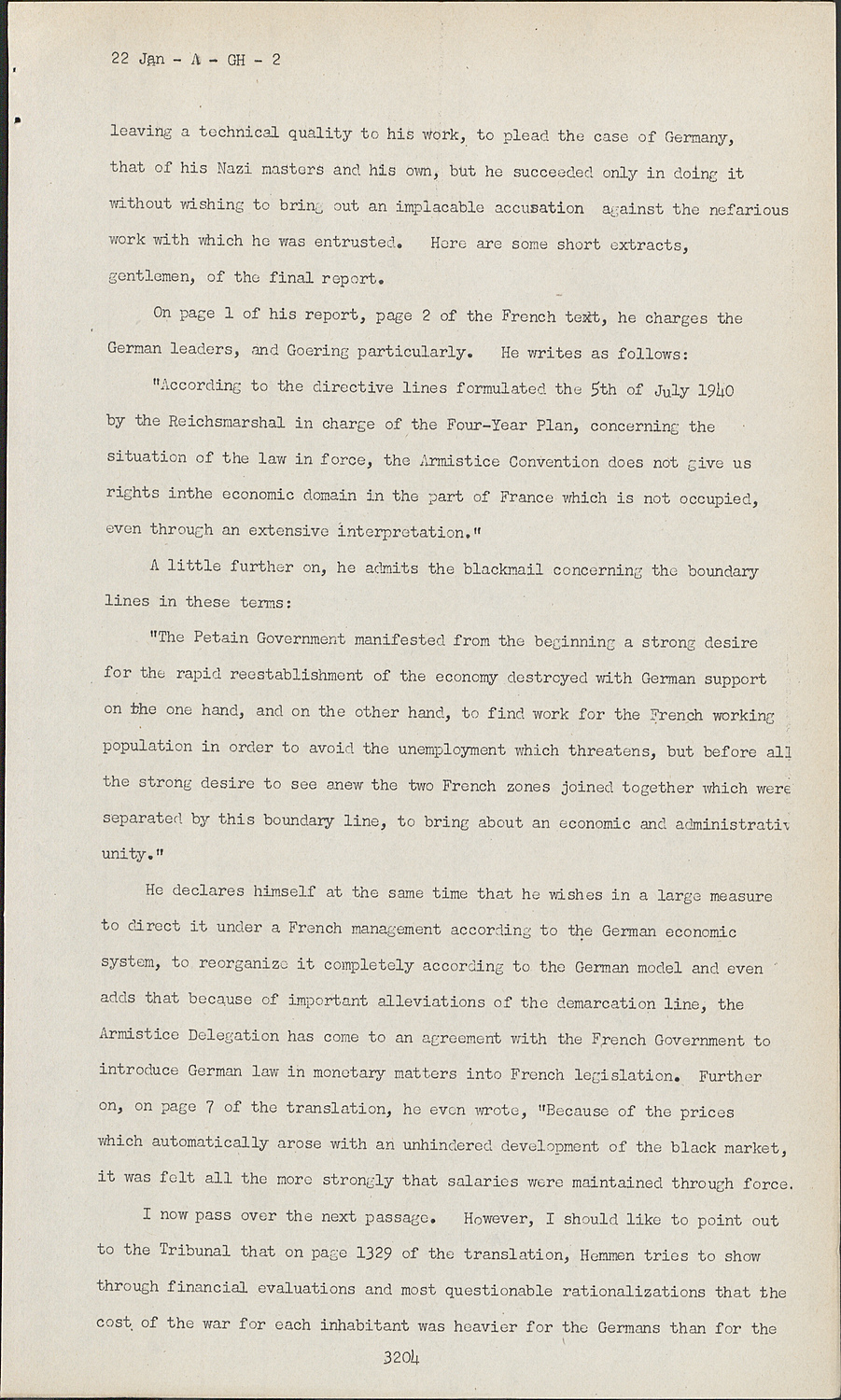
Here are some short extracts, gentlemen, of the final report.
On page 1 of his report, page 2 of the French text, he charges the German leaders, and Goering particularly. He writes as follows:
"According to the directive lines formulated the 5th of July 1940 by the Reichsmarshal in charge of the Four-Year Plan, concerning the situation of the law in force, the Armistice Convention does not give us rights inthe economic domain in the part of France which is not occupied, even through an extensive interpretation."
A little further on, he admits the blackmail concerning the boundary lines in these terms:
"The Petain Government manifested from the beginning a strong desire for the rapid reestablishment of the economy destroyed with German support on the one hand, and on the other hand, to find work for the French working population in order to avoid the unemployment which threatens, but before all the strong desire to see anew the two French zones joined together which were separated by this boundary line, to bring about an economic and administrative unity."
He declares himself at the same time that he wishes in a large measure to direct it under a French management according to the German economic system, to reorganize it completely according to the German model and even adds that because of important alleviations of the demarcation line, the Armistice Delegation has come to an agreement with the French Government to introduce German law in monetary matters into French legislation. Further on, on page 7 of the translation, he even wrote, "Because of the prices which automatically arose with an unhindered development of the black market, it was felt all the more strongly that salaries were maintained through force.
I now pass over the next passage. However, I should like to point out to the Tribunal that on page 1329 of the translation, Hemmen tries to show through financial evaluations and most questionable rationalizations that the cost of the war for each inhabitant was heavier for the Germans than for the French.
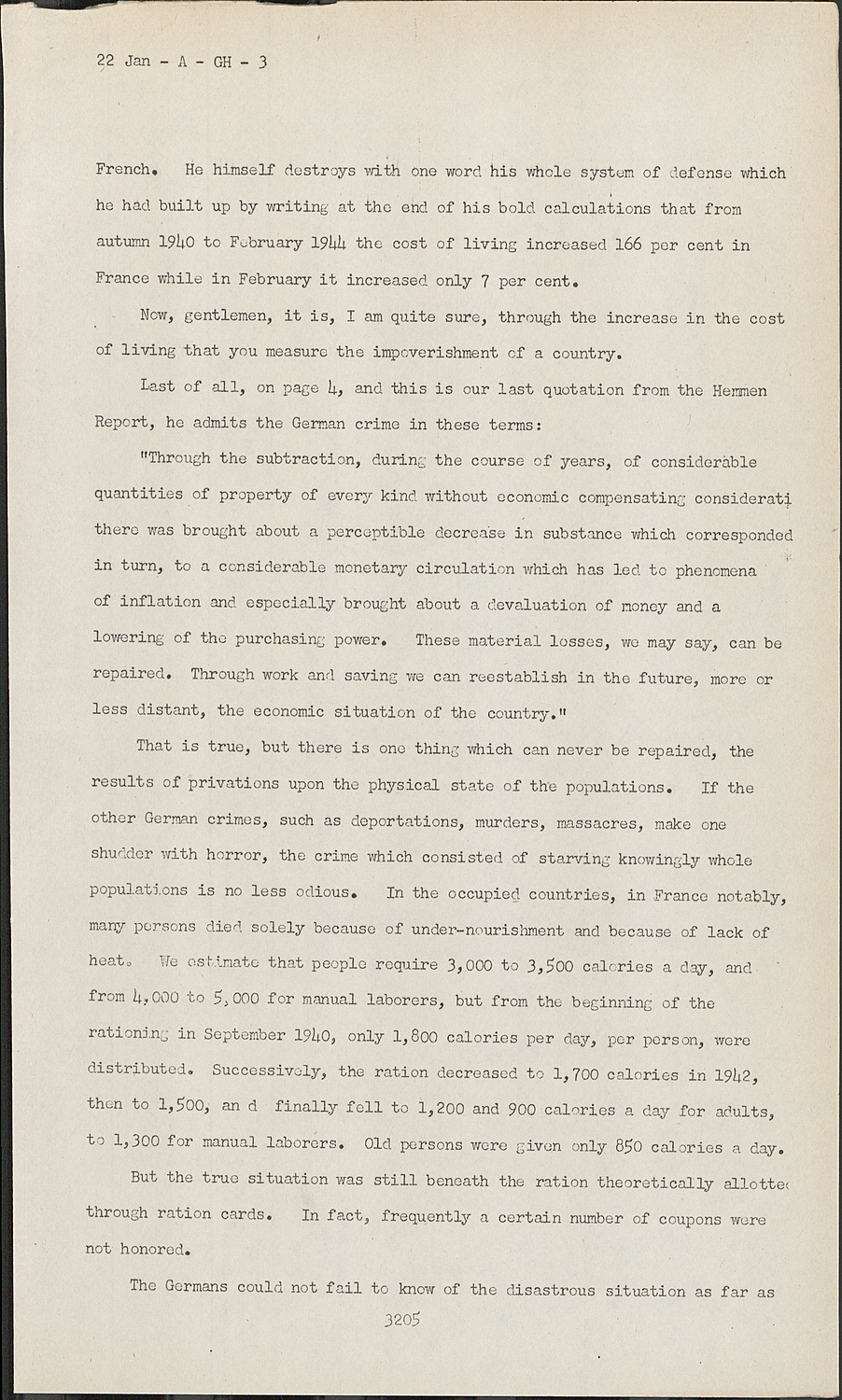
He himself destroys with one word his whole system of defense which he had built up by writing at the end of his bold calculations that from autumn 1940 to February 1944 the cost of living increased 166 per cent in France while in February it increased only 7 per cent.
Now, gentlemen, it is, I am quite sure, through the increase in the cost of living that you measure the impoverishment of a country.
Last of all, on page 4, and this is our last quotation from the Hemmen Report, he admits the German crime in these terms:
"Through the subtraction, during the course of years, of considerable quantities of property of every kind without economic compensating consideration there was brought about a perceptible decrease in substance which corresponded in turn, to a considerable monetary circulation which has led to phenomena of inflation and especially brought about a devaluation of money and a lowering of the purchasing power. These material losses, we may say, can be repaired. Through work and saving we can reestablish in the future, more or less distant, the economic situation of the country."
That is true, but there is one thing which can never be repaired, the results of privations upon the physical state of the populations. If the other German crimes, such as deportations, murders, massacres, make one shudder with horror, the crime which consisted of starving knowingly whole populations is no less odious. In the occupied countries, in France notably, many persons died solely because of under-nourishment and because of lack of heat. We estimate that people require 3,000 to 3,500 calories a day, and from 4,000 to 5,000 for manual laborers, but from the beginning of the rationing in September 1940, only 1,800 calories per day, per person, were distributed. Successively, the ration decreased to 1,700 calories in 1942, then to 1,500, an d finally fell to 1,200 and 900 calories a day for adults, to 1,300 for manual laborers. Old persons were given only 850 calories a day.
But the true situation was still beneath the ration theoretically allotted through ration cards. In fact, frequently a certain number of coupons were not honored.
The Germans could not fail to know of the disastrous situation as far as public health was concerned, since they estimated themselves in the course of the war of 1914-1918 that the distribution of 1,700 calories a day was a starvation regime, slow starvation, leading to death.
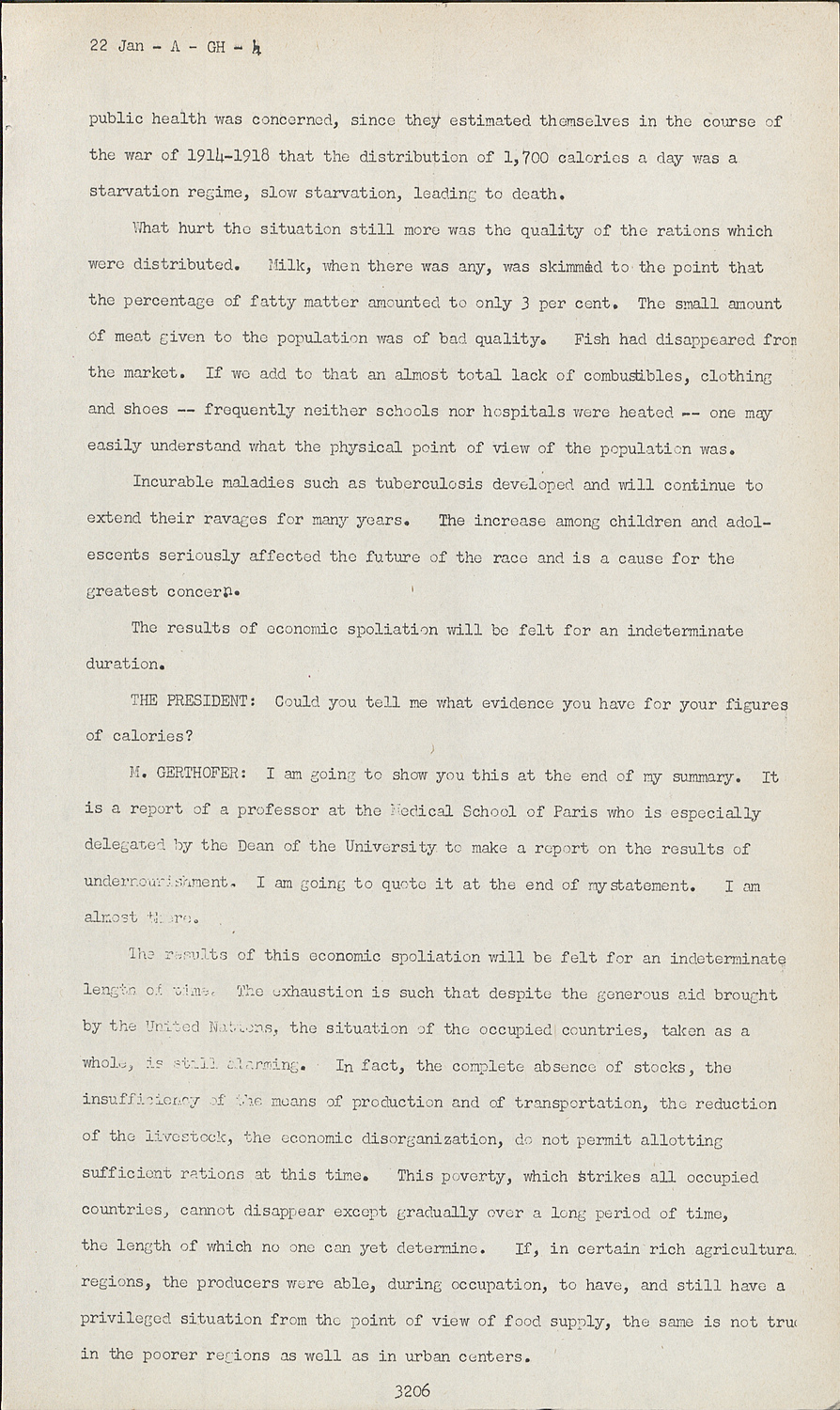
What hurt the situation still more was the quality of the rations which were distributed. Milk, when there was any, was skimmed to the point that the percentage of fatty matter amounted to only 3 per cent. The small amount of meat given to the population was of bad quality. Fish had disappeared from the market. If we add to that an almost total lack of combustibles, clothing and shoes -- frequently neither schools nor hospitals were heated -- one may easily understand what the physical point of view of the population was.
Incurable maladies such as tuberculosis developed and will continue to extend their ravages for many years. The increase among children and adolescents seriously affected the future of the race and is a cause for the greatest concern.
The results of economic spoliation will be felt for an indeterminate duration.
THE PRESIDENT:Could you tell me what evidence you have for your figures of calories?
M. GERTHOFER:I am going to show you this at the end of my summary. It is a report of a professor at the Medical School of Paris who is especially delegated by the Dean of the University to make a report on the results of undernourishment. I am going to quote it at the end of my statement. I am almost there.
The results of this economic spoliation will be felt for an indeterminate length of time. The exhaustion is such that despite the generous aid brought by the United Nations, the situation of the occupied countries, taken as a whole, is still alarming. In fact, the complete absence of stocks, the insufficiency of the means of production and of transportation, the reduction of the livestock, the economic disorganization, do not permit allotting sufficient rations at this time. This poverty, which strikes all occupied countries, cannot disappear except gradually over a long period of time, the length of which no one can yet determine. If, in certain rich agricultures regions, the producers were able, during occupation, to have, and still have a privileged situation from the point of view of food supply, the same is not true in the poorer regions as well as in urban centers.
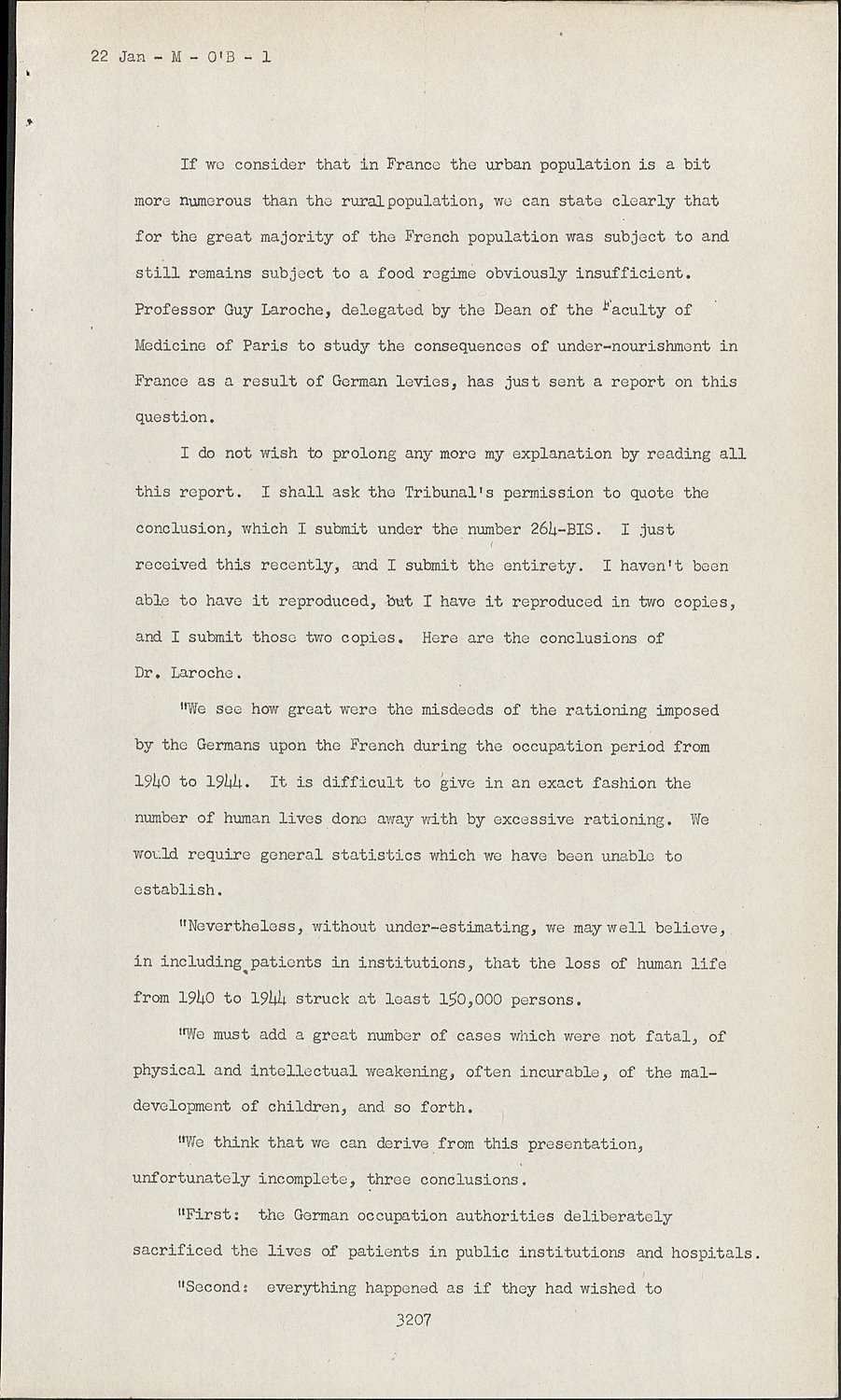
If we consider that in France the urban population is a bit more numerous than the rural population, we can state clearly that for the great majority of the French population was subject to and still remains subject to a food regime obviously insufficient.
Professor Guy Laroche, delegated by the Dean of the Faculty of Medicine of Paris to study the consequences of under-nourishment in France as a result of German levies, has just sent a report on this question.
I do not wish to prolong any more my explanation by reading all this report.
I shall ask the Tribunal's permission to quote the conclusion, which I submit under the number 264-BIS.
I just received this recently, and I submit the entirety.
I haven't been able to have it reproduced, but I have it reproduced in two copies, and I submit those two copies.
Here are the conclusions of Dr. Laroche.
"We see how great were the misdeeds of the rationing imposed by the Germans upon the French during the occupation period from 1940 to 1944.
It is difficult to give in an exact fashion the number of human lives done away with by excessive rationing.
We would require general statistics which we have been unable to establish.
"Nevertheless, without under-estimating, we may well believe, in including patients in institutions, that the loss of human life from 1940 to 1944 struck at least 150,000 persons.
"We must add a great number of cases which were not fatal, of physical and intellectual weakening, often incurable, of the mal development of children, and so forth.
"We think that we can derive from this presentation, unfortunately incomplete, three conclusions.
"First: the German occupation authorities deliberately sacrificed the lives of patients in public institutions and hospitals.
"Second: everything happened as if they had wished to organize in a rational and scientific fashion the weakening of the health of adolescents and adults.
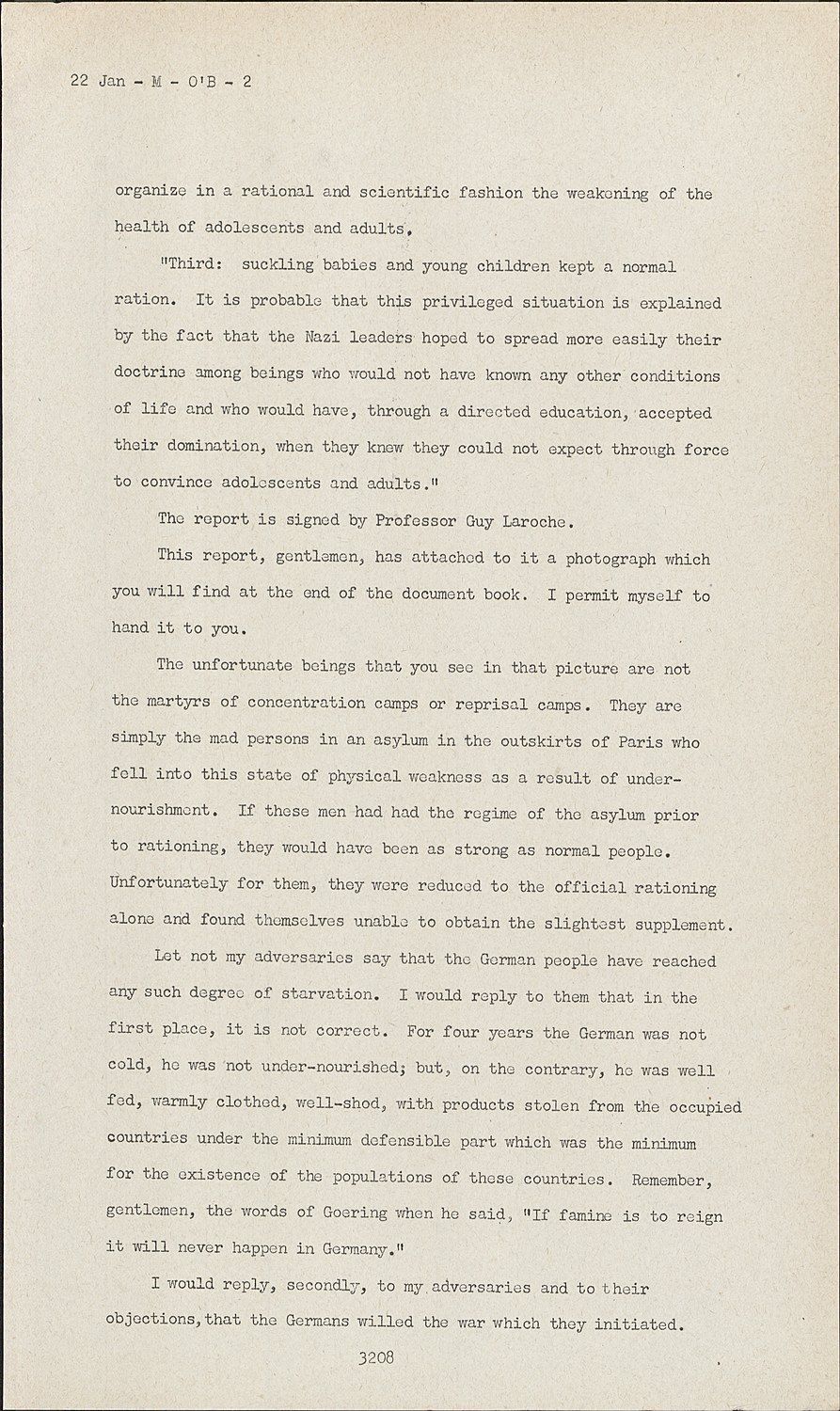
"Third: suckling babies and young children kept a normal ration.
It is probable that this privileged situation is explained by the fact that the Nazi leaders hoped to spread more easily their doctrine among beings who would not have known any other conditions of life and who would have, through a directed education, accepted their domination, when they knew they could not expect through force to convince adolescents and adults."
The report is signed by Professor Guy Laroche.
This report, gentlemen, has attached to it a photograph which you will find at the end of the document book.
I permit myself to hand it to you.
The unfortunate beings that you see in that picture are not the martyrs of concentration camps or reprisal camps.
They are simply the mad persons in an asylum in the outskirts of Paris who fell into this state of physical weakness as a result of under nourishment.
If these men had had the regime of the asylum prior to rationing, they would have been as strong as normal people.
Unfortunately for them, they were reduced to the official rationing alone and found themselves unable to obtain the slightest supplement.
Let not my adversaries say that the German people have reached any such degree of starvation.
I would reply to them that in the first place, it is not correct.
For four years the German was not cold, he was not under-nourished; but, on the contrary, he was well fed, warmly clothed, well-shod, with products stolen from the occupied countries under the minimum defensible part which was the minimum for the existence of the populations of these countries.
Remember, gentlemen, the words of Goering when he said, "If famine is to reign it will never happen in Germany."
I would reply, secondly, to my adversaries and to their objections, that the Germans willed the war which they initiated.
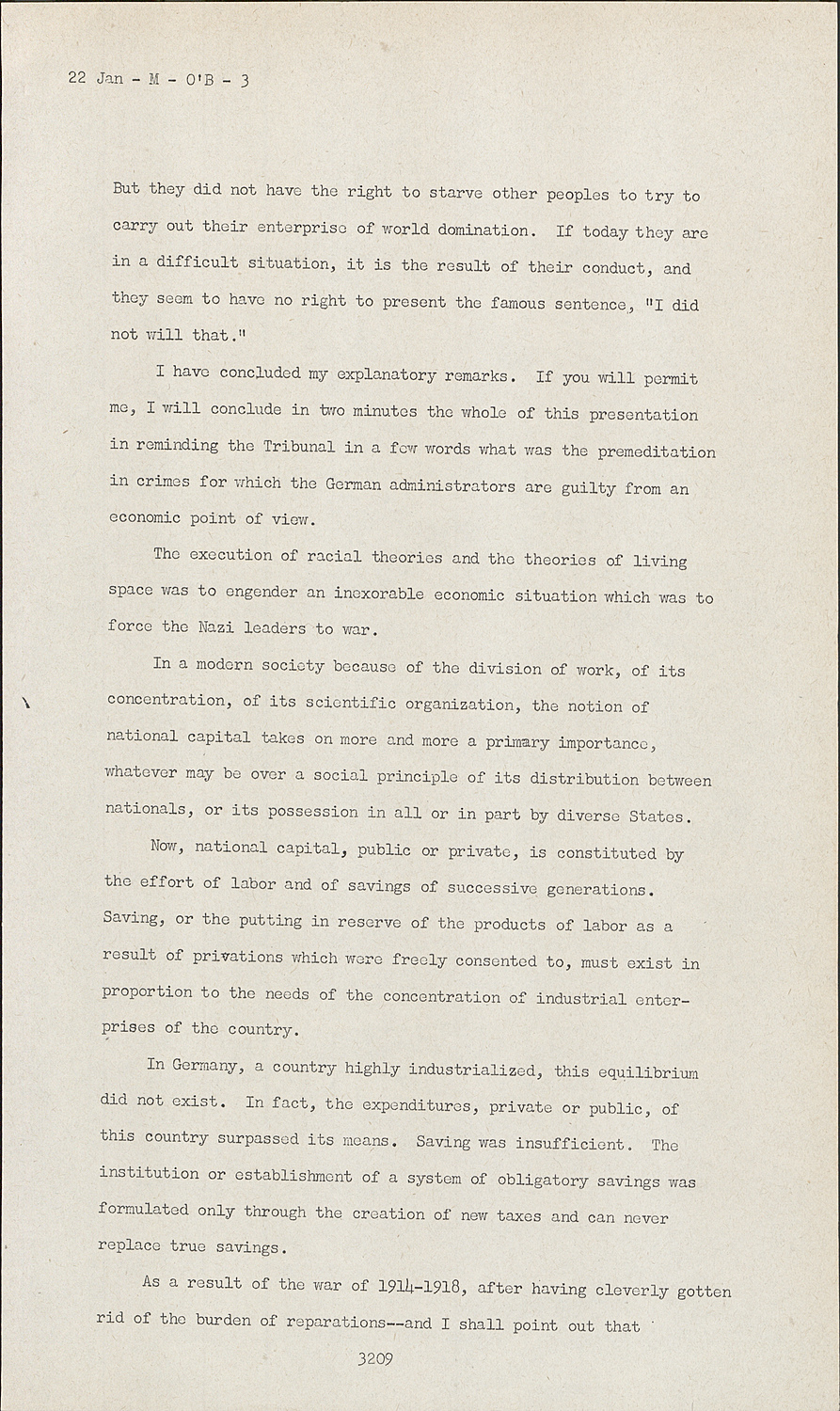
But they did not have the right to starve other peoples to try to carry out their enterprise of world domination.
If today they are in a difficult situation, it is the result of their conduct, and they seem to have no right to present the famous sentence, "I did not will that."
I have concluded my explanatory remarks. If you will permit me, I will conclude in two minutes the whole of this presentation in reminding the Tribunal in a few words what was the premeditation in crimes for which the German administrators are guilty from an economic point of view.
The execution of racial theories and the theories of living space was to engender an inexorable economic situation which was to force the Nazi leaders to war.
In a modern society because of the division of work, of its concentration, of its scientific organization, the notion of national capital takes on more and more a primary importance, whatever may be over a social principle of its distribution between nationals, or its possession in all or in part by diverse States.
Now, national capital, public or private, is constituted by the effort of labor and of savings of successive generations.
Saving, or the putting in reserve of the products of labor as a result of privations which were freely consented to, must exist in proportion to the needs of the concentration of industrial enter prises of the country.
In Germany, a country highly industrialized, this equilibrium did not exist.
In fact, the expenditures, private or public, of this country surpassed its means.
Saving was insufficient. The institution or establishment of a system of obligatory savings was formulated only through the creation of new taxes and can never replace true savings.
As a result of the war of 1914-1918, after having cleverly gotten rid of the burden of reparations--and I shall point out that two-thirds of the sum remained charged to France as far as this country is concerned--Germany, which really established its gold reserve in 1926, set about a policy of foreign borrowing and spent without counting.
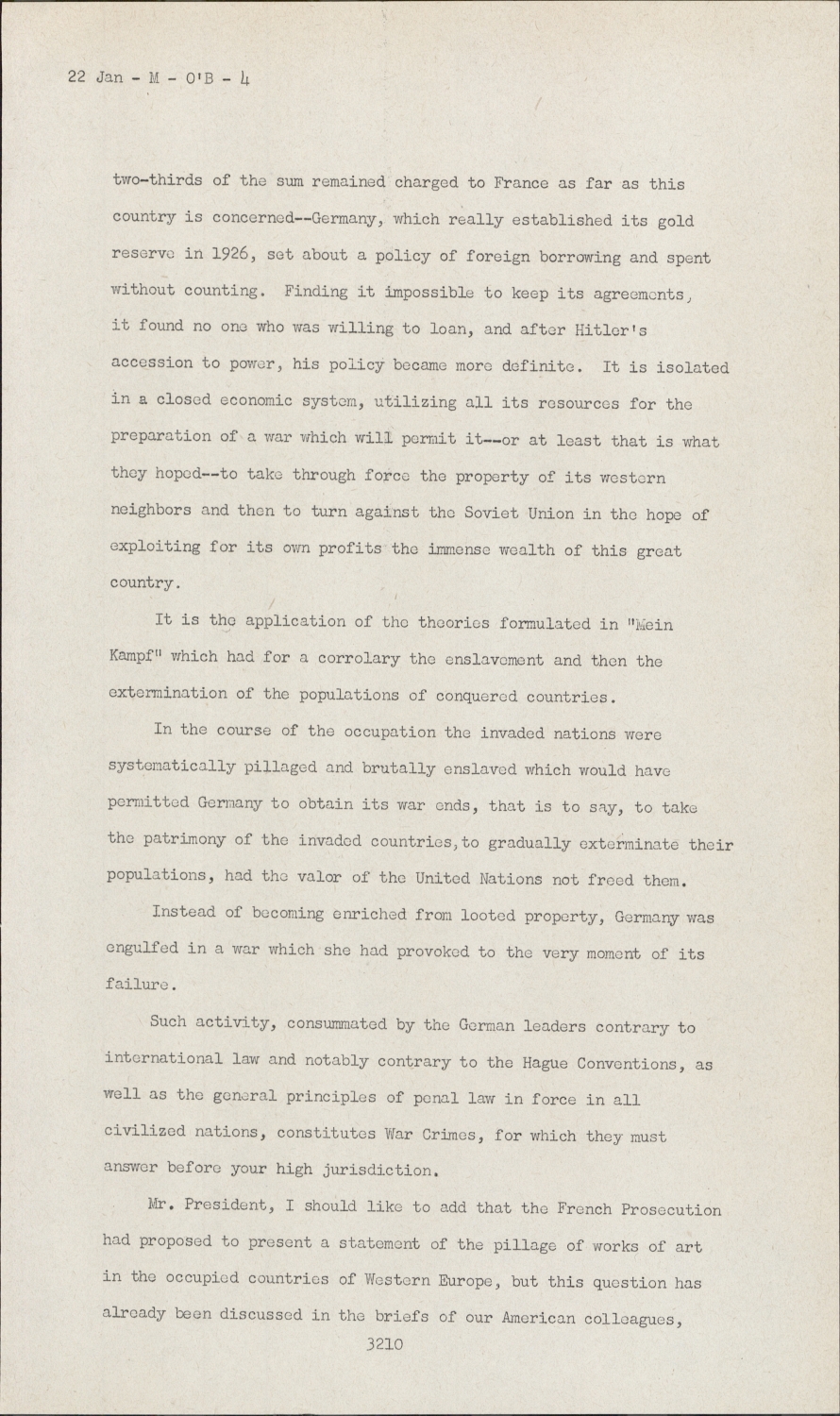
Finding it impossible to keep its agreements, it found no one who was willing to loan, and after Hitler's accession to power, his policy became more definite.
It is isolated in a closed economic system, utilizing all its resources for the preparation of a war which will permit it--or at least that is what they hoped--to take through force the property of its western neighbors and then to turn against the Soviet Union in the hope of exploiting for its own profits the immense wealth of this great country.
It is the application of the theories formulated in "Mein Kampf" which had for a corrolary the enslavement and then the extermination of the populations of conquered countries.
In the course of the occupation the invaded nations were systematically pillaged and brutally enslaved which would have permitted Germany to obtain its war ends, that is to say, to take the patrimony of the invaded countries, to gradually exterminate their populations, had the valor of the United Nations not freed them.
Instead of becoming enriched from looted property, Germany was engulfed in a war which she had provoked to the very moment of its failure.
Such activity, consummated by the German leaders contrary to international law and notably contrary to the Hague Conventions, as well as the general principles of penal law in force in all civilized nations, constitutes War Crimes, for which they must answer before your high jurisdiction.
Mr. President, I should like to add that the French Prosecution had proposed to present a statement of the pillage of works of art in the occupied countries of Western Europe, but this question has already been discussed in the briefs of our American colleagues, briefs which seem to us to establish without any question the responsibility of the Defendants.
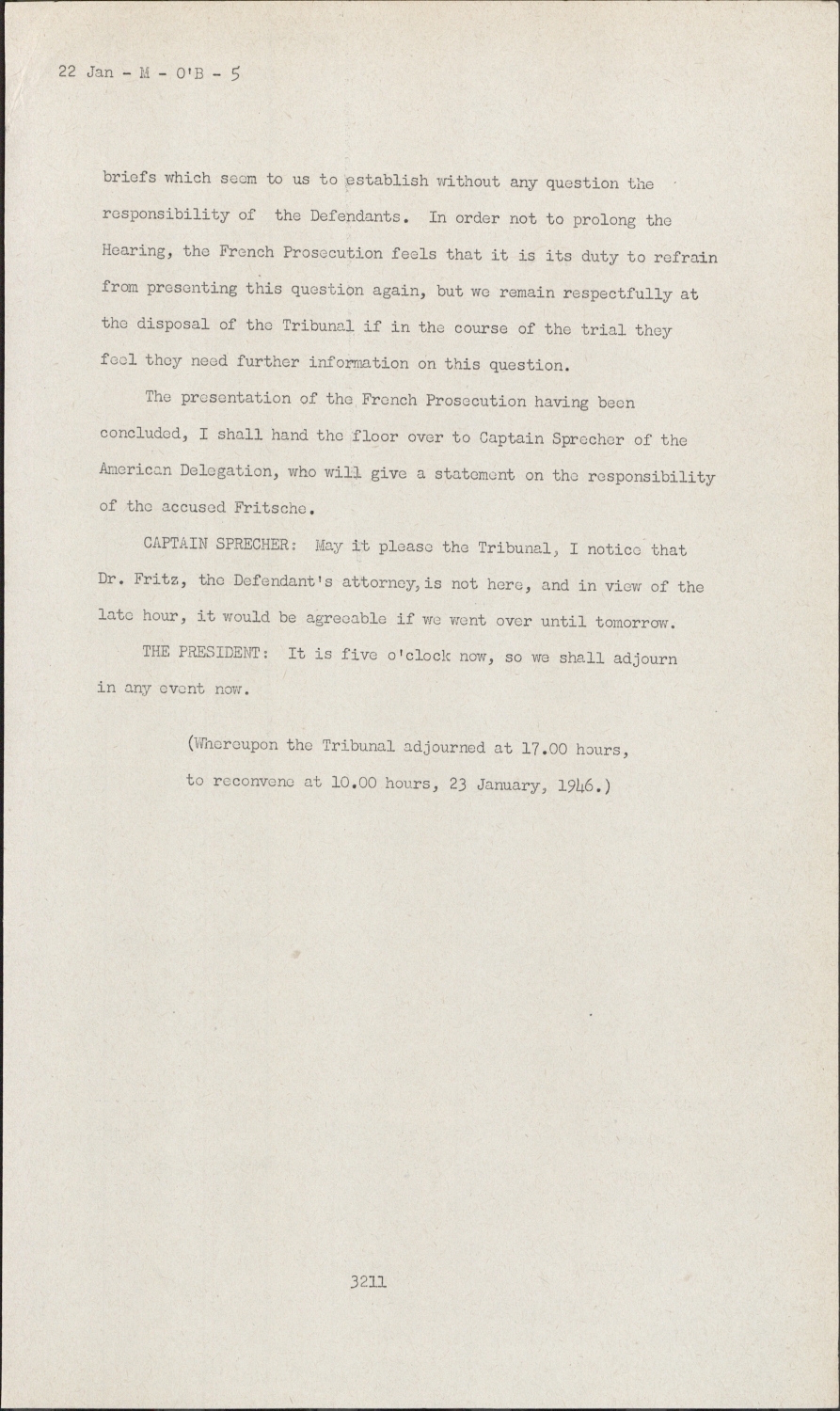
In order not to prolong the Hearing, the French Prosecution feels that it is its duty to refrain from presenting this question again, but we remain respectfully at the disposal of the Tribunal if in the course of the trial they feel they need further information on this question.
The presentation of the French Prosecution having been concluded, I shall hand the floor over to Captain Sprecher of the American Delegation, who will give a statement on the responsibility of the accused Fritsche.
CAPTAIN SPRECHER:May it please the Tribunal, I notice that Dr. Fritz, the Defendant's attorney, is not here, and in view of the late hour, it would be agreeable if we went over until tomorrow.
THE PRESIDENT:It is five o'clock now, so we shall adjourn in any event now.
(Whereupon the Tribunal adjourned at 17.00 hours, to reconvene at 10.
00 hours, 23 January, 1946.)