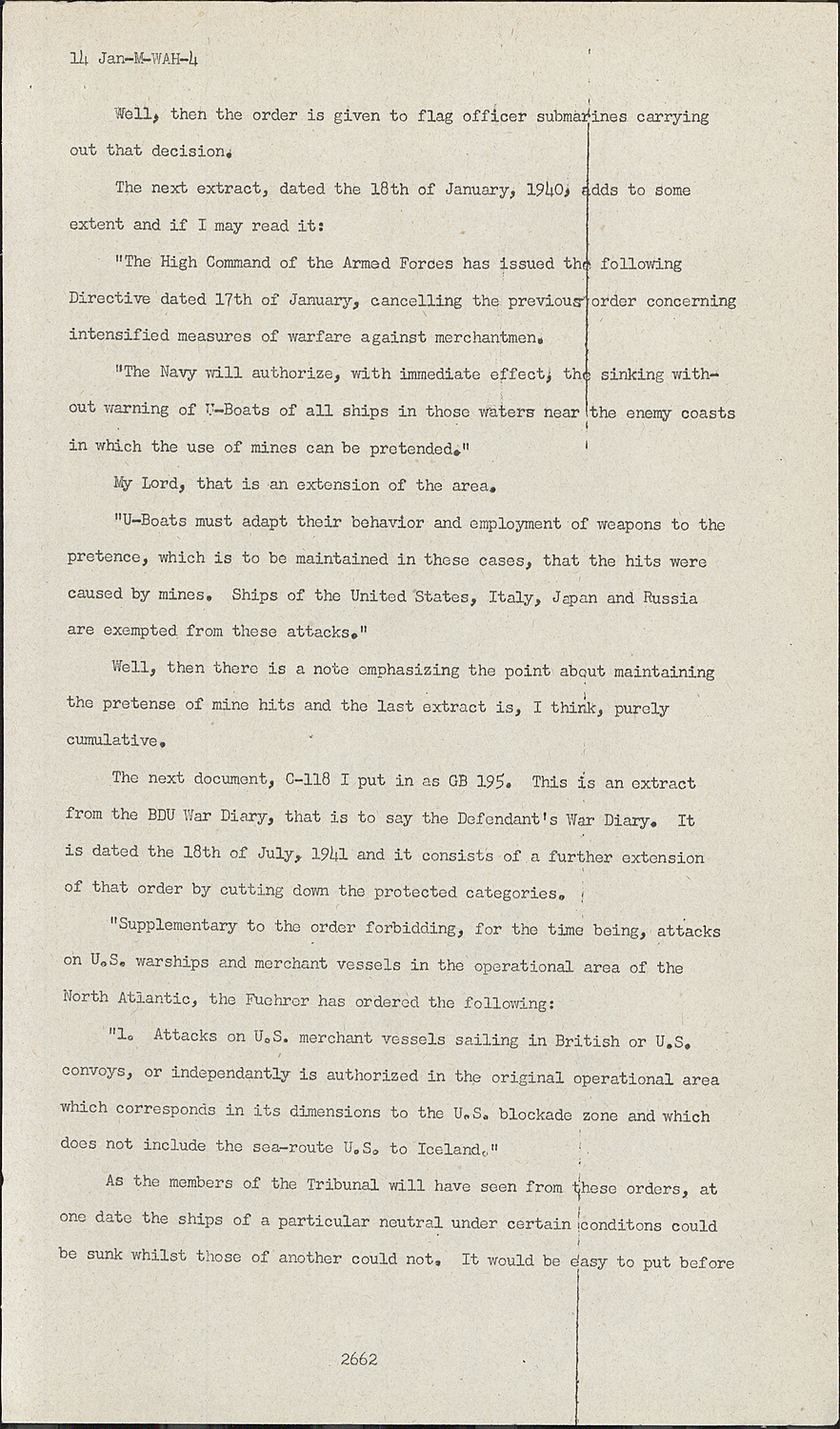
Well, then the order is given to flag officer submarines carrying out that decision.
The next extract, dated the 18th of January, 1940, adds to some extent and if I may read it:
"The High Command of the Armed Forces has issued the following Directive dated 17th of January, cancelling the previous order concerning intensified measures of warfare against merchantmen.
"The Navy will authorize, with immediate effect, the sinking without warning of U-Boats of all ships in those waters near the enemy coasts in which the use of mines can be pretended."
My Lord, that is an extension of the area.
"U-Boats must adapt their behavior and employment of weapons to the pretence, which is to be maintained in these cases, that the hits were caused by mines. Ships of the United States, Italy, Japan and Russia are exempted from these attacks."
Well, then there is a note emphasizing the point about maintaining the pretense of mine hits and the last extract is, I think, purely cumulative.
The next document, C-118 I put in as GB 195. This is an extract from the BDU War Diary, that is to say the Defendant's War Diary. It is dated the 18th of July, 1941 and it consists of a further extension of that order by cutting down the protected categories.
"Supplementary to the order forbidding, for the time being, attacks on U.S. warships and merchant vessels in the operational area of the North Atlantic, the Fuehrer has ordered the following:
"1. Attacks on U.S. merchant vessels sailing in British or U.S. convoys, or independantly is authorized in the original operational area which corresponds in its dimensions to the U.S. blockade zone and which does not include the sea-route U.S. to Iceland."
As the members of the Tribunal will have seen from these orders, at one date the ships of a particular neutral under certain conditons could be sunk whilst those of another could not. It would be easy to put before the Tribunal a mass of orders and instances to show that the attitude to be adopted toward ships of particular neutrals changed at various times.
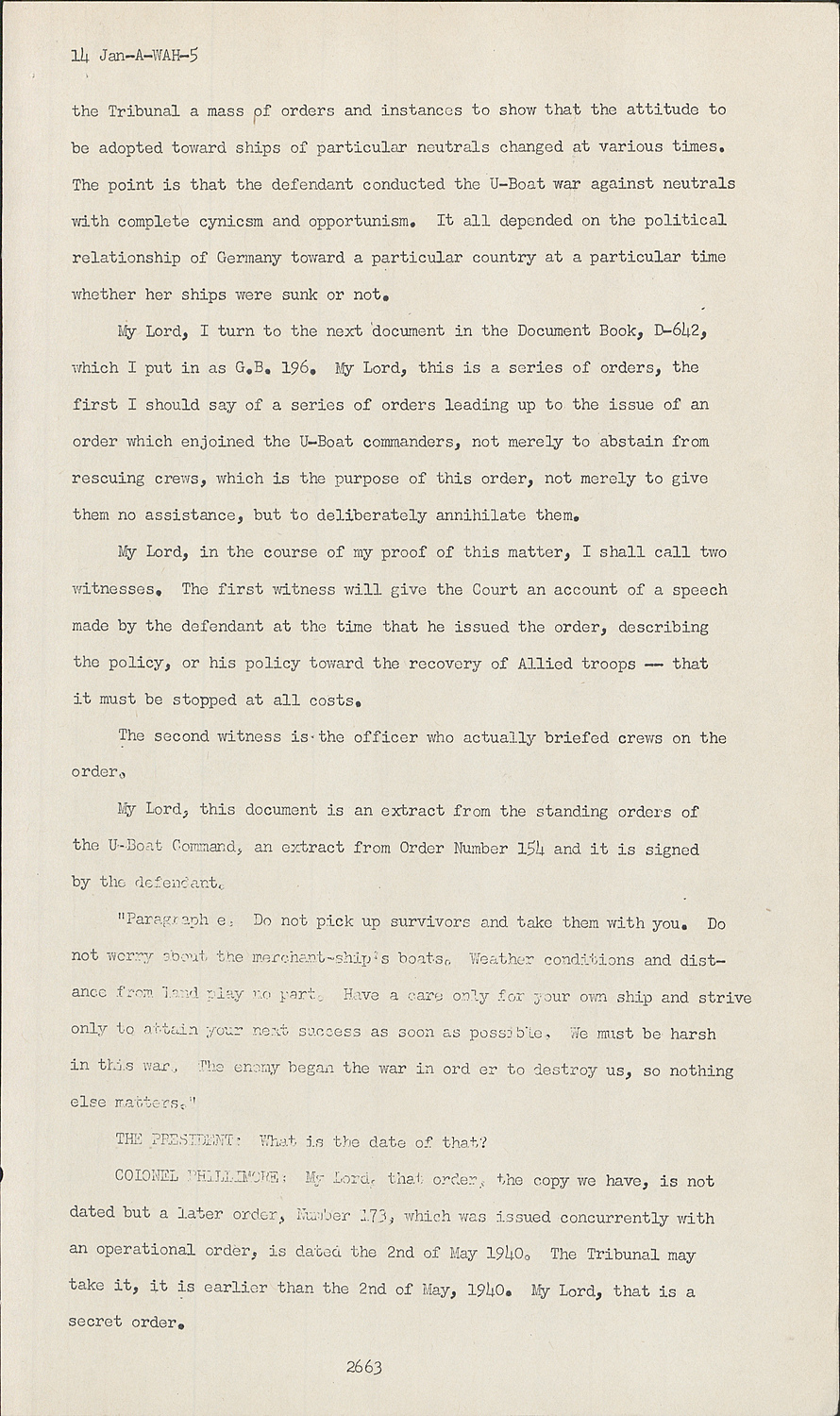
The point is that the defendant conducted the U-Boat war against neutrals with complete cynicsm and opportunism. It all depended on the political relationship of Germany toward a particular country at a particular time whether her ships were sunk or not.
My Lord, I turn to the next document in the Document Book, D-642, which I put in as G.B. 196. My Lord, this is a series of orders, the first I should say of a series of orders leading up to the issue of an order which enjoined the U-Boat commanders, not merely to abstain from rescuing crews, which is the purpose of this order, not merely to give them no assistance, but to deliberately annihilate them.
My Lord, in the course of my proof of this matter, I shall call two witnesses. The first witness will give the Court an account of a speech made by the defendant at the time that he issued the order, describing the policy, or his policy toward the recovery of Allied troops -- that it must be stopped at all costs.
The second witness is the officer who actually briefed crews on the order.
My Lord, this document is an extract from the standing orders of the U-Boat Command, an extract from Order Number 154 and it is signed by the defendant.
"Paragraph e: Do not pick up survivors and take them with you. Do not worry about the merchant-ship's boats. Weather conditions and distance from land play no part. Have a care only for your own ship and strive only to attain your next success as soon as possible. We must be harsh in this war. The enemy began the war in ord er to destroy us, so nothing else matters."
THE PRESIDENT:What is the date of that?
COLONEL PHILLIMORE:My Lord, that order the copy we have, is not dated but a later order, Number 173, which was issued concurrently with an operational order, is dated the 2nd of May 1940. The Tribunal may take it, it is earlier than the 2nd of May, 1940. My Lord, that is a secret order.
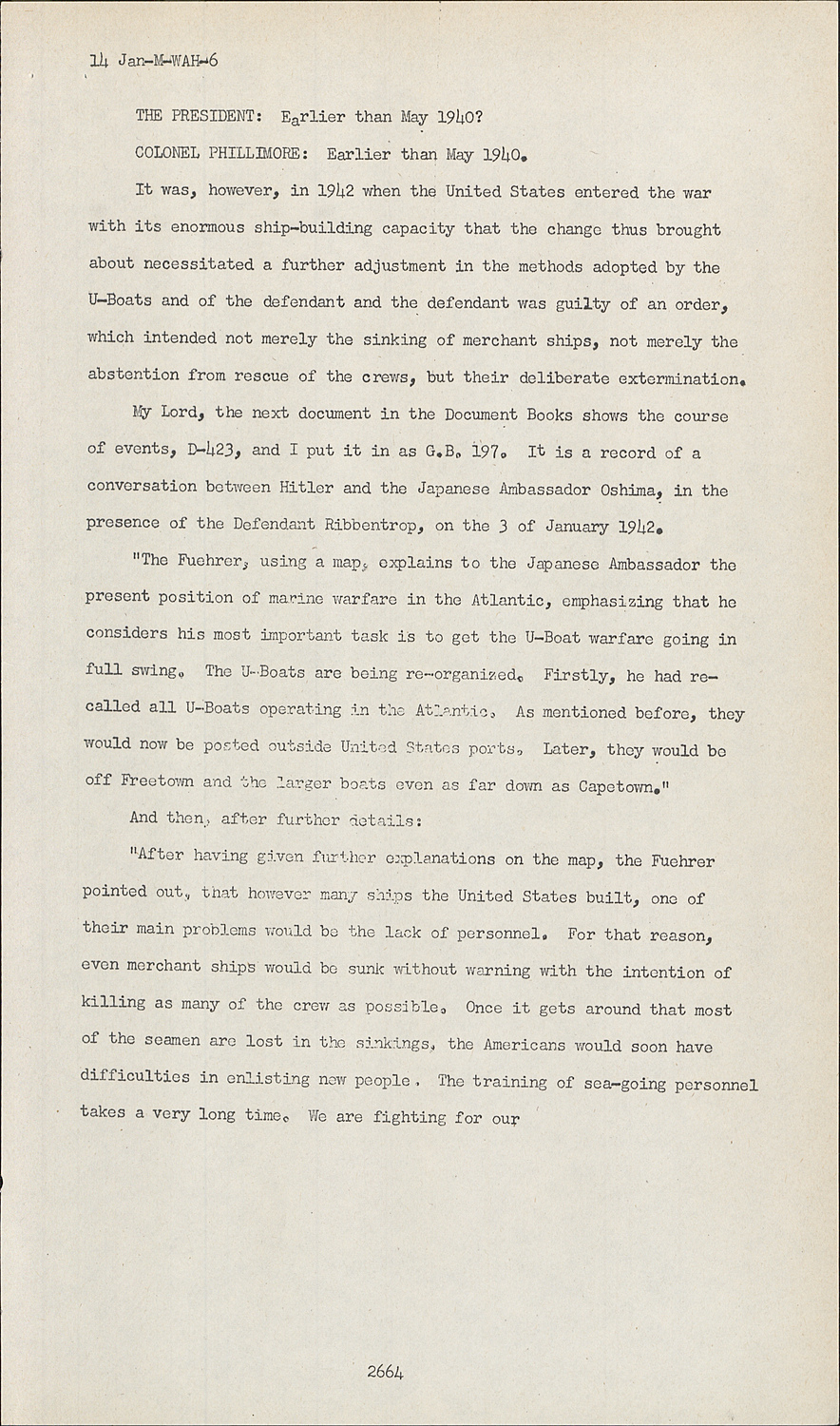
THE PRESIDENT: Earlier than May 1940?
COLONEL PHILLIMORE:Earlier than May 1940.
It was, however, in 1942 when the United States entered the war with its enormous ship-building capacity that the change thus brought about necessitated a further adjustment in the methods adopted by the U-Boats and of the defendant and the defendant was guilty of an order, which intended not merely the sinking of merchant ships, not merely the abstention from rescue of the crews, but their deliberate extermination.
My Lord, the next document in the Document Books shows the course of events, D-423, and I put it in as G.B. 197. It is a record of a conversation between Hitler and the Japanese Ambassador Oshima, in the presence of the Defendant Ribbentrop, on the 3 of January 1942.
"The Fuehrer, using a map, explains to the Japanese Ambassador the present position of marine warfare in the Atlantic, emphasizing that he considers his most important task is to get the U-Boat warfare going in full swing. The U-Boats are being re-organized. Firstly, he had recalled all U-Boats operating in the Atlantic. As mentioned before, they would now be posted outside United States ports. Later, they would be off Freetown and the larger boats even as far down as Capetown."
And then, after further details:
"After having given further explanations on the map, the Fuehrer pointed out, that however many ships the United States built, one of their main problems would be the lack of personnel. For that reason, even merchant ships would be sunk without warning with the intention of killing as many of the crew as possible. Once it gets around that most of the seamen are lost in the sinkings, the Americans would soon have difficulties in enlisting new people. The training of sea-going personnel takes a very long time. We are fighting for our existence and our attitude cannot be ruled by any humane feelings.
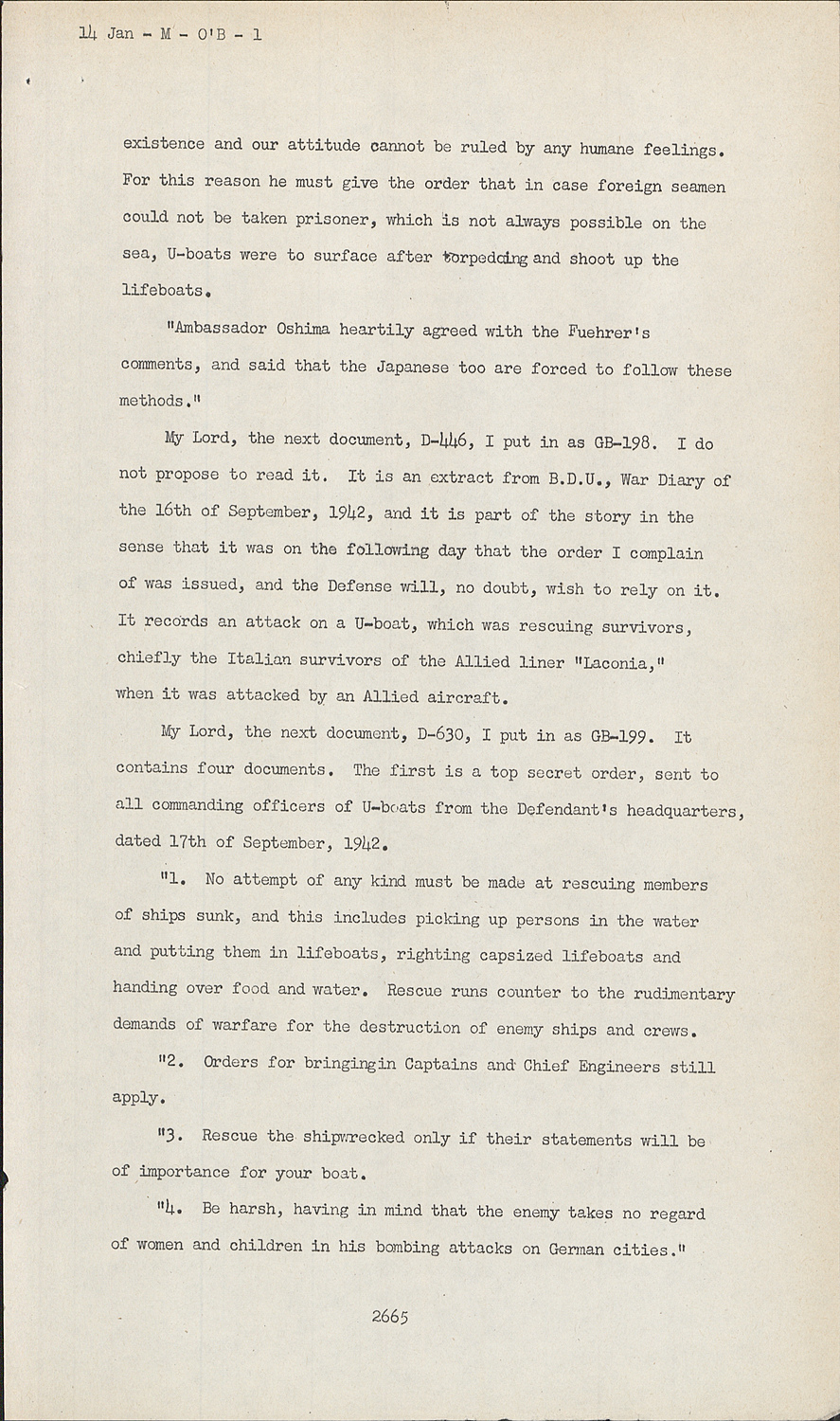
For this reason he must give the order that in case foreign seamen could not be taken prisoner, which is not always possible on the sea, U-boats were to surface after torpedoing and shoot up the lifeboats.
"Ambassador Oshima heartily agreed with the Fuehrer's comments, and said that the Japanese too are forced to follow these methods."
My Lord, the next document, D-446, I put in as GB-198. I do not propose to read it.
It is an extract from B.D.U., War Diary of the 16th of September, 1942, and it is part of the story in the sense that it was on the following day that the order I complain of was issued, and the Defense will, no doubt, wish to rely on it.
It records an attack on a U-boat, which was rescuing survivors, chiefly the Italian survivors of the Allied liner "Laconia," when it was attacked by an Allied aircraft.
My Lord, the next document, D-630, I put in as GB-199. It contains four documents.
The first is a top secret order, sent to all commanding officers of U-boats from the Defendant's headquarters, dated 17th of September, 1942.
"1. No attempt of any kind must be made at rescuing members of ships sunk, and this includes picking up persons in the water and putting them in lifeboats, righting capsized lifeboats and handing over food and water.
Rescue runs counter to the rudimentary demands of warfare for the destruction of enemy ships and crews.
"2. Orders for bringingin Captains and Chief Engineers still apply.
"3. Rescue the shipwrecked only if their statements will be of importance for your boat.
"4. Be harsh, having in mind that the enemy takes no regard of women and children in his bombing attacks on German cities."
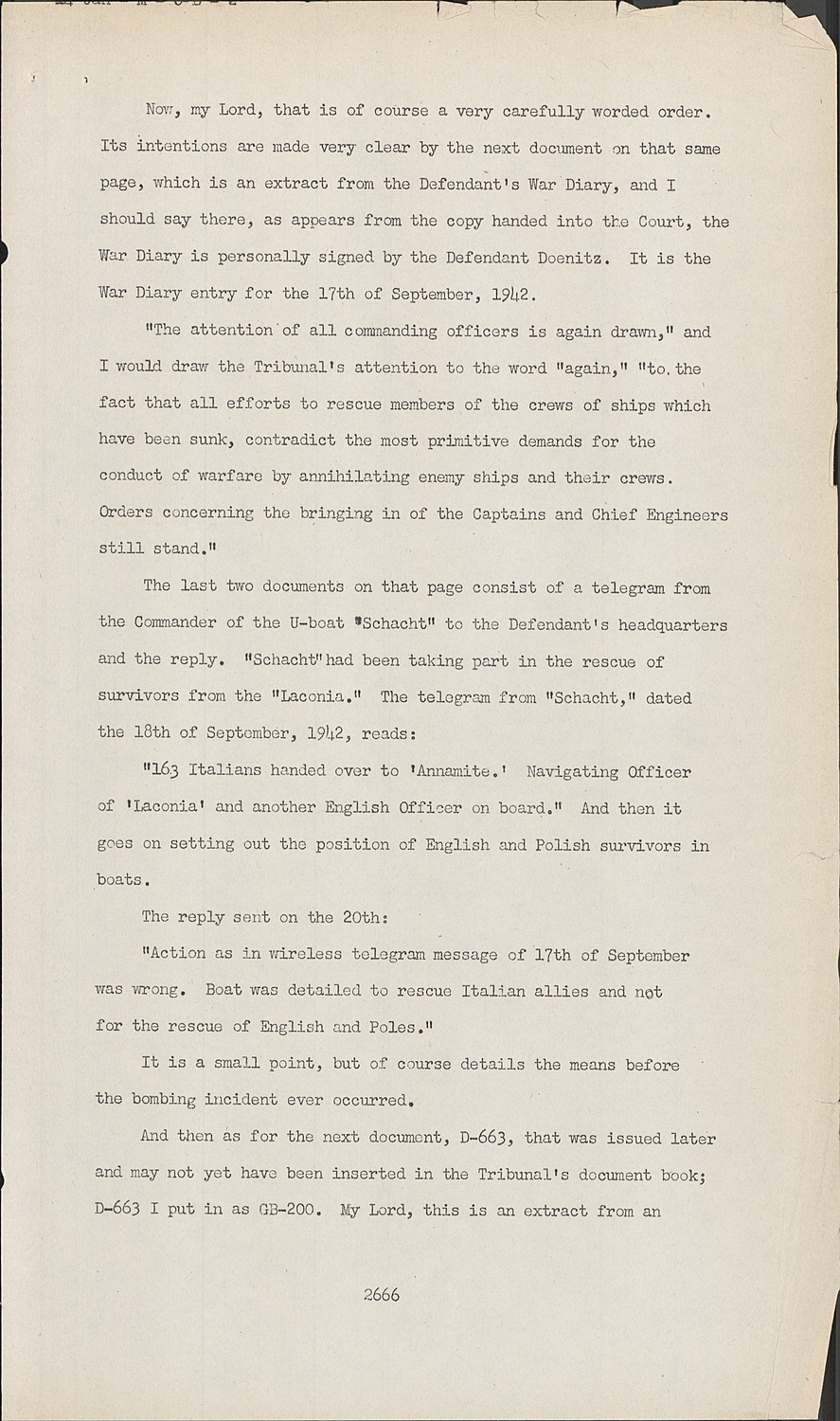
Now, my Lord, that is of course a very carefully worded order.
Its intentions are made very clear by the next document on that same page, which is an extract from the Defendant's War Diary, and I should say there, as appears from the copy handed into the Court, the War Diary is personally signed by the Defendant Doenitz.
It is the War Diary entry for the 17th of September, 1942.
"The attention of all commanding officers is again drawn," and I would draw the Tribunal's attention to the word "again," "to the fact that all efforts to rescue members of the crews of ships which have been sunk, contradict the most primitive demands for the conduct of warfare by annihilating enemy ships and their crews.
Orders concerning the bringing in of the Captains and Chief Engineers still stand."
The last two documents on that page consist of a telegram from the Commander of the U-boat "Schacht" to the Defendant's headquarters and the reply.
"Schacht" had been taking part in the rescue of survivors from the "Laconia."
The telegram from "Schacht," dated the 18th of September, 1942, reads:
"163 Italians handed over to 'Annamite.' Navigating Officer of 'Laconia' and another English Officer on board."
And then it goes on setting out the position of English and Polish survivors in boats.
The reply sent on the 20th:
"Action as in wireless telegram message of 17th of September was wrong.
Boat was detailed to rescue Italian allies and not for the rescue of English and Poles."
It is a small point, but of course details the means before the bombing incident ever occurred.
And then as for the next document, D-663, that was issued later and may not yet have been inserted in the Tribunal's document book;D-663 I put in as GB-200.
My Lord, this is an extract from an operation order, "Operation Order Atlantic No. 56," dated the 7th of October, 1943, and the copy put in is part of sailing orders to a U-boat.
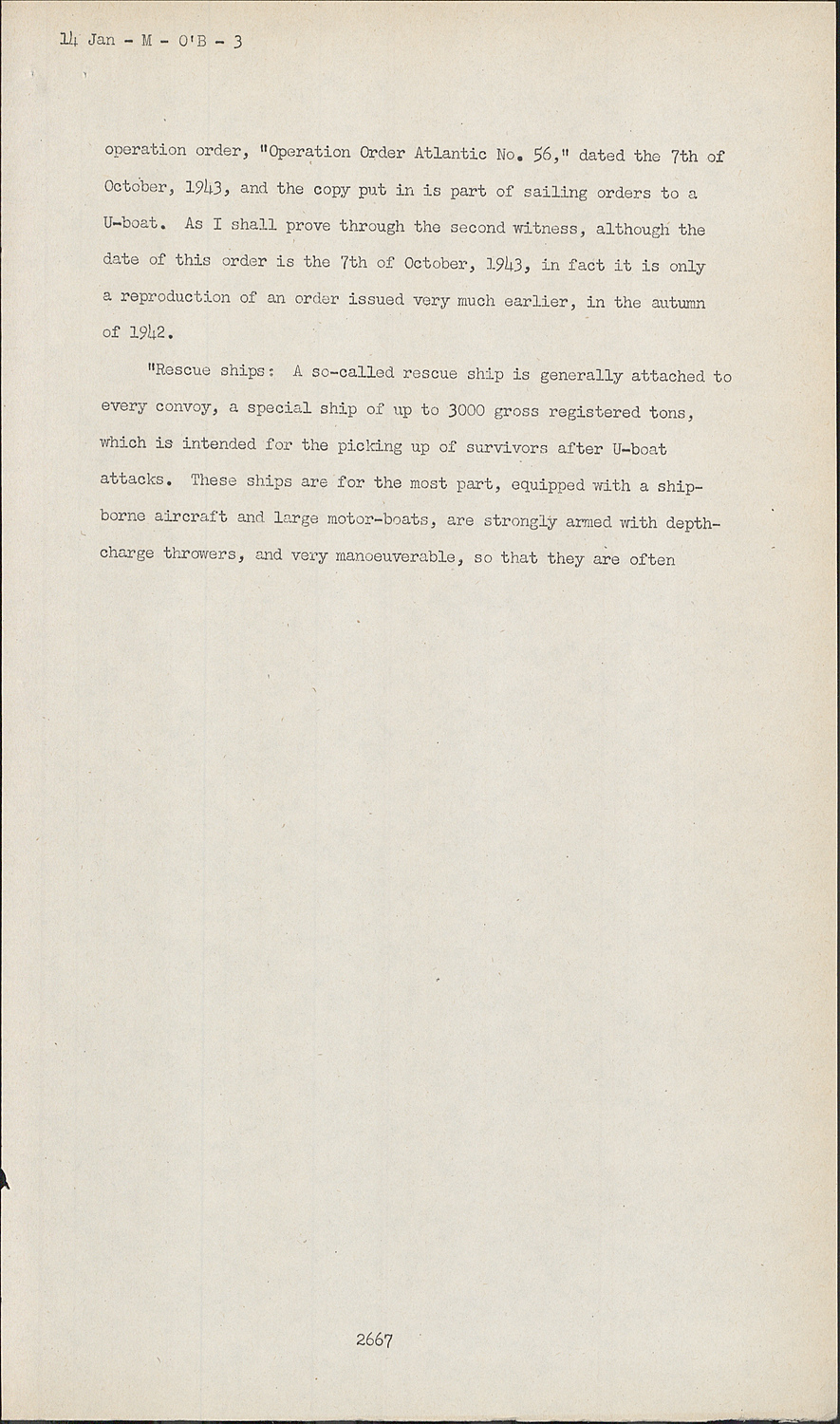
As I shall prove through the second witness, although the date of this order is the 7th of October, 1943, in fact it is only a reproduction of an order issued very much earlier, in the autumn of 1942.
"Rescue ships: A so-called rescue ship is generally attached to every convoy, a special ship of up to 3000 gross registered tons, which is intended for the picking up of survivors after U-boat attacks.
These ships are for the most part, equipped with a ship borne aircraft and large motor-boats, are strongly armed with depth charge throwers, and very manoeuverable, so that they are often called U-boat traps by the commander."
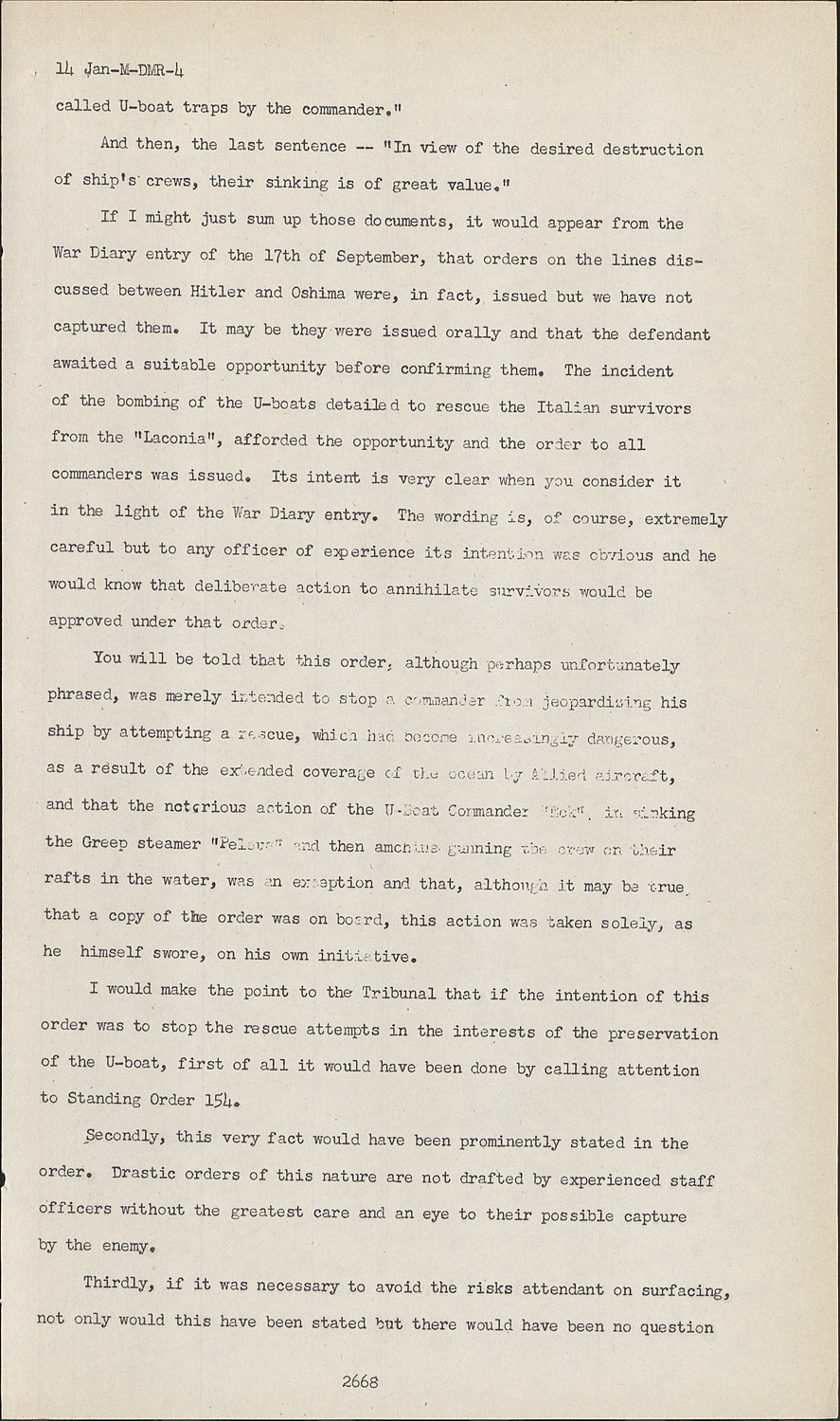
And then, the last sentence -- "In view of the desired destruction of ship's crews, their sinking is of great value."
If I might just sum up those documents, it would appear from the War Diary entry of the 17th of September, that orders on the lines discussed between Hitler and Oshima were, in fact, issued but we have not captured them. It may be they were issued orally and that the defendant awaited a suitable opportunity before confirming them. The incident of the bombing of the U-boats detailed to rescue the Italian survivors from the "Laconia", afforded the opportunity and the order to all commanders was issued. Its intent is very clear when you consider it in the light of the War Diary entry. The wording is, of course, extremely careful but to any officer of experience its intention was obvious and he would know that deliberate action to annihilate survivors would be approved under that order.
You will be told that this order, although perhaps unfortunately phrased, was merely intended to stop a commander from jeopardizing his ship by attempting a rescue, which had become increasingly dangerous, as a result of the extended coverage of the ocean Allied aircraft, and that the notorious action of the U-Boat Commander "Eck" in sinking the Greep steamer "Peleus" and then amchine gunning the crew on their rafts in the water, was an exception and that, although it may be true that a copy of the order was on board, this action was taken solely, as he himself swore, on his own initiative.
I would make the point to the Tribunal that if the intention of this order was to stop the rescue attempts in the interests of the preservation of the U-boat, first of all it would have been done by calling attention to Standing Order 154.
Secondly, this very fact would have been prominently stated in the order. Drastic orders of this nature are not drafted by experienced staff officers without the greatest care and an eye to their possible capture by the enemy.
Thirdly, if it was necessary to avoid the risks attendant on surfacing, not only would this have been stated but there would have been no question of taking any prisoners at all except possibly in circumstances where virtually no risk in surfacing was to be apprehended.
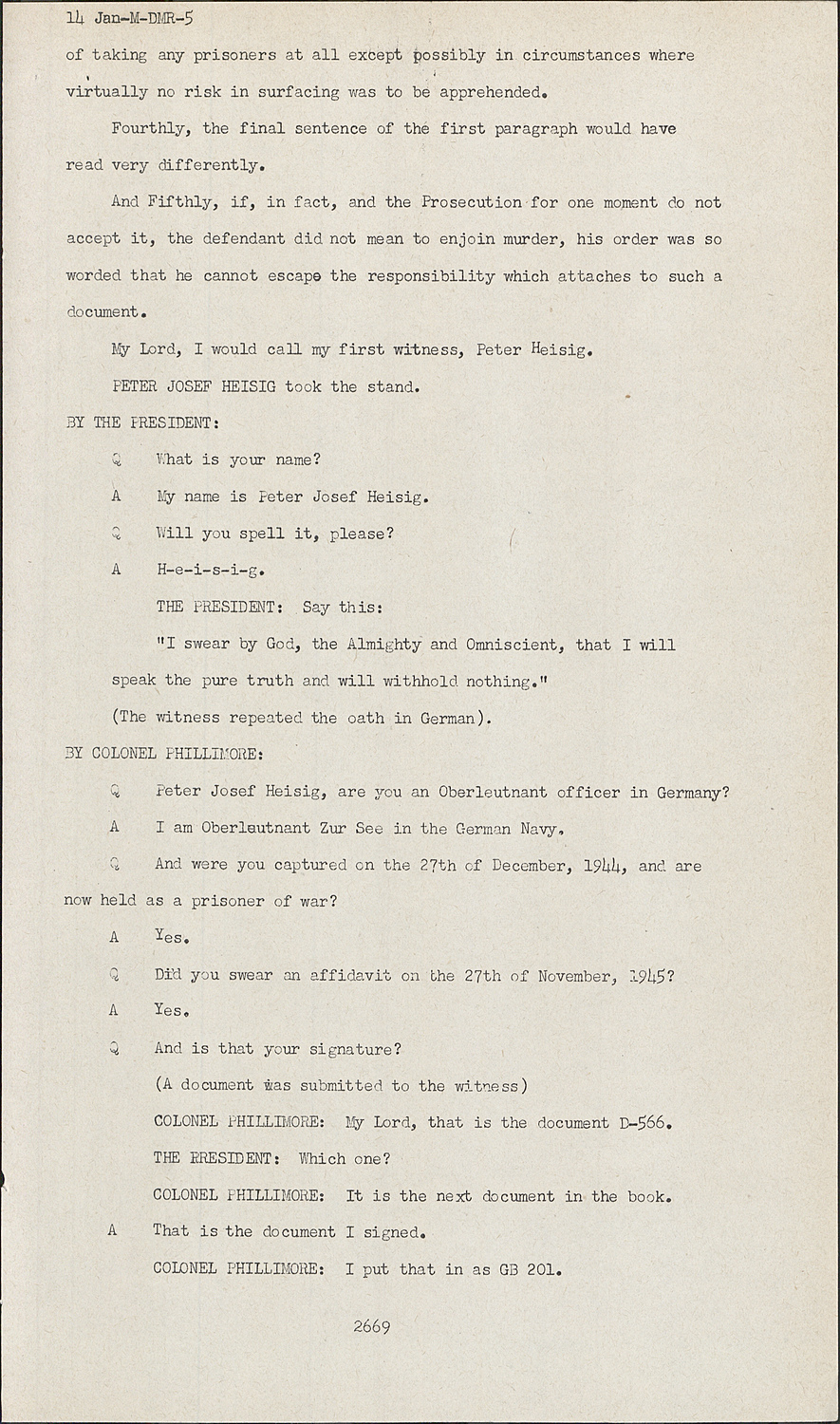
Fourthly, the final sentence of the first paragraph would have read very differently.
And Fifthly, if, in fact, and the Prosecution for one moment do not accept it, the defendant did not mean to enjoin murder, his order was so worded that he cannot escape the responsibility which attaches to such a document.
My Lord, I would call my first witness, Peter Heisig.
PETER JOSEFHEISIG took the stand. BY THE PRESIDENT:
QWhat is your name?
AMy name is Peter Josef Heisig.
QWill you spell it, please?
AH-e-i-s-i-g.
THE PRESIDENT:Say this:
"I swear by God, the Almighty and Omniscient, that I will speak the pure truth and will withhold nothing."
(The witness repeated the oath in German). BY COLONEL PHILLIMORE:
QPeter Josef Heisig, are you an Oberleutnant officer in Germany?
AI am Oberleutnant Zur See in the German Navy.
QAnd were you captured on the 27th of December, 1944, and are now held as a prisoner of war?
AYes.
QDid you swear an affidavit on the 27th of November, 1945?
AYes.
QAnd is that your signature?
(A document was submitted to the witness)
COLONEL PHILLIMORE:My Lord, that is the document D-566.
THE PRESIDENT:Which one?
COLONEL PHILLIMORE:It is the next document in the book.
AThat is the document I signed.
COLONEL PHILLIMORE:I put that in as GB 201.
BY COLONEL PHILLIMORE:
QWill you take your mind back to the autumn of 1942? What rank did you hold at that time?
AI was Midshipman at the second U-Boat Training Division.
QWere you attending a course there?
AI took part at the training course for U-Boat Officers of the Watch.
QDo you remember the last day of the course?
AOn the last clay of the course, Gross Admiral Doenitz, who was then Commander in Chief of the U-Boats, held an inspection tour of this second training division.
QAnd what happened at the end of his tour?
AAt the end of his visit -- not at the end of his visit, but rather during his visit, Grand Admiral Doenitz gave a speech to the officers who were being trained there.
Q Can you fix the date of this visit?
AI remember the approximate date; it must have been at the end of September or the beginning of October 1942.
QNow, will you give the Tribunal -- speaking slowly -- an account of what Admiral Doenitz said in his speech?
AGrand Admiral Doenitz, in his speech, made the point clear that the successes of the U-boats had gone back, and enemy activities were the cause of that. New ack ack guns had been developed, which was to make it possible for the U-boats to fight off enemy aircraft. Hitler had personally given the assurance that U-boats had received a priority over all other form of weapons and were to be equipped with these ack ack guns. It was to be expected that the old successes were to be reached again in a few months.
Grand Admiral Doenitz then mentioned his friendship and agreement with Hitler, and spoke about the German armament program.
There was a question about another matter, regarding an article in the paper. Since the United Nations were building more than a million tons of merchant shipping, Grand Admiral Doenitz covered this point. He doubted, at first, the credibility of this report and said that a figure by President Roosevelt was the basis of this report. Grand Admiral Doenitz then shortly mentioned Roosevelt personally, about the American production program and the potential program. He further mentioned that the Allies had a great difficulty, and that was commands of their ships. There was a shortage of personnel for their ships. Seamen considered the route across the Atlantic very dangerous because German U-boats were sinking Allied ships in great numbers, and many of the Allied seamen had been torpedoed more than once. News like that spreads, and seamen are kept back from going to sea once more. Some of them were trying to evade Atlantic duty so that the Allied authorities were forced, if it should be possible to impress the seamen.
These signs are considered favorable by the Germans, firstly, that the Allies are manufacturing much shipping; and, on the second point, that the Allies have many difficulties in manning these newly built ships.
This was the statement by Grand Admiral Doenitz. The personnel problem of the Allies is very serious; the losses of personnel are hitting the Allies especially hard, for one reason because they have few reserves and, on the other hand, -Q (Interposing): I don't want to interrupt you, but did he say anything about rescues at all?
You have told us about the Allied losses and how serious they were.
AYes, he mentioned rescues, but I would like to speak about that later.
Grand Admiral Doenitz mentioned that the losses of the Allies were heavy, first of all because they had no reserves and, for the second reason, that the training of seamen takes a long time, and he could not understand how, at this point, the boats -
THEPRESIDENT (Interposing): Just a moment. I don't think we want to hear the whole of Admiral Doenitz' speech. "e want to hear the material parts of it.
COLONEL PHILLIMORE:No, my Lord. BY COLONEL PHILLIMORE:
QNow, you have dealt with the question of losses. Will you come to the crucial part of the speech, at the end, and deal with that? What did the Grand Admiral go on to say?
DR. THOMA:The testimony of the witness does not concern me directly, but I have certain problems that -
THEPRESIDENT (Interposing): Just a moment. Will you state who you are and whom you appear for? You are Dr. Thoma, are you not?
DR. THOMA:Yes.
THE PRESIDENT:And whom do you appear for?
DR. THOMA:Rosenberg.
THE PRESIDENT:Yes.
DR. THOMA:According to German law, and German criminal law, the witness has to tell everything that he knows about a matter. If he is asked about a speech by Grand Admiral Doenitz, then he may not -- at least according to German law -- enumerate those things to the Tribunal, which, according to the opinions of the Prosecution, are unfavorable to the Defendant. I believe that this basic principle should apply, that if a witness is questioned in these proceedings the same principle applies also.
THE PRESIDENT:This Tribunal is not governed by German law. I have already stated that the Tribunal does not desire to hear the whole of the speech of Admiral Doenitz. That is all.
DR. THOMA:I beg your pardon. I did not hear all of this explanation.
THE PRESIDENT:What I said was that the Tribunal is not bound by German law, and that I have already said that the Tribunal did not desire to hear from this witness all of Admiral Doenitz' speech.
It will be open to any of the counsel for the defendants to cross-examine this witness.
Your intervention is therefore entirely unnecessary, BY COLONEL PHILLIMORE:
QNow, will you deal with the crucial parts of the Grand Admiral's speech?
AGrand Admiral Doenitz continued his speech as follows: Under the given situation he could not understand how German U-boats, contrary to their own safety, would let the ships be saved; it would be absolutely working for the enemy, and these rescued crews would travel again on newer command ships.
Now, the total war at sea was to be instituted. The men -- the seamen -- were to be a target for the U-boats, as well as the ships, and through this it was to be made impossible for the Allies to use this personnel again on a new ship. On the other hand, it was to be expected that in America and the other allied countries a strike was to be expected, for already a part of the seamen did not want to go back to sea.
Now if, according to our tactics, the sea war was to be harsher, it would have heavy respercussions along those lines. If this line is considere harsh, we should also remember that our wives and our families at home were being bombed.
That was the speech of Grand Admiral Doenitz in its main points.
QNow, about how many officers were present and heard that speech?
AI have nothing practical to give you the number of men, I can only give you an estimate. I would say roughly 120 officers,
COLONEL PHILLIMORE:My Lord, the witness is available for crossexamination.
THE PRESIDENT:Does the United States Prosecutor wish to ask any question?
(No response)
The Soviet Prosecutor?
(No response)
The French Prosecutor?
(No response).
Now, any of the defendants' counsel may cross-examine the witness.
DR. KRANZBUEHLER:Sir.
THE PRESIDENT:Are you counsel for Doenitz?
DR. KRANZBUEHLER:I represent Grand Admiral Doenitz.
THE PRESIDENT:Counsel will understand that what I said to Dr. Thoma was not intended to interfere with your cross-examination; it was only intended to save time. The Tribunal did not desire to hear unimportant passages in the Defendant Doenitz' speech. Therefore, they did not want to hear them from this witness. However, you are at liberty to ask any questions that you please.
BY DR. KRANZBUEHLER:
QYou are that Peter Josef Heisig that you say you are?
AYes.
QOn which boat were you, and who was your commander?
AI was on 877 and Finkeisen was the Commander.
QPlease repeat your answer.
AI was on U-877, and the Commander was Finkeisen.
QWere you successful?
AThe boat was brought into -- the boat was sunk.
QBefore you had ever sunk an enemy ship?
AYes.
QWhich enemy weapon?
AA depth charge sunk us. Two Canadian frigates had sighted our U-boat and destroyed it through depth bombs.
QYour testimony today differs slightly from the statement that you made on the 27th of November, and in an essential point. How did you come to this statement of the 27th of November?
AI made the statement in order to favor my comrades and colleagues who were before a court-martial and who had been sentenced to death for the murder of shipwrecked sailors.
QYour declaration, your affidavit, starts with the words that you had received reports that German sailors were accused of murder, and you felt yourself duty-bound to give the following affidavit.
Which report had you received, and when?
A At the beginning of the Hamburg proceedings against Eck and his officers, the crew.
At that time I was a prisoner of war in England and I heard news over the radio and from the papers that these officers were to be sentenced. Since I knew one of these accused officers, Lieutenant Hoffmann and since I had two or three times conversed with him on this subject, I felt duty-bound to come to his assistance through my testimony and to help him through my testimony.
QIn your hearing on the 27th of November were you not told that the death sentence against Eck and Hoffmann had already been set?
AI do not know whether it was on the 27th of November. I know only that here I was told of the fact that the death sentence had been carried out. The date I cannot remember; I was in several hearings.
Q. Can you, after knowledge of these facts, state that in the speech given by Grand Admiral Doenitz that the point was made that shipwrecked sailors were to be shot?
A.No; we gathered that from the order, that total war was to be carried on against ships and men, and traceable to the bombings. And we believed and we talked about this on the way back. We were convinced that Admiral Doenitz meant that. He did not speak clearly; he did not express himself clearly.
Q.Did you speak with any of your superiors at this school about this point?
A.On the same day I left school, but I con remember that one of my superiors, whose name I cannot remember -- and in which connection I had this conversation I don't recall -- we did speak about this same topic and we were told or advised that only officers were to be at the bridge of the ship in order to destroy shipwrecked sailors, if this possibility should arise, and if it should be advisable.
Q.One of your superiors told you that?
A.Yes, but I cannot remember the connection or where. I was taught much by superiors, and on many things.
Q.Was it at school?
A.No; I left school the same day.
Q.At school were you kept up on the orders of war?
A.Yes, we were advised.
Q.In these orders was there one word that shipwrecked sailors were to be shot or that their rescue materials were to be destroyed?
A.Those things were not covered, but I believe there was an innuendo by Rollmann, and we believed that a short time prior to that there was a general order that rescue measures were prohibited and that, on the other hand, radical measures of naval war were to be token. That is, it was to be carried on in a harsher manner.
Q.In the prohibition of rescue measures, do you see the same as the shooting of shipwrecked sailors?
Please answer my question. Do you see the same?
A.No.
Q.Thank you.
DR. KRANSBUEHLER:I have no further questions.
THE PRESIDENT:Dr. Thoma, I am afraid the Tribunal will have to adjourn now, and I have an announcement to make. You may cross-examine tomorrow.
DR. THOMA:Thank you.
THE PRESIDENT:As I have already said, the Tribunal will not sit in open session this afternoon.
The announcement that I have to make is in connection with the organizations which are alleged to be criminal under Article 9 of the Charter, and this is the announcement:
The Tribunal has been giving careful consideration to the duty imposed upon it by Article 9 of the Charter.
It is difficult to determine the manner in which the representatives of the named organizations shall be permitted to appear in accordance with Article 9, without considering the exact nature of the case presented for the Prosecution.
For this reason, the Tribunal has come to the conclusion that at this stage of the trial, with many thousands of applications being made, the case for the Prosecution should be defined with more precision than appears in the Indictment.
In these circumstances, therefore, it is the intention of the Tribunal to invite argument from the counsel for the Prosecution and for the Defense, at the conclusion of the case by all prosecutors, in regard to the questions hereinafter set forth.
The question which need further consideration are as follows:
1. The Charter does not define a criminal organization, and it is therefore necessary to examine the tests of criminality which must be applied and to decide the nature of the evidence to be admitted, Many of the applicants who have made requests to be heard assert that they were conscripted into the organization, or that they were ignorant of the criminal purposes of the organization, or that they were innocent of any unlawful acts.
It will be necessary to decide whether such evidence ought to be received to rebut the charge of the criminal character of the organization, or whether such evidence ought more properly to be received at the subsequent trials under Article 10 of the Charter, when the organizations have been declared criminal, if the Tribunal so decides.
2. The question of the precise time within which the named organization is said to have been criminal is vital to the decision of the Tribunal.
The Tribunal desires to know from the Prosecution at this stage whether it is intended to adhere to the limits of time set out in the Indictment.
3. The Tribunal desires to know whether, in the light of the evidence, any class of persons included within the named organizations should be excluded from the scope of the declaration, and which, if any.
In the indictment of the Leadership Corps of the Nazi Party, the Prose-
cution have reserved the right to request that Politische Leiter of subordinate grades or ranks, or of other types or classes, be exempted from further proceedings without prejudice to other proceedings or actions against them.
Is it the intention of the Prosecution to make any such request? If so, it should be done now.
4. The Tribunal would be glad if the Prosecution would also:
(a) Summarize in respect of each named organization the elements which in their opinion justify the charge of being a criminal organization.
(b) Indicate what acts on the part of individual defendants, indicted in this trial-in the sense used in Article 9 of the Charter-justify declaring the groups or organizations, of which they are members, to be criminal organizations.
(c) Submit in writing a summary of proposed findings of fact as to each organization, with respect to which a finding of criminality is asked.
The Tribunal hopes it is not necessary to say to the Prosecution that it is not socking to interfere with the undoubted right of the Prosecution to present its case in its own way, in the light of the full knowledge of all the documents and facts which it possesses; but the duty of the Tribunal under Article 9 of the Charter makes it essential at this time to have the case clearly and precisely defined.
This announcement will be communicated to the Chief Prosecutors and to defense counsel in writing.
The Tribunal will now adjourn until 10 o'clock tomorrow morning.
(whereupon at 1305 hours the hearing of the Tribunal adjourned, to reconvene at 1000 hours 15 January, 1946)

Official transcript of the International Military Tribunal, in the matter of:
The United States of America, the French Republic, the United Kingdom of Great Britain and Northern Ireland, and the Union of Soviet Socialist Republics, against Hermann Wilhelm Goering, et al, Defendants, sitting at Nurnberg, Germany on 15 January, 1946, 1000-1300, Lord Justice Lawrence presiding.
THE PRESIDENT:Do any of the other Counsel for the Defense wish to cross-examine this witness (referring to Peter-Joseph Heisig, interrogated the day previous)?
(There was no response).
Then, Colonel Phillimore, do you wish to re-examine?
COLONEL PHILLIMORE:No, my Lord, I have no further questions.
THE PRESIDENT:Then the witness can go.
COLONEL PHILLIMORE:Before I call my second witness, Karl-Heinz Moehle, an affidavit by him is the next document on the document book.
KARL-HEINZ MOEHLE took the stand. BY THE PRESIDENT:
QWhat is your name?
AKarl-Heinz Moehle.
QWill you repeat this oath: I swear by God, the Almighty and Omniscient, that I will speak the pure truth and will withhold and add nothing.
(The witness repeated the oath).
THE PRESIDENT:You can sit down, if you wish. BY COLONEL PHILLIMORE:
QKarl-Heinz Moehle, you held the rank of Corvette Captain in the German Navy?
AYes, sir.
QDid you serve in the German Navy since 1930?
AYes, sir.
QWill you tell the Tribunal what decorations you hold?
AI hold the General Service Cross, the Iron Cross Second Class, the Iron Cross First Class, the Ritter Cross, and the German Cross in Silver.
QDid you swear to an affidavit covering a statement you have made on the 21st of July, 1945?