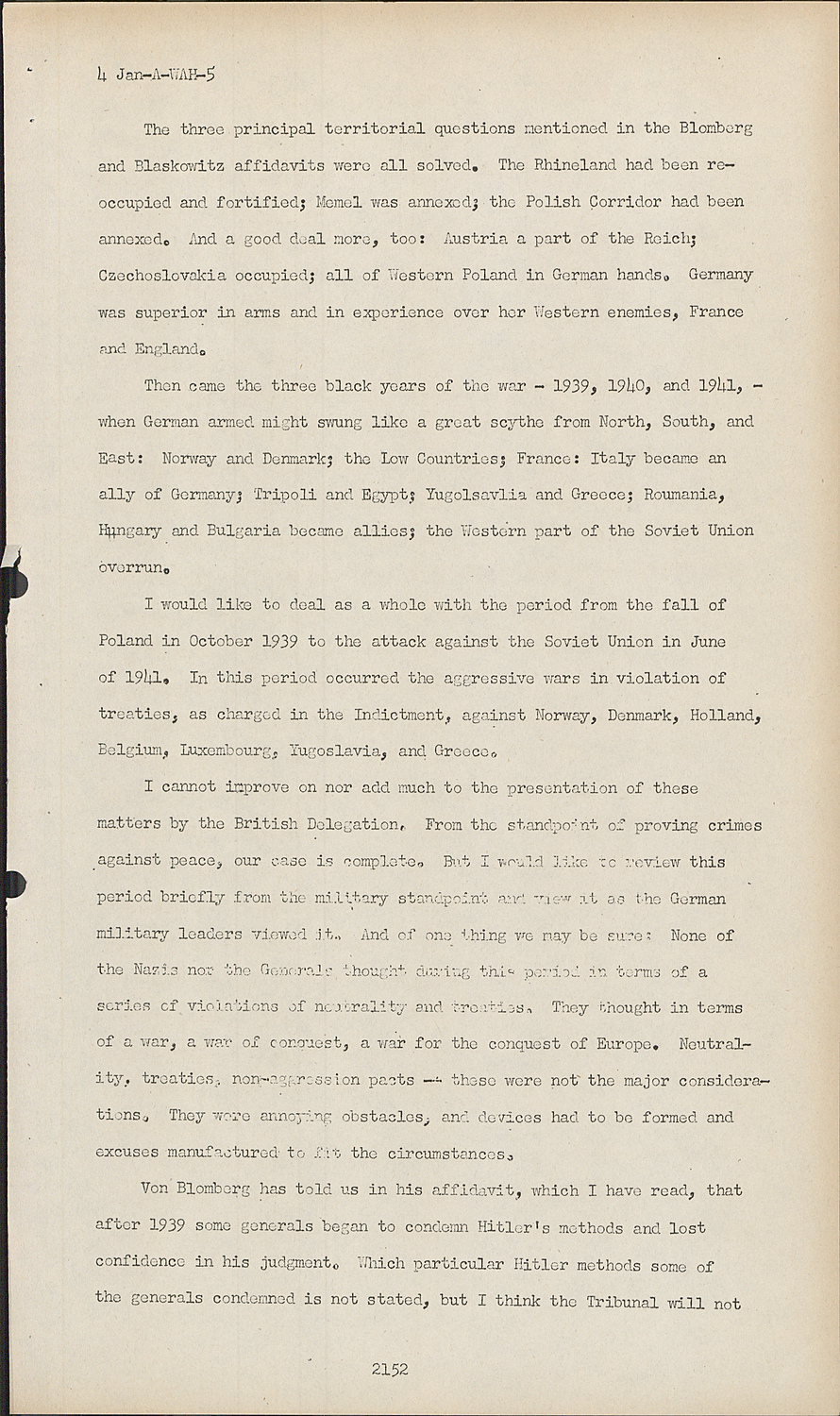
The three principal territorial questions mentioned in the Blomberg and Blaskowitz affidavits were all solved.
The Rhineland had been reoccupied and fortified; Memel was annexed; the Polish Corridor had been annexed. And a good deal more, too: Austria a part of the Reich; Czechoslovakia occupied; all of Western Poland in German hands. Germany was superior in arms and in experience ever her Western enemies, France and England.
Then came the three black years of the war - 1939, 1940, and 1941, when German armed might swung like a great scythe from North, South, and East: Norway and Denmark; the Low Countries; France: Italy became an ally of Germany; Tripoli and Egypt; Yugolsavlia and Greece; Roumania, Hungary and Bulgaria became allies; the Western part of the Soviet Union overrun.
I would like to deal as a whole with the period from the fall of Poland in October 1939 to the attack against the Soviet Union in June of 1941. In this period occurred the aggressive wars in violation of treaties, as charged in the Indictment, against Norway, Denmark, Holland, Belgium, Luxembourg, Yugoslavia, and Greece.
I cannot improve on nor add much to the presentation of these matters by the British Delegation. From the standpoint of proving crimes against peace, our case is complete. But I would like to review this period briefly from the military standpoint and view it as the German military leaders viewed it. And of one thing we may be sure: None of the Nazis nor the Generals thought daring this period in terms of a series of violations of neutrality and treaties. They thought in terms of a war, a war of conquest, a war for the conquest of Europe. Neutrality, treaties, non-aggression pacts -- these were not the major considerations. They were annoying obstacles, and devices had to be formed and excuses manufactured to fit the circumstances.
Von Blomberg has told us in his affidavit, which I have read, that after 1939 some generals began to condemn Hitler's methods and lost confidence in his judgment. Which particular Hitler methods some of the generals condemned is not stated, but I think the Tribunal will not hear any substantial evidence that many of the generals condemned the march of conquest during the years 1939 to 1941.
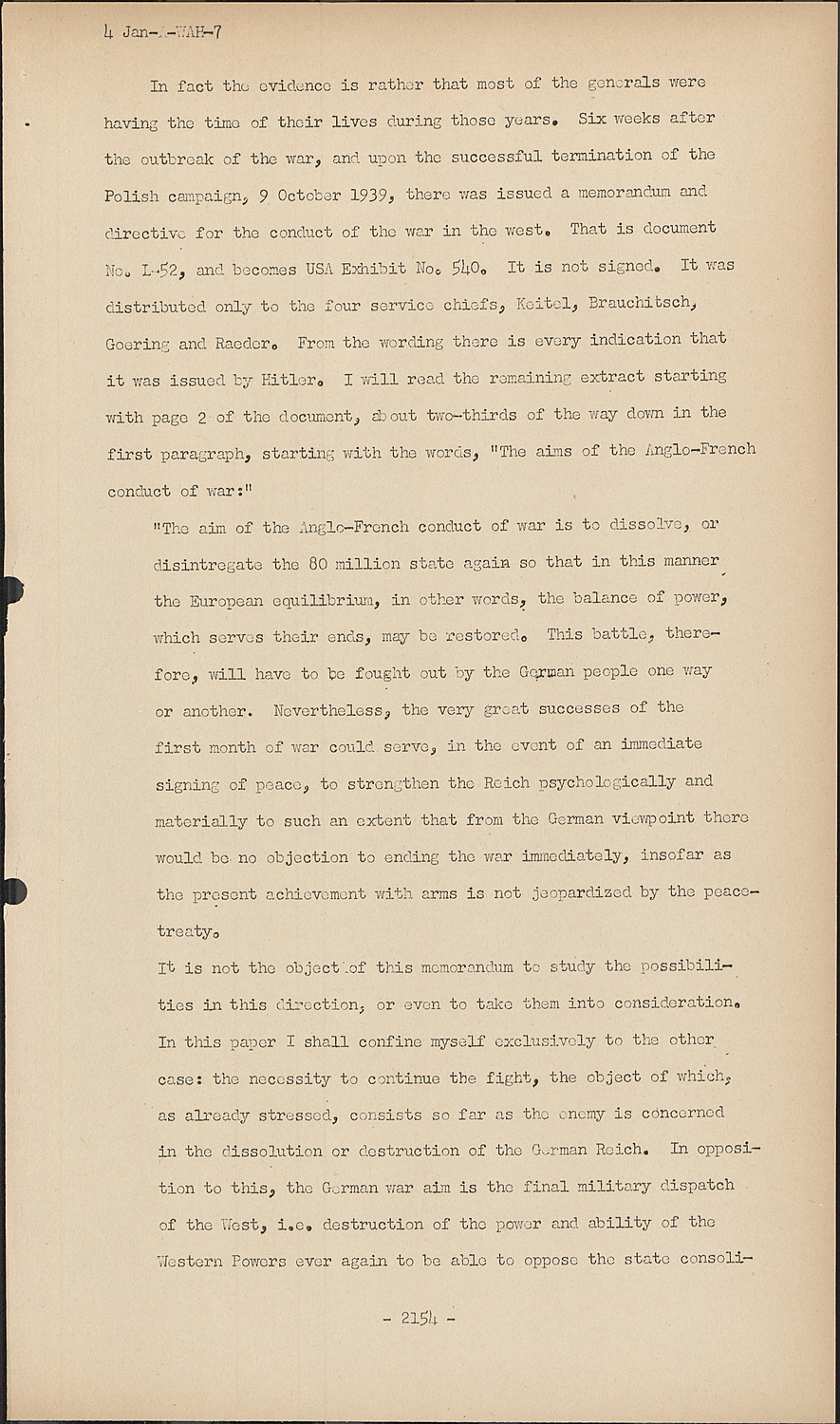
In fact the evidence is rather that most of the generals were having the time of their lives during those years.
Six weeks after the outbreak of the war, and upon the successful termination of the Polish campaign, 9 October 1939, there was issued a memorandum and directive for the conduct of the war in the west. That is document No. L-52, and becomes USA Exhibit No. 540. It is not signed. It was distributed only to the four service chiefs, Keitel, Brauchitsch, Goering and Raeder. From the wording there is every indication that it was issued by Hitler. I will read the remaining extract starting with page 2 of the document, about two-thirds of the way down in the first paragraph, starting with the words, "The aims of the Anglo-French conduct of war:"
"The aim of the Anglo-French conduct of war is to dissolve, or disintregate the 80 million state again so that in this manner the European equilibrium, in other words, the balance of power, which serves their ends, may be restored.
This battle, there fore, will have to be fought out by the German people one way or another.
Nevertheless, the very great successes of the first month of war could serve, in the event of an immediate signing of peace, to strengthen the Reich psychologically and materially to such an extent that from the German viewpoint there would be no objection to ending the war immediately, insofar as the present achievement with arms is not jeopardized by the peace treaty.
It is not the object of this memorandum to study the possibili ties in this direction, or even to take them into consideration.
In this paper I shall confine myself exclusively to the other case:
the necessity to continue the fight, the object of which, as already stressed, consists so far as the enemy is concerned in the dissolution or destruction of the German Reich.
In opposi tion to this, the German war aim is the final military dispatch of the West, i.e. destruction of the power and ability of the Western Powers ever again to be able to oppose the state consoli dation, and further development of the German people in Europe.
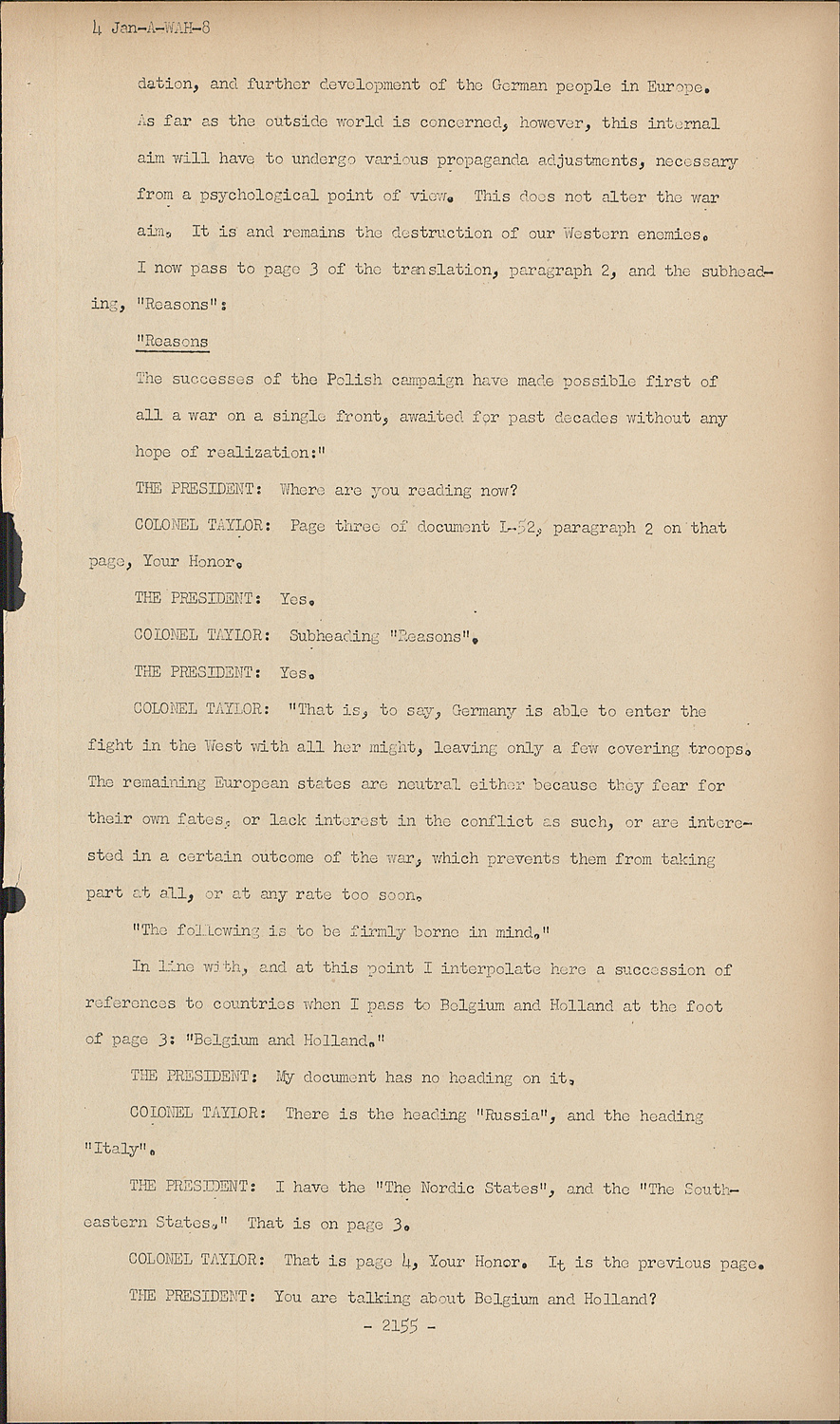
As far as the outside world is concerned, however, this internal aim will have to undergo various propaganda adjustments, necessary from a psychological point of view.
This does not alter the war aim.
It is and remains the destruction of our Western enemies.
I now pass to page 3 of the translation, paragraph 2, and the subheading, "Reasons":
"Reasons The successes of the Polish campaign have made possible first of all a war on a single front, awaited for past decades without any hope of realization:"
THE PRESIDENT:Where are you reading now?
COLONEL TAYLOR:Page three of document L-52, paragraph 2 on that page, Your Honor.
THE PRESIDENT:Yes.
COLONEL TAYLOR:Subheading "Reasons".
THE PRESIDENT:Yes.
COLONELTAYLOR: "That is, to say, Germany is able to enter the fight in the West with all her might, leaving only a few covering troops. The remaining European states are neutral either because they fear for their own fates, or lack interest in the conflict as such, or are interested in a certain outcome of the war, which prevents them from taking part at all, or at any rate too soon.
"The following is to be firmly borne in mind."
In line with, and at this point I interpolate here a succession of references to countries when I pass to Belgium and Holland at the foot of page 3: "Belgium and Holland."
THE PRESIDENT:My document has no heading on it.
COLONEL TAYLOR:There is the heading "Russia", and the heading "Italy".
THE PRESIDENT:I have the "The Nordic States", and the "The Southeastern States." That is on page 3.
COLONEL TAYLOR:That is page 4, Your Honor. It is the previous page.
THE PRESIDENT:You are talking about Belgium and Holland?
COLONEL TAYLOR: Belgium and Holland, Yes, sir.
THE PRESIDENT:Go ahead. Page 2, yes.
COLONELTAYLOR: "Both countries are interested in preserving their neutrality but incapable of withstanding prolonged pressure from England and France. The preservation of their colonies, the maintenance of their trade, and thus the securing of their interior economy even of their very life, depend wholly upon the will of England and France. Therefore, in their decisions, in their attitude, and in their actions, both countries are dependent upon the West, in the highest decree. If England and France promise themselves a successful result at the price of Belgian neutrality, they are at any time in a position to apply the necessary pressure. That is to say, without covering themselves with the odium of a breach of neutrality, they can compel Belgium and Holland to give up their neutrality. Therefore, in the matter of the preservation of Belgo-Dutch neutrality, time is not a factor which might promise a favorable development for Germany."
The final paragraph to be read is of the "The Nordic States:
- Provided no completely unforeseen factors appear, their neutrality in the future is also to be assumed. The continuation of German trade with these countries appear possible even in a war of long duration." End of quotation.
Six weeks later, on 23 November 1939, our group, as you will find in the indictment, the Oberbefehlshaber again assembled, as found in document No. 789-PS, already in the record as USA Exhibit No. 23 - our group of Oberbefehlshaber again assembled and heard from Hitler much of what he had said previously to the four service chiefs. This speech, part of which is already in the record, contains other portions not previously read from and now of interest, and the first extract which I would like to read on page 2 of the translation, about half way down in paragraph one, starting with the words: "For the first time in history we have to fight on only one front." I quote:
"For the first time in history we have to fight on only one front, the other front is at present free.
But no one can know how long that will remain so.
I have doubted for a long time whether I should strike in the east, and then in the west.
Basically I did not organize the armed forces in order not to strike. The decision to strike was always in me. Earlier or later, I wanted to solve the problem. Under pressure, it was decided that the east was to be attacked first. If the Polish war was won so quickly it was due to the superiority of our armed forces. The most glorious appearance in history. Unexpectedly small expenditures of men and material. Now the eastern front is held by only a few divi "sions.
It is a situation which we viewed previously as unachievable Now the situation is as follows:
The opponent in the west lies behind his fortifications.
There is no possibility of coming to grips with him.
The decisive question is: how long can we endure this situation."
Passing to page 3 of that document, line 3:
"Everything is determined by the fact that the moment is favorable now, in six months it might not be so any more."
The final passage on page 4 of the translation, in the long paragraph about half way down, beginning, "England can not live without its imports.
We can not feed --"
"England can not live with its imports. We can feed ourselves. The permanent sowing of mines on the English coasts will bring England to her knees.
However, this can only occur if we have occupied Belgium and Holland.
It is a difficult decision for me. None has ever achieved what I have achieved.
My life is of no importance in all this.
I have led the German people to a great height, even if the world does hate us now.
I am setting this work on a gamble. I have to choose between victory or destruction.
I choose victory.
Greatest historical choice, to be compared with the decision of Freidrich the Great before the first Silesian war.
Prussia owes its rise to the heroism of one man.
Even there the closest advisers were disposed to capitalation.
Everything depended on Freidrich the Great.
Even the decisions of Bismarck in 1866 and 1870 were no less great.
My decision is unchangeable. I shall attack France and Eng land at the most favorable and quickest moment.
Breach of the neutrality of Belgium and Holland is meaningless.
No one will question that when we have won.
We shall not bring about the breach of neutrality as idiotically as it was in 1914.
If we do not break the neutrality, then England and France will.
Without attack the war is not to be ended victoriously.
I consider it as possible to end the war only by means of an attack.
The question as to whether the attack will be successful, no one can answer.
Everything depends upon the favorable instant."
End of quotation.
Thereafter, the winter of '39 and '40 passed quickly, the winter of so-called "phony war."
The General Staff and High Command Group all knew what the plan was -- they had all been told.
To attack ruthlessly at the first opportunity;
to smash the French and English forces; to pay no heed to treaties with or neutrality of the Low Countries.
"Breaking of the neutrality of Holland and Belgium is meaningless.
No one will question that when we have won."
That is what Hitler told the Oberbefehlshaber. His generals and admirals agreed, and went forward with their plan.
Now it is not true that all the steps in this march of conquest were conceived by Hitler and that the military loaders embarked on them with reluctance and misgivings.
To show this we need only hark back for a moment to what Mr. Elwyn Jones told the Tribunal about the plans for the invasion of Denmark and Norway.
The Tribunal will recall that Hitler's utterances in October and November, which I have just read, although they are full of threatening comments about France and England and the Low Countries, contain no suggestion of an attack of Scandinavia.
Indeed, Hitler's memorandum of 9 October, from which I read, L-52, affirmatively indicates that Hitler saw no reason to disturb the situation to the north, because he said that onless unforeseen factors appear, the neutrality of the northern states could be assumed.
Trade could be continued with those countries, even in a long war, but a week previously, on the 3rd of October 1939, the Defendant Raeder had caused a questionaire to be circulated within the Naval War Staff seeking comments on the advantages which might be gained from a naval standpoint by securing bases in Norway and Denmark.
That document is C-122, GB-82.
And another document introduced by Mr. Elwyn Jones, C-66, which is GB-81, shows that Raeder was prompted to circulate this questionaire by a letter from another admiral named Karls, who pointed out the importance of an occupation of the Norwegian coast by Germany.
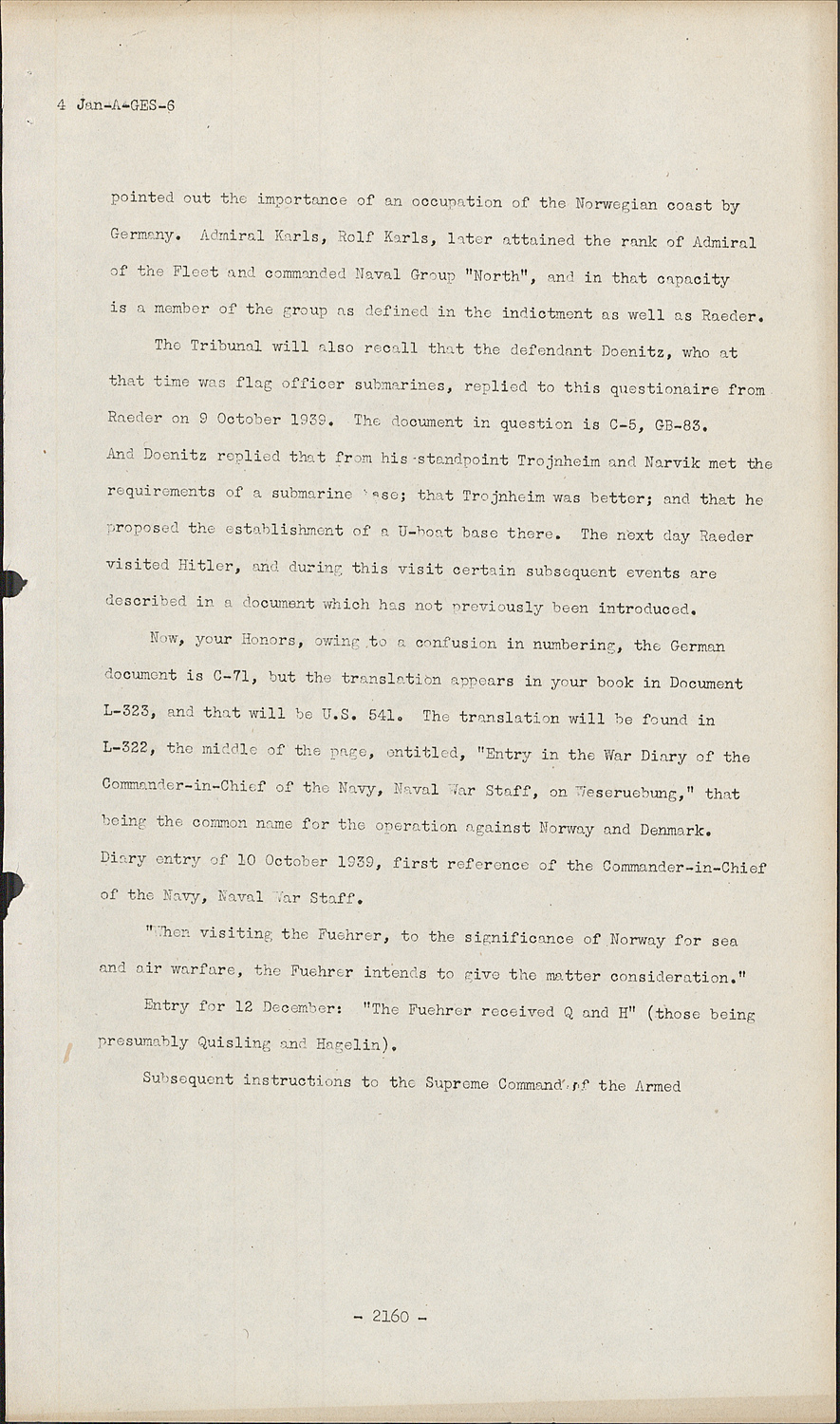
Admiral Karls, Rolf Karls, later attained the rank of Admiral of the Fleet and commanded Naval Group "North", and in that capacity is a member of the group as defined in the indictment as well as Raeder.
The Tribunal will also recall that the defendant Doenitz, who at that time was flag officer submarines, replied to this questionaire from Raeder on 9 October 1939. The document in question is C-5, GB-83. And Doenitz replied that from his standpoint Trojnheim and Narvik met the requirements of a submarine *ase; that Trojnheim was better; and that he proposed the establishment of a U-boat base there. The next day Raeder visited Hitler, and during, this visit certain subsequent events are described in a document which has not previously been introduced.
Now, your Honors, owing to a confusion in numbering, the German document is C-71, but the translation appears in your book in Document L-323, and that will be U.S. 541. The translation will be found in L-322, the middle of the page, entitled, "Entry in the War Diary of the Commander-in-chief of the Navy, Naval War Staff, on Weseruebung," that being the common name for the operation against Norway and Denmark. Diary entry of 10 October 1939, first reference of the Commander-in-Chief of the Navy, Naval War Staff.
"When visiting the Fuehrer, to the significance of Norway for sea and air warfare, the Fuehrer intends to give the matter consideration."
Entry for 12 December: "The Fuehrer received Q and H" (those being presumably Quisling and Hagelin).
Subsequent instructions to the Supreme Command of the Armed Forces to make mental preparations.
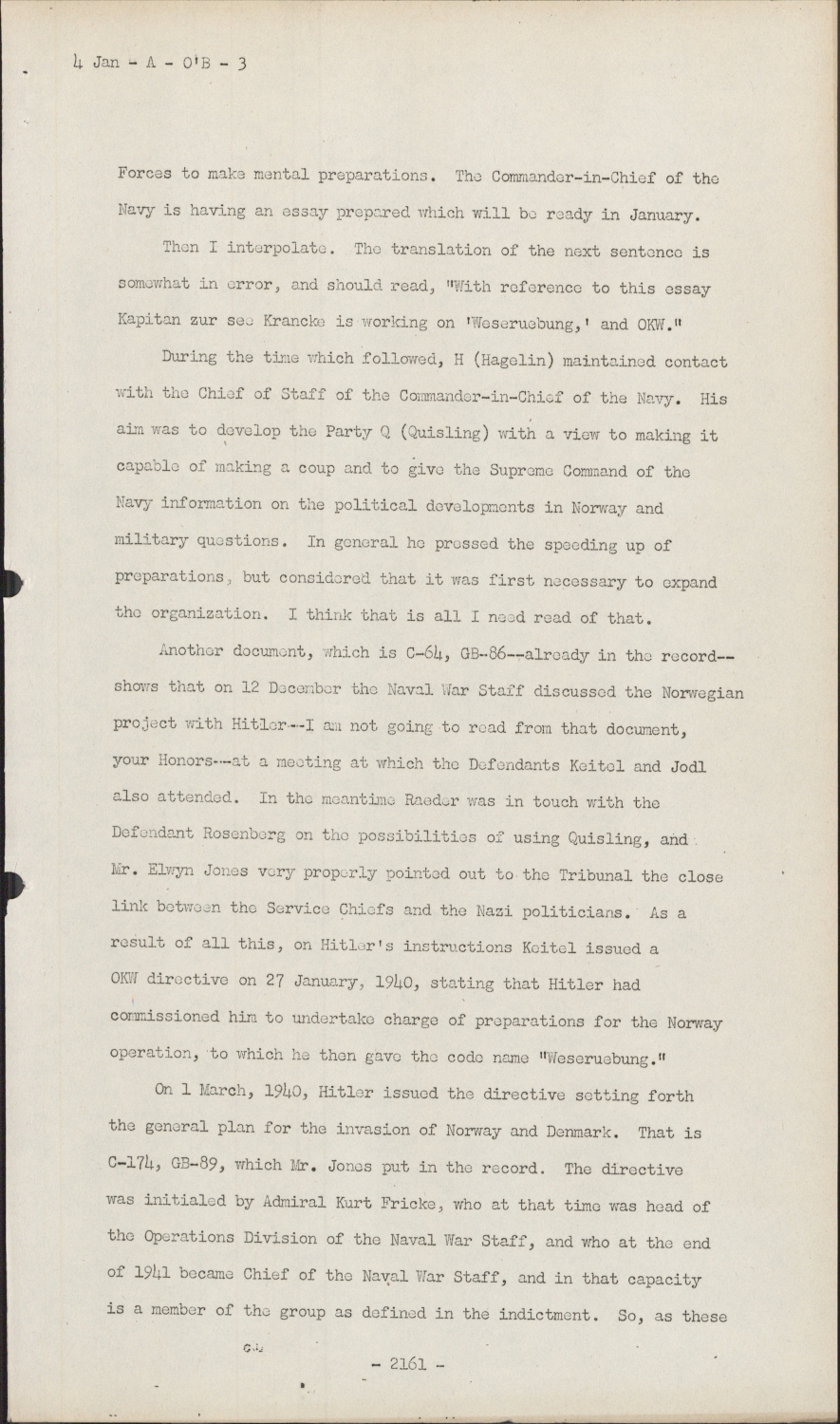
The Commander-in-Chief of the Navy is having an essay prepared which will be ready in January.
Then I interpolate. The translation of the next sentence is somewhat in error, and should read, "With reference to this essay Kapitan zur see Krancke is working on 'Weseruebung,' and OKW."
During the time which followed, H (Hagelin) maintained contact with the Chief of Staff of the Commander-in-Chief of the Navy.
His aim was to develop the Party Q (Quisling) with a view to making it capable of making a coup and to give the Supreme Command of the Navy information on the political developments in Norway and military questions.
In general he pressed the speeding up of preparations, but considered that it was first necessary to expand the organization.
I think that is all I need read of that.
Another document, which is C-64, GB-86--already in the record-
shows that on 12 December the Naval War Staff discussed the Norwegian project with Hitler--I am not going to read from that document, your Honors--at a meeting at which the Defendants Keitel and Jodl also attended.
In the meantime Raeder was in touch with the Defendant Rosenberg on the possibilities of using Quisling, and Mr. Elwyn Jones very properly pointed out to the Tribunal the close link between the Service Chiefs and the Nazi politicians.
As a result of all this, on Hitler's instructions Keitel issued a OKW directive on 27 January, 1940, stating that Hitler had commissioned him to undertake charge of preparations for the Norway operation, to which he then gave the code name "Weseruebung."
On 1 March, 1940, Hitler issued the directive setting forth the general plan for the invasion of Norway and Denmark.
That is C-174, GB-89, which Mr. Jones put in the record.
The directive was initialed by Admiral Kurt Fricke, who at that time was head of the Operations Division of the Naval War Staff, and who at the end of 1941 became Chief of the Naval War Staff, and in that capacity is a member of the group as defined in the indictment.
So, as these documents make clear, the plan to invade Norway and Denmark was not conceived in Nazi Party circles, nor forced on the military leaders;on the contrary, it was conceived in the Naval part of the General Staff and High Command Group, and Hitler was persuaded to take the idea up.
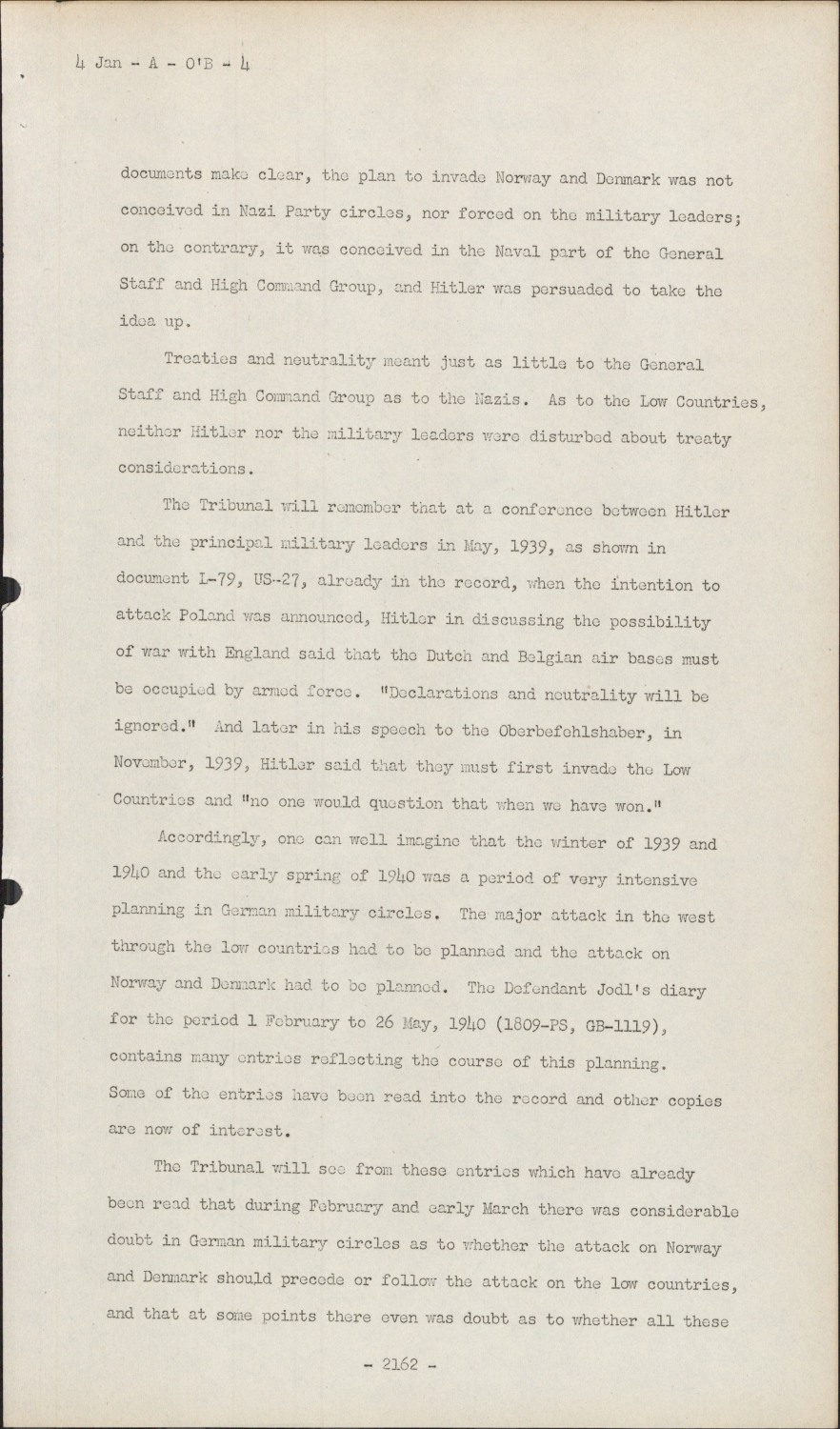
Treaties and neutrality meant just as little to the General Staff and High Command Group as to the Nazis.
As to the Low Countries, neither Hitler nor the military leaders were disturbed about treaty considerations.
The Tribunal will remember that at a conference between Hitler and the principal military leaders in May, 1939, as shown in document L-79, US-27, already in the record, when the intention to attack Poland was announced, Hitler in discussing the possibility of war with England said that the Dutch and Belgian air bases must be occupied by armed force.
"Declarations and neutrality will be ignored."
And later in his speech to the Oberbefehlshaber, in November, 1939, Hitler said that they must first invade the Low Countries and "no one would question that when we have won."
Accordingly, one can well imagine that the winter of 1939 and 1940 and the early spring of 1940 was a period of very intensive planning in German military circles.
The major attack in the west through the low countries had to be planned and the attack on Norway and Denmark had to be planned.
The Defendant Jodl's diary for the period 1 February to 26 May, 1940 (1809-PS, GB-1119), contains many entries reflecting the course of this planning.
Some of the entries have been read into the record and other copies are now of interest.
The Tribunal will see from these entries which have already been read that during February and early March there was considerable doubt in German military circles as to whether the attack on Norway and Denmark should precede or follow the attack on the low countries, and that at some points there even was doubt as to whether all these attacks were necessary from a military standpoint, but the Tribunal will not find a single entry which reflects any hesitancy from a moral angle, on the part of Jodl or anyone else that he talked to, to over-run these countries.
I will make some references now to document 1809-PS and some of the entries in it.
I do not find a verbatim quote in any one of them.
The Court will note that on 1 February, 1940, General Jeschonnek, the Chief of the Air Staff and a member of the Group as defined in the Indictment, visited Jodl and made a suggestion that it might be wise to attack only Holland, on the ground that Holland alone would offer a tremendous improvement for Germany's aerial warfare.
On 6 February, Jodly conferred with Jeschonnek, Warlimont, and Col. von Waldau, and what Jodl calls a "new idea" was proposed at this meeting: that the Germans should carry out actions H, being Holland, and under Weser exercises, that being Norway and Denmark only, and should guarantee those countries' neutraility for the duration of the war.
I suppose the German air force may have felt that the occupation of Holland alone would give them sufficient scope for air bases for attacks on England and that if Belgium's neutraility were preserved the German bases in Holland would be immune from attack by the Frency and British armies in France. If, to meet this situation, the French and British attack through Holland and Belgium, the violation of neutraility would be on the other foot. But whether or not this new idea made sense from a military angle, it appears to be a most extraordinary notion from a diplomatic angle. It was a proposal to violate without any excuse the neutraility of three neighboring small countries, and simultaneously to guarantee the neutraility of a fourth; but what value the Belgians might have attributed to a gurantee of neutraility offered under such circumstances it is difficult to imagine, and in fact the "new idea" projected at this meeting seems a most extraodinary combination of cynicism and naivete.
In the meantime, as Jodl's diary shows, on 5 February 1940 the "special staff" for the Norway invasion met for the first time and got its instruction: from Keitel. On 21 February, Hitler put General von Falkenhorst in command of the Norway undertaking and Jodl's diary records that "Falkenhorst accepts gladly".
On 26 February, Hitler was still in doubt whether to go first to Norway or the Low Countries, but on 3 March, he decided to do Norway first and the Low Countries a short time thereafter. The decision proved final. Norway and Denmark were invaded on 9 April and the success of the adventure was certain by the 1st of May. The invasion of the Low Countries took place ten days later.
So, France and the Low Countries fell, Italy joined the war on the side of Germany, and the African campaign began.
In October 1940, Italy attacked Greece.
The Italo-Greek stalemate and the uncertain attitude of Jugoslavia became embarrassing to Germany, particularly because the attack on the Soviet Union was being planned and Germany felt she could not risk an uncertain situation at her rear in the Balkans.
Accordingly, it was decided to end the Greek situation by coming to Italy's aid, and the Jugoslavian coup d'etat of 26 March 1940 brought about the final German decision to crush Jugoslavia also. The documents have already been introduced by Colonel Phillimore and there is little that I need to add for my present purposes. The decisions were made the Armed Forces drew up the necessary plans and executed the attacks. The onslaught was particularly unmerciful and ruthless against Jugoslavia for the special purpose of frightening Turkey and Greece. The final deployment instructions were issued by Brauchitsch and appear in a document which has not been read before, that being R-95; GB 127. Two extracts from this are of interest. R-95. These extracts are very short:
"The political situation in the Balkans having changed by reason of the Jugoslav military revolt, Jugoslavia has to be considered as an enemy even should it make declarations of loyalty at first.
"The Fuehrer and Supreme Commander has decided therefore to destroy Jugoslavia as quickly as possible."
And turning to paragraph No. 5, the "Timetable for the operations".
"On 5th April as soon as sufficient forces of the Air Forces are available and weather permitting, the Air Forces should attack continuously by day and night the Jugoslav ground organization and Belgrade".
The German attack on the Soviet Union, I have little more to say about. All the documents showing the aggressive nature of the attack have been put in ny Mr. Alderman. I suppose it is quite possible that some members of the General Staff and High Command Group opposed "Barbarossa" as unnecessary and unwise from a military standpoint. The Defendant Raeder so indicated in a memorandum he wrote on 10 January 1944 (C66; GB 81). C-66 is the translation, the only document I propose to read on this subject, from which a few extracts are of interest.
The quotation starts at the very outset of the Document C-66:
"At this time the Fuehrer had made known his 'unalterable decision' to conduct the Eastern campaign in spite of all remonstrances. After that, further warnings, if no new situation had arisen, were found to be completely useless. As Chief of Naval War Staff, I was never convinced of the 'compelling necessity' for Barbarossa."
And passing to the third paragraph:
"The Fuehrer very early had the idea of one day settling accounts with Russia, doubtless his general ideological attitude played an essential part in this. In 1937-38 he once stated that he intended to eliminate the Russians as a Baltic power; they would then have to be diverted in the direction of the Persian Gulf. The advance of the Russians against Finland and the Baltic States in 1939-40 probably further strengthened him in this idea."
And passing to the very end of document, paragraph 7, page 4:
"As no other course is possible, I have submitted to compulsion. If, in doing so, a difference of opinion arises between 1 SKL and myself" -That, if I may interpolate, is a division of the Naval War Staff having to do with operations. -- "it is perhaps because the arguments the Fuehrer used on such occasion (dinner speech in the middle of July to the Officers in Command) to justify a step he had planned, usually had a greater effect on people not belonging to the 'inner circle', than on those who often heard this type of reasoning.
"Many remarks and plans indicate that the Fuehrer calculated on the final ending of the Eastern campaign in the autumn of 1941, whereas the Supreme Command of the Army (General Staff) was very skeptical."
That, to be sure, indicates the division of opinion as to the military chances of a rapid success, but the part last quoted indicates that other members of the group favored "Barbarossa" and Raeder's affidavit says; to wit, that some of the generals lost confidence in the power of Hitler's judgment, but that the generals failed as a group to take any definite stand against him although a few tried and suffered thereby. Certainly the High Command took no stand against Hitler on "Barbarossa" and t the events of 1941 and 1942 do not suggest that the High Command embarked on the Soviet War tentatively or with reservations, but rather with ruthless determination backed by careful planning. The plans themselves have all been read and cited to the Court previously.
That concludes the evidence on the criminal activities of the Group under Counts One and Two. The documents written by the military leaders, and which I have previously introduced are not the writings of men who were reluctant to plan and execute these manifold wars.
I want to make clear again the nature of the accusations against this Group under Counts One and Two. They are not accused on the ground that they are soldiers. They are not accused merely for doing the usual things a soldier is expected to do, such as make military plans and command troops.
It is, I suppose, among the normal duties of a diplomat to engage in negotiations and conferences; to write notes and aide memoires, to entertain at dinner parties and cultivate good will toward the government he represents. The Defendant Ribbentrop is not indicted for doing these things. It is the usual function of a politican to draft regulations and decrees, to make speeches. The Defendants Hess and Frick are not indicted for doing those things.
It is an innocent and respectable business to be a locksmith, but it is none the less a crime, if the locksmith turns his talents to picking the locks of a neighborsand looting their homes. And that is the nature of the charge under Counts One and Two against the General Staff and High Command Group. The charge is that in performing the functions of diplomats, politicans, soldiers, sailors, or whatever they happened to be, they con-spired to, and did plan, prepare, initiate and wage illegal wars and thereby committed crimes under Article 6 (a) of the Charter.
It is no defense for those who committed such crimes to plead that they practice a particular profession. It is perfectly legal for military men to prepare military plans, to meet national contingencies, and such plans may legally be drawn, whether they are offensive or defensive in a military sense. It is even perfectly legal for military leaders to carry cut such plans and engage in war, if in doing so, they do not plan and launch and wage wars which are illegal because they are aggressive and in contravention of the Charter.
I am very far from saying that there may not be individual cases, involving some individual members of this group, where drawing the line between legal and illegal behaviour might not involve some difficulties. That is not an uncommon situation in the legal field. But I do not believe that there is any doubt or difficulty here, before this Tribunal, as to the criminality of the General Staff and High Command Group as a Group under Counts One and Two, nor as to the guilt of the five defendants who are members of the group.
In the case of the Defendants Goering, Keitel and Jodl, the evidence is voluminous and their participation in aggressive plans and war is constant. The same is true of Defendant Raeder, and his individual responsibility for the aggressive and savage attack on Norway and Denmark is especially clear. The evidence so far offered against Doenitz is less voluminous for the reason that he was younger and not one of the top group until later in the war. But numerous other members of the General Staff and High Command Group, including its other leaders, are shown to have participated knowingly and wilfully in these illegal plans and wars.
Brauchitsch, the Commander-in-Chief of the Army, and his Chief of Staff Halder; Warlimont, the deputy of Jodl; in the nature of things these men knew all that was going on and participated fully, as the documents show. Reichenau and Sperrle helped to bully Schuschnigg; Reichenau and von Schobert, together with Goering, are immediately sent for by Hitler when Schuschnigg ordered the plebiscite.
At a later date we have Blaskowitz as an Oberbefehlshaber in the field, knowingly preparing for the attack on Poland; Field Marshal List educating the Bulgarians for their role during the attacks on Yugoslavia and Greece; von Falkenhorst "gladly accepting" the assignment to command the invasion of Norway and Denmark.
On the air side, Jeschonnek has been recorded proposing that Germany attack Norway, Denmark and Holland, and simultaneously assure Belgium that there is nothing to fear.
On the naval side, Admiral Carls, member of the Group, foresees at an early date that German policy is leading to a general European war, and at a later date the attack on Norway and Denmark is his brainchild; Krancke is one of the chief planners of this attack; Schniewindt is in the inner circle for the attack on Poland; Fricke certifies the final orders for Weseruebung and a few months later proposes that Germany annex Belgium and northern France and reduce the Netherlands and Scandinavia to vassalage.
Most of the nineteen officers I have mentioned were at that time members of the Group, as defined, and the few who were not, subsequently became members.
At the final conference for Barbarossa seventeen additional members are present and at the two meetings with Hitler, at which the aggressive plans and the contempt for treaties were fully disclosed, the entire group was present.
The military defendants will perhaps argue that they are technicians. This amounts to saying that military men are a race apart from and different from the ordinary run of human beings -- men above and beyond the moral and legal requirements that apply to others, incapable of exercising moral judgment on their own behalf.
What we are discussing here is the crime of planning and waging aggressive war. It stands to reason that that crime is committed most consciously, deliberately and culpably by a nation's leaders -- the leaders in all the major fields of activity which are necessary to and closely involved in the waging of war. It is committeed by propagandists and publicists. It is committed by political leaders, by diplomats, by the chief ministers, by the principal industrial and financial leaders and it is no less committed by the military leaders.
In the nature of things, planning and executing aggressive war is accomplished by agreement and consultation among all these types of leaders. And if the leaders in any notably important field of activity stand aside or resist or fail to cooperate, then the program will at the very least be seriously obstructed. That is why the principal leaders in all these fields of activity share responsibility for the crime, and the military leaders no less than the others. Leadership in the military field, as well as in other fields, calls for moral wisdom as well as technical astuteness.
I do not think that the responsible military leaders of any nation will be heard to say that their role is that of a mere janitor or custodian, or pilot of the war machine which is under their command and that they bear no responsibility whatsoever for the use to which that machine is put.
The prevalence of such a view would be particularly unfortunate today, when the military leaders control forces infinitely more powerful and destructive than ever before.
Should the military leaders be declared exempt from the declaration in the Charter that planning and waging aggressive war is a crime, it would be a crippling, if not fatal blow, to the efficacy of that declaration.
Such is certainly not the view of the United States. The Prosecution here representing the United States believes that the profession of arms is a distinguished profession. We believe that the practice of that profession by its leaders calls for the highest degree of integrity and moral wisdom, no less than for technical skill. We believe that in consulting and planning with the leaders in other fields of a nation's activities, the military leaders must act in accordance with international law and the dictates of the public conscience. Otherwise the military resources of the nation will be used, not in accordance with the laws of modern society but the law of the jungle. The military leaders share responsibility with other leaders. I use the word "share" advisedly. Obviously the military leaders are not the final and exclusive arbiters and the German military leaders do not bear exclusive responsibility for the criminal holocaust which was committed. But the German military leaders conspired with others to undermine and destroy the conscience of the German nation. The German military leaders wanted to aggrandize Germany and, if necessary, to resort to war.
As the Chief Prosecutor for the United States said in his opening statement, "The German military leaders are here before you because they, along with others, mastered Germany and drove it to war."
Your Lordship, that concludes the evidence under Counts One and Two, and if this would be a convenient stopping point -
THE PRESIDENT:You have another branch of the argument?
COLONEL TAYLOR:Counts Three and Four, your Honor, which will take considerable time.
THE PRESIDENT:Very well, we will adjourn now. (Whereupon, at 1655 hours the hearing of the Tribunal adjourned to reconvene at 1000 hours on 7 January 1946) Official Transcript of the International Military Tribunal, in the matter of: