I quote the order in its entirety. It is very short:
"The 'Hone Schule' is supposed to become the center for National Socialistic ideological and educational research. It will be established after the conclusion of the war. I order that the already initiated preparations be continued by Reichsleiter Alfred Rosenberg, especially in the way of research and setting up of the library.
"All sections of the Party and State are requested to cooperate with him in this task."
Although the above order makes no specific mention of the seizure of art properties, by the 5th of November 1940, the program had extended beyond its original scope to include the seizure of Jewish art collections.
I now offer in evidence Document 141-PS, which is a certified copy of an order signed by Goering, dated 5 November 1940, in which the Defendant Goering states, and I quote:
"In conveying the measures taken until now for the securing of Jewish art property by the Chief of the Military Administration, Paris, and the Einsatzstab Rosenberg, the art objects brought to the Louvre will be disposed of in the following way:
"Those art objects about which the Fuehrer has reserved for himself the decision as to their use.
"2. Those art objects which serve to the completion of the Reichsmarshal's collection.
"3. Those art objects and library books, the use of which seem useful to the establishment of the higher institutes of learning, and which come tihin the jurisdiction of Reichsleiter Rosenberg.
"4. Those art objects which are suited to be sent to the German museums Thus, early in 1940, eleven months after the initiation of the program for establishment of the library for ideological research, the original purpose had been expanded so as to include the seizure of art works, not only for the benefit of research, but for the delectation of the Fuehrer and Goering, and the enhancement of the collections of German museums.
Impelled as they were by the perfidious dream of subjugating a continent, the Nazi conspirators could not content themselves merely with the exploitation of the cultural riches of France, and rapidly extended their activities to the other occupied countries. I now offer inevidence Document No. 137-PS. That is a copy of an order signed by the Defendant Keitel, dated 5th of July 1940; and I should like to read that brief order in full.
"To:- Chief of Army High Command Chief of the Armed Forces in the Netherlands.
"Reichsleiter Rosenberg suggested to the Fuehrer that:
1. The state libraries and archives be searched for documents valuable to Germany.
2. The Chancelleries of the high church authorities and lodges be searched for political maneuvers directed against us, and that the material in question be seized.
"The Fuehrer has ordered that this suggestion be followed and that the Gestapo, supported by the archivists of Reichsleiter Rosenberg, be put in charge of the researches. The Chief of Security Police, SS Gruppenfuehrer Heydrich, has been informed. He will communicate with the competent military commanders in order to execute this order.
"These measures will be executed in all regions on the Netherlands, Belgium, Luxembourg, and France occupied by us.
"It is requested that subordinate services be Informed.
"Chief of Army High Command:
"Signed KEITEL."
From the Netherlands, Belgium, Luxembourg and France the Einsatzstab's activities ultimately were expanded still further to Norway and Denmark. I now offer in evidence Document 159-PS, US Exhibit 380, which is a copy of an order signed by Utikal, Chief of the Einsatzstab, dated the 6th of June 1944, from which it is seen that a special mission of the Einsatzstab was sent to Norway and Denmark.
As the German Army penetrated to the east, the fingers of the Einsatzstab reached out to seize the cultural riches thus made available to them, and their activities were extended to the Occupied Fastern Territories, including the Baltic States and the Ukraine, as well as to Hungary and Greece I now offer in evidence Document 153-PS, US Exhibit 381, being a certified copy of a letter from Rosenberg to the Reich commissioner for the East, and Reich commissioner for the Ukraine, dated 27 April 1942. The subject of the letter is stated to be as follows:
"Formation of a Central Unit for the Seizure and Securing of Objects of Cultural Value in the Occupied Eastern Territories." In the last paragraph of that document, I quote:
"With the commissars of the Reich a special department within Department II (political) has been set up for a limited time for the seizure and securing of objects of cultural value. This office is under the control of the head of the main group of Einsatzstal of Reichsleiter Rosenberg for the occupied territories."
THE PRESIDENT:Perhaps this would be a good time to break off for ten minutes.
(A recess was taken from 1120 to 1130 hours.)
Activities were initiated in Hungary as indicated by Document No.
158-PS, U. S. Exhibit 382, which I now offer in evidence. This was a copy of a message initialled by Utikal, Rosenberg's Chief of Staff. The first paragraph of this document states, "The Einsatzstab of Reichsleiter Rosenberg for the occupied territories has dispatched a Sonderkomnando under the direction of Stabseinsatzfuehrer Dr. Zeiss, who is identi fied by means of his Service Book Number 187, for the accomplishment of the missions of the Einsatzstab in Hungary described in the Fuehrer's Decree of 1 March 1942."
I now offer into evidence Document No. 171-PS, U.S.A. Exhibit 383, an undated report on the "Library for Exploration of the Jewish Question". The 5th paragraph states, "The most significant book-collections today belonging to the stock of the Library for Exploration of the Jewish Question are the following:"
The 9th item of the list which follows refers to, "Book-collections from Jewish Communities in Greece (about 10,000 volumes)."
It was only natural that an operation conducted on so vast a scale, extending as it did to France, Belgium, the Netherlands, Luxembourg, Norway, Denmark, the Occupied Eastern Territories, the Baltic States, the Ukraine, Hungary and Greece, should call upon a multitude of other agencies for assistance. Among the agencies cooperating in the plunder program were several of those which stand indicted here as criminal organizations.
The cooperation of the Wehrmacht High Command was demanded by the Hitler order of 1 March 1942 which I offer into evidence as our document 149-PS, U.S.A. Exhibit 369, which is signed personally by Adolph Hitler and is also on the jumbo typo.
The order decrees the ideological fight against the enemies of National Socialism to be a military necessity and reaffirms the authority of the Einsatzstab Rosenberg to conduct searches and seizures of suitable material for the Hohe Schule.
The 5th paragraph states, "The measures of execution concerning the cooperation with the Wehrmacht are assured by the Chief of the OKW with the consent of the Reichsleiter Rosenberg."
While I am on that document, which is referred to later, I should like to read the ether portions. I call attention of your Honors to the distribution. It is distributed to all duty stations of the armed forces, the Party, and the State. It says:
"Jews, Free-Masons and their associated, ideological enemies of National Socialism are responsible for the war which is new being waged against the Reich. The coordinated, ideological fight against these powers is a military necessity. I therefore charged Reichsleiter Rosenberg to carry out this task in cooperation with the chief of the OKW. His 'staff for special purposes' in the occupied territories is authorized to search libraries, record - offices, lodges and other ideological and cultural institutions of all kinds for suitable material and to confiscate the said material for the ideological tasks of the NSDAP and the later scientific rescarchwork of the 'Hohe Schule.' The same regulation applies to the cultural values, which are in possession of Jews, ownerless or not of unobjectionable origin." The final passage is:
"The necessary measures within the territories of the East under the German Administration are determined by 'Reichsleiter' Rosenberg in his capacity as 'Reichsminister' for the occupied territories of the East.
"Signed: A. Hitler."
THE PRESIDENT:Cel. Storey, I think the Tribunal would find it convineint, and it would save time, if the documents when they are referred to were read in full in so far as you want to read them, rather than returning to read one passage and then returning to a document later on.
COLONEL STOREY:Yes, sir. May I explain why that was, sir? I was trying to fit in this presentation with the Leadership Corp. It was quoted in two places and I didn't notice it until I started.
THE PRESIDENT:What I am saying is that I think it is easier to follow the documents if all the parts of the document which you wish to read are read at one time, rather than read one sentence, then come back to another sentence, and then possibly come back to a document for a third sentence. I don't know whether that will be possible for you to do.
COL. STOREY:We will try to work it out that way, sir.
THE PRESIDENT:Thank you.
COLONEL STOREY: Cooperation of the SS and the SD is indicated in a letter from Rosenberg to Bermann dated 23 April 1941, Document No. 071-PS, U.S.A. Exhibit 311 which I now offer into evidence.
This letter states in the fifth sentence of the first numbered paragraph:
"It is understood that the confiscations are not executed by the regional authorities, but that this is conducted by the Security Service (SD) as well as by the police."
Further down in the some paragraph Rosenberg states:
"It has been communicated to me in writing by a Gauleiter that the chief office of the Reich Security (RSHA) of the SS has claimed the following from the library of a monastery:
The Catholic Handbook, Albertus Magnus; Edition of the Church Fathers; History of the Papacy by L. V.Pastor, and other works."
The second and last paragraph of this letter states that:
"I should like to remark in this connection that this affair has already been executed on our side with Security Service (SD) in the most loyal fashion."
The defendat Goring was especially diligent in furthering the purposes of the Einsatzstab Rosenberg, a diligence which will be readily understood in view of the fact that he himself directed that second in priority only to the demands of the Fuhrer were to be "those art objects which served the completion of the Reichsmarshal's collection." That is Goering.
On May 1, 1941, Goring issued an order to all Party, State and Wehrmacht services, which I am now offering into evidence as 1117-PS, USA Exhibit 384 an original order bearing Goring's signature. This order requested all Party, State and Wehrmacht Services, and I now quote:
"...to give all possible support and assistance to the Chief of Staff of Reichsleiter Rosenberg's staff ..the above-mentioned persons are requested to report to me on their work, particularly on any difficulties which might arise."
On 30 May, 1942, Goring claimed credit for a large degree of the success of the Einsatzstab. I offer into evidence a captured photost atic copy of a letter from Goring to Rosenberg, showing Goring's signature, which bears our No. 10151-PS, which I offer in evidence as USA Exhibit 385. The last paragraph of this letter states as follows:
"...On the other hand I also support personally the work of the Einsatzstab wherever I can do so, and a great part of the seized cultural goods can be accounted for because I was able to assist the Einsatzstab with my organizations."
If I have tried the patience of the Tribunal with numerous details as to the origin, the growth and the operation of the art looting organization, it is because I feel that it will be impossible for me to convey to you a full conception as to the magnitude of the plunder without conveying to you first, Information as to the vast organizational work that was necessary in order to nable the defendants to collect in Germany cultural treasures of staggering roportions.
Nothing of value was safe from the grasp of the Einsatzstab. In view of the great experience of the Einsatzstab in the complex business of the organized plunder of a continent, its facilities were well suited to the looting of material other then cultural objects.
Thus, when Rosenberg required equipment for the furnishing of the offices of the administration in the east, his Einsatzstab was pressed into action to confiscate Jewish homes in the west. Document No. 1-188, which is USA Exhibit 386, and which I now offer into evidence is a copy of a report submitted by the director of Rosenberg's Office West, operating under the Ministery for the Occupied Eastern Territories. I wish to read at some length from this document and I call the Tribunal's attention to the third paragraph on page 3 of the translation.
"The Einsatzstab Reichsleiter Rosenberg was charged with the carrying out of this task, (that is: the seizure of art properties). In addition to this seizure of property, at the suggestion of the Director West of the Special Section of the Einsatzstab, it was proposed to the Reichsleiter that the furniture and other contents of the unguarded Jewish homes should also be secured and dispatched to the Minister for the Occupied Eastern Territories for use in the Eastern Territories." The last paragraph on the same page states:
"At first all the confiscated furniture and goods were dispatched to administration of the Occupied Eastern Territories. Owing to the terror attacks on German cities which then began, and in the knowledge that bombed-out people in Germany ought to have preference over the eastern people, Reichminister and Reichsleiter Rosenberg obtained a new order from the Fuhrer according to which the furniture etc. obtained through the M Action was to be put at the disposal of bombed-out people within Germany." The report continues with a description of the efficient methods employed in looting the Jewish homes in the west (top of page 4 of translation.)
"The confiscation of Jewish homes was carried out as follows: So-called confiscation officials went from house to house where no records were available of the addresses of Jews who had departed or fled as was the case, for instance, in Paris, in order to collect information as to abandoned Jewish homes...They drew up inventories of those homes and subsequently sealed them...
"In Paris alone about twenty confiscation officials confiscated more than 38,000 homes.
The transportation of the contents of those homes was completed with the entire car park of the Union of Parisian Removal Contractors who had to provide up to 150 trucks, 1200 to 1500 French laborers."
If your honor please, I am omitting the rest of the details of that report because our French colleagues will present the details later.
Looting on such a scale seems fantastic. But I feel I must refer to another statement: For though the seizure of the contents of over 71,000 homes and their shipment to the Reich in upwards of 26,000 railroad cars is by no means a petty operation; the quantities of plundered art treasures and books, and their incalculable value as revealed in the documents I am about to offer will make these figures dwindle by comparison.
I next refer to the stacks of leather-bound volumes in front of me, to which the Justice referred in his opening statement.
These thirtynine volumes which are before me contain photographs of works of art secured by the Einsatzstab and are volumes which were prepared by members of the Rosenberg staff. All of these volumes bear our No. 2522-PS, and I offer them in evidence.
I am passing to your Honors eight of these volumes, so that each one of you -- they are all different -- might see a sample of the inventory. I call your Honors attention to the inside top page. Most of them have an inventory, in German, of the contents of the book, and then follows a true photograph of each one of these pricelss objects of art, separated by fine tissue paper.
There are thirtynine of these volumes that were captured by our forces when they overran a part of southern-occupied German territory.
THE PRESIDENT:Is there anything known about the articles photographed here?
COL. STOREY:Yes, I will describe them later. I believe each one of them is identified in addition to the inventory.
THE PRESIDENT:I meant whether the articles, the furniture or pictures themselves, have been found.
COL. STOREY:Yes, sir, most of them were found in an underground cavern. I believe in the southern part of Bavaria, and these books were found by our staff in connection with the group of U.S. Army people who have assembled these objects of art and are now in the process of returning them to the rightful owners. That is where we got these books.
I should like to refer while your Honors are looking at these to just the aggregate totals of the different paintings. Here are the totals as shown by Document 1015b-PS, which is in the Document Book 1015b-PS. As they are totalled, I don't think Your Honors need to follow the document; you can continue looking at the hooks if you like.
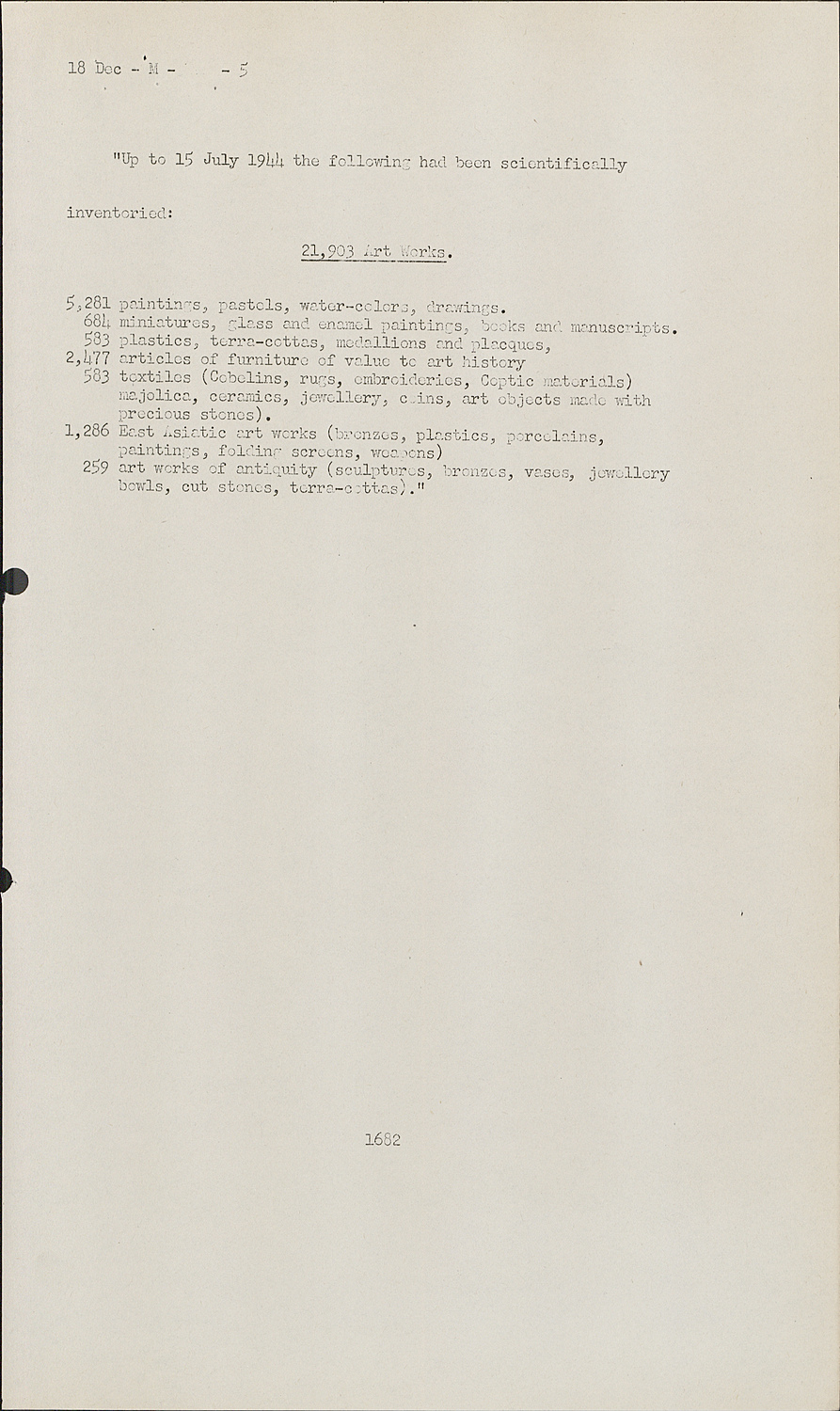
"Up to 15 July 1944 the following had been scientifically inventoried:
21,903 Art Works. 5,281 paintings, pastels, water-colors, drawings.
684 miniatures, glass and enamel paintings, books and manuscripts.
583 plastics, terra-cottas, medallions and placques, 2,477 articles of furniture of value to art history 583 textiles (Cobelins, rugs, embroideries, Coptic materials) majolica, ceramics, jewellery, coins, art objects made with precious stones). 1,286 East Asiatic art works (bronzes, plastics, porcelains, paintings, folding screens, weapons) 259 art works of antiquity (sculptures, bronzes, vases, jewellery bowls, cut stones, terra-cottas)." The mere statement that 21,903 art works have been seized does not furnish an adequate conception of their value.
I refer again to the statement in the document thus quoted: The extraordinary artistic and material value of the seized art works cannot be expressed in figures, and that they are objects of such a unique character that their evaluation is entirely impossible. These thirty-nine volumes are by no means a complete catalogue. They present, at the most, pictures of about 2,500 of the art objects seized, and I ask you to imagine that this catalogue had been completed and in the place of thirty-nine volumes we had 350 to 400 volumes. In other words, if they were prepared in inventory form as these thirty-nine volumes to cover all of them, it would take 350 to 400 volumes.
We had arranged, your Honors, to project just a few of these on the screen but before we do that, which is the end of this part of the presentation, I should like to call your Honors' attention to document 015-PS. It is dated April 16, 1943. It is a copy of a letter from Rosenberg to Hitler. The occasion for the writing of this letter was the birthday of the Fuehrer, to commemorate which Rosenberg presented some folders of photographs of pictures seized by the Einsatzstab. I imagine, although we have no authentic evidence, that probably some of these were prepared for that occasion. In the closing paragraph of the letter, Document 015-PS, he says:
"I beg of you, my Fuehrer, to give me a chance during my next audience to report to you orally on the whole extent and scope of this art seizure action. I beg you to accept a short written intermediate report of the progress and extent of the art seizure action, which will be used as a basis for this later oral report, and also accept three copies of the temporary picture catalogues which, too, only show part of the collection you own. I shall deliver further catalogues which are now being compiled, when they are finished."
Rosenberg then closes with this touching tribute to the aesthetic tastes of the Fuehrer, tastes which were satisfied at the expense of a continent, and I quote:
"I shall take the liberty during the requested audience to give you, my Fuehrer, another twenty folders of pictures, with the hope that this short occupation with the beautiful things of art which are nearest to your heart will send a ray of beauty and joy into your revered life."
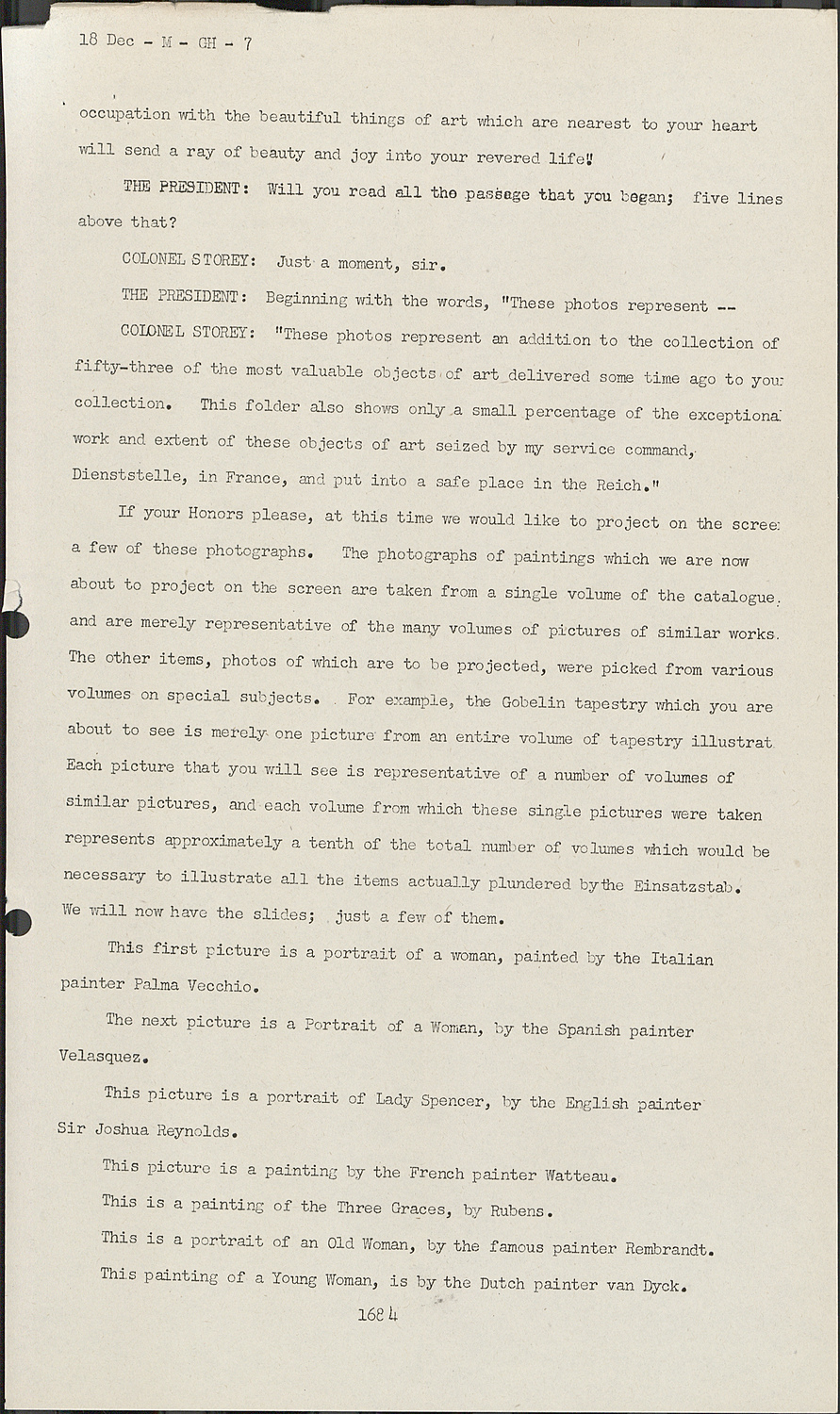
THE PRESIDENT:Will you read all the passage that you began; five lines above that?
COLONEL STOREY:Just a moment, sir.
THE PRESIDENT:Beginning with the words, "These photos represent -
COLONELSTOREY: "These photos represent an addition to the collection of fifty-three of the most valuable objects of art delivered some time ago to your collection. This folder also shows only a small percentage of the exceptional work and extent of these objects of art seized by my service command, Dienststelle, in France, and put into a safe place in the Reich."
If your Honors please, at this time we would like to project on the screen a few of these photographs. The photographs of paintings which we are now about to project on the screen are taken from a single volume of the catalogue and are merely representative of the many volumes of pictures of similar works. The other items, photos of which are to be projected, were picked from various volumes on special subjects. For example, the Gobelin tapestry which you are about to see is merely one picture from an entire volume of tapestry illustrat Each picture that you will see is representative of a number of volumes of similar pictures, and each volume from which these single pictures were taken represents approximately a tenth of the total number of volumes which would be necessary to illustrate all the items actually plundered by the Einsatzstab. We will now have the slides; just a few of them.
This first picture is a portrait of a woman, painted by the Italian painter Palma Vecchio.
The next picture is a Portrait of a Woman, by the Spanish painter Velasquez.
This picture is a portrait of Lady Spencer, by the English painter Sir Joshua Reynolds.
This picture is a painting by the French painter Watteau.
This is a painting of the Three Graces, by Rubens.
This is a portrait of an Old Woman, by the famous painter Rembrandt.
This painting of a Young Woman, is by the Dutch painter van Dyck.
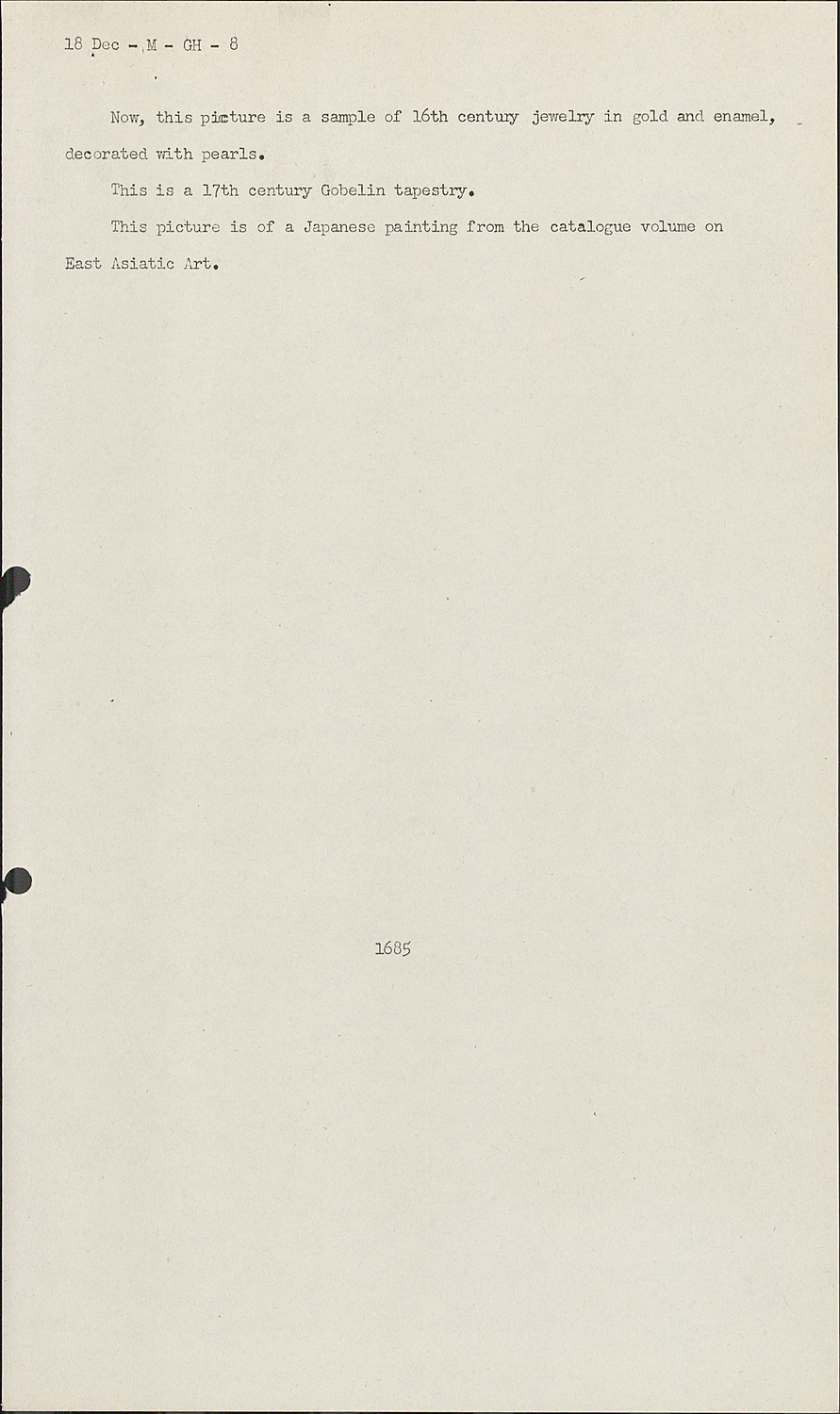
Now, this picture is a sample of 16th century jewelry in gold and enamel, decorated with pearls.
This is a 17th century Gobelin tapestry.
This picture is of a Japanese painting from the catalogue volume on East Asiatic Art.
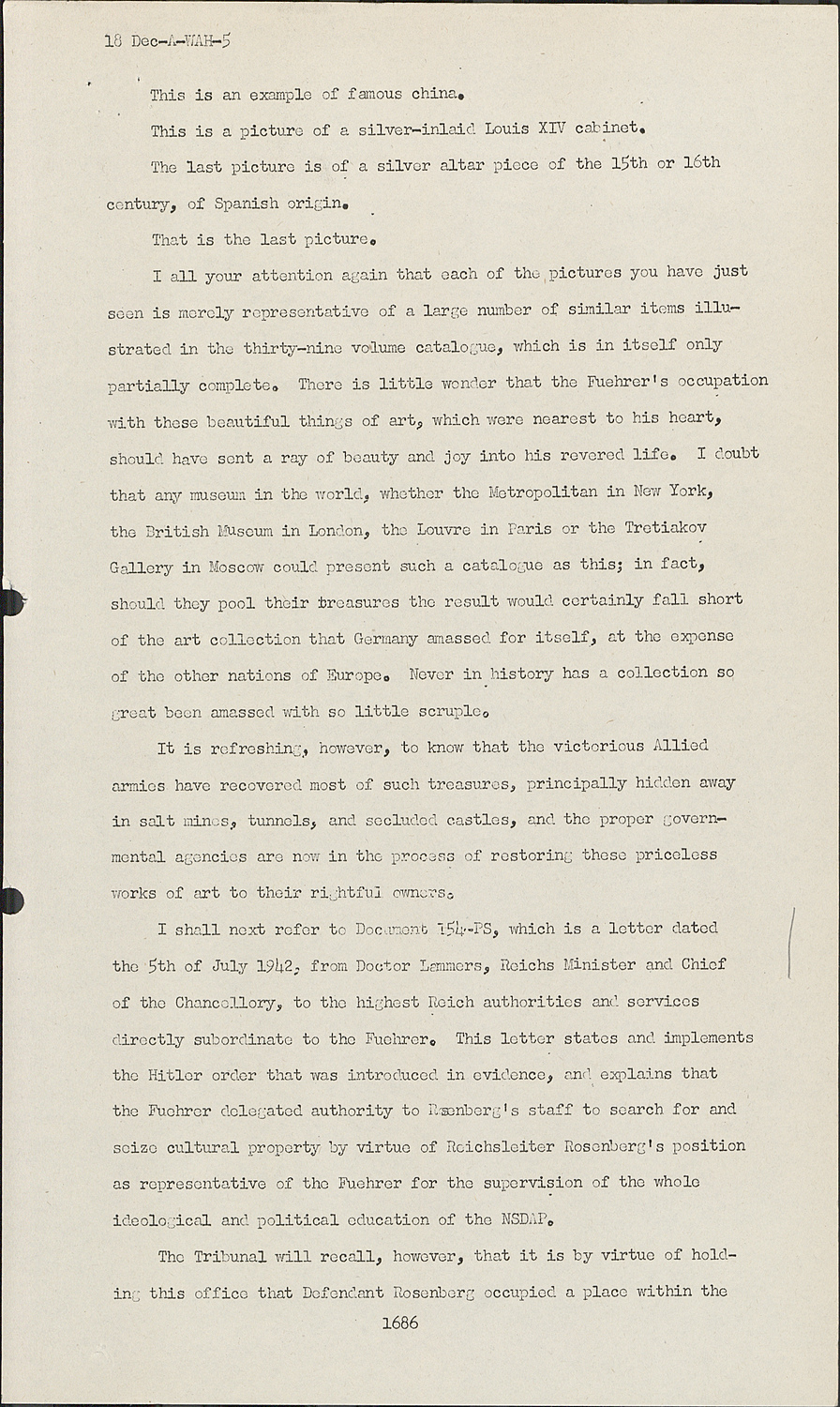
This is an example of famous china.
This is a picture of a silver-inlaid Louis XIV cabinet.
The last picture is of a silver altar piece of the 15th or 16th century, of Spanish origin.
That is the last picture.
I all your attention again that each of the pictures you have just seen is merely representative of a large number of similar items illustrated in the thirty-nine volume catalogue, which is in itself only partially complete. There is little wonder that the Fuehrer's occupation with these beautiful things of art, which were nearest to his heart, should have sent a ray of beauty and joy into his revered life. I doubt that any museum in the world, whether the Metropolitan in New York, the British Museum in London, the Louvre in Paris or the Tretiakov Gallery in Moscow could present such a catalogue as this; in fact, should they pool their treasures the result would certainly fall short of the art collection that Germany amassed for itself, at the expense of the other nations of Europe. Never in history has a collection so great been amassed with so little scruple.
It is refreshing, however, to know that the victorious Allied armies have recovered most of such treasures, principally hidden away in salt mines, tunnels, and secluded castles, and the proper governmental agencies are now in the process of restoring these priceless works of art to their rightful owners.
I shall next refer to Document 154-PS, which is a letter dated the 5th of July 1942, from Doctor Lammers, Reichs Minister and Chief of the Chancellory, to the highest Reich authorities and services directly subordinate to the Fuehrer. This letter states and implements the Hitler order that was introduced in evidence, and explains that the Fuehrer delegated authority to Rsenberg's staff to search for and seize cultural property by virtue of Reichsleiter Rosenberg's position as representative of the Fuehrer for the supervision of the whole ideological and political education of the NSDAP.
The Tribunal will recall, however, that it is by virtue of holding this office that Defendant Rosenberg occupied a place within the Reichsleitung or Party Directorate of the Leadership Corps.
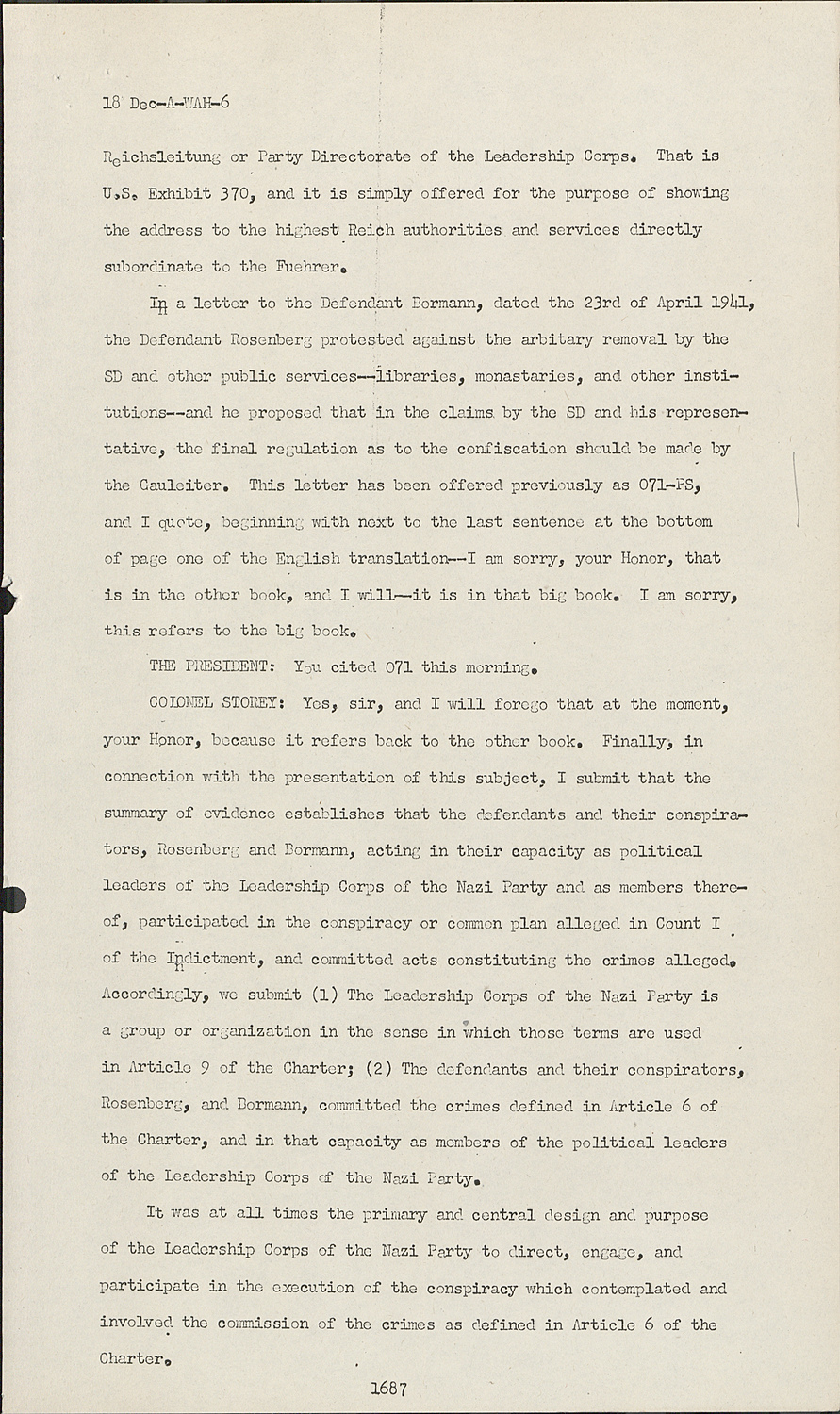
That is U.S. Exhibit 370, and it is simply offered for the purpose of showing the address to the highest Reich authorities and services directly subordinate to the Fuehrer.
In a letter to the Defendant Bormann, dated the 23rd of April 1941, the Defendant Rosenberg protested against the arbitary removal by the SD and other public services--libraries, monastaries, and other institutions--and he proposed that in the claims, by the SD and his representative, the final regulation as to the confiscation should be made by the Gauleiter. This letter has been offered previously as 071-PS, and I quote, beginning with next to the last sentence at the bottom of page one of the English translation--I am sorry, your Honor, that is in the other book, and I will--it is in that big book. I am sorry, this refers to the big book.
THE PRESIDENT:You cited 071 this morning.
COLONEL STOREY:Yes, sir, and I will forego that at the moment, your Honor, because it refers back to the other book. Finally, in connection with the presentation of this subject, I submit that the summary of evidence establishes that the defendants and their conspirators, Rosenborg and Bormann, acting in their capacity as political leaders of the Leadership Corps of the Nazi Party and as members thereof, participated in the conspiracy or common plan alleged in Count I of the Indictment, and committed acts constituting the crimes alleged. Accordingly, we submit (1) The Leadership Corps of the Nazi Party is a group or organization in the sense in which those terms are used in Article 9 of the Charter; (2) The defendants and their conspirators, Rosenberg, and Bormann, committed the crimes defined in Article 6 of the Charter, and in that capacity as members of the political leaders of the Leadership Corps of the Nazi Party.
It was at all times the primary and central design and purpose of the Leadership Corps of the Nazi Party to direct, engage, and participate in the execution of the conspiracy which contemplated and involved the commission of the crimes as defined in Article 6 of the Charter.
And I should like now to call attention again to a chart which was identified in the beginning - I believe by Major Wallis - and it was taken from the book, "The Face of the Party"--taken from the publication which is entitled, "The Face of the Party". This chart emphasizes clearer than I can state the total and thorough control over the life of the German beginning at the age of ten at the bottom of the chart, and continuing through the various categories on up through.
Notice the age of ten to fourteen, the Jungvolk. Then it goes to the Adolph Hitler School on the right, twelve to eighteen. The Hitler Jugend, fifteen to eighteen. The SA; the NSKK; NSFK; nineteen to twenty. And then the labor service over at the left. And then again to the SA; SS; NSKK; NSFK; and then into the Wehrmacht, and on up through to the top box on the left of the top row of men, the political leaders of the NSDAP.
And then finally all of those buildings up there, as I understand, are the academies of the NSDAP.
And then finally at the top to the politi cal leaders of the German Volk, showing the evolution.
This is the final exhibit, and with that I close the presentation of the Leadership Corps.
The next presentation is the Reich Cabinet, the Reichsregierung. We will take just a few moments; three or four moments.
If your Honors please, there is one thing Colonel Seay salled my attention to.
I simply refer to it for the record. In one of the previous documents, 090-PS, which is in the other document book, there was a state ment that clearly established that the expenses of the Einsatzstab Rosenbel that is, the staff's operational expenses, were financed by the Nazi Party.
Document 090-PS, which is already in evidence, and which I overlooked mentioning.
If the Tribunal please, I now offer document Book "X", which I believe has been passed to your Honors, and also we have prepared-- also, Colonel Dostert's staff has prepared a chart of the Reichsregierung in different languages, and I believe your Honors have copies.
There is one copy here in German that I shall be glad to pass to counsel who are especially concerned with this case.
They have one copy in German. I don't know who it is-
THE PRESIDENT:You mean counsel for the Reich Cabinet?
COLONEL STOREY:Yes, sir. May I say also by preliminary reference, that we examined the records in the collection office this morning, and only one letter of intervention has been filed in behalf of the Reichs Cabinet, and that was by the Defendant Keitel.
As I understand, only one has been filed, and that was by the Defendant Keitel.
We will now consider the Reichsregierung. Some preliminary remarks about this group have already been placed before the Tribunal by Mr. Albrecht in his comments upon the Government chart.
It will be necessary, however, for sake of coherence, to repear briefly some of the statements made by him, and therefore we beg the indulgence of the Tribunal The Reichsregierung, meaning Reich Cabinet, unlike most of the other groups named in the indictment, was not especially created by the Nazi party to carry out or implement its nefarious schemes and purposes.
The Reichsregierung -- commonly referred to as the Cabinet -- had, before the Nazis came to power, a place in the constitutional and political history of the country.
As with other cabinets of duly constituted governments, the executive power of the realm was concentrated in that body.
The Nazi conspirators realized this only too well. Their aim for totalitarian control over the State could not be secured -- they realized -- except by acquiring, holding and utilizing the top level machinery of theState.
And this they did. Under the Nazi regime the Reichsregierung gradually became a primary agent of the Nazi Party with functions and policies formulated in accordance with the objectives and methods of the Party itself.
The institution of the Reichsregierung became--at first gradually and then with more rapidity--polluted by the infusion of the Nazi conspirators into the Cabinet. Many of them--16 to be exact--sit before you today in the dock. There was no plan, scheme or purpose--however vile or inhuman or illegal in any sense of the word--that was not clothed with the semblance of legality by the Nazi Reichsregierung. It is for that reason that we will ask this Tribunal--after the proof has been offered-to declare that body, as defined in the Indictment, to be a criminal organization. The proof will be divided into two main categories-the first of which will tend to establish the composition and nature of the Reichsregierung under the Nazis, as well as delineating briefly its functions and powers; while the second will tend to establish--and conclusively we believe--the reasons why the brand of criminality should be affixed to that group.
The term Reichsregierung literally translated reads "Reich Government". Actually, as we said, it was commonly taken to refer to the ordinary Reich Cabinet. In the Indictment the term Reichsregierung is defined to include, not only those persons who were members of the ordinary Reich Cabinet, but also persons who were members of the Council of Ministers for the Defense of the Reich and the Secret Cabinet Council. However, the really important subdivision of the three is--as the proof will show--the ordinary cabinet. Between it and the other two there was in reality only an artificial distinction. There existed, in fact, a unity of personnel, action, functions, and purpose that obliterated any academic separation. As used in the Indictment, the term "ordinary cabinet" means Reich Ministers, that is, heads of departments of the central government; Reich Ministers without portfolio; State Ministers acting as Reich Ministers; and other officials entitled to take part in meetings.