COLONEL STOREY: Your Honor, please, that is the next subject.
THE PRESIDENT:Very well.
COLONEL STOREY:It may be doubted that the average German ever looked upon the face of Heinrich Himmler. But the man in the street in Nazi Germany could not have avoided an uneasy acquaintance with the Blockleiter in his neighborhood. As it is the "cop on the beat" rather than the Chief Magistrate of a nation who symbolizes law enforcement to average men and women, so it was the blockleiters who represented to the People of Germany the police-state of Hitler's Germany. In fact, as may be inferred from the evidence, the Blockleiters were "Little Fuehrers", with real and literal power over the civilians in their domains. As proof of the authority of the Blockleiter to exercise coercion, and the threat of force upon the civil population, I quote from Document 2833-PS, which is an excerpt from page 7 of the magazine published entitled "The Face of the Party", Document 2833-PS. It is just a line of quotation.
"Advice and sometimes also the harsher form of education is employed if the faulty conduct of an individual harms this individual himself, and thus also the community."
Before I get to the numbers, I want to deal with the Hoheitstrager.
THE PRESIDENT:Don't you think it is time to break off.
COLONEL STOREY:Yes.
THE PRESIDENT:Until two o'clock.
(Whereupon at 1245 hours the hearing of the Tribunal adjourned to reconvene at 1400 hours.)
Official transcript of the International Military Tribunal, in the matter of:
The United States of America, the French Republic, the United Kingdom of Great Britain and Northern Ireland, and the Union of Soviet Socialist Republics, against Hermann Wilhelm Goering, et al, Defendants sitting at Nurnberg, Germany, on 17 December 1945 1400--1700, Lord Justice Lawrence presiding.
COLONEL STOREY:Your Honors will notice that we have substituted an enlarged chart of the photostatic copy of that which was introduced in evidence this morning. Another thing to which I would like to call Your Honors' attention is the fact that the other chart, the big one, was dated 1945, and therefore did not show the Defendant Hess, because of his flight to England in 1941 and it will be recalled the defendant has occupied the position before Bormann, directly under the Fuhrer in the party organization.
We now take up the Hoheitstrager. The Hoheitstrager, diverting from the text is shown on this chart very well and all those shown in the black block constitute the Hoheitstrager beginning with the Fuhrer and going down the vertical column clear down to the black line.
Within the leadership corps of the Nazi Party, certain of the Political leaders possessed a higher degree of responsibility than others, were vested with special prerogatives, and constituted a distinctive and elite group within the Party hierarchy. Those were the so-called "Hoheitstrager" (Bearers of Sovereignty) who represented the party within their area of jurisdiction which is a section of Germany the so-called Hoheitsgebiet. I now quote from page 9 of the English translation of Document 1893-PS:
"Among the Political Leaders, the Hoheitstrager assumed a special position.
Contrary to the other Political Leaders who have departmental missions, the Hoheitstrager themselves are in charge of a geographical sector known as the Hoheitsgebiet, (Sectors of Sovereignty).Hoheitstrager are:
The Fuehrer The Gauleiter The Kreisleiter The Ortsgruppenleiter The Zallenleiter The Blockleiter Hoheitsgebiet are:
The Reich The Gau The Kreis The Ortsgruppe The Zelle The Block "Within their sector of sovereignty the Hoheitstrager have sovereign political rights.
They represent the Party within their sector. The Hoheitstrager supervise all Party officers within their jurisdiction and are responsible for the maintenance of discipline. The directors of offices, etc. and of the affiliated organisations are responsible to their respective Hoheitstrager as regards their special missions. The Hoheitstrager are superior to all Political Leaders, managers, etc., within their sector. As regards personal considerations, Hoheitstrager are endowed with special rights.
"The Hoheitstrager of the Party are not to be administrative officials, but are to move in a continuous vital contact with the Political Leaders of the population within their sector. The Hoheitstrager are responsible for the proper and good supervision of all members of the nation within their sector.
"The Party intends to achieve a state of affairs in which the individual German will find his way to the Party."
The distinctive character of the Politischer Leiter constituting the Hoheitstrager end their existence and operation as an indefinable group are indicated by the publication of a magazine, entitled "Der Hoheitstrager" whose distribution was limited by regulation of the Reich Organization Leader, to the Hoheitstrager and certain other designated Politischer Leiter.
I now refer to Doc. 2660 - PS U.S.A.
Exhibit No. 325, which I offer in evidence; and I quote from the inside cover of this magazine which reads as follows:
"Der Hoheitstrager, the contents of which is to be handled confidentially, serves only for the orientation of the competent leaders.
It may not be loaned out to other persons.
(Then follows a list of the Hoheitstrager and other Political Leaders authorized to receive the magazine)" The magazine states in addition, that the following were entitled to receive it--I would like to emphasize the ones to receive it:
"Commandants, Unit Commanders and Candidates of Order Castles ; the Reich, Shock Troop and Gaus Speakers of the NSDAP; the Lieutenant Generals and Major Generals of SA, SS, RSFK, and NSKK; Lieutenant Generals and Major Generals of the HJ."
That is the Hitler Jugend.
The fact that this magazine existed, that it derived its name from the Commanding Officers of the Leadership Corps, that it was distributed to the elite of the Leadership Corps, in other words, that a House Bulletin was circulated down the command channels of the Leadership Corps is probative of the fact that the Leadership Corps of the Nazi Party was a group or organization within the meaning of Article 9 of the Charter.
An examination of the contents of the magazine, Der Hoheitstrager, reveals a continuing concern by the Leadership Corps of the Nazi Party in measures and doctrines which were employed throughout the course of the conspiracy charged in the indictment. I shall not trouble the Tribunal nor encumber the record by offering in evidence exhaustive enumeration of these matters; but it may serve to clarify the plans and policies of the inner elite of the Leadership Corps by indicating that a random sampling of articles published and policies advocated in various issues of the magazine Der Hoheitstrager from February 1937 to October 1938 included the following: slanderous anti-Semitic articles, attacks on Catholicism and the Christian religion and clergy; the need for motorized armament; the urgent need for expanded Lebensraum and colonies; persistent attacks on the League of Nations; the use of the Block and Cell in achieving favorable votes in Party plebiscites; the intimate association between the Wehrmacht and the Political Leadership; the racial doctrines of Fascism; the cult of "leadership"; the role of the Gaus; Ortsgruppen, and Zellen in the expansion of Germany; and related matters all of which constituted elements and doctrinal techniques in the carrying out of the conspiracy charged in the Indictment.
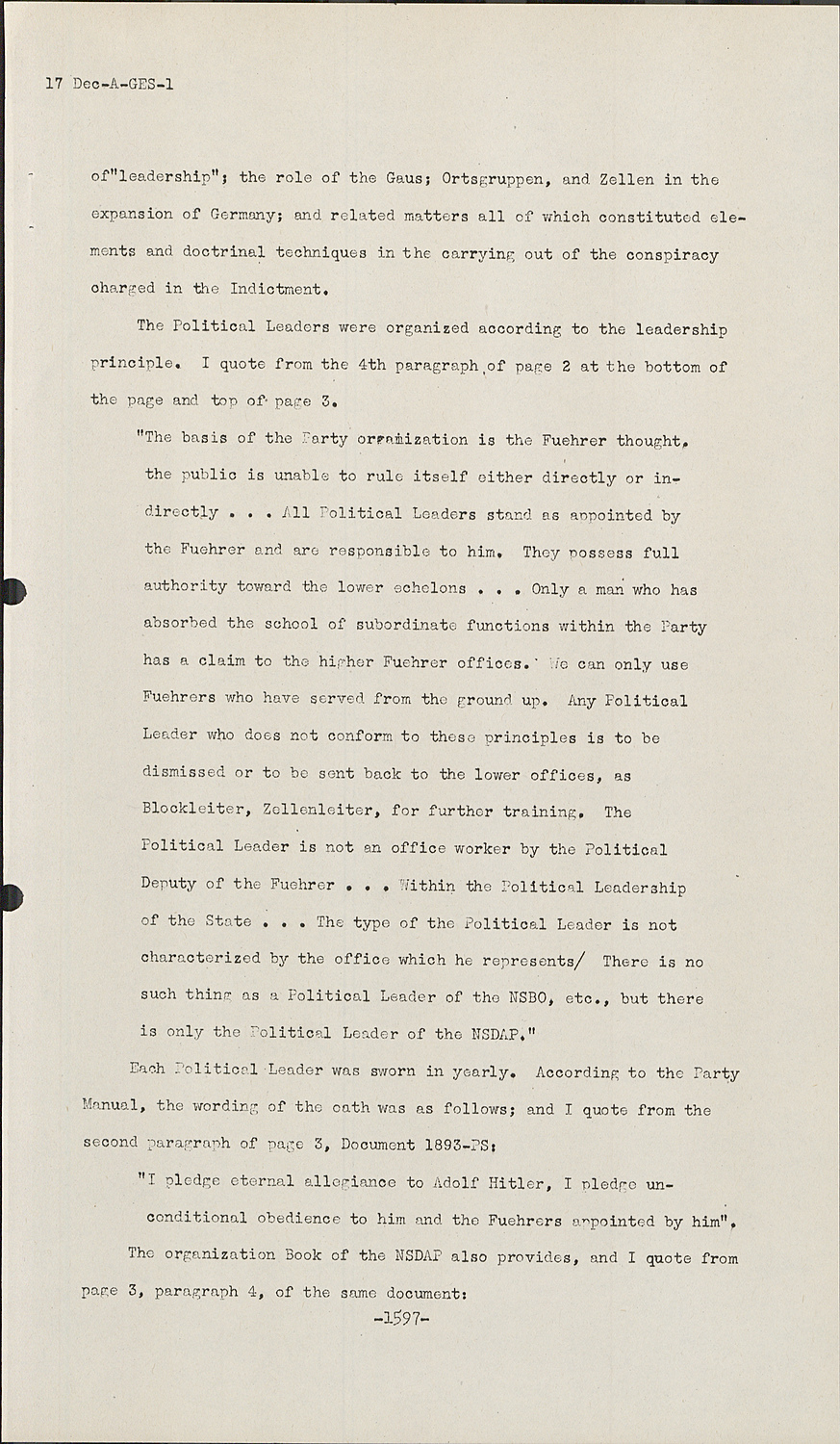
The Political Leaders were organized according to the leadership principle. I quote from the 4th paragraph, of page 2 at the bottom of the page and top of page 3.
"The basis of the Party organization is the Fuehrer thought.
the public is unable to rule itself either directly or in directly ... All Political Leaders stand as appointed by the Fuehrer and are responsible to him.
They possess full authority toward the lower echelons ... Only a man who has absorbed the school of subordinate functions within the Party has a claim to the higher Fuehrer offices.
We can only use Fuehrers who have served from the ground up.
Any Political Leader who does not conform to these principles is to be dismissed or to be sent back to the lower offices, as Blockleiter, Zellenleiter, for further training.
The Political Leader is not an office worker by the Political Deputy of the Fuehrer ... Within the Political Leadership of the State ... The type of the Political Leader is not characterized by the office which he represents/ There is no such thing as a Political Leader of the NSBO, etc.
, but there is only the Political Leader of the NSDAP."
Each Political Leader was sworn in yearly. According to the Party Manual, the wording of the oath was as follows; and I quote from the second paragraph of page 3, Document 1893-PS:
"I pledge eternal allegiance to Adolf Hitler, I pledge un conditional obedience to him and the Fuehrers appointed by him".The organization Book of the NSDAP also provides, and I quote from page 3, paragraph 4, of the same document:
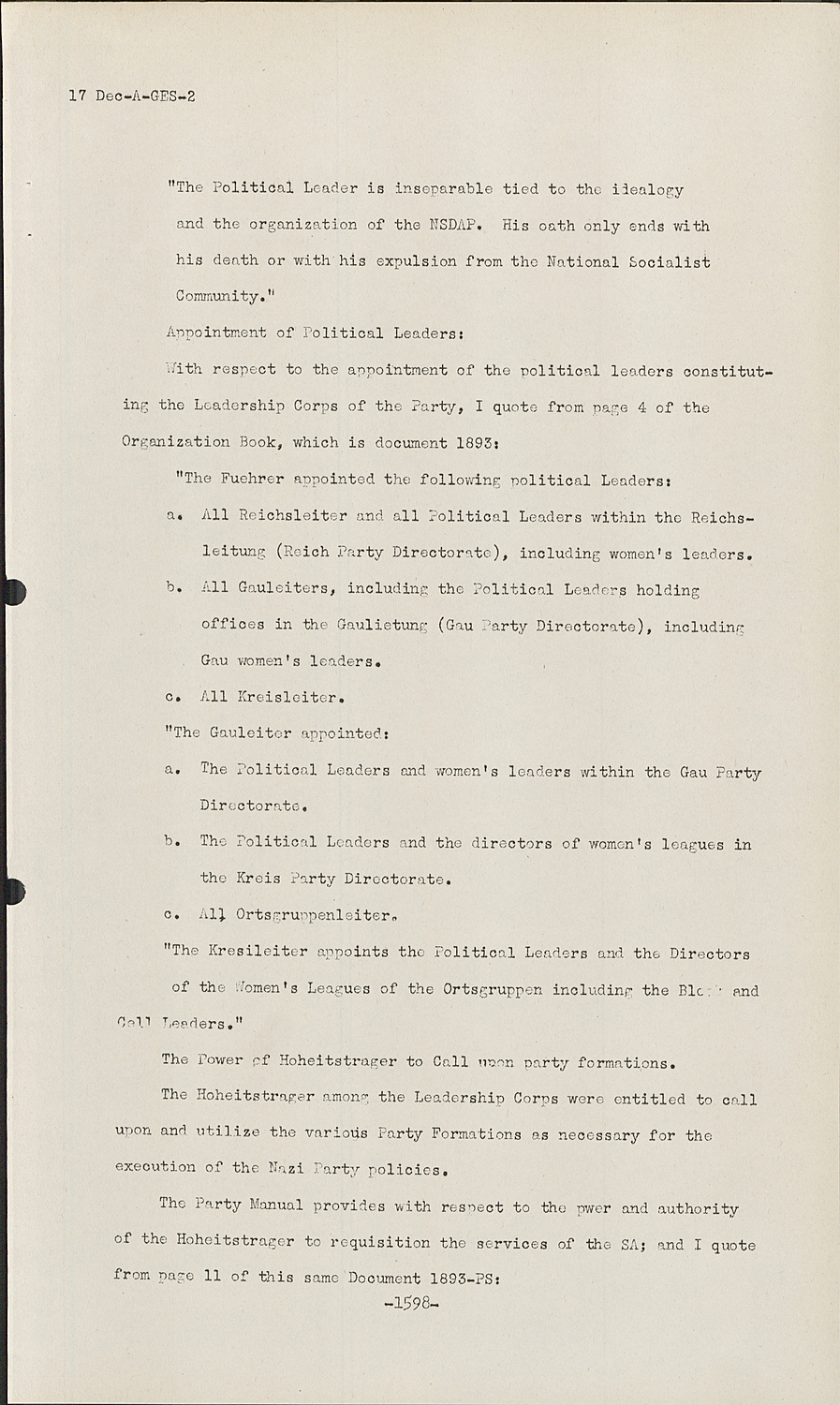
"The Political Leader is inseparable tied to the idealogy and the organization of the NSDAP.
His oath only ends with his death or with his expulsion from the National Socialist Community."
Appointment of Political Leaders:
With respect to the appointment of the political leaders constituting the Leadership Corps of the Party, I quote from page 4 of the Organization Book, which is document 1893:
"The Fuehrer appointed the following political Leaders:
a. All Reichsleiter and all Political Leaders within the Reichs leitung (Reich Party Directorate), including women's leaders.
b. All Gauleiters, including the Political Leaders holding offices in the Gaulietung (Gau Party Directorate), including Gau women's leaders.
c.All Kreisleiter.
"The Gauleiter appointed:
a. The Political Leaders and women's leaders within the Gau Party Directorate.
b. The Political Leaders and the directors of women's leagues in the Kreis Party Directorate.
c.All Ortsgruppenleiter.
"The Kresileiter appoints the Political Leaders and the Directors of the Women's Leagues of the Ortsgruppen including the Blood and Cell Leaders."
The Power of Hoheitstrager to Call upon party formations.
The Hoheitstrager among the Leadership Corps were entitled to call upon and utilize the various Party Formations as necessary for the execution of the Nazi Party policies.
The Party Manual provides with respect to the pwer and authority of the Hoheitstrager to requisition the services of the SA; and I quote from page 11 of this same Document 1893-PS:
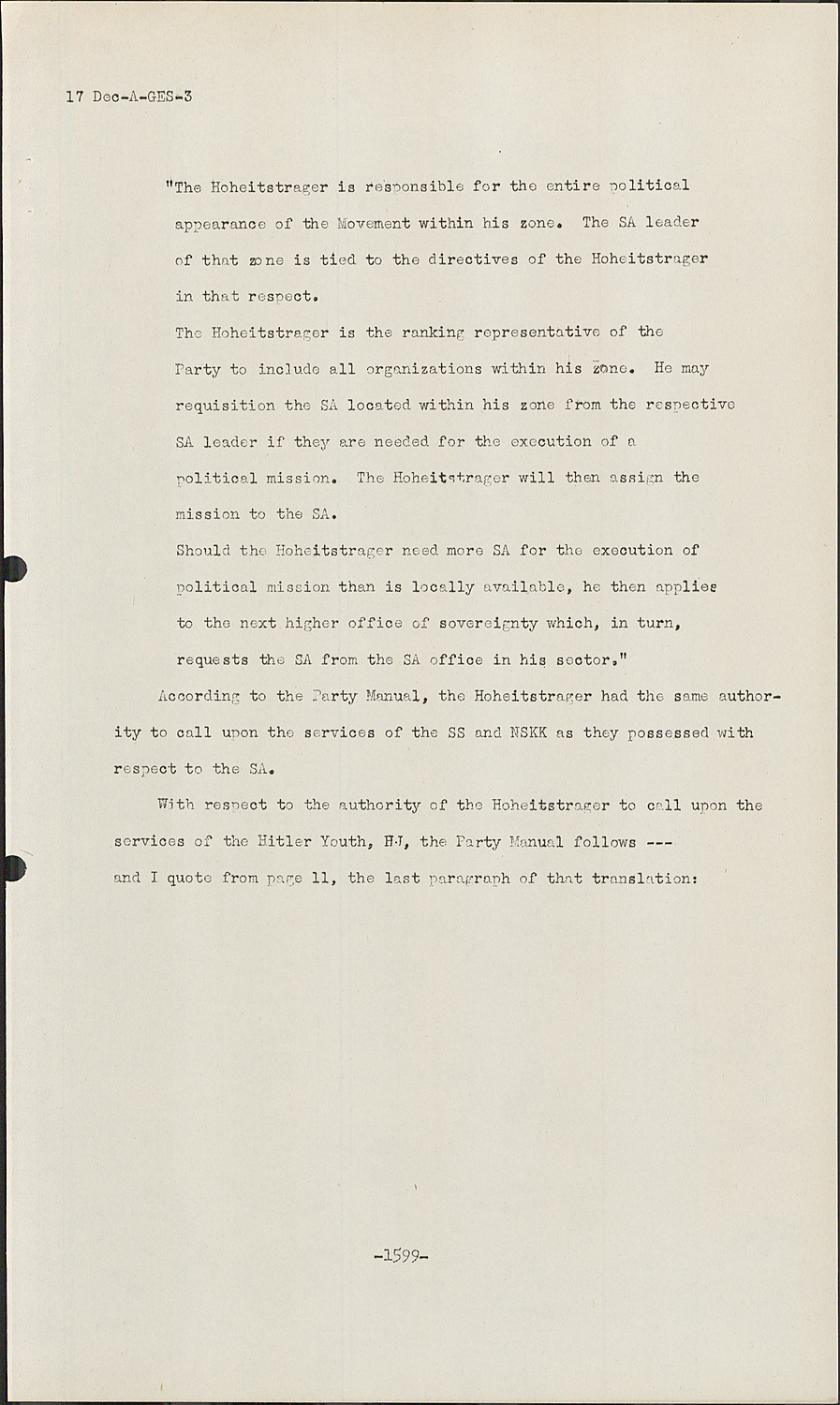
"The Hoheitstrager is Responsible for the entire political appearance of the Movement within his zone.
The SA leader of that zone is tied to the directives of the Hoheitstrager in that respect.
The Hoheitstrager is the ranking representative of the Party to include all organizations within his zone.
He may requisition the SA located within his zone from the respective SA leader if they are needed for the execution of a political mission.
The Hoheitstrager will then assign the mission to the SA.
Should the Hoheitstrager need more SA for the execution of political mission than is locally available, he then applies to the next higher office of sovereignty which, in turn, requests the SA from the SA office in his sector."
According to the Party Manual, the Hoheitstrager had the same authority to call upon the services of the SS and NSKK as they possessed with respect to the SA.
With respect to the authority of the Hoheitstrager to call upon the services of the Hitler Youth, HJ, the Party Manual follows --and I quote from page 11, the last paragraph of that translation:
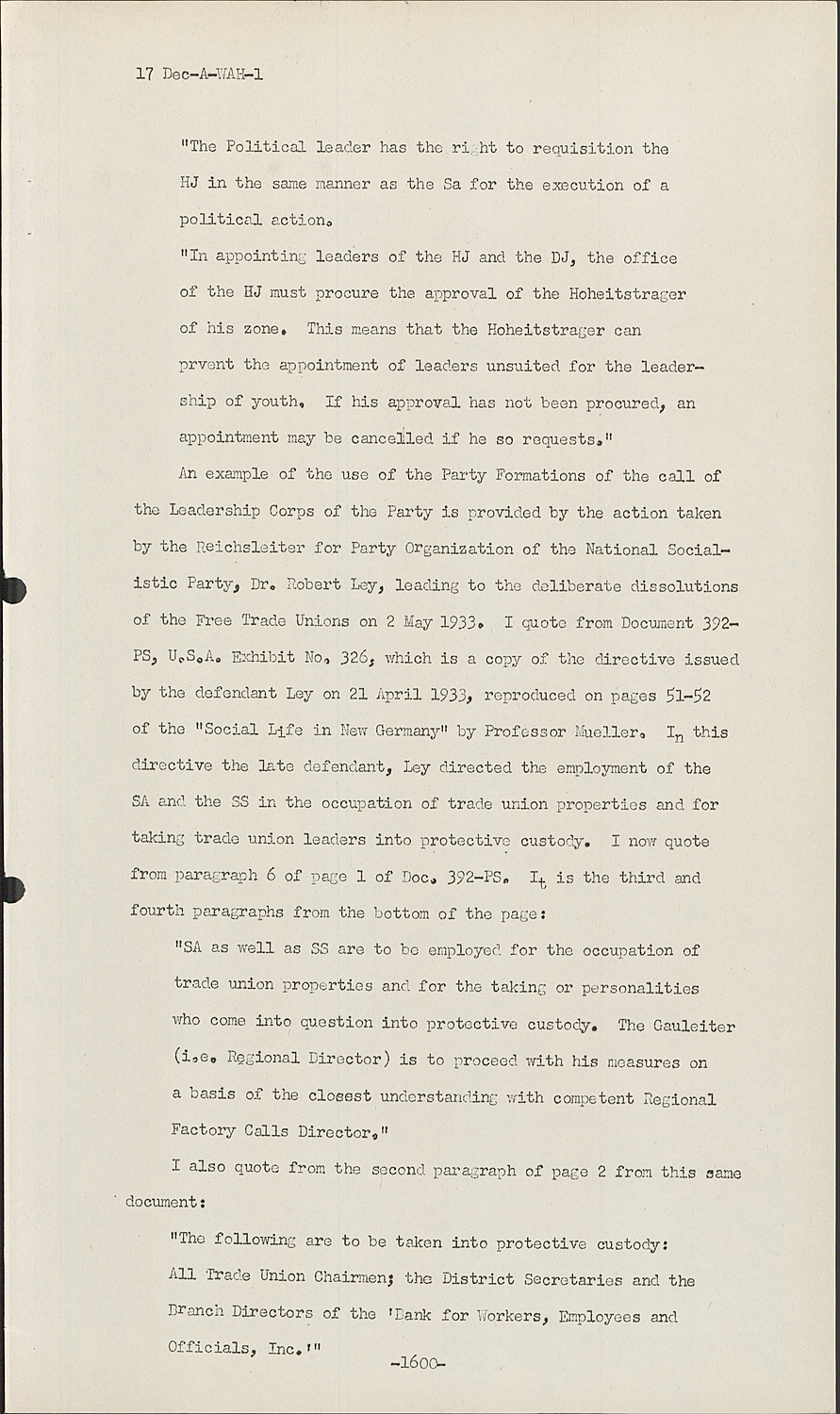
"The Political leader has the right to requisition the HJ in the same manner as the Sa for the execution of a political action.
"In appointing leaders of the HJ and the DJ, the office of the HJ must procure the approval of the Hoheitstrager of his zone.
This means that the Hoheitstrager can prvent the appointment of leaders unsuited for the leader ship of youth.
If his approval has not been procured, an appointment may be cancelled if he so requests."
An example of the use of the Party Formations of the call of the Leadership Corps of the Party is provided by the action taken by the Reichsleiter for Party Organization of the National Socialistic Party, Dr. Robert Ley, leading to the deliberate dissolutions of the Free Trade Unions on 2 May 1933. I quote from Document 392PS, U.S.A. Exhibit No. 326, which is a copy of the directive issued by the defendant Ley on 21 April 1933, reproduced on pages 51-52 of the "Social Life in New Germany" by Professor Mueller. In this directive the late defendant, Ley directed the employment of the SA and the SS in the occupation of trade union properties and for taking trade union leaders into protective custody. I now quote from paragraph 6 of page 1 of Doc. 392-PS. It is the third and fourth paragraphs from the bottom of the page:
"SA as well as SS are to be employed for the occupation of trade union properties and for the taking or personalities who come into question into protective custody.
The Gauleiter (i.e. Regional Director) is to proceed with his measures on a basis of the closest understanding with competent Regional Factory Calls Director."
I also quote from the second paragraph of page 2 from this same document:
"The following are to be taken into protective custody:
All Trade Union Chairmen; the District Secretaries and the Branch Directors of the 'Bank for Workers, Employees and Officials, Inc.
'" I now offer in evidence Doc.
2474-PS, U.S.A. Exhibit No. 327 which is a copy of a decree issued by the Defendant Hess, as Deputy of the Fuehrer, dated 25 October 1934, which underwrites the authority of the Hoheitstrager with respect to the Party Formations.
I quote from the numbered paragraphs 1, 5 and 6 of page 1 of Document 2474-PS which reads as follows:
"The political leadership within the Party and its political representation towards all offices, State or others, which are outside of the Party, lie solely and exclusively with the H heitstrager (Bearers of Sovereignty), which is to say with me, the Gauleiter, Kreisleiter, and Ortsgruppenleiter.
..
The departmental workers of the Party organization, as well as Reichsleiter, office directors, etc.
, as well as the leaders of the SA, SS, HJ and the subordinate affiliations, may not enter into binding agreements of a political nature with State and other offices except when so authorized by their Hoheitstrager.
In places where the territories of the units of the SA, SS, HJ and the subordinate affiliations do not conincide with the zones of the Hoheitstrager, the Hoheitstrager will give his political directives to the ranking leader of each unit within his zone of sovereignty."
It was the official policy of the Leadership Corps to establish close and cooperative relations with the Gestapo. The Tribunal will recall that the Head of the German Police and SS, Himmler, was a Reichsleiter on the top level of the Leadership Corps. Without offering in evidence a decree dated 26 June 1935, issued by the Defendant Bormann, as Chief of Staff, Deputy of the Fuehrer, I ask the court to take judicial knowledge, and I quote:
"In order to effect a closer contact between the offices of the Party and its organizations with the Directors of the Secret State Police (Gestapo), the Deputy of the Fuehrer requests that the Directors of the Gestapo be invited to attend all of the larger official rallies of the Party and its organization."
That is from the 1937 edition, page 143, dated the 26th June 1935, "The Decrees of the Deputy of the Fuehrer."
With reference to the meetings and conferences among the Hoheitstrager of the Leadership Corps, it is the contention of the Prosecution that the members of the Leadership Corps constitute a distinctive and identifiable group or organization. This contention is strongly supported by the fact that the various Hoheitstrager were under an abolsute obligation to meet and confer periodically not only with the staff officers on their own staffs, but with the political leaders and staff officers immediately subordinate to them.
For example, the Gauleiter was bound to confer with his staff officers (such as his deputy, and so forth, which included the school leader, propaganda leader, press leader, his Gau Party judge, and so on) every 8 to 14 days. Furthermore, the Gauleiter was obligated to meet with the various Gauleiters subordinate to him once every 3 months for a 3-day convention, for the purpose of discussing and clarifying Nazi Party policies and directives, for hearing basic lectures on Party policy, and for the mutual exchange of information pertinent to the Party's current program. The Gauleiter was also obligated to meet at least once a month with the leaders of the Party formations and affiliated organizations within his Gau area, such as the leaders of the SA, the SS, Hitler Youth and others. In support of these statements, I quote from page 8 of Document 1893-PS. I don't think it is necessary to read all of that.
"Leader conferences in the district:
If Your Honor pleases, with your permission I will omit the reading of that because it was really summarized in my previous statement. I will quote sub-paragraph (d):
(d) The bearer of sovereignty will meet at least once a month with the leaders of the SA, SS, NSKK, HJ, as well as the RAD and the NSFK who are within the zone for the purpose of mutual orientation."
The Organization Book of the Party imposes a similar requirement of regular and periodical conferences and meetings upon all the other Hoheitstrager, including the Kreisleiter, Ortsgruppenleiter, Zellenleiter and Blockleiter.
The clear consequence of such regular and obligatory conferences and meetings by all the Hoheitstrager, both with their own staff officers and with the political leaders and staff officers subordinate to them, was that basic Nazi policies and directives issued by Hitler and the leader of the Party Chancellery, the Defendant Bormann, directly through the chain of command of the Hoheitstrager, and functional policies issued by the various Reichsleiter and Reich office holders down functional and technical channels, were certain to be notified to, received, and understood by the bulk of the membership of the Leadership Corps.
If I may digress from my text, and call attention to this chart, you will see the dotted lines connecting down from the Party level, Gau level, to similar offices in the lower level.
Now I next come to the statistics relating to the Leadership Corps of the Nazi Party. The evidence relating to the size of the Leadership Corps of the Nazi Party, and as previously shown, the Leadership Corps comprised the sum of officials of the Nazi Party, including, in addition to Hitler and the members of the Reichsleitung, such as the Reichsleiter and the Reich office holders, a hierarchy of Hoheitstrager, which I have described, as well as the staff officers attached to the Hoheitstrager. I now offer in evidence Document 2958-PS, USA Exhibit No. 325, and this is issue No. 8, 1939, of the official Leadership Corps organ, "Der Hoheitstrager," similar to the one I exhibited a moment ago, and this is for the year 1939. This shows that there were:
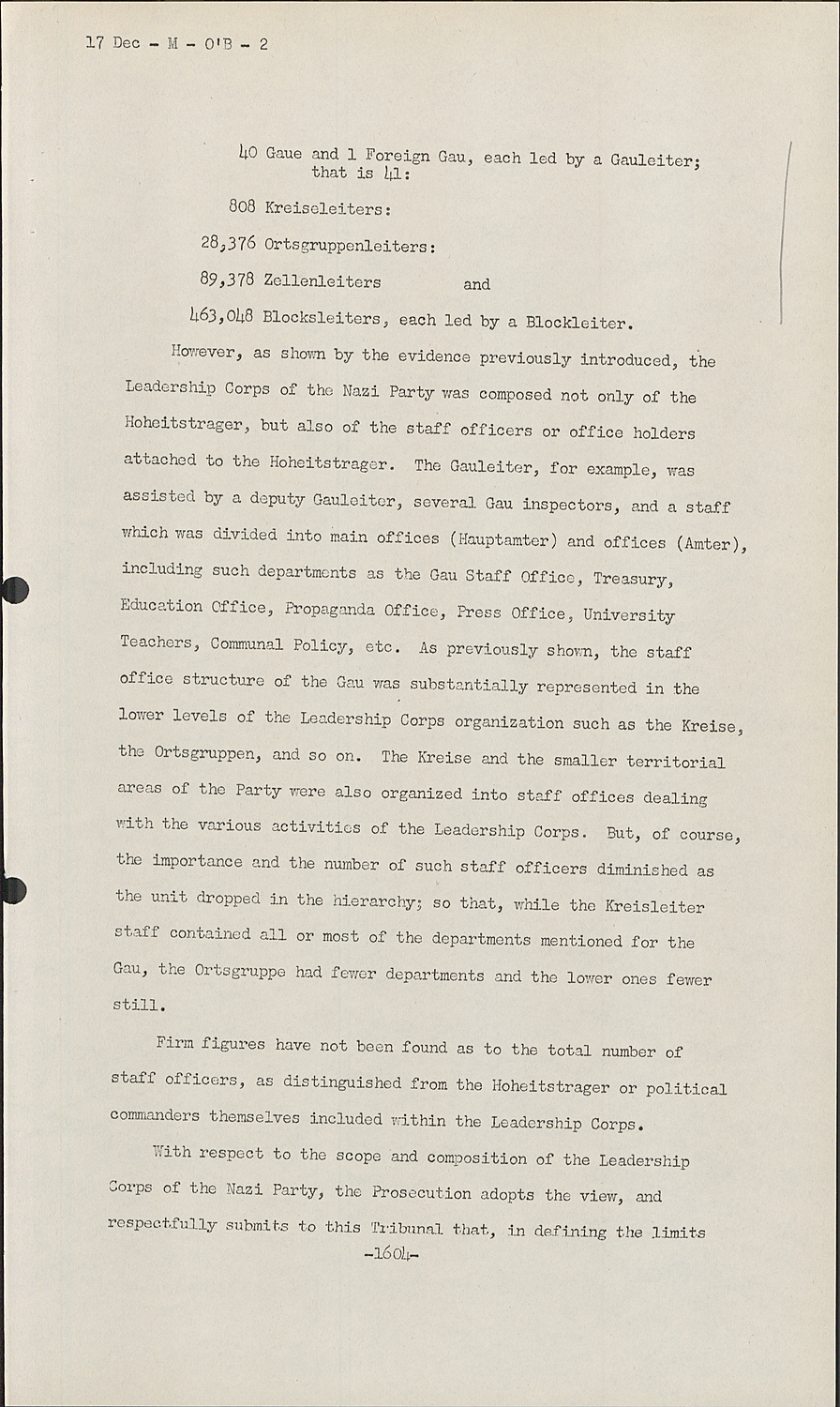
40 Gaue and 1 Foreign Gau, each led by a Gauleiter;
that is 41:
808 Kreiseleiters:
28,376 Ortsgruppenleiters:
89,378 Zellenleiters and 463,048 Blocksleiters, each led by a Blockleiter.
However, as shown by the evidence previously introduced, the Leadership Corps of the Nazi Party was composed not only of the Hoheitstrager, but also of the staff officers or office holders attached to the Hoheitstrager. The Gauleiter, for example, was assisted by a deputy Gauleiter, several Gau inspectors, and a staff which was divided into main offices (Hauptamter) and offices (Amter), including such departments as the Gau Staff Office, Treasury, Education Office, Propaganda Office, Press Office, University Teachers, Communal Policy, etc. As previously shown, the staff office structure of the Gau was substantially represented in the lower levels of the Leadership Corps organization such as the Kreise, the Ortsgruppen, and so on. The Kreise and the smaller territorial areas of the Party were also organized into staff offices dealing with the various activities of the Leadership Corps. But, of course, the importance and the number of such staff officers diminished as the unit dropped in the hierarchy; so that, while the Kreisleiter staff contained all or most of the departments mentioned for the Gau, the Ortsgruppe had fewer departments and the lower ones fewer still.
Firm figures have not been found as to the total number of staff officers, as distinguished from the Hoheitstrager or political commanders themselves included within the Leadership Corps.
With respect to the scope and composition of the Leadership Corps of the Nazi Party, the Prosecution adopts the view, and respectfully submits to this Tribunal that, in defining the limits of the Leadership Corps, staff officers should only be included down to and including the Kreise.
Upon this basis, the Leadership Corps of the Nazi Party did constitute the Fuehrer, the members of the Reichsleitung, the five levels of the Hoheitstrager, and the staff officers attached to the forty odd Gauleiters and the eight or nine hundred Kreisleiters. Adopting this definition of the Leadership Corps, it will be seen that the total figure for the membership of that organization, based upon the statistics cited from the basic handbook for Germany, amounts to around 600,000. By accepting the staff officers of the lower levels, as provided in the indictment, and as just defined, and without prejudice to any later individual action against those accepted, we think the figure of around 600,000 is approximately correct.
It is true that this figure is based upon an admittedly limited view of the size of the membership of the Leadership Corps of the Nazi Party, for the evidence has shown that the Leadership Corps, in effect, embraced staff officers attached to the subordinate Hoheitstrager, and the inclusion of such staff officers in the estimation of the size of the Leadership Corps if we had so recommended would have considerably enlarged the final figure if you had included staff officers to the Blockleiters so that it would have been 2,000,000, in round numbers.
MR. BIDDLE:What reason did you have for excluding them?
COLONEL STOREY:For this reason, your Honor, down in the Blockleiter, he might have called on an individual laborer that might have been on his staff, but he certainly didn't have the discretion that a staff leader did, for example, to the Gauleiter, say, as a propaganda man who disseminated, information down, as well as help participate in plans and policies of the upper organization.
The subordinate staff officers thus excluded were responsible functionally to the higher staff officers with respect to their particular speciality, such as propaganda. Party organization, and so on, and to their respective Hoheitstrager with respect to discipline and policy control, and as I mentioned, likewise such higher staff officers participated in planning and policy, and passed these orders down through technical levels or technical channels as opposed to command channels.
"The Leadership Corps of the Nazi Party joined and participated in the common plan or conspiracy" is the next title.
The Program of the Nazi Party, proclaimed by Hitler on 24th February, 1920, contained the chief elements of the Nazi plan for domination and conquest. I now quote from document 1708-PS, which is the Year Book for 1941, published by the Party, and edited by the late Robert Ley. This book contains the famous 25 points of the Party, which I now offer in evidence as USA Exhibit No. 324. Diverting from the text, I don't intend to quote these 25 Party objectives, but only refer to a few of them, and I quote from page 1 of the English translation of document 1708-PS.
"We demand the unification of all Germans in the Greater Germany on the basis of the right of self-determination of peoples."
Point 2 of the Party Program demanded unilateral abolition of the Peace Treaties of Versailles and St. Germain, which I quote.
"We demand equality of rights for the German people in respect to the other nations;abrogation of the Peace Treaties of Versailles and St. Germain."
Point 3: quoting.
"We demand land and territory (colonies) for the sustenance of our people, and colonization for our surplus population."
Point 4:
"Only a member of the race can be a citizen.
A member of the race can only be one who is of German blood, without consideration of confession.
Consequently, no Jew can be a member of the race."
Point 6:
"We demand that every public office, of any sort, whatsoever, whether in the Reich, the county or municipality, be filled only by citizens.
We combat the corrupting parliamentary economy, office-holding only according to Party inclinations without consideration of character or abilities."
Point 22: (which is from page 2 of the English translation of document 1708-PS) "We demand the abolition of the mercenary troops and formation of a National Army."
Back to page 1 - another quotation:
"The program is the political foundation of the NSDAP and accordingly the primary political law of the State All legal precepts are to be applied in the spirit of the Party Program.
Since the taking over of control the Fuehrer has succeeded in the realization of the essential portions of the Party Program from the fundamentals to the details.
The Party Program of the NSDAP was proclaimed on 24 February 1920 by Adolf Hitler at the first large Party gathering in Munich and since that day has remained unaltered.
....The National Socialist philosophy is summarized in 25 points."
As previously mentioned, the Party Program was binding upon the Political Leaders and they were under a duty to support and carry out that Program.
The Party Manual states, and I quote again from the middle of page 1 of Document 1893-PS:
"The Commandments of the National Socialists:
The Fuehrer is always right ....
The Program be your dogma.
It demands your utter devotion to the Movement ...
Right is what serves the Movement and thus Germany."
On page two of the same document another brief quotation:
"....Leader Corps is responsible for the complete penetration of the German Nation with the National Socialist spirit.
..."
The oath of the Political Leader to Hitler has been previously mentioned. In this connection the Party Manual provides, and I quote from the second paragraph on page 3 of the same document:
"The Political Leader is inseparably tied to the ideology and the organization of the NSDAP.
His oath only ends with his death or with his expulsion from the National Socialist community."
While the "leadership principle" assured the binding nature of Hitler's statements, program and policies upon the entire Party and the Leadership Corps thereof, the leadership principle also established the full responsibility of the individual Political Leader within the province and jurisdiction of his office or position.
The leadership principle applied not only to Hitler as the supreme leader, but also to the Political Leaders under him and thus permeated the entire Leadership Corps. I quote from the middle of page 2 of Doc. 1893-PS:
"The basis of the Party Organization is the Fuehrer thought...
All Political Leaders stand as appointed by the Fuehrer and are responsible to him.
They possess full authority toward the lower echelons.
..."
The various Hoheitstrager of the Leadership Corps were, in their respective areas, themselves Fuehrer. I quote from the third paragraph of page 9 of this same document:
"Within their sector of sovereignty, the Hoheitstrager (Gauleiter, Kreisleiter, Ortsgruppenleiter, Zellenleiter, Blockleiter) have sovereign political rights . . .They are responsible for the entire political situation within their sector.
.."
I again refer and quote from Document 1814-PS, U.S.A. Exhibit No.328, which is the Party Book. It is just a one-sentence quotation, and it states:
"The Party is an order of 'Fuehrer'. (End of quotation).
The subjection of the entire membership of the Leadership Corps to the fiat of the Fuehrer Principle is clearly shown in the following passage from the Party Manual; and it is this same document on page 3:
"....a solid anchorage for all the organizations within the party structure is provided and a firm connection with the sovereign leaders of the NSDAP is created in accordance with the Fuehrer principle."
(End of quotation).
Next is the subject:
"The Nazi Party, directed by the leadership Corps, dominated and controlled the German State and Government."
The Trial Brief dealing with the criminality of the Reich Cabinet sets forth the evidence as to the identity of various ministers comprising the Cabinet, and I shall not deal with that subject.
The presence of the Reichsleiter and other prominent members of the Leadership Corps in the Cabinet facilitated the domination of the Cabinet by the Nazi Party and the Leadership Corps.
A law of 14 July 1933 outlawed and forbade the formation of any political parties other than the Nazi Party and made offenses against this a punishable crime, thereby establishing the one-party State and rendering the Leadership Corps immune from the opposition of organized political groups. I now quote from Document 1388-PS, that being the English translation of the Law against the Formation of New Political Parties, stated in 14 July 1933, 1933 Reichsgesetzblatt, Part I, page 479, and I now quote the first two articles of this law, which read as follows:
"The National Socialist German Workers' Party constitutes the only political party in Germany.
Whoever undertakes to maintain the organizational structure of another political party or to form a new political party will be punished with penal servitude up to three years or with imprisonment of from six months to three years, if the deed is not subject to a greater penalty according to other regulations."
I now quote from Document 1394-PS, which is the English translation of Law to Supplement the Law for the Restoration of the Professional Civil Service, dated 20 July 1933, 1933 Reichsgesetzblatt, Part I, page 518.
On 13 October 1933: "law to guarantee public peace" was enacted which provided, inter alia, that the death penalty or other severe punishment should be imposed upon any person who "...undertakes to kill a member of the SA or the SS, a trustee or agent of the NSDAP.
.... out of political motives or on account of their official activity."
I next refer to Document 1395-PS, which is the English translation of the Law on Security and The Unity of the Party and State.
On 1 December 1933, the law was enacted "to secure the unity of Party and State." This law provided that the Nazi Party was the pillar of the German State, and was linked to it indissolubly; it also made the Deputy of the Fuehrer (then Hess) and the Chief of Staff of the SA (then Rohm) members of the Reich Cabinet. I quote:
"After the victory of the National Socialist Revolution, the National Socialistic German Labor Party is the bearer of the concept of the German State and is in separably the State.
It will be a part of the public law.
Its organization will be determined by the Fuehrer .....The Deputy of the Fuehrer and the Chief of Staff of the SA will become members of the Reich Government in order to insure close cooperation of the offices of the Party and SA with the public authorities.
..."
This law was a basic measure in enthroning the Leadership Corps in a position of supreme political power in Germany. For it laid down that the Party, directed by the Leadership Corps, was the embodiment of the State and, in fact, was the State. Moreover, this, law made both the Fuehrer's Deputy and the Chief of Staff of the SA, which was a Party formation subject to the call of the Hoheitstraeger, cabinet members, thus further solidifying the Leadership Corps' control of the cabinet. The dominant position of the Leadership Corps is further revealed by the provision that the Reichschancellor would issue the carrying-out regulations of this law in his capacity as Fuehrer of the Nazi Party. The fact that Hitler, as Fuehrer of the Leadership Corps, could promulgate rules which would have statutory force and be published in the Reichsgesetzblatt, the proper compilation for State enactments, is but a further reflection of the reality of the Party's domination of the German State.