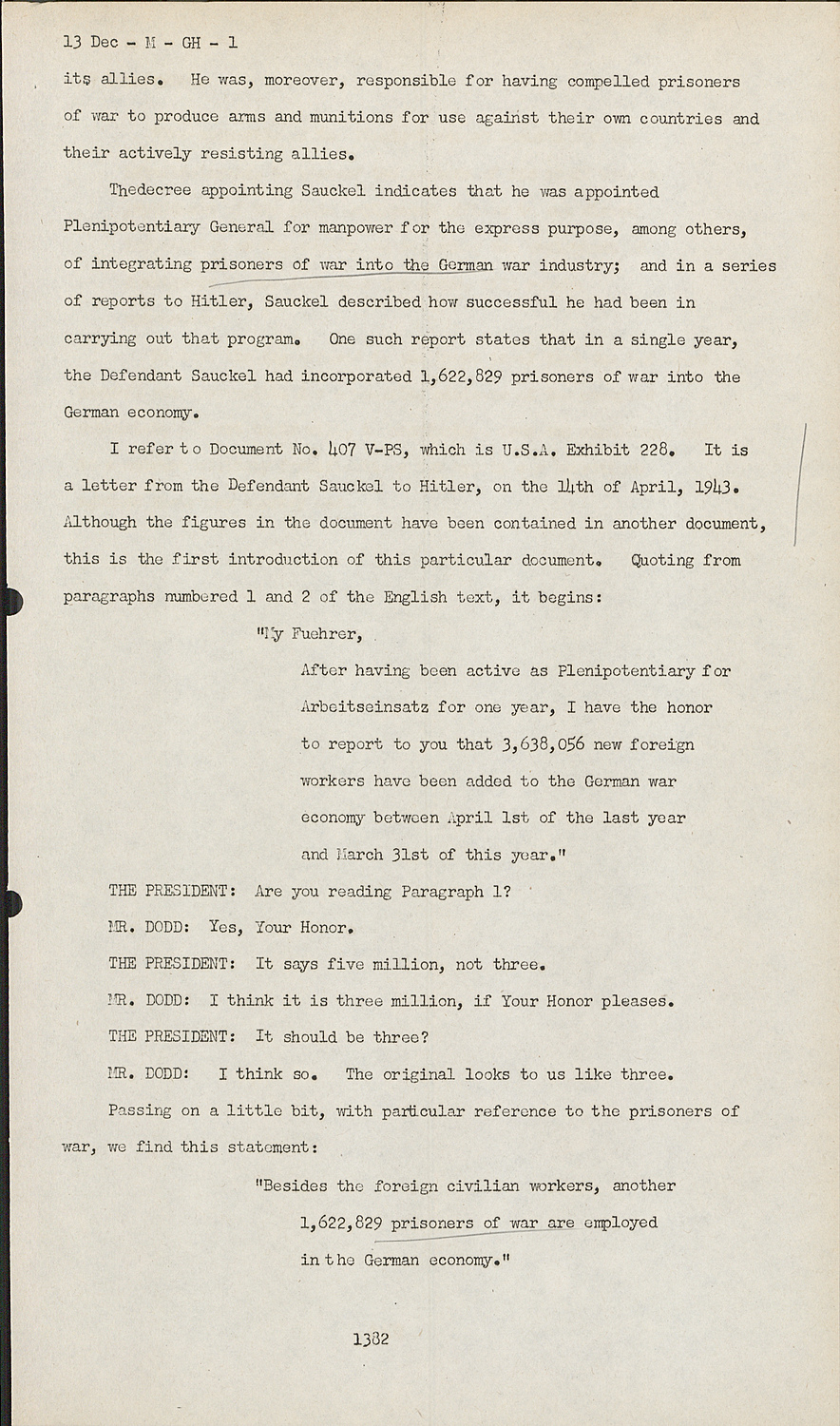
He was, moreover, responsible for having compelled prisoners of war to produce arms and munitions for use against their own countries and their actively resisting allies.
Thedecree appointing Sauckel indicates that he was appointed Plenipotentiary General for manpower for the express purpose, among others, of integrating prisoners of war into the German war industry; and in a series of reports to Hitler, Sauckel described how successful he had been in carrying out that program. One such report states that in a single year, the Defendant Sauckel had incorporated 1,622,829 prisoners of war into the German economy.
I refer to Document No. 407 V-PS, which is U.S.A. Exhibit 228. It is a letter from the Defendant Sauckel to Hitler, on the 14th of April, 1943. Although the figures in the document have been contained in another document, this is the first introduction of this particular document. Quoting from paragraphs numbered 1 and 2 of the English text, it begins:
"My Fuehrer, After having been active as Plenipotentiary for Arbeitseinsatz for one year, I have the honor to report to you that 3,638,056 new foreign workers have been added to the German war economy between April 1st of the last year and March 31st of this year."
THE PRESIDENT:Are you reading Paragraph 1?
MR. DODD:Yes, Your Honor.
THE PRESIDENT:It says five million, not three.
MR. DODD:I think it is three million, if Your Honor pleases.
THE PRESIDENT:It should be three?
MR. DODD:I think so. The original looks to us like three.
Passing on a little bit, with particular reference to the prisoners of war, we find this statement:
"Besides the foreign civilian workers, another 1,622,829 prisoners of war are employed in the German economy."
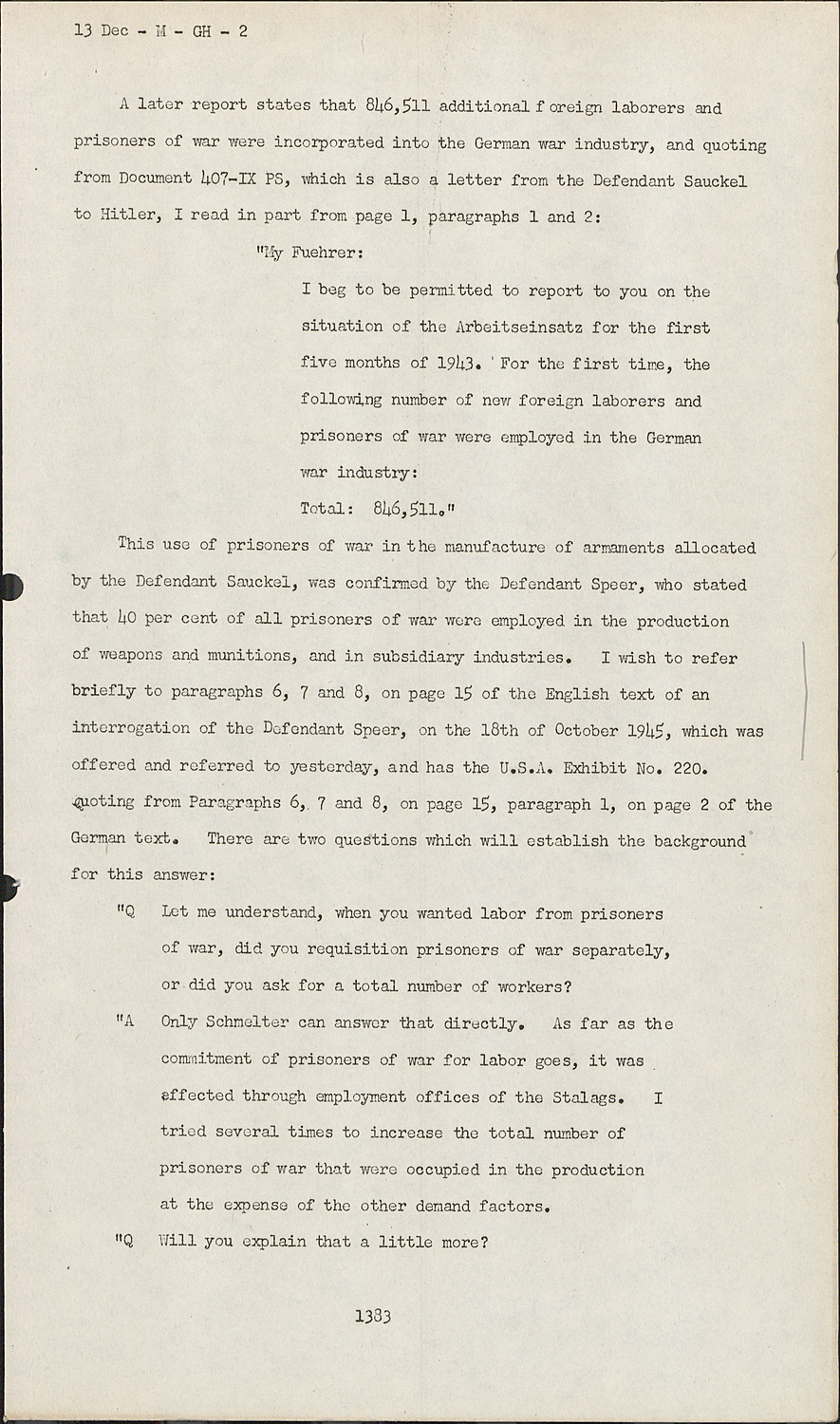
A later report states that 846,511 additional f oreign laborers and prisoners of war were incorporated into the German war industry, and quoting from Document 407-IX PS, which is also a letter from the Defendant Sauckel to Hitler, I read in part from page 1, paragraphs 1 and 2:"My Fuehrer:
I beg to be permitted to report to you on the situation of the Arbeitseinsatz for the first five months of 1943.
For the first time, the following number of new foreign laborers and prisoners of war were employed in the German war industry:
Total: 846,511."
This use of prisoners of war in the manufacture of armaments allocated by the Defendant Sauckel, was confirmed by the Defendant Speer, who stated that 40 per cent of all prisoners of war were employed in the production of weapons and munitions, and in subsidiary industries. I wish to refer briefly to paragraphs 6, 7 and 8, on page 15 of the English text of an interrogation of the Defendant Speer, on the 18th of October 1945, which was offered and referred to yesterday, and has the U.S.A. Exhibit No. 220. Quoting from Paragraphs 6, 7 and 8, on page 15, paragraph 1, on page 2 of the German text. There are two questions which will establish the background for this answer:
"Q Let me understand, when you wanted labor from prisoners of war, did you requisition prisoners of war separately, or did you ask for a total number of workers?
"A Only Schmelter can answer that directly. As far as the commitment of prisoners of war for labor goes, it was effected through employment offices of the Stalags.
I tried several times to increase the total number of prisoners of war that were occupied in the production at the expense of the other demand factors.
"Q Will you explain that a little more?
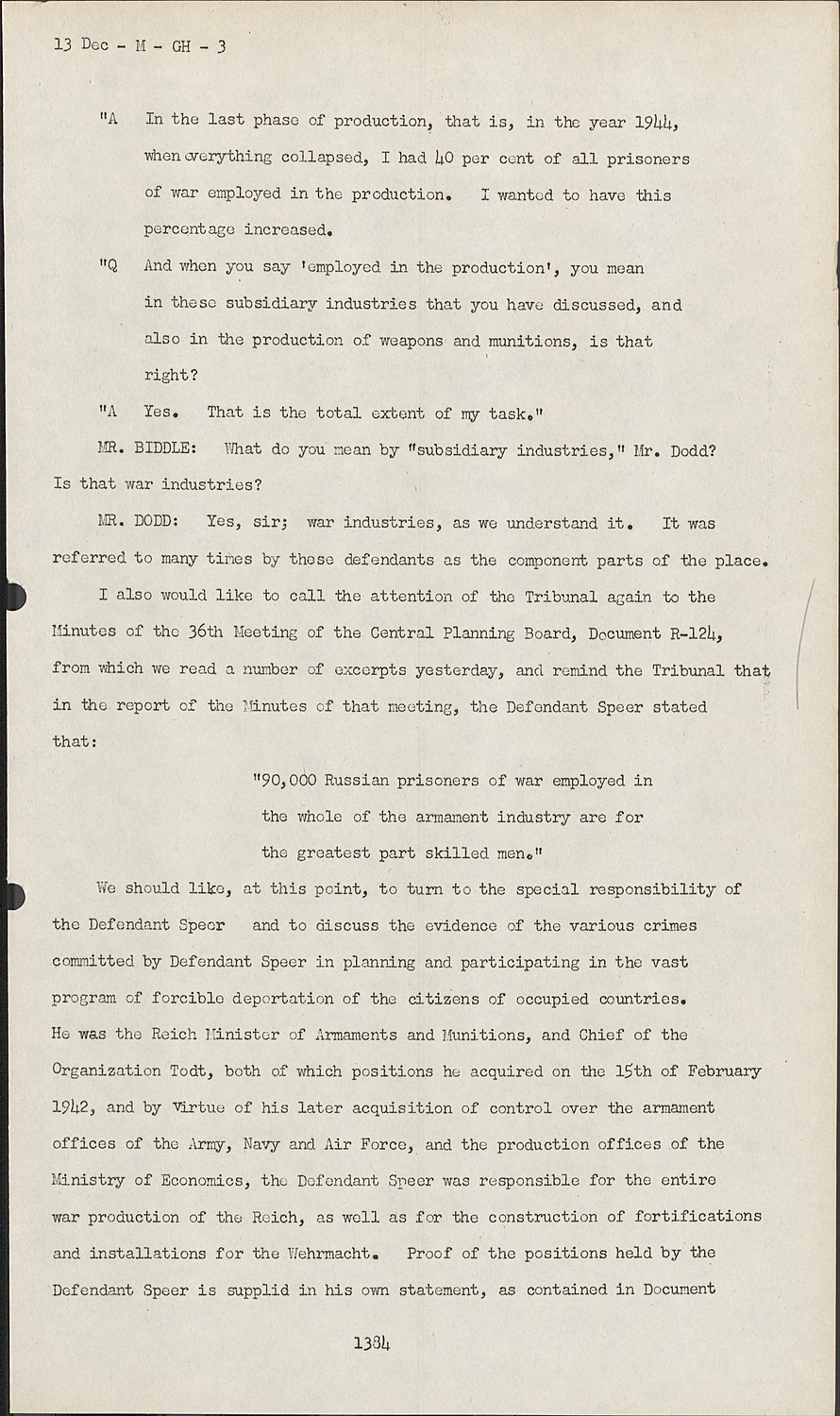
"A In the last phase of production, that is, in the year 1944, when everything collapsed, I had 40 per cent of all prisoners of war employed in the production.
I wanted to have this percentage increased.
"Q And when you say 'employed in the production', you mean in these subsidiary industries that you have discussed, and also in the production of weapons and munitions, is that right?
"A Yes. That is the total extent of my task."
MR. BIDDLE:What do you mean by "subsidiary industries," Mr. Dodd? Is that war industries?
MR. DODD:Yes, sir; war industries, as we understand it. It was referred to many times by these defendants as the component parts of the place.
I also would like to call the attention of the Tribunal again to the Minutes of the 36th Meeting of the Central Planning Board, Document R-124, from which we read a number of excerpts yesterday, and remind the Tribunal that in the report of the Minutes of that meeting, the Defendant Speer stated that:
"90,000 Russian prisoners of war employed in the whole of the armament industry are for the greatest part skilled men."
We should like, at this point, to turn to the special responsibility of the Defendant Speer and to discuss the evidence of the various crimes committed by Defendant Speer in planning and participating in the vast program of forcible deportation of the citizens of occupied countries. He was the Reich Minister of Armaments and Munitions, and Chief of the Organization Todt, both of which positions he acquired on the 15th of February 1942, and by virtue of his later acquisition of control over the armament offices of the Army, Navy and Air Force, and the production offices of the Ministry of Economics, the Defendant Speer was responsible for the entire war production of the Reich, as well as for the construction of fortifications and installations for the Wehrmacht. Proof of the positions held by the Defendant Speer is supplid in his own statement, as contained in Document 2980-PS, which has already been offered to the Tribunal, and which bears U.S.A. Exhibit No. 18.
The industries under the Defendant Speer's control were really the most important users of manpower in Germany; and thus, according to the Defendant Sauckel, Speer's labor requirements received unconditional priority over all ether demands for labor. We refer to the transcript of the interrogation of the Defendant Sauckel, on the 22nd of September, 1945. It is U.S.A. Exhibit 230. It is next to the last document in the document book. I wish to refer to page 1 of that document, paragraph 4. It is a brief reference, the last answer on the page.
The question was asked of the Defendant Sauckel:
"Q Except for Speer, they would give the requirements in general for the broad field, but in Speer's work, he would get them allocated by industry, and so on; is that right?
"A The others I only got whatever was left. Because Speer told me once in the presence of the Fuehrer that I an here to work for Speer and that mainly I am his man."
The Defendant Speer has admitted under oath that he participated in the discussions, during which the decision to use foreign forced labor was made. He has also said that he concurred in the decision, and that it was the basis for the program of bringing foreign workers into Germany by compulsion. I make reference to the interrogation of the Defendant Speer, of the 18th of October, 1945. It bears the U.S.A. Exhibit No. 220. We have already read from it; and I particularly refer to the bottom of page 12, and the top of page 13 of the English text:
"Q But is it clear to you Mr. Speer, that in 1942 when the decisions were being taken concerning the use of forced foreign labor that you participated in the discussions yourself?
"A. Yes.
"Q So that I take it that the execution of the program of bringing foreign workers into Germany by compulsion under Sauckel was based on earlier decisions that had been taken with your agreement?
"A Yes, but I must point out that only a very small part of the manpower that Sauckel brought into Germany was made available to me, a far larger part of it was allocated to other departments that demanded them".This admission is confirmed by the minutes of Speer's conference with Hitler on 10, 11 and 12 August 1942, in document R124, which has been offered here and from which excerpts have been read.
Page 34 of that document, paragraph 1 of the English text, has already been quoted, and those excerpts have been read before the Tribunal yesterdays.
The Tribunal will recall that the Defendant Speer related the outcome of his negotiations concerning the forcible recruitment of a million Russian laborers for the German armaments industry, and this use of force was again discussed by Hitler and Defendant Speer on the 4th day of January, 1943 as shown by the excerpts read from the document 536-PS 13, where it was decided that stronger measures were to be used to accelerate the conscription of French civilian workers.
We say the Defendant Speer demanded foreign workers for the industries under his control and used these workers with the knowledge that they had been deported by force and were being compelled to work, Speer has stated under oath in his interrogation of 18th October, 1945, page 5, paragraph 9 of the English text, quoting it directly:
"I do not wish to give the impression that I want to deny the fact that I demanded manpower and foreign manpower from Sauckel very energetically."
He has admitted that he knew he was obtaining foreign labor, a large part of which was forced labor, and referring again to that same interrogation of the 18th of October 1945, and to pages 8 and 9 of the English text and page 10 of the German text:
"Q So that during the period when you were asking for labor, it seems clear, does it not, that you knew you were obtaining foreign labor as wall as domestic labor in response to your requests, and that a large part of the foreign labor was forced labor.
"A Yes "Q So that, simply by way of illustration, suppose that on January 1 1944 you require 50,000 workers for a given purpose, would you put in a requisition for 50,000 workers, knowing that in that 50,000 there would be forced foreign workers?
"A Yes.
The Defendant Speer has also stated under oath that he knew at least as early as September of 1942 that workers from the Ukraine were being forcibly deported for labor into Germany.
Likewise he knew that the great majority of the workers of the Western occupied countries were slave laborers forced against their will to come to Germany, and again referring to his interrogation on this 18th day of October, 1945, and beginning with the fourth paragraph from the bottom of page 5 of the English text, paragraph 10 on page 6 of the German text, we find this series of questions and answers:
"Q When did you first find out then that some of the manpower from the Ukraine was not coming voluntarily?
"A It is rather difficult to answer this here, that is to name a certain date to you.
However, it is certain that I knew that at some particular point of time that the manpower from the Ukraine did not come voluntarily.
"Q And does that apply also to the manpower from other occupied countries, that is, did there come a time when you knew that they were not coming voluntarily?
"A Yes.
"Q When, in general, would you say that time was, without placing a particular month of the year?
"A As far as the Ukraine situation goes, I believe that they did not come voluntarily any more after a few months, because immense mistakes were made in their treatment by us.
I should say offhand that this time was either in July, August or September of 1942.
Turning to paragraph 11 on page 6 of the English text of this same interrogation, and page 7 and paragraph 8 of the German text, we find this series of questions and answers--and I am quoting:
"Q But many workers did come from the West, did they not, to Germany?
"A Yes.
"Q That means, then, that the great majority of the workers that came from the Western countries, the Western occupied countries, came against their will to Germany?
"A Yes."
These admissions are borne out, of course, by other evidence, for, as Document R-124 shows, and as we have shown by the readings from it, in all countries conscription for work in Germany could be carried out only with the active assistance of the police, and that the prevailing methods of recruitment had provoked such violence that many German recruiting agents had been killed.
And again, at a meeting with Hitler to discuss the manpower requirements for 1944, which is reported in Document 1292-PS, Speer was informed by the Defendant Sauckel that the requirements-including Speer's requirement for 1,300,000 additional Laborers--could be met only if German enforcement agents were furnished to carry out the enslavement program in the occupied countries.
Now we say that notwithstanding his knowledge that these workers were conscripted and deported to Germany against their will, Speer, nevertheless, continued to formulate requirements for the foreign workers and requested their allocation to these industries which were subject to his control. This is borne out by the minutes of the Central Planning board, as contained in Document R-124, and particularly page 13, paragraph 4 of the English text; and that is page 6 and paragraph 4 of the German text.
Speer speaking:
"Now, the labor problem in Germany. I believe it is still possible to transfer some from the western territories.
The Fuehrer stated only recently he wishes to dissolve these foreign volunteers as he had the impression that the army groups were carting around with them a lot of ballast.
Therefore, if we cannot settle this matter ourselves, we shall have to call a meeting with the Fuehrer to clear up the coal situation.
Keitel and Zeitzler will be invited to attend in order to determine the number of Russians from the rear army territories who can be sent to us.
However, I see another possibility: We might organize another drive to screen out workers for the mines from the Russian Prisoners of War in the Reich.
But this possibility is none too promising."
At another meeting of the Central Planning Board, the Defendant Speer rejected a suggestion that labor for industries under his control be furnished from German sources instead of from foreign sources.
And again, in this document R-124, on page 16, paragraphs 3, 4, and 5 of the English text, and page 12, paragraphs 6 and 7 of the German text, I quote the Defendant Speer speaking:
"We do it that way: Kehrl collects the demands for labor necessary to complete the coal-and-iron-plan and communicates the numbers to Sauckel.
Probably there will be a conference of the Reich Marshal's in the next week, and an answer from Sauckel should have arrived by then.
The question of recruitment for the armaments industry will be solved together with Weger."
Kehrl speaking; quoting Kehrl:
"I wish to urge that the allotments to the mines should not be made dependent on the recruitment of men abroad.
He were completely frustrated these last three months because this principle had been applied.
We ended December with a deficit of 25,000 and we never get replacements.
The number must be made up by men from Germany.
"Speer: No, nothing doing."
We say also that the Defendant Speer is guilty of advocating terror and brutality as a means of maximizing production by slave laborers.
And again I refer to this Documeunt R-124. At page 42 there is a discussion concerning the supply and exploitation of labor.
That excerpt has been read to the Tribunal before, and I simply refer to it in passing.
It is the excerpt wherein Speer said it would be a good thing--the effect of it was that nothing could be said against the SS and the police taking a hand and making these men work and produce more.
We say he is also guilty of compelling allied nationals and prisoners of war to engage in the production of armaments and munitions and in direct military operations against their own country.
We say that, as Chief of the Organization Todt, he is accountable for its policies, which were in direct conflict with the laws of war;for the Organization Todt, in violation of the laws or war, impressed allied nationals into its service, Document L-191 is an International Labor Office study of the exploitation of foreign labor by Germany.
We have only one copy of this document, being this International Labor Office study, printed at Montreal, Canada in 1945.
We ask that the Tribunal take judicial notice of it as an official publication of the International Labor Office.
I might say to the Tribunal, with some apology, that this arrived at a time when we were not able to even have the excerpt mimeographed and printed up to place in your document book, so this is the one document which is missing from the document book which is in your hands.
However, I should like to quote from page 73, paragraph 2, of this study by the International Labour Office.
It is not long; it is very brief.
I am quoting directly. It says:
"The methods used for the recruitment of foreign workers who were destined for employment in the Organization did not greatly differ from the methods used for the recruitment of foreigners for deportation to Germany."
The Organization, by the way, is the Organization Todt.
"The main difference was that, since the principal activities of the Organization lay outside the frontiers of Germany, foreigners were not transported to Germany, but had either to work in their own country or in some other occupied territory.
"In the recruitment drives for foreign workers for the Organization methods of compulsion as well as methods of persuasion were used, the latter usually with very little result."
Moreover, conscripted allied nationals were compelled by this same Organization to actually engage in operations of war against their country.
Document 407-PS, VIII, discloses that the foreign workers who were impressed into the Organization Todt, through the efforts of the Defendant Sauckel, did participate in the building of the Atlantic Wall fortifications.
As chief of German war production, this Defendant Speer sponsored and approved the use of those prisoners of war in the production of armaments and munitions.
This has been made plain by the evidence already discussed.
To sum it up briefly, finally, we say that it shows first after Speer assumed the responsibility for the armament production, his concern, in his discussions with his co-conspirators, was to secure a larger allocation of prisoners of war for his armament factories.
That has been shown by the quotations from the excertps of Document R-124, the minutes of the meeting of the Central Planning Board; and in this same meeting the Tribunal will recall that Speer complained because only 30 per cent of the Russian prisoners of war were engaged in the armaments industry.
We have referred to a speech of Speer, Document 1435-PS -- we quoted from it -- in which he said that 10,000 prisoners of war were put at the disposal of the armaments industry upon his orders.
And finally Speer advocated the returning of escaped prisoners of war to factories as convicts.
That is shown again by Document R-124, page 13, paragraph 5 of the English text, where the Defendant Speer says that he has come to an arrangement -
THEPRESIDENT (interposing): Mr. Dodd, don't you think that we really have got this sufficiently now?
MR. DODD:Yes, Sir.
THE PRESIDENT:We have Speer's own admission and any number of documents which prove the way in which these prisoners of war, and other laborers, were brought into Germany.
MR. DODD:Well, I just wanted to refer briefly to that passage in that document R-124 as showing that this Defendant advocated having escaped prisoners of war returned to the munitions factories.
THE PRESIDENT:Did you say 124?
MR. DODD:Yes, 124.
THE PRESIDENT:What page?
MR. DODD:Thirteen. Well, I don't want to labor this responsibility of the Defendant Speer.
I was anxious -- or perhaps I should say we are all over-anxious -- to have the documents in the record and before the Tribunal.
THE PRESIDENT:Which is the passage you want to refer to on page 13?
MR. DODD:I just referred in passing to the statement which begins with the words, "We have come to an arrangement with the Reichsfuehrer SS."
And the next to the last sentence says: "The men should be put into the factories as convicts."
Finally, with reference to the Defendant Speer, I should like 13.
Dec. M.RT-2 to say to the Tribunal that he visited the concentration camp at Mauthaussen, and he also visited factories such as those conducted by the Krupp industries, where concentration camp labor was exploited under degrading conditions. Despite this first-hand knowledge of these conditions both in Mauthaussen and places where these forced laborers were at work in factories, he continued to direct the use of this type of labor in factories under his own jurisdiction.
THE PRESIDENT:How do you intend to prove it as to these concentration camps?
MR. DODD:I was going to refer the Tribunal to page 9 of the interrogation of the 18th of October, 1945, and I refer to page 11, paragraph 5 of the German text; and page 9, beginning with paragraph 9 of the English text:
"Q But, in general, the use of concentration camp labor was known to you and approved by you as a source of labor?
"A Yes.
"Q And you knew also, I take it, that among the inmates of the concentration camps there were both Germans and Foreigners?
"A I did'nt think about it at that time.
"Q As a matter of fact, you visited the Austrian concentration camp personally, did you not?
"A I did'nt -- well, I was in Mauthaussen once, but at that time I was not told just to what categories the inmates of the concentration camps belonged, "Q But in general everybody knew, did they not, that foreigners who were taken away by the Gestapo or arrested by the Gestapo, as well as Germans, found their way into the concentrations camps?
"A Of course, yes. I did'nt mean to imply anything like that."
And on page 15 of this same interrogation, beginning with the 13th paragraph of the English text, and page 20 in the German 13.
Dec.M.RT-3 text, we find this question:
"Q Did you ever discuss, by the way, the requirements of Krupp for foreign labor?"
The answer is: "It is certain that it was reported to me"
THEPRESIDENT ( Interposing): What page is this?
MR DODD:Page 15.
THE PRESIDENT:Thank you.
MR. DODD:Beginning with paragraph 13.
THE PRESIDENT:Yes.
DODD: "Did you ever discuss by the way, the requirements of Krupp for foreign labor?
"A It is certain that it was reported to me what lack Krupp had in foreign workers.
"Q Did you ever discuss it with any of the members of the Krupp first?
"A I cannot say that exactly, but during the time of my activities I visited the Krupp factory more than once and it is certain that this was discussed, that is, the lack of manpower."
Before closing, I should like to take two minutes of the time of the Tribunal to refer to what we consider to be some of the applicable law of the case for the assistance of the Tribunal in considering these documents which we have offered.
We refer, of course, first of all, to Sections 6 (b) and 6 (c) of the Charter of this Tribunal. We also say that the acts of the conspirators constituted a flagrant violation of Articles 46 and 52 of the Regulations annexed to the Hague Convention No. IV of 1907.
Article 46 seeks to safeguard the family honor, the rights and the lives of persons in areas under belligerent occupation Article 52 provides in part that:
"Requisitions in kind and services shall not be demanded from municipalities or inhabitants except for the needs of the army of occupation. They shall be in proportion to the resources of the country".
We say that these conspirators violated this Article because the labor which they conscripted was not used to satisfy the needs of the army of occupation, but, on the contrary, was forcibly removed from the occupied areas and exploited in the interest of the German war effort.
Finally, we say that these conspirators, and particularly the Defendant Sauckel and Speer, by virtue of their planning, of their execution, and of their approval of this program which we have been describing yesterday and today, the enslavement and the misuse of the forced labor of prisoners of war -- that for this they bear a special responsibility for their crimes against humanity and their war crimes.
THE PRESIDENT: Are you finishing, Mr. Dodd?
MR. DODD:Yes, I have concluded.
THE PRESIDENT:I should like to ask you why you have'nt read Document 3057-PS, which is Sauckel's statement.
MR. DODD:Yes. We had intended to offer that document. Counsel for the Defendant Sauckel informed me a day or two ago that his client maintained that he had been coerced into making the statement. Because we had not ample time to ascertain the facts of the matter, we preferred to withold it, rather than to offer it to the Tribunal under any question of doubt.
THE PRESIDENT:He objects to it, and therefore, you haven't put it?
MR. DODD:No, we did not offer it while there was any question about it.
THE PRESIDENT:Very well.
MR. DODD:Might I suggest to the Tribunal that a recess be taken at this time? I am sorry to have to say that I am due to be before the Tribunal for a little while - that is, I am sorry for the Tribunal - with the matters on the concentration camps.
THE PRESIDENT:You mean a recess now?
MR. DODD:If Your Honor pleases.
THE PRESIDENT:Certainly, yes; ten minutes.
(Whereupon at 1120 hours a ten-minute recess was taken).
MR. DODD:May it please the Tribunal, we propose to offer additional evidence at this time concerning the use of Nazi concentration camps against the people of Germany and allied nationals. We propose to examine the purposes and the role of the concentration camp in the larger Nazi scheme of things. We propose to show that the concentration camp was one of the fundamental institutions of the Nazi regime, that it was a pillar of the system of terror by which the Nazis consolidated their power over Germany and imposed their ideology upon the German people; that it was really a primary weapon in the battle against the Jews, against the Christian Church, against Labor, against those who wanted peace, against opposition or non-conformity of any kind. We say it involved the syste matic use of terror to achieve the cohesion within Germany which was necessary for the execution of the conspirators' plans for aggression.
We propose to show that a concentration camp was one of the principle instruments used by the conspirators for the commission on an enormous scale of crimes against humanity and war crimes; that it was the final link in a chain of terror and repression which involved the SS and the Gestapo and which resulted in the apprehension of victimes and their confinement, without trial, often without charges, generally with no indication of the length of their detention.
My colleagues will present full evidence concerning the criminal role of the SS and the Gestapo in this phase of Nazi terorism, the concentration camp, but at this point, I wish simply to point out that the SS, through its espionage system tracked down the victims, that the criminal police and the Gestapo seized them and brought them to the camps, and that the concentration camps were administered by the SS.
This Tribunal, we feel, is already aware of the sickening evidence of the brutality of the concentration camp from the showing of the moving picture. More than that, individual prosecutions are going on, going forward before other courts which will record these outrages in detail. Therefore, we do not propose to present a catalogue of individual brutalities, but, rather, to submit evidence showing the fundamental purposes for which the camps were used, the techniques of terror which were employed, the large number of victims and the death and the anguish which they caused.
The evidence relating to concentration camps has been assembled in a document book bearing the letter "S". I might say that the documents in this book have been arranged in the order of presentation, rather than, as we have been doing, numerically. In this book we have put them in as they occur in the presentation. One document in this book, 2309-PS, is cited several tines, so we have marked it with a tab with a view to facilitating reference back to it. It will be referred to more than once.
The Nazis realized early that without the most drastic repression of actual and potential opposition, they could not consolidate their power over the German people.
We have seen that immediately after Hitler became Chancellor, the conspirators promptly destroyed civil liberty by issuing the Presidential Emergency Decree of February 28, 1933.
It is Document 1390 PS, and it sets forth that decree, which has already been introduced in evidence before this Tribunal and is included in USA Exhibit A. It was this decree which was the basis for the so-called "Shutzhaft", that is, protective custody -- the terrible power to imprison people without judicial proceedings.
This is made clear by document No. 2499-PS, which is a typical order for protective custody.
We offer if for that purpose, as a typical order for protective custody which has come into the possession of the Prosecution.
It bears USA Exhibit No. 232, I should like to quote from the body of that order:
"Order of Protective Custody.
"Based on Article 1, of the Decree of the Reich President for the Protection of People and State of 28 February 1933 (Reichsgesetzblatt I, p. 83), you are taken into protective custody in the interest of public security and order.
"Reason: Suspicion of activities inimical toward, the State."
Defendant Goering in a book entitled "Aufbau Einer Nation", published in 1934, sought to give the impression, it appears, that the camps were originally directed at those whom the Nazis considered Communists and Social Democrats.
We refer to document 2324-PS, USA Exhibit 233. This document is an excerpt from page 89 of the German book.
We refer to the third and fourth paragraphs of the document, which I read as follows:
"We had to deal ruthlessly with these enemies of the State. It must not be forgotten that at the moment of our seizure of power over 6 million people officially voted for Communism and about 8 million for Marxism in the Reichstag elections in March.
"Thus the Concentration Camps were created, to which we had to send first thousands of functionaries of the Communist and Social Democratic parties."
In practical operations, the power to order confinement in these camps was almost without limit.
The defendant Frick, in an order which he issued on the 25th day of January, 1938, as Minister of the Interior, made this quite clear.
An extract from this order is set forth in Document 1723-PS, to which we make reference.
It bears United States Exhibit No. 206.
I wish to read Article 1, beginning at the bottom of page 5 of the English translation of this order:
"Protective custody can be decreed as a coercive measure of the Secret State Police against persons who endanger the secutiry of the people and the State through their attitude in order to counter all aspirations of enemies of the people and State."
I wish also to read into the record the first two paragraphs of this order, which are found at the top of Page 1 of the English translation:
"In a summary of all the previously issued decrees on the co operation between the Party and the Gestapo I refer to the following and ordain:
"1. To the Gestapo has been entrusted the mission by the Fuehrer to watch over and to eliminate all enemies of the Party and the National Socialist State as well as all disintegrating forces of all kinds directed against both.
The successful solution of this mission forms one of the most essential ore-requisites for the unhampered and frictionless work of the Party.
The Gestapo, in their extremely difficult take, is to be granted support and assistance in every possible way by the NSDAP".The conspirators then were directing their apparatus of terror against the "enemies of the State", against "disintegrating forces", against those people who endangered the State "with their attitude".Whom did they consider as belonging in these broad categories?
Well, first, there were the men in Germany who wanted peace.
We refer to Document L-83.THE PRESIDENT:
What was the date of that document that you have been referring to, Number 1723-PS?
MR. DODD: January 25, 1938. Which has already been introduced and which is included in USA Exhibit A. This document consists of an affidavit of Gerhart H. Segar, and I wish only to read from Page 1, Paragraph 2 of that affidavit:
"2. During the period after World War One up until my commitment to the Leipzig jail and Oranienburg Concentration Camp in the Spring of 1933 following the Nazis accession to pwer in January of that year, my business and political affiliations exposed me to the full impact of the Mazi theories and practice of violent regimentation and terroristic tactics.
My conflich with the Nazis by virtue of my identification with the peace movement, and as duly elected member of the Reichstag represent ing a political faith (Social Democratic Party) hostile to National Socialism, clearly demonstrated that, even in the period prior to 1933, the Nazis considered crimes and terrorism a necessary and desirable weapon in overcoming democratic opposition."
Passing to Page 5 of the same document, and the paragraph marked (9) "That the Nazis had already conceived the device of the Concentration Camp as a means of suppressing and regimenting opposition elements was forcefully brought to my attention during the course of a conversation which I had with Dr. Wilhelm Frick in December 1932.
Frick at that time was Chairman of the Foreign Affairs Committee of the Reichstag of which I was a member.
When I gave an emphatic answer to Frick concerning the particular matter discussed, he replied, 'Don't worry, when we are in power we shall put all of you guys into Concentration Camps'. When the Nazis came into power, Frick was appointed Reichsminister of Interior and promptly carried out his threat in collaboration with Goering, as Chief of the Prussian State Police, and Himmler."
This paragraph shows that even before the Nazis had seized power in Germany, they had conceived the plan to repress any potential opposition by terror and Frick's statement to Segar is completely consistent with an earlier statement which he made on the 18th of October 1929.