I think the reference in the first two lines of his having been with Mussolini for the last fourteen days indicates probably that was about the middle of November, about that, of the Italian attack.
THE PRESIDENT:Could you give us the date of the Italian attack?
COLONELPHILLIMORE: 28 November 1940.
THE PRESIDENT:Thank You.
COLONEL PHILLIMORE:You are welcome. As the Tribunal will see from the succeeding document, it was at this time that Hitler was making plans for the offensive in the Spring of 1941, which included the invasion of Greece from the north.
Only from this letter is to compare how it was an integral part of those pacts that Jugoslavia should be introduced to cooperate, and how useless to maintain an disinterested attitude towards the liquidation of the other Balkan States.
I pass now to the next document in the bundle PS-44, which becomes GB-116.
It is a "Top Secret Directive." It is from an issue from Fuehrer's Headquarters, signed by Hitler, and initialed by the defendant, Jodl, dated 12 November 1940.
I may read the first two lines, and then pass to paragraph 4 on the third page:
"Directive No. 18.
The preparatory measures of Supreme HQ for the prosecution of the war in the near future are to be made along the following lines:"
Then after reading the operations as bearing against Gibralter, and its offensive against Egypt, we will read paragraph four on the third page:
"Balkans The commander-i n-chief of the Army will make preparations for occupying the Greek mainland north of the Eagean Sea in case of need, entering through Bulgaria, and thus make possible the use of German air force units against targets in the Eastern Mediterranean, in particular against those English air bases which are threatening the Rumanian oil area.
"In order to be able to face all eventualities and keep Turkey in check, the use of an army group of an approximate strength of ten divisions is to be the basis for the planning and the calculations of deployment.
It will not be possible to count on the railway, leading through Yugoslavia, for moving these forces into position.
"So as to shorten the time needed for the deployment, preparations will be made for an early increase in the German Army mission in Roumania, the extent of which must be submitted to me.
The commander-in-chief of the Air Force will make preparations for the use of German Air Force units in the South East Balkans and for aerial reconnaissance on the southern border of Bulgaria, in accordance with the intended ground operations."
I don't think I need trouble the Tribunal with the rest. The next document in the bundle is PS-1541, which I offer in evidence as GB-117.
That is a Directive issued for an actual attack on Greece. Before reading it might be convenient if I summarized the position of the Italian in vading forces at that time, as this is one of the factors mentioned by Hitler in the Directive.
I will make it very short. I can use the words of the Reichsminister as reported:
"Morale of the Greek Army throughout, has been at the highest and our own naval and land forces at the front has done much to maintain it.
The relative power of modern facilities has driven back the captured superior Italian forces more frequently than now at the point of abandonment.
The modern Greeks have thus shown that they are not unworthy of the ancient tradition of that country, and that they like their distant forebearers are prepared to fight against us in main taining their freedom."
In fact, the Italians were getting the worse of it, and it was time that Hitler came to the rescue.
On quoting this Directive of 17 September 1940 which the Top Military Secret, Direction number 20:
Operation Marita, and it shows the distribution of it, of course, to the Commander of the Navy, that would, of course include the defendant Raeder;one to the Commander of the Air Force, which would be the defendant Goering.
The Supreme Command of the Armed Forces, Keitel, and the Command Staff, I take it, would, rightly be the defendant Jodl.
I shall read first the two paragraphs, and then summarize the next two, if I may:
"The result of the battles in Albania is not yet decisive.
Because of a dangerous situation in Albania it is double necessary that the British endeavour be foiled to create a basis under the protection of a Balkan front, which would be dangerous above all to Italy as well as to the Rumanian oil fields.
My plan, therefore, is (a) to form a slowly increasing task force in Southern Rumania within the next months.
(b) After the setting in of favorable weather, probably in March, to send the task force for the occupation of the Aegean North coast by way of Bulgaria, and if necessary to occupy the entire Greek mainland (Operation Marita) The support of Bulgaria is to be expected."
The next paragraphs give the forces, and then the operation, and para graph 4 is the operation Marita itself.
You will perhaps read back:
"The Military preparations which will produce exceptional political results in the Balkans demands the exact control of all the necessary measures by the General Staff.
The transport through Hungary, and the arrival in Rumania will be reported step by step by the General Staff of the Armed forces, and are to be explained at first as a strengthening of the German Army mission in Rumania.
"Consultations with the Rumanians, or the Bulgarians which may point intentions as well as notification of the Italians are each sub ject to my consent, also the sending of scouting missions and advanced parties."
I don't think I'll trouble you going over the rest. Referring to the next document, PS-448, which I put in as GB-118, is again a "Top Secret Directive" carrying the plan a little farther, but which deals with decisiv action of the Turkey forces, and of the Italians in Albania.
I read, if I may, the first short paragraph, and then the paragraph at the foot of the page.
"The situation in the Mediterranean Theater of Operations de mands for strategical political and psychological reasons German assistance, due to employment of superior forces by England against our allies."
And the paragraph three, after dealing with the forces to be trans ferred to Albania, the Directive sets out the duty of the German forces, what the duties of the German forces will be:
"a) To serve in Albania for the time being as a reserve for an emergency case, should new crisis arise there.
b) To ease the burden of the Italian Army group when later attacking with the aim:
To tear open the Greek defense front on a decisive point for a far-reaching operation.
To open up the straits west of Salonika from the back in order to support thereby the frontal attack of List's Army."
That directive was signed by Hitler, and, as can be seen on the original which I have put in, it was initialed by both the Defendant Keitel and the Defendant Jodl.
Here again, of course a copy went to the Defendant Raeder, and I take it that for Intelligence it would probably reach the Defendant Ribbentrop.
I pass to C-134, the next document in the bundle, which becomes GB-119. This records a conference which took place on the 19th and 20th of January between the Defendant Keitel and the Italian General, Guzzoni, and which was followed by a meeting between Hitler and Mussolini, at which the Defendants Ribbentrop, Keitel, and Jodl Were present.
I need not trouble the Tribunal with the meeting with the Italians, but if you would pass to Page 3 of the document there is a paragraph there in the speech which the Fuehrer made which is perhaps just worth reading, the speech by the Fuehrer on the 20th of January 1941, in the middle of Page 3. It sets out that the speech was made after the conference with the Italians and then shows who was present.
On the German side I would call your attention to the Minister of Foreign Affairs, Chief of the Supreme Command of the Armed Forces, and the Chief of the Armed Forces Operational Staff. That is, of course, the Defendants Ribbentrop, Keitel, and Jodl; and on the Italian side, the Duce, Ciano, and then the General.
It is the last paragraph that I would wish to read:
"The massing of troops in Romania serves a threefold purpose:
"a. An operation against Greece.
"b. Protection of Bulgaria against Russia and Turkey.
"c. Safeguarding the guarantee to Roumania.
"Each of these tasks requires its own group of forces, altogether therefore very strong forces whose deployment far from our base requires a long time.
"Desirable that this deployment is completed without interference from the enemy. Therefore disclose the game as late as possible. The tendency will be to cross the Danube at the last possible moment and to line up for attack at the earliest possible moment."

I pass to the next document, PS-1746, which I offer as GB-120. That document is in three parts.
It consists, in the first place, of a conference between Field Marshal List and the Bulgarians, on the 8th of February.
The Second part and the fifth part deal with later events, and I will, if I may, come back to them at an appropriate time.
I would read the first and the last paragraphs on the first page of this document.
"Minutes of questions discussed between the representatives of the Royal Bulgarian General Staff and the German Supreme Command - General Field Marshal List - in connection with the possible movement of German troops through Bulgaria and their commitment against Greece and possibly against Turkey, if she should involve herself in the war."
And then the Last paragraph on the page shows the plan being concerted with the Bulgarians:
Paragraph 3: "The Bulgarian and the German general staff will take all measures in order to camouflage the preparation of the operations and to assure in this way the most favorable conditions for the execution of the German operations as planned.
"The representatives of the two general staffs consider it to be suitable to inform their governments that it will be good to take the necessity of secrecy and surprise into consideration when the three-power treaty is signed by Bulgaria in order to assure the success of the military operations."
I pass then to the next document, C-59. I offer that as GB-121. It is a further top secret directive of the 19th of February. I need not, I think, read it. All that is set out of importance is the date for the Operation Marita. It sets out that the bridge across the Danube is to be begun on the 28th of February, the river crossed on the 2nd of March, and the final orders to be issued on the 26th of February at the latest.
It is perhaps worth noting that on the original which I have put in the actual dates are filled in in the handwriting of the Defendant Keitel.
It is perhaps just worth setting out the position of Bulgaria at this moment. Bulgaria adhered to the three-power pact on the 1st of March-
THE PRESIDENT: What year?
COL. H. PHILLIMORE:Of 1941. And on the same day the entry of German troops into Bulgaria began in accordance with the Plan Marita and the directives to which I have referred the Tribunal.
The landing of British troops in Greece on the 3d of March, in accordance with the guarantee given in the spring of 1939 by His Majesty's Government, may have accelerated the movement of the German forces; but, as the Tribunal will have seen, the invasion of Greece had been planned long beforehand and was already in progress at this time.
I pass now to the next document in the bundle, C-167, which I would put in as GB-122. I am afraid it is not a very satisfactory copy, but the original which I have put in shows that both the Defendants Keitel and Jodl were present at the interview with Hitler which this extract records.
It is a short extract from a report by the Defendant Raeder on an interview with Hitler, in the presence of the Defendants Keitel and Jodl. It is perhaps interesting as showing the ruthless nature of the German intention.
"The C in C of the Navy asks for confirmation that the whole of Greece will have to be occupied even in the event of a peaceful settlement. Fuehrer: The complete occupation is a prerequisite of any settlement."
The above document-
THE PRESIDENT:Is it dated?
COL. H. PHILLIMORE:It took place on the 18th of March at 1600 hours.
THE PRESIDENT:Is that on the original document?
COL. H. PHILLIMORE:Yes, on the original document.
THE PRESIDENT:Yes.
COL. H. PHILLIMORE:The document I have referred to shows, it is submitted, that the Nazi conspirators, in accordance with their principle of liquidating any neutral who did not remain disinterested, had made every preparation by the end of January and were at this date in the process of moving the necessary troops to insure the final liquidation of Greece, which was already at war with and getting the better of their Italian allies.
They were not, however, yet ready to deal with Yugoslavia, towards which their policy accordingly remained one of lulling the unsuspecting victim. In accordance with this policy, the adherence of Yugoslavia to the three-power pact was secured. This adherence followed a visit on the 15th of February, 1941 by the Yugoslav Premier Cvetkovic and the Foreign Minister CinkarMarkovic to the Defendant Ribbentrop at Salzburg and subsequently to Hitler at Berchtesgaden, after which these ministers were induced to sign the Pact at Vienna on the 25th of March. On this occasion the Defendant Ribbentrop wrote the two letters of assurance, which are set out in the next document in the bundle, PS-2450, which I put in as GB-123. If I might read from half-way down the page:
"Notes of the Axis Governments to Belgrade.
"At the same time, when the protocol on the entry of Yugoslavia to the Tri-Partite Pact was signed, the governments of the Axis Powers sent to the Yugoslavian Government the following identical notes:
"'Mr. Prime Minister:
"'In the name of the German Government and at its behest, I have the honor to inform Your Excellency of the following:
"'On the occasion of the Yugoslavian entry today into the Tri-Partite Pact, the German Government confirms its determination to respect the sovereignty and territorial integrity of Yugoslavia at all times.'" That letter was signed by the Defendant Ribbentrop, who you will remember was present at the meeting in August of 1939 when he and Hitler tried to persuade the Italians to invade Yugoslavia, and in fact it was 11 days after this letter was written that the Germans did invade Yugoslavia, and two days after the letter was written that they issued the necessary order.
If I might read the second letter:
"Mr. Prime Minister:
"With reference to the conversations that occurred in connection with the Yugoslavian entry into the Tri-Partite Pact, I have the honor to confirm to Your Excellency herewith in the name of the Reich Cabinet (Reichsregierung), that in the agreement between the Axis powers and the Royal Yugoslavian Government, the governments of the Axis powers during this war will not direct a demand to Yugoslavia to permit the march or transportation of troops through Yugoslavian national territory."
The position at this stage, the 25th of March, 1941, was, therefore, that German troops were already in Bulgaria moving towards the Greek frontier, whilst Yugoslavia had, to use Hitler's own term in his letter to Mussolini, "Become disinterested" in the cleaning up of the Greek question.
The importance of the adherence of Yugoslavia to the Three-Power Pact appears very clearly from the next document in the bundle, PS-2765, which I put in as GB-124. That is an extract from the minutes of a meeting between Hitler and Ciano, and if I might just read the first paragraph:
"The Fuehrer first expressed his satisfaction with Yugoslavia's joining the Tripartite Pact and the resulting definition of her position.
This is of special importance in view of the proposed military action against Greece, for, if one considers that for 350 to 400 kilometers the important line of communication through Bulgaria runs within 20 kilometers of the Yugoslav border, one can judge that with a dubious attitude of Yugoslavia an undertaking against Greece would have been militarily an extremely foolhardy venture."
Again it is a matter of history that on the night of the 26th of March, when the two Yugoslav ministers returned to Belgrade, General Simowitsch and his colleagues effected their removal by a coup d'etat, and Yugoslavia emerged on the morning of the 27th of March ready to defend, if need be, its independence. The Yugoslav people found it so.
The Nazis reacted to this altered situation with lightning rapidity, and the immediate liquidation of Yugoslavia was decided on.
I ask the Tribunal to turn back to PS 1746, which I put in as GB 120, to the second part on page 3 of the document, consisting of a record of a conference of Hitler and the German High Command on the situation in Yugoslavia, dated March 27, 1941.
It shows that those present included the Fuehrer; Reich Marshall, of course the Defendant Goering; Chief, OKW, that is the Defendant Keitel; Chief of the Wehrmacht, Fuehrung Stab, that is the Defendant Jodl. Then over the page later on the following persons were added. I call the Tribunal's attention to the fact that those who came in later included the Defendant Ribbentrop.
If I might read the part of Hitler's statement set out on page 4:
"The Fuehrer describes Yugoslavia's situation after the coup d'etat. Statement that Yugoslavia was an uncertain factor in regard to the coming Marita action and even more in regard to the Barbarossa undertaking later on. Serbs and Slovenes were never pro-German."
I think I can pass on to the second paragraph:
"The present moment is for political and military reasons favorable for us to ascertain the actual situation in the country and the country's attitude toward us, for if the overthrow of the Government would have happened during the Barbarossa action, the consequences for us probably would have been considerably more serious."
And then the next paragraph to which I would particularly draw the Tribunal's attention:
"The Fuehrer is determined, without waiting for possible loyalty declarations of the new government, to make all preparations in order to destroy Yugoslavia militarily and as a national unit. No diplomatic inquiries will be made nor ultimatums presented. Assurances of the Yugoslav government, which cannot be trusted anyhow in the future will be taken note of. The attack will start as soon as the means and troops suitable for it are ready.
"It is important that actions will be taken as fast as possible.
An attempt will be made to let the bordering states participate in a suitable way. An actual military support against Yugoslavia is to be requested of Italy, Hungary, and in certain respects of Bulgaria too. Roumania's main task is the protection against Russia. The Hungarian and the Bulgarian ambassador have already been notified. During the day a message will still be addressed to the Duce.
"Politically, it is especially important that the blow against Yugoslavia is carried out with unmerciful harshness and that the military destruction is done in a lightning-like undertaking. In this way, Turkey would become sufficiently frightened and the campaign against Greece later on would be influenced in a favorable way. It can be assumed that the Croats will come to our side when we attack. A corresponding political treatment (autonomy later on) will be assured to them. The war against Yugoslavia should be very popular in Italy, Hungary and Bulgaria, as territorial acquisitions are to be promised in these states; the Adria coast for Italy, the Banat for Hungary, and Macedonia for Bulgaria.
"This plan assumes that we speed up the schedule of all preparations and use such strong forces that the Yugoslav collapse will take place within the shortest time."
Well, of course, the Tribunal will have noted that in that third paragraph, two days after the pact had been signed and the assurances given because there had been a coup d'etat, and it is just possible that the operations against Greece may be affected, the destruction of Yugoslavia is decided on without any question of taking the trouble to assert the views of the new Government.
Then there is one short passage on page 5, the next page of the document, which I would like to read.
"5) The main task of the Air Force is to start as early as possible with the destruction of the Yugoslavian Air Force ground installations and to destroy the capital of Belgrade in attacks by waves."
I pause there to comment; we now know, of course, how ruthlessly this bombing was done, when the residential areas of Belgrade were bombed at 7 o'clock on the following Sunday morning, the morning of the 6th.
THE PRESIDENT:The 6th of April?
COLONEL H. PHILLIMORE:The 6th of April.
Then again, still in that document, the last part of it, Part V, at page 5; a tentative plan is set out, drawn up by Defendant Jodl and I would read one small paragraph at the top of the following page, page 6:
"In the event that the political development requires an armed intervention against Yugoslavia, it is the German intention to attack Yugoslavia in a concentric way as soon as possible, to destroy her armed forces, and to dissolve her national territory."
I read that because the plan is issued from the office of the Defendant Jodl.
Now, passing to the next document in the bundle, C-127, I put that in as GB.125. It is an extract from the order issued after the meeting, from the minutes of which I have just read, that is the meeting of the 27 of March, recorded in PS.1746, Part II. It is worth reading the first paragraph.
"The military putsch in Yugoslavia has altered the political situation in the Balkans. Yugoslavia must, in spite of her protestations of loyalty, for the time being be considered as an enemy and therefore be crushed as speedily as possible."
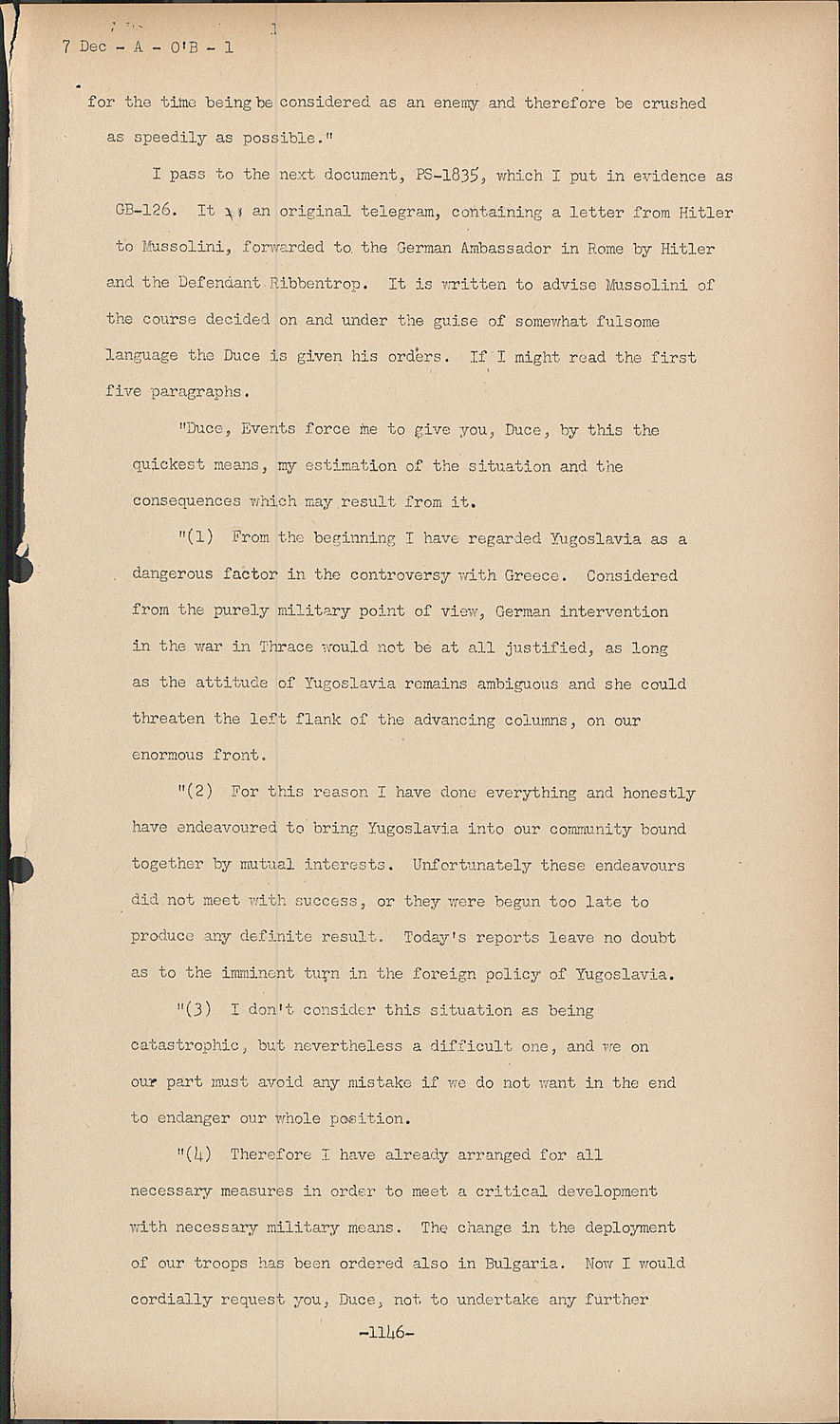
I pass to the next document, PS-1835? which I put in evidence as GB-126.
It is an original telegram, containing a letter from Hitler to Mussolini, forwarded to the German Ambassador in Rome by Hitler and the Defendant Ribbentrop.
It is written to advise Mussolini of the course decided on and under the guise of somewhat fulsome language the Duce is given his orders.
If I might read the first five paragraphs.
"Duce, Events force me to give you, Duce, by this the quickest means, my estimation of the situation and the consequences which may result from it.
"(1) From the beginning I have regarded Yugoslavia as a dangerous factor in the controversy with Greece.
Considered from the purely military point of view, German intervention in the war in Thrace would not be at all justified, as long as the attitude of Yugoslavia remains ambiguous and she could threaten the left flank of the advancing columns, on our enormous front.
"(2) For this reason I have done everything and honestly have endeavoured to bring Yugoslavia into our community bound together by mutual interests.
Unfortunately these endeavours did not meet with success, or they were begun too late to produce any definite result.
Today's reports leave no doubt as to the imminent turn in the foreign policy of Yugoslavia.
"(3) I don't consider this situation as being catastrophic, but nevertheless a difficult one, and we on our part must avoid any mistake if we do not want in the end to endanger our whole position.
"(4) Therefore I have already arranged for all necessary measures in order to meet a critical development with necessary military means.
The change in the deployment of our troops has been ordered also in Bulgaria.
Now I would cordially request you, Duce, not to undertake any further operations in Albania in the course of the next few days.
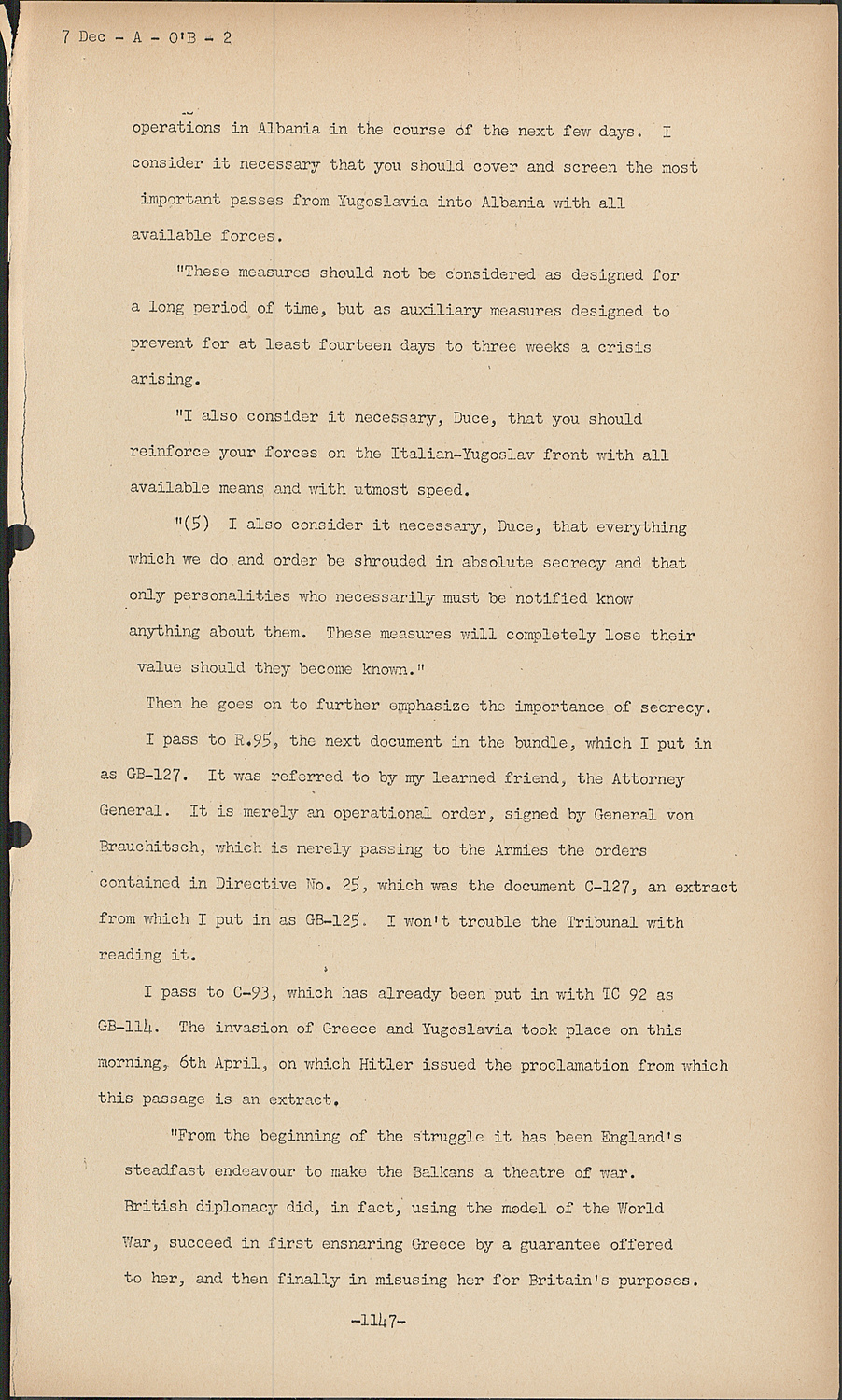
I consider it necessary that you should cover and screen the most important passes from Yugoslavia into Albania with all available forces.
"These measures should not be considered as designed for a long period of time, but as auxiliary measures designed to prevent for at least fourteen days to three weeks a crisis arising.
"I also consider it necessary, Duce, that you should reinforce your forces on the Italian-Yugoslav front with all available means and with utmost speed.
"(5) I also consider it necessary, Duce, that everything which we do and order be shrouded in absolute secrecy and that only personalities who necessarily must be notified know anything about them.
These measures will completely lose their value should they become known."
Then he goes on to further emphasize the importance of secrecy.
I pass to R.95, the next document in the bundle, which I put in as GB-127.
It was referred to by my learned friend, the Attorney General.
It is merely an operational order, signed by General von Brauchitsch, which is merely passing to the Armies the orders contained in Directive No. 25, which was the document C-127, an extract from which I put in as GB-125.
I won't trouble the Tribunal with reading it.
I pass to C-93, which has already been put in with TC 92 as GB-114.
The invasion of Greece and Yugoslavia took place on this morning, 6th April, on which Hitler issued the proclamation from which this passage is an extract.
"From the beginning of the struggle it has been England's steadfast endeavour to make the Balkans a theatre of war.
British diplomacy did, in fact, using the model of the World War, succeed in first ensnaring Greece by a guarantee offered to her, and then finally in misusing her for Britain's purposes.
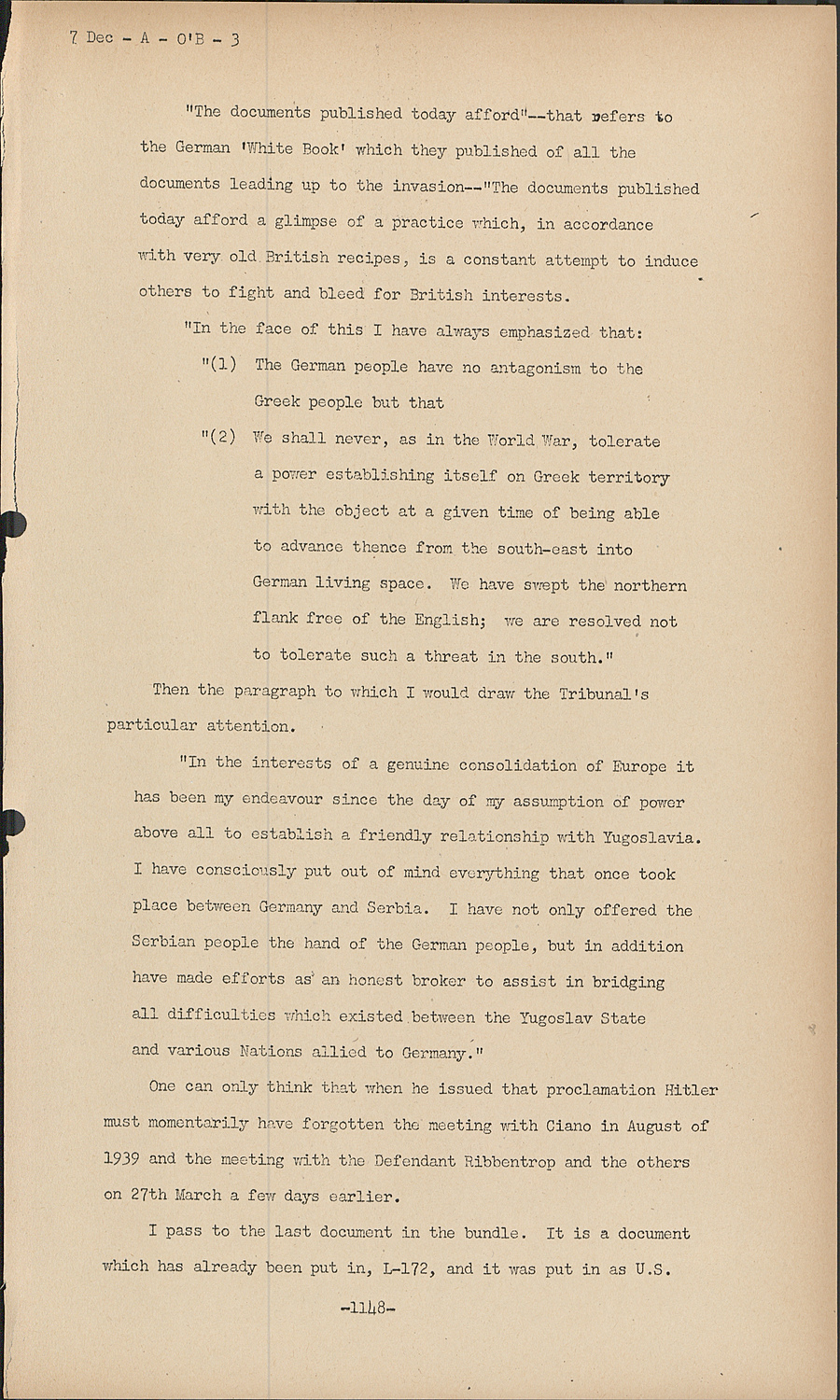
"The documents published today afford"--that refers to the German 'White Book' which they published of all the today afford a glimpse of a practice which, in accordance with very old British recipes, is a constant attempt to induce others to fight and bleed for British interests.
"In the face of this I have always emphasized that:
"(1) The German people have no antagonism to the Greek people but that "(2) We shall never, as in the World War, tolerate a power establishing itself on Greek territory with the object at a given time of being able to advance thence from the south-east into German living space.
We have swept the northern flank free of the English; we are resolved not to tolerate such a threat in the south."
Then the paragraph to which I would draw the Tribunal's particular attention.
"In the interests of a genuine consolidation of Europe it has been my endeavour since the day of my assumption of power above all to establish a friendly relationship with Yugoslavia.
I have consciously put out of mind everything that once took place between Germany and Serbia.
I have not only offered the Serbian people the hand of the German people, but in addition have made efforts as an honest broker to assist in bridging all difficulties which existed between the Yugoslav State and various Nations allied to Germany."
One can only think that when he issued that proclamation Hitler must momentarily have forgotten the meeting with Ciano in August of 1939 and the meeting with the Defendant Ribbentrop and the others on 27th March a few days earlier.
I pass to the last document in the bundle. It is a document which has already been put in, L-172, and it was put in as U.S. Exhibit No. 34.
It is a record of a lecture delivered by the Defendant Jodl on 7th November, 1943.
At page 4 there is a short passage which sets out his views two years later on the action taken in April, 1941.
I refer to Paragraph 11 on page 4:"What was, however, less acceptable was the necessity of affording our assistance as an Ally in the Balkans in consequence of the 'extra-turn' of the Italians against Greece.
The attack, which they launched in the autumn of 1940 from Albania with totally inadequate means was contrary to all agreement but in the end led to a decision on our part which -- taking a long view of the matter -would have become necessary in any case sooner or later. The planned attack on Greece from the North was not executed merely as an operation in aid of an ally. Its real purpose was to prevent the British from gaining a foothold in Greece and from menacing our Roumanian oil area from that country."
If I might summarize the story; the invasion of Greece was decided on at least as early as December or November 1940 and planned for the end of March or the beginning of April, 1941. No consideration was at any time given to any obligations under treaties or conventions which might make such invasion a breach of international law. Care was taken to conceal the preparations so that the German Forces might have an unsuspecting victim.
In the meanwhile, Yugoslavia, although to be liquidated in due course, was clearly better left for a later stage. Every effort was made to secure her cooperation for the offensive against Greece or at least, to ensure that she would abstain from any interference.
The coup d'etat of General Simovic upset this plan and it was then decided, that irrespective of whether or not his Government had any hostile intentions towards Germany, or even of supporting the Greeks, Yugoslavia must be liquidated.
It was not worth while to take any steps to ascertain Yugoslavia's intentions when it would be so little trouble, now that the German troops were deployed, to destroy her militarily and as a national unit. Accordingly, in the early hours of Sunday morning, the 6th of April, German troops marched into Yugoslavia without warning and into Greece simultaneously, with the formality of handing a note to the Greek Minister in Berlin, informing him that the German forces were entering Greece to drive out the British.
M. Koryzis, the Greek Minister, in replying to information of the invasion from the German Embassy, replied that history was repeating itself and that Greece was being attacked by Germany in the same way as by Italy. Greece returned, he said, the same reply as in the preceding October.
That concludes the evidence in respect of Greece and Yugoslavia. But, as I have the honor to conclude the British case, I would like, if the Tribunal would allow me, to draw their attention, very shortly indeed, to one common factor which runs through the whole of this aggression. I can do it, I think, in five minutes.
It is an element in the diplomatic technique of aggression, which was used with singular consistency, not only by the Nazis themselves, but also by their Italian friends. Their technique was essentially based upon securing the maximum advantage from surprise, even though only a few hours of unopposed military advance into the country of the unsuspecting victim could thus be secured. Thus, there was, of course, no declaration of war in the case of Poland.
The invasion of Norway and of Denmark began in the small hours of the night of April 8 - 9 and was well under way, as a military operation, before the diplomatic explanations and excuses were presented to the Danish Foreign Minister, at 4:20 a.m. on the morning of the 9th, and to the Norwegian Minister, between half past four and five on that morning.
The invasion of Belgium, Luxembourg and Holland began not later than five o'clock, in most cases earlier, in the small hours of the 10th of May, whilst the formal ultimatum, delivered in each case with the diplomatic excuses and explanations, was not presented until afterwards. In the case of Holland, the invasion began between three and four in the morning. It was not until about six, when The Hague had already been bombed, that the German Minister asked to see M. van Kleffens.
In the case of Belgium, where the bombing began at five, the German Minister did not see M. Spaak until eight. The invasion of Luxembourg began at four and it was at seven when the German Minister asked to see M. Beck.
Mussolini copied this technique. It was 3 o'clock on the morning of the 28th of October, in 1940, when his Minister in Athens presented a three hours ultimatum to General Metaxas.
The invasion of Greece and Yugoslavia, as I have said, both began in the small hours of April 6, 1941. In the case of Yugoslavia, no diplomatic exchange took place even after the event but a proclamation was issued by Hitler, a proclamation from which I read an extract, on five o'clock that Sunday morning, some two hours before Belgrade was bombed.
In the case of Greece, once again, it was at twenty minutes past five that M. Koryzis was informed that German troops were entering Greek territory.
The manner in which this long series of aggressions was carried out is, in itself, further evidence of the essentially aggressive and treacherous character of the Nazi regime. Attack without warning at night to secure an initial advantage and proffer excuses or reasons afterwards. Their method of procedure is clearly the method of the barbarian, of the State which has no respect for its own pledged word, nor for the rights of any people but its own.
One is tempted to speculate whether this technique was evolved by the honest broker himself or by his honest clerk, the Defendant Ribbentrop.
THE PRESIDENT:Mr. Alderman, will you be ready to go on after a short adjournment? That's what you were intending to do?
MR. ALDERMAN:Yes, we'll adjourn for ten minutes.
(A recess was taken from 1600 to 1610 hours.)
MR. ALDERMAN:May it please the Tribunal, before proceeding with the presentation of the evidence relating to the aggression against the Soviet Union, I should like to take about fifteen minutes to offer two further documents relating to the aggression against Austria.