In the second paragraph he asserts again that Poland's provocations were unbearable, and I quote paragraph 2:
"Germany was in all circumstances determined to abolish these Macedonian conditions on her eastern frontier and, what is more, to do so in the interests of quiet and order, but also in the interests of European peace.
"The problem of Danzig and the Corridor must be solved. The British Prime Minister had made a speech which was not in the least calculated to induce any change in the German attitude. At the most, the result of this speech could be a bloody and incalculable war between Germany and Poland."
THEPRESIDENT: (interposing) And England.
MR.GRIFFITH-JONES: I beg your pardon -- "and England. Such a war would be bloodier than that of 1914 to 1918. In contrast to the last war, Germany would no longer have to fight on two fronts." One sees the threats -- veiled threats -- appearing in this paragraph. "Agreement with Russia was unconditional and signified a change in foreign policy of the Reich which would last a very long time. Russia and Germany would never again take up arms against each other.
Apart from this, the agreements reached with Russia would also render Germany secure economically for the longest period of war."
The Fuehrer had always wanted Anglo-German understanding. War between England and Germany could at best bring some profit to Germany but none at all to England.
Then we come to the bribe. "The Fuehrer declared the German-Polish problem must be solved and will be solved. He is however prepared and determined after the solution of this problem to approach England once more with a large, comprehensive offer. He is a man of great decisions, and in this case also he will be capable of being great in his action. And then magnanimously he accepts the British Empire and is ready to pledge himself personally for its continued existence and to place the power of the German Reich at its disposal on condition that his colonial demands, which are limited, should be negotiated by peaceful means." Obligations to Italy remain untouched.
Again he stresses irrevocable determination never to enter into war with Russia. I quote the last two paragraphs:
"If the British Government would consider these ideas a blessing for Germany -
THE PRESIDENT:Why don't you read the first few lines of paragraph three?
MR.GRIFFITH-JONES: Yes; I did summarize it, paragraph three. He also desired to express the irrevocable determination of Germany and never again to enter into conflict with Russia.
THE PRESIDENT:Yes.
MR.GRIFFITH-JONES: I quote the last two paragraphs.
"If the British Government would consider these ideas a blessing for Germany and also for the British empire, a peace might result. If it rejects these ideas there will be war. In no case will Great Britain emerge stronger; the last war proved it. The Fuehrer repeats that he himself is a man of ad infinitum decisions by which he is bound, and that this is his last offer."
(A recess was taken from 1505 to 1525 hours.)
MR. GRIFFITH-JONES: I had just finished reading the offer to the British Government which was TC 72, No. 68, and which is G.B.65.
The British Government were not of course aware of the real object that lay behind that message, and taking it at its face value wrote to enter into discussions. And they wrote back on the 28th of August saying that they were prepared to enter into discussions. They agreed with Hitler that the differences must be settled, and I quote from paragraph four:
"In the opinion of His Majesty's Government a reasonable solution of the differences between Germany and Poland could and should be effected by agreement between the two countries on lines which would include the safeguarding of Poland's essential interests, and they recall that in his speech of the 28th of April the German Chancellor recognized the importance of these interests to Poland.
"But as was stated by the Prime Minister in his letter to the German Chancellor of the 22nd of August, His Majesty's Government consider it essential for the success of the discussions which would precede the agreement that it should be understood beforehand that any settlement arrived at would be guaranteed by other powers. His Majesty's Government would be ready if desired to make their contribution to the effective operation of such a guarantee."
I go to the last paragraph on that page, paragraph six. "His Majesty's Government have said enough to make their own attitude plain in the particular matters at issue between Germany and Poland. They trust that the German Chancellor will not think that, because His Majesty's Government are scrupulous concerning their obligations to Poland, they are not anxious to use all their influence to assist the achievement of a solution which may command itself both to Germany and to Poland." That of course knocked the German hopes on the head. They had failed by their tricks and their bribes to dissuade England from observing her obligations to Poland, and it was now only a matter of getting out of their embarrassment as quickly as possible and saving their face as much as possible. The last document becomes G.B.66. And I put in also Sir Neville Henderson's account of that interview, T.C. No. 75, which becomes G.B. 67.
During that interview the only importance of it is that Sir Neville Henderson emphasized the British attitude, and that they were determined in any event to meet their obligations to Poland.
One paragraph I would quote, which is interesting in view of the letters that were to follow. Paragraph ten.
"In the end I asked him two straight questions: Was he willing to negotiate direct with the Poles? and; Was he ready to discuss the question of an exchange of population? He replied in the affirmative as regards the latter. There I have no doubt that he was thinking at the same time of a rectification of frontiers. As regards to the first, he said he could not give me an answer until after he had given the reply of His Majesty's Government the careful consideration which such a document deserved. In this connection he turned to Ribbentrop and said, 'We must summon Field Marshal Goering to discuss it with him.'" Then in the next paragraph again Sir Neville Henderson finally repeated to him very solemnly the main note of the whole conversation, so far as he was concerned.
I pass to the next document, which is T.C. 72, No. 78, which becomes G.B.
The German reply, as I outlined before, was handed to Neville Henderson at 7.15 P.M. on the 29th of August.
The reply sets out the suggestion submitted by the British Government in a previous note and it roes on to say that the German Government are prepared to enter into discussion on the basis that the whole of the Corridor as well as Danzig are returned to the Reich.
I quote particularly the next to the last paragraph on the first page of that Document:
"The demands of the German Government are in conformity with the revision of the Versailles Treaty in regard to this territory which has always been recognized as being necessary; viz.
, return of Danzig and the Corridor to Germany, the safeguarding of the existence of the German national group in the territories remaining to Poland."
It is only just now, as I emphasized before, that that right has been recognized for so lone.
On the 28th of April, his demands consisted only of Danzig, of Autobahn, and of the railway.
The Tribunal will remember in the matter of which he is trying to get out of now, trying to manufacture justification, putting forth proposals which under no circumstances could either Poland or Great Britain accept, but as I said before, he wanted to make doubly certain.
I go to the second page, half-way down the page. Perhaps I better start with the third paragraph:
"The British Government attach importance to two considerations:
(1) that the existing danger of an imminent explosion should be eliminated as quickly as possible by direct negotiation, and (2) that the existence of the Polish State, in the form in which it would then continue to exist, should be adequately safeguarded in the economic and political sphere by means of international guarantees.
"On this subject, the German Government makes the following declaration.
"Though sceptical as to the prospects of a successful outcome, they are nevertheless prepared to accept the English proposal and to enter into direct discussions.
They do so, as has already been emphasized, salely as the result of the impression made upon them by the written statement received from the British Government that they too desire a pact of friendship in accordance with the general lines indicated to the British Ambassador.
And then to the last but one paragraph:
"For the rest, in making these proposals the German Government have never had any intention of touching Poland's vital interests of question ing the existence of ran independent Polish State.
The German Government, accordingly, in these circumstances agree to accept the British Govern ment's offer of their good offices in securing the despatch to Berlin of a Polish Emissary with full powers.
They count on the arrival of this Emissary on Wednesday, the 30th August, 1939.
"The German Government will immediately draw up proposals for a solution acceptable to themselves and will, if possible, place these at the disposal of the British Government before the arrival of the Polish negotiators."
That was at 7.15 in the evening of the 29th of August, And as I have explained, it allowed little time in order to get the Polish Emissary there by midnight the following night.
That Document was GB 68.
The next document, Neville Henderson's account of the interval summarises what had taken place, and I quote particularly paragraph four:
"I remarked that this phrase sounded like an ultimatum, but after some heated remarks both Herr Hitler and Herr von Ribbentrop assured me that it was only intended to stress urgency of the moment when the two fully mobilized armies were standing face to face."
That was the interval on the evening of the 29th August.
That last Document becomes GB 69.
Again the British Government replied and Sir Neville Henderson handed this reply to Ribbentrop at the famous meeting on the midnight of the 30th of August, at the time the Polish Emissary had been expected.
I need not read at length.
The British Government reciprocated the desire for improved relations.
They stress again that they cannot sacrifice their interest to other friends in order to obtain an improvement in the ***** situation.
They understand, they say, that the German Government accepts the condition that the settlement should be subject to international guarantee.
They make a reservation as to the demands that the Germans put forward in their last letter and they are informing the Polish Government immediately; and lastly, they understand that the German Government are drawing up the proposals.
That document, the account of the interview at midnight on the 30th of August, will be GB 70.
I beg your pardon.
That is the actual Document that Sir Neville Henderson handed to Ribbentrop at that interview.
For the account of the interview, we go to the next Document in the Tribunal's book, TC 72, Number 92, which becomes GB 71.
It is not a very long Document. It is perhaps worth reading in full.
"I told Herr von Ribbentrop this evening that His Majesty's Government found it difficult to advise Polish Government to accept procedure adumbrated in German reply, and suggested that he should adopt normal contact, i.e., that when German proposals were ready to invite Polish Ambassador to call and to hand him proposals for transmission to his Government with a view to immediate opening of negotiations.
I added that if basis afforded prospect of settlement His Majesty's Government could be counted upon to do their best in Warsaw to temporize negotiations "Herr von Ribbentrop's reply was to produce a lengthy document which he read out in German aloud at top speed.
Imagining that he would eventually hand it to me I did not attempt to follow too closely the sixteen or more articles which ti contained.
Though I cannot therefore guarantee accuracy the main points were:"
and I need not reed out the main points.
I go to paragraph three.
"When I asked Herr von Ribbentrop for text of these proposals in accordance with undertaking the German reply of yesterday, he asserted that it was now too late as Polish representative had not arrived in Berlin by midnight.
"I observed that to treat matter in this way meant that request for Polish representative to arrive in Berlin on 30th August constituted in fact, an ultimatum in spite of what he and Herr Hitler had assured me yesterday.
This he denied, saying that idea of an ultimatum was figment of my imagination.
Why then I asked could he not adopt normal procedure and give me copy of proposals and ask Polish Ambassador to call on him, just as Herr Hitler had summoned me a few days ago, and hand them to him for communication to Polish Government?
In the most violent terms Herr von Ribbentrop said that he would never ask the Ambassador to visit him. He hinted that if Polish Ambassador asked him for interview it might be different. I said that I would naturally inform my Government so at once. Whereupon he said while those were his personal views he would bring all that I had said to Herr Hitler's notice. It was for Chancellor to decide.
"We parted on that note, but I must tell you that Herr von Ribbentrop's demeanor during an unpleasant interview was aping Herr Hitler at his worst. He inveighed incidentally against Polish mobolisation, but I retorted that it was hardly surprising since Germany had also mobilised as Herr Hitler himself had admitted to me yesterday."
Nevertheless, Neville Henderson didn't know at that time that Germany had also already given the orders to attack Poland some days before. The following day, the 31st of August, at 6:30 in the evening, Herr Lipski, the Polish Ambassador, had an interview with Ribbentrop. This Document, the next Document TC 74, No. 112, becomes GB 72, and is a short account:
"I carried out my instructions. M. von Ribbentrop asked if I had special plenipotentiary powers to undertake negotiations. I said no. He then asked whether I had been informed that on London's suggestion the German Government had expressed their readiness to negotiate directly with a delegate of the Polish Government, furnished with the requisite full powers, who was to have arrived on the preceding day, August 30. I replied that I had no direct information on the subject. In conclusion M. von Ribbentrop repeated that he had thought I would be empowered to negotiate. He would communicate my demarche to the Chancellor."
As I indicated already, it was too late. The orders had already been given on that day to the German Army to invade.
I turn to C 126. It is already in as GB 45. Other portions of it were put in, and I refer now to the letter on the second page for the order "Most Secret order." It is signed by Hitler and is described as his "Direction No. 1 for the conduct of the war," dated 31st of August, 1939.
Paragraph one:
"Now that all the political possibilities of disposing by peaceful means of a situation of the Eastern Frontier which is intolerable for Germany are exhausted, I have determined on a solution by force.
"The attack on Poland is to be carried out in accordance with the preparations made for 'Fall Weiss', with the alterations which result, where the Army is concerned, from the fact that is has in the meantime almost completed its dispositions.
"Allotment of tasks and the operational target remain unchanged.
"Date of attack - 1 September 1939 Time of attack - 04:
45 (inserted in red pencil) "This time also applies to the operation at Gdynia, Bay of Danzig and the Dirschau Bridge.
"In the West it is important that the responsibility for the opening of hostilities should rest unequivocally with England and France. At first purely local action should be taken against insignificant frontier violations."
There it sets out the details of the order which, for the purpose of this Court, it is unnecessary to read. That evening, at nine o'clock, the German radio broadcast the terms of the German proposals about which they were so willing to enter into discussions with the Polish Government. It sets out the proposals at length. It will be remembered that by this time, neither Sir Neville Henderson nor the Polish Government, nor their Ambassador had yet been given their written copy of them, and it is indeed a document which is interesting to read, or to read extracts of it simply as an exhibition or an example of pure hypocrisy. I refer to the second paragraph. Further, the German Government pointed out that they felt able to make the basic points regarding the offer of an understanding available to the British Government by the time the Polish negotiator arrived in Berlin.
Now, we have heard the manner in which they did that. They then say that instead of the arrival of an authorized Polish personage, the first answer the Government of the Reich received to their readiness for an understanding was the news of the Polish mobilization, and only toward twelve o'clock on the night of the 12th of August, 1939, did they receive a somewhat general assurance of British readiness to help towards the commencement of negotiations.

Although the fact of the Polish negotiator expected by the Reich did not arrive, removed the necessary conditions for informing His Majesty's Government for the views of the German Government as regards the possible basis for negotiation. Since His Majesty's Government themselves had pleaded for direct negotiations between Germany and Poland, the German Minister for Foreign Affairs, Ribbentrop, gave the British Ambassador on the occasion of the presentation of the last British note, precise information as to the text of the German proposals which will be regarded as a basis for negotiation in the event of the arrival of the Polish Plenipotentiary. And thereafter they go on to set out the story, or rather their version of the story of the negotiations over the last few days.
I pass to the next document in the Tribunal's book, back to the document TC 54, which becomes GB 73.
On the 1st of September, when his armies were already crossing the frontier and the whole of the frontier, he issued this proclamation to his Armed Forces:
"The Polish Government, unwilling to establish good neighborly relations as aimed at by me, wants to force the issue by way of arms.
"The Germans in Poland are being persecuted with bloody terror and driven from their homes. Several acts of frontier violation which cannot be tolerated by a great power show that Poland is no longer prepared to respect the Reich's frontiers. To put an end to these mad acts I can see no other way but from now onwards to meet force with force.
"The German Armed Forces will with firm determination take up the struggle for the honor and the vital rights of the German people.
"I expect every soldier to be conscious of the high tradition of the eternal German soldierly qualities and to do his duty to the last.
"Remember always and in any circumstances that you are the representatives of National Socialist Greater Germany.
"Long live our people and the Reich."
And so we see that at last Hitler had kept his word to his generals. He had afforded them their propagandistic justification, and at that time, anyway, it didn't matter what people said about it afterwards. "The view shall not appear, asked later on, whether we told the truth or not. Might is what counts -- or victory is what counts and not right."
On that day, the 1st of September, when news came of this invasion of Polish ground, the British Government, in accordance with their Treaty of Legations, sent an ultimatum to the German Government, in which they stated that unless the German -- I quote from the last paragraph:
"I am accordingly to inform your Excellency that unless the German Government are prepared to give His Majesty's Government satisfactory assurances that the German Government have suspended all aggressive action against Poland and are prepared promptly to withdraw their forces from Polish territory, His Majesty's Government in the United Kingdom will without hesitation fulfil their obligations to Poland."
By the 3rd of September another withdrawal had taken place, and so at nine o'clock -- the document I have just referred to will be GB 74 -- at nine o'clock on the 3rd of September a final ultimatum was handed to the German Minister of Foreign Affairs. I quote from the third paragraph.
"Although this communication was made more than twenty-four hours ago, no reply has been received but German attacks upon Poland have been continued and intensified. I have accordingly the honor to inform you that, unless not later than eleven o'clock, British Summer Time, today 3rd September, satisfactory assurances to the above effect have been given by the German Government, and have reached His Majesty's Government in London, a state of war will exist between the two countries as from that hour."
And so it was that at eleven o'clock on the 3rd of September a state of war existed between Germany and England and between Germany and France. It all appeals to peace. It all appeals to reason. We now see completely stillborn, stillborn when they were made, plans, preparations, intentions, determination to carry out this assault upon Poland had been going on for months, for years before. It mattered not what anybody but the German Government had in mind or whatever rights anybody else but the German nation thought they had, and if there is any doubt left at all after what we have seen, I would ask you to look at two more documents.
If you would look at the last document first of all in your document book, PS 1831, which becomes GB 75. Even now on the 3rd of September Mussolini offers some chance of peace.
We have here a telegram. It is timed 6:30 hours, and I'm afraid I'm unable to say whether that is 6:30 in the morning or the evening, but it is dated the 3rd of September, and I quote:
"The Italian Ambassador handed to the State Secretary at the Duce's order following copy for the Fuehrer and Reich Chancellor and for the Reich Minister for Foreign Affairs:
"Italy sends the information, leaving, of course, every decision to the Fuehrer, that it still has a chance to call a conference with France, England and Poland on following basis: 1. Armistice which would leave the Army Corps where they are at present." And it will be read that on the 3rd of September they had advanced a considerable way over the frontier. "2. Calling the conference within two or three days. 3. Solution of the Polish-Germ an controversy which would be certainly favorable for Germany as matters stand today.
"This idea which originated from the Duce has its foremost exponent in France.
"Danzig is already German and Germany is holding already securities which guarantee most of her demands. Besides, Germany has had already its 'moral satisfaction.' If it would accept the plan for a conference, it will achieve all her aims and at the same time prevent a war which already today has the aspect of being universal and of extremely long duration."
But, My Lord, perhaps even Mussolini did not appreciate what all Germany's aims were and, of course, the offer was turned down in the illuminating letter which Hitler was to write in reply.
I refer you back to the document before that. That will be GB-76. I beg your pardon, it's still part of the same exhibit GB 75.
"Duce:
"I first want to thank you for your last attempt at a mediation."
THE PRESIDENT:As I understand it, the "GB" references you give are not on the documents at all; they are the exhibits themselves, which are to be put on the document after they have been put in.
MR. GRIFFITH JONES:Yes. That is correct. They will be put in by the Court, of course.
THE PRESIDENT:You will try to make clear the references which are on the document so that the Tribunal could find the document itself?
MR. GRIFFITH JONES.Yes. The last document was PS 1831, and it's the very last one in the document book. That's the one I've just referred to--the telegram from Mussolini. The document to which I am about to refer to is the one but last in the Tribunal's book but it has the sane number on it as the last because it forms part of the same exhibit.
THE PRESIDENT:I think if you'll just explain the system in which the exhibits are numbered it would help some.
MR. GRIFFITH JONES:The exhibits are numbered at the present moment before they are put in evidence with a variety of serial numbers, such as "PC", "PS", and "L" and other letters. There's no significance attached to that at all. It depends on who they have been found by and what files they have come from. When the documents are put in as exhibits, they are marked by the court with a court number. The documents are put in by the United States representatives prefixed with the letters "US". The documents which have been put in by the British prosecutors have all been prefixed with the letters "GB". If it would be of any assistance to members of the Tribunal I will have their document bocks marked up this evening with the new court numbers that have been put upon them by the court officials during the course of the day.
THE PRESIDENT: We'll talk about that later.
MR. GRIFFITH JONES:If there is any document missing from any of these bocks I have a copy.
THE PRESIDENT:You are going to read PS 1831?
MR. GRIFFITH JONES:Yes, that is GB 75.
"Duce:
"I first want to thank you for your last attempt at mediation. I would have been ready to accept, but only under condition, that there would be a possibility to give me certain guarantees that the conference would be successful. Because, for the last two days the German troops are engaged in an extraordinarily rapid advance in Poland. It would have been impossible to devaluate the bloody sacrifices made thereby by diplomatic intrigues. Nevertheless, I believe that a way could have been found, if England would not have been determined towage war under all circumstances. I have not given in to the English, because, Duce, I do not believe that peace could have been maintained for more than one-half year or one year. Under these circumstances, I thought that, in spite of everything, the present moment was better for resistance. At present, the superiority of the German armed forces in Poland is so overwhelmning in all fields that the Polish Army will collapse in a very short time. I doubt whether this fast success could be achieved in one or two years. England and France would have armed their allies, to such an extent that the crushing technical superiority of the German Armed Forces could not have become so apparent anymore. I am aware, Duce, that the fight which I enter, is one for life and death. My own fate does not play any role in it at all. But I am also aware that one cannot avoid such a struggle permanently and that one has to choose after cold deliberation the moment for resistance in such a way that the probability of the success is guaranteed and I believe in this success, Duce, with the firmness of a rock. Recently you have given me the kind assurance that you think you will be able to help me in a few fields. I acknowledge this in advance with sincere thanks. But I believe also - even if we march now over different roads that fate will finally join us.
If the National Socialistic Germany were destroyed by the Western democracies, the Fascist Italy would also have to face a grave future.
I was personally always aware of this community of the future of our two governments and I know that you, Duce, think the same way. To the situation in Poland, I would like to make the brief remark that we lay aside, of course, all unimportant things, that we do not waste any man in unimportant tasks, but direct all on acts in the light of great operational considerations. The Northern Polish Army which is the Corridor, has already been completely encircled by our action. It will be either wiped out or will surrender. Otherwise, all operations proceed according to plan. The daily achievements of the troops are far beyond all expectations. The superiority of our air force is complete, although scarcely one-third of it is in Poland. In the West I will be on the defensive. France can here sacrifice its blood first. Then the moment will come when we can confront the enemy also there with the full power of the nation. Accept my thanks, Duce, for all your assistance which you have given to me in the past and I ask you not to deny it to me in the future."
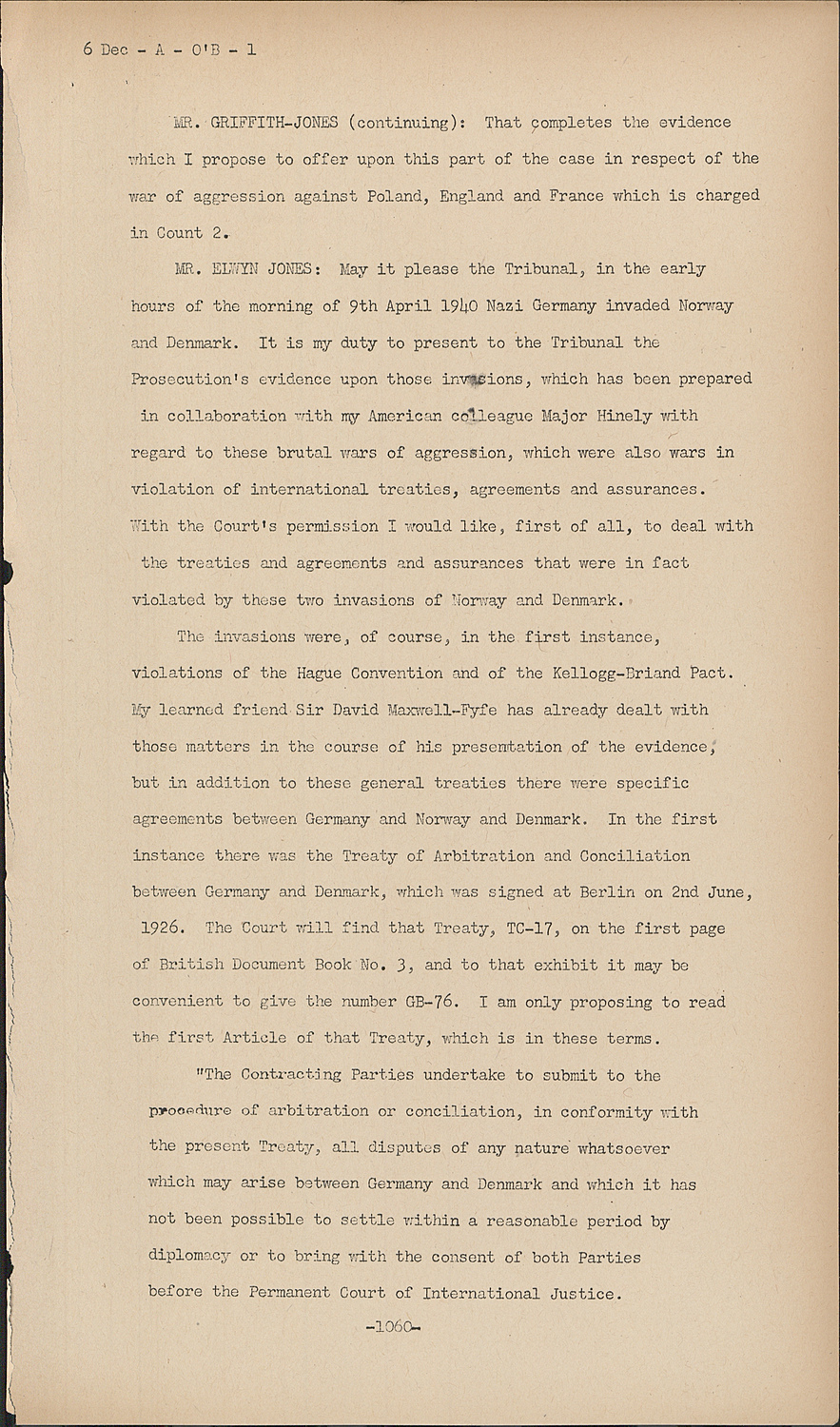
MR. GRIFFITH-JONES (continuing): That completes the evidence which I propose to offer upon this part of the case in respect of the war of aggression against Poland, England and France which is charged in Count 2.
MR. ELWYN JONES:May it please the Tribunal, in the early hours of the morning of 9th April 1940 Nazi Germany invaded Norway and Denmark.
It is my duty to present to the Tribunal the Prosecution's evidence upon those invasions, which has been prepared in collaboration with my American colleague Major Hinely with regard to these brutal wars of aggression, which were also wars in violation of international treaties, agreements and assurances.
With the Court's permission I would like, first of all, to deal with the treaties and agreements and assurances that were in fact violated by these two invasions of Norway and Denmark.
The invasions were, of course, in the first instance, violations of the Hague Convention and of the Kellogg-Briand Pact.
My learned friend Sir David Maxwell-Fyfe has already dealt with those matters in the course of his presentation of the evidence, but in addition to these general treaties there were specific agreements between Germany and Norway and Denmark.
In the first instance there was the Treaty of Arbitration and Conciliation between Germany and Denmark, which was signed at Berlin on 2nd June, 1926.
The Court will find that Treaty, TC-17, on the first page of British Document Book No. 3, and to that exhibit it may be convenient to give the number GB-76.
I am only proposing to read the first Article of that Treaty, which is in these terms.
"The Contracting Parties undertake to submit to the procedure of arbitration or conciliation, in conformity with the present Treaty, all disputes of any nature whatsoever which may arise between Germany and Denmark and which it has not been possible to settle within a reasonable period by diplomacy or to bring with the consent of both Parties before the Permanent Court of International Justice.
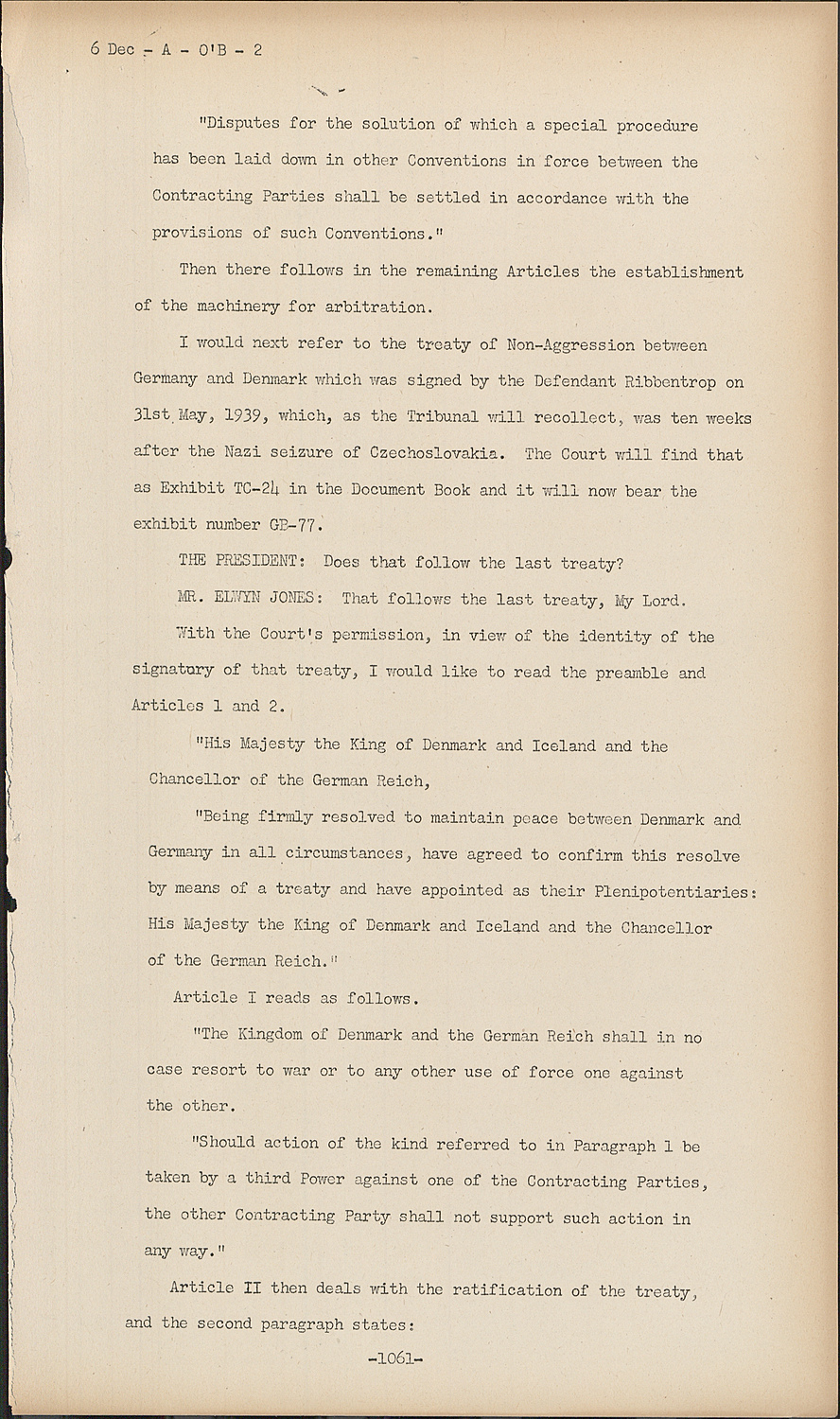
"Disputes for the solution of which a special procedure has been laid down in other Conventions in force between the Contracting Parties shall be settled in accordance with the provisions of such Conventions."
Then there follows in the remaining Articles the establishment of the machinery for arbitration.
I would next refer to the treaty of Non-Aggression between Germany and Denmark which was signed by the Defendant Ribbentrop on 31st May, 1939, which, as the Tribunal will recollect, was ten weeks after the Nazi seizure of Czechoslovakia.
The Court will find that as Exhibit TC-24 in the Document Book and it will now bear the exhibit number GB-77.
THE PRESIDENT:Does that follow the last treaty?
MR. ELWYN JONES:That follows the last treaty, My Lord.
With the Court's permission, in view of the identity of the signatory of that treaty, I would like to read the preamble and Articles 1 and 2."His Majesty the King of Denmark and Iceland and the Chancellor of the German Reich, "Being firmly resolved to maintain peace between Denmark and Germany in all circumstances, have agreed to confirm this resolve by means of a treaty and have appointed as their Plenipotentiaries:
His Majesty the King of Denmark and Iceland and the Chancellor of the German Reich."
Article I reads as follows.
"The Kingdom of Denmark and the German Reich shall in no case resort to war or to any other use of force one against the other.
"Should action of the kind referred to in Paragraph 1 be taken by a third Power against one of the Contracting Parties, the other Contracting Party shall not support such action in any way."
Article II then deals with the ratification of the treaty, and the second paragraph states:
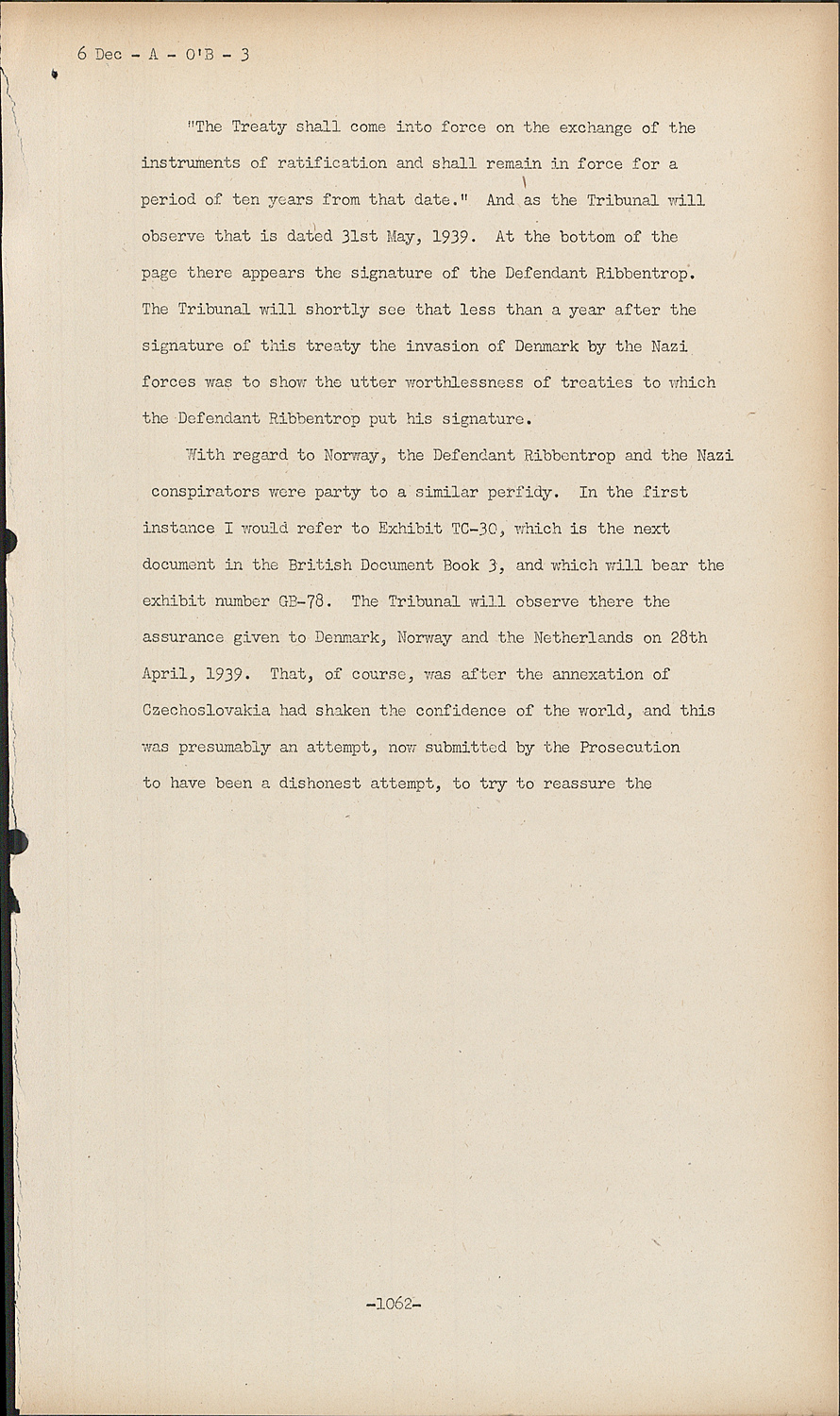
"The Treaty shall come into force on the exchange of the instruments of ratification and shall remain in force for a period of ten years from that date."
And as the Tribunal will observe that is dated 31st May, 1939.
At the bottom of the page there appears the signature of the Defendant Ribbentrop.
The Tribunal will shortly see that less than a year after the signature of this treaty the invasion of Denmark by the Nazi forces was to show the utter worthlessness of treaties to which the Defendant Ribbentrop put his signature.
With regard to Norway, the Defendant Ribbentrop and the Nazi conspirators were party to a similar perfidy.
In the first instance I would refer to Exhibit TC-30, which is the next document in the British Document Book 3, and which will bear the exhibit number GB-78.
The Tribunal will observe there the assurance given to Denmark, Norway and the Netherlands on 28th April, 1939.
That, of course, was after the annexation of Czechoslovakia had shaken the confidence of the world, and this was presumably an attempt, now submitted by the Prosecution to have been a dishonest attempt, to try to reassure the Scandinavian States.