QDo you know that Moehle testified here personally that he talked neither with Admiral Doenitz nor with you nor with Captain Hessler about his interpretation of the Lakonia order, even though he was repeatedly in your staff?
AThat I know.. Whether from Moehle's affidavit of last year or from another source, that I cannot tell you at this point.
QThe testimony of Admiral Doenitz has been put to you that you and Captain Hessler were against the Lakonia order, yet you state that you do not remember this contradiction. Do you consider it possible that Admiral Doenitz had overemphasized your objection to this order, in order to take the complete responsibility for himself?
THE PRESIDENT: Wait a minute. I do not think you can ask him that question, Dr. Kranzbuehler, whether it is possible that the Admiral had over-emphasized what he said.
DR. KRANZBUEHLER: If I am not permitted to put this question I have no further questions, Your Honor, to this witness.
THE PRESIDENT: The witness can retire.
DR. KRANZBUEHLER: Then with the permission of the High Tribunal I would like to call Captain Hessler as my next witness.
-------------------------
BY THE PRESIDENT:
QWill you state your full name?
AGunther Hessler.
QWill you repeat this oath after me:
I swear by God, the Almighty and Omniscient, that I will speak the pure truth and will withhold and will add nothing.
(The witness repeated the oath).
THE PRESIDENT: You may sit down.
DIRECT EXAMINATION BY DR. KRANZBUEHLER:
QCaptain Hessler, when did you enter the Navy?

A In April of 1927.
QWhat was your grade?
AKorvetten Kapitaen.
Q You are related to Grand admiral Doenitz. Is that correct?
AYes. In November of 1937 I married his only daughter.
QWhen did you enter the U-boat service?
AIn April of 1940 I started my U-boat training.
QAt that time during your training were you informed that you should act according to the Prisenscheibe?
AYes. I was instructed such at that time.
QWas this matter which I am just putting to you now, was that submitted to you?
AYes. This Scheibe was submitted to me and I was instructed about it.
QWill you tell the Tribunal briefly just what the purpose of this Scheibe is?
AHere we are concerned with a system of discs with which, through a simple mechanism, in the very shortest period of time possible we can determine how neutral and how other ships have to be dealt with. For instance, whether the neutral vessel has contraband, can be sunk; or whether it has to be passed -whether we have to let it pass.
This disc had a further great advantage that at the same time one could read on what paragraph of the prize law this case was to be found; and through that it was possible at the time of the investigation of a merchant ship to limit the time to the shortest possible time.
QThat means the disc had the character of a juristic adviser to the Commander?
AYes.
DR. KRANZBUEHLER:Now; I am submitting to the Tribunal this disc as Exhibit Doenitz Number 95. BY DR. KRANZBUEHLER:
QIn your training were you instructed about your behavior toward shipwrecked survivers?.
AYes. The rescuing of survivors in the naval action is a matter of course and is to be carried through as fas as military measures permit. In U-boat warfare rescue of survivors, that is, the taking on board of the entire crew, is utterly impossible, for the space conditions of the U-boat do not permit any such action. The carrying through of other measures, such as, for instance, the approaching to life-boats, the picking up of those who are swimming and the taking of them into the life-boats, giving provisions and water, is, on general principle not possible, fo the endangering of the U-boat is in every part of an operational zone so great that you cannot carry out any of these measures without endangering your boat too much.

QSoon after this course of instruction you took your cruise as Commander from when to when?
AFrom October 1940 until November 1941.
QIn what areas did you operate?
ASouth of Iceland, West of the North Channel, in the region between the Azores to Bergen, and the area West of Friedland.
QWhat success did you have as against merchant shipping?
AI sunk 21 ships with more than 130,000 tons.
QYou have the knight's Order?
AYes.
QHow did you act toward the survivors of these crews of the ships sunk by you?
AIn most of the cases the situation was as follows: That I immediately left the place of sinking; that at the place of sinking I had to go away from this point of sinking, for my danger through hostile sea or air forces required me to do so. In two cases the danger was not quite as large. I could approach the life-boats and help them.
QAnd what ships were concerned in this?
ATwo Greek ships were involved in this case, the Papalemos and Pandias. These were the two ships.
Q How did you help the life boats?
AFirst of all I told the ship-wrecked their exact position and told them how they could reach land in their life boats. In the second place I gave them water, which is very, very important for survivors in tropical regions. Then in one case I rendered medical aid for the few who were wounded.
QDid personal experiences with ships which had been sunk play a role too in how to surface while you were rescuing?
AYes, all experienced U-boat Commanders had a justified suspicion toward every merchant-man and it's crew no matter how innocent they might appear.
In two cases this suspicion saved me from my own destruction.
In the case of the Steamer Kalchas, a ten thousand ton British ship, which I torpedoed North of Cape Byrd. The ship had stopped after it had been hit by the torpedo. The crew had left the ship and was in the life boats and it seemed to be sinking. I was thinking whether I should surface in order to Save the crew, tell them how to reach land, and ask them if they needed water. Then the feeling, I might say it was more or less unexplainable, kept me from doing so. I lifted the periscope and at the same moment when the periscope extended quite a good deal above the surface of the water, this steamer which seemed to have been abandoned from previous experiences, the sailors manned the guns, and the sailors who had kept themselves concealed underneath the guns and behind the railing, then at the closest possible range they opened fire on my periscope so that I had to take all necessary precautions. The hit close to the periscope but could not endanger me.
In a second case, in the case of the Motor Ship, Alfred Jones, which I torpedoed, that ship also seemed to be sinking. I wondered whether I should surface, when in one of the life boats I sew two British sailors who were in perfect uniform, spotless uniforms, and that, of course, made me suspicious.

I saw the ship at close range. I would judge 50 to 100 motors and I took a good look at the ship and I determined that it had not been abandoned, but in all possible spots of concealment sailors were still present. When I torpedoed the ship these concealments burst, and I saw that the ship had at least four to six guns of ten to fifteen millimeter strength, a large number of depth charges and installations, and anti-flack was there also behind the railing. Just on the strength of the coincidence that the depth charges had not been let go, that was the reason I escaped destruction.
As a matter of course, after an experience like that, I was less concerned with the crews and survivors than with endangering my own ship, and with something which was entirely clear to me in the future.
QWhen did you enter the Staff as the Commander of the U-boats?
AIn November, 1941.
QYou were the first officer of that staff, what was your task as Commander? You were to secure and instruct them as to all orders?
AYes, I did that.
QAnd what was the relationship between the instructions you gave and the instructions by the Chief of the Flotilla had to give, such as Moehle?
AThe Commandant which I had to instruct received a bread outline about all questions as to their actions and demeanor at sea. The Chief of the Flotilla had the instructions or mission to ascertain that all Commandants shoul know of all recent orders of the Commander in Chief of the U-boats and would have them at hand. Therefore, I right say almost it was a limited instruction.
QIn this complete course of instructions were the Commandants told about their action toward survivors of the ship-wrecked?
AYes, and perhaps in the same manner in which the instruction had been in the U-boat school at my training.
QWas there any change in the manner of instructions after the Lakonia order of September, 1942?
AYes, I told the Commandants briefly of the incident and told them: Now, you are no longer to decide whether the situation in the open sea will permit your rescue only. From now on in it is prohibited to carry through rescue measures.
QDo you wish to say that during the entire balance of the war, that is, two and a half years, the Commandants were told about the Lakonia incident, or was it just immediately after this case?
AI would say at the most until January, 1943. After that time there was no more talk about that.
QThat means about the incident? That is about the Lakonia case? What about the orders issued as a result of it?
AYes, there was a specific order not to rescue any longer.
QDid the commandants at any time have an order or suggestion from you or from one of your crows to shoot at survivors?
ANever.
QWere the Commandants instructed by you about the order that captains and leading engineers, if possible, were to be taken along?
AYes.
QIn those instructions was it emphasized that this was to take place only when it could be done without endangering the ships?
AYes.
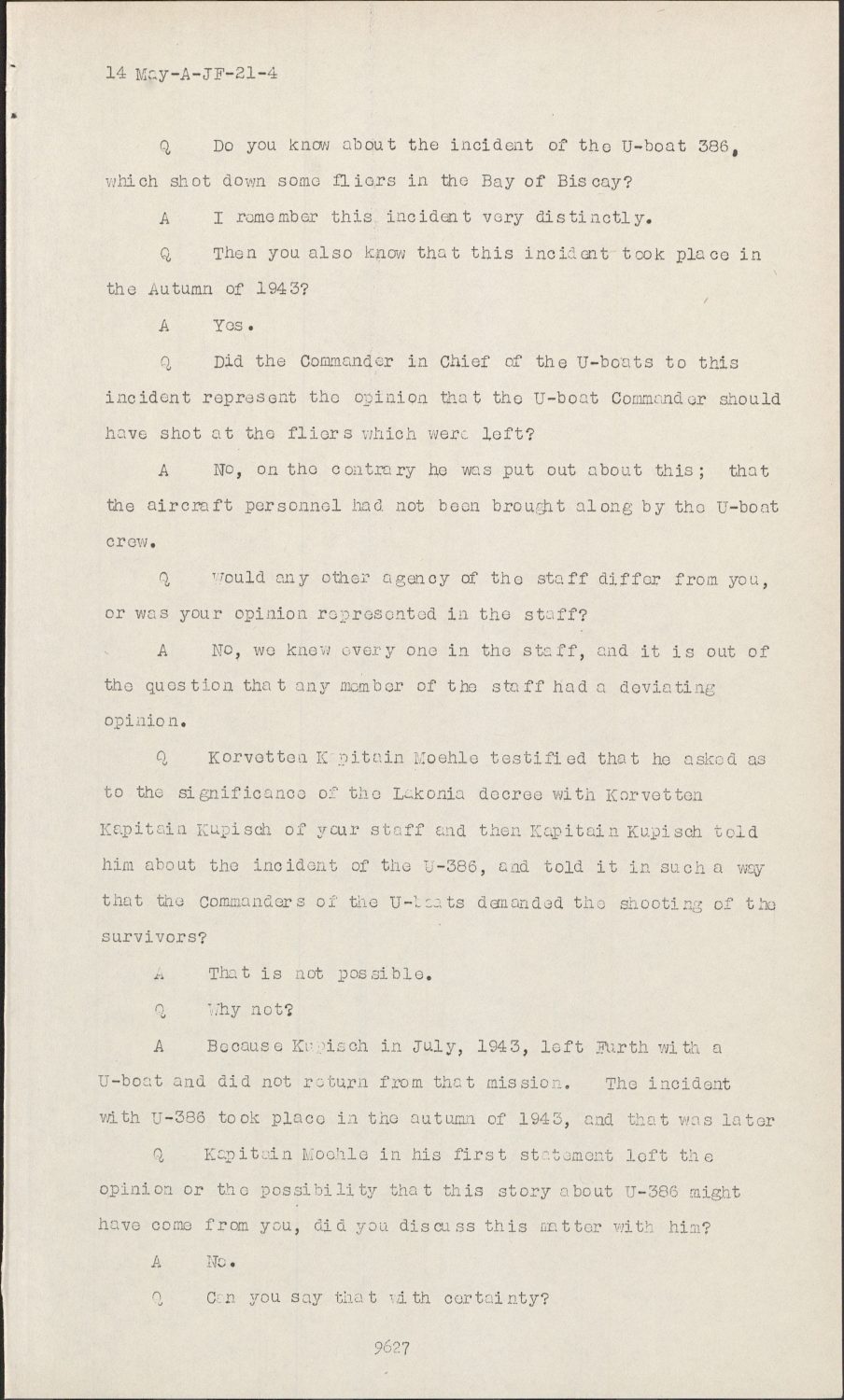
Q Do you know about the incident of the U-boat 386, which shot down some fliers in the Bay of Biscay?
AI remember this incident very distinctly.
QThen you also know that this incident took place in the Autumn of 1943?
AYes.
QDid the Commander in Chief of the U-boats to this incident represent the opinion that the U-boat Command or should have shot at the fliers which were left?
ANo, on the contrary he was put out about this; that the aircraft personnel had not been brought along by the U-boat crew.
QWould any other agency of the staff differ from you, or was your opinion represented in the staff?
ANo, we knew every one in the staff, and it is out of the question that any member of the staff had a deviating opinion.
QKorvetten Kapitain Moehle testified that he asked as to the significance of the Lakonia decree with Korvetten Kapitain Kupisch of your staff and then Kapitain Kupisch told him about the incident of the U-386, and told it in such a way that the Commanders of the U-boats demanded the shooting of the survivors?
AThat is not possible.
QWhy not?
ABecause Kapisch in July, 1943, left Furth with a U-boat and did not return from that mission. The incident with U-386 took place in the autumn of 1943, and that was later
QKapitain Moehle in his first statement left the opinion or the possibility that this story about U-386 might have come from you, did you discuss this matter with him?
ANo.
QCan you say that with certainty?

A With absolute certainty.
QDid you hear about the interpretation which Kapitain Moehle gave to this Lakonia order?
AAfter the collapse, that is, after the end of the war, and then through a British Officer.
QHow do you explain the fact that of the very few officers who were instructed by Moehle, none discussed the interpretation of this order with the Commander in Chief of the Submarines?
AI have only one explanation for this and that is that these officers considered the interpretation of Kapitain Moehle completely impossible, and that it did not agree with the interpretation or opinion of the Commander in Chief of the Submarines.
QTherefore, they could not require a clarification?
ANo, they did not require a clarification.
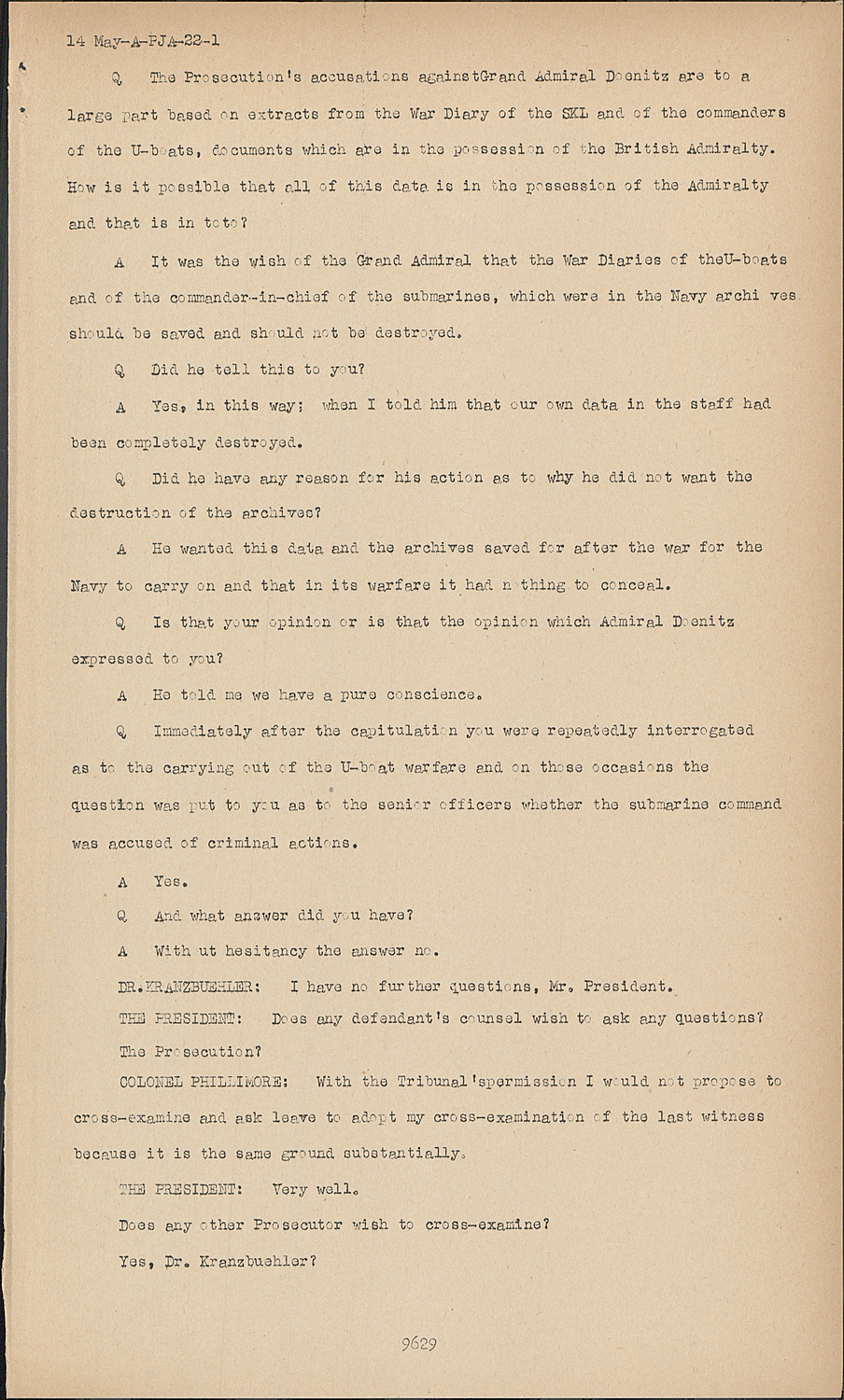
Q. The Prosecution's accusations against Grand Admiral Doenitz are to a large part based on extracts from the War Diary of the SKL and of the commanders of the U-boats, documents which are in the possession of the British Admiralty.
How is it possible that all of this date, is in the possession of the Admiralty and that is in toto?
AIt was the wish of the Grand Admiral that the War Diaries of theU-boats and of the commander-in-chief of the submarines, which were in the Navy archi ves should be saved and should not he destroyed.
QDid he tell this to you?
AYes, in this way; when I told him that our own data in the staff had been completely destroyed.
QDid he have any reason for his action as to why he did not want the destruction of the archives?
AHe wanted this data and the archives saved for after the war for the Navy to carry on and that in its warfare it had nothing to conceal.
QIs that your opinion or is that the opinion which Admiral Doenitz expressed to you?
AHe told me we have a pure conscience.
QImmediately after the capitulation you were repeatedly interrogated as to the carrying out of the U-beat warfare and on those occasions the question was put to you as to the senior officers whether the submarine command was accused of criminal actions.
AYes.
QAnd what answer did you have?
AWithout hesitancy the answer no.
DR. KRANZBUEHLER:I have no further questions, Mr. President.
THE PRESIDENT:Does any defendant's counsel wish to ask any questions?
The Prosecution?
COLONEL PHILLIMORE:With the Tribunal 'spermission I would not propose to cross-examine and ask leave to adopt my cross-examination of the last witness because it is the same ground substantially.
THE PRESIDENT:Very well.
Does any other Prosecutor wish to cross-examine?
Yes, Dr. Kranzbuehler?
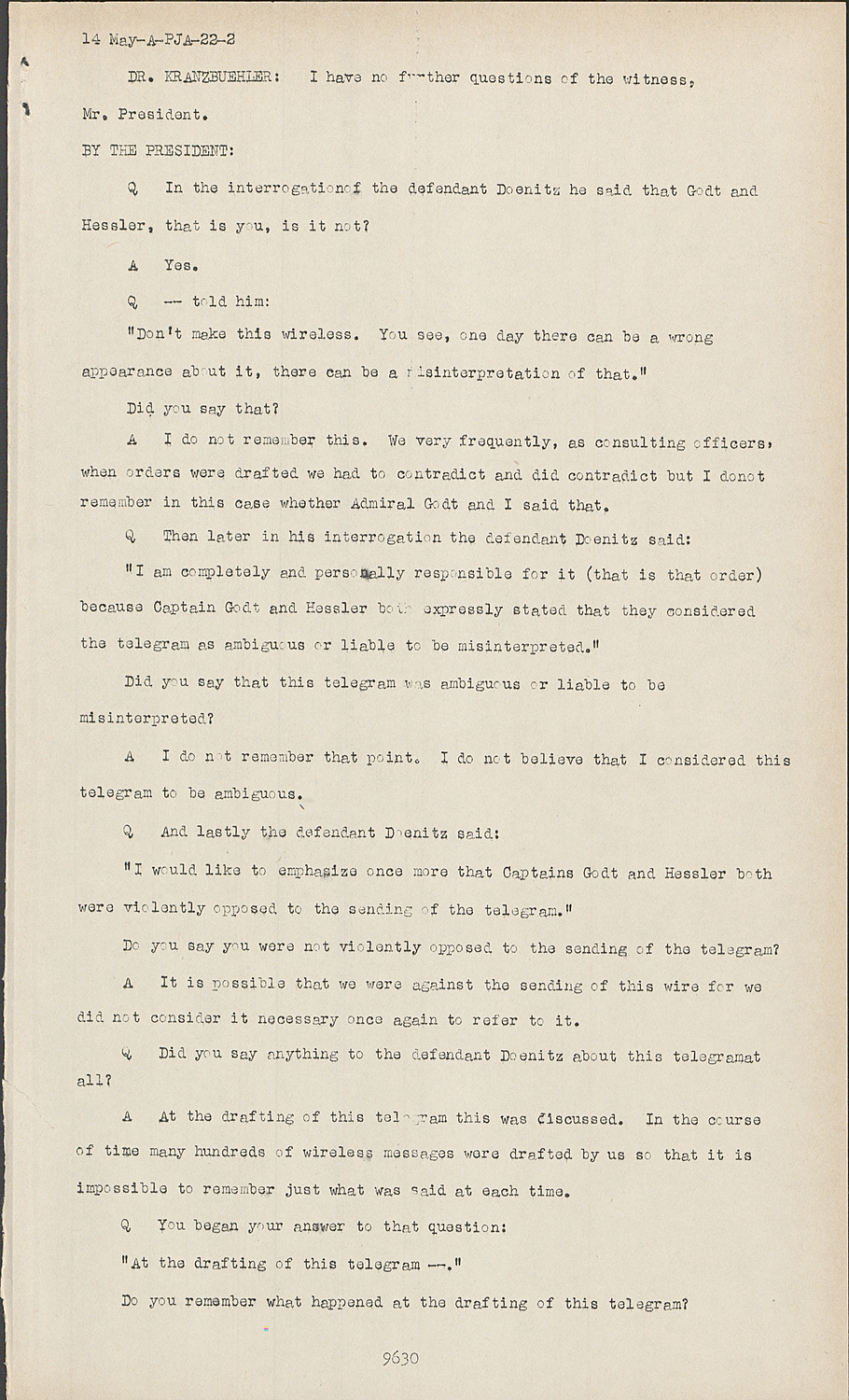
DR. KRANZBUEHLER: I have no further questions of the witness, Mr. President.
BY THE PRESIDENT:
QIn the interrogation of the defendant Doenitz he said that Godt and Hessler, that is you, is it not?
AYes.
Q -- told him:
"Don't make this wireless. You see, one day there can be a wrong appearance about it, there can be a misinterpretation of that."
Did you say that?
AI do not remember this. We very frequently, as consulting officers when orders were drafted we had to contradict and did contradict but I donot remember in this case whether Admiral Godt and I said that.
Q.Then later in his interrogation the defendant Doenitz said:
"I am completely and personally responsible for it (that is that order) because Captain Godt and Hessler both expressly stated that they considered the telegram as ambiguous or liable to be misinterpreted."
Did you say that this telegram was ambiguous or liable to be misinterpreted?
AI do not remember that point. I do not believe that I considered this telegram to be ambiguous.
QAnd lastly the defendant Doenitz said:
"I would like to emphasize once more that Captains Godt and Hessler both were violently opposed to the sending of the telegram."
Do you say you were not violently opposed to the sending of the telegram?
AIt is possible that we were against the sending of this wire for we did not consider it necessary once again to refer to it.
Q.Did you say anything to the defendant Doenitz about this telegram at all?
AAt the drafting of this telegram this was discussed. In the course of time many hundreds of wireless messages were drafted by us so that it is impossible to remember just what was said at each time.
QYou began your answer to that question:
"At the drafting of this telegram --."
Do you remember what happened at the drafting of this telegram?
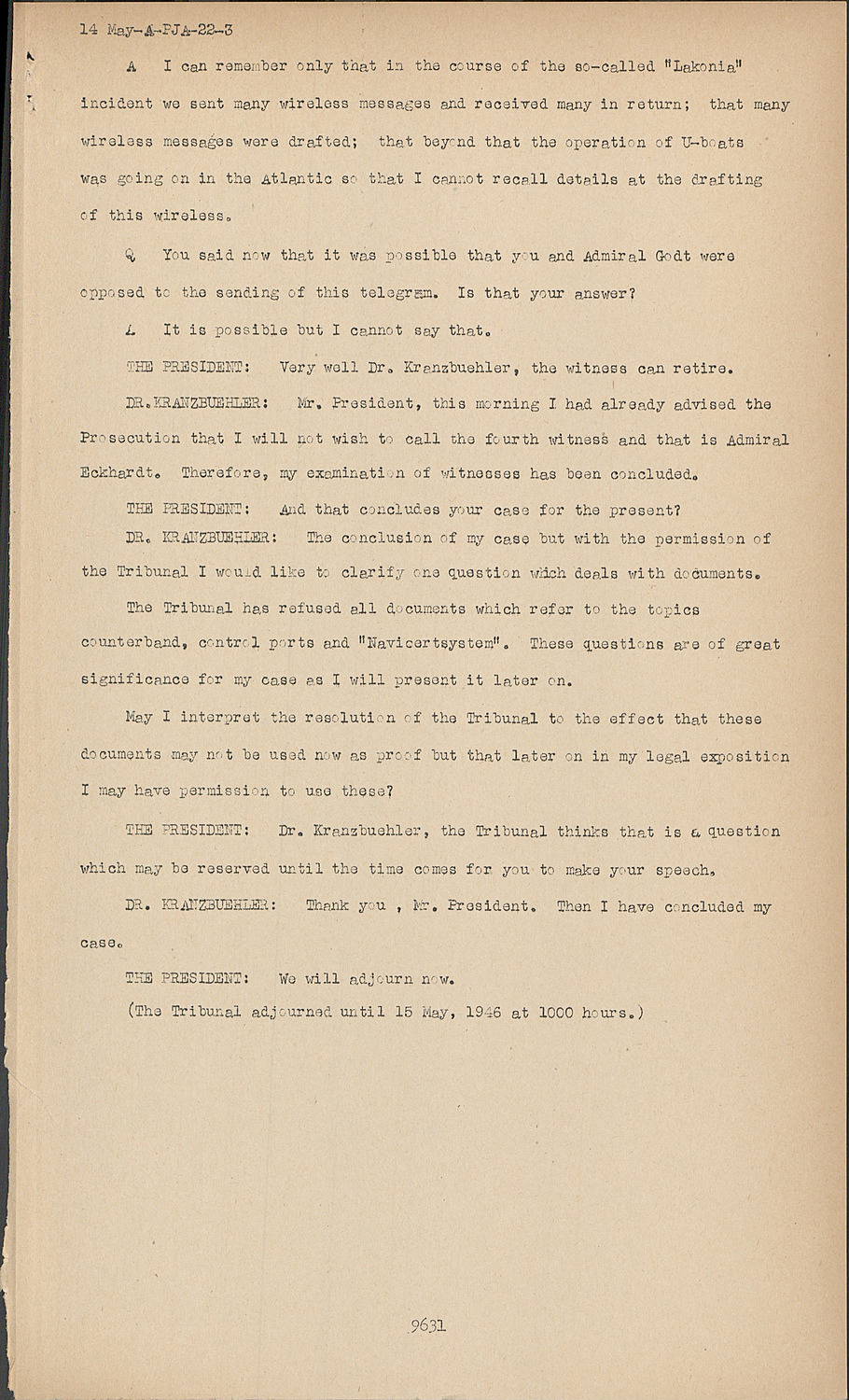
A I can remember only that in the course of the so-called "Lakonia" incident we sent many wireless messages and received many in return; that many wireless messages were drafted; that beyond that the operation of U-boats was going on in the Atlantic so that I cannot recall details at the drafting of this wireless.
QYou said now that it was possible that you and Admiral Godt were opposed to the sanding of this telegram. Is that your answer?
AIt is possible but I cannot say that.
THE PRESIDENT:Very well Dr. Kranzbuehler, the witness can retire.
DR. KRANZBUEHLER:Mr. President, this morning I had already advised the Prosecution that 1 will not wish to call the fourth witness and that is Admiral Eckhardt. Therefore, my examination of witnesses has been concluded.
THE PRESIDENT:And that concludes your case for the present?
DR. KRANZBUEHLER:The conclusion of my case but with the permission of the Tribunal I would like to clarify one question which deals with documents.
The Tribunal has refused all documents which refer to the topics countermand, central ports and "Navicertsystem". These questions are of great significance for my case as I will present it later on.
May I interpret the resolution of the Tribunal to the effect that these documents may not be used now as proof but that later on in my legal exposition I may have permission to use these?
THE PRESIDENT:Dr. Kranzbuehler, the Tribunal thinks that is a question which may be reserved until the time comes for you to make your speech,
DR. KRANZBUEHLER:Thank you , Mr. President. Then I have concluded my case.
THE PRESIDENT:We will adjourn now.
(The Tribunal adjourned until 15 May, 1946 at 1000 hours.)
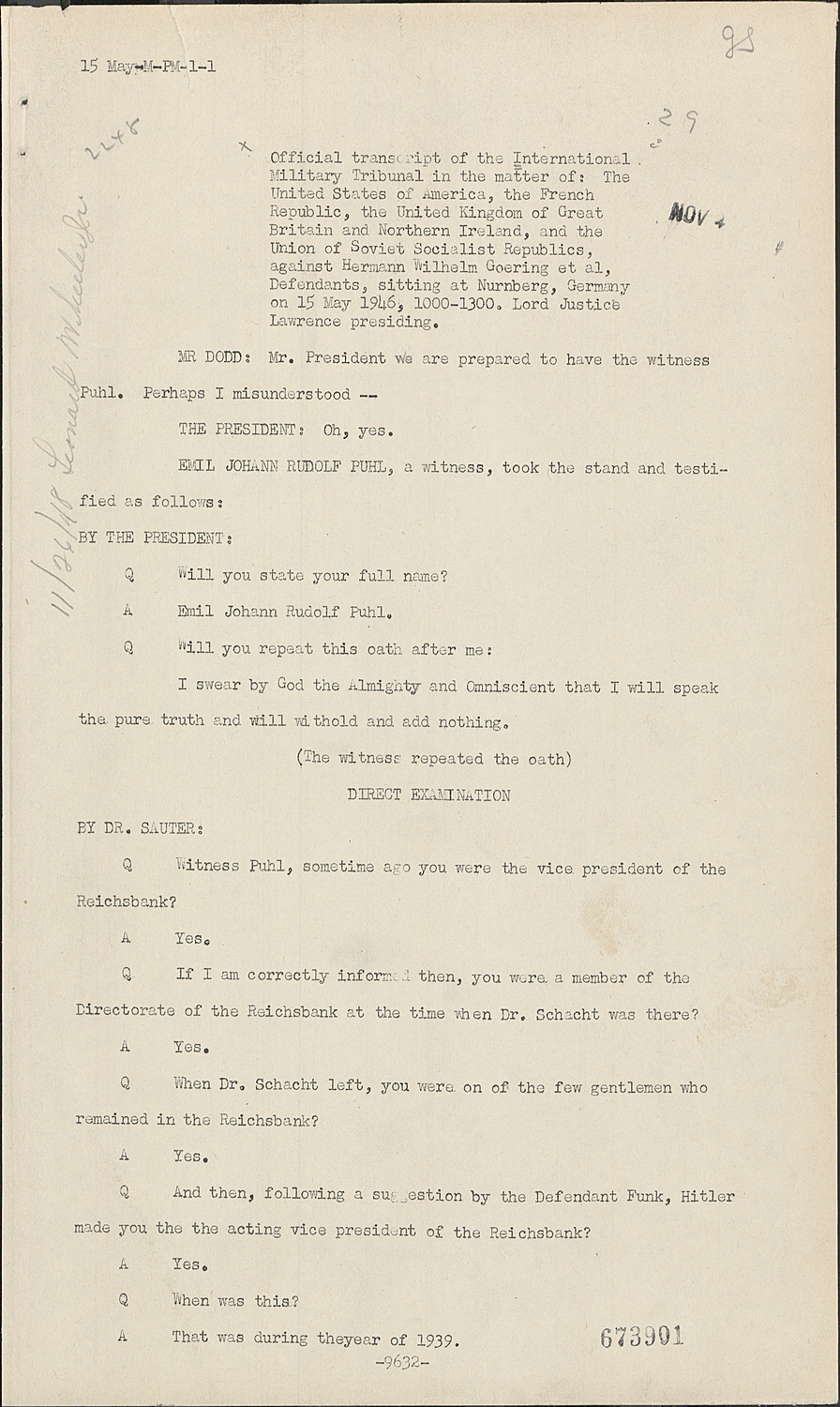
Official transcript of the International Military Tribunal in the matter of:
The United States of America, the French Republic, the United Kingdom of Great Britain and Northern Ireland, and the Union of Soviet Socialist Republics, against Hermann Wilhelm Goering et al, Defendants, sitting at Nurnberg, Germany on 15 May 1946, 1000-1300, Lord Justice Lawrence presiding.
MR DODD: Mr. President we are prepared to have the witness Puhl. Perhaps I misunderstood -
THE PRESIDENT: Oh, yes.
EMIL JOHANN RUDOLF PUHL, a witness, took the stand and testified as follows: BY THE PRESIDENT:
QWill you state your full name?
AEmil Johann Rudolf Puhl.
QWill you repeat this oath after me:
I swear by God the Almighty and Omniscient that I will speak the pure truth and will withold and add nothing.
(The witness repeated the oath)
DIRECT EXAMINATION BY DR. SAUTER:
QWitness Puhl, sometime ago you were the vice, president of the Reichsbank?
AYes.
QIf I am correctly informed then, you were a member of the Directorate of the Reichsbank at the time when Dr. Schacht was there?
AYes.
QWhen Dr. Schacht left, you were, on of the few gentlemen who remained in the Reichsbank?
AYes.
QAnd then, following a suggestion by the Defendant Funk, Hitler made you the the acting vice president of the Reichsbank?
AYes.
QWhen was this?
AThat was during theyear of 1939.
I see, '39. You stated that you were acting vice president.
I presume that this was due to the fact that the Defendant Funk wasn't a banking expert whereas you were, and that Defendant Funk, apart from that, was also in charge of the Reich Ministry for Economics?
AYes, but there was another reason which was decisive, and that was the separation of the powers who were handling the business and who were handling personnel.
QThe actual conduct of the business, therefore, was your job, wasn't it? Thus the name of Acting Vice President?
AYes, but may I make a few statements on that?
QYes, but only if it is necessare in the interest of our case,
AVery well. The conducting of the business of the Directorate of the Reichsbank was divided up amongst a number of members of the Directorate. Every member had full responsibility for his sphere. The Vice President was only the figure head, whose, main job was to be in the chair during the meetings and to present the President on any important occasions; and also he had to deal with the economic and bank policy.
QWitness, the present Defendant Funk, as early as December, has referred to you as one of his witnesses. You know that, don't you? And Accordingly, you were questioned at the camp where you are now residing, at Baden-Baden?
AYes, at Baden-Baden.
QOn the 1st of May?
AYes.
QAnd two days later you were again interrogated?
AYes.
QThat was on the 3rd of May?
AYes.
QDo you know why these matters which you were asked about on the 3rd of May weren't dealt with during the interrogation on the 1st of May?
AI have before me here the affidavit dated the 3rd of May.
QThat deals with these businesses with the SS, doesn't it?
A Yes. But I was also questioned on the 1st of May, but only very briefly.
On the 3rd of May they came back to ask more thoroughly regarding this subject.
QDuring your interrogation on May the 1st those businesses of the Reichsbank were not talked about, were they?
AYes.
QDid you mention them?
AA short statement was compiled.
QYou mean during the interrogation of May the 1st?
A Yes. At any rate, during are interrogation on the 3rd of May a thorough record was prepared of matters which had briefly been touched on before.
QI have got your interrogation of May the 1st before me. I read through it today and nothing is mentioned regarding the businesses with the SS. As far as I can see, there is nothing in it about that. The matter you are now mentioning must have been a further interrogation?
AYes.
MR. DODD:Mr. President I think perhaps I can be helpful in this apparent confusion. The interrogatory which was authorized by the Tribunal was taken on the 1st of May, but on that same day, and independent of these interrogatories, a member of our staff also interviewed this witness. But it was a separate interview. It wasn't related to the interrogatory, and I think that is the source of the confusion.
THE PRESIDENT:Very well. BY DR. SAUTER:
QThese businesses with the SS, were you interrogated about them twice?
ADuring the days about the 1st of May, yes, twice.
QHave you got the affidavit which you made on the 3rd of May, according to your recollection?
AYes.
QThat is the affidavit which deals with this business with the SS?
ACorrect.
QIs it true, what you have said in that affidavit?
AYes.
QWitness, since the 3rd of May have you been once more interrogated about this matter?
AYes, here in Nurnberg.
QWhen was that?
ADuring these last few days.
QI see. Today is Wednesday. When was this?
AFriday, Monday, Tuesday -- yesterday, Q Regarding this very matter?
AYes.
QHas someone shown you a film yet?
AYes, once or twice -- once.
QHad you seen that film before?
ANo.
QThe matters shown in that film, did you recognize them quite clearly?
AYes.
QThe reason why I am asking you, Mr. Puhl, is because, as you know, the film takes place very quickly and it is a very short film, and for that reason the prosecution showed it twice in this Court room so that the pictures shown in this film could be recognized reliably. Did the single showing of that film make it possible for you to become clear about the subject of the film?
AYes.
A Yes.
QIn that case will you tell me what you have seen?
AWell -
QOnly what you have seen in the film, or what you think you have seen in the film.
AYes. The film was taken outside the steel safes of our bank at Frankfurton-Main. The other safes were shown behind the glass doors. They were the locked cases and containers which had been apparently found there. It was a usual picture which such strong-rooms would present. Before these safes there were several containers which were opened, of which one could see, roughly, what the contents were -- pearls, jewels, bank-notes and watches.
QWhat sort of watches?
ALarge alarm clocks.
QDidn't you see anything else in the film?
AApart front these things, you mean?
QWell, apart from these valuables, didn't you see anything else that might have been kept there?
ANo, only these valuables.
QPlease go on.
AOn that occasion I noticed that in addition to these valuables there were coins, apparently silver coins, and also that amongst these valuables there were bank-notes, apparently American bank-notes. It was astonishing that these things were given to us for safe-keeping, because if they had been known to our original then no doubt there would have been a surrender of the bank-notes to the foreign currencies department since, as you Know, there was a general order to hand over foreign currency. But apart from that it was known to our officials that foreign bank-notes particularly were extremely rare and sought after. Something similar applies to the coins. They, too, really ought to have been handed over to the currency accounts, that is to say, they should have been purchased through the accounts of the Reich.
QThat is what you noticed, is it?
AYes.
QAnd didn't you notice anything else?
ANo.
Q Witness, in that manner valuable articles were supposed to have been kept in the Reichsbank, valuables which had been given to the Reichsbank for safekeeping.
And now I have been asking myself whether your Reichsbank might really deal with valuables and in safe-keeping by looking after them in such a manner as you have seen from that film. That is why I am interested in the question. Do you know, as the acting vice-president of the Reichsbank, how, for instance, in Berlin or how in Frankfurt where this film was taken, such, goods were meant to be kept in the strong-rooms and such valuables?
AYes. the picture of the safe installments in Berlin were similar to that in Frankfurt as it would probably be in any large bank. These matters which we called closed deposits were kept in closed containers for which we made room, and that space was paid for in accordance with its size.
QFor instance, in Berlin, or let's say in Frankfurt, were these matters kept just as it was apparent from that film?
AIn the case of the film I had the impression that the matters -- the things -- which we are now talking about had been put there particularly for the purpose of being photographed.
QYou perhaps recollect that, for instance, there might have been a sack which was shown which had the inscription, "Reichsbank, Frankfurt."
AI can say that I did see as sack which had the word, "Reichsbank", on it.
I am not sure whether it stated "Reichsbank" Frankfurt," on it, but I know it had "Reichsbank" on it, and that is why I thought the film was taken in Frankfurt, which is something the Prosecution had confirmed
MR. DODD:There have been two mistakes of some slight importance already. We didn't show the film twice before this Tribunal and what bag doesn't bear the legend, "Frankfurt." It simply says, "Reichsbank," And it was Schacht film that was shown twice here, because it moved rather quickly.
QWitness, in replying will you please continue to reply to my questions. My question is this: Did the Reichsbank have gold and such things in such sacks as this?
AThe way I understand the question is, if persons would deposit anything with us then their things would be deposited in sacks, is that what you meant to ask?
QI don't know how you handle them -
A The way we handle them is -- the name says that we had closed deposits.
Of course, that can be a sack which is closed; that is perfectly possible.
QWell, what I saw in banks in Munich, Witness, was that things which were being deposited in an increased measure during the war were always kept in close boxes or cases so that generally the bank wouldn't know at all what might be contained in the cases or boxes. Its that different with you?
ANo, it was just the same, and the remarkable thing about this sack is that it bears the word, "Reichsbank." Quite obviously that must be one of our sacks and not a sack belonging to a third party.
QSo that if I may repeat this, to avoid, any doubt, you too would look after such closed deposits by keeping them in some closed container?
AYes.
QOr they went to the safe or strong-room.
AThe "or", Mr. Counsel, might be misleading. Closed containers went to the tresor, the safe room. There you found steel chambers where these containers or boxes were deposited. And quite independent from that arrangement, we had the arrangement of so-called "open deposits." They were such deposits where right from the beginning an administration of the goods had been arranged, and these safes were in quite a different part of the building from the so-called main safe
QThese open deposits don't apply to our case, do they?
ANo.
QNow, I shall come to the deposit of the SS. That deposit -- or these deposits weren't in Frankfurt but presumably in Berlin at the Central department.
AYes.
QNow, I should like you to tell me about the discussions the Defendant Funk had with you regarding the deposits of the SS and to give me information about it. Witness, I should like to ask you to think very carefully about every answer and to examine your recollection every time you give an answer. Of course, I shall give you necessary time. First of all, I shall ask you, what did you and the Defendant Funk discuss when for the first time you were talking about this deposit of the SS?
AI am referring to my affidavit of the 3rd of May in this connection. The talk I had with Mr. Funk was extremly simple. It dealt with the fact that the SS had asked that they might use the arrangements in our Bank regarding deposits of valuable articles for which -- as it was said, they hadn't sufficient space in the cellars of their houses.