A Naturally, considering the military situation I did hear an occasional remark regarding an army commander, but I can't say today why it was made or what it was.
QYou were quite often present during discussions in the Fuehrer Headquarters, Did it become clear to you on such occasions that supreme commanders were stating different views before the Fuehrer?
AYes, that happened indeed.
QCan you remember any certain definite example?
AI remember, for instance, that in connection with t he question of the northern sector in the East, the army commander concerned with that part of the front had a different opinion than the Fuehrer, and I remember that there was an argument about that.
QWas that commander successful with his objections?
AI think partly yes, but I would like you to ask an army officer about that because the connections weren't authentically known to me in detail,
QDid the high military leaders of the wartime Navy have anything to do with the Special Action groups of the SD, the Einsatzgroups?
AThe wartime Navy? No. As far as the Army is concerned, I want to say I don't believe so and I assume they didn't, but please don't ask me about anything but the Navy;
QYes. That, of course, was what I was asking you about. And now, some questions about leaders in the Navy. Did the supreme leaders of Navy group commandos have territorial authorities?
ANo. There was the famous KG-4O, that is War Command 40, and the Navy had no territorial powers ashore. Its task was that when they were asho they had to see to the defense of the coast under the command of the Army, and that was divided in sectors. They were commanded by the divisions stationed in that particular sector, and apart from that they were dealing with the naval warfare before that coast.
QSo that supreme commanders of the Navy were troop commanders?
AYes.
QDid these Navy commanders have any influence on the formulation of orders regarding submarine warfare?
A. No, none whatever.
Q.Did they influence decisions regarding ships which were to be sink?
A.No, not at all.
Q.And did they influence the orders regarding the treatment of rescued personnel.
A.No.
Q.Now the, the group also contains the Chief of the Naval Operational Staff. What were the tasks of the Chief of the Naval Operational Staff?
A.He was in the supreme commando He had a position where he dealt with purely military tactical and operational matters of the wartime Navy.
Q.Did the Chief of the SKL have powers to issue orders?
A.No.
Q.So that his position was similar to that of the Chief of the General Staff of the Air Force or the Army?
A.I beg your pardon, but first of all I will have to put you right about the whole conception. I presume that by the Chief of Operational Staff you mean the Chief of Staff.
Q.Yes.
A.At the time of Admiral Raeder the name of the Chief of the Naval Warfare Command was the same as the Supreme Commander of the Navy. The organization about which you are making inquiries was called the Chief of Staff of Naval Warfare Command, whereas when I was the Supreme Commander of the Navy, the name of the Chief of Staff of Naval Warfare Command was changed to Chief of Naval Warfare Command, but it was the same person and he was under the command of the Supreme Commander of the Navy.
Q.Was there an Admiralty Staff in the Navy?
A.No, that didn't exist. Such an institution did not exist. Any necessary assistant leaders, as we called them, came from the front and they served on the staff and then they returned to the front.
Q.And now I shall ask one last question. The witness Gisevius has stated in this courtroom that the supreme military leaders had drifted into corruption by accepting donations, gifts. Did you receive any donation of any kind, any gift?
A. Apart from the salary to which I was entitled, I didn't receive a penny; no presents, no donation, nothing.
And the same applies to all the officers of the Navy.
DR. LATERNSER:Thank you very much. I have no further questions. BY DR. NELTE (Counsel for defendant Keitel):
Q.Witness, you were present when the witness Gisevius was being examined here. That witness, without giving concrete facts, passed judgment on various matters and made the following statement, "Keitel had one of the most influential positions in the Third Reich," and then, sometime later, he said, "I have received very detailed information regarding the tremendous influence which Keitel had on everything relating to the Army, and also how he represented the Army before the German people."
Will you, who must be able to judge these matters, tell me whether that judgment, that opinion, regarding the position of Defendant Field Marshal Keitel is correct.
A.I consider it a great exaggeration. I think that Field Marshal Keitel position has been so explicitly described here that it ought to be clear by now, and that these big words which he used are not correct.
Q.May I gather from that that the description of the position and functions as given by Marshal Goering Field Marshal Keitel can be confirmed by you?
A.Yes, it is perfectly correct. When the witness Gisevius judged these matters, he wasn't relying on his own direct knowledge, but was relying on information which he had received from Admiral Canaris.
Q.Did you know Admiral Canaris?
A.I know Admiral Canaris from the time when he was still a member of the Navy.
Q.Later on, when he became the Chief of Foreign Intelligence in the OKW, did you not have contact with him, and did you not have discussions with him? Did he not come to see you in his capacity as Chief of Counter-Intelligence?
A.After I had just become Supreme Commander of the Navy, he visited me and he made a statement, a lecture in fact, regarding news which he thought he ought to place at the disposal of the Navy, something which was interesting to me, of course.

That was his last report to me. Following that, and as a matter of course, I received from him or his department written reports regarding these views, and that information interesting to the Navy.
Q Is it right for me to say, or is it true, that the position of Admi-
ral Canaris as the Chief of the Counter Intelligence Department; that is, the espionage section, sabotage department and intelligence, was of great importance for the entire conduct of the war?
AHis position?
QHe was the chief of that department, wasn't he?
AYes, and of course he worked for the entire armed forces, all three branches, and I must say in that connection that, as you are asking me about the importance of the work, I am of the opinion or was of the opinion that that information, interesting to the Navy, was very very lean, very meagre.
QDid Canaris ever complain before you about the fact that Fieldmarshal Keitel; that is to say, the OKW were in any way impeding his work; that is to say, information and, his reports couldn't be taken to anybody?
AHe has never done that and, of course, he could only have done so during that first report but he didn't.
QWith reference to Canaris, I should like to know one more thing. Can you tell me anything about his character and his credibility as a source of information. Do you consider him reliable?
AAdmiral Canaris, during the time when he was serving in the Navy, was an officer who didn't find a lot of confidence. He was a man quite different from us.
THE PRESIDENT:Dr. Nelte, we don't want to know about Admiral Canaris when he was in the navy. I don't think there is any use of telling us that Admiral Canaris was in the navy. The only relevance would be his character afterwards when he was head of the intelligence.
DR. NELTE:Mr. President, don't you think that if someone who is a naval captain is regarded as unreliable and not very credible, that he might remain in the same light as an admiral in the OKW? Do you think that during the few years that could have changed all that much? BY DR. NELTE:
QBut, nevertheless, thank you very much for an answer to the question, witness, and I am now asking you to reply to my following question. Is it true that all parts of the armed forces were prohibited to make reports on political matters by Hitler and that they were told to confine themselves to their own sphere of work?
AYes, that is true.
QBut witness Gisevius has stated that Fieldmarshal Keitel had threaten ed officers under his command with handing them over to the Gestapo if they were concerning themselves with politics; and I am now asking you, is it true that in accordance with instructions applicable to the armed forces, the police including the Gestapo and SD, and criminal police, had juridiction over members of the armed forces no matter what rank they were, or did they have no executive powers:
AIt is correct that they didn't.
QAnd is it also correct that the sections of the armed forces and also the OKW were preserving that right which the armed forces had before the police?
AYes, that is true.
QSo that any such supposed threat as mentioned by Gisevious; namely that od handing these people ever to the Gestapo, was in fact not practicable?
ANo.
QAnd it is therefore also right that all officers of the OKW, before whom such a statement might be made, knew that of course, too?
AYes, naturally they did. Soldiers were subject to military discipline and nobody could interfere with the armed forces.
QSo, then, I ask you, over and above that, did Fieldmarshal Keitel, as Chief of the OKW, have the right at all to deal with officers in the OKW without agreement of the commander in question, to dispose of such officers? Could he, for instance, transfer them to another job or could he relieve then of their duties or something like that?
A The officer of the armed forces in question--say the Navy, for instance, would be commanded, would be attached to the OKW for a certain job.
That would mean that he would be taken off the strength of the navy and attached to the OKW. It was quite natural that in the case of a different employment of that officer in the OKW, the armed forces section to which he belonged would have had to be heard.
QIsn't it correct to say that these officers were still on the list of their own unit, since the OKW wasn't an actual military unit or proper formation; in other words, that if there were promotions, for instance, you would promote those people who originated from the Navy-Assuming, for instance, that Canaris was to be transferred, you, as the chief of the navy, would have to order such a transfer, of course, upon agreement or by suggestion of the OKW. I am merely concerned with the question of the actual orders, channel of orders?
AThese officers were attached to the OKW and, as far as I can recollect, they were still on the nominal roll of the navy and they were headed "Detached from the navy, attached to the OKW."
QBut they didn't leave the navy, did they?
APromotion for such officers, if I am remembering rightly, was, I think, done by the personnel office of the navy in agreement with the OKW, and I also think that any such attachment could not be carried out without agreement of the unit, of the officer.
QWitness Gisevius has stated that certain men, and amongst them was Fieldmarshal Keitel for the military sector, had formed a close ring of silence around Hitler so that nobody could approach Hitler, whom they didn't want to let through. My question to you is this: Did Fieldmarshal Keitel have the possibility, for instance, as far as you as supreme commander of the navy were concerned, to keep you away from the Fuehrer if you wanted to see him?
ANo
QDid Fieldmarshal Keitel have the possibility to keep the supreme commander of the air force away if he wanted to report to the Fuehrer?
A No.
QWhat was the position regarding the supreme commander of the army?
AI didn't experience that. When I was supreme commander of the navy, there wasn't such a position.
QRegarding the equality of rank, I want to ask you, what was the situation regarding the Chief of the General Staff of the army. Could he at any time get to the Fuehrer and get past Fieldmarshal Keitel to talk to Hitler?
AThe possibility of keeping anyone away did not exist with Fieldmarshal Keitel and he wouldn't have done a thing like that anyway.
QUpon being cross-examined by the prosecution, witness Gisevius stated in this courtroom that his group was reporting to Keitel through Canaris; that they were submitting reports which were dealing with crimes against humanity, which has been mentioned by the prosecution here. These reports, he said, had been camouflaged as "foreign reports" and presumably you know the type of reports I am referring to. My question to you is this: Did you at any time see such camouflaged information in reports from Canaris was it ever put before you or sent to you?
ANo, never.
QIn accordance with your knowledge of Keitel's personality, do you consider it possible that an important report, which was submitted to him, could have been kept away from the Fuehrer by him?
AI consider that absolutely out of the question.
THE PRESIDENT:I don't think that is a proper question for you to put.
DR. NELTE:That finishes this part of my question in any case and I have yet one more group of questions which can be dealt with very quickly, Mr. President, on the 26th of March, you had given me permission in writing, that I may submit an affidavit from Grand Admiral Doenitz, which deals with the functions and the position of the Chief of the OKW. That affidavit was submitted to the prosecution on the 13th of April and I understand, that there are objections being raised by the prosecut-ion, I have, however, not yet received the original back, after I had submitted them on the 13th of April, and I don't know whether it has in the meantime been handed to the Tribunal by the prosecution.

THE PRESIDENT:I don't know anything about the affidavit that you are dealing with.
DR. NELTE: I should, therefore, now be forced to put these questions to Admiral Doenitz, -which, nevertheless, in their majority are dealing; with the questions which I have already put to the defendant.
THE PRESIDENT:Do the Prosecution object to the affidavit at all?
DR. NELTE:No, they didn't raise any objections. Therefore, if the Prosecution would be good enough to return it to me, I should submit it to the Tribunal as an exhibit, without reading it.
THE PRESIDENT:Very well.
DR. NELTE:Thank you very much. BY DR. DIX (Counsel for defendant Schacht):
Q.Witness, you have stated that the SD and the Gestapo, in fact, the whole place, did not have executive powers regarding members of the armed forces, in particular, that they couldn't arrest members of the armed forces. Did I understand you correctly?
A.Yes.
Q.Do you, Witness, not know that officers which were suspected of participating in the affairs of the 20th of July had all, or at least most of them, been arrested by members of the SD; and that the department of the SD which arrested them sent them to the prisons which were under the control of the SD; and that they remained under the jurisdiction of the SD in these prisons; and that there was no jurisdiction of any military departments?
A.The answer is, no, I didn't know that, because after the 20th of July, as far as I can remember it, there was a specific order stating that the SD, as far as the armed forces were concerned, would have to name those soldiers which had participated in that revolt; and that those soldiers were then to be removed, to be dismissed from the armed forces, particularly because there was the principle of interference with the armed forces which was not to be infringed. So that this meant that afterwards the SD would have jurisdiction.
Q.That order came out, yes, but perhaps we can get nearer to the point when you answer further questions which I want to put to you.
Do you know, Witness, that the interrogations, in particular of those people arrested on the 20th of July, were exclusively carried out by officials of the SD or the Gestapo, respectively, raid not by the officers of the armed forces in military justice?
A.I can only pass judgment regarding the two cases which occurred in my Navy, I received information that those two officers had participated. I had questions put to them, and they confirmed it. Subsequently, these officers were dismissed from the Navy. The interrogation, of course, was then not carried out by the Navy, but I know that my Navy judges were still taking care of the officers and the interrogation.
Q.Who dismissed these men?
A.The Navy.
Q.That is you.
A.Yes.
Q.And, do you know, Witness, that in the course of the investigation regarding the 20th of July a committee was set up consisting of generals, which was headed by Fieldmarshal Rundstedt?
A.Yes, I heard about that.
Q.And that this committee, on the basis of the records of the SD, decided whether the person in question, the officer in question, was to be dismissed from the Army or had to leave the Army, so that, following that, he could come before the civil court, which in this case was the People's Court?
A.That is now known to me.
Q.May I put it to you that I am of the opinion that the statement regarding the decree which you had stated before -
THE PRESIDENT:Dr. Dix, you are bound by his answer. He said he didn't know anything about it. You can't then put to him what you say happened. If he says he doesn't know anything about it, you must accept his answer.
DR. DIX:What I intended was to put to him that the order to which he had referred earlier, and which, in fact, exists, and which does say that a decision will be made as to whether someone is to be dismissed from the Army or not, and is to be surrendered to the civil authorities, that this order is connected with this committee, the president of which was General Fieldmarshal von Rundstedt; and that they had to decide whether the officer in question would have to be dismissed, as not coming under military justice any more but under the People's Court.
It is a question which, therefore, refers -
THE PRESIDENT:I understood the witness to say he didn't know anything about it. I think you are bound by that answer.
DR. DIX:May I add something?
THE PRESIDENT:Who are you offering these questions for? You are counsel for the defendant Schacht.
DR. DIX:The questions of my colleague for Keitel were put regarding the credibility of witness Gesivius. Schacht's defense rests on the credibility of Gesivius, and he is very interested in it. I was putting these three questions to defend Gesivius' credibility. That is, of course, for Schacht. And may I add something, please?
THE PRESIDENT:Very well.
DR. DIX:The question to which your Lordship is objecting was merely put because I expected the possibility that the answer of the witness might have been based on a mistake, namely, that the general instructions which he was referring to, according to which the soldier in question would first of all have to be dismissed before the SD could take hold of him, that he was mixing that order up with the decree stating that Rundstedt's committee would have to decide whether the officer in question was to be dismissed from the armed forces and would then come before the People's Court, not the SD. The SD was only carrying out the investigation, but the People's Court would then take hold of the person in question.
THE PRESIDENT:What is it you want to ask him now? BY DR. DIX:
Q.Well, then, Grand Admiral, I think you have understood my question, or do you want me to repeat it?
A.I can't tell you any more than I already have done.
DR. SERVATIUS:Dr. Servatius, counsel for Sauckel. BY DR. SERVATIUS:
Q.Witness, as the Commander of submarines, you did have some official contact with Sauckel, didn't you?
A. No, it wasn't official contact; it was private.
Q.What was the cause?
A.A submarine which was to go into the Atlantic for eight weeks had reported to me that it had been found after it had left port that Gauleiter Sauckel had crept aboard. I immediately sent a wireless message giving the order for the submarine to turn about, and that he was to be put upon the first steamer.
Q.That was Sauckel's motive?
A.No doubt a belligerent. He wonted to go to sea again.
Q.But then he was Gauleiter, Didn't he have particularly special reasons for which he wanted to show that he was ready to fight in the war; that he didn't want to sit behind the front?
A.It surprised me that he could afford that as a Gauleiter, that is to go to sea, but, at any rate, I believed that this was a man who had his heart in the right spot.
Q.You believe that they were idealistic motives?
A.But most certainly, yes. Nothing much could be got out of traveling on a submarine.
DR. SERVATIUS:I have no further questions.
DR. STEINBAUER:Dr. Steinbauer, counsel for Seyss-Inquart: BY DR. STEINBAUER:
Q.Grand Admiral, do you remember that in your capacity as the head of the State on the 1st of May 1945, you ordered the commissioner for the occupied territories to come to Flensburg to report to you?
A.Yes.
Q.Do you also remember that on that occasion my client had asked you that the order originally sent to the commander in the Netherlands regarding which all locks should be blown up in the event of an attack, that this order should be canceled; and that he also asked that the order should be given that the detonation point should be discharged?

A. Yes, he did do that. It was in accordance with my own principles, because when I had become head of the State I had given the order that all destruction -- and that included occupied territories as, for instance, Czechoslovakia -- should cease forthwith.
Q At the end of his report, did he ask you for permission to return to his station in the Netherlands instead of remaining in Germany?
AYes, he did so repeatedly. He tried to get back, but the travel situation was difficult, and he could not be taken back by "E" boat quickly to the Netherlands.
DR. STEINBAUER:Thank you very much. BY SIR DAVID MAXWELL-FYFE:
QDefendant, I want you first of all to answer some questions on your record after becoming commander in chief of the navy on the 30th of January, 1943. As commander in chief of the navy you had the equivalent rank of a minister of the Reich; is that not so?
AYes, that is correct.
QYou had also the right to participate in meetings of the Reich cabinet, had any such meetings taken place?
AI was authorized to participate if my participation in such a meeting was ordered by the Fuehrer. That is the way it was worded. In that connection I must say that no meeting of any kind between the Reich Government and me at the time I was supreme commander, in 1943, took place at all. That is to say, this participation by order of the Fuehrer did in no way take place.
QFrom the time that you became commander in chief of the navy, the government of the Reich was in a sense carried from Hitler's headquarters; isn't that so?
AThat is correct.
QIt was a military dictatorship in which the dictatorship saw those people that he wanted at his military headquarters; that is right, is it not?
AYou cannot say "military dictatorship." It was not a dictatorship at all. There was a military sector and a civilian sector, and the Fuehrer had both components in his hand, united.
QI see. I will take the last part of your answer, and we will not argue about the first.
Now, you saw him on 119 days in just over two years; do you agree with that?
AYes. But in that connection, it must be stated that beginning on the 30th of January 1943 -- that is to say, when I was supreme commander of the navy -- and until the end of January, 19145 -- that is to say approximately two years -- the number was, I think, 57.
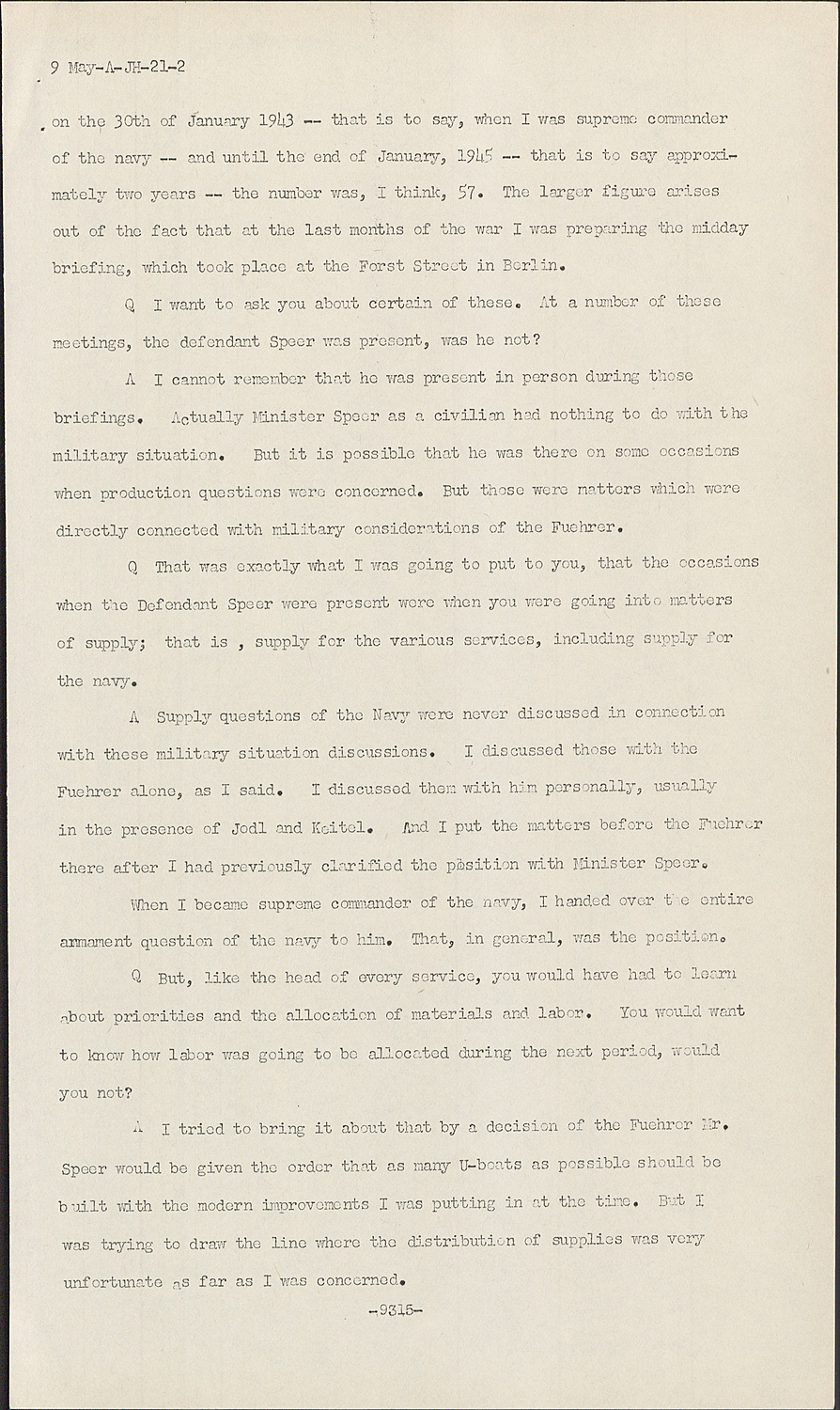
The larger figure arises out of the fact that at the last months of the war I was preparing the midday briefing, which took place at the First Street in Berlin.
QI want to ask you about certain of these. At a number of these meetings, the defendant Speer was present, was he not?
AI cannot remember that he was present in person during those briefings. Actually Minister Speer as a civilian had nothing to do with the military situation. But it is possible that he was there on sonic occasions when production questions were concerned. But those were matters which were directly connected with military considerations of the Fuehrer.
QThat was exactly what I was going to put to you, that the occasions when the Defendant Speer were present were when you were going into matters of supply; that is, supply for the various services, including supply for the navy.
ASupply questions of the Navy were never discussed in connection with these military situation discussions. I discussed those with the Fuehrer alone, as I said. I discussed them with him personally, usually in the presence of Jodl and Keitel. And I put the matters before the Fuehrer there after I had previously clarified the position with Minister Speer.
When I became supreme commander of the navy, I handed over the entire armament question of the navy to him. That, in general, was the position.
QBut, like the head of every service, you would have had to learn about priorities and the allocation of materials and labor. You would want to know how labor was going to be allocated during the next period, would you not?
AI tried to bring it about that by a decision of the Fuehrer Mr. Speer would be given the order that as many U-boats as possible should be built with the modern improvements I was putting in at the time. But I was trying to draw the line where the distribution of supplies was very unfortunate as far as I was concerned.
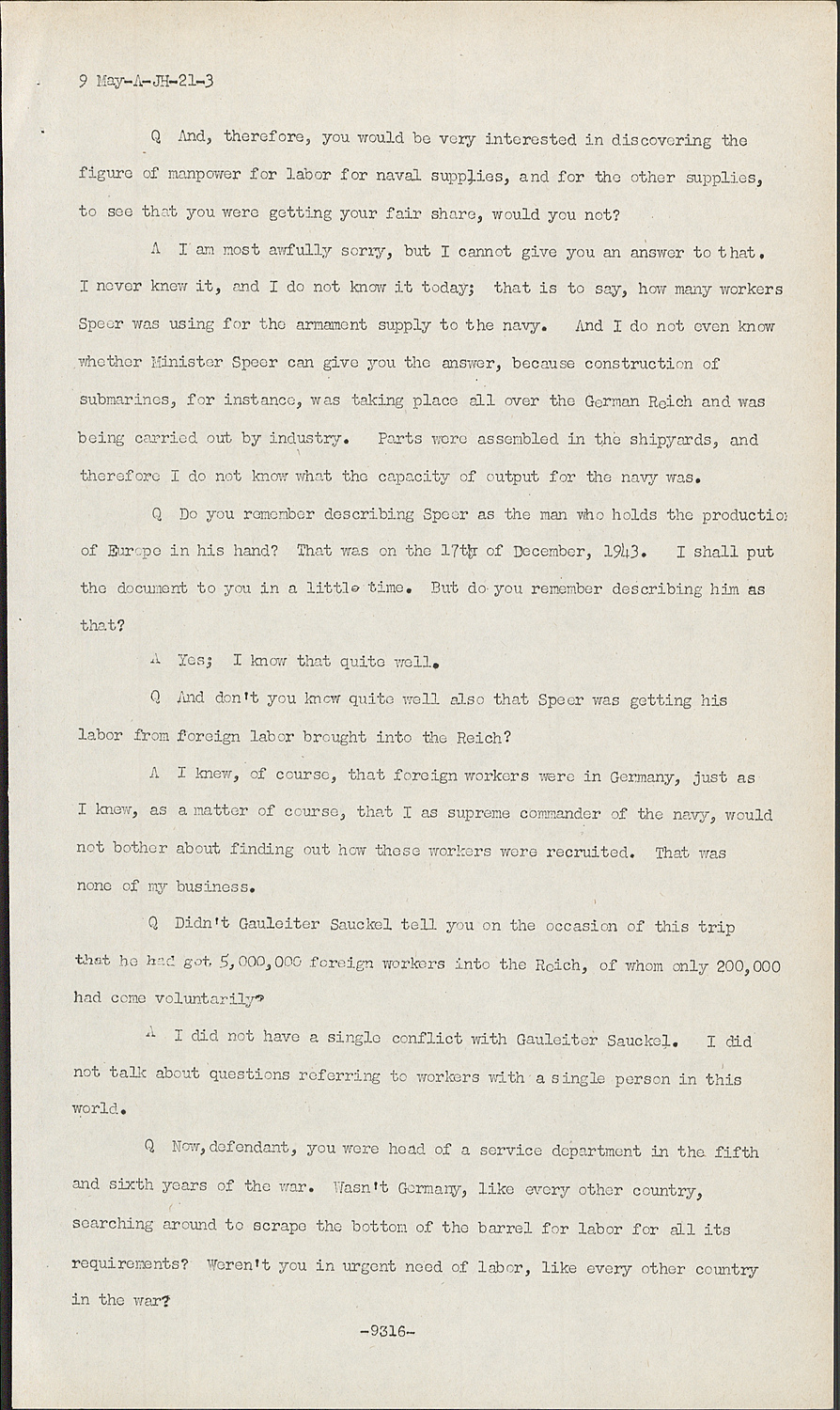
Q And, therefore, you would be very interested in discovering the figure of manpower for labor for naval supplies, and for the other supplies, to see that you were getting your fair share, would you not?
AI am most awfully sorry, but I cannot give you an answer to that. I never knew it, and I do not know it today; that is to say, how many workers Speer was using for the armament supply to the navy. And I do not even know whether Minister Speer can give you the answer, because construction of submarines, for instance, was taking place all over the German Reich and was being carried out by industry. Parts were assembled in the shipyards, and therefore I do not know what the capacity of output for the navy was.
QDo you remember describing Speer as the man who holds the production of Europe in his hand? That was on the 17% of December, 1943. I shall put the document to you in a little time. But do you remember describing him as that?
AYes; I know that quite well.
QAnd don't you knew quite well also that Speer was getting his labor from foreign labor brought into the Reich?
AI knew, of course, that foreign workers were in Germany, just as I knew, as a matter of course, that I as supreme commander of the navy, would not bother about finding out how those workers were recruited. That was none of my business.
QDidn't Gauleiter Sauckel tell you on the occasion of this trip that he got, 5,000,000 foreign workers into the Reich, of whom only 200,000 had come voluntarily?
AI did not have a single conflict with Gauleiter Sauckel. I did not talk about questions referring to workers with a single person in this world.
QNow, defendant, you were head of a service department in the fifth and sixth years of the war. Wasn't Germany, like every other country, searching around to scrape the bottom of the barrel for labor for all its requirements? Weren't you in urgent need of labor, like every other country in the war?
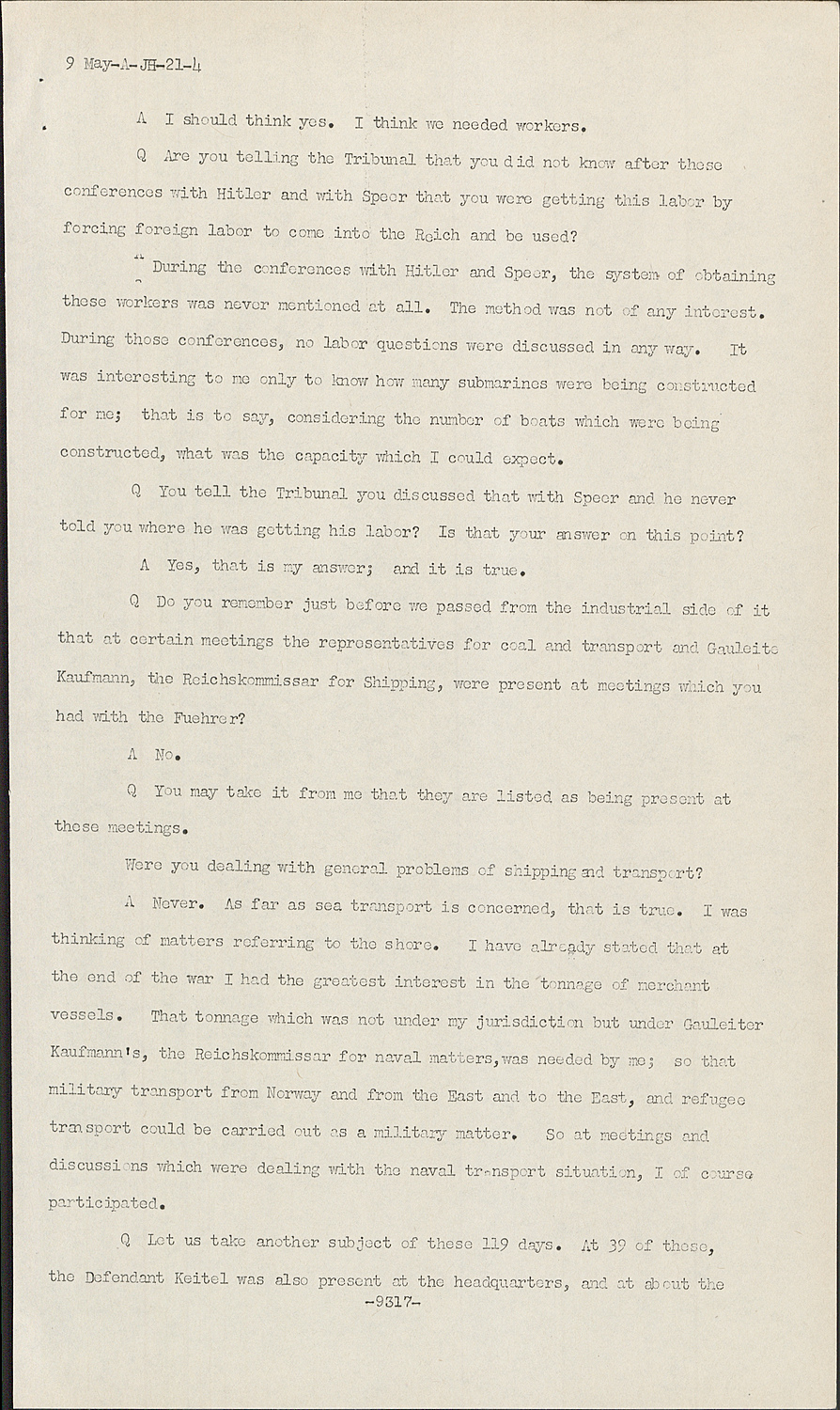
A I should think yes. I think we needed workers.
QAre you telling the Tribunal that you did not knew after these conferences with Hitler and with Speer that you were getting this labor by forcing foreign labor to come into the Reich and be used?
ADuring the conferences with Hitler and Speer, the system of obtaining these workers was never mentioned at all. The method was not of any interest. During those conferences, no labor questions were discussed in any way. It was interesting to me only to know how many submarines were being constructed for me; that is to say, considering the number of boats which were being constructed, what was the capacity which I could expect.
QYou tell the Tribunal you discussed that with Speer and he never told you where he was getting his labor? Is that your answer on this point?
AYes, that is try answers; and it is true.
QDo you remember just before we passed from the industrial side of it that at certain meetings the representatives for coal and transport and Gauleite Kaufmann, the Reichskommissar for Shipping, were present at meetings which you had with the Fuehrer?
ANo.
QYou may take it from me that they are listed as being present at these meetings.
Were you dealing with general problems of shipping and transport?
ANever. As far as sea transport is concerned, that is true. I was thinking of matters referring to the shore. I have already stated that at the end of the war I had the greatest interest in the tonnage of merchant vessels. That tonnage which was not under my jurisdiction but under Gauleiter Kaufmann's, the Reichskommissar for naval matters, was needed by me; so that military transport from Norway and from the East and to the East, and refugee transport could be carried out as a military matter. So at meetings and discussions which were dealing with the naval transport situation, I of course participated.
QLet us take another subject of these 119 days. At 39 of these, the Defendant Keitel was also present at the headquarters, and at about the same number, the defendant Jodl.
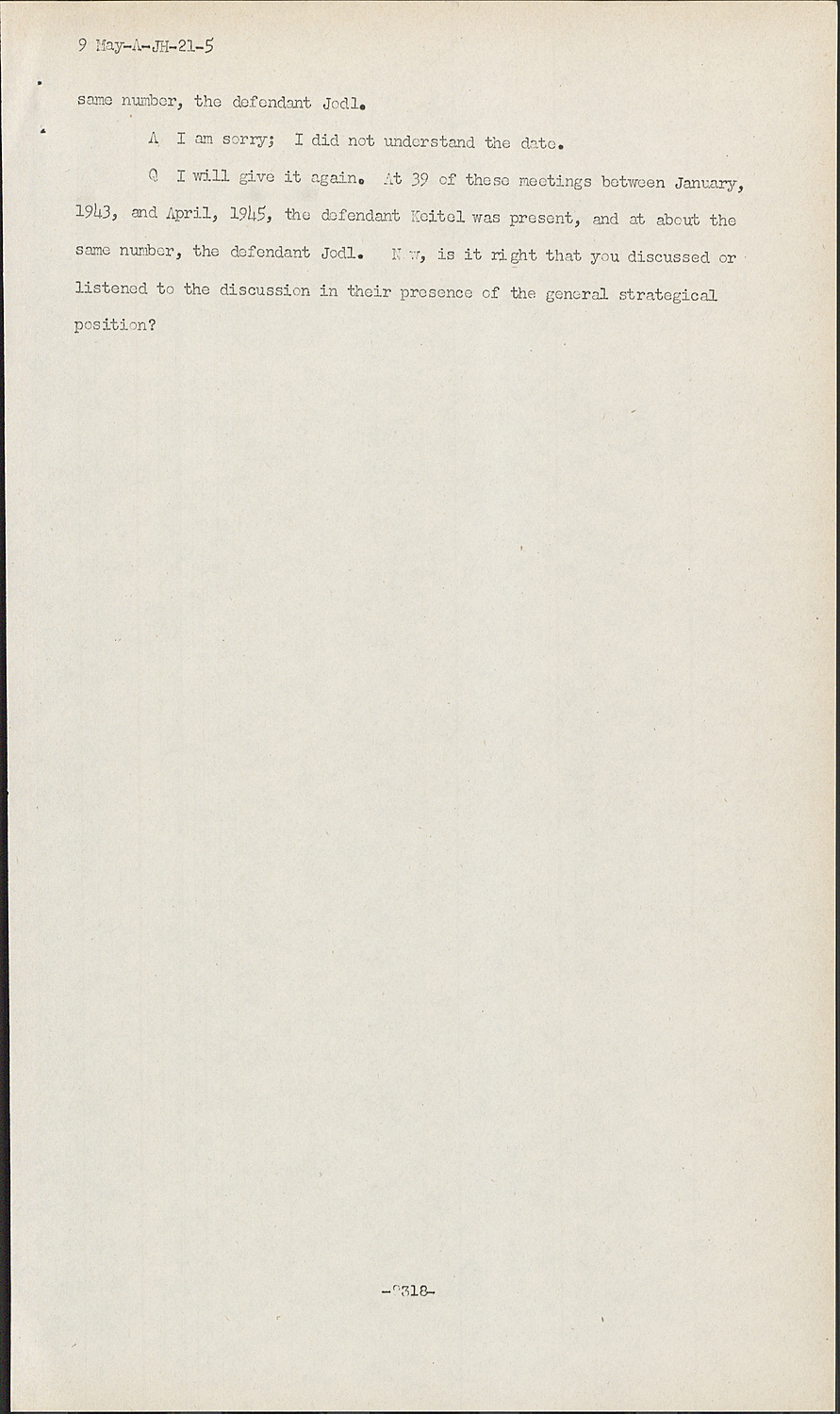
AI an sorry; I did not understand the date.
QI will give it again. At 39 of these meetings between January. 1943, and April, 1945, the defendant Keitel was present, and at about the same number, the defendant Jodl. New, is it light that you discussed or listened to the discussion in their presence of the general strategical position?
A May I say that the word meeting doesn't quits describe the matter.
QWall now, you choose the word; you give us the word.
AVery well, as I described it, there were large-scale military reports and briefings, and of course I listened in; I listened when the situation of the navy was referred to. That I explained before.
QI just want to get it quite clear that over these two years you had every opportunity of using and appreciating the military strategical position; that is so, isn't it?
AYes.
QWell now, on twenty of these occasions the defendant' Goering was present. The defendant Goering has put himself forward in two capacities; as commander in chief of the Luftwaffe and as a politician. What was he doing on these twenty occasions?
AReichsmarshal Goering was there as supreme commander of the air forces when the military situation was discussed.
QAnd so from the defendant Goering you would have a full knowledge and appreciation of the air situation and the position of the Luftwaffe during this period?
AAs far as it was possible, considering my only occasional participation during these briefings where only excerpts were being given and never a general picture being drawn. That is as far as I can make up my mind, and that was the reason why I never concerned myself with the military Matters outside of the Navy. I can only make up my mind in part.
QLet me ask you just one further question on this point. Following up what Dr. Laternser asked, on the 29th of June of 1944, apart from Keitel and Jodl and Goering, these defendants, Marshal von Runstedt and Marshal Rommel were also present; and may I remind you that that was three we after the allies had invaded in the west. You were being given the opportunity, were you not, of getting the appreciation of the strategical position after the allied invasion of Normandy; isn't that so?
AYes, I certainly had an impression regarding the situation in Normandy, right after the opponents had set foot on shore. I was in a position to report to the Fuehrer which of my small vessels could be used to attack in that sector.
QNow, let me change to another aspect of the government in general. On a number of occasions the Reich Fuehrer SS Himmler was present at these conferences -- shall I call them -- isn't that so?