A As to a government principle, one can never say a priori whether it is good or bad.
It depends on the given circumstances, and, above all, on those people who are doing the ruling.
The democratic and parliamentary principle was not successful in Germany. Germany had no parliamentary or democratic traditions, such as may be found in other countries.
Conditions were such that when the government made decisions those very few voices of the economic party actually did the deciding, and these voices were, in the main, bought. Therefore, another principle had to come to the fore; and in a totalitarian government, if those who carry the authority and responsibility are good, then the Government in turn is good.
The leadership principle, in my opinion, meant that the best one should rule, and so in such a way the authority would be from above to below and the responsibility would be from below to above.
From my conversations in the years 1931 with Hitler and other leading personalities of the Party, and, as I said, from the confidence and the enthusiasm which the German people brought to this political movement, I formed the opinion that this Party would have to come into the government, and that through this Party alone salvation could come, I personally wanted to put through my own economic ideas in this Party.
QDr. Funk, you just mentioned the personality of Hitler. Through whom did you meet Hitler? Who were the first personalities among Party circles through whom you were won over to the Party?
AIn the main, Gregor Strasser. As I mentioned yesterday, be brought about my first meeting with Hitler. Then much later, in Berlin, I met Hermann Goering. In the main, I had very few acquaintances in the Party at that time and played no role in the Party.
QThen after you had met Hitler, what impression did Hitler make on you at that time? I would like to make this introductory remark. I believe it was the year 1931. You were at that time a mature man yourself. You were more than 40 years old, and, as such, what was your impression of the personality and objectives, and so forth, of Hitler?
AMy first conversation with Hitler was rather reserved, but it was small wonder since I came from a world which was entirely strange to him. I immediately received the impression of an extraordinary personality.
With lightning speed he comprehended all problems and knew very well how, with expressive gestures and grear oratory, to present these problems.
He had the habit to take these problems and to contemplate these problems, and he seemed to discuss the problems with himself, and in that way lifted these problems to a more rarefied sphere.
At that time I told him my economic and political ideas and told him especially that I based my economic theories on private property, which was the fundamental tenet of my economic theories, and which was intimately connected with human activity.
He, himself, in a rather lively manner agreed with me and said that his idea in economics was also based on selectivity, that is, what a person could produce and personal capacity; and he was very glad indeed that I wanted to act along those lines in the Party; that I would work with him and support him in the economic line, all of which things I actually did.
Our relationships were no closer than they were at that moment, because he told me that "This moment I cannot tie myself down in an economic, political way, and the things that are said by my theorists, such as Feder, I am not in complete accord with."
The economic political department which existed at that time was led by a Dr. Wagner.
QThe economic political department of the Reichsleitung.
AThat was led by Dr. Wagner. I was not consulted on political matters. Closer connections to the Fuehrer I really had only in the year 1933 and the first half of 1934, at a time when, as press chief of the Reich Government, I contacted him regularly. At that time it happened on occasion that he would interrupt me suddenly, that we would go into the music room and he would have me play the piano for him.
Then the relationship became a little more reserved again. When I became Minister of Economics the Fuehrer kept his distance from no more and more, out whether he had special reasons, as Lammers testified here, I really don't know.
During my entire time as Minister, I was called in by the Fuehrer for discussion and consultation perhaps four or five times, but he really did not need me, because his economic and political directives were given to the Reichsmarshal, as he was the responsible head of economics.
Later, beginning with the year 1942, he gave these directives to Speer, since at that time armament dominated the entire economy.
By then I had close connections with him only in 1933 and the first half of 1934 until the death of the Reich President von Hindenburg.
QDr. Funk, you have come along quite a bit in your discussion. We would like to return now to the year when you entered the Party. When was that
AIn the summer of 1934.
QThe summer of 34. You have already told the Court that for the reasons given by you you did not object to the leadership principles.
ANo, this leadership principle was necessary.
QOn the contrary, you considered the leadership principle necessary for the period of emergency that obtained.
Now, I am interested in knowing, since there are various points of view in the Party program, points of view which later on worked out unfavorably, and which in the course of this proceeding have been used against the defendants in the dock here-just to use one example, Lebensraum. During these proceedings you have heard this word again and again. Dr. Schacht dealt with this problem also. Perhaps in all brevity, you cam give us your own attitude to this problem and this question.
ALebensproblem, the problem of life, is no cue word. It was really the problem of life of the German people at that time. Under the Lebensproblem.
QYou mean Lebensraum?
AAt that time I did not think of the conquering of foreign countries at all, and the thought of war at that time, as to most other Germans, was entirely strange to me.
As far as Lebensraum is concerned, we meant the opening of the world for German interests of life. By that I mean a participation of the German people for the using of goods of the world, which were present in abundance.
Whether that was to be done through colonies, or concessions, or through agreements of trade, that I did not actually bother myself with at that time in detail.
How things worked out for Germany in the world economy, for Germany before the First World War, was decisive for me in my becoming an economic journalist. The participation of Germany in the Rumanian petroleum industry, the concession of the Bagdad Railway, the growing German influence in South America and China and Greater Asia -- all of these things made me very enthusiastic. And even at that time I met men like Otto Guther, Karl Helferich, Withoeften, with an overseas merchant, Hamburg, and many other German economic pioneers, and with all the enthusiasm of a young journalist, I was wedded to my calling.
Lebensraum was for me at that time the fulfillment of these economic and political demands and of the economic participation in Germany, a share in the goods of the world, an eradication of the barriers which we met with on all sides. To me it was absolute nonsense that Germany on one side should pay tribute and pay debts while on the other hand the creditor nations refused to have these debts met in the only possible form, that is, in the form of goods and services.
At that time a great discriminating wave started. I would like to point to the Ottawa agreement and to the policy followed in America, a policy which resulted in 1929 and 1930 in a world economic crisis which hit Germany very, very hard also.
QDr. Funk, have you completed? Then I would like to ask you another question: The Prosecution in their trial brief contend thatyou participated in the formation of the Nazi program. What can you tell us about that?
AI do not know what the Prosecution means by Nazi program.
QI believe he means the Party program.
AThat is completely impossible. The Party program, as far as I know, was established in the year 1921 and at that time I didn't even know about National Socialism or about Adolf Hitler.
QThe Prosecution further asserts and is accusing you of the fact that the economic development program in the year 1932 was established by you. By that they mean a program for the recovery of German economic life. Is it correct that you established this economic program?
A In the year 1932 I gave Gregor Strasser a few vital points for an economic program which he, Strasser himself, made known as a program of mine and gave this material to the various Party officers as material for speeches.
This economic recovery program, which according to the words of the Prosecution was supposed to become the economic bible for the Party and its organizers is, I believe, not revolutionary in any way and could not draw any attention to it.
I believe that any democratic government could be accepted by any democratic government. I believe it is set down in a book -- in the book from which the Prosecution took certain extracts.
QYes, it is presented, in the book by Dr. Paul Oestreich, a book from which we have had many quotations. This book contains your biography under the title, "Walter Funk, A Life for Economy," and has been used by the Prosecution under Exhibit 3505-PS, U. S, Exhibit 653. Dr. Funk, I have this program before me -
APlease read, it.
QIt deals with/only half a page and in the main sets forth really nothing which might be characterized as National Socialist treads of thought.
AOf course, at that time I was not a National Socialist, or in any event only a very young member.
QThis economic recovery program has to be read in order to convince one's self how little of actually characteristic National Socialist demands are contained therein. This is a program of which the Defendant Funk says that almost any liberal, or domocratic or other beurgeois party could accept. The program mentions the bringing about of work through private andState investment, and new investments. That is point one, The providing of credit to the Reichsbank but to prevent inflation and to bring about a healthy currency, money and credit system. The general lowering of interest rates, considering the special interests as they applied, the bringing about of a central place for foreign currency and foreign trade, and the regulation of relations with foreign count tries, to the end that the domestic market be considered and with special attention to the export trade which is absolutely necessary to German life, Regulation of German finance and insurance, the displacement of methods of balancing the budget, Stete protection for agriculture, the revitalizing of real estate and property along the lines of productivity, expansion of German raw materials, the production of new national industries, technical changes -- that is all contained in this so-called economic recovery program.
AThis program was, according to the Prosecution, the official explanation of the Party for economic matters. It was my hope that the Party Would acknowledge these principles. In later years I had great difficulty with the various Party branches because of my economic principles, and I was considered in Party circles a liberal and an outsider because of those economic beliefs. I combatted the tendency and on the strength of it was in constant conflict with the labor front, but I was supported especially in some of my economic views by Reichsmarschall Goering and at my suggestion, even during the war, parts of the Hermann Goering Works were, once more put back on a private basis.
I was an opponent of State economy because State economy can bring about only average production. Staatswirtschaft (State Economy) means a sterile economy and economy which does not foster the utmost competition or individual effort, and any economy which lacks these elements of competition and initiative will remain sterile and will be at best mediocre in its results.
The Fuehrer at first always agreed very enthusiastically with my principles and it was a great disappointment to me when finally in the last years the Fuehrrer very vehemently turned toward the middle-class and bourgeois world, making a fiasco of my entire life's work.
THE PRESIDENT: Dr. Sauter, it seems he might get on to something more import ant than this, his views as between state economy and private enterprise.
DR. SAUTER:Yes, Mr. President. BY DR. SAUTER:
QDr. Funk, you know the tremendous problem of unemployment at that time made it possible for Hitler to get to power. What views: did you have for the elimination of unemployment, especially since you knew that problem?
THE PRESIDENT:Dr. Sauter, we have heard nearly all the defendants on the conditions which obtained in Germany at that time, and there is no charge against these defendants for trying to re-establish German economy between the years 1933 and 1939.
DR. SAUTER:Yes, of course, Mr. President. I wanted to put a question to the defendant, Dr. Funk, just how he envisioned the elimination of unemployment; for from the testimony of other defendants, I gathered that he had a. different way of doing away with unemployment, such as through, re -armament, perhaps. But in this case, as far as I know, this does not apply, and I believe when we come to judge the defendant Funk, this problem is of significance to him, the matter of how he viewed the elimination of unemployment, whether through re-armament or through another way.
I believe it will not take very much time, Mr. President. The defendant Funk, I am sure, will be very brief -- perhaps just a sentence or two.
THE PRESIDENT:He can answer that in a sentence, I should think. BY DR. SAUTER:
QPlease, doctor, be as brief as possible.
AIf I am to answer in just one sentence, I can say only that at that time I viewed the elimination of unemployment according to a very solid, plan, but without armament, but things which I would have to explain. But in any event, at that time, re-armament was not even discussed.
QBut can you just tell us in a few words?
AFirst of all, work was on the streets, so to speak. It was absolutely necessary to build streets and highways, it was necessary to bring about a revitalizing of the automotive industry, an industry which, of course, had to be protected. There was a building and housing program. Hundreds of thousands of houses were lacking and were needed.
Agriculture had to be put on a technical and motorized basis.
I would Like to give just one example, and something which will give us the proper light on the subject. Up until the war, of the entire productivity of Germany, two-thirds went to private consumption, only one-third for State needs. Up until that point, the armament industry did not play a decisive role.
QDr. Funk, now we will turn to another problem. You will remember that the Prosecution contended in their trial brief that the accusation against you was largely a diverted one. I assume, therefore, an argument which is less concerned with your actions, but rather is based on your offices. Therefore, I am interested. Which party offices did you have?
AAt only time, in the year 1932 -
Q (Interposing) These are party offices, not State offices.
AI understand. In the year 1932, and for only a few months, I received party directives and missions. At that time, Gregor Strasser wanted to give me an office for privatwirtschaft--private economy. This office, however, was dissolved a few months later when he himself left the party and its offices.
Then in December of 1932, I was instructed to head a commission for economy.
QThat is in December of 1932?
AYes.
And in February of 1933, that is, two months thereafter, I gave up this office, also. Both instructions, or offices, were insignificant, and therefore never accomplished anything in the short time of their duration. All the se I gentlemen can confirm me on this, all the defendants who had leading positions in the party at that time.
But beyond that, I never had a party office; that is, after 1933, I did I not have any instructions from the party, and no party office.
QThen this so-called Amt Fur Privatwirtschaft, the Office for Private Economy, if I understood you correctly, existed for just a few months in the year 1932, but did not actually function. And of the other, this Commission for Economic Policy, you were made the head in December of 1932. Then a month later, in February of 1933, just shortly after taking over power, this socalled office was given up by you; is that correct?
AYes.
Q As far as your connection with the party is concerned, were you a member of any organization of the party - of the SA, of the SS, or any other organization, branch, or affiliation of the party?
AI never belonged to any organization of the party, neither to the SA nor to the SS, or any other organization, and, as I have already said, did not belong to the Corps of Political Leaders.
QYou did not belong to the Corps of Political Leaders?
ANo.
QYou know, Dr. Funk, that the party functionaries, that is the Old Guard, and so forth, annually, in November, met in Munich; and we saw a film showing some of these functions.
Were you ever present at these gatherings of the 8th and 9th of November? Were you ever invited?
A.Whether I was invited I do not know. That may be. But I was never present at a gathering of this kind, for these were gatherings which were for the old party members, and of the Old Guard. They were in commemoration of the March on the Feldherhalle; and, as I say, I never participated in these gatherings, as I rarely attended larger gatherings. I never liked to attend. I only attended a party rally once. Mass gatherings always brought physical pain to me.
Q.Mr. Witness, after you had become a minister, did you receive the golden party emblem?
A.No; I received that when I was press chief of the Reich government
Q.You did not get it as minister?
A.No.
Q.How long had you been a National Socialist member of the Reichstag?
A.For just a few months.
Q.From when to when?
A.From July of 1932 until February of 1933. Then I was not reelected, for the Chairman of the Reichstag Organization, Dr. Frick, said that according to a directive of the Fuehrer, only the old party members would be called in. But I had a State position.
Q.Then with these laws, these laws which are especially important to this proceeding, such as the Ermaechtigungsgesetz, the Enabling Act, which for all practical purposes eliminated the Reichstag, or the law for the prohibiting of political parties, or the law dealing with the unity of party and State -- as far as all these laws are concerned, which were in preparation for later development, were you still a member of the Reichstag at that time, or had you been eliminated already?
A.I was not in the Reichstag any longer. But even so, I considered these laws necessary.
Q. That, of course, is another question. But you were not in the Reichstag any longer?
A.No; and I was not a member of the cabinet, either.
Q.Dr. Funk, repeatedly we have seen and heard about an affidavit by the American consul-general, Messersmith, dated the 28th of August, 1945, 1760-PS. He says in the passage which concerns you, Funk was the editor of one of the leading financial papers of Berlin before it was taken over by the Nazis, and had very little open sympathy for them -- that is, the Nazis-while they were in power.
He also says, later he became an enthusiastic National Socialist and became one of the most influential and effective tools of the party, because of his capabilities along certain lines.
And that is what the American consul-general, Messerwmith, has to say about you here.
I should like to quote another passage, to recall it to your memory, from the book which I have already mentioned, a book by Dr. Oestreich, which has the title "Walter Funk, A life for Economy". That is 3505-PS, and has already been used and submitted in these proceedings.
In this book the author says that even though the tasks given you by the Party were just of a few months' duration, these missions were rather significant and could be considered as such.
What can you tell us about these two quotations? What was your attitude?
AI declared myself for the Party and entered my Party work with enthusiasm; that I have already stated. But I never listened to propaganda organizations, as Mr. Messersmith says, and I really cannot remember knowing Mr. Messersmith at all. I do not recall having talked with him about Austira or the Anschluss ; that I do not recall. I considered the unification of Germany and Austria, but I do not recall that I discussed that matter with Mr. Messersmith.
As far as the book of Dr. Paul Oestreich is concerned, I am sorry that the prosecution considers this book as a source of information. Mistakes were disclosed which could have been avoided, and which I would not have to refute here and now.
Oestreich was a member who was completely apart iron the Party.
QWhat was he?
AHe owned a German newspaper in Chile, and for some years he was political editor of a German financial paper in Berlin.
First of all, he was interested in having a wide circulation for his book, and for that reason he really painted my picture in the Party in rather glowing terms, and he overestimated a little bit. I believe that he really wanted to do me a favor that way. However, in any event, things as they are pictured in the book are not true to form.
QMr. Witness, in a document submitted by the prosecution, 3563-PS, it says that you, Dr. Funk, were called an economic political counsellor of Hitler's In other spots it says that you were the Wirtschaftsbeauftragter-Economic Plenipotentiary -- of Hitler's. Was this a Party office, or just what was meant by this term? What functions did you have? Can you explain it?
AThis was neither a Party office nor was it a Party title. The press cal led me that many times, on the basis of my activity in the year 1932, an activity which developed then, and this passed, over from the press into litterature. However it was not an office and it was not a title. It seems to me nonsensical that this Activity could have been significant, then I certainly would have kept on with these offices, and retained then when the Party obtained power.
The Reich Minister of Food was a Reichsleiter; State Secretary Reinhardt, in the Finance Ministry was the head of the financial center in the Reichsleitun But a Reichsleiter fuer die Wirtschaft - Reich Leader for Economy -- there was never such thing. When the Party came to power, I left the Reichstag and all Party organizations.
QDr. Funk, in the course of this proceeding, perhaps once or twice, a Reichswirtschaftsprat der Partei, a Reich Economic Council of the Party -- and I stress "of the Party" -- has been mentioned. What do you know about your membership in this group, and about the instructions and the sphere of activity and influence of that Party instrument?
AI really had to think a long time in order to recall this matter, Neither Hess, Rosenberg, nor Frank could recall that Dr. Gottfried Feder had a circle of people when he called in for consultation, and rather pompous name "Reichswirtschaftsprat der Partei", was given to this group. After the takings over of power, it no longer existed.
I never participated in a session of that committee, and I was very much surprised that I was supposed to have been the Deputy Chairman of this group. However, this group never had any significance.
QYou mentioned Gottfried Feder.
AHe was the economic theorist of the Party from the beginning, until the Party actually got power.
Q He set up the dogmas and theories of the Party from the inception of the Party, until the taking over of power?
AYes. Then, Dr. Wagner and Keppler overshadowed this man. Keppler also had the title of economic counsellor to the Fuehrer. That is, he had this title in public.
QDr. Funk, these personalities which you just mentioned were) in you: opinion, if I understood you correctly, those men who might be called the economic advisers of Hitler?
ANo, that is wrong. Hitler did not consult anyone, he did not ask for advice, and least of all in the matter of economics. These were the men who dealt with economic-political problems in the leadership of the Party; that is, before my time and after my time.
QAlso in a journalistic way, like Dr. Feder?
AYes; they wrote quite a bit
QDr. Funk, those were your real or alleged Party offices. Now I turn to your State offices.
After the taking over of power --that is, in 1933 -- you became Press Chief of the Reich Government. And in March of 1933, when the Propaganda Ministry was created, which was a State Ministry, you became Secretary in this Propaganda Ministry under the Minister of Propaganda, Goebbels. Can you give us the antecedents of this step?
AMay I just briefly talk about these matters? It would be much easier if you just asked me one question at a time.
QThen I would like you to consider further the question of just why you were called into the Propaganda Ministry, why, you were made Press Chief of the Reich Government even though you, on the whole, had concerned yourself with economic problems and questions.
AThe Reichsmarshal, in his testimony, has already stated that he, first of all, did not know at any time that before the year 1933 I had been active in the Party, and that, secondly, the instruction to me to become Press Chief of the Reich Government was a complete surprise.
On the 29th of January, 1933, the Fuehrer told me that he could find no one among the old Party members who knew the press very well, and he was, therefore, asking me to take over the position of Press Chief.
In connection with this office, there was a regular discussion with the Reich President.
The Reich President knew me and, as I may mention again later on, he liked me. I was often a guest in his home, with his family.
QThat is, Hindenburg?
AYes, Hindenburg.
These were the reasons which prompted Hitler to make me Press Chief of the Reich Government. The Press Chief of the Reich Government was a ministerial director in the Reich Chancellory, and I did not like it very well that I should suddenly become an official, for I really did not want anything like that at all, ever. However, there was a general enthusiasm in those days, and in order to follow the call of the Fuehrer, I accepted. I had regular press interviews with him, in the presence of Lammers. This lasted for only a year and a half, up until the death of the Reich President; then these conferences stopped, and the Fuehrer gave his instructions to the press through the Press Chief of the Party, Dr. Dietrich, who later became a state secretary in the Propaganda Ministry.
When the Propaganda Ministry was founded, the Fuehrer asked me to organize this ministry so that Goebbels would not have to be bothered with administration, organization, and financial problems. Then the Press Department of the Reich Government, which I had headed up until now, was established in the Propaganda Ministry and incorporated into it as a special department, immediately subordinate to Goebbels, and we received a special head.
From that period of time, therefore, and after a period of a month and a half as Press Chief of the Reich Government, my activity for information and instruction of the press ceased. From that time on Goebbels concerned himself with this matter.
There was a sharp separation of political and administrative problems in the Ministry.
So far as propaganda was concerned, he brought in his old collaborators from the propaganda leadership of the Party. I was not taken into this sector; I was not used forpolitical propaganda. Goebbels took care of those matters through the Party, or through the Party instrument, of which I was not a member.
I, as the Chairman of the Supervisory Council of the Reichsrundfunk Gesellschaft, had to take care of the financial end. It was a matter of a hundred million.
I never gave any propaganda speeches over the radio and I never participated in large public announcements of the State or of the Party. Naturally, I realized fully the significance of propaganda for state leadership, and I agreed with this policy. I was amazed at the way in which Goebbels carried on the propaganda. However, so far as active propaganda was concerned, I had no part in it.
QThen, if I understood you correctly, all you did was work in the Propaganda Ministry, which was a state ministry, as an administrative and organizational man; but the propaganda itself was directed by Dr. Goebbels, the minister, and was formulated by those people whom he took from the propaganda set-up of the Party into the ministry. Is that correct?
AYes. Goebbels demanded propaganda. He wanted to dominate this whole field, and he made his demands known. I could not compare with him.
On the whole, my position as State Secretary was limited, to a large extent, by the fact that many missions of the State Secretary and other ministries were taken care of by Goebbels or by his own expert, the later Gauleiter Hancke.
QHancke?
AYes. I believe, during my entire activity in the Propaganda Ministry, I did not sign even three times as a deputy of Goebbels. One of these signatures has been brought in and proved by the prosecution, and that is my signature, under an order carrying through a directive that had come from Berlin.
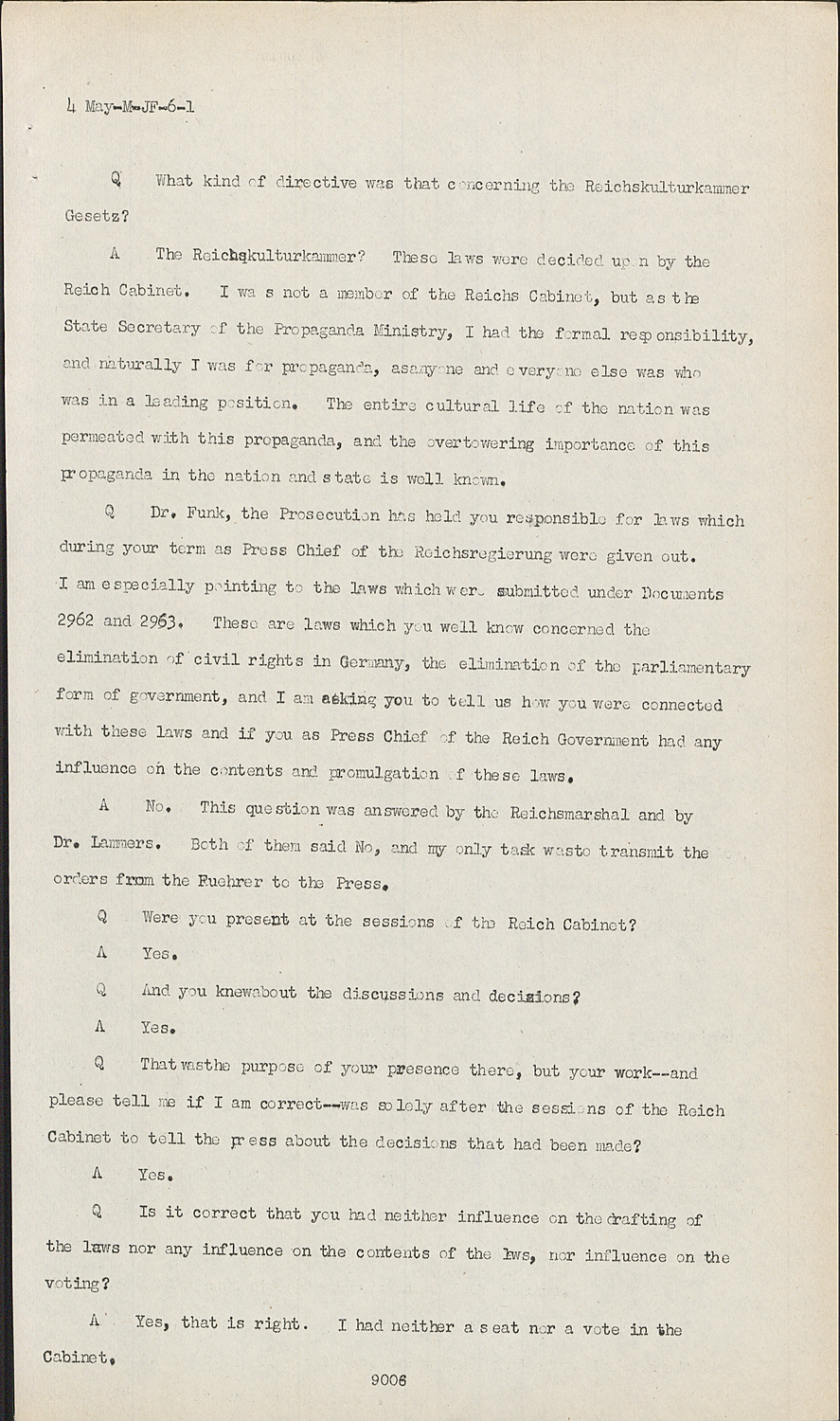
Q What kind of directive was that concerning the Reichskulturkammer Gesetz?
AThe Reichskulturkammer? These laws were decided upon by the Reich Cabinet. I was not a member of the Reichs Cabinet, but as the State Secretary of the Propaganda Ministry, I had the formal responsibility, and naturally I was for propaganda, asanyone and everyone else was who was in a leading position. The entire cultural life of the nation was permeated with this propaganda, and the overtowering importance of this propaganda in the nation and state is well known.
QDr. Funk, the Prosecution has held you responsible for laws which during your term as Press Chief of the Reichsregierung were given out. I am especially pointing to the laws which were submitted under Documents 2962 and 2963. These are laws which you well knew concerned the elimination of civil rights in Germany, the elimination of the parliamentary form of government, and I am asking you to tell us how you were connected with these laws and if you as Press Chief of the Reich Government had any influence on the contents and promulgation f these laws.
ANo. This question was answered by the Reichsmarshal and by Dr. Lammers. Both of them said No, and my only task waste transmit the orders from the Fuehrer to the Press.
QWere you present at the sessions of the Reich Cabinet?
AYes.
QAnd you knewabout the discussions and decisions?
AYes.
QThat wasthe purpose of your presence there, but your work--and please tell me if I am correct--was solely after the sessions of the Reich Cabinet to tell the press about the decisions that had been made?
AYes.
QIs it correct that you had neither influence on the drafting of the laws nor any influence on the contents of the laws, nor influence on the voting?
AYes, that is right. I had neither a seat nor a vote in the Cabinet.
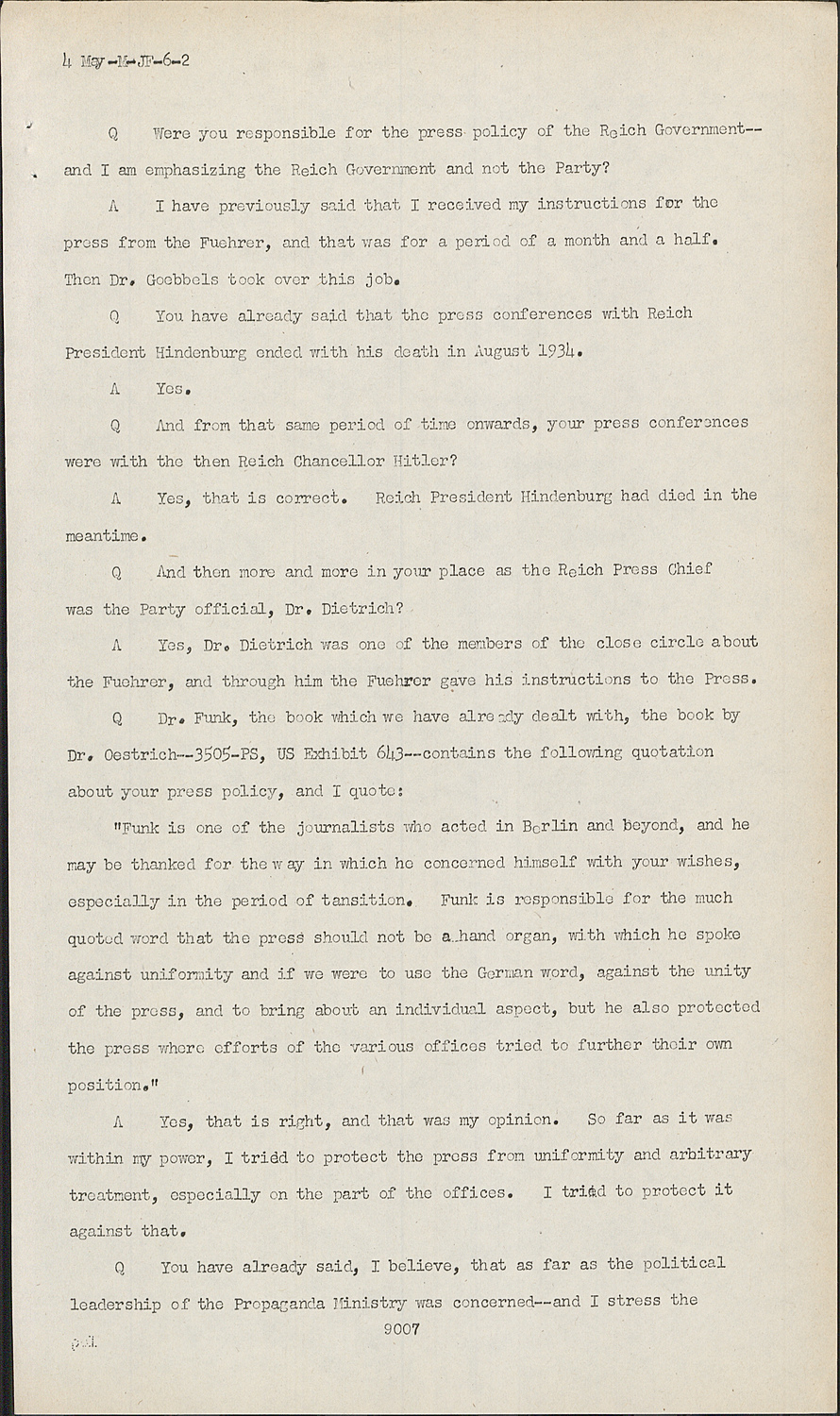
Q Were you responsible for the press policy of the Reich Government--
and I am emphasizing the Reich Government and not the Party?
AI have previously said that I received my instructions for the press from the Fuehrer, and that was for a period of a month and a half. Then Dr. Goebbels took over this job.
QYou have already said that the press conferences with Reich President Hindenburg ended with his death in August 1943
AYes.
QAnd from that same period of time onwards, your press conferences were with the then Reich Chancellor Hitler?
AYes, that is correct. Reich President Hindenburg had died in the meantime.
QAnd then more and more in your place as the Reich Press Chief was the Party official, Dr. Dietrich?
AYes, Dr. Dietrich was one of the members of the close circle about the Fuehrer, and through him the Fuehrer gave his instructions to the Press.
QDr. Funk, the book which we have already dealt with, the book by Dr. Oestrich--3505-PS, US Exhibit 643--contains the following quotation about your press policy, and I quote:
"Funk is one of the journalists who acted in Berlin and beyond, and he may be thanked for the way in which he concerned himself with your wishes, especially in the period of tansition. Funk is responsible for the much quoted word that the press should not be a hand organ, with which he spoke against uniformity and if we were to use the German word, against the unity of the press, and to bring about an individual aspect, but he also protected the press where efforts of the various offices tried to further their own position."
AYes, that is right, and that was my opinion. So far as it was within my power, I tried to protect the press from uniformity and arbitrary treatment, especially on the part of the offices. I tried to protect it against that.
QYou have already said, I believe, that as far as the political leadership of the Propaganda Ministry was concerned--and I stress the
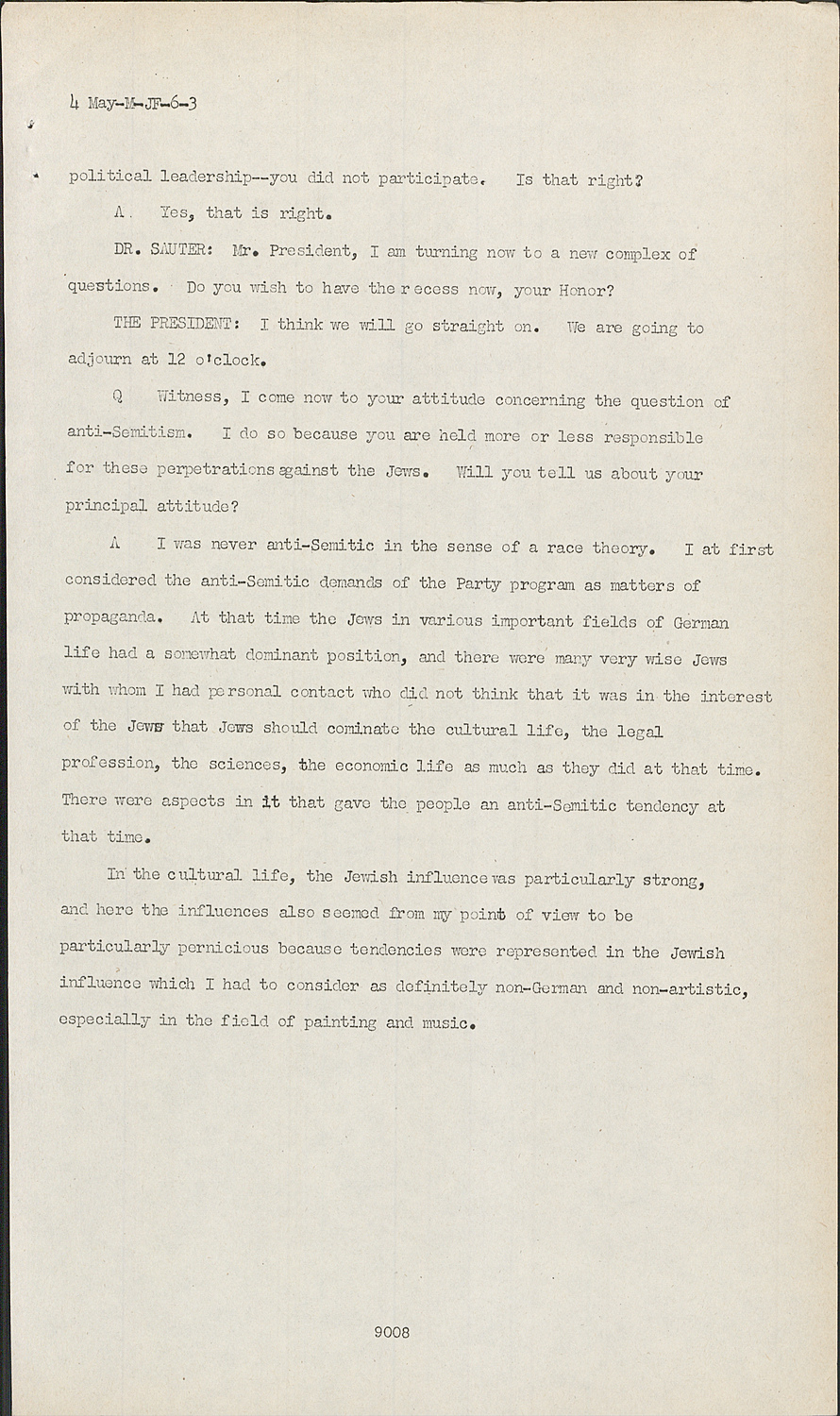
AYes, that is right.
DR. SAUTER:Mr. President, I am turning now to a new complex of questions. Do you wish to have the recess now, your Honor?
THE PRESIDENT:I think we will go straight on. We are going to adjourn at 12 o'clock.
QWitness, I come now to your attitude concerning the question of anti-Semitism. I do so because you are held more or less responsible for these perpetrations against the Jews. Will you tell us about your principal attitude?
AI was never anti-Semitic in the sense of a race theory. I at first considered the anti-Semitic demands of the Party program as matters of propaganda. At that time the Jews in various important fields of German life had a somewhat dominant position, and there were many very wise Jews with whom I had personal contact who did not think that it was in the interest of the Jews that Jews should cominate the cultural life, the legal profession, the sciences, the economic life as much as they did at that time. There were aspects in it that gave the people an anti-Semitic tendency at that time.
In the cultural life, the Jewish influence was particularly strong, and here the influences also seemed from my point of view to be particularly pernicious because tendencies were represented in the Jewish influence which I had to consider as definitely non-German and non-artistic, especially in the field of painting and music.
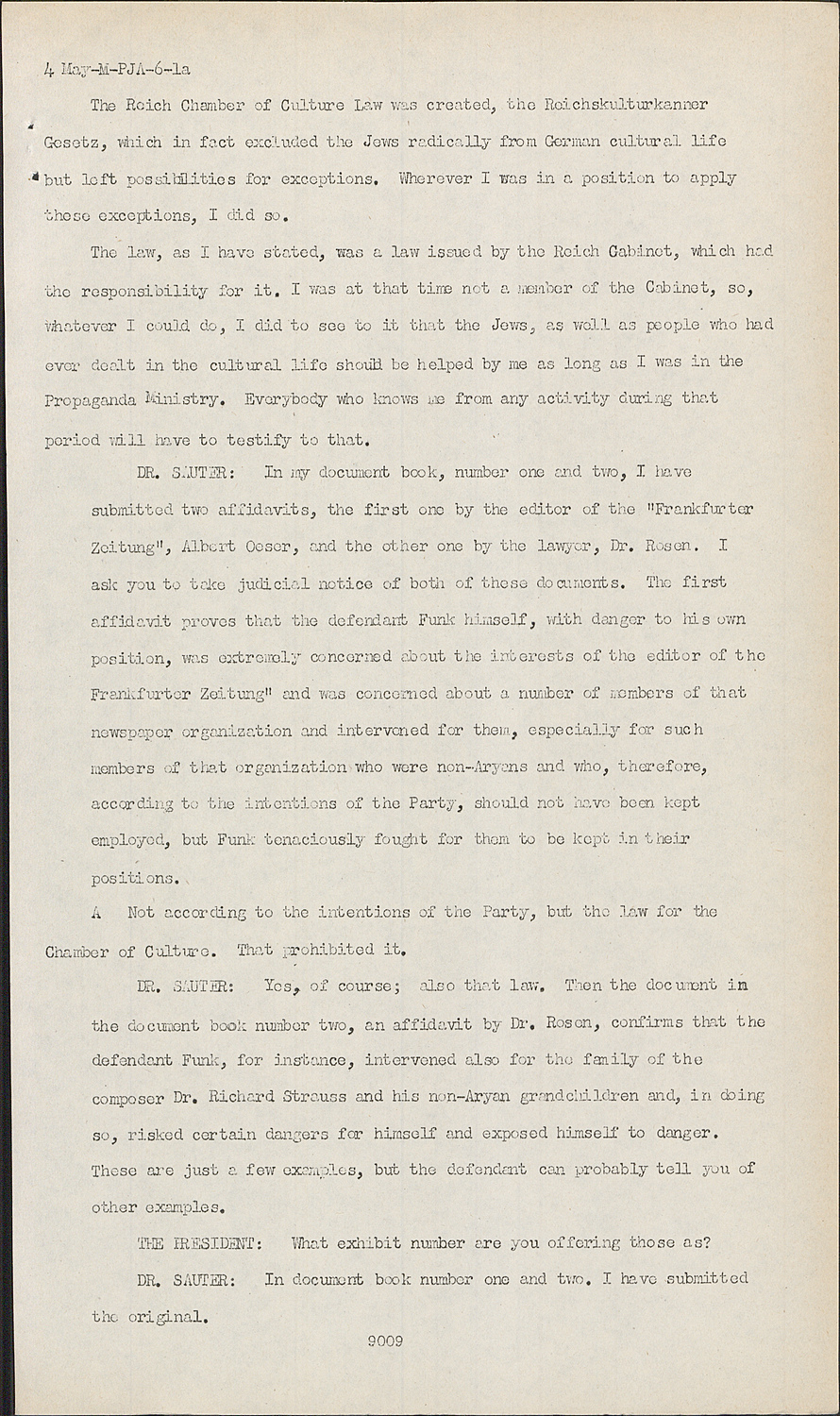
The Reich Chamber of Culture Law was created, the Reichskulturkanner Gesetz, which in fact excluded the Jews radically from German cultural life but left possibilities for exceptions.
Wherever I was in a position to apply these exceptions, I did so.
The law, as I have stated, was a law issued by the Reich Cabinet, which had the responsibility for it. I was at that time not a member of the Cabinet, so, whatever I could do, I did to see to it that the Jews, as well as people who had ever dealt in the cultural life should be helped by me as long as I was in the Propaganda Ministry. Everybody who knows me from any activity during that period will have to testify to that.
DR. SAUTER:In my document book, number one and two, I have submitted two affidavits, the first one by the editor of the "Frankfurter Zeitung", Albert Oeser, and the other one by the lawyer, Dr. Rosen.
I ask you to take judicial notice of both of these documents.
The first affidavit proves that the defendant Funk himself, with danger to his own position, was extremely concerned about the interests of the editor of the Frankfurter Zeitung" and was concerned about a number of members of that newspaper organization and intervened for them, especially for such members of that organization who were non-Aryans and who, therefore, according to the intentions of the Party, should not have been kept employed, but Funk tenaciously fought for them to be kept in their positions.
ANot according to the intentions of the Party, but the law for the Chamber of Culture. That prohibited it.
DR. SAUTER:Yes, of course; also that law. Then the document in the document book number two, an affidavit by Dr. Rosen, confirms that the defendant Funk, for instance, intervened also for the family of the composer Dr. Richard Strauss and his non-Aryan grandchildren and, in doing so, risked certain dangers for himself and exposed himself to danger.
These are just a few examples, but the defendant can probably tell you of other examples.
THE PRESIDENT:What exhibit number are you offering those as?
DR. SAUTER:In document book number one and two. I have submitted the original.