A Yes. May I also add to that that my suggestion would have been of a peaceful one.
QNow, he goes on.
"I did not comment, and others also failed to make remarks.
Schacht knew what the Army chief of 1914 meant when they invaded Belgium."
AI was going to comment. . .
Q "In six weeks, my division, and armies of neighboring little countries, especially North and East."
AAm I to reply?
QThat's what Dodd says about you.
AYes, but I didn't say it. May I reply to it?
QI ask you this question. That is the impression received over the course of your activities with Mr. Dodd whom you -- a man of your description -- describe as being a decent fellow and a friend of yours.
AMay I answer to that myself, that I have stated that Mr. Dodd became the victim of many misunderstandings, that in this case too he misunderstood me, he does not say that I said it, he said, that's what Schacht meant. That was his opinion. I have never said that at all.
QAs I understand it, then, it was the estimate of a friend?
AA friend obviously who was continually misunderstood. Ambassador Henderson, was also misunderstood.
QHe may have misunderstood Henderson, but he never misunderstood the Nazi outfit.
ABut he misunderstood my attitude.
QNow, when you went and asked first the Foreign Minister and Hitler to go to the United States, or have some one go to the United States, you testified, on page 8708 of the record, that you told Hitler this:
"It seems vital to me that one should have some one constantly in America who could clarify German interests in the place abroad. In America, that is."
Did you say that?
AYes.
QNow, is that what you actually said to Hitler?
AYes.
QNow, I call your attention to your own letter, No. 3700-PS to the Reich Marshal.
"In the beginning of 1940, I proposed to the Fuehrer that I go to the United States in order to attempt to slow down America's assistance to England in the matter of armaments, and in order, if possible, to prevent America becoming involved in the war more deeply."
I ask you, which of these is true?
ABoth of them.
QBut you did not refer that to the Tribunal yesterday, when you gave the conversation of that day, that you had reason to be in the United States, did you?
ANo, certainly not. I was to try to get the President to intervene for peace. That's something I haven't mentioned either.
Q Now, you also testified yesterday, that you never told about the extent, the type and the speed of the rearmament.
Do you recall that?
AYes.
QBut although you have no such information, you told us it was too much?
AI had the feeling that one ought to go slowly.
QNow let me remind you of certain statements made by General von Blomberg. It concerns 1937.
Question: "At that time, the frame of the planned Wehrmacht was about fulfilled.
Answer: "When?"
Question: "1937."
Answer: "I believe it was 1937."
Question: "Was that a plan that had been discussed with Doctor Schacht in connection with the finances establishing how big the Wehrmacht would be?"
Answer: "Yes. The plan for the formation of the Wehrmacht Schacht knew very well since we gave him every year the setting up of how many formations for which we had been spending money. All new formations for which we had been spending money. I remember in the year 1937 it was discussed, what should the Wehrmacht get for carrying expenses? After, a great amount was spent to build it up.
Question: "That means that you gave Schacht a clear statement of how much money you were putting into the creation of new instruments and so forth, and how much you were using for the operating expenses of the Wehrmacht?"
Answer: "Exactly right."
Question: "When you say that by 1937 the plan had been fulfilled, do you mean in the main?"
Answer: "In the main."
Another question. I skip two or three irrelevant ones.
"When you say that Schacht was familiar with these figures, how were they brought to his attention?"
Answer: "The demands that they made were handed to Schacht in writing."
Question: "That means, in connection with the monies which Schacht was arranging for the rearmament program, he was informed of how many divisions and how many tanks would be procured through those monies?"
Answer: "I don't think we put down the amount of money we needed for tanks and so forth, but we put down how certain parts of the Wehrmacht like the Navy and the Air force needed and then how much this required for activation and how much for operating. That is, Doctor Schacht could see each year how much of an increase there would be in the size of the armed forces as a result of the money he was procuring. That is certain."
I ask you whether you deny the statements made by von Blomberg as I have put them to you?
AIn full, I have to say that this is entirely completely unknown to me. A member of the Reichsbank Directorate will be testifying tomorrow, and I ask that you put this matter to him so that the question will be clarified. All of this was unknown to me.
QI don't care whether you know or whether you don't know about this. I am asking you these questions so that I can find out how far I can rely on your answers.
AI understand that.
QYou deny von Blomberg was telling the truth? That he reported to you in writing those facts?
ANever. I have to deny it, obviously. I do not remember anything in this connection.
QNow, you testified yesterday, or the day before, that the so-called New Plan had nothing to do with the armament program, did you not?
ANothing in particular with the armament, no. The Tribunal asked especially that I was not to discuss it until my cross-examination. I am only too wiling now to. . .
QYou have no objection to answering my question, have you?
ACertainly not.
QI am referring to the answer which you gave--the one which you were not allowed to give--which is on page 8732 of the record.
Question: "Some new policies which have been accused of being in preparation for war, were the so-called "New Plans". What was that?" And your answer:
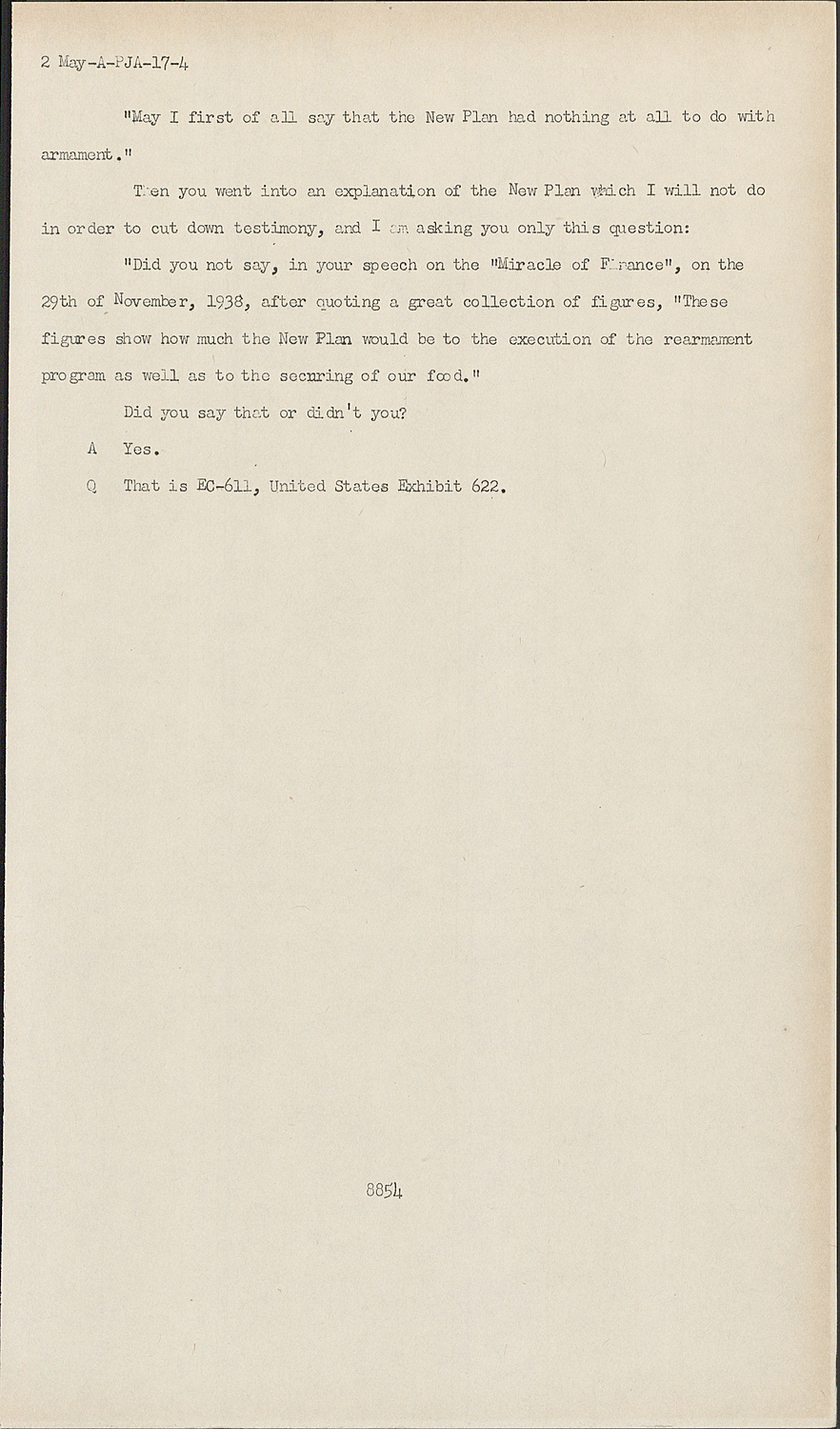
"May I first of all say that the New Plan had nothing at all to do with armament."
Then you went into an explanation of the New Plan which I will not do in order to cut down testimony, and I am asking you only this question:
"Did you not say, in your speech on the "Miracle of Finance", on the 29th of November, 1938, after quoting a great collection of figures, "These figures show how much the New Plan would be to the execution of the rearmament program as well as to the securing of our food."
Did you say that or didn't you?
AYes.
QThat is EC-611, United States Exhibit 622.
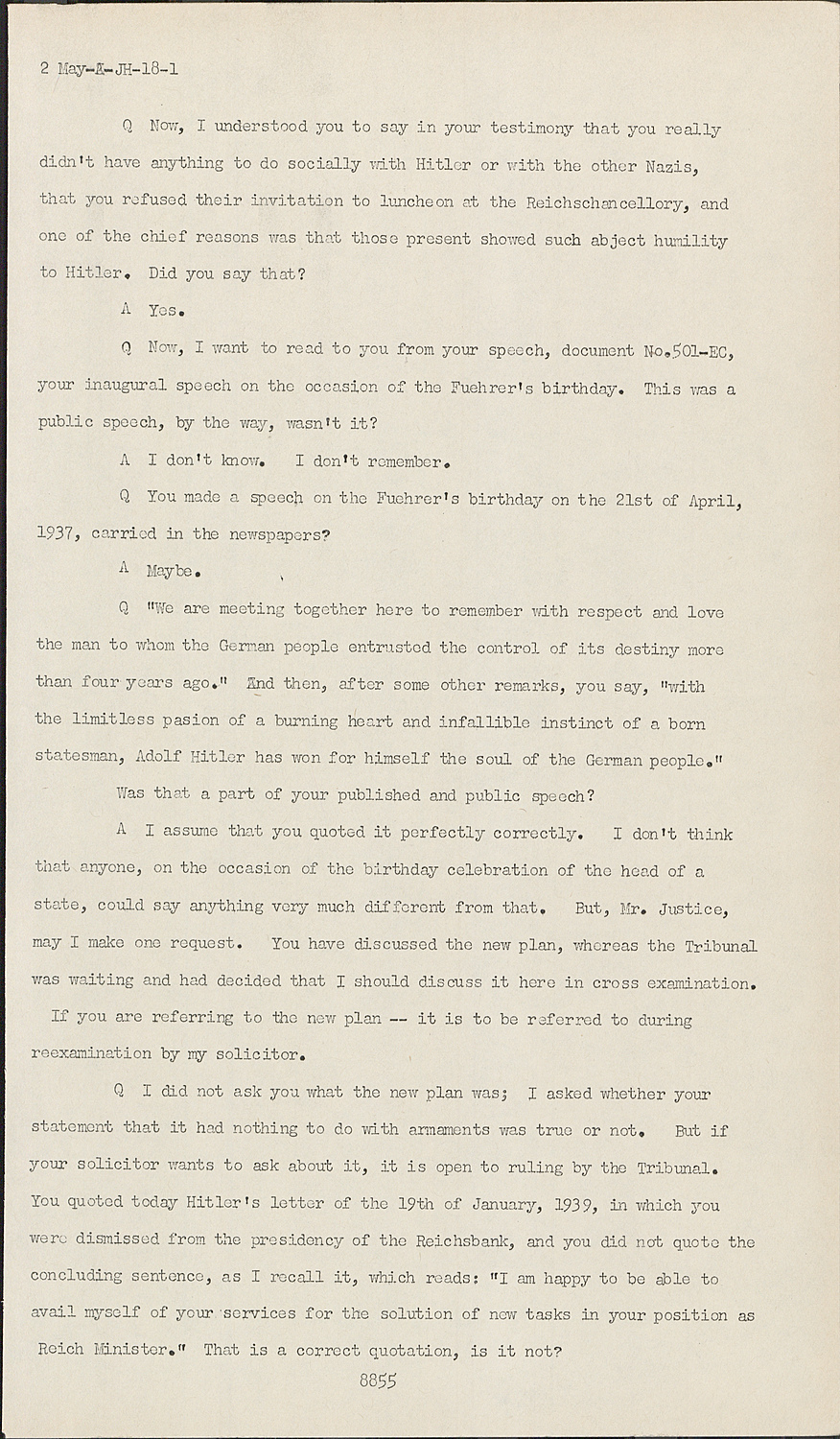
Q Now, I understood you to say in your testimony that you really didn't have anything to do socially with Hitler or with the other Nazis, that you refused their invitation to luncheon at the Reichschancellory, and one of the chief reasons was that those present showed such abject humility to Hitler.
Did you say that?
AYes.
QNow, I want to read to you from your speech, document No.501-EC, your inaugural speech on the occasion of the Fuehrer's birthday. This was a public speech, by the way, wasn't it?
AI don't know. I don't remember.
QYou made a speech on the Fuehrer's birthday on the 21st of April, 1937, carried in the newspapers?
AMay be.
Q "We are meeting together here to remember with respect and love the man to whom the German people entrusted the control of its destiny more then four years ago." And then, after some other remarks, you say, "with the limitless pasion of a burning heart and infallible instinct of a born statesman, Adolf Hitler has won for himself the soul of the German people."
Was that a part of your published and public speech?
AI assume that you quoted it perfectly correctly. I don't think that anyone, on the occasion of the birthday celebration of the head of a state, could say anything very much different from that. But, Mr. Justice, may I make one request. You have discussed the new plan, whereas the Tribunal was waiting and had decided that I should discuss it here in cross examination.
If you are referring to the new plan -- it is to be referred to during reexamination by my solicitor.
QI did not ask you what the new plan was; I asked whether your statement that it had nothing to do with armaments was true or not. But if your solicitor wants to ask about it, it is open to ruling by the Tribunal. You quoted today Hitler's letter of the 19th of January, 1939, in which you were dismissed from the presidency of the Reichsbank, and you did not quote the concluding sentence, as I recall it, which reads: "I am happy to be able to avail myself of your services for the solution of new tasks in your position as Reich Minister." That is a correct quotation, is it not?
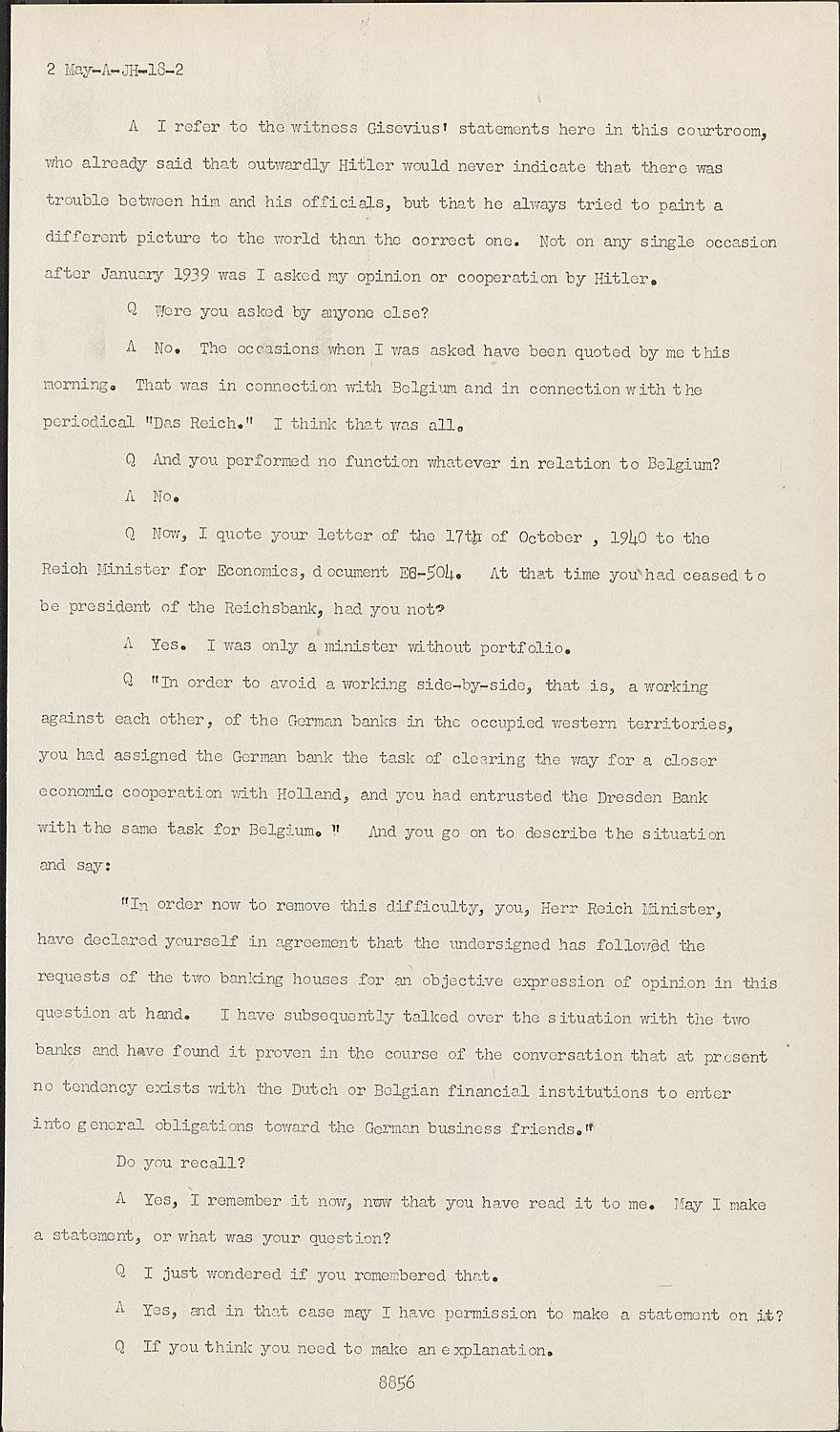
A I refer to the witness Gisevius' statements here in this courtroom, who already said that outwardly Hitler would never indicate that there was trouble between him and his officials, but that he always tried to paint a different picture to the world than the correct one.
Not on any single occasion after January 1939 was I asked my opinion or cooperation by Hitler.
QWere you asked by anyone else?
ANo. The occasions when I was asked have been quoted by me this morning. That was in connection with Belgium and in connection with the periodical "Das Reich." I think that was all.
QAnd you performed no function whatever in relation to Belgium?
ANo.
QNow, I quote your letter of the 17th of October, 1940 to the Reich Minister for Economics, document E6-504. At that time you had ceased to be president of the Reichsbank, had you not.
AYes. I was only a minister without portfolio.
Q "In order to avoid a working side-by-side, that is, a working against each other, of the German banks in the occupied western territories, you had assigned the German bank the task of clearing the way for a closer economic cooperation with Holland, and you had entrusted the Dresden Bank with the same task for Belgium." And you go on to describe the situation and say:
"In order now to remove this difficulty, you, Herr Reich Minister, have declared yourself in agreement that the undersigned has followed the requests of the two banking houses for an objective expression of opinion in this question at hand. I have subsequently talked over the situation with the two banks and have found it proven in the course of the conversation that at present no tendency exists with the Dutch or Belgian financial institutions to enter into general obligations toward the German business friends."
Do you recall?
AYes, I remember it now, now that you have read it to me. May I make a statement, or what was your question?
QI just wondered if you remembered that.
AYes, and in that case may I have permission to make a statement on it?
QIf you think you need to make an explanation.
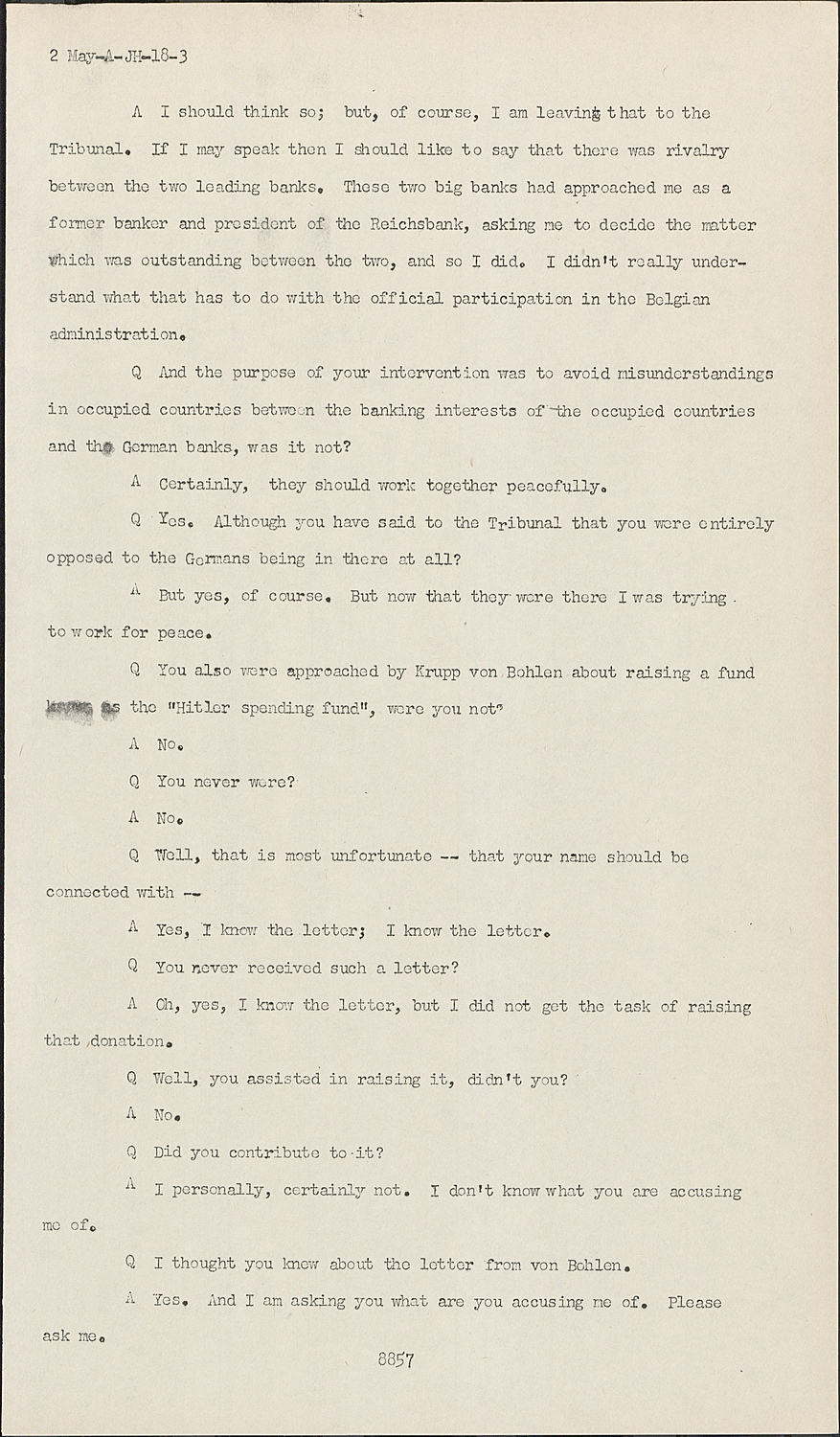
A I should think so; but, of course, I am leaving that to the Tribunal.
If I may speak then I should like to say that there was rivalry between the two leading banks. These two big banks had approached me as a former banker and president of the Reichsbank, asking me to decide the matter Which was outstanding between the two, and so I did. I didn't really understand what that has to do with the official participation in the Belgian administration.
QAnd the purpose of your intervention was to avoid misunderstandings in occupied countries between the banking interests of the occupied countries and the German banks, was it not?
ACertainly, they should work together peacefully.
QYes. Although you have said to the Tribunal that you were entirely opposed to the Germans being in there at all?
ABut yes, of course. But now that they were there I was trying to work for peace.
QYou also were approached by Krupp von Bohlen about raising a fund known as the "Hitler spending fund", were you not?
ANo.
QYou never were?
ANo.
QWell, that is most unfortunate -- that your name should be connected with -
AYes, I know the letter; I know the letter.
QYou never received such a letter?
AOh, yes, I know the letter, but I did not get the task of raising that donation.
QWell, you assisted in raising it, didn't you?
ANo.
QDid you contribute to it?
AI personally, certainly not. I don't know what you are accusing me of.
QI thought you knew about the letter from von Bohlen.
AYes. And I am asking you what are you accusing no of. please ask me.
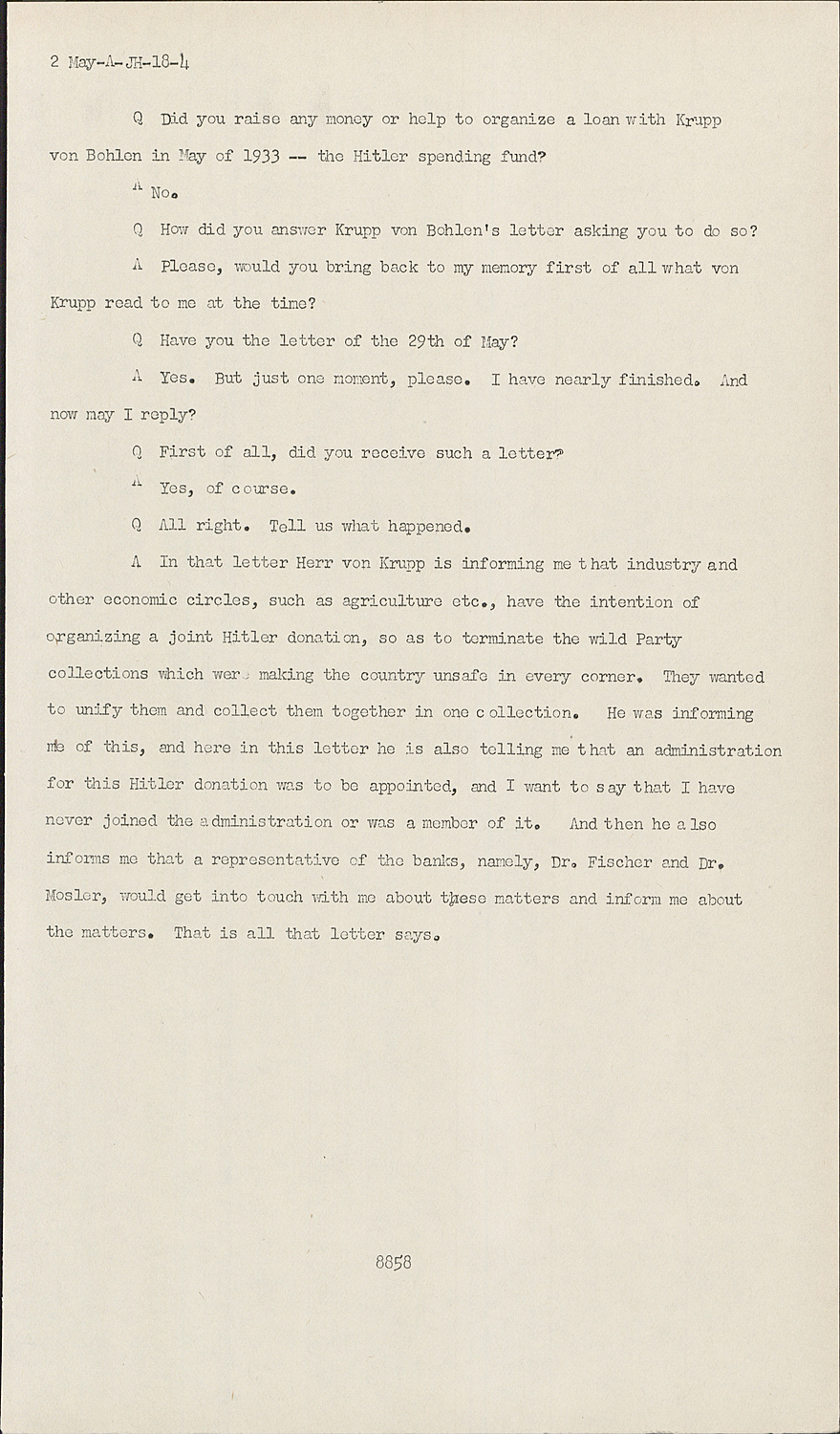
Q Did you raise any money or help to organize a loan with Krupp von Bohlen in May of 1933 - the Hitler spending fund?
ANo.
QHow did you answer Krupp von Bohlen's letter asking you to do so?
APlease, would you bring back to my memory first of all what von Krupp read to me at the time?
QHave you the letter of the 29th of May?
AYes. But just one moment, please. I have nearly finished. And now may I reply?
QFirst of all, did you receive such a letter"
AYes, of course.
QAll right. Tell us what happened.
AIn that letter Herr von Krupp is informing me that industry and other economic circles, such as agriculture etc., have the intention of organizing a joint Hitler donation, so as to terminate the wild Party collections which were making the country unsafe in every corner. They wanted to unify them and collect them together in one collection. He was informing me of this, and here in this letter he is also telling me that an administration for this Hitler donation was to be appointed, and I want to say that I have never joined the administration or was a member of it. And then he also informs me that a representative of the banks, namely, Dr. Fischer and Dr. Mosler, would get into touch with me about these matters and inform me about the matters. That is all that letter says.
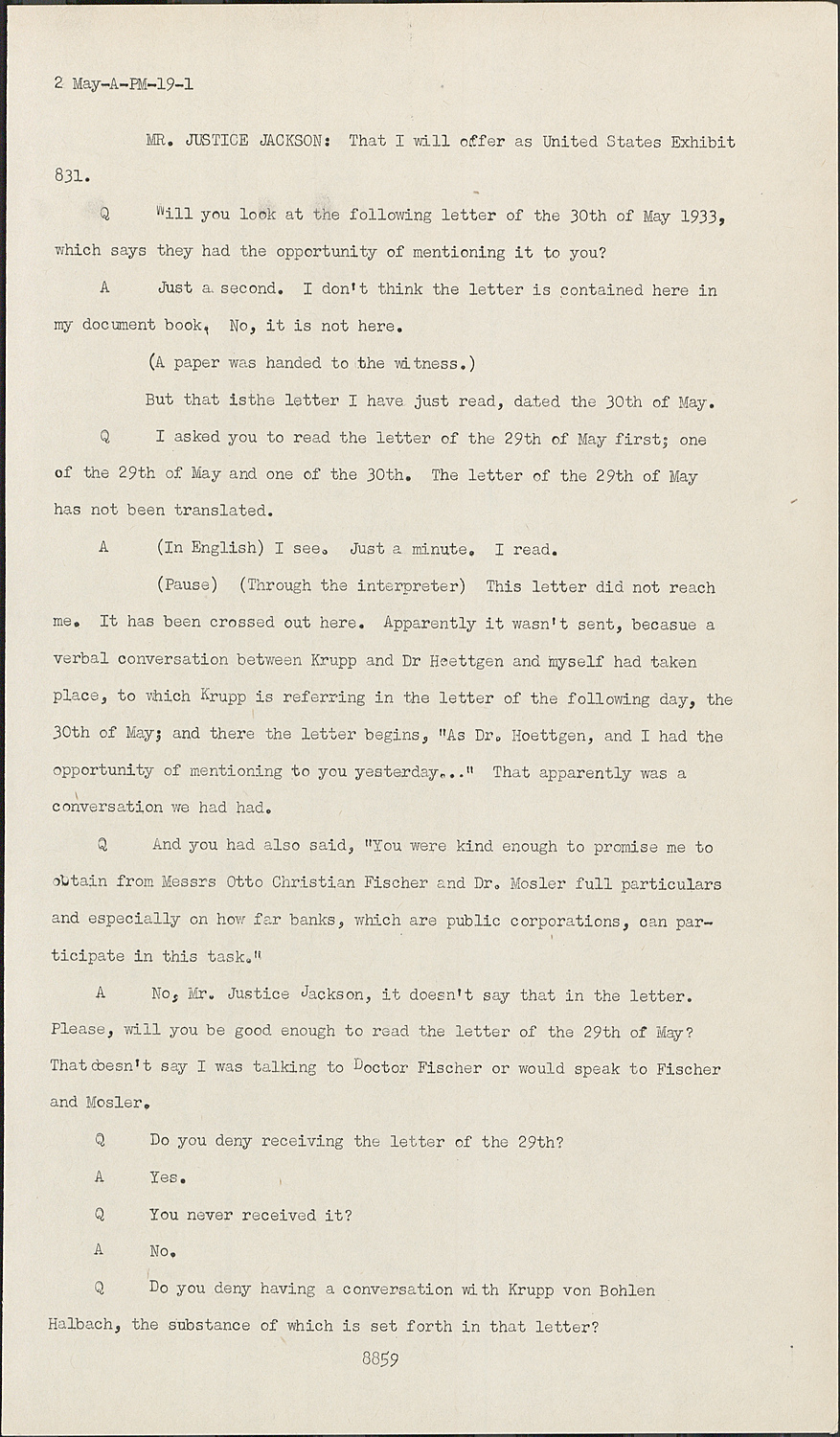
MR. JUSTICE JACKSON: That I will offer as United States Exhibit 831.
QWill you look at the following letter of the 30th of May 1933, which says they had the opportunity of mentioning it to you?
AJust a second. I don't think the letter is contained here in my document book. No, it is not here.
(A paper was handed to the witness.)
But that is the letter I have just read, dated the 30th of May.
QI asked you to read the letter of the 29th of May first; one of the 29th of May and one of the 30th. The letter of the 29th of May has not been translated.
A (In English) I see. Just a minute. I read.
(Pause) (Through the interpreter) This letter did not reach me. It has been crossed out here. Apparently it wasn't sent, becasue a verbal conversation between Krupp and Dr Hoettgen and myself had taken place, to which Krupp is referring in the letter of the following day, the 30th of May; and there the letter begins, "As Dr. Hoettgen, and I had the opportunity of mentioning to you yesterday..." That apparently was a conversation we had had.
QAnd you had also said, "You were kind enough to promise me to obtain from Messrs Otto Christian Fischer and Dr. Mosler full particulars and especially on how far banks, which are public corporations, can participate in this task."
ANo, Mr. Justice Jackson, it doesn't say that in the letter. Please, will you be good enough to read the letter of the 29th of May? That doesn't say I was talking to Doctor Fischer or would speak to Fischer and Mosler.
QDo you deny receiving the letter of the 29th?
AYes.
QYou never received it?
ANo.
QDo you deny having a conversation with Krupp von Bohlen Halbach, the substance of which is set forth in that letter?
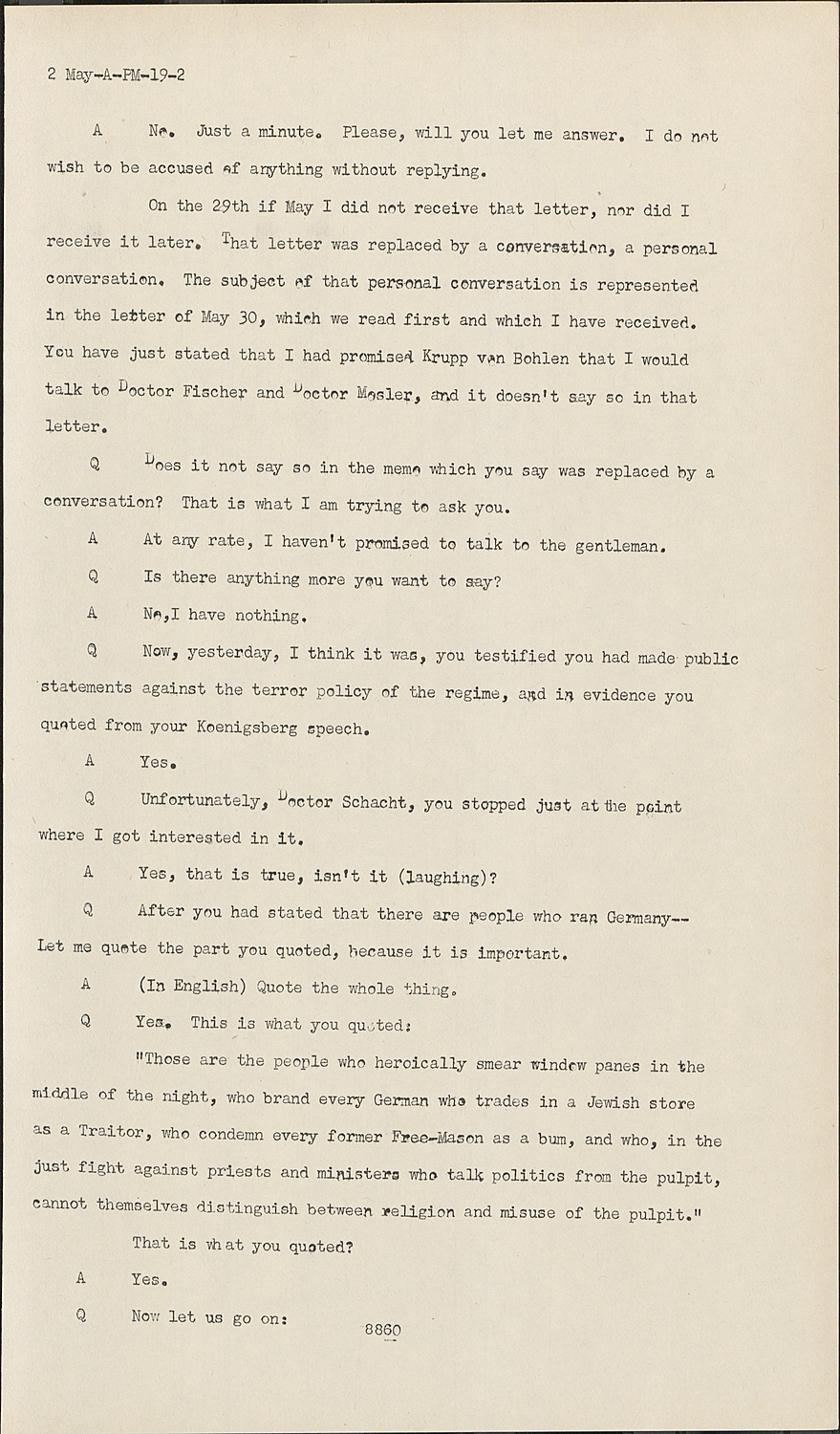
A No. Just a minute. Please, will you let me answer. I do not wish to be accused of anything without replying.
On the 29th if May I did not receive that letter, nor did I receive it later. That letter was replaced by a conversation, a personal conversation. The subject of that personal conversation is represented in the letter of May 30, which we read first and which I have received. You have just stated that I had promised Krupp von Bohlen that I would talk to Doctor Fischer and Doctor Mosler, and it doesn't say so in that letter.
QDoes it not say so in the memo which you say was replaced by a conversation? That is what I am trying to ask you.
AAt any rate, I haven't promised to talk to the gentleman.
QIs there anything more you want to say?
ANo, I have nothing.
QNow, yesterday, I think it was, you testified you had made public statements against the terror policy of the regime, and in evidence you quoted from your Koenigsberg speech.
AYes.
QUnfortunately, Doctor Schacht, you stopped just at tie point where I got interested in it.
AYes, that is true, isn't it (laughing)?
QAfter you had stated that there are people who ran Germany-Let me quote the part you quoted, because it is important.
A (In English) Quote the whole thing.
QYes. This is what you quoted:
"Those are the people who heroically smear window panes in the middle of the night, who brand every German who trades in a Jewish store as a Traitor, who condemn every former Free-Mason as a bum, and who, in the just fight against priests and ministers who talk politics from the pulpit, cannot themselves distinguish between religion and misuse of the pulpit."
That is what you quoted?
AYes.
QNow let us go on:
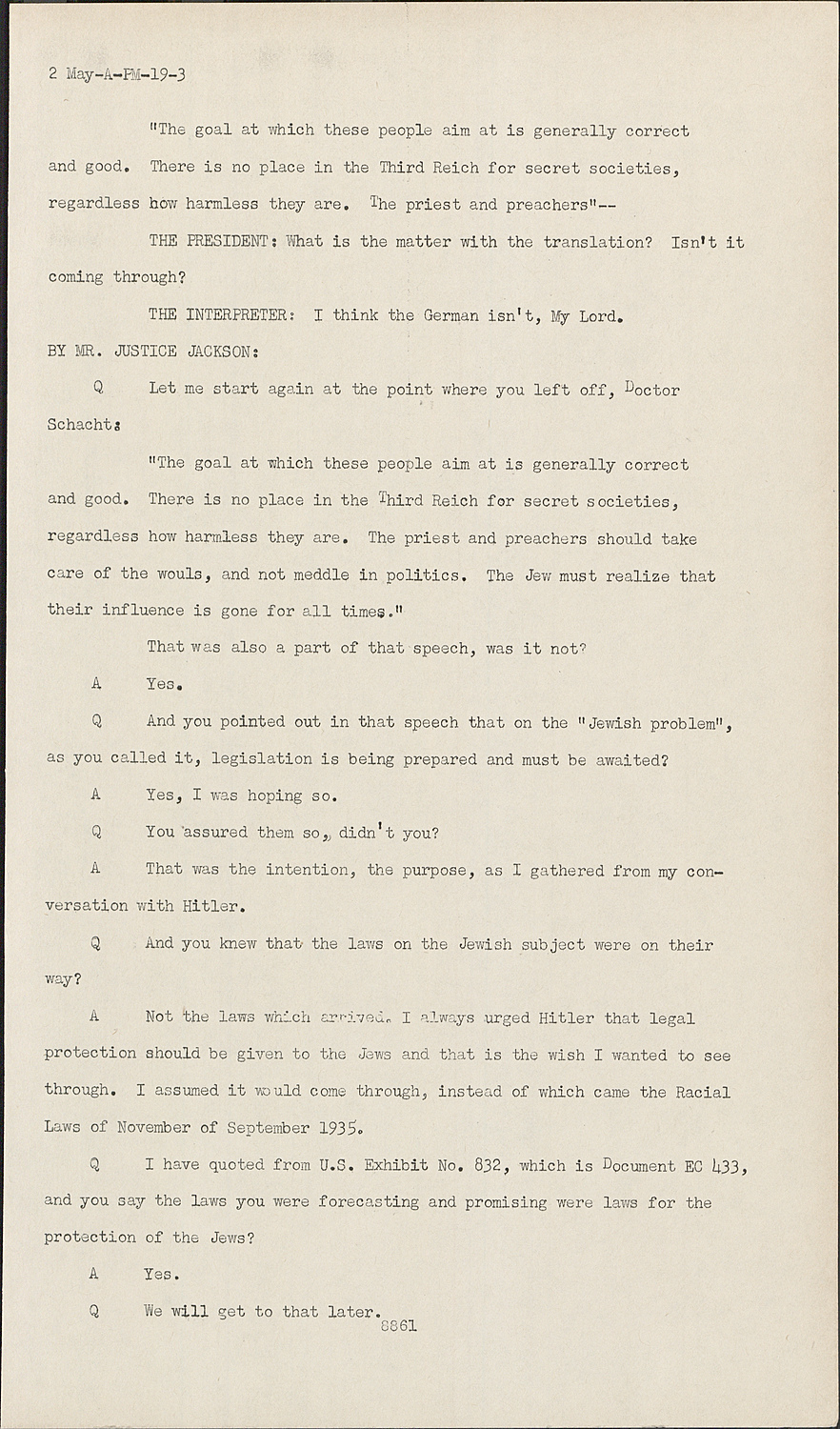
"The goal at which these people aim at is generally correct and good.
There is no place in the Third Reich for secret societies, regardless how harmless they are. The priest and preachers" -
THE PRESIDENT: What is the matter with the translation? Isn't it coming through?
THE INTERPRETER: I think the German isn't, My Lord. BY MR. JUSTICE JACKSON:
QLet me start again at the point where you left off, doctor Schacht:
"The goal at which these people aim at is generally correct and good. There is no place in the Third Reich for secret societies, regardless how harmless they are. The priest and preachers should take care of the wouls, and not meddle in politics. The Jew must realize that their influence is gone for all times."
That was also a part of that speech, was it not?
AYes.
QAnd you pointed out in that speech that on the "Jewish problem", as you called it, legislation is being prepared and must be awaited?
AYes, I was hoping so.
QYou assured them so, didn't you?
AThat was the intention, the purpose, as I gathered from my conversation with Hitler.
QAnd you knew that the laws on the Jewish subject were on their way?
ANot the laws which arrived. I always urged Hitler that legal protection should be given to the Jews and that is the wish I wanted to see through. I assumed it would come through, instead of which came the Racial Laws of November of September 1933.
QI have quoted from U.S. Exhibit No. 832, which is Document EC 433, and you say the laws you were forecasting and promising were laws for the protection of the Jews?
AYes.
QWe will get to that later.
You gave your reasons, which you said were reasons of principle, to the Tribunal for not becoming a Party member?
AYes.
QDo you recall that?
AYes.
QNow isn't it a fact that you have told the United States Prosecution Staff that you asked Hitler whether to join the Party, and that to your great relief Hitler told you not to?
AYes. I wanted to ascertain that before I participated in his actions in any way or cooperated with him -- whether he demanded that from me, namely, that I should become a member of the Party. He said "No", and I was most relieved,
QSo you remained out of the Party with Hitler's consent and approval?
AYes, of course. I think that is just another reason which will prove I have never been a member of the Party.
QBut you didn't mention that to the Tribunal when you were giving your reasons for setting out that Hitler had given permission?
ANo, I thought the Tribunal would believe me, anyway.
QWhen you received the Party Golden Swastika you stated that it was the greatest honor that could be conferred by the Third Reich, did you not?
AIt was, yes.
QAnd while you didn't wear it in your daily life, you did wear it on official occasions, you stated, did you not?
AYes. It allowed one great comforts during railroad journeys and rides in autobusses.
QFrom 1933 to 1942 you contributed a thousand Reichsmarks a year to the Nasi Party?
ANo. Yes I beg your pardon; from 1937 to 1942.
QDidn't you say in an interrogation that it was from 1933 to 1942?
ANo, that is an error. From 1937, after I had received the Swastika. That is a misunderstanding, but after I had received it I said to myself,"It is decent that I will give them a thousand marks, and that is that."
QFor upwards of ten years, not quite ten years, you accepted and held office of one kind or another under this regime, did you not?
AFrom the 17th of March to the 21st of January 1943.
Q And as I understand you, during this time, at least a part of the time, Hitler deceived you and all the time you deceived Hitler.
ANo, oh no.
QI have misunderstood you?
AYes.
QWell now -
AI think that in the first years, at least I didn't deceive Hitler. I not only believe so, I knew it. I only started deceiving him beginning in 1938. Until then, I was always telling him my honest opinion. I didn't cheat him at all; the contrary.
QWhat becomes, then, of your explanation that you entered his government in order to put brakes on his program? Did you tell him that?
AOh, no. I should hardly do A thing like that. He wouldn't have let me in then. But I didn't deceive him about that.
QDid he know your purpose in joining his government was to defeat his program by sabotage?
AI didn't say that I wanted to defeat his program. I said that I wanted to direct it into orderly channels.
QWell, you have said that you wanted to put brakes on it. You used that expression.
AYes.
QTo slow it down?
AYes.
QAnd he wanted to speed it up, isn't that right?
AYes, perhaps.
QYou never allowed him to know that you had entered his government for the purpose of slowing down his rearmament program, did you?
AI didn't have to tell him what I was thinking. I wasn't deceiving him. I wasn't telling anything wrong. I would hardly tell him what I was thinking inside me. He didn't tell me either, and you don't tell your political opponents either, but I never deceived him except after 1938.
QI am not asking you about a political opponent. I am asking you about the man in whose government you entered and became a part.
A Yes.
QYou don't tell your opponents, but is it customary in Germany that members of the government enter for the purpose of defeating the head of the government's program?
AI have just now told you that the word "defeat" is wrong. I did not intend to defeat him. I intended to brake, slow down, and that is indeed the custom, because every coalition government does that. If you enter into a coalition, then that means that you must discuss certain matters with your neighboring part and get an agreement about it, and certain matters which the other one wants must be slowed down by your influence. That isn't defeat; that is an attempt at a compromise solution.
QYou claim you entered as a coalition?
AYes.
QYou used the word yourself today, in dessribing your activities as sabotaging his rearmament program, did you not?
AYes, yes I did so, shall we say, after 1936. But then he noticed that. That wasn't defeat.
QYou take some part of the responsibility, I take it, for the loss of the war by Germany.
AThat is a most peculiar question. Please forgive me if I say so, and please forgive me if I say I do not assume part of the responsibility because I don't bear the responsibility for the war's being started, so I can't assume any responsibility that it was lost. I didn't want the war.
QAnd when did your doubts about Hitler as a man, his integrity, first arise?
AI have explained that in so much detail during the entire examination that I don't believe you want me to repeat it again.
QDid that occur -- I'll put it in the terms of your interrogation, since your interrogation is a little clearer.
"In 1934" -- so your interrogation runs -- "he killed or let be killed lots of people without then having any juristical substance, and a few days after, in the Reichstag, he said 'He was the highest judge in Germany.' He was certainly not, and for the first time I was shaken by his conception. It seemed to me absolutely immoral and unhuman."
Is that correct?
AI said the same here yesterday before the Tribunal, and the day before, exactly the same.
QWell, I want to fix these dates, Dr. Schacht. You see, your purpose in this trial and mine aren't exactly the same.
ANo, no, I know that.
QNow, you also received full information about the operation of the Gestapo from Gisevius in 1934 or '35 as he testified, di you not?
ANo, he did not say that. He said that he knew about these matters. He didn't tell me everything, but I said earlier today, this morning, that I admit that certain matters were communicated to me by him, and that I could and did draw my conclusions from that. At the beginning of May '35 I had already discussed that matter with Hitler.
QYou were informed about the Gestapo terrorism, Reichstag Fire-
AThe Reichstag Fire.
Q -- the falsity of the purge claim -
AJust one moment. May I go in the right order. The Reichstag Fire was something that I was told years later. It was done by the late Count Helldorf who has been mentioned by Gisevius.
QYou mean Gisevius never told you about that?
AI think I heard it from Helldorf. I may have heard it from Gisevius but I think it was Helldorf. But at any rate, it was after '35 that I heard about it. Until then, I didn't think it was possible.
QYou never doubted Gisevius' word When he told you in 1934 or '35 as he testified, did you?
AJust a moment. He told me either in '34 or '35, but not '34 and '35, and when he did tell me, well if Gisevius said so, I assume that it is true.
QIt was then that you knew about the persecution of the churches and the destruction of the labor unions, wasn't it?
A The destruction of the labor unions took place as early as May '33.
QYou knew all about that, didn't you?
AI didn't know all about it, but it became known to me. I knew just that, what every other German know about it, and what the labor unions knew themselves.
QAs a matter of fact, that was one of the reasons for the contributions by yourself and other industrialists to the Nazi Party, wasn't it?
AOh, no; oh, no. That was never mentioned.
QYou mean that meetings of industrialists were held and as important a thing to industry as the destruction of the labor unions was never mentioned in your conferences?
AI don't know about it. Please will you remind me of anything in particular.
QConfiscation of the properties, the putting of labor union leaders into concentration camps.
AI heard about it. Just a minute. Just who went to concentration camps, that I don't know. Regarding the confiscation of the property, I was informed because that was publicly announced. But as far as industrial meetings are concerned, if I understand you correctly, that is something I don't know.
QNow, you also knew very early about the persecution of the Jews, didn't you?
AI have explained with, great exactness here today just what I did know about the persecution of the Jews, how I acted in connection with the persecution of the Jews, and that as long as I was minister I did everything to prevent these things.
QI understood your generality, and I am trying to get at a little more detail about it, Dr. Schacht. Did you not testify as follows, on your interrogation on the 17th of October 1945:
"The National Socialists, as I took it from the program, intended not to have such a great percentage of Jews in the Governmental and cultural positions of Germany, with which I agreed."
AYes.
Q "Question: Well now, you had read Mein Kampf, had you not?
"Answer: Yes.
"Question: And you know the views of Hitler oh the Jewish question, did you not?
"Answer: Yes."
You so testified, did you not?
AYes.
Q "Well now, during your time as Reichsminister, statutes were passed, were they not, prohibiting all Jewish lawyers, for example, from practicing in the courts?
"Answer: Yes, that is what I said.
"Question: Did you agree with that?
"Answer: Yes."
Did you say that?
AYes.
QAnd you did agree?
AYes, I always agreed with the principle.
QYes. And you also agreed with the principle of excluding all Jews from civil service positions, did you not?
ANo. I want to emphasize in this connection -
QWell -
AMay I finish?
QYes.
A -- that I agreed with the principle about the dominating Jewish influence in the legal government circles, or rather, I always said that I did not consider that the dominating influence was favourable and was neither in the interest of Germany nor the German people, because that was a Christian state and based on Christian conceptions, nor was it in the interest of the Jews since it would increase animosity against the Jews, or rather, awaken it.
I was always for a limiting of the Jewish participation, limiting of figures in this connection, not actually based on the population figures, but perhaps on a certain percentage.
Q Well, let's go on with the interrogation. The interrogations are always so much briefer than the answers made in court where the press is present, if I may say so.
Did you not give these answers:
"Question: Now, with respect to civil service, there was this aryanization clause that was put in. Did you agree with that legislation?
"Answer: With the same limitation.
"Question: Now, did you ever express yourself in the Cabinet or clsewhere to the point that you wanted these restrictions put in, restrictions you have been talking about?
"Answer: I don't think so; useless to do it.
"Question: You say 'useless todo it'?
"Answer: Yes.
"Question: I thought you said at one time or another that the reason you stayed in is because you thought you might have some influence on policy.
"Answer: Yes.
"Question: You didn't consider this as important enough a matter to take a position on it?
"Answer: Not important enough matter to break."
ATo break?
QTo break.
AThat's right.
QThen, you were asked this:
"You certainly signed a law with respect to the prohibition against Jews receiving licenses to deal in foreign currencies."
Do you remember that?
AYes.