BY MR. JUSTICE JACKSON:
QDr. Gisevius, I have just a few more questions which I would like to put to you in reference to the war and the resistance movement of which you were a part.
THE PRESIDENT:Mr. Justice Jackson, there is just one question I should like to ask the witness. You said that you kept lists of the ministers and generals who participated in this system of spoils. What was your source of information?
THE WITNESS:We had information from the various ministries, from antechambers of ministries, and from the Finance Minister. But I did not finish the answer before. I said that I could only answer the question, as to which of the defendants had enriched himself, in the negative.
Concerning the defendant Schacht, I wanted to continue that I personally did not look into these lists, and that I only took part in the questioning of the defendant Schacht and could say that he himself had not enriched himself. I did not intend to say, therefore, that all the defendants, especially defendants von Papen or von Neurath, to name only these two, had enrichwd themselves. I do not know that. I only wanted to say that about Schacht we know, or rather I know, that he did not take part in that system of spoils. BY MR. JUSTICE JACKSON:
QWell, in addition to a system of spoils from confiscated property, there were also open gifts from Hitler to the generals and ministers, were there not, of large sums of property and money?
AYes. Those were the famous donations which, at least in the years after the outbreak of the war, the top generals systematically received.
QAnd did that hold true with reference to many of the ministers?
AI do not doubt it.
QNow, as I understood your testimony, whatever doubts you may have had before 1938 when the affair Fritszch occurred, that event or series of events convinced even Schacht that Hitler was bent on aggressive warfare.
AAfter the Fritszch crisis, Schacht was convinced that now radicalism and the course of war could not be held back any more.
Q There was never any doubt in the minds of all of you men who were in the resistance movement, was there, that the attack on Poland of September 1939 was aggression on Hitler's part?
ANo, no there could be no doubt about that.
QAnd that diplomatic means of righting whatever wrongs Germany felt she suffered in reference to the Corridor and Danzig had not been exhausted?
AI can only point to the existing material. There was no will for peace.
QNow, in the German resistance movement, as I understand you, there was agreement that you wanted to obtain various modifications of the Treaty of Versailles and you also wanted various economic betterments for Germany, just as other people wanted them. That was always agreed upon, was it not?
AWe were all agreed that in Europe the center of balance could be achieved if certain modifications of the Versailles Treaty would be carried through in a diplomatic way.
QYour difference from the Nazi group was chiefly, in reference to that matter, one of method.
AYes.
QFrom the very beginning, as I understand you, it was the position of your group that a war would result disastrously for Germany as well as the rest of the world.
AYes.
QAnd that the necessary modifications, given a little patience, could be brought about by peaceful means.
AAbsolutely.
QNow, it was in the light of that difference of opinion, I suppose, that your resistance movement against the regime in power in Germany carried out these proposals for putsches and assassinations which you have described.
AYes, but I would like to supplement that by saying that we were not only thinking of the great danger to the outside, but we also realized what internal dangers would be brought about by such a system of terror.
From the very beginning, there was a group of people in Germany who were not even thinking of the possibility of war, and still they protested against the deprivation of liberty and the fight against religion.
In the beginning, therefore, it was not a fight against war, but if I may say so it was a fight for the rights of man. From the very first moment on, in all classes of the nation, in all professional circles and in all other groups, there were people who were ready to fight for that idea, to suffer, and to die.
QNow, the question was arise here as to what your motives and what your purposes in this resistance movement were wise reference to the German people, and I shall ask you to state to the Tribunal your over all purposes in resisting the government in power in your country.
AI should like to say that there was such a rich harvest of deaths among the members of the resistance movement than it is only for that reason I sit here, and that otherwise men who were more able could give this answer.
Within that limitation, I feel that I can answer that from right to left, whether Jew or Christian in Germany, there were people who believed in the freedom of religion, in human rights and human dignity, not only for Germany, but also, in their responsibility as Germans, for Europe and the world.
QThere was a group which composed this resistance, as I understand it.
AIt was not only a group, but many individuals carried the secret of their resistance silently to their in death.
QMost of the men who were associated with you in this movement are dead?
AAlmost all of them.
QIs there anything you would like to add to clarify your position to the Tribunal, Dr. Gisevius?
AExcuse me.
QIs there anything you would like to add in order that the Tribunal may understand your position in this, your feeling, your very strong feeling in this matter, to understand and appraise your own relation to this situation?
A I do not like to talk of myself, but I want to thank you, Mr. Prosecutor, for giving me an opportunity to speak for those who are dead and those who are alive, and to certify for their actions.
MR. JUSTICE JACKSON:I have concluded the examination.
GENERAL ALEXANDROV:Mr. President.
THE PRESIDENT:Wasn't the understanding arrived at with counsel for the Prosecution that the witnesses for the Defendant Frick should only be cross examined by one prosecutor?
GENERAL ALEXANDROV:Mr. President, the understanding among the prosecutors was that the questioning of Schacht's witness should be done by one prosecutor, but that the French and Soviet Prosecution would also question this witness, and as the Soviet Prosecution has a number of questions to put to this witness Gisevius which have great importance to this case, I beg your permission to put these questions to this witness.
THE PRESIDENT: What are the questions which you say are of particular importance to the Soviet Union?
I do not mean the individual questions but the general nature of them.
GENERAL ALEXANDROV:Questions connected with the part played by defendant Frick in the preparation for war and also in connection with the relationship between the defendant Schacht and the Hitler regime and a number of further important questions.
THE PRESIDENT:The Tribunal will adjourn in order to consider whether the Prosecution ought to be allowed to cross-examine the witness in addition to the cross-examination which has alread taken place.
(A recess was taken)
THE PRESIDENT: The Tribunal has before it two documents which were pre-
sented to it by the chief prosecutors upon the subject of cross-examination. In the first of these documents it was provided that the following procedure for the cross-examination of the Defendants Keitel, Kaltenbrunner, Frank, Frick Streicher, and Funk was agreed, and that with reference to Frick the American Prosecution was to conduct the cross-examination of the Defendant and his witness. This document was presented because of the Tribunal's express desire than too much time should not be taken up by the cross examination by more than one prosecutor.
In addition to that document there was another document, which was only a tentative agreement, and with reference to the Defendant Schacht it provided that the American delegation should conduct the principal cross-examination and the Soviet and the French delegations should consider whether either would wish to follow.
In view of those two documents, the first of which suggests that the prosecution have agreed to only one cross-examination of the witnesses of the Defendant Frick, and the second of which tentatively suggests that in addition to the American Prosecution the Soviet and the French might wish to cross examine, the Tribunal propose to allow the additional cross-examination in the pre sent instance, and they are loath to lay down any hard-and-fast rule concerning cross-examination. They hope, however, that in the present instance, after the formal cross-examination by the Prosecutor of the United States, the Soviet Pro secutor will make his cross-examination as short as possible, For the future, the Tribunal hopes that the prosecutors may be able to agree among themselves that in the case of witnesses one cross-examination only will be sufficient and that, in any event, the additional cross-examination will be made as brief as possible. BY MAJOR GENERAL ALEXANDROV:
QMr. Witness, in order to save time, I beg you to answer my questions as briefly as possible.
Tell me, what part did the German ministry of the interior and the Defenda Frick play personally in the preparation of the second World War?
AThis question is very difficult to be answered by me. I left the mini try of the interion already in the month of May, 1935, and about conditions after that time I could not say any more than any ether German, that is to say that the ministry of the interior was part of the German government machine and doubtlessly there, as well as in all other ministries, all those preparations for war were made which administrations would make in preparing the war.
DR. PANNENBECKER:May I say something? Attorney Pannenbecker for Defendant Frick. The witness has just stated that he could not say any more in answering that question than any other German could. I believe that, considering the facts the witness is not the right person to make any definite statements.
THE PRESIDENT:He has just said so himself. That is exactly what he said. I don't see any reason for any intervention. The witness said so.
DR. PANNENBECKER:I only meant that he could not even function as a witness concerning these facts. BY MAJOR GENERAL ALEXANDROV:
QI consider it possible to put to you this question, and I am satisfied with your answer.
Do you know anything about the so-called "college of three", which consisted of the plenipotentiary for economics, and a representative of the OKW, and was entrusted with the preparation of all organizational questions connected with the war?
AI personally cannot give any information on that.
QDo you know anything about the activity of the ministry of the interior on territories occupied by the Germans?
AAs much as I know, the ministry of the interior sent important officials to the military administration, but it is not quite clear to me whether those officials from that moment on were still subordinate to the ministry of the interior or the OKW.
Q Do you know whether the organism of the Reich commissariat in territories occupied by the Germans was subordinated to the Ministry of the Interior or at least was considerably helped by this ministry?
AI should like to assume so, yes. I could say yes to the questions as far as the assistance is concerned because the ministry for the territories occupied in Russia could only take their officials from the personnel department of the Ministry of the Interior.
QWhat do you know as to the visits made by defendant Frick to the concentration camps?
AAt the time when I was in the Ministry of the Interior I did not hear anything about that.
QAnd after that?
AI didn't hear anything about that either.
QCould such a situation arise where the defendant Frick, being Minister of the Interior, was not informed as to the system of concentration camps established in Germany and the arbitrary treatment handled there?
AI believe that I haveyesterday already given exhaustive information to the fact that we were informed about everything.
QI'm not interested in defendant Frick in this particular case. What do you know about him?
AI have said yesterday that the Reich Ministry of the Interior received numerous cries for help from all over the country, and yesterday we have even seen a letter from the Ministry of Justice; also I have referred -
THE PRESIDENT:This subject was fully covered yesterday.
MAJOR GENERAL ALEXANDROV:Well, then, I will pass on to the next question, Mr. President. BY MAJOR GENERAL ALEXANDROV:
QAre you acquainted with the secret law concerning the killing of sick persons and aged people?
AYes.
QWhat had the defendant Frick to do with issuing of this law and its putting into effect?
AI assumed that he signed it.
THE PRESIDENT: The law, if there was a law, was after 1935, was it not?
What is the law that you are putting? If it was in 1935, then this witness was not in the Ministry of the Interior.
MAJOR GENERAL ALEXANDROV:I am speaking of the law which was issued in 1940.
THE PRESIDENT:He would not know anything about it any more than anybody else.
MAJOR GENERAL ALEXANDROV:Yes, I am satisfied with his answer. Will you allow me to pass on to questions concerning the defendant Schacht. BY MAJOR GENERAL ALEXANDROV:
QTell me, witness, you were in close relationship to defendant Schacht for a considerable period of time; is that right?
AYes.
QThus you were sufficiently acquainted with the political and state activities of the defendant Schacht?
AI believe so, yes.
QTell us what you know about the part of defendant Schacht in the seizure of power by Hitler?
AThat was just the time when I didn't know Schacht yet, and about which I cannot give any information.
QBut what do you know about it?
AI know only that he entered the cabinet and that without doubt he assisted Hitler in the preliminary political negotiations.
QDid you know anything about the meeting organized by Schacht between Hitler and the leaders of the industry in 1933; in the course of this meeting or as a result of this meeting a fund was created in view of the successful carrying out of the elections? What do you know about this meeting?
AI know nothing about this meeting. In my book I wrote that to my knowledge the decisive funds in the election campaign in 1932 were raised by Thyssen and the member of the Rumanian industry Grauer.
QBut what was the part played by the defendant Schacht on this particular occasion?
AAt that time I did not see Schacht in the Ruhr district, and I do not know whether he was there.
I emphasize again that I did not know him at that time.
QYes, I know that. But in your book entitled "Until the Bitter End", and published in 1926, and in your answer to preliminary interrogations, you characterized the defendant Schacht under favorable light; is that right?
AThe last words I did not understand.
QI repeat that you characterized the defendant Schacht from a positive point of view; is that right?
AYes.
QYou state that beginning with 1936 the defendant Schacht was in opposition to the Hitlerite regime and that he expressed these opinions in a sufficiently apparent way; is that true?
ANo, I emphasize that beginning with '36, he was starting to see things in a different light, but that the transitions to an opposition against Hitler came during the Frick crisis.
QWhich year was this crisis?
AEnd of 1937 ---beginning of '38, that is more like it.
QTell us, under the regime which existed then in Germany, could a situation arise where Hitler was not informed as to the oppositional views of Schacht which appeared to exist at the end of 1937?
AYou mean that Hitler, after 1938, was not informed?
QNo. I asked you, could it be possible under conditions existing in that regime that Hitler was not informed as to this attitude on the part of Schacht?
AHitler knew that Schacht was very critical towards the system and he frequently received letters from Schacht and heard a lot about it. But how far that opposition went, he did not find out.
QI understand. In the same way as in January. Well, then how could he remain in the cabinet as minister without portfolio if Hitler was informed as to this critical attitude of Schacht towards Hitler's policy?
AHitler always saw to it to let prominent individuals disappear quietly or put them in the shadow so that the foreign propaganda could not take advantage of these facts. The case Schacht is not the only one where Hitler tried to avoid or camouflage an open crisis.
Q You were not acquainted with a letter of Hitler's of the 19th of January, 1939, which was sent to Schacht upon his being relieved of a function as president of the Reich Bank?
I would like to remind you of the contents of this letter.
In this letter Hitler wrote to Schacht:
"In connection with your leaving the post as president of the Reich Bank, I wish upon this occasion to express to you my sincere and hearty gratitude for the service which you have rendered Germany and for the help which you have given me while in this particular pest in these years. Your name will always be connected with the first phase of the national armament. I am happy to be able to count upon your help for the solution."
THE PRESIDENT:This was all gone over yesterday by the witness.
MAJOR GENERAL ALEXANDROV:Well, then I beg to be forgiven, but in this connection I have a question to put to the witness about this letter. BY MAJOR GENERAL ALEXANDROV:
QThus, from the contents of this letter it is apparent that in January, 1939--and I stress this date, witness--Hitler appreciated the attitude of Schacht. How can you explain this diversion between this fact and your statement that Schacht was in opposition to the Hitler regime at the end of 1937?
A I should like to answer that I am not accustomed to consider any written or oral proclamation by Hitler as truthful.
That man has always said only that which seemed opportune to him to deceive the world or Germany. In this particular case Hitler intended to avoid the impression as if Schacht's resignation would cause a difficult economic crisis, but I am only saying now what Hitler could have had in his mind. Yesterday I described with what indignation Schacht received that letter. He considered it pure irony.
QQuite right. Then I will refer to another document, which is a letter of Schacht himself addressed to Hitler. This is a memorandum dated the 7th of January 1939. Schacht wrote to Hitler:
"Ever since the beginning of the Reichsbank I have realized that a successful foreign policy can be carried out only by a transformation of the German armed forces. I undertook to finance a program of rearmament, notwithstanding the factthat it was connected with a danger of devaluation. This necessity obscured all other arguments against it in order to render possible the carrying out of a foreign policy which was rendered necessary by the general situation." End of quote.
Do you also consider that this document is an expression of the oppositional attitude of Schacht?
AAs much as I have understood, you refer to a letter from the year 1934; is that correct?
QNo. This is a letter of the 7th of January 1939.
AYes. Then will you please excuse me. I can only say that which I have said yesterday already, that all these letters were very carefully written to make sure that they would not be considered a provocation, and the factual context of the letter was made illusory by the fact that Hitler simply said here "I am being attacked, personally." I have said yesterday already that it was the problem to make sure that the other ministers who were not so much in the opposition, to convince them about the fact and to bring them on our side.
QTell us, what was the attitude of the defendant Schacht towards the Anschluss?
AThe Anschluss, annexation of Austria, happened right in the middle of the Fritsch crisis, probably the dramatic climax of it, and that is why we were very indignant about it.
There was no doubt for us that here the German Army ---
THEPRESIDENT: (Interposing) Witness, wait a minute. You were asked if you knew what the attitude of Schacht was to the Anschluss at that time. You are not answering that question. Do you or do you not know?
THE WITNESS:I could not give a definite answer about that, because all of us saw clearly that the problem of Austria had to be solved in a legal way sooner or later. There were differences of opinion in our group, but most of us hoped that the independence of Austria could be preserved. Especially from the German point of view, it was desirable that another independent German state should exist, if at any later time there would be a league of nations or diplomatic negotiations, but I cannot state under oath whether Schacht personally was of that opinion or whether he was for an outright annexation. BY MAJ. GEN. ALEXANDROV:
QI will quote excerpts from a speech made by Schacht in Vienna in March 1939.
"Thank God, this could not prevent the German people from continuing on its way, because Adolf Hitler has reinforced the German will and the German thought by armed forces and has given a foreign form to German unity."
Do you consider these statements of Schacht also as expression of opposition toward the Hitler Regime?
AI would have to be able to read the entire speech. I personally would not have held it, but I do not know whether pure judgment on my part here serves any purpose. Why don't you ask Schacht what he meant?
THE PRESIDENT:The speech can be put to Schacht when he goes into the witness box, if he does. BY MAJ. GEN. ALEXANDROV:
QAll right. Tell me, witness, you are residing actually in Switzerland; isn't that true? Which town?
AI live near Geneva in a village.
QHow long have you lived in Switzerland?
ASince the first of October 1940.
Q Did you know about Schacht's visit to Switzerland in 1942?
ANo. In 1913 he did not come to Switzerland.
QIn 1942.
ANo, he did not go to Switzerland in 1943, either.
QThen Schacht was not in Switzerland in 1942 or 1943?
AThat's right.
QAnd while you were in Switzerland did you ever meet Schacht?
AYes, repeatedly. I was at least every four weeks or eight weeks in Berlin, and until 1943 -
Q (Interposing) No. I am asking you about Schacht's visit to Switzerland.
AThere was during the war one visit in 1941 in Switzerland by Schacht, on the occasion of his wedding trip, and then I saw him.
QThat was in 1941?
A 1941, yes.
QOn the 14th of January, 1946, in the Newspaper "Baseler Nachrichten", an article was published, entitled "How Schacht Thought". Did you have anything to do with that article?
AYes.
QWhat do you know about that article?
ANot more than I read in the paper about it.
I have tried to find out who was the American with whom Schacht had the conversation.
QNo, the details do not interest me.
And my last question: Did you know anything about a conference which took place at Berchtesgaden in Hitler's house in the summer of 1944, where the extermination of the workers deported to Germany, in case the Allies continued their advance, was discussed? Did you hear about this conference?
ANo, at that time I could not go to Germany any more, because there were proceedings against me, and I did not hear anything about that.
MAJ. GEN. ALEXANDROV:I have no further questions to put to this witness.
THE PRESIDENT:Then do you wish to re-examine, or does any other member of the defendants' counsel wish to ask questions of the witness?
DR. PANNENBECKER:Attorney Pannenbecker, for the defendant Frick.
REDIRECT EXAMINATION BY DR. PANNENBECKER:
QWitness, yesterday during the cross examination the American prosecutor submitted to you a letter by the Reichs Minister for Justice of the 14th of May 1935 to the Reich Minister of the Interior. In that letter there is also an appendix which is a copy of a letter by an inspector of the Secret State Police. Witness, did I understand you correctly to say that you personally assisted in writing that letter?
ABetween the Ministry of the Interior and the Ministry of Justice we had horizontal channels, and at times it was desirable, if from another ministry a very strong letter came, that I could present it to my minister. And I do not doubt that Frick also liked it if he received a strong letter that he could fight for something before the Cabinet. Thus I remember that that letter and the sending of that letter before had been discussed with several gentlemen of the Ministry of Justice and with myself.
QDid I understand you correctly then that the letter was a joint effort of the Ministry of Justice and the Ministry of the Interior to do something against the Gestapo terror?
AAs for myself, I can certainly agree to that. I was at that time a member of the Ministry of the Interior.
Of course about that point I have not spoken to my chief.
QIn that letter we find on page 5 of the German text the following sentence. I quote:
"In the concentration camp at Hohenstein in Saxony, inmates had to be on their stripping machinery, which has been constructed for that purpose, until the skin of their skull by the drops of water got serious injuries, infected injuries," End of quotation.
Do you know that the guards of that camp were later heavily punished about that incident?
ANo, and if that really had been done that would have been an exception
QWitness, then I have one more question. That is in connection with your statement which you have just made which was made before, that there was an atmosphere of hostility in the room of the attorneys. A number of colleagues, and they are not few, are deeply shocked by that statement of yours, and these colleagues of mine were glad that so openly you described conditions in Germany. Could you tell me whether that statement you made concerns all of the defense counsel?
AI am grateful to you that you give me the opportunity to correct an apparent misstatement or misunderstanding which was created by my statement. I meant a different incident which occurred as I entered the counsel room, about which I do not want to speak any further here. I want to state, I want to emphasize, that I know about the difficult task of the defense counsel, and I want to apologize if in any way the impression was created that I had reproached the majority of the defense counsel, in view of their difficult task.
QI thank you. I have no more questions.
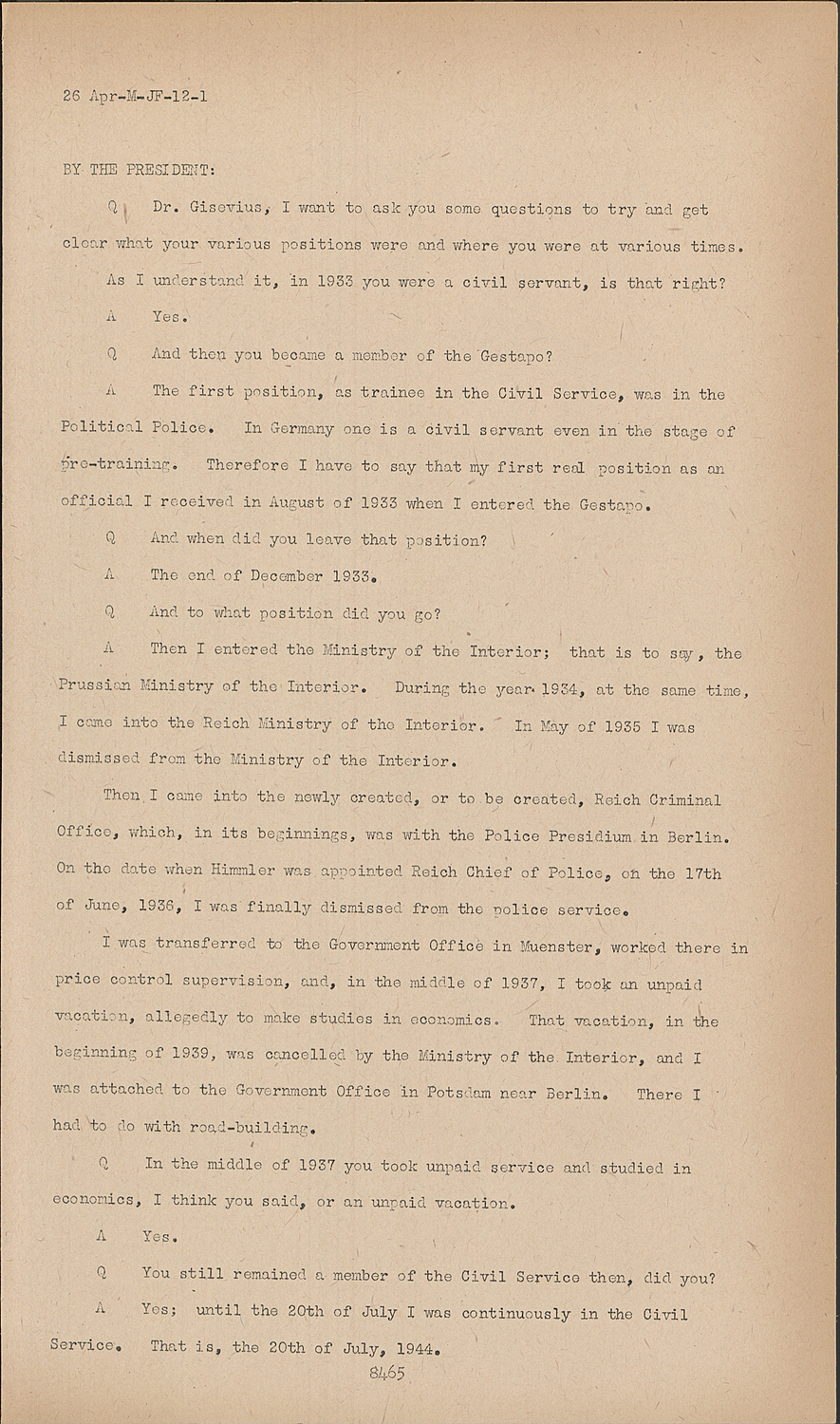
BY THE PRESIDENT:
QDr. Gisevius, I want to ask you some questions to try and get clear what your various positions were and where you were at various times.
As I understand it, in 1933 you were a civil servant, is that right?
AYes.
QAnd then you became a member of the Gestapo?
AThe first position, as trainee in the Civil Service, was in the Political Police. In Germany one is a civil servant even in the stage of pre-training. Therefore I have to say that my first real position as an official I received in August of 1933 when I entered the Gestapo.
QAnd when did you leave that position?
AThe end of December 1933.
QAnd to what position did you go?
AThen I entered the Ministry of the Interior; that is to say, the Prussian Ministry of the Interior. During the year 1934, at the same time, I came into the Reich Ministry of the Interior. In May of 1935 I was dismissed from the Ministry of the Interior.
Then I came into the newly created, or to be created, Reich Criminal Office, which, in its beginnings, was with the Police Presidium in Berlin. On the date when Himmler was appointed Reich Chief of Police, on the 17th of June, 1936, I was finally dismissed from the police service.
I was transferred to the Government Office in Muenster, worked there in price control supervision, and, in the middle of 1937, I took an unpaid vacation, allegedly to make studies in economics. That vacation, in the beginning of 1939, was cancelled by the Ministry of the Interior, and I was attached to the Government Office in Potsdam near Berlin. There I had to do with road-building.
QIn the middle of 1937 you took unpaid service and studied in economics, I think you said, or an unpaid vacation.
AYes.
QYou still remained a member of the Civil Service then, did you?
AYes; until the 20th of July I was continuously in the Civil Service. That is, the 20th of July, 1944.
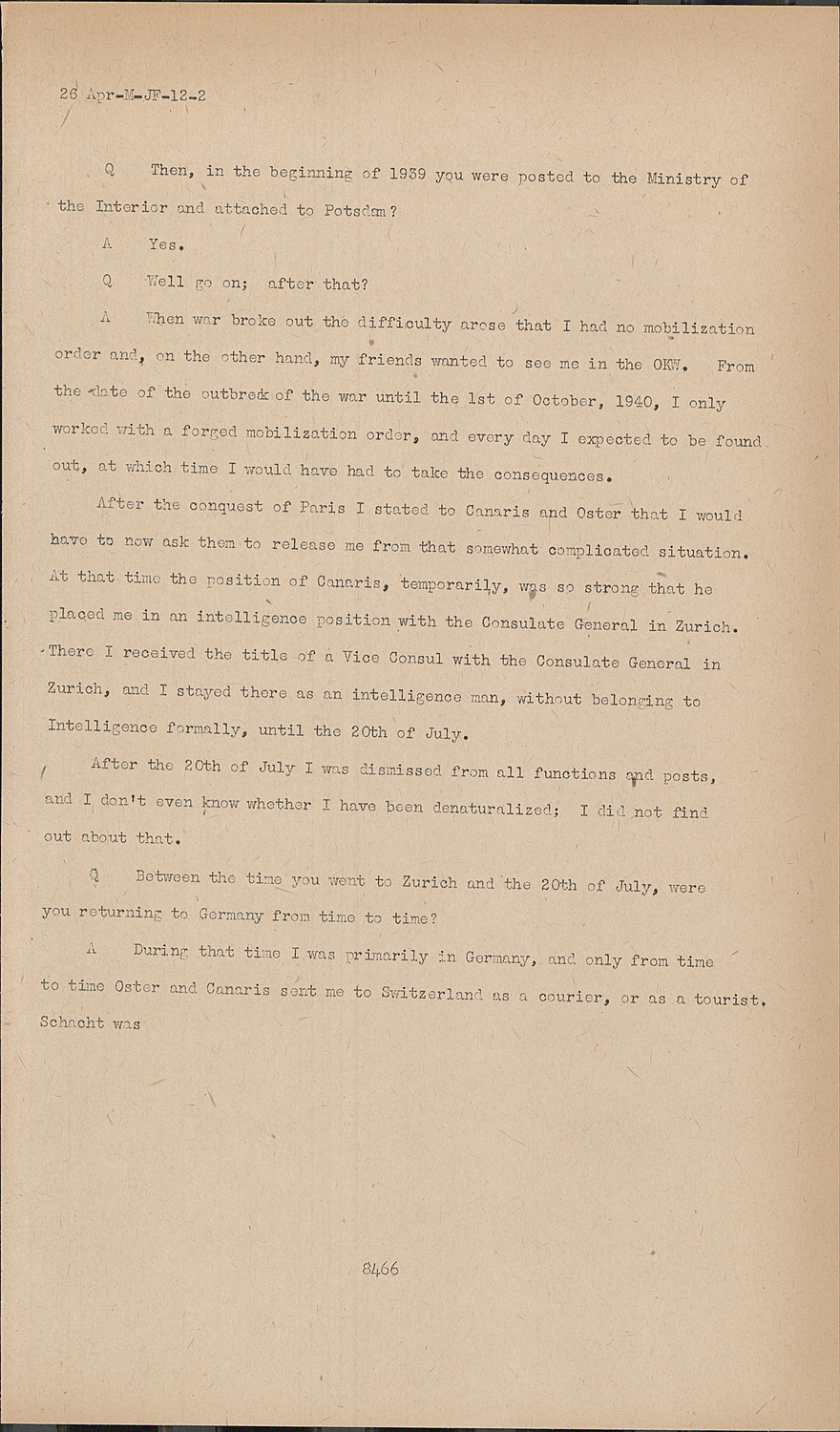
Q Then, in the beginning of 1939 you were posted to the Ministry of the Interior and attached to Potsdam?
AYes.
QWell go on; after that?
AWhen war broke out the difficulty arose that I had no mobilization order and, on the other hand, my friends wanted to see me in the OKW. From the date of the outbreak of the war until the 1st of October, 1940, I only worked with a forged mobilization order, and every day I expected to be found out, at which time I would have had to take the consequences.
After the conquest of Paris I stated to Canaris and Oster that I would have to now ask them to release me from that somewhat complicated situation. At that time the position of Canaris, temporarily, was so strong that he placed me in an intelligence position with the Consulate General in Zurich. There I received the title of a Vice Consul with the Consulate General in Zurich, and I stayed there as an intelligence man, without belonging to Intelligence formally, until the 20th of July.
After the 20th of July I was dismissed from all functions and posts, and I don't even know whether I have been denaturalized; I did not find out about that.
QBetween the time you went to Zurich and the 20th of July, were you returning to Germany from time to time?
ADuring that time I was primarily in Germany, and only from time to time Oster and Canaris sent me to Switzerland as a courier, or as a tourist. Schacht was quite helpful at that time in getting a Swiss visa, through the Swiss Legation.
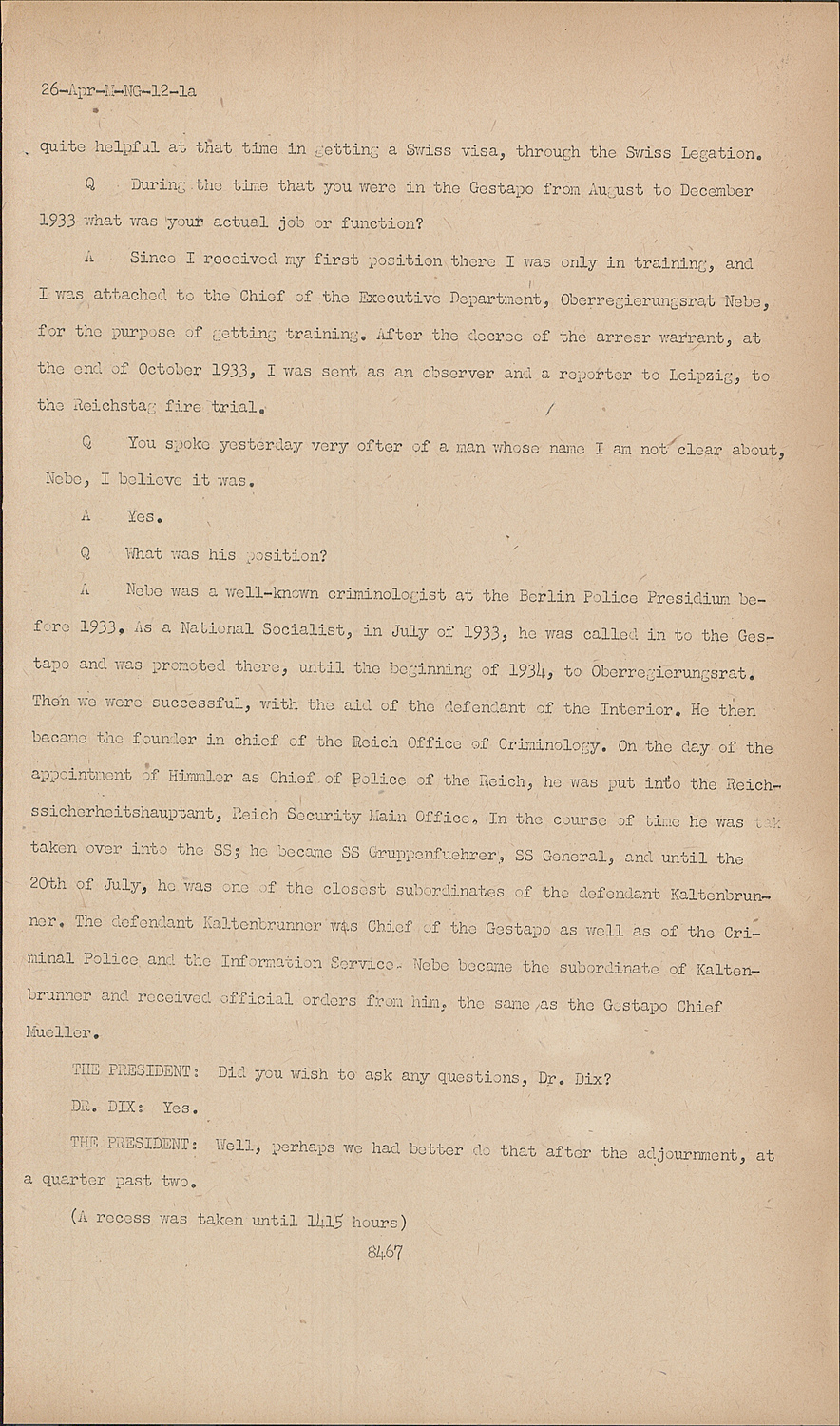
QDuring the time that you were in the Gestapo from August to December 1933 what was your actual job or function?
ASince I received my first position there I was only in training, and I was attached to the Chief of the Executive Department, Oberregierungsrat Nebe, for the purpose of getting training. After the decree of the arresr warrant, at the end of October 1933, I was sent as an observer and a reporter to Leipzig, to the Reichstag fire trial.
QYou spoke yesterday very ofter of a man whose name I am not clear about, Nebe, I believe it was.
AYes.
QWhat was his position?
ANebe was a well-known criminologist at the Berlin police Presidium before 1933. As a National Socialist, in July of 1933, he was called in to the Gestapo and was promoted there, until the beginning of 1934, to Oberregierungsrat. Then we were successful, with the aid of the defendant of the Interior. He then became the founder in chief of the Reich Office of Criminology. On the day of the appointment of Himmler as Chief of police of the Reich, he was put into the Reichssicherheitshauptamt, Reich Security Main Office. In the course of time he was ask taken over into the SS; he became SS Gruppenfuehrer, SS General, and until the 20th of July, he was one of the closest subordinates of the defendant Kaltenbrunner. The defendant Kaltenbrunner was Chief of the Gestapo as well as of the Criminal Police and the Information Service. Nebe became the subordinate of Kaltenbrunner and received official orders from him, the same as the Gestapo Chief Mueller.
THE PRESIDENT:Did you wish to ask any questions, Dr. Dix?
DR. DIX:Yes.
THE PRESIDENT:Well, perhaps we had better do that after the adjournment, at a quarter past two.
(A recess was taken until 1415 hours)
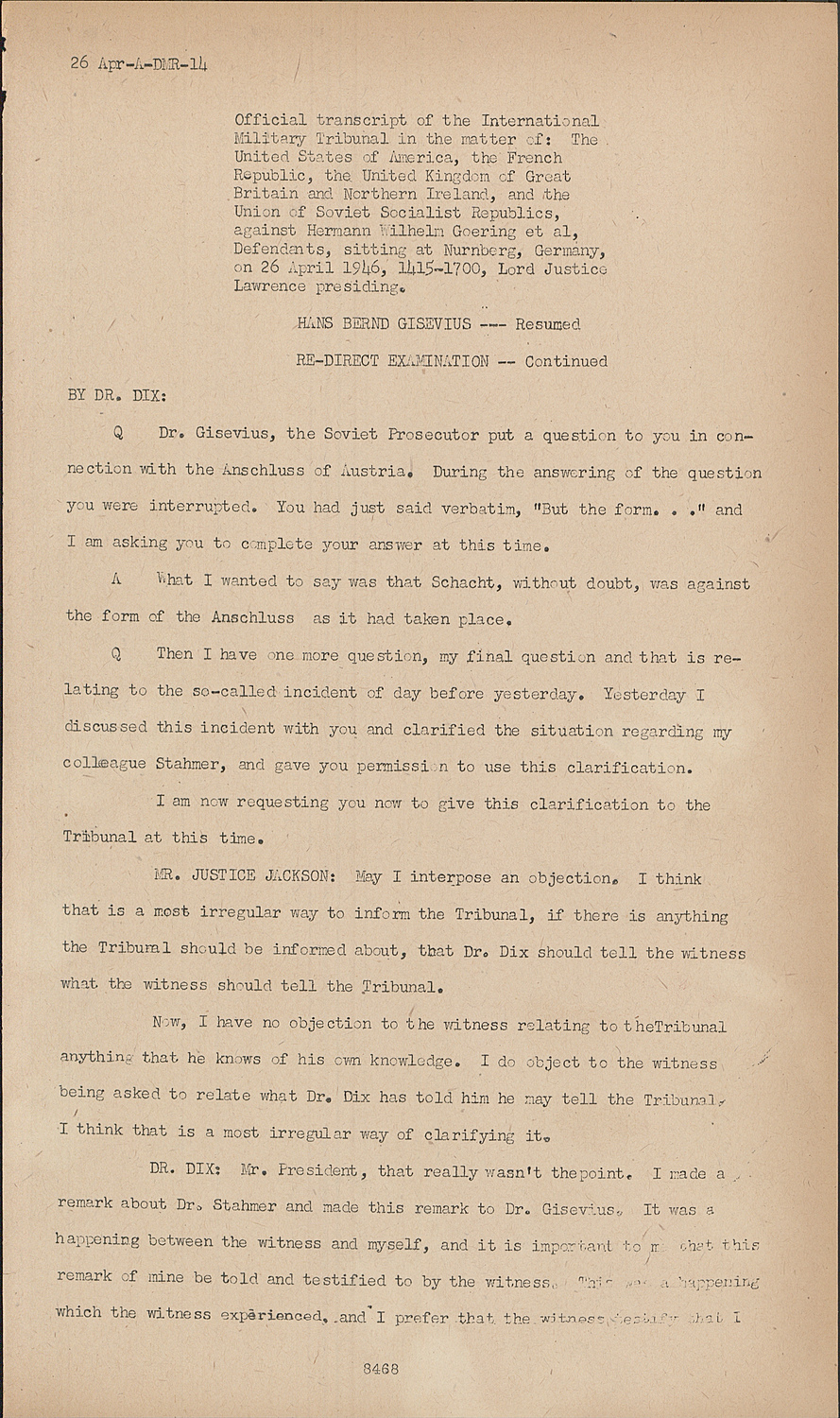
Official transcript of the International Military Tribunal in the matter of:
The United States of America, the French Republic, the United Kingdom of Great Britain and Northern Ireland, and the Union of Soviet Socialist Republics, against Hermann Wilhelm Goering et al, Defendants, sitting at Nurnberg, Germany, on 26 April 1946, 1415-1700, Lord Justice Lawrence presiding.
HANS BERND GISEVIUS --- Resumed RE-DIRECT EXAMINATION -- Continued BY DR. DIX:
QDr. Gisevius, the Soviet Prosecutor put a question to you in connection with the Anschluss of Austria. During the answering of the question you were interrupted. You had just said verbatim, "But the form. . ." and I am asking you to complete your answer at this time.
AWhat I wanted to say was that Schacht, without doubt, was against the form of the Anschluss as it had taken place.
QThen I have one more question, my final question and that is relating to the so-called incident of day before yesterday. Yesterday I discussed this incident with you and clarified the situation regarding my colleague Stahmer, and gave you permission to use this clarification.
I am now requesting you now to give this clarification to the Tribunal at this time.
MR. JUSTICE JACKSON:May I interpose an objection. I think that is a most irregular way to inform the Tribunal, if there is anything the Tribunal should be informed about, that Dr. Dix should tell the witness what the witness should tell the Tribunal.
Now, I have no objection to the witness relating to the Tribunal anything that he knows of his own knowledge. I do object to the witness being asked to relate what Dr. Dix has told him he may tell the Tribunal I think that is a most irregular way of clarifying it.
DR. DIX:Mr. President, that really wasn't the point. I made a remark about Dr. Stahmer and made this remark to Dr. Gisevius. It was a happening between the witness and myself, and it is important to me that this remark of mine be told and testified to by the witness. This is a happening which the witness experienced, and I prefer that the witness testify that I made this explanation, and I cannot see anything irregular about this pro-cedure, and I ask for a decision by the Tribunal.